15,000,000,000 (15 billion) years ago The creation of the
universe according to
Physical Sciences
information gateway (psigate) (Launched Manchester September
2001. - last surviving Internet Archive traced is 26.9.2006, but see
UK Web Archive)
13,800,000,000 (13.8 billion) years ago The creation of the
universe according to present estimates of "big bang" -
"Stephen Hawkings and others... estimate between 18 and 11 billion
with
13.8 being the closest estimation".
4,540,000,000 (4.54 billion) years ago Formation of planet Earth
- Usher's date
was 4,004BC - flood
geologists have suggested about
8,000BC
4,540,000,000 to
541,000,000 years ago
Pre-Cambrian - Before even old Welsh
rocks. The earliest 4.06 billion years (4,060,000,000?) of Earth's history.
88% of geologic time. See
Wikipedia. Followed by
Cambrian -
Ordovician -
Silurian
Azoic: Having no trace of life or containing no organic remains.
(Oxford Engish Dictionary)
(Wikipedia)
3,700,000,000 years ago Did life first come into being in a
primordial soup of compounds? In 1924
Alexander Ivanovich Oparin argued that it did. (See
biological
bases -
circumstances -
primeval swamp).
Archeozoic: end of Azoic to 2,500,000,000 years ago: The era
of the
earliest living beings on earth.
"More than 3.5 billion years ago, small single-celled organisms acquired
the capacity to photosynthesize" "Plants were restricted to the aquatic
world until three billion years later,
at the end of the Ordovician period"
(Miguasha
"plant world")
|
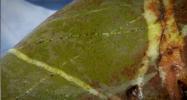
BBC 4 picture cyanobacteria - blue
green bacteria - on a stone from a rock pool.
|
|
Wikipedia says: Putative fossils are reported from
3,460,000,000 years ago. The reference here is to possible
cyanobacteria from the Warrawoona Group in Western Australia. Also dated
3,465,000,000 years ago.
(Wikipedia)
|
Wikipedia says: the first uncontroversial evidence for life is
found 2,700,000,000 years ago. The reference relates to sulphate and
iron reduction as early forms of microbial respiration. It is suggested
that analysis of sedimentary pyrite from the Belingwe sedimentary basin in
Zimbabwe may provide evidence for bacterial reduction at this date.
2,500,000,000 to 542,000,000 years
ago The Proterozoic Eon: the most recent part of the Precambrian
Supereon.
(Wikipedia)
Proterozoic: Age of
animalculae,
jelly fish,
green scum and the
like. In water "there was probably as rich and abundant and active a
life of
infusoria
and the like as one finds in a drop of ditchwater today".
Life in the
early paleozoic had a "general resemblance", to
ditchwater life on a larger scale.
(H.G. Wells)
starting about 2.500,000,000
years ago, sedimentary rocks affected by higher amounts of
oxygen in the atmosphere, appear red, as
though rusted.
Mesoproterozoic from 1,600,000,000 to 1,000,000,000 years ago.
(Wikipedia). May correspond to
Schenk's Upper Pre-Cambrian
The amoeba has no hard part, but some single cell organisms produce
microscopic skeletons or shells. Foraminifer's calcite creates limestone
and chalk. The silica of Radiolaria forms chert. Particular importance
attaches to
Phytoplankton, such as diatoms, which
photosynthesise much of the worlds oxygen and are the microscopic plants
at the base of the oceanic food chain.

|
Schenk, p.12: Seaweed, Algae-colonies,
Flagellate algae.
|
about 1.300,000,000 years ago
early seaweed formed. (BBC
4). Molecular clock methods indicate that red and
green algae arose around 1,500,000,000 years ago, and the secondary
symbiosis that eventually led to the
chromists occurred around
1,300,000,000 years ago during the late Mesoproterzoic era, after the
earth's transition to a more highly oxygenated atmosphere with an
ozone screen. Fossil evidence is consistent with these gene-based
estimates.
Schiel and Foster 2015, chapter one
"Introduction to Giant Kelp forests worldwide"

|
Wikipedia says: cells with nuclei certainly existed by
1,200,000,000 years ago. The reference relates to Multicellular
filaments from arctic Canada identified as a red algae Bangiomorpha
pubescens. "In all but detail, this fossil is indistinguishable from
modern Bangia"
(Butterfield 2000), which consists
of
hair-like filament of dark red cells which dry as dark skeins flat against
inter-tidal rocks. See
seaweeds of Alaska
|
|
Schenk, p.12: Sponges, Seaweed,
Giant seaweed, Coral.
|

|
Neoproterozoic from 1,000,000,000 to 541,000,000 years ago.
(Wikipedia)
Cryogenian Period from about 720,000,000 to 635,000,000 years ago
Cryo (cold) and Genesis (birth). - It was cold.
(Wikipedia)
about 700,000,000 years ago Fossils
of multicellular organisms. When oxygen levels
became high enough, a powerful ozone
screen started to form in the upper atmosphere.
(Stephen J. Mojzsis). The only fossils from
all but the last 100 million years or so of Precambrian time represent
single-celled life forms (541,000,000 plus 100,000,000 = 541,000,000 years
ago)
Summary of the life on earth
Ediacaran Period from about 635,000,000 to 542,000,000 years ago
Name reflects
Ediacaran biota.
(Wikipedia).
Wikipedia says: It took almost 4,000,000,000 years from the
formation of the Earth for the Ediacaran fossils to first
appear,
655,000,000 years ago.
"The Record of the Rocks... begins in the midst of the game... The curtain
rises on a drama in the sea that has already begun, and has been going on
for some time".
(H.G. Wells)
600,000,000 years ago First traceable
fossils dated to this time. (psigate) [Edgeworth David (1928 and before)
analysed pre-Cambrian rocks in Australia and found traces of micro-
biological material] - See also
primordial soup -
Cambrian -
Old Red Sandstone -
seed ferns -
hominid -
Piltdown geology -
Noah -
word and theory
Also page 15 "Inhabitants of the pre-Cambrian sea: Algae, flagellate algae,
volvox algae, sponges, flat worms,
brachiopoda,
echinoderms and molluscs.
All plant and animal life was present only in the oceans."
The soft bodies of worms would not have been preserved as fossils - See
Darwin on worms - but traces of (sea) worms are found in
Cambrian rocks.
Giovanni Arduino (1759) divided geologic time into
Primary,
Secondary, and
Tertiary. Jules Desnoyers (1829) added the term
Quaternary.
GeoWhen Database suggests the Primary and
Secondary are rough analogs of the Paleozoic and
Mesozoic.
and these more modern terms have taken their place. By contrast, the term
"Tertiary" has survived and is still in common use today.
Paleozoic (ancient life) Era includes the
Cambrian,
Ordovician,
Silurian,
Devonian,
Carboniferous, and
Permian. During most of
the Paleozoic, continents like Gondwana and Laurentia were coalescing to
become
Pangea
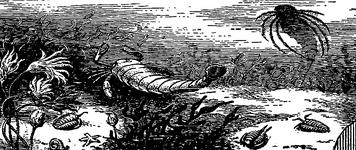 Rocks (and fossils) of the Welsh periods (Cambrian - Ordovician - Silurian)
are similar: hard sandstones, shales, slates, grits and (Ordovician and
Silurian) limestones
Rocks (and fossils) of the Welsh periods (Cambrian - Ordovician - Silurian)
are similar: hard sandstones, shales, slates, grits and (Ordovician and
Silurian) limestones
|
Early Paleozoic: Before the appearance of any vertebrate animals. Age of
sea scorpions and trilobites.
(H.G. Wells)
Now thought there were early vertebrates (without jaws) in the Cambrian.
Jawed vertebrates became common in the
Devonian.
(Wikipedia)
|
505,000,000 years ago
Fossil jellyfish
|
|
In
1849
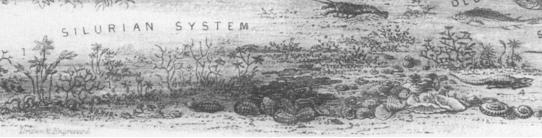
one could buy a hand coloured engraving called "The
Antidiluvian
World. Illustrations of the animals, reptiles, birds, fishes, trees, plants
etc which existed in different epochs prior to the
creation of man, and
whose remains are found entombed in the various
strata. From the
discoveries of
Buckland,
Cuvier,
Mantell,
Lyell
etc", Drawn and engraved by John Emslie. London, Published by James
Reynolds 174 Strand, 20t.10.1849. This showed life
beginning with the Silurian system, which it described as "a marine deposit
of vast extent containing abundance of marine organic
remains. 1. Encrinites and marine plants 2.
Trilobites 3. Marine
shells. 4
Lizards"
[too early]. In 1835, William Kirby in On Power of God in
Creation of
Animals 2. xiii. 10 referred to "plant-like animals .. which, from a
supposed resemblance..to the blossom of a liliaceous plant have been
denominated Encrinites".
|
485,000,000 to 444,000,000 years ago The
Ordovician
period.
(Ordovices were a Welsh tribe).
Nautiloids. Fossils include earliest fish, but of types very different
from modern ones.
Deposits that made Westmorland Green slate formed around 450 million years
ago. Grains being deposited in water led to patterning. About 50 million
years later, the material was altered by heat and pressure (metamorphosed)
to slate, during mountain-building.
(Kirk and Cook)
470,000,000 years ago mid-Ordovivian
470,000,000 years ago First evidence of plants on land.
Cryptospores - possible affinity with today's liverworts.
(BBC News 18.9.2003).
But see
Wikipedia: evolutionary history of plants. "At the end of the
Ordovician period... signs of the "tentative presence" of plants on land.
After many more millions of years, they resembled patches of moss a few
centimeters high. But things changed in the
Devonian Period.
(Miguasha plants)
Richard Cowen's
Chapter Eight: Leaving the Water -
images
-
curent page
470,000,000 to 248,000,000 years ago Eurypterids, otherwise known
as sea scorpions.
(Wikipedia)
Late Ordovician survivals and
extinctions: There were no land animals and extinctions were
confined to water life. There were two distinct extinctions roughly a
million years apart. The first of these began about 443 million years ago.
Together, these extinctions may have removed about 85 percent of species of
marine animals. All of the major animal groups of the Ordovician oceans
survived, including trilobites,
brachiopods, corals,
crinoids and
graptolites, but each lost important members. Widespread families of
trilobites disappeared and graptolites came close to total extinction.
(Sam Noble Oklahoma Museum of Natural
History).
|
The Ordovician/Silurian boundary was agreed in 1985 at
the base of the Parakidograptus acuminatus Biozone (a group of concurrent
graptolite species) in a
boundary stratotype at
Charles Lapworth's
[Wikipedia]
classic locality of Dob's Linn
[Wikipedia]
in
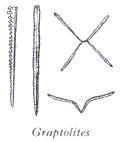
the Southern Uplands of Scotland. Graptolites (rock writing) are thought to
be horny skeletons of small creatures. Some are pictured here from the
Observers Book of
Geology, Their many different forms have enabled
beds of ancient rock to be identified.
|
The earliest graptolites appear in
Cambrian rocks and the last in
Carboniferous
443,000,000 to 416,000,000 years ago Silurian period.
(Silures a Welsh tribe). Sea Scorpions. Fossils include earliest land
animals and forerunners of ammonites. See
Pneumodesmus.
"When I view all beings not as special creations, but as the
lineal descendants of some few beings which lived long before the first bed
of the Silurian system was deposited, they seem to me to become ennobled.
Judging from the past we may safely infer that not one living species will
transmit its unaltered likeness to distant futurity." (Charles
Darwin)
Taylor's "Story of a piece of limestone" concerns only
Silurian limestone.
Later Paleozoic: Age of
fishes,
amphibia and
swamp forests
.
(H.G. Wells)
|
From primal swamp to speaking humans: Ernst Haeckel said (1903) that
the Pithecoiden (monkey) theory of
human evolution requires tracing our animal ancestors before monkeys.
He began to do this
in 1866 in the General
Morphology.
Silurian
fish are followed by
Devonian
Lurchfische,"
[lungfish] "the
Carboniferous
amphibians, the
Permian
reptiles and in the
Mesozoic the first
mammals. Mammals appear again in the Triassic as monotremes [egg layers], then in the
Jurassic as
marsupials [nurturing babies in pouches], and the
Cretaceous
The oldest placental mammals, in the
Tertiary
period
(Eocene), include our lowest primate ancestors, including
lemurs, the first catarrhines the Monkey (Cynopitheken), and later the
great apes (anthropomorphic). From a branch of the apes,
speechless
ape-man
(Pithecanthropus alalus) arose in the
Pliocene, leading,
finally, to the speaking person.
(source)
|
The
Old Red Sandstone [see
Wikipedia]
of Scotland is very thick and contains many
fossils,
particularly of the Devonian fishes.
Lungfish first appeared in the Early
Devonian. -
Taylor's "Story of a
piece of sandstone" -
Miquasha (Canada): "The Devonian is known as
the "Age
of Fishes" in reference to their evolutionary explosion during this
period". - The earliest rock in the
1854 Sydenham display is Old Red Sandstone,
but it does not feature animal life until the New Red Sandstone, treating
the
Devonian
and
Carboniferous
as ages of rocks and economic minerals.
|
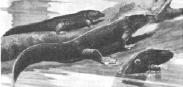
408,000,000 to 359.200,000 years ago
Devonian period. Primitive fish. Some life left the water.
Primeval swamp?
Ichthyostega
(Wikipedia) Greek ikhthus: fish - stegi: roof
|
Labyrinthodontia (Greek, "maze-toothed") is an extinct amphibian
subclass, of which the order Ichthyostegalia is the earliset example, and
the earliest landliving vertebrates.
(Wikipedia) -
G. Paselk
pictures four legged "protoamphibians", Acanthostega and
Icthyostega,
lungfish
(Dipterus) and a placoderm (Bothriolepis), with
early trees, Archeaosigillaria [see Devonian Times on
lycopsids]
and
Archaeopteris
in the background.
Amphibian: an animal living in both water and on land.
Reptile originally meant
a creeping animal,
and included amphibians. The
1854 Sydenham display is based on
islands in
water from which
life emerges (see
photo by Warren), which is relevant both to
the
biblical origin of life and to evolutionary theories. The
Sydenham display also links water to the
steam which drove the industrial revolution.
about 419,2000,000 to 393,300,000 years ago Early Devonian
The vegetation of the early Devonian consisted primarily of small plants,
the tallest being only a meter tall. By the end of the Devonian,
ferns,
horsetails and seed plants had also appeared, producing the first trees and
the first forests. University of California Museum of
Paleontology. See University of Aberdeen on
Rhynie Chert
about 393,300,000 to 382,700,000 years ago Middle Devonian
Ferns first appear in the
fossil record
382,700,000 to 358,900,000 years ago Late Devonian
382,700,000 to 372.200,000 years ago Frasnian age of the
Late Devonian
Late Devonian So called
"seed ferns". Wikipedia:
Pteridospermatophyta.
See
Marie Stopes
Late Devonian forests of large plants left many fossils in the
Old Red Sandstone,
mostly resembling
ferns
[Wikipedia], club-mosses
[Wikipedia]
and horsetails
[Wikipedia], but the
size of trees. These forests of flowerless trees, but with greater variety,
flourished even more in the
Carboniferous period. Similar plants lived throughout the rest
of the Paleozoic and well into the
Mesozoic.
(Observers
Book of Geology and Wikipedia
Timeline of plant evolution
The
coastal cliffs at Miguasha, Quebec, Canada, are Upper Devonian
strata of alternating layers of sandstone and shale deposited between
375,000,000 and 350,000,000 years ago. OR
(source)
The
Escuminac
formation
is now attributed to the middle part of the
Frasnian
Age. This corresponds to an approximate age of 380,000,000
years ago.
|
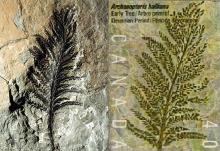
Archaeopteris was the main component of the earliest forests
until its extinction around the Devonian/Carboniferous boundary.
Archaeopteris grew up to seven metres (23 feet) tall, with a
trunk of lignin and cellulose and branches supporting fern-like fronds
extending horizontally to capture sunlight.
|
The
first picture shows a large frond from Archaeopteris halliana in the
Escuminac Formation in the Miguasha Museum. The Canadian stamp
was issued
in 1991.
"The earth's atmosphere was changing rapidly, going from perhaps 10 percent
to 1 percent CO2 and from about 5 percent to 20 percent oxygen over a 50-
million year period in the (late) Devonian period. All plants were
responsible for the transformation, but Archaeopteris was important because
it made up 90 percent of the forests during the last 15 million years when
these changes accelerated" ... "It was the first plant to produce an
extensive root system, so had a profound impact on soil chemistry".
(Science Daily summary "Archaeopteris is the earliest
known modern tree," by Brigitte Meyer-Berthaud, Stephen E. Scheckler, and
Jobst Wendt. Nature 22.4.1999.
See Devonian Times
archaeopteris and plants and soils and
"The Tree That Changed the World" by John
Perlin, Pacific Standard 29.3.2010.
|
Old Red Sandstone
of Kiltorean, County Kilkenny, Ireland.
Taylor 1873 writes of fine-grained greenish sandstones
deposited in freshwater in which land plant fossils are well preserved.
"Among the most attractive of these" tree-fern once called
Cyelopteris (Round-leaved Fern), re named Palasopteris
Hibernicus (Primitive Irish Fern). This was later renamed
Archaeopteris Hibernicus. It was the "monarch of the primeval
forests" whose "graceful fronds bent over the clear waters of a lake".
372,200,000 to 358,900 years ago Famennian age of the
Late Devonian
359,000,000 years ago End of the Devonian period - Start of the
Carboniferous period: In latter half of the Devonian, there are three
important
extinctions
separated by about 10 million years. About 375 million years ago, towards
the end of a time interval called the Givetian. The end-Frasnian extinction
(the largest) about 375 million years ago. The about 365 million years ago
during the Famennian.
The end-Frasnian extinction was most pronounced in tropical environments,
particularly in the reefs of the shallow seas. Reef building sponges called
stromatoporoids and corals suffered losses and stromatoporoids finally
disappeared in the third extinction near the end of the Devonian.
Brachiopods
associated with reefs also became extinct. Groups of trilobites
disappeared at each of the three extinctions and very few survived into the
following Carboniferous Period.
(Sam Noble
Oklahoma Museum of Natural History)
359.200,000 to 299,000,000 years ago Carboniferous
period.
By carboniferous [carbon bearing] soils, Richard Kirwan in 1799 meant the
"various sorts of earth or stone among or under which coal is usually
found". William Daniel Conybeare and William Phillips (1822, page vii)
proposed to consider all rocks in an ascending order with a group including
"not only the great coal-deposit itself, but those of the limestone and
sandstone also on which it reposes" as the "medial" [middle] order. They
said "the epithet carboniferous is of obvious application to this series".
Henry Shaler Williams (1891) proposed Pennine System as the name
for the Carboniferous. This was not adopted, but his division into
Mississippian, for the
Early Carboniferous and Pennsylvanian,
for
the
Late Carboniferous,
was (in the USA).
Giant insects. [Large]
Brachiopods.
Taylor's "Story of a piece of coal" focuses on coal formation,
but includes a section on the carboniferous limestone. It lists (but does
not discuss) the intervening millstone grit.
It mentions the following periods to indicate how long ago coal was formed:
Carboniferous followed by
Permian,
Triassic,
Liassic,
Oolitic,
Cretaceous (or chalk),
Eocene,
Miocene,
Pliocene
and
Pleistocene
... Illustrations of a section of Calamite (tree-like
horsetail)
[Wikipedia] - Branches, and fruit
(Lepidostrobus) of Lepidodendron (scale-trees)
[Wikipedia] - Bark of Sigillaria Groe seri
[Wikipedia] - "Fossil Fern
(Neuropteris)" (a
seed fern)
[Wikipedia] - Portion of Fossil Tree Fern
(Pecopteris arborescens) on Coal Shale
[Wikipedia] - Annularia. A Fossil Plant
allied to the Calamites -
[Wikipedia] -
358,900,000 to 323.200,000 years ago Early Carboniferous or
Mississippian
(USA) - noted for limestones (calcite). See
Late
Carboniferous
Palaeos -
Humboldt
|
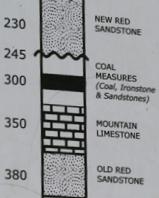
363,000,000 to 325,000,000 years ago: Deposition of mountain or
carboniferous limestones of England and Wales.
The
1854 Sydenham display shows the carboniferous
deposits sandwiched between the
Old Red Sandstone
and the
New Red Sandstone.
Rocks deposited during the Carboniferous period (350 - 290 million years
ago) underlie almost all of the Peak National Park and probably two thirds
of the remainder of Derbyshire.
|
359,200,000 - 326,400,000 years ago Dinantian series or epoch from the
Lower Carboniferous system in Europe
326,400,000 to 313,400,000 years ago Namurian stage in the regional
stratigraphy of northwest Europe
|
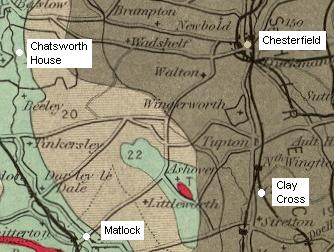
Chatsworth House - Where
Paxton built a
greenhouse: Carboniferous limestone (green)
Clay Cross: Hill Tupton
Rock - Sandstone (not marked)
over Pennine Lower Coal Measures (brown).
Matlock: Carboniferous
limestone (green), near to millstone grit (buff).
The
limestone continues under the grit and the
coal measures.
|
Mawe 1802 (sections 2 and
3), followed by
Ward (1818) (page 10), says the order
to the strata explored by the Derbyshire miners is: Argillaceous (clayey)
Grit, in which
coal
and
iron
are found - Silicious
Grit, providing stone for building and millstones - Shale - then lime-stone
and toadstone alternately. The veins of metallic ores appeared in the
limestone.
Three strata of toadstone had been found, and the limestone under the
third was as far as miners had reached. (About 300 yards underground). The
Bonsall map project describes the
"shallow tropical sea surrounded by coral reefs" in which the limestones
were laid down and how "subterranean volcanoes erupted spasmodically
through the sea floor, covering the limestones with ash and lava" which
formed the toadstone.
|
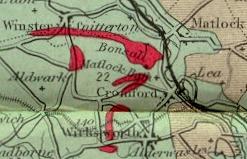
Igneous intrusions in the limestone (red: basalt, greenstone?) are the
source of minerals, particularly
lead. Bonsall area igneous rocks
includes a stone comprising basalt and dolerite, locally
referred to as toadstones.
A complex of mine and natural cavern near
Matlock Bath
inspired the mine and cavern feature in the limestone at the
1854 Sydenham display
|
Rutland
and
Great Masson
(now part of
Heights of Abraham) are well known public caverns in Matlock
Bath. Others are, or were, Victoria -
Devonshire
-
Flour Spar
- Speedwell -
Cumberland
- Fern -
High Tor. (See
History, Topography, and Directory of Derbyshire
offline
by Bulmer and Company 1895 page 428 following, and Ward Lock's Matlock
and Dovedale pages 11-16 -
Derbyshire Cave Association Register -
offline Masson Cavern complex)
[See Ann Andrews
Lead Mining in Matlock and Matlock Bath -
Peak District Mines
Historical Society - The most common source of
lead is
Galena (lead sulfide) formed as pockets or veins in carbonate rock into
which the mineral bearing fluid rock has intruded. Galena can contain minor
amounts of antimony, arsenic, bismuth, cadmium, copper, silver, and zinc
See
Lead ore and mines.
Water flowing through limestone is responsible for creating its natural
caves and also for their features of dripstone, stalactites
(water icicles)
and stalagmites. Encountering impermeable strata (such as toadstone) it
forms underground lakes in the limestone which overflow to the surface as
natural springs (a resurgence). To reach lower layers, miners drained water
from their mines through artificial tunnels (sloughs), thus adding
artificial springs. The thermal (hot) springs come from water in the
Carboniferous Limestone in structural settings that allow
meteoric water (rainfall etc) to descend low enough for it to be heated by
the geothermal gradient (earth heat), and then return to
the surface without a significant fall in temperature. [See
1780].
The original natural thermal resurgences at Matlock
Bath were greatly
modified by mining activities, but according to a contributor to the
Mine Exploration Forum, all the springs at
Matlock Bath
seem to
originate from Bacon Rake or the Bonsall Fault in the Ball Eye area.
See Matlock Bath
and
Crystal Palace
The main Early Carboniferous plants were the Equisetales
(Horse-tails), Sphenophyllales (scrambling plants), Lycopodiales
(Club mosses),
Lepidodendrales (scale trees), Filicales
(Ferns), Medullosales (previously
included in the
"seed ferns", an artificial assemblage of a number of early
gymnosperm groups) and the Cordaitales. These continued to
dominate
throughout the Carboniferous period.
[Wikipedia]
323.200,000 to 298.900,000 years ago Late
Carboniferous
or
Pennsylvanian (USA) - noted for coal (fossilised carbon)
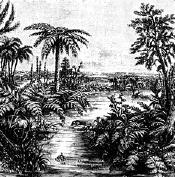
|
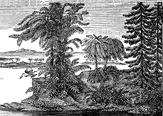
Plate 22 in
Observers Book of
Geology
includes a depiction by Eli
Marsden Wilson (1935) in the Natural History Museum, which it titles "A
primeval swamp of the chief coal-forming period". The picture used here
comes from Edwin J. Houston's The Elements of Physical Geography
Philadelphia 1891, which says "The continents during this age consisted
mainly of large, flat, marshy areas, covered with luxuriant vegetation."
|
Gymnosperms
[Wikipedia] originated in the late Carboniferous period,
replacing the lycopsid
[Wikipedia] rainforests of the tropical region. Taylor says
coniferous flora grew "abundantly" during the
Liassic.
Alfred Wegener
proposed that from the late
carboniferous, all continents were stuck together as one big
land mass, surrounded by just one ocean. (300,000,000 to
175,000,000 years ago)
We can see this in his diagrams
(below). Instead of giving the original continent a name, he uses German
composite words, beginning ur, that just mean original. Der
Urkontinent is
the original continent, which is surrounded by einen großen
Urozean
(a large original ocean). Der karbonischen Urkontinentalmasse is the
original continental mass in the carboniferous period. The
Urkontinent
was later called Pangea (all-
earth).
(See
Die Entstehung der Kontinente und
Ozeane 1920 -
Alfred Wegener - and
Wikipedia)
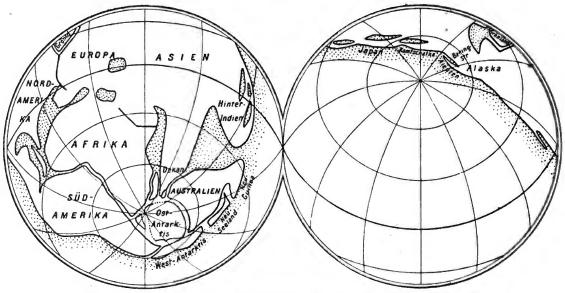
|
|
|
Lage der Kontinentalschollen für die Karbonzeit
(ohne Rücksicht auf Wasserbedeckung) -
Location of continental floes for the Carboniferous period (without
regard to water cover)
|
Pangea existed during the late
Paleozoic
and early Mesozoic
eras. It assembled about 300 million years ago, was intact until about
200 million years ago. and began to break apart about
175 million years ago.
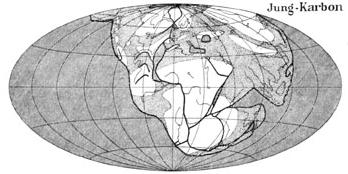
|
The 1922 and
1929 editions of Wegener's book contain a map of the world at
three time
periods: Late Carboniferous (Jung Karbon: this picture) -
Eocene - and
Quaternary.
|
The shading
shows land and sea at the time, with white land, dotted shallow lake and
shade: deep sea. Outlines of today's continents and some rivers ae
superimposed.
|
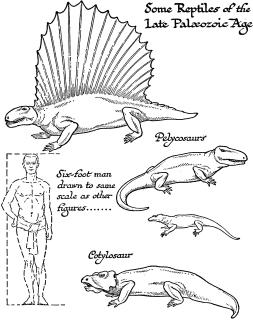
298,900,000 to 252,170,000 years ago Permian. Named after the Perm
district in Russia. In Britain includes dolomite limestones running south
from Durham.
(Observers Book of Geology [Wikipedia]
Primitive reptiles, such as
Pelycosaur and
Cotylosaur, illustrated in this
picture from H.G. Wells'
The Outline of History 1920. Emerged in the late
Carboniferous. Flourished in the Permian.
In Greek sauros is a lizard. From this came saurian - applied
to lizard-like creatures, including
crocodiles,
ichthyosaurus and
plesiosaurs in water,
pterosaurs in the air,
and dinosaurs like
megalosaurus and
brontosaurus
|
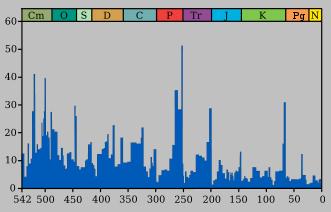
about 251,000,000 years ago: Permian extinction (worst
in history) wiped out more than 90 percent of all marine species and 70
percent of land animals.
(National Geographic) - See
Wikipedia
Permian-Triassic extinction
event
(Sam Noble
Oklahoma Museum of Natural History)
|
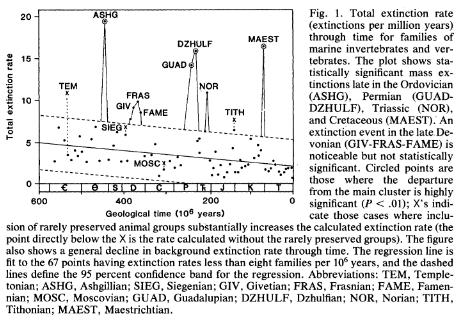
Graph attempting to represent extinction events based on replacement of
certain marine fossils.
.
(Wikimedia commons).
The Permian-Triassic (P - Tr) extinction is at the centre.
The table below is from D. M.
Raup and J. J. Sepkoski's "Mass extinctions in the marine fossil record",
published in Science in April 1982.
(online -
offline)
|
|
Raup and Sepkoski say that "five mass extinctions are clearly defined".
They occured "near the ends of geologic periods", which reflects
the fact that the periods were originally defined, in the first half of
the 19th century, using major changes in the fossils records.
|
Mesozoic (Middle) Era includes the
Triassic -
Jurassic - and
Cretaceous ages. It has
been associated with
conifers and
reptiles. In the
1854 Sydenham display, the Triassic
represents the
Primary part of geological history, the
Secondary starts with
the
Jurassic.
252,170,000 to 201,300,000 years ago Triassic (So named because it
has three divisons in Germany)
In England Bunter (bright coloured) Sandstone and above it Keuper Marl.
Forming north-west Midlands and including Cheshire salt beds. Formed in
desert conditions. Almost completely without fossils.
Taylor's "Story of a
piece of rock-salt". New Red Sandstone or Trias

|
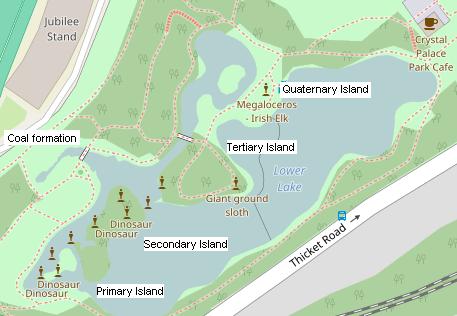
The Primary Island of the
1854 Sydenham
display is based on the New Red
Sandstone. It is here that its prehistoric animals begin. According to
Owen (1854) its animals are Batrachia,
[Wikipedia], from the Greek word for a frog, now
represented by "frogs, toads, and newts, or water-salamanders". [See
amphibians]
"But, at
the period of the deposition of the new red sandstone, in the present
counties of Warwick and Cheshire, the shores of the ancient sea, which were
then formed by that sandy deposit, were trodden by reptiles, having the
essential bony characters of the Batrachia, but combining these with other
bony characters of crocodiles and lizards ; and exhibiting both under a
bulk which is made manifest by the restoration of the largest known
species".
|
The models include
Labyrinthodon
salamandroides, the Salamander-like Labyrinthodon -
Labyrinthodon pachygnathus, the Thick-jawed Labyrinthodon - and
Dicynodon lacerticeps, or Lizard-headed Dicynodon. See Simon Jackson on
Labyrinthodon
and
Dicynodon
-
photo by Warren -
Wikipedia:
Dicynodon
|
237,000,000 to 228,000,000 years ago Carnian or Karnian stage
[Wikipedia]
at the
start of the Late Triassic epoch. Archosaurs
[Wikipedia]
, ancestors of birds and
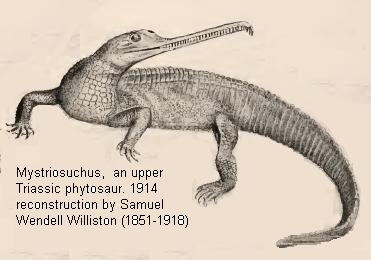
crocodiles, became the dominant faunas. Phytosaurs
[Wikipedia] first appear during the
Carnian. With many other large crurotarsan
[Wikipedia]
reptiles, they disappear at the
end of the Triassic
|
|
Picture (signed by the author), page 188 Water Reptiles of the Past and
Present by Samuel Wendell Williston.
Published 1914 by The University of Chicago Press in Chicago.
(Internet Archive -
offline). See
Teleosaurus.
|
230,000,000 years ago "The first
dinosaurs appeared about 230
million years ago and for the
next 160 million years, the Earth belonged to
these ancient
reptiles"
Natural History Museum.
208,000,000 years ago Asteroid impact in what is now Quebec,
Canada,
created crater 70 kilometres in diameter and wiped out many species
(psigate)
about 205,000,000 years ago First appearance of
Plesiosaurs in the latest
Triassic
Period (possibly Rhaetian stage),
They became especially common during the
Jurassic
Period and
continued until the the
end of the Cretaceous Period. They had a worldwide oceanic
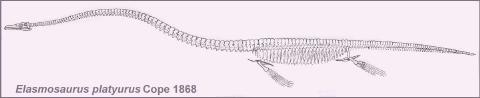
distribution. Elasmosaurus is a Plesiosaur from the
late Cretaceous.
"a flying reptile or dragon, called Pterodactyle, from the Greek
words pteron, a wing, and dactylos, a finger; because the wings are mainly
supported by the outer finger, enormously lengthened and of proportionate
strength, I which, nevertheless, answers to the little finger of the human
hand. The wings consisted of folds of skin, like the leather wings of the
bat; and the Pterodactyles were covered with scales, not with feathers: the
head, though somewhat resembling in shape that of a bird, and supported on
a long and slender neck, was provided with long jaws, armed with teeth."
(Owen 1854)
Late Triassic survivals and
extinctions (about 201 million years ago):
All major groups of marine invertebrates survived, but most suffered
losses.
Brachiopods, shelled
cephalopods, sponges and corals were
particularly hard hit. On land, casualties included the
phytosaurs.
(Sam Noble
Oklahoma Museum of Natural History)
201,300,000 to
145,000,000
years ago Jurassic. More dinosaurs.
Jurassic from the Jura Mountains on the borders of France and Switzerland.
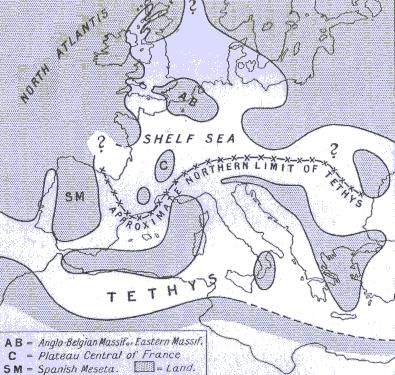
about 200,000,000 years ago After 100,000,000 years
the world still consisted of one continent,
Pangea, surrounded by one ocean.
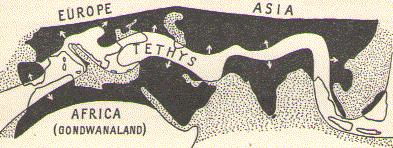
The picture shows the Tethys according to
Leopold Kober in 1922. Kober
thought it was a sea that ran in a syncline between the two great land
masses. Eduard Suess wrote in
Natural science: a monthly review of scientific progress
in 1893: "Modern geology permits us to follow the first outlines of the
history of a great ocean which once stretched across part of Eurasia. The
folded and crumpled deposits of this ocean stand forth to heaven in Thibet,
Himalaya, and the Alps. This ocean we designate by the name 'Tethys', after
the sister and consort of
Oceanus." (Oxford
English Dictionary)
Jurassic Park: a 1993 USA film in which re-created dinosaurs escape from a
theme park.
English Heritage's
A Building Stone Atlas of Dorset
-
(offline)
-
British Geological Survey begins with the Lias Group and
works upwards to
Heathstones in the
Lower Tertiary. The best known of the Dorset building stones are
the
Purbeck Marble
and
Portland limestones
Lower
Jurassic beds called Lias (quarrymen's layers) in
England
running between Whitby on the coats of Yorkshire and Lyme Regis in Dorset,
consisting of alternate beds of limestone and shale.
Owen 1854: The Lias
"forms the base of the oolite, or immediately underlies that division of
secondary rocks". But see
Wikipedia -
Gateway - Engineering Geology of British
Rocks and Soils - Lias Group 2012
online
offline
|
"Imagine well-watered and gently undulating lands teeming with plants and
animals, drained by large rivers turbid with mud and sand, and discharging
their burden of sediment, organic debris, and soluble salts into an open
but not very deep sea in which life abounded. Such is the picture of the
lias" (Wills 1929
p.134 and Figure 51 on p.126). For the figure, Wills references
[Émile] Haug - [Theodor] Arldt - and
[Dudley] Stamp
[Introduction to Stratigraphy 1923?]
|
|
Taylor's "What the
piece of jet had to say". "Where jet occurs: Lias beds". "As a fossil pitch
or gum, I am related to the peculiar
coniferous
flora which grew so
abundantly, although in comparatively few species, during the Liassic
epoch". (Taylor, p.129).
See
Lulworth forest
and
Hanover Point. Jet
was popular after
1861 when Queen Victoria wore it following the death of Prince
Albert.
[Wikipedia]
|
|

|
This drawing of a
Ichthyosaurus (fish lizard) is from J. E. Taylor's
Geological
Stories 1873)
|
199,600 to
140,000,000 years ago Fossil remains of Steneosaurus
[Wikipedia]
range
from the early
Jurassic
through the early
Cretaceous.
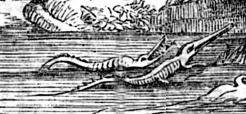
|
Steneosaurus
bollensis (previously Teleosaurus chapmani Konig) fossils are found
within Europe, including Germany, France and England. The
Whitby crocodiles
are regared as such Teleosaurs. See
Crocodile. Thalattosuchia
or sea crocodiles
[Wikipedia],
|
190,800,000 to 182,700,000 years ago
Pliensbachian in lower
Jurassic. Cleveland
ironstone. Jurassic
ironstone deposits
stretch in a broad arc from North East England through Lincolnshire,
Leicestershire, Northamptonshire, Rutland and into Oxfordshire. See
Wealden ironstone
182,700,000 to 174,100,000 years ago Toarcian in lower
Jurassic.
Includes
Alum shales of the Cleveland basin.
about 175,000,000 years ago Middle
Jurassic.
Lower Oolite: Inferior oolite - Fuller's earth - Great oolite and
Stonesfield slate - Cornbrash and forest marble.
- Middle Oolite: Oxford clay and Coral rag -
Upper Oolite: Portland stone and Kimmeridge clay
about 168,300,000 years ago to 166.100,000 years ago
Bathonian stage of the Middle Jurassic, named after Bath.
Lee's Quarry, Taynton Down, Oxfordshire is the type section for the Taynton
Limestone Formation. Part of the Great Oolite Group. Sites of four mines
around the village of Stonesfield Village, Oxfordshire,
are the type-locality of Stonesfield Slates, probably developed
at the base of the Taynton Formation.
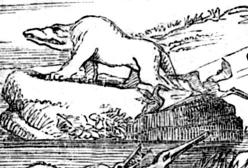
|
The Stonesfield "slates" are limestones,
originally deposited in a shallow sea.
William Buckland obtained fossil
bones from the quarries which later composed
Megalosaurus,
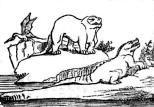
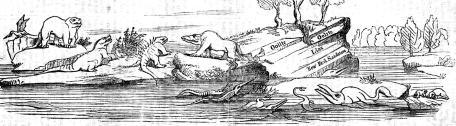
shown here dominating the Oolitic island at the centre of the
1854 Sydenham
display. To the right flew "Pterodactyles of the Ooolite",
Buckland's
Pterodactyle, found "pretty abundantly" at Stonesfield.
|
Pangea
began to rift from the
Tethys
Ocean in the east to the Pacific in the west.
One rift resulted in the North Atlantic Ocean.
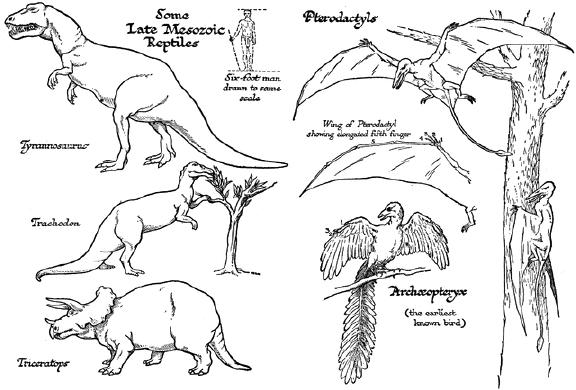
brontosaurus the thunder lizard -
stegosaurus covered lizard -
pterodactylus the winged finger -
camptosaurus flexible lizard -
diplodocus double beam -
tyrannosaurus tyrant lizard -
trachodon rough tooth -
triceratops three horned face -
archaeopteryx ancient wing -
Pictures from H.G. Wells'
The Outline of History 1920
about 161,000,000 million years ago Upper
Jurassic. Contains many
beds of limestone of the type called Oolite
Taylor's "What the piece of Purbeck Marble had to say". Includes
"flying
reptiles" and
"stonesfield slates".
between about 152,100,000 and 145,000,000 years ago The Tithonian
age, named after Tithonus, the lover who chased
Eos (dawn). It is the last
age of the
Jurassic, chasing the
Cretaceous. Includes
the the lithographic limestones of Solenhofen, Bavaria, which was used for
fine printing plates and which also preserves detailed fossils. Portland
stone (Dorset) underlies Purbeck Marble.
[Cambridgeshire] At the end of the Jurassic, about
145,000,000 years ago, the land was gradually sinking and a series of
clays were being deposited. See
Gault -
Upper Cretaceous -
Cambridge Greensands
145,500,000 to
66,000,000
years ago Cretaceous. Last
dinosaurs.
Although cretaceous means chalk, the lower cretaceous does not include
chalk. In Britain it comprises the Wealden Beds, the Lower Greensand and
the lower part of Blue Gault Clay.
Strata near Swanage, Dorset:
Portland
rock,
Purbeck
deposits,
Wealden, and
Cretaceous beds.
"Darwin's
"abominable mystery" asked how did the world's flora go from no
flowering plants at the beginning of the Cretaceous to modern ones by the
time of the
Dakota Group,
40 million years later".
around 140,000,000 to 125,000,000 years ago
Wealden Supergroup
|
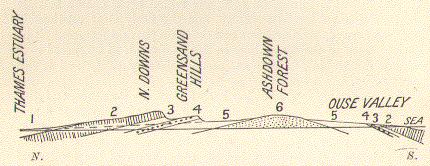
Generalised section across the Weal in south-east England, crossing the
escarpments (downs) in the north, but following the Ouse valley in the
south. From (Wills 1929
p.200). See
Portsmouth Symposium 2000 for relation to
Isle of Wight and Dorset. Also see
Bucks Geology Group
|
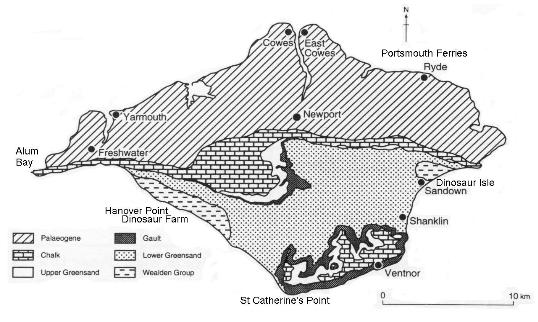
The "Pine Raft" at Hanover Point near Brook consists of
gymnosperm tree
remains that can be seen at low tide. They come from a Wealden plant bed.
The tree remains are either compressed or in solid uncompressed form ...
Examples ... impregnated by calcite at a very early stage ... have avoided
compaction. (Ian West's Brightstone Bay) - See
1825 and
BBC
The Petrified Forest which says
"the wood has been converted into a substance
resembling the mineral
Jet". See [Brightstone is also known as Brixton and is probably
where
Mantell found his cottage garden
Iguanodon toe bone]
about 139,800,000 to 132,900,000 years ago Valanginian stage of the
Lower Cretaceous includes Wadhurst Clay Formation. Clay
ironstone
nodules occur in the Wadhurst Clay and Ashdown Sand of the Kent and
Sussex Weald. [See
extraordinary book of doors for detailed
strata] See Jurassic
ironstone. Wealden ironstone was the basis of Wealden
iron. See
Research Group
Swanage (Dorset): The upper part of the Wealden, as seen very
completely in
the
Northern
Cliffs of Swanage Bay [Punfield Cove], exposes about 700 feet of clays
frequently red or
purple, less frequently blue, greenish, or very pale, alternating with
sandstones of different tints, mostly soft and fine- grained, but sometimes
hardened by irony impregnation, or modified by admixture of pebbles. One
band contains much lignite. In the upper part of this series, above every
red or purple bed, are
alternations of sandstone and pale shale. In one of the shale-beds is a
course of small nodules of pyritous ironstone.
John Phillips 1859 - See
Buckland 1829
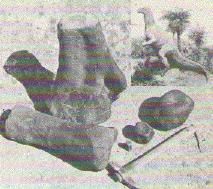
|
Eli
Marsden Wilson's 1935- "Idealized Landscape of the Wealden Lake" showing
Iguanodon
(iguana tooth),
Cetiosaurus (whale lizard)
and
Polacanthus (many spiked), (from the Natural History Museum,
London, has
the title "Mesozoic scene with great
reptiles" in the
Observers Book of
Geology. The Natural History Museum website
Image ID: 004324
describes it as "Scene from the Wealden times, during the Cretacous
period".
|
|
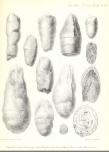
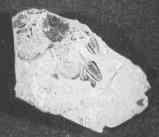
Fossil bones of an Iguanodon from the Wealden Beds of the Isle of Wight
(Observers Geology Plate 23)
|
about 125,000,000 to 113,000,000 years ago Aptian stage of the
Lower Cretaceous. Main period of lower greensand deposits.
about 120,000,000 to 90,000,000 years ago Mid-Cretaceous Period
"one period in the geologic past that stands out as distinctly warmer than
today, particularly at high latitudes"
(NOAA)
[Cambridgeshire] about 113,000,000 to 110,000,000 years
ago Gault
Clay deposited (reaching about 45 metres near Cambridge).
From about 110,000,000 years ago: a local upward
movement of the sea-bed caused sea erosion of the Upper Gault.
Heavier material, including fossils, was rolled around and
re-deposited , mixing fossils of different ages, and coating them in a
hard phosphate, sand and phosphatic nodules formed the
Cambridge Greensand.
100,500,000 to
66,000,000
years ago. Upper Cretaceous [Chalk] See
Dakota Group in North America.
Taylor's "Story of a piece of chalk". In
Britain
the upper cretaceous comprises the upper part of the
Gault, the
Upper Greensand, and the whole of the
chalk.
Place in strate in
Cambridgeshire: Topsoil, Chalk,
Chalk Marl,
Upper [Cambridge]
Greensand,
"Coprolite",
Gault, Lower Greensand. Picture below is a sketch of a pit
excavating phosphatic nodules at Horningsea, four miles north of Cambridge,
about 1874. The average depth of working the nodule bed was about twelve
feet but, as the undulations in the gault show, this was very varied.
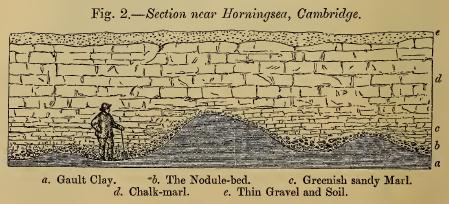
|
"On the Relations of the Cambridge Gault and
Greensand" by A. J. Jukes-Browne, of the Geological Survey
of England. Read 13.1.1875.
|
Quarterly Journal of the Geological
Society xxxi, p.260,
[Internet Archive] -
(offline)
about 100,500,000 to 93,900,000 years ago
Cenomanian age began the Upper Cretaceous.
[Cambridgeshire]
Cambridge
Greensands with phosphatic nodules.
Cambridge Greensands: "Glauconitic marl: Thin
but distinctive condensed basement bed of pale greenish grey marl rich in
phosphatic nodules (so called
"coprolites") at base. Much dark green
glauconite as sand-sized grains, disseminated or concentrated in pods and
layers giving a sandy texture and hence name "greensand"."
(Gateway to Earth). The nodule beds are on
average 25cm thick but, where hollows in the
Gault occur, local depths of over a metre
could accumulate.
Fossilised dung relatively scarce. Fossils at core of nodules
include many small sea creatures particularly bivalve molluscs (like
Terebratula),
brachiopods,
ammonites and belemnites.
Larger fossils include many fish and reptiles such as ichthyosaurs,
pterosaurs and some (often poorly preserved) dinosaurs.
(Wimpole coprolites 2015)
"The fossil beds were found at the
base of both the Lower and Upper Cambridgeshire Greensand".
(O'Connor)
|
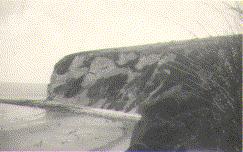
100,000,000 to 650,000,000 years ago. The Chalk Sea. Culver Cliff,
Isle of Wight was photographed in 1956, when I was twelve and it
not yet a milion years old. "Chalk is made from billions of tiny shells of
plankton which lived in the clear warm waters"
(Isle of Wight Geological History)
|
|
about 83,600,000 to 72,100,000 years ago Campanian age of the
Late
Cretaceous, when the
Plesiosaur Elasmosaurus swam in the
Dakota inland
sea
Fossils of flowering plants first become abundant in the chalk. Those of
the earlier
Tertiary including types
(in Britain) characteristic of a tropical climate.
(Observers
Book of
Geology and Wikipedia
Timeline of plant evolution) -
Charles Darwin
sought an explanation for what appeared to be an abrupt origin
and highly accelerated rate of diversification of flowering plants in the
mid-Cretaceous.
(Friedman 2008)
From 1853 fossils of the leaves of flowering plants were
collected from Cretacious rocks in the Dakota Formation in the USA mid-
west.
about 75,000,000 years ago According to Ron Hubbard, science fiction
writer and founder of the
scientologists,
Xenu, ruler of a Galactic Confederation of 76 planets, transported
billions of his charges in spaceships to Teegeeack (Earth), placed them
near volcanoes and killed them by exploding hydrogen bombs,
Their "thetans" (souls) later inhabited the bodies of
humans, causing the
dysfuntions that scientology claims to be able to repair.
about 72,100,000 to 66,000,000 to years ago Maastrichtian age ends
Late Cretaceous
None of the reptile "monsters are found in the rocks later than the Chalk"
(Observers Geology, p.132)
Tertiary (third) period: former term (still much used) for the
geological period from
66,000,000 years ago to the
Quaternary. Cenozoic (recent life). Ceno from
Greek kainos, meaning new or recent. Also used in -cene at
end of epochs: Paleo (old) - Eo (dawn) - Oligo (small) - Mio (less) - Plio
(more) -
Pleisto
(most) -
Holo
(whole) -
Anthropo
(human)
Age of mammals,
including primitive
horses and hominids.
Following the
Cretaceous
extinction of dinosaurs, the Eocene epochs -
Paleocene -
Eocene
-
Oligocene
-
Miocene
- and
Pliocene
-
have
been described as chapters in the mammals rise to dominance.
Most recent geological materials are soft sediments like sands and clays.
66,000,000 years ago extinction of dinosaurs at the end of the
Cretaceous epoch.
Cretaceous-Paleogene extinction event
. Psigate said
65,000,000 years ago "Impact at Yucatan Peninsula, Mexico, created
crater almost
200 kilometres across, caused global devastation and possible extinction of
dinosaurs, along with an estimated 85% of all life".
Another source: Dinosaurs (and
90% of all species) wiped out after a meteorite. defined by a "golden
spike" in sediments around the world iridium
dispersed from the meteorite.
Extinction
(vertebrates) of
dinosaurs and flying
pterosaurs, the mosasaurs,
plesiosaurs
and
ichthyosaurs of the oceans. (Marine invertebrates) ammonites,
groups of cephalopods and some bivalves, such as the
reef-building rudists and some relatives of modern oysters.
(Sam Noble Oklahoma Museum of Natural History)
- Most groups of organisms survived. Soon after the end of the
Cretaceous, there was a tremendous diversification of insects, mammals,
birds, and flowering plants on land, and of fishes, corals, and molluscs in
the ocean.
(Richard Cowen).
|
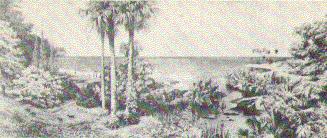
56,000,000 to 33,900,000 years ago Eocene Epoch. Plate 21 in
Observers Book of
Geology includes this depiction by Eli
Marsden Wilson (1935) in the Natural History Museum, which it titles
"Eocene landscape, London clay period".
|
A world that was essentially ice-free
|
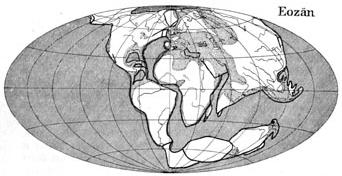
Wegener's Eozän: Eocene
In the early Eocene, there were land connections between Antarctica and
Australia, North America and Europe through Greenland, and probably between
North America and Asia through the Bering Strait.
|
About
60,000,000
to 55,000,000 years ago, Laurasia split when North
America/Greenland and Eurasia separated, opening the Norwegian Sea. See
Tethys. In the mid-Eocene, Australia and Antarctica separated.
New ocean currents cooled the world towards the end of the Eocene.
(source).
about 45,000,000 years ago during the early to mid Eocene
Palaeotherium species living in the tropical forests covering Europe.
(Wikipedia)
34,000,000 years ago
Antarctic ice sheet began to form around this time
(psigate)
Tropical forest to temperate grassland. Enter the
beautiful world
33,900,000 to 23,000,000 years ago Oligocene: a transition from the
tropical Eocene more temperate climates. Grasslands expanded world-wide and
tropical forests receded to the equatorial belt.
During the Oligocene and Miocene the
Alpine chain of mountains was formed, replacing the western end
of the
Tethys.
28,100,000 years ago Upper Oligocene (Chattian) -
(Wikipedia) - Abbe Bourgeois announced in 1867
that he had discovered man-made tools in an assemblage of chipped flints in
the bed of upper Oligocene age near Thenay. Similar finds were made
elsewhere in Europe in 1872 and 1877 in upper
Miocene beds. The human
origin of these
"eoliths" was disputed.
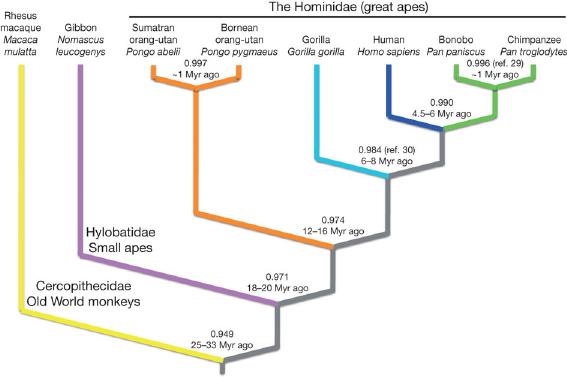
25,000,000 years ago hominoids (apes) diverged from the Old World
monkeys according to
Wikipedia. The Greek word pithecoid (ape like) was much
used in 19th century evolutionary theory. A 1900 Dictionary defines an ape
as a four limbed animal with teeth of the same number of form as humans and
without either tails or cheek-pouches, and Pithecoid as pertaining to apes,
or resembling an ape, or ape-like.
|
|
"Divergence among great apes, a small ape, and an Old World monkey with
respect to humans",
figure one from an article in
Nature 469, 529-533
(27.1.2011)
|
Rather than call this Middle Tertiary "in
1833 I proposed the name of Miocene, selecting the
'faluns' of
the valley of the
Loire in France as my example or type". "No British
strata have a distinct claim to be regarded as Miocene". (Charles Lyell)
|
|
23,030,000 to 5,332,000 years ago Miocene era -
(Wikipedia
"If the Creator
made this world
especially for man, then there was one
period paricularly adapted to man's wants. The world never experienced a
more beautiful period. That period was the Miocene, and by all manner of
logical reasoning it was the time when man should have appeared"
Mastodon, Mammoth, and Man by John Patterson MacLean 1878
page 67
|
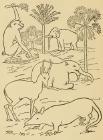
|
Picture of Miocene mammals from
The Prehistoric World: or, Vanished Races
by Emory Adams Allen 1885.
Taylor's "Story of a piece of lignite"
Whilst accepting the authenticity of the flint tools found by
l'abbé Bourgeois at
Thenay,
Albert Gaudry did not admit the
existence of humans in the Miocene epoch. Sommeone suggested Dryopithecus
cracked the stones.
(Histoire) - See
Mortillet.
|
|
In 1856
Éduard Lartet
described fossil jaw fragments and a piece of humerus from a
"très-grand
Singe de la tribu des
Simiens"
[Simian]
"ou Singes supérieurs", which had been
discovered by Monsieur Fontan, of
Saint-Gaudens (Haute-Caronne),
a [zealous] naturaliste.
He named the monkey whose bones these were,
Dryopithecus fontani [See
below]. They were found
in a strata of
marly clays (banc
d'argile marneuse) from the
Miocene being exploited at the base of the
plateau
on which Saint-Gaudens is built,
|
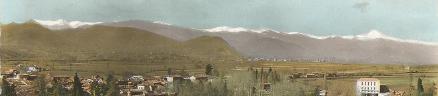
|
at the start of the plaine de
Valentine that stretches to the foothills of the Pyrenees.
|
|
Fontan recovered from the same site, bones of
Macrotherium,
Rhinoceros,
Dicrocerus elegans, apparently identical to species of the same
genera previously found at
Sansan. These mammals belong essentially, Lartet said, to "nos
terrains tertiaires moyens
(miocènes)", as we also find their remains in the
faluns
of
Touraine.
- See Lartout
"Note sur un grand singe fossile qui se rattache au groupe
des singes supérieurs" in
Comptes rendus de l'Académie des Sciences
Paris, Band 43, 1856, pages 219-223.
(offline)
The fossils were not (as Lyell states) found in lignite deposits, but
Lartet refers to trunks of oak, chestnut and pine in lignite in the
lowest foothills of the Pyrenees, which he thinks are the
same age as fossils a Saint-Gaudens and Sansan, because he has collected
some remains of mammals belonging to the same period. Lartet concluded
on the evidence he had that this monkey, of very great size, mainly ate
fruit, and lived usually in trees, as Gibbons of the present time.
He said he took the name Dryopithecus from [Greek] Dryos (tree, oak)
and pithekos
(monkey). So Lyell is correct in linking the name to oaks found in lignite.
Monsieur Fontan, after who the full name Dryopithecus fontani comes, is
named as Urbaine Fontan in the Journal de Toulouse. He may also be "A.
Fontan, docteur-médecin", who is mentioned elsewhere.
The Journal de Toulouse carried to reports of the discovery (the second
correctin the first) on
3.8.1856 and
5.8.1856. Fontan is reported as
saying the find is the more interesting as Cuvier had not managed to find
such a fossil. Flourens "went even further, this unexpected result gives
him hope that one will soon find fossil men". (3.8.1856 - Third page)
|
|
Plate and notes (adapted) provided with Lartet's note
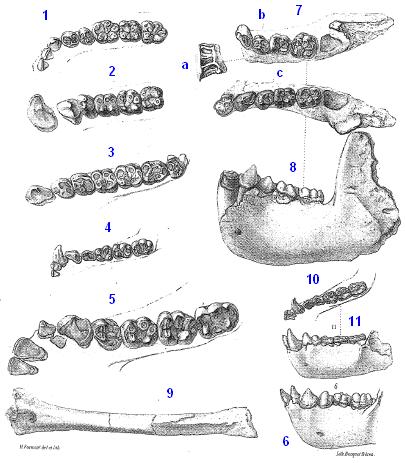
|
1. A series of teeth from "une négresse du Gabon"
2. The same series from an adult Chimpanzee - 3. Orang from Borneo - 4.
Gibbon from
Siamang - 5. Gorilla
7, 8, and 9 are Dryopithecus. 7 shows shows three views of jaw fragments
with teeth and 8 how they fot in to the whole jaw. 8 shows the humerus
(upper arm) bone (not to scale)
10 and 11 are the teeth and jaw of
Pliopithecus antiquus that Lartet
discovered at Sansan in 1837.
6 is a gorilla's jaw (not to scale)
|
|
Lartet says the
Siamang, "placed by Zoologists in general in the last row
of the tribe of the Simians or higher apes, nevertheless, provide by their
skeleton, a sum of characters approaching the human type much greater than
one can find in
Orang or even in the
chimpanzee".
|
13,000,000 years ago divergence between humans and orang-utangs
(between 12 and 15 million years ago).
more than 7,000,000 years ago divergence between the two existing
beavers: castor canadensis (north america) and castor fiber (europe and
asia).
7,000,000 years ago divergence between humans and gorillas
(between 6 and 8 million years ago).
6,230,000 years ago The the red deer (cervus elaphus) and Indian
spotted deer (axis axis) last shared a common ancestor. However, they
remain completely interfertile. ("Neanderthals and modern humans: an
example of a mammalian syngameon?" by T. W. Holliday 2006)
6,000,000 years ago divergence between humans and chimpanzees
(between 5 and 7 million years ago). Common ancestor of chimpanzees and
humans. Skin on face and hands of baby chimpanzees darkens after exposure
to the sun. The rest of the body is protected by hair (fur)) and remains
pale.
5,300,000 years ago appearance of Ursus minimus (the Auvergne bear).
(Wikipedia). It is thought to have been the
ancestor of Ursus etruscus. Etruscus became a larger bear. Radiating across
Europe and Asia, it gave rise
cave bears in Europe and
brown bears in Asia. See
A Review of Bear Evolution by
Bruce Mclellan and David
C. Reiner, 1992/1994.
Pliocene
means "more recent".
The shelly sand-banks of East Anglia known as crag were formed in
the Pliocene.
Pleistocene was "was
originally regarded as ... the period in which man, as tool-using animal,
first made his appearance and ... evolved". But the case was made in
"recent years" (1929) that tool-users existed in the "Pliocene or even
earlier". (Wills 1929
p.209).

|
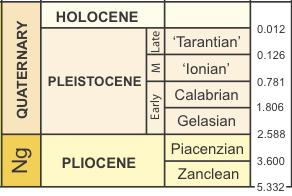
5,333,000 to
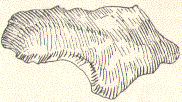
2,580,000 years ago Pliocene geological epoch. Eolithic
means dawn of
stone
and the term eolith was used for flints that might have
been hand wrought, but might be natural. This one is said to resemble a
musk ox on the left and a bear on the right.
(Larousse Prehistoric)
|
|
|
Nature 29.3.1924
contained a report dating eoliths that could have been tools to
"at least,
an early phase of the Pliocene period".
|
Rushton Hall
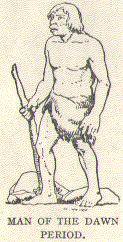
(1928/1930)
wrote "Out of the mists of Antiquity appear the
earliest known people, to whom
the name the people of the dawn or eolithic period has been given"
(p.40).
"Piltdown may be the remains of a Dawn Period man" (page 57).
His
Dawn Man developed in
River Drift Man, another possibility for
placing Piltdown
Man. The pictures are of Piltdown Man and an eolith from
Rushton Hall.
|
The so called southern apes
4,000,000 years ago to
2,000,000 years
ago
Australopithecus genus in Africa. Named by
Raymond A. Dart (1893-1988) in 1925 from Latin australis "southern" and
Greek pithekos
"ape". Wikipedia:
Australopithecus
about 3,900,000 years ago Equus caballus, the modern horse, ,
diverged from the lineage it shares with zebras and asses, according to
molecular data. The fossil suggests a divergence at least 2 millions years
ago.
about 3,600,000 years ago A woolly rhinoceros in the Himalayas lived
there during a general world period of warmth. they migrated from there to
northern Asia and Europe when the
Ice Age
began. The woolly rhinoceros co-existed with
woolly mammoths in the
Pleistocene.
Successively named Rhinocerotis antiquitatis - Gryphus antiquitatus -
Rhinocerotis tichorhini and Coelodonta antiquitatis.
|
European land mammals
Lindsay and others in 1980 wrote of
"three major dispersal events of large mammals during the Pliocene" at
3,700,000 years ago - then 2,600,000 years ago - then 1,900,000 years ago.
3,600,000 to 3,000,000 years ago or earlier Start of Villafranchian
fauna.
(Wikipedia) -
Villafranchian: The land-mammal stage that spans the upper Pliocene and
lower Pleistocene 3,600,000 to 1,200,000 years ago (Oxford: A Dictionary
of Zoology by Michael Allaby 2009). Villafranchian: An age that is
dated at base at approximately 3,000,000 years ago. It lasted approximately
2,000,000 years and therefore crosses the Late Pliocene/Early Pleistocene
boundary. (Oxford: A Dictionary of Plant Sciences by Michael Allaby
2006)
|
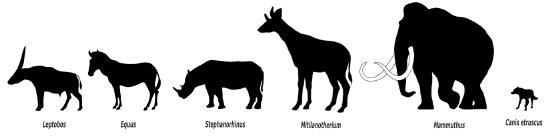
Leptobos event. Early Villafranchian starts with appearance of a primitive
bovid of the genus of Leptobos in Italy. Leptobos existed only during the
Late Pliocene to Early Pleistocene, thus it is a diagnostic taxon for the
Villafranchian-Nihewanian land mammal ages of Europe and China
|

|
|
The Etruscan rhinoceros
(Stephanorhinus etruscus) was the European rhino from the early
Pleistocene. It was
succeeded the Steppe Rhino (Stephanorhinus hemitoechus)
in the middle Pleistocene.
|

|
|
Elephant-Equus (elephant horse) event. somewhere between 3,000,000
and 2,000,000
years ago. It starts with the appeance of Equus (real horse) and
Mammuthus meridionalis. "We now report new data that
limit the time of Equus' dispersal and into Europe to the 2,600,000
years ago dispersal event". (Lindsay and others)
|

|
|
Equus was derived from a species of the single-toed horse Pliohippus, known
only from North America.
|

|
Begining of middle Villafranchian coincides
with Gauss/Matuyama magnetic transgresson and onset of
Quaternary
(Pleistocene) 2,580,000 years ago.
|
The Wolf event, may fall near
1,700,000
years ago.
The late Villafranchian
starts with the appearance of Canis etruscus (Etrurian wolf)
|

|
end Villafranchian event
Followed by
Galerian
Mammal Age and
Aurelian Mammal Age
(350,000 to 13,000
years ago).
|
3,300,000 years ago Lomekwi 3 site tools in Kenya discovered 2015.
Proposal to call the Lomekwian technology as
older and distinct from
Oldowan.
"Oldest stone
tools pre-date earliest humans"
(BBC) - Wikipedia:
stone age -
stone tools -
Article from Nature 21.5.2015 -
Article from Science 14.4.
2015
3,300,000 years ago hominin (human-like primate) called "Lucy"
discovered in Ethiopia in 1974
BBC 4.3.2015 -
Wikipedia
-
Google doodle archive.
Jablonski 2012
infers
skin and fur similar to chimpanzees as activities would not "built up
excess heat as the result of prolonged activity".
2,800,000 years ago Ethiopian jaw bone.
BBC 4.3.2015 "'First human' discovered in Ethiopia"
|
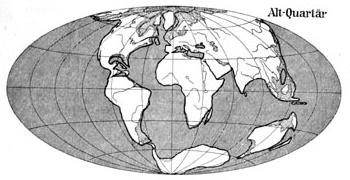
Wegener's Alt-Quartär: early Quaternary
The major land masses were about where they are today.
|
Quaternary Period current period of the
Cenozoic Era in the geologic
time scale. Includes two epochs: the Pleistocene to
11,700 years
ago - and the
Holocene to today.
Quaternary glaciation.
|
2,600,000 to
11,700 years ago Pleistocene [From Greek for most
recent. Term introduced by Lyell in 1839 for ice age deposits after the
Pliocene].
Current ice age with permanent ice sheets in Antarctica and
perhaps Greenland, and fluctuating ice sheets elsewhere.
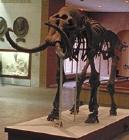
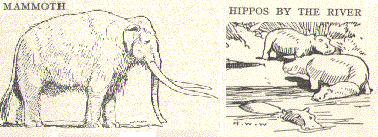
The ice across
much of Russia preserved
remains of Pleistocene mammals such as this
mammoth from near Moscow whose mounted bones are diplayed in the entrance
hall to the Orlov Museum of Paleontology. The
Woolly Rhinoceros
also roamed
Siberia. See Édouard
Lartet's age of.
|
|
|
furry coat or sweaty skin
a case of bi-polar - hot then cold - cold then hot
Glacials and
interglacials:
|
North Germany: Pre-Tiglian -
Tiglian
- Alpine region (Donau = Danube): Biber
(Wikipedia) - Biber/Danube - Danube
(Wikipedia)
-
Danube/Gunz
(Wikipedia)
MIS 62 -
Günz
-
MS 22
-
Cromerian (Piltdowns)
MIS 15
MIS 14
MIS 13
-
Mindel
MIS 12
-
Holstein MIS 11
(Swanscombes) -
Riss
MIS 10
(Bilzingslebens)
MIS 8
MIS 6
-
Eem (hippos)
MIS 5 -
Wurm
- MIS 2 -
Holocene (farmers)
MIS 1
.
Mammoth:
and rhinoceros -
ivory carving -
prehistoric art -
Aurignacian -
mammoths in art -
Dolni Vestonice -
cave bear and other
extinctions -
eburnien -
reindeer -
mammoth extinct -
The first cool period at the junction of the
Pliocene and the Pleistocene was the pre-Tiglian. - the Pre
tiglian cold stage can be dated between about 2,500,000 and
2,300,000 years ago -
The Tiglian was about 2,000,000 years ago -
The Tiglian interglacial phase ends in the Olduvai magnetic event about
1,700 years ago - 1,700,000 to
1,200,000 million years ago Donau-Günz or
Tiglian
interglacial.
Tiglian derived from Tegelen in the Netherlands
(Wikipedia). "A classical
Villafranchian
locality".
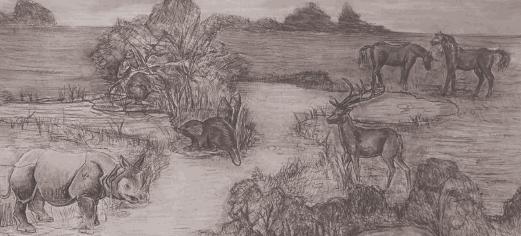
Part of a sketch of what the Tegelen landscape may have looked like, made
by Dubois (1904?). From
"A century of research on the classical locality of Tegelen (province of
Limburg, The Netherlands)" by
Lars W. Van Den Hoek Ostende
and John De Vos
Noted for its deer. Dubois wrote about a species of Eucladoceros (bush-
antlered deer) Eucladoceros tegulensis, later called Eucladoceros, and
Cervus rhenanus Dubois, 1904 (named after him), the small deer of Venlo,
remains of which are found primarily in Tegelen.
Elephants, rhinoceroses, a wild pig species and possibly even tapirs - a
landscape of riverine woodlands and swamps ("Origins and development of
grassland communities in northwestern Europe" by Herbert H. T. Prins 1998)
|
|
Paleo = old lithos = stone. The three ages, Paleolithic,
Mesolithic
and
Neolithic, were
named in
relation to the type of stone tools that survived in archaeological sites.
The Paleolithic is divided into
Lower,
Middle
and
Upper.
|
Paeolithic
savagery
(Gordon Childe)
[Strepean?] -
Chellean - Abbevillian
(Wikipedia) - Oldowan
(Wikipedia).
See
Mortillet classification
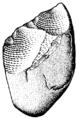
2,600,000 to 2,550,000 years ago Mode one - Oldowan - stone tools.
Picture above from Wikipedia of a "simple
chopping-tool".
Tools made by knocking flakes off a core stone (pebble core) with a
hammerstone. Core and
flake
tools made.
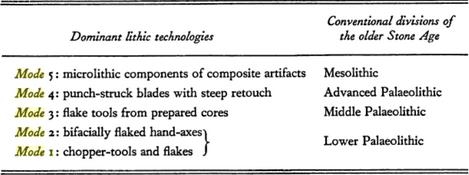
|
World prehistory: a new outline,
by Grahame Clark. 1969, page 31.
|
"Archaeology studies human history from
the development of the first
stone tools.." (Wikipedia). It is one of the
main ways in which social theorists have tried to access pre-history (the
human story before writing). Another major way has been through speculation
on the content of
myths. Artefacts, like stone tools, can be dated in a way
that inferences from myths can not. On the other hand, myths may give
access to the mind in a way that artifacts do not.
Lower
Paleolithic
The first homo - Latin for
human
2,350,000 years ago upper jaw from Hadar, Ethiopia, oldest
fossil attributed to the genus Homo before
2015 jaw
"Man alone has become a biped" (Charles Darwin) - After
Lucy.
2,000,000 years ago (or later) Upright human: Homo erectus: "the
fossil record between ...
Lucy
... and Homo erectus (with its relatively large brain and humanlike body
proportions) two million years ago is sparse".
((BBC 4.3.2015) -
Wikipedia
"Compared with its
australopithecine forebears-who were four feet tall with
ape-sized brains and no stone tools - Homo was larger physically, had a
larger brain, and made stone tools."
(Tomasello 1999)
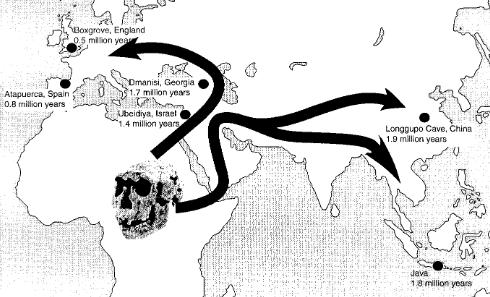
Map based on hominids leaving Africa about 2 million years ago. They get to
the far east in 100,000 years, but take over 1,000,000 years to get to west
Europe. Why? - Read about
Wushan Man and
Indonesia's top five hominid fossil sites -
Norfolk footprints and
Boxgrove tibia
1,800,000 years ago Hippopotamus antiquus, the European hippopotamus
appeared.
(Wikipedia)
1,800,000 years ago "Early human migrations began when Homo erectus
first migrated out of Africa over the Levantine corridor and Horn of Africa
to Eurasia about 1.8 million years ago".
(Wikipedia in an earlier incarnation) -
Two major dispersals of hominins out of Africa occurred. That of
homo erectus began around 1,800,000 years ago.
That of homo sapiens began
around
80,000 years ago.
(Jablonski 2012)
about 1,750,000 years ago The Olduvai child: OH 7 and Zinjanthropus:
OH 5
MIS 62 - 1.750,000 years ago: end of the
Tiglian
By about 1.76
million years ago, early humans began to make
Acheulean
handaxes and other large cutting tools.
(Smithsonian)
Acheulean about 1,600,000 to
200,000 years ago
Acheulean artifacts from Africa date to 1,600,000 years ago. The
oldest sites
in India are
slightly younger. In Europe
[See
Mortillet classification], the earliest
Acheulean tools appear just after
800,000 years
ago, as
homo erectus
moved north out of Africa.
(anthromuseum.missouri). But the classical
French Acheulean
is much later.
Mode two tools: Large bifacial cutting tools made from flakes
and cores
such as Acheulean handaxes, cleavers and picks.
about 1,500,000 years ago Turkana Boy or Nariokotome Boy
(WT-15000) discovered in Kenya August 1984.
108 bones
(view bones): almost all the scull and most
of the rest of the skeleton. The most complete early hominid found.
Structure suggests a physically very activ biped and
Jablonski 2012
deduces that early hominids had lost body hair and increased sweat glands
by the time he "traversed the woodland grassland" of the Lake Turkana
Basin.
Homo erectus preferred to
homo ergaster
1,500,000 years ago Attirampakkam, south India, Acheulean site.
See
Antiquity -
Indi-Uni -
Science -
Indian Acheulean.
Also see earlier dating.
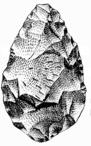
|
1,400,000 years ago
Acheulean - Mode two tools. The picture, from
Wikipedia, is of an Acheulean handaxe from Zamora in Spain.
From
Saint-Acheul, a suburb of Amiens where the first tools from this
period were found in 1859. Wikipedia:
Acheulean
The start of
Antroparkbaby in the
European Acheulean is based on
the
Bilzingsleben site of early palaeolithic human remains in
Thuringia, Germany, dated about 370,000 years ago. Also
Shoningen and
Stránská .
|
The four levels of Antroparkbaby are
Acheulean, which it associates with
homo erectus -
Mousterian
(Neanderthal) -
Gravettian - and
Magdalenian (both
homo sapiens)
about 1,250.000 to 700,000 years ago
The
Mid-Pleistocene
Transition or revolution. A period during which the dominant periodicity
of Earth's climate
(glacial-interglacial) cycles inexplicably changed from
41,000 years to 100,000 years
1,200,000 to
700,000
years ago Günz
glaciation (Alps). Britain's corresponding
Beestonian Stage consists of alternating glacial and interglacial phases.
The Beestonian Stage and Marine Isotope Stage 22 ended about 866,000 years
ago.
(Wikipedia).
H.G. Wells calls the "first glacial age"
MIS 22 - 1,030,000 years ago, marking the end of the Bavelian period in
Europe. The Leerdam interglacial is located at MIS23 and the Bavelian at
MIS25 by
Wll Roebroeks and Thijs Van Kolfschoten.
They include both in the Bavelian complex. This complex precedes the
Cromerian complex.
Antoine in began a chart
of regional sequancies with Leerdam followed by the aluvial
Somme
terrace "Ferme de Grace" (MIS22). The road to Ferme de Grace is in the
Renancourt district of Amiens.
|
In arranging
geological
strata Alexander Brongniart (1770-1847) proposed that each
stratum could be defined by the presence of one or more specific
fossils of animals or plants, which he called a fossile
caractéristique. In prehistoric archaeology, Mortillet spoke,
instead, of a
fossile-directeur, which served the same function. The Fossile-
directeur was a tool made by humans rather than a biological remain.
En 1861,
[Édouard Lartet] propose une chronologie du
Quaternaire fondée sur les
espèces successives de grands mammifères dominants, à
partir desquelles il pensait pouvoir dater les industries lithiques
paléolithiques: l'âge de
l'ours des cavernes, l'âge de
l'éléphant
(mammouth) et du
rhinocéros laineux,
l'âge du renne et l'âge de
l'auroch.
Lartet suggested four ages or periods based on associated
fauna, to which Felix Garrigou added an earlier Hippopotamus period:
The Hippopotamus period
The Cave Bear period
The Woolly Mammoth and Rhinoceros period
The Reindeer period
The Aurochs or Bison period
In Mortillet's scheme Hippopotamus became Chellean, most of Cave Bear and Mammoth became
Mousterian,
although
some late finds were put in a separate
Aurignacian.
Reindeer was divided into
Solutrean
and
Magdalenian, and
Robenhausian was
added for the Neolithic period.
(Oscar Abadía 2002)
|
|
Names of some periods of the paleolithic as classified by
Gabriel de
Mortillet. "Mortillet's most successful idea was to define time-
periods by their typical
stone tools which acted like the
fossile directeurs of the geologists".
(Aggsbach's Paleolithic Blog)
Tertiary
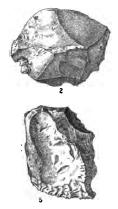
|
|
Thenaisienne -
Eolithique. Stones "étonnée par le feu". (shaped,
cracked into shape, using fire). Named after
Thenay
in Loire et Cher where,
from 1860, Abbé Bourgeois collected objects from
Upper Oligocene
beds that he suggested to the Congress of Paris in 1867 were man-made.
Possible
Tertiary man.
Picture 2 is an example shaped by fire. Picture 5 is an example
with its edge (bottom) retouched by chipping.
|
See Piltdown often
considered before Chellean.
Quaternary
Chelléen
(Chellean). Term suggested by Ernest d'Acy in 1878, employed by
Mortillet in
1883. Named after
site at
Chelles (Seine-et-Marne, France)
(Wikipedia).
Henri Breuil proposed replacing by
Abbevillien
in reference to sites on the haute terrasse de la
Somme at
Abbeville
(Wikipedia), where
tools coexist with the fossils of animals from a hot climate such as
Elephas
antiquus.
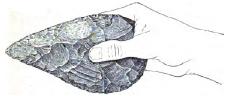
|
The characteristic tool is often
called an axe, but is a hand tool to cut, drill, trim and do
everything. Mortillet calls it a coup-de-poing (blow of the
fist - punch) or knuckle-fist. The word bifacial was substituted
following André Vayson (1920).
|
Acheuléen
(Acheulean), named after a site at
Saint-Acheul
near Amiens
(Somme). A
transitonal period with a cooler climate, still dominated by the coup-
de-poing, which is refined. The
mammoth replaces the elephant as the climate cools
Wikipedia: Acheulean tools are classified as
mode two, meaning they are
more advanced than the (usually earlier) mode one tools of the
Clactonian
or Oldowan/Abbevillian
[Mortillet's Thenaisienne]
industries but lacking the sophistication of the (usually later)
mode three
tools of the
Middle Palaeolithic, exemplified by the Mousterian (below)
See tools
Moustérien
(Mousterian). Named after a site at the l'abri
supérieur du Moustier à Peyzac-le-Moustier (Dordogne)
discovered by
Édouard Lartet
in 1860. Associated with the great bear of the caves.
The Acheulean and Mousterian were both very long periods during which
large fluvial (river) alluvium deposits of gravel, sands and silts formed.
Their deposits are much more abundant than chelleennes alluvium. The
industry gradually changed and eventually was completely transformed. The
general purpose tool, though persisting, was increasingly replaced by
specialist forms such as the blade, the tip and the scraper.
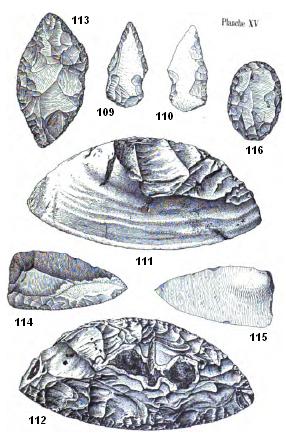
|
Mousterian flint tools in transition to Solutrean
113: a flint pointe.
109 and 110: Two sides of one flint pointe.
116: A double scraper.
111 and 112: two sides of a very large scraper. Lanceolate shape. Montillet
notes the care and skill that has gone into shaping each side and comments
that "this remarkable instrument approaches
solutrean".
114 and 115: two sides of one tool. 114 shows "passage" from a ponte to a
scaper. A pointe has been retouched along the length of one side (bottom)
"forming a very beautiful scraper". 115 shows a Conchoidal fracture
(percusion chonchoid) in the corner.
|
Aurignacian
|
Solutréen
(Solutrean) after a site discovered
au pied de la Roche de Solutré (Saône-et-Loire) par Henry
Testot-Ferry en 1866, which Mortillet visited at his invitation. First part
associated with mammoths, second with reindeer. Tool remains include two
types of pointes, which, although not abundant, are characteristic.
One type is laurel leaf shaped, the other willow leaf with a side notch.
Artistic retouching on both faces, at both ends and at the perimeter,
distinguishes them from Mousterian pointes. They were made
to be emmanchées (mounted, on wood, for example). Later authors
agree that the Solutrean represents the pinnacle of working flint and
produced arrowheads of a perfection rarely equalled afterwards.
|
|
Magdalénien
(Magdalenian). The name of the site of la Madeleine (Dordogne) discovered
by
Édouard Lartet in 1863. Humans lived in caves for the
most part. Asociated with reindeer throughout. Characterised especially by
development of instruments in bone and antler. It develops naturally
from the Solutrean. Bone objects begin to appear at the end of the
Solutrean and finely worked flint pointes are sometimes found in the early
Magdalenian. But the use of bone harms the development of flint objects,
which are less beautiful.
A dagger carved from reindeer antler. The handle is carved as a reindeer
From Laugerie-Basse (Dordogne)
(Wikipedia). Museum of Saint-Germain.
|

|
[Mesolithic] Term not used on Mortillet's plans. Instead,
he added Tourassien to the end of the old stone age and Tardenoisien to the
start of the new stone age.
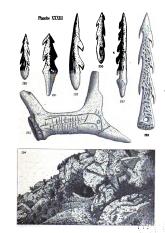
|
Tourassien (1872? 1894?)
Wikipedia. Term fell into disuse in favour of
the
Azilien
[terme tombé en
désuétude au profit
d'Azilien].
(Wikipedia)
At the end of the
Paleolithic a warmer climate
forced reindeer north. Without this "animal heaven"
the human populations of Western Europe lived in
much more difficult times and (stone) industry declined.
The shelter beyond Tourasse, close to
Saint-Martory (Haute-Garonne) provides a good set
of tools, characterised by harpoons.
|
Temps actuels = current time
"Sous le nom de temps actuels, on comprend tous ceux qui se sont
trouvés dans des conditions de géographie physique,
d'hydrographie, de climatologie, de flore et de faune à peu
pràs semblables
… celles de nos jours."
(Ascribed to Mortillet - Seems to be an extract from the second
edition (Paris 1895) of
Alcide Railliet's
Traité de zoologie médicale et agricole. Alcide
Railliet says that the Neolithic period contains only one time: the
Robenhausian. The "gap" between Quaternary and current time is
explained by the change from a cold dry climate to a temperate one, which
led to the reindeer moving north, followed by the humans who hunted them.
The space they left is eventually filled by a new people, bringing their
own tools.
|
Current - Tardenoisien (1897)
(Wikipedia) - named after natural French region of
Tardenois
Wikipedia. Characterised by
small flints with geometric shapes.
|
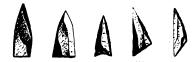
|
After geologic time came the current time, but at the beginning, and for a
long time, we are still in the stone age. At this point we call it
Neolithic or the new stone age. I begins with an industry
characterised by flint instruments which are very small and have geometric
shapes. They are in abundance in the Tardenois, Department of
the Aisne.
Néolithique
(Neolithic)
Period of Pierre polie (polished stone), because it generally polished
the most common instrument, the axe. Mortillet counts Tardenoisien and
Robenhausian as the two neolithic epochs. He just has one plate for
Tardenoisien, but many for Robenhausian.
Robenhausienne (Robenhausian) named after a Swiss Lake Resort,
the palafitte of
Robenhausen
(Wikipedia)
on small partly desiccated Lake Pfäffikon,
in the canton of Zurich. This important station provided
many and interesting information on industry, customs and habits of the men
in the end the period of the stone polished. The polishing of stone took
especially great development to
the robenhausienne time.
Plates with a diverse range of tools. The first plate being hammers or
firing pins, "the first of all the tools,.absolutely essential for trimming
stone".
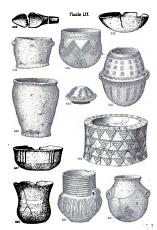
|
Mortillet says that ("primitive") Pottery, for general use,
appeared for the first time in Europe during the Robenhausian, having been
completely lacking during the
Quaternary. The
fist pots ("vases") are crude. (Perhaps?) incompletely fired. Only the
surface is reddened by the fire. The interior of the pottery is coloured
brown by the charcoal or black of smoke. It is usually mixed with angular
fragments of rocks or shells. This mixture intended to
give consistency to the clay and to prevent splitting during drying and
while cooking. These bottoms of these first pots are rounded, without a
flattened foot. To stand upright they would have to be pressed into earth,
sand or ash. Side nipples suggest suspension by cords.
|
Âge; du bronze (bronze age)
Morgienne
Larnaudienne
Âge; du fer (iron age)
Hallstattienne
Marnienne
Lugdnnienne
Chompdolienne
Wabennienne
|
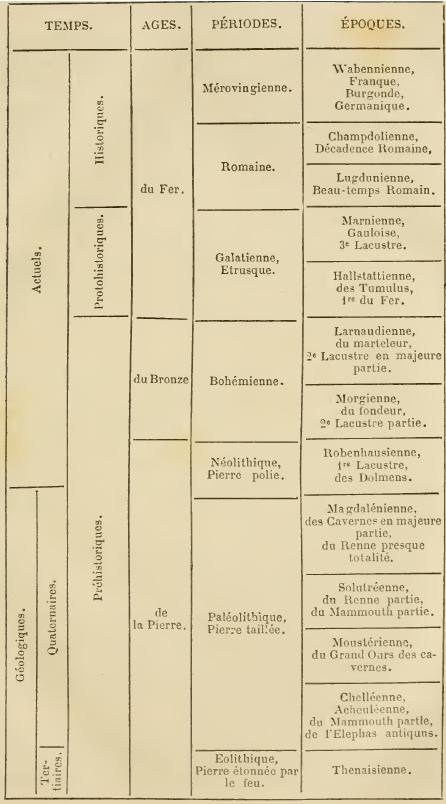
|
Mortillet 1883 Le
Préhistorioue - Antiquité de L'Homme p.21
A basic binary division is made between "temps geologiques" (geological
time) and
"temps actuelles" (current time). In geological time is
Tertiary
and
Quaternary, until the start of the Neolithic in current time,
which is marked by the polishing of stone tools.
It was considered possible that hunter humans had simply been replaced by
other humans who tilled the soil. It has been suggested (seriously?) that a
gap between the two might have marked
Noah's flood. The search for an alternative, develomental,
process led to the two-stage theory becoming a three stage one with a
Mesolithic (middle)
stage. See Wikipedia
|
|
Mortillet's research gap - the missing middle
Mortillet:
16.4.1874 at
la Société d'Anthropologie,
Toute la discussion, je crois, repose sur un malentendu.
Entre l'époque paléolithique ou des cavernes et
l'époque néolithique ou de la pierre polie, il existe un
hiatus; mais cet hiatus n'est qu'une simple lacune dans nos connaissances.
Il ne représente'pas une véritable lacune dans le temps et
dans l'industrie. Certainement l'époque paléolithique
a dû se rattacher et se souder à l'époque
néolithique;
mais nous n'avons pas encore découvert le point de
contact. Entre les deux époques, il n'y a pas eu une période
où l'Europe était inhabitable; seulement, les restes de
l'époque de transition ou de passage n'ont pas encore
été trouvés et reconnus. C'est ce qui constitue
l'hiatus que nous constatons. Je le répéte, cet hiatus n'est
pas réel un existe que dans le résultai de nos études
et de nos recherches actuelles. Je devais une explication parce que je suis
le principal propagateur de l'idée de l'hiatus. J'ai signalé
le
fait pour stimuler les recherches et les investigations.
The entire discussion, I believe, is based on a misunderstanding.
Between the Paleolithic era or the caves and the time Neolithic or polished
stone, there is a hiatus; but this hiatus is just a simple gap in our
knowledge. It is not a real gap in time and in the industry. Certainly the
Paleolithic era has had to be connected and merge in the Neolithic, but we
have yet to discover the point of contact. Between the two eras, there has
not been a period where Europe was uninhabitable; only the remains of the
epoch of transition or passage have not yet been found and
recognized. That is the gap we see. I repeat, this hiatus is not a real
one, but exists only in the results of our studies and our current
research. I owe this explanation because I am the main
propagator of the idea of the hiatus. I pointed out the fact to
stimulate research and investigations.
Mesolithic - needed or not needed?
Phillipe Salmon argued for a Campignian Culture (name from Campigny,
Seine
Inferieure
- Wikipedia)) starting before the
Robenhausian
(1882? 1891?). The
Tourassien
(later Azilian) may have been suggested in 1894 and the
Tardenoisien
in 1897. The Tourassien and Tardenoisien industries were collated to form
the Mesolithic period, which remained a controversial concept until after
the second world war. From the marxist approach of
modes of production, the transition from the old stone age to
the new was a transition from
savagery to
barbarism, and
a transitional stage was not needed. Gordon Childe wrote that cultivating
the soil "was the first step in the neolithic revolution, and suffices to
distinguish barbarism from savagery" (1942, p.43)
|
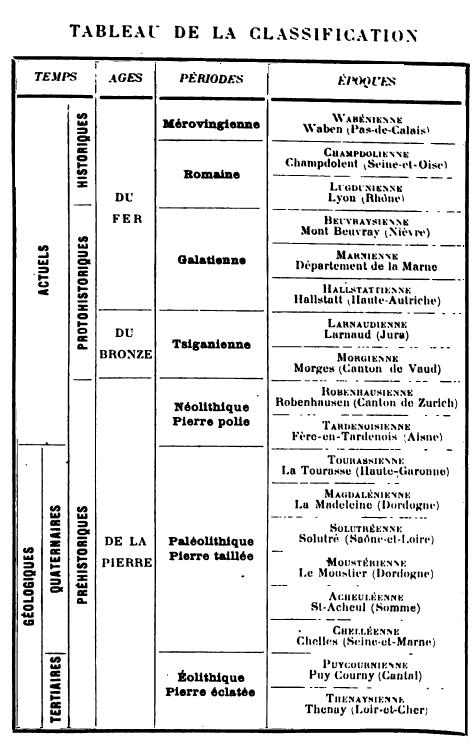
|
Musée préhistorique by Gabriel and Adrien de Mortillet.
1903 edition. The major change from the
1883 chart is two transitional epochs between the old and new
stone ages.
|
|
1,000,000 years ago
about 1,000,000 to 900,000 years ago The "end-
Villafranchian"
event. A practically total rejuvenation of the fauna of Eurasia, along
with new types of adaptation, and changes in climate and vegetation. May
have been triggered by tectonic movements in the mountain belts of central
and southern Asia. Major reorganization of large-mammal communities within
the interval from about 920,000 to 750,000 years ago, which is from the
early to middle Galerian mammal age. The bear Ursus dolinensis and the
bison, a more evolved form than Bison (Eobison), are taxa typical of the
beginning of the Galerian mammal age. Above beds with upper Villafranchian
fossils in East Anglia is the
Cromer Forest Bed. Early Cromerian and early
Galerian may be the same.
Choppers and flake tools (including scrapers) occur at a number of sites
before 1,000,000 years ago.
(Gilligan 3.2010) - Scrapers are possibly an indication of work
on hides for
clothing.
1,000,000 years ago "members of the genus
Homo living in Africa ... from which
all modern humans evolved ... probably had mostly naked and
darkly pigmented skin"
(Jablonski 2012)
Happisburgh: "Site 3 probably dates to one of the prominent warm stages
(i.e. those most likely to have supported deciduous forest and other
thermophilous plants)".
(British Museum) -
See
British Archaeology January/February
2006
About 80 flint tools
Footprints -
Research article: "Hominin Footprints from Early
Pleistocene Deposits at Happisburgh, UK" 7.2.2014.
Dates for Cromer Forest Bed: 780,000 to 450,000 years ago?
(Wikipedia). Link for
West Runton (mammoth and
rhino) - See Galerian
The three levels of the Thames Terraces: (gravels black)
Flood Plain Gravels (F.P.) are ones younger than the Taplow ones.
The Thames gravels were used to date the Piltdown gravels.
As a "missing link" between
monkey
and man,
Piltdown was considered as
buried in Boyn level gravels. The gravels he was alleged to have been found
in were, in fact, at the younger Taplow level. See
Piltdown geology.
The diagram is based on one by Henry Dewey and taken from
Wills 1929 p.241.
866,000 to
478,000
years ago or 700,000 to 650,000 years ago:
an
interglacial period - Called
Günz-
Mindel - Pre-Illinoian - or Cromerian. Called third
interglacial if dating backwards, but
H.G. Wells calls the "first interglacial period"
Chellean (Abbevillian) culture in France. The fossil locality of
Chilhac three is known for a rich
Villafranchian
fauna (Boeuf 1983) ......
thought to represent the earliest stage named Chellean (De Mortillet 1883).
See
Wikipedia. Possible fauna:
Etruscan
rhinoceros - Hippopotamus - Primitive horse - Sabre tooth tiger
- Broad
nosed rhinoceros - Straight tusked elephant - Giant beaver - Short faced
hyena - Deer - Bison - Wild Cattle.
"With extreme cold glacial times following the Cromerian, the European
Hippopotamus moved out of Britain, never to return. It would be another
250,000 years before a hippopotamus were to waddle into Britain again."
(Jan Freedman)
Cromerian interglacials starting 563,000 years ago
(MIS15)
- 533,000 years ago
(MIS14)
-
478,000 years ago
(MIS13)
|
"Prior to the Cromerian age the fossils are African"
"Australopithecus" - Then
"hominids are found in Asia and Europe as well - the volcanic
strata of
Java and the fossil beds near
Peking
and
Heidelberg
being good examples. These fossils have recently been grouped as
Homo erectus".
(Larousse Prehistoric 1957-1962).
Other finds were said to "show that the following animals lived in this
part of the Wealden country when Piltdown Man was here: Giant Elephant
(probably
Elephas antiquus). Horse
(Equus caballus).
Hippopotamus
(Hippopotamus amphibius). Red Deer
(Cervus elaphus). Beaver
(Castor fiber).
To these may be added the following from Eastbourne:- Small-horned
Rhinoceros (Rhinoceros hemitarchus *). Giant Irish Deer
(Megaceros
hibernicus ). Bison (Bison priscus). The country must have been well
wooded, and watered by rivers which were often bounded by swamps. The
climate could not have been very different from that of the present day,
only perhaps with heavier rain. It was indeed a truly mild episode in the
Great Ice Age, and the occurrence of the hippopotamus with the giant forest
elephant confirms the supposition that this was the earliest break in the
Arctic record. The Piltdown gravel is therefore shown to belong to the
early part of the
Pleistocene period." (pages 35-36)
*
Stephanorhinus hemitoechus - Dicerorhinus hemitoechus -
Rhinoceros
hemitoechus
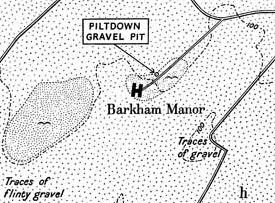
|
The geology of Piltdown, in the Weald of East Sussex: The area is
one of "Tunbridge Wells Sand" from the
cretaceous period.
However, in places, there are shallow surface deposits of gravel. These
deposits were not shown on the geological maps until after the first world
war. Workman repairing roads excavated them, however, and are said to have
provided Charles Dawson with his first scull fragment in 1908.
|
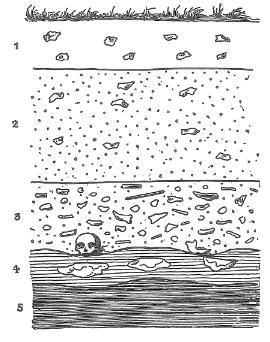
|
The strata at Piltdown.
1. 35 centimeters (14 inches) of surface soil
2. A few centimters to a meter (3.3 feet) of pale yellow gravel
3. 50 centimeters (20 inches) of dark gravel in which
fossil were "found"
4. 25 centimeters (10 inches) of gravel without fossils
5. Tunbridge Wells Sand
(Cretaceous)
Francis H. Edmunds mapped the Piltdown gravel in 1925. He found it
correlated with the
Thames Taplow gravels, much younger than the
Swanscombe terrace
deposits.
|
Another account has some Piltdown men (I)Eoanthropus
(Eolithic culture)
about
1,000,000
years ago probably living in "the valley of the early post-Pliocene
Thames". An Ice Age
started and then men of the
Old Stone Age
appeared in the lower part of the valley at least
500,000 years ago. These
included both
"Chellean
and
Acheulean Paleolithic cultures". The use of stone tools probably
began about 500,000 years ago. Chellean man developed stone tools for about
200,000 years.
about 781,000 to
126,000
years ago (655.000 years): Middle
Pleistocene
or Ionian stage. See
Mid Pleistocene Transition
"toolmakers graduated from the chopping tools to... a
handaxe, made of quartzite or flint"
(Coon, p.75).
During cold periods towards the end of the Middle Pleistocene,
proliferation of
scraper tools in the
"cooler climatic zones occupied by hominins, facilitated the manufacture of
simple clothing. (See
below)
(Gilligan 1.2010 and 3.2010)
about 750,000 years ago A date for Peking Man
(BBC - Wikipedia:
Peking Man -
Zhoukoudian caves - "a tool-maker, killed and
devoured his fellow beings and even knew the use of fire" (
Schenk, G. 1961, p.75)
MIS 17 - 712,000 years ago
MIS 16 - 676,000 years ago
|
MIS 15 - 621,000 years ago
|
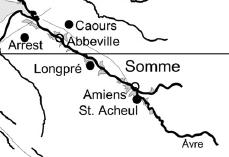
|
The Somme valley in northern France is developed on an
Upper Cretaceous
Chalk bedrock (continuous with that under the Thames) and has
has terrace system in its middle
part (about 70 km long). Between Amiens and Abbeville, ten stepped alluvial
formations (nappes alluviales) have been described.
|
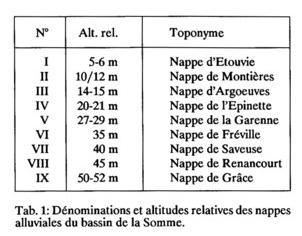
|
In the area of Amiens, the river terraces tiered system of Somme includes
ten fossil alluvial the oldest (the highest) was set up there more than a
million years. Numbered from the most recent to the oldest,
The upper terrace (Nappe de Grâce) weathered to red on the surface,
may be
attributed to the Older
Mindel
phase. These deposits are generally
decalcified, with little wildlife, except at Abbeville.
|
|
Table from
Le système de terrasses du Bassin de la Somme...
by Pierre Antoine. Quaternaire Année 1993 Volume 4
Numéro 1 pp. 3-16. See also his thesis:
Les terrasses quaternaires du bassin de la somme. ...
Thèse,
Université des Sciences et Techniques de Lille Flandres-Artois,
1989.
(offline) - and
Paléoenvironnements pléistocènes et peuplements
paléolithiques dans le bassin de la Somme 2003.
in Abbeville (Carrière Carpentier), where mammal assemblages show
that calcareous fluvial deposits have been deposited in an interglacial
environment. On the basis of terrace stratigraphy, ESR-quartz dating, and
biostratigraphic data, these fluvial deposits are allocated to
MIS 15.
Handaxes discovered at the base of the slope deposits, directly overlying
the fluvial sequence, can be, as a first hypothesis, allocated to
MIS 14. They are thus due to
Homo heidelbergensis according to the age of the eponymous Mauer
site in Germany. Consequently, in the state of knowledge, the "Rue du
Manège" and Carrière Carpentier findings represent the oldest
in situ evidence of the hominid occupation in the terrace record of
Northern France.
Dating the earliest human occupation of Western Europe:
New evidence from the fluvial terrace system of the Somme basin (Northern
France) by
Pierre Antoine, Emmanuelle Stoetzel and others 2015.
|
about 600,000 years ago The Heidelberg jaw discovered in
1907.
about 600,000 years ago First human settlements at
Stránská Rock, Brno, Moravia. Further settlements between
40,000
and
30,000
years ago.
(Wikiedia) See
Bohunician.
MIS 14 - 563,000 years ago
550,000 years ago Possible date for earliest
Somme valley
Acheulean remains (see below)
MIS 13 - 533,000 years ago
About 500,000 years ago Flints and a hominid tibia from
Eartham Pit. Boxgrove, Sussex in
Britain.
500,000 to 450,000 years ago Earliest human occupation in Somme
Valley according to
Antoine 2003 who says they already represented well developed
Acheulean
industries (about the start of
MIS 12
according to modern excavations)
478,000 to 424,000 years ago Mindel
glaciation
-
Anglian in UK - MIS 12 - "The Anglian Stage and Marine Oxygen Isotope Stage
12
started about 478,000 years ago and ended about 424,000 years ago." The
most extreme ice age during the last 2 million years. In Britain the ice
sheet reached Hornchurch in north-east London"
(Wikipedia). Equated with the
Elster glaciation of northern Germany, but dates
given are very different.
H.G. Wells calls the "second glacial age"
Quarry of Menchecourt at Abbeville (where
Boucher de
Perthes recovered antediluvian antiquities.
In the Somme terraces system in situ Acheulean settlements where dated to
early
MIS 12 at about
450,000
years ago in the 1990s, but new field
discoveries allow to increase significantly the age of the oldest human
occupation (Early Middle Pleistocene). The first one (Amiens "Rue du
Manège" 2007) is dated at about 550,000 years ago using ESR and
terrace
stratigraphy.
(Antoine, Stoetzel and others 2015).
The Abbevillian type site is on the 150-foot [45.72 meters] terrace
of the
River
Somme. Tools found there are rough chipped bifacial handaxes
made during the
Elsterian Stage of the Pleistocene Ice Age, which covered
central Europe between 478,000 and 424,000 years ago.
(Wikipedia). See
Mortillet
The Carrière de Menchecourt à Abbeville (Quarry of
Menchecourt at Abbeville), Rue de Haut
80100 Abbeville, France, in the grounds of what was the
Maison du Temple
à Abbeville (House of the Templers at Abbeville) was made
an
historical monument on 1.12.1983. (See
also)
Marcel-Jérôme Rigollot inspected the Abbeville
finds and Menchecourt quarry in 1853, and made similar finds at
Saint-Acheul in 1854. See
Mortillet
See Jardin archéologique de Saint-
Acheul -
Archeological Travel -
Le-Musee-Boucher-de-Perthes
424,000 to 374,000 years ago
[Marine Isotope Stage 11] or
300,000 to 250,000 years ago: an
interglacial period - Called
,
Mindel-Riss, Pre-Illinoian,
Holstein
and Hoxnian. Called second interglacial if dating backwards and by
H.G. Wells.
Boyn Hill Thames Terrace deposits
.
Sand and gravel
deposits underneath Swanscombe were laid down between 425,000 and 350,000BC
by an ancient course of the Thames,
(Swanscombe Heritage Park) -
Swanscombe woman
and
Steinheim (man?)
Swanscombe Animals: lion, straight tusked elephant - rhinoceroses - giant
deer - mice - bats - water voles - reptiles - fish - molluscs -
A climate slightly warmer than the present day.
MIS 11 424,000 years ago - Hoxnian Stage in Britain.
"Differentiating the two interglacials
MIS 11
and
9
is not always possible,
as they were short and sometimes shared common climatic and environmental
features.
MIS 10
is also considered to be short and is not always preserved
in the sedimentological record."
(Aggsbach's Paleolithic Blog)
The Clactonian is the name given to an industry of European flint tool
manufacture that dates to the early part of the Hoxnian interglacial.
a tufa deposit located at the top of a Middle Pleistocene fluvial
sequence... correlation of the Saint-Acheul assemblage with malacofaunas
recovered in other MIS 11 tufa deposits from the Somme and Seine
valleys....
reappraisal of these French molluscan assemblages shows that they are
similar to British malacofaunas of
Hoxnian
age. These new results strengthen the uniqueness and biostratigraphical
value of the 'Lyrodiscus assemblage'.
(N. Limondin-Lozouet and P. Antoine 2006,
"A new Lyrodiscus (Mollusca, Gastropoda) assemblage from Saint-Acheul
(Somme Valley): a reappraisal of MIS 11 malacofaunas from northern
France". Boreas, 35: pp 622-633).
See also -
and
|
400,000 years ago Common ancestors of
neanderthal humans and
homo erectus began separation. Neanderthal developed in Europe and homo
erectus in Africa.
The picture shows a racial depiction of the separation in a 1950s
Children's Encyclopedia. The separation of "ape men" from "true
men" is
shown as equivalent to, or greater than, that
separating humans from
gorillas and
chimpanzees. True men then divide into
two distinct lines - black (negro - negroid - australoid) and white
(european - mongoloid). This distinction is shown as equivalent to that
between
orang-utangs and gorillas.
|
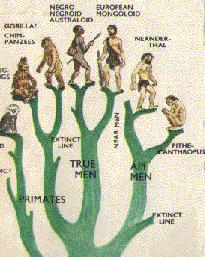
|
|
A group of individuals that actually or potentially interbreed in nature is
considered the same species, however different appearances. See
early human gene exchange.
|
about 400,000 years ago scullcap discovered in Olduvai Gorge by
Lewis Leakey in 1960.
Coon classifies as homo erectus.
|
400,000? years ago First use of fire
|
See trees.
|
about 400,000 years ago
Swanscombe woman lived and died in Kent,
Britain.
Charcoal may indicate fire. Before the
Boxgrove tibia,
her remains were the earliest in what became
Britain. See
Britain an island. She lived during the
MIS 11 interglacial, near
the start of the
Aurelian mammal age.
Argued to have a lower
Clactonian strata below an
Acheulean culture. One of the richest Pleistocene vertebrate
localities in Britain, and by far the richest locality attributable to the
Hoxnian
Interglacial.
About 400,000 to 380,000 years ago Wooden spears made of spruce of
from an ancient lakeshore hunting ground. Found in a coal mine in
Shöningen, near Hanover, Germany in 1997.

|
about 370,000 years ago Bilzingsleben site in Germany. In the 1970s
Dietrich Mania excavated "three round ground plans of dwellings
with
hearths by their entrances". (Antropark).
He "found large
stones arranged in a circular manner. He thought that it probably was a
base for a
dwelling. However, ring-center analysis showed that the site was
an open air site. C. Gamble proposed that humans congregated at the site
around the
fire".
Stone chopping tools of small size, mainly flint.
Numerous bone tools include hoes,
scrapers,
point
and gougers. Some hoes
made of antler or ivory. Some wooden artefacts preserved.
(Wikipedia)
|
Sewing The burin, a
stone chisel that could shape bone, was rare before the
Upper Paleolithic. Instead of bone awls, the Antropark website suggests, people made holes in
leather using wooden
awls made of dry yew and sewed with sinews. "Another
possibility was
to cut narrow stripes and to make small holes in those parts of leather one
wanted to join using a minor flake. The holes were cleaned using a sharp
piece of wood. The stripes were then pushed through the holes and parts of
leather were sewn together in this way."
|
350,000 to 250,000 years ago Steinheim skull
350,000 to 13,000 years ago Aurelian
Mammal Age. (after Via
Aurelia,
north east of Rome). Start indicated by the Irish elk (Megaloceros
giganteus), the
cave bear (Ursus spelaeus), and grey wolf (Canis lupus).
Few "archaic carnivores survived the transition to the Aurelian ELMA,
roughly around the beginning of MIS 9" about 333,000 years ago.
(Steven Churchill
2014).
MIS 9 - 337,000 years ago. Informally called the Purfleet
Interglacial
Wikipedia). See
GeoEssex
300,000 years ago "Cave bears inhabited caves in Europe throughout
the Pleistocene, from
about 300,000 to 15,000 BC,
disappearing by the end of the last ice age. Their population
seems to have diminished upon the arrival of
Cro-magnon in Europe" "Most
cave bears seem to have died off well before the
Weichselian glaciation".
(Cave Bears) - See
cave Chauvet and
Édouard Lartet's age
of
Middle
Paleolithic
300,000 to 30,000 years ago
300,000 years ago In the mont Châlat area of Chelles a
settlement of people whose flint tools were discovered in 1874. Near
Lauchonia sylva (forest) and the river Marne. See
flint biface in Musée
départemental de Préhistoire d'île-de-France,
Nemours, from the collection of local prehistorian Edmond Edmee Doigneau
(23.9.1825-4.5.1891). See
Mortillet
300,000 to 125,000
years ago
Rhodesian man - See
1921 and
1950s reconstruction and
Heidelberg.
250,000 to 120,000 years ago Riss
glaciation
Penultimate Ice Age.
H.G. Wells calls the "third glacial age"
Early
blade tools in Europe date from the penultimate ice age
The Riss is paralleled by MIS 6, 8 and
10, which would therefore place it about 350,000 and 120,000
years ago
(Wikipedia)
MIS 8: Somme level three: Argoeuves. 300,000 to 250,000 years
ago
lavalloisian
250,000 to 200,000 years ago First "true"
Neanderthals
(Whatever
that means)
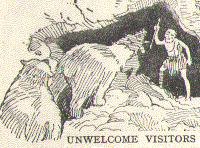
|
"Most of the
Mousterian
as well as the upper Paleolithic cultures seem to
have coincided with one of the
Glacial episodes when man dwelt chiefly in caves"
(Wills 1929 p.248).
"The cave bears were old tenants with long existing rights. But the
Mousterian hunters had... the courage of despair. They must be housed or
perish" (Rushton Hall
1928/1930 p.80)
|
220,000 to
40,000
years ago
Mousterian on
Antroparkbaby. Mode three
tools. Based on
Molodova -
Ukraine. Tool culture named after
Le Moustier. Associated
primarily with Homo
neanderthalensis.
Wikipedia dates Mousterian from
160,000
years ago - See
Mortillet classification
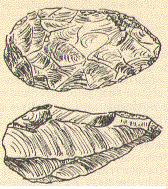
|
Mode
three tools: Flake tools struck from prepared cores, with an
overlapping sequence of flake removal (sometimes referred to as
façonnage) system - including the Levallois technology, See
Archaic Human Culture by Dennis O'Neil and
Making Flint Tools by Don Hitchcock.
The picture, from
Noël-Hume (1953), shows a
core culture axe at the top and then a flake point. Technology
moved its emphasis from fashioning cores to fashioning flakes.
|
sapiens: the wise, discerning, thinking
200,000 years ago "It is most likely that modern
Homo
sapiens born 200,000 thousand years ago, somewhere in Eastern
(Central)
Africa"
(Dates in the history of
biology)
(I have assumed it means 200,000)
The first
anatomically modern human fossils
date back 195,000 years.
Geneticists argue that almost all living men gained their Y chromosome from
a common male ancestor living between 140,000 and 60,000 years ago.
(New Scientist)
"Since the earliest appearance of modern humans more than
150,000 years ago during the
Pleistocene (Ice Age), people had always relied on hunting herds
of wild animals, fishing, and gathering wild plants to feed themselves...
All human groups during the
Paleolithic ("Old Stone") period during the Ice Age were nomadic
hunters and gatherers."
(Gil Stein)
190,000 to 50,000
years ago Range of stone tools discovered alongside
homo floresiensis the dragon island Flores in Indonesia.
(Wikipedia)
From about 180,000 to about 60,000
years ago: no evidence of human occupation in Britain, Wikipedia:
Prehistoric Britain
160,000 years ago
Between 130,000 and 114,000 years ago, the ice retreated during the
Eemian
interglacial
- and then advanced again to create the glacial that
most people know as "the ice age".
(New Scientist 24.5.2010).
Riss-
Würm. Corresponds to
Marine Isotope Stage 5e.
Called first interglacial if dating backwards, but
H.G. Wells calls the "third interglacial period"
The
Taplow Terrace dates to the rise of the sea in this
interglacial.
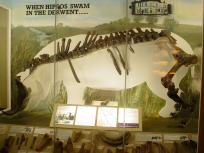
|
At the peak, Northern Hemisphere
winters were generally warmer and wetter than now. The hippopotamus was
distributed as far north as the rivers Rhine and Thames.
(Wikipedia) - and further north:
Bones from a hippopotamus, and some from rhinoceros and
elephant, were
dug up in Derby in 1895. They are now in the Derybshire Museum's
new nature gallery
|
121,000 years ago ± 4000 years: uranium-thorium dating of
Calcite
deposits overlying the bone-bearing sediments in the
Kirkdale Cave.
MIS 5: 130,000 to 71,000
years ago.
MIS 5e - 123,000 years ago. (Eemian or Ipswichian)
MIS 5d - 109,000 years ago.
MIS 5c - 96,000 years ago.
MIS 5b - 87,000 years ago.
MIS 5a - 82,000 years ago.
According to Unwritten History, Dawn man developed into river drift
man. River drift man began in the warmer climates that supported
rhinoceros, hippopotamus and straight tusked elephants in Britain. In the
succeeding cold period, river drift man developed into cave man
|
A large number of sites in Britain are attributed to Marine Isotope
Stage 5e, mainly on the basis of hippopotumus remains. None show signs of
humans. See
Nick Ashton
In Britain Elephas (Palaeoloxodon) antiquus is often found in association
with remains of hippopotamus in early Last Interglacial deposits (OIS
substage 5e), about 125,000 years old.
(Natural History Museum)
Harry William Whanslaw's picture (1934) shows "river-drift men" hunting the
"straight-tusked elephant of prehistoric time". A specimen from Upnor, near
Chatham, Kent, was mounted at the Bitish Museum of Natural History in 1926.
|
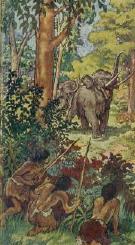
|
about 126,000 to
11,700 years ago Late
Pleistocene
or Tarantian geological stage. Strata start with sediments laid down at
the start of
the Eemian interglacial and
include the subsequent
ice age. Archaeological
remains include
scrapers,
blades,
awls and adornment. Industries with
blades and awls accompany humans into colder zones. Signs of
modern human
behaviour.
(Gilligan 3.2010)
125,000 years ago
Modern humans,
Homo sapiens, evolved in Africa up to
200,000 years
ago and reached the Near East around 125,000 years ago.

An attempt to depict migrations from
Madison Coonan's website
|
From the
Near East, these populations spread east to South Asia by 50,000 years
ago, and on to
Australia by
40,000 years ago, when for the first
time H. sapiens reached territory never reached by H. erectus.
|
H. sapiens
reached Europe around 40,000 years ago, eventually
replacing the
Neanderthal population. East Asia was reached by 30,000
years ago.
(Wikipedia)
110,000 to
12,000 years ago - The last
glacial
period - Weichselian
glaciation. Frequently just called the Ice Age.
H.G. Wells calls the "fourth and last glacial period"
last 100,000 years of the
Pleistocene
See
maximum.
100,000 years ago Noam Chomsky's date for the chance mutation that
he considers made the sudden appearance of
language possible.
100,000 years ago Blombos Cave, South Africa, tools for making ochre
paint.
(BBC) - Wikipedia
Blombos Cave
100,000 to 90,000 years ago
With the last Ice Age,
there developed the more-or-less continuous use of clothing. This was
partly because cold promoted the replacement of
simple clothing
(draped loosely over the body) by
complex clothing (shaped to fit body and limbs). This acquired
psychosocial functions
that have helped to maintain its continuing use up to the present.
(Gilligan 1.2010 and 3.2010)
80,000 years ago
"Climate Change May Have Spurred Early Human
Migration"
70,000 years ago A possible date for the
"Python Cave" evidence of
ritual in the
Tsodilo Hills of Botswana that some suggest is the first evidence of
religion.
(National Geographic report).
Bone tools in Blombos Cave, South Africa, indicate
"modern" behaviour in humans.
(National Geographic report)

|
Modern humans began living above the tropics more than 60,000
years ago.
|
Jablonski 2012 relates this, and
later movement, to survival value from light skin.
50,000 to 10,000 years ago
Upper
Paleolithic
(Wikipedia)
"Blades became the favored technology... although they are occasionally
found in earlier periods" (Wikipedia
blade). Stone burins (French for
engraving tools) or chisels were developed for carving
ivory,
bone and
antler
into spears, harpoons, throwers,
and portable art like figurines. See
Gravettian pictures
See
Epipaleolithic and
Mesolithic

|
Modern humans began living above 50 degrees north about
40,000 years ago.
|
Jablonski 2012
Prehistoric imagination, art and craft
"It was in the
upper Paleolithic
that for the first time man gave expression to his beliefs,
his feelings
and thoughts with figurines, engravings and exorcist
rock-paintings".
(
Schenk, G. 1961
, p.111)
Ice Age
art arrival of the modern mind (2013 exhibition at the
British Museum)
"Ice Age art was created between 40,000 and
10,000 years ago
and many of the pieces are made of
mammoth
ivory and
reindeer
antler
Édouard Piette (1827-1906) used the term glyptic for the period of
carved figures. In the
eburnien (ivory) period
he decided (from analysis of
carved figures) that two races existed: a hairy and a hairless race or a
fat (steatopygous) race and a not fat (asteatogenous) race. The fat race
became associated with the idea of people of
African appearance (but hairy)
living in Europe, and producing
fat Venuses, who were dominated by another
race - less hairy and thinner,
Cro-Magnons.
Between 38,000 and 29,000 years ago Aurignacian
Named after the
cave of Aurignac
Mode four tools: "Punch struck
blades with steep retouch" (Clark). A core
stone is prepared from which blades are struck and then retouched into
various specialized forms such as scrapers,
burins, backed blades and points. See
pictures
40,000 to 35,000 years ago
Venus of Hohle Fels figurine. Discovered in
2008 in the
Hohle Fels
cave in Germany. The figurine is tiny (6 centimetres). A nearby discovery
was a 20 centimetre long vulture's bone
flute
with four holes and a V-
shaped mouthpiece. See
Divje Bab eflute
36,000 years ago Goyet Cave, Samson River Valley, Belgium
Dog-like skull
36,000 years ago A date for the Man of Spy - Homme de Spy -
Mens van Spy. Discovered
1886. See
Espace de l'Homme de Spy
|
About 35,000 years ago,
Carleton S Coon begins his "second phase of
history" "the skilled hunter and healer", when "man covers the face of the
earth". Ending "about
7000BC with the invention of
agricuture". See
50,000BC and
phase
3
|
"thirty or thirty-five thousand years ago as the climate grew warmer" a
"more intelligent" race
"ousted the
Neanderthalers
from their caves ... they hunted the same
food; they probably made war upon their grisly predecessors and killed them
off"
(H.G. Wells 1922. Drawing inspiration from
Rutot and
Mascré).
Rutot called the new race
Paleolithic and argued that it enslaved the
Neandethals.
|
The end of the
Mousterian has now been pushed back to about
40,000 years ago. See
co-existence.
|
35,000 to
11,500 years ago
mammoths
in
prehistoric art
around 35,000 years ago The development of the needle. See
sewing -
22,000 years ago -
clothing remains -
manufacture -
needle lost -
needlework 1840 -
sewing machine
1917 -
About 35,000 years ago First human occupation of the
Grotte
d'Aurignac (Cave of Aurignac). Remains also show occupation
by wild
animals: 10 herbivores include horse
(Equus caballus),
aurochs
(Bos primigenius/Bison europceus), rhinoceros
(Rhinoceros tichorhinus),
mammoth, stag
(Cervus elaphus),
elk
(Megaceros hibernicus), roebuck (Cervus capreolus),
reindeer
(Cervus/Rangifer tarandus), and pig (Sus scrofa). Carnivores
included
cave-bear
(Ursus spelceus),
brown bear (Ursus
arctos?), badger (Meles taxus), polecat (Putorius vulgaris), cave hyaena
(crocuta spelae), cave-
lion (Felis spelcea), wild cat (Felis catus ferus), wolf
(Canis lupus), and
fox (Canis vulpis).
The oldest layer of the cave is later than the
Acheulean
(1,700,000 to
300,000
years ago), but before the
Solutrean
(approximately
22,000
to
17,000
before present), thus defining a
new prehistoric culture, the
Aurignacian
(approximately
39,000
to
28,000
before present), the first culture of the
Upper Paleolithic in Europe.
34,000 to
24,000
years ago "With the exception of dwarfed island descendants in the
Mediterranean, the expansion of cold grasslands and the contraction of
forests drove Palaeoloxodon to extinction" in Europe.
(National Geographic -
Wikipedia)
|
About 30,000 years ago, modern
homo sapiens entirely
replaced earlier
man-like forms. Weapons and tools of flint and bone survive
along with
female carved stone figures with exaggerated sexual features,
suggesting
fertility symbols and magical ceremonies.
Mentone caves. "Grimaldi Man" "The three best-known skeletons
(4,5,6) may
have been burials from an early
Upper Paleolithic
(Aurignacian or
Gravettian)
level into a sterile layer that may represent an interstadial period.
This last level immediately succeeds the latest
Mousterian horizon in the cave." (source)
A
1934 Encyclopedia
contrasts the "Grimalid Race" remains, which are of "a
Negroid type" with
"Cro-magnon remains" at a higher level in the Mentone caves.
|
Growth of the
ice sheets to their maximum positions occurred between
33,000 and
26,500 years ago. (Peter Clark and others
Science 7.8.2009).
MIS 2: 29,000 years ago (near Last Glacial Maximum)
30,000 years ago Gravettian on
Antroparkbaby, which calls
it "the biggest and the longest continued civilisation of the
modern man".
Based on
Pavlovian culture. Probably
Dolni Vestonice
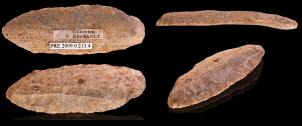
|
29,000 to 22,000 years ago: Gravettian toolmaking culture Named
after La Gravette in the Dordogne region of France.
(Don's maps). Toolmaking culture most closely
associated with
Venus figurines.
|
29,000 to 25,000 years ago. Pavlovian culture [a variant of the
Gravettian]
existed in the region
of Moravia, northern Austria and southern Poland. See
Antropark -
archive
28,000 years ago age of Cro-Magnon cave people: Louis Lartet Lartet
discovered the first five skeletons in the
Abri de Cro-Magnon in March 1868. "These Cro-magnon humans were
soon
identified as a new prehistoric human race distinct from the
Neanderthal
fossils discovered in Germany in 1856".
(source). A
1934 Encyclopedia
focuses on the
Mentone
caves (Italy) rather than France, contrasting Cromagnon with
Grimaldi man:
"It ws not until the opening-up of the Mentone caves that our
direct ancestors were found... early representatives of
Homo sapiens... named
the Cro-magnon Race".
and saying "These men men were the pre-historic artists and mystics",
speaking the possibilities of "a great beyond" in the "cults of nutrition,
death and motherhood" revealed by
cave drawings.
A 1952 Pictorial
Encyclopedia mentions cave painting and tools and says:
|
Nearly all ice sheets were at their
Last Glacial Maximum positions from 26,500 to
20,000
to 19,000 years ago
26,000 years ago
The mammoth hunter of Dolni Vestonice
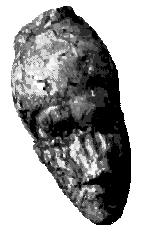
|
Head carved from mammoth
ivory showing a person with an asymmetrical face,
found in Dolni Vestonice, Southern
Moravia. It is a face:
"finely strung, lively,
sympathetic and also suffering, a being which stood facing the
world
devout, pure and humble. This picture...has all the
characteristics of
human elevation. Everything points to the Ice Age hunter
having depicted
himself". (
Schenk, G. 1961
, p.127)
First thought to depict a man, it is now known as Venus XV and the
consensus seems to be that it depicts the
woman who made the ceramic figures from
Dolni Vestonice]
|
about 24,000 years ago European
"cave bear"
(Ursus spelaeus) became
extinct.
Wikipedia on
Pleistocene extinctions: - Across Eurasia, the
straight-tusked elephant became extinct
between 100,000-50,000 years ago. The hippopotamus, interglacial rhinoceros
(Stephanorhinus), cave bear (Ursus spelaeus), and heavy-bodied Asian
antelope (Spirocerus) died out between 50,000-
16,000
years ago. The spotted hyena, woolly rhinoceros and
mammoths died out
between 16,000-
11,500 years ago. The
musk ox died out later, as
did the giant deer
(Megaloceros)
with the last pocket having survived until
about 7,700 years ago in western Siberia. A pocket of mammoths survived on
Wrangel Island until 4,500 years ago. - See
Édouard Lartet
about 22,300 years ago Kostenki I (Polyakov site) prehistoric
settlement in the watershed of the river Don in central Russia. Excavation
begun by I. S. Polyakov in 1879. See
"Palaeolithic Art from the Danube to Lake Baikal" by
Väino Poikalainen in Folklore
volume 18 2001 and
Kostenki Paleolithic site on the Don River
Flint points from Kostenki-I have use-wear traces of hide-working at their
tips indicating they were used as
awls.
(Gilligan 3.2010)
22,000 to 17,000 years ago: Solutrean
a mammoth and racing animal [reindeer] time (eburnien and tarandien) ... a
horse, mammoth and racing animal time (liquidien, eburnien and tarandien)
... a
Solutrien and Magdalenian time ... or a mild weather open sky and cold cave
living time... Von H. Behlen in Haiger. (1907?) "Der diluviale
(paläolithische) Mensch in Europa". [The diluvial (Paleolithic) humans
in Europe].
(Internet Library). Ebur: Latin ivory.
Reindeer in Latin: rene, onis, or tarendus
Eyed
needles from the Solutrean (dating to
MIS 2) at Grotte de
Jouclas.
France
(Gilligan 3.2010).
Marine Isotope 2 began 29,000 years ago near the
Last Glacial Maximum.
(Wikipedia)
22,000 years ago
20,000 to 19,000 years ago start of the Northern Hemisphere
deglaciation. (Source of an abrupt rise in sea level)
20,000 years ago
20,000 years ago to about 10,500 years ago Epipaleolithic or Levant
Mesolithic. The Levant is the eastern end of the Mediterranean: modern
Israel, Lebanon, Syria and Jordan.
See The Mesolithic (EpiPaleolithic) of the
Levant The "most diagnostic archaeological feature"
of the mesolithic "was a chipped stone industry characterised by
microlithic tools".
[Mode five tools]. See
microlith technology. Levant Mesolithic sites were
first discovered in Palestine. The earliest group of these sites
was called Kebaran.
(
(Wikipedia)). The second phase was called
Natufian.
Mode five tools: Retouched microliths and other retouched components of
composite tools -
Middle Stone Age toolkits included points, which could be hafted on to
shafts to make spears; stone awls, which could have been used to perforate
hides; and
scrapers that were useful in preparing hide, wood, and other
materials. (Smithsonian) - But see
Bilzingsleben and
Late Pleistocene -
Kostenki one
19,400 years ago Ohalo village of six circular
brushwood huts
on the shore of the sea of Galilee in Palestine.
Wikipedia -
Ohalo to
Jericho
19,000 years ago wolf-like
canid drawing, Font-de-Gaume, France.
By radiocarbon analysis charcoal and bone proteins associated with pottery
fragments in strata at Yuchanyan Cave, Hunan Province,
China, it has been possible to "securely date" the pottery to
"18,300 to 17,500" years ago. The cave was occupied from around
18,000 to 14,000
years ago.
(Elisabetta Boaretto and others, 1.6.2009).
Pottery "may be the oldest known to science".
(BBC News 1.6.2009). "The Yuchanyan pot is oldest
known clay vessel". History of "firing clay and making figurines" is "twice
as long as vessel making". See ceramic objects from
Dolni Vestonice.
Anthropology.net. See
clay and
settlements and
Robenhausian.
18,000 years ago
|
17,000 years ago is 15,000 BC
|
17,000 to
12,000 years ago
Darren Brewer's
events in science and history
begins between
15,000 and 10,000 BC with the world warming up from the ice
age and people
painting in caves. This corresponds with the five thousand year
Âge du renne (age of the reindeer). Name given to the final
phase of
the
European Upper Paleolithic by
Édouard Lartet in
1861. It
was later renamed the Magdalenian. The Magdalenian on
Antroparkbaby is based on
the cave of
Altamira which was occupied (used?) from
22,000 to
13,000 years
before the present.
(Museo de Altamira) - See
settlements
Stone burin (chisel) characteristic of the Upper Paleolithic
(especially
Magdalenian) in the Old World and of some Early Lithic and Mesolithic
cultures of the New World. Most stratified finds of spear-throwers (Europe)
come from the Magdalenian.
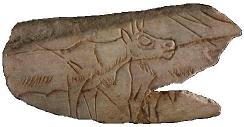
|
Fragment of engraved reindeer metatarsal decorated on one surface with two
reindeer, one of which is now incomplete. Length: 7.1 centimetres.
Width: 3.3 centimetres. Thickness: 2 centimetres. Stored in the British
Museum where the
acquisition notes say "exacavated by both Christy and Lartet in
1863".
|
about 17,000 years ago (15,000BC) Cave paintings at Lascaux, near
Montignac, south west France. Charging bulls. Discovered by three teenagers
searching their lost dog in 1940. Opened to the public in 1948. Closed
1963. Reproduction paintings now on view in the International Centre of
Parietal Art at Montignac.
16,945 years ago Eliseevich-I site, Bryansk Region, Russian Plain,
Russia:
"Ice-age
dogs"
16,000 years ago
|
about 15,000 years ago (13,000BC) Cave art
Trois Frères,
Ariège, France.
(French Wikipedia).
Dieu cornu (horned god) or Sorcier (sorcerer) or
chaman (shaman). In animal skins and stag antlers. Upper
wall above the entrance to the 20,000-25,000 year-old grand
gallery.
|

|
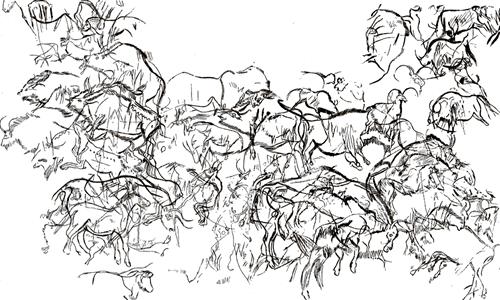
|
Petit Sorcier a l'Arc Musical (Little sorcerer with musical bow),
amongst animals in 285 cm wide panel on right hand wall of Sanctuary.
|
The two human figures in Trois Frères, are wearing animal skins as a
form of
clothing.
13,500 to 11,100BC Hamburg culture a Late
Upper Paleolithic
culture of
reindeer
hunters in northwestern Europe. Finds from this culture in
Scandinavia have been excavated since the early 1980s.
MIS 1
- 14,000 years ago: end of the Younger Dryas marks the start of the
Holocene, continuing to
the present.
14,000 to 15,000 years ago start of the
deglaciation of the West Antarctic Ice Sheet. (Source of an
abrupt rise in sea level)
about 14,500 years ago (12,500BC) to 11,500 years ago (9,500BC) Natufian
culture in the
Levant sedentary hunter-gatherers. -
Wikipedia
about 12,000 to
9,000BC Azilien cultural period. Mortillet's
Tourassien.
about
12,000 to
8,000
years ago - 10,000 to 6,000BC
Flood geology locates
Noah's flood.
|
Fossil
evidence: On "the highest mountains" "shells, skeletons of fish and sea
monsters" have been found, showing the sea once covered them. Animals are
found "far from their native areas": Elephants in England. Crocodiles in
Germany.
(Edwin Rice 1893). Coder and Howe's The Bible, Science and
Creation (1966, page 63) says "flood geology" dates creation to about
10,000
years ago "and relates most of the geological strata and fossil beds
to the Flood"
|
|
The flood
has been located (about 1870) between the old and new stone
ages. The New Bible Dictionary (Douglas 1962, page 429) relates much
"evidence of a serious flood" to the
Ice Age and suggests a
world wide flood might have been caused by "release of water" at the end of
that about "10,000BC"
|
12,000 years ago (12,000BP) is
10,000 BC
|
About 10,000BC End of last glacial period
(ice-age), beginning of
Holocene (recent), or present period with ice at the north and south and on
mountains. [About 11,700 years ago End of the
Pleistocene, start of the Holocene]. Holocene defined by
boundary between two ice layers in a core taken from Greenland and now
stored in Denmark.
On one system, interglacials are numbered backwards from the Holocene (1)
and glacials also backwards.
Spindle whorls. Thermal basis for greater use of woven fabrics in post-
glacial climates. Production of fibres for
textiles
a prominent feature of early
agriculture.
(Gilligan 3.2010)
12,600 years ago (10,600
BC) to 10,300 years ago
(8,300BC) Period when the
Baltic
was a large freshwater, inland, lake. The
Baltic Ice Lake.
(See
evolution of Baltic)
"Finds of
bone implements (axes, harpoons, fishing tackle), as well as of
very primitive
flint implements... These ... bone age people
evidently lived by hunting and fishing". (Hallendorff
and Schuck p.2)
See Hamburg culture -
bone -
Baltic sea -
7000BC Middle stone age -
Ertebølle culture
-
Meilgård midden -
Megalit graves
-
Alvastra -
single graves -
bronze -
iron
"Until recently, the last woolly
mammoths
were generally assumed to have vanished from Europe and southern Siberia
about 12,000 years ago", (Wikipedia)
Jodey Bateman's (2002)
Jericho history begins with Natufian camp
fires around 11,000BC. Around 11,000 to 10,000BC:
Levant
warm spell in which
Natufians occupied much of the Middle East. "At places like
Jericho they left the charcoal of their campfires and the distinctive tools
of stone and animal bone that they used". They deserted the Jericho site
during "a brief cold spell" from about 10,000BC to 9,800BC.
(Bateman 2002)
10,200BC Neolithic (new stone age) in some parts of the Middle
East (See Wikipedia) -
Europe.
Neolithic
barbarianism (Gordon Childe)
10,000BC - 12,000 years ago
|
Tell es-Sultan:
In Arabic, a tell is a tall hill.
In Midle East Archaeology, a tell
is a mound formed by the accumulated remains of ancient
settlements.
|
Jericho: Earliest permanent settlement at Tell es-
Sultan
(Wikipedia) dated between
10,000 and 9.000 BC. "The earliest remains date back to the
Natufian
period, 10th-8th millennia BC"
(UNESCO) - See
Ohalo to Jericho -
Bateman -
town -
wall -
Cipola -
second settlement
- 5500BC
- bronze age Jericho
- Jericho and Ai
destroyed -
Canaanites -
end of bronze age
town -
Joshua -
Hiel -
Judea -
end -
Herod's Jericho
"The round
pit-houses in Natufian settlements at
Jericho and
Abu Hureyra are some of the world's earliest known
villages."
(Gil Stein)
10,000 to 5,000BC: Mesolithic or Middle Stone Age in Europe. See
Levant -
(Wikipedia)
Core axe known as a Thames pick. Small blade
known as "microlith" used collectively mounted on wood in spears, and
harpoons and a borer.
"The oldest
clothing remains in the world in the Middle East dated
to around 9,500 years ago" . But we have evidence of the kinds of tools
required to make fitted garments - primitive
hide-scraping and cutting
devices and
needles. Until the last cold period,
30,000
years ago,
Neanderthals
did not bother with specialised cutting and sewing technologies."
Ian Gilligan. The Australian National University, See
ochre -
sewing -
50,000BC -
Trois Frères
art -
Spanish art
9,000BC - 11,000 years ago
8,500BC?
"The town of
Jericho", covering about 6
acres, preceded the wall by about
500 years". It contained round
mud-brick
houses, without street planning. (Wikipedia)
8,300 to 7,500 BC Pre-Pottery Neolithic A (PPNA) - cultivation of
wheat and barley.
As the
the Baltic ceased to
be a lake the "climate became less severe and the vegetation less stunted".
From this time onwards the "shores of southern Scandinavia yield numerous
traces of early man. In particular, the
'kitchen-middens'" "The
implements now in
use were generally made of flint". (Hallendorff
and Schuck p.2)
Eighth millennium BC
8,000BC - 10,000 years ago
Rock Art of the Mediterranean Basin on the Iberian Peninsula
(Wikipedia). "According to UNESCO, the oldest
art ... is from 8000BC, and the most recent examples from around
3500BC"
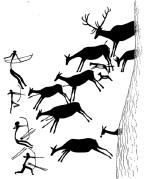
|
"The bow seems to have been invented near the transition from the
Upper
Paleolithic
to the
Mesolithic, roughly
10,000 years ago".
(Wikipedia). See
Valltorta
From 10,000 to 6500BC Valencian cave art. Scene of hunting of deer
with
bows and arrows. Wall painting in
Cueva de los Caballos in the Valley of Valltorta, Castell in Eastern
Spain
Other pictures from this area/period show people wearing
clothes.
|
About 8,500BC Initial domestication of taurine cattle from local
wild ox (aurochs) in the Near East. About "80 female aurochs were initially
domesticated". An initial breeding phase lasted some 1.5 millennia in an
area between the Levant, central Anatolia and western Iran. Domestic cattle
started to appear in western Anatolia and southeastern Europe by 6,800BC,
in southern Italy by 6,500BC and Central Europe by 6,000BC.
(Ruth Bollongino and others 1.9.2012) -
See also
Mario Melletti:
First cattle with short horns appeared in Mesopotamia about 3000BC
and was the most common form in Europe from about 1000BC.
"By the 8th millennium BC,
Jericho
became a big fortified town surrounded by a stone wall supported by a
massive round tower. These are the earliest urban fortifications known in
the world, later several times replaced" (UNESCO)
About 8,000BC
Star Carr in north Yorkshire, England. Post-
holes of a
round-house structure. About 7,600BC
Howick house, Northumberland, England. Similar to Star Carr.
7,500 to 5,700 BC
Çatalhöyük in southern
Anatolia. A city of
mudbrick
houses crammed together without streets between. Most entered
through holes in their roofs.
Wikipedia - Cast lead beads dating from about 6,500
BC. Earliest
metal smelted. See Moses metal
list.
Galena
is one of the easiest ores to
smelt. It can simply be placed in a fire and then lead can be recovered
from under the ashes when the fire goes out. Archaeologists have found
evidence that lead was smelted as early as 6,500 BC in what is now Turkey.
Small amounts of silver were refined from lead by the Romans about
2000 years ago. See lead UK
- Rutland 1470 -
Rutland 1810 -
Pb 1814 -
Rutland 1844 -
Crystal Palace 1854 -
Thomas Legge -
lead poisoning
1904 -
lead poisoning
1912 -
lead paint ban
1921 -
lead paint 1930-1955
-
lead in hair 1977
- lead in gardens -
lead paint ban
1992
7,500 to 6,000 BC Pre-Pottery Neolithic B (PPNB) - domestication of
sheep and goats,
cattle
and pigs. about 6,800BC Second settlement
at
Jericho: rectilinear
(straight-sided) mudbricks
buildings on stone foundations. "Square adobe houses".
At Jericho from shortly after 7,500BC to shortly before
7,000BC. Wall paintings show dances wearing masks. Seashells
(traded?) carved for necklaces and to make eyes in the skulls of their
dead. "Left Tell es Sultan shortly before 7,000 BC and the mound
which had
been building up for almost
1,000 years was deserted for
1,500 years"
(Bateman 2002).
Seventh millennium BC
About 9,000BP (7,000BC) insolation peak of Holocene. Separated by
some 115,000 years from the Eemian insolation peak at 125,000BP. Suggests
insolation maxima at about 240,000BP and 355,000BP.
7,000BC Indus Valley:
Mehrgarh precursor to the Indus Valley
Civilization.
Remains of an ancient farming
village
at
Jericho have been
carbon-dated
to around 7,000 BC. The same excavations uncovered materials
pre-dating agriculture which have been carbon-dated 800 years earlier
(Carlo Cipola 1962, pp 18-19)
7,000BC The climate in
Scandinavia was warming as it moved from the
Boreal to the Atlantic period. Reindeer and their hunters had migrated
to northern Scandinavia, and forests had established. Wikipedia
Nordic Stone Age
(Mesolithic)
Between 6,430 and 6,120BC Calibrated
carbon dating of an underwater
oak tree bole at the foot of the underwater cliff at Bouldnor in
the Isle
of Wight. Mesolithic remains recovered from this underwater site include
string (6,220-5,980BC), worked
wood
(6,240-6000BC),
flint tools and flakes,
and
burnt (cooked?) hazel nuts. There is an imaginative
re-construction of
this as a "Mesolithic
Village" at
CosmOnline.
Sixth millennium BC
About 6,000BC Rising sea level cuts Britain off from Europe.
About 5,000BC Rising sea level submerges Bouldnor Cliff
About 6,000 to 4,000BC
Neolithic or New Stone Age in Europe. [See
Middle East]
Marked by the adoption of
agriculture, the development of pottery, polished
stone tools and
larger,
more complex settlements. "European Neolithization ~6000-4000 BC
represents a pivotal change in human history when farming spread and the
mobile style of life of the hunter-foragers was superseded by the agrarian
culture".
(Tegel)
6,000BC or earlier: beans, lentils, peas, and
chickpeas believed to have become part of the eastern Mediterranean diet.
about 5500 to 45005BC Linearbandkeramik flourished in Europe.
(Wikipedia). "Longhouses, pottery and stone
tools". The
longhouses
have left "only ground-plans in the soil".
(Tegel)
about 5400BC The
Sumerian settlement of
Eridu (Eridug) founded on a site that was then close to the
Persian Gulf near the mouth of the Euphrates River. It appears to be the
earliest settlement in the region. The
Sumerian King List begins by saying that "After the kingship
descended from heaven, the kingship was in Eridug. In Eridug, Alulim became
king; he ruled for 28800 years." Sumerian was the first language
to be written. No related languages are now known. It died out
as a spoken
language about 2000BC
Enki, the god of wisdom, was the patron god of
Eridu. Sumerians
believed that he created civilisation by bringing humanity's skills
together in a cohesive world order. Sumerian language, writing and culture
continued after their passing, in Mesopotamia, under the
Akkadians and
Assyrians.
Assyrians belied that Enki gave his people
metal working skills.
(Haidar, D. 2011). See also
Ancient Mesopotamian Gods and Godesses
5500BC Pit-house dwellers at
Jericho made
pottery storage jars for
grain. A new people came who built houses of stone and adobe. The pithouse
people (unusual for Jericho or the Middle East) lived peacefully in the
same village with the house builders. Gradually everyone in the community
came to live in houses. The site was deserted again in
4000BC
approximately.
(Bateman 2002)
about 5300BC to
3950BC Ertebølle culture of
southern
Scandinavia. The last hunter-gatherer culture of the Stone Age?
Preceded
by Kongemose culture and followed by Funnelbeaker
culture.
(Wikipedia). The shell bank at
Meilgaard
was discovered in 1850.
5206 to 5098BC Date given to
oak timbers in excavation near Leipzig,
Germany, by Willy Tegel and Dietrich Hakelberg. See
"Early Neolithic Water Wells Reveal the World's
Oldest Wood Architecture"
|
From prehistoric to historic times:
|


|
Fifth millennium BC
5000BC to 4000BC Millennium between pre-history
and
(recorded)
history.
History is story told by human beings about human
beings, and our
first written records come from
Sumerian (southern Mesopotamia) and
Egyptian cultures
in the
fourth millennium
19th century historians were inclined to start
written history
much later, at the end of
the second millenium BC.
about 5000BC In Ensisheim, France, a 50-year-old man died. His
skull, excavated in "had two holes" that
Sandra Pichler (and others) 1997
say "were clearly the result of surgery, not violence".
(offline)
4700BC Possible beginning of
Sumerian
calendar.
4600BC to 4200BC
Varna Cemetry (Bulgaria). Some of the world's
oldest gold jewellery hanging on skeletons. See
silver and
coins.
4500BC Meilgård midden-settlement. In east of the coastal
forest of Nederskov on the
Djursland peninsula in
Denmark. Just north of
Meilgård castle. "Land covered debris" from a settlement
of the
Ertebølekultur about 4500BC.
(Panoramio -
fortidsmindeguide)
Worsaae (quoted
Gräslund, p.36) described artifacts found in association with shell
banks like this as
"rough-hewn flint axes, chisels, arrows, flint cores, nodules
and flint flakes made of deer antlers and a great many bodkins and
implements made of bone"
4228BC Possible introduction of
Egyptian calendar.
By 4000BC the
Sumerians
could melt copper - and so extract the metal
from its ore.
(Haidar, D. 2011). Copper Age also called
Eneolithic and Chalcolithic: Late 5th millennium BC in the Middle East and
the Caucasus for about 1,000 years to the
Early Bronze Age. The
transition from the European Copper Age to Bronze Age Europe occurs about
the same time, between the late 5th and the late 3rd millennia BC.
(Wikipedia)
Evidence of human use of the Spaccasasso cave in Southern Tuscany,
Grosseto, Italy, from
Late Neolithic to the Copper Age, the Early and Middle Bronze
Age, and Late Antiquity (5th and 6th centuries B.C.). The cave and
the calcareous rock face is characterised by thermal action, which
deposits mercury sulphide in the limestone rock and results in cinnabar
veins. Cinnabar minerals were mined in different phases
of the site's occupation. Copper age mining remains include a large
fireplace used to heat the rock face. Above this are copper age funerary
remains.
(Federico Poggiali and others 2015). See also
The Prehistoric Quarry of La Pietra ...
Copper Age Lithic Workshops and the Production of Bifacial
Points in Central Italy
by Adriana Moroni and others 2016.
Fourth millennium BC
"If the Creator made this world especially for man..."
Quran: thy Lord said to the angels:
"I am about to create man from
clay". Adam is considered the first of the prophets in
Islam. Others include
Ibrahim
(Abraham) - Musa
(Moses) -
Daud
(David)
- Sulayman
(Solomon) -
Isa
(Jesus)
- and Muhammad
4000BC
Sumerian
writing on
clay
tablets
using picture signs. See
Eridu -
2400BC -
library.
|
Foundations of 25 buildings discovered in peat wetland by
Robert Rudolf Schmidt
in
1930. About 20 two-room
houses with walls of split
wooden posts. A much
larger central building probably used for community acrivities. Other
buildings possibly for storage. A hunting community with wheat and barley
fields and livestock. Small polished stone hatchets and bone tools found.
Hearths and clay ovens in the houses. Unpainted pottery.
(Britannica)
"In prehistoric Europe the largest neolithic village yet known, Barkaer in
Jutland, comprised 52 small, one-roomed dwellings, but 16 to 30 houses was
a more normal figure; so the average local group in neolithic times would
average 200 to 400 members".
(Gordon Childe
1950)
|
3800BC
"Babylonian"
[Sumerian]
"census (for taxation purposes)" - Start of
Ed Stephan's
demography timeline and [Ireland's]
the census through
history an [UK]
census-taking in the ancient
world [Does anyone know the evidence?]
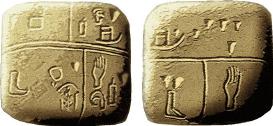
|
about 3500BC Limestone tablet engraved with pictographic writing
Kish,
Mesopotamia. Contains pictographs of heads, feet, hands, numbers
and threshing-boards. Now in the Ashmolean Museum, Oxford. Photographed by
José-Manuel Benito.
|
The cuneiform (wedge shaped) writing of
Sumeria (now Iraq)
starts about
3400BC. It is the earliest form of writing known that does
not use
pictures. The early stages of Egyptian hieroglyphics date from
about
3200BC
Metallurgists dealt with
copper for [over a thousand years before] bronze, an
alloy of tin and copper, was discovered. The Bronze Age in
Mesopotamia
started around 3300BC and it denoted that bronze tools, decorations
and weapons were commonly used and owned items. The
transition from the Copper to the Bronze Age was simplified because the
melting temperature of bronze is less than copper, between 1084øC and 232øC
449.4øF) depending on the percent of tin, so new techniques to cast and
forge bronze were not required.
(Haidar, D. 2011)
about 3600 to 2900BC Megalithic tombs in
Sweden. The oldest
megalithic tomb in Europe was built in Brittany around 4800BC. A few other
countries in Europe have tombs to the beginning of bronze age, around
1500BC. Skegried”sen is a well-preserved stone chamber tomb surrounded by
seventeen stones, dated 3000 to 2500BC. Wikipedia:
Megalitgrav -
Megalith. See
Alvastra and
single graves
about 3500BC New village on
Tell es-Sultan
now over 20 feet high is first of the
bronze age. Walled with a tower. Pottery styles show contact
with Sumeria and Egypt. Early village unplanned, with rubbish discarded
between houses. In "later Early Bronze layers" laid out in a grid and
rubbish discarded outside wall. Deforestation for construction or firewood.
(Bateman 2002)
Sometime between 3400BC and 3100BC: Death of Ötzi, the
Tyrolean Iceman.
Wikipedia
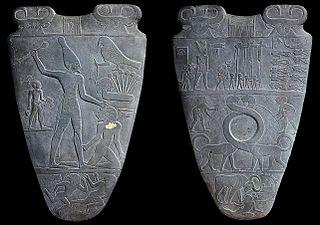
|
About 3100BC. Reign of Narmer in Egypt. The Narmer Palette (left)
was discovered by James E. Quibell in
1898 in Hierakonpolis. On it, Narmer displaying the insignia of
both Upper and Lower Egypt, giving rise to the theory that he unified the
two kingdoms and was the founder of the first dynasty.
Narmer is sometimes identified with Menes.
|
See:
5000BC -
calendar -
hieroglyphics -
Narmer -
papyrus -
geometry -
Old Kingdom
- Middle Kingdom -
Thebes library -
New Kingdom - Eighteenth Dynasty 1549-1292 -
Amenhotep 4 -
Nineteenth Dynasty 1292-1189 -
Ramesses 2 -
Twenty-sixth Dynasty 672-525 -
Amasis -
Ptolemaic (Hellenistic) -
Argead Dynasty
332-305 - Ptolemaic Kingdom 305-30BC -
Cleopatra
Papyrus, depicted on the
Narmer Palette, is a plant that grew in the river
Nile from which a writing material, also called papyrus, was made.
|

|
|
about 3100BC end of the Late Ubaid period in
Mesopotamia.
A
setlement from this period lay under the
Ur flood
deposit disovered by the archaeologist Leonard Woolley and announced in In
1929. Wooley believed the 3.75 meter (12 foot) thick clay deposit had been
laid down
by the
Great Flood. Jona Lendering
writes "It is likely... the event ... behind the myth... can be
dated to the end of Early Dynastic I period". (2,750BC?)
|
|
Third millennium BC
See
Wikipedia article on
Ancient History which has table from different parts of the world
from 3000BC
About 3000BC Alvastra pile dwelling constructed in the Dags Mosse
mire, Alvastra, Östergötland, Sweden. Swedish
stone age. See
Sweden graves
About 3000BC Silver first mined in Anatolia (Turkey) -
source. See
gold -
Moses metal list -
Shalmaneser -
coins -
Edmund -
Spain.
3000BC:
Five thousand years ago, the
Egyptians began the invention of
practical
geometry.
The waters of the river Nile
overflowed every year and wiped out the land boundaries.
Perhaps geometry
was invented because it was necessary to reconstruct the
fields for
taxation purposes and to tell people where to plant their
seeds.
One of the geometrical rules discovered was the
3,4,5
Rule
for constructing right angles. It
may have been discovered by people laying out fields, or
perhaps by
builders or architects. This way of making right angles was
used as a trick
of the trade. It was not known why the rule works, but it
does, and it was
used to make temples and
pyramids.
Cities
=
civilisation (!?)
Urban
revolution.
"About 5,000 years ago irrigation cultivation (combined with stock-
breeding
and fishing) in the valleys of the
Nile, the
Tigris-Euphrates and the
Indus
had begun to yield a social surplus, large enough to support a number of
resident specialists who were themselves released from food-production.
Water-transport, supplemented in Mesopotamia and the Indus valley by
wheeled vehicles and even in Egypt by pack animals, made it easy to gather
food stuffs at a few centres... Thus arose the first cities -
units of settlement ten times as great as
any known neolithic village."
(Gordon Childe
1950)
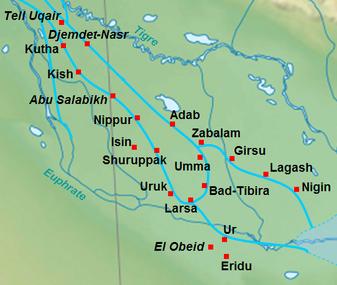
|
about 2900BC
Eridu (in southern Mesopotamia), argued to be the
oldest city in the
world has been said to have become a substantial city of
mudbrick and reed
houses covering 20 to 25 acres. Eridu is south of the (later)
city of Ur.
This are "was the birthplace of cities and of civilisation about 5,000
years ago and home to the
Sumerians
and the later
Babylonians".
(Stuart Campbell, Manchester archeologist.
See below)
|
about 2800BCE Swedish-Norwegian Battle Axe culture appeared.
It is known from about 3000 graves.
Wikipedia Corded Ware culture. Associated with single graves.
See
Sweden graves
"the stone-chamber tombs and the passage graves consitently
yield smoothly shaped, finished and sharp-edged flint artefacts and, in
addition, neat stone hammers, amber ornaments and earthenware pots, several
of which have quite tasteful shapes and decorations" (Worsaae quoted
(Gräslund, p.36)."
Old Kingdom of
Egypt
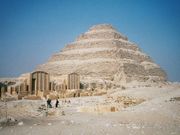
|
The first pyramid of Egypt. The Pyramid of Djzosèr built at Saqqara
in Egypt around 2630-2611 BC. Said to have been designed by Imhotep,
who may
be the first architect whose name we know, and who was defied 2.000 years
later as a god of medicine and healing. The picture is taken from the
Wikipedia website. Clicking on it will take you to more information
|
The pyramids in the Egyptian deserts are monumental
tombs for
the rulers of ancient Egypt, who were believed to be gods.
The Great Pyramids
at Gizah were erected about 2650BC. One of these, the grave of
Cheops, is
built of stone blocks
averaging
2.5 tons
in weight. The pyramid, 481 feet high, is of great
geometrical
accuracy.
The way the pyramids were built and the
mathematical
calculations
involved are
subjects of much speculation.
Jewellery From the
old kingdom onwards, much archaeological and textual evidence of
expeditions in search of
copper,
gold, turquoise, malachite and other
gemstones. (source)
about 2600 to 2400BC Early Dynastic Three period in
Mesopotamia - Royal
Tombs. A stratum from this period lay on top of the
Ur flood deposit
2400BC
Sumerian baked
clay tablets
with
arithmetic
. There is a large
body of mathematical tablets dating back to the
old Babylonian
period (1800 to
1500BC).
|
2348BC "The Second Age of the World" "When
Noah was 601 years old,
on the 1st day of the 1st month (Friday, October 23rd), the 1st day of the
new post-flood world, the surface of the earth was now all dry. Noah took
off the covering of the ark".
(Usher) refering to
Genesis 8:13.
See 1736
"evidences of the Deluge" and
flood geology. See
Epic of Gilgamesh and
Ur flood.
Picture described as "Various animals entering the Ark built by Noah
because of the great flood".
|
|
From the early nineteenth century (see
1849, for example) the term antediluvian
(before the deluge), sometimes lost specific reference to a flood and
referred to long extinct beings only known as
fossils.
2286BC One of the classical dates for the foundation of the city of
Babylon, originally a small semitic, Akkadian speaking city. See
Old Babylonian Period -
Hammurabi -
Ninevah falls -
and Nebuchadnezzar
about 2300 to 2200BC
Jericho and Ai (the largest town in the area) destroyed.
Invaders broke the walls of Jericho with fires.
(Bateman 2002)
2200BC Approximate date for the erection of the
standing stones at Stonehenge. The earlier earthbank and ditch have been
dated about 3100BC
2015BC Word
Siqlu, as a unit
of weight, in use in Mesopotamia. The Hebrew term shekel derives
from this.
Ur-Nammu, founder of Sumerian Third Dynasty
of Ur. See
... reconstructing the Ur-Nammu
Stela by Jeanny Vorys Canby. Possible dates for Ur-Nammu:
2112BC to 2095BC.
The
Legal Code of Ur-Nammu, written on tablets in the Sumerian
language
about 2100BC to 2050BC. Fragments are on display in the
Istanbul Archaeological Museums. The lugal (big man, or king) ruled
a society divided into two classes: lu
(free)
and
slave (male,
arad; female geme).
(Wikipedia)
about 2100BC in the Third Dynasty of
Ur, Early
Sumarian poems. Surviving copies of the complete
Epic of
Gilgamesh date from the
18th to
10th centuries BC. In these the
Cedar Forest, the realm of the gods, is
desecrated by Gilgamesh by cutting down cedars for
timber. See Jan Oosthoek
wood in world history.
Second millennium BC
"Old Babylonian Period" used for south Mesopotamia from about 2000BC
to
1600BC. Initially a
number of (city?) states dominating the
region: Isin, Larsa, Eshnunna and, from
1894BC,
Babylon.
Middle
bronze age in Middle East: 2100 to
1550BC
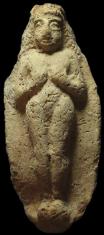
|
Excavation of Tell Khaiber, 20 kilometres from Ur
about 2000BC "We provisionally date the site to around 2,000 BC, the
time of the sack of the city and the fall of the last
Sumerian royal dynasty." Stuart Campbell, (April 2013)
,Manchester
archeologist
excavating at Tell Khaiber, 20km from Ur, "the last capital of
the Sumerian royal dynasties".
-
Web page of Ur Region Archaeology Project
The naked lady features on the 2013 Report
The
Jewish
book of Genesis say that
Abraham came from
"Ur of the Chaldees"
(Genesis 11:31)
|
around 2000BC
Middle bronze
age Jericho (Canaanite)
had stone walls six to nine feet thick on ridges of packed earth. The main
street, about six and a half feet wide, was built in stair steps to the top
of the mound and there was a small ditch alongside the street to catch rain
water and keep the area from flooding. In the Middle Bronze, about 200
settlements on the highland ridges including Jerusalem, Hebron and Nablus
(Shechem).
(Bateman 2002)
2000BC Time that Cadmus would have introduced the original
(Phoenician) alphabet to Greece if the speculations of
Herodotus were correct. See
Hobbes on the invention of letters.
about 2000BC The
Lavagnone plough (Italy), made of
wood, claimed to be the
world's oldest surviving plough.
"You might as reasonably expect to understand the nature of the adult man
by watching him for an hour.. as to suppose that you can fathom humanity by
studying the last four thousand years of its evolution"
(Herbert Spencer quoted by
Paul Hirst, 1976, p.32)
1921BC
Usher's Third Age of the World. Start of 430 years which
Abraham
and his posterity spent in foreign lands.
about 1850BC The "Petrie
Papyri", from Kahun and Gurob, (named after
Flinders Petrie who discovered them in
1889). "Principally of the Middle
Kingdom" They include literary, medical and vetinary papyri and
mathematical fragments. The three pages of medical text are all
gynaecological and include a brief passage that suggests crocodile dung
and/or honey to prevent child-birth. I think this is the bit with the
crocodile:

1812BC to 1637BC (175 years). Traditional
Jewish dates for
the life of
Abraham. "He lived, an hundred threescore and fifteen years". A
Christian
term for Abraham, Isaac, and Jacob and
other revered rulers of
families
(tribes) in the
Bible is the
Patriarchs. The same term is used for high ranking bishops in
the church. See
Die Familie
(1912). In Jewish tradition
"Abraham, Isaac and Jacob, known as the Patriarchs, are both the physical
and spiritual ancestors of Judaism". The word "Jew" is derived
from Y'hudah (Judah), the fourth son of Jacob.
Abraham's "family" or "household" was large. At one time he formed an army
of 318 "trained servants, born in his own house". He was "rich" in cattle,
silver and gold. All male members of his household
(slave or free) had to be circumcised.
Abraham was accompanied on his journey out of
Ur by his nephew, Lot.
Lot's adventures in relation to Sodom and Gomorrah are part of
the Jewish,
Christian and Muslim scriptures. These sinful cities were destroyed by
"fire and brimstone", brimstone being sulphur. See
gunpowder -
brimstone -
Paracelsus -
sulphuric acid -
Wesley -
sulphate -
manure -
phenothiazine -
child
labour -
antibiotic -
trace
methods -
surplus.
When Lot's wife turned to
look back, she became a pillar of salt.
1800BC
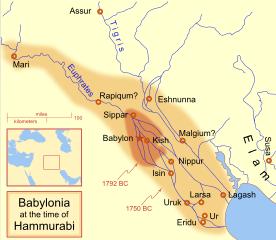
|
1792BC to 1750BC Reign of Hammurabi, who extended the rule of
Babylonia
throughout Mesopotamia
Code of Hammurabi - Babylonian law code.
|
1700BC to 1100BC Possible date range for the (oral)
composition of the Rigveda. - See
artificial limb
|
Sweden: Bronze age ahips
"The
stone age was followed by the
bronze age, which lasted from
about
1800BC
to 600BC" (Hallendorff
and
Schuck p.5). Johan Ling: BA Bronze Age
1700BC to
500BC.
about 1700BC to
500BC. Rock Art (Hällristningar - Cliff-drawings) in
Uppland,
Sweden includes some 2000 ship pictures. Drawings, dates and
text on these ships based on Johan Ling Rock Art and Seascapes in
Upland 2013.
|
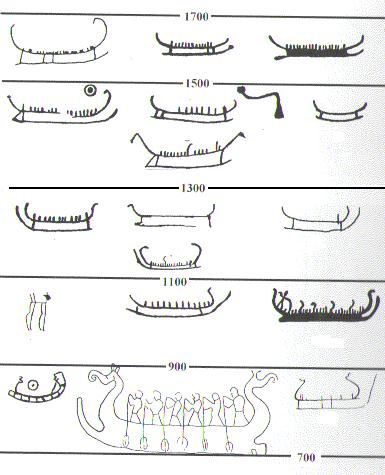
|
Early Bronze Age 1700BC to
1100BC
Period one
200 years to
1500BC - Period two 200 years to
1300BC
-
Period three 200 years to
1100BC
-
Late Bronze Age 1100BC to
500BC
Period four 200 years to 900BC -
Period five 200 years to
700BC
-
Period six 200 years to
500BC
Ling suggests that the rock art at Bogösa indicates a meeting ground
in a maritime space for a wide area that was, at the time, penetrated by
the sea. (p.96)
|
|
Metres above sea-level of lowest images from succeding periods (ordered by
type of ship): Period
one: 25 metres.
Period
two: 22 metres.
Period
three: 19-20 metres. Period
four to
five: 18 metres.
Scandinavian boat drawings have been interpreted as skin boats, planked
boats, dugouts and rafts.
|
1670BC
According to Lenormant, a royal
library was established at Thebes in
Egypt. See
Amasis
1650BC The Hyksos (Shepherd Kings) ruled northern Egypt.
(Wikipedia)
1600BC
about 1550BC (stratigraphical dating by Kenyon).
about 1573BC (later carbon dating): Destruction of the Bronze Age
Jericho.
1500BC Domestication of silk worm in
China. [I think this is far too late a date]. See
silk road and
rayon.
|
All images with inturned prows and horizontal or
slightly upturned keel extensions were 24 metes or more above sea level.
(Ling page 81)
|
|
1500BC to
1300BC: Baal with Thunderbolt.
(Wikipedia). Drawing
(1960) by Gillian Potter from
a photograph of the limestone stele in Musée du Louvre, excavated
(1932) from Ras Shamra, Ugarit.
Baal meant lord, master, owner or husband in Semitic languages. It was also
applied to
Gods. The plural was Baalim. Baalim might own specific areas,
being the Gods of specific peoples.
The
Jews
also called God lord and believed he had a special relationship to them.
However, they (eventually) believed in only one God (monotheism) who is
master of all, and they believed that graven images should not be made of
him. [See
ten commandments]
See Amenhotep 4
|
1400BC Possible date for
Jews
settling in what became
Israel.
Traditionally, the
ten commandments and the rest of the
Torah (Five books
of "law" or Pentateuch) is conceived
to have been received by Moses before this. The
Tabernacle, a portable shrine said to have been created by Moses
to contain the law, eventually became part of the
Temple
It is possible that the earliest of the Jewish psalms (sacred songs -
hymns) is Psalm 90 and that this was composed about 1400BC. Psalms
continued to be composed until a time
after the exile (Psalm 137, after 538BC)
1446BC Suggested date for fall of
Jericho to forces under
Joshua (Hoshea),
who
God told to "march around the city... with
seven priests carrying seven trumpets of rams' horns before the Ark".
When they heard the sound of the trumpet all the people were to shout
"and the wall of the city will fall down flat". "Cursed... be the man that
... Jericho. At the cost
of his first-born shall he lay its foundation, and at the cost of his
youngest son shall he set up its gates." (Joshua 6:26 RSV).
1380BC to 1050BC Approximate period covered by the
Jewish
book of
Judges. "In those days there was no king in Israel: every
man did that which was right in his own eyes". See
John Locke on
justice in a state of nature.
|
1300BC Suggested date for the (mythical) journey of the ship Argo in
which Jason and the other Argonauts sought the Golden Fleece. Vase painting
(480-470BC) in British Museum shows 4 oarsman, but 6 oars.
Suggested there were 12 men, 6 oars each side, 3 men to a bench.
|
1348/1346BC
Egyptian
pharaoh Amenhotep 4th raised Aten (the Sun) to
the status of supreme God. This, and the "Great Hymn to the Aten" have been
considered as origins of
monotheism
(belief in one God). Amenhotep's chief
wife was Nefertiti.
|
about 1279 to 1213BC Ramesses 2nd. The Ramesseum in Thebes is
the 'mortuary temple' of this
Egyptian
king. The
Petrie Papyri were
found beneath this.
|
1194BC to 1184BC Dates of possible conflict behind the
stories of a "Trojan War". Roughly corresponds with archaeological evidence
for burning of Troy 7.
1100BC

|
1100BC to
900BC:
Bronze four. In periods four and
five more elaborate
"depictions of humans" (Ling, page 87)
|
|
*********
|
19TH CENTURY
1800-1828
Robert
Owen
ran a model factory community at
New
Lanark in Scotland, demonstrating, he thought, that people
respond to good
treatment by becoming good people. This was a refutation in
practice of
Malthusian
pessimism.

|
Possibly at the turn of the century that this house was built by
Quakers to guard
the new entrance to their main London graveyard. It became known
as the "caretaker's cottage"
A hipped
roof, oriel sash windows and symetrical proportion show the
Queen Anne style as a standard of restrained middle-class
domestic architecture.
|
Monday 10.3.1801: First British
Census
The 1801 census recorded the
number of people in each parish, the inhabited and uninhabited
houses, and
classified occupations into agriculture, manufacturing,
commerce and
handicrafts.
Population of England and Wales: 8,893,000; Scotland:
1,608,000
The censuses of 1801, 1811, 1821 and
1831 were purely
numerical.
Names were first recorded in
1841. See
1851 -
1861 -
1871 -
1881 -
1891 -
1901 -
1911 -
1921 -
1931 -
[There was no census in 1941]
- See
1951 -
1961 -
1971 -
1981 -
1991 -
2001 -
2011 -
See
index history of statistics -
Vision of Britain -
Karen Berry's history
"
London had nearly 900,000 inhabitants, more than ten times the
population of its nearest rival in England, Manchester-Salford. Already
there were were 123,000 people living in the five outer parishes of
Kensington, Chelses, St Marylebone, Paddington and St Pancras, which a
hundred before had been
semi-rural
villages
with fewer than 10,000
inhabitants between them. By the year of the
Great Exhibition, the population of the present area of the
County of London had risen to 2,363,341."
(R.S.R. Fitter 1945 p.63)
|
October 1801 Having established the preliminaries of
peace with
the British, Bonaparte began preparation for a military
expedition to Haiti
to restore white rule. War between French forces and
Toussaint.
Autumn 1803 French forced to evacuate Haiti by the
black led
armies
1804
Immanuel Kant died
1.1.1804 First ever black republic established.
Called Haiti as
it had been before European conquest.
7.3.1804 The British and Foreign
Bible Society formed in London at a meeting of members of both the Church
of England and dissenting denominations. It sought to make cheap
(1611) bibles available in Britain and other countries "without
note or comment". The society was concerned about "recent attempts which
have been made on the part of Infidelity to discredit the evidence, vilify
the character, and destroy the influence of Christianity".
21.3.1804 The French civil code promulgated. Became the Napoleon
Code in 1807.
"My true glory will not result
from the forty battles that I have won. These will fade away because of
Waterloo. My
true glory will reside in my Civil Code, which will never be forgotten. It
is my Civil
Code, which will live eternally" (Bonaparte on
Sainte-Hélène. See
Catherine Delplanque)
May 1804 Napoleon became Emperor.
8.10.1804 The black leader of Haiti, Dessalines,
crowned himself
emperor as Jean Jacques 1st.
1805
Thomas Malthus became the first
Professor of
Political
Economy
|
In 1805 Mary Jane Godwin and William Godwin opened M.J. Godwin & Co.
Juvenile Library, a bookshop and publisher of mainly children's books.
They were joining a growing market. Their significant contribution, along
with
Mary and Charles Lamb, was to publish books that fed children's
delight in fiction and imagination.
|
1805 Collection at Lund University (Sweden) divided into
natural things, which became the foundation for the Zoological and
Botanical Museums; and ethnographic and archaeological artefacts, which
became the foundation of the Historical Museum. Lund was "the centre of
gravity in scientific archaeology in Sweden" until the middle of the 19th
century. (Gräslund, p.14). See
Bror Emil Hildebrand
1806
1806 A portraiture of Quakerism : as taken from a view of the
moral education, discipline, peculiar customs, religious principles,
political and civil oeconomy and character of the Society of Friends
by
Thomas Clarkson
published in London.
20.5.1806 John Stuart
Mill, co-author of
the future of the
labouring classes, born. (early
life)
Harriet Taylor was born 10.10.1807 (life and
ideas).
|
October 1806, Napoleon won the
battle of Jena against the Prussians. Hegel described him as
"the soul of
the
world"
The picture (1810) by French artist Charles Meynier of Napoleon's entry in
Berlin is described by
Rene Girard as the symbolic beginning of the Franco-German
enmity - See symbolic
end
|
1807
|
22.5.1807 Oldsagskommissionen (The Antiquities Commission)
established in Denmark. Members of the (University) library commission were
begining to organise a collection of antiquities in the roof of
Trinitatis Church, Copenhagen. They were allowed to start a
collection rune stones at the Round Tower. These were steps towards a
future "Nazionalmuseum". (See Thomsen). Det Kongelige Museum for Nordiske
Oldsager opened
to the public in 1817.
|
|
|
In 1832 the museum moved to Christiansborg Palace
and later moved it to the Prince's Palace. The Nationalmuseet,
incorporating the collections, was established by Royal Decree of
28.12.1892.
|
25.3.1807 British Parliament prohibited slave trade. (1807 Abolition
of the Slave Trade Act
became law) -
National Archives weblink -
Wikipedia
|
In Thomas Rowlandson's
cartoon (from which the pictures are taken), a gentleman explains that coal
is steamed, producing tar or paint for the outside of houses, and then the
smoke is passed through, removing its substance and then burns "as you
see".
|
|
The chemical
combination of
different atoms in different proportions producing substances
qualitatively
different from each other - although the constituent atoms
remain the same.
The experimental power of this theory (related to the
calculation of
weights) laid the foundations of modern
chemistry - And put an end to any idea that qualities can only
be explained
as a result of the merging of constituent qualities.
(external link)
a precise and
beautiful
theory
|
1808 Charles Fourier
Théorie des quatre mouvements
et des destinées générales -
(Theory of the Four Movements and General Destinies)
"As a general thesis: Social progress and
historic changes occur by virtue of the progress of women toward liberty,
and decadence of the social order occurs as the result of a decrease in the
liberty of women."
(external source - See
Engels and Marx
1845
-
Compare with John Stuart Mill)
1809 Jean-Baptiste Lamarck's
Philosophie zoologique, ou exposition des considérations
relatives à l'histoire naturelle des animaux. (Zoological
Philosophy. An Exposition with
Regard to the Natural History of Animals) - One of the books in which
Lamarck set out his theory of
evolution. -
External link to extracts in English
1810
12.2.1810 French
Code pénal de 1810
1810 Sun Life Assurance Society founded
as part of the
Sun Fire Office to provide life insurance. It became part of
Friends Life in 2010.
1810 Great Rutland
Cavern -
at Matlock Bath
opened to the public as a tourist attraction.
Developed from part of the Nestus Mine, which has written records
from the
15th century. The Duke of Rutland owned mineral rights in the
area. The
Great
Masson Cavern
was opened in 1844. Rutland remained (1920s) the largest of the Matlock
caverns open to the public, it had room for a thousand people and was
"extremely rich in fossils and minerals". At some stage,
after 1838, it was gas lit.
Its
"Roman Hall" claimed to show traces of Roman lead mining.
March 1811: Percy Byshee Shelley, a young aristocrat, expelled
from
Oxford University
for publishing a pamphlet on The Necessity of
Atheism and
challenging the clergy to debate it with him. In the following
years he
distributed pamphlets to the working class calling for
revolution in the
cause of liberty, equality and justice.
The first two volumes of Barthold Georg Niebuhr's Römische
Geschichte (Roman History) were published in Berlin in 1811-1812. The
full three volume set was published in Berlin between 1811 and 1832. They
were translated into English from 1827 onwards.
1811 Antiqvitetskommissionen (Antiquities Commission) for Norway
established. This was the origin of the Oldsaksamlingen (Antiquities
Collection) at the University of Oslo.
(Norweigan Wikipedia)
1811 Joseph Anning found the scull like a crocodile in the rocks at
Lyme Regis. In 1811 Mary and Joseph found the rest of the body. In
1814 named Proteosaurus and from 1817
Ichthyosaurus. See
1820 -
1823 -
1828 -
Dorset page -
Bristol -
Torrens
1812
1812 to 1814 Robert Owen wrote his four
Essays on the Formation of Human Character
1812 Étienne-Géry Lenglet's
Introduction à l'histoire, ou Recherches sur les dernières
révolutions du globe et sur les plus anciens peuples connus
(Google books
offline)
-
(Introduction to History, or Research on the recent revolutions in the
globe and the oldest known peoples). Révolutions du globe (upheavals
of the world?) referred to cataclysmic events that may have structured the
earth's geology. These might include
Noah's flood, but the theorising is much broader.
1813
1813 Humphry Davy engaged Michael Farady as his assistant at
the Royal
Institution and entrusted him with performing the experiments
which led to
the condensation of gases into liquids by pressure.
1813 First edition of
James Cowles Prichard's
Researches into the Physical History of Man
1813 Essay on the Theory of the Earth translated from, the
French of M. Cuvier, by Robert Kerr with Mineralogical Notes, and an
Account of Cuvier's Geological Discoveries, by Professor Jameson.
Edinburgh. Cuvier text is a translation of the Discours preliminaire . . .
from Recherches sur les ossemens fossiles . . . Paris .. Second edition
(1815)
online.
|
End of the Napoleonic Wars
April 1814: Napoleon abdicated
Restoration of monarchies
throughout continental Europe. Louis 18th King of France.
|
18.6.1814 The Czar of Russia and King of Prussia, Britain's allies
against Napoleon, were received at the Guildhall in London. A reenactment,
called 'End of the Great War',
concluded the history of London and Empire in the
1911 Pageant of London.
"The world believed that the war had come to an end". [See
1910 and
First World War]
|
Humphry Davy patented the miners' safety lamp
1814 Jacob Berzelius' "Essay on the Cause of Chemical Proportions,
and on Some Circumstances Related to Them; together with a Short and Easy
Method of Expressing Them" in the Annals of Philosophy laid the
basis of using letter, or letter combinations, derived from Latin names, as
chemical symbols. For example, Pb from Plumbum for
lead. See
Peter van der Krogt
1814 First edition of The Matlock, Buxton and Castleton Guide,
containing concise accounts of these and other remarkable places and
objects, chiefly in the northern parts of the interesting County of
Derby, by Rev. Richard Ward who was the Anglican minister at Cromford
from before 1799 to 1839 and lived in Matlock (See
Oakhill). Second edition 1818. Sixth
edition 1825. In 1818 the three caverns near Matlock Bath are
Rutland, Cumberland, and
Fluor. By 1825, Devonshire and one at the base of High Tor had been
discovered. Devonshire, like Great Masson discovered later, was a natural
cavern.(See
John Mawe 1828).
1815 Napoleon returned, but was defeated at Waterloo
(18.6.1815).
|
1815 Corn Law. During the Napoleonic Wars farmers
flourished
because corn from abroad could not undercut their prices. Once
the war was
over foreign corn could come in and bring down the price of
corn. To
protect the rents of the landed aristocracy Parliament passed
the Corn Law
(repealed 1846)
which put taxes on imported corn.
This rise in the price of
the people's
staple food coincided with a period of widespread poverty and
unemployment,
following the end of the war. The cost of poor relief soared,
leading to a
movement to reform the Poor Laws
1815 William Smith's map A Delineation of the Strata of England
and Wales with part of Scotland was the first
geological map to
identify the layers of rock based on the
fossil they contained rather than
on their composition.
(external link) - See
Zhu Xi
18.8.1816 The Observer reported a project in
which a balloon
the
shape of a dolphin, powered by steam and with wings that would
act as
rudders would "carry the nobility and gentry to Paris, and
subsequently
elsewhere" in ten hours or less. [I do not know what
happened]. Balloons
for flight, carrying humans, had been demonstrated in France
in
1783, and used by Napoleon as military observation
platforms.
1817 Ricardo's Principles of Political Economy
and
Taxation published. People, like
Malthus
and Ricardo, who wanted to abolish any
form of poor relief were known as the Abolitionists. They
argued that poor
relief perverted the market, undermined incentive, reduced the
mobility of
labour and encouraged overpopulation. Such arguments were at
the strongest
about 1817. Between 1817 and 1834, when the
Poor Law Amendment
Act
was passed, they were modified considerably.
Wealth and Poverty: Malthus and
Ricardo
1818
|
1818
Chapter 18: Victor Frankenstein and Henry Clerval travel from London to
Scotland, avoiding "the great road to Edinburgh" in order to visit Windsor,
Oxford,
Matlock, and the
Cumberland lakes. The country around the village
of Matlock "resembles, to a greater degree, the scenery of Switzerland; but
everything is on a lower scale, and the green hills want the crown of
distant white Alps ...
We visited the wondrous cave, and the little cabinets of natural history,
where the curiosities are disposed in the same manner as in the collections
at Servox and Chamounix. ... From Derby, still journeying northward, we
passed two months in Cumberland and Westmoreland. I could now almost fancy
mr self among the Swiss mountains.
|
1819 Our Village sketches by Mary Mitford in The Lady's
Magazine. Idyllic pictures of an English
village, its cottages and
gardens and village green. Book form 1824 - 1826 - 1828 - 1830 - 1832.
John Clare's Poems Descriptive of Rural Life and Scenery was
published in 1820 and his The Village Minstrel, and Other Poems in
1821.
1819 Adam Sedgwick (1785-
1873), newly appointed Woodwardian Professor of Geology at
Cambridge and John Stevens Henslow (1796-1861) , newly
graduated,
went on a geological walking tour
of the
Isle of Wight, during which they conceived a project to
institute a society in Cambridge "as a point of concourse for scientific
communication". On their return they founded the Cambridge Philosophical
Society. Henslow became Professor of mineralogy in 1822 and of Botany in
1825, combining this with being a vicar from 1832. From 1837 he was Rector
of Hitcham in Suffolk, where he lived from 1839.
See
1842. An account that the
Isle of Wight Philosophical
Society was founded in 1810 and established a collection in 1819
is referenced to work by
Jackson in the 1940s.
The Isle of Wight Tourist, and Companion at Cowes (1830) by "Philo
Vectis" says the society was formed about 1822.
Martin Munt (2008) says "Collecting of geological specimens for
museum collections is documented as early as
1825". A
history was provided as part of the
Portsmouth Symposium's field excursion to the Isle of Wight on Saturday
2.9.2000.
16.8.1819 Peterloo. Troops fired on demonstrators in
Manchester.
(External Link- Spartacus
schoolnet)
The Times, 10.10.1819 page 4.
1819 Act for the Resumption of Cash Payments led to bank notes being
convertible to gold from 1.5.1821. Convertibility had been suspended in
1797. It was fully resumed
over a period of three years (1821-
1824)
JAMES MILL'S ESSAY ON GOVERNMENT
1820
James
Mill's
Essay on
Government
first
published in
the supplement to the Encyclopedia Brittanica. See
1825
1821 London sale of
Anning
fossils raised up to £400, which
rescued the family.
Monday 28.5.1821:
Third
British Census
Population of England and Wales: 12,000,000; Scotland:
2,092,000
|
1821 Discovery of
Kirkdale Cave
[Wikipedia]
- 1822 "Account of an Assemblage of Fossil
Teeth and Bones of Elephant, Rhinoceros, Hippopotamus, Bear, Tiger, and
Hyaena, and Sixteen Other Animals; Discovered in a Cave at Kirkdale,
Yorkshire, in the Year 1821: With a Comparative View of Five Similar
Caverns in Various Parts of England, and Others on the Continent" by
William Buckland. Philosophical Transactions of the Royal Society of
London, Volume. 112 (1822), pp. 171-236. Available
online
-
(offline) - "many small balls
of the solid
calcareous excrement of an animal that had fed on
bones".
Discussion - Buckland: See
Anning -
1823 -
1825 -
1828 -
1829 -
1845
1822
John Stuart Mill
and his
friends formed a Utilitarian
Society (broken up 1826).
Utilitarianism
was the dominant theory of Social Science in nineteenth
century Britain. It
was challenged by the French Sociologist,
Emile Durkheim,
in the 1890s.
July 1822
Lyell wrote to
Mantell with details of
the "anticlinal axis and order of superposition of the strata at Sandown
Bay" and their correspondence with the
wealden and cretaceous
systems of Sussex and Surrey with "a section from
Culver Cliff to Shanklin
Down" and a "suite of specimens".
(Mantell 1847)
1823
David Ricardo died
About 1823
John Stuart Mill allegedly arrested
distributing birth control leaflets to working class women. [I heard he was
dropping them into the "areas" of rich people's houses, where the servant
girls would pick them up.] See 1886 - 1934 -
1950s -
1957 -
1961 -
1964 -
1987 -
2008
|
1823
Whitby
Literary and Philosophical Society in with the prime
purpose to setup a
Museum. George
Young (1777 1848), a Presbyterian
minister, and John Bird (1768-1829: artist), two members, published A
geological survey of the Yorkshire coast : describing the strata and
fossils occurring between the Humber and the Tees, from the German ocean to
the plain of York in 1822
(online
offline), with a substantial revision in 1828
(online
offline). John
Bird became the museum's first curator.
(website)
Among the specimens was
Teleosaurus chapmani
catalogue
|
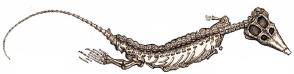
|
A second Whitby
crocodile
like
fossil was found
in the
lias between Staiths and Runswick in 1791, and better skeleton
in the
alum-shale
of the lias at Saltwick in 1824. This was eighteen feet long and became one
of the best known exhibits in the museum.
|
|
The drawing "Teleosaurus Chapmanni: Crocodilian remains from the Lias at
Whitby", of the specimen discovered in 1824, is from Buckland's
Bridgewater Treatise (1835), plate 25, but based on John Bird's
drawing in the 1828 edition of the Geological Survey (Plate 16. Two
page
spread. Hand coloured). Buckland's notes say this appears to be the
same species as that presented to the
Royal Society in
1758, and so Mr. Konig [of the
British Museum]
"has applied to it the name of Teleosaurus Chapmanni".
|
|
10.12.1823
Mary Anning discovered a fossil with a "remarkable long
neck and a small head", not resembling an
Ichthyosaurus. 26.12.1823 Letter with sketch suggests it
is a
Plesiosaurus (nearer to a saurus). Plesiosaurus was 9 feet long,
but its
head was only 4 to 5 inches long.
|
 Plesiosaurus and Ichthyosaurus appear to do battle in sketch for the
1854
exhibition
Plesiosaurus and Ichthyosaurus appear to do battle in sketch for the
1854
exhibition
|
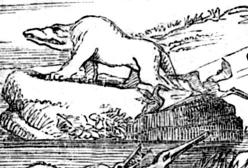
|
On 20.2.1824 a Geological Society meeting heard
a report on this find and one from
William Buckland on his
Megalosaurus.
The three images below, from the Oxford Museum of Natural History, show
Megalosaurus developing from
a waddler to a runner.
|
1824
German historian
Franz Leopold Ranke (21.12.1795 -23.5.1886) wrote that
rather than "judging the past" would seek "only to show what actually
happened" (wie es eigentlich gewesen)
1824
Comte
and
Saint-Simon
fell out over the way
Comte's
Systeme de Politique Positive was to be
presented in Saint-
Simon's Catechism Des Industriels
The Athenaeum club for leading artistic, literary and scientific men and
for patrons of the arts and sciences was founded in 1824.
Michael Faraday was secretary, and
Humphry Davy
chairman. The
Athenaeum literary and scientific periodical was first published in
1828.
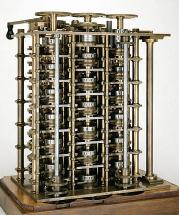
|
Charles Babbage (1791-1871) thought of the idea of a
machine considerably more complex than an
abacus to calculate and print
mathematical tables in 1812. He wanted to eliminate the inaccuracies of
hand calculations by large numbers of human "computers". Cogs would be more
reliable. He began his first machine in 1824 and it was put together in
1832 by Joseph Clement, a skilled toolmaker and draughtsman. It was a
decimal digital machine - the value of a number represented by the
positions of toothed wheels marked with decimal numbers.
|
about 1824-1825 Organisation of
Antiquities in Copenhagen on his three-age-
system, by
Christian Jürgensen Thomsen completed. The system was
described in 1836
1825
1825 Michael Faraday isolated and identified
benzene
from the oily residue derived from the production of
illuminating gas. He called it bicarburet of hydrogen.
In 1836, the French chemist Auguste Laurent named it
phéne. This is the word root of phenol and
phenyl. [See
phenothiazine]. Phenol is also known as
carbolic acid.
1825 James
Mill's Essay on
Government
(1820)
distributed in a free edition with other
essays. William
Thompson's Appeal on
Behalf of Women
written in collaboration with
Anna
Wheeler
criticised this essay.
. Thompson and Wheeler were
Irish Owenites who developed socialist theories from
Benthamism. See
Radicals, Socialists and Early
Feminists and
Thompson and Wheeler weblinks
December 1825: Two Lombard Street (London) banks failed
with
consequent failures of country banks. Over one hundred banks
failed in a
few weeks. The bank
crisis was stabilised by greater reliance
on gold, but
this was the start of the first world wide economic
depression.
"From the time of the resumption of cash payments by the Act of
1819, and especially
since
the commercial crisis of 1825, the favourite explanation of every rise or
fall of prices has been 'the currency;'"
(Mill, J.S.
1848 book three, chapter 8 "Of the value of money, as dependent
on demand and supply".
|
1825 Reverend Gerard Smith recovered fragments of fossil bones of
reptiles from Sandown Bay on the east of the
Isle of Wight. In 1829 James Vine found many near Brook
Point on the south-west coast, at the other end of the same
iron-stone
strata. They were numerous at "Bull-face Ledge", where "the
iron-stone
is
abundantly loaded with
prostrate trunks of fossil trees". (fossils sent to
the collection of the
Geological Society of London). In 1834 John Smith, of
Yaverland Farm, near Sandown,collected several large vertebrae
of the Iguanodon, portions of two thigh bones,
and many fragments of smaller bones, which were presented to the Oxford
Museum.
(Buckland 1829 and Mantell 1847)
1826 Benjamin Disraeli's Vivian Grey explored the relation of
birth, wealth and intellect to power, stating that "to enter into high
society, a man must either have blood, a million, or a genius". Vivian Grey
regrets that he is not the "son of a millionaire, or a noble". The word
millionaire had entered English from French in the late 18th
century. Here it is associated with the new rich finacial and industrial
classes. See also Marx and Engels 1848
paragraph 1.9 and
cotton millionaires in 1850.
|
Sometime in 1826: "Breast-feeding mother" by Willem Bartel van der Kooi
(1768-1836), a Dutch artist famous for pictures of family and childhood.
The mother is a Frisian woman from the countryside.
John Stuart Mill's melancholy winter of 1826/1827. Autobiography paragraphs
5.2c -
5.6
|
9.4.1827 was the end of the Liverpool Tory Government (The
only English
government to last longer than Mrs
Thatcher's).
30.4.1827 A foundation stone laid in Gower Street of
what became
London University, the first "godless" university in England.
Although many
who supported it were very religious, the University was
founded on the
principle that religious tests would not be required of staff
or students.
For the first time, dissenters and
jews
(in particular) could
study for a
degree without travelling to Scotland or continental Europe.
(external link) - The first academic sessions
started in October 1828 - On 28.11.1836 the university, renamed University
College, was united with King's College as the University of London. King's
College was a rival university founded by the established church. The North
London Hospital was opened opposite the university in 1834. It became
University College Hospital in 1837. See
1840s -
1846 -
1869 -
1871 -
1878
Michael Farady succeeded Humphry Davy in the chair of
Chemistry at the
Royal Institution. He published the first edition of
Chemical
Manipulation
August 1827 First edition of Popular Lectures on the Study of
Natural History and the Sciences, Vegetable Physiology, Zoology, the Animal
and Vegetable Poisons: And on the Human Faculties, Mental and Corporeal, as
Delivered Before the Isle of Wight Philosophical Society edited by
William Lempnere (a vice-President). A second edition was published in
1830. The curators of
the museum were Delabere [Pritchett] Blaine, author
of the Encyclopiedia of Field Sports, who died in the Isle of Wight
on 1.4.1845, aged 74 and Rev Edmund Kell (born 18.1.1799, died 17.1.1874)
Unitarian Minister at Newport since 1823. The Society met monthly during
the winter season, when a lecture was usually delivered at the Townhall by
one of the members upon any subject of natural history, or of general
literature. It was linked to the Portsmouth Philosophical Society. See
1847.
1828 John Stuart Mill established contacts with
Saint-Simonians
at the London Debating Society.
26.10.1829 Death of John Mawe (born 1764) minerologist owner of a
"Free Museum" at
Matlock Bath. See
Wikipedia.
The second edition of The Panorama of Matlock and its environs: with the
tour of the Peak was published in 1828.
The Matlock Tourist in 1838 says Mawe wrote this.
The Panorama says the
Devonshire Cavern "on the Heights of
Abraham, (Mount Parnassus)" was "discovered about four
years ago" (page 18). "It is visited by every curious resident; and, on
comparison
with the others, is greatly preferred, being a natural cavern,
and of very great extent, and presenting an ininite number of
'water icicles', (a most appropriate local term,) some of which
line the sides,
and others are pendant from the roof" "The Proprietor"
had "been at considerable expense" to provide easy access and
"driving a gallery through it to the open air".
winter 1828
Mary Anning discovered the first British example of a
"flying dragon" or
Pterodactylus, which caught the public's
imagination more than any other of her finds.
Dimorphodon macronyx (Buckland, 1829) PV R
1034 - Two articles by
William Buckland in
Transactions of the Geological Society of London, followed one
another: "On the discovery of a new species of
pterodactyle in the lias at Lyme Regis" and "On the Discovery of
Coprolites, or Fossil
Faeces, in the Lias at Lyme Regis,
and in other Formations" in 1829. (In
series 2, volume 3, 1835, see pages 217-240 and plates at end).
(offline)
"In the same
blue lias formation at Lyme Regis, in which so
many specimens of Ichthyosaurus and Plesiosaurus have been discovered by
Miss Mary Anning-, she has recently found the skeleton of an unknown
species of that most rare and curious of all reptiles, the Pterodactyle, an
extinct genus, which has yet been recognized only in the
upper Jura
limestone beds of Aichstedt and Solenhofen, in the lithographic stone,
which is nearly coeval with the
chalk
of England"
|
Buckland thought the Pterodactyle might be able to fly, swim, creep, or
climb, or suspend itself from trees. He compared it to Milton's description
of
the devil: "The Fiend, O'er bog, or steep, through straight,
rough, dense, or
rare, With head, hands, wings, or feet, pursues his way. And swims, or
sinks, or wades, or creeps, or flies."
Paradise Lost, Book 2. line
947.
|

|
1829
1829 Thomas Babington Macaulay's review of James Mill's
Essay
on Government criticised it for using
deduction
rather
than
induction.
1829
John Stuart Mill read Comte for
the first time.
1829
Robert Owen returned to England to find he is a guru of
the labour
movement.
May 1829: The British Association for Promoting
Cooperative Knowledge
founded in London.
4.12.1829
William Buckland read a paper "On the discovery of Fossil Bones
of the
Iguanodon, in the
Iron Sand of the
Wealden
Formation in the
Isle of Wight, and in the
Isle of Purbeck" Finds (by
local fossil collectors) helped to
connect "the geological structure of ... parts of the Isle of
Wight and
Isle of Purbeck ... with the Weald of Sussex and Kent".
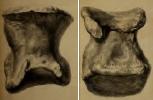
|
Two views (drawings) of Metacarpal bone of Iguanadon from Sandown Bay, Isle
of Wight. The vision of Iguanadon was initially deduced from such pieces.
Mantell used the
proportions
of eight different fossil bones compared with
those of "the recent Iguana" to calculate prehistoric Iguanadon's as
70 feet long (including 52.5 feet of tail) and 14.5. feet in body
circumference.
|
Mantell, in 1847,
noted that "the largest toe-hone of the Iguanodon now in my possession was
obtained from a row of stones placed round the flower-plot of a cottage
near
Brixton".
Swanage, in Dorset, is
located where
iron-sand divides the
Purbeck limestone to the south, from the greensand and chalk of Ballard
Down to the north. From Swanage bay. a Rev. F.O. Bartlett and Colonel White
had collected bones of fossils for Bartlett's museum, including ones from
Iguanodon, Plesiosaurus, crocodiles, and possibly Megalosaurus. Washed
from cliffs, the fossils had been rolled up and down the beach and
partially
eroded.
1830
5.7.1830 Start of French invasion of Algiers. "The invasion marked
the end of several centuries of Ottoman rule in Algeria and the beginning of French
Algeria" (Wikipedia). This is considered te beginning of the second French
Empire. The occupation of French Indo-China took place under Napoleon 3rd.
See Roland Barthes
the signification.
9.8.1830 Louise Philippe proclaimed king of France. On
16.8.1830 ex-king Charles 10th left for exile in England.

|
28.8.1830 First threshing machine destroyed in the "Swing Riots" in
England.
|
|
15.9.1830 Railway opened between the port of Liverpool and the
cotton town of Manchester.
George Stephenson (9.6.1781 - 12.8.1848) constructed the line and his son
Robert Stephenson (16.10.1803 - 12.10.1859) designed and built the steam
locomotives.
The painting (a detail) of open carriages on the first day was painted by
A.B. Clayton in 1830
(Wikimedia Commons)
|
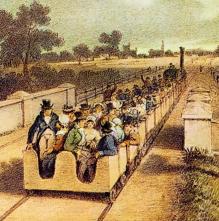
|
|
Charles Tayleur and Company at Newton Le Willows
opened in 1832 to produce girders for bridges, switches and
crossings, and other ironwork following the opening of the railway. Robert
Stephenson was a partner for a few years. Became The Vulcan Foundry Company
in (or by)
1847.
[See mythology Vulcan]
See
1854 -
1899 - and
Festivalof Britain 1951
and
Vulcan 1951 -
before 1960.
|
15.11.1830 was the end of the Wellington Tory Government in the
United Kingdom. 17.11.1830 was the start or Grey's Whig Government.
1830: Royal Geographic Society founded. It
incorporated the
African Society (founded in 1788), in 1831. From 1830 to
1840 it met
in the
rooms of the Horticultural Society.
[external link to history]. The
National
Geographic
Society of
the United States was founded in 1888.
1830 At
Lund, Bror Emil Hildebrand arranged exhibits according to
Christian Jürgensen
Thomsen's three age system. He did the same at
Stockholm between 1831 and 1837. Rudolf Keyser
applied the system in
Christiania (Oslo), Norway, between 1833 and 1836.
So, by the time Thomsen published his guide to the system in
1836, it was already
known and accepted in Scandinavia. (Gräslund, p.20).
|
|
1831
|
September 1831 British Association for the
Advancement of
Science founded. A brief (pdf) history on the
British Association's website
implied that an
objective was to make science more open, and less elitist. The
focus of the
Association's activities was its Annual Meeting "which was an
important
forum for major scientific announcements and debate". - There is now
a web brief history.
(archive)
Major scientific announcements the brief history lists are
"Joule's experiments on the mechanical equivalent of heat in the
1840s, Bessemer's steel process
(1856), the discovery of the first of the inert gases, argon, by
Rayleigh and Ramsay
(1894), the first public demonstration of wireless transmission
over a few hundred yards by Sir Oliver Lodge
(1894), and J. J. Thomson's discovery of the electron
(1899)." It also mentions the debate on
Darwin's theory in
1860. As can be seen, the
emphasis is on the natural sciences, and the new
statistical section (1835) was told not to be political.
|
The Spirit of the Age
Georg Friedrich
Hegel, the philosopher of history as the
development of ideas, died in Germany in 1831.
German
"idealism" and French
"positivism"
provided English speakers with alternative approaches to
social science to
utilitarianism.
John Stuart Mill's articles on the
Spirit of the Age (1831) showed the influence of
Saint-Simon
in his
explanation of the way different ideas fit different periods
of history.
Mill was a utilitarian arguing that there is a cultural
difference in what
gives pleasure. He adapted utilitarianism to the philosophy of
history.
Thomas Carlyle argued against utilitarianism in a fiction
called Sartor
Resartus (Latin for "clothes maker repaired"), which he
wrote in 1831
(published later). This argued for a social science based on
the analysis
of symbols. Clothes are typical social symbols. We are
naturally naked, but
in society we use clothes to convey meaning to one another.
Although the
movement of planets may be described on the model of a
machine, Carlyle
said social science requires the analysis of meanings.
Religion had
provided this, but, like old clothes, it no longer fits. The
times require
new clothes. Utilitarianism will not do, because it removes
the
significance of symbolic meanings, reducing them all to
degrees of pain and
pleasure in an effort to imitate the machine model used by
physics.
|
|
|
1832
|
1832
Michael Faraday
(England) Joseph Henry (USA) reported their
separate conversion of electricity into magnetism and back into
electricity.
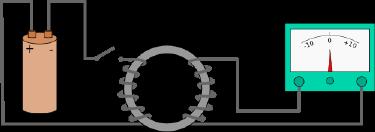
|
Faraday sent a current through a coil of wires,
creating a magnetic field which induced a momentary current in a second
coil.
|
This discovery of electromagnetic induction led to the development of
electric motors, generators and dynamos.
1832
Friends Provident Institution founded, on the proposal of Samuel Tuke and
Joseph Rowntree, "to provide the security of life assurance" to Quakers.
Office above a sweet shop in Bradford. See
online history.
1.2.1832 Royal Commission on the Poor Laws appointed. It
reported in
1834
14.4.1832
Robert Owen's penny paper
The Crisis began publication. "It is now evident to every
one who observes passing events .., that a momentous
Crisis is at hand".
June 1832 Insurrection républicaine à Paris en juin
1832 -
Wikipedia
6.6.1832
Jeremy Bentham died.
He left his body to medical science and you can still visit
his corpse at
the University of London.
30.6.1832 Society for the Diffusion of Useful Knowledge announced
planned publication of a Penny Cyclopaedia. When it commenced (1833?) there
were six penny numbers per month. On 13.11.1833 these were offered bound
together in cloth at 7/6d as Volume 1 - A to Andes. Price and numbers later
increased but the same publication plan continued until completion in 1843/1844. (See
article by James Carlile
Open Court
1919)
In 1832 a Whig Government passed a
Parliamentary Reform
Act (Royal Assent 7.6.1832). This did not add many
voters, but it spread
the vote more
evenly over
the country. There was a marked shift in the balance of power
from the
landed aristocracy to the urban middle classes.
|
|
1833
|
Emancipation of
Slaves: In August 1833, the British
Parliament
passed an Act prohibiting slavery in British colonies. This
Act came into
force on Friday 1.8.1834,
which was treated as a day of celebration by the people of
Britain. As in
France in 1794,
the
common people of the slave-owning country identified with the
freedom of
the slaves. This is how the novel John Halifax,
Gentleman (D.M.
Craik, 1856) described the celebrations:
"what a soft, gray, summer morning it was, and how it broke
out into
brightness; how everywhere bells were ringing, club
fraternities walking
with bands and banners, school-children having feasts and
work-people
holidays."
1833 The Swedish chemist Jacob Berzelius coined the term polymer
(many parts), originally for a compound with a formula that was a multiple
of another. (A definition still used in dictionaries). It has evolved into
a word for a compound with a large number of similar units bonded together,
with special reference to
plastics, resins and
rubbers formed of such organic compounds. See
nylon.
1833 A Topographical Dictionary of Great Britain and Ireland:
..., Volume 1 Compiled by John Gorton.
"Bristol, until eclipsed by
Liverpool, was the
principal port on the western coast of England. Its
lead-branch of foreign commerce is with West Indies, which it
supplies with
every sort of article necessary to the black and white population; and
receives back vast quantities of rum, cotton,
sugar, and other West India
produce in return.
Sugar
is the most important article,"
|
Franz Bopp's Comparative Grammar was published in Berlin in six part
in 1833, 1835, 1842, 1847, 1849 and 1852. The full title being
Vergleichende Grammatik des Sanskrit, Zend, Griechischen, Lateinischen,
Litauischen, Gotischen und Deutschen (Comparative Grammar of Sanskrit,
Zend, Greek, Latin, Lithuanian, Gothic and German). It is the comparative
study of languages that is thought of as the origin of scientific as
distinct from literary philology and linguistics.
|
May 1833 "Joseph Whitworth, Tool-Maker from London" established in
Manchester. Whitworth produced the machine tools which made the development
of railways and steamships possible. "He is best remembered for his
promotion of true plane surfaces and the Whitworth screw thread. His
promotion of standard measures and interchangeability brought about an
engineering revolution".
(Whitworth Society)
Statistical
Societies
formed
Members of the
British Association for the Advancement
of Science,
meeting at
Cambridge in the summer of 1833, formed a
statistical
section. - See
history on website of the
Royal Statistical Society). The Belgian mathematician
Quetelet was invited and presented a paper on the
relationship between the statistics of
crime and age in France and Belgium to a small private meeting
which included Thomas
Malthus and
Charles Babbage. Crime statistics were figures that European
states
had only recently begun to generate.
State generated numbers opened a bright new window through which
society could be looked at scientifically. Babbage proposed a statistical
section of the British Association (section F) and this was agreed on the
condition that it was non-political.
Manchester Statistical Society was established before
the end of
1833.
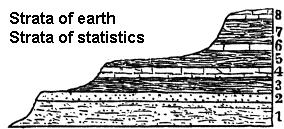
|
1833 In volume three of Principles of Geology,
Charles Lyell compared the
fossil record in succesive strata of
rocks to the records in a succesion of registers left by
census officials:
|
"Let the mortality of the population of a large country
represent the successive extinction of species, and the births of new
individuals the introduction of new species. While these fluctuations are
gradually taking place everywhere, suppose commissioners to be appointed to
visit each province of the country in succession, taking an exact account
of the number, names, and individual peculiarities of all the inhabitants,
and leaving in each district a register containing a record of this
information. If, after the completion of one census, another is immediately
made after the same plan, and then another, there will, at last, be a
series of statistical documents in each province. When these are arranged
in chronological order, the contents of those which stand next to each
other will differ according to the length of the intervals of time between
the taking of each census." (Lyell, C. 1833, p.32)
|
|
1834
|
The Statistical Society of London, which had been projected at
Cambridge,
was established in the spring of 1834, and
"since that time the pursuit of this science has extended very
rapidly".
Journal of the
Statistical
Society of London,
Vol.1, no.1 May 1838 p.4
The decision to found was made at a meeting at Babbage's house on
21.2.1834 and the society held its first meeting within two weeks,
setting down its aims as 'the collection and classification of all facts
illustrative of the present condition and prospects of society, especially
as it exists in the British Dominions'. The Council was elected at a
meeting on 3.5.1834.
(Archive)
9.4.1834 Start of the second revolt of the canuts and la semaine
sanglante (week of blood) in France.
(external link)
1834 POOR
LAW
1834 Poor
Law
Amendment
Act. By this Act a Poor Law
Commission was created to regulate the poor law centrally.
Under its
influence local authorities were encourage to build workhouses
and to
refuse poor people any welfare payments unless they left their
home and
lived in the workhouse. The Act was hated by the working class
who called
workhouses the English "Bastilles". To erect some workhouses
the government
had to provide an army guard. Malthusianism was blamed for the
New Poor
Law. So evil were its motives thought to be that many thought
they would be
poisoned in the workhouse to control population.
See Social Science History, chapter five:
Social Science and the 1834 Poor Law
The Theories that Smith, Bentham, Malthus and Owen
made
England's Poor Law
Commissioners
and the Trade in Pauper Lunacy 1834-1847
and
Mental Health, for the effect of the Act on
the growth
of asylums.
|
The Bridgewater Treatises On the Power Wisdom and Goodness of God As
Manifested in the Creation - published in volumes between 1833 and 1836
1833 Thomas Chalmers (1780-1847), On the Power, Wisdom and
Goodness of God as Manifested in the Adaptation of External Nature to the
Moral and Intellectual Constitution of Man - John Kidd (1775-1851),
On the Adaptation of External Nature to the Physical Condition of Man:
Principally with Reference to the Supply of His Wants and the Exercise of
His Intellectual Faculties - 3 William Whewell (1794-1866),
Astronomy
and General Physics Considered with Reference to Natural Theology
Internet Archive
offline
-
Charles Bell (1774-1842), The Hand: Its Mechanism and Vital Endowments
in Evincing Design
1834 Peter Roget (1779-1869) Animal and Vegetable Physiology:
Considered with Reference to Natural Theology -
William Prout (1785-1850) Chemistry, Meteorology, and the Function
of Digestion: Considered with Reference to Natural Theology
1835 William Kirby (1759-1850) On the Power, Wisdom and Goodness
of God as Manifested in the Creation of Animals and in Their History,
Habits and Instincts
1836 6. William Buckland (1784-1856) Geology and
Mineralogy
Considered with Reference to Natural Theology
online
Internet Archive
plates
offline
plates
|
|
|
1835
|
The first volume of
Alexis de Tocqueville's
Democracy in America
published in French. The second volume was published in 1840.
John Stuart
Mill wrote a review in The Edinburgh Review, vol 72,
1840.
Tocqueville's
Recollections were written in 1850/1851.
His
The Ancien Regime and the French Revolution was published
in 1856. He died
in 1859
Farr in "Mortality
of lunatics" has the idea of a natural death rate as something
distinct from the (statistically) normal death rate - without using these words
1835
Roderick Impey Murchison and Adam Sedgwick's "On the
Silurian
and
Cambrian
Systems, Exhibiting the Order in which the Older Sedimentary Strata
Succeed each other in England and Wales" since described as the germ of the
modern geological time scale.
|
|
1836
|
James Mill died
1836 The post of Registrar General (births, deaths and marriages)
for England and Wales created by the
Births, Deaths and Marriages Registration
Act. Registration began in
1837.
William Farr was appointed (first) Superintendent of the
Statistical Department in
1838. The Registrar
General was responsible the census in England and Wales from
1841,
1836
Contrasts by Augustus Welby Pugin published.
Asserted that only a Roman Catholic Society could produce a truly
Gothic style.
1836
Edouard Biot (1803-1850) [in French] "The Population of
China and its Variations
since the year
2400 BC, until the
thirteenth century AD"
1836
Christian Jürgensen Thomsen's Ledetraad til nordisch
Oldkyndighed. Published in English as Guide to Northern
Archaeology in 1848
|
|
1837
|
1837 A Descriptive and Statistical Account of the British Empire:
Exhibiting its extent, physical capacities, population, industry, and civil
and religious institutions by John Ramsay McCulloch assisted by
numerous contributors, published in two volumes under the superintendence
of the Society for the Diffusion of Useful Knowledge.
(Read online).
The chapter on
"Vital
statistics, or, The statistics of health, sickness, diseases, and
death"
was written by
Wiliam Farr. ["Vital Statistics" means "life statistics"]
1837 to 1839
Thomas Carlyle's two volume
The French Revolution established him amongst the chief writers
of the day.
February 1837 Digging began on the Clay Cross Tunnel in
Derbyshire,
to enable the Leeds to Derby railway to pass under Clay Cross Hill. It was
was completed in August 1839. Coal and iron deposits discovered during the
digging were the basis of the rapid expansion of Clay Cross as a mining
town. Its geology inspired the coal formation feature at the
1854 Sydenham display.
(History -
Domesday -
Clay Cross walk
May 1837 William Cooke and Charles Wheatstone patented their
electric telegraph which used a battery to send an
electric current down five wires to five needles which pointed to letters
and numbers on a panel. It was
first used by the Great Western Railway. [See drum telegraph]
1.7.1837
Registration of births, deaths and marriages in England and
Wales
required by law. - External link to
General Register Office
Poor Law Commission decide to extend the law to the north.
Opposition spread faster than the Commissioners. An Anti-Poor
law campaign
and a campaign to control factory working hours merged with
the campaign
for the Charter.
The Charter called for a vote for every adult male.
Chartists believed that if the working class could gain
control of
Parliament they would gain control of the welfare system and
of the
economy. Tied to the Charter was a plan to bring it about. A
large
demonstration would present a monster petition to Parliament
asking that
all men should have a vote. They would wait outside
Parliament and when
the petition was rejected they would declare themselves a
National
Convention -a kind of People's Parliament which would take
over from the
official Parliament - To enforce their will they would call a
sacred month
or national strike of the working classes. The use of the word
"Convention"
was seen as deliberate reference to the French Revolution. The
idea of the
"sacred month" was common amongst the Owenites.
Aborigines' Protection Society (London) founded in the
aftermath of
British emancipation of
slaves. The Ethnological Society of London was
founded in
1843
|
A young portrait of Victoria was used from her first coins of 1838 until
1887 for
gold
and
silver
coins, but continued in use until as late as 1895
on some
bronze
coins.
Victorian (and subsequent) pennies were legal currency in the United
Kingdom until
1971. The early Victorian ones were worn very thin by over a
century of use.
|
Isambard Kingdom Brunel (9.4.1806 - 15.9.1859) designed the first steamship
purpose-built for
regularly scheduled trans-Atlantic crossings. The ship was part of a
project that would link London, England to New York in the USA. This was
completed on 30.6.1841 when the Great Western Railway from Paddington to
Bristol opened.
|
The
Falmouth Art Gallery has this
wood engraving by W. Serjent
"The Great Western Steam Ship of Bristol"
|
19.7.1837:
Listen to the news on the day the
Great Western Steamship
(archive -
new)
was
launched at Bristol. It left on its first voyage
for America in 1838. There is also a
feature on the lunacy commission described in the news bulletin.
|
Hegel died in
1831.
The Doktorklub, later renamed Die Freien
of Young Hegelians met in Berlin in the late 1830s and early 1840s
|
|
This cartoon of Die Freien is by
Engels. I do not have a date.
|
|
|
1838
|
1838 The Principles of General and Comparative Physiology by
William Benjamin Carpenter. Developed in different formats over many years.
1846 A Manual of Physiology, including physiological anatomy Second
edition 1851
[Internet Archive] refers to
"green scum,
which floats upon ponds, ditches...
which consists of the cells of a minute Cryptogamic Plant". [Cryptogram =
non-flowering. We would now call the green scum
green algae]. He considered the chemical processes triggered in
this by light, uniting carbon and hydrogen and releasing oxygen. Carpenter
carried out microscopical studies of the
Foraminifera, minute shelled creatures found in surface waters
and oceanic (and geological) deposits. In the 1860s he was involved in the
debate over 'dawn life' fossils
Eozoon canadense.
Objective statistics In an 1820 paper to the Royal Society,
Benjamin Gompertz criticised life assurance societies for
selecting mortality tables that they hoped would be favourable to them,
rather than seeking objectivity. In 1838 he was a member of a
committee formed by seventeen assurance offices to pool information in the
search for reliable statistics.
1838 William Ewart Gladstone
The State in its Relations with the
Church "We have no fear for the Church of England in her
competition
with the denominational bodies around her."
1838 Anselme Payen, a French chemist, isolated cellulose
from plant matter and determined its chemical formula. The purest natural
form of cellulose is cotton fibre. Explosive "gun cotton" was made by
treating cotton with nitric acid. This "nitrocellulose" formed the basis of
early synthetic
plastics from
1862. Registered as Celluloid in 1870. Celluloid film became
the basis of
home photography (1889) and
cinema (1895).
Cellulose from wood (mainly) was the basis of the
artificial fibre industry that came to be known as
rayon (1900).
|
One spring morning 1838 A mirror
image of Boulevard du Temple, Paris
at "huit heure du matin" (8 a.m.) captured by Louis-Jaques-Mandé
Daguerre using a light-sensitised
silver
plate. The plate was exposed
in a camera for about ten minutes to take the picture. Moving objects were
not recorded but a shoe-shiner and his customer were still enough to be
immortalised.
|
See
photograph
- photo 1856
- cabinet cards 1863
- street scene 1865 -
film 1895 -
film 1900 -
photo 1905 -
passing life 1909 -
forgotten grief
1916 - working class
families 1920s -
Picture Post
|
September 1838 The London to
Birmingham Railway opened. The first main line in the world. [See steam and
commerce]
|

|
In October 1838,
Charles
Darwin
read
Malthus on
Population. This eventually led to his
theory of
evolution by natural
selection.
23.11.1838 A "Natural-History Society" established in
Warrington, which "is
already in possession of a Phrenological Society".
1838 Charles Lyell The Elements of
Geology
- Originally planned as volume four of
Principles
1838 The Matlock Tourist, or guide through the Peak produced,
in connection with the Centre Museum of J. Valence and Benjamin Bryan of
the
Devonshire Cavern. Of the
caverns of Matlock the guide
says "so rich and rare an assemblage of Minerals, Fossils, Ores,
Stalactites, and Crystals, in an almost ininite variety of
formation, is
not to be met with in any other part of the kingdom".
Rutland, at this time,
used candles to illuminate its roof. Bengal lights (blue flares) were used
in
Devonshire.
|
|
1839
|
The speed of
the train may annihilate distance: The
first volume of
The Quarterly Review (January-March) for 1839 started with an
article in
which the author suggested the current speed of possibly 30 miles per hour
might increase to sixty or even a hundred.
"It will be evident that the first effect of this increasing
series is the gradual annihilation, approaching almost to the final
extinction, of that space and of those distances which have hitherto been
supposed unalterably to separate the various nations of the globe; and that
in proportion as this shall be effected, the centralisation, whether for
weal or woe, of the human family, must be accomplished. For instance,
supposing that railroads, even at our present simmering rate of travelling,
were to be suddenly established all over England, the whole population of
the country would, speaking metaphorically, at once advance en masse, and
place their chairs nearer to the fireside of their metropolis by two-thirds
of the time which now separates them from it; they would also sit nearer to
one another by two-thirds of the time which now respectively alienates
them. If the rate were to be again sufficiently accelerated, this process
would be repeated ; our harbours, our dock-yards, our towns, the whole of
our rural population, would again not only draw nearer to each other by
twothirds, but all would proportionally approach the national hearth. As
distances were thus annihilated, the surface of our country would, as it
were, shrivel in size until it became not much bigger
than one immense city, and yet by a sort of miracle every man's
field would be found not only where it always was, but as large as ever it
was!"
7.5.1839 First presentation of the Charter to
Parliament.
12.5.1839 La Société des saisons launched an
usuccesful republican revolt against the July monarchy
(French Wikipedia)
9.7.1839 Completion of thirteen miles of
electric telegraph between the Paddington and West Drayton
stations of the Great Western Railway.
10.9.1839: John Frederick William Herschel to William Henry Fox
Talbot: I have not tried
Daguerre's process - But
I yesterday succeeded in
producing a photograph on glass ... The process ...
consists in depositing on the glass a perfectly uniform film of Muriate of
Silver - dry (by subsidence from water) - drying it - then
washing it with
Nitrate to render it sensitive... When placed glass foremost in the focus
of a Camera This takes the image with much greater sharpness than paper."
See also Fox
Talbot's paper based
salt print method.
|
|
Hungry Forties
|
|
The Hungry Forties; life under the Bread Tax was the
title chosen by
Jane Unwin, in 1904, for a collection of documents from the
1840s. The term
caught on as the British labour movement of the early
twentieth century
recounted to itself the struggles of its predecessors, and
British
communists studied the Communist Manifesto and tried to relate
it to the
decade that gave birth to it.
The "hungry forties", when a large part of the Irish peasantry
starved to
death and the condition of the English workers was also
miserable, had a
strong effect on the ideas about society of people of many
different
political persuasions.
But the date 1840 is artificial, the period really begins in
the 1830s. The
1830s and 1840s were a period of rapid industrial development,
social
distress and the emergence of open class conflict. A period
when Britain
came nearer to revolution than at any other time in recent
history.
It was also a period when people were thinking about how
society is
structured and how society changes. There was a great deal of
political and theoretical discussion, not only about class,
but also about
how we should think about men, women and children and their
position in
society.
|
|
|
1840
|
1840:
"In all ages woman may lament the ungallant silence of
the historian"
. The art of
needle-work from the earliest ages : including
some notices of the ancient historical tapestries by Mrs Elizabeth
Stone, edited by Mary Margaret Stanley Egerton, Countess of Wilton.
London: Henry Colburn 1840. ix and 405 pages. 1841 edition available at
Project Gutenberg
December 1840
An article
by Lord
Ashley
in the Tory
Quarterly
Review, discussed the employment of children in factories,
and argued
that society and the family in Britain were being destroyed by
the
industrial revolution. The way to restore a healthy society
was for the
rich to concern themselves with the welfare of the poor.
Brief note on Ashley
Ashley's
writings
Ashley in the 1830s and 1840s
Ashley as a Lunacy Commissioner
|
|
1841
|

|
1841
Ludwig Feuerbach,
in
The Essence of
Christianity argued that Christianity is a necessary phase
of human
culture whose essence is to understand human potenial in a heavenly rather
than an earthly form.
Feuerbach's earth-centred (rather than heaven-centred) view of religion has
been described as
anthropological and as humanist
|
|
1841 A Huntley and a Palmer (both Quakers) became partners in
biscuit making in Reading. This advertisement is before 1846. (See
Reading
Museum). Huntley had sold biscuits to travellers on (horse
drawn) coaches since 1822. Tins to preserve them were manufactured by one
of his sons from 1832. The square shape of the tins had to be modified when
they were sent by the new trains.
More about
biscuits
|
|
23.2.1841 The Chemical Society of London held its first meeting.
In 1980, the Chemical Society merged with the
Royal Institute of Chemistry, Faraday Society and the Society
for Analytical Chemistry to become the Royal Society of Chemistry.
15.4.1841 Pharmaceutical Society of Great Britain founded by
leading London chemists and druggists "for the protection of their general
interests and the advancement of the art and science of Pharmacy." Proposed
by
William
Allen, who became its first President.
Sunday 6.6.1841/Monday 7.6.1841:
Fifth
British Census
This recorded names for the first time. People over 15
years old had
their age recorded to the lowest term of five. The place a
person was born in was partially recorded: Y for born in the
same county, N
for not. S for Scotland, I for Irelend. For the first time,
householders
could complete their own forms if they were able to.
(Census layout - external)
Population of England and Wales: 15,914,000; Scotland:
2,620,000
Suicide
statistics:
Emile Durkheim's table of
"Stability of suicide
in the principal European countries (absolute figures)" has
time series starting in
1841 for France, Prussia, Saxony and Denmark, in
1844 Bavaria, and in
1857 for England.
Chesnais (2003) says that
"some countries have
time series stretching back to the
18th century and
in some cases, point observations dating as far back as
the
13th century". However, to "To ensure coverage of a sufficient
range of countries" he uses data starting between 1845 and 1855.
|
July 1841 Following on the Crocodilia, Richard Owen
introduced the
Dinosaurians (fearfully great lizards) in his "Report on
British fossil reptiles" to the British Association in Plymouth. There
were, he said, similarities in the "gigantic Dinosaur to the crocodilian
structure". "Owen used three genera to define the dinosaurs: the
carnivorous
Megalosaurus, the herviborous
Iguanodon and armoured
Hylaeosaurus" (Wikipedia).
September 1841 (London) Voice of Jacob launched by Jacob
Franklin. October 1841 Jewish Chronicle launched by Isaac
Valentine. The two papers merged in a complicated history.
Poems by Alfred Tennyson published. One that was soon
popular
(Locksley Hall), celebrates science and the march of
mind and
industry as the spirit of the age in Europe and contrasts it
with the
savagery of dusky races. (The words are Tennyson's, not mine).
"Here about the beach I wander'd, nourishing a youth sublime
With the fairy tales of science, and the long result of
Time;
When I dipt into the future far as human eye could see;
Saw the Vision of the world, and all the wonder that would
be -
In the steamship, in the railway, in the thoughts that shake
mankind.
Tennyson dreams of having children with a "savage woman" so
that they are
supple-sinewed, leaping brooks rather than poring over books,
but recoils.
"I the heir of all the ages, in the foremost files of time -
Let the people
spin for ever down the ringing grooves of change. Better fifty
years of
Europe than a cycle of Cathay."
Compare
with Barry
Cornwall
The poet recognises mind in women as well as men: "Women is
the lesser
man, and all thy passions, match'd with mine are as moonlight
unto
sunlight, and as water unto wine". In 1847 Tennyson published
a poem in
which a royal princess founds a women's university. She falls
from the
chastity of thought when she falls in love, but the dominant
image is that
European men and women are both to be engaged in the
adventures of science
and thought.
But the march of mind and the march of hunger are in
competition. In
the immediate present "all things here are out of joint,
science moves, but
slowly slowly, creeping on from point to point: Slowly comes a
hungry
people, as a lion, creeping nigher". (Quotations all from
Locksley
Hall)
May 1842 Second presentation of the Charter to
Parliament.
May 1842 John Bennet Lawes, of
Rothampsted, applied for a patent for "chemically
decomposing for purposes of manure by means of
sulphuric acid of Bones, or
Bone Ash or Apatite or Phosphorite or any other substances containing
phosphoric acid". (Patent 9353, granted November 1842).
sometime 1842
Fossils thought to be
coprolites
(fossilised dung) discovered at Felixstow,
on the Suffolk coast, by
John Stevens Henslow,
rector of Hitcham, leading
to the development of extraction for phosphatic fertiliser. See
1843 -
1845 -
1861 -
1872. See
Friends of Darwin -
O'Connor 1993 -
Berridge Eve 2004
1842 The railway from Derby opening as far as
Ambergate made day trips from Midlands' industrial towns to
Matlock Bath in the Peak District possible. From Ambergate,
visitors were taken in boats along the canal to Cromford. They then walked
a mile to Matlock Bath. Many factories organised excursions
on the annual works holiday. Sometimes parties of as many as 500 people.
(Fact Sheet)
7.6.1842
Lord Ashley introduced a bill intended to
ban women and
children from working in coal mines.
10.8.1842 Coal Mines Act became law.
Summer 1842 Plug riots. English workers, striking
for the
Charter, roamed the Midlands and North of England setting
light to rich
men's houses and pulling out the plugs of factory boilers.
Parliament
thought that the revolution was upon them.
1842 Volume 24 of the
Penny Cyclopaedia (Taiwan to Titlarks) included
a long article on
Teleosaurus
that starts "Since the article
Crocodile was written" Owen's
Report on British Fossil Reptiles has covered a "family of
extinct crocodilians" divided into two genera: Teleosaurus and
Stensosaurus.
|
|
1843
|
|
Blackwood's Magazine volume 53, p.397 "These are to constitute a new
science, to be called Social Ethics, or
Sociology" - First use recorded in the Oxford English
Dictionary.
|
1843 The Zoologist - A popular miscellany of natural history
a monthly magazine edited by
Edward Newman founded. Newman was editor in chief until his
death in 1876.
February 1843
Ethnological Society of London founded by members of the
Aborigines' Protection
Society. To be "a centre and depository for the
collection and
systematisation of all observations made on human races".
Divided over
racialist issues from early days, it split into an
Ethnological Society and
an
Anthropological Society in
1863.
Merging in
1870, it became
The
Anthropological Institute of Great Britain and Ireland in
1871. (Royal
from 1907). Now The
Royal Anthropological Institute (Link goes directly
to its
website)

|
29.3.1843 Colchester railway station opened. This was the then
eastern terminus of the Eastern Counties Railway from London
(Shoreditch/Bishopsgate)
passing through Stratford, Romford, Brentwood, and
Chelmsford.
|
|
|
1.7.1843 Gardeners Chronicle Advertisements for Guano and
for
J.Lawes's Patent Manures. Deptford Creek factory, opened 1843, later moved
to Barking Creek. Initial phosphate production from bones, but Lawes'
patent gave him a monopoly of manufacture from the new
coprolite.
|
Autumn 1843
John Bennet Lawes and Joseph Henry Gilbert established the
Broadbalk experiment
on Lawes' Rothamsted Estate in Berkshire. This was the first of the long-
term "classic experiments", and it still exists today.
A winter-wheat crop was first sown in the autumn of 1843. A control strip
has received no fertiliser or manure since 1843. Other strips have received
farmyard manure or inorganic fertiliser. Lawes was the pioneer of
artificial fertilisers having established the manufacture of superphosphate
at his factory in Deptford, England in 1842. See
1919
Rothamsted Experimental Station
1986 Institute of Arable Crops Research: See
Long Ashton Research Station
1999 Rothamsted Research
October 1843
Henslow had "called attention to the occurrence
of phosphate of lime in pebbly beds of the
red crag at Felixstow, in
Suffolk; these nodules, though extremely hard, presented external
indications of an animal origin, and yielded, upon analysis, 56 per cent.
of phosphate of lime...
In 1843 Edward Packard made a bone-based
superphosphate at Snape in Suffolk, and shortly after used local
coprolites, ground in a mill, as a base. In 1847 he took over an old
flourmill on the quay at Ipswich, first grinding coprolites, later treating
them with acid, but the fumes were unpopular, so in 1851 he moved to a site
between the navigation and the railway at Brantham.
(bagseals and
O'Connor).
|
Christmas 1843
The Song of the Shirt
Surrounded by comic characters, a poem about the misery of a
dressmaker appeared in the Christmas number of Punch, or the
London Charivari on 16.12.1843.
19.12.1843 A Christmas Carol in Prose, Being a Ghost-Story of
Christmas by Charles Dickens published as an (expensive) gift book.
Scrooge is visited by the spirit of the past, of prisons, workhouses and
asylums - and the humanity within them. Then by the spirit of the present:
a jolly one with food and drink. Finally, the spirit of
things to be calls on him to change his selfish ways.
(Wikipedia)
20.12.1843. Completion of the Penny Cyclopaedia of the society
for the difussion of useful knowledge (Volume 27, 10/6d bound in cloth.
Wales to Zygophylacea) London: Charles Knight. Begun
1833. Copies
at
Hathi Trust
|
|
1844
|
1844 A natural cavern at
Matlock Bath
opened to the public, called Great Masson. (See
Devonshire). Owned by
Greatorex family in the 19th century.
Entered by 400 yards of an "old Roman
lead mine". The natural cavern had been discovered "in
following a vein of lead". Sides and roof covered with fossilshells and
encrusted with crystals of dog-tooth and flour spar. See also
Rutland mine.
21.12.1844 The Rochdale Equitable Pioneers Society opened a shop
"selling pure food at fair prices and honest weights and measures".
(Link
to museum)
|
|
1845
|
1845
Vestiges of the Natural History of Creation
(external link -
archive)
"
Fifty years ago, science possessed no facts regarding the origin of organic
creatures upon earth ... all was a blank antecedent to the first chapters
of what we usually call
ancient history". [Since then] "researches in the crust of the
earth" [have shown that]... "strata of various thickness were deposited in
seas... The
remains and traces
of plants and animals found in the
succession of strata, show that, while these operations were going on, the
earth gradually became the theatre of organic being, simple forms appearing
first, and more complicated afterwards. A time when there was no life is
first seen. We then see life begin, and go on ; but whole ages elapsed
before man came to crown the work of nature.
"
1845 Johannes Japetus Steenstrup (1813-1897)
On the alternation of generations, or, The propagation and development
of
animals through alternate generations : a peculiar form of fostering the
young in the lower classes of animals.
Translated from the German version.
[Internet Archive
-
offline]
"I presuppose that my readers are
acquainted with the animals vulgarly termed
jelly-fishes or sea-nettles
and in scientific language Medusa". See
Darwin on jelly fishes -
Wikipedia
jellyfish -
Primordial soup.
Thomas Huxley's paper "On the Anatomy and the Affinities of the
Family of the Medusae" was published in 1849.
[Royal Society -
offline]
Tuesday 14.6.1845 at the 15th Meeting of the British Association for
the Advancement of Science, at Cambridge, Section C: Geology and
Physical
Geography. Paper from
Professor Henslow "On Nodules, apparently
Coprolitic,
from the Red Crag,
London Clay, and
Greensand" about potential source of
phosphate, which occurred near the surface over many square miles in the
vicinity of Cambridge in strata never more than a foot thick.
Buckland
doubted the coprolitic origin of the nodules. (Report in The
Atheneum)
1845
The Claims of Labour. An Essay on the Duties of
the
Employers to the Employed, published anonymously, argues
for a new
order of society based on benevolence of employers towards the
employed.
John Stuart Mill's review of The Claims
of
Labour in the Edinburgh Review argues that a new
moral order
based on benevolence would undermine the independence and
self-
determination of working class people
Summer 1845 Engels:
The Condition of
the Working
Class in
England
October 1845 Beginning of the Great Famine in
Ireland. Potato
blight destroyed three-quarters of the crop.
|
|
1846
|
26.6.1846
Repeal of the Corn Law
In Dickens' 1838 satire on the Poor Law, Oliver Twist caused a
sensation by
asking for more food. In 1846 it seemed the satire had come
true. It was
revealed that in Andover Workhouse the residents were so
hungry that they
fought over rotten bones. The scandal of Andover led to the
replacement of
the Poor Law Commissioners, in 1847, by a Poor Law Board
responsible
directly to Parliament and, under new management, the poor law
became the
centre of a remarkably extensive pauper welfare state. Poor
law hospitals
laid the foundations for the National Health Service - and
many are still
in use.
12.8.1846 Term
"folklore" suggested for the culture and traditions of ordinary
people
Winter 1846/1847: John Stuart Mill laid aside work on
the
Principles of Political Economy to campaign for land
reform in
Ireland.
|
|
1847
|
27.1.1847 Institution of Mechanical
Engineers founded at a meeting
at the Queen's Hotel,
Birmingham. George Stephenson elected first President. The 70
founder members included representatives of nine different railways. The
Vulcan Foundry
was represented by Edward Tayleur and Henry Dubbs. (Vulcan Magazine
Volume 2, Number 4, Winter 1951-1952, p.18)
9.6.1847 Warrington Council met for the first time.
[See rail]. Its first Mayor, William Beamont (1797-1889), became
the first chairman of the
Museum and Library Committee in 1848.
July 1847 Poem
Song of the Famine
in Dublin
University Magazine
1847 Ridderstolp House
1847 Tancred; or, The New Crusade, a novel by
Benjamin
Disraeli, in which Sidonia says that "All is
race; there is no other truth". England
"A Saxon race, protected by an insular position, has stamped
its diligent and methodic character on the century. And when a superior
race, with a superior idea to work and order, advances, its state will be
progressive, and we shall, perhaps, follow the example of the desolate
countries... The decay of a race is an inevitable necessity, unless it
lives in deserts and never mixes its blood." (Chapter 20)
1847 Jacques Boucher de Perthes, a French customs official and
member of the
Société Royale d'Emulation
d'Abbeville published Antiquités celtiques et
antédiluviennes. Mémoire sur l'industrie primitive et les
arts à leur origine.. Paris: Treuttel et Wurtz, fuelling the
debate over the antiquity of humans. From the late 1830s he had collected
Roman and Celtic atrtefacs from alluvial deposits on the
Somme, near
Abbeville. In
very deep deposits he found crude stone artefacts from stratigraphic
layers that also contained extinct animal bones. He believed these were
proof that humans had lived in France at a time when mammoths and
rhinoceros still roamed the region, and thus humanity was far older than
traditional history and biblical chronology allowed. (From
The Study of
Prehistoric Artefacts in National Context
by Mathew Goodrum 2013). See also
Linda Hall Library and
Dons maps. Boucher de Perthes; sa vie, ses
ouvres, sa correspondance by Alcius Ledieu 1885.
(Internet archive -
offline)
Geological excursions round the Isle of Wight, and also along the
adjacent coast of Dorsetshire: illustrative of the most interesting
geological phenomena, and organic remains by
Gideon Algernon Mantell. "In one week, it would be easy for a
practical geologist to collect a more instructive series of specimens, than
is contained in
the Museum of the Scientific Institution of the capital of the
Island - Newport". Fossils are "for the most part ...
picked up by persons
wholly uninstructed as to the characters which
alone render such specimens interesting. What the
waves cast up on the strand, the fishermen gather
together, the casual visitor selects such as please
his fancy, and the remainder are thrown away, or
employed to pave the footpath, or surround the
flower-border, of the cottager's dwelling."
(Internet Archive -
offline)
1847-1852 (Three volumes): Studien über die innern
Zustände,
das Volksleben und insbesondere die ländlichen Einrichtungen
Russlands by Baron August von Haxthausen (1792-1866) published in
Hanover.
Described by Frederick Starr (1968)
as "the first attempt to bring the Russian commune into the sphere of
European social thought". -
See
Engels footnote
1848: John Stuart
Mill's
Principles of Political
Economy published with a chapter drafted by
Harriet
Taylor
on the
self-
determination of the labouring classes - and women
1848:
Elizabeth Gaskell's Mary Barton
|
|
1848 REVOLUTIONS
|
1848 was a year of revolutions in Europe. In
France
the monarchy
collapsed and the Second Republic was established. In the
German Confederation there were many revolts for constitutional
government and a
national parliament.
24.2.1848 Louis Philippe driven out of Paris and the French Republic
proclaimed.
25.2.1848 Armed workers occupied the French Assembly demanding the
right to work.
4.3.1848 Marx arrested
by the police (in Brussels) and escorted to
the French frontier. Continued to Paris
13.3.1848 People of Vienna broke the power of Prince Metternich. He
fled the country.
18.3.1848 People of Berlin took arms. King surrendered to them after
18 hours.
10.4.1848 Chartists gathered on Kennington Common
to
prepare for a march to Parliament. The marchers were fewer
than expected
and the presentation of the third, and final, petition ended
peacefully.
April 1848 to May/June 1849: Marx and Engels worked for the
Neue Rheinische Zeitung in Cologne
May or June 1848. First copies of The Communist Manifesto
circulating in Germany.
3.6.1848
Warrington
Museum and Library opened, making Warrington one of the first towns in
England to support a
public library from the rates.
A library established in
1760
united with the museum of the local Natural History Society, which had been
founded in
1838.
This was achieved under the
1845 Museums Act. The museum
and library were first housed in rented premises in Friars Green House. See
1855.
|
|
1849
|
August 1849 Marx
settled in London as a political refugee.
November 1849 Engels arrived in London.
From 1849
Engels worked in his father's business in Manchester and
supported Marx
financially. Between December 1849 and November 1850,
a series of articles, by Marx, in the Neue Rheinische
Zeitung analysed political events in France from 1848 to 1850 in terms
of class struggles.
1849
Christian Jürgensen Thomsen opened
Det Kongelige Etnografiske Museum (the Royal
Ethnographical
Museum), which became part of the Nationalmuseet (National Museum)
in
1892.
|
*********
|
20TH CENTURY
|
Some new words in the
1900 Dictionary: - -
x-rays - Victorian - valence
and valency - ultra-red - ultra-violet -
tuberculine - tuberculosis -
telepathy - symbiosis - spirillum - sepsis - saccharin
(sweetener made from
coal-tar "no nutritive value, but apparently harmless" -
rubella -
referendum - psychometry - prognosis - poundal - pornography -
phylum -
photogravure -
paludal (marsh) fever - oceanography - occultism -
neuropathology -
neuromuscular - neurasthenia - micro-organism - metazoa -
metabolism -
menopause - matriarchy - massage - margarine - magazine-rifle
- machine-
gun - Listerism (antiseptic surgery) - lanoline -
laisser-faire - karma -
impressionist - hypnosis - glossic (phonetic spelling) -
germicide -
felicific - eurhythmy -
eugenic - eugenics - endoplasm - endoplast -
ectoplasm - demography - coulomb - cordite - colonial -
colonize - cephalic
index (scull measurement "according to which...races.. are
called
brachycephalic or dolichocephalic) - cardiograph - burette -
brontosaurus -
boom (economic) -
bacteriology - ampere - aluminium - alienism -
|
From
silk to rayon. About 1900 Courtaulds acquired British rights
to the viscose process for making "synthetic silk" from
cellulose, and developed
the first commercial product in 1905. The name rayon for such products was
decided on by a committee formed by the United States Department of
Commerce in 1924 or 1926. In 1934 the Daily Express Encyclopedia
described "the development of the industry in recent years" as "phenomenal,
the world production in 1928 being 350 million lb."
1900 to 1907 Short "local topical"
films made by Sagar Mitchell and
James Kenyon at 40 Northgate, Blackburn, Lancashire showed factory workers
leaving work, workers promanading in their Sunday best, football and rugy
matches and similar scenes.
1900
Sigmund Freud's
Interpretation of Dreams
26.2.1900-27.2.1900 UK
"Labour
Representation Committee" formed at a
conference in Farringdon aimed at getting MPs into Parliament who would
support labour interests. Renamed the Labour Party 15.2.1906.
24.3.1900 Royal Charter for Birmingham University (previously
Mason Science College). Other "red brick"
universities followed at Liverpool Manchester (1903), Leeds (1904),
Sheffield (1905) and Bristol (1909) followed. Birmingham University and the
Birmingham Settlement in Aston (a neighbourhood response to poverty
established in 1899) built strong links. See
1908
15.4.1900 to 12.11.1900, Exposition Universelle held in Paris
"to
celebrate the achievements of the past century and to accelerate
development into the next"
(Wikipedia)
26.9.1900 to 30.9.1900
Congrès international de l'éducation sociale. Paris.
See Durkheim
September/October 1900 UK General Election
1901
"The white population of the empire reached in 1901 a total of over
53,000,000, or something over one-eighth of its entire population, which,
including native races, is estimated at about 400,000,000. [...] The
population of the empire may therefore be calculated as amounting to
something more than one-fourth of the population of the world." (1911
Encyclopaedia Britannica)
1901 Publication of
Seebohm Rowntree's Poverty, A Study of Town
Life. 28% of the population of York (England) calculated as living in
"absolute poverty". The main reason for this was low wages.
The Legacy of Rowntree - Presentation by Jonathan
Bradshaw 2013 -
offline
Sunday 31.3.1901/Monday 1.4.1901:
Eleventh
British Census
Population of England and Wales: 32,612,000; Scotland:
4,479,000
|
1901 Enrico Ferri's The Positive
School of Criminology
|
24.10.1901: The Psychological Society founded at
University College London. It was
renamed the
British Psychological
Society in 1906.
|

|
The ten founder members were:
Robert Armstrong-Jones (1859-1943) -
William Ralph Boyce Gibson (1869-1935) -
Sophie Bryant (1850-1922) -
Frank Hales (1878-1952) -
William
McDougall -
Frederick Mott -
W.H.R. Rivers -
Alexander Shand (1858-1936) -
W.G. Smith -
and
James Sully.
1901 to 1902 Durkheim's last Sociology lectures at
Bordeaux were
on the history of sociology. All that survives of them is his
article on
Rousseau's Social Contract. This argued that Rousseau
bridges the
gap between state of nature theory and sociology
In 1901
Marcel Mauss and
Paul
Fauconnet
provided the article on Sociology for the
Grande Encyclopédie
1902
1902 Joseph Lucas Ltd (Birmingham, UK) started making electrical
parts including magnetos, alternators, windscreen wipers, horns, lighting,
wiring and starter motors for the car industry. Major growth started in
1914 with a contract to supply Morris Motors Limited. Lucas was the
principal supplier of such electrical components to British manufacturers
until the
1970s.
Durkheim took over the
Science of
Education
at the
Sorbonne.
La science et l'hypothèse
(Science and Hypothesis) by Henri Poincaré
(1854-1912)
published in Paris.
William Bateson (1861-1926)
Mendel's Principles of Heredity. A defence
... With a translation of Mendel's original papers on hybridisation
Cambridge University Press.
(external link to English translation of
Mendel)
3.4.1902 Funeral of Cecil Rhodes in Cape Town.
1902 Rhodes Scholarships, established under the will of Cecil John
Rhodes, provided international scholarships at
Oxford University
for
students from the British colonies, the United States, and Germany, because
" ... a good understanding between England, Germany and the United States
of America will secure the peace of the world ... " No German scholars were
chosen from 1914 to 1929, nor from 1940 to 1969.
"I contend that we are the first race in the world, and that
the more of the world we inhabit the better it is for the human race. I
contend that every acre added to our territory means the birth of more of
the English race who otherwise would not be brought into existence."
8.8.1902 Royal Charter granted to incorporate the "British Academy
for the Promotion of Historical, Philosophical, and Philological Studies" -
now known as the "British Academy" with the present day objects of the
"promotion of the humanities and social sciences". -
website - See
Royal Society -
1899
- Union Académique
Internationale -
Academy of Social Sciences -
Society Counts
9.8.1902 Coronation of King Edward 8th and Queen Alexandra -
Postponed due to the king's illness. "Thine Empire shall be strong...
Land of Hope and Glory, Mother of the Free... Wider still and
wider shall thy bounds be set"
1903
1903-1912 An enlarged building for the Glasgow and West of Scotland
Technical College to meet increasing demand. Opened in 1912 as the Royal
Technical College, it was Europe's largest single educational complex.
1903 British Civil Service Typists' Association formed. All
typists were (apparently) women. It merged with the Federation of Women
Clerks in 1916 to form the Federation of Women Civil Servants.
1903 An Association to Promote the Higher Education of Working Men
founded by Albert
Mansbridge and his wife. Renamed the Workers Educational
Association in 1905.
1903 "Despite its high price", the first edition of
Musée préhistorique by
Mortillet, father and
son had
sold out, after twenty years. The publishers suggested a new, "slightly
shorter", edition at a "much more modest price".
Adrien de Mortillet took the
opportunity to review the whole book in the light of changing ideas.
(Introduction). Despite Guy de Mortillet's influence, none of his work
appears to have been translated into English and
COPAC
lists only one each of the French editions of Musée
préhistorique , both at Oxford.
1903 to 1907, Edvard Alexander Westermarck, first Lecturer in
Sociology at
London
School of Economics. From 1906 to 1918, he was also Professor of Practical
Philosophy, University of Helsinki, and from 1907 to 1930, Professor of
Sociology, London School of Economics (with
Hobhouse).
May
1903 George Griffith
Sidelights on Convict Life
May 1903 Durkheim and Fauconnet, Révue Philosophique,
"Sociology exists; it has a history displaying its nature;
there is, therefore, no place for efforts to imagine what it is. We can
observe it. Though no good purpose is served in disputing in
abstracto what the science ought to be, there is on the contrary
a real interest in becoming acquainted with the course of its
development, in giving an account of the various elements whence
it resulted, and of the parts they occupy respectively in the whole
structure."
Sociological Papers by
F. Galton,
E. Westermarck,
P. Geddes,
E. Durkheim, H.H. Mann and V.V. Branford published by Macmillan
(London) for
the
Sociological Society. (Volume one 1905). There were three
volumes
covering (I think) sessions October to June 1904-1905,
1905-1906 and 1906-
1907. It then became The Sociological Review It was the "Journal of
the Sociological Society" from 1908 to 1930; of the
"Institute of Sociology" from 1931 to
1952. From 1953 to 1961
issued by the University College of North Staffordshire; From 1962 to the
present by University of Keele.
10.12.1903 Nobel Prize in Physics awarded to Antoine Henri
Becquerel, Pierre Curie and Marie Curie, née Sklodowska for
Becquerel discovery of spontaneous radioactivity and the Curie's "joint
researches on the
radiation phenomena" discovered by Becquerel.
(citation). In
1911, Marie Curie won the prize for Chemistry. See
biography
|
1903
Edward Step Wayside and Woodland Trees: A pocket guide to the British
sylva

|
London to become the city of Plane trees
"The Plane (Platanus orientalis). In spite of the fact that the Plane is an
exotic of
comparatively recent introduction, it seems in a fair way of
being associated in the future with London. It has taken with great
kindness to London life, in spite of the drawbacks of
smoke, fog,
flagstones, and asphalt. Its leaves get thickly coated with
soot, which
also turns its light-grey bark to black; but as the upper surface of the
leaves is smooth and firm, a shower of rain washes them clean, and the
rigid outer layer of bark is thrown off by the expansion of the softer bark
beneath. This is not thrown off all at once, but in large and small flakes,
which leave a smooth yellow patch behind, temporarily free from soot
contamination. A variety of trees has been tried for street-planting, but
none has stood the trying conditions of London so well as the Plane, and
therefore before many years the capital will be the city of Planes."
|
1904
|
1904 The thermionic valve (See
Ambrose Fleming). The valve can only pass an
electric signal one way. Consequently, alternating signals from radio waves
can be converted into pulsating direct current that can be used to produce
sound. Valves can also be used in binary calculations with current flowing
counting as one state and not flowing counting as the other state.
See Transistor
|
|
1904 John Lockhart Gibson A plea for painted railings and painted
walls of rooms as the source of
lead poisoning amongst Queensland
children.
|
1904
Gardening for the Million by Alfred Pink (of Dulwich), author of
Recipes for the Million published by T. Fisher Unwin, 267 pages in
an Art Nouveau Book Design.
1904 In his Nobel
Prize
address,
Pavlov introduced the idea of the conditioned
reflex.
(extracts).
20th Century Words records the term in English use from
1906.
Pavlov's works appeared in English in
1926
|
January 1904. National Training School of Cookery and other
Branches of Domestic Economy, London, awarded a Fist-Class Diploma for
Laundry Works to Ethel Bird (21 years old). Signed by the Chairman and by
Edith Clarke, Lady Superintendent. Certificate was framed by G. Bannister,
Practical Carver and Gilder, Looking Glass and Picture Frame Maker, 65
Cross Street (3 doors from Upper Street), Islington, London, N. The
certificate depicts science and art at the top, with taste central,
supported by small, sight, hearing and touch.
1904
Charles Spearman suggested a way of measuring a
"general intelligence" underlying specific abilities.
18.7.1904 Patrick Geddes read his first paper on
Civics: as Applied Sociology to the
Sociological Society.
His second paper
Civics: as Concrete and Applied Sociology was read on
25.1.1905. The meetings were chaired by
Charles Booth and theoretical criticisms received in writing
included
one from W.I. Thomas of Chicago.
1904/1905 Weber's The Protestant Ethic and the
Spirit of
Capitalism, first published in German. This book by Weber
became
number 4 in the century's top 10.
Economy and Society was number one.
1904-1905 The first course in Sociology at the London School of
Economics and Political Science was taught by Edvard Westermarck in the
Session 1904-1905.
Leonard Trelawney Hobhouse lectured at the
London School of Economics
from 1904? to 1929. With his colleague,
Westermarck, Hobhouse became one of the first two Professors of
Sociology
in a British
University in 1907.
Ronald
Fletcher
says of him that, with the exception of
Talcott
Parsons:
"Hobhouse was probably the last scholar to accomplish an
entire 'system' of
sociology with success"
Many
of his works, such as Mind in
Evolution (1901), Morals in Evolution (1906), and
Development and Purpose (1913) were about the evolution of
societies.
Morris Ginsberg
became his research assistant in 1912. In
1915,
Hobhouse, Gerald Clair Wheeler and Ginsberg produced a comprehansive
analysis of anthopological reports that correlated the development of
material
culture and social institutions.
1905
Eugenics:
its definition, scope and aims by
Francis Galton.
In a letter,
William Bateson suggested a need for a word that combined the
idea of studying
biological
heredity and biological variation. The word he suggested was
genetics, and this was used in the title of
a conference he chaired in
1906.
1905 Identification
chromosomal differences between male and
female insects: males having XY and females XX sex chromosomes.
1905 Binet-Simon Scale for measuring
intelligence introduced.
1905 Criminalité et conditions economiques by William
Adrian Bonger, Professor of Law, Amsterdam University, published. It was
translated into English and published as Criminality and Economic
Conditions by the Political Economy Club in Vancouver, British
Columbia, Canada in 1915.
1905 "In 1905 the Department of Social Science was opened at the
University of Liverpool. It evolved from a campaign led by a group of
intellectual and civic leaders, two key leaders being Eleanor Rathbone and
Elizabeth Macadam."
(source)
Sunday 15.1.1905 Sisters of Charity open St. Joseph's Hospice in
Hackney.
photographs
|
About 1905,
Frederick John Martin, a foreman house painter (worker as
distinct from employer) of Britannia Road, Fulham (north of the gas works)
took his only son,
John May Martin to Gambier Reeks Photographers, 529
Fulham Road (near the new Town Hall) to have this father and son
cabinet card taken.
Frederick had to travel around for work. Perhaps the cabinet card travelled
with him and sat on mantlepieces or by his bedside?
Picture postcards of views became very popular
before and after 1900. Family photographers picked up the idea and the
established
"cabinet cards" gave way to postcards of people.
|
Ron Cosens
says "Most cabinet cards had been phased out by 1905/1906 in favour of the
cheaper to produce postcard format mounts" (personal email). But maybe
cabinet cards remained popular with working class paople?
Monday 11.9.1905 The new Chelsea Football Club played Hull City at
the first home game at Stamford Bridge. They won 5-1. Formed to use the
enormous Stamford Bridge Stadium, Chelsea (with Clapton Orient) was the
first southern club to join the northern dominated Football League. Gambier
Reeks was its official photographer.
1906
January/February 1906: UK General Election. Lloyd George Prime
minister to 1922
10.10.1906 Launch of HMS Dreadnought. "All battleships built after
1906 were dreadnoughts" (Oxford Reference Dictionary)
15.1.1906 Publication by Joseph Dent (1849-1926) of the first fifty
titles in Everyman's Library, edited by Ernest Rhys. Volumes 262 and 263
(1907) were William Harvey's The Circulation of the Blood and
Francis Galton's Inquiries into Human Faculty.
Published
Burke in 1910 -
Hume in 1911 -
Rousseau in
1911 and 1913 -
Owen in 1927 - See also
Home University Library
Early 1906 The Bio-Chemical Journal
edited by Benjamin Moore and Edward Whitley established. Copyright the
Bio-chemical Department, Johnston Laboratories, University of Liverpool. It
was to be issued monthly as far as material was available.
Online archive 1906-2005. The
Biochemical Club (later Biochemical Society)
was formed in January 1911. See
5.2.1913.
1906 Combe lectureship in General and Experimental Psychology and
the
George Combe laboratory established at Edinburgh
University with
funding from the Combe Trust.
W.G. Smith, the first lecturer, was a student of
Wundt. His succesor,
James Drever senior, became the first Professor of Psychology in
Scotland in 1931. He was succeded by his son,
James Drever, junior, who wrote the
Penguin Dictionary of Psychology (1952). -
external history
1906 International Conference on
Genetics, Royal
Horticultural Society, London. The first with this title. Previous
conferences had been on "Breeding and Hybridisation".
(external link)
|
1906 Préjugé des races by Jean Finot (1858-
1922)
|

|
translated into English in the same year by Florence Wade-Evans as
Race Prejudice [Available
online -
offline]
"All condemnations of peoples and races in virtue of an innate
superiority or inferiority have in reality failed... A savant who presumes
to pronounce a verdict of eternal barbarism against any
people deserves to be laughed at."
Contents: Part 1: The inequality of human beings -
Part 2: Towards the unity of the human type
Part 3: Anthropo-psychology and anthropo-sociology
Part 4: The mysterious or uncertain origins of peoples and race
Part 5: Are there peoples condemned to remain eternally inferior to others?
1907
|
1907 Babikir Badri established education for women in
Sudan
new English terms recorded: racialism
(1907), race
relations (1911), racialist (1917), racist
(1932),
racism (1935). See Sorokin (1928) on the racialist branch
of the biological
school of
sociology
|
1907 Charles Edward Walker "It has been held that every hereditary
character is represented by a chromosome" - The Essentials of Cytology:
an introduction to the study of living matter, page 99.
1907 Pyx Granite licensed to quarry stone in the Malvern Hills.
Several companies, and Malvern Hills Urban District Council, were quarrying
the hills by the 1909, particularly for the construction of roads. By 1949
the Observers Book of
Geology wrote "a whole range of hills, the Malverns, formed
of a hard igneous rock very suitable for road making, is in danger of being
bodily quarried away".
17.12.1907
Inauguration of the Martin White professorships of sociology
University of London LSE. "
Westermarck and
L. T. Hobhouse became the first two professors of sociology
at the LSE, Hobhouse spoke on "The roots of modern sociology", and
Westermarck on "Sociology as a university study." See
1913.
1908
The
1908 Old Age
Pensions
Act
was brought in after a long campaign to
remove older people from the punitive effects of the
Victorian Poor Law.
It provided
people over 70 with a pension of 5/- a week.
Sociological Review started 1908. Journal of the
Sociological
Society replacing Sociological Papers? An early article
was by
Wilfred Trotter on the herd instinct
"At one time the infant British sociology movement seemed about
to be taken over entirely by eugenists, who even after 1908 were regular
contributors to the Sociological Review".
(G. R. Searle, 1976 page 11)
1908 First editions of William McDougall's
An Introduction to Social Psychology
(October 1908)
and Edward Alsworth Ross's
Social
Psychology: An outline and sourcebook. The phrase had been
coined in French: psychologie sociale (1875), German: soziale
Psychologie (1879), Italian: psicologia sociale (1880) and
English
(1880). McDougall's explanation of the concept (page 18) is
"Social psychology has to show how, given the native
propensities and capacities of the human mind, all the complex mental life
of societies is shaped by them and in turn reacts upon the course of their
development and operation in the individual."
|
1908
Cecil Spring Rice wrote a two verse poem which later developed into:
I vow to thee, my country, all earthly things above, Entire and whole and
perfect, the service of my love;
The love that asks no question, the love that stands the test, That
lays upon the altar the dearest and the best;
The love that never falters, the love that pays the price, The love
that makes undaunted the final sacrifice.
And there's another country, I've heard of long ago, Most dear to them that
love her, most great to them that know;
We may not count her armies, we may not see her King; Her fortress is a
faithful heart, her pride is suffering;
And soul by soul and silently her shining bounds increase, And her ways
are ways of gentleness, and all her paths are peace.
|
January 1908 to May 1908 Freud analysed a four/five year old child ("Little
Hans") through correspondence with his father and one meeting (on
30.3.1908).
"Analysis of a Phobia in a Five-Year-Old Boy" published in 1909.
3.8.1908 At La
Chapelle-aux-Saints, Paul Bouyssonie retrieved a cranial cap
typical of
Neanderthals with a pronounced sub-orbital ridge.
(Wikipedia). Remains of Neanderthalers were
discovered at
Le Moustier earlier in 1908, at La Ferrassie in 1909, and at La
Quina in 1911.
Marcellin Boule (1861-1942), director of the
Muséum National d'Histoire Naturelle, oversaw the findings at La
Chapelle and La Ferrassie.
See
La Chapelle 1909.
Tuesday 6.10.1908 One year social studies course started at
Birmingham University.
Advertised as training for social and philanthropic work.
(Ann Davis
2008). See
2003
1909: French banker Albert Kahn (1860-1940) decided to
establish a record of the
world in film and colour
photographs: Recording, especially, ways of life
thought to be disappearing. The "Archives of the Planet" were photographed
in fifty countries, between 1909 and 1931.
1909 Arnold van Gennep's
Les rites de passage
1909
Thomas Henry Craig
Stevenson (1870-1932) appointed Superintendent of Statistics in
the
General Register Office in succession to John Tatham. See
class 1913
Careers and Vocational Training. A guide to the professions and
occupations of educated women and girls.. Biennial from 1909 to 1977
Published London.
A copy of the 10th edition (about 1940) is available in the
Internet Archive -
offline
|
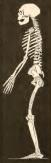
|
27.2.1909 The Illustrated London News published a
reconstruction of the
La Chapelle
skeleton drawn by Frantisek Kupka (1871-1957), with the aid of
Marcellin Boule. On the right, the La Chapelle skeleton model
used is compared with
that of a modern human.
|
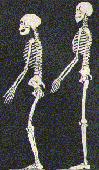
|
|
"Massive, coarse with a long broad lower jaw without chin, with a short
bent figure and a barrel shaped chest ... a true
Ice Age palaenthropine
[ancient human] who never reached the balance and grace of present man."
(Schenk 1961, p.85)
|
1910
|
The Model B was the Wright brothers' most successful aircraft. It was
produced from late 1910 to 1914, and during 1911 and 1912, the Wright
Company was shipping four Model Bs a month out the factory door. See
America
|
|
1910
Trollhättan Electrical Power Station, Sweden -
timeline.
Construction of the Olidestationen (Olide plant) began in June 1906
and plant was in regular operation by March 1910. Kungliga
Vattenfallsstyrelsen (The Royal Waterfalls Board) was formed in
1909. The photograph is from Hallendorff and Schück's
History
of Sweden (1929).
|
|
Kungliga
Vattenfallsstyrelsen, now Vattenfall, is said to have been the world's
first state-owned power producer. See
The Vattenfall story
.
January/February 1910: UK General Election
6.5.1910 The death of King Edward 7th coincided with a visit from
Halley's Comet, which provided George Dangerfield in
1936 with
an introduction to his The Strange Death of Liberal England.
Dangerfield associated the "death" of liberalism between 1910 and
1914
with the development of violent civil conflict over home rule for Ireland
(Tory rebellion),
votes for women and industrial relations (the
women's and
workers' rebellions)
"For nearly
a century men had discovered in cautious phrase, in
the respectable gesture, in the considered display of reasonable emotions,
a haven against those
irrational storms that threaten to sweep through
them" (page 135)
September to October 1910 Lockouts, strikes and riots in South Wales
mark the start of the "great labour unrest" of 1910 to 1914.
28.10.1910
Ferdinand de Saussure's
"Brief survey of the history of linguistics" begins his
1910-1911
lecture course which was published in
1916.
December 1910: UK General Election
1910-1914 Weber's
Wirtschaft und
Gesellschaft
(Economy and Society) written.
It included Structures of Power, Class,
Status, Party
and Bureaucracy. (See extracts and
Weber's toolbox). It was not published (in German)
until 1922.
It was partly translated into English in
1947 and
1962, but not completely
until 1968.
This book by
Weber
became
number 1 in the century's top 10

|
Principia Mathematica by Alfred North Whitehead and
Bertrand Russell
published in two volumes by Cambridge University Press in
1910 and
1913.
|
This attempts to demonstrate that mathematics is a development
of logic: A
way of grouping the world into sets and showing what will be
included in,
and what excluded from particular sets and how the sets relate
to one
another. It was an element in what Russell called the
"dethronement of
mathemetics" from its special status as a source of knowlege
in reason
rather than empirical observation. Mathematics, Russell wrote
"is not
a-priori knowledge".
"It is, in fact, merely verbal knowledge. 3 means 2
+ 1 and
4 means 3 + 1. Hence it follows (though the
proof is long)
that 4 means the same as 2 + 2"
(Russell, B.
1961 p.p 785-786)
1911
|
1911 An old Tram factory in Trafford Park, Manchester converted to
an assembly plant to make the
Ford Model T. It employed 60 people. 6,000 cars were produced in
1913,
supplying 30% of Britain's market. The first moving
assembly line, in 1914, produced 21 cars an hour.
In
1919, 41% of British registered cars were Fords. 1931: Dagenham opened.
1962 Halewood opened
|
"I have proposed" [1909] "the terms
'gene' and 'genotype'... to
be used in the science of
genetics. The 'gene' is nothing but a very
applicable little word, easily combined with others, and hence it may be
useful as an expression for the 'unit-factors', 'elements' or
'allelomorphs' in the gametes, demonstrated by modern Mendelian
researches." (W. Johannsen)
1911 International Association of Chemical Societies met in Paris in
1911 and proposed to work on the standardisation chemical names, atomic
weights, formats of publications and other matters. It was succeded by the
International Union of Pure and Applied Chemistry in 1919.
History link
4.3.1911 A meeting of 38 committee members the new Biochemistry
Society at University College London drew up rules. A
"letter from a lady who wished
to become an original member" prompted an amendement to the rules that ,
that "only men be eligible for membership" (carried 17 votes to nine). The
decision was reversed on
13.7.1912 (24 votes to seven)
Sunday 2.4.1911/Monday 3.4.1911:
Twelfth
British Census
Population of England and Wales: 36,136,000; Scotland:
4,751,000
The schedules used from 1911 to
provided separate columns for birthplace and nationality; in addition, the
particulars obtained enabled foreign residents to be distinguished from
visitors. Questions about ethnicity were not asked until
1991, questions about religion were not asked until
2001
|
April 1911 Ernest Rutherford wrote "The scattering of alpha and beta
particles by matter and the structure of the atom" published in
Philosophical Magazine, volume 21 (1911), pages 669-688, reporting
the results of an experiment (in Manchester) in which
radioactive particles
were fired
through minutely thin metal foils (notably gold) and detected using screens
coated with zinc sulfide (a scintillator). The vast majority
of particles passed straight through the foil, but approximately 1 in 8000
were deflected. Rutherford theorised that most of the atom was made up of
'empty space'. His atomic theory described the atom as having a central
positive nucleus surrounded by negative orbiting electrons with
most of the mass of the atom contained in the small nucleus.
(source) -
biography at Cambridge
|
12.5.1911 Victoria Memorial, London, unveiled by her grandsons
George 5th of England and Willhelm 2nd of Germany. behind the memorial, the
new ceremonial Mall sweeps away to Admiralty Arch.
|
|
22.6.1911 Coronation of George 5th and Queen Mary in London.
In
December they went to India, where they were proclaimed
Emperor and Empress
at the Dehli Durbar in Coronation Park on 12.12.1911. The Imperial
Crown of India was created for the occasion, and has not been used since.
|
Later, the king shot 21 tigers, 8 rhinoceroses and a bear in Nepal.
See war
memorial and
death.
|
Wednesday 26.7.1911 to Saturday 29.7.2011 Universal Races
Congress held at the University of London.
(information) -
Papers on inter-racial problems, communicated to the first
Universal Races Congress edited by Gustav Spiller.
offline
5.8.1911 "Galton Chair of Eugenics. Professor
Karl Pearson,
F.R.S., has been appointed to be the
first occupant of the Chair of Eugenics established in connexion
with the legacy bequeathed for that purpose by the late
Sir Francis Galton."
(British Medical Journal. 5.8.1911 p.317)
|
A nationwide merchant seamen's strike was called on 14.6.1911, leading to
strikes in
other sectors. A strike committee representing all workers in dispute
was chaired by the syndicalist Tom Mann, who had recently returned from
Australia.
Sunday 13.8.1911
Police baton charged a crowd of 85,000 people, who had gathered to hear Tom
Mann speak, on St. George's Plateau, in Liverpool.
The Liverpool strike ended on Thursday 24.8.1911 and troops were officially
withdrawn on 28.8.1911
|
28.10.1911 Festival of Empire closed at Crystal Palace
December 1911 Amédée Forestier illustrated the
Glastonbury Lake Village in the Illustrated London News. His later
illustrations include
Piltdown Man,
Rhodesian Man, and
Nebraskan Man.
10.12.1911 Nobel Prize for Chemistry for 1911 to
Marie Sklodowska Curie for the discovery of the chemical
elements radium and polonium;
the determination of the properties of radium, the isolation of radium in
its pure metallic state; and her "research into the compounds of this
remarkable element." (citation)
|
Dawn of hope leaflet dated 28.6.1911(?).
This mass-produced leaflet shows
Lloyd George offering the worker "national insurance against
sickness and disablement" through his bill and calls on people to "support
the Liberal Government in their policy of social reform"
16.12.1911 Royal Assent to the U.K's
National Insurance Act which provided the elements of
health services and unemployment insurance for insured people, but not for
their dependants. Came into effect
15.7.1912
|
1911 First ten volumes of "The Home University Library of Modern
Knowledge" published under the editorship of Gilbert Murray. A further set
of ten volumes were published in the year, and a further set of ten
planned.
1912 In
The
Elementary
Forms of Religious
Life,
Durkheim
argues that human beings have always had a knowledge of the
fundamental
reality of their societies. This knowledge, however, was not,
previously,
scientific, but religious. (See
extracts
and
the dance of
life)
1912 Die Familie by Franz Carl Müller-Lyer (1857-1916)
München, J. F. Lehmann. English: The Family New York 1931.
Outlines three stages in its historic development 1) the
tribal stage with the clan, 2) the familial stage with
large and then
small patriarchal families, 3) the individual era with the
a small family of husband, wife and children. See
Burgess and Locke (1945) p.25
1912: Alfred Wegener's theory of
Continental Drift
External Link
Polyvinyl acetate (PVA): Developed commercially as glue and as part of
paint. "The synthesis and patenting of vinyl acetate monomer by
Dr Fritz Klatte in 1912, in Germany, provided the foundation for
many
valuable and now essential
plastic
products".
(source).
Polyvinyl alcohol was prepared from polyvinyl acetate and ethanol in
1924. It is used in papermaking, textiles, and a variety of coatings.
See
Wikipedia and
Joan Hughes
1976
1912
Lead Poisoning and Lead Absorption. The symptoms, pathology
and prevention, with special reference to their industrial origin and an
account of the principal processes involving risk by
Thomas Morison Legge
and Kenneth Weldon Goadby. xi and 308 pages.
(Internet archive)
1.1.1912 Republic of
China. Hobhouse in 1915, spoke of centuries of a central
government of
"barbarian invaders" being replaced by one that
hovered between despotism and disorder.

Unemployment insurance stamp 1912
|
15.7.1912 UK
National Insurance Act came into effect.
Unemployment benefit at 7 shillings a week has been estimated at about 22%
of average male earnings in manufacturing. By 1979 it was still about 21%
of average earnings (manual and non-manual, male and
female). By 2008, the renamed jobseeker's allowance had fallen to
10.5% of average earnings. (Jonathan Bradshaw, York University, Letter
published in The Guardian, 15.5.2009.)
|
28.9.1912 Ulster's Solemn League and Covenant to resist home rule
for Ireland "using all means which may be found necessary".
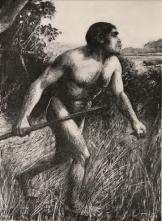
|
18.12.1912 Charles Dawson told a meeting of the Geological Society
about the discovery of fragments of a skull with features of man and monkey
in
Piltdown
in Sussex. A
1934 Encyclopedia
says "in the Piltdown discovery
we have a definite human head accompanied by an equally definite simian
jaw. However the relic is considered human. It is named Homo
Dawsonii. The reconstruction, published in the The Illustrated
London News was drawn by
Amédée
Forestier under the direction of William Plane Pycraft of the
museum. In November 1953, The Times published evidence that
the skull was a forgery.
|
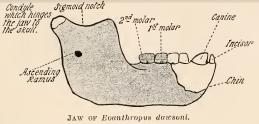
|
A reconstruction of the Piltdown jaw by William Plane Pycraft, published,
with Forestier's picture in The Popular Science Monthly (pages 206-
207) February
1913. See
Arthur Smith Woodward
|
"Recent discoveries prove that primitive man at a period from
one hundred thousand to a
million years
ago was widely spread over Europe
and apparently as far as
Java, and
that different species and perhaps
genera may have lived simultaneously
in different regions".
Heidelberg jaw mentioned. (The Popular Science Monthly)
See resources at
Welcome to the Piltdown
Plot! "saved 160 times between October 8, 1999 and June 1,
2016".
1912
Morris Ginsberg graduated in Philosophy and Sociology at London
Schoool of
Economics. He became
Hobhouse's research
assistant,
1912 William Stern, Die Psychologischen Methoden der Intelligenz-
prüfung Leipzig, Translated into English (Baltimore, USA) as
Psychological methods of testing intelligence by Guy Montrose
Whipple in 1914. The German uses the term Intelligenz-quotient for a
child's mental age divided by his or her chronological age
(source). See
Binet-Simon Scale
and
I.Q.
1913 Mental Deficiency Act and The Board of Control
University of London. Monographs on sociology. Edited by Professor L. T.
Hobhouse and Professor E. A.
Westermarck.
1. Heinrich Oppenheimer The rationale of punishment. (1913)
2. Bronislaw Malinowski The family among the Australian aborigines:
A sociological study (1913)
3. L. T. Hobhouse, G. C. Wheeler, and
M. Ginsberg. The material
culture and social institutions of the simpler peoples: an essay in
correlation (1915)
Gerald Clair William Camden Wheeler (1872-1943)
4. Yükao Liang
and Menghe Tao
Village and
Town
Life in
China (1915)
|
14.6.1913 London funeral of Emily Wilding Davison (born 11.10.1872)
organised by the Women's Social and Political Union. She had died following
a collision with the King's horse in the Epsom races when demonstrating on
4.6.1913. Her gravestone in Northumberland say "Deeds not words", which
was Women's Social and Political Union slogan
|
Science - art - society Bihalji-Merin in 1938 (p.44) argues that science
in the early 20th century was finding a "deeper vision" and this seeing
below the surface was matched by a movement in art:
"matter in a state of
evolution ... the
atom ... being
broken up ...
relativity revolutionised ideas of space and time ...
psycho-analysis ...
probed into ...
psychological spheres and
mythical memories ...
radium and
x-rays [give us] a picture of decay and renewal ... penetrate
matter and
make it transparent"
|
Die Windsbraut by Oskar Kokoschka painted 1913-
1914
|
|
"Confining himself to the range of apparently traditional forms" Kokoschka
"delves down by dream-routes to explore hidden strata of existence"
(Bihalji-Merin 1938 p.56)
"in the nineteenth-century ... everything seemed clear or capable of
comparison ... This psychological attitude was the result of a long
historical process which commenced with the commencement of the bourgeois
personality and broke of when its existence was threatened" (Bihalji-Merin 1938 p.42)
|
|
Social Grades: British measurement of the hierarchy of
social class
began when the
Registrar General's Annual Report for
1911 (not published until
1913) included a summary of occupations designed (by
Thomas Stevenson) to
represent "social
grades" (later referred to as "social classes") which were used for the
analysis of mortality data and the 1911 Census tables on Fertility of
Marriage. The "Registrar General's Social Classes" (RGSC) was re-named
"Social Class based on Occupation" in
1990. The scheme of 1913 was substantially modified in
1921. Stevenson explained its reasoning in
1928. OPCS formed
1970. (Rose,
SRU 9, 1995).
See 2001 census
The original grades were: 1) Professional -
2) Intermediate - 3) Skilled Manual - 4) Intermediate
- 3) Unskilled Manual -
|
|
17.3.1914 Srinivasa Ramanujan, Indian mathematician, sailed from
Madras, arriving
London (for Cambridge) 14.4.1914. He remained in England through the
war, returning to India in 1919 and dying 26.4.1920, aged only 32.
(English Wikipedia) - See also Tamil
Wikipedia.
India Postage stamp issued 22.12.1916 to mark Ramanujan's
75th birthday (born 22.12.1887).
|
|
|
"Farmstead" by
Adolf Hitler. Signed and dated 1914. Two watercolours by
Hitler, this and "Farm Buildings on the River", were sold at auction in
Nuremberg (Nürnberg) in April 2009.
"this period before the War was ... by far the most contented of my life.
... I did not live to be able to paint, but painted ... to enable myself to
go on studying"
(Mein
Kampf)
|
1918: Joan and Peter - The Story of an Education by H.G.
Wells, in which Oswald says "Old Mother Nature is a half-wit...
She's thinking of everything at once... Most of her world is desert with
water running to waste. A tropical forest is three-quarters death and
decay, and what is alive is either murdering or being murdered. It's only
when you come to artificial things, such as a ploughed field, for example,
that you get space and health and every blade doing its best."
(online)
14.12.1918: UK General Election
|
24.12.1918 A radio broadcast from Moscow called for "communists of
all countries" to "rally around the revolutionary Third International."
2.3.1919 to 6.3.1919: Comintern founded at a Moscow Congress to coordinate
activities of communist parties world-wide.
|
1919
Punch 1919:
"Jazz, the Fox-Trot and the Bunny-hug"
(dances) - Jazz as popular music see
Adorno 1936
|
|
1919 Isle of Wight Natural History and Archaeological Society
founded.
website
The UK Public Libraries Act 1919 removed restrictions on the establishment
of public libraries.
21.2.1919 Assasination of Kurt Eisner, socialist leader of Bavaria -
Beacuse he was a jew.
See
Hitler's commentary
The cover photograph of the first edition was a picture of Queen Mary
visiting a Women's Institute Exhibition. Some had thought that when the war
finished the Institutes would close, but its leaders had said the "WI
movement is not a war emergency measure but will be of permanent value in
the world of rural regeneration". Home and country had meant food for the
nation. Now it meant home and countryside. In
2002 it meant the world!
28.6.1919 Treaty of Versailles ended the
state of war between Germany and the Allied Powers.
|
15.10.1919: Preface to The ABC of Communism by
N.
Buharin and E.
Preobrazhensky describes it is "an elementary textbook of
communist
knowledge" to be "followed in the party schools" and "used for
independent
study by every worker or peasant who desires to acquaint
himself with the
party program."
|
18.10.1919 Statute of the Union Académique
Internationale, based in Brussels, defined its aims as
"to encourage cooperation in the advancement of studies through
collaborative research and publications in those branches of learning
promoted by the Academies and institutions represented in the IUA -
philology, archeology, history, the moral, political and social sciences."
(website)
October/November 1919 First session of the International Labour
Conference held in Washington. This is the plenary body of the
International Labour Organisation. Its first decision was to admit Germany
and Austria as Member States. It went on to adopt conventions and
recommendations on: hours of work in industry; unemployment; maternity
protection; night work by women and young people; and the minimum age for
work in industry.
history
1919 Constitutive Assembly of the
International Research Council in Brussels, set up to to oversee
cooperation within the scientific community of the Allied nations who had
won the war. Preparations were made to set up the International
Mathematical Union, also restricted to the victors. See
above. In 1931 it was replaced by the
International Council of Scientific Unions which had no
restrictions on membership.
William Beveridge was Director of the
London School of Economics and Political Science from 1919
until 1937, when he was elected Master of University College,
Oxford. See
1942
In 1919 the Partito Nazionale Fascisto was
formed in Italy.
The
fascisti, under Benito Mussolini, controlled Italy from 1922 to
1943. They
opposed
liberalism and communism, symbolising their social order by
the ancient
Roman fasces - the bundle of sticks that bound together
cannot be
snapped. The fascists donated to social theory the concepts of
fascism and
corporatism and
totalitarian. Unlike
National
Socialism (also
described as fascist), Italian fascism was not virulently
anti-semitic or
racist.
|
|
1919 to 1933
Ronald Fisher working at
Rothamsted
The simple "latin square" (left) illustrates the principle of
equalising the conditions in an experiment.
|
|
The top, or the left hand side, of the field may be more
fertile than the bottom or the right hand side. To avoid this distorting
the results, if two seeds are being tested, the field is divided into
squares and one seed is sown top-left and bottom-right and the other is
sown top-right and bottom-left.
|
|
Left: A 5 x 5 forestry experiment in Beddgelert in Wales, to compare
varieties of tree; designed by
Ronald Fisher. This was laid out in 1929 and photographed about 1945.
Source Baily, Cameron and Connelly 2008
|
21st century 6 x 6 experiment to compare methods of controlling aphids;
conducted by Lesley Smart at Rothamsted Research. Photographed in 2004
|
1920s
The rise of logical positivism Logical positivists
sought to divide
the world of ideas into the meaningful (science) and the
meaningless
(metaphysics). They held that "a statement has a meaning if
and only if the
fact that it is true makes a verifiable difference" (M.
Schlick 1932).
Only two types of knowledge were accepted: logic (which had to
include
mathematics) and empirical knowledge.
(external link)
See distinction between logical positivism and Comte's
positivism
and note on
Russell's logical analysis and
Karl Popper on
falsification
1920
|
August 1920 Communist Party of Great Britain formed. Headquarters 16
King Street, Covent Garden where a Communist Bookshop was opened in 1921
(Worker's Bookshop from 1927). As well as being a retail outlet for the
party, the bookshop distributed books and magazines from the Soviet Union.
The distribution arm was relaunched as Central Books in 1939.
21.11.1920 or earlier Lenin to the eighth congress: "Communism
equals the power of
the Soviets
plus electrification of the whole country"
(Compare Morris on force)
|
H.G. Wells'
The Outline of History: Being a Plain History
of Life and
Mankind published. George Bernard Shaw suggested
(1932)
that this and
"the host of imitations and supplements that its huge success
has called
into existence" was the modern alternative to
Genesis as an explanation of who
we are and
where we come from. See also
1929
1920 Publication in Paris of
La Responsabilité,
Etude de Sociologie [Responsibility. A sociological study]
by
Paul Fauconnet, sets out a Durkheian criminology. Fauconnet
published Durkheim's
L'éducation morale [Moral Education] in 1925
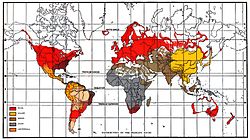
|
1920
Theodore Lothrop Stoddard's The Rising Tide of Color Against
White
World-Supremacy New York. Map "Distribution of the primary races"
divided the world into white, yellow, black, Amerindian, and brown peoples
|
10.1.1920 League of Nations (English) Société des
Nations (French) founded with headquarters in Geneva, Switzerland. The
League in 1920 did not include the countries defeated in the war
, the United States of America, or the Union of Soviet
Socialist Republics. Germany joined
8.9.1926, but withdrew
19.10.1933. The USSR joined
18.9.1934, but was expelled
14.12.1939.
|
10.1.1920
Inter-Allied Rhineland High Commission came into being.
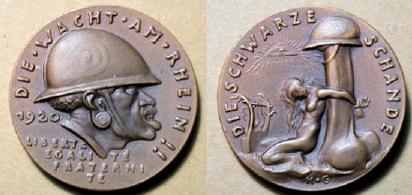
|
Bronze medal cast by Karl Goetz "Die Wacht am Rhein" (The Watch on the
Rhine). "Liberte, Égalité, Fraternité" (Liberty,
Equality, Fraternity) under the image of a black French soldier.
|
"Die Schwarze Schande" (The Black
Shame). Lorelei, the spirit of the Rhine, is tied to a penis shaped tree
capped by a French helmet. The broken lyre of the murmuring Rhine is
watched over by the eye of God. Compare
Paris Match 1955. See the
colour of the French Revolution,
Charles Darwin,
Cesare Lombroso and Hitler's
Mein
Kampf, which says
"the contamination caused by the influx of
negroid blood on the Rhine, in the very heart of Europe, is in accord with
the sadist and perverse lust for vengeance on the part of the hereditary
enemy [France]
of our people" -
Rheinland bastards video
|
April 1920 Le Play House, 65 Belgrave Road,
Westminster, opened as
a home for the
Sociological Society, which had been
based at the
London School of Economics.
(external link)
14.6.1920
Weber died of pneumonia [aged 56]
16.8.1920 Royal assent to the UK's 1920 Seed Act (Seeds?) (cap 54),
that came into
effect on 1.8.1921 as it was "impossible to get our testing stations
into proper order in order to deal with this season". Seeds to be 98% pure.
An early example of consumer legislation and also a major cause of the
decline in cornfield weeds (wild flowers).
1921
12.1.1921 "The woman juror's new sphere" - "The summoning of the
first women to serve on the juries at the Central Criminal Court is an
event of considerable importance in England's judicial history",
Manchester Guardian. The
Women's Institute urged eligible women to "accept their full
responsibilities as citizens in whatever
way they may be called upon to serve
their country". Very few women met the qualifying criteria.
March 1921 Prehistory
a Study of Early Cultures in Europe and
the Mediterranean Basin by
Miles Crawford Burkitt, with a short preface H. Breuil
Professor at the Institute
of Human Palaeontolocy, Paris. Cambridge
(Internet
Archive - offline)
1921 "White
Lead (Painting) Convention", drawn up by the
International Labour Office in Geneva to ban the indoor use of lead paint,
but not ratified by Britain or many other major countries. (See
Thomas Legge)
Sunday 19.6.1921/Monday 20.6.1921:
Thirteenth
British Census
Population of England and Wales: 37,932,000; Scotland:
4,882,000
The census omitted questions about fertility and about handicap and lunacy
which had been in the 1911 census; it introduced a new classification of
occupations and questions about widows, orphans and other dependants.
|
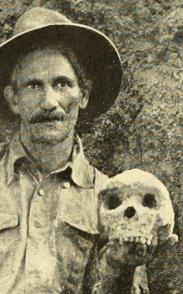
|
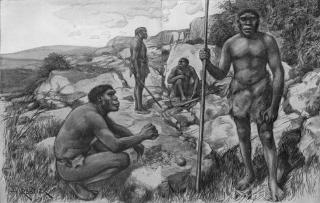
Tom Zwiglaar, a Swiss miner, with the scull he found in 1921 and a
reconstruction by
Amédée
Forestier of
Rhodesian Man
in The Illustrated London News
19.11.1921, emphasising his striking characteristic "giant"
eyebrows, strongly
sloping forehead, far protruding from the face of the jaw, but entirely
modern body structure.
(See Russian blog -
archive)
|
December 1921 London County Council's
Mental and Scholastic Tests by
Cyril Burt:
"If a child's mental age be divided by his chronological age,
the quotient
will state what fraction of ability the child actually possesses out of the
sum total of ability which at his age he should theoretically possess both
amounts being measured in terms of years. This fraction may be termed,
with
Stern, the child's
"intelligence quotient," or, more
euphoniously
perhaps, his "mental ratio."" (page 151)
"The abbreviated form I.Q. first recorded in 1922, has become much better
known than the full version" (20th Century Words Oxford, 1999)
1922
1922 12th edition of the Encyclopedia Britannica included an
article by James Jeans on Relativity.
|
Joseph Stalin (1879-1953)
became General Secretary of the Communist Party of the Soviet
Union.
|
1922
Max Weber's
Wirtschaft und
Gesellschaft (Economy and Society) published in
German.
1922 La Mentalite Primitive by
Lucien Levy-Bruhl (1857-1939). Translated
into English (London and New York) by Lilian A. Clare in 1923
[See
Park, R.E. 1925/7 and
1925]
1922
Bildnerei der Geisteskranken (Artistry of the
Mentally Ill) by
Hans Prinzhorn made comparisons with the art
of children, "primitives" and contemporary art. He argued that the
patients'
art succeeded because of its ability to tap the unconscious. (See
Degenerate Art). He
provided life stories (lebensläufe) for ten schizophrenia image makers
(schizophrenia Bildner), illustrated with samples of the images they made:
Karl Brendel [Karl Genzel 1871-1925] -
August Klotz [August Klett 1866-1928] -
Peter Moog [1871-1930] - August Neter
[August Natterer 1868-1933] - Johann Knüpfer [1866-1910] -
Victor Orth [Clemens von Oertzen 1853-1919] - Hermann Beil [Behle] -
Heinrich Welz [Hyacinth Freiherr von Wieser] - Joseph Sell [Joseph
Schneller] - Franz Poll [1864-1920]
1922 Bronislaw
Malinowski published
Argonauts of the Western Pacific in which he reported on
his
participant observation in the Trobriand Islands.
Alexander Morris Carr-Saunders (1886-1966), an active member of
the
Eugenics Education Society, London, published
The Population Problem. A Study in Human Evolution.
"The population problem, as he saw it, was the evolution of
primitive people with low mental and physical qualities and high
reproduction rates... The book was an instant success"
(Peder Anker, 2001, page 93)
Carr-Saunders later paublished Report
on Juvenile Employment in Liverpool (1924);
Population (1924);
Eugenics
(1926);
A survey of the social structure of England and Wales
(1927);
Professions: Their Organisation and Place in
Society (1928); Standing-Room Only: A Study in
Population (BBC
Talk) (1930); A Century of Pauperism (1934). He
contributed to We
Europeans: a survey of 'racial' problems by Julian Huxley
and A.C.
Haddon (1935) Eugenics in the light of population
trends (The
Galton lecture to the Eugenics Society 16.2.1935) and similar
works. On
20.5.1942 he gave the 12th
L.T. Hobhouse memorial lecture, in the Mill Lane lecture rooms
Cambridge, on
The biological basis of human nature.
[See mental health history words:
deficient]
(external link).
1922 "British students founded the National Union of Students to
maintain links with their European peers".
February 1922 Publication of the reports of the Committee on
National Expenditure chaired by Eric Geddes. Under the consequent cuts to
public expenditure the Metropolitan Police women officers were cut from 112
to 20. The
National Federation of Women's
Institutes passed a resolution calling
for their reinstatement. In 1923 fifty officers were re-sworn, with
increased powers. "Over the next
26 years Women's Instute members joined a vigorous
campaign to increase the number of
women police". [See
history 1 and
2]
|
19.4.1922
Ronald A. Fisher
"On the Mathematical Foundations of Theoretical
Statistics"
In the 1920s, Fisher introduced the the
P value "as an informal way to
judge whether evidence was significant in the sense of worthy of a second
look. The idea was to run an experiment, then see if the results were
consistent with what random chance might produce. Researchers would first
set up a
'null hypothesis' that they wanted to disprove, such as there
being no correlation or no difference between two groups. Next, they would
play the devil's advocate and, assuming that this null hypothesis was in
fact true, calculate the chances of getting results at least as extreme as
what was actually observed. This probability was the P value. The smaller
it was, suggested Fisher, the greater the likelihood that the straw-man
null hypothesis was false."
Regina Nuzzo 12.12.2014 See also
p-hacking and
13.9.1998
|
|
24.6.1922 G.E. Smith "Hesperopithecus: the ape-man of the western
world" The Illustrated London News p. 944, (See
Fossil Hominids FAQ)
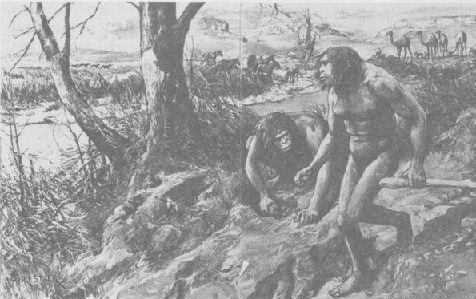
|
Left: The remarkable sketch
Below: The tooth

Connection unclear
|
Amédée
Forestier
"has made a remarkable sketch to convey some idea of the
possibilities suggested by this discovery. As we know nothing of the
creature's form, his reconstruction is merely the expression of an artist's
brilliant imaginative genius. But if, as the peculiarities of the tooth
suggest, Hesperopithecus was a primitive forerunner of
Pithecanthropus, he
may have been a creature such as Mr. Forestier has depicted."
15.11.1922: UK General Election: Lloyd George's coalition defeated.
Conservative Government to 1924. The Communist Party candidate, Shapurji
Dorabji Saklatvala, was elected as MP for Battersea with Labour Party
support. He was the third Asian to serve as a British MP, and the last
until 1987.
1923
1923
George Catlin (1896-1979), the English author of a short study
of
Thomas Hobbes, appointed to lecture at
Cornell University, New York, where he helped to develop
political science. He married the English novelist Vera Brittain (1893 -
1970) in 1925, and their children included Shirley Williams (born
27.7.1930) English politician and USA academic. Catlin was supervising a
translation of Durkheim's Rules of Sociological Method in November
1933 when his student George Simpson published a translation of
Division of Labour in Society. The English translation of
the Rules, with an introduction by Catlin, was not published until
1938
8.1.1923 First outside
broadcast. On 18.1.1923
The
Postmaster-General granted the British Broadcasting Company a
licence
to broadcast.
11.1.1923 French occupation of the Ruhr in order to enforce
reparations. French forces withdrew on
25.8.1925
12.7.1923 Indecent assaults on children discussed in a
House of Commons debate on the Home Office by
Frank Briant (1863
- 1.9.1934), Liberal MP for Lambeth North and superintendent of the
Alford House Institute for Workingmen and Lads; the Tory Nancy Astor and
Liberal Margaret Wintringham; as well as the Home Secretary William
Bridgeman. See
paedophile
6.12.1923: UK General Election
1924
|
Labour saving for the home owner (i.e. up-market)
Left: An advertisement from How to Equip a House R.A. Bateman Ltd,
Kingsway, London. [Published after 1923, but before October 1926]. Electric
lighting preferable where available. Central heating preferable. The "old-
fashioned kitchen range... stands condemned" (p.293). "Gas cooking without
question is the most generally practised in moderate-sized houses today".
(p.301). "The use of electricity for cooking is increasing rapidly".
(p.304). The vacuum cleaner is first amongst the labour saving devices for
cleaning." "Washing machines" (p.324) were "operated by hand". "Electric
irons have become commonplace" (p.336). A "modern water-closet" is of "the
simple pedestal type, of glazed impermeable ware" with an S or P shaped
bend retaining water to keep sewer gasses out. (p.328)
|
|
Recorded Music. In 1924 Lily Rose was eight and Gertie Hughes
about six. In the crowded Kentish Town flat they would lie in bed
pretending to be asleep. In the same room, Wilfred Finch (aged 27) was
entertained by cousin Amy. Wilf would bring a gramophone to play records to
Amy. In the only other room, Grandma Annie and Granddad Albert would sit
by the fire. See
Wireless 1937
|
1924 Simon Marks, owner of Marks and Spencer, made a fact finding
visit to the United States followed by a restructuring of his retail
business in shops specialising in food (established) and clothes (new),
responding to the increasing working-class demand for ready-made clothing.
He established direct relations with manufactures and those with Corah and
Sons, hosiery and textile manufacturers, Leicester, led to the St Michael
brand in 1928. A Textile Laboratory in London was established in 1935,
and Merchandise Development and Design Departments (for clothing) in 1936.
By 1939 the company was expanding from the underwear it started with to a
wide range of ready made clothing for men, women, and children.

|
Alexander Ivanovich Oparin's hypothesis that life on earth
developed through
a gradual chemical evolution of carbon-based molecules in the earth's
primordial soup published in The Origin of Life (in
Russian) by Moscow Worker (publisher) 1924
|
21.1.1924 Vladimir Lenin died.
|
April May 1924 Stalin: "The combination of Russian revolutionary
sweep with American efficiency is the essence of Leninism in Party and
state work."
(See marxist.org)
|
May 1924 For the first time massed voices of women sang
Jerusalem at the Annual General Meeting of
National Federation of
Women's Institutes in Queen's Hall, London.
|
I will not cease from mental fight,
Nor shall my sword sleep in my hand:
Till we have built Jerusalem,
In England's green and pleasant land
|
The photograph shows the 1925 AGM in Queens Hall. Each level has "aye" and
"no" exits for the delegates to vote by passing through.
29.10.1924: UK General Election. Minority Labour Government under
Ramsay MacDonald - Replaced later the same year by a Conservative
Government under Stanley Baldwin (until
1929)
1924 Harry Elmer Barnes Sociology and Political Theory, a
consideration of the sociological basis of politics, New York: Knopf,
Leonard T. Hobhouse "represents the sociological expression of
the
Neo-Liberalism of England that has produced..more constructive
social legislation than the combined product of earlier English
governments."
|
|
1924 to 1944 Geologist James Frederick Jackson
(1894-1966) working for
Isle of Wight Natural History and
Archaeological Society reorganised the museum. See
obituary
1925
First volume of
Adolf Hitler's
Mein
Kampf argued
human history
is a struggle for survival between biological races
of human
beings. Hitler's social theories drew on mainstream
sociology, as can be seen by comparing them with the
range of theories covered by Pitirim
Sorokin. The forged Protocols apart, most
elements of
Hitler's theory can be found in the mainstream sociological theories
reviewed by Sorokin.
Lucien Levy-Bruhl, Paul Rivet (1876-1958) and
Marcel Mauss
(1872-1950) created the Institut d'Ethnologie Institute of Ethnology
at the Sorbonne, dedicated to the memory of
Durkheim. Rivet
and Mauss were
the secretary-generals.
1925 Dorothy and Leonard Elmhirst purchased Dartington Hall (14th
century) and estate, near Totnes in Devon, England, and founded the
Dartington Hall Trust.
|
1925 WAGES: A Mr Brandon was engaged by London Co-op as driver of heavy
vehicles at £4.10/- a week. Right through the depression, Co-op wages
remained constant - Mates, 3 guineas; One ton drivers, £3.9/-. (See
1937 cost of a valve wireless)
|
September 1925 Amateur archaeologist, Einar Kjellén,
(26.9.1903 - 15.7.2000) discovered Sweden's "most remarkable
bronze age ship image". The
Brandskogship - Boglösa
109.
1926
1926 13th edition of the Encyclopedia Britannica included
an
article by Albert Einstein on "Space-
Time". This was a new topic.
From the Italian totalitario (complete, absolute) the
words
totalitarian and totalitarianism entered
English,
"fascist totalitarianism" being contrasted
with
"political dualism". See Neumann's
dictatorship types and
Hannah Arendt 1951
Pavlov,
Conditioned
Reflexes: An investigation of the physiological
activity of the cerebral cortex Translated from Russian
into English
and edited by G. V. Anrep, published by Oxford University
Press
1926 The Holy Bible Containing the Old and New Testaments, a New
Translation by James Moffatt begins "This is the story of how the
universe was formed" - See
1611 -
Genesis -
Job.
|
Working class family
photos: The family album of the Roberts family of Warrington
begins in 1926. Edwin Roberts was 7 years old on Saturday
30.10.1926 and
"when he was seven or eight" the family got a "Convenience front loading
camera", via the magazine John Bull. About
1932, when Edwin was 13,
Aunt Alice bought Edwin his own
Box Brownie camera. The price of Brownies
in 1937-1938 (Army and Navy Stores) was from 5/- to 1 guinea (Catalogue
page 984). The
Martin family of May Street, Fulham, took their own photographs
in
1928. Their surviving earlier photographs were taken by
Gambier Reeks in Fulham High Street.
|
8.6.1926 to 16.6.1926 Preliminary conference on oil pollution
of navigable waters, held in Washington DC, USA. In 1927
Women's Institute "members lobbied for action on pollution in
the seas".
4.5.1926 The British general strike began. Newspapers
(apart from
one the Government ran) disappeared, but the BBC
broadcast five news
bulletins daily. "It is not easy to estimate what would have
been the
effect of the strike if there had been no such thing as
wireless
communication". (Radio Times)
|
15.8.1926 Death of silent-movie star Rudolph Valentino
"the face of Valentino was
causing suicides"
(Roland Barthes)
|
|
15.10.1926 Birth of
Michel Foucault. See
1934 -
1935 -
1940 -
1961 -
1968 -
1971 -
1975 -
25.6.1984
25.12.1926 to
7.1.1989 The Shōwa period in Japanese history,
corresponding to the reign of Emperor Hirohito
Creation of the UK General Electricity Board, followed
by the
construction of the National Grid for Electricity, enabling
industry to move off the coalfields. (
external link: Paul Lyons on cooperation in
the
electricity industry
(archive)
See Morris on force)
1927
new word 1927: polystyrene. Used as a hard
plastic for moulding or, in a light expanded form, for packing
and insulation. 1937: First commercial production of polystyrene by IG
Farben, Germany
Ronald Laing born
1.1.1927 British Broadcasting Corporation established
See
1923,
1937,
1953,
1993.
December 1927 Institute of Sociology formed by the amalgamation of
the Sociological Trust, the
Sociological
Society
and the
LePlay House.
1927
Charles Sutherland Elton (1900-1991)
Animal Ecology. Elton was a
student of
Carr-Saunders and Julian Huxley and a friend
of
Arthur Tansley
1927
Sir Alexander Morris Carr-Saunders and David
Caradog Jones
A survey of the social structure of England and Wales as
illustrated by
statistics. Does not define social structure. Begins with
population units, then marital association, housing, urbanisation,
distribution of industrial facilities, of occupations, of national income,
of social services, "special attention was also given to ... matters such
as the breadth of the educational ladder"
(source)
|
Detached suburban houses spreading along Hercies Road, Hillingdon, linked
by the new A40 to central London, 18 miles away, and to
Oxford, 40 miles
west. They are near the new underground station at Hillingdon, one stop
before the end of the Metropolitan and Picadilly lines at Uxbridge.
|
The outline of this one
has reflections of
Kelmscott Manor
in Oxfordshire. The cladding, I think, is recent.
About 1927, Bernard Ralph
Allfree, an artist, bought a family home in Hercies Road that he named St
Nicholas after the village of his childhood home in Thanet. The 1928
Representation of the People Act gave his wife, Dorothy Maude, a vote, so
she is recorded from 1929. The houses were numbered from 1938.
1928
|
Contemporary Sociological Theories by
Pitirim
Sorokin published in USA.
Sorokin, a Russian, taught in the
sociology
department of Minnesota, USA. He followed the German
theorists,
George Simmel (1858-1918) and Ferdinand Tönnies (1885-1936)
in
arguing that
sociology should be about the forms of social
interaction. He also
claimed that it was only valuable as a science in as far as it
produced
empirical results. His book helped to set the tone for
USA
Sociology. He established the sociology
department at
Harvard University in 1931
and was succeeded by
Talcott
Parsons
as head of the department
in 1942.
Robert King Merton (see crimtim) was one of his students.
|
|
1928 Ludwig Von Bertalanffy: Kritische Theorie der Formbildung,
Borntraeger. Translated into English and adapted by translated and
adapted by J. H. Woodger as Modern Theories of Development: An
Introduction to Theoretical Biology, Oxford University Press, New York:
Harper, 1933
"We must view the germ as a whole, as a
unitary system, which accomplishes the developmental processes
on the basis of the conditions which are present in it and depend on the
organisation of its material parts."
21.2.1928 "The vital statistics of wealth and poverty" By
T.H.C. Stevenson, C.B.E., M.D. read before the Royal Statistical
Society.
25.2.1928
Joan Martin [later Hughes] born.
Childhood 1928-1939. Brought up on Cow and Gate Milk. Medicated
with camphor oil [rubbed in against colds] and syrup of figs swallowed
weekly to prevent constipation]. The smell and taste of these make them
early memories. Sometimes her grandmother bought her an
orange. Her father smoked Players Weights. The 1929 edition of
Our Baby contains adverts for several milks and foods,
but not Cow and Date. "We owe his life to Nestle's Milk" "Humanised
Trufood. Nearest to mother's milk". "Benger's Food for infants, invalids
and the aged", "Neaves saves baby's life after 8 other food failed" [etc]
[See
Voice]
|
24.3.1928
Charlotte Mew drank half a bottle of disinfectant (Lysol),
from which
she died.
27.7.1928 Publication of
The Well of Loneliness by Radclyffe
Hall, with a commentary by Havelock Ellis. Jonathan Cape.
19.8.1928 Sunday Express editorial by James Douglas, "A Book
That Must Be Suppressed"
|
|
James Douglas wrote that the book suggested
"sexual inversion and
perversion" was "unavoidable, because they cannot save themselves". He
argued tht it was a "self-made debasement". James Douglas and Radclyffe
Hall were both devout Christians.
|
Family time for the
newspaper seller - Saturday evening Music Hall -
Sunny Sunday pub crawl
Changing times: Outside
broadcasting - All talking films
|
1928-1930 "Dad used to take us the Bedford Music Hall on Saturday
night". [Camden High Street - Gracie Fields and Charlie Chaplin
appeared at the Bedford in 1912 and Marie Lloyd celebrated her 50th
birthday in pantomime there in 1920].
|
"On sunny Sundays we had a regular outing with mum and dad in their best
clothes escorting us over Hampstead Heath - First we visited the Railway
Tavern in Pond Street, then the Freemason's Arms, followed by the Old Bull
and Bush" [of Marie Lloyd fame] - Stanley Morse
|
"Outside Broadcast Problems" BBC Handbook 1928:
"The
B.B.C. has been the first in the world to exploit Simultaneous
Broadcasting to its fullest advantage for a national system, and thanks to
the co-operation of the
Post Office engineers, it is possible to pick up a programme
wherever it may take place within the British Isles and radiate it
simultaneous from all distribution centres. Looking ahead still further and
assuming that the
wireless will supplement the
wire line link, there is no reason why a simultaneous broadcast
of something of fundamental importance to the whole civilised world should
not take place some time in the future".
"
|
|
September 1928 The Jazz Singer presented, and Hollywood "all-
talkie" The Terror shown at the Piccadilly Theatre, London.
Followed
shortly by The Singing Fool, Fox Movietone Follies, Rio
Rita, Broadway, The Broadway Melody, Sunny Side
Up, Blackmail (1929 "Britain's All-Talkie Challenge to the
World", directed by Alfred
Hitchcock)
In
July 1939 The BBC (wireless) presented the first of the
summer's 56 seaside concert party broadcasts with the comment "nobody can
say the talkies have killed them". The implication might be that talking
cinema had replaced music hall.
|
|
The Science of Life. A summary of contemporary knowledge
about life and
its possibilities by
H. G. Wells, Julian Huxley and G. P.
Wells
published in three volumes by Amalgamated Press, 1929-1930.
The Physiographical Evolution of Britain by Leonard Johnston
Wills (born 1884). London : E. Arnold and Co 1929.
30.5.1929: UK General Election. Minority Labour Government under
Ramsay MacDonald. National Government under Ramsay MacDonald from 1931.
21.6.1929 Death of Leonard Trelawny Hobhouse.
Morris Ginsberg was
appointed to succeed him in the Martin White chair of sociology.

|
1929-1930 The "towering"
Stone House
rose amongst brick buildings in Bishopsgate. An early example of open plan
office space? From 1930 it was the London office of Shanghai based E.D.
Sassoon and Company, who set up E.D. Sassoon Banking Company.
|
24.10.1929 - Wall Street Crash
Publication in Vienna and London of Sigmund Freud's
Das Unbehagen in der Kultur -
Civilization and its Discontents. German edition actually
published end of 1929 - although dated 1930. French translation, Malaise
dans la civilisation published 1934.
The highest
lead
content in paint occurred between 1930 and
1955. See
lead paint ban
1930
Talcott
Parsons'
translation into English of Weber's
The Protestant Ethic and the Spirit of Capitalism
|
The first part of Unwritten History by Henry Rushton Hall,
"Book one - The age of stone" was published in 1928. Book two "The age of
metals" followed in 1930, along with a combined volume (348 pages). All
were illustrated by Harry William Whanslaw (December 1883 - 26.3.1965).
Whanslaw, a puppet theatre pioneer as well as an illustrator, later
illustrated many bible books.
|
1930
Alfred Rosenberg's The Myth of the 20th Century
provided a possible
theoretical structure for the racialist doctrines of the
Nazi
(Nationalsozialist) party. To replace Christianity, Rosenberg
suggested a
story of a Nordic race that, through the German state, would
subdue
inferior
races. According to this story, the aristocracy of
France, at the
time of the
French revolution, was nordic. The revolution was
an uprising
of inferiors who spread the doctrines of liberalism (freedom,
equality and
universal community). Liberalism developed into marxism, that
produced the
Russian revolution. The destiny of Germany was to combat the
ideas of the
French revolution, and to undo their effect. See Nazi theory. See also
Nazi-Christian dialogue
July 1930
Max Horkheimer became Director of the
Institut für Sozialforschung in Frankfurt. In his inaugural
address (1931) he redefined
Marx's
"historical materialism" as a
critique rather than a
science and argued for the reintegration of philosophy
with social
science.
(Swingewood, A. 2000, p. 131)
1.12.1930 First publication of Swallows and Amazons
by Arthur Ransome: A story of children on sailing adventures in the English
Lake District.
1931
A new word: dosoxyribonucleic acid appeared in Levene and Bass's book
Nucleic Acids. Doeoxyribonucleic acid has since replaced it
and, since 1944 it has been called DNA. The Journal of Biological
Chemistry in 1944 spoke of the "key role... of these substances in the
reproduction of inheritable characteristics". The structure of DNA was
drawn in
1953.
February 1931 "A National Plan for Britain" by Max Nicholson
published in The Week-End Review. This stimulated the formation of
the organisation
Political and Economic Planning (PEP) later in the
year, with
Elmhirst money. Directors included Max Nicholson,
Michael Young (1941-1945)
and
Raymond Goodman.
"an independent non-party group, consisting of more than a
hundred working members who are by vocation industrialists, officers of
central and local government, doctors, university teachers, and so forth,
and who give part of their spare time... in fact-finding and in suggesting
principles and possible advances over a wide range of social and economic
activities..." (1939)
|
12.2.1931 The All-India War Memorial inaugurated by Viceroy Lord
Irwin. The foundation stone had been laid on 10.2.1921. The architect was
Edwin Lutyens, who also designed
the cenotaph in Whitehall, London. It commemorates 60,000
Indians who died the First World War and 13,516 British officers lost on
the North West Frontier.
|
Mead's theories enabled
people to analyse our minds and personalities (our "self") as
something we
we actively create in
symbolic
interaction
with
others. Mead's theories were made popular by
Goffman, and
others, in
the 1960s.
July 1931
Association for the Scientific Treatment of
Criminals. It was renamed the Institute for the Scientific
Treatment of Delinquency in July 1932, and the Institute for the
Study and Treatment of Delinquency in 1951. Became the Centre for
Crime and Justice Studies in 1999.
(website history) - See also
Child
Guidance
11.7.1931 Fifth Assembly of the International Research Council and
the First Assembly of the International Council of Scientific Unions held
at Brussels.
International Council of Scientific Unions (ICSU) formed.
(website). "It
represents the evolution and expansion of two earlier bodies known as the
International Association of Academies (IAA; 1899-1914) and the
International Research Council
(IRC; 1919-1931)"
(source). Became the International Council
for Science (but still ICSU) in 1998.
25.8.1931
Joachim
Benemann
arrived in the United Kingdom for his first (two months conditional) stay.
"After leaving College, in order to gain some insight into the working
population's life, he worked in an Italian shipyard, a Russian coalmine, a
Scandinavian farm and an English coal mine".
|
October 1931 Indian leader Mahatma Gandhi chose to stay in the East
End of London at
Kingsley Hall, rather than as a government guest, when he took
part in British government sponsored talks. See
1947 - 1948
This is probably how a
working class girl in Camden Town (later my mother) learnt who he was and
was
inspired by him
|
|
"Star, News, Standard!" - "Gandhi swims the Channel".
Selling newspapers on
his pitch in front of the Dominion in Tottenham Court Road, London,
Herbert
Morse (my mother's step-father) created
bizarre news stories to attract attention.
Cartoon by my uncle, Stanley Morse.
|
|
27.10.1931: UK General Election
1932
1932 Der Sinnhafte Aufbau der sozialen Welt : eine Einleitung in
die
verstehende Soziologie (The "sense-clung" structure of the social
world: an introduction to
"understanding" sociology) by Alfred Schütz (1899-1959)
published in Vienna. Tranlated into English as The Phenomenology of the
Social World in 1967.
Zeitschrift für Sozialforschung (Journal for Social Research)
published
Frankfurt from 1932 to 1941
July 1932 Reich Broadcasting Corporation established
Late 1932 In the
Cavendish Laboratory at
Cambridge an atom split.
Dalton's atom was the smallest element.
Rutherford's was a nucleus with electrons spinning round
it. "The challenge was to crack open the nucleus." John Cockcroft and
Ernest Walton built a particle accelerator which used protons as 'bullets'
to shoot at lithium atoms, aiming to split it into two helium atoms. By
learning the correct, slow speed to fire the protons, the experiment was
successful.
archive of source -
1951 Nobel citation. See
nuclear fission
December 1932 George Bernard Shaw's The Adventures
of The Black
Girl in Her Search for God, designed and engraved by John
Farleigh,
went through (at least) four reprints in the month of
publication.
(See Shaw on
Pavlov) -
John
Farleigh archive
new word 1933: polyvinyl chloride (See
vinyl. Abbreviated PVC 1941), a
thermoplastic resin used for raincoats, amongst other things.
Patented Germany 1913. Plasticised PVC USA
1926 (substitute for rubber). Raw material
ethylene dichloride.
1930: first commercial long-playing vinyl record. First production of PVC
in UK in 1940.
Vymura vinyl wallpaper 1961
1933 Clarence Crane Brinton's English Political Thought in the
Nineteenth Century (London: Ernest Benn, 1933) begins its chapter on
Herbert Spencer (pp. 226-227)
"Who now reads Spencer? It is difficult for us to realize how
great a stir he made in the world. . . . He was the intimate
confidant of a strange and rather unsatisfactory God, whom he
called the principle of
Evolution. His God has betrayed him.
We have evolved beyond Spencer."
|
1933-1945
Hitler and the Nazi (Nationalsozialist - National Socialist)
party in power
in Germany (30.1.1933). The two
German marxist parties were made illegal and liberal theories
were opposed.
Social theorists who had built ideas of human progress on the
triumph of
reason and democracy were thrown into intellectual crisis by
the popular
support for the Nazi's. This led to the creation of
new social
theories,
sometimes by synthesising the ideas of
Marx and
Freud. The
Nazi persecution
of German (and other)
Jews
led to many German intellectuals
emigrating, and
founding new academic traditions of social science in Britain,
the United
States, or elsewhere. See Nazi
theory
First Volksempfänger (the people's receiver) produced.
[External link:
Hitler's Radio]
"Radio went to war on five continents shortly after the Nazi
Party came to power in Germany. In nine years it has been streamlined from
a crude propaganda bludgeon into the most powerful single instrument of
political warfare the world has ever known." (Charles, J. Rolo, 1943
Radio Goes to War Faber and Faber.
|
17.6.1933 Baldur Benedikt von Schirach, head of the Hitler-Jugend
(Hitler Youth), was appointed supreme youth leader in Germany. The
Reichsschaft Deutscher Pfadfinder (Reich Association of German
Scouts)
was banned in June 1934.
From 1934,
Joachim Benemann was
building links for the Hitler Youth in the United Kingdom.
|
4.7.1933 Formal opening of the Undercliff Walk at Brighton, Sussex,
built between 1930 and 1933 to protect the chalk cliffs. It used
13,000 tons of cement. "The concrete facing ... protected them from
destruction ... as effectively as would a basalt dyke"
(Observer's
geology p. 205) -
(History link)
|
July 1933 "Shelf Appeal . A monthly publication devoted to
the planning, designing, manufacturing and display of the package."
Creative Journals Limited, Museum Station Buildings, 133 High Holborn,
London, W.C.1. [May have been biomonthly at times]. In 1936 and
1938 Creative Journals published a 300 page Package Omnibus
"The first encyclopaedia of packaging", - "Includes boxes, bags,
bottles and tins" (Wellcome Library catalogue) - and in
1938 a larger
Omnibus of
marketing and packaging
1935 brands included Dettol, Lux
soap powder, Carter's Little Liver Pills, Gibb's toothpaste, Brylcreem,
Rose's lime Juice, Ty-Phoo Tea, Erasmic soap, Cuprinol, Bird's custard,
Izal toilet paper, Yardley cosmetics, Player's cigarettes, Eno's Fruit
Salt, Wright's Coal Tar Soap, Anchor butter, Nestle's cheese, Lyons' cakes,
Tate and Lyle
sugar, Lifebuoy soap,
Scott's Porage Oats, Terry's
chocolates, Steradent denture cleaner, Elastoplast and Band-Aid plasters
and Ovaltine. The 1938 Omnibus had 540 illustrations.
The
war changed things.
Shelf Appeal ran to
April 1942. From then to October
1946
it was
replaced by Scope "Magazine for industry", which was supplemented
by the Scope year book of industry, trade and finance. However, in
1939, Creative
Journals had launched a quarterly called
Persuasion - Public relations, propaganda, advertising and
publicity, edited by John
M. Ryan. This was absorbed by Scope in
1951.
Creative Journals Limited was threatened with being struck of the Companies
Register in 1950 but in the 1950s it brought out a magazine called Sales
Appeal and Packaging Technology and then just Sales Appeal
appeared. The company was eventually removed from the register in
1977.
|

|
26.12.1933 Queen Christina first shown in New York. Released
1934 in the rest of the world.
Roland Barthes
"The Face of Garbo" about 1954. "The face of Garbo is an
Idea, that of
Hepburn an Event". In the film the Queen dresses as a man to
escape into common life. Snowbound in a hotel she shares the same bed as
Spanish envoy Antonio.
|
It is not the similar story line to
Roman Holiday (Hepburn 1953) that attracts Barthes attention,
but the different presentation of faces. "Garbo still belongs to that
moment in cinema when capturing the
human face still plunged audiences into the deepest ecstasy, when
one literally lost oneself in a human image..."
1934
Karl Popper's Logik der Forschung (The Logic
of
Scientific
Discovery) published. (See
review and
external link) Popper accepted
much of
the programme of
logical positivism, but argued
that
verification of general scientific statements, in the sense of
proving them
true by testing against experience, was not possible. Good and
meaningful
science would seek to draw out consequences from its theories
which could
prove them false. A meaningful or scientific theory is one
constructed to
make predictions about the empirical world which could prove
it wrong.
See 1956,
1994 and
weblinks
Lev Semenovich Vygotsky died
|
1934 Publication of Sociology by
Morris Ginsberg
London:
Home University Library of Modern Knowledge, Thornton
Butterworth. 1934. 260 pages Price 2s. 6d. Chapters: 1) Scope and method
of sociology (31 pages) - 2) Society,
culture and civilisation (16 pages) - 3) Race and environment (44 pages) -
4) The psychological basis of social life (31 pages) - 5) The growth of
societies (30 pages) - 6) Social classes and economic organisation (37
pages) - 7) Aspects of mental development (38 pages) - 8) Conclusion (13
pages). Bibliography divided into: General, Race and environment, Social
psychology, Social organisation, Mental development.
|
1934
The Daily Express Encyclopedia published in 8 Volumes.
"the special interests of our age are largely scientific, economic and
technological" and not exclusively "literary or historical". A copy was
purchased for Leyton Public Libraries in October 1944. The article on
"Anthropology" (Cultural and Physical) draw heavily on the
Mentone Caves for their discussion of "modern man".
January 1934 contraceptive advertisment

|
Walter Rendell's sperm killer was available from
1886. Larger
advertisements in the 1930s mentioned that it resolved "family problems"
and that a booklet on "Hygiene for women" by nurse Drew could be obtained
from chemists. The company encouraged chemists to display the booklet on
their counters.
|
22.2.1934 Committee which formed the nucleus of the National Council
for Civil Liberties (UK) first met.
26.2.1934 Arrival of hunger marchers in London watched by observers
from the Council. [history -
history -
history]
Campaigned against Sedition (Incitement for Disaffection) Bill of 1934 and
Public Order Act of 1936,
See
1947
-
1950
and
1.11.1954
- 1975
25.7.1934 Austrian Chancellor, Engelbert Dollfuss, assassinated by
Austrian Nazis. Young
Michel Foucault
learnt a lesson.
1935
1935 Victor Gollancz started the Left Book Club and the first
Penguin Books were published.
|
In 1934 and 1935
Joachim Benemann worked in the United Kingdom under Otto Bene of
the German Embassy. He arranged boys camps for members of the
Hitler Youth
and English boys. On Wednesday 8.5.1935 the
Jewish Daily
Bulletin, based on a News
Chronicle report, said the first Anglo-German camp had been held
at Bryanston School, Dorset, with thirty boys from each country.
|
The British "are five young miners, five cigarette factory
hands and a number of public school boys".
One boy reported:
"They say there are no class distinctions in Germany now - it doesn't
matter
whether you are a millionaire or a tramp. They say the worst that happened
to the
Jews was that
some windows were broken".
|
Main hall Bryanstone by Ben Brooksbank
|
The New Chronicle said Benemann was "a pleasant young German
journalist"... "on the Hitler youth movement staff" who had
"addressed twenty-three public schools and fifteen factories" and founded
what he calls 'slands' at Manchester, Birmingham and Nottingham of people
wanting to establish better relations. In December 1935 he was in Germany,
trying to link the
Hitler Youth with the
Scouts. In 1936 and 1937 he arranged camps in Germany and the
United Kingdom. (MI5)
|
June 1935 A meadow at Granchester: Alan Turing tried to
envisage a
machine that would decide the provability of any mathematical
assertion
presented to it. His paper "On Computable Numbers, with an
Application to
the Entscheidungsproblem" (January 1937) laid the mathematical
foundations
for modern
computers
that can handle thought patterns much more complex
than the arithmetic of
Babbage's
machines. A
"computable number" is any number that can be
defined by some rule. So
pi
( )
is a computable number even though it can never
be calculated. Turing's imaginary machines linked the world of
abstract
symbols to the material world of metal and glass. Valves and
then
silicon chips would later sort out thought at speeds beyond the
speed
of thought.
[See hardware and
software,
monster
computers in the
1960s, cold war
communications and world wide
web] )
is a computable number even though it can never
be calculated. Turing's imaginary machines linked the world of
abstract
symbols to the material world of metal and glass. Valves and
then
silicon chips would later sort out thought at speeds beyond the
speed
of thought.
[See hardware and
software,
monster
computers in the
1960s, cold war
communications and world wide
web]
17.6.1935 Radio detection (later called RADAR) at Orfordness,
Suffolk, of a flying boat 17 miles away. Research was pioneered under the
umbrella of the Air Ministry. At the start of World War Two
training was given in Technical Colleges before the Air Ministry
established its own unts.
1.7.1935 "FN Ordinary index" (Now FT30 index) started by the
Financial News. Based on the share prices of 30 British companies
from a wide range of industry it was designed to "test the feel and
changing moods of the equity market". The original constituents were:
Associated Portland Cement - Austin Motor - Bass - Bolsover Colliery -
Callenders Cables and Construction - Coats (J and P) - Courtaulds -
Distillers - Dorman Long - Dunlop Rubber - Electrical and Musical
Industries - Fine Spinners and Doublers - General Electric - Guest Keen and
Nettlefolds - Harrods - Hawker Siddeley - Imperial Chemical Industries -
Imperial Tobacco - International Tea Co Stores - London Brick - Murex -
Patons and Baldwins - Pinchin Johnson and Associates - Rolls-Royce - Tate
and
Lyle - Turner and Newall - United Steel - Vickers - Watney Combe and Reid -
Woolworth (FW) -
(Financial Times 2006)
September 1935 The
Institute of
Sociology and the International Student Service held a
series of conferences at King's College, London on the relations between
the social sciences (The Social Sciences: Their Relations in Theory and in
Teaching), A further series was held in 1936.
Rocquin, B. 2006 p. 28)
|
3.10 1935
Italy invaded the independent African state of Ethiopia
The conquest was complete by May 1936
Foucault remembers
"A vigorous press in the Gold Coast and Nigeria meant that the
most marked response of Africans in Africa was in West Africa... The West
African elite had, until Ethiopia, a considerable residue of faith in the
"progressive" aspects of colonialism. But the way Britain appeased Italy
over Ethiopia made them loose faith in British "fair play"...Up to now,
West African nationalism had tried to work within the trusteeship concept.
It was henceforth replaced by a more militant anti-white pan-Africanism"
(Mazrui and Tidy 1984 pp 7-8)
|
14.11.1935: UK General Election. National Government under Stanley
Baldwin.
"On the Concept of Function in Social Science"
(external link to extract) by
Radcliffe-Brown. published in American Anthropologist
37: pages 394-
402. It was reprinted in his
1952 collection of essays
Structure and Function in Primitive Society See
Functionalism. Also look at the
entry for
Malinowski on the
LSE
History site
1936
1936
John Maynard Keynes:
The General Theory of Employment Interest and Money
1936
Rose Garden image in T.S. Eliot's poem "Burnt Norton". "What
might have been" (the rose garden of the mind) as well as "what has been"
are both somehow part of the present and of reality.
1936
Theodor Adorno's article "Über Jazz" (On
Jazz) published in
Zeitschrift für Sozialforschung - In 1938 he wrote
"To make oneself a jazz expert or hang over the
radio all day, one must
have much free time and little freedom".
1936 Methodenlehre der Sozialwissenschaften by Felix Kaufmann
(1895 - 1949) published in Vienna.
(External link to review by Joseph Mayer) -
Methodology of the Social Sciences published by Oxford University
Press in London and New York in 1944.
Sometime in 1936 an "Anglo-German Brotherhood" was formed by
Baron von der Ropp
at a meeting at Grünheide.
(source).
This was a (nationalist - völkische - racist) Christian organisation.
It is not the same as the (secular political) Anglo-German Fellowship (1935
to 1939), but it may have affiliated to
The Link in 1939
1936 The "London Brick Company" works at Stewartby in Bedfordshire
was the largest brickworks in the world. Its "Fletton" or "London" bricks
were cheap to make because of properties of the clay used and mass-
production methods, and this made it more economical to transport brick by
rail than to make it locally.
(Alan Cox 1979)
6.1.1936 Heavy rain and flooding in England
20.1.1936 Death of
George 5th announced by John Reith
on the BBC
outside normal radio news hours. February 1936 First
British comic
(Mickey Mouse Weekly) in full colour photogravure.
1.3.1936 Edward
8th broadcast his first message to the Empire.
8.3.1936 German troops reoccupied Rhineland.
3.5.1936 Popular Front alliance of left wing parties won power in
France. Léon Blum became President of the Council. [See
Barthes]
First
week July
The Radio Times "Television Number" was restricted to
London: In
range of the transmissions from Alexandra Palace which the 300
owners of
private sets could receive. 18.7.1936 Start of Spanish
Civil War.
Foucault remembers
refugees
1.8.1936: Berlin
Olympic Games opened by
Hitler.
Television pictures
were available to the Berlin public in television parlours.
Nazi's and
Christians
The
"type of human .. we saw ... during the Olympic games" ...
exuded
"proud physical
strength" (Hitler)
4.10.1936 Battle of Cable Street when Oswald Mosley
(British
Fascist) was prevented from marching through the East End.
5.10.1936 Start of Jarrow March. Unemployed led by
Ellen Wilkinson
MP walked 280 miles from Jarrow to London. It was reported
sympathetically
on Cinema Newsreels. 16.11.1936 Edward
8th advised Prime Minister, Stanley Baldwin, that he wished to marry Mrs
Simpson after her second divorce.
|
30.11.1936
Crystal Palace
burnt
down. Baird had
all his television equipment stored here. Picture postcard of "Crystal
Palace Parade, Upper Norwood" posted from Sydenham 3.12.1936 (1d stamp)
says "can hardly imagine how desolate it looks with only the two towers
standing... [We] were at Committee in Sydenham that evening. Had difficulty
getting home as front of Palace blocked. In a taxi had to go round by
Dulwich and West Norwood".
|
Friday
11.12.1936 Edward
8th's abdication broadcast from Windsor Castle. Accession of
George 6th
(who stuttered). Christmas 1936 No King's Christmas
broadcast.
|
Seebohm Rowntree's second York study was made in 1936,
although not
published until
1941. He wrote that "The economic condition of the workers
is better by 30 per cent than in
1899, though working hours are shorter.
Housing is immeasurably better, health is better,
education is better.
Cheap means of transport, the provision of
public libraries and
cheap books, the
wireless, the
cinema and other places of entertainment, have
placed within the reach of everyone forms of recreation unknown, and some
of them unthought of, forty years ago."
|
1937
|
Talcott Parsons The Structure of Social
Action. A study in social theory with special reference to a
group of
recent European writers
[extracts]. Primarily an
integration of the work of
Marshall,
Pareto,
Durkheim
and Weber to
create a
general theory (the action frame of reference) in which
socially directed
actions of individuals are integrated by the common value
system of the
society. The Structure of Social
Action became
number 9 in the century's top 10
|
|
1937
Max Horkheimer's essay "Critical and traditional theory"
introduced the term critical theory as opposed to traditional
positivist science whose goal, he argued, is pure
knowledge. Critical
theory was committed to emancipation.
(Swingewood, A. 2000, p. 131)
|
12.5.1937 Coronation of George 6th televised. Seen on
the 300 sets
then existing around London. See
1927, 1953,
1993. First
Mass Observation Day. See
weblink. Later in the year Faber published May
the Twelfth: Mass Observation Day Surveys
|
Another "mass
observation" was under way, a "quickened interest in wild
life" "perhaps partly" explained by "modern transport, giving quick and
easy access to the country" (Forward to Observers Book of British
Birds). The first two "Observer" books (birds and wild flowers)
were published in 1937. Butterflies, trees and shrubs, and wild
animals
followed in 1938, freshwater fishes in 1941 and grasses sedges and rushes
in 1942. Then came the first one not about nature, airplanes in
1942
|
|
|
24.5.1937
Daily
Herald
report, "Nazis must be spyclists" said
the Nazi Cyclists Association memers cycling abroad should memorise
locations of landmarks, the construction of bridges and the width of
streams and the depths of fords.
(MI5)
|
Joachim Benemann, 27 Mecklenburgh Square, London, WC1 was
watched by
MI5. He and returned to the United Kingdom 25.1.1937. In June
1937 opening his post was
authorised. "Joachim Benemann is a member of the
Reichsjugendführung organsation, a
branch of the
N.S.D.A.P., which directs the activities of the Hitler Jugend.
He has been active intermittently in this country for the last three years.
His work might prove a source of danger in the event of war..."
Otto Hermann Eichele of 106 Norfolk Road, London. E8, teacher, In England
from 1934 to 1937, Nazi Party number 3710198, joining in 1936 (from
England) was leader of the
Hitler Youth
in the UK. He worked at the German Orphanage and may have left England
because they were not happy to support his activities in the Hitler Youth.
MI%
|
25.5.1937 to 25.11.1937 The Exposition Internationale des
Arts et
Techniques dans la Vie Moderne (International Exposition dedicated to Art
and Technology in Modern Life) held in Paris. The Musée de
l'Homme was founded on this occasion, in succession to the
Musée
d'Ethnographie du
Trocadéro.
(visit now).
Its Director,
Paul Rivet,
was a
prominent anti-fascist.
(Victor Serge weblink)
Two years before the
second world war, the exhibition buildings of Nazi Germany (on
the left) and the Soviet Union confront on another across the Pont
d'Iéna (Jena Bridge). This picture was probably taken from the
esplanade between the new Musée de l'Homme and
Musée des Monuments Français. The war between Nazi
Germany and the Soviet Republics was delayed by the non-aggression pact of
23.8.1939.
June 1937 The
"Georgian Group" of the
Society for the Protection of
Ancient Buildings formed. "In the inter-war period, buildings
dating from after 1700 were considered too modern to qualify for statutory
protection"
(website). It began to function independently
in the early 1940s. The Victorian Society was founded in
1958 and the Twentieth Century Society started as the Thirties
Society in
1979,
18.7.1937 Opening of Haus der Deutschen Kunst ("House of
German Art") in Munich. The inaugural exhibition was the Große
Deutsche Kunstausstellung ("Great German art exhibition").
Hitler's speech at the opening was broadcast.
|
Ivo Saliger (1894-1987): Urteil des Paris (Judgement of Paris) 1939.
external link "Idealized female nudes...
Well-formed, perfect body... the aesthetics of the Nordic people... should
symbolize grace, beauty and purity. Aryan men... muscular man figures
modelled on classical antiquity.."
Paris is depicted as a Hitler Youth in shorts, choosing
between three healthy examples of Aryan womanhood.
|
Catalogues, prints, magazines and postcards spread the messages of the art
gallery to all parts of the German population
(Haus der Deutschen Kunst):
|
|
Postcards of Richard Heymann's Glückliche Mütter (happy mothers)
and F. Staeger - Germanische Urbarmachung in den Ostlanden (Germanic
reclamation in the eastlands)
|
GDK Research - research platform for images of the Great German Art
Exhibitions 1937-1944 in Munich (German and English)
|
19.7.1937 Exhibition of Entartete Kunst
(Degenerate Art), organized by Adolf Ziegler and the Nazi Party,
opens in Munich. It closed 30.11.1937 and then travelled to other cities in
Germany and Austria. [Twelve stages: Berlin, Leipzig, Düsseldorf
(November 1938?), Salzburg,
Hamburg, Stettin, Weimar, Vienna, Frankfurt/Main, Chemnitz, Waldenburg,
Halle (April 1941).
Some of the artists
The sculpture on the cover of the guide is Otto Freundlich's "Der neue
Mensch" [The New Man]
1912. Made of plaster, about 139 cm high, it is now lost
In 1938, Penguin Books published Modern German Art by "Peter
Thoene", a psudonym for
Oto Bihalji-Merin
1904-1993 - See
1938
|
|
WIRELESS. A death at the end of 1937 enabled the Morse family of
Kentish
Town to replace their cats whiskers wireless with a valve
wireless set,
using money from a life insurance. This cost about £8 or £9
(See
wages). It
was cased in a large wooden box with a fretwork front where the loudspeaker
was. It was still the family wireless in the 1950s. (External link:
"crystal and valve")
|
19.11.1937
Robert Baden Powell and (Mrs) Rose Kerr (representing Guides)
had tea with Joachim von Ribbentrop, the German ambassador, Hartmann
Lauterbacher, Chief of Staff Hitler Youth, and
Joachim Benemann, organiser
of the
cycling tours.
1938
1938 Facing
Mount Kenya: The
tribal life of Gikuyu, by
Jomo Kenyatta, with an introduction by
Bronislaw
Malinowski,
published by Secker and Warburg (London)

|
February 1938 William Heinemann (London and Toronto) published
Marie Curie by her daughter Eve Curie, translated by
Vincent Sheean. Several printings in 1938 included a cheap edition (8s.6d).
Reprinted 1939, 1940, 1941, 1942, 1943, 1947.
Marie Curie (born Poland 7.11.1867), died in France on 4.7.1934. Her
youngest daughter, Eve (1904-2007), devoted the following years to
researching and writing her mother's biography. Wikipedia says it was
published simultaneously in France, Britain, Italy, Spain, the United
States and other countries.
Internet Archive -
offline
|
The first of the 10,000 children to escape to England from Nazi Europe
arrived in 1938. Known as the kindertransport refugees. How
many
more could have been saved? See BBC
News in pictures - See
holocaust.
In June 1938
Sigmund Freud
and his family fled their home in Vienna to
escape the
Nazis. They
settled in
Hampstead, London, where Freud wrote a
summary of his theory, An Outline of Psychoanalysis. He
died in
September 1939.
Extracts from An Outline of
Psychoanalysis
Freud Museum (Hampstead) web
link
6.7.1938 The
President of the The Royal Medico-Psychological Association
spoke of a "vast increase of public interest in psychological
matters" since 1914-1919 war, "accompanied by the decline in the
observance of any form of religion". "The younger generation
are no longer looking outwards for their salvation, but are driven deep
into their inmost consciousness for a solution of their problems and,
finding there what does not give them peace, fly to the psychologist."
"Thirty years ago" a patient would
promptly answer "Church, Chapel, or Roman Catholic, as the
case might be" when asked about his religion. "Now, if we wish to know
whether an individual is sociable" we ask about "his
reactions to the
cinema, or his recreational pursuits".
"The warm glow of faith has faded and mankind gropes in the
darkness, seeking new gods on whom to lean. In some countries reason and
science have gone with the wind, and men find myopic comfort in 'thinking
with the bloood' or in putting a blind trust in megalomanic
leaders."
|
8.7.1938 "Exhibition of 20th Century German Art" opened in the New
Burlington Galleries, London at the same time as Modern German Art
by
Peter Thoene (Oto Bihalji-Merin) was published. The text (right)
is from the cover
of the book. The exhibition was organised by Herbert Read, Roland Penrose
and Noel Evelyn Norton.
|
In Modern German Art Oto Bihalji-Merin (Peter Thoene) wrote that
"Never before have generations of artists been
placed beyond the pale of the law, nor a whole epoch of art as such
proscribed and its representatives threatened with sterilisation because
their palettes did not function to the liking of the ruling powers" (p.42)
[See
Hitler on
what should happen to degenerate artists]
|

|
13.7.1938 Jewish physicist Lise Meitner escaped to the Netherlands.
|
20.9.1938 First page of a British Communist Party leaflet
calling for a united stand of Britain, France and Russia against Hitler's
plans for Czechoslovakia.
"Giving way to Hitler" will not "give us peace" - "It makes world war
certain". "If we stand firm, we, the French and the Russians", Hitler will
probably not fight "for the superiority of the three of us now is
enormous. And if he were mad enough to challenge us, he would certainly be
defeated".
29.9.1928 When
Edwin Roberts, a young clerk, turned up for work at the Foreign
Office, there were police across the entrance to Downing Street. From the
Foreign Office window he saw Neville Chamberlain leave for Munich.
30.9.1928 British Prime Minister Neville Chamberlain brings back a
worthless "Peace in our Time" (at the cost of Czechoslovakia) from Adolph
Hitler in Munich.
|
1.10.1938: The German Wehrmacht invaded the Sudetenland
|
1.10.1938 The first edition of Picture Post. The same picture
was used on the cover of the last edition on
1.6.1957.
With
"photographs
of the ordinary lives of ordinary working men and women
it was as new, and extraordinary, as when the
Dutch painters of the seventeenth century decided to paint
ordinary folk, instead of the Holy Family..." (Edward Hulton in the last
Picture Post)
1957: "the success of
commercial television has drawn away thousands
of people who formerly rejoiced in a fourpenny picture paper" (Edward
Hulton in the last
Picture Post)
|
9/10.11.1938 Kristallnacht (Night of Crystal) -
Night of
broken glass in Germany. "I thought of myself as a German girl until they
broke our windows because we were
Jews" (a friend who
later
lost all her
family to the
extermination camps).
British Jews could not travel safely to Germany to assess the situation,
but the Friends' Service Council (Quakers) sent a team of six volunteers to
Berlin, including
Ben Greene
21.11.1938 A joint Quaker and Jewish delegation persuaded
the Home Secretary, Samuel Hoare, to allow unaccompanied children to enter
Britain.
2.12.1938 The first Kindertransport arrived in Harwich, bringing
about 200 children from a Jewish orphanage in Berlin which had been
destroyed in the Kristallnacht pogrom.
17.12.1938
Nuclear fission
[splitting]
of heavy elements by Otto Hahn and
Fritz Strassmann. Explained theoretically in January 1939 by Lise Meitner
and her nephew,
Otto Robert Frisch. Frisch named the process by analogy with biological
fission of living cells. The reaction can release large amounts of energy.
(Wikipedia)
1939
new words 1939: polythene or polyethylene [PE]: a tough, light, translucent
plastic. PE could supersede gutta-percha, a natural material,
for insulation of submarine cables. ICI began commercial scale production
on 1.9.1939. See polythene
pipes. history of
discovery (1933) and development
new word 1939: vinyl (short for
polyvinyl).
Nature "Resins more recently
developed, such as vinyl and
polystyrene, are
slowly making headway". USA Armed Forces distributed vinyl records instead
of using shellac. Polyvinyl in household goods from the late 1950s.
|
1939 Teach Yourself Household Electricity by
Caroline Haslett
CBE, Comp.I.E.E. Director of the Electrical Association for Women
published.
The association was the idea of Mrs M.L. Matthews, a member of
the
Women's Engineering Society and Caroline Haslett
was its first Director.
|
1939
Norbert Elias' two-volume Über den Prozess
der
Zivilisation
first published. Its republication in
1969 was accompanied by an English translation:
The Civilising Process
(See Wikipedia). The
Civilising
Process became
number 7 in the century's top 10 -
A Sage "Master in Modern Social
Thought"
8.3.1939 Death in Islington of David Gestetner (born 1854) who
developed office copying machines, often known as duplicators. These used
stencils cut on a typewriter through which ink passed. See
Gertie Beckett's memories of the 1950s. In the 1960s
and 1970s the UK market was
dominated by Gestetner and Roneo. See
duplicator publishing
April 1939 United Kingdom Minister appointed to coordinate supply
(later Minister for Supply). See
Hansard on stocks of raw materials
21.9,1939.
"O mois des floraisons mois des métamorphoses
Mai qui fut sans nuage et Juin poignardé
Je n'oublierai jamais les lilas ni les roses
Ni ceux que le printemps dans les plis a gardés"
(Louis Aragon in 1941)
[months of flowering and changing - May without a cloud, June stabbed - I
will never forget the lilacs and the roses - or those who the spring for a
while enfolded.]
Saturday 13.5.1939 About 900 Jewish refugees from Germany boarded
the ship St Louis in Hamburg, to go
to Cuba where they would wait for visas to the USA.
20.7.1939 Hythe (Kent) bye-election. A safe conservative seat with
Liberals in second place. No Labour candidate. John Philby stood for the
British People's Party (a splinter group from the British Union of
Fascists) on a no war platform, arguing that "no cause whatever is worth
the spilling of human blood" and for "protection of the small man against
big business". He only received 576 votes.
Ben Greene
(a
Quaker) was the Treasurer of the British People's Party. Philby
and
Greene were both interred at the start of the war, but then released. John
Philby introduced his son, Kim Philby, to the British secret service.
|
*********
|
1945 - post-war domestic order:
United Kingdom: See
National Archives -
opportunities at
Enfield
West Germany: See Wikipedia
Wirtschaftswunder
See Ulrick Beck
post-war order
USA
1945 - post-war international order:
George Orwell's Animal Farm in 1945 was followed in
1949 by a book
called Nineteen Eighty Four. Animal Farm pictured the
defeat of
communist ideals of equality and cooperation. "All animals are
equal - But
some are more equal than others". Nineteen Eighty Four
pictured a future
society of total
surveillance where the
official language is newspeak, devised to meet the
propaganda needs
of Ingsoc (English Socialism). "Do you know the
newspeak word
goodthinkful?"
20.11.1945 to 1.10.1946 Main Nuremburg trials.
9.12.1946 to 13.4.1949
Supplementary trials
|
Richard Sidney Richmond Fitter's first book: London's Natural
History published in the New Naturalist series: "London is the
largest aggregation of humans ever recorded in the history of
the world..."
(Introduction). The editors describe the book as the first known attempt to
"to write the history of a great human community, in terms of the
animals and
plants it has displaced, changed, moved and removed,
introduced, dispersed, conserved, lost or forgotten" - "the progressive
sterilisation of London is a sad story"
|
1946
New words (1945/1946): analogue and
digital in connection with computers
6.1.1946 First meeting of the General Assembly of the
United Nations in Methodist Central Hall Westminster, with 51
nations represented.
"Bring in the golden years of peace"
UNESCO: Its Purpose and its Philosophy by Julian Huxley published by
the "Preparatory Commission of the United Nations Educational, Scientific
and Cultural Organisation" -
external download -
offline - "An evolutionary approach provides
the link between natural science and human history" - "Our first task must
be to clarify the notion of desirable and undesirable directions of
evolution"
First edition of Mary R. Beard's Woman as Force in History.
A Study in
Traditions and Realities published in USA. Completed in
the Summer of
1945, it showed the recognition by communists, democrats and
fascists that
the support of women was needed for their cause and argued
that women
always had been a force in history, but one which social
theorists had
denied. (See Hidden from
History)
First edition of Bertrand Russell's History of Western
Philosophy
1946 UK Report of the Committee on the Provision for Social and
Economic Research, etc. Chairman, Sir John Clapham
3.3.1946 to 9.3.1946 All children born in Britain tracked as part of
the
National Survey of Health and Development: The first of the
British
cohort studies. See
1958 -
1970 -
2000
 Vespa 98, 1946
Photo c.
Archivio Museo Scienza
|
In the spring (March/April) of 1946 Italians saw pictures of the new Vespa
(Wasp) motor bike with everything encased and aerodynamic lines. It was
launched in the autumn at the International Motor Bike Fair in Milan. 2,500
Vespas were sold in 1947, over 10,000 in 1948, 20,000 in 1949, and over
60,000 in 1950. 100,000 sales are said to have been promoted by the film
Roman Holiday in 1953.
|
20.4.1946 International Refugee Organization (IRO) founded. Replaced
by Office of the United Nations High Commissioner for Refugees (UNHCR)
14.12.1950
1.5.1946 Alan Nunn May sentenced to ten years hard labour for
supplying atomic secrets to the USSR. "After his release, he characterized
his passing Uranium isotopes to the Soviet Union as a "contribution ... to
the safety of mankind.""
(Wikipedia)
3.5.1946 Speech by Winston Churchill in Fulton,
Missouri, USA:
"From Stettin in the Baltic to Trieste in the Adriatic an iron
curtain has
descended across the Continent". The war-time alliance between
the Union of
Soviet Socialist Republics, the United Kingdom and the United
States of
America was breaking down. The battle of cultures and
long-distance arms
(wars in other people's countries) from the late 1940s to the
mid
1980s was called
the "Cold
War"
2.6.1946 In
Pair dadeni or "The cauldron of rebirth",
John Cowper Powys asked the transition from 2,000 years of Pisces to 2,000
years of
Aquarius
could mean the cauldron of rebirth after the
cauldron of death.
"Astrology has at least the unscientific advantage of
being the oldest of the sciences, and its very age gives it ... a
poetical advantage". (Wales Volume 6 no 2.
offline).
June 1946 First edition of Penguin Science News -
online list of content for all 54 issues to
March 1960. See
Joan Martin on books in the Autumn of 1946.
[New Scientist was lauched in 1956]
La Société Psychoanalytique de Paris resumed
activity after
the war. By the 1950s it was falling out with one of its
leading members:
Jean Jacques Lacan
|
From the UK Met
Office monthly weather reports:
After a mild, dull and very wet November and a stormy early December,
A dry, cold spell from 15.12.1946 to 21.12.1946 brought
appreciable snow to
South East England.
See Wellington
boots and lisle
stockings.
January started with stormy weather. Then it was very
mild from 14.1.1947 to 16.1.1947. An anticyclone brought
cold weather
with heavy frost from 17.1.1947, followed by snow. See
the
January Wind Rose
February 1947 Britain like an icy tundra. Also sterling crisis, and
all this with rationing! Early 1947 Persistent blizzards. Fuel crisis.
March 1947 Very cold first half, with snowstorms; unprecedented
heavy floods in England and Wales later.
|
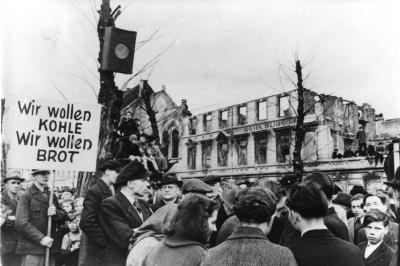
|
Hungerwinter 1947 On Monday 31.3.1947, in Krefeld
(British
Occupied Germany), thousands left work and gathered at a protest
rally on the Karlsplatz. Wir Wollen Kohle Wir Wollen Brot (We want coal We
want bread). Another poster just said Wir hungern (We are hungry).
Notice
the children sitting in the tree.
|
1947
New word: D.R. Hartree wrote about the hardware of the USA
computer
ENIAC. In
1960, The Times spoke
of "both punched card" (the means used to feed information into a computer)
and "computer 'hardware'" continuing to develop rapidly. Software
was used for the programs used by a computer from
1960, thus completing the distinction between hardware
(the machine) and software (the program). In
2000,
Zygmunt Bauman applied the terms to types of society.
1947 Puzzled People. A study in popular attitudes to religion,
ethics, progress and politics in a London borough (called Metrop).
Prepared for the Ethical Union by
Mass Observation. Published: London : Victor Gollancz. 159
pages.
January 1947
Simone De Beauvoir begins flying from
France to
America

|
World
War two made long runways available, and after the war Pan Am, TWA, Trans
Canada Airlines, BOAC, Air France and others acquired larger piston
aircraft, which allowed flights over the North Atlantic with intermediate
stops (usually in Gander, Newfoundland and/or Shannon, Ireland). To aid
aircraft crossing the Atlantic, six nations grouped to divide the Atlantic
into ten zones. Each zone had a letter and a vessels station in that zone,
providing radio rely, radio navigation beacons, weather reports and
coordinated rescues in case an aircraft went down.
Wikipedia
|
The Indian Independence Act 1947 (10 + 11 Geo 6 c. 30) partitioned British
India into independent dominions of India and Pakistan.
with effect from 15.8.1947.
12.2.1947 Christian Dior launched the New Look in Paris. Skirts
dropped from knee to near-ankle length and the femininity of women was
accentuated. Dior dresses shocked people with the amount of cloth they used
and in some areas of Paris women in Dior dresses had them torn off by other
women protesting at the conspicuous consumption. (Observer Colour
Supplement 28.11.1965) -
Ready to Wear:
"Before the Second World War,
fashion was for toffs and clothes were for ordinary people. After it,
fashion was available for everybody. What brought about such a change?
...when the war ended and rationing didn't, the women revolted. They saw
Dior's New Look with its voluminous floor length skirts and put their foot
down. They wanted to be feminine and colourful again and not even the
government was going to stop them." (Radio Times 18.5.1999). See
1953
1948
1.1.1948 British Transport Commission came into operation.
1.4.1948 Electricity Boards came into operation.
30.1.1948 Assassination of
Mahatma Gandhi (1869-1947), the
non-violent protest leader of the independence movement.
UK: The gradual abolition of rationing began in April 1948; it was not
completed until the abolition of meat and butter rationing in July 1956.
Butler and Freeman 1968, p.271

|
7.4.1948 World Health Organization (WHO) established with its
headquarters in Geneva, Switzerland.
|
See 1948
diseases -
1951 -
1953 -
1968 -
1982 drugs -
1988 -
1990 diseases -
1993 -
2001 ICF -
2001 -
2008 -
2010 statistics
-
22.6.1948 Empire Windrush arrived at Tilbury with 492 passengers
from
Jamaica. Symbolically treated as the start of post-war
immigration to
Britain from the West Indies. See
Frank Bangay
July 1948
UK National Health Service
|
July 1948 A solid state alternative to the
electronic valve
Two p-n junctions placed back to back with metal connections to the two p
regions and one to the n region. The emitter analogous to the cathode in a
thermionic valve, the base to the grid and the collector to the
anode.
|
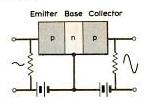
|
1949
1949 Method of
radioactive carbon dating
for archaeological remains developed by Willard Frank Libby and his team
at
Chicago University. [See
Wikipedia
1949 The
Observer's Book of [British] Geology, written by I.O. Evans
(Idrisyn Oliver Evans 11.11.1894-13.3.1977), an amateur geologist who had
suggested the publishers extend their "works on Natural History". He was
assisted by Herbert Leader Hawkins, the Professor of Geology at Reading,
who wrote a philosophical Foreword explaining that a geologist was an
"observer" who "tries to find
a meaning". The final section on "human handiwork" discussed
ploughed fields,
the
Elan Valley Reservoir,
Malvern road
stone,
Brighton sea defences
and the
suggested use of "atomic bombs" to "melt the polar ice-caps".
1949 First edition of Paris Match (match referring to the
game of life rather than sport). Slogan (1949-2008) "Le poids
des mots, le
choc des photos". (The weight of words, the impact of photographs)
1949
Simone De Beauvoir's
Le deuxième sexe published.
Translated
into
English as The
Second
Sex in 1953. An
existentialist, De Beauvoir
believed
that human
beings are essentially self-determining and free. Her book
explores why
women are treated (and treat themselves) as
"the other", as
objects of male
attention rather than self-determining beings.
1949
Les Structures élémentaires
de la parenté by
Claude Lévi Strauss. [English 1969 The Elementary Structures of Kinship.
The inspiration for the book is
L'Essai sur le Don.. by
..
Marcel Mauss... - ..."the ground for .. later work" [on
mythology and totemism],
"and the respect he gained from fellow professionals comes largely from his
... work on kinship... this book is his masterpiece."
(Anthony D Buckley's
review)
|
January February 1949
Talcott Parsons gave the University Lectures
in Sociology at the University of London. They formed a rough
outline for
his book
The Social System
|
|
1949 British Journal of Sociology established by staff at
London School of Economics after a failed effort to take over
the
Sociological Review.
Early in 1949, Mary Edwards in the USA posted a pair of
nylon stockings to
Joan Martin in London, "wrapped up in a magazine. These were
forbidden imports and the first I had ever seen".
14.3.1949
clothes rationing ended in Britain with immediate effect from
15.4.1949.
(Hansard link)
|

|
18.4.1949 to 23.4.1949
Scouts "bob-a-job week". Every Scout urged to
earn at least one shilling to raise money for the Scout headquarters.
|
From
1950 to 1970 it became an annual event. [See
1954]. Renamed Scout Job Week in
1970
due to impending
decimalisation, but
by this time there were concerns about
he safety of boys going from home to home and the scheme was changing. In
1972 sponsored shoe polishing
was introduced, in 1980 sponsored litter clearing. In
1999 it was abolished in favour of other fundraising activities.
|
11.5.1949 (Modern) Israel admitted to the United Nations by majority
vote. (See
ancient Israel and
Balfour)
|
The kingdom of evil
17.7.1949
Hansard "I feel that in education in this country as a
whole
we have tended to conceive practical matters as rather belonging to the
kingdom of evil, and in our educational system this has taken the form of
tending to be rather mean over technical education in the past." (David
Hardman, Parliamentary Secretary to the Minister of Education)
|
14.8.1949 First elections to the Bundestag (parliament) of the
Bundesrepublik Deutschland (Federal Republic of Germany - or West Germany)
that had been created in
zones occupied by the USA, Britain, and France.
|
A poster from the archives of the centre-right German Christian Democratic
Party
(source), which won the largest number
of seats in the Federal elections
1947 Hunger - Not - Elend 1949 Vorwärts!
Aufwärts!
Der Erfolg der CDU Abbildung:
Verelendete - fröhlich spielende Kinder
1947 Hunger - Emergency - Misery - 1949 Forward!
Upward! The
success of the CDU - Figures: Sunk into poverty and joyful playing children
|
September 1949 In the hard asphalt playground of Campsbourne infants
school, north London, big girls (six years old) organised us into gangs to
fight or to link arms and march up and down the playground chanting
repeatedly that
"We won the war - In 1944". Girls all wore cotton dresses
and we boys short grey flannel trousers and shirts. Sweets were rationed,
and a small square of chocolate was a treat, but we won the war - in 1944,
over and over again. So we all knew who our national enemy was: Germany.
|
September 1949 International Sociological Association organised at a
meeting in Norway in which twenty two countries participated. This called
the First World Congress of Sociology in Zurich for September 1950.
"Sociology was abolished in
China from
1952 to
1979. Marxist historical materialism, a branch of philosophy,
was the nearest available discipline." (Xiangquan Chang 2013)
|
From 1949 to 1972
Ralph Miliband was a lecture in Political
Science at the London School of Economics. See
1969 -
1979 -
2013
1950
1950/1951 to 1971/
1973 Post-war boom. See
Wikipedia
Thomas Humphrey Marshall Citizenship and Social Class and
other essays, published as a collection by Cambridge University Press.
1950
Institut für Sozialforschung returned to Frankfurt
in Germany from its exile in the USA.
Early in 1950
Joan Martin renewed her applications for jobs in laboratories.
Getting into chemistry was difficult, but Joan worked in a dairy
laboratory before obtaining work with
Permutit in September 1951. She combined work with evening
study. Employers really wanted men, and definitly not someone who was
"not quite normal".
23.2.1950 United Kingdom General Election. Labour returned with a
slim majority.

|
Norman Dodds, MP for Dartford, Kent, delivered the first
question to Parliament, on behalf of the Deptford United Nations
Association: "Mr. Dodds-to ask the Prime Minister if he is aware of the
passionate desire of the people that he should take the initiative in
endeavouring to call a conference with the object of finding ways and means
of outlawing the hydrogen bomb and atomic weapons."
|
Darenth Park Mental
Deficiency Institution was in Norman Dodds constituency and this
may have been the origin of his
interest in mental health reform
|
March 1950 Meeting at the home of James Van Allen, in Washington DC,
that led to the
International Geophysical Year in 1957/1958. This period was
selected to coincide with a time of maximum solar activity when the most
benefit could be expected by international cooperation in geo-physical
observations.
|
20.7.1950
UNESCO Statement by Experts on
Race Problems -
UNESCO archive -
text at Honest Thinking
20.7.1950 About 24 million pairs of
nylon
stockings were being sold in the United Kingdom in a year. There was a
shortage, which was exploited by "spivs". Stocking machines bought under
Marshall Aid were undersupplied by polymer from Imperial Chemical
Industries and nylon yarn from the
British nylon
spinners. The President of
the Board of Trade (Harold Wilson) was unable to guarantee adequate
supplies for the Festival of Britain and
lisle stockings were recommended as an alternative.
(Hansard debate on nylon stockings).
|
4.9.1950 to 9.9.1950 First
World Congress of Sociology
held in Zurich, Switzerland. General
theme: Sociological Research in its bearing on International Relations."
|
1951
1951
"Women's Institutes ... have a unique and unrivalled
opportunity to help in cancer education... doing away with
fear and ignorance, obtaining early diagnosis and saving
thousands of lives". The consultant physician at St Bartholomew's Hospital,
London quoted in
100 years of campaigning
. See
1962 -
1964 -
Screening
(1968) -
1975 -
Forrest Report (1986)
UNESCO
1951 Statement on Race
|
1951 The
Observer's Book of [British] Architecture, written
and illustrated by John Penoyre and Michael Ryan, "describing and indexing
the development of building in Britain from Saxon times to the present
day". Foreword by F. R. S. Yorke. Number 13 in the series and only
the
second that was not on natural history. A revised edition in
1958
included an illustrated glossary.
|

|
The Door with Seven Locks By Edgar Wallace
Published hard cover London, 1926
This Hodder paperback 1951
"It was unfortunate that Dick Martin should find a murdered crook in
his bureau just when he was thinking of retiring from the Force. But he was
a detective by nature and so naturally he couldn't help becoming involved
in this curious case".
|
|
Talcott Parsons'
The Social
System
attempted to
provided a model for sociology that views society as more than
the sum of
its individual members, whilst remaining consistent with
American
ideas of
the importance of the individual
|
 sick role
|
Stuart Hall came to England with his mother in 1951. He studied
at
Oxford University.
"Marxist models were far too mechanical and
reductive. (We did not yet have access to Lukacs, Benjamin,
Gramsci or
Adorno)." "There was no
'black politics' in Britain; post-war
migration had
only just begun."
(Hall 2010)
January 1951 First edition of
The British Road to Socialism
adopted by the Communist Party of Great Britain replaces the previous
For Soviet Britain - "The path forward for the British
people will be to establish a People's Government on the basis of a
Parliament truly representative of the people".
1.1.1951 First national transmission of The Archers (an
everyday story of
countryfolk) on BBC radio. Centred on the fictional
village of
Ambridge it brought rural life to a largely
urban audience.
14.1.1951
Frank Bangay born, Wandsworth. See
reflections on working class childhood.
Sunday 8.4.1951/Monday 9.4.1951:
Fifteenth
British Census
Population of England and Wales: 43,815,000; Scotland:
5,102,000
The previous census was in
1931
|
|
April 1951: Ambassador for inter-world peace
"After a failed outing early in 1951, when graphic novelist and filmmaker
Osamu Tezuka" [3.11.1928-
9.2.1989] "first introduced the robot as
the peacemaking
Ambassador Atom
in a Japanese magazine for boys, "Astro Boy" as we know him was launched a
year later".
(source)
See Manga and
Astro boy 2003
|
May 1951 Letter in The Times announcing the formation of the
British Sociological Association
(external link to website).
"Social and legislative changes in recent years have made much
sharper the need for study and research in sociological fields. In
particular, the extension of planning since the war demands an
understanding both of the sociological basis of planning and of its impact
on society."
The BSA was based at
London School of Economics until
1992, when it moved to Durham.
Morris Ginsberg was chair from 1951 to 1955 (then President).
Raymond Goodman was Secretary from 1951 to 1953
It soon replaced
the
Sociological
Society, which decided to close in
1955.
(external link).
|
|
Thursday 3.5.1951 King George 5th opened the Festival of Britain,
which
closed on Sunday 30.9.1951. Amongst the 8.5 million visitors was
Grahame Smedley (13) with a party from Newton-le-Willows, Lancashire, who
who travelled over-night via Liverpool in a seven and a half hour train
journey (Liverpool to Euston). The
morning and evening of Saturday 8.9.1951 was spent exploring London and the
afternoon in the exhibition. They arrived home on Sunday morning.
|
|
|
The Dome of Discovery was too dark and stuffy for Grahame. The son of a
Vulcan factory worker, he went alone to the Transport Pavilion.
"and the
first thing I saw was the Vulcan locomotive" [a Diesel Electric] "at the
very front of the Pavilion. Inside the Pavilion there were some model
tramcars, a jet motor car, a London tube train and thousands of other
things...". The Home and Gardens Exhibition had "lovely planned rooms" and
the Education Pavilion "the most modern ways of teaching"... it was the
most enjoyable day of my life". (Vulcan Magazine Winter 1951-1952
pages 21-22)
|
|
The Festival of Britain across the Thames from the Embankment on the
evening of Saturday 8.9.1951 taken by H. Talbot from the Vulcan factory
Lancashire.
|
5.9.1951 The start of commercial computing. Lyons Electronic Office
(LEO) took over Bakery Valuations calculations for J. Lyons and Co.,
(probably) the best known catering and food company in the UK. Later, it
took over payroll calculations, the inventory, and so on. In 1956
Lyons started doing the payroll calculations for Ford UK and others.
25.10.1951 United Kingdom General Election.
Conservatives returned
to power on a one nation platform that incorporated many
Labour values.
(manifestos link)
(archive)
|
Vulcan Foundry retirements: 28.8.1951 aged 65, William
Traverse (Plater-Tender Shop) who started
April 1900. 12.10.1951 Walter Cooke (Coppersmith) aged 61 who
started
February 1903. 2.11.1951
Herbert Payne. 2.11.1051 Alfred Andrews (Striker, Boiler Shop)
aged 69 who stared
September 1907.
Made in Britain - exported to South America
The front cover of the Vulcan magazine shows a
P.S.11 Class (steam)
Locomotive
made for the Argentines and a
3,000 Horse Power
Electric Locomotive made for Brazil.
Vulcan also made trains for Britain. My grandfather would take my sister
and me to the
end of the platform and we would bend down to see the pipes he made in the
copper shop.
|
1952
"If we want to use the fallout from
nuclear weapons to mark the
beginning of the
Anthropocene
Epoch, the 1945
Alamogordo nuclear
weapons test marks the start of the nuclear age but lacks a clear
radiogenic signature in the global geological record. By comparison,
the most pronounced rise in plutonium dispersal commences in
1952 and can provide a practical
radiogenic signature for the beginning
of the Anthropocene".
(Colin Waters and others 2015)
Structure and Function in Primitive Society,
the
collected essays of
Alfred Reginald
Radcliffe-Brown
(1881-1955) published.
This title and Talcott Parson's argument (1951) that theory
must be in
structural-functional terms (for the
present) are amongst
the origins of the concept that there is a school of sociology
called
structural functionalism
Carlos Paton Blacker resigned as general secretary of the
Eugenics Society, acknowledging (in Eugenics. Galton and after 1952)
that efforts to
revive the scientific credibility of
eugenics, after its association with the race hygiene policies
of the Nazis, had failed. (Richard Soloway, Dictionary of National
Biography)
Wednesday 6.2.1952 Death of George 6th, "King of all Britain",
The BBC (Wireless) played solemn music all day.
22.12.1952. Pinay in front of a gold coin.
|
8.3.1952 Antoine Pinay became French Prime Minister (to 23.12.1952).
Inflation in France was at about 12% a year (It had fallen from about 59%
in 1948). Pinay represented himself as the defender of the Franc and the
consumer. He introduced a national loan (called emprunt Pinay), backed by
gold, as part of the policy against inflation. In the very favourable
economic environment at the end of the Korean War, it succeeded and prices
fell in France in 1953, for the first time since 1935. [See
Roland
Barthes]
|
11.3.1952 Utility Goods (Revocation) Order, 1952 (S.I., 1952, No.
489). Later
Hansard discussion
24.9.1952 The Corneal Grafting Act became law in Britain, permitting
a registered medical practitioner to remove eyes soon after death for graft
purposes and legalising the bequest of eyes for graft purposes. At the time
it was envisaged that other parts of the body (skin, for example) might be
subject to similar arrangements later.
The
Federation of Women's Institutes
joined a campaign to
educate the British public about corneal
grafting.
October 1952 "Dormobile" (mobile dormitory) appeared in the
Trade Marks Journal. In the 1950s the camper van developed with
seats that could make bunk beds, an elevating roof that allowed people to
stand upright, a gas stove, sink and cupboards.
October 1952
Roland Barthes wrote about "Le monde où l'on
catche" [The World of Wrestling] in Esprit. Wrestling was popular in
France from about 1950 to 1970. In the early 1950s it could be seen at
fairs or special occasions such as galas in honour of
July 14. It was
performed at the
Cirque d'Hiver (Winter Circus) in Paris as well as in "the
most squalid Parisian halls". Later in the 1950s it was watched on
television.
(French Wikipedia). This was the earliest article that composed
Mythologies in
1957
|
November 1952 The Pictorial Encyclopaedia edited by Richard
Haddon, Charles Harvey, and E. S. Wolff published in London by Sampson Low,
Marston at 15/-. 237 pages.
My
copy was in use in Leyton Public (Junior) Libraries from August 1956.
The illustration shows
a tree depicting racial separation between "men"
in which a difference between "ape men" and "true men" is
shown as equivalent to, or greater than, that
separating humans from gorillas and chimpanzees. True men then divide into
two distinct lines - black (negro - negroid - australoid) and white
(european - mongoloid), shown as equivalent to that
separating orang-utangs from gorillas.
|
|
|
1953 Britain "How Much is That Doggy in the Window" in
the top ten for weeks - Women's papers show women proud to make their own
dresses on new sewing machines,
dresses with plenty of cloth (after the
shortages) and calf length skirts - However, there is the shocking
behaviour of a French woman, Bridget Bardot, photographed in a bikini at
Cannes - The Archers - "everyday story of country folk" just beginning its
eternal run on the BBC - In
1952 all scheduled broadcasting was replaced for a day by solemn
music because the family king had died. In 1953 we may visit friends with a
television sets to watch the new Queen being crowned, or listen on the
wireless and go to the cinema to see the film of the fairy- tale
coronation.
|

|
1953 The Institute of Community Studies
established in
Bethnal Green, London, by
Michael Young, Peter Willmott,
Peter Townsend and
Peter Marris. (See dictionary community). "Our main research focus
in the
Institute's early years was the smallest institution of all,
the family in its
nuclear
and
extended versions." (Peter Willmott 1995). Reports
1957 -
1958 -
1960 -
1961 -
1962 - and later
Wednesday 4.2.1953 UK Sweet rationing ended.
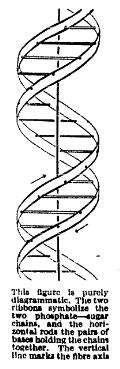
|
25.4.1953
"Molecular Structure of Nucleic Acids. A Structure for
Deoxyribose Nucleic
Acid - We wish to suggest a structure for the salt of
deoxyribose nucleic
acid (D.N.A.)..." Letter in Nature from F. H. C. Crick and J. D.
Watson
April 1954 "The Complementary Structure of Deoxyribonucleic Acid" by
F. H. C. Crick and J. D. Watson published in the Proceedings of the
Royal Society -
Wikipedia article on DNA - See
genetics. - See
1968
|
Friday 29.5.1953 Sherpa Tenzing Norkay and Edmund Hilary reached the
top of Everest, the world's highest mountain, in an expedition led by John
Hunt. The news reached Britain on he day of the coronation, and was
headlines in the morning papers.
2.6.1953 Coronation of Elizabeth 2nd televised.
The number of television licences doubled from 1.5 to 3
million in the run-
up to the Coronation.
See 1927,
1937, 1993.
July 1953 Pierre Poujade organised a tax protest in his town in
France. This led to a national movement of small traders and others in a
mouvement known as Poujadisme by
January 1956.
20.7.1953 "An employer who makes the stupid statement
that 'what we want is a little unemployment', is just as bad, and causes
just as much harm, as the Socialist politician or trade union leader who
makes rabble-rousing speeches". Edwin Leather - Conservative MP and Trade
Union supporter

|
27.8.1953 Roman Holiday.
"The face of
Garbo is an
Idea, that of Hepburn an Event".
Trailer. The princess who escapes into common life rides a
Vespa
wildly around Rome.
|

Audrey Hepburn Google Sunday 4.5.2014:
Idea or event?
|
Autumn 1953
Jacques Lacan began seminars in Paris. His
interpretation
of Freud attracted participants from outside psychoanalysis. See
June 1964
|
October 1953
Albert RN "The War's Most Daring Prioner of War Escape"
The British inmates of a Prisoner of War camp think they have an informer
among them after several escape attempts fail. One of the prisoners makes a
dummy which they christen "Albert" and use at roll call in order to foil
the German guards.
From 1955 to 1976 Jack Warner played Dixon of Dock Green in the BBC
television series about a fictional Metropolitan Police station in the East
End of London.
|
21.11.1953
Times (London)
"Piltdown Man Forgery - Jaw and Tooth of Modern Ape - "Elaborate
Hoax" - From our Museum Correspondent"
1954
13.4.1954 League of Empire Loyalists founded at Caxton Hall,
London, to oppose moves to dissemble the British Empire.
26.4.1954 to 21.7.1954 Geneva Conference divided Vietnam into
North and South. 18.6.1954 to 23.2.1955 anti-colonial left
wing government of Pierre Mendès France withdrew French from Indo-
China. He began the processes that led to the independence of Tunisia and
Morocco. 1.11.1954 called Toussaint Rouge (Red All-Saints
Day) because of liberation attacks on police and army targets in Algeria.
Later considered the start of the Algerian War of independence. On
12.11.1954 Pierre Mendès France said
"One does not compromise when it comes to defending the
internal peace of the nation, the unity and integrity of the Republic. The
Algerian departments are part of the French Republic. They have been French
for a long time, and they are irrevocably French. ... Between them and
metropolitan France there can be no conceivable secession."
Report of the Nature Conservancy, year ended 30.9.1954, p. 25:
Piltdown Skull Site: "As a result of the discovery during
the year that the Piltdown jaw was not genuine and that none of the
"Piltdown" remains could be definitely attributed to the site, the
Conservancy decided to revoke the declaration of the Piltdown Skull Site as
a National Nature Reserve. Arrangements are being made to hand it back to
the Barkham Manor Estate on condition that scientists accredited by the
British Museum (Natural History) have access to the site; that the memorial
stone is not removed; and that the windows of the trench exposing the
gravel in which the bones were alleged to have been found are left intact,
in case the gravel should be required for further study."
(source)
|
22.11.1954 This issue of Elle (number 467) was "anti-
cold". As well as features on Winter fashion, Winter coats and Week day
fashion, it contained, on pages 62 to 65 an article by Roger Kemp
"70 Romancières, 300 romans: Les Femmes de lettres
s'imposent." [70 Novelists, 300 novels: women of letters are necessary].
Elle had started as a weekly magazine on 21.11.1945
The 1960s slogan was "Si elle lit elle lit Elle"
|
"If we are to believe the weekly Elle, which some time
ago mustered seventy women novelists on one photograph, the woman
of letters is a remarkable zoological species: she brings forth, pellmell,
novels and children. We are introduced, for example, to
Jacqueline Lenoir (two daughters, one novel); Marina Grey (one
son, one novel); Nicole Dutreil (two sons, four novels), etc"
(Roland Barthes 23.1.1955)
1954 Social
Mobility in
Britain edited by David Victor Glass.
David Glass had been a
research assistant to
William Beveridge and
John Rex (1974, pp 1-2) describes him as
the "principle representative" of the
"Fabian interest in social reform"
December 1954 Seymour Martin Lipset
argued that the "new sociology"
had "destroyed a number of hallowed myths". It had established (for
example) that social mobility was more or less the same in European
countries as it was in the United States.
|
Speaking of Western Germany,
Ulrich Beck
says that, since the mid
1950s
"the unstable unity
of shared life experiences mediated by the market and shaped by status,
which Max Weber brought together in the concept of social class, began to
break apart. Its different elements (such as material conditions dependent
upon specific market opportunities, the effectiveness of tradition and of
precapitalist lifestyles, the consciousness of communal bonds and of
barriers to mobility, as well as networks of contact) have slowly
disintegrated'
(Beck, U. 1986/1992 p.96)
|
1955
1955 Birth of Nicholas Weldon, son of
Fay. Fay, her sister and her
best friend lived in Saffron Walden with babies and no partners. "the
normal fate of the unsupported mother, which we three avoided by the skin
of our teeth, of being forced to hand the baby over for adoption... was...
cruel in the extreme". But people thought of it as "natural and ordinary
social justice" ("Things I wish I'd known at 25" Aura May 2000,
p.140). See
cold linoleum.
1955
Homosexuality and the Western Christian Tradition by
Derrick Sherwin Bailey of the Church of England's Moral Welfare Council.
See
Timothy Jones "The End of Sodomy: Derrick
Sherwin Bailey and the Emergence of the 'Homosexual' in the Church".
February 1955
Roland Barthes small mythology essays on childhood
included one on
toys (Jouets) which criticised their content (prefiguring
the world of adults) and material
(plastic
replacing wooden craftmade toys). With plastic,
imitation materials were household goods: "artifice aims at
something common, not rare".
March 1955 Term "New Left" recorded (Oxford English Dictionary) -
Later associated with left wing critics of (or within) the Communist Party.
(See Reasoner)
12.4.1955 National Union of Teachers' Conference at Scarborough.
David
Eccles, the Minister of Education, said
"But now all is mixed up. The professor mends his car and his
wife
has no maid. Every year that passes more mothers are as expert with
their babies as the professional nannies who, when I was in my pram,
ebbed and flowed twice a day in Kensington Gardens. ... In short, we
are all coming closer together, in a sense we are all working-class
now, and tomorrow we shall be able to enjoy a share of the culture
and leisure which used to be the prerogative of the few." (Quoted
Hansard 26.4.1955, col. 772)
18.4.1955
Albert Einstein died
"Mythologically, Einstein is matter, his power does not
spontaneously draw one towards the spiritual, it needs the help of
an independent morality, a reminder about the scientist's
'conscience' ... Einstein himself has to some extent been a party to the
legend by bequeathing his brain, for the possession of which two hospitals
are still fighting as if it were an unusual piece of machinery which
it will at last be possible to dismantle."
(Roland Barthes
June 1955)
nuclear spectroscopy: "the late forties" to "early sixties" was
a "rewarding time in
nuclear physics since the nuclear shell model, complemented with
the collective
properties, was then developed". To a large extent this was
"founded on
experimental material brought together from nuclear decay
studies." See
Kai Siegbahn's
Nobel lecture, 8.12.1981
Joan Martin:
"The Inverse World".
|
27.5.1955
Election victory for Tories under Eden
- "It is interesting to contrast the feverish activity of the
Conservative Government in the last three months before the General
Election with the cuts and economies which took place during the first
three months of its period of office" (Alice Bacon,
Hansard 26.4.1955)
June 1955 J. Guerin (Jean Paulhan) wrote in his "Notes" in La
Nouvelle revue francaise pages 1118-1119: "Mais peut-être
Barthes nous dira-t-il un jour ce qui n'est pas mythe?" "Après
tout, peut-être M. Roland Barthes est-il simplement marxiste. Que
ne le dit-il?" [But maybe Barthes will one day tell us what is not myth?
After all, maybe Mr Roland Barthes is simply marxist. Why not say so?]

|
5.6.1955 to 9.6.1955
Billy Graham at the Vel' d'Hiv' in
Paris.
|
|
16.6.1955 to 22.6.1955 International symposium "Man's Role in
Changing the Face of the Earth", organised by the Wenner-Gren Foundation
for Anthropological Research and held at the Princeton Inn on the edge of
Princton University, New Jersey, USA.
(Online history at Princeton University)
|

|
|
In the mid-1950s, Paul Bigelow Sears and his colleagues were analysing
cores of sediment from the Plains of San Agustin in New Mexico. The
changing pollen contents indicated the changing vegetation in the late
Pleistocene when the sediments formed in a lake. This provided
an indication of climate change in the ice ages. It was in connection with
these studies that Sears wrote (in a paper published in the symposium
report) about "a widespread confidence that this
impact of man upon
environment can continue indefinitely"
[A relevant paper]
|
|
June 1955 Diouf, Issa and Santoura were "enfants de troupe"
(children training to be soldiers) in the school at Ouagadougou in
French West Africa. They were taken to Paris in June 1955 to take part in a
military parade.
In 2006
they were searched for
|
|
Polythene (polyethylene or PE) used for pipes since the
early
1950s (Wikipedia).
Henry Herbert Moss of Billericay made a note shortly after 1955
"Plastic Pipes - burst proof". "Polythene Piping expands and
contracts,
thus keeps free of bursts, can be used only for cold water. Fitted in
Oldham, Lane. houses 3 years ago - never a burst."
|
1956
Karl Popper's article, Science: Conjectures
and
Refutations, argued that the origin of science is in
imagination, and
suggested falsification as the destructive empirical test of
theories
1956
USA: Robert Dahl's A
Preface to Democratic Theory published.
1956
USA: Lewis Coser's The Functions of Social Conflict published.
1956 Social Class and Educational Opportunity edited by J.E.
Floud, A.H. Halsey and F.M. Martin. published, London
permissive
1956 C. A. Tonsor in Clearing House 30. v. 289, "I realize
that in the face of the permissive tendencies of the age, there is not much
respect for rules."
|
1.1.1956 French legislative elections. "Some candidates for
Parliament adorn their electoral prospectus with a portrait. This
presupposes that photography has a power to convert which must be
analysed." Photography spirits away politics in favour of a manner of
being. "This antithesis is one of the major myths of
Poujadism (Poujade on television saying: 'Look at me: I am like
you' ". (Roland
Barthes
February 1956). [This is the only mention of television in
Mythologies - See
popular culture]
18.1.1956 Anthony Eden (UK Prime Minister) spoke in
Bradford of the
world-wide scientific revolution
"The prizes will not go to the countries with the largest
population. Those with the best systems of education will win. Science and
technical skill give a dozen men the power to do as much as thousands did
fifty years ago. Our scientists are doing brilliant work. But if
we are to make full use of what we are learning, we shall need more
scientists, engineers and technicians. I am determined that the shortage
shall be made good". (Quoted
Technical
Education 1956 p.4)
Leslie Greene: "The British Empire is the greatest force for
peace that the world has ever known and you are giving it away" "We have
not given it away. What has happened is that the people of the Commonwealth
are steadily developing towards freedom and self-government"
|
January 1956
British Sociological Association conference
on "The Present State and Development of Professional Sociology" held at
the London School of Economics. The first edition of the Association's
Bulletin, in October 1956, featured a report by Asher Tropp
"The Present State and Development of Professional Sociology"
21.2.1956 Harold Macmillan (UK Chancellor of the Exchequer):
"The average weekly earnings of men aged 21 and over in manufacturing and
certain other industries covered by the regular Ministry of Labour
inquiries were £3 9s. in October, 1938. A married man with two
children would require weekly earnings of £9 2s. at the present time
to provide the same purchasing power, after tax. The actual average
earnings in April, 1955, the latest date for which figures are available,
were £10 17s. 5d."
(Hansard) - "In two days he had earned
nearly £3, a man's wage" (David Roxan p. 185 referring to
Peter Whitehead's casual wages picking damsons in 1954) - See
"never had it so good" 1957
25.2.1956
Nikita Khrushchev's secret speech at the
20th Congress of
the Communist Party of the Soviet Union in which he criticised
Joseph Stalin. In June 1956 Le Monde published a
French translation of the speech.
|
29.2.1956 Publication of
Technical Education (Cmnd
9703 - 43
pages)
a White Paper on the future of technical
education, covering England, Wales and Scotland.
29.3.1956 House of Commons debate on
Higher Technical Education, Tees-side
(available online)
21.6.1956 House of Commons debate on Technical Education
(available online)
"I think there is just a danger that we may campaign for
technical education as though it were an international race, like the arms
race." (The Minister of Education (Sir David Eccles) in the debate) See
International Geophysical Year below.
|
19.4.1956 to 27.4.1956
Soviet leaders Nikolai Bulganin and Nikita Krushchev on a State visit
to the United Kingdom.
May 1956 Victor Gollancz published
Colin Wilson's The Outsider for the first time.
July 1956: UK abolition of meat and butter rationing. (Last
rationing to go)
5.7.1956 Royal Assent to "An Act to make provision for abating the
pollution of the air" 4 and 5 Elizabeth 2, chapter 52. [United Kingdom
"Clean Air Act"]. This came into effect over the next ten to fifteen years.
End of July 1956 First issue of the Reasoner, an anti-
Stalinist communist journal, produced by John Saville and Edward P.
Thompson. Issue one of the New Reasoner was published in Summer
1957.
(external link). The first issue of
Universities and Left Review had been published in Spring 1957 by
Raphael Samuel, Gabriel Pearson, Charles Taylor and
Stuart Hall. The
two journals worked together and merged in 1960 as
New Left Review
(edited by Stuart Hall).
Charles Wright Mills wrote a
"Letter to the New Left" in New Left Review issue 5.
|
22.8.1956 to 29.8.1956 Third
World Congress of Sociology
held in Koninklijk Instituut voor de Tropen, in the Netherlands. General
theme: Problems of social change in the 20th century."
"The Soviet Union, and the other countries of the Soviet bloc, ... for the
first time sent delegations... Their representatives were not sociologists
in the strict sense of he word, but they showed themselves very willing to
take part in the proceedings" (
Maus, H. 1956/1962 p.165)
|
26.10.1956 Red Army troops invade Hungary.
29.10.1956 Israel invades the Sinai Peninsula and push Egyptian
forces back toward the Suez Canal.
31.10.1956 The United Kingdom and France begin bombing Egypt to
force the reopening of the Suez Canal.
22.11.1956 New Scientist magazine launched. A popular
magazine for
science and
technology. New
Society
followed in 1962. New Scientist still thrives, New Society has
withered
away.
"We are falling rapidly behind USA and USSR in training
scientists and technologists. The remedy is a revolution in the secondary
school system" A.D.C. Peterson, Headmaster of Dover College "How to break
the barrier between science and arts" pp 12-13 New Scientist
22.11.1956
|
1957
|
Biological death of the Thames In 1957 researchers from
London's
Natural History Museum said the river Thames was biologically dead because
of high levels of industrial and sewage pollution. "By the 1950s the
estuary was probably in the worst state it had ever been. Surveys in this
decade recorded oxygen levels at below 5% for 52 km and a 20 km stretch of
the Thames around the two main outfalls having no measurable oxygen in the
water! No fish populations were present for a 69 km stretch from Kew to
Gravesend. The Thames was basically lifeless for most of its upper length,
save for some hardy worms in the mud banks"
Martin Attrill 16.10.2006
|
|
Commercial production of polypropylene began in 1957
|
1957
United Kingdom Consumer's Association (publisher's of "Which?") founded by
Michael Young
Family and Kinship in East London by
Michael Young and
Peter
Willmott published (Institute of
Community Studies Report 1). It became a Penguin paperback
in 1962. Revisited in 2006 -
The family life of old people : an inquiry in East London by Peter
Townsend (Report 2). See 2006
Antonio Gramsci's Selected Works in Three Volumes
published in Russian in Moscow 1957-1959
The Modern Prince, and Other Writings by Antonio Gramsci,
translated
with a biographical introduction by Louis Marks, published in London by
Lawrence & Wishart 1957.
Carl Marzani's
The Open Marxism of Antonio Gramsci
published in New York 1957. Oeuvres choisies
(selected
writings) were published in Paris by Editions Sociales in 1959.
Gramsci's writings were used to argue that class conflict
which Marx and Engels placed at the core of history was as much
a struggle for the creation of new ideas as anything else.
1957 to 1970
"Christian radicalism' in the Church of England". "Radicalism
grew in influence from the late 1950s, and burst into the national
conversation with John Robinson's 1963 bestseller,
Honest to God"...
driven by a narrative of epochal transition, which understood British
society ... to be undergoing a seismic upheaval, comparable to the
transition between the
Middle Ages and the
Renaissance.
February 1957
Roland Barthes'
Mythologies published in Paris. The last
part of this, "Le mythe, aujourd'hui", is dated September 1956.
|
Roland Barthes
appeared on French Television discussing Mythologies in "Lectures
pour tous" on
29.5.1957 You Tube
|
[Lectures pour
tous
was the premierre
literary programme of French television, broadcast on the first channel of
RTF and then the ORTF from 27.3.1953 to 8.5.1968.]
|
6.3.1957 Independance of
Ghana from colonial British rule
|
25.3.1957 Treaty of Rome signed by Belgium, France, Italy,
Luxembourg, the Netherlands and West Germany. This established the European
Economic Community on 1.1.1958. This was succeeded by the
European Union in 1992.
May 1957 Percy Report favours community care
|
1.6.1957 The last edition of Picture Post used the picture
from the cover of the first edition in
1938.
1957: "the success of
commercial television has drawn away thousands
of people who formerly rejoiced in a fourpenny picture paper" (Edward
Hulton in the last
Picture Post)
On page 38, the paper ran its last advertisement for contraception - or
married happiness:
|
|
"Complete fulfilment of 'married happiness' combined with freedom from
anxiety need not be a secret. Nor is it just luck that has brought enduring
joy to thousands of couples for
over sixty years. Theirs has been the uncomplicated plan, which
has helped to bring the good things in life to them and their children - so
very simply with Rendells"
"Sold by Boots, Timothy Whites and chemists everywhere, and made by W.J.
Rendell Ltd, Hitchin, Herts, who will be pleased to send full explanatory
literature in a plain envelope on request."
|
20.7.1957 A speech by the United Kingdom Prime Minister, Harold
Macmillan included "... most of our people have never had it so good.
Go around the country, go to the industrial towns, go to the farms and you
will see a state of prosperity such as we have never had in my lifetime -
nor indeed in the history of this country."
(source). See
industrial and agricultural wage 1956

|
July 1957 to December 1958: The International Geophysical Year
|
|
Friday 4.10.1957 First Sputnik (Russian satellite) sent into space.
The second was sent on 3.11.1957 with a dog on board. The first
disintegrated on 4.1.1958. I was thirteen years old and, although I had
books that discussed how rockets might be sent into space, I had thought
that going into space would prove impossible. See
countdown -
1961 - Russian
- America
1962 -
men on moon 1969
and 2000.
Friday 11.10.1957 Jodrell Bank radio telescope in operation.
1958
Claude Lévi-Strauss (1908 -
2009) -
Anthropologie structurale ("Structural
Anthropology")
- See
Structuralism
Widows and their Families, etc. by Peter Marris.
(Institute of
Community Studies Report 3).
Good Friday 4.4.1958
|
17.2.1958 Inaugural public meeting of the Campaign for Nuclear
Disarmament at Central Hall, Westminster, attended by five thousand people.
The first Aldermaston March was at Easter 1958.
Stuart Hall: "... a new kind of political mobilisation-
beyond... the
big party battalions - which reflected certain emergent social forces and
aspirations characteristic of their time ... one of the first of this type
of 'social movement' to appear in post-war politics... like the
civil-rights movement at the
time, and feminist and sexual questions, ecological and environmental
issues, community politics, welfare rights and anti-racist struggles in the
1970s and 1980s- have proved difficult to construct within the
organizational agendas of the traditional left."
(Hall 2010)
|
3.3.1958 to 9.3.1958 All children born in Britain tracked as part of
the
National Child Development Study: The second of the British
cohort studies.
June 1958 "the old form of indenture of
apprentices
has largely died
out
and been replaced by schemes for vocational education" [A Quaker minute]
See 1726
25.8.1958 Racial disturbance in Nottingham when West Indians
defended
themselves against what they thought were threats from white Teddy Boys.
This was followed by attacks by white youths on black people in Notting
Hill, London.
Stuart Hall: "the New Left Club in London became deeply involved
in 1958 with the race riots in Notting Hill and with the anti-racist
struggles of the period around North Kensington... Rachel Powell, an active
club member, unearthed the scandal of 'Rachmanism' and white landlord
exploitation in Notting Hill."
(Hall 2010)
28.10.1958 Pope John 23rd succeeded Pius 12th. He died
3.6.1963 and was succeeded by Paul 6th. Pope John called the Second
Vatican Council, which lasted from 11.10.1962 to 8.12.1965. The
Constitution on the Sacred Liturgy (Sacrosanctum concilium), on
4.12.1963 sought "fully conscious and active participation in liturgical
celebrations", one aspect of this was the greater use of vernacular
languages in place of Latin.
The Council was also
important in the development of dialogue between christians and with other
faiths. The
Declaration on
the Relation of the Church to Non-Christian Religions (Nostra
Aetate) was
made on 28.10.1965. - See
Joan Hughes: about
1938:
child deaths:
Latin mass
:
sex:
mother's death:
Rome 1950:
Jennifer:
1959 more openness:
Christian
club- See
Civil Service Catholic Guild
-
|
1959 Ralf Dahrendorf's Class and Class Conflict in Industrial
Society published.
Bernard Crick The American Science of Politics: Its origins
and
conditions
1959 First edition of Outline of Human Genetics by Lionel
Sharples Penrose, Galton Laboratory, University College, London.
Heinemann, London.
Second edition (with new chapter) 1963.
"People want to know whether their children are going to be
clever or stupid, handsome or ugly, tall or short, healthy or unhealthy,
and so on. Traits like these" [as a general rule] "do not segregate in
families" [unlike] "relatively simple traits like colour blindness" (page
5)
1959 Start of Critical Quarterly
(External link to history)
21.1.1959 First
duplicated edition of The Billericay Observer - Wynford
Grant's newspaper produced by a schoolboy.
Link. "It started as one copy passed around
neighbours and friends and then became carbon copies, initially sewn
together, then stapled. After about a year I got a duplicator and then it
really started to develop." This is my earliest memory of
the use of office duplicators for community publishing. The next was its
use by
a group of mental patients in 1963. See the
Gestetner Revolution of 1968 and
Centerprise in 1970.
8.12.1959 United Kingdom General Election. Increased Conservative
majority -
manifestos link
(archive)
-
Wikipedia
|
1.12.1959 Antarctic Treaty opened for signature. It came into force
on 23.6.1961. The treaty preserves the continent for scientific
research and prohibits any kind of military use.
|
|
"The case for the existence" of postmodernism "depends on the hypothesis of
some radical break or coupure, generally traced back to the end of the
1950s or the early 1960s" ... "this break is most often related to notions
of the waning or extinction of the hundred-year-old modern movement (or to
its ideological or aesthetic repudiation)"... "every position on
postmodernism in culture ... is also ... [a] stance on the nature of
multinational capitalism today".
(Fredric Jameson 1991). See
USA postwar
order
|
|
Cold linoleum and no sex
"how different life was in the late fifties, early sixties,
pre-pill, pre-
coil, when the man not the woman was in charge of
contraception. When the
very word was still almost too rude and explicit to be mentioned, and body
parts were a deep mystery to everyone except medical students. There were a
few Marie Stopes "birth-control clinics" for women in major cities, but you
had to show a wedding ring to get access to them. Men had condoms, but
often preferred not to use them. Abortion was frequent, dangerous and
illegal...
How we lived then! The sheer physical discomfort of it... A woman's work
was never done and very boring it was, too. Few ate out (a wicked waste) or
had the money to do so. Meals were plain and tasteless: garlic and even
mushrooms were rare. Spices were meant to be bad for you. Foods were not
eaten out of season... Wicked wastes... included taking a taxi, running a
deep bath, owning more than two pairs of shoes... Winter meant cold: people
wore vests. No central heating, hot-water bottles in every home, cold feet
on icy linoleum in the morning, ice inside the windows, not just the
outside. A dusty, dirty coal fire (shut the door, please: don't let the
heat out!) and smelly paraffin fire to supplement it if you were lucky."
|

|
1960s
Marshal McLuhan
popularised the idea that developments in modern media are
creating a global
village. 1960 "Television gives this
quality of simultaneity to events in the global village". See
1915 -
1962 -
1993
|
Monster computers
(electronic counting machines) were developed during the
1960s. By the
end of the 1960s and early 1970s, machines the
size of a London bus (*) were processing statistics for social scientists.
These large room-filling computers became known as "mainframes", a term
originally used for the large cabinets they occupied.
By
the late 1970s the capacity of these monsters was being reduced into
microchips. See
Desktop - (*) The exaggerated comparison to a
London Bus reflects my awe-infected memory of the
Enfield computer.
In France, Michel
Foucault's
Histoire de la Folie (1961) began an
excavation of
history that was awake to the traditions of philosophy,
literature, social
science and the creative imagination. Nobody was quite
sure what to
do with it. - External link:
Warren Montag on
"Althusser's Reading of Folie et dé raison"
1960
Ronald Laing
The Divided Self: An existential study in sanity and
madness
1960 Family and Class in a London suburb by Peter Willmott
and Michael
Young.
(Institute of
Community Studies Report 4).
Norman Dennis and George Erdos (1992) argue that "the 1960s saw
the beginning of a period of rapid and far-reaching change" in social
arrangements "controlling who could bring children into the
world" - "responsibilities for rearing the children" - "the sources and
saliency of sexual pleasure" - and "ensuring so far as possible that each
adult had a life-long source of mutual assistance". Under the "pre-1960s
system" (they argue) "
marriage, realistically, was child-centred,
not spouse centred". "To place
companionship with one other
person at the centre of adulthood... was still
regarded (perhaps especially among working-class women) as a sign
of an inappropriate translation into real life of romantic notions".
|
Herbert Edwin Roberts (second from right, short man, retired from the
Vulcan Foundry in, 1960. So this photo taken before then.
|

|
25.8.1960 to 11.9.1960 17th
Olympic Games held in Rome.
18.9.1960 to 25.9.1960 9th Annual International Stoke
Mandeville Games, now known as the 1960 Summer Paralympics, held in Rome
|

|
|
Wednesday 2.11.1960 The Evening News: "Jury Says Yes To
The Novel
Banned For 32 Years". Lady Chatterley's Lover launched
the
permissive
society.
Ronald St. Blaize-Molony (2004) argues that "the Swinging
Sixties"
"properly dates from 1966" (to 1976). "The intellectual chassis carrying
that motor of dissent and revolution was the product of
then Home Secretary
Roy Jenkins, aided and abetted by the then Director General of
the BBC - Sir Hugh Carleton Green."
Hugh Carleton Greene was Director-General of the BBC (British Broadcasting
Corporation) from 1960 to 1969,
|
|
1961:
Contraceptive Pill available to (some?) married women on the
National Health Service. My recollection is that it only became freely
available (to married women) slowly during the 1960s. Wikepedia
has
a history of its availability to single women
in the UK. See
contraception
|
about 1961 The British Society of Criminology founded.
website
|
Vinyl wallpapers
"By 1961 ICI had developed 'Vymura', a paper coated with
PVC and printed with specially developed inks. Such papers were
no longer limited to kitchen and bath-room, but were promoted for use
throughout the house"
(Victoria and Albert Museum -
In the late 1960s and early 1970s the use of wallpaper boomed and peaked.
New "papers" were laminated with paper backing and vinyl, silk, fabric and
other surfaces, requiring stronger adhesive than the traditional wheat
based ones. Prepasted papers were introduced. The comparative difficulty of
removing the new wallpapers contributed to the decline of papering.
(source)
|
Wednesday 12.4.1961 Major Yuri Gagarin made first flight
into space and back. My Russian pen-friend sent me a postcard of
him. Yuri Gagarin's reception by Kruschev at Moscow airport was the first
event to be filmed by British television. (Panorama). [Not sure what that
means, but it was "memorable live" "outside broadcast" by Richard Dimblby,
followed by one of "the May Day Parade some days later". See
Panorama in the
Sixties by David McQueen]
Sunday 23.4.1961/Monday 24.4.1961:
Sixteenth
British Census
Population of England and Wales: 46,196,000; Scotland:
5,184,000
|
Family and social change in an African city. A study of rehousing in
Lagos by Peter Marris.
(Institute of
Community Studies Report 5).
The UK Commonwealth Immigrants Act of 1962 removed the right of automatic
entry for Commonwealth Citizens.
1962
1962
Jürgen Habermas: The structural transformation of
the
public sphere - External links:
quotations -
Douglas Kellner on -
Marshall Soules on
(archive)
-
Wikipedia -
The Gothic Novel
Education and the Working Class. Some general themes raised by a study
of 88 working-class children in a northern industrial city by Brian
Jackson.
(Institute of
Community Studies Report 6) -
Living with Mental Illness. A study in East
London by
Enid Mills (Report 7).
7.3.1962 UK Royal College of Physicians press conference launching
its report "Smoking and Health", linking smoking to lung cancer. They
recommended restriction of tobacco advertising; increased taxation on
cigarettes; more restrictions on the sales of cigarettes to
children and on smoking in
public places and more information on the tar/nicotine
content of cigarettes. The
National Federation of Women's
Institutes passed a resolution to ban
smoking in public places in 1964.
Summer 1962 Kenneth H. Smith and Roger Orman opened a beach
bookstall for holidaymakers on Sandbanks in Dorset that sold nothing but
books (paperbacks), postcards, cheap classical records and pulp magazines
and comics (No beach-goods). It had all books face forward and a stand of
material they nick-named the "sin-bin". This included
Lady Chatterley's Lover (Penguin) and the (at first
unexpurgated)
Fanny Hill (Mayflower), Love and Marriage by Dr Eustace
Chester and Psychology of Sex by Havelock Ellis (Pan),
Sex and the Single Girl. The Kama Sutra of Vatsyayana
(Unexpurgated) and The Perfumed Garden (Panther). Panther
brought out Love in Action - The Sociology of Sex by Fernando
Henriques in June 1964 (followed by the rest of the series) and Corgi
published Sexual Life in England by Ivan Bloch in 1965.
|
|
11.7.1962
First live television between the United States and Europe via the Telstar
satellite.
|
4.10.1962
New Society, a popular UK magazine about social
science, launched, on the model of
New Scientist.
. It thrived in the 1960s and 1970s, and withered
away in the
1980s. See
Wikipedia and
"Revisiting New Society" by Mike Savage in
Discover Society 1.10.2013.
5.10.1962 Release of "Love Me Do", the first Beatles record and
London premiere of "Dr No", the first Bond film.
10.12.1962 The Nobel Prize in Physiology or Medicine awarded jointly
to Francis Harry Compton Crick, James Dewey Watson and Maurice Hugh
Frederick Wilkins "for their discoveries concerning the
molecular structure of nucleic acids and its significance for
information transfer in living material".
Between
1962 and
1970, George Brosan and Eric
Robinson
engineered the rapid
expansion of the social sciences at
Enfield College of Technology,
a small north London college founded in 1901 by the English
inventor
of the electric light bulb. The idea of "People's
Universities" was
publicised by Eric Robinson in The New Polytechnics, a
Penguin
paperback in 1968. At about the same time, the whole side of
the main
building at Enfield was converted to a room in which
technicians maintained
a
large computer at exactly the right temperature. This
computer was shared
with local industry. By the 1970s, social scientists
outnumbered engineers
and Middlesex Polytechnic (now Middlesex
University) had an
international reputation as a centre for the social sciences
and, in
particular, criminology.
1963
1963 Pierre
Bourdieu
began his education research in France. See
books and
below
The Questionnaire: Question 7: Which are your three favourites among the
following singers? Charles Aznavour, Edith Piaf, Luis Mariano, Léo
Ferré, Jacques Brel, Petula Clark, Johnny Hallyday, Georges
Guétary, Jacques Douai, George Brassens, Françoise Hardy,
Gilbert Béaud. [Used in
La Distinction 1979]
1963
Earliest records of complaints to the police about the sexual
behaviour of Jimmy Savile. See
Top of the Pops 1964 -
Broadmoor -
autobiography 1974
-
Bethlem
1980
photo -
exposure 2012
- 26.2.2015
Hospitals
-
Manchester Trust 2015 -
27.5.2015
22.1.1963 Konrad Adenauer, Chancellor of West Germany, and General
de Gaulle, President of France signed the
Elysée Treaty "convinced that the reconciliation of the
German people and the French people, ending a
centuries-old rivalry,
constitutes a historic event which profoundly transforms the relations
between the two peoples". See
Jena 1806
February1963
Towards a Quaker View of Sex
published by The Friends Home Service Committee
(Secretary
George Gorman) on behalf of a working group on "Homosexuality
and Other Problems of Sex." See
online exhibition.
19.3.1963 Publication of
Honest to God by John A. T. Robinson, Bishop of Woolwich. Argued to
the image of God as "up there" or "out there" was inadequate for the modern
world. Robinson was more attracted the image of God as the "groundwork
of our being" See
"Honest to God - Fifty Years On" by Philip
Feakin. - At the Methodist Youth Club I was the tame agnostic on their Any
Questions Panel. I was asked if the book did not give me doubts about my
agnosticism. I said that the only doubt I had was why John Robinson was an
Anglican bishop and I an agnostic, when we appeared to have the same
beliefs.
1963: "Almost overnight it became educated common sense to describe
contemporary England as a secular society." (Simon Green 2011 quoted by
Sam Brewitt-Taylor (18.6.2013)
White heat of scientific revolution
1.10.1963
Harold Wilson to the Labour Party Conference: "We are
redefining and we are restating our socialism in terms of the scientific
revolution.... The Britain that is going to be forged in the white heat of
this revolution will be no place for restrictive practices or outdated
methods on either side of industry." [This perspective is reflected in the
development of "new polytechnics" from "colleges of technology". See
Enfield]
October 1963 An Introduction to Positive Economics by Richard
G. Lipsey, Professor of Economics at the University of Essex. "The student
of economic theory needs to ask at every stage what are te relevant
magnitudes and quantities in the real world" (p.xii)
29.11.1963
First Things First manifesto written by Ken Garland.
Published with signatures of other designers in 1964. It challenged the
idea that commercial advertising should be designers' highest ideal, saying
that street signs, books, instructional manuals, industrial photography,
films and television features, and scientific and industrial publications
provided more useful and lasting forms of communication.
1964
1964 Joyce Butler (Co-op MP) "founded the Women's Cervical Cancer
Control Campaign (later the Women's National Cancer Control Campaign),
which united over forty interested organisations". (Dictionary of National
Biography)

|
1.1.1964 DJs
Jimmy Savile and Alan Freeman presented the first "Top
of the Pops", which featured (in order) The Rolling Stones with "I Wanna Be
Your Man", Dusty Springfield with "I Only Want to Be with You", the Dave
Clark Five with "Glad All Over", The Hollies with "Stay", The Swinging Blue
Jeans with "Hippy Hippy Shake" and The Beatles with "I Want to Hold Your
Hand", that week's number one
29.11.2011
"Telly legend Sir Jimmy Savile, who brightened the lives of millions, was
found dead"
|
26.5.1964 Alain Peyrefitte, French Minister of Information: "public
opinion... makes
the Government responsible for everything which is
said or done on
R.T.F. [Radiodiffusion-Télévision
Française.
|
Under the current system, the R.T.F. is the Government
in each French dining room. There is a tendency to interpret any
information or comments
disseminated by R.T.F. as taking a Government position,
which reduces the credit and even credibility of
programming.
|

|
Regardless of the sincerity of our
liberalism, we do not collect the fruits of our efforts at
objectivity, which is tainted by suspicion. In reality, I have rarely
tasted the benefits of the authority available to me on R.T.F., I have
felt all the drawbacks."
["Dans le système actuel, la R.T.F. c'est le gouvernement dans la
salle à manger de chaque Français." Debate - French National
Archives]
|
27.7.1964 Royal Charter establishing the UK
"Council for National
Academic Awards" (CNAA)
27.7.1964 Brook Advisory Centres Ltd, a non-profit making
company, registered to "protect, promote and preserve the sexual and
reproductive health of young people by educating them in matters relating
to sexual behavior,
contraception, sexually transmitted infections and
unwanted pregnancy." See
1983.
12.8.1964 to 18.8.1964 UNESCO Expert meeting on the biological aspects
of
race held in Moscow.18.8.1964
"Proposals on the biological
aspects of race" signed in Moscow
(external link)
June 1964
École freudienne de Paris founded by
Jacques Lacan.
|
Times They Are A-Changing: 15.10.1964 Peter, Paul and
Mary's version
in the charts for two weeks. 11.3.1965 Ian Campbell Folk Group
version in
the charts for five weeks. 25.3.1965 Bob Dylan's version in
the charts for
eleven weeks.
|
|
15.10.1964 United Kingdom General Election. Labour
Victory.
Harold Wilson Prime Minister. Transforming Britain in "the white
hot
heat of
technology" -
manifestos link
(archive)
-
Wikipedia on Labour Party
A Modern Economy "The aims are simple enough: we want full
employment; a faster rate of industrial expansion: a sensible distribution
of industry throughout the country; an end to the present chaos in traffic
and transport; a brake on rising prices and a solution to our balance of
payments problems.
As the past 13 years have shown, none of these aims will be achieved by
leaving the economy to look after itself. They will only be secured by a
deliberate and massive effort to modernise the economy; to change its
structure and to develop with all possible speed the advanced technology
and the new science-based industries with which our future lies. In short,
they will only be achieved by socialist planning." (Labour Manifesto)
|
1964
Richard Hoggart founded the Centre for Contemporary Cultural
Studies at Birmingham University. [See
Norma Schulman's intellectual history].
Stuart Hall became Director in
1968.
1965 to
1976. City of London bomb holes, and their Rosebay willow
herb, disappeared beneath the concrete brutalist architecture of the
Barbican Estate, which blocked the post-war vision of St Paul's Cathedral.
1965 Complete
Russian Course for Scientists by M. Beresford,
University of Manchester, published. "Recent advances made by Soviet
science and technology have placed Russian second only to English as a
medium of disseminating scientific information" (page xv)
1965 In France, theoreticians of the Communist Party,
including
Louis Althusser, thought hard about
how to read Marx. Lire Le
Capital was
translated into English as
Reading
Capital
by Ben Brewster in 1970
and was intensely studied in the mid-1970s.
1965 Mary Morse's
The Unattached (Penguin) popularised the concept of
"detached youth" unconnected to youth clubs and similar social
institutions.
|
Under the direction of
Pierre Bourdieu, a group of French sociologists
published the results of their surveys into the social uses of
photography. Un art moyen. Essais sur les usages sociaux de la
photographie was translated into English in 1990 as Photography: A
Middle-brow Art.
|
January 1965:
Journal of the History of the Behavioural Sciences
founded.
(Journal website)
July 1965 Issue of
UK Government Circular 10/65 "requesting" the introduction of a
"comprehensive" system of education. Comprehensive is not specifically
defined but it will be a system that will "end selection at
eleven plus and to eliminate separatism in secondary education"
|
Friday 13.8.1965 UK
National Union of Students set up Endsleigh, an
insurance company for students, named after Endsleigh Street in London
where the union had its office from 1925 to 1983. Its founder,
Mike Naylor, said at the time "It does not matter how long an applicant's
hair is, how scruffy their anorak, or how floral the decoration of their
car, we shall quote them competitive rates."
|

|
From an 1978 brochure. My family shared accomodation, our income was
irregular, and our medical history unhelpful,
|
|
but through Endsleigh we were
able to arrange household contents insurance, life assurance and a pension
between 1979 and 1984.
|
8.11.1965 "An Act to abolish capital punishment in the case of
persons convicted in Great Britain of murder ..."
|
1965 Department of Education and Science report of the Committee on
Social Studies 1964-1965 Cmnd. 2660
107 pages.
Statutory Instruments 1965 No. 2015: SCIENTIFIC RESEARCH:
The Social Science Research Council Order 29.11.1965 - Coming into
Operation 1.12.1965.
The Social Science Research Council is established as a Research Council
for purposes of the
Science and Technology Act 1965. Objects:
(a) To encourage and support by any means research in the social sciences
by any other person or body.
(b) Without prejudice to the foregoing paragraph, to provide and operate
services for common use in carrying on such research.
(c) To carry out research in the social sciences.
(d) To make grants to students for post graduate instruction in the social
sciences.
(e) To provide advice and to disseminate knowledge concerning the social
sciences.
Social Science Research Council esatblished under
Michael Young
|
23.12.1965 to 30.11.1967 Roy Jenkins UK Home Secretary.
1966 Two books by Peter Berger (the first written with
Thomas
Luckmann) used symbolic interactionist theory to make a
sociology that felt
human because it was centred on the construction of meanings
by ordinary
human beings, as distinct from social scientists. The first
was called
The Social Construction of Reality, the other
Invitation to
Sociology. A Humanistic Perspective. Berger and Luckmann's
approach is
called
phenomenological sociology. The Social
Construction of
Reality became
number 5 in the century's top 10
Purity and Danger - An analysis of concepts of pollution
and taboo
by Mary
Douglas
|
1966
Teach Yourself Sociology by
Joseph Hayim
Abraham "Head of Department of Social Sciences West Ham College
of Technology. Abraham dismisses Talcott Parsons in one sentence as having
"simply taken over the laws of force in physics, substituted motive for
force, and claimed to have discovered the laws of human behaviour!" (p.52)
|
|
7.4.1966 BBC "Frost report" comedy sketch on the British
class system.
|
|
I look down on them because I am upper class.
I look up to him because he is upper class but I look down on him because
he is lower class. I am middle class.
I know my place.
I get a feeling of superiority over them.
I get a feeling of inferiority to him but a feeling of superiority over
him.
I get a pain in the back of my neck
|
7.5.1966 "Life sentences on couple in moors case", The Times.
Ian Brady (Ian Duncan Stewart, born 2.1.1938. Died 15.5.2017) and Myra
Hindley (23.7.1942 - 15.11.2002) were convicted on 6.5.1965 at Chester
Assizes of the murder of three children in 1964 and 1965. See
The
Guardian.
August 1966:
Howard Becker's presidential address to
the Society for
the Study of Social Problems: "Whose Side are We On?" argued
that objective
neutrality is not possible in sociology:
"We must always look at the matter from someone's
point of
view. The scientist who proposes to understand society must,
as
Mead
long
ago pointed out, get into the situation enough to have a
perspective on it"
The paper was widely circulated in the 1970s. Becker spoke of
a "hierarchy
of credibility" favouring the perspectives of those with the
highest social
rank. Instead, new social scientists in the 1970s often chose
to look at
the world through the eyes of the deviant or lower ranks. (See
Criminology
for Criminals). It took less than thirty years for
the criminals
to become the police. Since the 1990s, or earlier, Becker's
ideas have been
taught as "research ethics".
Summer 1966 Frankfurt: Prologue of
Negative Dialectics signed by
Theodor Adorno. In part three the book contains a section "After
Auschwitz"
October 1966 Guiness withdrew its "crazy clocks" (including the
original in
Battersea Park), sending them for scrap.
(history)
Juliet Mitchell's
Women: the Longest Revolution (article) published
in the November/December 1966 edition of New Left
Review
1966
Scholarship and the history of the
behavioural
sciences by Robert Young (History Today)
reviewed the
then histories of psychology.
|
1967

|
1967 A Sociology of English Religion by David Alfred Martin
published by London by S.C.M,
"The sociological study of religion in this country is still very much in
its infancy. So much so, that Dr Martin's book would seem to be the only
one of its kind currently available"
For attitudes an beliefs drew on
Puzzled People 1947
|
|
January 1967 UK Social Science Research Council to make a grant of
£33,000 to Essex Univesity to establish a SSRC Survey
Data Bank.
A
two year
feasability study led to an Inventory of Surveys being published in
March 1967. Copies were available for purchase from the, Social and
Economic Archive Cente, PEP, 12 Upper Belgrave Street, London, SW1.
(Source:
article by John Madge)
40 years of the UK Data Archive
|
|
January 1967 First issue of
Sociology, the journal of the
British Sociological Association.
|
1967
In the spring, some Americans declared it would be a summer of
love in San
Francisco, spreading throughout the world.
|

|
In Britain paperback
poetry books came out with psychedelic covers: "Love, Love,
Love" (Corgi).
In June 1967, television nearly went global (the
communist countries
pulled out) with a two hour programme simultaneously broadcast
to 24
countries in which
the Beatles unveiled a new song largely consisting of the
words
"All You Need is Love"
1.7.1967
Article by François Châtelet in which he argued
that
structuralism did not have intellectual unity. He began the
article by quoting Alain Badiou "Dans le monde instantané où
les concepts se commercialisent, l'éclectisme est de règle",
which, I think, means that in the world of instant soundbites, where
concepts have to market themselves, eclecticism is the rule - So one would
not expect intellectual unity. He identified
Claude
Levi-Strauss (reading, scientist, below),
Jacques Lacan (crossed arms - psychoanalyst, below) ,
Roland Barthes (right, unconvinced, below).
Michel Foucault (left, explaining, below), and
Louis Althuser as different kinds of structuralist. Althuser is
not shown on the cartoon by Maurice Henry that concluded the article.
|
15.7.1967 to 30.7.1967 Roundhouse Congress
(London) on the
Dialectics of Liberation. Followed in 1968 by the
Anti-University. Stokely
Carmichael's talk on
"Black Power" at the Congress included the distinction
between "individual racism" and "institutional racism".
24.7.1967 The poet Paul Celan met
Martin
Heidegger
visiting him at Todtnauberg on 25.7.1967 External
links
The Boston Review -
Another link
gives the year as 1966. We do not know what the
Holocaust
survivor discussed with the philosopher who supported
Hitler,
but
John Banville imagines it
in a
play (Todtnauberg) that also
features Hannah Arendt, Gerhart Baumann, Karl Jaspers,
Theodor Adorno,
Edmund Husserl and
Herbert Marcuse
27.7.1967 Royal Assent for an Act that said (in England and Wales)
"a homosexual act in private shall not be an offence provided that the
parties consent thereto and have attained the age of twenty-one years".
1967 Gregory Stone and Harvey Faberman published an article
suggesting that Durkheim was moving towards the perspective of
symbolic
interaction
1967 Desmond Morris The Naked Ape. A Zoologist's Study of the
Human
Animal
1967
Harold Garfinkel:
Studies in Ethnomethodology
A Sage "Master in Modern Social
Thought"
|
new word 1968: "Desk-top
computers for use in homes... may be made possible
for by an invention described today" (Daily Telegraph). This may refer to
the development of medium scale integrated circuits leading to
microchips. Personal
desktop computers, cheap enough to use at home, did not arrive until the
second half of the 1970s and
the
1980s, and were not widely used until the
1990s.
James D. Watson (1928- ) published The Double Helix
in 1968 - A very personal and controversial account of the discovery of
the structure of DNA.
- (Penguin teacher's
notes -
offline). It became a popular best seller.
permissive
1968 Listener "This dreadful dilemma of the puritan in a
permissive society"
|
1968
Pedagogia do Oprimido by Brazilian writer Paulo Freire
(1921-1997). Translated into English as Pedagogy of the Oppressed in
1970
1968 The
World Health Organisation in Geneva published
Wilson and Jungner Principles and practice of screening for disease.
Available
online. Recommended trials in screening for cancer
of the uterus, glaucoma, mental illness, urinary infections, breast cancer,
lung cancer, and high blood pressure. See
Womens
Institutes:
1951 -
1975
Betty and her husband, jim, made "cumfies" to fill bras.
 Breast Cancer
Care -
Guardian obituary
Breast Cancer
Care -
Guardian obituary
|
1968 Betty Westgate, a 49 year old biology teacher, had a biopsy for
a lump in the breast and was told she would be having a mastectomy. "When
she asked a doctor about the operation, he reacted as though he could not
understand her need to know."
In 1968, breast cancer was not a subject that was discussed, in the wider
world or with friends and family. Betty believed in shared support. "She
helped to connect women who had a shared experience and she campaigned to
make it a topic which could and should be discussed".
In 1972 she founded
Cancer Education Voluntary Service, offering a talk
called "Lumps and Bumps" to groups. She founded the Mastectomy Association
on 24.12.1973. This became the Breast Care and Mastectomy Association of
Great Britain in 1987 and Breast Cancer Care in 1994.
|
|
|
Paperback versions of
Goffman's
Asylums
and
Stigma published
as Pelicans by Penguin Books. Cover designs by Briggs and McLaren, the
design firm established by Ken Briggs and Ian McLaren, both of whom were
signatories to the
First Things First manifesto.
|
1968 The Maytals (later Toots and Maytals) released "Do the Reggay"
in Jamaica and the UK.
In 1969,
Frank Bangay was interested in Progressive Rock, but also "liked
the black music of that time, including
the Ska/Reggae that came from Jamaica. At the same time I held the
prejudice/fear that a lot of people had towards the Caribbean families who
were moving into the area that I lived in."
In the early 1980s, after the
Brixton riots,
Galaxy FM combined soca and
reggae music with black empowerment.
February 1968:
Anti-University started in London. It had
collapsed by 1969
but an
anti-psychiatry group continued to meet in a member's
flat
10.3.1968 Sunday Times p.52:
"
Structuralism is a technique for analysing
any kind of
symbolic system. Its break with the past consists in refusing to take note
of the appropriateness of symbols for the things they symbolise." (Oxford
English Dictionary) - See
1958
March 1968
Numéro one of
Population and Sociétés
4.4.1968
Martin Luther King assassinated.
20.4.1968 Enoch Powell's "rivers of blood" speech (See
Stuart Hall). Ian Birchall
18.12.2013: "one of the lessons of history is that things
sometimes change very rapidly and unexpectedly. I remember April 1968 - the
Powell speech and workers striking and demonstrating in his support, and
how gloomy and depressed we all felt. Then came the French May and seven
years leading up to the
Portuguese revolution, when revolutionary change did seem on the
agenda." (Ian Birchall on 18 December, 2013 at 9:13
pm)
|
May 1968: Paris student rising. Thursday 2.5.1968
University of Paris at Nanterre closed. Friday 3.5.1968
Students meet at the Sorbonne to protest.
|
August 1968 First Time Out issued (1/-) London. Just a folded
listings, not yet a radical magazine.
Sunday 11.8.1968: Last day of
steam on British Rail
Russian invasion of Czechoslovakia
1968
Richard Hoggart moved to a post at
UNESCO and
Stuart Hall became Director of the
Centre for Contemporary Cultural Studies (Until
1979) -
Wikipedia.
Norma Schulman speaks of a "turn toward Marxism, roughly
coinciding" with the change from Hogart to Hall as Director. "Classical
marxist theory was incorporated -
progressively modified" by "key concepts (like ideology and hegemony) from
neo-Marxists thinkers like
Althusser and
Gramsci". The
"Race and Politics Group" started in autumn 1978.
1969
"A recent investigation by the
British Sociological Association revealed that the most rapidly
expanding
sociological
specialism is
education
.... As a first step towards
a 'Fairer Society'" it is suggested we see "what will happen to one
variable (the
class system) when we manipulate another (the
educational
system."
(Ford, J. 1969, p.vii)
|
Pierre Bourdieu and Alain Darbel; with Dominique Schnapper
published the results of their surveys into the use of European
Art Museums by different publics.
L'amour de l'art. Les musées d'
art et leur public was translated into English in 1997 as
The Love of Art: European Art Museums and their Public.
|
La Société Post-industrielle: Naissance d'une
société by
Alain Touraine was published in Paris in 1969.
"A new society is developing before our very eyes which is different from
all those that have gone before. This society is a post-industrial society
in which all social relations are profoundly changed."
[It's late]
1969
The Université de Vincennes à Saint-Denis was founded in 1969
as a direct response to events of
May 1968. [See
Wikipedia]. Michel Foucault was appointed as head of its
philosophy department in December. He suggested the appointment of
Gilles Deleuze.
|
1969 Corgi paperback edition of The Other
Victorians: A study of
sexuality and pornography in mid-nineteenth century England by
Steven
Marcus. This was first published in hardback in 1966 (USA) and
1967 (UK).
Michel Foucault's Histoire de la sexualité 1 - La Volonté
de savoir
(1976) is a, in part, a discourse with this book. Foucault
presents the Victorians as creating a science of sex and this
"will to know" as being the reality underlying the sexual repression and
liberation.
|
1969
Ralph Miliband's
The State in Capitalist Society dedicated to
"the memory of
C. Wright Mills"
March 1969 "Fight for Education" edited by Charles Brian Cox and
A.E. Dyson (The Black Paper) from right wing critics of the Comprehensive
school. It was followed by left wing attack by
Julienne Ford in
Social Class and the Comprehensive School
19.4.1969 One-day inaugural meeting of the British Society for
Social Responsibility in Science (BSSRS) held at the Royal Society.
Maurice
Wilkins spoke of a "crisis in science today". [Presumably a
crisis of social responsibility?]. BSSRS Newssheet ran for 17 issues before
enlarging to become Science for People in Autumn 1972. Issue 70 (the
last) appeared in the Autumn of 1989. See
archive
website
Spring 1969: Sheila Rowbotham's Women's Liberation and the New
Politics
(Mayday Manifesto pamphlet 4, 2/6) contained the germ of her
Hidden from
History. 300 Years of Woman's Oppression and the Fight Against
It
(1973) in its emphasis on
"breaking the silence". Hidden
from
History recognises the previous work of historians such as
Mary Beard,
but
attempts a
class conscious analysis of women's history. The publication
of Hidden
from History was important for the development of women's
history
studies, much of which took place outside the universities in
Workers
Educational Association and similar groups.
1969 Roger Jowell and Gerald Hoinville founded Social and Community
Planning Research (SCPR). This started the British Social Attitudes survey,
in 1983.
(source)
20.7.1969
Men on the moon. See
Wikipedia. The NASA moon landing was
considered the "Greatest TV moment" in a
2001 poll.
1.9.1969: The first "Interface Message Processor" was
installed at
the University of California, Los Angeles "about" this day. By
the end of
the year four defense research sites were connected to
"ARPANet" (Advanced
Research Projects Agency Network) and the first
email message
had been sent from Los Angeles to Stanford. This was all part
of the Cold
War: the USA Military wanted a bomb-proof communication
system. Out of it
was born the
internet
1970
early 1970s: energy crisis mainly
due to rising
oil prices
Kate Millett Sexual Politics
1970 Introducing Sociology published by Penguin. Editors
Peter Worsley, Frank Bechhofer, Richard Brown, Margot Jeffreys, Mary
McIntosh; and Howard Newby. Subsequent editions (1973, 1977, 1979) sold
over half a million copies. Jeffrey Henderson (2013) said that its
displaced as an introductory textbook by Anthony Giddens
Sociology in the early 1990s. Note Henderson's other
comment that Worsley was "highly critical of what he saw as attempts, first
emerging in the 1970s, to undermine
structural forms of analysis in
sociology, including its relation to
political economy"
|
1970 Carole Pateman
Participation and Democratic Theory
"During the last few years of the 1960s the word
'participation' became part of the popular political
vocabulary."
"... for a democratic polity to exist it is necessary for a participatory
society to exist ... in all areas... The most important area is industry."
(page 43)
|
|
permissive
1970 Germaine Greer "The permissive society has done much to
neutraise sexual drives by containing them"
|
1970 Graham Ovenden's art photography of "five girls", including
"Little Lorraine". The photographs were presented to the Tate by
Waddington
Galleries through the Institute of Contemporary Prints in 1975. See
Graham Ovenden 2009
|
1970 Pierre
Bourdieu and Jean-Claude Passeron
La Reproduction. [Presenting the theoretical synthesis of
research first published in
1964 in the book Les héritiers. Les étudiants
et la culture.]
From empirical work on school reports, the everyday and
the University use of language, and on economic and symbolic effects, it
builds
a general theory of the action of symbolic violence and the social
mechanisms that conceal this violence.
|
January 1970 Tessa Fothergill (Raga Woods)
wrote about "Gingerbread", her mutual
support group for unsupported parents in the new magazine
Time Out
|
27.2.1970 Around 500 women came together for the first UK Women's
Liberation Conference which was held at Ruskin College in Oxford.
[BBC Woman's Hour item]
|
7.3.1970 to 8.3.1970 "Combat Bourgeois Psychology".
"Anti-academic conference" at Keele University organised by Keith Paton of
21 Victoria Street, Basford, Stoke-on-Trent. It was
hoped that "a later weekend" would "write a pamphlet on academic psychology
and its uses in capitalism". (The Black Dwarf 20.2.1970). About 200
people attended and one of the outcomes was the launch of "Red Rat: The
Journal of Abnormal Psychology". Keith Paton (8.5.1948 to 3.7.2009) changed
his name to Keith Mothersson in the late 1970s.
(Peace News obituary)
See Politics of
Psychology Conference 1971 -
Rat Myth and Magic
1972 -
British Psychological Society April 1973
Sunday 5.4.1970 to Saturday 11.4.1970 birth of 17,198 babies in
England, Scotland, Wales and Northern Ireland. They became the subjects of
the third
cohort study in Britain (but the first to include Northern
Ireland). First known (illogically) as the
British Births Survey. Now as
the 1970 British Cohort Study. "After the initial birth survey,
Northern Irish participants were dropped from the sample".
7.4.1970 to 10.4.1970
Annual Conference of the British Sociological Association held
at the University of Durham on the theme The sociology of education. Papers
included one by Pierre Bourdieu on
"Cultural Reproduction and Social
Reproduction"
May 1970 UK(?)
General Register Office
and
Government Social Survey Department merged in The Office of
Population Censuses and Surveys (OPCS),
The director of OPCS was also Registrar-General for England and Wales.
29.5.1970 Royal assent (Great Britain) for "An Act to prevent
discrimination, as regards terms and conditions of employment, between men
and women." The Act did not come into force until
29.12.1975 (section 9)
Thursday 18.6.1970 United Kingdom election. Unexpected
Conservative
Victory under Edward Heath. -
manifestos link (archive). Margaret Thatcher,
Secretary of State for Education and Science in the new government,
attracted the "maximum of political odium" (her words) for removing free-
school milk for older children.
1971
1971 Mental Health Statistics
Ronald Fletcher published two volumes of The
Making of
Sociology,
his history of sociological theory. He saw a unity in
sociology as a science, in contrast to the dominant spirit of
the times
which set theory against theory as irreconcilable opposites. It
has been argued that the United Kingdom perception of Sociology
as dominated by three classic thinkers
(Marx,
Weber and
Durkheim) does not
pre-date Anthony Giddens' 1971
Capitalism and Modern Social
Theory. An Analysis
of the Writings of Marx, Durkheim and Max Weber. Compare
Raymond Aron's
Main Currents in Sociological
Thought (Penguin paperback 1967)
"that the natural reproductive difference between the sexes
led directly to
the first division of labour based on sex, which is at the
origins of all
further division into economic and cultural classes and is
possibly even at
the root of all caste (discrimination based on sex and other
biologically
determined characteristics such as race, age, etc)" (Firestone, S.
1970 p. 9)
Firestone's chart of Engels' overview of history is
used to
provide a model for her own theory of biological materialism.
Her book
includes an analogous chart showing the development of "sex"
(caste),
"class" (production - division of labour) and "culture"
according to Engels
and her theory.
permissive
1971 Daily Telegraph "perhaps it is time... for Parliament to
have another look at the whole subject of abortion, family planning and
perhaps permissiveness in general"
|
"feminism, permissiveness, pornography and environmentalism
were transforming the lives of millions" (publisher's blurb for
State of Emergency ...
Britain 1970-1974/ by Dominic Sandbrook
January 1971 First 25,000 students enrolled for four multi-
disciplinary foundation courses in the arts, social sciences, science or
mathematics at the UK's new
Open University See
history of the OU. From
1979 to 1989,
Joan Hughes was able to spend ten years completing a degree in
technology and social science subjects.
12.1.1971 Angry Brigade bombs went off outside the house of Robert
Carr, UK Secretary of State for Employment. Robert Carr spoke of an
"uncomfortable streak of violence" running throughout the world.
Thursday 11.2.1971 to Monday 15.2.1971 UK banks closed for
decimalisation.
Decimal currency: 2p, 1p + ½p introduced. We
already had 50p, which had replaced the 10 shilling note; 10p, which had
replace the 2 shilling piece; and 5p, which had replaced the shilling.
Shops had 18 months to convert and both systems of currency were legal for
these 18 months. All our
pennies became antiques and we no longer carried 130 years of
history in our pockets.
February 1971 The "environment reporter" of The Times
reviewed The Environmental Handbook by John Barr as "a good
40p's
worth for all do-it-yourself environmentalists". He quoted its message: "Be
as subversive, clever, radical, yet constructive as you possibly can".
18.3.1971
David Glass elected a Fellow of the Royal Society for his work
as a demographer. "His election would revive a practice that dates from the
earliest days of the Society." (Citation)
Sunday 25.4.1971/Monday 26.4.1971:
Seventeenth
British Census
Population of England and Wales: 49,152,000; Scotland:
5,236,000
The 1971 UK Census was amongst
the first data sets to be made available on magnetic data tapes. These had
to be mounted on large tape readers. [I think the implication is that the
data could be fed into a computer]
(Uprichard, Burrows and Byrne 2008)
The Office for National Statistics' Longitudinal Study of England and
Wales drew its first sample from the 1971 census data.
(source)
|
|
10.5.1971 a new group calling itself Friends of the
Earth left
1,500 non-returnable Schweppes bottles on the front steps of the company's
London office in Connaught Place, London, W2 in a protest aimed at
promoting recycling.
A
Guardian
retrospect says they were "protesting against
bottles being
dumped in the countryside"
|
25.6.1971 - 6.7.1971 Berlin International Film Festival. First
showing of
W.R. - Misterije organizma (Polish) by Dusan Makavejev, later shown
with English sub-titles as WR: Mysteries of the Organism [W.R. being
Wilhelm Reich]
Tuesday 27.9.1971 Politics of Psychology Conference. London
School of Economics. "... an attempt to found a movement... an opportunity
to learn from each other ... with a view to countering actively the
ideology and power of Establishment Psychology". [See
Combat Bourgeois Psychology
1970]
November 1971 Dutch television transmitted
a dialogue between Noam
Chomsky and
Michel Foucault, moderated by Phons Elders. It was
one in a series of encounters organised by the International Philosophers
Project.
21.12.1971 La
création de
Médecins Sans Frontières
5.10.1971 to 16.12.1971 Trail of nine people connected with
the Mangrove Restaurant in Ladbroke Grove and a march on 9.8.1970
protesting against police raids on the restaurant. Events described
by Michael La Rose as "the beginning of the Black community's
organised response to the problems of the police and courts in Britain."
October 1971 to May 1972 Murders and bombings by Red Army
Faction (Baader Meinhof) in West Germany.
1972
1972 Archie Cochrane (1909 - 1988) a British epidemiologist, wrote
"Effectiveness and Efficiency: Random Reflections on Health Services" -
Start of Cochrane Hierarchy of Evidence.
(source) See
Pete
Fleischmann
|
Alvin Gouldner's The Coming Crisis of Western Sociology
published in
Britain. Some sociology courses adopted it as their main text.
Students
were expected to evaluate the criticism
without any experience of the subject criticised.
|
|
Women's Report - A Bimonthly Feminist News Magazine 1972 to
1979. 20p
a copy. Women's Report Collective, London
Elaine Morgan (born 1920) The Descent of Woman
[External link -
David Attenborough's radio programmes on
the
theory]
1972 Anti-Oedipus by
Gilles Deleuze and Félix Guattari.
It is the first volume of
Capitalism and Schizophrenia
, the second volume
of which is A Thousand Plateaus (1980). See
David Amery
2013
new word: environmentalism
February 1972 UK Power Cuts in miners' strike
10.4.1972 About 80 people attended a preliminary meeting in Hackney
Town Hall about reviving Hackney
Workers' Educational Association after
"years of inactivity". The WEA had drained away from the inner cities to
the suburbs. This new inner city WEA was to be different, with radical
political ideas and democratic classes without as clear a division between
tutor and class as was normal. "Women's Studies, Hackney people's history,
local government legislation, writers' workshops, mental health care and
'alternative strategies' became recurring themes. (10th anniversary
leaflet) - See 1978
- 1981 -
1989
29.6.1972 UK Secretary of State for Social Services, Keith Joseph,
gave a speech at a conference organised by the Pre-school Playgroups
Association in which he argued that families transmit disadvantage in a
"cycle of deprivation", despite the egalitarian influence of the welfare
state.
26.8.1972 to 11,9.1972. Second Berlin
Olympics
(See first) On 5.9.1972 nine Israeli athletes were taken
hostage, and later killed, by Palestinian gunmen.
21.12.1973 In a
New Scientist article
(online), Cecil Leonard Boltz
(1900
-) describe semi-conductors as the "Invention of the Century". "There has
not been a technological invention with such a profound impact on society
since Michael Faraday discovered electromagnetic induction in
1831. The point-contact transiator and its succesor, the
junction transistor, ushered in the communications era that is now re-
ordering the lives of millions"
|
The first edition of "Rat Myth and Magic: a
political critique of
psychology" (64 pages at 24p) was published late in 1972. It argued that
"psychology is involved in the upholding of power relationships" and also
that the "authority of print needs to be challenged" by do it yourself
publishing. Nigel Armistead provided the introductory and concluding
critique and John Rowan wrote on Humanistic Psychology and Personality.
Both were editors of the new "Humpty Dumpty" magazine that aimed to
topple Humpty Dumpty from his wall.
|
1973
The New Criminology by Ian Taylor, Paul Walton and Jock
Young, set
out a specifically social theory of deviance, developed after
an analysis
of criminology since the 18th century. Particular attention
was paid to the
theories of Robert King Merton and Friedrich Engels.
|
1973: Daniel Bell's first edition
(see 1999) of
The Coming of Post-Industrial Society: A Venture in Social
Forecasting.
[It's late]. Other works by Daniel Bell include
The End of
Ideology in
1960 and The Cultural Contradictions of
Capitalism in
1975
|
|
|
By
the 1970s the term women's studies related not to
domestic subjects but to reflecting on why women were themselves
domestic subjects and
how that could be changed
Women's studies Begining mostly in adult education (outside formal
curiculums) with titles like "Families, Society and Women's Lives". "A
feature of the first courses we taught, about six years ago, was that
material was... scarce... Today" [1979) "... Books, pamphlets and articles
have proliferated"
(
Bristol Women's Studies Group 1979/1984 pages
6-7)
The London Feminist History Group began meeting in 1973.
(source)
|
21.6.1973 First meeting of Virago Press
source Picture Virago 1973: (left to right)
Harriet Spicer, Carmen Callil, Ursula Owen
|
|
|
Peace studies
In 1973, a "Peace Studies" department was established at Bradford
University, with the support of Quakers.
The library of David Hoggett (1929-1975), became the core of the
"Commonweal Collection" at Bradford University, after his death.
|
1.9.1973 The Centre for Alternative Technology opened in a disused
slate quarry in Machynlleth, Powys, mid-Wales, by the eccentric
entrepreneur Gerard Morgan-Grenville.
(Wikipedia)
|
From student revolt to archaeological revolution
|
|
1973 John Morton Coles Archaeology by Experiment. February
1973 Student sit-in in support of Faculty Reform at Cambridge
University. A proposal to reconstruct an Anglo-Saxon house as part of the
protest led, after discussions, to students forming the "West Stow
Experimental Archaeology Group", renamed "West Stow Environmental
Archaeology Group", to construct the first experimental reconstruction
(SFB 21)
of the
West Stow site
Source:
The History of West Stow Manor,
West Stow Heath and
Anglo-Saxon Village Site
-
internet archive
|
Thursday 5.4.1973 to Monday 9.4.1973 British Psychological
Society conference in Liverpool.
Humpty Dumpty
refused permission to sell on a stall. The President for that year,
psychiatrist Max Hamilton, criticised some behaviour therapists and
"unscientific" clinical psychologists, encounter groups and
politically-minded critics, using material from
Rat Myth and Magic for illustration.
October 1973: Economic crisis and cuts
"The majority of historians argue that the first oil crisis and the
collapse of the 'Bretton Woods system' in 1973 can be used as the date when
a deep
structural break marked the end of a
"golden age" and the prolonged
post-war boom. Eric Hobsbawm pronounces it distinctly: 'The
history of the
twenty years after 1973 is that of a world which lost its bearings and slid
into instability and crisis.' Eric Hobsbawm, Age of Extremes. The Short
Twentieth Century. 1914-1991 (London 1994), p. 403.
(Source)
The market value of shares on the London Stock Exchange was shaky from 1973
to 1976. It then rose steadily until 1989. 1984 was the year the
FTSE index was introduced.
(Source: London Stock Exchange Historical
Statistics)
1974
1974
Juliet Mitchell's
Psychoanalysis and Feminism. A Radical Reassessment of
Freudian Psychoanalysis [See brief description]
1974
Approaches to Sociology. An introduction to major trends in
British
sociology edited by John Rex.
Contributions from twelve academics, eleven connected to a
"university" and one to a "polytechnic".
1974 As it happens -
Jimmy Savile, O.B.E.: his autobiography
28.2.1974 United Kingdom General Election. Labour
returned to power
-
manifestos link
(archive)
-
Wikipedia on Labour Party
25.4.1974 Start of the Portuguese Revolution that ended the
dictatorship.
10.10.1974: New Society
"The Coming Corporatism" by R. E.
Pahl and Jack Winkler.
21.11,1974 Birmingham (England) pub bombings, killing 21 people and
injuring 182.
1975
1975
Paradigms and Fairy Tales by
Julienne Ford
used the idea that theories are like fairy tales ...
(more)
1975 In France, Michel
Foucault's Surveiller et Punir: Naisance de la
Prison (1975)
explored the joint genesis of institutions and social
structure in the
all seeing
eye. This was translated in English in 1977 as
Discipline and Punish: The Birth of the
Prison
.
See
surveillance
1975 The
National Federation of Women's Institutes started informing
members about the importance of breast examination and lobbying the
government to set up
screening clinics. After the
Forrest report in
1986, a national screening programme was
eventually introduced in 1988.
From 1975 to 1981
David Martin was chair
of the newly formed
Sociology of Religion Study Group of the
British
Sociological Association. Its founder was Jim Beckford
(Convennor), who succeeded Martin as chair in 1981. Eileen Barker succeeded
Jim Beckford.
6.4.1975 Interviewed on television about The Second Sex by
Jean Louis Servan Schreiber for his programme questionnaire,
Simone De Beauvoir reveled that many communists spat on the
book. An
interview with De Beauvoir by John Gerassi was published in
Society in January February 1976.
|
|
|
Academic social theory had become a heated
political issue. This advertisement from the September 1975
edition of Spare Rib demonstrates why some commentators were to
describe developments in social science as an
attack on higher education. It says
Study Sociology ... the philosophical and historical background
to marxism and sociology, the roots of racism and sexism, revolutionary
movements and the dynamics of domination in the third world"
The advertisement was found in the archives of Spare Rib by
Emma Dowling in May 2015. It is reproduced without permission.
|
1.10.1975
"The End of 6,000 Years of Man-Rule Approaches - What Has Been
Accomplished?" The Watchtower. "Since a new
Jewish lunar year
began
in September 1975 a significant point in human history was reached. What
was that? According to the Bible's count of time, mankind then completed
6,000 years of existence on earth." [On the basis that
Adam was created
in the Autumn of 4026BC. Some said the end was due on 5.9.1975]
It was not clear if this meant "Christ's millennial Kingdom rule" was due
or not. Large numbers of Jehovah's Witnesses had been expecting he end of
the world. See Colin
Hambrook
29.12.1975 In Britain, the
Equal Pay Act of 1970 came into force. Before this, it was legal
to have different pay scales for men and women.
1976

|
1976
Penguin edition of
Ann Oakley's
Housewife
(1974)
published. The cover design, by Paul McAlinden, was based on an
Omo packet. The blurb said
"Roughly 85 per cent of all women in Britain are housewives, who spend
between 3000 to 4000 hours a year doing housework... she is always female;
usually financially dependent; she is classed as economically non-
productive.."
|
1976
"Plastics in its great variety of forms becomes the most used
type of material in the world"
(British Plastics Federation)
January 1976 Alternative Corporate Plan for the future of
Lucas
Aerospace (UK) published by workers after Lucas announced loss of
thousands of jobs because of industrial restructuring, international
competition and technological change. The workers made the case for
socially useful production instead of redundancy. Shop stewards started a
general campaign for socially useful production. They wanted to "inflame
the imaginations of others" and demonstrate the "creative power of
'ordinary people'" (Mike Cooley). Lucas workers organised road-shows,
teach-ins, and created a Centre for Alternative Industrial and
Technological Systems (CAITS) at North-East London Polytechnic. (See Adrian
Smith
The Guardian
and
Socially Useful Production
2014)
Spring 1976
Radical Statistics newsletter one. "The Radical
Statistics Group, usually abbreviated to Radstats, was formed in 1975 as
part of the radical science movement associated with the establishment of
the British Society for Social Responsibility in Science (BSSRS)". -
Link to website
mid-June to the end of August 1986 Hot, dry, sunny weather in the
United Kingdom. The summer of 1976.
See Met Office
Summer 1976 Start of the "Grunwick picket line" in which low paid
workers, mostly women and mostly Asians, tried to assert a right to be
trade union menbers. "These were the heady days of the Communist University
of London where you could go on the Grunwick picket line at 6am then give a
lecture on
semiotics at 10 (what nostalgia!)"
(Diana Rose email 19.8.2009) - See
wikipedia
22.11.1976 Royal Assent to the UK Race Relations Act 1976 (cap.74)
1976 The medical collection of Henry Wellcome was transferred
on permanent loan from the Wellcome Trust to the
Science Museum. This stimulated the opening of two galleries on
the history of medicine, in December 1980 and December 1980. "We changed
from a museum of the physical sciences and of technology, to one that also
embraced medicine and biomedical research".
(museum blog)
December 1976 The new Museum of London opened as part of the
Barbican Estate.
Galleries were laid out so that there was only one route through the museum
- from the prehistoric period to the modern galleries. See life of
Colin Sorensen,
1977
A group of right wing (Conservative) social theorists
published
The Attack on Higher Education.
Marxist and Radical
Penetration,
surveying and criticising the contribution of left wingers to
social theory
during the 1960s and 1970s. Academic social theory had become
a heated
political issue. The next decade was to see a move away from
socially
critical and collectivist theories towards conservative and
free market
theories.
There was a revival in the ideas of
Adam Smith. The
Adam Smith
Institute (weblink) was founded in the USA in
1977 and in the
United Kingdom in 1981. The ideals identified in Smith's work
were "the
importance of free markets, fair competition, and limited
government". It
promoted the 'privatisation' of socially owned assets.
1977 Terrorism and the Liberal State by Paul Wilkinson,
published London. Examples of "terrorism" from activities of the
PLO (Palestine Liberation Organisation),
IRA (Irish Republican
Army), The Angry
Brigade (UK),
Baader Meinhof (West
Germany) and some USSR State activities.
27.5.1977 release of
Sex Pistols single "God save the queen - She
ain't no human being - And there's no future -In England's dreaming".
Jubilee Bank Holiday Monday was on
6.6.1977
Summer 1977 First published short story of William Gibson, who later
coined the term
Cyberspace
"When I started to write science fiction, the intelligent and
informed position on humanity's future was that it wasn't going to have one
at all. We've forgotten that a whole lot of smart people used to wake up
every day thinking that that day could well be the day the world ended"
(William Gibson
2007 [See
Ulrich Beck
1986
threat of self-destruction of all life on Earth]
Monday 19.9.1977 Meeting of the
"Paedophile Information Exchange" at
Conway Hall, Red Lion Square, London. 20th Century Words:
"paedophile (1951) someone who is sexually attracted to young children. A
derivative of
paedophilia (1906).... it began to emerge into the public
domain in the 1970s...
See subject index
child abuse
and dictionary entry for
(adult) sex with children
See
indecent assaults on children 1923
-
1983 PIE Interview
1978
The UK Social Research Association was founded in 1978 "by social
researchers to advance the conduct, development and application of social
research".
(website)
When Dave Davies proposed a course on microchips to
Hackney Workers Educational
Association, in 1978, I and other members did not know
what
they were.
Micro Chips: Silicon Electronics and Society six
fortnightly
meetings with speakers in October, November and December. Part
of the
publicity read
"Microchips, as the new generation of
very small computers are
called, have
recently become a major talking point...What will the impact
be on our
jobs, the way we do them? Which industries are threatened by
the most
dramatic changes? What difference will it make to us as
consumers? Already
we have electronic watches, calculators and TV
'Games', and
this is only
the start."
As a social science, Psychology usually argues that it is
scientific
because its theories are empirically testable. Its roots
include John
Stuart Mill's speculations that testing is possible and
Wilhelm Wundt's
laboratory.

|
Small
"personal" computers, based on the microchips, made it
possible to
computerise the teaching of experimental psychology. At
Middlesex Polytechnic the decision to do this was taken in
1978. They used South West
Technical 6800 computers using 6502 (Intel) chips. They had a text editor,
which meant you had to put in command lines.
|
The first
electronic
spreadsheets
appeared in 1978. Spreadsheets led to computers being adopted
widely by
business.

|
Aya set in the Ivory Coast of 1978. Based on
Marguerite
Abouet's memories of childhood in Abidjan, where she was born in
1971.
Aged twelve, she was sent to study in France. Aya is nineteen.
"...the
story, along with French illustrator Oubrerie's artwork, brings to life an
Ivory Coast ... overflowing with vibrant, rich
textiles, new words, music, food, and lively characters filled with humor,
love, and the hope for a better life." Library Journal. Published
(French)
20.11.2005. Became part of the graphic novel series
Aya
De Yopougon, translated into English as Aya of Yop City
|
March and April 1978 BBC Radio 4 broadcast the first six episodes
of Douglas Adams' The Hitchhiker's Guide to the Galaxy.
"Probably the oddest thing in the universe" is the "Babel fish" which,
"if you stick one in your ear, you can instantly understand anything said
to you in any form of language". The internet Babel Fish began
appearing in people's ears in 2002. Adams created the computer
game Bureaucracy
in 1987.
July 1978 UK White Paper "1981 Census of Population" (Cmnd. 7146)
said "In order to carry out their responsibilities under the
Race Relations
Act, and in developing effective social policies, the Government
and Local
Authorities need to know how the family structure, housing, education,
employment and unemployment of the ethnic minorities compare with the
conditions of the population as a whole".
(quoted by
Heather Booth, Radical Statistics February 1979)
Autumn 1978 Race and Politics Group established at the
Centre for Contemporary Cultural Studies under
Stuart Hall. After three years research, work from the group was
published as
The Empire Strikes Back in 1982
1978 USA Film Blacks Britannica
1979
Talcot Parsons died
1979
Peter Townsend's massive
Poverty in the United Kingdom. A Survey of
Household Resources and Standards of Living published by
Penguin.
Jean-François Lyotard: La condition
postmoderne:
rapport sur
le
savoir Paris. Translated into English in
1984 as The Postmodern Condition: A Report on
Knowledge
[It's late]
1.2.1979 Imam Khomeini returned to Iran after the fall
of the Shah.
Iran became an islamic state under clerical rule
|
21.4.1979
"I believe there is a place for corporal punishment....there is a place in
law for a good hiding." Cyril Smith (MP from 1972 to 1992) in the
Rochdale Observer.
See
Rochdale Alternative Press - "The Strange Case of Smith the Man" May 1979
.
22.4.1979 "Its not a very friendly gesture, publishing that, all he
seems to have done is spank a few bare bottoms." David Steel's Press
Office. [In 2014 David Steel said this would have been the Liberal Party
Press Office. He also said "We have to remember that this was a different
era. Corporal punishment was permitted. It would be totally illegal now,
there is no question he would be up for assault now. In those days it went
on."
(BBC Tuesday 29.4.2014)]
|
|
3.5.1979 Conservatives won the General Election in the
United
Kingdom -
(manifestos link)
(archive)
- Margaret
Thatcher became
Prime Minister with an
agenda to "role
back the frontiers of the state". In 1968, the marxist
historian Ralph
Miliband had written
"More than ever before men now live in the shadow of the
state. What they
want to achieve, individually or in groups, now mainly depends
on the
state's sanction and support."
Traditional Conservatives had often been associated with this
expansion of
the state's influence. But, under Margaret Thatcher, "true
Conservatism"
was seen as the restriction of collectivism and the
encouragement of
private enterprise.
|
|
October 1979 "Thatcherism: Breaking out of the Impasse" by Martin
Jacques in Marxism Today. This and other articles up to
January 1983 formed the core of The Politics of
Thatcherism published in 1983.
A new word emerging: 24.11.1979 Times "... Thatcherism, with
its simple monetarist policies" ...
Alternatives to...
11.8.1982 "At heart, Thatcherism is a liberal economic reaction to
the collectivism and corporatism of the past 40 years."
|
about 1980 Galaxy FM pirate radio, based in Peckham, South London,
UK. See
Londons Underground pirates 3.1.2002 -
galaxy afiwe about 30.7.2015 -
Wikipedia on pirate radio in
the UK -
Philip Morgan
January 1980 Michael Haralambos signed the preface to the first
edition of
Sociology - Themes and Perspectives a textbook aimed at
GCE Advanced level students, which he had begun to research in 1975. "At
that time there were sociology books for undergraduates, but none
specifically targeted at school, sixth-form and further education college
students" (Simon Midgley Guardian Education 10.3.1998, p.13
18.3.1980 Death of
Erich Fromm (1900-1980)
(external link)
25.3.1980
Roland Barthes died aged 64. He was born 12.11.1915.
29.4.1980
House of Commons debate on why there would
be
no ethnicity question in the 1981 census
25.8.1980 August Bank Holiday in England Wales and Northern Ireland.
UK Government issued 260 copies of Inequalities in Health: Report of a
Research Working Group DHSS 1980.
A
popular abridged edition, edited by
Peter Townsend and Nick Davison, was published by Penguin in
1982. The full text of the report was
published online in 2005 in connection with a
25 year anniversary conference.
In
December 1980,
New Scientist explained that
word processors were
"computerised typewriters displaying typed words on screens". Some were
"stand-alone" machines. Others, like Wordplex, were groups of machines that
shared a central control unit. It said that there were 15,000 "screen-based
word processors" in Britain. A stand-alone machine from Automatic
Electronic Systems (AES) cost £7,000, which was 15 per cent less than
a year before.
1981
1981 Midnight's Children A novel by Salman Rushdie about
Saleem Sinai and the other 1000 babies born in the 'magic' hour after
Indian independence on
15.8.1947
1981
Mass Observation revived
(website)
Sunday 5.4.1981/Monday 6.4.1981:
Eighteenth
British Census
Population of England and Wales: 49,634,000; Scotland:
5,180,000
A proposed question on ethnicity was not included in the 1981 census
because of very high nonresponse in the 1979 Test Census, believed to have
been due to a fear that the information might be used to deport people.
(Bulmer, M. 1986 "A controversial census topic: race and ethnicity in the
British Census", Journal of Official Statistics, 2(4): pp 471-480.)
See 1991 census
|
Saturday 11.4.1981 "Swamp 81" against black crime in Brixton began.
Serious riot followed. Start of the "worst civil unrest seen on British
streets this century." During the summer the rioting spread to Liverpool,
Birmingham, Manchester and Leeds. (Quote from 1998 BBC2 Windrush
documentaries). - See
Jock Young 2011
Alternatives
Early in 1981, Lawrence and Wishart published The
Road from
Thatcherism - The Alternative Economic
Strategy by Sam Aaronovitch (137 pages). In April 1981, "following on
from" this,
Sheila Rowbotham proposed to the
Hackney Workers' Educational
Association a series of classes on "Alternatives to Everything".
Everything
could include day care for children and housing. People were asked to write
to Sheila with ideas. The course ran in the autumn and spring of 1981/1982.
13.11.1981 Conservative Government first announced its
"
Enterprise Allowance" scheme, which was piloted between January
1982 and July 1983 and
fully introduced in 1983. Under the scheme, unemployed people could receive
a guaranteed income of £40 a week, for a year, if they produced a
basic business plan and funded the first £1000 out of their own
funds.
25.11.1981 Publication of the Scarman Report "into the serious
disorder in Brixton on 10-12 April 1981" with recommendations.
(Wikipedia)
|
Computing 1981
5.3.1981 Launch of Sinclair ZX81 as a low-cost introduction to
home computing for the general public.
Extracts from Peter Rodwell (Editor of Personal Computer World) "Everything
You Want to Know About Personal Computers". Written and published Autumn
1981).
"Many schools now have their own
microcomputers... more and more companies are buying them...
Like
me, you could be a technofreak. A home computer is possibly the most
advanced piece of technology you'll ever be able to buy (page 16) 8 ....
thousands of people in Britain who have never attended formal computing
courses... own their own machines. (page 16) "Computers are good at
performing mathematical and logical calculations and at storing,
retrieving, and sorting through large quantities of
information" (page 40)
[BUT] "If you want to store and retrieve extensive amounts of information
on each of the 50,000 stamps in your collection, you'll certainly need a
very big micro-computer" (page 70) "The biggest use for home computers
right now is
game-playing" (page 48). "Until... personal computers, there
was no way small businesses could buy their own computers... (page 83)
"Stock control programs are available.... accounting packages ... [include]
keeping track of VAT... a financial modelling package... [allows you]...
"play 'what if' speculations" (page 85)... "having computerised the stock
control and accounts, you may like to... invest in word processing... (page
86). "this entire book has been written on a word processor." (page 88)
|
1982
Death of Erving Goffman (1922-1982)
(external link)
Early 1982 The Empire Strikes Back - Race and racism in 70s
Britain A collection of essays by members of the
Race and Politics
Group at the
Centre for Contemporary Cultural Studies - Including Paul
Gilroy (who signed the preface)
February 1982 Inaugural meeting of the Association of Learned
Societies in the Social Sciences held at the Royal Geographical Society.
First chair
John
Eldridge
of the
British Sociological Association. The
Academy of Social Sciences eventually developed from this. The
Association has been described as reactive: formed to protect social
sciences against impending cuts and criticisms. The Academy was intended to
be proactive: a proponent of the social sciences.
2.4.1982 to 14.6.1982 Falklands war.
(Wikipedia) Resurgence of British
nationalism.
About June 1982 First edition of The Salisbury Review, editor
Roger Scruton, author of
The Meaning of Conservatism
30.6.1982
House of Lords debate on Lord Rothschild' Report on the
Social Science Research Council. [See
Social Sciences under Attack in the UK (1981-1983)
by Michael Posner]
4.7.1982 Death of Terrence Higgins, one of the first people to die
of an AIDS related disease in the United Kingdom. -
external link AIDS in UK
21.7.1982 Greater London Enterprise Board Limited formed. It became
Greater London Enterprise Limited on 4.1.2001 and
Newable Limited on 7.10.2016. The Greater
London Enterprise Board funded the "London Innovation Network".
November 1982 Article by Ray Honeyford, a Bradford school
headmaster, on race and education in The
Times Educational Supplement. See 1984 and 1987
1983
|
Computing 1983
Programmer Keith Griggs (Xyroth) (Boston, Lincolnshire) set up
Xyroth enterprises "to get around the problem
that computer companies would happily send out technical info that was
needed for programming if you were a company, but not if you were an
individual working freelance."
Recently (2013) says "has been creating hypertext systems ever
since". In
August 2000 "this website finally moved
online, after many years of work with other hypertext systems".
About 1983 that
James Graves (Zyra) established
Felix Computers in Boston.
"It was the period in history just after computers were thought to be huge
engines with whirring magnetic tape drives, punch cards, and teletypes,
programmed by superintelligent boffins, and before the age where computers
were thought to be just unhelpful things you move a mouse about on. It was
the age of the BBC Computer Literacy project, where the idea was to learn
to program a computer."
zyra.org.uk was registered
5.7.2000
|
1983-1985 The worst famine in Ethiopia's 20th century history
1983 Letterbox Library was founded in 1983 by Gillian Harris and
Ivan Spencer. Living in Hackney and raising a three year old, Gillian found
"the children's books we were reading were all about white, nuclear
families". Letterbox sought "books featuring strong girls, characters from
a range of ethnicities and disabled protagonists" and "issues such as the
environment, bullying, loss and bereavement". (Hackney Today
16.4.2018)
1983 John Tusa interviewed two members of the
Paedophile Information Exchange on BBC Newsnight. See
How did the pro-paedophile group PIE exist openly for 10 years?
BBC News Magazine 27.2.2014
9.6.1983 United Kingdom election.
Post-Falklands
Conservative
Victory under Margaret Thatcher. -
manifestos link (archive)

|
January 1983 "The Heat in the Kitchen" by Lynne Segal and
"Falklands
Fallout" by Eric Hobsbawm in
Marxism Today. Last of the articles that formed the core
of The Politics of
Thatcherism
published in 1983.
|
Political Science in Africa. A Critical Review A
collection of
seventeen articles, edited by Yolamu Baronga "..the inception
of political
science.. in Black African universities coincides with the
attainment of
independence"
1984
Leonard Fagin The Forsaken Families: The effects of
unemployment on family life Penguin, 1984.
|
1984
William Gibson's science fiction novel Neuromancer
popularised the term
Cyberspace that he had coined in 1982. In
2007, he commented
that
"in 1984, cyberspace already existed
for some people, but they didn't spend all their time there."
|

|
"Cyberspace. A
consensual hallucination experienced daily by
billions of legitimate operators, in every nation, by children being taught
mathematical concepts... A graphic representation of
data abstracted from
the banks of every computer in the human system. Unthinkable complexity.
Lines of light ranged in the nonspace of the mind, clusters and
constellations of data. Like city lights, receding." (1984)
January 1984
Ray Honeyford's "Education and Race - an alternative
view" published in The Salisbury Review". The article was re-printed
in the Yorkshire Post in March - Resulting, on 15.3.1984, in the
formation of "Drummond Parents Action Committee" calling for Honeyford to
be dismissed as a headmaster.
January 1984 The UK Social Science Research Council renamed the
Economic and Social Research Council.
3.1.1984 Start of Financial Times Stock Exchange 100 Index (FTSE) at
1,000
12.3.1984 to 5.3.1985 National miner's strike in United Kingdom.
(Wikipedia) -
Some sociologists have suggested
its defeat marks the victory of
consumerism over producerism.
25.6.1984
Death of
Michel Foucault - Born
15.10.1926
(external link). Foucault is said to have
died from an
AIDS related disease.
The
DNA profiling technique was first reported in 1984. Monday
10.9.1984. 9.05 am
Alec Jeffreys "Eureka moment" with respect to DNA profing.
October 1984 Debate over "black sections" at UK Labour Party
conference. See
article by Trevor Phillips in September 1984 Marxism
Today - See
Stuart Hall
1988 about "the term 'black'" "as a way of referencing the
common experience of racism in Britain".
12.10.1984 Brighton hotel bombing. An IRA attempt to kill the United
Kingdom Prime Minister and her cabinet which has been compared to the
gunpowder plot of
1605. The five people killed
included Anthony Berry MP. Michael Portillo was elected to replace him as
MP for Enfield Southgate on 13.12.1984 and served until his iconic defeat
in
May 1997 - The
"Portillo moment". - See
Wikipedia.
The European cover (here) was more sexual and put much less emphasis on
wealth than the American.
|
New International Inequalities:
"The
proletariat of the global risk society settles beneath the
smokestacks, next to the refineries and chemical factories in the
industrial
Centres of the Third World."
(Ulrich Beck,
Risk Society
p.41)
|
2.12.1984 to 3.12.1984 Bhopal disaster. See
Wikipedia
See
Pearce 1987 -
The "greatest industrial catastrophe in history"
(Der Spiegel) quoted by
Ulrich Beck
|
"While many died in their sleep , thousands more ran through the narrow
dark
alley ways trying to escape the dense gas cloud which made it difficult to
breathe and burned the eyes and lungs. Many fell dead. The survivors
suffered extensive lung damage, cardiac damage, blindness, long-term
gynaecological problems, pelvic inflammatory diseases, cervical erosion and
slow death. Civil authority was virtually nonexistent and few medical
facilities were available."
(source)
|
|
late 1984/early 1985 ICL One Per Desk Computer (known as the OPD)
released. It could be connected to a text only network by placing the phone
receiver on a modem built into the keyboard. You could send a message and
just maybe post to a bulletin board (Mark Roberts email 10.3.2012)
(external link)
|
|
5.3.1985 Defeated
UK miners marched back to work with pride behind
their bands.
Here the workers from
Mardy Colliery in South Wales return, their head held high.
|
The memorial in Mardy commemorates the
solidarity of both
working class
and
family: It is "a tribute to the mighty courage,
heroism and
pride of the Rhondda miner and his family".
Glasnost: 11.3.1985: In a speech accepting the post
of General
Secretary of the Communist Party of the Soviet Union, Mikhail
Gorbachev
called for greater openness in public statements, including
criticisms of
government policy. He used the Russian word "Glasnost"
(publicity). In
1986, perestroika (restructuring) was added to
glasnost.
March 1985 Motorola 8000X, the
cell-phone that is usually remembered, made available in the
UK.
(Vodafone timeline)
The first
mobile phones I remember were being used for business on a train
from Gloucestershire to London on 5.11.1986.
5.5.1985
London Innovation Network leaflet gave as two examples of its
work a changing bed for severely handicapped children designed at Middlesex
Polytechnic to specifictions by nurses and an idea of
Joan Hughes of Hackney for an electronic aid to help deaf people
'hear' the doorbell or telephone which was being developed by Jose de
Silva, an electonics engineers at the Polytechnic of North London.
24.8.1985 Opening ceremony of 13th Summer Universiade in Kobe,
Japan. It was at this that
Maria Patino was tested and diagnosed male. -
(Her account)
Summer 1985
The Passion of Remembrance was made.
(external link).
It was completed in 1986. First television transmission may have been
31.10.1986 (8?) "a film that gives a mosaic impression of the
different generations of a Black experience... poses some important
questions within the drama: What emotions remain in the silences left by
the unfinished business of the 60/70s - the continuing business of sex
and gender?"
9.9.1985 to 11.9.1985 Second Handsworth Riot
(Wikipedia
5.10.1985 Death of Cynthia Jarrett during a raid on her home in
Thorpe Road, London N15, sparked the Broadwater Farm riots. See
Jock Young 2011
1986
9.2.1986 The visit of
Halley's Comet was not spectacular as in
1910. However, this
visit was observed by space probes. See
Astronomical Society of the Pacific
|
Big bangs, global change, and risk
1986
Ulrich Beck's
Risikogesellschaft
(Risk Society) published. "rapidly
went into a second edition after the Chernobyl nuclear accident" (
Outhwaite 12.2009, p.1031.
"Just as
modernisation dissolved the structure of
feudal society in the
nineteenth century and produced the
industrial
society, modernisation today is dissolving industrial society
and another
modernity is coming into being." [Remember this is a German book and that
German industrialisation was behind that of England and
France]
|
26.4.1986 Chernobyl nuclear disaster in the USSR - See
Wikipedia. There were 31
immediate deaths, but the United Nations estimated that there would be
30,000 long term deaths worldwide over the next 70 years or so.
(Health and Safety
Exectutve
1992) p. 44) - See
6.10.1992
|
September 1986 The
International Council of Scientific
Unions launched the International Geosphere-Biosphere Programme
to provide "the information we need to assess the future of the Earth in
the next 100 years". It sought to understand the Earth as an interconnected
whole. Its newsletter,
Global Change, was launched in May 1989.
(issue one offline). It closed at the
end of 2015.
27.10.1986 Big Bang: Deregulation of the London Stock
Market. One aspect of this was that trading moved from being conducted
face-to-face on a market floor to being performed via computer and
telephone from separate dealing rooms.
|
November 1986 Breast Cancer
Screening. Report to the Health
Ministers of England, Wales, Scotland and Northern Ireland by a working
group chaired by Professor Sir Patrick Forrest published. Available
online.
1986 Winter in the Morning: A Young Girl's Life in the
Warsaw Ghetto and
Beyond, 1939-1945 by
Janina Bauman published by Virago. It was also published in
German. His wife's retelling of her childhood influenced
Zygmunt Bauman's writing on the
Holocaust
(1989)
Playing Away is dated 1986. It was reviewed in the New
York Times on
13.3.1987 -
external link
The Department of Psychology at Durham University took "an early decision,
in 1986, to publicise the advantages of
email to
students".
(
Crook and Webster 1997, p.48). Analysis of use in Crook, C. 1994. A
later analysis (1997 or earlier) suggested that the major academic use of
email was material sent by tutors to lists of students.
11.12.1986
BBC reported church criticism of the slogan "Play Safe"
in its forthcoming radio campaign about
Aids. It was said to condone promiscuity. The National Federation of Women's
Institutes says it was
"was one of the first
organisations to talk about AIDS and
used its unrivalled network of local
organisations to educate the public and
get people talking about the issue. WI
members were involved in a government
awareness raising campaign, and took up
the BBC's challenge to 'Face up to Aids' by
organising public meetings."
1987
January 1987 UK
AIDS leaflet sent to every household in the country: Aids. Don't
Die of Ignorance. Backed up by television advertising with the same
"tombstone" theme. Condoms became positive as infection prevention rather
than
contraception.
12.1.1987 Critical review of
Handsworth Songs in The Guardian by Salman
Rushdie. "Down at the Metro cinema, in Soho, there's a new documentary
starting a three-week run". The first television transmission was
6.7.1987.
(video) - Handsworth Songs, a 60
minute film by John Akomfrah, focused on the riots of September and
October
1985 in the Birmingham district of Handsworth and in London.
Running through it is the idea that the riots were the outcome of a
protracted suppression by British society of black presence. It portrays
civil disorder as an opening onto a secret history of dissatisfaction that
is connected to the national drama of industrial decline.
(source)
6.3.1987 Herald of Free Enterprise sank at Zeebruger. 193
passengers drowned. Instant and continuous coverage on UK television.
11.6.1987 United Kingdom election. Third Conservative
Victory under Margaret Thatcher. -
manifestos link (archive). First black and asian
Members of Parliament
since the 1920s elected: Diane Abbott (Hackney North) was the
first
black woman MP. Keith Vaz, Bernie Grant and Paul Boateng were also elected.
All were Labour Party members.
June/July 1987 [issue 30, p.x] Jon Turney, science editor of the
Times Higher Educational Supplement reported that "The
Office of Population Censuses and Surveys is considering
substitutes for
"social class" as it revises its occupation-based class
categorization for the
1991 Census. Sociologists in contact with O.P.C.S. maintain the
change is a
direct result of ministerial distaste for the "divisive" language of class
in official statistics.... A spokeswoman for O.P.C.S. said ministers were
aware of the discussion, but the motive for the change was criticism of the
existing usage as poorly grounded in sociological theory.""
(source)
September 1987 Twenty two white parents in Dewsbury, Yorkshire,
taught their children in a local pub rather than send them to Headfield,
the local school, 80% of whose pupils were Asian. They claimed their
grounds were cultural, not racist, and were supported by
Ray Honeyford and the Bradford Muslim Parents Association, which
wanted separate education for muslim children.
Stuart Hall, in
New
Ethnicities (February 1988) said
"cultural racism in its
Dewsbury form - not only persists but positively flourishes under
Thatcherism".
1.10.1987 Maulana Karenga (USA) spoke in London about the
contributions of Black people throughout history at the invitation of
Akyaaba Addai Sebbo, coordinator of special events for the Greater London
Council. Black history month (October) in the United Kingdom developed from
this. (source) -
blackhistorymonth.org.uk website first
archived 3.12.2001
19.10.1987: Black Monday: world
stock market crashes
began in New
York
31.10.1987: Prime Minister Margaret
Thatcher in Woman's Own:
"There is no such thing as Society. There are individual men
and women, and
there are families"
You would not expect a Durkheimian sociologist to agree with
her (see
society) - But some
Weberian
sociologists
said she had correctly understood their position and should
restore their
funding. (Or words to that effect)
13.9.1987
Sammy and Rosie Get Laid at the Toronto Film Festival.
(
Wikipedia -
Screenonline overview)
1988
Diana H. Coole's Women in Political Theory. From Ancient
Misogyny to
Contemporary Feminism. This, and other books at this time,
re-explored
and revitalised the history of social theory by looking at its
concepts of
gender.

|
Dreaming
Rivers -
(external link). Miss T., from the Caribbean,
dies alone in her one-room apartment. Her family and friends gather at her
wake. An "impressionist rendering" of "the past, present and future".
"Fragments of a life lived, but only partly remembered."
"Three young people discuss the loss of" their mother as a metaphor for
their Caribbean identity that is fragmented with the passing of each
generation." "..remarkable for its syncretic use of Afro-Caribbean rituals
and Christianity, the Creole language, and other Atlanticisms which
indicate that Britishness is no longer the terrain of whiteness and
Christianity." (Manthia Diawara, Black American Literature Forum)
(source)
|
20th Century Words records the term Dependency
Culture from
1988 (although I think it must be earlier). In a
dependency culture
people
(especially the unemployed and poor) are said to rely on money
or services
from the state and to be robbed of by this of their motivation
to provide
for themselves or improve their situation. In America, black
people were
singled out. In 1992 The Economist wrote "During
the boom
years of
the mid-1980s... conservative works chronicling the
growth of a
black
dependency culture in America's ghettos multiplied".
On 20.2.1988 there was a conference in Edinburgh on
"Dependency :
dependence, independence and interdependence in culture and
society"
In 1991, a collection of papers, Dependency to
Enterprise,
from a conference called "From the culture of dependency to
the culture of
enterprise" was published.
"the politics of anti-racism has often constructed itself in terms of a
contestation of 'multi-ethnicity' or 'multi-culturalism'. On the other
hand, as the politics of representation around the black subject shifts, I
think we will begin to see a renewed contestation over the meaning of the
term 'ethnicity' itself."
(Stuart Hall
New Ethnicities)
Early 1988 "'Black', racial equality and Asian identity" by
Tariq Modood in New Community (A journal publishied by
the Unite Kingdom Commission for Racial Equality:
"it is foolish to
expect a
'rainbow coalition' (as
Jesse
Jackson calls the non-white
political alliance
in America) to be successful if it involves asking a partner to this
coalition to adopt
an identity false to their own being" (page 402) "it is my
conviction that what we Asians need at present is to develop and project a
public identity which will be readily communicable and be true to our own
being and our own sense of worth." (page 403)
February 1988 Day Conference at the (UK) Institute for Contemporary
Arts that led to the publication of
Black Film, British Cinema later
(December) in the year. The conference focused on
The Passion of Remembrance -
Playing Away
and Handsworth
Songs.
"The book looks at the relationship between cinema
and black people, exploring recoding narratives of race and nation, black
independent
film, black film in Britain and America,
new ethnicities as well as many other subjects" (Bookseller's
advert). (See
Stuart Hall).
24.3.1988 Royal Assent to legislation restricting the powers of
local authorities in Great Britain. This included (section 28) a
"prohibition on promoting homosexuality by teaching or by publishing
material" and on "teaching in any maintained school of the acceptability of
homosexuality as a pretended family relationship." This section was
eventually repealed on
18.9.2003.
25.4.1988 The chemical analysis of
lead
(Pb) in the leaves of lemon scented balm began
Joan Hughes' citizen scientist project on "Lead in Gardens".
|
July 1988
to
April 1989
|
1989
1989 First edition of
Anthony Giddens' textbook
Sociology - See
Worsley 1970
1989
Zygmunt Bauman
Modernity and The Holocaust
David Harvey's The Condition of Postmodernity - See
1973. Harvey writes
about a move from from
"Fordism" to "flexible accumulation".
|
7.1.1989 Death of
Emperor Hirohito (Emperor Shōwa). His state funeral was on
24.2.1989
He was buried in the Imperial mausoleum in Hachiōji, alongside Emperor
Taish#333;, his father.
|
|
|
9.2.1989 Death of
Osamu Tezuka. In the year before he died, he
summed up his work to a Japanese interviewer:
"My manga have a wide variety of themes - they are a paean to life, they
are antiwar and they are antinuclear, and they advocate the preservation of
nature - but ultimately they are all one thing.
They are the following appeal to young readers, to think objectively about
this fragile Earth:
When you grow up, don't forget to look at both Earth and mankind
objectively. And always
think about what it means to be human" (Schodt 2007, p. 144).
|
30.3.1989 Scottish Appeal Judges gave reasons for their legal ruling
that a husband should stand trial for the alleged rape of his wife while
still living with her.
Herald 31.3.1989. Lord Emslie said that
in the eighteenth
century "A married woman... could be said to have subjected
herself to her
husband's dominion. She was required to obey him in all things... a wife's
freedoms were virtually non-existent... By the second half of the twentieth
century, however, the status of a married woman in our law changed quite
dramatically. A husband and wife are now for all practical purposes equal
partners in marriage ... A wife is not obliged to obey her husband in all
things..."
|
Computing 1989
July 1989 All of
Middlesex Polytechnic used
mainframe computers on one site
(Bounds Green). The total storage of the "VAX Cluster" was "approximately 3
Gigabytes" [The disk I am currently (2011) using on a
personal computer has
149 Gigabytes]. The University also had microcomputers in "microcomputer
rooms". "As microcomputer systems are a relatively new development in
computing, new uses are being found for them almost every day. The "most
important development" was linking all the computers, via the inter-Campus
network and site networks. "It should be possible to transfer data from any
computer system, be it mainframe, mini or micro, to any other system" The
University sold
Lotus 123 (Spreadsheet) - DBase 4 (Data base) -
WordPerfect
5.0 (Wordprocessing) - Accu-type (Keyboard training) - T3 (Scientific word-
processing) -
Quattro (Spreadsheet) - Minitab and SPSS-PC (Statistics)
packages. ("Using the Computing Service" Mike Bell. July 1989)
6.11.1989 WordPerfect Corporation released WordPerfect 5.1 for DOS,
"the program's most successful version".
December 1989 My first
home computer - bought for my use by Middlesex University. It
was a Kaypro with a 80286 processor, 512 Kilobytes of memory, a
20 Megabyte hard disk, and 5.25 inch floppy drive. The Operating system was
MSDos (3?) and the only software was WordPerfect for DOS version 5.
|
28.10.1989 A debate in the University Library of Manchester on the
proposition that "The concept of
society is theoretically obsolete"
The speakers were Marilyn Strathern (for), John Peel (against), Christina
Toren (for) and Jonathan Spencer (against). A report was edited by Tim
Ingold.
|
9.11.1989 "This ninth of November is a historic day." East Germany
"has announced that, starting immediately, its borders are open to
everyone." [See
Wikipedia]
Wikipedia:
Revolutions of 1989
|
The avalanche of post-modernism:
"an avalanche of literature was produced at the turn of
the 90s" about
post-modernism and sociology. (Oleg Kharkhordin,
Postmodern ghosts in
sociology.
Working paper from the Summer School for Soviet Sociologists,
1991)
1990
Peter Morea's
Personality - An introduction to the theories of
psychology took a human look at the theories of
Freud,
Skinner,
Rogers,
Fromm,
Mead and Kelly.
Saturday 31.3.1990 "Poll tax" riot in Trafalger Square, London in
demonstration against the "Community charge" shortly to come into force.
Imagery harking back to 1381.
Recession:
The British economy grew until the third quarter of 1990. It then went into
decline. The end of the recession was officially declared on 26.4.1993.
"Economic growth around the world has slowed significantly with the United
States and European countries, including the UK, in recession during 1991.
Economic recovery is likely to be slow" (John Reeve, Managing Director Sun
Life Assurance)
July to September 1990
Summer School for Soviet Sociologists held at
the University of Kent.
[Soviet] "sociology was in a very poor state, having been banned from
the 1930s to the 1950s and repressed in the 1970s and 1980s, during the
`period of stagnation'" - On social movements see
Sergey Mamay
28.11.1990 John Major United Kingdom Prime Minister following the
resignation of Margaret Thatcher.
1991
1991 Jan van Dijk's book De Netwerkmaatschappij (The Network
Society). The term was later used by
Manuel Castells
1991 Sandra Harding Whose science? Whose knowledge? Thinking from
women's lives (Ithaca: Cornell University Press) discusses "socially
situated knowledge". Term "standpoint theory" is used to describe such a
theory of knowledge. (See
Wikipedia).
Sunday 21.4.1991/Monday 22.4.1991:
Nineteenth
British Census
Population of England and Wales: 51,099,000; Scotland:
5,107,000
The 1991 Censuses in England, Scotland and Wales were the
first UK censuses to ask about
ethnicity. (Asked about in Northern Ireland
as well in 2001). See
reports in 1996 and 1997. Published figures for England and
Wales were:
White 46,938,466
Black Caribbean 499,325
Black African 209,665
Black Other 175,493
Indian 829,966
Pakistani 455,443
Bangladeshi 161,626
Chinese 146,156
Other Asian 192,857
Other ethnic group 281,496
|
21.7.1991 UK Conservatives adopt language of the
French Revolution - Launch of
Citizen's Charter
|
"The project is based on the philosophy that much academic information
should be freely available to anyone."
|
14.11.1991 Preliminary
meeting of what became
The Association of Denominational Historical Societies and Cognate
Libraries. One objective was that the computerisation of
catalogues could lead to setting up a combined database. "Which in those
days had to be provided by the exchange of disks or purchase of
microfiches". By 2004 "internet access" had made "instant availability of
bibliographical information" possible (Sue Mills 2004)
25.12.1991 End of the Union of Soviet Socialist Republics (USSR) -
The Soviet flag was lowered for the last time over the Kremlin. See
Wikipedia
23.10.1991 UK Law Lords agreed that "in modern times the supposed
marital exemption in rape forms no part of the law of England".
[See
domestic violence]
1992
1992 The Fairtrade Foundation established by CAFOD, Christian Aid,
New Consumer, Oxfam, Traidcraft and the World Development Movement. These
organisations were later joined by the
Women's Institute.
(Wikipedia)
1992 Scientists for Global Responsibility formed in the UK
by the merger of Scientists Against Nuclear Arms - Electronics and
Computing for Peace - and Psychologists for Peace (PfP), organisations
originally set up to campaign to reduce the widespread use of science and
technology for military purposes: in particular, the elimination of weapons
of mass destruction. With the break-up of the Soviet Union and the end of
the Cold War, together with the growing realisation of the threat of
climate change, they decided to merge and widen their focus to a general
concern about the misuse of science and technology as threatening human
life and the wider environment. At roughly the same time, the
British Society for Social Responsibility in Science disbanded
and many of their members joined Scientists for Global Responsibility.
7.2.1992 Maastricht Treaty signed. The European Union succeeded the
European Economic Community from 1.11.1993.
28.2.1992 UK Environmental Protection (Controls on Injurious
Substances) Regulations 1992 came into force, implementing a European
directive banning most
lead paints.
9.4.1992 United Kingdom election. Unexpected Conservative
Victory under John Major. Soapboxes and disappointed roses -
manifestos link (archive)

|
|
5.6.1992 Convention on
Biological Diversity opened for signature at the United Nations
Conference on Environment and Development (the Rio "Earth Summit"). It
came into force on 29.12.1993. See
2002 -
2012
|
16.9.1992: Black Wednesday: Financial speculation
forced the United
Kingdom to withdraw from the European Exchange Rate Mechanism.
October 1992: At the newly re-styled
Middlesex University
all the academic staff were given a personal computer and, at about
the same time, they were told they had to do their own
word processing work.
6.10.1992
"Nuclear disaster 'is million-to-one chance'"
(The Independent). This appears to be based on a passage
of
a Health and Safety Executive report that says "in practice, the
measures taken for nuclear installations mean that the risk borne on
average by members of the public in the vicinity of a plant from its normal
operation will generally be no more than 1 in 1 million". Normal operation
did not include nuclear disaster (!!). See
Risk.
End of 1992
UK Cochrane Centre
established by the National Health Service Research and
Development Programme. See
Pete
Fleischmann
John Lea: Criminology and postmodernity
9.2.1993 Television showed CCTV footage of two ten year old boys
taking a
toddler out of a shopping centre. The toddler was later found
dead. But the
eye could also be faked. A 1995 commercial video Caught in
the
Act used CCTV shots for entertainment. One of these, a sex
scene in a
lift, was staged by actors. Images were everywhere, but
which were true?
Spring 1993 The first issue of the PC Plus Software Guide
(602 pages at £4.95)

|
|
covered Word Processing - Spreadsheets -
Database Software - Integrated Software - Accounts Software - Desktop
Publishing - Graphics Software - Business and Office Software - Computer
Aided Design - Communication and Networks - Programming -System Software
and Vertical Software.
|
March 1993 The first number of
Social Research Update: "Analysing Qualitative Data by
Computer" by Nigel Fielding, Issue 4 (date uncertain) was "Exploring the
Internet" by Nicky Ferguson. Issue 6 (1995?) was "Computer
simulation of social processes" by Nigel Gilbert. Issue 20
(Spring 1998) "Finding information on the World Wide Web" by
Stuart Peters, Issue 21
(Summer 1998)
"Using e-mail as a research tool" by
Neil Selwyn and Kate Robson.
May 1993 UK White Paper: Realising Our Potential - A Strategy for
Science, Engineering and Technology published. This lead to the
formation of the Government Office for Science and the
Technology Foresight programme
21.10.1993 Royal Assent for the United Kingdom
National Lottery Act. See
Millennium Awards
8.10.1993 John Major (UK Prime Minister) argued that
"we must go back to basics" at the Conservative Party conference.
20.12.1993 General Assembly of the
United Nations
"Declaration on the Elimination of Violence against Women"
|
1993/1994 Phil Powell, Middlesex University: "It
does not require government department, or press, or academia to inform you
that UK is in some kind of economic crisis" (written lecture to first year
social science students). He related this to statistics of
unemployment, seen in a long term perspective. This introductory
course explicitly critiqued the
"back to basics"
campaign. This "economic crisis" was about the employment prospects of
students, workers, women and ethnic minorities. I cannot see any indication
of an economic crisis in
share prices.
|
1994 The Sveriges Riksbank Prize in Economic Sciences in Memory of
Alfred Nobel 1994 awarded to John C. Harsanyi, John F. Nash and Reinhard
Selten "for their pioneering analysis of equilibria in the theory of non-
cooperative
games". (source)
1994
At Western Washington University (West Coast, USA),
Ed Stephan began
creating his
The Division of Territory in Society as a web
document.
His,
rapidly famous,
Timeline of Sociology
(archive)
"a listing
of on-line
biographies and books from
1600" was entered on the web in Winter 1996. His
demography timeline, modelled on
the
Sociology Timeline but starting in
3,800BC, was
first recoded
by the web archive on 6.10.2003. In
1994 Andrew Roberts was still firmly offline.
Death of
Karl Popper (1902-1994):
(external link)
1994: Anthony Giddens Beyond Left and Right, followed
by
The Third Way: the renewal of social democracy in 1998,
The Third Way and its Critics in 2000 and The Global
Third Way
Debate Polity in 2001
1994
Association for the Psychoanalysis of Culture and
Society founded in
the USA:
(website)
11.11.1994 Demos limited registered as a charity "to promote
education and research for the public benefit in issues of politics,
economics, the environment and public policy". It was founded in 1993 by
Martin Jacques, the ex-editor of
Marxism Today
(last issue December 1991), and Geoff Mulgan, who became its first
director.
|
1,10.1994 to 31.3.1995 Data collected that was used for the
visualisation
of Earth's
city lights on 23.10.2000.
|
1995
|
1995 Citizen science: A study of people, expertise, and
sustainable development by Alan Irwin (1955-) published by Routledge in
its Environment and society series.
See Wikipedia on
Citizen Science
|
17.3.1995
Internet Public Library opened - First internet archive
19.12.1996
10.4.1995
UK National Criminal Intelligence DNA Database came into
operation. It was tThe world's first national DNA database and remans its
largest. Home Secretary Michael Howard called the biggest breakthrough in
the fight against crime since fingerprints. (
The Telegraph DNA
Datbase timeline
11.4.1995 to 15.4.1995
Special Session of United Nations Statistical Commission adopted
the
United Nations Fundamental Principles of Official Statistics. -
See Canadian video
August 1995 My new
home computer was connected to the internet by a dial up-up
account on a separate line from my telephone. On Sunday 10.9.1995 a 6.5
hours phone call cost £18.2 (of a £48.54 bill). Starting
10.24pm. Which either means that I spent half the night on the internet, or
(more likely) that I left the connection on when I thought I had turned it
off. "Surfing the net" was addictive though. On Sunday 26.11.1995 I was
"browsing with Netscape" the websites of clients of a (small) Internet
Service Provider. But I also "Visited Paris, Louvre and downloaded Mona
Lisa."
|
4.9.1995 to 15.9.1995 The Fourth World Conference on Women,
held in Beijing,
China, produced the
Beijing Declaration and Platform for Action
November-December 1995 Wave of general strikes in France against
proposed programme of welfare cutbacks and related issues. "The most
disruptive social upheaval France has seen since the student protests of
1968"
(Margaret Warner, PBS). The collective Raisons
d'Agir (Reasons to Act), and associated publishing house
Liber/Raisons d'Agir were established by
Pierre Bourdieu at the end of 1995.
|
1996 Open the Social Sciences: Report of the Gulbenkian
Commission on the Restructuring of the Social Sciences published
Stanford, California: Stanford University Press, xv and 105 pages
"Concerned about the worldwide state of the social sciences - the relations
between disciplines, and their relationship with both the humanities and
the natural sciences - the Calouste Gulbenkian Foundation, based in Lisbon,
established the Gulbenkian Commission on the Restructuring of the Social
Sciences in 1993.
The report explores how social science was historically constructed
... why it was divided into a specific set of relatively
standard disciplines ... between the late eighteenth
century and 1945. ... World developments since
1945 have raised questions about this intellectual division of labour and
have reopened the issues of organisational structuring.
Argued that economics, sociology and political science had taken the
natural sciences as a model. This had nurtured three expectations
impossible to fulfil in universalist form: prediction, management and
quantifiable accuracy. Prediction and management, it argued were premised
on quantifiable accuracy. (Quoted
Byrne 2015.
Binghamton University summary -
Wikipedia
|
1996
Manuel Castells' The
Information Age: Economy,
Society and
Culture volume one "The Rise of the
Network Society" -
(Volumes 2 and 3
were published in 1997)
[It's late]
About 1996, Howard Becker started
Howie's Home Page on the world
wide
web,
making his papers available to anyone who wants them, and
sharing
photographs of Everett Hughes, Alfred Lindesmith and Herbert
Blumer.
1996 Unchained voices : an anthology of black authors in the
English-speaking world of the 18th century edited by Vincent Carretta
published. The writers are people who move between Africa, the Americas and
Europe. Five of them provided the inspiration for an
East End of London local history project.
27.1.1996 First Tag des Gedenkens an die Opfer des
Nationalsozialismus (The Day of remembrance for the victims of National
Socialism) in Germany German wikipedia) - See
27.1.1945 and
27.1.2006
March 1996
Journal of Material Culture founded. "Published by SAGE and based in
material culture at University College London (managing editors); includes
wide ranging interdisciplinary research into
material culture broadly
conceived."
(website)
"concerned with the relationship between artefacts and social
relations irrespective of time and place and aims to systematically explore
the linkage between the
construction
of social
identities and the production and use of
culture." (2015)
March 1996 BBC2 Television series
Parsons on Class explored
the the class lifestyles of three families.
March 1996 Launch of
Sociological Research Online
|
1.4.1996 UK
Central Statistical Office and
Office of Population Censuses and Surveys (OPCS) and the
statistics division of the Department of Employment merged in the
Office for National Statistics. in which The director, from 2000,
was known
as the National Statistician.
1997: Family Record Centre established at Myddelton Street, Islington
2000: Statistics Commission and 'National Statistics' established
2005: Announcement made by the Chancellor of the Exchequer of his
intention to legislate for independence in statistics
2007: Bill introduced in Lords and
Royal Assent given [28.7.2007]
2008: UK Statistics Authority established (Statistics Commission
abolished)
|
22.4.1996 Middlesex University's first
officially approved World Wide Web site.
May 1996
"Transgressing the Boundaries: Towards a Transformative Hermeneutics of
Quantum Gravity" Social Text: "it is becoming
increasingly apparent that physical
'reality'" is fundamentally "a social and linguistic
construct" [Please believe me, this is
a hoax]
July 1996: Albert Benschop started
SocioSite. The internet gateway
to world wide
social science, based at the University of Amsterdam.
4.11.1996 earliest archive of the
Social Science Information Gateway
22.11.1996 earliest archive of the
Project Gutenberg website
December 1996
Dead Sociologists Index established by Larry Ridener
then of Baylor College. Earliest archive I know is
3.12.1998.
21.12.1996 earliest archive of the United Kingdom
BBC website
The Fontana History of the Social Sciences by Roger
Smith
Review by Nick Crossley
1997
|
|
Towards a new global age : challenges and opportunities
Policy report published Paris by the Organisation for Economic Co-operation
and Development in 1997. See
Globalisation - See
2009
[It's late]
|
1997 Richesse du monde, pauvretés des nations by
Daniel Cohen (1953-) published in Paris. Translated into English as The
wealth of the world and the poverty of nations in 1998. A defence of
globalisation against the charge that international trade between rich and
poor nations undermines the welfare state in the rich countries.
28.2.1997
Geodiversitas by Muséum national d'histoire
naturelle (Paris). A quarterly journal devoted to varied aspects of
Earth Sciences. This was a new name for the museum's bulletin on
Sciences de la Terre, paléontologie, géologie,
minéralogie. It also had bulletins on botany and zoology.
January 1997
The rise of the social entrepreneur by
Charles Leadbeater published by
Demos. During 1997 "The
School for Social Entrepreneurs" was founded by
Michael Young
4.1.1997 earliest archive of the
United Nations website
February 1997 Social Science History by Andrew Roberts
first
published
1.5.1997 United Kingdom General Election won by "new" Labour.
Prime
Minister Tony Blair. New Labour, replacing
true
Conservatism had a
philosophy of freemarkets balanced, or humanised, by the
state.
|
Science magazine's special issue on
Human-
Dominated
Ecosystems.
Humankind casting its shadow over the whole planet, with the structure
and function of virtually every ecosystem being affected by pervasive human
activity. Examines science-led measures to
optimize resource management and protect the environment.
|
"Kundera's Immortality : the interview society and the invention of
the self" article by Paul Atkinson and David Silverman in Qualitative
Inquiry volume 3, number 3, pages 304-325. David Silverman: "perhaps we
all live in what might be called an interview society, in which
interviews seem central to making sense of our lives"
1998
12.2.1998 earliest archive for the United Kindom
Office
of National Statistics website
26.7.1998 to 1.8.1998
Fourteenth
World Congress of Sociology
held in Montreal
included
announcement of the
books of the 20th century -
archive -
most influential on the
sociologists.
The top authors were
Weber,
C.W. Mills,
Merton,
Berger and Luckmann,
Bourdieu,
Elias,
Habermas,
Parsons (not The Social System), and
Goffman
Sociocybernetics was formally recognised as a research committee (RC51) at
the 1998 World Congress. This was one of the examples, given by John Urry,
of a
complexity turn in sociology as it incorporated the tools of
the complexity sciences. Others included the
Journal of Artificial Societies and Social Simulation,
founded in 1998, and Complexity
Theory and the Social Sciences (also 1998) by David Byrne
[It's late]
23.8.1998 The International Day for the Remembrance of the Slave
Trade and its Abolition first celebrated in Haiti. Celebrated
Senegal 23.8.1999. National Museums Liverpool and the black
community in Liverpool have held events to commemorate Slavery Remembrance
Day since 1999.
13.9.1998 "Scandal of test flaws that lead to health scares"
Daily Telegraph "Many scientific 'breakthroughs" are nothing but
mirages based on flawed research". Claimed that
Bayesian methods
of estimating the probability of a test result being significant are
better than
frequentist methods and the use of
p-values. The statistics
behind these claims were critically examined by John Whitehead in a lecture
in
13.2.2014, available as a video.
Late 1998 "In response to the growing body of opinion in favour of
prospective registration of
controlled trials, Current Controlled Trials Ltd launched the
Current Controlled Trials website in late 1998, aiming to
increase the
availability, and promote the exchange, of information about ongoing
randomised controlled trials worldwide".
(source). For an example from the site see
INTERACT.
1998-2001 Pierre Bourdieu videoed by Pierre Carles
1999
1999:
Reflexive Modernisation Research Centre in Munich established.
Headed by
Ulrich Beck
[It's late]
1.1.1999 Eurozone: Euro the currency of eleven European
nations.
Notes and coins were introduced in 2002.
March 1999 to June 1999 Kosovo war. NATO attack on Serbia in
defence of Kosovans. Described by some as the "first humanitarian war".
Wikipedia.
Majid KhosraviNik (2009) analysed the representation of
refugees, asylum seekers and immigrants in British newspapers during this
conflict and the British general election of 2005.
15.8.1999:
Review: "Why
Daniel Bell Keeps Getting It Right" of a reissue of
The
Coming of Post-
Industrial Society: A Venture in Social Forecasting (1973)
with a new,
30,000-word foreword by the author
24.9.1999 United Kingdom Academy of Learned Societies for the
Social Sciences incorporated. It developed from
the
Association of Learned Societies in the Social
Sciences and became the
Academy of
Social Sciences on 5.7.2007.
Wikipedia (2010) says its "ambition" is an
"Academician of the Social Sciences" should have similar "prestige" to a
fellowship of the
Royal Society or the
British Academy.
See May 2002 -
Great Expectations -
Browne 2010 -
Campaign for Social Science
2000
Loïc Wacquant launched the international journal
Ethnography for "the
ethnographic study of
social and
cultural change. Bridging the chasm between
sociology and
anthropology" -
Publisher's website.
March 2000 Conclusions of the European Council held in Lisbon
"affirm that Europe has indisputably moved into the
Knowledge Age".
(Brussels, 30.10.2000 A Memorandum on Lifelong
Learning (external pdf)
March 2000 to September 2003
Nupedia.com, the free
encyclopedia of the
internet.
Wikipedia (free and democratic)
began as a complement to it on 15.1.2001
dot.com bubble about to burst
10.3.2000 The NASDAQ Composite index peaked at 5,132.52. It fell to
3,227 by 17.4.2000 and in the following 30 months fell 78% from its peak.
The decline from this peak signalled the beginning of the dot-com bubble
burst.
Wikipedia
12.5.2000 Official opening of
Tate Modern: as much about
recent social
theory as modern art?
May 2000 "The 'Anthropocene'", a short article by Paul J. Crutzen
and Eugene F. Stoermer published in
Global Change 41.
(offline). Suggested the
impacts of human activities on earth and atmosphere, geology and ecology,
made it "more than appropriate" to use the term anthropocene
for the "current geological epoch". They suggested the
end of the eighteenth century as a start date and related this
to the development of
steam power. For other suggestions see
2016.
June 2000 UK
Framework for National Statistics operational.
26.6.2000
PRESIDENT CLINTON ANNOUNCES THE COMPLETION OF THE FIRST
SURVEY OF THE ENTIRE HUMAN GENOME -
Press release: "Without a doubt, this is the most
important, most wondrous map ever produced by humankind." Draft results
were published in
Nature and
Science
in
January 2001.
5.7.2000
James Graves'
zyra.org.uk went online. By a system of
affiliate marketing, the Zyra website made a fortune for James,
who went to Panama as a tax exile on 22.12.2012. He died in Panama in
October 2012 (aged 52)
20.7.2000 Royal Assent to UK Terrorism Act 2000
(external link)
|
|
|
September 2000
United Nations Development Goals to 1: Eradicate
extreme poverty and hunger 2: Achieve universal primary education
3: Promote gender equality and empower women 4: Reduce child mortality
rates 5: Improve maternal health 6: Combat HIV/AIDS, malaria, and other
diseases 7: Ensure environmental sustainability 8: Develop a global
partnership for development.
|
September 2000 to January 2002 Birth of the 19,517 children in
19,244 families selected through Child Benefit Records who are part of the
UK's
Millennium Cohort Study - See
1946
October 2000: Launch of
Nature Reviews with
Genetics, Neuroscience and Molecular
Cell Biology. October 2001: Cancer and Immunology. January
2002: Drug Discovery. 2003: Microbiology. See
website
|
5.12.2000:
Mobile phones on Southbury station
Clutch an ear,
Walk along,
Seriously sing
Sixties folk song:
Seriously talk
Mobile Telephone.
Set the tone
Shiver the bone.
Everyone rapping
On the station.
Calling someone.
Faces tight
Tensly listen.
Faces break in
Smiling thought.
Nicely caught.
One to one
Folk singers with
Bone vibrators.
|
1.4.2001 Same-sex
marriage (Dutch: Huwelijk tussen personen van gelijk geslacht[1]
or commonly homohuwelijk) became legal in the Netherlands. The first
recognition of "gay marriage". - See below, for
religious
opposition.
Sunday 29.4.2001/Monday 30.4.2001:
Twentieth
British Census
Population of England and Wales: 52,042,000; Scotland:
5,062,000
In 2001 the Office for National Statistics replaced 'Social Class based on
Occupation' (formerly the
Registrar General's 'Social Class') and 'Socio-
economic Groups' with a new
'Socio-economic Classification' (SEC) for all
official statistics and surveys. The new SEC is an occupationally based
classification but contains rules to provide coverage for the whole adult
population.
See
1991 Census for 1991/2001 ethnicity comparison
The 2001 census was the first since
1851 to ask about
religion.
Overal figures for Britain (England, Wales, Scotland) were
Christian 41,015,000
No religion 8,596,000
Religion not stated 4,434,000
Muslim 1,589,000
Hindu 558,000
Sikh 336,000
Jewish 267,000
Buddhist 149,000
Any other religion 159,000
See 2011
|
Good - So we have been counted and we
have computed.
What else? - We died. To keep this end of the timeline in the
present,
without just listing the obituaries, perhaps I could focus on
some recent
authors (such as
Frank Pearce) who are conscious of their
theoretical heritage.
Any ideas welcome
2.6.2001 First
internet archive of
"Performativity, Cultural Capital, and the Internet. An Analysis of the
Internet as a Proposed Medium for Scholarly Communication. Using Concepts
from Lyotard and Bourdieu" by Martin Halbert
2.7.2001 BBC
Analysis "Unreliable
Evidence?": "It ought to be a golden age for "relevant" social
science. Tony Blair promised more rational, modernised government based on
new understanding of "what works". Research budgets have been boosted.
Enough, you would have thought, to create a mood of optimism among social
enquirers based on a belief they will be listened to in the corridors of
power. But is it there?"
archive

|
|
11.9.2001 "9.11" Terrorist attack on symbolic buildings in
the United States. See
Wikipedia
|
|
6.12.2001
Musée de l'Homme end? -
first
capture -
(See 1937)
2002
Individualisation:
Institutionalized individualism and its social and political
consequences
January 2002: Death of
Pierre Bourdieu
3.2.2002 Martin Bright, in The Observer refers to the
Angry Brigade as "Britain's only home-grown terrorist group".
14.2.2002
Budapest, Hungary
Budapest Open Access Initiative
- This did not refer to
open access to physical
library shelves, but to "free and unrestricted online
availability" to "scholarly journals".
Open Access Week started in 2009
|
March 2002 After recovering from lows following
11.9.2001, stock market
indices started to fall steadily, with dramatic declines in July and
September 2002.
(Wikipedia)
Andrew's ISA index In March 2002 I saved £7,000 in stocks and
shares. This lost over £1,225 in the next three months and by the end
of 2002 was only worth £4,788. From
2003
to
2007
the value rose,
passing £7,000 in 2004/2005 and exceeding £10,500 in 2007. By
the middle of
2007
the value was falling. In six months from August
2008
to
February
2009
it lost over £2,760 and was worth only £5,600.
The
value began to rise again and was over £7,000 early in
2010. There
was a fall in the first half of
2011
when "market volatility" was predicted
without a "credible solution to the eurozone crisis". In August
2012
rising
value meant it was worth £9,455. The lowest ten year prediction in
2002 was for 5% growth, giving £9,280 on its tenth year.
Since February 2012 the ISA has risen to £18,340 in August
2018.
Rising value was interrupted in the
summer of 2015 and resumed in the summer of
2016.
|
Late March 2002 Reports of a "Silence Machine" that would exclude
unwanted noises whilst allowing all others through, being developed by
Selwyn Wright
(Wikipedia), an engineer at the University of Huddersfield.
(New Scientist)
May 2002 First
Bulletin of the (UK)
"Academy of Learned Societies for the Social Sciences" -
archive
28.5.2002 First capture of the
History and Policy website
"A national
platform for scholars to offer informed, accessible and constructive
insights from recent historical research to assist policy makers and
advisers".
HistoryandPolicy

|
August 2002
Picture from the front cover of
Home and Country
Earth Summit special
issue. The 2002 World Summit on Sustainable Development was held in
Johannesburg from 26.8.2002 to 4.9.2002. The magazine cover
said "the whole
world in their hands"
|
end of 2002
Babel Fish. With online electronic
translation, the internet begins to break down language barriers. The name
come from science
fiction in 1978.
2003
23.2.2003
Death of
Robert Merton
(1910-2003):
(external link)
|
|
The original
Astro boy stories, begun in 1951, were set in
the future when the robot was created in a laboratory at Takadanobaba on
4.7.2003. See
"Japan hopes Astroboy's birthday will reignite boom
days"
Frederik L. Schodt, author of "The Astro Boy
Essays," says:
"It's fascinating to see how Tezuka foresaw some of our problems with
artificial intelligence, ecology -- even suicide bombing and terrorism.
There are stories that address racial discrimination in the United States
and discrimination within Japan. He even had Astro Boy go to Vietnam and
protect the
villagers from American bombers. It's hard to believe all
that's built into a story designed for 10-year-old boys."
|
27.10.2003
Convention for the Safeguarding of the Intangible
Cultural Heritage
Autumn 2003 A "full time mother" recounted how fellow sociologists
were unable to accept her identity. Without an "institutional affiliation"
Siew-Peng Lee was "socially excluded"
(Network). In 2005 she and others
formed
Sociologists Outside Academia
2003 Completion of the
Human genome project
2004
The term "Web 2" became notable after the first O'Reilly Media
Web 2.0 conference in 2004 - See
Wikipedia
2004 Norway started the
"The Holberg International Memorial Prize
for outstanding scholarly work in the areas of arts and humanities, social
sciences, law or theology"
[website]
(an archive)
-
("I call him wise, he who seeks wisdom, not the fool who thinks he has
found it.")
(archive)
- In November 2004 the first prize was
awarded to
Julia Kristeva of Paris whose
"explorations... on the intersection of language, culture and literature
have inspired research across the humanities and the social sciences
throughout the world". 2005:
Jürgen Habermas
(This site) -
2006:
Shmuel N. Eisenstadt -
2007:
Ronald Dworkin -
2008:
Fredric Jameson
(This site) -
2009:
Ian Hacking -
2010:
Natalie Zemon Davis -
2011:
Jürgen Kocka -
2012:
Manuel Castells
(This site) -
2013:
Bruno Latour
February 2004
Making Mathematics Count.
The report of Professor Adrian Smith's Inquiry
into Post-14 Mathematics Education
1.5.2004 Eight East European countries joined the
European Union:
Czech Republic, Estonia, Hungary, Latvia, Lithuania, Poland, Slovakia and
Slovenia.
25.5.2004 Having introduced
mobile phones in November 2002, North
Korea prohibited their
use. They were reintroduced from December 2008. These mobile phones do not
have an internet connection or allow international calls.
(Kretchun and Kim 2012, Appendix 4 -
The Sydney Morning Herald 4.6.2004)
September 2004
"We are the first generation that can look extreme poverty in
the eye, and
say this and mean it - we have the cash, we have the drugs, we
have the
science. Do we have the will to make poverty
history?" Bono
In
2005 I asked "Can anyone tell me who Bono is?" On
27.7.2011 I found out
that my web page has a reader when Eddie McCann, a first year sociology
student, told me that Bono is Paul David Hewson (10.5.1960) lead vocalist
of the rock band U2 and directed me to
Wikipedia (A link to the page I could have read in
2005)
18.11.2004 Royal Assent for Act establishing Civil Partnerships in
the United Kingdom. A civil partnership "is a relationship between two
people of the same sex ("civil partners")" which "ends only on death,
dissolution or annulment". Like a
marriage, but not a marriage.
2005
|
2005
'Girl Picking Apples' painting by Quentin Blake was part of Scope's
In the Picture campaign
11.3.2005 Royal Assent to UK Terrorism Act 2005
|
12.4.2005
Terrorism, Crime and the collapse of Civil
Liberties: John Lea's
address to the Criminology Society at Middlesex University
mid July 2005 Department of Media, Culture and Sport (England)
launched its Taking
Part Survey (adults)
a weblink. A continuous national survey of a
representative cross-section of private households in England.
A child survey introduced in January 2006. The survey is commissioned
in partnership with Sport England, Arts Council England and English
Heritage.
(a weblink)
July 2005 UK Prime Minister Tony Blair chaired the G8 summit of the
world's major economies at Gleneagles in Scotland. The two biggest issues
discussed were climate change and Africa. 6.7.2005 London awarded
the 2012
Olympics. 7.7.2005 A series of bomb attacks on London's
transport network killed 52 people and injured 700. 13.7.2005 The
Independent
"The police's nightmare: home-grown
terrorists"
(archive)
by Kim Sengupta [See
Angry Brigade] -
"Moments in the Day"
A poem by Frank Bangay.
30.8.2005
"Why Most Published Research Findings Are
False" by
John P. A. Ioannidis. "Investigators working in any field are likely to
resist accepting that the whole field in which they have spent their
careers is a 'null field'." [See
Hilda Bastion's blog review and
May 2013]
Friday 9.9.2005 Socialist Health Association Conference: The
Black Report - 25 Years On held in Manchester. See
archive of conference report
27.10.2005 "Two French youths of Malian and Tunisian descent were
electrocuted as they fled the police in the Parisian suburb of Clichy-sous-
Bois. Their deaths sparked nearly three weeks of rioting in 274 towns
throughout the Paris region, France, and beyond"
source. See
Jock Young 2011
2006
Crime and Conflict Research Centre
launched
27.1.2006 First International
Holocaust Remembrance Day. -
(Wikipedia). -
Deutsche Welle - See
27.1.1945 and
27.1.1996
13.2.2006 Publication of
The New East End: Kinship, Race and
Conflict by The Young Foundation, re-visits
1957. The authors are
Geoff Dench, Kate
Gavron and Michael Young (who died in 2002). -
Madeleine Bunting Guardiam Review
30.3.2006 Royal Assent to UK Terrorism Act 2006

|
May 2006
|
21.6.2006 "Sociology After
Durkheim" conference at the University of Surrey.
The organisers say that much of sociology has been developed on Durkheim's
principle of social objectivity. But, they say, post-structuralists, post
modernists and feminists have criticised "received notions of the social
and of objectivity". "
Latour (2005) repudiates Durkheim's concept of the
social as stable and distinctive, and argues for a return to an earlier
usage and an emphasis on transient associations.
Garfinkel (2002), however,
has reworked Durkheim's aphorism as the foundation of
ethnomethodology,
while eschewing theory. Is there scope for new form of theory, for
synthesis and re-evaluation of existing works, or must we accept that
sociological theory has, reflexively, persuaded us to stop theorizing?"
Copac notice
a remaining link. Let us see if we can work
out what they mean.
18.7.2006 to 21.7.2006
First International Conference on Interdisciplinary Social
Sciences held on the Island of Rhodes in Greece. By 2010,
the fifth conference
had reached
Cambridge (England)
|
Monday, 16.10.2006 London's Ecology - How clean is the
Thames?
Gresham College lecture by Martin Attrill, Professor of Marine Ecology,
Plymouth University. See
Thames 1957
|
Colony collapse disorder "During the months of October, November,
and December 2006, an alarming number of honey bee colonies began to die
along the East Coast of the United States".
(source). In England and Wales, the
National Federation of Women's Institutes passed a resolution
calling for increased funding for research into honey bee health in
2009, followed by an "SOS for Honey Bees campaign".
2006 "can be regarded as the break-through year of
social media" according to
Ahlqvist, Bäck, Halonen and Heinonen (2008). Early
applications like
Wikipedia and MySpace had gathered significant numbers of users,
while Facebook and YouTube had been introduced to the public. The examples
represent "different
types of applications: Wikipedia collaborative knowledge creation in the
form of an
open encyclopaedia, MySpace and Facebook social networking, and Flickr and
YouTube content sharing of photos, pictures and videos."
2006 Last edition of
Home and Country as
Women's Institute magazine. It was replaced by WI Life
in 2007. Dissenters thought the Institute had "moved away from both its
original aims and its traditional rural focus".
Daily
Telegraph
2007
March 2007
European Union Agency for Fundamental Rights (FRA) (an
advisory body of the European Union) established in Vienna
(Wikipedia)
March 2007 British Sociological Association launched
Cultural Sociology saying that "in the last two decades
or so... cultural processes and artefacts have come to be particularly
central in sociological thinking and research".
Mentioned linguistic, postmodern and 'cultural' turns and that
"Bourdieu's
magisterial work of sociology of culture,
Distinction, frequently tops polls of the most
influential works of sociological analysis"
June 2007 One of the wettest months on record in Britain. July was
wettest on record in England.
(Wikipedia 2007 United Kingdom Floods). The
unpredictable weather's effect on plants triggered
Frank Bangay's thoughts on ecology.
9.8.2007 International French investment bank BNP Paribas
blocked withdrawals from two of its hedge funds - an early sign that banks
were refusing to do business with each other.
October 2007 Equality and Human Rights Commission in Britain
etablished from combination of the Equal Opportunities Commission, the
Commission for Racial Equality, and the Disability Rights Commission.
(external link)
15.11.2007
William Gibson in the last of three 40th Anniversary
Issues of Rolling Stone (One dealing with the future)
"Totally ubiquitous computing. One of the things our
grandchildren will find quaintest about us is that we distinguish the
digital from the real, the
virtual from the real. In the future, that will
become literally impossible. The distinction between
cyberspace and that
which isn't cyberspace is going to be unimaginable. When I wrote
Neuromancer in
1984, cyberspace already existed for some people, but they
didn't spend all their time there. So cyberspace was there, and we were
here. Now cyberspace is here for a lot of us, and there has become any
state of relative nonconnectivity. There is where they don't have Wi-Fi
...
In a world of super-ubiquitous computing, you're not gonna
know when you're on or when you're off. You're always
going to be on, in some sort of blended reality state. You only
think about it when something goes wrong, and it goes off.
And then it's a drag"
Thomson Reuters' ISI Web of Science
List of refereces (citatons) from the journal literature it indexed in
2007 to books in the humanities and their authors. This table lists those
authors whose
books, collectively, were cited 500 or more times in 2007
Times Higher Education
26.3.2009
1. Michel Foucault (1926-1984) Philosophy, sociology, criticism 2,521
2. Pierre Bourdieu (1930-2002) Sociology 2,465
3. Jacques Derrida (1930-2004) Philosophy 1,874
4. Albert Bandura (1925- ) Psychology 1,536
5. Anthony Giddens (1938- ) Sociology 1,303
6. Erving Goffman (1922-1982) Sociology 1,066
7. Jurgen Habermas (1929- ) Philosophy, sociology 1,049
8. Max Weber (1864-1920) Sociology 971
9. Judith Butler (1956- ) Philosophy 960
10. Bruno Latour (1947- ) Sociology, anthropology 944
11. Sigmund Freud (1856-1939) Psychoanalysis 903
12. Gilles Deleuze (1925-1995) Philosophy 897
13. Immanuel Kant (1724-1804) Philosophy 882
14. Martin Heidegger (1889-1976) Philosophy 874
15. Noam Chomsky (1928- ) Linguistics, philosophy 812
16. Ulrich Beck (1944- ) Sociology 733
17. Jean Piaget (1896-1980) Philosophy 725
18. David Harvey (1935- ) Geography 723
19. John Rawls (1921-2002) Philosophy 708
20. Geert Hofstede (1928- ) Cultural studies 700
21. Edward W. Said (1935-2003) Criticism 694
22. Emile Durkheim (1858-1917) Sociology 662
23. Roland Barthes (1915-1980) Criticism, philosophy 631
24. Clifford Geertz (1926-2006) Anthropology 596
25. Hannah Arendt (1906-1975) Political theory 593
26. Walter Benjamin (1892-1940) Criticism, philosophy 583
27. Henri Tajfel (1919-1982) Social psychology 583
28. Ludwig Wittgenstein (1889-1951) Philosophy 583
29. Barney G. Glaser (1930- ) Sociology 577
30. George Lakoff (1941- ) Linguistics 577
31. John Dewey (1859-1952) Philosophy, psychology, education 575
32. Benedict Anderson (1936- ) International studies 573
33. Emmanuel Levinas (1906-1995) Philosophy 566
34. Jacques Lacan (1901-1981) Psychoanalysis, philosophy, criticism 526
35. Thomas S. Kuhn (1922-1996) History and philosophy of science 519
36. Karl Marx (1818-1883) Political theory, economics, sociology 501
37. Friedrich Nietzsche (1844-1900) Philosophy 501
2008
|
January 2008:
Yvonne
Christie: "This UK Black Phenomenon"
"There are at least two other groups of victimised people whose
experience of oppression has left them as confused and overrepresented in
prisons and psychiatric institutions, dependent on drugs and alcohol
(possibly denial of self too) as Black people here in the UK - the
indigenous Americans (Indians) and the aborigines in Australia. Has the
time come to explore our psyche and our history side by side?"
|

|
9.1.2008
Simone De Beauvoir's 100th birthday celebrated in Paris with a
1950s picture of her beautiful bottom.
Florence Montreynaud wrote "My first thought on seeing the magazine was
that they would never have considered putting a picture of Sartre's bottom
on the front of Le Nouvel Observateur," she said. "Luckily, perhaps. Then
my second thought was 'what a fine bottom'. No male philosopher I can think
of would have had such a lovely bottom. Mme de Beauvoir had a brilliant
mind. She also had a wonderful body. Women win on both counts."
|
Spring 2008 Publication of Natural Experiments of History, a
collection of essays edited by Jared Diamond and James A. Robinson, each of
which demonstrates the use of
quantitative methods alongside the
qualitative methods more often used to study the past.
Review -
Review
6.4.2008 Olympic torch left London. Abdur Chowdhury was attempting
to create "an algorithm to really figure out what people are talking
about". Using Twitter, this highlighted spikes in the use of people, places
and nouns. "I start to see Rome, Prague, London, Moscow". "What I realised
is that I was watching the Olympic torch runner run through Europe. It was
at that moment I realised that trends - this ability to extract what's new
and interesting happening in real-time - was going to be a thing."
(BBC)
|
starting with
the crash of Lehman Brothers.
"Widely described as
the most disruptive since"
1929, it "has also triggered severe social
issues."
|
|
October 2008 Deirdre Fullerton and Elizabeth Burtney
Guidelines for Setting Up a C-Card Condom Distribution Scheme For Young
People (Final draft of
Brook guidelines dealing with English schemes distributing
free condoms to young people under 24.)
14.10.2008 Open Access Scholarly Publishers Association launched at
Open Access Day Celebration in London hosted by the Wellcome
Trust.
Restructuring amidst financial turmoil
9.10.2008. Resolution Limited incorporated in Guernsey. It acquired
Friends Provident in November 2009 and AXA
Sun Life
and Bupa Health Assurance in the
autumn of 2010. Its 2010 Annual Report
and Accounts is sub-headed "Value driven restructuring in financial
services". Became Friends Life Group in May 2014, but
Aviva plc
(Wikipedia) acquired
Friends Life Group Limited in May 2015.
5.11.2008 Queen Elizabeth 2nd visited the London School of
Economics. It was the first visit by a British head of state since
George 5th laid a foundation stone in
1920. On this visit, she visited a debate about Africa and
climate change and was given a presentation about turmoil on the
international markets. She asked: "Why did nobody notice it?" She is
estimated to have lost about £25 million in the
financial crisis.
(Telegraph report)
December 2008 Pope Benedict 16th criticised
gender theory -
BBC Report - Guardian -
Wikipedia on gender studies -
full text - See also
2012 address
2009
|
The Sackcloth Man by
Jayasree Kalathil
in the Indian series of children's books Different Tales:
Stories from Marginal Cultures and Regional Languages.
Deepa Sreenivas in
The Hindu commented that Indian children's books are
usually about
"urban, middle-class" and "invariably" about upper caste children. These
are the exceptions. They "focus on the lives of Indian children from small
town or
village communities". Illustrated by Rakhi Peswani.
|
2009 Loïc Wacquant
Punishing the Poor: The Neoliberal Government of Social
Insecurity
2009 Contested Histories in Public Space: Memory, Race, and
Nation edited by Daniel Walkowitz and Lisa Maya Knauer. About
historical narratives presented to the public in museums, monuments, texts,
and festivals around the world.
|
|
31.1.2009 United Kingdom Prime Minister, Gordon Brown, speaks of the
"the first financial crisis of the
global age". The past offered "no clear
map ... to deal with it". However, "This is not like
the 1930s. The world can come together"
(BBC report) - See
USA
|
18.3.2009 New Scientist
The credit crunch: What happened?
26.4.2009 "The age of irresponsibility is giving way to the age of
austerity". Leader of UK Conservatives, David Cameron.
(online
transcript) - See Wikipedia
on austerity. See
welfare austerity.
5.5.2009 Launch of
This is Survivor Research
17.6.2009
The Global Financial Crisis - Why Didn't Anybody Notice? British
Academy Forum. -
archive
-
archive of
letter to the Queen
September 2009: Launch of
BBC Lab UK. The results of the first experiemnt,
a clinical trial of "brain testing games", were published in
Nature Volume:
465, Pages7 75-778 on 10.6.2010 (online 20.4.2010). The study concluded
that improvements in perfomance from practice did not tranfer to other
acitivities.
30.10.2009
Claude Lévi-Strauss died, aged one hundred years. He was
born
28.11.1908.
October 2009 Tate Gallery removed images of pictures by
Graham Ovenden
from its website.
10.11.2009 UK conservative opposition leader, David Cameron,
outlines how the "big society" will mend the "broken society" by
transferring power and responsibility from the "big state" to "community
groups, charities, social enterprises and responsible citizens".
(analysis) -
manifesto -
election
2010
350th anniversary of the
Royal Society -
Personal perspectives in the life sciences
for the Royal Society's 350th anniversary was published
(free online) in
December 2009. It includes
"The social brain: allowing humans to boldly go where no other species has
been" by Uta Frith and Chris Frith -
video

|
1.1.2010 Inspiring women:
New logo for the
Womens Institute featured in the
Daily Telegraph... "the largest women's organisation in
Britain, with 205,000 members. In recent years, urban branches have been
set up, which have attracted younger women."
|
22.1.2010 Mending our "broken society", building a
"big society" in UK Conservative Party's
draft manifesto.
external link
- See
Community disintegration theory
1.3.2010 Likestillingsparadokset [The Gender Equality
Paradox] shown on Norwegian television. This was the first of a seven part
series in which Harald Eia confronted Norwegian social scientists with the
evidence for some biological influence on personality. The series was
called Hjernevask (Brainwash)
[Watch the video] - Consider call for a research space
about
"the mutual interactions between genetics and identity", and
"activities that occur in the body and the social practices of identity in
which bodies are situated and constituted".
19.3.2010
Erotic capital
8.4.2010 United Kingdom Equality Act (2010)
(external link) Major provisions came into
force 1.10.2010.
Late April 2010 Credit rating agencies downgraded Greek bonds to
junk status. Danger of "sovereign default".
6.5.2010 United Kingdom General Election that led to the
formation
of a Coalition Government of Conservatives and Liberal Democrats.
26.5.2010 UK
"Coalition government sets out radical welfare reforms"
25.8.2010
History as research method: The Survivors History Group
at the
"Qualtiative Methods in Mental Health Research" conference at Nottingham.
September 2010 Bauman Institute launched
(external link). Researching
Zygmunt Bauman's sociological work - consumerism and
sustainability -
globalisation, risk and uncertainty
renewing
politics and civil society.
[It's late]
October 2010
The London Geodiversity Action Plan
first published
1.10.2010
Post-truth politics
11.10.2010 The Equality and Human Rights Commission published
How fair Is Britain?, which it claims is
"the most
comprehensive compilation of evidence on discrimination and disadvantage
ever compiled in Britain"
Bill Clinton 10.5.2012 "In 2010, a UN report said that
wireless technology becoming a common medium has done more to
lift people out of poverty than any other technological advance in history.
In the poorest countries in the world, every 10 percent increase in
cell
phone penetration tends to add about 1 percent per year to GDP.
It's a
stunning thing."
"UK social science research is a world leader": Statement from the (UK) Academy of Social
Sciences in respect of the "Browne Review proposals" and the UK
government Comprehensive Spending Review announcement of 20.10.2010.
That copy lost. See Social Space
9.11.2010
Making the Case for the Social Sciences No. 3 - Sustainability, the
Environment and Climate Change.
Academy of Social Sciences and the British Psychological
Society.
Booklet
Thursday 25.11.2010 UK Prime Minister, David Cameron,
speech on
wellbeing
November 2010 Start of six month period in which the UK
Office for National Statistics established
"measures of well-being". See
2012
18.12.2010
Suicide start to "arab spring"
December 2010 Austerity announced as "word of the year" for 2010 by
Merriam-Webster
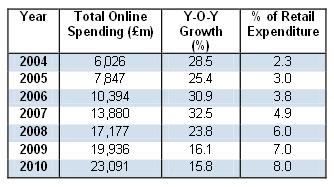
|
The growth of internet shopping
UK Online Retail Statistics - Source: Verdict Research, UK E-Retail, 2011.
qouted
DBIS 12.2011, page 14
|
2011
January 2011 Rihanna goes Red Hot Cover: British GQ magazine
20.1.2011
Campaign for Social Science (in he UK) launched at the House of
Lords by the
Academy of Social Sciences - (Report on Social Science
Space) - The Making the Case for the Social Sciences booklets
began before the Campaign started:
1: well-being
- 2:
ageing -
3: sustainability, the
environment and climate change -
4: crime -
5: sport and leisure -
6: management -
7: Scotland -
8: longitudinal studies
-
9: mental well-being
-
10: Wales
- Predictions of significance
26.1.2011 BBC's
"Great British Class Survey"
launched. [Date of launch of web survey]. See
CRESC website - The results
were published on
2.4.2013
26.1.2011 British Sociological Association
workshop at Warwick included Doing Historical Sociology
with Kristy Warren and Lucy Mayblin -
a session with Gurminder K Bhambra and International Historical
Sociology with George Lawson.
another link
March 2011
Laurie Taylor interviewed Stuart Hall
We are not watching you half as much as we said we were:
British estimate of
survillance cameras revised down form 4.2 million cameras to
1.85 million.
Evening Standard 3.3.2011 (Headline: "We're watching
you: 'Britons caught on CCTV 70 times a day'")
Friday 11.3.2011 Earthquake and tsunami in Japan. Fourth most
powerful in the world since modern record keeping began in 1900.
Wikipedia
Monday 23.5.2011 Bankrupt Britain - An atlas of social change
by Daniel Dorling and Bethan Thomas published. Mapping the effects of the
recession on Britain geographically over the last three years: "in the wake
of the
2007 banking crisis,
2008 economic crash and
2009 credit crunch". -
Guardian review -
22.7.2011 Appearing out of nowhere (as it seemed) Anders Behring
Breivik (born 13.2.1979) murdered 77 fellow Norweigians in an Oslo bombing,
followed by a mass shhoting at a Labour Party Youth Camp.
"2083 - A European Declaration of Independence" was a manifesto
released immediatelly before that presented political correctness,
multiculturalism,
cultural marxism
(Gramsci mentioned) and the Islamic
colonisation of Europe as the enemies to be confronted.
See New Statesman
article
27.7.2011
This webpage finds a reader
1.9.2011
The Class Ceiling
11.10.2011 First episode of BBC Radio 4's
The Life Scientific interviewed Paul Nurse, Nobel prize-
winning geneticist and President of the Royal Society.
October 2011
"Lesbians Seeing Lesbians - Building Community in Early Feminist
Photography" at Leslie-Lohman Museum of Gay and Lesbian Art.
Presented by co-curator Ilana Eloit (Ilana Eliot
17.11.2011
Making the Case for the Social Sciences No. 5 - Sport and Leisure.
Academy of Social Sciences and the British Psychological
Society.
Booklet
[Olympic context]
13.12.2011
The Portas Review: An independent review into
the future of our high streets by Mary Portas.
|
|
|
17.12.2011 United Nations Decade on
Biodiversity launched in Kanazawa, Japan.
|
2012
|
30.1.2012 PProf puts
p-hacking in the Urban Dictionary as "exploiting -perhaps
unconsciously - researcher degrees of freedom until p<.05".
|
See P values
|
|
16.4.2012 Aditya Chakrabortty "Economics has failed us ... why
aren't political scientists and sociologists offering an alternative view?"
The
Guardian. On 29.6.2012 BSA News suggested, in the
light of "some recent newspaper articles", a special number of
Sociology responding to "recent global experiences". This
materialised in
October 2014 with the opening sentence "why talk about the
global economic crisis today"? On 8.10.2012 the BSA was a joint sponsor of
a conference at the British Library "Understanding the financial crisis:
sociology, political economy and heterodox economics?"
|
|
Top academics as The Young Ones in The Guardian
 Actually do some meaningful work? Us?
|
1.4.2012 Start of
INTERACT Trial: INvestigation of TExt message Reminders on
Adherence to Cardiac Treatment -
See report

|
Saturday 19.5.2012
|
The
first Unofficial Histories Conference at
Bishopsgate Institute, London: "A free public conference to discuss how
society produces, presents, and consumes history beyond official and elite
versions of the past".
30.5.2012
"Women's Institute set to debate midwife shortage"
Nursing
Times (Press Association report).
18.6.2012
Making the Case for the Social Sciences No. 6 -
Management.
Academy of Social Sciences and the Society for the Advancement
of
Management Studies.
Booklet
June 2012 United Nations Conference on Sustainable Development in
Rio de Janeiro, Brazil.
(Rio+20). "Future Earth" announced. A consortium based in five
countries was established in 2014 to create the Future Earth "distributed
hub network". Future Earth was fully operational at the
end of 2015.
25.7.2012 to 12.8.2012 London
Olympic Games. Main
venue: Stratford. See
David Amery on East End.
3.10.2012 ITV documentary
Exposure: The Other Side of
Jimmy Savile (see
Wikipedia
10.10.2012
Mariage homosexuel, homoparentalité et adoption : ce que l'on
oublie souvent de dire: By Gilles Bernheim, the Chief Rabbi
of France. This includes translated as
"
marriage
is not only the recognition of love. It is the institution that articulates
the
covenant of man and women with the succession of
generations. It is the
institution of a
family, that is to say a cell which creates a relationship of
direct descent between its members. Beyond the common life of two
people, marriage organises the life of a
community composed of descendants
and ascendants. In this sense, it is fundamental in the
construction and
stability of both
individuals and
society"
"
le mariage
n'est pas uniquement la reconnaissance d'un amour. C'est l'institution qui
articule l'alliance de l'homme
et de la femme avec la succession des générations. C'est
l'institution d'une famille, c'est-à-dire d'une
cellule qui crée une relation de filiation directe entre ses
membres. Au-delà de la vie commune de deux
personnes, il organise la vie d'une Communauté composée de
descendants et d'ascendants. En ce sens,
c'est un acte fondamental dans la construction et dans la stabilité
tant des individus que de la société.
"
Friday 19.10.2012
Women in science: Wikipedia workshop
at The Royal Society, London. See also
The Guardian 25.7.2013
20.11.2012
Office for National Statistics
Measuring National Well-being: Life in the UK
18.12.2010
Making the Case for the Social Sciences No. 7 - Scotland.
Academy of Social Sciences.
Booklet
Friday, 21.12.2012 Pope Benedict 16 gave his
Christmas greetings to the Roman curia. In
the course of this he referred to a study by the Chief Rabbi of France,
Gilles Bernheim, of the philosophy behind the "attack we are
currently
experiencing on the true structure of the family, made up of father,
mother, and child". Gilles Bernheim criticises
Simone De Beauvoir for her claim that On ne naît pas
femme: on le devient (One is not born, but rather becomes a woman).
- See also
2008 address
2013

|
2013
|
January 2013 Launch of the
Social Theory Applied website - Leading to The Journal of
Applied Social Theory 2015 - ??
|
13.2.2013 First
"More then a Number"
(another link)
series of public lectures run by Lancaster
University.
This one -
video -
is about "opinion based medical research" in testing
drugs. John Whitehead describes Fisher's
P value and
the
Bayesian approach where an investigator
considers the likely outcome before conducting the experiment. This prior
knowledge which may be from previous trials or some instinct that a
scientist may have is combined with the data from the experiment to provide
a result. [See 13.9.1998 and
12.12.2014]
Saturday 23.2.2013 Inequality and Statistics Conference organised by
the Radical Statistics Group in York -
Programme and presentations
|
March 2013
History not Propaganda website launched.
15.4.2013 Danielle Allen:
The Art of Association: the formation of egalitarian social
capital. Held at the British Library Conference Centre.
Annual British Sociological Association/British Library Equality Lecture
10.6.2013
Making the Case for the Social Sciences No. 8 - Longitudinal Studies
Academy of Social Sciences -
Campaign for Social Science and Sage.
Booklet -
Launch videos
|
|
Saturday 15.6.2013 -
Sunday 16.6.2013
|
The
second Unofficial Histories Conference in
John Dalton Building, Manchester Metropolitan University. See
Anne Plumb's presentation.
Beginning of October 2013 Launch of
Discover Society "a new, online magazine of social
research, policy analysis and commentary which has been set up by current
BSA President, John Holmwood and former President, Sue Scott.
The magazine seeks to restore social research to the heart of public debate
and commentary by demonstrating the importance of context and social
position"
October 2013 Special issue of
Sociology on "Genetics and the
Sociology of Identity". See
Christine Hauskeller and others
14.11.2013
"Reading the Book of Life in Prehistoric Dung", an article about
Karen Chin and the study of
coprolites
. See
National Geographic 2003 -
Earth Magazine.
16.11.2013
Jock Young died in New York.
2014

|
In the 1960s,
Roland Barthes analysed
popular culture through fashion
(Barthes
1967), which he
claimed conveys meaning through desires. Today, a picture of the Samsung
"Galaxy S3"
(mobile phone) being the
signifier, the
signified is the meaning
and value given to it that it is 'the best' and 'latest' phone. This
creates a sense of fetish this means we need the product, which is the
myth. The sense of
desire is created through commercialised adverts this
creates the
sign, the myth is the idea that
individuals need the phone.
Historically this is a development of
capitalism, but it appears to be
natural that individuals buy the commodities. (Fawziyah
Hussain's essay)
[See
very modern in 2014]
|

Read more
|
17.1.2014 Launch of The World of Statistics
http://www.worldofstatistics.org/
Successor to the International Year of Statistics
(Statistics2013). A global network of more 2,350 organizations
worldwide committed
to:
Increasing public awareness of the power and impact of
statistics on
all aspects of
society
Nurturing statistics as a profession, especially among young people
Promoting creativity and development in the sciences of probability
and statistics
|
Wednesday 19.2.2014 in C109 at 6pm at
Middlesex University, Hendon. The controversial launch of
the new
Socrimology book club focused on a
psychologist. The next meeting
(10.4.2014) will focused on
Jock Young, a sociologist. It discussed his 1971 classic
The Drugtakers - The social
meaning of drug abuse
|
For the first meeting, the book under discussion was
Adrian
Raine's "The Anatomy of Violence: The biological roots of
crime",
published by Penguin last year.
Books are chosen to
provoke discussion, but have to be relevant to the
social sciences.
|

|
|
Thursday 27.2.2014
"Climate Change Evidence and Causes - An overview from the Royal Society
and the
US National Academy of Sciences"
"Greenhouse gases such as carbon dioxide (CO2) absorb heat
(infrared radiation) emitted from Earth's surface. Increases in the
atmospheric concentrations of these gases cause Earth to warm by trapping
more of this heat. Human activities - especially the burning of fossil
fuels since the start of the
Industrial Revolution - have increased
atmospheric CO2 concentrations by about 40%, with more than half the
increase occurring since
1970. Since
1900, the global average
surface
temperature has increased by about 0.8 øC (1.4 øF). This has been
accompanied by warming of the ocean, a rise in sea level, a strong decline
in Arctic sea ice, and many other associated climate effects. Much of this
warming has occurred in the last four decades." [See relation to
modernisation and reflexive modernisation]
|
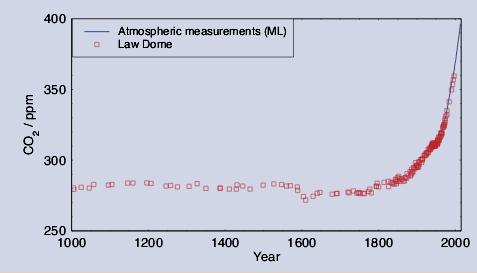
|
CO2
variations during
the past
1,000 years, obtained
from analysis of air trapped in an
ice core extracted from Antarctica
(red squares).
Modern atmospheric
measurements from Mauna Loa are
superimposed in blue.
|
|
Figure
by Eric Wolff, data from Etheridge et al.,
1996; MacFarling Meure et al., 2006
|
Wednesday 26.3.2014
Clive Boddy
"Corporate Psychopaths: Who they are, What they do, Why they should be
managed"
Wednesday 16.4.2014
Religious Programming in an Age of Religious Illiteracy: The Case for
Religion on TV and Radio - Also
Independent 18.10.2013.
Friday 4.7.2014 Rolf Harris verdict. Reflections of
Father Joe Borg at Times of Malta on Saturday.
(offline text).
8.7.2014 to 26.8.2014 (7 weeks)
Israel-Gaza conflict
(Wikipedia).
19.7.2014
"Sulphur surplus: Up to our necks in a diabolical element" by
Laurence Knight
BBC News Magazine
Thursday 14.8.2014 to Monday 18.8.2014 72nd
World Science Fiction Convention ("Worldcon") to be held in
London
15.9.2014 "Bricks turn me on sometimes... I feel a bit funny even
writing this down"
poem by Hollie Mcnish. ".. "the TV it confuses me...
sexiness is explained the same way day after day after day".. "I don't
believe what you say".
1.10.2014 Launch of
JSTOR Daily -
background article by Joseph Lichterman
See Sociology June
2018
Thursday 6.11.2014 UN Report:
A World That Counts: Mobilising The Data Revolution for Sustainable
Development
"
Data are the lifeblood of decision-making. Without data, we
cannot know how many people are born and at what age they die; how many
men, women and children still live in poverty; how many children need
educating; how many doctors to train or schools to build; how public money
is being spent and to what effect; whether greenhouse gas emissions are
increasing or the fish stocks in the ocean are dangerously low; how many
people are in what kinds of work, what companies are trading and whether
economic activity is expanding."
"... huge data and knowledge gaps remain about some of the
biggest challenges we face, and many people and groups still go uncounted.
These gaps limit governments' ability to act and to communicate honestly
with the public. Months into the Ebola outbreak, for example, it is still
hard to know how many people have died, or where.
"
|
2.12.2014 'On the Street Where you Live': Bourdieusian analysis of
socio-spatial hierarchy -
Conference report
17.12.2014 UK Policy paper:
Our plan for growth: science and innovation
-
Evidence paper
18.12.2014 Science included discovering the
world's oldest cave art
amongst its top ten breakthroughs for 2014.
|
|
|
24.12.2014
United Nations Arms Trade Treaty, regulating the international
trade in conventional arms - from small arms to battle tanks, combat
aircraft and warships - entered into force.
|
2015
24.2.2015 Launch of a report
The Business of People: The Significance of Social Science Over the Next
Decade by the
Campaign for Social Science.
(predicted 25.1.2015)
- "social science supplies tools, concepts and models to
help us think about and run the state and markets".
(read online)
12.3.2015
"If you're excited about the upcoming The Nun in the World
symposium", thank Carmen Mangion.
30.3.2015 - 1.4.2015 Journal of Youth Studies
conference in Copenhagen, Denmark theme "Contemporary Youth, Contemporary
Risks". Signe Ravn and Tea Bengtsson identified
neoliberalism, aspiration and NEET (Not in Education, Employment
or Training) as concepts "reappearing again and again". They added comments
on social investment.
"When concepts cross borders" in
Discover
Society May 2015.
April 2015 "Migration and Crisis in Europe" conference at Middlesex
University.
6.4.2015 Pension changes in the UK.
(BBC)
Thursday 7.5.2015 UK General Election with
easy to read manifestos - Pre-election polls failed to predict
the outright Conservative majority.
Nature
explains why. Exit polls got it right.
Exit polls
explained.
ukpollingreport.co.uk
June 2015 to June 2016 Global stock market sell-off.
Wikipedia
Friday 19.6.2015 David Lammy on
the need to
resurrect evening classes.
1.7.2015
Mediterranean Crisis 2015 at six months: refugee and
migrant numbers highest on record. By
UNHCR.
14.7.2015
Making the Case for the Social Sciences No. 10 - Wales.
Academy of Social Sciences and Campaign for Social Science,
Wales Institute of Social and Economic Research, Data and
Methods and Research Institute for Applied Social Sciences at Swansea
University.
Booklet

|
David Byrne attacked the "construction of models of social reality based on
linear regression and its derivatives". He argues that, in
social science,
variables and
their effects are "so complex" that a full analysis would not yield
straight lines or curves, but would look more like a bowl of spaghetti. He
quoted the
Gulbenkian Commission with approval.
(Network Summer
2015
Network referred the reader to an article in Sociology by
Salvatore Babones for "background". Basically, some people
think Q-Step needs more
critical thinking.
|
| Is Q-Step good or bad? According to Byrne, it is good
make quantitative methods central to social science, without privileging
them over other methods. It is good to make students comfortable with using
numbers. It is bad to "generate a kind of social physics dependent on
mathematical formulation" and to push "regression methods as a way to
understand complex social causation".
|
16.7.2015 England's Department of Education
consults on revised GCSE and A level reform: content for
teaching from September 2017 including Sociology -
Psychology -
Economics -
Business -
Geology -
Astronomy -
Engineering - at GCSE
level.

|
5pm Saturday
25.7.2015 in Los Angeles, California, USA is
1am Sunday 26.7.2015 in the United Kingdom.
Opening ceremony of the
14th Special
Olympics World Summer Games.
|
Monday 31.8.2015 The
Royal Society marked the 350th birthday of
Philosphical
Transactions with two special online editions: one on
physical and the other on
life sciences.
17.12.2015
Bella
Gaia (Beautiful Earth) performed San Francisco, followed by
a discussion earth "earth-system scientists" at the end of the
International Geosphere-Biosphere
Programme, which merged into
Future Earth
. The
website will continue unedited for some years.
2016
8.1.2016
"The
Anthropocene is
functionally and stratigraphically distinct from the
Holocene" in
Science. The
"'Anthropocene' Working Group" of the International Commission on
Stratigraphy suggests making
1950 the start of the
anthropocene. Other proposals had been an "early Anthropocene" starting
when
beginning with the
spread of agriculture and deforestation; the exchange of
species between continental blocks after
Columbus and
the
industrial revolution.
The group list as "markers" that humans have left in rock, soil and ice
around the world: radioactive fallout, pottery, glass, bricks, concrete,
copper alloys, elemental aluminum (only found as an ore in nature),
plastics, black carbon and
other particles from fossil fuel combustion,
high levels of nitrogen and phosphorus from fertilizers and pesticides.
|
3.6.2016 Michael Gove says "people in this country have had enough
of experts". (BBC) -
Britain does not trust the experts on Brexit
(Washington Post)
.
|
|
3.6.2016
John Curtice: "a debate about the kind of
society the UK is [and] should be, and in particular [about how]
it has been shaped ...
globalisation."

|
This poster was launched on 16.6.2016 by the United Kingdom Independance
Party. It shows the party's leader, Nigel Farage, holding back large
numbers of asylum seekers on the southern boarders of the European Union.
|
By coincidence, Joe Cox MP, a campaigner for remaining in the Union and for
rights of asylum seekers, was assassinated on the same day.
Mark Easton's social analysis. -
Parliament or
or
prerogative? -
Immigrants who voted leave
-
Leeds -
"Leave" and "Remain" are the new tribes. -
Open Britain
27.6.2016 - 28.6.2016
"Political Citizenship and Social Movements" conference at the
University of Portsmouth. Keynote speakers
Engin Isin and
Therese O'Toole. See
Médecins Sans Frontières and
movement and citizenship
Nurses and navvies
|
Thursday 30.6.2016 to Sunday 3.7.2016 Birkbeck (Thursday) and Queen
Mary University of London. 'Feminism and Radical Utopianism, Past and
Present (Thursday) and Radical histories and histories of radicalism (three
day conference).
Talks, films, screenings, theatre, song, dance, walks and talks
Stands, exhibitions, caucuses, debates
Find out more. I heard
Ilana Eloit -
Danny Walkowitz -
Carmen Morgan -
Timothy Jones -
Sam Brewitt-
Taylor and
others.
|
Friday 8.7.2016 Launch of The New European.
"The new Pop-Up paper for the 48%". Initially four
issues were planned, but it continued on a regular basis.
website -
Wikipedia
Wednesday 13.7.2016 Theresa May replaced David Cameron as UK Prime
Minister.
'They've made Boris Foreign Secretary?'

|
7.8.2016 Representing Egypt, Doaa Elghobashy (shown) and her
colleague Nada Meawad
played Laura Ludwig and Kira Walkenhorst of Germany in beach volley ball at
the Rio Olympics. The German women won 21-12, 21-15.
Until the 2012 Olympics all female volleyball players had to wear bikinis
or a one-piece swimming costume.
|
Saturday 20.8.2016 Launch of
Urban Shamanism: A London Poetopographical at the the
Poetry Cafe in West London. Amongst other things, Urban Shamanism is
situated poetry written from a particular social and georgraphical
perspective. Niall McDevitt, one of the four authors in the anthology,
argues that
William Blake was "the first urban shaman of the first
industrial city".
(BBC 12.8.2009). A rather different approach
to Urban Shamanism is provided by Will Hall (27.7.2014) in
Beyond Meds
27.8.2016 to 4.9.2016 35th International Geological Congress held in
Cape Town, South Africa. - University of
Leicester Press Release. Most voted for
about 1950 as the Base/beginning of the Anthropocene. Ideas
about the What the Primary Signal were more diverse, including: plastic: 3,
fuel ash particles: 2, carbon dioxide concentration: 3, carbon isotope
change: 2, radiocarbon bomb spike: 4, Plutonium fallout: 10, and one vote
each for lead, persistent organic pollutants, and technofossils
Monday 29.8.2016
Anthropocene: Utility and Definition
Friday 16.9.2016 and Saturday 17.9.2016
At Friends House, Euston Road, London.
A multi-denominational conference on
Nonconformist attitudes to war and peace in the long twentieth
century will look at divergent resposes to the
first world war (in particular) with papers on
the second.

|
Wednesday 9.11.2016
nrc.next (Netherlands) "Wat gaat hij doen?" (What will he do?)
|
2017
7.2.2017
"Uncertain times - Brexit and its impact on the financial sector"
Remarks delivered (in English) by Andreas Dombret at Boston Consulting
Group,
Frankfurt am Main. "Brexit fits into a certain trend we are
seeing towards renationalisation. I strongly believe that this negatively
affects the well-being of us all." [The meaning appears to be a trend
towards nation-centred and away from inter-national policies]
Friday 21.4.2017 In
The Evening Standard Tony Blair forecast a clear
Conservative victory in 8.6.2017 United Kingdom election, but suggested
"organisations that want to keep open the right of people to change their
minds on Brexit ... mobilise voters to demand from candidates a clear
statement of ... whether they would refuse to support a
deal that substantially diminishes our access to the single market or a "no
deal" outcome".
|
Saturday 22.4.2017 World Wide March for Science. "... it isn't OK
that leading officials can simply reject evidence-based science... our
battle is for more than securing science funding. It is about engaging the
public in our research ... and empowering them to be critical and
sceptical about science in the media." "... with Brexit and ... some
equally concerning decisions regarding ... climate change and child
vaccination, politicians do not care about what experts have to say..."
Suze Kundu - Materials Chemist, University of Surrey.
|

|
"The March for Science champions robustly funded and publicly communicated
science that serves the common good"
Facebook - BBC -
London
website -
Forbes
Science - Twitter -
Thursday 25.5.2017 Artificial Intelligence.
"Google AI defeats human Go champion"
"Google's DeepMind AlphaGo artificial intelligence has defeated the world's
number one Go player Ke Jie".
4.5.2017 UK Local elections (not London): "Labour and Ukip wiped out
while Tories gain over 550 new seats" (Daily Telegraph headline).
8.6.2017 UK National elections. Conservatives (Tories) lose 13
seats, Labour gain 30. Conservatives remain in power with support of the
Democratic Unionist Party of Northern Ireland.
Saturday 24.6.2017
"Passions flare as Turkey excludes evolution from textbooks" by
Selin Girit, BBC News, Istanbul
Saturday 15.7.2017
Brexit and the Centre by Tony Blair
29.12.2017:
From the
resignation letter of Andrew Adonis: "Brexit is a populist and
nationalist spasm worthy of Donald Trump. After the narrow referendum vote,
a form of associate membership of the EU might have been attempted without
rupturing Britain's key trading and political alliances. Instead, by
allying with UKIP and the Tory hard right to wrench Britain out of the key
economic and political institutions of modern Europe, you are pursuing a
course fraught with danger. Even within Ireland, there are set to be
barriers between people and trade. If Brexit happens, taking us back into
Europe will become the mission of our children's generation, who will
marvel at your acts of destruction... What Britain needs in 2018 is a
radically reforming government in the tradition of Attlee, working
tirelessly to eradicate social problems while strengthening Britain's
international alliances".
2018
|
Friday 18.5.2018: Meghan Markle and her mother, Doria Ragland, arrived at
Cliveden House Hotel after meeting the Queen.
"Ragland's great-great-great-great grandfather worked in the Deep South
plantations and was freed after the
Abolition in 1865. He then chose a new
name to mark his emancipation, calling himself Wisdom." (Harper's BAZAAR UK
11.5.2018)
|
|
Meghan Markle is the first descendant of an African American slave to marry
into the royal family of the United Kingdom. Welcome, and good luck!
|
late June 2018 Sociology special issue on "Migration and
Crisis in Europe", building on "a small conference with the same title" at
Middlesex University in
April 2015". Revisiting the theme of
crisis from 2014.
Sunday 18.11.2018 "Lest We Forget. A perspective on African
Caribbean Family History". A lecture by James Dawkins on tracing his slave
family roots through manuscripts about the white slave owner Dawkins family
of Jamaica. Also a family tree presentation by Nailah Cumberbatch. 7th
Annual Tony Cheesman Lecture, Stratford Library, 3 The Grove, London E15
1EL. 4pm-7pm.
2019
If I am still here, I plan to write something. But if not, why not write
your own history of science and society? And, if you cannot
be best, be better!
11pm 29.3.2019 United Kingdom due to leave the
European Union, with a transition pariod to midnight on
31.12.2020
|
*********
|