Charlotte Mew Chronologywith mental, historical and geographical connectionslinking with her own words, and listing her essays, stories, poems and friends. |
|
Introduction: life - inference - intensity - history - science - Chicks - evolution - dissolution - sensual - God - language - madness - faerie - spirit
Charlotte Mew was born in 1869. Her father was an architect and her mother the daughter and granddaughter of architects. Charlotte was the second of four children who survived early childhood. Their nursery and their childhood was watched over by Elizabeth Goodman, the servant who stirred their imaginations even though she did not value their writings. Charlotte wrote about her in An Old Servant (1913). Charlotte's first published work was a short story, Passed in 1894. The journey in Passed was through Clerkenwell. The Country Sunday , published before The London Sunday, in 1905, has been interpreted as an account of her childhood holidays on the Isle of Wight. Charlotte's best known work is a collection of poems, The Farmers Bride, in 1916. This includes the poem In a Nunhead Cemetery relating to her brother, Henry Herne Mew, who died in an asylum in 1901. Her sister, Freda, was also a patient in an asylum. On the Asylum Road and Ken are two of Charlotte's poems that explore her thoughts and feelings about insanity and asylums. Charlotte died from swallowing disinfectant in 1928. Freda lived in the mental hospital until she died in 1958.
Inference: Charlotte Mew published stories, essays and poems. She was very determined not to provide anyone with even the briefest of autobiography. I think we should be cautious about inferring her life from her writing. Even the most biographical of her essays could, in theory, be complete fiction; and poetry has a structure and content of its own, unconstrained by any relation to the life that generated it. One of the reasons for constructing a life and works of Charlotte Mew in this inter-linked web form, is to allow any speculation about the relation of her writing to her life to be tested against other sources of information. Her writing in Passed (fiction), An Old Servant and The Hay Market (New Statesman articles) reveal close links to the life of Elizabeth Goodman and the geography of Clerkenwell and Cumberland Market and this may be grounds for inferring links in other works where relationships cannot be so firmly established. It is not, however, intended to obscure the creative insight of Charlotte's art by reading it as a diary. Ken, for example, is a poem, and should not be read as a description of Freda Mew - Anymore than the old town with its nuns and priests is a description of Carisbrooke - Knowing about Freda, however, does allow us to think more about the issues on which Ken gives us insight. Without, in any way, distorting the internal unity of the art, we can say that Charlotte's writing maintains a remarkable relationship to her life and experience. This is so much so that Mary Davidow was convinced that E.V. Knox's parody of Charlotte's poetry revealed an insider's information about Charlotte's secrets. I do not think it does. Without his knowing it, the one short book of poems had revealed to him the architecture of the poet's life. No wonder Charlotte was upset.
Intensity: There is a concentrated intensity to Charlotte's
perception. Twice, she suggests she shares her vision with the blind.
(See
The Country Sunday and
Men and
Trees). It is sight that hears and feels and smells every
dimension of the immediate, imminent, reality and all its passion and
energy. Her essay
The Wheat, first published in
1954 shows how the soul of a bank worker
is revealed in one delirious utterance. In this essay, she writes about
"the throb in the breasts of things that ought to be flying".
A few years before her suicide, she wrote in
Domus Caedet Arborem
about the city crouching, waiting to spring on living things.
In her poem
Madeleine in Church
Charlotte describes how (from childhood?) Madeleine
suffered an intensity of being and seeing that was, at once, mystical
and sensual.
I could hardly bear
The dreams upon the eyes of white geraniums in the dusk,
The thick, close voice of musk,
The jessamine music on the thin night air,
Or, sometimes, my own hands about me anywhere -
The sight of my own face (for it was lovely then) even the scent of my
own hair
In
A Country Book she
explains, quoting
Richard Jefferies, that there are no words to describe the
colours of a dandelion - But quoting
Byron she exclaims
"Oh that my words were colours". How she conveys the immediacy of her
perception, naming but not describing the colours, can be seen in her
description of the flowers
In the
Curé's Garden.This, like much of
Charlotte's
writing, from Passed
onwards, is about a dialogue between a spiritual and
material reality:
"God's parle with dust". In
Passed
she had
discovered in a kiss "a page of gospel" that the priest facing
the spiritual, with his back to the material, "might never read".
In
The Forest Road, the intensity of love is too
much for her. She hears her soul singing amongst the trees, and escapes.
History: Usually quietly, many of Charlotte Mew's writings explore issues of the history she lived through. Her first publication, Passed reflects on her journeys into the slums of London, in the late 19th century, at the time when sociologists and religious leaders were making the same exploration. The significance of the century's turning is recorded in her poems on the death and funeral of Queen Victoria. In Notes in a Brittany Convent (1901) the new sciences approach old religion. Mary Stuart in Fiction, written during the miltant suffragette protests, argues her passion for victory. Men and Trees is not quiet comment. It attacks the destruction of the Congo, the Amazon and the people who live there, and defends the "barbarian" against the "culte du moi". Her censored poem Ken picks up on the theme of relations with people of "poor wits" that she raises in Passed, and may be her personal protest against the ideas behind the 1913 Mental Deficiency Act. The Great War for Civilisation is commemorated in two 1915 poems, and reflected on in The Cenotaph in 1919. She is present at the birth of Labour, with the article on the life of Elizabeth Goodman and on the life in Cumberland Market, published in The New Statesman in 1913 and 1914, (possibly) reviews in the Daily Herald in 1919, and her poem "Old Shepherd's Prayer" in the first edition of The New Leader in 1922. As she herself approches death, she sees in the destruction of the trees by her home, to make room for more buildings, something symbolic.
Science: Charlotte Mew's prose and poetry has in it reflections of the development of natural and social sciences. Natural scientists figure prominently amongst her circle of friends: notably Harriette Chick, the Tansleys, the Brownes and Francis Wall Oliver. In 1901, when Charlotte's brother died of tuberculosis, the new science bacteriology, that Harriette Chick had made her speciality, was reflected in Charlotte's writing. The germ theory of disease, applied to cancer, may even have been an element in the ideas that led to Charlotte's suicide. Brittany, where Charlotte stayed and whose mythologies she studied, was also the location of Francis Wall Oliver's pioneer field trips in the even newer science of ecology. Charlotte's interest in what we might now call "green issues" is evident throughout her writing, but reaches a manifesto peak in her (1913) Men and Trees essays. Charlotte regarded herself as an urban being, but with nature beneath her, in what we might call her subconscious. The Society for Psychical Research would have called it her subliminal self. This duality of being is reflected in many of her poems, including The Changeling, where the fairy call of nature draws the child away from the noise and urbanity of the nursery. This occupation with another consciousness is present in Charlotte's writing from the beginning and may partly explain the new interest in her work that appears to coincide with the interest in psychoanalysis and associated ideas that developed about the time of the first world war. The complexity of levels of consciousness may be strongest in her unfinished story Aglaë about the passions of a spinster aunt.
Chicks In the world that Charlotte Mew wrote about, science was not isolated from art and literature: And sociology was related to the natural sciences in a way that it no longer is. To recognise Charlotte's world we must recover these relationships. We are helped to do so by her friendship with the Chick sisters. The Chick sisters, and their descendants, were active in the arts and the sciences and it is clear from Harriette's diary that conversation flowed easily across all areas. The science of evolution was embedded in literature in the bookplate that Arthur Tansley (Edith's husband) designed. Similarly, Tansley's friend botanist Frederick Frost Blackman (Elsie's husband) was a patron of the Fitzwilliam Museum. Tansley's ecology might be regarded as a development of the biology of Herbert Spencer. Spencer sought the most general laws with the widest application and his evolutionary biology lay at the heart of his social science.
Evolution Before Herbert Spencer's evolutionary biology there was Georg Friedrich Hegel - Henri Saint Simon and Auguste Comte - with the concept of the evolution of mind in history that Comte formulated as a progress from religion (theology) through philosophy (metaphysics) to science (positivism). Edward Burnett Tylor's application of these ideas to the development of empirical anthropology in Primitive Culture: Researches into the Development of Mythology, Philosophy, Religion, Art, and Custom (1871) was published when Charlotte Mew was one or two years old. William Robertson Smith's application of anthropological thought to the Bible had been published by the time she was twenty one and James Frazer's application of anthropological thinking to the crucifixion of Christ was published when she was thirty. Her detailed analysis of these ideas, in Men and Trees, was published when she was in her early 40s. Men and Trees is an anthropological study that makes full use of Tylor's concept that present culture incorporates survivals of the past. The sacrifice of Christ on a tree, as analysed by Frazer, is central to Charlotte Mew's moral commentary on her times.
Dissolution The first part of Charlotte Mew's life was shaped by her family's objective of perpetuating itself. She and her brothers and sisters carried forward the names of relatives that would otherwise have been lost, and, with the names, endowments. The rest of her life, and that of her sister Anne, was shaped by their decision to extinguish the family line, to exterminate its taint. Whilst accepting the constraint that she should not have children, Charlotte took issue with other implications of the dominant sciences of evolution and dissolution; eugenics and social hygiene. Those sciences she leaves unnamed, but she battles explicitly with the related philosophy of the cult of selfishness and the omnipresence and omniscience of the market place. In Men and Trees, she argues that civilisation has replaced the old gods and devils by the worship of self. Civilisation is shocked by the blood sacrifices of the old religions, but it has its own blood sacrifices in the commercial exploitation of the rubber trees of the equatorial forests and the destruction of the barbarian cultures of their inhabitants. In Herbert Spencer's language of science, evolution is fuelled by the survival of the fittest and civilisation is the victory of the individual. Its opposite is dissolution, the degeneration of races and individuals - a dissolution that includes insanity in the individual as well as the degeneration of races. In Passed, in Ken and in On the Asylum Road, Charlotte describes the degenerate in terms that discover virtues in their being. In The Cenotaph, the empty tomb of the son or lover testifies against the cult of selfishness. It stands in the market place asking who will buy and sell those things that should not be bought and sold.
Sensual Charlotte's world is sensual. It is her sensuality that
unites materialism with spirit. Like William Blake, who she much resembles,
she sees [the] world in a grain of sand. Some of her writing pivots on
death. Through
death, she brings life to life. This is apparent in her comparison of this
life with the idea of heaven in her poem In the Fields
Can I believe there is a heavenlier world than this?
And if there is
Will the heart of any everlasting thing
Bring me these dreams that take my breath
away?
Two other striking death images are materialist ones. The first is one of death being like a candle going out. It is taught her by Miss Bolt, the agnostic needlewoman whose worldly wisdom tutored her childhood. As a young woman, in her poem An Ending, Charlotte uses the same metaphor to confront the religious judge (Samuel Chick?) who thinks she has missed her way. Her soul is "just a spark alight for her". In death it goes out. But the beauty of the sensual is heaven you would go to hell to experience again: A golden street? Give me the yellow wheat!. But this is not a spiritless or irreligious materialism, nor is it the materialism of the culte du moi. The golden wheat of her youth is the same experience of the spirit of sensual reality that enlightens grieving lovers and mothers at The Cenotaph and the delirious bank worker in The Wheat
The second death image is of a body rotting to a
skeleton, whilst
the hair continues to grow. This can be seen as part of
Charlotte's exploration of the phenomena, the experience, of life and
death. It is an image in her
"mad-woman" poem The Forest
Road in which the soul or spirit of the woman struggles with
her body. In
In Nunhead Cemetery the experienced contrast is
emphasised
by the word THAT:
There is something horrible about a flower;
This, broken in my hand, is one of those
He threw it in just now: it will not live another hour;
There are thousands more: you do not miss a rose.
One of the children hanging about
Pointed at the whole dreadful heap and smiled
This morning after THAT was carried out;
There is something terrible about a child.
We were like children last week, in the Strand;
That was the day you laughed at me ...
Life and death are experiences for the living.
Requiescat says it would be "strange"
if the dead had memories. In the experience of the living, however, life
penetrates death (as in the growing hair) and death penetrates life (as in
the living becoming something terrible in the face of the clay of death).
Blake's Innocence and Experience comes into my mind as I read these
images. The child becomes experienced by death, as Charlotte had. In
The Fête, where only a woman's hair belongs to God, the
adolescent becomes experienced through sex. In this poem, sex experience is
not only development, it is also has elements of dying.
There is something new in the old heavenly air of Spring -
The smell of beasts, the smell of dust - The Enchanted Thing!
All my life long I shall see moonlight on the fern
And the black trunks of trees. Only the hair
Of any woman can belong to God.
The stalks are cruelly broken where we trod,
There had been violets there,
I shall not care
As I used to do when I see the bracken burn.
God In Charlotte Mew's writing, making one (atonement) appears more of a problem than even our all-knowing - all-suffering - all loving creator fathoms. Fallen flesh has questions that God does not answer. His arms are full of broken things. The world is fractured and, in its fracturing, we see, not only its cruelty, but its beauty. The trees murdered to make way for the Quaker temple, recall that even a rat should be alive in the spring. And heaven cannot equal the beauty that passes as the shadows of leaves on growing grass. The gift of Charlotte's writing is its problems. Even as she writes that only a woman's hair belongs to God, one realises that her hair has become the centre of sensual desire.
Language The language of Charlotte Mew's writing frequently includes the combined use of French and English, usually in dialogue; sometimes just in titles. There is occasional use of Latin and Spanish, but no German. At times, dialect is also used (English and French - See Pêcheresse). These features can be related to her analysis of culture and its relation to social relations and the nature of being. It is not just that she speaks more than one language at once, she also explores more than one world at once.......... In 1921, Punch depicted Charlotte as a precocious English school girl adding simple French phrases to her poems. One poems that it appears to parody, uses French to capture a children's street game. "'Tiens! que veux-tu acheter?' Renée cries, 'Mais, pour quat'sous, des oignons,' , Jean replies. And one pays down with pebbles from the shore." (The Narrow Door)
Madness E.V. Knox's parody of Charlotte Mew's poetry
begins
The moonlight drips on the parlour floor;
I shall go mad if no one wipes it up.
When I was one year old Nurse used to say,
"It's no more use to cry when milk is spilt
Than cry about the moon." There were big bars
Across the nursery window
Knox conveys the image of a writer
threatened with madness, and
confinement, whose poetry
uses the experience. Her poems also communicate to him that her visions are
fashioned by her life and her family. To steal words from
Freda Mew's
casenotes, the "predisposing cause" of Charlotte's "madness",
and her poetry,
is "probably heredity", but not in the biological sense. In the sense that
it is steeped in the experience of her family, her childhood, and her
intimate relations. Madness in Charlotte's writing is softened or
romanticised: She seeks to
"obscure the tragic side by a gentleness of treatment". As is
common for her time, her image combines elements of mental
illness and retardation or learning disability. There are also similarities
of form between her pictures of madmen
(for example,
Ken)
and her pictures of
fairies (for example,
The
Changeling), and
between her pictures of these and her depicting people and cultures in
contact with nature (for example
Arracombe Wood). Madness is sometimes another
world cut of from sanity
by
clouded glass, but
sometimes her own being. More often, sanity and
madness are two worlds between which we pass as in the same way that we
pass from the nursery floor to fairyland.
Faerie - The word faerie can be used for the mythical land of fays (fairies), its inhabitants, and its enchantment. When Charlotte Mew was writing, the theosophists were drawing on many religions and mythologies to create their own world vision. Their sources including belief in elementals, faerie forces or spirits of the elements, from which races of humans and gods could have evolved. Charlotte was sufficiently close to theosophist circles in 1914 to have a story about a woman with supernatural communication published in The Theosophist. The death in 1895 of Bridget Cleary, an Irish labourer's wife , illustrates the relation in (some) popular cultures of the world of faerie and changes in human personality. I have argued that this theme of changing being and changing consciousness runs through much of Charlotte's writing. It is what Baring- Gould would have called a "radical" (motif) to her stories. The word and the motif that symbolises this most effectively, in relation to fairies, is changeling. The Farmer's Bride (1911/1912) is a fay, or fairy - The Changeling, a children's poem, (1912/1913) was published at the same time as Men and Trees, which finishes with Joan of Arc, as a child, dancing round a fairy tree. In The Smile, the child (then woman) who can see the enchanting smile without climbing to the enchantress, as others have to, had, as a baby, the characteristics that might have been interpreted as indicating a changeling.
In Men and Trees, Charlotte partly explains the significance of fairies to the twentieth century. She says
"The Renaissance revered the ancient world, the nineteenth century was moved and lit by the Renaissance; we have no patience even with the nineteenth century. The past is a stupid corpse. The inspiration of the woods, the forest voices, the fairy dancers ... these are 'of old time' ... We must not speak in the marketplace of what happens to us in the forest, says Hawthorne - [nowadays] Everything happens in the market-place. Where else? But the market-place is not real: the real things are happening in the forest still."
Spirit The spirit that animates Charlotte Mew's writings appears accesible to agnostic and believer alike, and disturbing to the proconceptions of all of us. Siegried Sasson wrote to, and of, Charlotte that poets "carry the world on their shoulders... And in their eyes the future of civilisation struggles to survive". Charlotte, he said, was "intensely" aware of her "responsibility" and sustained it "nobly". The world that is carried in Charlotte's writing is the material world of flesh and death, of life and grief, of desire and reverence. The spirit that animates it is "Everything there is to hear in the heart of hidden things".
eighth century AD Dream of the Rood carved in runes on a cross in Ruthwell churchyard in Scotland. Used by Charlotte Mew in Men and Trees (1913)
24.9.1541 Death of Paracelsus. His Liber de nymphis, sylphis, pygmaeis et salamandris et de caeteris spiritibus [Latin title, but German text] was published after his death. In it he associated sprit people with air, earth, fire and water. Nymphis, nymph, undina or undine is the water spirit. Sylphis, sylph, or sylvestris is the air spirit. Pygmaeis, pygmy, gnomus or gnome is the earth spirit. Salamandris, salamander or vulcanus is the fire spirit. This is the main source of the idea of "elementals", linking science and fairie in the theories of theosophists and others (late 19th century onwards). African pygmies were perceived by some as real descendants of the earth elementals in an evolutionary process. Charlotte Mew published one story in The Theosophist (1914) and drew on the idea of elemental races in Men and Trees (1913).
1648
6.9.1648 - 30.11.1648 the "Treaty of Newport" between Parliament and
King Charles
In Isle of Wight dialect, a young or wild bull is a "bugle". The Bull Inn
of 1648 is the
Bugle Inn that the Mew family acquired.
"During the negotiations the king and his friends occupied the
grammar school and the Parliamentary Commissioners the Bull Inn,
while the
meetings took place in the town hall. The subject of the negotiations
related chiefly to the governance of the church and the militia, but the
treaty led to no satisfactory results." From: 'Parishes: Newport', A
History of the County of Hampshire: Volume 5 (1912), pp. 253-65. available
at
British History Online
1650
Son-Days
Bright shadows of true rest! some shoots of bliss;
The pulleys unto headlong man; Time's bower;
The Church's love-feasts; Time's prerogative,
by
Henry Vaughan
Heaven once a week;
The next world's gladness preposses'd in this;
A day to seek
Eternity in time; the steps by which
We climb above all ages; lamps that light
Man through his heap of dark days; and the rich
And full redemption of the whole week's flight!
The narrow way;
Transplanted Paradise; God's walking hour,
The cool o' th' day!
The creature's jubilee;
God's parle with dust;
Heaven here; man on those hills of myrrh, and flowers;
Angels descending; the returns of trust;
A gleam of glory after six-days-showers!
And interest
Deducted from the whole; the combs, and hive,
And home of rest.
The milky way chalk'd out with suns; a clue
That guides through erring hours; and in full story
A taste of heav'n on earth; the pledge and cue
Of a full feast; and the out-Courts of glory.
|
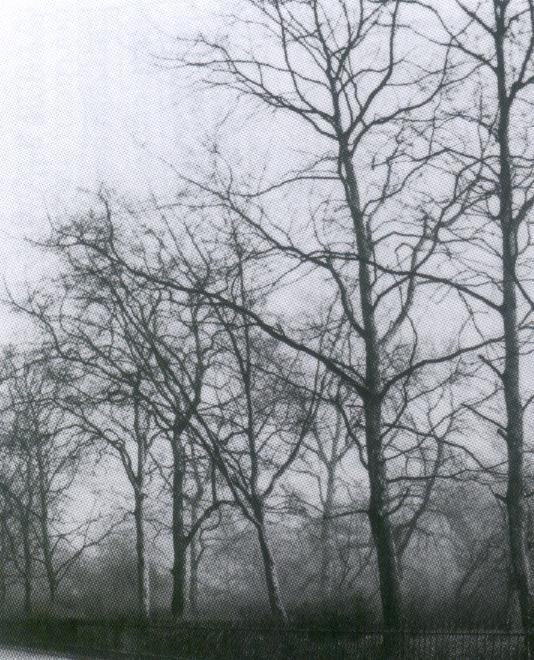
The London Plane: Platanus x acerifolia (Aiton) Willdenow is a hybrid of the oriental and occidental planes, possibly originating in Britain in the Oxford Physic Garden [Later Oxford Botanical Gardens] in 1670. The London Planes were important to Charlotte Mew throughout her life. See Doughty Street - Gordon Street Map - Men and Trees - 1922. For some other planes in London see Bunhill and Wick Woodlands. In her poems, the house sparrow Passer domesticus:, lives in the trees, the London pigeon sits on the houses and seagulls visit the town.
|
About 1731 Thomas Mew of Newport, Hampsire, born. He married Elizabeth Hains (born about 1735, of Newport) on 16.10.1756. Their (14?) children included Thomas christened 23.3.1757 - William christened 17.12.1758 - John christened 14.1.1761 - James christened 25.1.1763 - Richard (born 1764), a great grandfather of Charlotte Mew - Mary christened 27.1.1769, died 31.12.1770 - Mark christened 15.3.1771, died 7.5.1810 - Mary christened 14.7.1773 - George (baptised 1775), from whom Charlotte's grandfather took over the Bugle Inn in 1829, Anne, born about 1777, died 8.4.1781 - Joseph Haynes christened 20.5.1782 - William christened 2.1.1784 - and Benjamin (baptised 19.10.1786), who founded Mew's brewery. The evidence suggests to me that the whole Mew family were involved with one another and that the various businesses in the Isle of Wight and Lymington were family concerns, at least whilst fathers survived to hold the unit together.
1754 William Borlase (1695-1772) Antiquities of Cornwall
published at Oxford. Used by Charlotte Mew in Men and Trees (1913)
1.10.1764: Richard Mew, the son of
Thomas, christened Newport, Isle of
Wight. He married Ann Coleman on 31.7.1787. One of their sons was
Henry Mew, paternal grandfather of
Charlotte Mew, and licencee of the
Bugle Inn, in Newport.
All but one of Richard and Ann's known children were
born in Newport. The children are: Edward born
about 1789, died 26.4.1789
- Henry and Edward both christened 28.12.1792 -
Richard christened 19.3.1794, died 9.2.1821 - Charles born 17.4.1795,
christened 28.6.1795,
died 24.1.1796 - Sarah, born 19.7.1797,
christened 19.12.1797, married Robert Yele of Newchurch 3.1.1822 (no
children traced) - Stephen born (Carisbooke) about 1804, died
23.1.1806.
Richard died at Newchurch on 25.5.1830, aged 63, and was buried at Newport.
Ann died 28.1.183something, aged 71 and was buried at Newport
25.8.1775 George Mew
(son of Thomas and
Elizabeth)
christened Newport. He may have married Christian Ceser in
Newport on 10.11.1799. Alfed Ceser Mew was born 21.11.1802 in Newport and
christened 25.9.1803 - Kate Mew born 1.11.1807, Christened 13.1.1808
23.3.1776 Henry Edward Kendall
(senior), one of
Charlotte Mew's maternal great-
grandfathers, born. Although he is said to have been born York
(Colvin, H.M.
1995), the
census for 1841, 1861 and 1871 shows him as born in Middlesex (Marylebone -
1861, 1871). Colvin says that he married twice and had a son and two
daughters. It seems probable that he actually married three times.
The eldest son is
Henry Edward Kendall (junior) (born 1805). A daughter is
Sophia Kendall (later Cubitt) (born 1811) - These are the two
mentioned by Colvin. I do not know who his wife at this time was. Both
Henry Edwards were architects. In
1822 Henry Edward senior
married Ann(e) Lyon (see 1841)
. They had a son
Charles Kendall, born 1829. Anne died in 1863 and
Henry Edward senior married Matilda Alice Clowser in
1866. Henry Edward senior
died in
1875.
Mary Herne,
Charlotte Mew's maternal great-grandmother on
her grandmother's
side, was born about 1784.
She married Thomas Cobham in
1801. She was living with Kendalls in
1841 and died in
1855. The Cobham and Herne names reappear in children's names
and inheritances. See
Edward Herne Kendall,
Thomas Cobham Kendall
Henry Herne Mew,
Richard Cobham Mew,
will of 17.4.1883
and
Caroline and James Herne
and
T.A. Cobham.
1786 Benjamin Mew
(son of Thomas) born.
The
Mew/Cull brewery in Crocker Street was established about 1814
(about age 28). Benjamin married Mary Ann Parker on 11.11.1818, in Norwood,
London. Their children
included -
Thomas Parker Mew, christened 6.10.1819, who may have married
Mary Julia Willslead, in Newport, in the October/December quarter of 1837
-
William Baron Mew, christened 7.11.1820, Newport. -
Mary Ann Mew, born 30.9.1821, christened: 23.1.1822 Newport -
George Owen Mew, born 3.3.1824, christened 2.4.1824 Newport -
James Alfred Mew, born 13.2.1826, christened 15.3.1826 Newport. He
married Mariane Hooper at Alderbury, in Wiltshire, about 1852 -
Ann Agnes Mew, born 3.9.1827, christened 3.10.1827 Newport -
Joseph Parker Mew, born 2.4.1829, christened 29.4.1829 Newport -
Sarah Jane
Mew, born 29.4.1831, christened 1.6.1831 - Arthur Parker Mew, christened
9.1.1833 Newport.
Benjamin Mew died 1850
Kevin Mitchell's
website says that in the later part of the eighteenth century,
Benjamin
"apparently" began to collect inns and formed a partnership
with his
brother [which?] under the name of Mew and co., Brewers of Newport and
Lymington. But Benjamin was only 14 in 1800 and the
Lymington brewary appears to be after 1828].
26.3.1790 Henry Mew
(son of Richard),
paternal grandfather of
Charlotte Mew, born.
The son
of
Richard and Ann Mew. Henry and his younger brother, Edward (born
1.3.1792), were both baptised on 28.12.1792 at Newport.
Sometime married
Ann Norris of Lymington. In
1828, Henry Mew was licencee of the
Anchor and Hope in Lymington. In 1852
(See also 1851) this
was run by Henry Ackland, but
the Angel Hotel, 108 High Street, Lymington was run by
William Bay Norris
Their children (survivors highlighted) were:
They appear to have lived in
Lymington until becoming licensee of the
Bugle Inn in Newport about 1829.
Frederick Mew
(Charlotte's father) was born in 1832.
Henry Mew died in
1859. His wife,
Ann, lived to
1878
About 1793
Birth of Anne Esther Lyon, who became the
second wife (1822) of
Henry Edward Kendall senior (
Charlotte Mew's maternal great-
grandfather). See
1841 -
1861 -
1871. The year of birth is suggested by the 1861 and 1871 data
(between about 1792 and 1794). I do not know the name of the
first wife - One can guess her first name was Sophia. Ann(e) Kendall's son
was
Charles Kendall.
About 1796 Ann Norris (who married
Henry Mew) paternal grandmother of
Charlotte Mew, born
Lymington. Following the
death of Henry Mew (November 1858) Ann Mew was
living with Richard Mew in Newport
in 1861. In
1871 she ("Anne Mew") was living as a lodger in Ryde. With her
was
Maria Anne Norris, unmarried, age 29, no occupation, born
Lymington.
Relationship not shown, but possibly a niece. Maria Anne was the daughter
of William B. and Henrietta Norris who (1861) ran the Angel Hotel, 108 High
Street, Lymington. Ann Mew died in
October 1878.
About 1800 Birth in Lymington of William Bay (or Benjamin) Norris,
who married Henrietta. See
1851 Census -
1861 Census -
1871 Census -
1801
With the consent of her father (Thomas Herne)
Mary Herne, a minor, married
Thomas Cobham, of St Mary le Bone, at Whitechapel.
July/August 1805 Henry Edward Kendall
(junior), Charlotte Mew's maternal
grandfather, born Westminster
(died
1885) [Dates in
RIBA archive. Years in
Colvin, H.M.
1995. The
1881 online Census calculates 1811 as his date of birth, but
this is inconsistent with the 1841
census.] He trained as an architect in
his father's office. By
1841, they had separate practices. Kendall junior's practice
built three lunatic asylums - Essex in Tudor style,
Sussex
in the Italian style and a new one for
Dorset.
He married Mary Cobham
in
1836.
Charlotte Mew's mother
seems to have been their oldest child.
[See family listing 1861]
He died in
1885
1811: Sophia Kendall,
Henry Edward (junior)'s sister, born at Suffolk St,
Westminster.
In
1830 she married Lewis Cubitt, one of her father's architecture
pupils.
She died in
1879.
See dialect
About 1812 Mary Cobham [Kendall]
Charlotte Mew's maternal
grandmother, born St
Pancras.
She married
Henry Edward Kendall (junior) in Sussex in
1836.
Penelope Fitzgerald
1988 calls her "Maria Kendall".
See 1841 -
1861 (fullest view of family)
-
1871 -
1881
and 1891
Census. Her will was
written in
1883 and she died in Brighton in
1892.
Anna Maria Kendall, Charlotte's mother, was born in 1837 and Mary Leonora Kendall (Charlotte's maternal
aunt) about
1847.
Also on the same website:
An Isle of Wight Records Office summary of the Mew Brewery History says
"The connection of the Mew
family with Crocker Street dates at least from
1814, when
Benjamin Mew and his partner James Cull, brewers, were jointly
occupying premises
there." [The partnership with James Cull was over by 1816]
See Bugle Inn 1816 -
New Fairlee Farm 1816 -
Mew family business 1828 (my earliest original reference to the
Crocker Street brewery - Benjamin brewer) -
1841 Census (Thomas brewer in Sea Street,
Newport, Benjamin brewer in Brading) -
Benjamin Mew died in 1850. The Kevin Mitchell website says that
Lymington Brewery was left to
Thomas and the Newport
business to
William.
In the
1851 Census Thomas is shown as
both a wine and spirit merchant and a brewer in
Lymington. [Also in an
1852 Trade Directory] - William is
the brewer at Crocker Street. -
The Records Office summary says that in 1854 the Newport interests
William Baron Mew (including the Crocker Street brewery) and the Lymington,
interests of Thomas Parker Mew, were combined.
In the
1861 Census, both
William (newly widowed) and Thomas are brewers in Newport. The birth places
of Thomas's children suggest he had been in Newport for at least seven
years
The Kevin Mitchell website says that (at some date) William bought out the
Lymington business from Thomas.
The
1865 Trade Directory has
W. B. Mew and Co. Brewers to Her Majesty, Crocker Street, and at
Esplanade, Ryde" [No mention of Lymington] and
"W.B. Mew and Co., wine and spirit merchants, Crocker street, and at West
Cowes, Ryde and Lymington" -
At the 1871 Census
William Mew is at Crocker Street and Thomas Mew at Medham Farm, near Cowes.
At 68 Sea Street, Newport, Joseph Parker Mew is "Brewer's Manager" - In
1861 he was a "Brass and Iron Founder" in Cowes.
-
The Records Office summary says that Walter Langton, late of
Lambeth, injected £20,000 capital into the business in 1873 which
then became W. B. Mew, Langton & Co. -
William Baron Mew, Joseph Parker Mew and Charles Edward Templeman Mew of
Newport, brewers, maltsters and spirit merchants, traded in partnership as
W. B. Mew, Langton & Co.
At the 1881 Census
William Baron Mew was living at Polars. Thomas, age 61, was at Wallhampton,
outside Lymington, Brewer "retired". Joseph Parker Mew was the brewer at
Crocker Street and at St James Street his son Herbert Mew (Brewer) is
living with William Baron Mew's brewer son, Charles.
-
[1887?] Fourteen years after W. B. Mew, Langton & Co. was formed it became
W. B. Mew, Langton & Co. Ltd. The death of William Baron Mew was registered
in the January/March quarter of 1887. His brother and son continued trading
under the name "W.B. Mew [etc]"
The death of Joseph Parker Mew (age 66, born about 1829) was registered
Alderbury, Wiltshire in the January/March quarter of 1895
Ryde Pier 1814: Opening of the pier at Ryde, Isle of Wight.
(external link) - Ryde addresses related to
the Mews are the Royal Pier Hotel (below) -
9 Barfield (Barfield Lodge) and
75 Union Street
In 1828 no "Pier" hotel is listed in the Trade
Directory - but Daniel Hale is at the Bugle, Ryde. The
"Royal Pier Hotel", Pier Street is in the 1841 Census, with George Rendall,
age about 30, Hotel Keeper, not born in Hampshire, and his wife, Caroline,
age about 25, born in Hampshire - It is
the "Pier Hotel" (a posting inn) in an 1844 Trade Directory. -
The 1851 Census has the "Pier Hotel", with Caroline Rendell,
wife (no husband shown)
age 38, born Ryde, as Hotel Keeper. She is living with Martha Hale, mother,
widow, age 67, Annuitant, born Kingston? Dorset (died December quarter
1852?) and Daniel Barnes, nephew, unmarried, age 29, clerk, born Somerset -
1852 Directory: Royal
Pier Hotel, Pier Street, posting and family, George Rendell - 1859 Royal
Pier Hotel, Pier Gates, Daniel Barnes. - The 1861 Census - The 1871 Census - The 1881 Census - The 1881 Census - 1898 Trade Directory: Royal Pier,
The Gordon Hotels Limited, (Louis Henry Claridge, Manager) Pier Street
-
The 1901 Census
- The Royal Pier Hotel Ryde was
demolished in the early 1930's to allow better traffic access from the
bottom of Union Street onto the Esplanade.
(external link)
1815
1816
26.11.1816
"Bargain and sale" - reference JER/OSBORNE/2 "New Fairlee Farm with barns,
stables and outhouses
lately erected on Fairlee Common and Fairlee Common Fourgrounds (18 acres 1
rood 7 perches), lying together near road from Newport, towards East Cowes,
with Middle Field (18 acres) and close on west side of it (12 acres), both
part of Fairlee Common Lower Ground. Also Barn Ground Closes: the Thirteen
Acre Close (13 acres), the Ten Acres (10½ acres), the Seven Acres
(7½
acres), Ilems and Tilsons Close (5 acres), one close (17 acres), parcel of
Heathy Ground (42 acres), parcel of lands called Blakes Heath (above) lying
on east side of highway leading to East Cowes, together with so much
ground, part of Brick Kiln Close (alias Sixteen Acres), part of the said
Blakes Heath as shall be marked out for a way from Lower Blakes Heath to
pond in or near Brick Kiln Close." (Isle of Wight Record Office - Deeds and
Documents of Osborne Estate: Catalogue Ref. JER/OSBORNE. Creator(s):
Blachford family of Osborne) - See
1841 Census
New Fairlee Farm 1843 -
Newport 1865 -
Isle of Wight Holidays
-
1881 South Fairlee Farm -
4.2.1899 -
1901 New Fairlee
Farm (and South Fairlee Farm distinct) -
1936 Fairlee House and South
Fairlee Farm - 1963 change of
ownership -
2006 New Fairlee Farm.
1819: Birth of Victoria who was to become Queen.
Elizabeth Goodman was born about five years later and may have
celebrated
25 years of domestic service about the time that Victoria
celebrated 50 years of being Queen.
6.10.1819 Thomas Parker Mew, son of
Benjamin, christened
1820
Sometime about here,
Henry Mew married
Ann Norris of Lymington. Their first child, Ann, was born about
1821. This is the earliest connection I have for the Mew family and
Lymington.
I do not know where Ann Mew was born, but her older siblings,
Henry, Florence and Richard, were born in Lymington. Henry (the father) was
landlord of the
Anchor and Hope, Lymington, in 1828, at a time when
the brewery
business appears to have been limited to Newport.
Thomas Parker Mew was a brewer in Newport
in 1841, but appears to have moved to Lymington between the
biths of a child in 1843 and 1845.
In 1851 he is listed as a a Wine and Spirit Merchant on the Quay
at Lymington. In
1865 the Trade Directory has "W.B. Mew and Co., wine and spirit
merchants, Crocker street, and at West Cowes, Ryde and Lymington", but the
brewery is only at Crocker street and Ryde.
7.11.1820 Christening of William Baron Mew, who inherited the
Newport brewery and bought the Lymington one
(see his father). He is shown
(unmarried) as Maltster and Brewer in
Crocker Street in
the 1851 Census. He married
Frances Mary Templeman in the April/June quarter of 1854, at Chard in
Somerset. Charles Edward Templeman Mew (birth registered Isle of Wight
July/September quarter 1856) was William Baron Mew's eldest son. Francis
(Frank) Templeman Mew (birth registered Isle of Wight October/December
quarter 1857) was his second son.
Henrietta Bernard Mew's birth was registered Isle of Wight in the
April/June quarter or 1859. The birth of Amy Bernard Mew and the death of
her mother, Frances Mary Mew, were both registered on the isle of Wight in
the October/December quarter of 1860.
1821
1822
about 1822 Daniel Barnes born Somerset - marrried
Frances Mew - died
1881
Henry Edward Kendall senior married his second wife, Anne Esther
Lyon, at St Andrew's church, Holborn. He already had two children:
Henry Edward Kendall junior (17) and
Sophia (11). Ann(e) and Henry's son,
Charles Kendall,
was born in 1829. The death of an Anne Kendall was recorded in the spring
of 1863 in St Martin (in the Fields), Middlesex.
1823
Henry Edward Kendall (senior),
Charlotte Mew's maternal great-
grandfather, became District Surveyor for the Parishes of St Martins in the
Fields and St Anne's, Soho. He had previously worked for the Barrack
Department of the War Office. He was about 47 years old, and held the post
of District Surveyor for
over 50 years.
5.7.1824: Henry Mew, son of
Henry and Ann, and a paternal uncle of Charlotte, born. In 1841
(aged 15) he was with a group of men in St James, Westminster (I do not
think it is a school) being looked after by mainly female servants.
In
1851 he is shown as "Wine Merchant" living with his parents at
the
Bugle Inn.
He
married Mary Toward
in 1854. Henry succeeded his father at the
Bugle Inn/Hotel. He was
the mayor of Newport three times: in 1864,
1865 and 1870. The
Bugle Hotel.
is still a Mew family business in the
1875 Trade
Directory, but,
by 1881, Henry and Mary were living in Ventnor. He died
13.5.1881. The Bugle Hotel may have left the
Mew family when Henry and Mary left.
About 1825: Birth of Elizabeth Goodman, the
"Old Servant" of
Charlotte's essay, born at Barton On Humber, Lincolnshire.
(link to GENUKI website).
The
life story of the real Elizabeth Goodman, traced through the censuses, is
very close to that of the Old Servant described by Charlotte.
"That grey remote village on the hillside" does not describe
Barton, which is a market town on the Lincolnshire bank of the river. It
could be a village outside Barton in the Yorkshire Wolds. Charlotte wrote
that it as a village none of the Mew children ever saw, but
"all the ways of which we knew so well by hearsay".
The census descriptions show the Goodman's district (from 1841) as mixed
farms, brickworks and potteries. Their street, "Newport", appears to have
been on the edge of Barton in an area that was being absorbed - The "new
road" (Queen Street) was opened "in 1827... It cuts across the former
gardens of the great house which stood on the site of the present police
station. Its grounds originally occupied most of the area bordered by High
Street, Finkle Lane, Newport, Catherine Street and Marsh lane"
(Barton on Humber virtual Victorian Walk).
Elizabeth's
mother, also Elizabeth Goodman, was born at Horkstow in Lincolnshire about
1782. She was a widow by 1841. In the 1861 census she is shown as a
"farmer's widow". Living with her in 1841 were William Goodman, age 20, an
agricultural labourer, and our Elizabeth, age 16, shown as a female
servant. By inference from Charlotte Mew's story, Elizabeth came to London
in 1845, 20 years old, and became a servant in the Kendall grandparent's
house. In the
1851 census she is shown (26) as the children's nurse. The
Kendall household had high care needs. There were three nurses in 1851: a
"nurse" who may have cared for Mary Cobham, Charlotte's great grandmother,
Elizabeth, who is the "children's nurse" and a "children's nursemaid". It
seems likely that the nursemaid cared for Arthur (2) and Mary (4) and that
Elizabeth cared for Anna Maria (14), Thomas (10) and Edward (6). There was
no live-in governess.
By 1861 Elizabeth had returned to her mother's residence in
Barton. Her profession as "quilter" suggests this is more than a visit.
Perhaps she stayed with her mother until her death in
1866. If so, this means
she was not with the Mew family until after
their marriage, in 1863, and after
the birth of Henry Herne
Mew in 1865. But, this is not the impression given by
Charlotte's story, which says [Elizabeth] was "chosen to follow her young
mistress on her marriage". In the
1871 census Elizabeth is shown as "cook". But she was the kind
of cook that takes care of children when they are ill: She recorded the
deaths of baby
Frederick in 1867, and Christopher and Richard
in 1876.
See
1841 census -
1845 -
1851 census -
1861 census -
1865 -
1866 -
1867 -
1871 -
1874
(Chapel) -
1875 -
holidays -
1876 -
1881 census -
1891 census -
1892 -
1893.
The Every-Day Book by William Hone appeared in weekly instalments in
1825 and 1826. Bound volumes appeared in 1826 and 1827. Kyle Grimes has
created
an online version. The blessing of the apple tree takes place on
January 5th
(see index)
Here's to thee, old apple-tree,
A very similar "jolly couplet" is
quoted by Charlotte Mew in Men and Trees
About 1826: Birth of Richard Mew, Charlotte's paternal uncle
(older than
her father)
who was
to farm
New Fairlee Farm. He was born in Lymington,
as was his sister, Frances. Their father,
Henry Mew was ran the Anchor and Hope Inn in Lymington
in 1828, before moving to the
Bugle Inn about 1829. In 1841,
Richard appears to be in charge of
New Fairlee Farm.
(Charlotte's father,
Frederick, and
uncle
Walter are also there). A letter Richard wrote in
1843 survives. At this time, Frederick had just returned from a
trip to London. In
1851 Richard is
shown as "bailiff for his father". In
1861, Richard Mew is shown as a wine merchant living with his
widowed mother,
Ann Mew (aged 65, born Lymington), plus a female general servant
and a groom, in Lugley Street, Newport
(external link) and Walter was in charge of
the farm. An 1865 trade directory shows Richard as the farmer
and also
lists the family business as Henry Mew, farmer - and sons,
Bugle Inn.
and wine importers. Richard married
Fanny Read in
1866. He is shown as the farmer in subsequent censuses.
Charlotte Mew spent time, as a child, with Richard's family on the Isle of
Wight and Fanny's family in Somerset. Richard
acted in the place of father to
Freda Mew after the death of her father in 1898. He died
in
1903, but I suspect his family would have
continued with some responsibility for Freda in the Isle of Wight Asylum.
Charlotte remained in contact with this part of the family throughout her
life and they were a major source of information for
Mary Davidow's biography.
About 1827: Birth, in
Lymington, of
Frances (known as Fanny) Mew, Charlotte's paternal aunt
(older than
her father).
In 1841, "Fanny Mew", age 14, was living with
fifteen other girls ("pupils") of about the same age, in a house on the
south side of Neport High St -
In 1851 she is shown as "housekeeper" at New Fairlee Farm - She
married
Daniel Barnes of Ryde in 1853 - see
1861 -
1871 -
1881 - She may
have died on the Isle of Wight in the April/June quarter of 1911, but that
Frances Mew as age 87
23.10.1827 The consecration of
St George the Martyr, Ramsgate.
Designed by Henry Hemsley and H E Kendall and constucted between 1824 and
1827, it seats 1,300 people and has a lantern tower (placed at the request
of Trinity House) as a navigational aid to passing ships.
Described as one of the two "most architechturally
distinguished" Kent churches in the first half of the nineteenth century.
However it is in a "free versions of Gothic". This style became
"unacceptable" after the launching of the Cambridge Camden Society and
ecclesiology in the 1840s. "The ecclesiologists wanted to return the Church
of England to an idealised version of the Middle Ages, both for the
architecture of its buildings and the arrangements for public worship."
[Detailed discussion in Jonathan Smith's (1994)
Architecture and Induction: Whewell and Ruskin on Gothic
]
1828-1829 Henry Edward Kendall
senior and
junior were the architects of the esplanade
and tunnel for Kemp Town, the fashionable new eastern extension to
Brighton.
Penelope Fitzgerald
1988 p.14 says that during the development of Kemp Town, the
Kendalls became a Brighton family of distinction. They had a seaside house
in Brighton at
6 Codrington Place
Piggots Commercial Directory 1828
I think this list includes all the Mews listed (Hampshire, including the
Isle of Wight). The Morris and Richard Mew may not be related to our Mews
Of three "Inns and Hotels" (distinct from "Taverns and Public Houses"), the
"Anchor and Hope (and commercial hotel)" is owned by
"H. Mew". The Anchor Inn (hotel and posting house) is owned by
M. Butcher - Mary Butcher is a wine merchant.
The
Brewers are William Best and William Hebberd
Newport
The
Brewers are William Cooke and son, Sea Street - Thomas Self,
Lugley
Street - George Linington, Sea Street -
Benjamin Mew, Croker Street - Wise and Co. Quay Street.
There are seven "Inns and Hotels", one of which is Bugle (and posting
house)
George Mew, High Street.
There are 38 "Taverns and Public Houses". Only the Waggon and Horses in
Crocker Street has a Mew: Morris Mew
There is a Richard Mew in the High Street under Cabinet Makers and
Upholsterers
About 1829: Birth of
Edward Mew who died, aged 11, on 4.4.1840
Alehouse Licences for Newport show
George Mew
at the
Bugle Inn for 1816, 1822
and 1826. In 1829 the licensee is
Henry Mew
(IOW 18.1.2005).
Frederick Mew born at the Bugle Inn in
1832 -
1841 Census - Death of Henry Mew senior
1859
1829 Christening at St Martin in the Fields of "Chas" (Charles)
Kendall, son of
Henry Edward
and
Anne.
Architect.
Alida Monro's
estimate of the age of Charlotte Mew's parrot, would place his
birth a little earlier than 1830. She calls him "Willie". Charlotte's
letters speak of "Wek". Wek first appears in the letters
Mary Davidow
reproduces on
14.7.1909, when Charlotte wonders if he is to be trusted on the
floor. Ninety years would be an extreme old age for a parrot. Given his
longevity, Wek would have been one of the larger parrots, such as an Amazon
Green. They were (and are) an expensive pet to buy. About 1880, the prices
of parrots were: grey African from £1.5/- to £2 - Amazon Green
from £1 to £2; Australian parakeets (budgerigars) 5/- to
£1. "The parrots most in favour as pets are the grey and green
varieties". A good cage for a grey would cost 14/- to 25/-. A parrot that
could talk would cost £5 to £10. Macaws (£5) and
cockatoos (£3 to £5) were also more expensive.
Cassell's Household Guide (about 1880),
volume 4, pages 248 "Cage-Birds - 14: Parrots).
If Wek was a family heirloom (so to speak), he may have entered the Mew
family on the death of aunt
Mary Kendall in
1902
23.1.1830 Marriage of
Sophia Kendall to Lewis Cubitt
(29.9.1799 - 9.6.1883), the younger brother of Thomas
Cubitt. At Saint Nicholas Church, Brighton.
Lewis had been a pupil of her father. He designed many of
the housing developments constructed by Thomas. Lewis also designed
Kings Cross Railway Station. Their son, Lewis Cubitt, was born 5.12.1834
and christened at
Old Church, St Pancras, London. Their daughter, Ada, was born
about 1841 and was a witness at the marriage of Frederick Mew and Anna
Kendall in
1863. Sophia died in
London in
1879. In
1881, her widower and Ada were living in Lewes Crescent,
Brighton, where he died.
Building of first houses of what was to become Rosherville New Town
14.3.1832 Frederick Mew, Charlotte's father, born
Newport, Isle of
Wight.
Penelope Fitzgerald's supposition
(1988 p.3) that he was born
in the
Bugle Inn seems reasonable. He was baptised 13.4.1832. His
parents were Henry
and
Ann Mew (born
Norris). In 1841
(9 years old) he was living with his older brother, Richard (15), on New
Fairlee Farm. In 1843,
however, he had been in London, possibly
at school - By
1851 he was an
"architect" (19 years old) living in lodgings at 5 Sidmouth Street, just
north of Mecklenburgh Square, where Charlotte was to be born 18 years
later. - He worked with Michael Prendergast Manning (1832- ), a young
architect his own age, on the design for the
Sheffield School of Design. The plans were
exhibited in 1856 and the college opened in 1857. The office address they
used was Frederick's (new) lodgings in
2 Great James Street.
In 1859 he became an Associate of the
Royal Institute of British Architects. By 1860, when he again
exhibited at the Royal Academy,
he was using the address of Henry Kendall, architect, his future
father in law, at
33 Brunswick Square. He was still living at 2 Great James Street at
the time of the 1861 census. Frederick's lodgings in 1851 and 1861
are in easy walking distance of 33 Brunswick Square. He may have joined the
firm between 1856 and 1860, or have been working for Henry Kendall earlier
and used his own address for the Sheffield Design School exhibit.
Frederick joined the firm at a time when Henry Mew was designing some of
the new county asylums -
Warley -
Haywards Heath and Dorset. His father-in-law provided design books for
schools and
homes in a variety of styles, but specialised in the
Italianate. The utilitarian aspect of this, illustrated by
Kings Cross Station, designed by Cubit, may be related, in some
way, to Frederick's ability to design the Sheffield Design School on a
small
budget. But there was a fantasy element to Henry Kendall's work manifest in
his exhibit at the
Paris Exposition of 1856, which inspired Baudelaire; in the asylum architecture of
Warley; and in the domestic architecture of Farnborough Hill, which Henry was designing as
Frederick and Anna prepared to marry. - In
May 1863 Frederick was named as (an?) executer in
Henry Kendall's will. The provisions meant he would become a trustee of a
fund to care for Mrs Kendall after Henry's death. In
December 1863 he
married Henry Kendall's oldest daughter, Anna, at a fashionable Bloomsbury
church. One of the witnesses to their wedding was the sister (or mother) of
Henry Gillum Webb who (later?) was co-trustee with Frederick of the funds
to care for Mrs Kendall and her children. - Frederick and Anna moved into
their new home at Doughty Street. Their children's "second mother",
Elizabeth Goodman, previously Anna's nurse, may have moved in
with them, or joined them shortly after. Between 1864 (after the marriage)
and the 1871 census,
Henry and Mrs Kendall, and the architect's firm, moved from Brunswick
Square to Paddington, a move possibly facilitated by the opening of the
first underground railway in 1863. The Trade Directories I have
looked at do not show Frederick Mew as an architect until after Henry
Kendall's death. Doughty Street (nor Brunswick Square after the move) does
not appear to have been used as an architect's office before Henry's death.
Frederick Mew appears to have worked as part of his father-in-law's firm
until Henry died. In
1876, the year that two of Charlotte's brothers died, the
Kendall firm submitted plans for a new Vestry Hall at Hampstead. The Hall,
by "Kendall and Mew", may have opened in
1878 (or it may have opened later) -
1881 -
Henry Kendall died in
June 1885.
In February 1890 the Mew's moved from Doughty Street to Gordon Street. This
does appear to have acted as an architect's office.
-
1891 -
Frederick died in
1898, probably of stomach cancer.
about 1833: Birth in Somerset of Fanny Read who married
Richard Mew in
1866. They farmed
South Fairlee Farm. She died in
1891
A committee formed to bring into existence the (Royal) Institute of British
Architects.
(RIBA - Link to its website).
Some of its committee meetings were held in the house of Henry
Edward Kendall senior in
Suffolk Street
7.7.1834 Birth of
Walter Mew, Charlotte's paternal uncle
(younger than her father) who married Georgina Selby (born about 1839), the
daughter of a farmer, on the Isle of Wight in the April/June quarter of
1860. Walter and Georgina were farming South Fairlee Farm in
1861, when
Frederick was in London and
Richard was a Newport
wine merchant. However, by
1871, they were running a hotel in Sandown (Isle of Wight) and
Richard and Fanny Mew were at
South Fairlee Farm. In the July/August quarter of 1869,
Georgina's sister, Ellen Anne, married the Newport grocer, Broadley Wilson
Way (born about 1832). It was his second marriage. Their daughter, Georgina
Selby Way (born October/September quarter 1871) was living with Walter and
Georgina in 1881. Broadley Wilson Way died (age 42) in the January/March
quarter of 1874. Ellen Anne Way moved to Sandown to run another hotel.
Georgina died (age 43) in the
October/December quarter of 1881. Walter moved to Abingdon, Berkshire, and
died there (age 66) in the July/September quarter of 1900. Georgina Selby
Way (niece - barmaid) was living with him in 1891.
August 1835: Rosherville. Particulars of land, situate at
Northfleet, in the county of Kent, to be let, on building leases 4
pages with a lithograph illustration. Printed for H.E. Kendall and William
Rosher in London. Library of
RIBA
23.1.1836
Mary Cobham married
Henry Edward Kendall (junior) (of St Martins in the Fields,
Middlesex) at Uckfield, East Sussex. Her mother was also
Mary Cobham and was living with the Kendalls in
1841 and
1851.
[Cobham is a largely Lancashire name. In the 1861 census there is only one
Cobham (a servant) in the whole of Sussex. The Lancashire Cobhams, in 1861
and later, were mainly basketmakers. There is a Cobham family in
Devon (in 1851 and 1861/1871) who have money, and another in Hertfordshire
with land.]
Various figures have been given for Anna Maria's
age but, not only was she was four in
1841 and 24 in
1861, but her christening at
St Pancras is recorded (1837) in Pallot's Baptism Index. From this, the
date of her parents' marriage, and the
1861 family list, it seems reasonable
to conclude that Anna Maria was the eldest child and born in 1837.
The
shade of insanity (and possibly other shadows) on Charlotte's
life appear to have
come from the Kendall side of the family.
Anna Maria's own character is outlined later.
Her
brother, Henry
(born 1839), probably died as a child. Her brother Thomas
(born
1840) died, aged 33, in
1873, in circumstances suggesting other shadows on the Kendall
family apart from insanity. Her brother Edward (born
1844) lived the longest, but information of his life between
childhood and
death seems to have escaped record. Anna Maria's sister, Mary
Leonora
(born about 1847), lived at home all her life and died of
"nervous debility and inanition 12 years" in 1902. Her death was
within three years of Freda Mew's admission to the Isle of Wight asylum and
Henry Herne Mew's death in Peckham asylum. The youngest child, Arthur, born
about 1849, was a sailor in 1871.
Anna Maria married Frederick Mew in
1863
She died in
1923.
For brief
descriptions of Anna Maria, see
family 1915-1923 and
recollections of the 1880s.
Mary Davidow (1960) (pages 20) says "Mrs Mew is remembered by
two of Charlotte and Anne's contemporaries", at Lucy Harrison's School,
"as a 'silly' person and not at all what one might call 'intellectual'".
She says Anna Mew "believed all her life that in marrying Frederick Mew she
had lowered her social rank". She also says Anna was never taught to manage
the household finances and regarded "domestic tasks" as the sole
responsibility of hired help". Davidow suggests that Anna Mew was never
"head" of the household. On her husband's death (after Elizabeth Goodman),
that role passed to Charlotte. Later (pages 74-75) she says that Anna Mew
was "an extremely dependent person" and "had to have a companion provided
for her" if her daughters went on holiday. If she was displeased with the
companion, she would dismiss her and send a "dispatch" to Charlotte
demanding her return. Alida Monro
(1953 page ix) says that "mother... was treated very much as if
she was a naughty child, and on the evenings that I went there she was
always told to go up to bed". Margaret Jarman expressed suprise that, when
she and her husband visited Charlotte and Anne Mew,
"their mother... didn't appear at dinner".
In disused chalk pits at Gravesend, covering 17 acres, George Jones
established the
Kent Zoological and Botanical Gardens Institution. At
Rosherville, Northfleet, Kent, Henry
Edward Kendall senior, with junior, designed the hotel, pier and gardens
"Their designs for development were too grandiose for realisation and it
eventually degenerated into an amusement park"
Colvin, H.M. 1995 and
F.W. Leakey 1956
Melksham Union workhouse at Semington, Wiltshire built. The
architect was
Henry Edward Kendall (senior),
Charlotte Mew's maternal great-
grandfather. (Peter Higginbotham's website has several
photographs). He also designed the workhouse at Uckfield in
Sussex which was built in 1838/1839.
(Peter Higginbotham's website). Both were
built to the Poor Law Commission's standard design.
A 1838 print (lithograph, with watercolour) in the Wellcome Library shows
"Schools of the London Society for Teaching the Blind to Read, Avenue Road,
- Regent's Park". The architect is "H. E. Kendall, Junr. Archt. F.S.A" who
published it from
33 Brunswick Square
1.2.1839 Henry Robert John Edmonds Kendall born to
Mary Kendall and
Henry Edward Kendall. He was christened at
Old Church, Saint Pancras on
28.8.1839. See 1841.
Possibly
their eldest boy child. I have not found any further reference to him. He
may have died young. See 1851 and
1861.
October/December 1839 Birth of
Maria Anne Norris registered Lymington, Hampshire
Victorian architecture was self-consciously significant - Seeking to
integrate modern power and plumbing with a restoration of beauty and
community. Pugin's contrasts showed the architects what the issues were -
But they did not all adopt one solution.
The building at the front that has replaced the half-timbered house is the
gas storage for the town. Gas lights can be seen on the bridge. The bridge,
a free community facility in the medieval picture,
has become a toll-bridge in the 1840 picture.
The building at the front that has replaced the green [outside a church,
which I have not included] where
children played with their parents is a
Panopticon - The all purpose institution of the utilitarian
Bentham that could serve as school, workhouse, prison, or even
factory. The cathedral is a ruin, the warehouses crowd out the spires of
the churches, there is nowhere shown for the workers to live and the smoke
from the factory chimneys has blackened everything. Pugin illustrates this
last point in his illustration of the church - not shown. Finally, the town
smothers nature. Town and countryside become separate worlds that do not
seem to communicate with one another. In much of her work, Charlotte Mew
explores and compares
the rhythms of the two worlds.
Architects responded differently to the challenge of the age. The
response of Charlotte Mew's family was not the gothic revival adopted by
Gilbert Scott.
They drew on Early English, Tudor and Italian inspiration, used local
materials, and favoured creative fantasy in the integration of elements in
buildings. The familys' use of styles (at least, its use of
Italianate) does not attempt to disguise the
function of the building in the way that Gilbert Scott did
at St Pancras Station, and in this sense they are more modern.
about October 1840: Birth of Thomas Cobham J. Kendall
(see 1841),
architect uncle of Charlotte,
who died when she was about three years old
Henry Edward Kendall (junior or senior) designed additions to
Wimpole Hall
(archive), near Cambridge, which were removed
as ugly in the
mid-20th century. An large ornate porch entrance was removed in the early
1940s and added on eastern and western service wings with
"Italianate
towers" in 1953.
Note in Isle of Wight Record Office: "(New Fairlee Farm held by
Henry Mew 1843 = 173 acres 3 roods 18 perches)".
Island and London:
[In 1841] Nos 5 and 6 Love Lane, (St Mary) Aldermanbury, in the City of
London were the premises of Spence, Begallay, Westall and Co., wholesale
haberdashers. [1841 Trade Directury]].
29 people lived there: five clerks, 20 journeymen warehousemen (there are
no apprentices listed) and three female and one male domestic servant. One
of the warehousemen was James Bull,
aged 15 (indexed as Rull) -
The recipient of the following letter in 1843. In
1861, at Staplers
Toll
Gate, just
down the road from Fairlee Farm, a James Bull "Storekeeper",
aged 29, born Whippingham, was living with his wife and children. There is
a six (or more) year discrepancy in the age of the 1841 and 1861 James.
The 1841 age could have been anywhere between 15 and 19 - So we
cannot identify the two Jameses.
Henry Edward Kendall (junior)
appointed District Surveyor for Hampstead. (F.W. Leakey 1956 page 55). Sometime around here
(spring 1844?), Edward Herne Kendall, Henry and
Mary's fourth? child was born. He was Charlotte's longest
surviving? Kendall uncle,
dying just before she did. He is in the
1851 and
1861 census, but I have
not
traced him in subsequent ones.
By inference from
An Old Servant, about 1845:
Elizabeth Goodman came to London to become a servant to
Charlotte's maternal grandparents. The real Elizabeth Goodman (16) was in
Barton, Lincolnshire
in 1841 and a children's nurse (age 26) with Charlotte's
maternal grandparents
in 1851. The
1861 census shows her (36) back at Barton On Humber. She may
have returned to London
soon after her mother died in the winter of
1866. She was working for the Mews by
September 1867 (about 42). She was their cook
in 1871 (46).
In
1846:
The Believer's Daily Remembrancer: or, Pastor's Morning
Visit by
James Smith 1802-1862), a Baptist Minister, was published in London by S.
Marshall & co.
Over 380 pages of meditations. Editions published in 1864, 1871 and 1911.
It may have been Elizabeth who pleged
Charlotte Mew to read the book
"at night and morning"
The architecture of St John The Evangelist, Kensal Green, designed by
Henry Edward Kendall (junior)
in 1843, and opened in 1845 has been "much criticised". It is a building of
white and yellow brick with black flint dressings in
Romanesque style, seating 600 (300 free). It had a
shallow apse, nave, twin west towers with pinnacles and short spires
flanking a three-order portal. In 1903 a chancel in Gothic style, replaced
the apse.
(Paddington: Churches in A History of the County of
Middlesex Volume 9
In 1845, Victoria and Albert bought Osborne House on the Isle of Wight.
With the assistance of Thomas Cubitt, a new building in the
"Italianate
Style" was built over the next few years.
(External link to Osborne House website). In 1850, the Mew
brewaries
were granted a Royal Warrant to supply Queen Victoria when she was in
residence at Osborne
From 1846 to 1853, Kendall and Pope, architects, were constructing the new
Essex County Asylum, required by the
1845 County Lunatic Asylums Act. Kendall was Henry Edward Kendall (junior),
Charlotte Mew's maternal grandfather. (Not his father -
See below).
The firm was
Kendall and Pope, Architects,
33 Brunswick Square, Bloomsbury.
Mr Pope was Robert Philip Pope and the partnesrhip continued until at least
the
mid 1850s.
Churches they designed include
Holy Trinity, New Hythe, Kent
(1852-1855) and
St. Laurence [Lawrence], Skellingthorpe, Lincolnshire
(1854-1856)
about 1847
Mary Leonora Kendall, Charlotte Mew's
maternal aunt, born St
Pancras. She
lived with her parents throughout their lives. She died early in
1902.
12.5.1847 Grafton Street Chapel, St Anne's Soho - Kendall, district
surveyor: Metropolitan Archives reference MBO/PLANS/98
After 1848
Hampstead Workhouse built by H.E. Kendall.
(external link)
"The
following year
Bedford
College
had
opened on much the same lines. Both schools quickly drew to themselves all
the intelligent, middle-class girls in London whose thwarted ambition to
learn was recognised and approved by liberal parents"
(Margaret Forster 1984) - However,
Mary Cathcart Borer (1975/1976)
contrasts the success of Queen's with the initial near failure of Bedford.
In 1853
a school was opened
on the premises to provide a better standard of entry to the classes in the
College.
Some college students became resident when "The Residence" was
opened in Grenville Street
(see 1861). Later 48 Bedford Square became the residence.
[In the 1861 Census, 47 Bedford Square has only two people living in it:
John Dawson, aged 37, born Ipswich, the Hall Porter - and Ann, his wife,
born Vauxhall, the House Keeper. Number 46 has a family (including
servants) of fourteen people. In 1871, 47 Bedford Square is occupied by a
retired merchant (Mosco Joseph) whose large family were mostly born in
Australia. Number 48 has only three people living in it: Elizabeth Barclay?
aged 55, Resident of Bedford College? born Teddington - Janet Barclay, aged
46, something Visitor, also born Teddington - Harriet Liddard, servant,
aged 57, Cook, born London. Number 49 also has only three people living in
it: Ann Bradd, aged 27, Parlour Maid - M.A. Marshall, aged 30, House Maid
- Elizabeth A. Bostook, aged 53, Boarder "Interest of Money", born
Liverpool who is, like the others listed, unmarried.
The census was taken seven days before Easter, so 49 could be the
residential unit with only one boarder due to a vacation.
The
preparatory school was, at some stage, run by Miss Frances Martin, who
retired in 1868. The school was then given up by the college, but
Caroline
Bolton - Mary Dixon
and
Lucy Harrison
continued a school in
Gower Street. This may have moved (over time) from a school to
prepare women for college to a girls' day school, some of whose pupils may
have gone on to boarding school
(the Olivers?), others to college
(Ann Mew?), others straight into life (perhaps with part time
college classes) Charlotte
Mew?.
See The Cambridge History... Literature (1907-19221) on
The education of women, which concludes: "No doubt, girls'
schools, at the beginning, voluntarily handicapped themselves by trying to
teach most of the things taught in boys' schools, as well as those things
which women either need to know, or are conventionally expected to know, or
to be skilled in. But this mistake was not slow to disclose itself and be
corrected. On the other hand, they were not handicapped by traditional
methods; and the professional bent encouraged by the advocates of a better
education for girls gave the teachers a critical attitude towards
educational principles and their own work."
Mary Davidow continues:Since an apprenticeship in architecture
generally commenced at the age of sixteen, lasting for five or six years
(Colvin, H.M.
1954 page 4), one may assume that Frederick Mew, upon reaching
that age" [that would be 1848] "received his training in the office
of some
established architect.
In March 1849, Frederick
would have been seventeen. It is possible that Frederick's
stay in London in 1843 refers to his first weeks at
school.
Mary Davidow continues: "In
1856 he exhibited a design for the "School of Art,
Sheffield" at
the Royal Academy from the office of Manning and Mew at 2 Great James
Street, London" (reference
Royal Academy dictionary, 1905, volume 5)
["Manning and Mew" designed the new block for the Sheffield School of
Design (opened 1857) - "in 1853 the emphasis of the school was changed from
the education of designers to the teaching of fine arts. In order to meet
increased demand for places a new block was designed by architects Manning
and Mew, these plans were in a simple style due to a restrictive budget"
web information]. "The school of design, founded in
1841, now occupies a building erected in 1857 at a cost of above
£7,000"
(The National Gazetteer of Great Britain and Ireland
1868)
Michael Prendergast Manning (born St Pancras, 1832 - so
the same age as Frederick) was active as a London
architect between 1851 and 1902. [Not in an 1852 London Directory]
In 1861 ("architect") he was living with his parents at 3 Holmes Terrace,
St Pancras. He
designed some churches after 1870.
Penelope Fitzgerald
1988 pp 263-264 says he became an associate of the
RIBA in 1866, and retired in 1902.
In 1881 ("surveyor and architect") he was married, with several children,
living at 5 Provost Road, Hampstead. His widowed father ("retired
tradesman") was living with them. In 1884 "Manning and Simpson" were at 6
Mitre Court Chambers, Fleet Street
and
"Mew F. Templeman" was at 3 Mitre Court, Fleet Street. In 1891
("architect"), the family were at Pounds Farm, Higham, Suffolk.
"In 1859 Frederick Mew
became an
Associate of the Royal Institute of British Architects".
In
1860, he exhibited at the Royal Academy "from the office
of
Kendall and Mew at 33 Brunswick Square".
15.11.1850 Death of
Benjamin Mew, the
brewer. The inscription beneath
the memorial windows in the parish church reads
Also said to be in 1850 that a Royal Warrent was granted to
Mew's Brewery - Although the earliest original evidence I have
for this is
1865.
James Fleming says that Ella d'Arcy was the
daughter of Anthony Bryne D'Arcy and Sophia Anne. The marriage of Sophia
Anne Sutherland to Anthony D'Arcy took place at Gravesend in the
October/December quarter of 1863. Anthony was a corn merchant. He was born
in Ireland about 1820. Sophia was born in Kent about 1823. She may have
died in Kensington in the January/March quarter of 1892. She is shown as a
widow in the 1881 census. Ella d'Arcy is not shown on the census records of
this family that I have traced.
James Fleming says that Ella D'Arcy was educated in France and Germany and
that she studied at the Slade School of Art from 1880 to 1881. She moved to
literature because her eyesight began to fail.
Frederick Mew, architect, aged 19, born Newport, Isle of Wight
was lodging at 5 Sidmouth Street, St Pancras (This is just north of
Mecklenburgh Square). It is not clear if he has a completely
separate apartment or is one of several lodgers with Edward Thurlow, age
53, pattern maker, and his wife, Elizabeth, age 52.
33 Brunswick Square:
23 Wilton something. St George's, Hanover Square
William Henry Covey, born about 1804, death registered April June quarter
of 1878, age 74, St George Hanover Square
1851 census, Isle of Wight
Bugle Inn, 195 High Street, Newport
New Fairlee Farm
Crocker Street
Lymington - Hampshire
Quay
Trade Directory: Thomas P. Mew, Quay shown as Wine and Spirit Merchant
"spirit only" and also (Thomas Parker Mew, Quay) as one of the towns five
Brewers
Angel Hotel - High Street
Trade Directory: Anchor and Hope, High Street (commercial and posting)
Elizabeth and Henry Ackland
Trade Directory: Mary and Sarah Peress (school) High Street. One that took
boarders. Pupils (census) include:
Maria Norris, age 11, pupil, born Lymington
St Mary's, Barton upon Humber - Newport Strret
William Carlile age 75 agricultural labourer
1852 Post Office London Directory -
Kendall and Pope, architects and surveyors, 33 Brunswick Square
Said it was possible to build an "artistic and tasty village school" for
£300. It would be cheaper if the casements had wrought iron frames
and the gargoyles and parapets were made in cement. (Penelope Fitzgerald
1988 p. 284)
Daniel Barnes, who
became the proprietor of the
Royal Pier Hotel, Ryde,
married
Frances Mew, on the Isle of Wight, in the October/December
quarter of 1853. Their children included:
April/June quarter 1854: Marriage of
Henry Mew to Mary Toward, daughter of Andrew Toward (born
Scotland about 1796, died Isle of Wight 1881) who was the land agent for
Barton's Farm, Whippingham.
Charlotte Mew included French in Some Ways of Love and
Notes in a Brittany Convent in 1901
- In the Curé's
Garden in 1902 -
Mademoiselle in 1904 -
The Fête in 1913 -
Madeleine in Church (1915?) -
 Quoi Bon
Dire
and
Jour des Morts
(just the titles) -
Le Sacre Coeur -
Monsieur Qui
Passe and
Fin de féte (1923) (just the titles) -
and
Aglaë -
Alida Monro
(1953 page x) says "In her earlier days, while her father was
alive and money was plentiful,
she made several sojourns in northern France, and always had a great
nostalgia for that country. She read French fluently and introduced many
interesting books to her acquaintances. She always had a French book going
at the same time as an English one and was an indefatigable reader."
(Penelope Fitzgerald
1988 pp 4-5 describes this as having "handsome illustrations"
which showed clients "exactly what to expect". A variety of styles are
shown, which can be mixed. She lists Greek, Early English, Gothic,
Italian Renaissance, Tudor, Jacobean and Queen Anne. She says the firm
"specialised in private houses from villa to mansion, Board Schools and
lunatic asylums".
detail from the architect's original drawing for
Sussex Asylum, Haywards Heath built between 1856 and
1859 to the
design of
H.E. Kendall, Junior
"a structure of
brick, in the
Italianate
Lombardo-Venetian style"
(Kelly's Directory 1891) -
[See external link Lombardo]
July/September quarter 1856 The birth of Walter Mew Barnes, son of
Daniel Barnes and
Frances Mew registered. In
1871, aged 14, he was at school in Sherbourne,
Dorset. He went to Oxford University. Simon Blackwell (email 13.10.2006)
has a two-volume edition
of
Forster's The Life of Charles Dickens that belonged to
Walter Mew Barnes when he
was a student at Brasenose College in Oxford. - He is in the 1895 Post
Office London Directory (under Barristers) as a Special Pleader at 4
Harcourt Buildings, Temple EC. His area being the Western Circuit:
Hampshire, Portsmouth, Southampton and Winchester Sessions. He appears to
have lived in Ryde, on the Isle of Wight. He was staying with his
(newly) widowed
mother in Ryde in 1881 - and also in
1891 and
1901. A letter to Walter from Charlotte's
father on 20.12.1892
shows that he had a role with respect to the family trusts.
16.5.1857 The Builder page 275: A wood engraving: Lettering
"Essex County Lunatic Asylum, Brentwood. - Mr. H.E. Kendall, Jun.
architect". A birds-eye view of the asylum.
Spring:
Le Salon de 1859. Review by Charles
Baudelaire regrets the absence of the English, including a visionary
dreamer of an architect (whose name escapes him) who builds on paper towns
whose bridges have the legs of elephants under which pass gigantic three-
masted ships. (In
"L'Artiste Moderne")
14.11.1859 Death of
Henry Mew,
Charlotte Mew's paternal grandfather, licensee of the
Bugle Inn and owner of
New Fairlee Farm, at
Whippingham, aged 69. His wife,
Ann, lived to
1878. I seems that after Henry senior's death
the family business was divided amongst (at least two of) his sons with
Henry junior taking control of the Bugle and
Richard the farm and wine merchant's. The business still had
entries as [Henry] Mew and Sons in the
1865 Trade Directory.
(Henry Mew junior did not have sons).
Charminster (second Dorset county asylum) built between 1859 and
1863 to the design of
H.E. Kendall, Junior
Temple Bar: a London magazine for town and country readers [monthly
1/-]
first published.
(external link).
From 1866 to 1898 this was owned by Richard Bentley and Son (London
publishers from 1829 to 1898) and edited by the "sons" George Bentley,
(born 1828, died 1895) and Richard Bentley junior (born 1854, died 1936).
See October
1893. Their previous Bentley's Miscellany was first
edited (1837) by Charles Dickens, who left because he wanted more editorial
freedom than Richard Bentley senior would give him. Bentley's
Miscellany was discontinued when they took over Temple Bar.
Temple Bar was published by Macmillan and Co.
from 1898.
It continued to
1906 Its first contribution from Charlotte Mew was
The China Bowl in
1899. During the next six
years it published several contributions from her each year.
[See
Lane Library Early
British list]
Frederick Mew, architect, aged 29, born Newport, Isle of Wight
was lodging at
2 Great James Street, Finsbury, with Abraham Bateman (45),
coach wheelwright, his wife, Unity (46), and Leah Astley, the housekeeper,
aged 60. This is close to
Doughty Street,
Brunswick Square and
St George's Church, Bloomsbury
33 Brunswick Square:
15 Spring Gardens
93 Euston Road, Islington
1861 census, Isle of Wight
Bugle Hotel, High Street, Newport
Lugley Street (Newport, Isle of Wight?)
New Fairlee Farm
Crocker Street
88 High Street, Newport
Royal Pier Hotel, Ryde
Barton on Humber, Lincolnshire - April 1861
In 1862 Octavia Hill and her sisters started a school at 14
Nottingham Place. (Nottingham Street?). Octavia was effectively the
headmistress. She continued a connection until the school closed in
1891. She taught
drawing and bookkeeping. "On Saturday evenings _ every child had to submit
the account of her week's pocket money to Octavia, and it had to be
absolutely accurate" (see
Stephen Walker)
1863
In 1863, Anna Kendall's
architect father was designing
Farnborough Hill in Hampshire as a house for
the publisher, Sir Thomas Longman. This is now a
school (Farnborough Hill Convent College)
(archive with history)
The Metropolitan Railway would have enabled commuting between Doughty
Street and
Burlington Road.
13.5.1863 Will of
Henry Edward Kendall (junior) signed. This
made Frederick Mew his executer. The residue of his estate was bequeathed
to his wife and Frederick jointly, but it as to be invested in Government
or real securities in England and Mrs Kendall was to get the income. After
her death, the capital was to be divided between [her?] children equally.
(Penelope Fitzgerald
1988 pages 5 and 264)
Penelope Fitzgerald also says that
the newly-weds moved into
30 Doughty Street [Not 10 Doughty Street as sometimes stated]. They
were at 30 Doughty Street in
1871. They lived there until
about
January 1890.
This is where Freda and her Isle of Wight cousins spent
a joyous afternoon getting hot and sweaty and dirty.
This and the other pictures around the house were taken by
Andrea Nagy on Sunday 26.8.2007
Charles Dickens Museum at 48 Doughty Street.
He and his new family lived there from April 1837 to December 1839.
From February 1837 to March 1839
Oliver Twist; or, The Parish Boy's
Progress was published in Bentley's Miscellany as a
monthly
serial.
He called this his "first novel". By the summer of 1837, his "second
[planned] novel" had a subject and draft title. This became
Barnaby Rudge,
not published until 1841. Its London settings include
Clerkenwell, which
appears to be the setting of Charlotte's fictional walk in
Passed.
(1881
Census)
Doughty Street is on the other side of Coram's Fields from
Brunswick Square. The Georgian Houses in Doughty Street were
erected between 1792 and 1810. Mecklenbourgh Square and Brunswick Square
were laid out in 1794.
The
1868 Gazetteer for St Pancras, on the GenUKI site, describes the
Foundling Hospital (not the present one) as between Mecklenburgh Square and
Brunswick Square. This area is now Corams Fields.
Octavia Hill links
Philanthropic women and accounting.
Octavia Hill and the exercise of `quiet
power and sympathy' by Stephen P. Walker, Cardiff:
(html)
(pdf)
July/September 1864 Death of James Herne registered Islington (See
1861) This may
be James Herne, master auctioneer of Shadwell (born St George's, Hanover
Square, about 1790).
Henry Herne Mew (1865-
1901), Charlotte's oldest sibling, born. If the age given on
his
death certificate is correct, he was born after
23.3.1865. This
is consistent with his age on the
1871 and
1881 census forms: placing his birth after early April 1865. His
birth was registered in St Pancras in the April-June quarter of
1865.
The known children of
Frederick and Anna Mew
are
Henry Herne Mew -
Frederick Mew -
Charlotte Mew -
Richard Cobham
Mew -
Caroline (Anne) Mew -
Daniel Kendall Mew
(Christopher Barnes) -
Freda Kendall Mew
Richard Mew, farmer, New Fairlea. This is in Cowes (East) and
Whippingham -
The most illustrious resident of which is
Queen Victoria. [Re New Fairlea,
however, see
Henry Mew below]
Newport
Newport Corporation: Mayor
Henry Mew esquire. Justices headed by
William
Baron Mew esquire - Who was also an Alderman. Councillors for
North Ward
included Henry Mew and Thomas Parker Mew.
Posting Houses in Newport: Bugle Hotel in the High Street - Mew and Sons.
The Clergy, Gentry section includes Thomas Parker Mew, esquire in Crocker
Street and William Baron Mew esquire of Polars.
In the Commercial section for Newport:
Emily Mew. registrar office for servants, High Street
Henry Mew, farmer, New Fairlee Farm
Henry Mew and sons, importers and bonders of foreign wines and spirits,
merchants, St James Street,
Henry Mew and sons, Bugle Hotel, Commercial inn and posting house, High
Street
James Tucker Mew, professor of music, Westminster
W. B. Mew and Co.
Brewers to Her Majesty,
Crocker Street, and at Esplanade,
Ryde
W.B. Mew and Co., wine and spirit merchants, Crocker street, and at West
Cowes, Ryde and Lymington
1866
1.3.1866
Henry Edward Kendall
Matilda Alice Clowser when
he was 89 and Matilda was 27.
1866
Fanny Read
married
Richard Mew at Crewkerne in Somerset. Her
mother, Elizabeth Read (born about 1811), was the widow of John Read (born
about 1801), a farmer. In 1841, the family consisted of John, Elizabeth,
Robert Rendall Read, aged 3 and Mary Ann Read, aged 1. In 1861 (Turlands?
Farm, Crewkerne) it was Elizabeth, widow aged 50, Farmer of 270 (? 27?)
acres employing eight men and five boys, born Mernott, Somerset - Robert
R. Read, aged 22, Farmer's son, born Crewkerne - Fanny Read, aged 27,
Farmer's daughter, born Crewkerne - Mary Anna Read, aged 21, Farmer's
daughter, born Crewkerne - Louisa Read, aged nine, Farmer's daughter, born
Crewkerne, plus a visitor and servant. Elizabeth and
Fanny's sisters are probably the Somerset aunts
whose garden taught
Charlotte her love of flowers. At the
1871 census (when Fanny was 37),
Louisa Read aged 19, sister-in-law of Richard Mew, occupation "companion"
was staying at
South Fairlee Farm, whilst
four year old Fanny Mew
was staying with Elizabeth Read (aged 59) and her daughter Mary Anna Read
(aged 30) in Bath and Wells.
11.11.1866 Fanny Mew of
South Fairlee Farm,
eldest daughter of Richard and Fanny Mew, born. [I did have the
date as "about 1867"]
The birth of a Fanny Mew was registered Isle of Wight vol.2b page
567 in the September-December quarter of 1873.
In
1901 Fanny Mew, aged 34, born Newport Isle of Wight was
living in
Whippingham Isle of Wight.
The memorial to her in
St Pauls Church gives her date of birth and
death.
Emily Davies
held a gathering of 50 governesses in Elizabeth
Garrett's house in 1866 that led to the formation of the London Association
of Schoolmistresses.
(external link). Activities of this
Association included the publication of a series of pamphlets on the part
that different subjects should play in the curriculum.
Lucy Harrison contributed the one on
History. Early publications of the Association included a
lecture on teaching arithmetic by Joshua Girling Fitch (1869) and
discussion on the relation of headmistresses to their assistants (1870). In
1870 a meeting discussed if members should be asked about reducing the time
and work pupils spent on various subjects. In
1877 there was a pamphlet on
Physical exercises and recreation for girls, followed by one by
Emily Davies on Home and the Higher Education
(1878). A single sided
leaflet on the Association (1878) survives at Cambridge and its 12 page
report and rules for 1883 at the University of London. Subject pamphlets
included Memory
(1878) - Mathematics (J. Westlake,
1879) -
Geography (Jane Agnes Chessar, 1879) - School Honour (Sophie Bryant, 1879)
- History (Lucy Harrison,
1880) -
Translation (L. J. Menzies, 1880)
- Latin ( Edwin Abbott Abbott,
1884) - English Literature (Anna
Buckland,
1885) - Natural Science (Catherine A. Raisin, 1885).
M. H. Sharpe made A plea for the extended study of works of imagination
in the school course in
1882,
Agnes Ward contributed The principles and practice of thrift among
teachers in
1883. The Association was dissolved, and its final meeting
held on
21.3.1888. Emily Davies was Secretary throughout.
(Emily Davies archives -
also)
Lydia Rous became
Superintendent of
Friends Girls School, York. In 1867 "there were only 43
girls...of which eleven were teacher trainees, girls only a little older
than the scholars... who had stayed on after their schooling." Staff and
student were all Quakers. The girls came from all over the country
(including Ireland). "The duration of school life was much shorter then -
three years at the most, and more often just a year or two, with a yearly
summer holiday"
[Compare 1881]. The curriculum did not include music, singing or
dancing. It did include history, arithmetic, geography and English
literature.
Elizabeth
Goodman's
mother (also Elizabeth Goodman)
died in Barton?,
Lincolnshire in the last quarter of 1866. It may have
been shortly after this that Elizabeth (aged about 43) returned to London
and became the
"cook" in the Mew household. She was a member of the household
by
September 1867
16.7.1867 Birth of "Frederick George Webb" [presumably Mew]
at
30
Doughty Street. Registered by Frederick Mew, Architect on 23.8.1867 at the
Grays Inn Lane sub-district office of Pancras. Mother's name "Anna Maria
Mardon Mew, formerly Kendall" (Frederick and Anna's,
second? child)
7.9.1867 Death of Frederick Mew (Son of Frederick Mew an architect)
aged 7
[not 2] months, at 3 York Place, Broadstairs. Cause of death:
"Diarrhoea, 48
hours, Certified" (no name)". [Comment: diarrhoea, probably following on a
holiday infection, would be the actual cause of death as it removed body
salts] "Death notified (Ramsgate district of Thanet,
Kent) by "Elizabeth Goodman: Present at the death" on 9.9.1867. Her address
given as 30 Doughty Street, Mecklenburgh Square, London, WC.
["Frederick George Webb Mew": Penelope
Fitzgerald 1988 p.9, "died on an outing to Broadstairs, aged two
months". The certificates are typed copies made for Mary Davidow in
1958.
The death of a George Frederick Mew, aged 0, was registered
"Westminster St. M." vol.1a page 233 in
the July-September quarter of 1869.]
1868
The
(ex-Bedford
College)
school that Charlotte Mew
would later attend, moved to Gower Street in, or after, 1868.
The 1871 census shows, at 78 Gower Street: Caroline Bolton,
Unmarried, 30 (could be 39), School Mistress - Mary Dixon Unmarried 23?
Governess, born Liverpool - Dora Arthur, Boarder, Unmarried, 20, Scholar -
Lucy Harrison, age 27? (very unclear) School Teacher, Birkenhead -
Madeleine? Earle, Boarder, Unmarried, 16, Scholar, birth place: N.K. -
Ethel Harrison, Boarder, 11, Scholar, born Bayswater
(1881 census)
-
Edith Harrison,
Boarder, 13, Scholar - Marianne Mathers, Boarder, 17 (12?), London -
Annie Jewell, servant, unmarried, 20, cook, born Clare? North Devon -
Kate Gregory, servant, unmarried, 19, House Maid, born London.
The Royal Commission on Education Given in Schools in England,
appointed
1864 to discover measures "for the improvement of secondary education",
reported in 1868. (21 volumes). Argued that no scheme of education was
complete without science: "the study of natural science develops better
than any other studies the observing faculties, disciplines the intellect
by teaching induction as well as deduction". It "supplies a useful balance
to the studies of language and mathematics". It found the study of science
more prevalent in girls' schools than in boys'. It argued that English
literature should be taught to "kindle a living interest in the learner's
mind, to make him feel the force and beauty of which the language is
capable, to refine and elevate his taste" rather than "to find material
with which to teach English grammar". The mathematics taught should vary,
with upper classes being taught Euclidian theory, other classes practical
arithmetic. The subject range of the
London Association of Schoolmistresses'
booklets may give an indication of the range of
Charlotte Mew's secondary education.
Daniel Oliver (father)
(6.2.1830-21.12.1916) librarian of the Herbarium at the Royal Botanic
Gardens, Kew from 1860-1890 and Professor of Botany at
University College,
London from 1861-1888.
Archives -
FRS. Although born Newcastle,
his father, was not "old Daniel Oliver", who
lived with his family in "Paradise, Newcastle", a house by the river as
suggested by
this external link. He was the son of Andrew
and Jane Oliver of Benwell Hills, Quakers. He went to the Society of
Friends' School, Brookfield, Wigton. Northumberland.
(external link). He began working at Kew
Gardens in
1858. In 1861 he is shown as "Professor Botany. Librarian Royal
Gardens Kew", and is living alone with a female servant. He married Hannah
Wall on 18.4.1861. They are at "10 Kew Gardens Road" in the 1891 and 1901
Census, which appears to have been their retirement home. After his
retirement, Daniel Oliver painted and drew landscapes. Some of these were
given to the Laing Art Gallery in
Newcastle in 1919, a larger number in 1947
(catalogue). Daniel Oliver was awarded the
Gold Medal of the Linnean Society in 1893.
Hannah Hobson Oliver (mother) (born about
1835). The entry in the
online 1881 Census which shows her as also Keeper of the
Herbarium is, unfortunately, a transcription error.
She was born Hannah Wall, daughter of James and Jane Hall of Sheffield.
From August 1844 to June 1851 she attended
Friends' School for
Girls in York. The death of a Hannah H Oliver, aged 68, was
registered in the Hexham district of Northumberland in the October-December
quarter of 1911. (Estimated birth year: about 1843)
Francis W. [Wall] Oliver, born 10.5.1864 at Richmond, Surrey. Died
14.9.1951. The family had moved to Kew by the time Winifred was born. About
1873 (aged 9), Francis was sent to the Friend's School at Kendal (See
guide to Quaker schools) where he developed his "passion and
skill for mountaineering". He was then a
scholar at
Friend's Boy
School, 20 Bootham, St Giles, Bootham, York.
He is shown there (aged 16) on the 1881 census.
(external link to history). At York he was
given charge of their 4 and a half inch telescope. An "enthusiast developed
in him a predilection for botany". He studied for a year at
University College, London, and then went to Trinity College,
Cambridge, graduating
1885/1886. "In 1888" (aged about 24) "Oliver took his father's place...
first as lecturer, then in 1890 as
Quain
professor".
From "early 1889 until the summer of 1890",
Arthur Tansley was one of his students - [before moving on to
Cambridge where he was a friend of
Frederick Frost Blackman] In 1891, Francis Oliver, "Professor
of Botany", was staying on a Westmoreland farm
(in Rydal and Loughrigg - Wordsworth country -
map) as a
"boarder" with Winifred Oliver ("Art
Student"), Ethel Oliver (no occupation shown), Frederick E. Weiss
("Demonstrator in a Botany School") and others. Frederick
Weiss (in 1901) was a Professor of Botany in Manchester.
In
1892,
Arthur Tansley became Oliver's assistant - probably on
fossil botany, which
Edith Chick appears to have been developing an interest in
at this time. The marriage of
Francis Wall Oliver was registered Sevenoaks, Kent in the September Quarter
of
1896. He married Mildred Alice Thompson, born about 1869, died
1932, the
daughter of Charles Robert (surgeon) and Emma Thompson, District Visitor.
He had met the Thompsons "when climbing in the Alps". "They had one
daughter and two sons both of whom attained distinction in the navy".
I cannot find them in 1901. He was working with
Arthur Tansley in
1904.
He became a
Fellow of the Royal Society on 11.5.1905
when his botanical knowledge and researches "especially" included
"ecology and
fossil botany".
He may have been know as Frank within the family. Charlotte Mew calls his
wife "Mrs Frank"
(1909). From 1929 to 1950 he was in Egypt.
-
(Archives)
-
Winifred Oliver, born 3.5.1866 in Kew. She became a scholar at
Friends' School for
Girls, Driffield Terrace, York in January 1881
(aged 14, almost 15)
and is shown on
the census (see for more details). She left in December 1883.
(aged 17).
She was an art student in 1891
(above). She and Ethel were single women in their parents' house in 1901.
In Charlotte Mew's
1909 letters to Ethel Oliver there is a reference to Winifred
sympathising with an artist who is painting outdoors. The same letters
contain a passage suggesting Ethel was also an artist: But one who painted
portraits.
Ethel Oliver, born 12.10.1868, was living (age 2) in her parents'
house at Kew in
1871. Daniel Oliver sent an 1871 photograph of her to John Ruskin on
4.3.1873.
(Ruskin collection).
In 1881, Ethel was living at home, but was living with Lucy Harrison
(London) soon after.
Charlotte Mew may have met her in
1879 or
earlier, was living with her about
1884. Ethel went to
Friend's School, York, in
January 1885 (aged 16. She left in June 1896, aged 17, almost
18). Ethel went to York about the same time that
Lucy Harrison
left the Gower Street School and went to Yorkshire (although not at first
to Friends
School).
See above for 1891, when Ethel was in the Lake District. She was with her
parents at Kew in 1901.
Ethel may have gone to France with Charlotte in
1901. Charlotte wrote letters to Ethel Oliver
("My dear") (all from France) in
1902 -
1909 and
1911 and Ethel was
Charlotte's executer
Mary Davidow 1960, page 38 "While their parents were alive Ethel
and Winifred lived with them at
10 Kew Gardens where Ruskin was a frequent
visitor.
Arthur Hughes was a family friend, and some of his paintings
hung
in their parlour... When Ethel left Miss Harrison's School she travelled
with Winifred to Italy where they studied painting and music. Before
returning to England they spent some time in France, developing a
preference for Brittany. When their tour ended they settled down to a
routine of volunteer social work, weekly "At Homes" for their friends when
they discussed literature and art, and regular visits to the galleries and
occasional attendance at concerts. Winifred and Ethel painted, but not
professionally. Ethel, a good musician, was deputy organist for St Mary's
(Church of England) in Isleworth for years)" [Presumably St Mary, Spring
Grove, built 1856 for the Spring Grove Estate. It is in the evangelical
anglican tradition. St Mary the Virgin, Worton Road was built
1952/1954 in the high anglican tradition. (See
Isleworth Churches in British History online]
When the burden of grief became close to unbearable, Charlotte Mew turned
to her friends at
2 The Grove in Isleworth
where Winifred and Ethel lived
after the death of their parents. Here, in the "true quiet of a Quaker
household," the distraught Charlotte frequently found rest" [The quote is
referenced to a letter in the Berg Collection
18.1.1923
1869
29.10.1869 Birth at
5 Newman Street
of
Edith Chick, the oldest Chick daughter to survive infancy,
Monday 15.11.1869
Charlotte Mary Mew born
Doughty Street.
She lived there until
about
February 1890 when her family moved to 9
Gordon Street, Gordon Square, where Charlotte lived for most of her life.
October/December quarter 1870 Birth of Ethel Louisa Mew of
South Fairlee Farm registered.
The inhabitants of
30 Doughty Street were
Frederick
and
Anna M. Mew, their children
Henry H. (aged 5) and
Charlotte M. (aged 1)
and the servants:
Elizabeth Goodman
(cook) and Sarah A. Basiome? (housemaid
aged 21) [So Richard Cobham Mew (below) was born between April and
September 1871]
33 Brunswick Square was
no longer occupied by Kendalls [or Mews, or architects].
Instead, at 34 Burlington Road,
Paddington:
Henry E. Kendall (65) Surveyor,
Mary Kendall (59),
Arthur Kendall
(unmarried son) Sailor, Ann Perkins (servant aged 32) and Sarah Mitcham
(servant aged 28). In South London,
Mary Kendall
(unmarried, aged 24, born
Bloomsbury) was staying with
Robert William Billings [1813-1874], "architect and author of works on
architecture" and his wife, "Landowners".
Thomas C. Kendall (Architect, born "London", aged 31)
was living with "Mrs Kendall" (aged 23, born London) as lodgers in the
house of Edwin Baker, housepainter, and his family at 15 Desborough
Terrace, Paddington.
Thomas died two years later.
70 Dean Street, St Anne, Soho
Henry E Kendell, Architect and
District Surveyor, aged 91, born London, Middlesex, living with Matilda
A. Kendell,
his wife, born Hampstead, aged 26. Also a servant,
Susannah Nedchld (?), domestic servant, aged 55, born Southwark, Surrey,
Isle of Wight
117 High Street (Bugle Hotel)
New Fairlee Farm
70 Crocker Street, Newport
68 Sea Street, Newport
Medham Farm, near Cowes
Royal Pier Hotel, Ryde
No 9 Barfield - Ryde
75 Union Street
Millbrook, Hampshire
1 Moselle Villa, Millbrook Road
Bath and Wells
The birth of Richard Cobham Mew was
registered Pancras vol.1b page 62 in the
July-September quarter of 1871.
Frederick and Anna's
fourth? child. He died
in December 1876. Age
on death certificate indicates his birth was before 9.12.1871.
"Servants of the House - Part 13: Occasional Help: Charwomen,
Needlewomen, Sweeps, Dustmen, etc. The greater the amount of work that
can be done at home without occasional assistance... the better... Superior
to the charwoman in social position... is that large class of women who go
out for a day's work at the needle. The blessed invention of the sewing-
machine has reduced this class of workers considerably... The best have
sewing-machines of their own, and have plenty of employment at full pay at
home... The chief economy in having dresses made up at home lies in making
use of old materials.."
Cassell's Household Guide (about 1880),
volume
3, page 27.
Education outside the home did not begin for the Mew children when they
were five, [See under
Gower Street School] and no resident governess is shown on
census returns. It seems reasonable to suppose some teachers came in on an
arranged basis.
In her essay
The Governess in Fiction
(1899), Charlotte wrote
The death
Thomas Cobham J. Kendall (aged 33) was recorded Kensington
vol.1a page 7 in the January March quarter of 1873. This is Charlotte
Mew's architect uncle who was living as a lodger with a "Mrs Kendall" in
working class lodgings in
April 1871. Perhaps there were secret
shadows other than insanity over the lives of the Mews?
Caroline Frances Anne Mew, younger sister of Charlotte
(see family)
Ann Mew, born about 1821, who died, aged 11, on 8.1.1832
Henry Mew born
Lymington 5.7.1824 who died 15.5.1881 at
Newport
Richard Mew, born
Lymington about 1826
Frances Mew, born
Lymington 1827?,
who married Daniel Barnes, Proprietor
(1859 or earlier) of Pier Hotel, Ryde, Isle of Wight. One of
their children was
Walter Mew Barnes.
Edward Mew, born about 1829, who died, aged 11, on 4.4.1840
Frederick Mew born Newport 1832: See
1843 for character.
Walter Mew, born 7.7.1834 in Newport
A sprig of Chick lace - probably late 19th century -
from a photograph in
Margaret Tomlinson's book
17.6.1811 Samuel Chick, grandfather in the
Chick family Charlotte Mew knew, was born in
Branscombe, Devon.
He was christened on 7.7.1811. His father, also Samuel, had married
Abigail Tutcher. Abigail Chick founded the Chick's Honiton Lace
business in the early nineteenth century. She set up a shop in Dean
(now called Street - north west of Branscombe) where the sprigs
of lace were collected from the cottage workers, made into finished items
and marketed in
Sidmouth and elsewhere.
(External link Branscombe Parish. Lace
Industry -
map). Charlotte Mew gave a poem in dialect
called
An Ending to
Edith Chick.
The scenery seems
relevant
to this part of Devon and the dialect is the same as that in
The China Bowl. The
poem was not published until
Margaret Chick sent it to
Mary Davidow in 1958 - But it is said to have been written in
the early
1890s and is, therefore, one of the earliest, if not the
earliest, Charlotte Mew poem we have.
The Mew Brewery
Newport Pubs - An Illustrated History by Kevin Mitchell
http://www.insula.vecta.btinternet.co.uk/NP1.html
"Control of the new company remained in the hands of the Mew
family
throughout its life. It passed to William Baron Mew's son, Francis
Templeman Mew and, after the latter's death in 1922, to his son Francis
Joseph Templeman Mew. By 1965 two hundred public houses and twenty off-
licences on the Isle of Wight, around Lymington and in Southampton and
Portsmouth were controlled and annual sales amounted to more than œ1.5
million. In that year, however, a take-over by Strong & Co. of Romsey was
accepted and Mew, Langton's independent existence came to an end. In 1968
Strong's itself was bought out by Whitbread. Part of the Crocker Street
brewery site is still used by Whitbreads as a depot but the major part,
including most of the buildings, has been adapted and redeveloped as
sheltered housing."
So St Pancras New Church appears to have been the parish church of
Henry
Edward Kendal Junior and his family
(see 1841) and Frederick Mew and his family
(see 1863) -
Conceal'd her features better than a veil;
And one hand o'er the ottoman lay drooping,
White, waxen, and as alabaster pale:
Would that I were a painter! to be grouping
All that a poet drags into detail
Oh that my words were colours! but their tints
May serve perhaps as outlines or slight hints.
(Byron, 6th Canto of Don Juan)
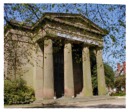
In 1824-1826, A Sessions House and a House of Corrections were built
at Spilsby. They were designed by
Henry Edward Kendall (senior).
["The stately Sessions House of 1826, where quarter sessions for the area
of Lindsey were held until 1878, is now home to the Spilsby Theatre"]
[The House of Correction occupied about two acres. It was enlarged in
1869 to accommodate 85 cells]
hence thou mayst bud, and whence thou mayst blow!
And whence thou mayst bear apples enow!
Hats full! caps full!
Bushel-bushel-sacks full,
And my pockets full too! Huzza!"
"the principal feature is an extensive crescent and square, the
opening between the wings of which is 840 feet, and the wings, each 350
feet in extent, present a frontage towards the sea of 1,540 feet: the
glacis is terminated by an esplanade commanding a beautiful and sheltered
prospect of the ocean: beneath this, at the base of the cliff on which Kemp
Town stands, a road is carried to the west end of the Marine-parade and is
united with the gardens and lawns in the centre of the crescent by a
tunnel."
(Kelly's 1867 Directory - GenUKI website)
The Mew family business about 1828 - 1829
"By 1804 the Bugle was said to be "the best and chief hosteirie
in Newport" and was the chief departure point for coaches to all parts of
the Island." Gay Baldwin -
Whitewash -
Summer Issue 2002
The Bugle was the Newport "posting house". I think this means it was the
inn where stage coaches stopped overnight. Horses would be kept to provide
fresh horse when needed. I believe posting inns also kept horse for hire.
The New Fairlee
Farm may have provided provisions for the horses as well as the
guests at the inn, and may have been somewhere to quarter and possibly
breed horses.
Baby Wek
Anna Maria Mardon Kendall, Charlotte's mother, born St Pancras.
1440-
1840 Contrasts The pictures below are from Contrasts,
the architectural challenge published by Augustus Welby Pugin in
1836. It
shows the losses and gains over
400 years.
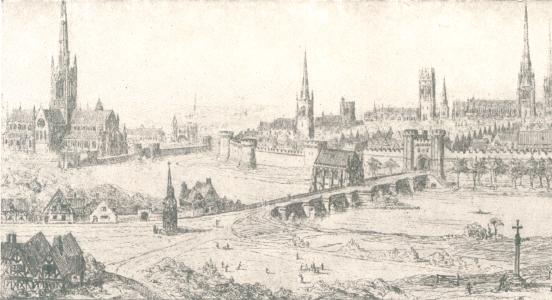
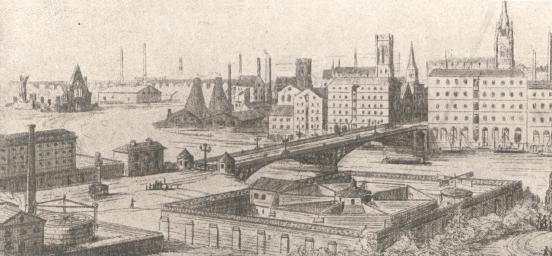
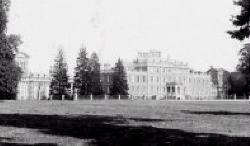
1905 photograph (loaned by Mr and Mrs John Proctor) from Steve Odell's
website. It shows one of Kendall's service wings clearly to the left of the
trees, and also the ornate porch.
Kendall may have also built a stable
(Peter Evans' website)
"The families I've had,' said Mrs Gamp, 'if all
was knowd and credit done where credit's doo, would take a week to
chris'en at
Saint Polge's fontin!'"
(Charles Dickens' Martin Chuzzlewit)
From
"Rd. Mew - Fairlee" [Wednesday] 4.10.1843 to Mr James
Bull, 5 Love Lane, Aldermanbury, London. Dear James, Not feeling inclined
to go out this evening, I thought I would let you know how things are with
us in the Island. It would be useless telling you things prior to H.
Wadmore's departure for town, as you must have had everything over and over
again by this time. By the bye,
Fred is not much altered
by his stay in London. He is just as
droll as ever - The next time you see him ask him whether he will take a
"little more of the Patent" "Lovely night"...

1846

Messrs. Kendall and Pope, architects
clicking on the brickwork will take you to the full colour photograph
on Simon Cornwall's website
December 1847: Emily Brontë's
Wuthering Heights and
Anne Brontë's Agnes Grey published.
"It is mainly upon
Wuthering Heights that Emily Brontë's reputation as a great artist
and a repulsive woman has been built"
(The Poems of Emily Brontë 1904).
see
poems -
1850 -
1883 -
1899 -
1903?
and
1904 -
1909
Brontë
weblinks
"Messrs. Kendall and Pope, architects" on
an archive
(Hampstead Workhouse board room - ref. MBO/PLANS/6 - date: 1845-53?
Elliptic beam Messrs. Kendall and Pope, architects]
Queen's College was started in 1848 by Frederick Dennison
Maurice, the Christian
Socialist lecturer of
King's College, under the auspices of the
Governesses Benevolent Institution. The
college was open to girls and women over twelve years old. There were
preparatory classes for younger girls, and evening classes for girls
already governesses.
Llewellyn Davies, brother of Emily Davies, was involved in Queen's College.
(Margaret Forster
1984) Female teachers who studied at Queens included
Dorothea Beale
and
Frances Mary Buss
The Ladies College at 47 Bedford Square was founded in 1849 by
Mrs Elizabeth Jesser Reid (born Sturch 25.12.1789 - died 1.4.1866), a rich
widow who had been "in contact with leading figures in the
revolutions in France and Germany in 1848" . (Quote may be from
Margaret Forster 1984)
Elizabeth Reid leased the
house, gave £1,500 to three (male) trustees, and persuaded friends
serve on
the management committees and act as teaching professors. It was to provide
a broad and non-sectarian education for women - much as
London University did for men. It opened in October 1849.
At the end of 1851 Mrs Reid wrote "Can anyone explain the failure of
this college? or tell how it is that where one might reasonably expect
several hundreds, the number who seem to look for Education here is
somewhat under nineteen?"
(Borer 1975/1976 p.266)
Bedford College moved to York Place in 1874.
school in the Old Kent Road:
Mary Davidow (1960 pages 5-6) says "In due time
Frederick Mew followed his brothers to London to attend Mr
Wotton's School in the Old Kent Road." (Footnote, "from letters and papers
in the possession of the family of Mr
Richard Percy Mew, Charlotte Mew's first cousin"). On
11.11.1982,
Southwark Local Studies Library advised Penelope Fitzgerald that they could
not find a school of that ("Wootton's") name. "However, the Post Office
London Directory for 1849 lists a Mr T. Walton at the Albany House
Academy, in the Old Kent Road."
In memory of Benjamin Mew who departrd this life 15th Nov
1850 aged LXV
Henry E. Kendall, junior ("architect" age 45) and
his wife,
Mary (age 35).
[No Henry Kendal son]
[Anna Maria Kendal elsewhere]
[No Thomas Kendal]
Edward Kendall, son, age 6
Mary Kendall, daughter, age 4
Arthur Kendall, son, age 2
Mary Cobham Mother-in-Law - Widow, age 70, Annuitant, born
Marylebone
Sarah Tomlin servant age 38 nurse
Mary Endicot servant age 42 cook
Elizabeth Goodman servant age 26 children's nurse, born Barton
upon
Humber, Lincolnshire
Jane Beedle servant age 24 housemaid
Mary Ann Cook servant age 14 children's nursmaid
William H[enry] Covey 47 General Practitioner, MRCS and LAC, born
Basingstoke, Hampshire.
Emma S[arah] Covey 40 his wife
Emma Covey 20 daughter
Fanny C Covey 17 daughter
Charles Covey 16 son
Myra J Covey 14 daughter
Francis Day 21 visitor
Anna M Kendall 14 visitor, born
Middlesex
Elizabeth Lunn 25 servant
Ellen Barton 26 servant
Arthur Gardener 17 servant
and 1851 Trade Directory
Henry Mew, age 61, Inn Keeper, born Newport
Ann Mew, age 55, wife, born
Lymington
Henry Mew, age 26, son, Wine Merchant, born
Lymington
Jane James, servant, unmarried, age 40, Barmaid
Henry Holloway, visitor, married, age 42, Nail Maker?
William Newham, servant, unmarried, age 20, Porter
Harriet Blanchard, servant, unmarried, age 34, Chambermaid
Mary Mackell, servant, unmarried, age 36, Cook
Eliza Woods, servant, unmarried, age 20, Chambermaid
Jane Prince, servant, unmarried, age 23, Cook
[No head of household shown]
Richard Mew, son, age 25 Bailiff for his father, born
Lymington, Hampshire
Fanny Mew, daughter, age 23 Housekeeper, born
Lymington,
Hampshire
Walter Mew, son, age 17, Agricultural Labourer, born Newport
Frances Goodall 48 servant
John Croad 42
Keziat Croad 50
John Cooke 17
Mark Morris 13
William Baron Mew, unmarried, age 30, Malster employing 9 men,
Brewer
employing 17 men.
Ann Agnes Mew, sister, unmarried, age 23, born Newport
Joseph Parker Mew, brother, unmarried, age 22, Brewery Assistant [?]
Manager of Brig Harriet [?], Cowes. Coal Trade
Trade Directory: Parish of Lymington: 4,164 inhabitants
Thomas P. Mew age 31 Wine and Spirit Merchant born Newport
Mary J. Mew wife age 28 born Portsmouth
Julia Mew daughter age 10 born Scholar Portsmouth
Mary E.E. Mew daughter age 9 Scholar born Newport
Frances N. Mew daughter age 8 Scholar born Newport
Benjamin P. N. Mew son age 6 Scholar born Lymington
Ellen Mew daughter age six months born Lymington
Maria Hooper, visitor unmarried, age 20, born Downham, Wiltshire
Three House Servants
Willam Norris age 50 Hotel Keeper born Lymington
Henrietta Norris, wife, age 31 born Exbury
Georgina Norris, daughter, age 8, scholar, born Exbury
Willam Norris, son, age 7, scholar, born Exbury,
Thomas Norris, son, age 6, scholar, born Exbury
Four servants
Angel Inn, High Street (family and posting) William Benjamin Norris
Introduction on Lymington says "Concerts, balls and other amusements
occasionally take place at the Assembly Rooms at the Angel Hotel"
Sarah Carlile age 75 his wife
Elizabeth Goodman age 67 lodger, widow, annuitant
Holy Trinity, New Hythe, Kent (1852-1855) was designed by Robert
Philip Pope, the
partner in the Kendall's firm. It is built of the native ragstone.
"The edifice is small, capable of seating about 300 persons. Its
architectural style is early English, plain but imposing from its massive
simplicity". Click on the bell-tower to visit.
Kendall, Henry Edward, architect, 17
Suffolk Street
, Pall Mall East
Kendall, Henry Edward junior, architect and district surveyor, 33
Brunswick Square and Holly Cottage, Heath Street,
Hampstead
(1862 map)
1853 Designs for schools and school houses,
parochial and
national. By H.E. Kendall [Junior] 11 pages, 21 plates.
Printed by Atchley & Co.... [National Art Library Shelfmark: 62.C.57
Fiche Number: 4.2.1606] The British Library catalogues the same title
published 1847.
Walter Mew Barnes birth registered July/September 1856
Marian Barnes, birth registered January/February 1862
Edward Daniel Barnes birth registered July/September 1863
George Frederick Barnes birth registered October/December 1866
The names
Walter and
Frederick were names of Frances' brothers. In
1875 the names
Daniel and Barnes were used for one of Charlotte's brothers. At
this time, the Barnes children lived (in Ryde) away from the
hotel with a governess, and the grandmother of the Mew and Barnes children
lived with an aunt in Ryde. It seems reasonable to assume that the Mew
children sometimes visited. Walter Mew Barnes had a role with respect to
the Mew family trusts (See letter
20.12.1892).
1856:
The Universal Exposition Paris:
Henry Edward Kendall (junior)
exhibited his Composition architecturale. F.W. Leakey 1956 page 56 says this seems to be the
only dessin "libre" that Kendall published. [A free drawing as
distinct from an architect's drawing?]. It is now lost but may once have
hung above Charlotte Mew's mantlepiece.
Alida Monro
wrote "I have a faint
recollection of the Architectural Composition... I feel sure
Charlotte showed it to me on one of my first visits to her. I think it hung
over her mantlepiece... I remember an airy lightness in the picture..."
(F.W. Leakey 1956 page 62)
The study of architectural style would presumably have taken the
architects in the Kendal/Mew family to the continent. Charlotte may
have had childhood holidays abroad and may have had a period at
school in Paris. She became bi-cultural
English/French and mentally lived
on both sides of the Channel.
1856: Modern Architecture by Henry Edward
Kendall.
[junior] 2
volumes, 36 plates. [National Art Library Shelfmark: F.17.38,39 Fiche
Number:
4.2.1719] The British Library catalogues the same title "By H. E. K.?"
published 1846.
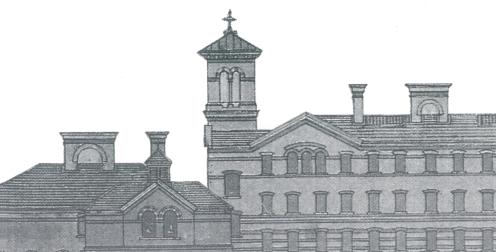
"Ruskin... jumped to the conclusion that only a Gothic
church was worthy of worship and that Renaissance architecture was pagan in
spirit. The reason for this is plain. The total impression of a typical
Renaissance building upon Ruskin's sensibility was the antithesis of the
naturalistic detail he loved so much in Gothic architecture. Lombardo's
church,
Santa Maria dei Miracoli, a prime example of Renaissance
architecture in Venice, became one of Ruskin's betes noires simply because
it substituted for Venetian Gothic a harmonious order of parts which
offended Ruskin's proclivity for a semblance of wildness and rudeness in
architecture. When Lombardo based his blueprint upon a symmetrical design
of circles and rectangles, he was only following an ideal of beauty
codified in the 1450s by
Leon Battista Alberti. But such an ideal was
anathema to Ruskin. It was his assumption that "Whatever is in
architecture fair or beautiful, is imitated from natural forms." And
natural forms are antipodal to the Renaissance ideal. Natural forms flow,
blossom and grow, as the craftsmen of medieval Venice recognized when they
preferred to carve the leaf and the flower rather than the square and the
triangle upon the rich facades and capitals of
San Marco. It is not
difficult to understand why Ruskin, who cherished the "look of mountain
brotherhood between cathedral and the Alp", found the Euclidean order of
Lombardo's church both sterile and inhuman. Ruskin was unable to
appreciate almost any Renaissance edifice because its governing ideal of
harmonic proportion, which through all the vicissitudes of the Baroque and
Rococo periods dominated European architecture until the last century, was
unequivocally hostile to the Gothic imitation of natural forms."
(Richard Titlebaum "John Ruskin and the Italian
Renaissance")
Sussex County Lunatic Asylum, opened 1859, and
Our Holy Redeemer in
Clerkenwell, opened in 1888, were designed by different architects in
a similar style. The asylum was designed by Charlotte Mew's
grandfather. In
her first published short story, Charlotte writes of the Church of the Holy
Redeemer as
"a church in the district, newly built by an infallible architect, which I
had been directed to seek at leisure". - Compare
Basilica di San Francesco di Assisi
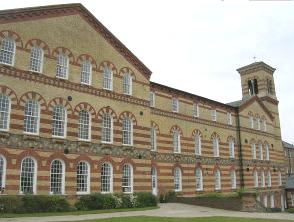
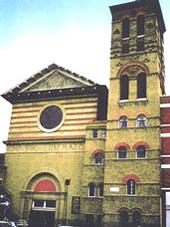
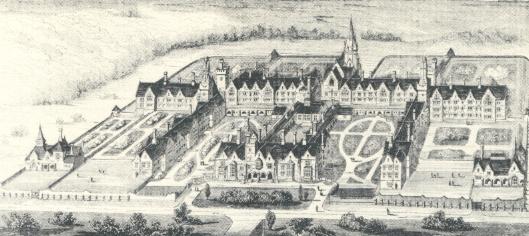
Henry E. Kendall, junior ("architect and surveyor" aged 55) and
his wife,
Mary (aged 45).
[No Henry Kendal son]
Anna Maria Kendall aged 24
Thomas C. Kendall,
son, aged 21, "architect and surveyor"
Edward H. Kendall, son, aged 16, scholar
Mary L. Kendall, daughter, aged 14, scholar
Arthur Kendall, son, aged 12, scholar
Elizabeth Johnson, "nurse", aged 34
Laura Rowe, "housemaid", aged 33
Emily Howard, "cook", aged 25
Henry Kendall aged 81 Architect
Ann Kendall aged 67
Charles Kendall, son, aged 31, Clerk to Defense Committee: Horse
Guards.
Emily Sills, house servant aged 25
Sarah Taylor house servant aged 26
Leonora
Herne, aged 64, born Middlesex and her sister, Caroline Herne,
aged 62 "Independent Lady" (both unmarried) living with a servant.
The death of Leonora Herne (age 80) was registered Islington, in the
October/December quarter of 1870. The death of Caroline Parr Herne (age 75)
was registered (volume 1b, page 178), Islington, in the January/March
quarter of 1874. This may be the "Caroline F. Herne" (Aunt Caroline) whose
£500
was included in the trust for Anna Maria Kendall and her
children.
Charlotte's sister was christened Caroline in the autumn of
1873. In 1851, Leonora Herne (age 50) was living in the home of her widowed
sister in law, Mariane Herne (age 60, born Plymouth, Devon) at 38 Beumont
Street, Marylebone. In 1841 she was living at 39 Beumont Street with her
husband, Robert, (age 55), independant means, born Middlesex). In 1851,
Caroline (age 54) was living at 11 Tonbridge Place St Pancras, with her
sister, Charlotte Herne (age 52). Both were unmarried and "fundholders".
Both were born in St George's, Hanover Square. The death of Charlotte
Henrietta Herne was registered St Pancras in the July/September quarter of
1851.
Henry Mew
36
Mary Mew 30
Thomas Toward, visitor, age 20
Samuel Cooper, visitor, age 60
James W Turner, visitor, age 24
James Fullford, visitor, age 36
John Goode, visitor, age 32
Chas Wm Cooke, visitor, age 38
John Erves, visitor, age 71
Caroline Mills, servant, unmarried, age 29, Barmaid
Alfred Hathway, servant, married, age 32, Waiter
Emma Dennett, servant, unmarried, age 25, Chambermaid
Charlotte Dore, servant, unmarried, age 21, Chambermaid
Mary Gallop, servant, unmarried, age 17, Kitchenmaid
Sarah Salter, servant, unmarried, age 15, Scullerymaid
William Denton, servant, married, age 30, Poeter
Anne Mew, widow, head of household, age 65, retired hotel
keeper, born
Lymington, Hampshire
Richard Mew, son, unmarried, age 65, wine merchant, born
Lymington,
Hampshire
Mary Beaumot? servant, unmarried, age 20, general servant, born
Clareton?, Hampshire
George Beaumot? servant, unmarried, age 20, groom, born Whippingham,
Walter Mew, age 27,
Farmer, born Newport
Georgina Mew, wife, age 22, born Hamsters? Hampshire
Sarrah I. Slippens, servant, unmarried, age 19, House Servant, born
Rookley
John Croad?, servant, age 52, Agricultural Labourer, born Arreton
Kesiah? Croad?, servant, age 60, Dairy Woman, born Northwood
William Baron
Mew, widow, aged 40. "Alderman. Brewer employing about 35
servants"
Elizabeth Constance? Bishop, Governess, unmarried, age 40, born
Maidenhead, Berkshire
No children shown
Five house servants
Thomas P. Mew, age 41,
Brewer
Mary J. Mew, wife, age 38
Julia Mew, daughter, age 21
Frances P. Mew, daughter, age 18
Benjamin T.P. Mew, son, age 16, scholar, born Lymington
Agnes G. Mew, daughter, age 13, scholar, born Lymington
Ellen Mew, daughter, age 10, scholar, born Lymington
William C. Mew, son, age 7 scholar, born Isle of Wight
Two house servants
Daniel Barnes, Hotel keeper, age 39, born Somerset
Frances Barnes, wife, age 32, born Lymington, Hampshire
Frances E Barnes, daughter, age 6, born Ryde
Walter M. Barnes, son, age 4, born Ryde
Arthur Henry Barnes, son, age 3, born Ryde
Anna Barnes 32 - sister
28 Newport Street, St Mary's, Elizabeth Goodman, farmer's widow, aged
79,
born Howstow, and
Elizabeth Goodman, her daughter, quilter?, aged 35, born Barton.
The death of an Elizabeth Goodman, aged 84, was recorded in the
December quarter of
1866 in Glanford Brigg (which includes Barton) volume 7a, page
385. If Elizabeth Goodman born Barton
about 1825, came to London as a cook in
1867, she would have celebrated 25 years of
domestic service in
1892.
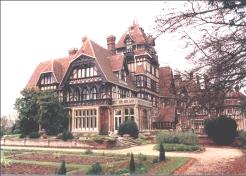
A grade one listed building. Recently described as "Stockbroker/ baronial
fantasy
style,
two storeys with five-storey tower. Red brick, stone dressings,
steep tiled roof, turrets, pinnacles, ornate carved bargeboards."
and "turrets, towers and many gables. Steep pitch roofs in
plain and patterned tiles. Once owned by the widowed Empress of
Napoleon 3rd".
19.12.1863 Marriage of
Frederick Mew and
Anna Kendall at
St George's Church, Bloomsbury. The witnesses being Henry
Kendell, Anna's cousin
Ada Cubitt (aged about 22) [Not her mother Mrs Lewis Cubitt]
and
Sophia Webb (probably
aged 23). I would guess that the witnesses were the father of the bride and
her two bridesmaids.
[Penelope Fitzgerald
1988 (p.6) says Sophia Webb was "wife of the proprietor of the
Fountain Inn,West Cowes" - but this does not appear to be correct].
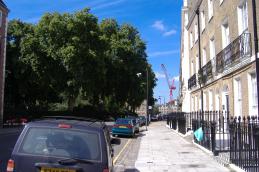
Penelope Fitzgerald says the
house was "at the end of the street, overlooking the airy trees of
Mecklenburgh Square" In fact, Number 30 is further south than the square.
But, as the
pictures suggest, the children should be able to
see north to the square from
the nursery window
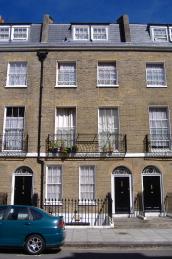
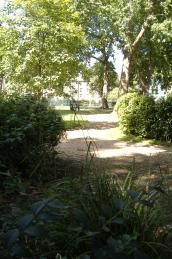
The privet hedge around Mecklenburgh Square is now very
high. From a side street one can peer in on the private playground under
the
trees that the Mew children shared with the other children of their houses.
The
London plane trees in Brunswick Square are about
the same size as those in Lincolns Inn, which are believed to have been
planted about 1820
(external link). The oldest in central London
may be those in Berkley Square, thought to have been planted in 1789.
(external link)
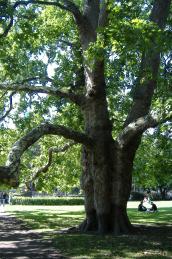
See 1811 -
1867 -
1887
In
1863, Samuel Chick the
father
(to be)
established the London office for
the firm's lace at 5 Newman Street. This
remained his London business centre, and became his family home. Newman
Street is not shown on the above map. It is just to the west of Tottenham
Court Road (south west corner of map). Samuel Chick's ledger of business
letters from 1863 to 1865 provides the material for chapter eleven ("Early
Days at Newman Street") of
Margaret Tomlinson's history.
Newman Street: See
1867 -
1887 -
1924 -
1952 -
1956
(Sheet music cover at National Library of Australia)
-
It is possible that this was only available in French until the 1920s.
The
"vocalist" parodies it in Charlotte Mew's
Notes in a Brittany Convent
Harrod & Co.'s Directory of Hampshire & Isle of Wight, 1865
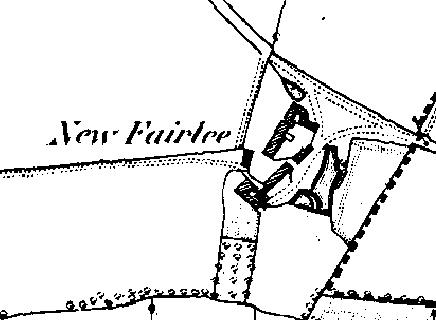
In April, May or June of
1867, Samuel Chick, the father
(to be) -
(see Newman Street) married
Ema Hooley in Macclesfield. (volume 8a page 209). All their
children were born at Newman Street.
Samuel and Alice were born on
31.3.1868. Edith was born sometime in October 1869, not long
before
Charlotte Mew. The other Chicks were younger than Charlotte.
Margaret Tomlinson's chapter starting with the marriage is
Called "Lace and London Property" because, with the decline in the Honiton
lace business, Samuel Chick diversified, first into trading foreign laces
and then into buying and developing property. It may be that the Chicks
became family friends of the Mews (architects) through the property
development. It may also be that Charlotte and
Anne were involved in
producing designs for the Chick lace makers. New designs helped to sell.
Designs "after nature" and copies of antique designs were particularly
popular. However, art students tended to make too make designs that were
too complex and people who could draw but understand the practicalities of
the material were difficult to find. It is
via the Chicks that Charlotte's needlework and designs were
preserved.
Ethel Oliver, born 12.10.1868 at Kew. Her immediate family
are:
October/December quarter 1868 Birth of Richard Percy Mew
registered Isle of Wight. (See
New Fairlee)
He was sent to
Cranleigh School for Farmers' Sons
and eventually took over the
management of New Fairlee Farm
(see 1901). Richard Percy Mew and
his wife gave information to Mary Davidow about their cousin
(Charlotte) in
1958. From 1927 to 1963 "Mew,
R.P. Farmer, New Fairlee" was in the Isle of Wight telephone directory.
However, a "Richd. P Mew" appears in the Hillingdon telephone directory
from 1963 to 1981 - which would make him impossibly old if it was the same
person.

1869

Charlotte Mew was born 15.11.1869, almost certainly at 30 Doughty Street,
near Mecklenburgh Square, London. Her father, Frederick Mew, was an
architect. Her mother, Anna Kendall. was the daughter and granddaughter of
architects. Frederick Mew worked in the Kendall business. Charlotte's older
brother, Henry Herne Mew, was born in the early summer of 1865. Their
nursery and their childhood was watched over by the servant Elizabeth
Goodman, who Charlotte later described as a second mother.
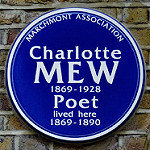
" Her article
[An Old Servant. 1913], about her old nurse,
Elizabeth Goodman, gives an
account of the Mew nursery..." [Val
Warner, 1981,
page ix]
1870
Charlotte -1

Autumn: Cousin Ethel born on the Isle of Wight. Six months later, the
census shows her youngest Somerset aunt (19) staying with the Isle of Wight
family, whilst Ethel's four year old sister, Fanny is cared for in
Somerset.
Although we cannot ascribe many dates, Charlotte's stories and memories
show
that her childhood also included staying with her Isle of Wight and
Somerset relatives, and that the Isle of Wight children stayed in London.
In
1901, "Ethel Mew", aged 30, an "Art Teacher", born Newport Isle
of Wight, was staying with Claire Murrell (I think it is rr), an
Artist/Painter on her own account, aged 37, born Brixton, at 102 Burwood
Park Road, Walton On Thames, Surrey
(map). The other person there was Pauline
Eliza Peters (?), aged 18, a general servant born Weybridge, Surrey.
(Possible 1881 Census entry for Claire/Clara
Murrell).
Mary Davidow says she met Margaret Chick at Notting Hill High School.
Penelope
Fitzgerald
1988 (p.156) says that in 1915 she was working as an art teacher
at
Notting Hill High School
.
As an "elderly
teacher... "on the verge of retiring" she visited Anne Mew when she was
dying
(1927). She was concerned that Charlotte might kill herself, and
visited her just before her death. (pages 214-215 and 225)
1871
Charlotte 1-2
Late summer: brother Richard born
Henry Mew 46
Mary Mew 40
Caroline Mills 39
Henry Cohen 22
Charles Muck 46
Oliver S Bishopp 22
Ben Mew 28
Edwin M Leal 12
Edward Shaw 22
Ellen Stallard 18
Elizabeth Baker 21
Annie Corke 27
Mary Ann Cooper 24
Edward Blanchard 40
Richard Mew - age 46 - Farmer
Fanny Mew - age 37 - wife
Richard P? Mew - age 2 - son
Ethel L. Mew
- age 6 months - daughter
Louisa Read, Sister in Law - age 19 - occupation "companion"
[Five servants
William Baron Mew age 50, Brewer Master employing 65 hands.
Henrietta B. Mew, daughter, age 12
Amy B. Mew, daughter, age 10
Servants
Joseph Parker Mew, age 41,
Brewer's Manager
Euphemia Mew, age 34, wife, born Kent
Marion E. Mew, daughter, age 9, scholar, born Newport
Agnes M. Mew, daughter, age 7, scholar, born Newport
Joseph M.P. Mew, son, age 5, scholar, born Newport
Leonard Mew, son, age 3, born Newport
Servants
Thomas Parker
Mew, age 51, Brewer etc..
Mary Julia Mew, age 48
Benjamin T.P. Mew, son, age 26. Brewer
Agnes Alice Mew, daughter, age 23
Ellen Mew, daughter, age 20
Three servants
Daniel Barnes 49
Frances Barnes 42
Persis Friend 28 unmarried Governess born Kidderminster.
Bracketed note to following three entries "Children of Daniel Barnes of
Ryde Pier Hotel. This house is a nursery expressly for his children"
Marian Barnes 9
Edward Daniel Barnes 7
George Frederick Barnes 4
Martha Williams 28 servant
Ellen Brell 21 servant
Anne Mew, Lodger, widow, age 75, no occupation, born Lymington
Maria Anne Norris, Lodger, unmarried, age 29, no occupation,
born
Lymington
William Norris, age 72, Retired Hotel Keeper, born Lymington
Herrietta Norris, age 55, wife, born Exbury
Elizabeth Read - age 59
Mary Anna Read - age 30
Fanny Mew - age four
Occasional help
"To outsiders she was simply an unusually incompetent little needle-woman.
Twice a week and on occasions of domestic pressure or festivity, she used
to mount the creaky stairs...
I see her now, seated within the charmed
circle of a white drugget, in our low nursery, filling up the gaps in our
pinafores and
budding intelligences... (Miss Bolt)
1872
Charlotte 2-3
Governess in fact and fiction
"A very cursory glance into the advertisement columns of the daily press
will prove to any one that if there be one branch more overstocked than
another, it is that of daily governesses in London. The prices asked and
paid are so small as to render it astonishing how body and soul can be kept
together on such a pittance. Instruction in music, French, or German - in
fact, in any foreign language - can be obtained in London at the cost of
one shilling per lesson; in some cases from natives of the various
respective countries, as well as from English women."
Cassell's Household Guide (about 1880),
volume
1, page 206. The article goes on to recommend young women to train as
elementary school teachers instead of becoming resident or daily
governesses.
"Mr Kenneth Grahame, in his Golden Age, in the few pages
headed 'Exit Tyrannus', has portrayed in his own delicate fashion the
mixture of regret and bravado with which his children watch their governess
depart. And it is chiefly in such slight sketches that for us our governess
reappears. In fact, perhaps she has become our tyrant; in fancy assuredly
she has been our friend. Is she in both, in life as in literature, becoming
obsolete with the three-volume novel? If so be, so be it."
1873
Charlotte 3-4
Autumn: sister Anne born
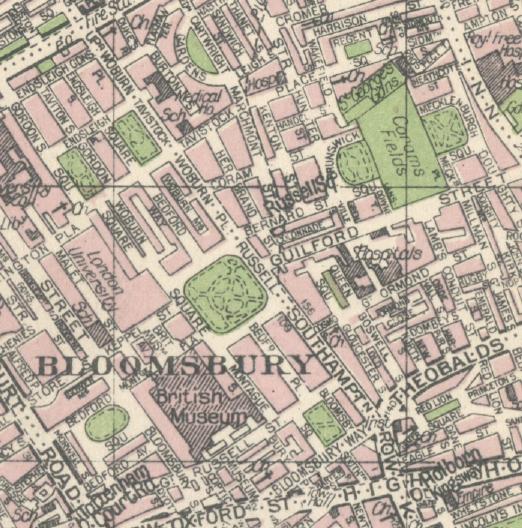
| 1874 | Charlotte 4-5 |
|
|
Spring: cousin Florence born. Florence and Gertrude (born 1875) contributed memories to the 1960 reconstruction of Charlotte's life. |
Florence Elen Mew of South Fairlee Farm born [Penelope Fitzgerald gives her name as Florence Ellen Mary Mew. I think she adds the name Mary because she thinks Florence is Sister Mary Magdalen] The birth of Florence Ellen Mew was registered in the January-March quarter of 1874, Isle of Wight volume 2b, page 552. Florence and Gertrude Mary were the two female cousins whose memories Mary Davidow (1960) drew on. There was just over one year between their ages.
In 1901, "Florence Mew", aged 27, born "Whippenham" Isle of Wight, was living at 13 Templeton Place, Kensington, London. Occupation "Independent". This is a boarding house run by Emma Hawkins (aged 42, husband Amos) with eleven boarders, predominantly women, and mostly "Independent" (One secretary and one artist). Florence Elen was interviewed, in the 1950s, by Mary Davidow.
|
Marriages of older sisters of
Lucy Harrison, taking place in Bromley, Kent (where their
parents lived):
The birth of Amice Anna B Macdonell was registered Bromley, Kent vol.2a page 348 in the October-December quarter of 1874. Her mother was Agnes T. Macdonell, a novelist, who wrote For the King's Dues (1874) and Quaker Cousins (1879). Amice's father, John Macdonell, was a barrister who had become a Master of the Supreme Court by 1891. His youngest sister, Anne (or Ann) Macdonell (born about 1861 in Aberdeen) (who knew Charlotte), was also a writer. Amice and younger sister, Margaret R. B. Macdonell, were both born in Beckenham Kent. Margaret was born about a year after Amice. See the 1881 Census, when the family are living in Surrey. The birth of Margaret Rachel B. Macdonell, was registered Bromley, Kent vol.2a page 363 in the June-August quarter of 1876. In the 1891 Census the family are shown at 24 Stanley Gardens, Belsize, St John, Hampstead. In the 1901 Census they are at 28 Belsize, St Peter, Hampstead. Amice said that she was ten years old [1884/ 1885 - not 1882] when she went to school with Charlotte Mew. The two letters from her to Mary Davidow in 1959 are a major source of information on Charlotte Mew's childhood. Amice Macdonell became Amice Lee (Name on books indicates this was possibly about 1909). She wrote a series of historical plays for children (1908-1913) including the story of Alfred the Great, Robin Hood and The Armada, and The enterprise of the Mayflower (first series) and Saxon and Norman, Magna Carta, Edward 3rd, Caedmon, The Burghers of Calais, The Good Queen and The Crusaders. The Way of the Heart, Saint George, and Beowulf. These were published in London by George Allen & Sons and included illustrations by the author. After the war, she wrote The Sacred Fire. A Morality Play for the League of Nations (Basil Blackwell, 1924), The Name on the Rock (1933) and then a book about The Production of School Plays (1934). In 1955, Oxford University Press published her Laurels and Rosemary: the life of William and Mary Howitt. [Her relatives, William (1792-1879) and Mary, previously Botham (1799- 1888). Her final exercise in family history, In Their Several Generations, was published privately in the United States. It gave a family history from 1640 to 1930. The index was constructed by one of her american cousins. |
| 1875 | Charlotte 5-6 |
|
|
Spring/summer: Cousin Gertrude, Charlotte's favourite cousin, born Newport, Isle of Wight - Autumn: Baby Daniel, renamed Christopher, born - name links with family at Ryde, Isle of Wight |
4.1.1875 Henry Edward Kendall (senior), Charlotte's architect great-grandfather died. His death (aged 98) was recorded Westminster vol.1a page 402 in the January March quarter of 1875
Gertrude Mary Mew of
South Fairlee Farm born.
The birth of Gertrude Mary Mew was registered in the April-June quarter
of
1875, Isle of Wight volume 2b, page 523. She would have been five in
the summer of 1880.
Charlotte Mew's "favourite cousin" was thinking of entering a convent in
1919. (Mary Davidow appears to accept the identification of
"favourite cousin" and Sister Mary
Magdalen]. I cannot find any reference in Mary Davidow to the convent being
Anglo-Catholic or belonging to any Anglican order
(as Penelope Fitzgerald says). It is possible that the cousin
converted to the Roman
church. Mary Davidow says that Ann Mew "died an Anglo Catholic" - [But, as
an anglican with high church leanings, so did Charlotte].
Daniel Kendall
Frederick and Anna's
sixth? child, born in 1875, was
renamed Christopher Barnes a few months after his birth. He died in
1876
"shortly after receiving his new name"
(Penelope
Fitzgerald 1988 p.9) The birth of Daniel Kendall Mew was
registered Pancras vol.1b page 78 in the October-December quarter of
1875.
In
1901, "Gertrude Mew" aged 25, born
Whippingham, Isle of
Wight"
was living in London and working as a "Hospital Nurse" at
St Bartholomews
Hospital, West Smithfield. She became Sister Mary
Magdalen (See
August 1958).
|
Mew businesses in 1875 Trade Directory:
Henry Mew, Bugle family and commercial hotel and posting house High Street Richard Mew, wine, spirit and ale merchant, 16 Lower St James Street |
|
Isle of Wight Holidays
"In late May or June every year the Mew children went to the Isle of Wight". Their mother "it seems" preferred to stay with her family in Brighton. "but the children went on by the Mid-Sussex Railway to catch the boat at Southampton for the Island, in the care of Elizabeth Goodman.".. "During the holidays the children had the chance to tour the Island from Newfairlee" (Penelope Fitzgerald 1988, pages 14-15). Clicking on the map below will take you to a map of a larger area. |
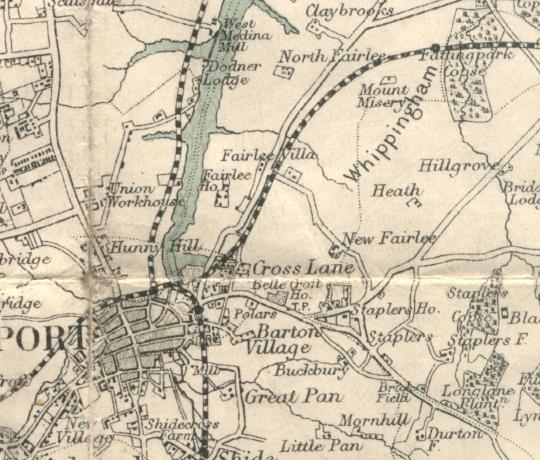
|
The Road east from Newport through Barton Village is, today, called
Staplers Road. It leads eventually to Ryde. The road north, beside the (now
disused) railway track is called Fairlee Road. It leads to East Cowes. The
farm track going from opposite Fairlee Villa, on Fairlee Road, to New
Fairlee and then to Staplers Road, was called (by 1901) "Mews Lane". New
Fairlee Farm is shown hugging the south of Mews Lane opposite the words New
Fairlee. It is shown in closeup on
an 1866 map, where one can see the tracks into the farmyard and
to the cow sheds passing what appears to be a farmyard pond. Perhaps this
is the drive that this memory in
The Trees are Down harks back to:
I remember one evening of a long past SpringThe Mew children presumably walked down Mew Lane to and then west along Staplers Road to St Paul's Church, which is close to "Polars" (where William Baron Mew lived) in Barton Village.
Kevin McCoy, the
St Paul's Barton webmaster,
has helped me with Mew family history.
Penelope Fitzgerald 1988 pages 15-16 identifies this with the church of Charlotte's childhood described in The Country Sunday . Above the Sanctuary "is a cupola of stars set in a deep blue sky surmounting three beautiful stained glass windows depicting Faith, Hope and Charity these are in memory of Benjamin Mew who died in 1850, aged 65". The church also contains "a stone tablet in memory of Rev William Henry Nutter; and Fanny Mew, daughter of Richard and Fanny Mew". The first vicar of the parish was Rev. W.D. Parker (1844-1853). If the story is taken literally, the vicar in The Country Sunday would be Rev William L. Sharpe (1854-1890 - See 1881 Census). He was followed by Rev. William Henry Nutter (1891-1909 - See 1881 Census)
Somerset Garden
I expect I get my affection for flowers from spending some time in Somerset
when I was a child with
ancient aunts who didn't like me... their garden -
when I was allowed into it - being, then, my only pleasure...
|
|
The Nursery: The following passage from
Mary Davidow (1960 page 23) may be based on the memories of
Gertrude Mary Mew and
Florence Elen Mew.
Charlotte was already five when Gertrude Mary was born.
Perhaps the first passage draws on memories from when
Charlotte was about ten 1880,
and Freda just born. The second passage relates to when
Freda Mew was a small child, and Charlotte a teenager. Perhaps
about 1884?
"The Mew nursery... was located in the attic or top floor. The night nursery contained the essential beds and cupboards, and the day nursery was fitted with bookshelves, a toy-chest, a Noah's ark, a rocking horse, a doll's house with a bay window built by the architect father, and the indispensable round table at which the children ate their meals, and, in the intervals, at which they learned from Nurse their first lessons in reading and writing... The Mew nursery followed a fairly standard routine; breakfast at eight, dinner at noon, and tea at six. In the evening the children were allowed to go downstairs for dessert and for the privilege of spending a little time with their parents"
"An Isle of Wight cousin recalls that on one of her visits to London she played in the Square with Freda where they spent a delightful and, for the over-disciplined and repressed Freda, an intoxicatingly joyous afternoon. When they returned to the house, looking as happy children ought to look -- hot and sweaty and dirty - Nurse spanked them for getting into such a state." (page 29)
"One of Frederick Mew's Isle of Wight nieces recalls that when she visited the London Mew's, Uncle Fred took his children and the visiting relative to the Foundling for Sunday services to hear the music. During the short walk he recited the salient historical facts concerning the institution, and cautioned the children to be attentive to the music and the sermon. After the services the visitors were permitted to walk about the dining room and talk with 'the dear little children' while they ate their dinner." (page 28) |
| 1876 | Charlotte 6-7 |
|
|
March: Baby Christopher and then, in December, Richard (5) die The needlewoman may have explained death to Charlotte as like a candle going out. Cousin Gilbert born in the Autumn |
Ralph Waldo Emerson's Letters and Social Aims published, containg the essay Immortality
"Is immortality only an intellectual quality, or, shall I say, only an energy, there being no passive ? He has it, and he alone, who gives life to all names, persons, things, where he comes. No religion, not the wildest mythology, dies for him ; no art is lost. He vivifies what he touches. Future state is an illusion for the ever-present state. It is not length of life, but depth of life. It is not duration, but a taking of the soul out of time, as all high action of the mind does : when we are living in the sentiments we ask no questions about time. The spiritual world takes place ;- that which is always the same"
In 1876 two of Frederick and Anna's chidren died
21.3.1876: Christopher Barnes Mew, son of Frederick Mew Architect, died, aged "4 months" at 30 Doughty Street. Cause of death: "Convulsions, Certified by J. Whicker, MRCSE" [Comment: The convulsions probably came at the end of an infection, but could have been the result of a congenital defect. The violent shaking damages the brain etc, and can bring about death in a matter of minutes]. Informant: "E. Goodman. Present at the death", registered it at Grays Inn Lane, Pancras on 24.3.1876. The death of Christopher Barnes Mew, aged 0, was registered Pancras vol.1b page 63 in the January-March quarter of 1876.
April 1876: Competition for the design of the new Vestry Hall for Hampstead
6.5.1876: Hampstead and Highgate Express "Sir... while inspecting the drawings for the above, prior to the decision of the Vestry, my attention was called to a gentleman with a foot-rule, pointing out the merits (?) of the design marked 'Cavendo tutus' to all comers. Upon speaking to him, I discovered he was a vestryman, and he stated to me that he knew whose design it was, and had seen it prior to its being sent in... 'Cavendo tutus' appears to have ignored all the conditions - the large hall showing to hold about 400 people (if I mistake not) instead of the 800 required." Penelope Fitzgerald 1988 pages 33-34)
2.10.1876 Margaret Chick born. If she started at the Gower Street School when she was five, that would be about 1881. However, Gower Street pupils may have started when they were about seven (1883).
October/December quarter 1876: Birth of Gilbert Mew of
South Fairlee Farm registered.
In
1901, Gilbert Mew, aged 25, a farmer, born Newport, was
a visitor at 15 Bouverie Road (East?), Folkestone, Kent. This was the
house of Arthur M. Riddall (aged 29, born Poplar) a Hotel Proprietor -
although I do not think this was the hotel. In the absence of any other
information, I have assumed Gilbert
farmed the home farm with his father and brother.
9.12.1876: Richard Cobham Mew (Son of Frederick Mew, Architect), five years old, died at 30 Doughty Street. Cause of death: "Scarlet fever, Congestion of kidneys, Uraemia. Certified by T. Robinson, LRCP. [Comment: It looks as if scarlet fever triggered Bright's Disease (of the kidneys) leading to poisoning of the blood by the urine. The child would have become mentally disturbed as an effect of the urea on the brain. Possibly severe slowing down of mental faculties.] Informant: "Elizabeth Goodman, Present at the death", who registered it at the Grays Inn Lane sub-district, Pancras on 12.12.1875 [The death of Richard Cobham Mew, aged 5, was registered Pancras vol.1b page 51 in the October-December quarter of 1876].
See also An Ending (possibly Charlotte's earliest surviving poem) "my soul goes out 'Most like a candle in the everlasting dark"
|
Alida Monro (1953), page xii, says that "Charlotte Mew was
educated at the
Lucy Harrison School for Girls in
Gower Street and for
many years helped with
Miss Paget's Girl's Club, work which she enjoyed
enormously". Following up this lead brought
Mary Davidow in contact with
Amice Lee, who provided
memories of Charlotte when (by about
1882), she and
Ethel Oliver [a Quaker] were both living with Lucy Harrison.
Amice's letters show that Charlotte lived with Ethel Oliver when
Charlotte was about fourteen, and that she knew the other Oliver children.
There is a suggested age difference that does not appear to be true.
Margaret Chick's recollections suggest that
all of the (four?) oldest Chick girls attended the Gower Street
School. The strong
scientific bent of some of the Olivers and Chicks may indicate that
science was a component of the school's education.
Mary Davidow says that
Anne Mew was a pupil at the Gower Street School under
Amy Greener
, and went from there to the School of Art. Penelope
Fitzgerald says that Charlotte
also met
"Maggie Browne"
at the school - But I cannot find a basis for this.
Mary Davidow (1960), page 31, says "Formal education began for Charlotte Mew at the Lucy Harrison School for Girls in Gower Street when she was six or seven" [1876/1877]. She does not give a source. The census for 1881 has Henry H. Mew at 15 and Charlotte M. Mew at 11 as "Scholar" - But not Caroline F.A. Mew [Ann] at 7. Henry was not shown as a scholar when he was 5 (1871 census), Freda (aged 12) and Caroline (aged 17) was not shown as a scholar on the 1891 census. No Governess is shown living in on any census - But professional home tuition could have been provided by someone not living in.
Penelope Fitzgerald
(page 22) says Charlotte "was entered as a pupil" at
"the Gower Street School" in
1879 (not referenced). [See
also
1881 and
1882].
Lucy Harrison (1844-1915), born in Liverpool (census) came from a "Quaker
family with a Yorkshire background". She was one of eight children of
Daniel
(tea merchant born about 1795) and Anna (born about 1798). The
other
children included Mary (born about 1826. The oldest.
An invalid) -
probably Charles Harrison,
tea merchant, born about 1830 -
Samuel (born about 1837) -
Agnes, born about 1841 -
Anna Jemima, born about 1842 - Annie, born about 1842 - Lucy
(whose full name may have been Emma Lucy Harrison) born 17.1.1844. Charles
Harrison married Mary (born about 1833) and they had (at least) four
children: Charles W.D. Harrison (born about 1854?) - Edith M.W. Harrison
(born about 1858) - Ethel M.J. Harrison (born about 1859) and Arthur J.U.
Harrison (born about 1860). In 1871,
Edith and Ethel were pupils at the school where Lucy taught.
In 1861 and 1862, Lucy (and Annie) attended Bedford College, studying Latin, History and English literature. In 1865 or 1866 she started to teach the Bedford College School, which moved to Gower Street about 1868. She became headmistres in 1875. Lucy Harrison left the Gower Street School in 1885/1886, because her health broke down. Amy Greener took over the Gower Street School, and she and Lucy became close friends. Lucy Harrioson spent some years of recuperation in Wensleydale [North Yorkshire]. She became headmistress of Friends Girls School, York (Mount School) in January 1890. In 1881, Lucy Harrison, aged 37, born "Edge Hill, Cheshire" [Edge Hill is a district of Liverpool] Governess (Private) was living at 80 Gower Street with Ellen Mathews, aged 25, born Shrewsbury, Teacher (Private) - Mary Newcome, Housekeeper, (married) aged 48, born Devon - Lucy Newcome, assistant, aged 23, born St Pancras - and Ann Ayliffe, Housemaid, aged 17, born Bishops Stortford, Hertfordshire.
Lucy Harrison is "superintendent of school" at 6 Driffield Terrace, York in
the 1891 Census -
headmistress of Mount School, Dalton Terrace (by Driffield Terrace), York
in the 1901 census. In the 1881 census (when Winifred Oliver was a "scholar" there) this is
entered as "Friends' School".
[Friends Girl's School, York (Mount School)]
Amy Greener (born 1860) was a daughter of a coal agent in West
Auckland. In 1871 the family were in Aston Hall, Cheshire. In 1881, Amy
Greener was a "Governess" (one of two) assisting
the
headmistress in a school at 3 Lansdowne Road, in Notting Hill
(near Notting Hill High
School). She was 21
years old, born Etherley, Durham. She first met
Lucy Harrison in
1885.
In 1891 she
was in charge of the Gower Street School in
its new premises
. In 1901 she was a teacher at Mount School, where Lucy Harrison
was
headmistress.
She published Lucy's life and papers in 1916.
There were educational publications by (a) Lucy Harrison in
1880 -
1883. But not
1903.
|
| 1877 | Charlotte 7-8 |
|
|
Frederick Mew, Charlotte's father, engaged in the construction of Hampstead Vestry Hall: Design: 1876 - Opening August 1878? |
|
Clerkenwell House of Detention closed . It was demolished. A school opened on the site in 1893, so the prison was probably being demolished at about the time Passed was written. Click on the image for the EC1 local history trail leaflet |
8.6.1877 Hampstead and Highgate Express "though the work had not been proceeded with so rapidly as it might have been, the architect was of the opinion that his was all the better for the building" Penelope Fitzgerald 1988 p.35)
| 1878 | Charlotte 8-9 |
|
|
October: Death of grandma Mew on the Isle of Wight |
"Although mixed classes were held at University College from 1878, women still had a separate Common Room there (in fact, the Common Rooms were not desegregated until 1969 [Harte and North 144]), and many in those days still considered women-only establishments more appropriate" (external source). See also 1979 - 1986 - 2004
"The [Hampstead] vestry met at the board room of the guardians in the workhouse until 1878 when a vestry hall and offices were built on the Belsize estate at Haverstock Hill. The red-brick and stone Italianate building, designed by H. E. Kendall, the district surveyor, and Frederick Mew, was extended in 1896." (From British History Online. Source: Hampstead: Local Government. A History of the County of Middlesex: Volume IX, T.F.T. Baker (Editor) (1989). - (external link with picture) 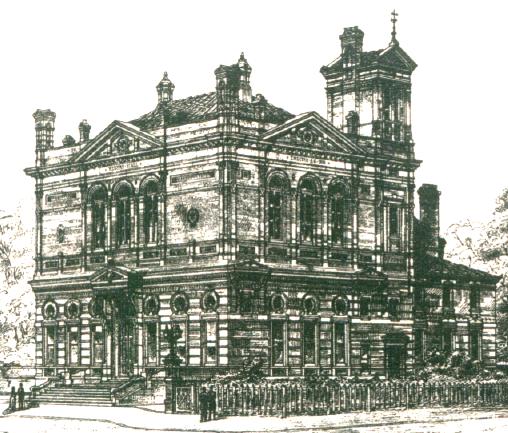
This drawing of the "Vestry-Hall - Hampstead" is dated "August 1878" and has the name "Kendall and Mew, Architects".
|
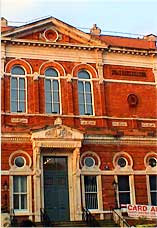
17.10.1878 Death of Ann Mew, Charlotte Mew's paternal grandmother. She was buried at Newport, Isle of Wight.
| 1879 | Charlotte 9-10 |
|
|
Spring: Freda born |
|
There is another summary of what is known of Freda
under
Henry, Anne and Freda
.
After 1.3.1879?, but before 3.4.1879: Freda Kendall Mew, Frederick and Anna's seventh? child and Charlotte's youngest sibling, born. Her birth was registered at St Pancras in the April-June quarter of 1879. She was entered as two years old on the 3.4.1881 census and 19 years old on admission to an asylum on 4.2.1899. She was 78 years old when she died on 1.3.1958.
There is ambiguity about Anna Mew's age, but she was probably about forty two when Freda was born. (See birth defects in children born to women over 40). Before 1886(?), when she was five, Freda attended dancing classes (at the Gower Street School?) with her mother. Her mother is described (by Amice Lee, recalling childhood memories) as "certainly silly". In an earlier letter, Amice mentions Freda followed by reference to a shadow on Charlotte's life. One interpretation is that Freda had a problem that could not be disguised from children who knew her. Freda (aged 12) was living at home in June 1891. She is not entered as "scholar" (as Charlotte was when she was 11). [The legal school-leaving age was ten for all children, however poor] We do not know where she was between 1891 and 1898. At the end of 1898 she was on the Isle of Wight. There is a strong association with the Isle of Wight, and with Richard Mew, her uncle, in her hospital records (See case book - census - and death certificate). This may indicate that she had been living there for some time. The (male) subject of Charlotte Mew's poem, Ken, has features similar to Freda's when she was institutionalised. Before that, he is described as living in a town similar to Carisbrooke and spending time in the country with animals. Freda was admitted to institutional care on the Isle of Wight soon after her father died. She was admitted to the Isle of Wight County Lunatic Asylum on 4.2.1899. In 1901 she appears as "F.K.M." in the Isle of Wight Asylum. On the 1901 census her place of birth is given as the Isle of Wight and her death certificate gives "Richard Mew" (her Isle of Wight uncle and cousin's name) instead of "Frederick Mew" as her father - |
17.2.1879 Death of Sophia Cubitt at Talbot Square, Westminster. She was buried at Kensal Green Cemetery
Her sisters were
Florence attended St Andrew's Girls School, Enfield, and began teacher
training at the same school on 10.5.1895. She began teaching at her
father's school (for boys) on 10.1.1897. From 1903 (possibly earlier)
she published children's stories: Little Lie-a-bed; and other
stories (1903). Florence met Thomas Hardy in 1905, when she was 26
years old. She published Old Time Tales - Tim's Sister and
Nurse Jane! in 1907 and Country Life in 1908. Florence left
teaching in 1908. The Book of Baby Beasts, pictures in colour by E.
J. Detmold and descriptions by F. E. Dugdale, with contributions by Thomas
Hardy, was published in 1911. The Book of Baby Birds followed in
1912, The Book of Baby Pets in 1914. She also published In Lucy's
Garden, illustrated by John Campbell, in 1912. Emma Hardy (Thomas's
first wife) died 27.11.1912. Florence became his secretary in 1912 and
moved into his home at Max Gate in 1913. They were married at St Andrew's
Church, Enfield on 10.2.1914. He was --. She was --.
Correspondence with Charlotte Mew began
24.9.1918 -
The Hardy's met
Charlotte Mew in
December 1918. - See letters
1918 -
Spring 1919 -
Autumn
1919 -
Spring 1921 -
Autumn 1921 - Letters
from Charlotte to the Hardys' friend
Mrs Inglis begin in 1922 -
letter 1923 -
1923 meal with De la
Mare -
letters 1925 -
Biography at The Knitting Circle
I have not been able to find him in the 1901 census
Representative poetry online
See Poetry Bookshop
1913
Ethel (born May
1877. Also shown as a "School Teacher" in 1901); "Ethel Dugdale-
Richardson"?
Constance (born 1884. Also shown as a "School Teacher" in 1901);
Married Tom Soundy?
Eva (born 1887. Aged 14 in 1901) -
note in
book - nurse? - nursed Thomas Hardy in his final illness.
-
Present at Florence's death;
Margaret (born 1893. Aged 7 in 1901)
Present at Florence's death.
|
Dicken's Directory of London, by Charles Dickens
junior (1879) includes:
Bedford College for Ladies York Place, Portman-square, is under the management of a council, and undertakes to give a thorough education to girls and young women. Students are not admitted under 14 years of age, and may either pursue a systematic course of study as regular students, or select any number of separate classes as occasional students. The work is intended to prepare ladies desirous of matriculating and graduating at the University of London. All information may be obtained of the hon. secretary at the college.
Since moving to York Place in 1874, the college had added extensions for
science laboratories. The degree examinations of the University of London
were
opened to women in 1878. Bedford students gained BA, BSc and
Masters
degrees from the early 1880s.
[See Harriette Chick. Helen Wigginton, Archives Assistant, Royal Holloway, inspected and helped interpret Hariette Chick's record. The Bedford College calendar for 1899 (AR/243) contains a list of all Bedford graduates, from which the information was taken. No Student Record File has been found for Harriette in the Bedford College or London University records/archives. File reference AR/285/1, obituaries and newspaper cuttings for former students, contains a small news cutting from The Times in July 1977 announcing Harriette Chick's death and an accompanying hand written note "student 1893 - 96; DSc 1904 from UCL"]. Link to Royal Holloway (including Bedford College) Archives
|
Lydia Rous retired as Superintendent of Friends School for Girls, York, in 1879, due to ill health. She continued to live in York until 1887, and to advise the school. She helped Lucy Harrison when she became headmistress. Lydia Rous's immediate successor was Susanna Elizabeth Scott, who was superintendent in 1881, when Winifred Oliver (aged 14) was a pupil. Winifred started at York shortly after the first scholar went to Girton College, Cambridge.
| 1880 | Charlotte 10-11 |
|
|
Summer 1880? Charlotte (Lotti) breaks nurse's parasole on the Isle of Wight - Christmas: Charlotte (Lotti) and Anne write a poem for Freda |
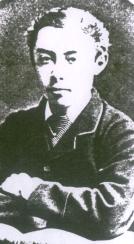
|
Henry Herne Mew in 1880, when he was fifteen years old |
London Association of Schoolmistresses . 8 pages.
"A cousin remembers vividly an incident which occurred in Newport one summer when she, accompanying her mother in the fly," [one horse covered carriage] "rode to the Newport railroad station" [Ryde-Newport linked by rail in 1875] "to meet Lotti, then about ten, and Nurse, who had arrived to spend a part of the summer holidays at the farm." [So, where were Henry and Anne? Freda was just born] "After the little ceremony of greeting was over, they all walked toward the fly. As they were about to mount, Lotti, who moved in sudden burst of energy, scrambled into the driver's seat so that she might enjoy an unobstructed view of the gently rolling farmlands as they rode home. Nurse, in utter exasperation, gave the wayward child a smart whack with her folded parasol, commanding her at the same time to get down and take her 'proper' place. The irate Lottie seized the parasol and, with a gesture expressing and exasperation equal to Nurses's, snapped the shaft of it in two across the edge of the seat, then, with an air of complete defiance, tossed the parasol aside. More than that, she refused to budge from her chosen place. She was severely punished for her poor conduct when the group reached the farm.As a child, Lottie was a 'determined little thing who knew what she wanted and generally got it' (Told by Mary Mew, Sister Mary Magdalen)" (Mary Davidow 1960 page 30)
Christmas 1880: "When Charlotte was ten years old
Freda... was born. In this sister's honour" a poem called
"Christmas 1880" was written and signed "Lotti" and
[Anne]. It was owned by Alida Monro when
Mary Davidow (1960 page 3) wrote about it, but has not been
found.
| 1881 | Charlotte 11-12 |
|
|
"Scholar" by Charlotte's name in the 1881 census probably indicates that she was a pupil at the Gower Street School |
|
Sunday 3.4.1881/Monday
4.4.1881 Census:
30 Doughty
Street, London,
(See census)
recorded
Frederick Mew aged 49, born Newport, Isle of Wight:
Architect
and his wife
Anna M.M. Mew, aged 44, born St Pancras, with their
children
(all born St Pancras):
Henry H. Mew, aged 15, Scholar.
Charlotte M. Mew, aged 11, Scholar,
Caroline F.A. Mew, aged 7 and
Freda K. Mew aged two, together with the live-in
servants:
Elizabeth Goodman, aged 56, "Nurse Domestic", and
Lucy Best, aged 18, "Cook Domestic"
Charlotte's maternal grandparents,
Henry Edward Kendall and
Mary Kendall, with her aunt,
Mary (Leonora) Kendall were living
at 34 Burlington
Road. (See Census).
Neighbouring streets show that this was in Westbourne Park.
[Ledbury Road and
Artesian Road are near]. Ann Perkin,
cook aged 40, remained with the family: See
1891,
1901,
1902.
(80) Gower Street School
The Oliver family at Kew:
See census
Family of
Elsie Millard:
See
census
Charlotte's paternal uncle and aunt,
Richard Mew and
Fanny
Mew
lived at South Fairlee Farm, Naider Road,
Whippingham (outside Newport) on
the Isle of Wight
(See Census). Richard (aged 55, born Lymington) was a farmer of
400
Acres, employing 5 Men and 2 Boys. Fanny is shown as aged 47 and born in
Somerset. They lived with their children
(one was at boarding
school), all born
on the Isle of Wight:
Fanny, aged 14,
Ethel Louisa, aged 10,
Florence Elen, aged 7,
Gertrude Mary, aged 5 and
Gilbert Mew, aged 4. They had a "Governess Teacher
(Private)", Anna Maria
Wigmore aged 24, unmarried, born Isle of Wight, who boarded in the
house. There was also Jane Osborne, a domestic servant, unmarried,
aged 36,
born Isle of Wight. Living in the house were George Kennington,
aged 59, a "Farm Servant (Indoor)", Jane Kennington, aged 57, "Dairy
Woman", (married, presumably to George), and Sarah Kennington
unmarried aged 30, the "Cook". The Kenningtons had all been born in Sussex.
Other farm workers lived in nearby cottages.
Richard Percy Mew, aged 12, born Newfairley, Isle of
Wight, was a scholar at Surrey County School Cranleigh - A boys public
school opened in 1865 "for parents of the middle class or moderate incomes"
whose fees were initially set at £30 a year. Elsewhere it is
descriced as a "school for farmers' sons".
See
1881 census and
1901 census
The Polars
William Baron Mew: Widower, aged 60, born Newport. "Two
Partners.
Brewer Employs 50 60 Men Malsters 15 Men Farmers 8 Men 3 Boys",
living with two nieces, Ethel Muriel Mew, aged 16, born Arreton (Standew),
Isle of Wight, and Louisa Agnes Mew, aged 26, born Carisbrooke, plus three
female domestic servants.
(census)
70 Crocker Street
121 St James Street, Newport
At 9 Barfield, Ryde, (Isle of Wight),
Frances Barnes a widowed annuitant aged 52, born in
Lymington,
Hampshire, was living with
Walter M. Barnes, her unmarried son, aged 24, born
Ryde, a Barrister At Law and BA Oxon (Not Practising), Marian Barnes, her
unmarried daughter, aged 19, born Ryde and Edward W. Barnes, another
unmarried son, aged 17, born Ryde, an Articled Solicitors Clerk [The death
of
Daniel Barnes, age 59, was registered on the Isle of Wight in
the January/March quarter of 1881]
Ventnor
Wallington House, Belgrave Road
Wallhampton Cottage, Wallhampton, Lymington
In 1881,
6 Codrington Place, Brighton, was occupied by
The honorable
Anne Massey and her daughter, Catherine Lippincott. Anne Massey
was also there in
1867. A Mr Martin lived there in 1858.
Charlotte Mew was born in
1869 - Penelope Fitzgerald says that her mother stayed with her
mother at 6 Coddrington Place whilst Charlotte and the other children
went to the Isle of Wight. Mrs Kendall is living there in the
1891 Kelly's Directory.
5 Lewes Crescent:
Lewis Cubitt - Sussex Square to the
right, but numbers between about 10 and 40 seem to be missing
Friends' School for
Girls, Driffield Terrace, York
(See
census)
There are 51 scholars of whom only one is 13 years old - three (including
Winifred Oliver are 14 years old - four are 15 years old -
fifteen are 16 years old - twenty two are 17 years old - four are 18 years
old - two are 19 years old.
See school in 1867
Lydia Rouus:
(census)
|
1881 The novel Joseph's Coat by David Christie Murray, published by Chatto & Windus, illustrations by Frederick Barnard, includes a passage where two men are blinded to the ugliness of a Norman Church by their love for the lady who is playing the organ inside. "They yearned a little over the wheezy voluntary, which, after all, was played by Love's own hands."
| 1882 | Charlotte 12-13 |
|
|
|
Charlotte Mary Yonge (1823-1901): Unknown to History: A Story of the Captivity of Mary of Scotland Macmillan and Co. 1882 (First of many editions). Two volumes. Published London and New York. Charlotte Mew wrote:
"Miss Yonge, in Unknown to History, carries us back to the schoolroom of the eighties, and the tinkle of its overworked piano. Basing her story on the tradition of the seventeenth century that Mary, during her imprisonment at Lockleven, gave birth to a daughter who was conveyed to France and became a nun at Notre Dame do Soissons, she adapts the legend, essentially romantic, as it stands, to meet the requirements of a tame domestic tale. A tale of James Hepburn and Mary Stewart pacing a convent garden, shut in with her passions and her ghosts; here, for the poet or the novelist is the finest stuff of dreams. We are, at least, indebted to Miss Yonge for having made practically no use of it" (Mary Stuart in Fiction)
| 1883 | Charlotte 13-14 |
|
|
Margaret Chick's school memories of Charlotte? |
17.4.1883 Will of Mary Kendall, Charlotte's maternal grandmother [She died 1892]
to dispose of her legacy from her own family, the Cobhams. One-third was to go to Anna Maria "for her sole use and benefit separate and apart from and exclusive of her said husband Frederick Mew, and that she may hold and enjoy and dispose of such share in the same manner as if she were unmarried" (Penelope Fitzgerald 1988 p.35)
Amy Greener (1916) says that
"After
nearly twenty years connection with the
Gower Street
School, Miss Harrison's health broke down and at length she
determined to
give up her work and carry out the plan she had for years had in her mind,
to build a little house and live in the country. Her ambition from girlhood
had been to own a piece of land and build. Hence in the summer of 1883 she
went with her widowed sister,
Mrs Macdonell," [Anna Jemima. Agnes was not widowed - She is
living with John in 1881, 1891 and 1901] "to Bainbridge for several
weeks. .. and at length she found Cupples field. The building was
not actually begun until 1885". [A booklet says 1883 was the year Lucy Harrison
moved from London to Wensleydale -
Amice Lee's recollections fit in with the later year
(1886)
given by Amy Greener - Who is, in any case, the source the booklet cites.
Margaret Chick's school recollections
Mary Davidow says (page
40) "
Margaret Chick was the last of the family to attend
Miss Harrison's School. She was a few years" [Seven years:
1869 -
1876] "younger than Lotti" [Charlotte Mew]
"
Anne Mew and
Amice Macdonell were nearer her age".
[Margaret was seven in October 1883
-
Anne eleven -
Amice nine]
In Margaret Chick's
opinion
Lucy Harrison was an exceptional teacher who possessed a
philosophy
of education which was for the times 'progressive' in that she believed
that
girls should be as well educated as boys; she, therefore, offered a
broader curriculum than that which was to be had at most girls' schools of
the period. Miss Chick recalls that Lotti was a bright, spirited, gay
little person who had a way with children, and who told amusing stories
because she loved to make people laugh. Her letters to Margaret Chick,
then a mere child, were filed with delightful illustrations,
many of them highly comical. Charlotte and Anne were both clever with their
hands. Charlotte could turn out exquisite pieces of
embroidery executed to
her own designs."
| 1884 | Charlotte 14-15 |
|
|
Freda in the square with visiting cousin/s? - school memories of Amice Lee? - November: photograph of the sisters |
It is possibly about here that the memories of Freda in the Square belong. Gertrude Mary would have been nine in the summer of 1884, Freda five. I would have thought the Sunday visits to the Foundling Hospital were earlier.
"Ships that pass in the night, and speak each other in passing,
Only a signal shown and a distant voice in the darkness;
So on the ocean of life we pass and speak one another,
Only a look and a voice, then darkness again and a silence."
Charlotte wrote about "Like souls that meeting pass, And passing never meet again" because, in her story she only meets the other at a deep level once. She is repulsed, and her second meeting is a seeing, not a meeting of souls.
The back of this (early 20th century) postcard says "chromographed in Berlin". I think this is post-lithography. |
Breasts: London's waxworks moved from Baker Street to Marylebone Road in 1884. In Passed, Charlotte wrote about the attraction of waxwork breasts. In Paris, John Singer Sargent lifted the fallen shoulder strap on Madam X to appease public opinion. George Frederic Watts' Clytie (Sunflower as breasts) was painted about 1868. Charlotte Mew's Antoine de St Perre says that Watt's use of colour was but "a clever copy" of Paolo Veronese - who also used breasts in his allegories. See also Grosvenor Gallery. By the 1880s chromolithography was becoming widely used for magazines and advertising. This involved several stones being used to lay on the separate colours. High quality chromolithography to reproduce realistic flesh was expensive, but increasingly more affordable. Charlotte's Clerkenwell art shop sells a "chromo" of a girl with "elaborately bared breasts" - presented praying to make her colourful bosoms falsely respectable. ( Erotica versus pornography; An expose, by Cameron Kippen, contains some history of the media). |
In 1884, Alphonse Laveran relates in "Treatise on Marsh Fevers" that Louis Pasteur's discovery that microbial germs cause most infectious diseases (the "germ theory") led to the hypothesis of a bacterial origin of malaria being popular. However, in 1880, Laveran identified (correctly, as it turned out) a protozoan parasite as the cause of malaria. The protozoa being single cell "animal" organisms, whereas bacteria are a range of microorganisms that appear to have properties plant-like and animal-like. Failing to find the protozoa in soil, water or air, Laveran suggested, in "Treatise On Marsh Fevers", that it could be carried by the mosquitoes. The theory of the protozoan cause was not liked by most followers of Pasteur, who favoured bacteria as the cause of disease, but Pasteur accepted it quickly. It only became "indisputable" after staining of the microscopic samples was developed (1899) to make it clearer what one was looking at. Before the development of pigments, the microscope search for malaria signs began with looking for black granules that Lavaran had identified as present in all malaria victims. (external link - Nobel speech). In Notes in a Brittany Convent (1901), the bacteriologist approached Catholicism in a scientific spirit, comparing its fascinations to the study of malaria whilst Charlotte uses the "metaphor" of the "black rotundity" to link that to the ubiquitous presence of the priest who seeks their conversion.
Gram stains - external link
Mary Davidow (1960 page 37) says that "In the year preceding her retirement Miss Harrison and one of the other teachers from the school took a house in Hampstead on Haverstock Hill between Chalk Farm and Belsize Park where they accommodated three boarding pupils. Charlotte was one of these..."
Internal evidence suggests that the following letters from Amice Lee (previously Macdonell) in Mary Davidow 1960, and the preceding recollection of MargaretChick relate to about 1884/1885.
11 Gray's Inn Square
Dear Miss Davidow,
Your letter Interests me much, and I am trying at once to make a contact
with someone who may yet be alive and who knew Charlotte M. Mew. I am now
aged 84 but I can remember C. M. Mew, or "Lottie" as we called her, clearly
and can fancy I hear her very voice and laugh.
I was then aged 10
[that would be 1884/1885], and Lottie would be about 14.
We were at school
together when
Aunt Lucy had the school in Gower Street, London. That
would be some time in the 1880ties
I have already written to someone of a Quaker family, care of Friends'
House, the Quaker H.Q. in London, to see if this person,
Ethel Oliver,
daughter of Prof. Daniel Oliver, Quaker keeper of the Herbarium at Kew, a
known botanist, is alive.
I know C. M. Mew's father was an architect and they lived in
Doughty Street
near here where at one time C. Dickens lived.
Lottie lived at Aunt Lucy's; she
had taken a house at Hampstead and had three girls boarding there and I
joined them daily and we drove down together and then walked a long way
back, partly through noisy roads and dreary, but I walked with C. M. Mew
and her talk made the way seem pleasant
She was about 14, short, with curly short hair. On week days she wore a
black and white check frock; on Sundays, her best, a brown one. She was in
a High Church phase then and wore a small silver cross on weekdays and a
gold for best.
We walked in procession: my aunt and one of the teachers, the
elder two together.
1. Edith Scull whose father was a professor at Harvard, I think. She was
dark with deep-set brown eyes and rather stout. She did clever drawings.
2.
Ethel Oliver, daughter of Professor Daniel Oliver
of Kew, a stiff, silent girl of 16. Edith Scull was 17. So to
CM they seemed grown-up.
Lottie and I brought up the rear.
Aunt Lucy had the school
and later it moved from 80 to 96 Gower Street, taken over by Miss Greener
who after lived with Aunt Lucy in Wenslydale, Yorkshire, where she had
built a house.
I loved, as we all did, Aunt Lucy, mother's youngest sister, born 1844,
died, after being Head of the Quaker School, The Mount, York, 1915.
Edith Gray Hill taught me (with small success) sums! She married a Mr.
Hill who was in some business. I well recall the Chicks: Edith, Harty
(presumably Harriet), and then I can't recall the name of the youngest
Chick. One of them made quite a name in Gov't service.
The Olivers kept up with Charlotte M. Mew when grown up, I know, and knew
of her cares and sorrows. She had one brother of whom I don't know, a
younger sister, Anne, and a little sister. You probably know of the shadow
on poor Lottie's life.
I was so sorry I did not keep up with her in later times. She was very
bright, musical, excitable. When my sister told her that
Aunt Lucy was
going to retire from the school, Lottie, who was practising,
jumped up in
wild grief and started to bang her head on the wall.
My sister, aged about
8, was taken aback and wondered if she ought in loyalty to Aunt Lucy to
bang her head too!
The kind American cousin of mine who did the index of
the book left out
Aunt Lucy. He had never known her. I am planning on being able to visit
my cousins in N.Y. in May this year....
Yours sincerely, Amice Lee
11 Gray's Inn Square
My dear Miss Davidow,
Your letter has just come....I think the
father of Charlotte
must have been
a fairly successful architect. I always heard he designed
the Town Hall
(threatened for destruction), and also a large red brick house, for a Mrs
Hill, called Ivy Bank. I feel such regret that I did not continue
friendship with Lottie....I remember
the Mother as certainly "silly" all
decked out in blue boas; she used to bring
Freda to the dancing class. I
wrote to the Quaker Head Office; they had old
Daniel Oliver's name and
dates and birth of his three children. Their subsequent dates
not there.
Lottie I can see now
when she was about fifteen. There was something
piquante about her; she had bright eyes, was light and small-boned; had a
way of turning round as she talked, sort of pirouetting on her feet; hands
and feet were small. I recall often laughing with her. As for Aunt Lucy's
influence, I can't say. Lottie at that time would be more like a child,
though I recall some tale of Mr Mew going on his knees to Aunt Lucy to beg
her to keep Lottie in the school. Her literary sense was very good.
I had hoped to contact
Ethel Oliver who knew Lottie in adult life, and was
a kind friend, but she is dead, and was older than Lottie; and her elder
sister is dead.
Yes, by the "shadow" I meant the
shade of insanity. Aunt Lucy did not
worry; she was loving and gentle, but rather aloof then and would have had
no sex interest; might have been without sympathy a bit to Lottie's
ardent nature - I don't know. As for Edith Scull and Ethel Oliver they kept
together and they rather ignored Lottie who was younger and very excitable.
We walked miles. I was about ten, down Gower Street, through dull grey
squares, through dreary Camden Town with crowded pavements and a horrible
canal, and then up Haverstock Hill to Hampstead; but Charlotte M. Mew was
good company, I feel.
Lottie wrote for the
Yellow Book - Bohemian
oftentimes -. Her poems give me sorrow now when I think of her sad life and
its ending which must have a bitterness of fate in it. I did not know her
late enough to even guess at some lover (likely from her poems), or at her
literary friends. She probably knew
Hardy. He was well known to my
father's youngest sister
Anne Macdonell who knew Lottie, and artists and
actresses. Aunt Anne was in that set, but also an authority on St Francis
of Assisi! She has gone hence years ago.
I hoped for a personal touch from Ethel Oliver. Edith, Ethel, and Lottie,
all three boarded for about a year in Aunt L's house in Hampstead. Mary
Howitt was my great-aunt....
I hope we may meet....
Amice Lee
February 6, 1959
February 13, 1959
|
November 1884 Charlotte (aged
just 15) in the centre, with
Caroline Frances Anne (Anne) (aged eleven) and
Freda
(aged 5 and half).
Photocopy of a photograph ("courtesy Peter, John and Richard Mew") in Davidow, M. 1978 page 442 |
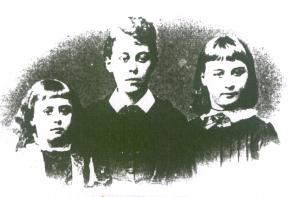
|
| 1885 | Charlotte 15-16 |
|
|
January: Ethel Oliver leaves Gower Street and goes to York - June: Grandfather Kendall dies - Kendall and Mew becomes just Frederick Mew, architect - Amy Greener comes to Gower Street |
An Open Door is about the missionary spirit of the upper classes.
January 1885 Ethel Oliver, aged sixteen, became a pupil at the Friends' School York. She was there until June 1886

|
9.6.1885 Henry Edward Kendall (junior), Charlotte's architect grandfather, died at Burlington Road, Westbourne Park, London. (See 1887) Buried Kensal Green Cemetery. His obituary published Builder volume 48, 20.6.1885, pages 883-884 Penelope Fitzgerald 1988 p.35 says that his wife and unmarried daughter "went to live permanently in Brighton" |
Gower Street School "The school was passed over in 1885 to Miss Amy Greener, a total stranger." Lucy Harrison helped Miss Greener connect. "In this way, the two came much in contact, and their acquaintance ripened into a close and lasting friendship". Building at Cupples field began in 1885. Lucy Harrison moved there in 1886. Amy Greener spent summers there. (Amy Greener 1916)
| 1886 | Charlotte 16-17 |
|
|
Lucy Harrison leaves the Gower Street School, which has passed to Amy Greener. Anne Mew (13 in the autumn) remained at the school. Edith Chick (16 in October), unwilling to join the family business, started at Notting Hill High School. In 1913, aged 43, Charlotte composed The Fête about the feelings of a sixteen year old boy in France. This refers, twice, to young ladies in a boarding school (demoiselles of the pensionnat). There are other indications that Charlotte may have gone to France to study when she left Gower Street. |
If Charlotte Mew went to school in Paris, as Laurence Armitage, the central figure of An Open Door, does, I expect it was to develop her French after leaving the Gower Street School. Edith Chick, the oldest daughter, was sixteen on October 1886. "Samuel thought that the time had come for her to join him as an assistant in the lace business. All his daughters, he said, would have to contribute to their own support". Edith loved school and "in desperation, declared she wanted to be a teacher". Samuel made enquiries and, in 1886, Edith entered Notting Hill High School. "She particularly enjoyed her first introduction to algebra and science" (Margaret Tomlinson p.67)
Siegfried Sassoon bibliography - biography at Counter-Attach - biography at Knitting Circle - See 1905 - 1912 - April 1917 (Old Huntsman) - 1918 - June 1918 (Counter- Attack) - July 1918 - November 1918 - 20.11.1918 - 2.4.1919 - June 1919 (Picture Show) - 24.8.1919 - 7.9.1919 - October 1919 (War Poems) - November 1919 - 5.11.1919 - January 1920 - August 1920 - April 1921 - 22.7.1921 - 1923 - 3.1.1924 - 7.1.1924 - 30.11.1924 - 11.12.1924 - 4.4.1925 - 29.4.1925 - 1961 - 1966 - 1967 - diaries
As far as her 20th century friends knew, Charlotte Mew had one sister (Anne), who she lived with. The family was the mother and two sisters. Alida Monro (1953), page ix, wrote about the family after 1915: and before 1923:
"Ma" was a tiny woman, scarcely more than four feet, very shrivelled and with tiny claw-like hands. There was a portrait of her painted in oils hanging on the walls, which showed that in her youth she had been very pretty and bright, like a little bird. She was the mother of four children, a son and three daughters. Charlotte was the eldest girl, then came Anne, her inseparable companion. I never met the youngest sister or brother, and only after Charlotte's death did I hear from an intimate friend that they had gone out of their minds many years before and were both in asylums. The friend who spoke of them, told me that the third sister, Freda, was as remarkable as the other two and was "like a flame". Their sad condition was a constant torment to Charlotte. Freda being an asylum patient is confirmed by a number of primary sources. The evidence for her brother, Henry Herne, is confirmed by his death certificate. The intimate friend may be Ethel Oliver. Alida does not say what (if anything) Charlotte and Anne did say about the rest of their family. I assume they kept as quiet as they could about Henry (who had died in 1901) and their living sister, Freda, - which was not unusual. However, Charlotte did not keep quiet about having insanity in the family and the fear that Anne and she had of it. Alida says (page xiii) She and her sister had both made up their minds early in life that they would never marry for fear of passing on the mental taint that was in their heredity
See race
improvement
Henry Herne Mew is recorded as a "scholar" aged 15 in 1881. Penelope Fitzgerald 1988 p.11 says he was apprenticed to his father as soon as he became 16, but became a patient in his early twenties (therefore not before 1885). His death certificate has Doughty Street as his home address, which may mean he was admitted to the asylum before 1890. I have been unable to trace him in the 1891 census. Penelope Fitzgerald says he was diagnosed with dementia praecox - which is possible, but it seems early for the term in England. He died in Peckham House Lunatic Asylum in 1901. Freda Kendall Mew was admitted to the Isle of Wight County Lunatic Asylum on 4.2.1899. "F.K.M." (aged 21) is shown as a patient in the private wing of the Isle of Wight County Asylum in 1901. This wing opened about 1897. A letter of 1921 confirms that Freda had been "confined in the Isle of Wight County Hospital" at an annual expense of "roughly 130 pounds a year". She died in 1958 at Whitecroft. [The hospital name is Whitecroft, not Whitelands.]
Penelope Fitzgerald says Freda "began to show
recognizable symptoms of
schizophrenia
(in the early 1890s - before the term was used), then, like
Henry, broke down beyond recall. "Her father insisted that she be sent
back to the Island", within reach of family. (Penelope Fitzgerald 1988 p.38). We can be certain
that Freda was not diagnosed "schizophrenic" by anyone in the 1890s.
On admission to the Isle of Wight Asylum, Freda's "form of mental disorder" was diagnosed as "acute mania". [Case notes]. Before seeing this record, I suggested that:
" Using the 1844 list of conditions as a guide, the possibilities appear to be one of the manias (these would include conditions later diagnosed as "early dementia" - dementia - schizophrenia). Her length of life rules out congenital syphilis as a cause (leading to G.P.I.). Melancholia seems an unlikely cause for institutionalisation in one's teenage years. I believe moral insanity was a rare (and unlikely) diagnosis." As there is no mention of syphilis related diseases on Henry Herne Mew's death certificate, and he was also institutionalised young, I suggest mania was the most likely diagonosis for him as well.
We do not know if Charlotte visited Henry and Freda. However, when we read the descriptions of children's games in her writing we assume she watched children: So when we read her descriptions of mental disability, should we not assume that she observed that closely?
As far as her friends knew, Charlotte had one sister, who she lived with, Caroline Frances Anne Mew, known as Anne. Anne's death, in 1927, precipitated Charlotte's, and they are buried together. Anne was an artist who, Penelope Fitzgerald (1988 p.44) says, specialised in bird and flower painting. I do not know if any of her work survives, but it would be good to consider it in relation to Charlotte's writing, where bird's and flowers are as essential as people. Alida Monro (1953), pages ix-x, says:
"Anne was a little taller than Charlotte, much gayer and much less weighed down by the sorrows of their lives. These lay heavily on Charlotte, whose temperament was naturally keyed very low. Anne bore a striking resemblance to Marie Antoinette. She had the most brilliant violet-blue eyes that I have ever seen, and although she was very fragile and delicate, she always managed to be bright and witty. She was an accomplished artist in redecorating seventeenth century furniture. She worked all her life painting flowers and fire-screens and renovating English painted furniture for a firm of antique dealers, who, according to Charlotte, paid her only a sweated wage." Painting on satinwood as employment to support greater visions is described by Charlotte in a studio that may have been Anne's. But perhaps we should not separate the greater visions from the craft? Charlotte in her needlework and Anne in her painting may have shared the ideal of uniting craft and art.
Charlotte Mew wrote to Ethel Oliver, in 1902,
"Physically I have been really better here but mentally tired, but if I wished to get my nerves under control up to now, thanks to being better, I have done it, and hope that it will last. I can't transport my thoughts to England and the things left behind with any sense of reality, and perhaps it is better so, but it makes me seem very egotistic - which I'm not really. It is a queer uncertain mind this of mine - and claims are being made upon it at the moment which I find difficult to meet." In February 1899, Freda Mew's case file states that there is a family history of "Madness" in her "Brother and Sister", no family history of "Consumption", and that it is unknown if there is a family history of "Drink". Consumption of the Lungs (Phthisis Pulmonalis) was the disease that Freda's only brother Henry died of in March 1901. The disease is now known as tuberculosis. Henry died in a lunatic asylum and had probably been in one for many years, but was not, presumably, consumptive in February 1899. But which of Freda's two sisters suffers from madness? I do not know of any suggestion that Anne had a nervous temperament, whereas incidents throughout Charlotte's life, including, of course, her suicide, spring to mind. Anne appears to have worked regularly from the time she left Art College to the time she retired. Charlotte's income from writing must have been negligible. It is probably, therefore, Anne who was described in December 1921 as doing some "occasional light work which brings her in a very trifling income". I am unclear which of the sisters (in the same letter) is described as "very delicate" and a "great expense" to her mother. Alida Monro (1953 page xi) says Anne "had always been very delicate and suffered with backache to a terrible degree". On the other hand, Charlotte, eight months after the 1921 letter, wrote about her (Charlotte's) heart having gone wrong again. A letter from Arthur Tansley to Sydney Cockerell on 27.6.1944 compares the mental stability of the Mew sisters. He writes: "Anne, as you say, was the most stable (and, my wife says, the most human) of the family. It was Freda's tragedy, confirmiing the fear of insanity in herself that probably determined Charlotte's end. Charlotte herself was never insane (as I am sure you will agree) though she had the mental instability that goes with certain types of genius. Her fear began with her brother's death - he had the same trouble as Freda. As you suggested, Charlotte's end may have been 'for the best', as they say, for she was profoundly unhappy for several years." |
| 1887 | Charlotte 17-18 |
|
|
|
| To the glory of God and in loving memory of William Barron Mew who died on February 14th 1887. The alter rails and tressecated pavement were placed in this church by his children. |
7.9.1887 Dorothy Chick, the youngest Chick, born at 5 Newman Street. Shortly after, the Chick family moved "to a commodious modern house in the growing suburb of Ealing." [Chesterfield", 177 Mount Park, Ealing] "On high ground and standing in half an ecre of garden, the house then commanded fine views over cornfields towards central London" (Margaret Tomlinson p.62)
December 1887 In Passed, Charlotte wrote My prayers were requested for the "repose of the soul of the Architect of that church, who passed away in the True Faith - December - 1887". (See 1885, when her grandfather died, and 1891, when the architect of Holy Redeemer died)
|
The Female School of Art Anne Mew would have been 14 in the autumn of 1887. Elsie Millard would have been about the same age. Amy Greener went to Yorkshire after June 1891. Mary Davidow (1960, page 43, source not stated) says:
"Upon the completion of her studies at the Gower Street School, then under the direction of Miss Amy Greener, Anne Mew attended the Female School of Art in Queen's Square, London. While there she met Elsie Millard, a student"
Elsie Millard (19) is shown as a student of drawing in
the 1891 Census, but Anne Mew (17) does not have an occupation
shown.
The Female School of Design was founded in 1842. It changed its name to the Metropolitan School of Ornament for Females in 1852. From 1842 its Principal was Fanny McIan. Louisa Gann (1824-1912) became headmistress in January 1858. The school became the (Royal) Female School of Art in 1862. The Female School of Art is mentioned in the Illustrated London News in July 1864. In an 1884 Directory it is "Female School of Art, 43 Queen Sq. WC" (Under Schools - Public). In an 1899 Directory it is "Bloomsbury Royal Female School of Art, 43 Queen Square". In 1907, the Committee of Management tried to dismiss Louisa Gann (aged 83) without any pension. Louisa Gann sued for wrongful dismissal. London County Council agreed to pay her £150 pounds in settlement on condition it take over the "debt-ridden and deteriorating Queen Square building. 58 The school was renamed the Day School of Art for Women, and moved to the Central School of Arts and Crafts in Southampton Row." "The Royal Female School of Art (established 1842) was transferred to the London County Council and incorporated into the Central School in 1908". See (external link) and F. Graeme Chalmers 1998
|
|
|
|
In 1887, Alan Cole interviewed (grandma) Harriet Chick in Sidmouth. "She had, he says, almost quite retired from the business with which she had been connected for over forty-five years... she had once 'spent a ten-pound note' at the School of Design at Somerset House but 'no good really came of it, the students did not understand the technical requirements of designing for the lace-maker and the delicately painted white patterns were of no use to the worker'" (Margaret Tomlinson p.60). The School of Design was established at Somerset House in 1837. See external link to Victoria and Albert Museum |
Charlotte Mew's Men and Trees in 1913 is written within the framework of the anthropological analysis of religion that was developed by Tyler, Robertson Smith and Frazer. She is critical, however, of the progressive thesis and sees civilised values in primitive religion and barbaric elements in present day beliefs.
| 1888 | Charlotte 18-19 |
|
|
|
map: Newlyn,
Cornwall
Penelope Fitzgerald
1988 (chapter six) suggests that this picture of grief, with a
china bowl
catching the light, is part of the background to Charlotte Mew's
"The China Bowl". - Where the grief is much darker and the bowl
is
sold.
By 1913, Charlotte knew Newlyn Harboour [Charlotte's
handwritten letter does say Newlyn, not Newlight as in the typed
transcript] - But The China Bowl is more likely set in Devon. The main
characters are Methodists called Rachel and David Parris. There was no
one called Parris in the 1881 Cornwall Census, whereas there were
several Parris families in Cornwall, including families in the part of
South Devon
the Chicks came from. The dialect of The China Bowl is the same
as that in
the poem that Charlotte gave to one of the Chicks
| 1889 | Charlotte 19-20 |
|
|
|
Toy balloons (air-balls) arrived about this time. They were all round, made of rubber, and possibly imported from Belgium. In Passed, Charlotte Mew, writing about the calendar of children's toys in the streets of Clerkenwell says "Easter is heralded by the advent in some squalid mart of air-balls on Good Friday"
Autumn 1889 Edith Chick began her studies at University College London with physics and mathematics.
| 1890 | Charlotte 20-21 |
|
|
February 1890: Mews move from Doughty Street to 9 Gordon Square Before the Mews moved house, Henry Herne Mew (probably) admitted to an asylum Early 1890s: An Ending and other poems. Relation with Chicks |
Henry Vaughan. - External link on
Richard Jefferies
|
The Mew family moved from
30 Doughty Street to 9 Gordon Street, Gordon Square, WC
in
February 1890. They lived there until
March 1922.
Mrs Anne Powell, the previous leaseholder of 9 Gordon Street, died sometime in the last three months of 1899 - Probably in December. Frederick Mew bought the lease of the house from Mrs Powell's son, before the end of February 1890. A letter dated 24.2.1890 (Davidow 1960, p.270) states:
" 86 St. George's House The death of Anne Powell, aged 88, was registered in St Pancras in the December quarter of 1889. Ellison Powell, born 2.8.1833 in Middlesex, was the son of Edward Joseph Powell and Anne Powell
A letter from Mrs Ann Mitchell, Archivist, The Bedford Estates to Betty Falkenberg, dated 22.6.2005 says that she cannot find any correspondence relating 9 Gordon Street in the archives. 9 Gordon Street is no longer part of the Bloomsbury estate of the Duke of Bedford and she suspects the relevant files will have been destroyed. Alida Monro (1953), pages viii-ix, gives a description of the house as it was sometime after 1915: " When I met her, Charlotte Mew lived in a tall, typically Bloomsbury house, No. 9, Gordon Street, Gordon Square (destroyed by bombs in 1940-41). It was tall and narrow, dark and gaunt inside... They moved to Gordon Street when she was still a child and here she lived for almost her entire life. Her father had been an architect, and the rooms and passages were lined with drawings and plans of his work... When I first knew Charlotte, the top half of their house was let to some people, but it was a long time before this was disclosed to me in confidence, as it was felt that such a circumstance was a matter of which to be deeply ashamed..."
Gordon Street:
Street Map See letter head
1913
The Mew's house in Gordon Street
Gordon Street links the west side of Gordon Square and Euston Road.
At the Gordon Square end of Gordon Street, on the west side, was All Saints
Church, built in 1843. Between
this and Euston Road there were 18 terraced houses. The Mew's house was the
sixth from the
church. In the 1895 Trade Directory, Frederick Mew, architect, shared the
street with gentlemen, and some ladies, most of whom have no trade or
occupation shown. There is the occasional vicar, solicitor or physician. In
the 1910 and 1915 Trade Directory, the church has closed, and many of the
houses have been taken over by ladies running boarding houses, and there is
a University hotel.
The Squares: Until
the second world war, these squares were private, protected
areas.
Mecklenburgh Square, at the end of
Doughty Street, is still a private square.
|
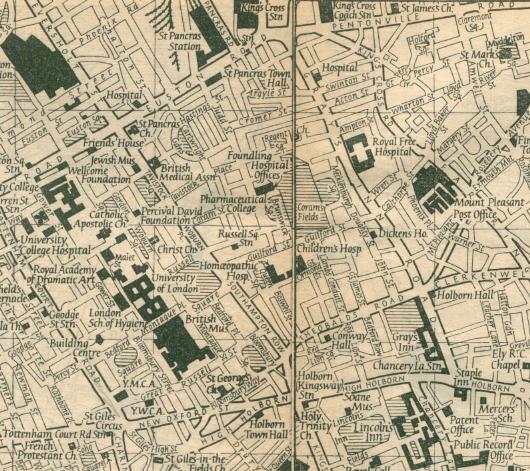
The 1950s map below shows how Gordon Street backed on to University College in Gower Street. It shows Charlotte Street in the south west and Boswell Street (previously Devonshire Street) in the south east.
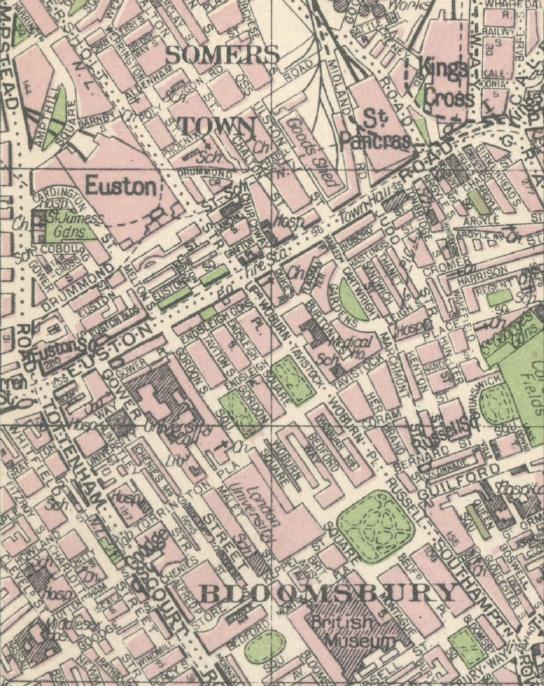
|
London University and Charlotte Mew
Alida Monro (1937) says that
Charlotte Mew attended lectures at
London University. Several of her friends were students there at one time
or another - See
Chick family -
Edith Chick -
Mary Chick -
Harriette Chick -
Margaret Chick -
Elsie Chick -
Frances Chick -
Margaret Robinson -
Charlotte's house in Gordon Street backed on to University College in Gower
Street.
Charlotte attended a musical at University College in
March 1914 and
May 1914 -
at this time she was helping
Elsie Chick with her
MA. Gower Street is mentioned again in
1920
|
Very early poems? (See Alida Monro's list of
"early poems").
Mary Davidow reproduces a group of poems "From
Frederick B. Adams' typecript" that had not been published
before.
An Ending is thought to date from the early
1890s. The others may also be early poems:
A Question - Left Behind - A
Farewell - There
shall be no night there.
An Ending and Charlotte's short story The China Bowl are both written in a dialect that I argue is based on South Devon. (Mary Davidow (1960 page 78) identifies the following poems as also written in "English West Country dialect": The Farmer's Bride - Sea Love - Arracombe Wood and Old Shepherd's Prayer. Two of the poems - The Farmer's Bride and Arracombe Wood - use "the Fall" for autumn, which I think persisted in south west England at the time. Charlotte's dialect writing, although not extensive, appears to have spanned her writing career rather than being located at one period |
Mary Davidow says (page
40) "It
has been said that there was a romance between Charlotte Mew and
Sam Chick, the elder son of Samuel and Emma Chick. This may
account for the close tie which existed in the early nineties between the
Chicks and Charlotte Mew. Each Christmas she sent gifts to the family. Many
of these the Chicks still possess. Among them are a dainty, pocket-sized,
hand executed calendar
for the year 1891 which,
Margaret Chick
pointed out, was sent to her father, and is one of several; linen
handkerchiefs, hem-stitched and initialled by hand; and pieces of
embroidery, designed and worked by Charlotte, which are still in
use. Also
in their possession are some of the unpublished writings, early pieces. A
holograph" [A document wholly written in the hand of the author who has
sigmed it] of the poem
An Ending, written in the early nineties, was sent by
Charlotte Mew to
one of them; a typescript of a short story,
The Minnow
Fishers, believed to be unpublished, bears a notation in the
upper right hand corner in Charlotte Mew's hand reading, "The property of
The Outlook".
...
Margaret Chick recalls that Charlotte Mew was "advanced for the time". She
smoked, and went about visiting very much as she pleased, most often
unescorted. This, from the point of view of the standard behaviour of the
period, was daring indeed. She wore her hair in a short bob, much like a
boy's. Her attire was invariably the tartan skirt, black velvet jacket,
white blouse and soft silk tie. She moved in and out of a circle of friends
who were for the most part writers, artists, and actors and actresses.
Autumn 1890 Edith Chick's second year of studies at University College. She included a substantial amount of botany with her physics and preliminary science (repeat). [Presumably bringing her into contact with the professor, Francis Wall Oliver]
| 1891 | Charlotte 21-22 |
|
|
Charlotte started using the British Museum Reading Room - June: Charlotte with the Chicks |
| In 1891, Charlotte Mew obtained a ticket for the British Museum Reading Room - A ticket which she last renewed in July 1927 (Val Warner's Mew 1997, pages ix and xviii). Her first published work was Passed in 1894. The China Bowl was unsuccessfully submitted for publication in January 1895. A Wedding Day is dated 1895. An Open Door was rejected by Blackwood's in 1898. - (Val Warner's Mew 1997, page x, who adds "On stylistic grounds, most of her prose unpublished till the Collected edition of 1981 may be ascribed to this period". [That is, before 1899] |
7.4.1891 John Dando Sedding (born Eton, Berkshire 13.4.1838), architect of The Church of Our Most Holy Redeemer, died at Winsford Vicarage, Somerset. Suggests this was the year that Charlotte Mew visited the church and saw the memorial card asking for prayers for the architect's soul.
|
5.6.1891/6.6.1891 Census.
The inhabitants of 9 Gordon Street were Frederick and Anna M. M. Mew, their children Caroline F.A. Mew (aged 17) and Freda "Wendall" (aged 12), and the "domestic servants": Elizabeth Goodman (65), Emma J. Barker (20) and Emily Sanger (17) I could not find Henry Herne Mew (or H.H.M.) in the census. He did not appear to be a patient in either of the Peckham asylums. Charlotte Mew (aged 21) was staying in the Chick family home at "Chesterfield", 177 Mount Park, Ealing:. [By 1901 the family had moved to "Chestergate", 30 Park Hill, Ealing - "5 Chestergate" was the family home of Emma Chick (born Hooley) in Macclesfield. Hugh Sinclair (1986) says that Samuel and Emma Chick were "both Methodists" (see above) who brought up their children "with family prayers twice daily and a ban on such worldly pleasures as theatres and dancing". Dorothy Lumb says "the Chick family were Methodists. It may be because of being Methodists that the daughters received a good education, I have heard this is part of Methodist tradition. I do not recognise in my family background the often repeated idea that women have only recently been educated or had careers!". Samuel's brother, Elijah Chick of Sidbury Devon entered his occupation as "Miller (Corn) Local Methodist Preacher" in the 1881 census. Margaret Tomlinson (pages 52, 56, 77, 80-82) says that Samuel Chick, although brought up as a Wesleyan Methodist, became a Baptist. Her account suggests that he may have been active in the Baptists in London and in the Methodists in Devon. Charlotte Mew's describes Elizabeth Goodman as a Methodist and makes the main characters in The China Bowl Methodists There were twelve Chick children: four boys and eight girls, but one boy and one girl died when they were about three months old. All the Chick children were born at 5 Newman Street. The date and (usually) time of birth were recorded in a family Bible (Watts boxes). According to Hugh Sinclair (1986), all the Chick daughters went to Notting Hill High School. Perhaps they went to the Gower Street School when they were living in Holborn and then Notting Hill when they moved to Ealing? [See also Chicks at Gower Street]
1) Samuel Chick
Born
31.3.1868 at 9.30pm. Died
December 1917. Eldest son, who would be age 23, was
not at home in 1891. He
was at home
(Chestergate)
in 1901 (age 33) when he is shown as a printer and an employer.
It is Samuel Chick who was said to have had a romantic attachment to
Charlotte Mew. His niece
Margaret Tomlinson could not get her relatives to say much about
him, because a "black sheep in the family" was not something they "of all
people, found easy to accept". He had ability, but was irresponsible about
women and money. "A small printing business, set up for him by his father,
ended in failure, so, predictably, did a brief marriage. When things at
home reached breaking-point he was provided with an annual allowance and a
flat in London." (page 80)
Information below on the Chick sisters draws on an analysis of some student
index cards at University College, London, and photocopies of some previous
work on the what the University records show of Harriette Chick and her
sisters. (See
3.10.2005)
Those at home in 1891 were:
The Tansleys lived in the same house at Grantchester, just
outside Cambridge, from 1907 until Arthur Tansley's death. He
died at
Grantchester, Cambridgeshire, on
25.11.1955.
(multi-map). Edith's
Univerity College
London Index Card suggests that (1924 and 1929) her full address
was
"Grantchester, Cambridge". But the
telephone directory (1938-1972) gives it as "Grove Cottage,
Grantchester"
In
1908 he was paired with
Frederick Frost Blackman in a student cartoon.
The
Survey of British Vegetation he edited (1911) contains
ideas that are reflected in Charlotte Mew's "Men and Trees" (1913). Tansley helped to found the
British Ecological Society in 1913. Edith and Arthur both went
on the International
Phytogeographic Excursion in the United States in the summer of
1913.
About this time, Arthur began to develop an interest in Freud's
ideas.. (See Sigmund
Freud - May
Sinclair - Charlotte Mew absence and
clinic)
When Tansley became a Fellow of
the Royal Society (6.5.1915), his proposers included
Frederick Frost
Blackman and
Francis Wall Oliver. "While working in the
ministry of munitions
at some point in the first world war he had a dream, set in a sub-tropical
country and featuring, along with his wife, some South African "savages".
He later indicated that this dream was a major turning point in his life
and a spur to
contacting Freud." (external link). In 1920 he became famous with the
publication of
The New Psychology and its Relation to Life. This led to
his studying with Freud in the spring
and summer of 1922. In
1923 he resigned from
Cambridge and emigrated to
Vienna with his family to study with Freud. The
Tansley family "moved back to Grantchester" after six months. In
1924 Arthur Tansley was appointed acting chairman for the
British Empire Vegetation Committee by the Imperial Botanical Conference
From 1927 to 1937 he was
professor of botany at Oxford University.
Mary Davidow (1960 page 39) says he was "knighted for his work
in the interest of conservation during World War 2". She refers to a letter
in the
Berg Collection dated 27.6.1944.
Edith Tansley provided a
holograph of a poem in
1958 and corresponded with
Solly Zuckerman in 1969.
Harriette Chick papers at the Wellcome Library. The earliest diary is from 1906. However, an earlier diary has recently been found.
96 Gower Street Amy Greener [indexed as Any Creence], aged 31, "Principal of School" and an "employer", born Etherley, Durham. Alice H. Stocker (43), cook, born Yorkshire. Ann Craven (20), housemaid, born Wardour St, London. [Lucy Harrison "began her work at The Mount School in January 1890". In 1891-1892 she had an attack of rheumatic fever, which affected her heart, and in 1902 she retired. (Amy Greener 1916)] In January 1895, Amy Greener, "who had given up the school in London, joined the Mount School staff as an English mistress." (Amy Greener 1916). In a directory for 1895, the entry for 98 Gower Street is "Glover Miss Josphn. M. girls' schl"
Death of Aunt Fanny
5.6.1891/6.6.1891 Census. Val Warner, 1997,
page 45 says that "Aunty Fanny from Crewkerne, wife of Uncle Richard,
farmer on the Isle of Wight, and mother of most of Mew's cousins" is shown
as blind in this census, but not in the
1881 census. [She died later that
year (see below)]
The death of
Fanny Mew, aged 58,
was registered Isle of Wight vol.2b page 376 in the October-December
quarter of 1891. Her daughter,
also Fanny, aged about 24, may have
become the farm's housewife - With her brothers,
Richard Percy, aged about 22 and
Gilbert, aged about 14, as
farmers with their father (aged about 65).
The other three Mew girls appear to have left home in the next few
years (or earlier) - See 1901
Census -
This would be the family closest to Freda Kendall Mew
when she was
admitted to the Isle of Wight County Lunatic Asylum in
1897/1898?.
No 9 Barfield - Ryde
|
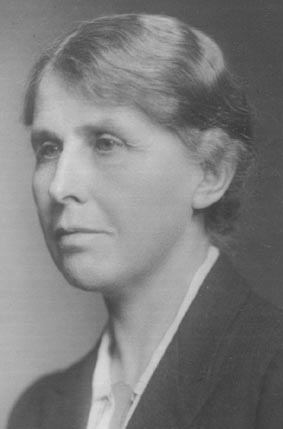
Kelly's Directory of Kent, Surrey and Sussex 1891:
Codrington Place, between Montpelier Road and Hampton Place, Western Road.
1. Mrs George Smith, 2. George Field Tavenor, 3. Miss Skirrow, 4. C.
Augustus
Lee, 5. Mrs F. Rew, 6. Mrs Kendall, 8. James Brooks Leigh, 9. Mrs
Kidd.
Census: Mary Kendall aged 79, widow, born London. Living on
her own means. Mary Kendall L. aged 45, single, born London. Two
servants: Ann Perkin, Cook, aged 50 and a parlormaid aged 21, both
single)
The Bookman (New York) owned by George H. Doran was published from 1899 (or earlier) onwards. Following Charlotte's USA publication in 1921, the New York Bookman published a poem by Charlotte Mew in April 1922 (and included this in its anthology of that year), and another in June 1923.
| 1892 | Charlotte 22-23 |
|
|
Death of Grandma Kendall in Brighton. Charlotte's mother present - Relatives' money in trust to Charlotte's mother - Handled by Frederick Mew, Colonel Henry Gillum Webb and Walter Mew Barnes |
1892: Entartung, by Max Simon Nordau (1849-1923), published in Germany. This was translated into English as Degeneration (1895?). A "popular edition" was published by Heinemann in 1913. - German Wikipedia - English Wikipedia - an article in German - "degenerates are not always criminals, prostitutes, anarchists, and pronounced lunatics, they are often authors and artists". The book was dedicated to Caesar Lombroso. Degenerate authors included Nietzsche, Oscar Wilde, Ibsen, Tolstoy, Richard Wagner, Zola, and Walt Whitman.
Elizabeth Goodman may have received her
twenty-five year's service certificate. See Winter 1866
In the early months of 1892, Grandma Harriet Chick died. She had been ill for more than a year, during which Emma (Hooley) Chick came as often as she could be spared from home. When Harriet fell ill the grandchildren were no longer able to stay at her house. "For some years the Miss Tuckers stepped into the breach and invited the girls - nt more than two at a time - to spend time at Barnells. A later ... arrangement was the renting of a cottage nearby as an overflow". (Margaret Tomlinson pages 72-73)
8.6.1892 Mary Kendall died at 6 Codrington Place, U.S.D., Brighton. Her age is shown as 80 years. Occupation: "Widow of Henry Edward Kendall (Architect)". Cause of death: "Senile Decay. Certified by F.W. Salzmann M.R.C.S." [Comment: means she died due the natural decay of age]. Informant "A.M.M. Mew, Daughter, In attendance, 9 Gordon Street, Gordon Square, London, Middlesex". Registered 8.6.1892. [The death of Mary Kendall, aged 80, was registered Brighton vol.2b page 167 in the April-June quarter of 1892.] Penelope Fitzgerald 1988 (p.164) says her grave in Kensal Green Cemetery has this inscription from Psalm 21 "He asked life of thee; and thou gavest him a long life; even for ever and ever". See 1916 Val Warner 1981 p.xiv, however, says the inscription is on the grave of Ann Kendall in Fortune Green Cemetery.
Autumn 1892 In 1892 Edith Chick was awarded an exhibition of £40 a year for two years - Honours - Intermediate Experimental Science Botany. In the autumn she began her fourth year at University College London with biology and applied mathematics, but mostly "BSc Applied Mathematics, Geology and Mathematics" She won the Morris Prize in Geology. From 1893 to 1907, Arthur Tansley was working as Francis Oliver's assistant, researching and teaching in palaeobotany, plant anatomy, and ecology (Whilst also continuing his studies at Cambridge) (Peder Anker, 2001, page 12)
|
[I was able to give shape to Klemantaski family with
the assistance of Roderick Hinkel, a descendent of the family
18.12.1892 Birth in London of Alida Klementaski who married Harold Monro. She was the daughter of Sigismund Klemantaski, a Polish-Jewish trader, and his English wife, Lizzie, nee Phillips. (Oxford DNB) Alida married Harold Edward Monro on 27.3.1920 in Holborn, London. He died 16.3.1932 in Broadstairs. She died on 31.7.1969 in Chichester, Sussex, England. Sigismund Klemantaski married Lizzie Phillips, of Hope House, Stamford Hill, Hackney, in the City of London in 1890. Her father, Godfrey Phillips, was a tobacco manufacturer. The name of her younger brother, Moses David, suggests a Jewish family. Sigismund's older brother, Martijn Klemantaski, married Lizie's older sister, Helena, in the City of London in the March quarter of 1891. In 1891, Sigismund and Lizzie were living with a domestic servant at 10 A(something) Road, Stoke Newington [Hackney]. Sigismund is a "Russian Merchant". The birth of Louis Arthur Klemantaski was registered Hackney in the September quarter of 1891 (volume 1b page 456), and that of "Ale_ia" [could be Aleidia] "Klemantaski" in the March quarter of 1893 (volume 1b page 469). The birth of Benjamin I.[Leonard] Klemantaski was registered in Edmonton in the June quarter of 1894 (volume 3a, page 328). The family of another brother, Maurice Klemantaski, lived in south Edmonton [Tottenham]. Tottenham is north of Stoke Newington along the Hertford Road. The birth of Elizabeth Klemantaski was registered in Hackney in the December quarter of 1895 (volume 1b page 454). The birth of Godfrey C. [Charles] Klemantaski was registered Hampstead in the June 1901 quarter of 1901 (volume 1a page 626)) In the 1901 census, Alida is shown as eight years old, living at 2 Tanza Road, Hampstead. [It is "Klimantaski" in the transcription and in the original. However, the 1905 directory shows S. Klemantaske at 2 Tanza Road and the 1908 and 1914 directories show Sigismund Klemantaski at 2 Tanza Road, Hampstead on West Side (first house)] She is living with her father (Sigismund aged 32), mother (Lizzie), a governess, and nine year old brother, Louis A[rthur] Klimantaski. Sigismund is a horse hair merchant, and an employer. He is shown as a "(Dutch sub.[ject])"
Alida's older brother, Louis Arthur Klemantaski, was born on 12.8.1891 in
Hackney, London.
He was employed as a Clerk in 1911. He was a man of letters,
specialising in musical criticism. He founded and edited his own musical
quarterly Euterpe when he was only 18.
He served in the
military in 1914 (Commissioned 19.11.1914, 8th Battalion, Royal Berkshire
Regiment - Second Lieutenant (1916?)). He married
Phyllis Agatha Powell, daughter of Charles Powell and Georgina Meriton
Wastell on 7.10.1915 in The Register Office, Wareham, Dorset. She was born
8.5.1883 in Westminster, London. He was buried in May 1916 in
Bully-les-Mines, Departement du
Pas-de-Calais, Nord-Pas-de-Calais, Grenay Communal British Cemetery
Extension, France (Plot; 1. A. 15.).
died on 27 May 1916 in Near Loos, north of the Somme, WW1.
Phyllis died on 10.3.1917 in 7 Tanza Road, Hampstead.
Alida Klemantaski was born on 18.12.1892 in Hackney. Sometime between 1895
and 1901, her family moved to 2 Tanza Road, Hampstead, where they remained,
at least until 1914.
Alida read a Charlotte
Mew poem in
1912, when she was
about 19 years old. She
met
Harold Monro of the
Poetry Bookshop in 1913. She met Charlotte Mew
in November 1915 when
she invited Charlotte to hear a reading of her poetry at the bookshop.
Alida married Harold Monro in 1920.
After the death of Harold Monro
1932, she
continued living in London
until 1939, when she moved to West Sussex.
Her
Charlotte Mew- A Memoir (1953) is the point from which
subsequent biographies start, and the only one based on knowing Charlotte.
She died in
1969.
Alida means "noble" in Dutch, "archaic" in German, and "winged" in
Latin.
(archive)
Benjamin Leonard Klemantaski
Benjamin Leonard Klemantaski, who changed his name to Klemens,
was born about June 1894 in Lower Edmonton. In the June Quarter of 1919, he
married Katherine "Kitty" Phillips, daughter of Phineas Phillips and
Ophelia Phillips. Kitty was born in 1892 in New York, USA or Stamford
Hill, London (1911
census says born in Stamford, London). Benjamin died between March and June
1951. Kitty died in 1960 in London,
Elizabeth Klemantaski, born about December 1895 in Hackney, died on
30.9.1922 in Sanatorium de
la Rose de la Reine, Buysinghen, Belgium.
Godfrey Charles Klemantaski, who changed his name to
Godfrey Charles Phillips, was
born about June 1901 in Hampstead. (The birth of
Godfrey C. Klemantaski was registered Hampstead in the June 1901 quarter
of 1901 (volume 1a page 626)). He married Patience
Evelyn. Godfrey Charles died on 10.6.1930 in Hull, Yorkshire.
In 1899, "Klemantaski Brothers and Co. russian merchants"
were at 37 Great Tower Street, EC (Note "T.A. "Klemantaski"" which I
do not understand). The partners may have been Lodewijk (Louis) (Alida's
grandfather; Isidore Brand (Alida's uncle);
Martijn
Klemantaski
(another
uncle),
Maurice Louis (another uncle) and Sigismund Klemantaski (Alida's
father)
Lodewijk (Louis) Marcus Klemantaski (Alida's grandfather, born
about 1827
in Warsaw or a part of Poland in Russia) was employed as a
Shoe Maker in Rotterdam then Horse Hair Manufacturer and Employer in
London, living in Walthamstow. (1901 census. Age 74). The census says he
was born in Russia and a Russian subject. His (second) marriage certificate
says he was born in Warsaw.
His first marriage (7.12.1853 in Rotterdam, South Holland) was to Aaltje
(Alida
Hannah) Bosman (born 22.7.1833 in Rotterdam). She was Alida's grandmother.
The death of Alida Hannah Klemantaski (aged 48) was registered Hackney,
London, in the December quarter of 1882 (volume 1b page 321). [She died
16.10.1882 - Ten years before Alida was born]
Lodewijk (Louis)
Lodewijk (Louis) married his second wife, Flore Bessie in the City of
London in the
March quarter of 1884. Flore (aged 45 in 1901) was born in Holland and a
Dutch subject. There was a son (aged 28) at home named Jacques. The death
of
Louis Klemantaski, aged 80, was registered in Hackney in the September
quarter of 1907 (volume 1b, page 193). He was buried in 1907 in Plashet.
Alida's oldest aunt, Louisa Klemantaski, the first born child of Lodewijk
(Louis) married Eduard Bles. The next child, Celina Klemantaski, married
"Isaac Brand" [Isidore is a non-Jewish name often adopted
in place of Isaac] in
the September quarter of 1883 in the City of London. In 1901 Isidore (44,
born City) and Celine (42 born Holland) Brand, with their son Leonard (16
Commercial Clerk), lived at 20 St Marks Villas in Dalston. Isidore is a
"Hair (Horse) Produce Merchant".
Martijn Klemantaski born 13.5.1864 in
Rotterdam. About March 1891 in the
City of London, he married
Helena Phillips (born about 1858 in St.
John Hackney. Died 11.11.1948 in London). Their eldest son, Godfrey Louis
Klemantaski, was born 8.7.1893 in Hackney (died 17.9.1980) in
Camden) [Birth registered in Hackney September 1893 (1b page 453)]
Martijn died 8.8.1941 in London.
Maurice Louis
Klemantaski. Born 27.4.1866 in Rotterdam. Maurice married
Deborah Jaffa in The City of London in the December quarter of 1891.
Maurice Klemantaski was at Devon House, Hertford Road, Lower
Edmonton in 1894. Three Klemantaski births were registered in Edmonton:
Louis Philip J. in the December quarter of 1893. Benjamin I. in the June
quarter of 1894 (volume 3a, page 328) and Alida Evelyn in the
March quarter of 1895 (vol.3a page 459). In 1901 Louise would have been
about 8, Benjamin about 7, and Alida about 6.
In 1901, M.L. Klemantaski, aged 34, was at 46 Pretoria Avenue, Walthamstow.
A Jaff, Widow, 81, his mother in law, is with the family. Maurice is a
merchant in hair, working on his own account. Shown as "Foreign sub[ject]".
Only initials are shown for the first names. The rest of the family are
D. [Deborah] 36 (wife
born Australia). H. [Harry] 8 (son); L. [Louis] 7 (son) and A. [Alida
Evelyn] 6 (daughter). The children
are shown as born London (which does not fit Edmonton, and the initials and
ages do not fit properly, but it is the best
fit I can make). Maurice died
8.1.1946 in London.
Harry, Alida and Louis Klemantaski were potographed by
the tennis court at Brook House, Tottenham in the 1920s:
(external link). There is also a picture of
this Alida
playing tennis. The entry says that this
"Jewish community" family resided "here" from 1898 until 1956. Brook House,
in 1951, stood on
the site of "B.R.S. parcels depot" by the Edmonton boundary.
Searching the National Archives (Public Records Office) Catalogue with
"Kl?m?nt?sk?", or even "Kl*m*nt*sk*", only gives
Klemantaski.
Second Lieutenant L.A. Klemantaski is in the War Office Records for
1914-1917.
A limited company Klemantaski, Bates & Co. Ltd. 117094.
Possibly limited 1911. Still existing 1925. There is
"Declaration of Alienage" for a L.P. Klemantaski in 1917. Elizabeth
Klemantaski, from the Netherlands, Resident in Bournemouth, is naturalised
6.5.1921 (Certificate 7,997 Re-admission) and Louis Klemantaski, from the
Netherlands, Resident in London on 27.6.1933.
|
20.12.1892 Letter from Frederick Mew ("affectionate uncle", at 9 Gordon Street, to "Walter" [who is Walter Mew Barnes, Esq. 4 Harcourt Buildings, EC and is acting as lawyer for the Mews] "We quite think with you that the grandfather's money be transferred, and Aunt Caroline's £500 added to it... The dividends your Aunt received the other day were" [three lots: Mr Cobham's; Mr James Herne's and Mrs Kendall's] "The dividend from Mr Cobhams money must therefore be one of those referred to in Messrs James and James letters". [The letter from James and James relates to money from the estate of T.A. Cobham deceased. They wrote to Frederick Mew on 15.12.1892, "as one of the Trustees of Mrs Mew's Settlement". The "Cotrustee" was "Col. Webb". In Frederick's letter he gives the full name as "Henry Gillum Webb"]
External links says that William Monk moved to London in 1892, "setting up at the Hogarth Studios in Charlotte Street, Fitzroy Square". If the Hogarth Studios refers to 64 Charlotte Street (currently labelled Hogarth Studios) these are the premises that Anne Mew later occupied. In an 1895 Street Directory the occupant of 64 Charlotte Street is shown as "Duff and Spagnoletti, artists in stained glass". In 1899 it is "Spagnoletti and co., artists in stained glass", and two others are also at 64 Charlotte Street: "Carpenter Alfred, designer" (who was still there in 1910) and "Ayrton Maxwell, architect" (external link) - The 1899 Trade Directory bears no relation to the 1901 Census, which shows three apartments with residents: Mary Ann MacGillivray (lodging house keeper aged 41) and her mother Alice Owen, both widows. Walter Francis Scott Hetherington (aged 35) Sculptor/Artist born Liverpool, and his lodger, Henry Samuel P Lancellor (aged 24), Artist born Ireland. Hubert Lloyd Wellington (aged 21) Artist born Gloucester and his wife Nancy (same age) born Grays in Essex.
| 1893 | Charlotte 23-24 |
|
|
Spring: Death of Elizabeth Goodman |
Death of Elizabeth Goodman "dropping one day suddenly between the shafts, she died". [An Old Servant. 1913] The death of Elizabeth Goodman, aged 67, was registered Pancras vol.1b page 34 in the January-March quarter of 1893.
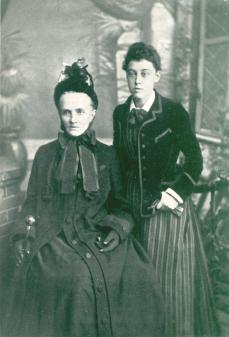
|
This photograph described as "Charlotte Mew as a girl with her old nurse"
is reproduce in
Alida Monro
(1953), facing page xiv. Underneath the main heading, it says
"Photo reproduced by courtesy of Sir Sydney Cockerell. The original bears
the legend Artistic Photography at Night by
the New Electric Light"
"At sixty-five she looked wistfully through the frosted window panes,
regretting nothing more than that she could no longer skate and slide and
snowball with the 'best of us', the spirit still keen for all adventures
when the flesh, which was so small a part of her, had grown infirm."
Seventeen years before, little Charlotte had counted knots fearful of Elizabeth's death. The Mew children were her "family", but now another family arrived. |
May? 1893 Daniel Oliver awarded the Gold Medal of the Linnean Society for his service to science. The first medals (two) were awarded at the society's centenary in 1888 to a zoologist and a botanist. The zoologist was Richard Owen, superintendent of the natural history departments of the British Museum (later the Natural History Museum) from 1856 to 1883, who created the name "dinosaur", and opposed Charles Darwin's theory of evolution. The botanist was Joseph Dalton Hooker, Director of the Royal Botanical Gardens at Kew, and a close friend of Darwin. In the succeeding years the medal was awarded, alternatively, to a botanist or a zoologist. It was awarded to Alphonse de Candolle, Director of the botanic gardens in Geneva, in 1889. Thomas Henry Huxley received it in 1890, [Jean Baptiste] Edouard Bornet of France in 1891, Alfred Russel Wallace in 1892, and Ernst Haeckel in 1894. Later recipients included Francis Wall Oliver in 1925, Frederick Frost Blackman in 1937 and Arthur George Tansley in 1941
Autumn 1893 Edith Chick's fourth year at University College London with biology and some applied mathematics and mechanics
October 1893 Pall Mall Magazine launched in Britain and America. "One of the more visually impressive magazines of the 1890s, championing art nouveau". Charlotte Mew appears to have had one story accepted by it - In 1901. The editor from January 1901 to August 1905 was George Roland Halkett (1855-1915), cartoonist and writer.
December 1893 May Sinclair's "The Ethical and Religious Import of Idealism" published in New World (an American magazine) is largely based on Thomas Hill Green (1836-1883) (Wikipedia). ( Suzanne Raitt 2000 pages 45 and 275).
| 1894 | Charlotte 24-25 |
|
|
July: Charlotte published: Passed, a short story in which she explores Clerkenwell and sees a kiss that means more than the established religion. |
16.4.1894: First volume of The Yellow Book. An Illustrated
Quarterly published by Bodley Head.
[See Victorian Web] Editor (throughout 1894 - 1897)
Henry Harland ...
Ella D'Arcy was assistant and contributed stories,
including
"Irremediable" (April 1894) - "A Marriage" (October 1894) - "The Pleasure-
Pilgrim" (April 1895) - Monochromes (1895) - "The Death Mask" (July 1896).
[I think it is inferred that Charlotte Mew met Ella D'Arcy at this time.
The first referenced trace seems to be when Charlotte Mew visited her in
Paris in 1902
Ella D'Arcy may have lived in Paris from sometime in the 1890s until 1930]
29.4.1894 Letter from
H. Harland to Charlotte Mew. The address on all his letters
is 14 Cromwell Road, SW.
[Adams collection -
Davidow 1960 275-276]
2.5.1894 Letter from
H. Harland
to Charlotte Mew:
Includes "Please don't forget that you are to let me read your other mss.
I wish it could be arranged between you and
Messrs Mathews and Lane to
publish a volume"
[Adams collection -
Davidow 1960 276-277]
3.5.1894 Letter from
H. Harland to Charlotte Mew [Adams collection -
Davidow 1960 277-279]
|
July 1894
Passed by Charlotte Mew published in the second
volume
of The Yellow Book pages 121 to 141. Charlotte was
twenty-four years old, living with her parents in
Gordon Street.
The story tells of a walk from her part of London
to the poorer parts, which she regards as romantic. This was a time of
social surveys of poverty (See
1883 -
1889 -
1890).
The directions
north to Islington or south to
Westminster suggest a walk from nearer London City than where
Charlotte
lived. Going north to Islington from the City, the prison being demolished
about this time is the
Clerkenwell House of Detention.
The nearby Church of our Most Holy
Redeemer appears to have all the features of the church
described in the story. Charlotte's imaginary walk
may be up St John's Street, east to the prison, south to
Clerkenwell Green and then north by
streets with rural names, to Exmouth Market. The
1862 map show street names with rural connotations going north
from Clerkenwell Green to Exmouth Market, where the church is. The main one
is Coppice Row (which became Farringdon Road), but there is also Pear Tree
Close, Bowling Green Lane, Wood Street and Vineyard Walk
|
Passed "like souls that meeting passed" - but also, perhaps, passed as Mademoiselle uses it, for passé. In which case, I would note that the true gospel is neither the new picture or the old religion in a new building, but the "sublime and ghastly" kiss.
In Passed, themes that will flower in Charlotte's later works, lie like the curled springs of newly sprouting seeds. Here, for example, are the parallel rhythms of town and country, running together in the names of streets. And here is the parallel consciousness, the ability to absent oneself from the present reality or, as Charlotte writes "My heart went home". Faced with death, she left her body in the chamber to which she was taken, and travelled elsewhere
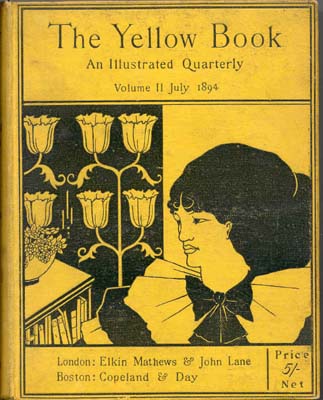
|
The Yellow Book was what it said, a yellow book. It was 8.25 inches tall, a typical book height, but 6.5" wide, presumably to give a more square page for the illustrations. Each volume was about an inch thick |
| No further publication by Charlotte Mew from 1894 until 1899 is known. The China Bowl (or another long story) was unsuccessfully presented for publication in 1895. The Minnow Fishers has been ascribed to this period. Its "anonymous revised publication" has been traced to Outlook 31.1.1903 by Val Warner. |
Autumn 1894 Harriette Chick began her studies at University College London with biology.
| Tommy and diptheria In 1894, a horse named Tommy was injected with diptheria by Armand Ruther of the Lister Institute and Charles Sherrington of the Brown Animal Sanatoria Institution. From it, serum was obtained which it was thought might cure diptheria. Sherrington tried the serum on his nephew, who was dying of diptheria, and the boy recovered. It was later tested on children at Eastern Hospital (Homerton) and Great Ormond Street. Harriette Chick met Sherrington in 1901 - He later recommended her to the Lister Institute. |
| 1895 | Charlotte 25-26 |
|
|
January: Henry Harland suggests a volume of stories - February: A Wedding Day - July: Delivered - Summer on Guernsey and a sunlit house. |
3.1.1895 Postmark on a letter from
H. Harland to Charlotte Mew: "There is no living writer of
English fiction who can touch you. I am afraid the tale is too long for the
Y.B., but it would make the backbone of a volume. It is partly about a
volume that I wish to speak"
"When Wilde was arrested in 1895, he was reported in the press to be
clutching a copy of The Yellow Book, though it was a French novel.
John Lane defended The Yellow Book by dismissing Aubrey Beardsley,
the art editor, but in 1897 it closed"
[Val Warner, 1997,
page 44]
The list of architects in the 1895 London Trades and Professional Directory
includes "Mew, Frederick 9 Gordon Street, WC". He is an Associate of the
Royal Institute of British Architects.
The
British Library typescript of Charlotte Mew's short story
A Wedding Day is dated February 1895, although
apparently
unpublished
until 1981. It is about life (yes) and
death (no) and one "who met thus, alone and smiling, the terror of men's
dreams" - There is also a copy in the Buffalo Collection, which is catalogued as being
between 1906 and 1928 - Possibly on the hypothesis that, being unpublished,
it was written
after Temple Bar finished.
14.2.1895 Premiere of Oscar Wilde's comedy The Importance of
Being
Earnest - A Trivial Comedy for Serious People at St James's Theatre,
with
Evelyn Millard in the role of Cecily Cardew, the young ward of
Jack Worthing (Earnest) who fantasizes that she is engaged to Jack's wicked
fantasy brother (Earnest).
Fairy index: See
Faerie -
The Farmer's Bride
-
The Changeling -
Men and Trees -
The Pedlar -
November 1911 -
July 1895 Photocopy of a handwritten draft of a short story titled
Delivered, located in Box 3.5 of the
Penelope Fitzgerald
Papers, is initialled
C.M.M., dated July 95 at the top of the first photocopied page in Charlotte
Mew's
hand, and consists of 8 leaves. Information supplied to Betty Falkenberg by
L. Christine Amos, Library, University of Texas, Austin, 3.5.2005 (email).
Note to
The Sunlit House: I passed this house on a hot
Guernsey road (with a rollicking party) one afternoon in '95, and have hung
about it in thought, like the frog footman 'on an off for years and years'.
Only suddenly 2 months ago I saw the little bound spirit inside. I will
not be a psychic, but please - one day - explain. CMM, 9 Gordon Square,
WC"
Autumn 1895
Harriette Chick
continued her studies at
University College London with biology and
chemistry. Edith and
Harriette Chick were both officers of the Women's Debating Society in 1896.
Edith was President of the Social Discussion Group in 1898. The
University College Gazette has items showing their activities in
February, July and December 1896 - March 1897 - February and March 1898. It
does not always distinguish which "Miss Chick".
"With a simple, guileless heart in his breast,
And a mind as honest as ignorant.
Half a child and half a man"
| 1896 | Charlotte 26-27 |
|
|
|
Two poems by "Charles Catty" (Charlotte Mew?) published in The Yellow Book. April 1896: "Song of Sorrow", volume 9. page 157. October 1896: "The Wind in the Tree", volume 11 page 283. Although it has been suggested that this was a pen name for Charlotte Mew, it would seem more likely to be Charles William Stratford Catty who published (Charles Stratford Catty) Poems and Legends in 1914.
June? 1896 Harriette Chick graduated with a second class B.Sc. from "Un & Bed College" -[London University and Bedford College]
|
August 1896 Photograph of Charlotte Mew (aged
26)
Edited from a photograph ("courtesy Peter, John and Richard Mew") in Davidow, M. 1978 page 443 Mary Davidow describes this as "at the beginning of her career as a writer" |
|
Autumn 1896 Harriette Chick continued her studies at University College London with advanced chemistry, organic chemistry and analytical chemistry.
Herbert Edward Durham subsequently worked with Frederick Walker Mott on the spread of dysentery in London asylums. They reported in 1900. Durham then joined Walter Myers (March 1872-20.1.1901) on the Yellow Fever Expedition to Brazil from the Liverpool School of Tropical Medicine June 1900 to April 1901. In preliminary notes they gave credit to the theory that yellow fever was transmitted by gnats. Myers died on the trip. Durham's interim report suggested that gnats did not transmit the disease. Harriette Chick knew Durham before meeting him on his return from South America. It seems likely that she had met him in London.
| 1897 | Charlotte 27-28 |
|
|
|
April 1897: Last volume of the The Yellow Book
The private block of the new Isle of Wight County Lunatic Asylum opened about 1897. "F.K.M." is shown as a patient on 31.3.1901.
March 1897 Death of
Edward Chick, aged 26, at Ealing. Interred at Perivale.
Family Bible (Watts boxes). Free BMD:
March quarter 1897 recorded
Brentford 3a 62. He died of appendicitis, a death which
Margaret Tomlinson (page 80) thinks could have been avoided
"with modern day surgery and the use of anti-biotics". This is a comment
she also applies to the deaths of
Dorothy (aged 31) and
Frances (aged 35) in 1919.
Autumn 1897
Harriette Chick is
not recorded as taking classes at University College London.
| 1898 | Charlotte 28-29 |
|
|
September: Charlotte's father dies in London, Charlotte witnesses his death - November: On the Isle of Wight, Freda, Charlotte's youngest sister, goes mad - An Open Door rejected |
An Open Door was rejected by Blackwoods Magazine
in 1898
"after earlier encouragement to submit further stories".
(Val Warner's Mew 1997, page x)
It was
published in Temple Bar in 1903. [The British Library
catalogues
a printed copy of this, but
no typescript].
In September 1898,
Gertrude
Mayer became
editor of Temple Bar and it is possible this was why
Charlotte Mew found a publisher.
Monday 12.9.1898: Death of Frederick Mew, age 65 years. Architect, (Charlotte's father) at 9 Gordon Street. C.M.Mew, Daughter, Present at the death, and of the same address, registered the death in the Tottenham Court district of Pancras on Tuesday 13.9.1898. The cause of death was "Malignant disease of the Stomach. Exhaustion. Certified by E. Hollings, MD" [Comment: It sounds like cancer of the stomach with exhaustion from the pain contributing to the death]
An obituary was published in 1899 in the RIBA Journal volume 6 page 328. Alida Monro (1953), page ix, says
"Her father... seems to have been a man who took his responsibilities very lightly. His daughter's account of her early life was one of gaiety and extravagance which she enjoyed to the full. However, he died when she was about twenty-nine, leaving nothing, having spent all his available capital on living. The sudden drop in her financial circumstances had a most damaging psychological effect. Charlotte Mew inherited from her mother a view that was very prevalent during the last century, namely that appearances must be kept up at all costs"Autumn 1898 Harriette Chick continued her studies at University College London with two terms of bacteriology and bacteriology laboratory work.
about September 1898: Macmillan bought Temple Bar from Richard Bentley and Son, The editor of Temple Bar from September 1898? to December 1900? was Gertrude Mary Townshend Mayer - I have no information about who the editor was from 1900 to 1906 - Richard Bentley and Son published Mayer's Women of Letters in 1894. The change of editor and owner may have meant a more liberal policy about what was published. (See May Sinclair's experience in 1893). It is noticeable that Charlotte Mew's unpublished (until 1981?) stories include Elinor, a powerful and compelling story, whose heroine has a philosophy opposed to Christian values. Her only publications before Temple Bar under Gertrude Mayer had been in the deliberately unorthodox The Yellow Book [And look what happened to that] and, just before Temple Bar, The Governess in Fiction, which the editor of The Academy cut.
early November 1898 Freda Mew became insane. (She had been insane for three months when admitted to the Isle of Wight Asylum on 4.2.1899). She was taken (at some time) to The Limes, Newport, Isle of Wight
| 1899 | Charlotte 29-30 |
|
|
January: Freda tries to kill herself - February: admitted to the local asylum - August: The Governess in Fiction published - September: Charlotte finds a regular outlet for her writing in Temple Bar - The China Bowl published - The family will revised |
Will of Anna Maria Mew witnessed by Samuel Chick senior and Mary Chick
About Wednesday 25.1.1899 Freda Mew jumped out of a window. (Suicidal)
Saturday 4.2.1899 Freda Kendall Mew, aged 19, admitted from The Limes, Newport, Isle of Wight, to the Isle of Wight Lunatic Asylum. Her "Relative's Address" is "Mother" "Mrs A.M.M. Mew, 9 Gordon Street, Gordon Square, London, WC" followed by "Mr Richd Mew, Fairlee, Newport, I.W.". Details of Freda's "Previous History" were given by "Nurse Sutton, Newport". her admission had been planned. Medical Certificates were provided by two local doctors "J. Groves, M.B. and S.Foster, LRCP.Ed, Newport". Their certificates said:
"(a) At time of examination and on previous occasions she has not replied to questions put but has held her face down and could not be got to look up, playing with her fingers and behaving generally in an abnormal manner: said she jumped out of a window to end all."
"(b) Impossible to get an answer to any questions: holds her head down so that her face cannot be seen: quiet and made no remarks at time of examination and only by pressure could be got to say yes or no: don't think it possible to get a satisfactory answer from her"
In the morning Freda had said "she would commit suicide sooner or later". Patrick Taffe Finn, the assistant superintendent of the asylum, diagnosed her form of mental disorder as acute mania. She was a single woman of no occupation who had not previously been treated for insanity, but had been insane for three months.
Under "Supposed Cause" the "Predisposing" cause was entered as "Probably heredity". No "Exciting" cause was entered and she was not "Epileptic". There was a family history of madness in her " Brother and Sister".
Her expression was "Downcast; rather scowling". She "At times
struggles to get through windows" and she "usually has her head down". Her
conversation "is limited. When addressed she barely answers, sometimes not
at all. She has delusions of persecution at the hands of some Miss"
[space]. "At times very stubborn".
[Case notes]
Saturday 11.2.1899
Freda: "Remains the greater part of the day gazing at a
book without apparently reading a word: has attempted to get through a
window: stubborn refusing to do as she is told: barely answers when spoken
to, sometimes not at all: has delusions of persecution.
Saturday 18.2.1899
Freda: "At times resists getting dressed: never
voluntarily says a word to others: will not employ herself in any way."
Saturday 25.2.1899
Freda: "At times she is very troublesome at night
jumping out of bed and trying to get at the windows: nearly always has her
face hidden with a book or newspaper."
Saturday 4.3.1899
Freda: "Will not say a word when spoken to nor does she
take the least notice of others, and will not amuse herself."
Friday 3.4.1899
Freda: "At times seizes article of clothing the nurses have
on and struggles to get them saying they are hers: will not answer when
spoken to."
Tuesday 2.5.1899
Freda: "There is little sign of improvement so far: she
continues stubborn and still refuses to answer when spoken to: she is in
fair health but thin.
May? 1899 Berlin Congress on Tuberculosis. At this congress, Virchow challenged the dominant belief in an hereditary disposition to tuberculosis (See 1911 Encyclopedia). The Mew family had not known about Henry Herne's tuberculosis when Freda was admitted to the Isle of Wight Asylum. Presumably it developed from infection in Peckham asylum sometime over the next eighteen months. Henry Herne died in March 1901. Bloch, in 1908, classifies alcoholism, syphilis and tuberculosis as the three most potent causes of racial degeneration. Any one of them, or "actual mental disorder" was a "contra-indication" to marriage with the person afflicted, although not necessarily with his or her relatives.
25.5.1899: Papal encyclical consecrating the whole world to the heart of Jesus. The Litany of the Sacred Heart, approved by Pope Leo 13th on 2.4.1899, starts, in its French Translation:
"Seigneur, ayez pitié de nous,
Jésus-Christ, ayez pitié de nous,
Seigneur, ayez pitié de nous,
Jésus-Christ, écoutez-nous,
Jésus-Christ, exaucez-nous"
Thursday 1.6.1899
Freda:
"Occasionally she is for a few hours very
excitable during which she will scratch and bite: will not yet answer when
spoken to."
26.6.1899 to 5.7.1899 International Congress of Women. London "It is estimated about three thousand women were present. The meetings lasted over a week, and were held sometimes five at once... Many complained of the different halls... of having to go from one place to another. That was London's fault... London is in many ways an old-fashioned city, and her public buildings were erected before the day of women's congresses." (Charlotte Perkins Stetson)
12.8.1899 Charlotte Mew's essay: The Governess in Fiction in The Academy pages 163 to 164 [The signature is just "M". Penelope Fitzgerald 1988 page 269 says it was identified as Charlotte Mew's by Mary Davidow. On page 71 she says the editor cut the essay] "nowadays, when nothing, it seems, is unpermissible to youth" [remember] "that to the young person of that period Jayne Eyre was a forbidden book" [with a] "too unfettered, too fervid romance"
Thursday 31.8.1899
Freda:
"She is less excitable but never answers when
spoken to only turns away in disgust: she will not amuse or employ herself
in any way: getting fatter."
| September 1899 Charlotte Mew: The China Bowl in Temple Bar volume 118. Although Penelope Fitzgerald 1988 page 70 says it appeared in two parts in September and October 1899, I have a bound copy with continuous pages numbers from 64 to 90. "Charlotte M. Mew" is at the end of the story. |

|
" All things that are of the earth shall turn to the earth again: and that which is of the waters doth return into the sea. But thy providence, O Father, governeth it: for thou hast made a way in the sea, and a safe path in the waves;" Jenefer Parris - aged 13 - March 16th 1844 [Her sampler] The second is quoted again at the end of the last chapter, David Comes Home [Dead]. Jenefer had been swallowed, not by the sea, but by the city. "Together they had watched for Jenefer, long and patiently and lovingly; listening vainly for unreturning feet, but still together. Now, for David, she watched alone, rarely stirring from her seat at the window looking upon the bay".
Charlotte developed the story of The China Bowl into a one act play. The play was read by May Sinclair in July 1913. Sometime between 1899 and 1913 (I infer), Charlotte attempted to have the play produced, and it was possible that the actress Violet Vanbrugh would produce it.
Thursday 30.11.1899
Freda:
"Remains taciturn: assumes the same attitude and
sits in the same place daily: she is insulting and very untidy in person:
still gaining in weight."
Autumn 1899 Edith Chick was Quain Student for five years, carrying out research which she published with Arthur Tansley. Harriette Chick had a research scholarship. It is not clear for how long, but she seems to have been researching micro-organisms in England, Austria and Germany from 1899 to 1904. She was in Vienna (Austria) by 20.2.1901. Neither Harriette nor Mary Chick were at home in England on 31.3.1901, but both of them were in Austria on 27.6.1901. Mary always appears to be Harriette's companion in her diary for these years, so I am inclined to think she went to Vienna at the same time as Harriette.
| 1900 | Charlotte 30-31 |
|
|
Freda remains silent |
February 1900
Freda: "Will sit in the same place as long as left with her head
hung down: she will not do anything for herself: pale but in fair health.
Monday 28.5.1900
Freda: "For the last 3 months has scarcely spoken a word: takes
not the slightest notice of anything said to her: bodily health is fair".
Wednesday 9.5.1900 Max von Gruber lectured on prostitution from the standpoint of social hygiene (Die Prostitution vom Standpunkte der Sozialhygiene aus betrachtet) to the Sociological Education Association (Sozialwissenschaftlichen Bildungsvereine) at Vienna University (Universität Wien)
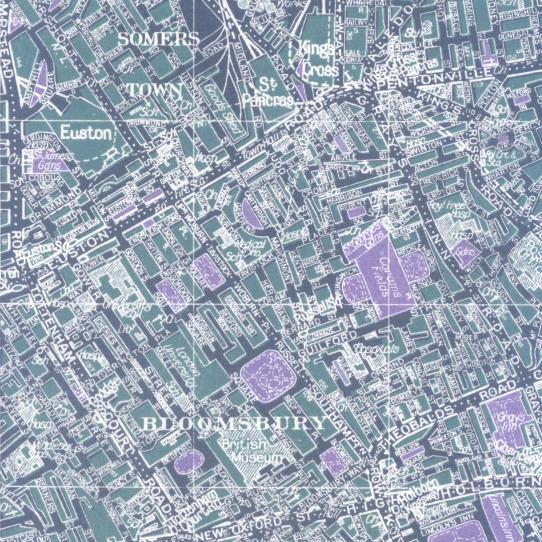
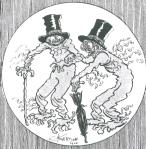
|
1900: Punch tries to laugh at the invisible enemy - ["Dr Miguel has discovered that germs live to an advanced age" - Weekly Paper] A couple of "Old 'Uns," seen through Mr Punch's microscope - In Peckham House, Charlotte Mew's older brother was dying of tuberculosis. On 10.8.1900 the International Congress of Medicine and Hygiene met in Paris with Lord Lister as guest of honour. 1900 House (1999) argues the fear of germs led to much greater concern for household cleanliness. |
27.8.1900
Freda: "Sits almost quite still, never noticing anyone, nor
saying a word: she is in fair condition and bodily health"
September 1900 Arthur Bourchier (1863-1927) became manager of the Garrick Theatre. From here, through to 1906, he and his wife, and fellow actor, Violet Vanbrugh (1867- 1942), staged plays at the Garrick most of which were by contemporary authors. It seems likely that this was the period when Violet Vanbrugh intended producing Charlotte Mew's The China Bowl, but was prevented.
30.9.1900 - 4.5.1901 Arthur Tansley "Diary Kept in the East 1900-1901". Tansley was on a half year tour to Ceylon, the Malay peninsula, and Egypt "all ambitious scholars had to make such a voyage if they wished to scale the hierarchy of British botany" (Peder Anker, 2001, pages 13 and 254) On the voyage Tansley collected specimens of Lindsaya and Schizea and Matonia which were used, on his return, for research, and publication, in collaboration with post-graduate students (Godwin 1957), including Edith Chick.
November 1900 Two seeds of the Californian Nutmeg, from the garden of Orton Longueville, near Peterborough, were sown "with the fleshy covering still on, at the time when the seeds were ripe". They had been supplied to Professor Oliver by Mr. A. Harding, the head gardener. Edith Chick grew them until 31.5.1902, and 15.6.1902, "so that they were respectively eighteen and nineteen months old" before "gathering" them for examination. The interest in this plant, I suspect, lay in the possibility that it related to plants that were fossilised in coal - Such as the ones Marie Stopes was analysing under Professor Oliver's supervision. Edith also used a seedling from Kew sown in January 1895, and gathered in May 1896.
26.11.1900
Freda: "Requires to have everything done for her: has not spoken
a word since last entry: bodily health continues fair."
In the second edition of The Golden Bough. A Study of Magic and Religion, James Frazer "spelled out a parallel with the Christian atonement that had he had been content to leave latent in the version of 1890. In the third, he coyly banished this section to an appendix" (Robert Fraser, 12.1.2001). Charlotte Mew's reflections on Brittany, between 1901 and 1913 include the pagan and christian elements of the culture, and their relationship. In Men and Trees (1913), the blood on the wood is related to the modern exploitation of the Congo and Amazon rain forests.
| 1901 | Charlotte 31-32 |
|
|
End of January: death of Queen Victoria - March: Poems on the Queen's death - Asylum death of brother Henry of tuberculosis - April: Miss Bolt - Harriette and Mary Chick in Vienna - Summer: Holiday with the Chicks in a Brittany Convent - September: To a Little Chid in Death - October: Notes in a Brittany Convent - November: Freda perfectly stuporous |
Tuesday 22.1.1901 Death of Queen Victoria at Osborne House.
criticising Frazer's new chapter, in the Fortnightly Review 75 (1901) pages 650-662
Monday 4.2.1901 Victoria buried beside Albert in the Frogmore Royal Mausoleum at Windsor Home Park. Her body had been bought, in state, across the Solent and on to Windsor.
|
Monday 25.2.1901
Freda: "Remains in the same attitude as long as left and never
says a word: she is in fair condition and bodily health."
| March 1901: C.M V.R.I. Temple Bar volume 127, pages 289-290. A two part poem. The first part is called January 22nd 1901. The second part is called February 2nd 1901 |
|
|
22.3.1901: death of
Henry Herne Mew, Charlotte's brother,
"Age 35 years". His death certificate,
issued 23.3.1901, has "R.E. Leonard,
Present at Death, Peckham House Lunatic Asylum"
[Not Peckham Hospital.
The cause of death is
"Phthisis Pulmonalis"
[Tuberculosis, not pneumonia]
"Certified by H.C.
Halstead, MD"
Richard Eugene Leonard, single, aged 36, born Ireland, was an "asylum attendant" (1901 census)].
[Harold Cecil Halsted, single, aged 38,
born Chichester,
David Kessel commented
that, "if the
patient's resistance was low, which I suspect it was, death could have
followed a few months after the first signs of the disease. If his
resistance was high, he could have been ill for several years". Freda Mew's
case notes say there was no consumption in the family in
February 1899, two year's earlier. The implications that the Mews may have
drawn for the diagnosis
can only be guessed.
was the medical superintendent of the asylum. (1901 census)] Henry Herne Mew is shown as "no calling" and of "30 Doughty St" - Although the family moved from there in February 1890.
[The death of Henry Herne Mew,
aged 35,
He is said to have been buried in
Nunhead Cemetery
- Just south of Peckham.
was registered Camberwell vol.1d page 536 in the January-March quarter of 1901]. The following verse from Charlotte Mew's poem In Nunhead Cemetery has every appeaance of being written just after Henry's funeral. The poem, written in parts, was completed by July 1913.
"I shall stay here: here you can see the sky; As Charlotte explained in 1913, this verse, the last in the published poem, was written first. It was, in her opinion, "the most inevitable" ... "a lapse from the sanity and self-control of what precedes it. The mind and senses can stand no more, and that is to express their failure and exhaustion."
|
|
On
Sunday 31.3.1901 Census:
At 9 Gordon Street: Anne Mew aged 60: Charlotte Mew aged 30: Caroline Mew aged 25 (no occupations shown for any) and Emily Stafford, single, aged 41. General Servant Domestic, born Blunsdon, Wiltshire. [Transcribers spell Blunston and mis-read her age as 14]. Broad Blunsdon is a north Wiltshire hamlet, south east of Cirencester in Gloucestershire. [The 1881 census shows Emily as born Cirencester, Wiltshire and, in 1881 (aged 19), a Domestic Servant to an elderly farmer and his wife in Stonehouse, Gloucestershire. I cannot find her in 1891. The Mews now have one general servant (mature) in place of Elizabeth Goodman and two young servants in 1891. Emily may have been succeeded by "Jane the factotum"]
[The
Mary Kendall
aged 52, born Westminster, living at 29 Ryland Road, St Pancras, London is
not Charlotte's aunt. See
Brighton below
At 30 Park Hill (Chestergate) - Samuel Chick (59) and Emma Chick (57). - Edith Chick (31) - Dorothy Chick (13) - Samuel Chick (33) - James Chick (21 Warehouseman - Worker) - Anne Smith (Visitor - 57 - Living on own means) - Louise Lacey and Mary Seymour, Cook and Housemaid.
Brighton
At 20 Sillwood Road:
Mary L. Kendall (mis-transcribed Kendell),
single, living on own means. Aged 53.
Ann Perkin (mis-transcribed
Perken), single, Housekeeper, aged 64, born Hanley? Worcestershire.
New Fairlee Farm, 22 Mews Lane
Richard Mew, Head,
Widower aged 75 Employer working at
home Born
Hampshire
Lymington,
Fanny Mew, his daughter Single aged 34, born Newport,
Isle of
Wight,
Richard Mew, his son, single, aged 32 Employer working at
home born
Newport, Isle of Wight, Rosena Harding, Servant, single, aged 20 ,
General
Domestic, born Avreton, Isle of Wight
New Fairlee Farm 23 Mews Lane: Walter J. Pragnell Head. Married aged
29 Dairyman, and
his family
South Fairlee Farm Isle of Wight County Lunatic Asylum Patient 6 on page 3: "F.K.M. - Patient - Single - 21 - born Newport Isle of Wight - Lunatic" The page of twenty five females appears, from the occupations shown, to be the patients in the women's wing of the private unit. [The unit had 50 places, male and female] The entry for place of birth seems to be incorrect. With most patients there is no entry in this column. No occupation is shown for fourteen patients, including F.K.M. The occupations of the other eleven are: "Wife of Publican - Living on own means (3) - Formerly Milliner - Wife of Naval Engineer - Wife of Civil Engineer - Wife of Medical Practitioner - Boarding House Keeper - Wife of retired Tool Manufacturer - Wife of Customs Officer. All are described as lunatic in the final column. None are described as blind, deaf or dumb, or imbecile/feeble-minded" (the alternative categories). Most of those where a place of birth is shown, were born outside the Isle of Wight.
Devon
Hazelwood,
Branscombe, Devon
Margaret Chick
"Head"
Hazelwood was rented by
Samuel Chick the father from 1901. In the 1920s it
appears to have been the home of Samuel and Harriette. It was
bought by the
Chick sisters in
1930. See also
1944 and
1977.
See
Three trunks in a Branscombe attic
by Barbara Farquharson Spring 2011
|
| April 1901 Charlotte Mew's essay Miss Bolt in Temple Bar volume 122 pages 484-493 |
|
|
This copy of Temple Bar
(external source) is the month after Miss Bolt was
published.
As far a I can tell, the magazine always had a standard format, measuring
about 7 and three quarter inches by 9 and three quarters, and always the
same colour and design.
At the time Charlotte wrote for it, Temple Bar did not have illustrations. Its stories were plain pages of print, like a book. The print was clear and I do not agree with Penelope Fitzgerald's description of it as so tightly packed that its readers must have risked eyestrain. |
| Harriette Chick's diary: [Sunday] 28.4.1901: "I set my house in order in the morning for we are going to Venice tomorrow". Appears to be in Vienna. Edith has been staying, but leaves in the evening. She is "rather low as it wore to evening". "We got Edith a comfortable carriage and to her and our delight, up comes the dear Padre, with a packet of chocolates". This is the earliest entry in the diary. The Padre is a constant part of the story in Vienna, he visits in Munich and, at one point he travels to London and Liverpool with Harriette. The close association and dialogue of Harriette and the Padre may be reflected in that between the bacteriologist and the priest in Charlotte Mew's Notes in a Brittany Convent - See below |
May 1901? Return of Arthur Tansley from his botanical voyage
Upon his return the Gazette reported that he "danced to the very last extra" during the annual prom of 1901, and he even wrote an article praising the women of Cambridge, whoes "feet and ankles are proverbial... and hockey skirts are short" (quoted Taylor, D. 1968 pages 22 and 35-47). It was during this happy period of his life he fell in love with his former student Edith Chick (the first female student to recieve the Quain Studentship)... (Peder Anker, 2001, pages 13 and 254)
|
21.5.1901 Harriette Chick's diary: Vienna: We went to tea
with the Padre. Mary has been to Rothschild's Garden....
A mighty experiment: (from Harriette Chick's diary) - This takes place in Vienna. Harriette, Mary and, possibly, Samuel Chick, are there. Thursday 27.6.1901 "I'm getting ready a mighty experiment with 400 test tubes and 2.5 kilos glass beads. beads = 3 g a kilo. glass rod 1 g 60 a kilo. so Mary principally has saved 3 g 50 and I have spent 90 heller on files. We cut up half a kilo in the evening.
[one gulden was two krones and one krone was 100 heller
Friday 28.6.1901 "worked to death again. Mary like an angel cut up another kilo in the morning. Padre came to tea. After tea he was pressed into the service and it was very beautiful to see him chopping glass. I have since given him his file as a memento. Then it was eight o'clock. He went to supper and so did we and then we had intended to go to the Volksgarten, but it was too late, so we went to the [word deleted] Wiener Prater where I provided drinks. Later hr Mosley and Schmidt turned up and I treated them to teas. Then we all went and got weighed and got home strictly in good time."
[External link about
Wiener Prater about 1900
Saturday 29.6.1901 "I had to work on until after two and only met the party at Hadersfeld - Mary, the Padre, Miss Cross and Miss Barfoot. I was disappointed. I expected gay, reckless, dissipated, handsome ------ and found only common. I had weißer Wein gespritzt and drank coffee (much) and then we walked down to Kritzendorf. Padre and I together, chatted about Miss Barfoot - She had suggested accompanying him to Budapest and the dear man had not had presence of mind enough to turn the attack. He talked about her mostly.
[correctly it would be "Weißwein gespritzt" which is German and means
white wine with soda or sweet soda]
Home. had supper, changed clothes and then went to the Padre's. Hymns sung and then 'Sam' had his present and then Mary and I went home." Sunday 30.6.1901 "Went to the Lab for one hour and then dressed and went to Church. The Padre is coming to Seyring with us today..! Went to church and had a very good sermon and then waited to take the Padre out - to our indignation he cam and said goodbye - I stared - 'I can't come. I am not free to' and that was all. So I said 'Well I'd like to know what to believe' and the matter ended. He went off to the Gillespies with Miss Cross and we went to Seyring. Mr Krauss [?] very nice, made a tremendous fuss of me - too much fuss! I drank whisky and soda for dinner, was made to lie down after dinner and read [?]"
[Help with transcription and local knowledge from
Andrea Nagy
Tuesday 2.7.1901 "A hard days work - very. In the afternoon, with
the Professor's help, inoculated all my test tubes for the
nitrifying organisms and did not get to Miss Cross' s to tea
till very late...."
Friday 5.7.1901 Dresden
Early July: London and then Liverpool
Sunday 14.7.1901 also rather flat till I went to see Mrs Sherrington
in the afternoon and they made me feel quite at home and comfortable and to
supper I stayed and ... nice
Dr Sherrington... We talked... and all sorts
of things.
Monday 15.7.1901
Dr Durham came back from South America - He seemed pleased to
hear I had been to see dear
Max... he has grown a beard and seems in good spirits.
15.7.1901
This part of the diary ends.
|
July 1901 International Medical Congress on Tuberculosis in London. Amongst those present was Robert Koch, who had identified the tubercle bacillus in 1882 and, in the 1890s, raised (disappointed) hopes that his "tuberculine" preparations could arrest the progress of the disease. At this conference he announced his belief that different bacteria caused tuberculosis in cattle and humans. In 1905 he was awatded the Nobel Prize for "for his investigations and discoveries in relation to tuberculosis". (External link to his lecture on "The Current State of the Struggle against Tuberculosis"
|
July 1901 Charlotte Mew's story Some Ways of Love
published
in Pall Mall
Magazine [Not listed in
Mary Davidow's 1960 bibliography, but included (without comment,
as far as I can see) in
Collected Poems and Prose (1981)
There is an online index of the contents of the volume in which her story appeared. It was illustrated by A.J.B. Salmon Left: A 1902 bound volume of the Pall Mall Magazine |
Sunday 25.8.1901
Freda: "She maintains a stubborn silence, never utters a word
voluntarily and takes not the least notice of anyone near her. Generally
very untidy and absolutely unemployed."
Summer 1901 [Penelope Fitzgerald says June - But Harriette Chick's diary would place it later]. Charlotte Mew and friends holiday in the convent at St Gildas de Rhuys on the south coast of Brittany. (See language and France) map - weblink with pictures - another - another - another - For other Brittany entries see 23.6.1902 - Oliver's Brittany field trips - the index of trips from 1906 - June 1909 trip
The holiday is not entirely a deduction from Charlotte's essay Notes in a Brittany Convent (October 1901). Mary Davidow (1960 page 67), who interviewed Margaret Chick, says
In the summer of 1901 Charlotte Mew and five other "unmated females" spent a holiday in Brittany. Notes in a Brittany Convent is a direct product of Charlotte Mew's observations among the Bretons. Margaret Chick was one of the group; Florence Hughes, later Mrs Alsop, has been identified as the singer mentioned in the essay"
In the story, the travellers cross from Southampton to St Malo, them south (by train?), then by four horse-drawn vehicles to the convent.

|
"Although they had a bad crossing she danced ... for them in the cabin, in her boots and silk directoire knickers" [bloomers] - story told by Michael Holroyd in Unreceived Opinions p.156 New York 1967 (Penelope Fitzgerald 1988 pages 74 and 270) |
This may not have been an occasion when Charlotte Mew saw the "midsummer" fires at Guingamp. In the "Notes", she and friends appear to spend their time in the region of the convent, and, if Harriette Chick was part of the real party, the trip took place after mid July, whilst the Guingamp Pardon is in late June (?) or early July. Deduction from Men and Trees suggest summer 1902 as a visit to Guingamp. The 1909 holiday in Brittany was in July and her surving letters from it discuss Guingamp.
| September 1901 Charlotte Mew's poem To a Little Child in Death published in Temple Bar "He who calleth all... Doth call the smallest soonest to his knee, Since smallest limbs are soonest weary". [A different poem with a similar title was published in 1922] |
|
| October 1901 Charlotte Mew's essay Notes in a Brittany Convent in Temple Bar volume 124. "Our party of six 'unmarried females' included a Botanist, a Zoologist, a Bacteriologist, a Vocalist, a Humorist, and a Dilettante" |
|
It may not be possible to create a convincing one-to-one relationship between the essay and a real party which is consistent with the evidence we have. Charlotte Mew and Margaret Chick were part of the group, but who do we identify them with? Margaret cannot be the vocalist (elocution teacher) if that is Florence Hughes. Harriette Chick seems clear as the bacteriologist and her close association with Edith Chick suggests that Edith was the botanist. Later associations with Charlotte Mew suggest Margaret Robinson as the zoologist.
A simple explanation would be that Charlotte went with a party of Chick sisters, including Harriette (and Mary?) on route for Vienna. However, the Chicks do not appear to have included a zoologist, so perhaps the line up was Botanist: Edith Chick - Zoologist: Margaret Robinson - Bacteriologist: Harriette Chick - Vocalist: Margaret Chick - Humorist: Charlotte Mew - Dilettante: Mary Chick or Elsie Chick
Penelope Fitzgerald 1988 (page 74) says "According to Charlotte's account" the women were "all thirtyish [?], and all old school friends [?]" [I cannot see these points in the story]. Her identification of Margaret Chick (aged about 24) as the bacteriologist is a mistake for Harriette (aged 26). She says the botanist was Edith [she means Ethel] Oliver (aged 32), who, she says, helped her father revise his official handbook to the Kew Gardens Museum. [ Edith Chick, who I think more likely, was about 31]. She identifies the Zoologist as Maggie Browne [Margaret Robinson at this time]. The Vocalist was Florence Hughes She says "the Dilettante was Anne (a painter without a studio), and Charlotte was... the Humorist"
| " The little portress ... will die young, whatever age they write up over her... She sits framed in the slit of window... As you pass, though she does not look up, you catch somehow the fragrance of that presence with its sense of benediction..." |
Botanist, zoologist, bacteriologist, as three of he names for the six (fictional?) travellers, do link us to some of Charlotte Mew's actual friends - especially the Chick family. Equally, the six travellers (including vocalist, humorist and dilettante) could be read as aspects of Charlotte's character, and aspects of modern character, which enter into dialogue with the unquestioning faith of the little portress.
The story is rich in dialogues, but I have selected that between scientific spirit and unquestioning faith as one illustration. It may reflect both a dialogue within Charlotte Mew and dialogues between Harriete Chick and the Padre.
|
21.10.1901 First experimental date on Harriette Chick's unicellular
green alga research [Which I take to be at Liverpool - But it may also have
been in London]. The last experimental date is
22.12.1902.
Friday 8.11.1901 Harriette Chick's diary: She attends an "At Home" in Liverpool where she is ignored because (she thinks) she is not rich enough or not a Professor's wife. |
Monday 4.11.1901
Freda: "Perfectly stuporous and listless: dribbles, unable to
attend to her personal wants, silent and unemployed. General condition poor
and bodily health indifferent.
| 1902 | Charlotte 32-33 |
|
|
January: Aunt Mary dies of nervous debility - February: Freda receives thyroid treatment - April: Charlotte in Paris after physical and mental problems - Visits Ella D'Arcy - Letter to Ethel Oliver - At the Convent Gate - June: In the Curé's Garden - Freda utterly demented - Song unable to sleep with sorrow - Not for that City prefers dreamless sleep to heaven |
The first edition included the first of a series of papers he co-authored with Frederick Frost Blackman on the classification of green algae. [See green algae - Chlorella and Cyanobacteria]
19.1.1902 Charlotte Mew's aunt, Mary Leonora Kendall, died at 29 Sillwood Road, U.D.. Age given as 55 years. Occupation: "Fundowner. Daughter of Henry Edward Kendall. Architect (deceased)". Cause of death: "nervous debility and inanition 12 years. Paralysis of intestines and bladder 1 month." [Comment: She had been suffering from mental illness for twelve years, as a result of which she had not taken care of herself (not eating and drinking). Perhaps she survived that long because she was looked after, but was difficult to persuade to eat. She could have been agitated, but perhaps more likely that she was withdrawn. Her intestines and bladder seizing up could have been the result of not eating properly. Probably means she did not pass water or solids.] "Certified by J. Bradbury Winter M.R.C.S." [A "medical practitioner" aged 31, living at 28 Montpelier Road - Which is near. (census)]. Informant: "A. Perkin. Present at the death. 29 Sillwood Road, Brighton". [The death of Mary Leonora Kendall, aged 55, was registered Brighton vol.2b page 182 in the January-March quarter of 1902]
March quarter of 1902 Marriage of Elsie Millard and James George O'Keefe registered St Marylebone. One of the bridesmaid was Vivian Haigh-Wood (28.5.1888 - 22.1.1947), an artists daughter from Hampstead, who married T.S. Eliot in 1915. The O'Keefe's had two children by 1913, when they may have known Mrs Hill. The two children may have been a girl born about December 1903, who died in a road crash on 30.5.1926, and a boy, born summer 1908, who was badly injured in the same road accident.
4.2.1902
Freda: "Resistive and stuporous, taking no interest in objective
influences; reticent and indolent: habits dirty: at present under
Thyroid
treatment. frv. bis.indic. Health fair."
| 1.3.1902 Harriette Chick's diary: She attends a party in Liverpool that she enjoys. |
4.5.1902
Freda: "Sits quite still all day, absolutely unemployed, silent
and stuporous and evincing no interest in her surroundings: never utters a
word. Health poor but slightly improved."
April 1902: Charlotte Mew in Paris visiting Ella D'Arcy
18.4.1902 Letter from Charlotte Mew to Ethel Oliver ("My dear") from 26 rue de Turin. [ Buffalo Collection - Mary Davidow 1960 pp 282-285]
When, in her conclusion, Charlotte writes
"Love to thee who understands...", thou will not not need to be
a Quaker to feel the sensitive touch of "thee".
Speaking of Quaker peculiarities,
David Murray-Rust says that the use of thee and thou was not
unusual within British Quaker
families during the first half of the twentieth century, but was little
used in public. The (small) Quakers in Christ
community still use thee and thou.
"Early Poems" Six "early poems" were published as an appendix to The Rambling Sailor (1929). Alida Monro said they were all first published in Temple Bar. They are: At the Convent Gate (1902) - Requiescat (1909 in The Nation) - The Little Portress (1903) - Afternoon Tea - She was a Sinner (external web copy) - Song (1902). [See Very early poems?)]
| 1902 Charlotte Mew's poem At the Convent Gate in Temple Bar volume 125, page 299 |
|
Charlotte Mew in America Living Age reproduced In the Curé's Garden and The London Sunday (1905) from Temple Bar and Requiescat (1909) from The Nation. It also published Exspecto Resurrectionem, and may well have published other works by Charlotte. These appear to be her first appearance in the United States media. American poets were active in The Egoist (London based) when it published Charlotte's work in 1914. This and Charlotte's war-time publication do not appear to have crossed the Atlantic, although three poems were submitted unsuccessfully to a Chicago magazine in 1913. Her poetry collection appeared in the United States in 1921 when, according to one report, she "immediately received wide critical recognition". See after the war |
16.6.1902
Freda: "Utterly demented - never voluntarily moves - dribbles
and requires everything done for her"
23.6.1902 - St John's Eve - The summer solstice: In Men and Trees (1913) Charlotte Mew links this to the Fête of Notre Dame de Bon Secours at Guingamp. (map). Charlotte's letter of 6.7.1909 and the 2005 notice, suggest the festival is not held on mid-summer's night. - Web list of Pardons says "Premier dimanche juillet: pardon Notre-Dame de Bon-Secours, à Guingamp". I thought Charlotte might have linked the Guingamp festival and midsmmer because of James Frazer's 1913 writing on the fire festivals of Europe, but this appears to be later in the year than Men and Trees
The text of Men and Trees suggests a number (minimum two) of midsummer visits over ten years. - Which raises the possibility that Charlotte Mew was in Guingamp (Brittany) in late June/early July 1902.
4.7.1902 Harriette Chick's diary: "Came down to Branscombe with E's Botanical Party"
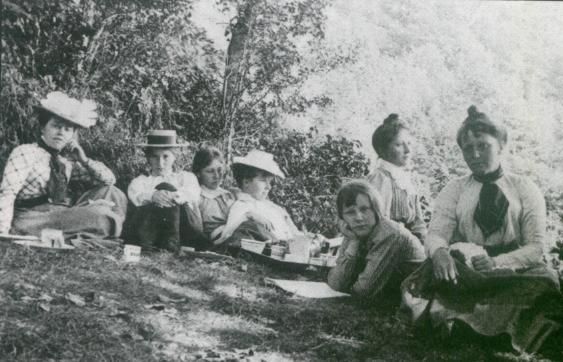 The
seven Chick sisters in a photograph that
Margaret Tomlinson dates "about 1902"
The
seven Chick sisters in a photograph that
Margaret Tomlinson dates "about 1902"
7.7.1902 Harriette Chick's diary speaks of taking a panorama view of a group (not the above) and then going to investigate some pools. They walked home by the shore. Cam [?] expiated on botany in general and Mr Blackman's botany in particular. Harriette said she had chosen the title for her papers for the New Phytologist. She would write about "Decadence in Modern Botany. Its Causes - Extent and Suggested Cure".
Tuesday 6.7.1902 Harriette Chick's diary: "And I daresay you wouldn't think the Chick family Scorners and Scoffers - But they are."
15.7.1902: Harriette Chick's diary: She and friends attend Richard Wagner's Tristan und Isolde in London. Sung in German with a printed English translation for the audience.
|
1902 Charlotte Mew's poem
Song in
Temple Bar volume 126, page 230
"I left my love at your behest, I waved your little boughs of yew, But, Sorrow, Sorrow, let me rest, For oh! I cannot sleep with you! |
|
| 1902 Charlotte Mew's poem Not for That City in Temple Bar volume 126 page 600 |
|
15.11.1902
Freda: "She is still listless and apathetic and absolutely never
speaks: She needs the attention of others."
22.12.1902 Last experimental date on Harriette Chick's unicellular
green alga research [Which I take to be at Liverpool - But it may also have
been in London]. The first experimental date is
21.10.1901
| 1903 | Charlotte 33-34 |
|
|
January: An Open Door published - The Minnow Fishers published - May: A White Night - Freda kicking - Edith Chick and Marie Stopes on Palaeobotany in New Phytologist - June?: The Little Portress - July: In Devon for the Marriage of Edith Chick and Arthur Tansley - August: Freda a silent, demented patient, in fair health, who sometimes kicks - Autumn: Death of Uncle Richard - December: Proposal for book of Emily Brontë poems |
1903 was the first year of The London Calendar, with an original print of London, produced by William Monk and Elkin Mathews, Vigo Street. During the year, Charlotte approached Elkin Mathews with a proposal - (External link to MOTCO site)
| January 1903 Charlotte Mew's story An Open Door in Temple Bar volume 127 pages 71-91. See above - 1895 and 1898 |
|
31.1.1903 Issue of Outlook or The Outlook in which Val Warner found The Minnow Fishers. I think this must be the magazine that began as New Review in 1889 rather than the one that started in 1870. The 1870 magazine had a family and religious orientation that does not fit the amoral fishers for minnows. George Wyndham is listed as editor of The Outlook throughout its life with that title (1897-1928). It was published in London.
28.2.1903
Freda: "She never speaks and never moves unless told to.
Requires care from others Her health is fair."
Harriette Chick "A Study of a unicellular green alga, occurring in polluted water, with especial reference to its nitrogenous metabolism" Proceedings of the Royal Society, vol.71, 1903, pp.459-476, one plate. Communicated by Professor Rubert Boyce, FRS, Received February 28 - Read March 12 1903. From the Thompson Yates Laboratories, University of Liverpool. [Harriette identified a variety of green algae that she called Chlorella pyrenoidosa. It is sometimes called Chlorella pyrenoidosa chick. Chlorella was discovered in 1890 by the Dutch microbiologist, Martinus Beijernick (1851-1931) [Wikipedia] Harriette distinguished Chlorella pyrenoidosa from Chlorella vulgaris, discovered by Beijernick] Richard Ford has a copy inscribed by Harriette Chick, extensively annotated with corrections and additions, including long passages crossed out, and with manuscript pages in her hand inserted. This could be preparation, by Harriette, for her D.Sc.
|
17.3.1903 Harriette (1905, p.258) gives this date for a measurement of the flow through some experimental filters at Munich. 1.4.1903 Harriette Chick set up the filters for her (main) sewage experiment in Munich. Last reading 13.6.1903 (1905, p.261) A table on page 263 gives readings from 24.6.1903 to 27.11.1903 (according to the heading), but actually includes a reading for 20.1.1904. Table on page 265 has experiments that cover 17.12.1903 to 3.2.1904. Sunday April 12th [1903] It has rained today as never before in Austria, I think.. Thursday April 23rd [1903] Feeling slightly ill and also very much bereft. Cheered by the sight of my Institut particularly Here Dokter who is very English in appearance - |
May 1903 edition of
New Phytologist, 2 (1903) contained
by "Edith Chick, B.SC,
Quain Student in Botany, University College, London, pp 83-91 "The Seedling
of Terreya Myristica" [Nutmeg seedlings] -
(online), followed by "M.C. Stopes
(University College, London)"
[Marie Carmichael Stopes]
On the Leaf-structure of Cordaites, pages 91-97. Edith Chick thanked
Professor Oliver for the help and interest he had taken in her
work and
Marie Stopes was "indebted to Professor F. W. Oliver for the use of the
fossil slides, and for the interest he has shewn in their description.
The sections figured are all in the collection belonging to the
Botanical Department of University College". Edith and Marie are said to
have been friends.
| May 1903 Charlotte Mew's story A White Night in Temple Bar volume 127 pages 625-639. "some pride of spirit or of race bore her honourably through. She had... clogged the wheels of an inflexible machine... the speck of dust she knew herself to be... was... swept away." [Reprinted 1998] |
|
7.5.1903
Freda: "She sometimes kicks people but beyond that never
voluntarily moves. In fair health"
| June? 1903 Charlotte Mew's poem: The Little Portress (St Gildas de Rhuys) in Temple Bar volume 128 pages 88-89. The little portress is the character in "Notes in a Brittany Convent" who provides the counter-balance to the modern world of questioning science, humour, dilettantism and romance. |
|
Arthur Tansley and Edith Chick in Annals of Botany June 1903; os-17: pages 493 - 510. "On the Structure of Schizaea malaccana" [a fern] - 1911 Encyclopedia on Pteridophyta - 1911 Encyclopedia on Palaeobotany
|
Harriette Chick's
diary:
Wednesday 1.7.1903 [Munich] First event of importance, letter announcing arrival of Herr Padre, 4.p.m. arrival of Herr Padre Saturday 4.7.1903 Had an excellent meal from Frau Schlegel. Somehow I think Munchen makes you think very much of food
Branscombe wedding
Thursday 30.7.1903 Edith Chick married Arthur George Tansley at Branscombe Church (free BMD: Honiton in Devon). (Date from Dorothy Lumb. Rest from Family Bible (Watts boxes). Harriette Chick's diary [Loose sheets with] Sunday 26.7.1903 Harriette Chick, on paper headed "Hazelwood, Branscombe, Axminster" "Telegrams, Branscombe, Beer" "Got home from Germany to find the house much excited [another word]. Inspected the wedding presents and the 14 serviette rings and in the afternoon Stopey and Norman and Lot came to tea. Stopey was rather sweet on the subject of the D.Sc. amusingly so. Norman finally went off at about seven and Lot stayed. E's clothes etc the absorbing subject of conversation." Monday 27.7.1903 They went shopping. At 3pm "A select party saw the bride off, including Aunty Smith, Lot..." Mention of "dress boxes" Tuesday 28.7.1903 Packed hard and then to Mrs P. where we were fitted in a most awful rush and then went is a special train figuratively to the Brocate where we lunched with Cam, drank Munchester beer with all due rites and ceremonies - awful day with rain and then caught the 3.0 train at Wolerton [?] Journey down uneventful except for a momentary scare when I thought I saw the name of Coopar [??] hanging out of a window at Seaton Junction, but it was a mistake. Wednesday 29.7.1903 Showery day again, but we picnicked in true Chickian way on Colzton moors whilst we got heather to decorate the house, ate bread and cheese, got flowers, sat in the road and behaved in a most unbecoming manner - especially the bride. At night in the pouring rain Mrs Cane [?] and Mrs Sutton and others arrived. Weather prospects awful.
Thursday 30.7.1903
Day broke looking promising. Bride has been sleeping most disgracefully
well. Can't realize there is to be a wedding today. It seems quite unlike
it somehow. Entertaining Mrs Cane [?], getting the brides boots heeled and
fetched and decorating the house with flowers took up all of the [day
deleted] morning. The village is en fete, banners, flags [word] an arch. A
slight dampener was cast over our otherwise glad hearts by a letter from
Exeter telling us H. Chick was coming over [word] !!
[Lunch and deleted] We dressed, [word] and then oversaw [?] the bride - all
went very well. But the bride was a little disconcerted to find that the
intention was for the Exeter contingent to hurry back from church and "play
the happy pair in" with a wedding march [?] or some such thing. -
E. said
"something" and Mary finally attacked Pop and got the thing vetoed to our
great delight - Then Mary and I got into an empty carriage.
Harriette Chick's D.Sc (Doctor of Science)
Hugh Sinclair (1986) says
Harriette obtained her "London D.Sc" in 1904. However
her London University Student Index
Card shows it as 1903. She was approaching thirty years of age.
See
Wikipedia on Doctor of Science. [At this time
her research was based at Liverpool University under Professor Rupert
Boyce?] -
See above on alga
|
30.8.1903
Freda: "Quiet demented patient. Never speaks. At times kicks. In
fair health."
The death of Richard Mew, aged 78, was registered Isle of Wight vol.2b page 264 in the October-December quarter of 1903. There is no mention of this event in Freda's case notes, but there never is mention of external events.
20.12.1903
Freda: "In a state of advanced dementia, requiring to be cared
for in every way. She never voluntarily speaks. Is in fair health."
29.12 - 1903? [The year is not stated] A letter from Charlotte M.
Mew to
Elkin Mathews, Esq. "venturing to submit to you a MS on the
Poems of Emily Brontë which I designed as an introduction
to a separate re-publication of her poems which as yet are I believe only
procurable - with those of her sisters - at the end of the volume of The
Professor... if the idea of reprinting Emily Brontë's poems with
it should at all commend itself to you." She enclosed a postage stamp for
the return of the manuscript if found unsuitable.
Mary Davidow (1960 page 285)
| 1904 | Charlotte 34-35 |
|
|
January: Mademoiselle The Camden art studio and Paris - August: The Poems of Emily Brontë - A change of focus, Charlotte moves from the study of various forms of resignation to the study of determined "pagan" struggle - Freda demented and spiteful |
| January 1904 Charlotte Mew's story Mademoiselle in Temple Bar volume 129 pages 90-101 - In which Mademoiselle and Monsieur dissect English culture from a studio in Camden - which may suggest Anne was there before Hogarth. |
|
20.4.1904
Freda: "Always sits in the same position. Never speaks. Is at
times spiteful kicking other patients and staff. Health fair."
10.3.1904: Marie Stopes, writing to her mother from Munich:
"Dear Mother ... [Kenjiro Fujii] and I were to go out together on the Sunday ... the Chicks were to have met us and all gone together but at the station they never turned up so we had to go without them." (British Library, Stopes Papers quoted Ruth Hall 1977, page 49)
20.7.1904
Freda: "Utterly demented. Takes no notice of anything and has to
be looked after by others. Health fair."
| August 1904 Charlotte Mew's essay The Poems of Emily Brontë in Temple Bar volume 130. |
|
|
"It was with the face of a pagan warrior
that
she confronted life and met death". |
|
Brittany
Field Trips
September 1904 Francis Wall Oliver's first field trip with students to the Brittany coast to study salt marsh vegetation. The trips were to Bouche d'Erquy (Wikipedia francais). The trips were reported in New Phytologist, including The Bouche D'Erquy in 1907 by F.W. Oliver (Volume 6, Issue 9, Page 244 - November 1907 and The Bouche D'Erquy in 1908 by T.G. Hill in Volume 8, issue 3, Page 97 in March 1909
Francis Wall
Oliver and
Arthur George Tansley
"Methods of surveying vegetation on a
large scale" -
The New Phytologist, volume 3, nos. 9 and
10, November
and
December 1904.
"The methods, both of which we have recently used with success in the survey of a circumscribed salt-marsh occupying the floor of an estuary called the Bouche d'Erquy on the north coast of Brittany, may be termed the "Method of Squares" and the "Gridiron Method " respectively." The September excursions to the Bouche d'Erquy continued until 1908. "after 1910" Oliver "annually took his honours students for a fortnight to Blackney Point, Norfolk, to study plant life in relation to habitat conditions and raised the funds to erect the field laboratory there" (Edward Salisbury in DNB) Edward James Salisbury was a collaborator in these field trips and the likely author of the following limerick about Oliver:
A certain Professor of Botany
(Peder Anker, 2001, pages 16 and 256) "In 1904, A G Tansley and Robert Smith among others formed the Central Committee for the Survey and Study of British Vegetation, which became the British Ecological Society in 1913" (David Evans 1986, page 18)
|
16.10.1904
Freda: No change whatever. Demented and spiteful. Health fair.
Also sometime in 1904: "'General Intelligence', Objectively Determined and Measured" by Charles Spearman published American Journal of Psychology 15, 201-293. (External link to web copy)
| 1905 | Charlotte 35-36 |
|
|
January: Mark Stafford's Wife - April: Freda incontinent - November: The Country Sunday - December: The London Sunday |
| January 1905 Charlotte Mew's story: Mark Stafford's Wife in Temple Bar volume 131 pages 90-101 |
|
21.1.1905
Freda: "Sits in the same place staring in front of her, never
speaking. [Unreadable word] spiteful at times. In fair health.
18.4.1905
Freda: "Stuporous [unreadable word] always in one place. Does
not speak or take any interest [?] when addressed [?]. Dirty in habits. In
fair health."
11.5.1905 Professor H. Marshall Ward, FRS, read to the Royal Society a paper by Harriette Chick, D.Sc., received 1.4.1905. "A Study of the Process of Nitrification with Reference to the Purification of Sewage" Later published in the Proceedings of the Royal Society of London. Series B, Containing Papers of a Biological Character (1905-1934) Issue Volume 77, Number 517. 26.2.1906
May/June 1905 Harriette Chick "The biological limitations of the method of pure culture" - The New Phytologist, volume 4, nos. 5 & 6, May and June 1905, pp.120-123). - Online - download copy - - (Richard Ford) -
22.7.1905
Freda: "Takes no notice when spoken to, sitting in one place
staring in front of her. In fair health."
20.9.1905 Birth of a Margaret Tansley to Edith and Arthur Tansley. (Information from Dorothy Lumb. Birth registered Pancras 1b 43, December quarter 1905. She became Margaret Tomlinson, the Chick biographer, and died 9.10.1997. She was educated at the Perse School in Cambridge and Newnham, from which she graduated in 1927. She studied architecture, married her tutor and had a daughter, Anna. She was a Director of Samuel Chick Limited from about 1948 to 1956 or later. As well as her Director's fee, she received a small salary. She worked on the Victoria County History (from 1949?), photographing buildings, investigating and writing articles. After her retirement she researched and wrote the Chick family history. (external link).
20.10.1905
Freda: [unreadable word] always in one place never speaking - At
time spiteful to those near her. Dirty in habits. In fair health.
| November 1905 Charlotte Mew's essay The Country Sunday in Temple Bar volume 132. |
|
| December 1905 Charlotte Mew's essay The London Sunday in Temple Bar volume 132. Also published in Living Age volume 248 on 27.1.1906 pages 240-243 |
|
| 1906 | Charlotte 36-37 |
|
|
No regular outlet for Charlotte's writing after Temple Bar until 1912 - Freda doubly incontinent (July) and getting much thinner (October) |
"In the six year's before ...
"The Farmer's Bride" [February 1912] nothing is known about
her life except she published
one other poem [Requiescat 1909] and had
a holiday in Dieppe [1909, but actually
Brittany]
with her friend Elsie O'Keeffe (born Millard) [more likely Elsie Chick] and
in Boulogne [1911] with her
sister Anne."
[Val Warner,
1997, page 43]
Mary Davidow (1960 page 41) says "Letters indicate that
Charlotte Mew was
in Brittany
in 1909, in
Boulogne in 1911, in
Dieppe, or thereabouts in 1913, and in
Dieppe again in 1914.
January 1906 Temple Bar: Number one of the new series, brought out by Macmillan. Number 10 was published in October. Charlotte Mew does not appear to have been published in the new series.
22.1.1906
Freda: "Always sits in the same place - Never speaks or answers
when spoken to. Is at all times unemployed - spiteful - In fair health."
17.4.1906
Freda: "Sits doubled up in the chair and resists any form of
examination - Requires attention of others. In poor health"
20.7.1906
Freda: "Never speaks or answers when addressed - Wet and dirty
and often very spiteful. In fair health.
Harriette Chick Notebook with travel journal of visit to Germany 9.8.1906 to 8.9.1906. Several blank pages between entries for 20.8.1906 and 21.8.1906. Some financial notes at the back. Wellcome Library
16.10.1906
Freda: "Requires constant attention of others which she resists.
Wet and dirty. Has recently been getting much thinner although no organic
disease can be discovered, but examination is very difficult"
| 1907 | Charlotte 37-38 |
|
|
Freda confined to bed from weakness and wasting |
1907-1914 The construction of King Edward 8th's Galleries, fronting Montague Place, as an extension to the British Museum. The felling of a tree, over several days, was watched by Charlotte Mew - perhaps in 1912, or the spring of 1913. The British Museum had bought all the surronding properties with a view to a massive expansion - But was stopped by protection orders.
25.1.1907
Freda: "Stuporous, dirty in habits, never speaks or answers when
addressed. Resists everything done to her by kicking and biting - Confined
to bed from weakness and wasting - In poor health."
20.4.1907
Freda: "Lies curled up in bed and never speaks. Bites at those
who come near her. In poor health."
17.7.1907
Freda: "Has to have everything done for her by others. Spiteful
and demented. In poor health [unreadable word/words]"
18.10.1907
Freda: "Eats ravenously like an animal. Bites and kicks at
anyone coming near. Extremely emaciated."
| 1908 | Charlotte 38-39 |
|
|
Freda curled up in feeble health |
|
Cinematograph:
11.1.1908 Panic at cinematographic exhibition at Barnsley, 16 children killed. 13.1.1908 cinematograph explosion at Boyestown, Pennsylvania, over 160 killed. The 1911 Encyclopedia article Cinematograph says it "enables living or animated pictures of such subjects as an army on the march, or an express train at full speed, to be presented with marvellous distinctness and completeness of detail. Machines of this kind have been devised in enormous numbers and used for purposes of amusement under names (bioscope, biograph, kinetoscope, mutograph, &c.) formed chiefly from combinations of Greek and Latin words for life, movement, change, &c., with suffixes taken from [words meaning "to see" or "to depict"]. They have also been combined with phonographic apparatus, so that, for example, the music of a dance and the motions of the dancer are simultaneously reproduced to ear and eye. But when they are used in public places of entertainment, owing to the extreme inflammability of the celluloid film and its employment in close proximity to a powerful source of light and heat, such as is required if the pictures are to show brightly on the screen, precautions must be taken to prevent, as far as possible, the heat rays from reaching it, and effective means must be provided to extinguish it should it take fire. The production of films composed of non-inflammable material has also engaged the attention of inventors." The Cinematograph
that Charlotte Mew attended
(Bastille day 1909)
|
This, and/or another article later in the year by Harriette and Charles Martin (Journal of Hygiene 1908; 8: pages 654-697 ) publicised the Chick-Martin Test of the efficiency of disinfectants. Their original method contaminated water containing the typhoid bacteria with 3% dried human faeces and was carried out for 30 minutes. The previous (Rideal- Walker 1903) method had tested the death rate of typhoid bacteria in distilled water for shorter, variable, periods up to 15 minutes. The killing power of commercial disinfectants was much greater in distilled water than in the dirty environments they were supposed to work in and the Rideal-Walker test discriminated against disinfectants that took longer to work. Nowadays, the Chick-Martin Test does not use faeces. (External link - See under "Method")
27.1.1908
Freda: "Lies curled up and will not say a word or take any
notice when addressed. In feeble health." [No further entry
until October]
24.3.1908 Votes for Women (2, page 211) contained "How it Strikes a Mere Novelist" by May Sinclair - (Suzanne Raitt 2000, p.112)
Berlin - 21.8.1908 - Letter from Karl Abraham to Sigmund Freud: "Dear
Professor, Things are moving! On the 27th the Berlin Psycho-Analytic
Society will meet for the first time. For the time being, the following
gentlemen (all of them physicians) will take part: Hirschfeld, Iwan Bloch,
Julius-burger, and Koerber (Chairman of the Monistenbund). I believe others
will soon join in. Dr Juliusburger in particular is very keen; he is
Oberarzt [senior staff physician] in a private institution and is
introducing psychoanalysis in spite of his superior's opposition.
(external source)
28.10.1908
Freda: "Exactly the same as in
above note. Feeble health."
| 1909 | Charlotte 39-40 |
|
|
February: Freda strikes - Freda bites - June/July: Charlotte in Brittany with Elsie Chick - Letters to Ethel Oliver - August: Freda in the airing court - November: Freda up daily and is all the better for it - Requiescat published in The Nation - Ella D'Arcy thinks more beautiful than any Brontë poem - |
8.2.1909
Freda: "She takes no notice when she is spoken to. Is very
spiteful and struck one of the nurses yesterday out of spite - habits dirty
- health poor."
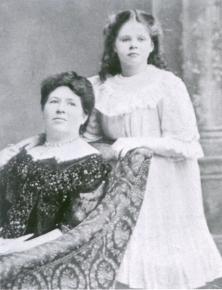
|
March 1909
Catherine Amy Dawson Scott "...since
Henry's death. I have got
back my power of writing poetry and grown a great love of Cornwall. I have
also the greatest desire to push his poetry to greater recognition. Since
he went on, I have been to Cornwall 4 times... I am also writing about
Cornwall. It is almost as if he had combined with me in my work and that my
new love of his country was in some way due to him. I have lately been very
conscious of this. I long for Cornish seas and air..."
Catherine and Marjorie (age 11) Dawson Scott in 1909. They met Charlotte Mew in May 1912. In her eighties, Marjorie wrote of Charlotte "I remember clearly the admiration and excitement that surrounded her; in my teens I loved her and her poems" |
10.5.1909
Freda: "Lies in bed and never speaks - is spiteful and bites
strikes, at [times?]. Feeble health."
Sunday 4.7.1909 Guingamp procession?
Letters from Charlotte Mew to
Ethel Oliver: ("My dear")
The letters refer to "Elsie" as Charlotte's companion. Mary Davidow
(page 71) says this was
Elsie O'Keefe. Elsie O'Keefe had two children by 1913, but there is no mention of Elsie's family in
the letters. Another possibility is Elsie Chick. Elsie sends her love to Ethel at the
end
of two of the letters, including thanks for a card.
Mary Davidow identifies a
"Mrs Frank" as the wife of
Francis Wall Oliver. There is mention (page
295) of a "lady artist" complaining about children making a nuisance, with
whom
"Winifred ought to sympathize!". There is no clear mention of
Elsie and art - Elsie had heard "the Bazaar realized £2,000 - and the
expenses were £800" (page 286). Although this could have been an art
bazaar, it could also have been a bazaar to raise funds for building
restoration - or something like that. Charlotte (page 291) has had a card
from Ella
(Ella D'Arcy?) at Landernean saying she is going to stay
somewhere in Beaumont le Roger: "I hope the experience is happier than
ours". She has also heard from
Maggie.
Tuesday 6.7.1909 from Hotel de Bretagne, Le Conquet [
Buffalo Collection -
Mary Davidow 1960 pp 286-288]
(map). They had crossed to St Malo
(map)
- went by
train to Dinan
(map)
- to Guingamp
(map)
next day - Le Conquet - Brest
(map)
- Le Conquet
(map)
(letter). They plan to go on to Landernean - Quimper
(map) (Sunday or Monday) and
Audieme.
Wednesday 14.7.1909 from Hotel du Lion
d'or, Quimper
(map).
[
Buffalo Collection -
Mary Davidow 1960 pp 288-292]
This includes
automobiles and
Bastille Day
celebrations with
a cinematograph.
Saturday 24.7.1909 from Hotel du
Commerce, Audierne
(map). [
Buffalo Collection -
Mary Davidow 1960 pp 292-295]
17.8.1909
Freda: "Sits in airing court with a fixed stare - never speaks -
is spiteful at times."
13.11.1909 Charlotte Mew's poem
Requiescat published in
The Nation. Also published in
Living Age 2.4.1910 volume 265, page 2.
It was republished in
The Rambling Sailor (1929)
Requiescat is also available on
the web in
the reservoir to John Fraser's Voices from the cave of
Being -
(archive copy)
17.11.1909
Freda: "Has a funny way of getting up suddenly and dancing
across room or airing court - has been up daily and is all the better for
it."
December 1909 Marriage of
Margaret Robinson to Edward Thomas Browne. "On his marriage...
he made his home at "Anglefield", Berkhampstead, a house with a good garden
on the outskirts of the town. Here he built a special laboratory for his
work, and for the housing of his numerous collections and the fine special
library on
coelenterates which he had got together" (1938 obituary). The
National
Marine Biological Library at Plymouth have several
papers published by Margaret Robinson, University
College London, starting in 1892, but ending in 1910.
The Dawson Scotts bought a house in Southall. They moved
there from Cowes on the Isle of Wight.
May Sinclair appears to have spent most of the month on
Evelyn Underhill's yacht (borrowed from her), off the coast of
Dorset. May Sinclair invited
Thomas Hardy to join her party, but he was in London, occupied with an
operatic
production of Tess of the d'Urbervilles. (Suzanne Raitt 2000,
p.114. See also p.236)
"Looking through some of
Ella's old letters, I find she wrote
to me three about the Requiescat... she had seen it in The Nation
and wrote at first ironically - Thanking me for sending it to her (very
likely!
as she'd always spit on every thing I'd done-!) and adding 'it goes into my
private anthology'. And in the next, 'But you are a poet which I did not
know and beg you very earnestly - not to neglect the finest of all
gifts. The poem was a sight realer and more beautiful than any by
the Brontë sisters whose poetical genius you think so much
of -
go on
producing"
(CM/CADS12.5.1914
- Penelope Fitzgerald
1988 p.96).
| 1910 | Charlotte 40-41 |
|
|
Between 1910 and 1915 - Anne moves into her 64 Charlotte Street studio |
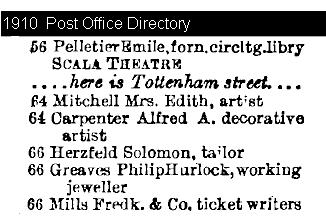
|
Some time between 1910 and 1915, Miss Anne Mew, artist, appeared in the
Post Office Directory at 64 Charlotte Street. This is on the east side of
Charlotte Street and the north corner of Tottenham Street.
(map)
Penelope Fitzgerald 1988 p.95 says that in 1909 Anne Mew was able to rent "6 Hogarth Studios, 64 Charlotte Street". - The full address is "Charlotte Street, Fitzroy Square". The district (after Anne and Charlotte's deaths) became known as Fitzrovia (External link). 64 is someway south of the square, which is where Horatio Cowan had his surgery. This external panorama circles Fitzroy Square and the trees in the gardens.
|
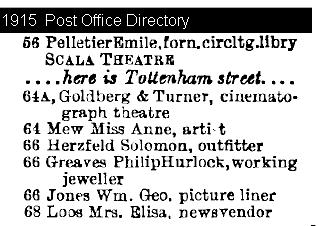
|
In 1910, Harriette
Chick
moved from studying the death rate of bacteria in disinfectant to the death
rate of bacteria in hot water. She showed that both processes followed a
mathematical formula similar to one for chemical processes. She theorised
that the sudden death of the bacteria at a certain temperature was due to
the
coagulation of their proteins, and that this was a similar
process to
the white of an egg setting as it is boiled. In 1910, 1911 and 1912,
Harriete Chick and Charles Martin published a series of articles in the
Journal of Physiology "On the "Heat" Coagulation of Proteins". (See
Wikipedia)
In her 1971 history, Harriette explains the philosophic, as well as the scientific, significance of this work:
"The importance of the work done by Chick and Martin was their demonstration that the heat coagulation of protein was an orderly process governed by established chemical laws; it removed the death of bacteria by heat or disinfection from the realms of mysterious vital forces to that of a phsico-chemical reaction. The way was thus paved for the development by which proteins became regarded as giant molecules which with suitable techniques could be studied in the laboratory as profitably as simple salts" (Chick, Hume, Macfarlane 1971, p.92 The effort was to explain life (and death) in terms familiar to physics and chemistry. A similar objective was pursued by Edith Chick's husband Arthur Tansley in his interpretation of Freudian psychology as a system of energy forces and in his concept of the ecosystem. This is just one of the world-views that Charlotte Mew describes and analyses. Death is like a candle being snuffed out. But, in the poem for Edith Chick (An Ending) this metaphor is turned away from phsico-chemical reactions: life's candle is "just a spark alight for her" and God knows "what's in a look you'd go to Hell to get again". Charlotte described the "bacteriologist"'s approach to religion in Notes in a Brittany Convent in 1901, contrasting it with the unquestining approach of the The Little Portress. The bacteriologist "drew analogies and formulated theories" to explain the old religion. In a similar vein, Charlotte Mew described an old unquestioning society based on religion as operating as an inflexible machine. |
| 1911 | Charlotte 41-42 |
|
|
June: Charlotte and Anne in Boulogne - Letter to Ethel Oliver |
Section 1.1. "The Point of Departure" begins "The most highly developed branches of the human family have in common one peculiar characteristic. They tend to produce - sporadically it is true, and often in the teeth of adverse external circumstances - a curious and definite type of personality; a type which refuses to be satisfied with that which other men call experience, and is inclined, in the words of its enemies, to 'deny the world in order that it may find reality'."
29.4.1911
William Elijah Chick born. His grandparents
were
Elijah (1852-1921) and Elizabeth Chick
(1881 census), who were the brother and
sister in law of
Samuel Chick, father of the Chick sisters. His parents were
William Chick (born about 1878) and Elizabeth (nee House). William the
father was the second of eight children. Two sisters were born after him
before Quartus. The oldest brother Elijah, born 1876, died aged 4. The
birth of "Elijah Quartus Chick" was registered in Honiton (5b 30) in the
July-September quarter of 1882 - But he was known in the family as just
Quartus. (Information mostly from Dorothy Lumb).
27.6.1911 Letter from Charlotte Mew to
Ethel Oliver ("My dear"). From "Café Belle
Vue", 10 Place
Frederic
Sauvage, Boulogne". Charlotte and Anne are there. [
Buffalo Collection -
Mary Davidow 1960 pp 296-298]
July 1911
Frances Chick married
S H Wood at Branscombe Wesleyan Chapel
|
The International Phytogeographical Excursion in the British Isles
Tuesday 1.8.1911 - Wednesday 6.9.1911 Report by Arthur Tansley in New Phytologist 10 (7-8), 271-291 which online listing dates "July 1811". Download report Excursion started at Cambridge. On Wednesday 2.8.1911 the party went by punts and canoes to Grantchester where Edith and Arthur Tansley gave them lunch. After a tour of Cambridge Colleges, Professor Albert Charles Seward and Frederick Frost Blackman gave them dinner in St John's College. Excursion organised by the Central Committee for the Survey of British Vegetation formed (in 1904?) by Arthur Tansley. Its tour of the British Isles was financed by George Claridge Druce. Committee members were Francis John Lewis, Charles Moss, Francis Wall Oliver, Marietta Pallis, W. Munn Rankin, and W.G. Smith (note 64, p. 257). The Committee prepared a book for the visitors which was then (late summer 1911) published as Types of British Vegetation. By members of the Central Committee for the Survey and Study of British Vegetation: edited by A. G. Tansley ... With 36 plates and 21 figures in the text. Cambridge University Press. 20 introductory pages, 416 main pages. The following summary (from (Peder Anker, 2001, page 19) of the chapter on forests is relevant to Charlotte Mew's "Men and Trees"
"The British Isles was originally covered by forests", the authors explain, but with the introduction of the human community the forests gradually disappeared, since the human community was "the natural and inevitable enemy of the tree communities of the countries it inhabits" (pages 65 and 66). The formation and degeneration of the oak forests and woodland occupy a good part of the book, which established that a forest climax "before the beginning of the historical period" had "degenerated into heathland during the last few centuries" (pages 91 and 92). Subordinate, retrogressive, or degenerating associations of woodland had been brought about by too felling of trees, grazing, and, above all, "the absence of any definite system of re-planting" (pages 130) The overseas guests included Frederic Clements and Mrs Clements of Minneapolis and Henry Cowles and Mrs Cowles of Chicago. As a result of the excursion "Professors Clements and Cowles... decided to arrange an international excursion in the States in August and September, 1913". Excursions in Switzerland, Belgium and Denmark, planned to coincide with the International Congress planned for London in 1915, were presumably exploded by the world war. |
Henry Noel Brailsford (1873-1958) was a journalist and socialist author. Jessie Murray met May Sinclair through the suffrage movement. In 1922 Henry Noel Brailsford launched the The New Leader, a weekly paper of the Independent Labour Party, containing a poem by Walter de la Mare and one by Charlotte Mew.
|
C.A. Dawson Scott also published Mrs Noakes, An Ordinary Woman in
1911
C.A. Dawson Scott, Nooks and Corners of Cornwall published Eveleigh Nash, London. no date. It was mentioned in the Irish "Archaeological and Literary Miscellany", edited by the Rev. P. Power, in what appears to be its 1912 edition "From England come three interesting works on British Antiquities: "Nooks and Corners in Cornwall by Dawson Scott (Eveleigh Nash, London), "The Ruined Temple of Stonehenge" by Edgar Barclay (London, Nisbett & Co., Ltd.) [Published 1911], and Part I., Vol, I., of the "Proceedings of the Prehistoric Society of East Anglia" (London, H. R. Lewis). The first gives a useful resume of the Celtic remains of the Cornish peninsula..." [see pdf and link page. C.A. Dawson Scott planned a "Nooks and Corners of Devon" in the same series, but it does not appear to have materialised. Nooks and Corners of Cornwall Prehistoric remains, near Padstow, lead Mrs Scott to tell how psychic powers have combined with archaeology to see the distant past. Speaking of Tregudda Gorge (p.55) she says "The Cornish tell strange stories of these places, stories of the 'little people' whom they believe to be fairies, but who are probably the neolithic dwarf race which is said to have inhabited parts of the country. They are also firm believers in psychic faculty, though they call it by other older names". She then tells how a clairvoyant had a prehistoric bone put in his hand and saw "a little brown man dressed in skins" (p.57)... Then, discussing the pre-historic cemetery discovered Helwyn Bay in 1900, she tells how she sent a tooth from it to a friend in London who was to place it in the hand of a clairvoyant. The clairvoyant had visions of the bay in pre-historic times. After discussing the pre-historic tombs of the toe of Cornwall (pp 84-86), Mrs Scott says that "it is hardly a matter for surprise if the people who dwell among these relics of the immemorial past still retain some of the superstitions of their forefathers... To them witches are as real as wreckers, and they cannot believe that the 'little people' - once perhaps inhabiting those subterranean passages and huts - are gone for certain, and for ever.... (pages 86-88 on fairies and mermaids) |
| 1912 | Charlotte 42-43 |
|
|
February: The Farmer's Bride in The Nation March: A new regular outlet for Charlotte's writing in The Englishwoman The Voice - April: Mary Stuart in Fiction May onwards: Catherine Amy Dawson Scott and psychic readings - Charlotte meets Marjorie, Christopher and Toby. Summer: Sees Fontainebleau's forest road? |
|
Children and young people in Charlotte Mew's
life at this time include:
Sylvia Parsons born 1894 Marjorie Scott born December 1898 Christopher Scott born March 1901 (girl) O'Keeffe born 1904 Toby Scott born June 1904 Celia Hill born 1905 - "and the rest" (boy) O'Keeffe born 1908 See - Marjorie's memories May 1912 - Children's party March 1913 See also To a Little Child in Death (1902) - poems for children (1913-1914) - To a Child in Death (1922) - On Youth Struck Down (from an unfinished elegy) Later children Margaret Cockerell born 1908 Christopher Cockerell born 4.6.1910 Katharine Cockerell born summer 1911 |
See Charlotte Mew 1913
Catherine Amy Dawson Scott, A Dream of Daffodils: Last poems by H.D. Lowry (64 pages); arranged for the press by G.E. Matheson and C.A. Dawson Scott; with a memoir by Edgar A. Preston. London : G.J. Glaisher, 1912. - Catherine Amy Dawson Scott Beyond (Poems, 31 pages) London : G. J. Glaisher, 1912.
Freud, S.( 1912). "A note on the unconscious in psychoanalysis". Proceedings of the Society for Psychical Research, 26:312-318 [S.E. 12].
External link: The Putumayo affair - Also see Charlotte Mew 1913
Term Vitamine coined in 1912 by Casimir Funk at the Lister Institute. In a survey of the literature on beriberi, scurvy and pellagra, he used the term for an element he argued was deficient in the diet of sufferers which was vital to life. He also suggested vitamine deficiency was responsible for rickets. Other researchers used the longer term "Accessory Factors in Normal Dietaries" - See Accessory Food Factors Committee 1919
Max von Gruber, Hygiene des Geschlechtslebens [Hygiene of the sex life] Bücherei der Gesundheitspflege Band 13, 5. Auflage, Stuttgart 1912 - (online text in German) - "The most important task of the sons is to produce healthy grandchildren. So regarded, the sex life is not an article of shameless thoughtlessness..."
Jessie Murray took courses in experimental psychology at University College London from 1912 to 1915. She registered for a DSc in the subject in 1918, she died before it was awarded. Elizabeth Valentine by email). - [Suzanne Raitt 2004 says that in 1913, Jessie Murray was taking a "post-graduate" degree in psychology at University College London].
3.2.1912 Charlotte Mew's poem The Farmer's Bride published in The Nation. "When us was wed she turned afraid Of love and me and all things human; Like the shut of a winter's day. Her smile went out, and 'twasn't a woman-- More like a little, frightened fay". [fay = fairy]. "The women say that beasts in stall Look round like children at her call. I've hardly heard her speak at all."
"Many years ago, buying, as was my custom, a copy of The Nation one Saturday morning, I opened it eagerly to see if there might be a poem, and was electrified to find printed there "The Farmer's Bride". This poem I immediately committed to memory, and a year or two later repeated it with enthusiasm to Harold Monro, who had recently opened the Poetry Bookshop..." (Opening paragraph of Alida Monro's memoir, 1953)
Tha Farmer's Bride was, of course, republished in The Farners Bride (1916). It was chosen for Twentieth Century Poetry in 1933 and, possibly, 1929.
March 1912 Charlotte Mew's poem The Voice published in The Englishwoman Volume 13, page 304. With minor modifications, this was re-published as "The Call" in 1929. It is not clear who made the modifications. It is printed as The Call in Collected Poems (1953) (Where is concludes the volume) and Collected Poems and Prose (1981).
April 1912 Charlotte Mew's essay Mary Stuart in Fiction. published in The Englishwoman volume 14. 40
"It is... less on their adventures and achievements than on their power of personification that the survival of great personages depends. So, for all slips of theirs, their poets and their commentators, Jeanne d'Arc still stands for Inspiration, and Mary Magdalen for Devotion, and Mary Stuart for Romance"... But, in "painting her as the woman of one passion" one must not "mistake the passion". She is not an "erotic derelict". A contemporary says: "The thing that most she thirsteth after is Victory, so that for victory's sake payne and perylls semeth pleasant unto her"... "Mary Stuart, rejecting failure, has not gone by. Losing the kingdom she so much coveted, she has captured another in the imagination of posterity. A great achievement gained at the cost of a great disaster. For had she won the crown she fought for, Mary of Scotland and England, setting back the clock for Europe, must have turned to the world another face"
13.5.1912 Charlotte Mew met
Catherine Amy Dawson Scott,
who lived, with
Horatio F.N. Scott, her
doctor husband,
in Southall.
(Just west of the Hanwell County Asylum).
In 1926 Catherine
Dawson Scott published
a book of spiritualist messages,
with an introduction by
May Sinclair. Her sessions at Southall, where
Charlotte was a subject, may have been as much an exploration of mind and
body issues as literary events.
"In May 1912 Sappho met Charlotte Mew, described her as 'an imp with brains' invited her to tea and, as soon as she had read some of her verse, became an ardent admirer. For two years, until July 1914, Sappho's and Charlotte's friendship was warm and, since she liked children, it spilled over into the poet's friendship with us, so that I, then 13, [in December 1911] remember her very well. She was a queer, elfin like woman, shy and yet gay when she felt at ease, but often abrupt, 'farouche' and obstinate, and she could be downright rude, yet was attractive and loveable too. As she got to know us, she several times took us all three to the Zoo, or the Coliseum... and we were delighted to go. (Marjorie Watts 1987, p.55) .... Between May 1912 and July 1914 Sappho received 23 letters from Charlotte. Then the correspondence ceased abruptly, and I think the reason is clear. Charlotte was a lesbian, and Sappho was unaware of this." (Marjorie Watts 1989, p.58)
|
According to Penelope Fitzgerald
1988 (p.112), as a result of public readings of her poems at Mrs
Dawson Scott's house,
"Charlotte, by the end of 1912, was in a
modest way becoming one of the known" However, she says that "All details
about these reading are from
Mrs Dawson Scott's diaries for 1913" (Penelope Fitzgerald
1988 p.273). Charlotte
(in March 1913) says that publication in The Englishwoman
is making her known.
Penelope Fitzgerald 1988 p.111 gives this description of the readings: Charlotte "would never begin until she felt like it. Once she got started... Charlotte seemed possessed, and seemed not so much too be acting or reciting as a medium's body taken over by a distinct personality. She made slight gestures and used strange intonations at times, tones that were not in her usual speaking range. During In Nunhead Cemetery Sappho had 'to pinch herself black and blue'... to keep back the tears... At the end Charlotte gave her characteristic toss of the head... the painter Kathy Giles, took this as a signal and asked some questions, but Charlotte, looking over her head into the distance, seemed hardly conscious of them, and Miss Giles was told "she's not here yet". Freud's 1909 lectures repeatedly use the word "absence" to describe a certain hysterical state. This is the (French) word Joseph Breuer used for the states that patient "Anna O" (Bertha Pappenheim) went into in the early 1880s. The first Breuer and Freud paper was published in Vienna in January 1893. It was first commented on in Britain, a few months later, by Frederic William Henry Myers (1843-1901) of the Society for Psychical Research (Which May Sinclair joined in 1914). Myers related the changed states of consciousness found in hysteria, hypnosis and psychical phenomena. Myers suggested several levels of "subliminal" consciousness that could receive information inaccessible to the "supraliminal" (conscious) mind. (See R. D. Hinshelwood's Psychoanalysis In Britain) |
June 1912? At some time before February 1913, Charlotte was in a village near Fontainebleau whose road through the forest inspired a passage in Men and Trees (March 1913) and her poem The Forest Road
1.7.1912 First Royal Command Variety Performance took place at the Palace Theatre, London, in the presence of King George 5th and Queen Mary. Famous musical hall performers appearing included "little Tich" (Harry Relph). I do not know if Margaret Cooper accompanied at the piano, but in July 1913 Charlotte Mew suggested Catherine Dawson Scott was mistaking her for little Tich or Margaret Cooper at the piano
| 1913 | Charlotte 43-44 |
|
|
Anne and Charlotte on the underground - Charlotte introduced to May Sinclair - February: The Changeling, a poem for children - Men and Trees 1 - March: Letter to Mrs Hill - studio At Home - Men and Trees 2 - Exspecto Resurrectionem - June: Charlotte in Dieppe writing The Fête - July: Letter from May Sinclair mentions Charlotte's play and compares her poems to D.H. Lawrence - Letter to Mrs Hill discussing Fame; The Quiet House; Ken and In Nunhead Cemetery - Charlotte, with May Sinclair's help, seeking publication - Letter from May Sinclair mentions Pêcheresse; The Sunlit House; Ken; In Nunhead Cemetery; The Quiet House; and Beside the Bed - October: An Old Servant - November: Péri en Mer - Medico-Psychological Clinic - December: embroidery for May at Christmas |
I am not clear what she bases this on - But it may refer specifically
to Charlotte's poetry and assume that she wrote her poems complete shortly
before we read about them in a letter or read them in a publication. If
there was an intensely creative period, would it not stretch from
1912 to
1916? And how do we deal with the problem
(which Val Warner herself identifies) that we know so little about the
period after Temple Bar
closed and before The Farmers
Bride was published?
|
"By January 1913 the Poetry Bookshop, Georgian Poetry, Poetry and Drama,
and
the Little Theatre were all operational. For the next few years the Poetry
Bookshop was the focus of new poetry. Also in 1913
Harold Monro met
Alida Klemantaski..."
(Knitting Circle biography).
See November 1915 -
Wikipedia article -
Devonshire Street is now Boswell Street -
(map)
weblink with Poetry Bookshop picture - Bob Blair's Geocities Pages has online text of Georgian Poetry March 1913 advertisement in The Equinox, Copied from reviews page
POETRY AND DRAMA
A QUARTERLY Periodical devoted to the criticism and appreciation of Modern Poetry and Drama of all countries, published in the 15th March, June, September and December, at the Poetry Bookshop, 35 Devonshire Street, Theobald's Road, London, W.C. Each issue contains: Articles on subjects relating to Poetry. Original work by modern poets. Criticism of important current books of poetry, biography and the art of the theatre. A survey of American, French, Italian, and German literature, and the Drama. Annual Subscription 10s. 6d. net, post free. Separate copies, 2s. 6d. net each. Every on interested in Poetry should visit THE POETRY BOOKSHOP, at 35 Devonshire Street, Theobald's Road, W.C., three minutes from Kingsway or from the British Museum. There is no obligation to buy, seats are provided, and customers are welcome to inspect the books at their ease. They will find on the shelves copies of nearly every book of English and American poetry published, as well as most of the important reprints and new editions of standard authors and a large selection of foreign books and periodicals. Orders for foreign books or periodicals of any country are promptly and carefully executed. For further particulars 'phone 2248 Holborn, or call any time between 10 and 6 at:
THE POETRY BOOKSHOP
|
5.2.1913 First meeting of the Biochemical Club at which new members were elected. A rule that the club should be for men only had been overturned in 1912. "Three of the seven new members were women; they were Dr Ida Smedley - later Dr Smedley-McLean, the first woman Chairman of the Committee (1927), Dr (later Dame) Harriet Chick and Muriel Wheldale. The designation 'Club' was considered more appropriate to a group without its own scientific Journal. The saga of the acquisition of the Biochemical Journal is discussed later" (Goodwin, T.W. 1987)
Anne and Charlotte on the underground
Wednesday 12.2.1913
Catherine Amy Dawson Scott and Mrs Lowry
(presumably
Mrs Scott's aunt, Winifred Lowry) visited Charlotte Mew
Thursday 13.2.1913 Letter from Charlotte Mew to
Catherine Amy Dawson Scott
[BF CM-CADS 1913]
Friday 14.2.1913 Charlotte Mew attended the "intellectual orgy" of
Mrs
Scott's, with "the usual misgiving" though "very gratefully"
17.2.1913 Charlotte Mew's poem for children
The
Changeling
published in
The Englishwoman pages 134-136.
Charlotte sent this poem to Alida Monro, as a companion to The Farmer's
Bride, and both were read at The Poetry Bookshop in
November 1915. It was one of the poems in the
1916 collection.
The
web copy at poetry archive is based on
Methuen's 1921 anthology
same edition: 1913 Charlotte Mew's essay
Men and Trees
1.
published in
The Englishwoman volume 17. 50 pages 121-128
- See
British Vegetation Survey above
Wednesday 12.3.1913 Letter from Charlotte Mew to Mrs Hill. [
Buffalo Collection -
Mary Davidow 1960 pp 298-299]. There are three
letters to Mrs Hill in Mary
Davidow 1960. This,
24.7.1913
and
l4.1.1915. The
originals are in the
The Poetry Collection, University of Buffalo.
Mrs Hill has not been identified. This letter indicates that Mr and Mrs
Hill had
a daughter "Celia". The birth of a Celia Florence Hill was
registered
Hampstead in the September Quarter of 1905. (volume 1a, page 601). The
letter also says Charlotte is "already thinking when you come to town of a
children's party with
Mrs O'Keefe's (née Millard) 2 Irish villains, Celia and
the rest". At London University,
Francis Wall Oliver worked with Thomas George
Hill (13.2.1876 - 25?.6.1954) who was a Botanist Scientist living in his
parent's house in Hanover Square in 1901.
(Wikipedia on Thomas George . Other
people's suggestions are:
Mrs Hill had been
Charlotte Mew's teacher. (She taught mathematics). (Penelope Fitzgerald 1988 p.271: "Mrs Hill was
related by marriage to the Hill family, for whom Fred Mew had built Ivy
Lodge,
Hampstead, where Belsize Lane meets Haverstock Hill" [That is,
just north of the
Hampstead Vestry Hall - Possibly based on
Amice Lee's letters,
but I do not think the two Hill's are the same.
[Note Arthur William Hill
who married Florence Lavinia Hammond in Islington in the March
quarter of 1901. volume 1b page 397, is not the same, as
Arthur William Hill, demonstrator in botany,
still single on 31.3.1901, later connected to Kew. He never married
(DNB)]
March 1913 Charlotte Mew's essay
Men and Trees
2.
published in
The Englishwoman volume 17. 51. pages 311-319
Monday 17.3.1913 Letter from
May Sinclair to Charlotte Mew: "I'm so glad you like
The Combined
Maze. I never thought you'd read it!"
[Alida Monro Collection - Mary Davidow 1960 pp 299-300]
Saturday 22.3.1913 Charlotte Mew's poem Exspecto
Resurrectionem
published in
Living Age page 706. [Reprinted from another source?]
28.3.1913 Letter from Charlotte Mew to
Catherine Amy Dawson Scott. "I broke into
'Hawthorns' a fortnight ago and found
Mrs Mayer upstairs , alone and too
weak to make herself tea or write a postcard. She is better now but this
sort of thing goes on and I don't like to think of it."
[BF CM-CADS 1913]
[Mrs Mayer was a
mutual friend of Charlotte and Mrs Scott - see
13.5.1914 - She
kept Charlotte informed about Mrs Scott after they lost contact
in 1914.
June 1913 Dawson Scotts
moved to ["Harden"] The Bank House, 6 King Street,
Southall - There until war started in August 1914. "In the early summer of
1913, we had a house warming party... to which thirty people, mainly
writers, came down from London" (p.53)
June 1913 Charlotte Mew on holiday alone in
Dieppe, where she wrote
some of the long poem The Fête.
(Penelope Fitzgerald 1988 pp 124 and 126]
(See 13.9.1913"Once when
[Mrs Dawson Scott] was sitting in the Edgware Line
train
[not Edgware until 1922], absorbed in thinking about Charlotte,
both the Mew
sisters
unexpectedly got into the carriage, as though thought-willed at
Golders
Green. 'She is tiny... uses amazing slang, and has ungainly
movements - a
queer mixture. Has a wonderful young soul, neither quite boy nor quite
girl. Under the curious husk is a peculiarly sweet, humble nature"
(diaries, early 1913.
Penelope Fitzgerald
1988 pages 117 and 274)
Catherine Amy Dawson Scott's diary
early spring 1913: I went to
Evelyn Underhill's and met
May Sinclair
and asked her to come and see me. She agreed and I then asked Charlotte,
who resisted, saying she didn't want to meet clever people. Eventually
agreed to come. May arrived first and was annoyed, as she wanted to talk to
me. However, when Charlotte came I persuaded her to read to us The
Farmer's Bride, and May was so won over that she deserted me and they
went away together"
"I have been writing polite replies to the 'little human praise' I have
certainly not missed lately -- all the time struck by the generosity of
people who having done big things themselves can find such kind things to
say to my little ones. I am now 'Charlotte' to Mrs Sappho (Dawson Scott)
and largely appreciate my new acquaintance because of the children in her
home - a
delightful girl of 14 who does the housekeeping and dressing of
her mother to leave her free for literary work -
a boy of ten and
a regular
footpad
some years younger -- though I am not allowed to see much of
them
and am already thinking when you come to town of a
children's party with
Mrs O'Keefe's (née Millard) 2 Irish villains, Celia and
the rest. The Doctor won't give me sleeping stuff so I am fighting it out
myself with the selfish resolution to put business and domestic cares
absolutely behind me for a time. I have a
studio At Home on Saturday, to see new people, which
invitation I owe to the
Englishwoman things"
[At this time, just her poems
The Voice and
The Changeling
and her essays
Mary Stuart in Fiction and the first
part of
Men and Trees had been published in
The Englishwoman? "An At Home" (phrase
in use since the mid-18th century) is a reception, between certain hours,
of visitors who care to call. Who, or where it was, advertised that
Charlotte (and Anne) were free to meet new people, is not clear. One such
"At Home" may be the start of
Men and Trees]
Volume 1, Number 1. Sunday 15.6.1913. 20 pages, stapled. Contains "Trees of Gold" by Rebecca West, "Social Atavism in California" by R. W. Kauffman, "Mind in Movements (Woman's New Era)" by Francis Grierson, "The Eclipse of Woman" by F.R.A.I., "Concerning Free Love" by Theodore Schroeder, etc. - Number 3. Tuesday 15.7.1913 contains "The Belief in Personal Immorality" by Rebecca West, "The Eclipse of Woman: White Slavery" by F.R.A.I., and contributions by Godfrey Blount, Huntly Carter and others. - Number 4, Friday 1.8.1913 contains "At Valladolid" by Rebecca West, "The Eclipse of Woman" by F.R.A.I., "The Status of Women in Early Greek Times" by Edward Carpenter, and contributions by Reginald W. Kauffman, Huntly Carter, and others
West introduced Ezra Pound, who was then the foreign correspondent for Poetry, to Marsden and Weaver. In August 1913, Ezra Pound gained control of the literary content of the magazine. He was engaged in an aggressive conflict with Harriet Monroe over the editorial policy of Poetry
Thursday 26.6.1913 Letter from Charlotte Mew to Catherine Amy Dawson Scott "Its very nice of you to ask me down again but I simply must not". Comments on their poems. Charlotte has read the last pages of Mrs Noakes. [BF CM-CADS 1913]
Sunday 29.6.1913 Charlotte Mew went to see an exhibition of the artist Jean Baptiste Siméon Chardin (1699-1779) at the Burlington Fine Arts Club.
4.7.1913 Letter from May Sinclair to Charlotte Mew [Alida Monro Collection - Mary Davidow 1960 p.300] - She would like to see more of Charlotte's poems (apart from The Farmer's Bride) and would like to "send something to the English Review"
17.7.1913 Letter from May Sinclair to Charlotte Mew. From 4 Edwards Square Studios West. [Alida Monro Collection - Mary Davidow 1960 p.301] "My dear Miss Mew: The play is splendid and so - with some differences - are all those poems. I don't know any living writer (with, possibly, the exception of D.H. Lawrence) who is writing things with such profound vitality in them. And you have qualities of tenderness and subtleties that he has not. I know exceptions will be taken to the apparent lack of metrical technique in some of the poems. All I can say is that when you read them to me the lack was not apparent; they sounded perfectly right..." She will have three typed copies of the unpublished one's made to send to Edward Garnett, Austin Harrison and Ezra Pound. "Mr Pound says that Poetry (published in Chicago) will pay you better than the English Review, but there is no reason why you shouldn't appear in both." She urges Charlotte to send her short stories to Mr Harrison, suggesting they could be "published anonymously, or under another name, if you don't want to sign them"
| The play is splendid: "She wrote a one-act play in Cornish dialect, The China Bowl, which shows her sense of drama at its best; Violet Vanbrugh intended producing it, but circumstances prevented her from doing so, and to Charlotte's intense disappointment no more was heard of it. I think from what she said this was one of the great disappointments of her life, and, characteristically, being disappointed she threw the MS into a drawer and left it there." (Alida Monro 1953, pp xviii) |
18.7.1913 Letter from Charlotte Mew to Catherine Amy Dawson Scott "Miss Sinclair said she would send my things to Edward Garnett - Harrison and Pound". [BF CM-CADS 1913]
24.7.1913 Letter from Charlotte Mew to Mrs Hill, discussing her poems. [ Buffalo Collection - Mary Davidow 1960 pp 301-303] In 1953 Alida Monro quoted from this letter (Alida Monro 1953, pp xvii-xviii)
The letter discusses Fame (published 1914) - The Quiet House (see 29.7.1913) - Ken (see 29.7.1913) - and In Nunhead Cemetery (see 29.7.1913). These all became part of The Farmer's Bride in 1916. With the exception of Fame, this may have been their first publication.
See race improvement - dictionary and timeline and 1913 Mental Deficiency Act
The three magazines that appear the most likely candidates for rejecting Ken are The Nation - The New Statesman and The Englishwoman The friendship of The Englishwoman's editor with Edith Wharton may make that a likely candidate.
The letter also contains two of Charlotte Mew's few references to Cornwall. She says she cannot see her way to accepting Mrs Scott's invitation and then, later, that she is "dying to escape to the sea and can't bear to think of Newlyn Harbour in the sunshine." From which I infer that she knows Newlyn Harbour in the sunshine. The printed letter head is "9 Gordon Street. Gordon Square, WC"..
The four poems discussed include two, Fame and The Quiet House, that are situated around the stairs of a house. They are subjective rather than objective poems, but the architectural structure of Charlotte's life is there - the nursery - the birds and trees outside - the intensity of colour - death and people going away - fame and longing for something else. And, in Fame, there are reminiscences of older, simpler, poems - Such as "larks that cannot praise us, knowing nothing of what we do", which seems to hark back to Mary Lamb's poem for children "The Boy and the Skylark". (external link to discussion of The Quiet House). These are the inner poems. The other two are written from the outside, one from the open space of the cemetery, the other from the world outside the church, the convent, the castle, the house and the asylum. But they are intimate, not distant, poems. She meets Ken closely on the "half-lit stair" of his house and, from then to the end of the poem, each looks into the other's eyes. And in the cold wet cemetery the passion is hot: "I will burn you back, I will burn you through, Though I am damned for it we two will lie And burn, here where the starlings fly To these white stones from the wet sky..."
29.7.1913 Letter from May Sinclair to Charlotte Mew. [Alida Monro Collection - Mary Davidow 1960 p.303] "Mr Harrison seems to have run away with the idea that all your poems have been published elsewhere, because of the notes attached to some of them... Please tell me whether I should be correct in saying that Pêcheresse, The Sunlit House (see 1895), Ken, In Nunhead Cemetery, The Quiet House , and Beside the Bed have not been published, or indeed, sent to any other editor yet. Mr Harrison is intensely interested and wants short stories. I haven't seen Ezra Pound yet. He's been away. But he's lunching with me tomorrow; and I'll let you know about Poetry
13.8.1913 Letter from May Sinclair to Charlotte Mew. [Alida Monro Collection - Mary Davidow 1960 p. 304] She had sent five poems to Austin Harrison
about August 1913 (no date) Letter from May Sinclair to Charlotte Mew. [Alida Monro Collection Collection - Mary Davidow 1960 p. 304] "I return the MSS I don't want and Harland's letter and some loose notes that were enclosed with the MSS. Ezra Pound has sent three of the poems to Poetry (Chicago) - Suzanne Raitt (2000, page 187) quotes more from this letter than the brief content in Mary Davidow: ... what I meant was that your duplicate mss would be safer with you than accompanying me in my wanderings ... as for 'Good-bye' I never dreamt it would be interpreted as 'Good-bye for ever'! But it is my own fault if - going to Yorkshire and Scotland for two months - I write as if I were bound for the North Pole. In November - I hope, we meet, if you are not to disgusted with my style!"
26.8.1913 18.7.1913 Letter from Charlotte Mew to Catherine Amy Dawson Scott [BF CM-CADS 1913]
Last week of August 1913 Charlotte Mew wrote a verse with "the bat
and the owl and the dusk all in". Could it have been
Tuesday 2.9.1913 Letter from Charlotte Mew to
Catherine Amy Dawson Scott Christopher (I
infer) offered to swap on of his funny poems for one of Charlotte's sad
ones. He sent a poem he had written when he was much younger. A handsome
offer, Charlotte replied, "any blighter can make you cry
but only the very elect can make you laugh". Se sent him a poem that, by
inference, would have been
On the Road to the Sea [BF CM-
CADS 1913]
4.9.1913 Charlotte Mew attempted to give up
smoking.
Saturday 6.9.1913 Day Charlotte Mew hoped to take Marjorie,
Christopher and Walter to the zoo.
Saturday 13.9.1913 Day Charlotte Mew hoped to visit the Dawson-Scott
children, if they were unable to go to the zoo the Saturday before.
13.9.1913
Mrs Dawson Scott wrote in her diary "Charlotte is writing
a poem about the soul of a boy of 17" [That is
The Fête.
(Penelope Fitzgerald 1988 p.124]
18.9.1913 Letter from Charlotte Mew to
Catherine Amy Dawson Scott "1 fortnight ago -
(to the day)- of non-smoke has reduced me to a state of misery & stupidity
beggaring description -- but fairly apparent I imagine from this scrawl.
je veux mourir." [BF CM-CADS
1913]
18.9.1913
Letter from
May Sinclair to Charlotte Mew.
(Suzanne Raitt 2000,
page 187 - Who says Sinclair apologised for not inviting Charlotte Mew to
Yorkshire, explaining that she needed time to work on the opening chapters
of
The Three Sisters. "I'm not behaving worse to you than to
the other friends I wanted to have here")
28.9.1913 Letter from Charlotte Mew to
Catherine Amy Dawson Scott "I've looked out
the few (excessively dirty) French novels I have -- and if you'd care to
have Loti's Marriage de Loti -- Ramuncho - Roman d'un
Spahi -- Turgenev's Bulgare, Flaubert's Mme. Bovary.
Marguerite Andoux's Marie Claire - I will send them down when
Carter Paterson has got over his strike.
[BF CM-CADS 1913]
16.10.1913 Charlotte Mew's essay
An Old Servant published in
New Statesman -
Generally taken to be a description of
Elizabeth Goodman, the features fit what is known about her life
reasonably well.
17.10.1913
Letter from
May Sinclair to Charlotte Mew. [Alida Monro Collection
Collection
November 1913 Charlotte Mew's poem Péri en Mer
(Cameret) published in
The Englishwoman 20, page 136. Péri en Mer is
perished at sea. Camaret sur Mer is in Brittany.
(map)
Cameret sur Mer is on the south of the Rade De Brest. Le Conquet, which
Charlotte
visited and wrote about in 1909, is at the northern entrance to
the Rade. John Newton (2000,
p.105) says that Charlotte "had briefly visited Camaret-sur-mer
during a holiday in Brittany in 1909". He gives no reference, and I can
find no evidence in Charlotte's surviving letters. I would suppose that
Charlotte knew the port personally, but from visit/s we do not have letters
about.
7.11.1913 Letter from Charlotte Mew to
Catherine Amy Dawson Scott. She proposes to
invite 1) an expert in Early English (female) 2) an expert in Old Irish
(male) or 3)
Mrs Clement Parsons to meet Mrs Scott when she visits the
Studio after an operation. [BF CM-CADS
1913]. The expert in Early English would be
Elsie Chick and the
expert in Old Irish,
James George OKeefe.
19.12.1913 Letter from Charlotte Mew to
Catherine Amy Dawson Scott.
[BF CM-CADS 1913]
26.12.1913 Letter from Charlotte Mew to
Catherine Amy Dawson Scott "Yes - the book
was - is - for you - but an enclosure (also for you) must have gone in Mrs
Hill's package of books and toys and I may get it back.
Four days of directing envelopes and doing up parcels from noon till
midnight - with only an hour or two's sleep between must be my apology for
mixing things up. My sister could not get an hour off from her work even
on Xmas Eve - so I had to do her shopping too this year and what I could
for her when she got home dreadfully fagged -- and ill with a chill got by
working in a freezing room. Her boss is a first-class devil -- and though
again, I am credited witih a more or less indifferent front to these things
-- the fact is that they cut me to the heart."
[BF CM-CADS 1913]
In the
autumn of 1913, the
Medico-Psychological Clinic
was established by
Jessie Murray and
Julia Turner.
One of the clinic founders and financial supporters was
May Sinclair, one of Charlotte's letters to
whom "includes an offer to address envelopes for the Clinic"
(Val Warner 1981 p.x).
The clinic started informally in Jessie Murray and Julia Turner's house at
14 Endsleigh Street
(near Gordon Street where Charlotte Mew lived)
The clinic moved to its own premises at 30 Brunswick Square
in July 1914 where it sought "to provide at one convenient centre
several of the different forms of treatment, both medical and
psychological, that have proved useful" in working with "functional nervous
diseases and ...
functional disorders accompanying organic
diseases". An in-patient annexe at
34 Brunswick Square opened in 1916, and in 1917 the annexe
expanded into
33 Brunswick
Square, with the addition of a special residential unit for
shell-shocked soldiers. -
The clinic closed in 1923.
The clinic was often called, informally, the Brunswick Square Clinic.
Information on the clinic is mostly taken
from
Suzanne Raitt 2004.
For background see R. D. Hinshelwood 1991 and
1995
and
War and the Practice of Psychotherapy: The UK Experience 1939-1960
by Edgar Jones.
Associated with the clinic, or its training institute, at one time or
another were Hugh Crichton-Miller (founder of the Tavistock Clinic) -
Charles Spearman
(Professor of Psychology, University College, London) -
Percy Nunn (Chair of Education at the same university) - L.T. Hobhouse,
(first professor of Sociology at the University of London) - W. H. B.
Stoddart (Superintendent of Bethlem) -
William McDougall
(Reader in Mental
Philosophy at Oxford) - Charles Myers - Francis
Aveling (Professor of Psychology, King's College, London)
(Suzanne Raitt 2004)
Christmas 1913: Charlotte Mew
embroidered a cloth as May Sinclair's Christmas present. Sydney
Cockerell gave Frederick Frost Blackman
a very expensive book.
"You know, at dusk, the last bird's cry,
And round the house the flap of the bat's low flight,
Trees that go black against the sky
And then - how soon the night!"
| 1914 | Charlotte 44-45 |
|
|
February: The Pedlar: another poem for children - The Hay Market - The Forest Road written? - April: Charlotte in Dieppe again - Letter to Ethel Oliver - May: The Fête published in The Egoist - The Smile in The Theosophist - Fame - June: On the Road to the Sea - Pêcheresse - Last country summer until after the war - Mrs Dawson Scott withdraws to Cornwall - war - May Sinclair excited by war |
Thursday 1.1.1914 Letter from May Sinclair to Charlotte Mew. (Suzanne Raitt 2000, page 188) "dear little cloth with... birds and beasts and fishes"... [She will call in early January] "Don't stay in. I shall be in your neighbourhood anyway".
Saturday 17.1.1914 Postcard from Charlotte Mew to Catherine Amy Dawson Scott [BF CADS 1914] - A plan for Evelyn Underhill and Kathie Giles and Mrs Scott to visit Gordon Street at 4.30 on Saturday 28th [February?]
February 1914: Charlotte Mew's poem for children The Pedlar published in The Englishwoman volume 21 page 160. There is (slightly inaccurate) web copy at web books - another web copy (same mistakes?)
Thursday 5.2.1914 Letter from Charlotte Mew to Catherine Amy Dawson Scott [BF CADS 1914]. Charlotte is reading Joseph Conrad's novel Chance slowly, because she does not want to finish it. [She has read, at least, to the penultimate chapter]. "I am giving up smoking again and as I write I weep!"
Saturday 14.2.1914 Charlotte Mew's essay The Hay Market published in New Statesman.
Weblink to 1862 map showing Cumberland Hay Market - Haymarket, where the Theatre Royal is and where the essay starts, takes its name from a market for hay and straw that opened in the 17th century, before being moved to Cumberland market (the main subject of the essay) in 1830. On this map, the Theatre Royal is marked by a circle near the centre of the map and Cumberland Market is on the northern border, east of Regents Park, above where it says "A50". See British Library web and also A Topographical Dictionary of England, Samuel Lewis, 1831 on Alan M. Stanier's website. "The markets for hay and straw are held three times a week in Cumberland Market, near the Regent's Park; Portman Market, Paddington; at Smithfield, Whitechapel, and Southwark." Mogg's New Picture of London and Visitor's Guide to it Sights, 1844 The nearest underground station to Cumberland Market is Great Portland Street which is about 10 minutes to the South West. Camden Leisure Link. In 1913, William Roberts had a studio in Cumberland Hay Market - and then worked in Fitzroy Square. A "block of studios just built, in a blind street off Camden Town" features in Charlotte Mew's Mademoiselle.
18.2.1914 Letter from Charlotte Mew to Catherine Amy Dawson Scott
Sunday 15 (Thursday 19?).2.1914 Letter from Charlotte Mew to Catherine Amy Dawson Scott [BF CADS 1914]
Sunday 1.3.1914 Letter from Charlotte Mew to Catherine Amy Dawson Scott [BF CADS 1914] Miss Sharp, Miss Giles, Miss Underhill. Miss Giles has painted Catherine's portrait. Charlotte proposes Margorie attend a University College Musical on Tuesday 10.3.1914.
Sunday 8.3.1914 Letter from May Sinclair to Charlotte Mew. [Alida Monro Collection Collection - Mary Davidow 1960 p. 305] Similar to previous letters, it begins "My dear Miss Mew" and ends "May Sinclair".
Tuesday 10.3.1914 Letter from Charlotte Mew to Catherine Amy Dawson Scott [BF CADS 1914]. The Fete and Pound and Co. Mrs Moore only wants "short things". Charlotte appears to refer to herself (in good humour) as a "performing monkey" at events organised by Catherine
Tuesday 10.3.1914 (evening) University College Musical 8pm-10pm
Thursday 12.3.1914 Letter from Charlotte Mew to Catherine Amy Dawson Scott [BF]. "The only thing I have no mercy for is hardness and deadness - and this lady has been kind to me" [Speaking of Ella. See Requiescat above. Occasion is Ella's appreciation of the Fete. Material on Anne "her own very definite gift - all going to seed" because of over-work.
Saturday 14.3.1914 Private viewing at Royal Society of British Artists. Charlotte hoped Miss Giles would go with Anne.
Monday 16.3.1914 Catherine Amy Dawson Scott wrote:
"I think this ought to be a marked day in our lives. Charlotte came down to read her poems to Evelyn Underhill and Kathie Giles. Charlotte sat with the little table before her, and on it were her papers and cigarettes, and she smoked, and she smoked all the time and, in her wonderful way, read us 5 poems. It was an enchanting hour! She was a little nervous when she began, but after her first poem forgot herself. At the end Evelyn Underhill turned to me with 'Magnificent'.And Kathie said, 'I will go to the ends of the earth any time to hear your Charlotte tell her poems - she is a modern piper, and I will follow her piping'." (Marjorie Watts 1987, pp 56- 57)
Monday 30.3.1914 Charlotte read to Mrs Moore her "first attempt at unrhymed stuff". [The only poem in The Farmer's Bride that does not rhyme is The Forest Road] - Charlotte does not "care for it".
Wednesday 1.4.1914 Letter from Charlotte Mew to Catherine Amy Dawson Scott [BF CADS 1914] - Spending the afternoon helping a friend [Elsie Chick] "clear up" her MA thesis on Old English Poetry "about which I know nothing".
Friday 4.4.1914 Charlotte Mew hears from Mrs Moore that she thinks Scott James will take "some of" the verses.
Sunday 5.4.1914 Charlotte Mew in Dieppe again.
Monday 6.4.1914 "Monday afternoon I spent in a high garden (up a great flight of steps) overlooking the quay".
Tuesday 7.4.1914 Letter from Charlotte Mew to Catherine Amy Dawson Scott from Dieppe. [BF CADS 1914] She mentions Florence Mary [Parsons] being shocked that Charlotte did not open a book "the whole time I was there"
Wednesday 8.4.1914 [Letter from Charlotte Mew, At the Hôtel du Commerce, Dieppe to "My dear" [Penelope Fitzgerald 1988 believes to be Ethel Oliver] [ Buffalo Collection - Mary Davidow 1960 pp 305-287] In 1953 Alida Monro quoted from this letter (Alida Monro 1953, p.xvii), but said it was from Boulogne in 1911.
"...heard from Mrs Scott today when they start for Cornwall. Dr Scott says the Forest Road was so deeply realised that it made him feel the writer was mad! - a professional point of view!"....
"I heard from Normandie (a very polite note) that they would do me for 8/s., but really one must be here. The Square is a pure delight and when one hasn't too many holidays, it makes all the difference to be in the right place. And I should never have done the Fête verses if I hadn't been here last year. One realizes the place much more alone I think."
Friday 24.4.1914 Letter from Charlotte Mew to Marjorie, Christopher and Walter [BF CADS 1914]
Friday 1.5.1914 Charlotte Mew's poem
The Fête
published in
The Egoist -
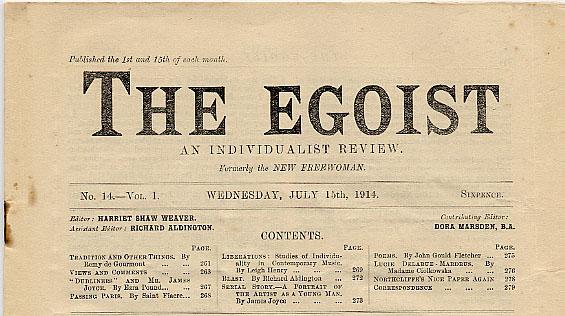
|
The
war years changed many things in Charlotte Mew's life: Including
stopping her trips to France. The poems that Alida Monro groups together as
"Early Poems" (some of
which are from France) as well as those she groups as "Poems from France"
may all date from before the war.
"Poems from France" (with dates of first known publication) are The Narrow
Door (1916)
- The Fête (1916) -
Pêcheresse (1914) -
Jour Des Mortes (1916) -
Madeleine in Church (1916)
-
Le Sacré-Coeur (1921)
- Monsieur Qui Passe (1929).
See Aglaë
The war years may have confined Charlotte Mew largely to the London area. in April 1919 she wrote that she had not seen "summer in the country" since 1914. An alleged rupture between Charlotte Mew and Catherine Dawson Scott is dated just before the start of the war. Whatever the personal substance to this suggestion, war also disrupts relationships, and this may have happened true of some of Charlotte's other relationships. |
Friday 8.5.1914 Charlotte Mew's story The Smile published in The Theosophist volume 35.
Tuesday 12.5.1914 Letter from Charlotte Mew to Catherine Amy Dawson Scott
Tuesday 12.5.1914 Mrs Moore persuaded Charlotte Mew to "spout my verses to a friend of hers".
Wednesday 13.5.1914 Letter from Charlotte Mew to Catherine Amy Dawson Scott [BF CADS 1914] This letter mentions that Mrs Mayer had given her a "long eulogy of Eulalia" (Ulalia - Mrs Scott's unpublished masterpiece, finished July 1912) - The changed spelling, matching eulogy, is a play on words to complement Mrs Scott: Eulalia is well spoken.
Thursday 14.5.1914 Letter from May Sinclair to Charlotte Mew from 1 Blenheim Road, NW. [Alida Monro Collection - Mary Davidow 1960 pp 307-308]. Unlike the earlier letters, it begins "My dear:" and ends "Always yours, May Sinclair". See 1915 [ Theophilus E. M. Boll suggests that Charlotte Mew attempted a sexual assault on May Sinclair at the time of the 14.5.1914 letter. If she did, it seems to have made no discernable difference to their relationship. Suzanne Raitt (2000 page 190) suggests that if this alleged assault ever happened, it was after August 1916].
Tuesday 19.5.1914: 4.30 Day that May Sinclair proposed (14.5.1914) that Charlotte Mew should "try your luck again... when I've asked the Aldingtons and Evelyn Stuart-Moore. It will be awfully nice if you'll come"
Thursday 21.5.1914 University College Musical
Friday 22.5.1914 Letter from Charlotte Mew to Catherine Amy Dawson Scott [BF CADS 1914] - From which I conclude that Mrs Scott and Marjorie accepted Charlotte's invitation to a cold supper followed by a trip to the musical, the day before. Marjorie lost a "precious book" which, it seems, Charlotte returned.
Saturday 30.5.1914 Charlotte Mew's poem Fame published in The New Weekly page 334
June 1914 Charlotte Mew's poem On the Road to the Sea published in The Englishwoman volume 22 pages 300-302. It was not included in the 1916 collection, but was in 1921. There is a web copy at web books The poem was discussed by Florence Hardy and Charlotte Mew, who suggested that it might be clearer (or darker) if these words were put at the head of it: La beauté des jeunes femmes est distribuée sur les diverses parties. Quand elles vieillissent, la beauté se fixe sur leur visage [The beauty of young women is distributed through all their parts. As they grow older, the beauty is fixed in their face]. The poem in The Englishwoman does not specify the gender of the two people in it, but the poem in the second edition of The Farmer's Bride has the line "I who make other women smile" instead of "I who make others smile"
Friday 26.6.1914 Letter from Charlotte Mew to Catherine Amy Dawson Scott [BF CADS 1914] - Charlotte says she must get the Caddis-Worm, but must also read the Life of Francis Thompson which she has had for a week without time to read. [Mrs Scott's The Caddis-Worm is about Catherine Blake who submits to her bullying doctor husband until circumstances allow her to achieve independence for herself and her children. (Arthur St John Adcock)] The next correspondence I know with Charlotte Mew is 1917.
|
July 1914 Alleged rupture between Charlotte Mew and Catherine Amy Dawson Scott Friday 3.7.1914 Postcard from May Sinclair to Mrs Scott, giving directions to her home 1 Blenheim Road, St John's Wood, and hoping for a visit about 4 "so that we can talk". Sunday 12.7.1914: Mrs Scott: "Spent afternoon and evening with May Sinclair. She is a dear, so gentle, conscientious, anxious - and so clever. A very sympathetic personality. She must have been a very pretty girl - she looks pretty still. I had thought we had nothing in common, but we talked like old friends" Marjorie Watts (1987) says "On that day Sappho learned that Charlotte had been bothering and annoying May. This was a great shock she wrote:" Mrs Scott continued: "All the geniuses I have met have been unsound sexually ... Ella d'Arcy was immensely over-sexed, practically a prostitute. Charlotte is evidently a pervert. Is then genius merely one form of sex? Genius creates, just as sex does, and in genius perhaps the sex instinct is always atrophied, flawed, damaged, because all the real stuff has gone into the genius" Saturday 25.7.1914 Marjorie Watts (1987): "we all went down to Cornwall for the summer holidays, after which, the war disrupted our lives. There is no evidence that Charlotte and Sappho had any contact [until 1917] ... although Charlotte and May Sinclair remained friends.
Charlotte Mew told Mrs Hill (12.3.1913) that her main interest in the Dawson
Scotts was
the children. Mrs Scott was concerned to protect her children against
perverts
(see Noel Coward in 1918). If she suggested to Charlotte that
she should keep away from her children, that would explain Charlotte not
continuing writing
|
Saturday 25.7.1914 Charlotte Mew's poem Pêcheresse published in The New Weekly page 174. The pêcheresse (sinner - female) will not confess her one night of love [not sex] - she cherishes it. Written before 29.7.1913. The poem was re-published in the 1916 collection.
The last verse is:
"Just so the long days come and go,
Yet this one sin I will not tell
Though Mary's heart is as frozen snow
And all nights are cold for one warmed to well.
But, oh! ma Doué! the nights of Hell"
ma Doué = mon dieu = my God, - but as said in Brittany. Searching the web for it brings some interesting pictures: April 1895 - another (not Brittany) - Brittany box bed - Breton photographer
Sylvia Parsons would recite the last line in comment on her nights.
August 1914 C.A Dawson Scott's story The Purse of Fortunatus - A Turkish Story published in The Theosophist volume 35, p.724 - [She also made two contributions during the war]
| Val Warner (1997, p. xvi) suggests that "after July 1914 Mew apparently published nothing in magazines during the war years, until July 1919. In 1915 she added the last stanzas to Madeleine in Church and probably wrote the short story Spine". Charlotte wrote "The Gipsy" on the manuscript. Val Warner thinks it was probably intended for Henry Savage's The Gypsy. On grounds of style, she also dates The Wheat at this time. |
|
"Tansley was studying the relation between Alpine and
Mediterranean vegetation in the Alps when the war broke out... Tansley
discovered he was too old to enrol as a soldier and that there was hardly
any teaching at the universities, so he was assigned to do routine clerking
in one of the government ministries. In his leisure time he cultivated a
friendship with two young psychologists named
Wilfred Trotter
and
Bernard Hart, who
introduced him to the work of Freud"
(Peder Anker, 2001, page 19)
Purity in danger - Edith to the rescue I dreamed that I was in a sub-tropical country, separated from my friends, standing alone in a small shack or shed which was open on one side so that I looked out on a wide open space surrounded by bush or scrub. In the edge of the bush I could see a number of savages armed with spears and the long pointed shields used by some South African native tribes. They occupied the whole extent of the bush-edge abutting on the open space, but they showed no sign of open hostility. I myself had a loaded rifle, but realised that I was quite unable to escape in face of the number of armed savages who blocked the way. Then my wife appeared in the open space, dressed entirely in white, and advanced towards me quite unhindered by the savages, of who she seems unaware. Before she reached me the dream, which up to then had been singularly clear and vivid, became confused, and though three was some suggestion that I fired the rifle, but with no knowledge of who or what I fired at, I awoke.
|
May Sinclair and the First World War - a two page extract from Suzanne Raitt 2000
25.9.1914 to 13.10.1914 May Sinclair in Belgium with a voluntary ambulance group.
| 1915 | Charlotte 45-46 |
|
|
Spring: Cousin Richard marries - January: Letter to Mrs Hill - Charlotte on the grief of war - Reading aloud and discussing the draft of her poem about a prostitute with May Sinclair - May and June war poems - June: May Sinclair compares Charlotte to imagists and encourages her to publish her poems - Iron-grey suite - Death of cousin Fanny - November: reading of The Changeling and The Farmer's Bride at The Poetry Bookshop. Charlotte in low spirits - Harold Monro suggests a book of her poems - Birth of nephew Peter |
In the January/March quarter of 1915, Richard P. Mew married Margaret Crump at Hastings. The birth of a Peter Mew (born 22.12.1915) was registered on the Isle of Wight in the January/March quarter of 1916. Richard Percy Mew, and his wife, were alive in 1958, when both shared memories of Charlotte with Mary Davidow. He may have died about 1966. Peter Mew was at "Regent House, Circular Road", Telephone Seaview 2105 in 1964 and at "Heathway, Buckbury Lane, Staplers, Newport" Telephone 3667, from 1965 to 1971. The (1884?) photograph of the Mew sisters was reproduced in 1978 courtesy of "Peter, John and Richard Mew". The death of Peter Mew (born 22.12.1915) was registered on the Isle of Wight in April 1995.
Monday 4.1.1915 Letter from Charlotte Mew to Mrs Hill: -
"I seem in the way of poetical criticism now, as yesterday Miss Sinclair turned up with a French poem of her own and we had three hours 'with the poets', ourselves included"
Much of the letter is about Mrs Hill's poems about the war and about the anxiety of a mother (Mrs Crackanthorpe) and wife ("an old servant") about their men going to war. A. [Anne?] is spending a "cruelly wet week-end at Berkamstead". Charlotte is "so glad" that Mrs Hill has "found someone to take Celia" and hopes "Mr Hill isn't fagged out".
Wednesday 6.1.1915 Letter from May Sinclair to Charlotte Mew. [Alida Monro Collection - Mary Davidow 1960 p.310] Similar to subsequent letters, this begins "My dear Charlotte" and ends "Love, always yours, May Sinclair". [Compare above]. "...Finish -- finish your Courtesan" [Madeleine in Church?] "She's magnificent. The last verses are all there -- coiled up in a lobe of your brain asleep and waiting to be waked -- just like darling Tommy" [May's black cat] "in his basket". Presently you'll hear them stirring in their sleep and soon after, the poem will finish itself. I'm a little like you (in this) that I can't tell how fine a thing is till I've shut myself up alone with it -- but even as you read the last poem I could see how great it was. I shouldn't say 'even', for you read furiously well: I never knew anyone who could get out the passion of a thing as you can. But this time I felt that it was there -- depths and depths of passion and of sheer beauty..."
Tuesday 19.1.1915 Miss Dorothy Chick, surgeon, left Paddington Station for the Serbian front.
Spring 1915 Typhus on the Serbian front. 40% of those who caught it died.
22.4.1915 Letter from May Sinclair to Charlotte Mew from Reeth, Richmond, Yorkshire: [Alida Monro Collection - Mary Davidow 1960 pp 310-311] "I liked those three stories of yours immensely -- especially Mark Stafford's Wife. It is one of the few good tales of that sort. Your style in this story reminds me of Henry James, and in Mademoiselle of Henry Harland..." Charlotte has read another story [not old] to May that May describes as "miles better"... "much more concentrated"... "entirely free of any 'flavours' but your own". There is no indication of what this is.
1.5.1915: A special imagist number of The Egoist included a poem "After the Retreat" by May Sinclair and an essay (pages 77-80), "The Imagists Discussed" by Harold Monro, critical of imagist poetry.
The two following poems by Charlotte Mew may not have been published until 1929. A manuscript and a typescript of the first are both dated 23.5.1915.
May 1915 - Manuscript title Spring 1915
June 1915
1.6.1915:
The Egoist included "Two Notes. 1. On H.D. 2. On
Imagism" by
May Sinclair in which she defended imagism against Harold
Monro's criticisms.
9.6.1915
Letter from
May Sinclair to Charlotte Mew: "About the Imagists - I'm not so
stupid, really, as I seem. Remember, I'm defending H.D. against what I know
to be an unfair and rather spiteful attack from a writer who isn't fit to
lick her boots. H.D. is the best of the Imagists (You'll observe that I
don't say very much about the others)... I am not stupid, and I can feel
poetry even if I cannot understand it; but I have a catholic taste, and I
see that these young poets are doing something that at its best is
beautiful, and it is intolerable that they should meet with ridicule and
contempt because they are not doing something else... I know one poet whose
heart beats like a dynamo under an iron-grey tailor-made suit (I
think one of her suits is iron-grey) and when she publishes her
poems she will give me something to say that I cannot and do not say of my
Imagists". (Quoted
Suzanne Raitt 2000 page 197)
November 1915 As her poems
The Changeling and
The Farmer's Bride
were in the programme of readings at the
Poetry Bookshop, Charlotte Mew
attended. When she arrived. she was asked "Are you Charlotte Mew?" and
replied "I am sorry to say I am".
At his suggestion a letter was written to Charlotte Mew in care of
The Nation asking whether or not she had other poems, or a number of
poems that
could be got together to form a book. Charlotte Mew responded very kindly
to the tentative suggestion, but with her characteristic lack of confidence
declared that no one would want to read them if they were published.
However, she sent another poem,
The Changeling, which, she remarked,
might or might not be liked as much as The Farmer's Bride. This poem
also
made an immediate impression, and I wrote to her saying that I proposed to
read both the poems at the Bookshop on a Tuesday or Thursday evening, on
which days there were always readings of poetry at six o'clock in the
evening. Charlotte Mew was told that there would also be a number of other
interesting new poems read and was asked whether she would care to be
present. She replied that she would do her best to be there.
So on that Tuesday evening in far away November 1915 Charlotte Mew came to
the Poetry Bookshop for the first time. Let me try to describe her.
The
Bookshop itself was a small room about twelve feet square, lined from floor
to ceiling with books, and opening on to a dark slummy street off
Theobald's Road in Bloomsbury. There would be a number of people wandering
about looking at the shelves before going up to the reading room.
The
reading room itself was a converted workroom that had been originally used
by the gold-beaters who occupied a large part of the street: and the gentle
thud, thud, of their gold-beating hammers rang in the ears of all those who
lived there, from morning to night, every day.
At about five minutes to six
the swing-door of the shop was pushed open and into the room stalked
Charlotte Mew. Such a word best describes her walk. She was very small,
only about four feet ten inches, very slight, with square shoulders and
tiny hands and feet. She always wore a long double-breasted top-coat of
tweed with a velvet collar inset. She usually carried a horn-handled
umbrella, unrolled, under her arm, as if it were psychologically necessary
to her, a weapon against the world. She had very fine white hair that
showed traces of once having been a warm brown. Her eyes were a very dark
grey, bright with black lashes and highly arched dark eyebrows. Her face
was a fine oval, and she always wore a little hard felt pork-pie hat put on
very straight. The whole time she was speaking she kept her head cocked at
a defiant angle.
When she came into the shop she was asked: "Are you
Charlotte Mew ?" and her reply, delivered characteristically with a slight
smile of amusement, was: "I am sorry to say I am". She invariably adopted
this self-depreciatory manner when meeting strangers, and invariably spoke
as if those who addressed her expected her to defy them. As she got
accustomed to a person this defiance vanished completely, and no one could
be more warm-hearted and witty in her talk and in her friendship. After
that evening at the Poetry Bookshop a close friendship sprang up between
us.
Poetry Bookshop Rhyme Sheets. Penelope Fitzgerald 1988 (page 286) says that
numbers 1 to 7 of the Rhyme Sheets (2d coloured) were hand coloured by
Alida Klementaski and Charlotte Mew. I am not clear what she
bases this on.
10.11.1915 Royal Assent for the
1915 Naval and
Military War Pensions
Act which established local War Pensions Committees.
Charlotte Mew visited on behalf of her local committee.
December 1915
Richard Aldington's Images 1910-1915 published
by The Poetry Bookshop (8d). White paper wrappers with a hand coloured
illustration by John Nash on top cover. (Woolmer 1988: A12)
Penelope Fitzgerald 1988 (page 168) says the
hand colouring was done by
Alida Klementaski and Charlotte Mew. There is no indication how
she knows this.
14.12.1915 Letter from Charlotte Mew to Harold Monro. "A few weeks
since" he had suggested a book of her poetry. The day before he had
suggested only half the ones supplied be published in the spring and then
the rest a year later. Charlotte wrote "I still think it would be better...
that the verses should come out altogether in a small volume... For, as I
told you, these verses hang together for me, and mark a period..."
22.12.1915
Peter Mew born on the Isle of Wight
27.12.1915
Letter from
May Sinclair to Charlotte Mew from 1 Blenheim Road, NW.
[Alida Monro Collection -
Mary Davidow 1960 pp 312-313] - [Harold Monro] "sold 260 copies
of
Richard Aldington's Images the other day, and Richard has
not the strong human appeal that you have."
Marjorie Scott was 17 in December 1915 "My mother told me
the
detailed story when I was about 17 and asked why we never saw Charlotte"
(Marjorie Watts:
Memories of Charlotte Mew, PEN Broadsheet no 13,
Autumn 1982, quoted Penelope Fitzgerald 1988 page 138)
May Sinclair spent most of 1916 in Yorkshire
working on
A Defence of Idealism
Alida Monro 1953 says that a small firm of printers in
Clerkenwell agreed to print The Farmer's Bride and galleys had been
delivered when the printer's son arrived to explain that "the compositor,
who was a Methodist, had said that he could not set up Madeleine in
Church as he considered it to be blasphemous".
9.2.1916 Letter from Charlotte Mew to
Harold Monro: " I think your printer must be the spiritual
brother of
the Editors who refused Ken because they "believed in the
segregation of the feeble-minded" and after this, one can't expect the
advocates of early marriages to buy the Farmer's Bride!"
[The typed copy in
Mary Davidow 1960 has Editors. The quotation in
Alida Monro 1953 (page xviii) has editor. This is then
cited by Penelope Fitzgerald 1988 pages 41 and 267 as saying
"the first editor to see
Ken rejected
it on the grounds that the magazine..."]
10.2.1916 Letter from Charlotte Mew to Rolfe Arnold
Scott-James listed in the
Buffalo Collection
4.3.1916 Letter from Charlotte Mew to
Harold Monro [
Buffalo Collection -
Mary Davidow 1960 p.316]
9.3.1916 Letter from Charlotte Mew to
Harold Monro [
Buffalo Collection -
Mary Davidow 1960 p.317]
12.3.1916 Letter from Charlotte Mew to
Harold Monro [
Buffalo Collection -
Mary Davidow 1960 p.318]
17.4.1916 Letter from Charlotte Mew to
Harold Monro [
Buffalo Collection -
Mary Davidow 1960 p.319]
16.5.1916 Letter from Charlotte Mew to
Harold Monro [
Buffalo Collection -
Mary Davidow 1960 pp 319-320]
May 1916
A collection of Charlotte Mew's poetry under, the collective title The
Farmer's Bride, published by the
Poetry Bookshop, London. This
contained (with year of first publication or writing when known and
highlighting those that may not have been published
previously)
The Farmer's Bride (1912) -
Fame (1914) -
The Narrow Door
- The Fête
(1914) -
Beside the Bed
(Written before 29.7.1913)
-
In Nunhead Cemetery (written by
July 1913) - The Pedlar (1914) - Pêcheresse (1914) - The
Changeling (1913) -
Ken (written by
July 1913)
- Â Quoi Bon Dire
(external web
copy)
- The Quiet House (written by
July 1913) -
On the Asylum
Road -
Jour Des Mortes -
The Forest Road (written
1914?)
-
Madeleine in Church (1915?). -
Exspecto Resurrectionem (1913).
Val Warner 1981 p.xiv suggests that the dedication here is to
Henry Herne Kendall. Penelope Fitzgerald 1988 (page 164) suggests that
it is to Lucy Harrison. It
could also be a
general war-time dedication - A literary
empty tomb.
Slate green
paper wrappers. Price 1/-
Advertisements inside front and back wrappers
1000 copies printed. Only 500 bound at first.
500 were subsequently (not before
April 1917) issued as a "second edition" in blue paper wrappers.
This had "Second edition" printed on the top wrapper and the advertisments
were changed.
Woolmer 1988: A16a
This grey picture from Woolmer
1988: A16a
The 1916 edition (and the second 500) was what we might
now call a paperback, or even a magazine. The 1921 edition was a what we
might now call a hardback, bound in boards. "Paper wrappers" does not mean
a dust jacket. It is a thick paper or thin card binding (depending on how
you describe it!). I have a fragile copy of the second 500 which I am
pleased has survived so long. It was not designed to last. My copies of the
1921 and 1929 editions are reasonably robust books.
OLDIS has useful definitions of wrapper and chapbook.
The 1916 and 1921 editions have the poems in the same order, but the type,
page layout, page numbers, and some punctuation, differ. The 1921 and 1929
editions also differ from one another, but the differences are not so
pronounced. See
editions of 2000.
The cover illustration is by Claude Lovat Fraser
[external link]. This is scanned from the 1921 edition.
28.5.1916 Letter from Charlotte Mew to
Harold Monro Thanks for her six copies of The Farmer's
Bride [
Buffalo Collection -
Mary Davidow 1960 p.321]
29.7.1916 Letter from Charlotte Mew to
Harold Monro The Farmer's Bride is "going dead". "I am
truly sorry if you are to be landed with 850 'remainders'"
[
Buffalo Collection -
Mary Davidow 1960 p.321]
4.8.1916
Letter from
May Sinclair to Charlotte Mew. This ends "Always affectionately
yours, May Sinclair".
[Alida Monro Collection -
Mary Davidow 1960 p.322]
Mary Davidow (1960)
reproduces no letters to or from Charlotte Mew (with anyone) from this
point until 3.7.1918
Suzanne Raitt (2000 page 190) says there is no (known)
communication between Charlotte Mew and May Sinclair after February
1916 (Which is clearly a mistake). "Their relationship may conceivably
have ended with a dramatic bedroom
scene (although not, as Boll believes, in
May 1914); but it is much more likely that it simply fizzled
out."
25.8.1916
Letter from
May Sinclair to Charlotte Mew, quoted by
Suzanne Raitt (2000 page 152) "I can't imagine anything more
awful than... the state of mind that doesn't believe [in the war], and that
can imagine that anything that's been thought and written (within the last
twenty years, anyhow) more important than the winning of the War!"
Marjorie Scott was 18 in December 1916
Alida Monro (1953), pages xviii to xx, finds it "difficult" to
explain what she sees as Charlotte Mew's small output of literary work in
her life - given her talent. She says "From the very first she found a
ready market for her stories - the poems were
a later development of her talent... I think myself that as she
grew older she no longer had the power of concentration required to sit at
a desk for hours at a time, that she lost interest in story writing which
had been her main work until about 1916, after which she wrote no
more prose at all and very little verse. The sustained prose work dwindled
from the long stories printed in Temple Bar in the
'nineties" [Actually from 1898 to
1905, when the magazine folded?] "to short studies and
occasional essays in the early 1900s, and then to odd poems, and slowly
work came to a standstill...
She herself attributed her small output to the difficulties of domestic
life, doing the housekeeping and looking after "Ma", and the constant
interruptions when she sat at her desk -
Jane, the factotum" [general servant - does everything] "who was
with her
for years, knocking on the door to ask if she should 'finish up' the rice
pudding for her dinner? and should she run out for some kippers? or would
Miss Lottie mind going herself?"
26.2.1917 Letter from Charlotte Mew to
Catherine Amy Dawson Scott.
Charlotte is not able to read to her club. - [BF CADS 1914]
I don't remember your asking me to read The Farmer's Bride when it came
out, to your friends - I'm sure the suggestion didn't reach me - and now I
am so sorry I can't read the poems to your Club.
L'impossible arrange tout. I am quite incapable of it - any public
appearance on any stage.
I expect you are quite pleased to be back on the old swing again - and
oddly enough - when your letter came
Mrs Mayer had just been telling me all
about your big literary party and how well
Madcap Jane is goin 1`zg in the
new edition. Congratulations.
V. Sincerely yours
April 1917 "Second edition" (second 500 of first edition) of
The Farmer's Bride bound in April 1917 or later. -
Only 150 of the first 500 had sold by
29.7.1916.
Siegfried Sassoon's copy was from the second 500. I do not know
which batch
Sydney Cockerell distributed from. If it was the second five
hundred, this would make sense of Florence Hardy thanking Charlotte for a
copy of the "first edition" on
12.12.1918 -
Possibly one of Charlotte's original six.
"The effect of exposure to temperatures at or above 100C. upon the
substance (vitamin E) whose deficiency in a diet causes polyneuritis
in birds and
beri-beri in man" by Harriette Chick and Margaret E. Hume
Proceedings of the Royal Society, B, Vol.90, 1917
"The distribution among foodstuffs (especially those suitable for the
rationing of armies) of the substances required of the prevention of
(A)
Beriberi and (B) Scurvy" by Harriette Chick and Margaret E. Hume
Transactions of the Society of Tropical Medicine and
Hygiene, July 1917. Vol.10, no.8, pp 141-178
Dear Mrs Scott
If adjectives are powerless, I'm afraid there's nothing to be done with
people deaf to the Sacred Call and to whom the prospect of being 'snowed
under' is a tranquil one - with - let us hope - some sense of humour and
proportion still breathing gently beneath the drift.
People are only 'disappointing' when one makes a wrong diagnosis - but how
comes the sole begetter of a Tomorrow Club to be 'babbling o' green fields'
and yesterdays?
V sincerely yours
Of course its nice to know that up to June 21, 1917, you still liked the
old jingle! CM
8.8.1917 Correspondence from May Sinclair and
Oliver Lodge in
Medical Press.
Autumn 1917
May Sinclair A Defence of Idealism: Some
Questions and Conclusions Macmillan in London and New York. This
contained a chapter on psychology and psychoanalysis. She describes the
unconscious as "the haunted world below our waking consciousness".
(page 8, quoted page 135 of
Suzanne Raitt 2000)
She also said that, for her, the "theory of
sublimation is the one thing of interest and value that
Professor Freud and professor Jung have contributed to Psychology" (page 5,
quoted page 229 of
Suzanne Raitt 2000) (Date
Suzanne Raitt 2000, p.203)
May Sinclair's A Tree of Heaven was
also published in 1917, by Cassell in London and Macmillan in New York
8.12.1917 Death in Buxton of
Samuel Chick the son, aged 49. Buried at Buxton Cemetery on
10.12.1917 Family Bible (Watts
boxes).
20.12.1917
Elsie Chick married
Francis Frost
Blackman at Haven Green Chapel, Ealing. This is the last
marriage recorded in the
Family Bible (Watts boxes).
Frederick Frost was 51 years old. Elsie was 35. Their son,
Peter F. Blackman, may have been born between 1918 and 1923. See also
1937 -
1948 -
1958 -
1977 -
1979 -
1986 -
2001 -
2006 -
Elsie's London University Card suggests that she moved from
Samuel Chick (the father)'s home at Park Hill to
34 Storey's Way, Cambridge. Residential accommodation for the
University (Churchill
College) was built there before and after the war. See external link to
"typical example"
Online edition without the preface
-
archive of online edition with the preface
Sydney Cockerell
gave or lent copies of The Farmer's Bride to various poets. As a
result
Charlotte met Thomas Hardy
(December 1918) and Siegfried Sassoon
May 1919. [Surviving
letters show that Cockerell
communicated with Thomas Hardy, Wilfred Scawen Blunt and A.E. Houseman
about copies of the book. He introduced Sassoon to Charlotte, but may not
have provided him with her work]
22.6.1918 Florence Hardy to Sydney Cotterell, thanking him for the
book of poems by Charlotte Mew. - [BF]
Alida Monro told
Mary Davidow in
August 1958 that
Sydney Cockerell "attended several of the
poetry readings at 35
Devonshire Street in the hope of meeting Charlotte Mew; but at
none of these did she appear. Cockerell then requested" [Alida] "a
manuscript copy of the title poem The Farmer's Bride"
(Mary Davidow 1960, page
82)
Wednesday 3.7.1918 Letter from Charlotte Mew to
Sydney Cockerell:
[Berg Collection -
Mary Davidow 1960 p.322]
"Dear Sir:
Miss Klemantaski tells me you would
like a MS copy of
The Farmer's Bride which I have much pleasure in
sending you. Faithfully yours, Charlotte Mew."
5.7.1918 Letter from
Sydney Cockerell
to Charlotte Mew
[Berg Collection -
BF]
8.7.1918 Letter from
Sydney Cockerell
to Charlotte Mew
[Berg Collection -
BF]
Wednesday 10.7.1918 Letter from Charlotte Mew to
Sydney Cockerell:
[Berg Collection -
Mary Davidow 1960 p.323] She turns down his suggestions for
altering The Farmer's Bride.
11.7.1918 Letter from
Sydney Cockerell
to Charlotte Mew
[Berg Collection -
BF]
17.7.1918 Letter from Wilfred Blunt to
Sydney Cockerell
Returns The Farmer's Bride which Cockerell had left with him, with
comment.
18.7.1918 Letter from
Sydney Cockerell
to Charlotte Mew
[Berg Collection -
BF] - He sends her a letter from Wifred Blunt.
Wednesday 20.7.1918 Letter from Charlotte Mew to
Sydney Cockerell:
[Berg Collection -
Mary Davidow 1960 p.324] - She returns the letter from Wilfred
Blunt, with thanks to both of them.
27.7.1918 Florence Hardy to Sydney Cotterell. Thomas has been
carefully studying Charlotte Mew's poems again. "There is an
extraordinaryily pathetic wail in most of the lines. My husband says he
would like to know her." - [BF]
4.8.1918 Florence Hardy to Sydney Cotterell. Thomas Hardy agrees
with Wilfred Blunt. He dictates his opinion.
Mary Davidow 1960 p.89]
6.9.1918 Letter from
Sydney Cockerell
to Charlotte Mew
[Berg Collection -
BF] - He (still) wants to visit her.
9.9.1918 Letter from A.E. Houseman to
Sydney Cockerell,
returning poems of Charlotte Mew, with comments.
[Adams collection
Mary Davidow 1960 p.324].
9.9.1918 Letter from
Sydney Cockerell
to Charlotte Mew
[Berg Collection -
BF] About visit (below):
Tuesday 10.9.1918 Sydney Cockerell visits at the "Hogarth Studios"
at 4.30
12.9.1918 Letter from
Sydney Cockerell
to Charlotte Mew
[Berg Collection -
BF] - He enjoyed talk on Tuesday.
Wednesday 18.9?.1918 Letter from
Sydney Cockerell
to Charlotte Mew
24.9.1918 Letter from
Florence Hardy
to Charlotte Mew.
[Alida Monro Collection -
Mary Davidow 1960 p.325] -
Dear Miss Mew,
I believe that you have heard from our friend Mr Sydney Cockerell of the
immense pleasure your poems have given my husband It is long since I have
known him so engrossed by a book, as by The Farmer's Bride. It now
lies by him on his study table and I have read all the poems to him - some
of them many times - and shall probably read them to him many more times.
.. .He is, as you know, not a young man and he cares to see but few people
now-a-days, but he has expressed a wish to meet you if that should be
possible.
It is a tedious journey to Dorchester from London, and not the time of year
when one cares to go into the country - but if you should ever be near us -
or indeed if you thought it worth while to come that distance to see him,
we should be most delighted to put you up for the night.
Yours very truly,
Florence Hardy
25.9.1918 Letter from Charlotte Mew to
Florence Hardy.
[Berg Collection -
Mary Davidow 1960 pp 325-326] - surprise and pleasure - "My time
is not just now my own". She would like to visit after 12.10.1918.
1.10.1918 Letter from
Sydney Cockerell
to Charlotte Mew [His address 3 Shaftesbury Road, Cambridge]
[Berg Collection -
Mary Davidow 1960 p.326] - 3 Shaftesbury Road, Cambridge was the
Cockerell home address until he moved to Kew after his retirement. - He was
at Max Gate when her letter arrived. Can he continue their talk next week?
13.10.1918 Letter from
Florence Hardy
to Charlotte Mew.
[Alida Monro Collection -
Mary Davidow 1960 p.327] - deferring visit because of Thomas
Hardy being unwell.
About November 1918, Sylvia Parsons, the (about 24 years old)
daughter of
Florence and Clement Parsons, became ill with an illness
from which she
died
eight months later. Her mother wrote (23.7.1919) that Charlotte
"understood her so perfectly. You were her favourite of all visitors
through
that eight months ordeal of hers." "Sylvia loved you so much. She was so
proud of you. She was never tired of declaiming in her own trembling, weak,
ill voice your poems to Nurse. I haven't the right words, but there is a
line like
"But, oh, ma Doue! the nights of Hell" that she used to
emphasize
with her half-playful, half-tragic effectiveness when she was asked how she
was and how she was sleeping...We thought her beginning to recover because
the fever left her - but them she had not the strength to rally. Oh, what a
winter, what a spring and what a summer!... I can't say how much I owe you
during Sylvia's illness." Penelope Fitzgerald (1988 pages 158 and 278. No
reference) identifies the illness as tuberculosis. This is consistent with the night
fevers. If Sylvia had been a victim of the
flu pandemic, I do not think it would have been a long illness.
Young women were particularly prone to
encephalitis lethargica, another disease associated with this
time, but the exchange about sleeping suggests sleepless nights rather than
too
much sleep.
[The letters in
Mary Davidow (1960 pages 334-335) give her name as Silvia. It
appears to be Sylvia in the 1900 Census]
Wednesday 6.11.1918
Cockerell Diaries - BF]: "After going to see
Cayley Robinson's
wallpaintings at Middlesex Hospital... called on Miss Anne Mew and dragged
her to see them... Called on Miss Charlotte Mew to show her a book (Song of
Songs) decorated by Kate. She was naturally delighted with it. She went on
with me to tea at Miss [Klementaski]'s at 4 Millman St.
Sunday 10.11.1918 Letter from
Sydney Cockerell
to Charlotte Mew
[Berg Collection -
BF] Charlotte has sent him material, including her play and
An Old Servant
Monday 18.11.1918
[Cockerell Diaries - BF] Had tea with Charlotte Mew
Thursday 21.11.1918
[Cockerell Diaries - BF] He took his book of Warrington Taylor's letters
to Charlotte Mew. [George Warrington Taylor (1835-1870) was business
manager of William Morris's firm from 1865]
Saturday 30.11.1918 Letter from
Florence Hardy
to Charlotte Mew.
[Alida Monro Collection -
Mary Davidow 1960 pp 327-328] - Free to receive a visit, but
will understand if Charlotte wishes to wait until Spring or Summer.
Sunday 1.12.1918 Post Card from
Sydney Cockerell
in Amiens, France, to Charlotte Mew
[Berg Collection -
BF]
Monday 2.12.1918 Letter from Charlotte Mew to
Florence Hardy.
[Berg Collection -
Mary Davidow 1960 pp 328-329] "... I should like ... to come
down this Wednesday by the South Western on the 12.30 from Waterloo due at
Dorchester 4:14."
Tuesday 3.12.1918 Letter from
Florence Hardy
to Charlotte Mew.
[Alida Monro Collection -
Mary Davidow 1960 p.329] She expects to be at the station to
meet Charlotte...
Wednesday 4.12.1918:
[Cockerell Diaries - BF] "Called on [Charlotte Mew] who had gone to the
Hardys for the night. Had a talk with her sister Anne."
Wednesday 4.12.1918: Charlotte Mew's visit to Thomas and Florence
Hardy at Max Gate in Dorset. It was described in a letter from Florence
Hardy to Sydney Cockerell which some biographers have (perversely)
described as unsympathetic (or "cold") to Charlotte. "Pathetic" means
exciting sympathy. It did not acquire its derogatory colloquial meaning
until later in the twentieth century:
10.12.1918 from Charlotte Mew to
Florence Hardy
[Berg Collection -
Mary Davidow 1960 p.330]:
"No doubt this
thin old green book ought to be a fat pink one... And please, if
you like, keep
The Road to the Sea. I'm sure there's a typed copy
somewhere."
A copy of The Farmer's Bride
(1916) inscribed to Florence Emily Hardy from Charlotte Mew,
December 1918, from the
Hardy library, was sold in 1938 [MG Sale/307]. It is in the Albert A. and Henry W.
Berg Collection, New York Public Library.
Another copy, with a note apparently in hand of FEH's sister Eva Dugdale,
is in the
Purdy collection at Yale. This may be the copy FEH received from
Sydney Cockerell
in 1918: LEFH , 142-4, 146. [Sotheby's 6-7 Nov. 2001/42; seen at Adams]
12.12.1918 Letter from
Florence Hardy
to Charlotte Mew.
[Alida Monro Collection - Mary Davidow 1960 pp 330-331] - Thanks her for the
valued gift of
"the
first edition of your poems" and the MS. Hopes she will be able
to visit in the summer and
stay longer. Would like to visit her in London. Hopes "that the business
about letting your house has been satisfactorily settled".
22.12.1918 from Charlotte Mew to
Florence Hardy
[Berg Collection -
Mary Davidow 1960 p.331]:
22.12.1918 Florence Hardy to Sydney Cotterell. "I am begging
everyone to read her poems, and have given away several copies". Mentions
the possibility of a Civil List Pension - [BF]
Sunday 2.2.1919 Letter from
Sydney Cockerell
to Charlotte Mew
[Berg Collection -
BF] Invitation, tickets to hear [John William] Mackail on Ruskin
Wednesday 26.2.1919
Dorothy Chick died, aged 31 years, at 21 Endsleigh Street. This
is the same address that her sister, Frances, died at
later in the same year. Dorothy was interred at Perivale on
3.3.1919 (Family Bible: Watts
boxes). - See
above - One of Dorothy's "greatest friends"
was a Baptist medical missionary in a remote part of India. She returned
from India about a year after Dorothy's death and visited Samuel and Emma
at Ealing. Her story at the disappointment felt when a parcel from home
contained illuminated texts rather than luxuries led Samuel Chick to
institute the anonymous sending of Christmas luxuries to fifty missionaries
all over the world through the Baptist Missionary Society - From "Barnabas
- The son of consolation"
(Margaret Tomlinson p.81)
Wednesday 2.4.1919
Siegfried Sassoon's first article in The
Daily Herald as its new literary editor. Wikipedia says
he employed
Charlotte Mew as one of his reviewers.
Sunday 13.4.1919
Letter from
Florence Hardy
to Charlotte Mew.
[Alida Monro Collection -
Mary Davidow 1960 p.332] Lowes Dickinson, Elliott Felkin, and E.
M. Forster have been reading The Road to the Sea
week commencing 7.4.1919: another edition of The
Farmer's Bride suggested
(see below)
Monday 14.4.1919
Letter from Charlotte Mew to
Florence
Hardy
[Berg Collection -
Mary Davidow 1960 pp 332-333]:
"The Road to the
Sea represents to me a middle-aged man speaking, in thought,
to a middle-aged woman whom he had only met once or twice. This last week
there has been a suggestion of another edition of the
Farmer's Bride... I've not seen summer in the country
since 1914...
Thursday 8.5.1919 Letter from Sydney Cockerell
to Charlotte Mew (Used by
Mary Davidow, but not reproduced). Sydney Cockerell sends her
some poems that he has found very moving. Mary Davidow (page 92) footnotes
this letter to "Cockerell brought Siegfried Sassoon to tea" [In Anne's Charlotte
Street Studio] "one afternoon". [Berg Collection
Let us remember Spring will come again
To the scorched, blackened woods, where the wounded trees
Wait with their old wise patience for the heavenly rain,
Sure of the sky: sure of the sea to send its healing breeze,
Sure of the sun. And even as to these
Surely the Spring, when God shall please,
Will come again like a divine surprise
To those who sit today with their great Dead, hands in their hands,
eyes in their eyes,
At one with Love, at one with Grief; blind to the scattered things and
changing skies.
Who thinks of June's first rose today?
Only some child, perhaps, with shining eyes and rough bright hair will
reach it down
In a green sunny lane, to us almost as far away
As are the fearless stars from these veiled lamps of town.
What's little June to a great broken world with eyes gone dim
From too much looking on the face of grief, the face of dread?
Or what's the broken world to June and him
Of the small eager hand, the shining eyes, the rough bright head?
15.6.1915 Death of
Fanny Mew. Her memorial in St Pauls reads
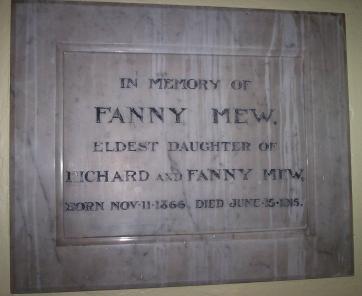
In memory of FANNY MEW eldest daughter of Richard and Fanny Mew. Born
November 11th 1866. Died June 15th 1915.
Photograph by Kevin McCoy, the
St Paul's Barton webmaster
Many years ago, buying, as was my custom, a copy of
The Nation
one Saturday
morning, I opened it eagerly to see if there might be a poem, and was
electrified to find printed there
The Farmer's Bride. This poem I
immediately committed to memory, and a year or two later repeated it with
enthusiasm to Harold Monro, who had
recently opened the Poetry Bookshop,
with the avowed intention of publishing the work of young poets and
presenting them to a large audience.
1916
Charlotte 46-47
February: Compositor refuses to set blasphemous prostitute poem - May:
Charlotte's book of poems (The Farmer's Bride) published -
May Sinclair and Charlotte diverge over war, and, possibly, over sex -
December: Death of Daniel Oliver
"To ------.
He asked life of thee; and thou gavest him a
long life; even for ever and ever"
The first edition of The Farmer's Bride was a different size and
shape to
the, better known,
1921 and
1929 editions.
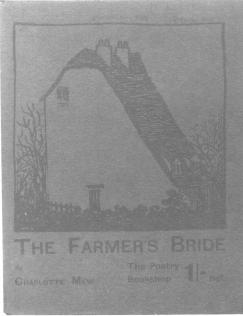
[Probably best to refer to this as the "second 500" to distinguish from the
"new edition" in 1921 - which was followed by a "third edition" in 1929]
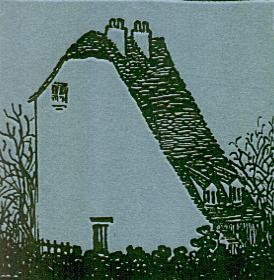
She would tell stories of her encounter with some war widow or pensioner
during her visits on behalf of the
War Pensions Committee. I remember the
zest with which she once described her arrival in some back street slum,
and her knocking at the door, only to be faced by a harridan, with a man's
cap worn back to front and a heavy bobbly shawl, towering above her and
demanding what she wanted. When told the name of the woman who was sought,
the harridan turned and went half-way up the flight of stairs, shrieking in
her strident voice, "Tell the lidy upstairs there's a person 'ere who wants
to see 'er". Or again of the scene in Somerstown when a whole crowd of
dirty little boys were playing War in the street, fighting and pummelling
each other, vociferously demanding to be "the prisoner". This unfortunate
was placed in a sack and dragged and bumped along the pavement to the
cheers of the other boys. (Alida Monro
(1953 page xiv)
1917
Charlotte 47-48
Mrs Mayer keeps Charlotte informed -
February: Charlotte turns down an invitation to read her poems to the
Tomorrow Club - June: Dawson Scott writes about a poem -
December: death of Samuel Chick, the son - Marriage of Elsie Chick to
F.F. Blackman
C. A. Dawson
Scott began promoting the idea of The To-Morrow Club (for
tomorrow's writers) "early in 1917". It was to provide a meeting place for
new writers where they could also listen to informal talks from established
writers. She wrote to both groups about the proposal. One of those she
asked to talk was Charlotte Mew (see below). - Watts - See also
PEN website
Dear Mrs. Scott
Charlotte Mew
14.5.1917 Letter from John Galsworthy to Catherine Dawson Scott in
which he says her idea [for a Tomorrow Club] is a good one. [Soon after?]
he agreed to speak at a club meeting. "At first we met in an unattractive
room in the Bedford Hotel... Soon, however, we found a ... room on the
first floor at 65, Long Acre... and this was hired every Thursday evening.
Sappho appointed herself 'Fixtures Secretary' and undertook to find a
subject, speaker and Chairman every week. She continued to do this for the
next five or six years...The Tomorrow Club was immediately popular... "
24.6.1917 Letter from Charlotte Mew to
Catherine Amy Dawson Scott. -
[BF CADS 1914]
June 24th 1917
Charlotte Mew
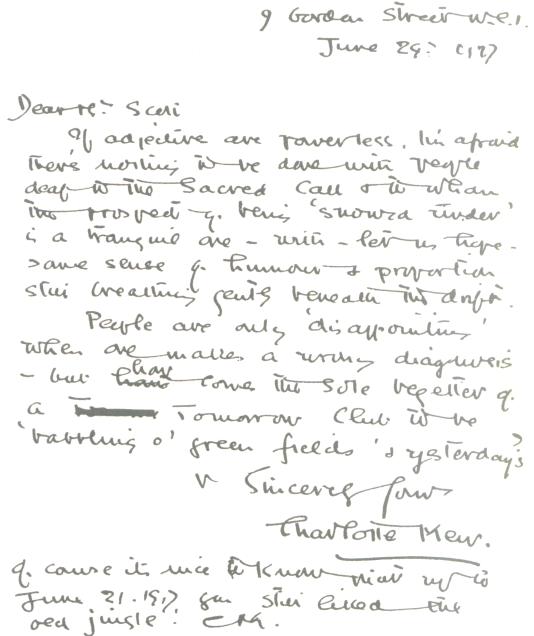
1918
Charlotte 48-49
June: Florence Hardy thanks Sydney Cockerell for The Farmer's Bride
-
July: Sydney Cockerell correspondence begins - September: correspondence
with Florence Hardy begins - November: Sylvia Parsons ill - December:
Charlotte a guest of the Hardys in Dorset - General Election, but Charlotte
not entitled to vote - Armistice - December: Florence Hardy promoting
Charlotte's poetry
Max Gate
Dorchester
September 24, 1918
"... What a pathetic little creature! One longed to be kind to
her and look after her. And she was not silent -- talked all the time. We
never had anyone here who talked so much... T.H. talked very kindly to her,
and read her some of his poems. But she is not his type of woman at all. he
prefers a woman like
Mrs Inglis -- whom he declares he likes best of all my
friends, and whose departure he is always lamenting (as I do). But poor
Miss Mew is so pathetic. I made her stay two nights instead of one
when I found how she liked being here -- and would gladly have kept her a
month had it been possible. She has genius, I think." (Quoted by Mary
Davidow, page 92, from
Viola Meynell's 1940 collection, page 300)
"have been rather rushed among other things, getting our new people in, on
a little heap of sweeps and 'chaos' and whitewashers. And I would much
rather you didn't return the
Englishwoman's
verses; at best, it's only a bit of nothing one can send!"
1919
Charlotte 49-50
February: Death of Dorothy Chick - March: Siegfried Sassoon begins to
prepare a birthday tribute for Hardy from 40 poets - April: second edition
of The Farmer's
Bride suggested and Charlotte thinks of holidays -
May: Charlotte recalls enthusiasm for Jefferies and Vaughan -
Sassoon comes to tea. June: Daily Herald book review/s
(?). July:
death of Sylvia Parsons - Chapbook provides outlet for new poems,
beginning with Sea Love - August: Cockerell wants to see the Hardy
poem - September: The
Cenotaph - Cousin
Gertrude Mary to become Sister Mary Magdalen - October: Death of Frances
Wood (Chick) - Song for Hardy and The Athenaeum - Children's dreams
and fairy tales
The novel is semi-
autobiographical. See July 1919 -
December
1919
Friday 16.5.1919 Day that Sydney Cockerell asked to bring Siegfried Sassoon to tea - Or take them all out to tea.
Saturday 17.5.1919 Letter from Sydney Cockerell to Charlotte Mew [Berg Collection - BF] Poems by an earlier Charlotte he has introduced her to.
Monday 19.5.1919 Letter from Charlotte Mew to Sydney Cockerell: She writes, of his ability to experience such enthusiasm, "I felt much the same when I first found Jefferies and Henry Vaughan but I don't remember anything like it since."
Wednesday 11.6.1919 A book review by Charlotte Mew in The Daily Herald. [I do not know the subject. It is not in her collected works. Nor do I know if there were any others.]
July 1919: Charlotte Mew's poem
Sea Love published on
the last
page (32) of the first number of
The Monthly Chapbook.
Sea Love
was republished in
the second edition of
The Farmers
Bride in 1921 and in
Modern American and British Poetry in 1922. Alida read it on
the wireless on 24.8.1926. It was chosen for Twentieth Century
Poetry in
1933 and, possibly,
1929.
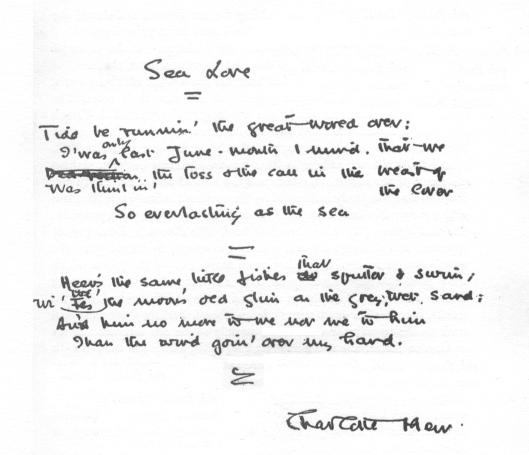
Alida Monro reproduced this corrected manuscript of Sea Love in the 1953 Collected Poems, p. xviii. The manuscript is now in the [ Buffalo Collection, along with another one that does not have corrections. |
| Twenty-Three New Poems By Contemporary Poets being The Monthly Chapbook Number One, Volume One July 1919. With poems by John Alford - Herbert Read - W P R Kerr - Walter De La Mare - Osbert Sitwell - H D - Siegfried Sassoon - D H Lawrence - F S Flint - S Sitwell - W J Turner - Rodney Pasley - Harold Munro - T Sturge Moore - Edith Sitwell - Robert Nichols - R Holman - Rose Macaulay - Douglas Goldring - Frederic Manning - W H Davies - Richard Aldington - Charlotte Mew. |
6.7.1919 Letter from Sydney Cockerell to Charlotte Mew [Berg Collection - BF] He writes from the Hardy's house (Max Gate). He (and his wife) invite Charlotte to Cambridge, but the next letters are about her inability to go because of illness.
Wednesday 9.7.1919 Death, in the morning, of Sylvia Parsons. Later the same day, Florence Parsons wrote to Charlotte, and told her that the funeral service would be at 11am on Saturday 12.7.1919 at St Saviours Church, Warwick Avenue. On 23.7.1919, Florence re-read Charlotte's letter of sympathy and wrote to her a letter from which the details of Sylvia's illness are taken. She will be returning to London on 23.9.1919 and hopes Charlotte will visit her.
Wednesday 9.7.1919 Letter from "Your loving, F. Parsons" to "My dear Charlotte" (above) [Alida Monro Collection - Mary Davidow 1960 p.334]
Sunday 13.7.1919 Letter from Sydney Cockerell to Charlotte Mew [Berg Collection - BF] Charlotte has been unwell.
Wednesday 16.7.1919 Letter from Sydney Cockerell to Charlotte Mew [Berg Collection - BF] Charlotte is ill.
Wednesday 23.7.1919 Letter from "Yours F. P." to "My dear Charlotte" (above) [Alida Monro Collection - Mary Davidow 1960 p.334-335]
25.7.1919 Letter from Sydney Cockerell to Charlotte Mew [Berg Collection - BF] He cannot visit the day after. Hopes Charlotte is better.
24.8.1919 Letter from Sydney Cockerell to Charlotte Mew [Berg Collection - BF] Siegfried Sassoon has shown him the Poetry Bookshop publication poem. He wants to see the poem she wrote out for Thomas Hardy [Which is? The next poem they discuss is Song. Perhaps this had already been written out for Hardy's birthday book?]
J. Howard Woolmer had a copy of the second 500 of The Farmer's Bride "with Mew's then unpublished poem "Love, Love Today" written out on the verso of the title page in Siegfried Sassoon's hand" (Woolmer 1988. A16a)
28.8.1919 Letter from Charlotte Mew to Sydney Cockerell - [Berg Collection - Writing about Song she says it was "written for music, and not quite 20th century!" and "perhaps I shall one day put an air to it" (Newton 2000, p.118)
30.8.1919 Letter from Sydney Cockerell to Charlotte Mew [Berg Collection - BF] About the writing of Song
Monday 1.9.1919 Letter from Charlotte Mew to Sydney Cockerell.
9.9.1919 Letter from Sydney Cockerell to Charlotte Mew [Berg Collection - BF] More about the writing of Song
Saturday 20.9.1919 Letter from Charlotte Mew to Sydney Cockerell
"two days ago my favourite cousin descended on us with the sudden announcement that she was going into a convent.."
The favourite cousin appears to have been Gertrude Mary Mew and to have become Sister Mary Magdalene. Mary Davidow (1960 page 109), who met her, says "Sister Mary Magdalen, Charlotte Mew's 'favourite cousin', reported that were it not for Confession, Charlotte would have become a Roman Catholic quite readily."
Saturday 27.9.1919: [Not Sunday 7.9.1919] Charlotte Mew: The Cenotaph (BBC copy) Westminster Gazette
See above 19.7.1919
Aftermath website discusses the poem in the context of other poetry written in reflection on the war. Mary Davidow (1960 page 93) says that Siegfried Sassoon "praised the poem highly". She is probably basing this on the letter of Sydney Cockerell. Siegfried Sassoon made his own copy of the poem. It would seem likely to have been salient in his thoughts when he wrote, in 1924, that the future of civilisation struggles to survive in the eyes of poets. The cult of self, criticised in Men and Trees (1913), is, in The Cenotaph, represented as that which could destroy civilisation - not the basis of civilisation as Auguste Barrès (and many others) had argued.
Late September 1919: Start of National Rail Strike that prevented
Florence Hardy visiting London and Charlotte Mew. The strike was over by
11.10.1919.
5.10.1919 Letter from
Sydney Cockerell
to Charlotte Mew
[Berg Collection -
BF]
12.10.1919
Mrs Frances Wood (Frances Chick) died, aged 35, at 21 Endsleigh
Street. This is the same address that her sister, Dorothy Chick, died at
earlier in the year. Cremated at Golders Green.
(Family Bible: Watts boxes).
- See
above
about 18.10.1919?
Siegfried Sassoon delivered the bound copy of
poems to Thomas Hardy that had been prepared as a birthday tribute.
22.10.1919 Letter from
Sydney Cockerell
to Charlotte Mew
[Berg Collection -
BF]
Friday 24.10.1919: Charlotte Mew's poem
Song
published in
The Athenaeum page 1058. "Love, Love to-day... Wise maids
know how soon
grows sere The greenest leaf of Spring". - The poem
was written
for music, and it found its music:
"Love, love today my dear [music] : song" (No. 2 in F) music by
Laura G. Lemon, words by Charlotte Mew, was published London:
Bosworth in 1922
[Aberdeen University Library] The
Berg Collection has a copy of the poem hand-written and signed
(no date) by Charlotte Mew. The 1919 poem may also be the "Song" that
Mary Davidow's 1960
bibliography says was published in the
The Literary
Digest (New York) 17.1.1920. It was republished in
the second edition of The Farmers Bride in 1921. It was included in the
American anthology
Modern British Poetry and the British
A New Anthology of Modern
Verse (1941)
28.10.1919 Letter from
Florence Hardy
to Charlotte Mew.
[Alida Monro Collection -
Mary Davidow 1960 pp 336-337] She has been to visit a niece of
Thomas Hardy's first wife, in "an asylum at Woodbury" [Devon - I cannot
identify]. "We have just read your poem in the Westminster --
The Cenotaph." Both think it very fine. She thanks Charlotte for
the address of
Miss Jacobs, a typist, who has done some typing for Florence "splendidly".
28.10.1919 Letter from
Thomas Hardy
to Charlotte Mew. Thanking her for "the beautiful poem you wrote in the
volume made up by my poet friends". [identified? as
Love, Love to-day]
31.10.1919 Letter from
Sydney Cockerell
to Charlotte Mew
[Berg Collection -
BF]
The Vienna Medical School
(external link) had been cut off from
scientific developments in the western world during the war.
(Chick, Hume, Macfarlane 1971 p.155)
The science of radiography had advanced sufficiently to enable the expert
to make a precise diagnosis of rickets from
X-ray pictures of the growing ends of the ling bones"
(Chick, Hume, Macfarlane 1971 p.157)
5.11.1919 Letter from
Sydney Cockerell
to Charlotte Mew
[Berg Collection -
BF] Sends her a note from SS
[Siegfried Sassoon], who "does not take the trouble to copy out
a poem as long as
the Cenotaph unless he is genuinely moved by it"...
"Shame on you for not having sent me Margaret Sackville's article". [(Lady)
Margaret Sackville - Children's poet, peace campaigner and aristocratic
friend of the Labour leader, Ramsey MacDonald. See
22.12.1921 and
January 1922]
11.11.1919 Letter from
Sydney Cockerell
to Charlotte Mew
[Berg Collection -
BF]
Monday 17.11.1919 Possible date of a letter from Charlotte Mew to
Florence Hardy
which starts "The Royal Society of Literature has sent me a ticket for this
week's meeting, and Mr Cockerell tells me I owe this to your kind thought.
It is a very kind one... I shall go to hear Gosse on Wednesday and think
how nice it was of you to remember and give me the chance...".
Mary Davidow (1960) dates the letter 17.10.1919. That was
a Friday. We have not traced a lecture by Edmund Gosse, but he chaired
a lecture on 19.11.1919. [Florence and Charlotte both wrote for
children].
[Berg Collection -
Mary Davidow 1960 pp 335-336]
Wednesday 19.11.1919 Charlotte Mew may have gone to hear
a lecture at the Royal Society of Literature. The list of Papers 'read
before the Society' includes: "November 19th, 1919. Edmund Gosse, Esq.,
C.B.,in the chair. A Paper was
read on Wordsworth, and his Life's Work, by the Rt. Hon. Lord
Charnwood, Hon. Treasurer."
[See some helpful
people] I believe Lord Charnwood is Godfrey
Rathbone Benson (1864-1945)
24.11.1919 Letter from Florence Parsons to Charlotte Mew
[Alida Monro Collection -
Mary Davidow 1960 p.337] 17 Blomfield Road, W.9. "My dear
Charlotte, Will you for love of Sylvia who loved you use her cigarette
case? Affectionately, Florence Mary Parsons".
28.11.1919 [Two] Letter [s] from
Sydney Cockerell
to Charlotte Mew
[Berg Collection -
BF]
14.12.1919 Letter from
Sydney Cockerell
to Charlotte Mew
[Berg Collection -
BF]
21.12.1919 Letter from Florence Parsons to Charlotte Mew
[Alida Monro Collection -
Mary Davidow 1960 pp 337-338]
| 1920 | Charlotte 50-51 |
|
|
Sassoon promotes in the United States - March: Marriage of Alida Klementaski to Harold Monro - July: I Have Been Through the Gates - September: Cockerell shares confidences - vacation in Devon |
From January 1920 to August 1920
Siegfried Sassoon went on a lecture tour (reading his war poems)
of the USA. He spent "quite a bit of time" time with
Louis Untermeyer and his wife, Jean Starr. One evening,
he read aloud to them the whole of
"Madeleine in Church".
According to
Louis Untermeyer's report, Sassoon read "with a beauty, and
poignance"
[Falkenberg 2005 p.36] - See Charlotte Mew in
America -
1921 -
1922 -
April 1922 -
1924 -
1925 -
1930 -
1936 -
1939 -
1970
2.2.1920 Letter from Sydney Cockerell to Charlotte Mew
[Berg Collection
BF] "Why so touchy?" The letter contrasts "Gower Street"
(presumably
London University) with Cambridge.
Sunday 28.3.1920 Letter from Charlotte Mew to
Alida (Klementaski) Monro congratulating her on her
marriage to Harold Monro.
[Berg Collection]
12.4.1920 Letter from
Sydney Cockerell
to Charlotte Mew
[Berg Collection -
BF] "Am I still in disgrace?"
15?.4.1920 Letter from
Sydney Cockerell
to Charlotte Mew
[Berg Collection -
BF] The bookshop marriage - Recent acquisitions of The
Fitzwilliam.
28.4.1920 Letter from
Sydney Cockerell
to Charlotte Mew
[Berg Collection -
BF]
July 1920 Charlotte Mew's poem
I Have Been Through the Gates published in number
13 of
The Chapbook (on page 3? - It was the first poem). 13
New Poems by Contemporary Poets (Also Pins for Wings by Emanuel
Morgan).
September 1920 Early death of
Jessie Murray from
cancer.
5.9.1920 Letter from
Sydney Cockerell
to Charlotte Mew
[Berg Collection -
BF] Charlotte to go on vacation - confidential G.B.S. letters -
9.9.1920 Letter from Charlotte Mew to
Sydney Cockerell -
[Berg Collection -
BF] From New Commercial Hotel, Axminster. Devon. Comfortable
quarters - perfect weather - expects to move on in a day or to. G.B.S.
letters are safe.
26.9.1920 Letter from Charlotte Mew to
Sydney Cockerell -
[Berg Collection -
BF] She is reading letters of Lady Burne-Jones (Georgina
Macdonald 1840-1920) which Sydney has lent her. Anne is in Norfolk.
9.10.1920 Letter from Charlotte Mew to
Sydney Cockerell -
[Berg Collection -
BF]
10.10.1920 Letter from Charlotte Mew to
Sydney Cockerell -
[Berg Collection -
BF]
17.10.1920 Letter from Charlotte Mew to
Sydney Cockerell -
[Berg Collection -
BF]
30.11.1920 Letter from Charlotte Mew to
Sydney Cockerell -
[Berg Collection -
BF] Welcome home letter
5.12.1920 Letter from Charlotte Mew to
Sydney Cockerell -
[Berg Collection -
BF]
"Against all his instincts, but out of a sense of obligation,
Monro married Alida on 27 March 1920. She had by then discovered he was
drinking heavily, a weakness exacerbated by the war, and she soon realized
that he had male lovers. She never lived with him, but he took a house for
her in Bloomsbury and they spent weekends together in the country; he
always had a cottage somewhere, rural escapes being important to him."
(Dominic Hibberd Oxford Dictionary of National Biography)
| 1921 | Charlotte 51-52 |
|
|
Changeling in Methuen anthology - February? Expanded Farmer's Bride - Saturday Market in USA - Reviews - August: Parody - December: Financial problems as tenancy comes to an end - and Wek dies. |
An Anthology of Modern Verse. Chosen by A. M. [Sir Algernon Methuen.] With an introduction by Robert Lynd. London : Methuen & Co., 1921, included The Changeling by Charlotte Mew.
19.2.1921: Letter from Florence Hardy to Charlotte Mew. [Alida Monro Collection - Mary Davidow 1960 pp 338-339] How much she enjoyed seeing Charlotte, and meeting Anne, last time she was in town. "Such a happy hour". "...seeing you does me a great deal of good".
24.2.1921 Possible date that Charlotte Mew sent a copy of The Farmer's Bride to Florence Hardy - See below - which appears to be a mistake.
| Woolmer 1988, A16b dates the new edition of The Farmer's Bride April 1921 - It appears to be earlier. It cost 4/-. The first edition measured 8½ inches x 6¾ - This edition measured 7¾ x 6½ - As did the 1929 edition |
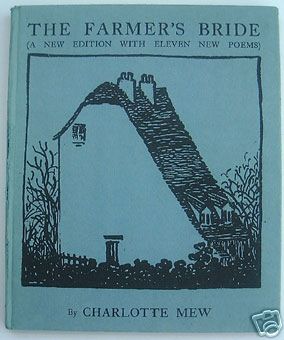
|
The Farmer's Bride. New edition with eleven new
poems
London: The Poetry bookshop. 59 pages. Also published in America as
Charlotte Mew:
Saturday Market. New York: Macmillan,
The additional poems (highlighting those that may not have been published previously) were: On the Road to the Sea (1914) - The Sunlit House (Written before 29.7.1913) - The Shade- Catchers - Le Sacré-Coeur - Song (1919) - Saturday Market - Arracombe Wood - Sea Love (1919) - The Road to Kerity - I Have Been Through the Gates (1919 - The Cenotaph (1919).
|
| The Author begs to thank the Editors of The Nation - The Westminster Gazette - The New Weekly - The Englishwoman - The Egoist - The Graphic - The Athenaeum - and The Monthly Chapbook for permission to reprint some of the poems in this book. |
|
Charlotte Mew in America The occasional story or
poem in Living Age did not create a presence for
Charlotte Mew in the United States. In Britain
The
Englishwoman and then The Poetry Bookshop and
her poetry collection gave her a presence or even
fame in some circles.
Her poetry collection appeared in the United States in
1921 when, according to
one report, she "immediately received wide
critical recognition". Saturday Market was reviewed in the
New York Evening Post
- the New York
Bookman - Poetry (Chicago), and, no doubt, elsewhere
in the USA.
In the USA, Charlotte's presence was institutionalised by the inclusion of a selection of her poems, with an introductory essay, in Louis Untermeyer's Modern British Poetry (1925). Louis Untermeyer had been introduced to Charlotte Mew's poetry by Siegfried Sassoon in 1920. He began a correspondence with Charlotte at the same time as he wrote the review of Saturday Market for the New York Evening Post. The publication of Saturday Market also stimulated John Chipman Farrar, editor of The Bookman, to publish The Rambling Sailor and to contact Charlotte for a new poem to publish. He secured To a Child in Death, which he republished in The Bookman Anthology of Verse 1922, with a brief introduction referring to her "distaste for revealment of biographical detail". Charlotte Mew also resisted Louis Untermeyer's efforts to find out about her life, but he overcame this by creating the romantic image of the secretive hermit. Sometime in 1922, Untermeyer published two of Charlotte's poems in his new Modern American and British Poetry. In the winter of 1924, Untermeyer and his wife visited Charlotte in London. Charlotte and Anne were helped to entertain them by Siegfried Sassoon. This may be the occasion when Charlotte gave Louis Untermeyer some of her manuscripts. The following February (1925) his revised Modern British Poetry was published with five of her poems and an extended tribute to her. After her death, Charlotte Mew's American presence increased rather than decreased. Untermeyer's anthologies were used in schools and colleges throughout the United States, and so generations of Americans read his postmortem on the reclusive British poetess forced to live in poverty in Bloomsbury whilst she pined for the countryside which she saw only occasionally, notably on a weekend trip to see Thomas Hardy. British readers, by contrast, would need to secure one of the Poetry Bookshop's collections of Charlotte Mew and her publisher said that less than six booksellers ordered a copy between 1939 and 1948. One of the Americans introduced to Charlotte Mew by Untermeyer's introduction and selection, was Mary Davidow, who went on the research a substantial biography of the poet. |
2.3.1921: Letter from Florence Hardy to Charlotte Mew. [Alida Monro Collection - Mary Davidow 1960 pp 339-340] - "My dear Charlotte Mew; (If I may venture)". Thanking Charlotte for the gift of the new edition of The Farmer's Bride
2.4.1921 "New Poetry" (anonymous) Review of Saturday Market, by Charlotte Mew. New Statesman 2 April 1921: 759. (Peggy Parris bibliography)
4.4.1921 Edith Sitwell, review of The Farmer's Bride in the Daily Herald quoted Mary Davidow 1960, pp 93-94
"In each poem we find the record of some great and terrible emotional experience, some ardent spirituality, controlled and made understandable by intellect and by an infallible certainty for the right expression"
May 1921: Wilfred Rowland Childe, Review of The Farmer's Bride. Voices May 1921: 92 (Peggy Parris bibliography)
25.5.1921, review of The Farmer's Bride in the Southport Guardian quoted Mary Davidow 1960, pp 93-94
"one of the best of contemporary women poets, individual in style and in outlook, skilled in metrical forms, and fresh in expression"
26.5.1921, review of The Farmer's Bride in The Sheffield Telegraph quoted Mary Davidow 1960, p.94
"full of restrained tenderness and pathos... forceful phrasing which rings absolutely sincere, stirring one knows not what divine sense of tears, voicing one knows not what insistent 'obstinate questionings of sense and outward things'. There is poetry here..."
July l921: W. H. Chesson, Review of The Farmer's Bride. The Bookman July l921: 181. (Peggy Parris bibliography) - Wilfrid Hugh Chesson (1893-1946) is described as an "English" literary critic, so I suspect this is the London Bookman.
|
22.7.1921 Letter from
Louis Untermeyer to Charlotte Mew.
[Berg Collection] He considered ignorance of Charlotte Mew's
poems in America "little short of criminal". This letter appears to be the
source of
our knowledge that Siegfired Sassoon read Madeleine in Church to
Untemeyer a year before.
[Falkenberg 2005 p.36]
23.7.1921 "The Poems of Charlotte Mew". Louis Untermeyer's review of Saturday Market in The New York Evening Post 23.7.1921 (See Peggy Parris bibliography) |

|
27.7.1921 (anonymous?) Review of The Farmer's Bride, by Charlotte Mew, Nation 27 July l921: 104. (Peggy Parris bibliography)
|
4.8.1921 E.V. Knox's parody of Charlotte Mew in Punch
The Circus Clown
The moonlight drips on the parlour floor;
And then the fête...
The band came up the street, the lions, the bears,
The forest road...
You must have meant me to come out to you;
And still the sparrows twitter in the square,
Reproduced by
Mary Davidow (1960) pp 95-96. She also reproduces a letter to
her (4.11.1958) from E.V. Knox
|
TF TQH Ken INC TF TFR TFB |
September 1921 Charlotte Mew refused to supply biographical information to Louis Untermeyer [Falkenberg 2005 p.36]. Untermeyer provided biographical introductions in his anthology of British poets. He found his way round the problem by introducing Charlotte Mew with an essay in tribute and describing her as an exceedingly reticent and hermit-like poet.
September 1921: Frank Swinnerton, Two Women Poets. A review of Saturday Market, by Charlotte Mew. The Bookman (London) 54 (Sept. 1921): 66. - [Although Frank Swinnerton is a London critic, this appears, from the volume number, to be the New York Bookman - Which would fit in with the USA title "Saturday Market" being used]
2.10.1921: (24.2.1921?) Letter from Florence Hardy to Charlotte Mew. [Alida Monro Collection - Mary Davidow 1960 pp 341-342] Her sister [Eva Dugdale?] had been to tea with Charlotte - white geraniums - She will be in London - Mr Cockerell pursues people and wears himself out.
24.10.1921 Date on copy of The Farmers Bride in the Hardy library inscribed to Florence Emily Hardy. Sold in 1938 [MG Sale/307] to Frederick B. Adams. Not stated where dispersed to .
---. The Farmer's Bride and Other Poems. London: Poetry Bookshop, 1921. ('A New Edition with Eleven New Poems') Presentation inscription to Florence Emily Hardy from Charlotte Mew 24 Oct. 1921. (MG Sale/307; Adams)
|
8.12.1921: Extract from a lawyer's letter respecting Mrs Mew's
tenancy of 9 Gordon Street, Gordon Square:
"Our client is about 90 years of age and we understand is an invalid and constantly under the Doctor's care. She is tenant for life of certain trust property which brings in a net income of approximately 300 pounds. Out of this sum she has to provide for the maintenance and support of a daughter who is and has been for some time past confined in the Isle of Wight County Hospital the expense of which amounts to roughly 130 pounds a year. Our client also has to support two other daughters one of whom is very delicate and is a great expense to her. On the death of Mrs Mew the trust property is divisible amongst her three daughters. We understand that one of the daughters does some occasional light work which brings her in a very trifling income." |
18.12.1921 Letter from Charlotte Mew to Sydney Cockerell
22.12.1921 Letter from Sydney Cockerell to Charlotte Mew [Berg Collection - BF] He has asked Margaret Sackville to send Charlotte her "sheaf of Epitaphs" ... "uncompromising eulogy of your poems".
Saturday 31.12.1922 Charlotte Mew arrived at the Cockerell's house in Cambridge "to spend the weekend with us". [Cockerell Diaries - BF]
|
The death of Wek
Alida Monro (1953 pages x-xi) says Charlotte "had one companion in her house - a parrot, Willie, who was said to be at least ninety years old and might have been older. He was a very noisy bird and made great difficulties at her tea parties when he took a dislike to some guest, usually a man, and would not be silenced. She and Anne had an enormous affection for this bird, and when he was ill, as he often was in his later years, Charlotte would frequent the parrot house at the Zoo any moment of the day, and sometimes at night if she could knock up the parrot man, to get help for him. However, as time went on his foot became worse and worse until he could not stand on his perch, and there came a day when I was summoned by Charlotte and told that the parrot man had said that Willie must be put to sleep and that I was the person to do it, as he could not stand men and a veterinary surgeon was therefore out of the question. It was a terrible moment when I was led by the two sisters to a room at the back of the house in complete darkness except for a candle, given a sponge, a large bottle of chloroform and several big blankets, and told that the chloroform was to be put on the sponge, the sponge put into the cage, and the blankets tucked well round to cut off all air so that Willie might be anaesthetised and die. This was done, and the dreary procession of three went downstairs to wait the period prescribed by the chemist as necessary to ensure his death. At the given time I went upstairs, took off the blankets, and put in my hand in the dark to remove the corpse from the floor of the cage, only to receive a smart nip on the ringer which nearly caused me to scream hysterically. However, I decided that the two sisters could stand no more, and bravely put in a hand, took the parrot by his neck - he was very weak - and held it till he was dead. I then placed the corpse in the little box waiting to receive him, and went downstairs to report that all was over. This death fortunately occurred just at the time that the lease of Gordon Street was up |
| 1922 | Charlotte 52-53 |
|
|
January: Kate Cockerell's illuminations - Lady Margaret Sackville comes to tea - February: The Rambling Sailor - March: Mews move to Delancey Street - April: To a Child in Death first published in the USA - September: Anthologised in the USA - October: Old Shepherd's Prayer in a Labour paper - November: General Election, but Charlotte not entitled to vote - December: Mrs Mew's fractured thigh - Dorothy Hawksley |
Arthur George Tansley Elements of Plant Biology London; New York : George Allen & Unwin Ltd.: Dodd, Mead & Company
| Louis Untermeyer included Beside the Bed and Sea Love in his Modern American and British Poetry. [Falkenberg 2005 p.36]. I assume that it was for this that he had asked Charlotte for biographical details in September 1921. In April 1922, the (New York) bookman published To a Child in Death. It included this in its Anthology (after September 1922), with an introduction that suggests Charlotte also refused it biographical details. |
|
|
In 1922 the south side of Euston Square Gardens began to be demolished to
make way for buildings. In this (1950s) map, the site of the
southern gardens is between Euston Road and Endsleigh Gardens. South of
that is
Gordon Square. The 1862 map beneath it (taken from the
Motco site) shows Euston Square on both sides of Euston Road.
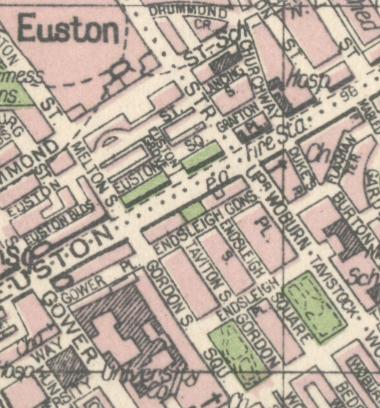
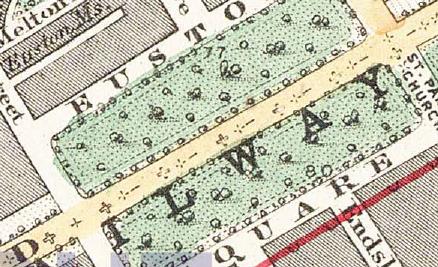
This involved the removal of some London Plane Trees. Charlotte Mew's emotional response to this is expressed in the following poem and in The Trees Are Down.
Ever since the great planes were murdered at the end of the gardens
Domus Caedet Arborem was published in
The Rambling Sailor in 1929 and in
Recent Poetry in December 1933.
In 1922, the lease expired on
9 Gordon Street, and the Mews had to move. It is possible that
this was part of a general re-development of the district.
|
3.1.1922 Letter from Charlotte Mew to Kate Cockerell. [BF] - Charlotte leaves a note of thanks for two days she has spent with the Cockerell's. Writes about Kate's illuminations.
24.1.1922 Letter from Charlotte Mew to Sydney Cockerell - [Berg Collection - BF] "Lady Margaret Sackville came here to tea on Thursday & gave me a delightful hour".
27.1.1922 Letter from Sydney Cockerell to Charlotte Mew. [Berg Collection - BF] Glad Charlotte and Margaret Sackville have met "at last"
February 1922: Charlotte Mew's poem The Rambling Sailor in The Chapbook. Twelve New Poems by Contemporary Poets. Charlotte Mew's poem is the fifth. [(Woolmer 1988, E2.25: Note "This is issues is printed on much cheaper paper than the other issues"). Also published in The Literary Digest 1.4.1922: 38; and then in The Bookman volume 57, pages 423-423 in June 1923
March 1922: Mews moved from 9 Gordon Street to 86 Delancey Street, Camden Town. (map) - Three year lease (Letter 29.5.1924)
April 1922: Charlotte Mew's poem To a Child in Death in The Bookman volume 55 (therefore New York), page 117. [Not Temple Bar as in the Peggy Paris online list. A different poem with a similar title was published in 1901]
9.4.1922 Letter from Louis Untermeyer to Charlotte Mew. [Berg Collection] He asks if he and his wife could have a photograph of her. "Already in reply to his request for biographical information in September, she had declined" . In the same letter he said he had seen To a Child in Death in The Bookman and would like to include it in his next anthology. [Falkenberg 2005, p.36] - See description Jean Starr Untermeyer's description of Charlotte Mew, who she saw once, briefly, in 1924, matches a photograph of her. Suzanne Raitt (2000, plate 16) dates the picture, without explanation, as "in 1923"
6.4.1922 Freud wrote to Ernest Jones in London: "Tansley has started analysis last Saturday. I find a charming man in him, a nice type of the English scientist. It might be a gain to win him over to our science at the loss of botany." (external link)
The Wellcome Library has "Carbons (torn out of book) of letters from Mary Chick, c/o British Relief Mission , Hofburg I, Vienna, to Mr and Mrs Ensor about relief work with Austrian children, May-June 1920."
1.5.1922 Date on inscription in a copy of Poems from the works of Charles Cotton selected and decorated by Claud Lovat Fraser, The Poetry Bookshop: "For Charlotte Mew from Harold Monro - 1 May 1922". [Offered for sale by Ulysses bookseller, London September 2007 at £150
9.5.1922 Letter from Charlotte Mew to Kate Cockerell. [BF] From "86 Delancey Street, N.W.1" Charlotte wishes Kate could illuminate a small book of Walter de la Mare's poems. His Song of the Mad Prince has been running through her head.
9.5.1922 Letter from Charlotte Mew to Sydney Cockerell [?]
June 1922 Marion Strobel, Review of Saturday Market. Poetry [Chicago] XX June 1922: 152-155. (Peggy Parris bibliography) - Saturday Market, by Charlotte Mew, Volume 19, June 1922, Page 152 (Poetry index)
2.6.1922 Letter from Sydney Cockerell to Charlotte Mew. [Berg Collection - BF]
5.6.1922 Letter from Charlotte Mew to Sydney Cockerell [Berg Collection - BF] Very hot weather. Sydney had given Charlotte a copy of Thomas Hardy's Late Lyrics and of his sister (Olive)'s French Garden "I haven't got beyond the illustrations - but these - rabbits and mice and bacteria are delightful. - and the watering can is nearly human".
17.7.1922 Letter from Sydney Cockerell to Charlotte Mew. [Berg Collection - BF]
25.7.1922 Letter from Charlotte Mew to Mrs Inglis. [Berg Collection - BF]. Thanking her for a letter and box of flowers from her garden. Sweet Williams (of all "the old garden things... my favourites") - little country roses - pansies. Anne is going to paint some of them. The letter refers to Mrs Inglis's trip to town having been cut short - So maybe Charlotte had entertained Mrs Inglis at Florence Hardy's request?
| September 1922 (or shortly after) The Bookman Anthology of Verse 1922, edited by John Chipman Farrar (1896-1974), New York, George H. Doran company, included To a Child in Death - "While the majority of the poets represented are American, the work of several notable Englishmen is included." Online edition - entry on Charlotte Mew |
|
| The anthology has this entry on Charlotte Mew: "With one volume of poems published in her native England and reprinted here under the title Saturday Market, Charlotte Mew immediately received wide critical recognition last year. Her dramatic poems, with their simplicity and force, her carefully-constructed and yet poignant lyrics, were impressive even though their volume was slender. When I read this book, I wrote to a friend in England to see if he could secure a poem for me. Miss Mew replied, cordially, and this fine lyric was the result. She has the Englishwoman's distaste for revealment of biographical detail; but her strong, penetrating, strikingly original work speaks tellingly of her." |
14.8.1922 Letter from Charlotte Mew to Kate Cockerell. [BF] From "Delancey House, 86 Delancey Street, N.W.1" - Charlotte cannot join her in Sussex. - "The last two days my heart has gone wrong again". - See also 29.5.1924 and 21.11.1927.
14.8.1922 Letter from Sydney Cockerell to Charlotte Mew. [Berg Collection - BF]
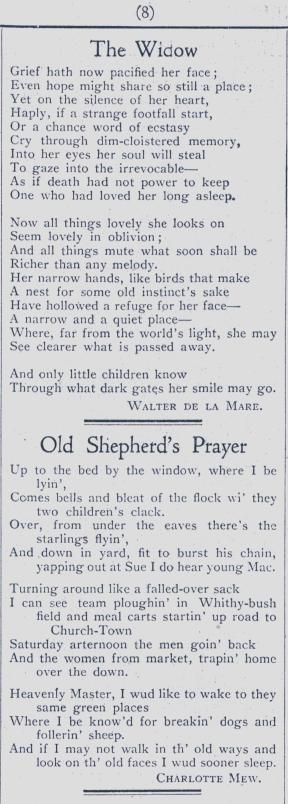
|
6.10.1922 First edition of The New Leader, a weekly paper of the Independent Labour Party, edited by Henry Noel Brailsford, contained Walter de la Mare's poem The Widow and Charlotte Mew's poem Old Shepherd's Prayer. It also contained articles by J. Ramsay MacDonald, H. N. Brailsford, T. F. Powys, G. D. H. Cole, and H. G. Wells, as well as various news items. (16 pages) [Information from John Eggeling of Todmorden Books, who sold a copy on ebay for £26 on 30.7.2007 - See helpful people] |
October 1922 Shorter Lyrics of the Twentieth Century, 1900-
1922 "Selected with a Foreword by W.H. Davies". The Poetry Bookshop.
Included lyrics by Charlotte Mew.
22.10.1922 Letter from
Sydney Cockerell
to Charlotte Mew.
[Berg Collection -
BF]
30.11.1922 Letter from Charlotte Mew to
Mrs Inglis.
[Berg Collection -
BF] - I send you a small poem
in a Labour paper -
December 1922 "Mrs Mew fell and fractured her thigh"
(Mary Davidow 1960 p.98)
22.12.1922 Letter from
Sydney Cockerell
to Charlotte Mew.
[Berg Collection -
BF] He has "asked
Dorothy Hawksley to find out how things have been going and to
let me know."
25.12.1922 Letter from
Sydney Cockerell
to Charlotte Mew.
[Berg Collection -
BF] Mrs Mew now in hospital
| 1923 | Charlotte 53-54 |
|
|
The Rambling Sailor anthologised in Britain - Last flurry of poems - January: The Trees are Down - February: Fin de Fête - March In the Fields - May: Death of Charlotte's mother - Charlotte self administers peroxide - November: Harley Street opinion - December: Meal with Walter de la Mare - General Election: Charlotte Mew's first chance to vote - Civil List pension |
January 1923: Charlotte Mew's poem The Trees Are Down published in The Chapbook (See 1922). This edition contained poetry and prose. There was an item by "The Recorder" which was Alida Monro.
18.1.1923: Letter referring to true quiet of a Quaker household
17.2.1923 Charlotte Mew's poem Fin de Fête published in The Sphere
February 1923 Letter from Charlotte Mew to Mrs Inglis. [Berg Collection - BF]
March 1923 Charlotte Mew's poem In the Fields published in The Sphere. It was republished in an American anthology in 1925 and The Rambling Sailor in 1929.
5.4.1923 Letter from Sydney Cockerell to Charlotte Mew
|
12.5.1923 Death of Anna Maria Mew, Charlotte's mother. Her age given as 79, which has to be wrong because she was four years old when the 1841 census was taken. She died at St Peters Harbour, 10 Greville Place.
In 1917: St. Peter's Harbour; 10 Greville Place, Kilburn;
"Permanent home for women over 60. From 15s. to £2 2s" (Herbert
Fry's Royal Guide to the London Charities edited by John Lane, 1917
Her home address was 86 Delancey Street, St Pancras [NW] and C.M. Mew her daughter, of the same address, "present at the death", notified it at North Marylebone, St Marylebone, on 14.5.1923. The causes of death were 1) Toxaemia, 2) Partial obstruction of bowel [and] Exhaustion. Certified by C.H. Harbinson, BA, MB. [Comment: Possibly bowel cancer leading to blood poisoning (toxaemia). Exhaustion of the body from the pain.]
|
18.5.1923: Letter from Florence Hardy to Charlotte Mew. [Alida Monro Collection - Mary Davidow 1960 p.344] She has just heard from Mr Cockerell the news of the death of their mother
30.5.1923 Letter from Arthur Tansley to Frederic Clements, in which he says "It is likely I shall take my whole family with me to Vienna". They moved in October.
8.11.1923 Letter from Sydney Cockerell to Charlotte Mew [Berg Collection - BF] Anne has told him the advice that a Harley Street specialist has given Charlotte. It would have been his own diagnosis. "Only I don't know what you might have done to yourself with that ridiculous peroxide."
Wednesday 5.12.1923 Sydney Cockerell arranged a meal for Charlotte and Anne Mew, Alida Monro, Florence Hardy and Walter de la Mare. [Cockerell Diaries - BF]
17.12.1923 Letter from Charlotte Mew to Kate Cockerell from 86 Delancey Street. [BF, probably Adams collection]. "Anthology windfall" 25.11.1923 Letter from Sydney Cockerell to Charlotte Mew - BF] Anne, but not Charlotte, has spent Christmas with the Cockerell's. Sydney had lunch with Conrad on Friday and found "he was a keen admirer of your poetry".
Saturday 29.12.1923 Sydney Cockerell notified that a Civil List Pension of £75 a year had been awarded to Charlotte Mew "in recognition of her poetical works". [Cockerell Diaries - BF]
| 1924 | Charlotte 54-55 |
|
|
January: Peter Pan - Siegfied Sassoon makes contact- the future of civilisation - May: Kate Cockerell's painting The Wood at World's End - December: Lunch with Sassoon who then helps with Charlotte's American guests |
Thursday 3.1.1924 Letter from Charlotte Mew to Katharine Cockerell. [BF] - aged 13. She has booked tickets for Peter Pan, at the Adelphi Theatre, on Friday 11.1.1924. Katharine also invited to tea at "my sister's Studio" after the show.
Thursday 3.1.1924 Letter from Siegfried Sassoon, from 54 Tufton Street, SW1, to Charlotte Mew: "Dear Miss Mew, This is good news, though you deserve a more generous reward from the country you have served so nobly by your poetry. In an age like this, poets are more than ever a fortunate (though irritable) race. They carry the world on their shoulders, so it seems to me. And in their eyes the future of civilisation struggles to survive. I wish more of them were as intensely aware of their responsibility as you are, and sustained it so nobly. Forgive this effusiveness, but I feel very strongly about what you have done in verse." [See above, The Cenotaph] - He sends her a copy of his latest book [ Recreations]
7.1.1924 Letter from Charlotte Mew to Siegfried Sassoon. [Siegfried Sassoon Collection - Mary Davidow 1960 p.348] She finds beauty in his poems Falling Asleep and Limitation. "Professor Brown" may refer to Early Chronology (162) and "the gentlemen peeling plovers' eggs" to The Case for the Miners. The Case for the Miners appears to be the stimulus of this comment "Pity and Beauty may be the divinest things but there is, too, something divine and wholesome and cleansing in righteous anger". Charlotte is pleased that Sassoon has written to her as it gives her an opportunity to thank him for recomending her work to Louis Untermeyer
Wednesday 23.4.1924 British Empire Exhibition opened at Wembley by George 5th. The Imperial Botanical Conference, hosted by the Department of Botany at the Imperial College of Science and Technology at South Kensington, was timed to coincide. "... debates were centered around genetic approaches (with William Bateson as the main collaborator), ecological approaches (with Tansley and Chipp as the main contributors), or a blend of both." (Peder Anker, 2001, page 34)
Tuesday 13.5.1924 Samuel Chick Limited established by an "agreement" of Samuel Chick to sell "certain herediments in the Parish of St Marylebone" to the company (at a price of £1). The Report 5.8.1924 shows the Directors as Samuel Chick "Lace Merchant" - Emma Chick - James Hooley Chick "Lace Merchant" - and Mary Chick. All of whom lived at Chestergate, 30 Park Hill, Ealing, W5. The Manager was Samuel Chick and the Secretary, Oscar Marshall at 5 Newman Street. There were 12,000 shares and the Chick papers (Watts boxes) suggest that these were all held by members of the family.
Wenesday 28.5.1924 Letter from Kate Cockerell to Charlotte Mew. [Berg Collection BF] She wants Charlotte to visit
29.5.1924 Letter from Charlotte Mew to Kate Cockerell from "Hogarth Studios, 64 Charlotte Street, W.1." [BF] House at Delancey Street empty. Charlotte cannot visit because she is so tied up with legal, tenancy and domestic matters. "Plus which my heart which hasn't been working properly this year is getting restive - and I can only do everything at half speed." Anne is with friends in Chester for a week and may be going on to Buckinghamshire.
|
30.9.1924 Florence Hardy operated on for a the removal of a tumour -
In the nursing home, recuperating afterwards - Florence's principle
visitors were Charlotte Mew and Sydney Cockerell. She began writing to both
on first name terms.
(Millgate, 1995/1996)
3.10.1924 Letter to Florence Hardy from Charlotte Mew 5.10.1924 Charlotte Mew visited Florence Hardy - Also letter to Florence Hardy from Charlotte Mew Fitzroy House - 7.10.1924 - envelope marked for hand delivery My dear Charlotte I have so loved reading the magnificent poems you so kindly sent. I think Here Lies a Prisoner is my favourite. It is so strong and so clear cut - I love "frozen breath of his silenced soul". May I take that home to show T.H. I will not lose it I faithfully promise (no I will copy it if you don't object). Fin de Féte I do not like quite so much as some others of yours - though of course I do like it. And the same with The Rambling Sailor which, though it is fine, I admit does not appeal to me so much as Hurt Not the Trees. How T.H, would love that. But I fear if he read it never again would a one bough be lopped of the trees that hem us round and make some of our rooms so dark and depressing. I have read the poem again since I wrote those last words and it is more and more wonderful. There is no other living poet - man or woman - who could have written just that poem. Thank you so much for sending them. It did me so much good to see you again here. It was so good of you to come. I am writing this at 6.30 in the morning - having watched the dawn and listened to the milk carts rattling by. I am ashamed to confess that I am rather enjoying these last few days. I am so looking forward to seeing your sister. With love - and please do make me proud by calling me Florence. Always yours affectionately. F.E.H 7.10.1924 Anne Mew collected the poems and books, by arrangement.
|
"It was not until the end of 1924, when I visited England to give a lieder recital in London's Aeolian Hall, that I met Charlotte Mew. By that time I knew her "The Farmer's Bride" and "Madeleine in Church" and was eager to meet a woman at once so passionate and reserved, with whom I already felt in sympathetic relationship" (Jean Starr Untermeyer 1965, p.108)
30.11.1924 Letter from Sydney Cockerell to Charlotte Mew [Berg Collection - BF] - He and Siegfried Sassoon had travelled back from Dorchester together on Friday. "He had been writing something about you for Berlin and was seeing that afternoon somebody connected with a sort of American Golden Treasury in order to make sure that you were properly represented. He told me that the Poet Laureate had joined the band of your admirers."
Tuesday 2.12.1924 Letter from Charlotte Mew to Sydney Cockerell [Berg Collection]
Thursday 11.12.1924 Sydney Cockerell, Charlotte and Anne Mew, Dorothy Hawksley, Siegfried Sassoon and Stephen Gooden lunched at the Gobelins from 1.15 to 3pm. Cockerell wrote "I wanted Charlotte and Sassoon to be friends and they got on capitally" [Diaries - BF]
Thursday 11.12.1924 Letter from Charlotte Mew to Kate Cockerell from "64 Charlotte Street, W1" [BF] On Saturday (4pm) she has some "exhausting Americans" visiting, who Siegfried Sassoon has "promised to come and help me with". - Charlotte suffering from a "sort of permanent Influenza"
Saturday 13.12.1924 Visit of Louis and Jean Starr Untermeyer - Was this the occasion that Charlotte gave Louis Untermeyer manuscripts of her poems, including To a Child in Death (which he had already seen in April 1922), In the Fields (published May 1923), and Old Shepherd's Prayer (published October 1922)?
|
Jean Starr Untermeyer:
"Several years before, while visiting America, Siegfried Sassoon had read to us some poems of Charlotte Mew. Although at this moment I have no access to her letters and photographs, I feel sure that 1924 was the year of our first meeting with this gifted poet. Whether the connection was first established by correspondence or the meeting arranged by Alida Klamentaski, her close friend, I do not remember. But we met for tea at Miss Mew's flat in London, and immediately I felt a wave of almost electrical attraction. I still recall the impact of that white and narrow face, the bones showing almost as luminous through the flesh as in the face of Duse, framed in glistening white hair and punctuated by dark, burning eyes in which the tragic sense was deep-seated, but which could brighten instantly with her ready humour."
"Her nature is best deduced by a reading of her poems - such as I Have Been Through the Gates - Sea Love - and Beside the Bed - and I should not be successful if I tried to capture her quality in a sentence. So I recommend these poems, which face the world so realistically and so compassionately. Passionate as she surely was, her demeanour was controlled and British enough. I saw her only this one time, and actually could not converse alone with her. But we corresponded, and though the letters kept mostly to human generalities and to literature, I felt some mutual recognition had taken place." (Jean Starr Untermeyer 1965, pp 113-114) |
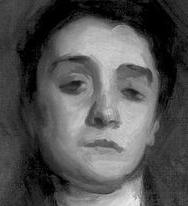
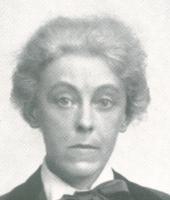
Sunday 14.12.1924 Letter from Charlotte Mew to Sydney Cockerell: Siegfried Sassoon "angelically came and helped me with the Untermeyers at teatime yesterday"
| 1925 | Charlotte 55-56 |
|
|
January: Moorland Night - February: American anthology includes In the Fields - March: Sassoon sends his new book - April: Business in the country - Charlotte hopes Sassoon will call - December: Samuel Chick bequest to Charlotte and Anne - Anne becoming ill |
24.1.1925 Charlotte Mew's poem Moorland Night published in The Nation and Athenaeum - Republished in The Rambling Sailor (1929). It was chosen for Twentieth Century Poetry in 1933 and, possibly, 1929.
| February 1925 Louis Untermeyer's revised Modern British Poetry includes five poems by Charlotte Mew, with an introductory tribute. |
|
"...in the second week of February 1925, 'the thoroughly revised' Modern British Poetry went to the printer. The expanded group of Mew's poems, with the extended Tribute, would include In the Fields - To a Child in Death - Sea Love - I Have Been Through the Gates - Song. The editor calls particular attention to the longer poems that could not, because of their length, be included. The expanded tribute reads, in part, 'One of the most amazing figures in modern poetry is Charlotte Mew. An exceedingly reticent person as well as a hermit-like poet, she has published only one book, yet that small collection contains some of the finest poetry of our times". [Falkenberg 2005 p.36]
4.4.1925 Letter from Charlotte Mew to Siegfried Sassoon [Siegfried Sassoon Collection - Mary Davidow 1960 p.349] - thanking him for his new book. But "I remember... your... Dreamer and Dug-Out and wish your next book might be in words of one syllable". She thinks he wastes "good powder and shot" on the Anglican clergy and Wembleys [Afterthoughts on the Opening of the British Empire Exhibition p.127 and Lady Lucres [Breach of Decorum p.135]
29.4.1925 Letter from Charlotte Mew to Siegfried Sassoon [Siegfried Sassoon Collection - Mary Davidow 1960 p.350] - Selected Poems arrived on Monday night. Beauty and horror side by side. Mentions Invocation - Idyll - At Carnoy - Before the Battle - Wraiths - A Poplar and the Moon - "the two last - to me - the most unforgettable of all". - She has just got back from staying with friends - has been down with a touch of flue since Monday - when she is all right, she expects "any day to have to go to the country on business" [Which may mean family business on the Isle of Wight] - "when I'm finally back I shall ask you to come to see me - and hope you will"
21.5.1925 Letter from Florence Hardy to Charlotte Mew. [Alida Monro Collection - Mary Davidow 1960 pp 350-351]
27.5.1925 Letter from Florence Hardy to Charlotte Mew. [Alida Monro Collection - Mary Davidow 1960 pp 351-352]
20.11.1925 Letter from Charlotte Mew to Kate Cockerell. [BF] [??]
6.12.1925 Death of Samuel Chick the father, aged 84, at Chestergate, Ealing. Interred at Perivale 9.12.1925 (Family Bible: Watts boxes).
Order of Service for the funeral of Samuel Chick June 7th 1841 died December 6th 1925 - Congregational Church Ealing Green, Rev WY Fullerton Assisted by Rev Witton Rix.
Epitome of the will of Samuel Chick Esq, dated 29th Sept 1924, testator died December 6th 1925. Executors Trustees, Emma Chick, James Hooley Chick, Mary Chick, Samuel Hooley Ackroyd (his nephew). Samuel Hooley Ackroyd was a Civil Servant who lived at 22 Webster Gardens, Ealing. He died in January 1948.
The epitome of the will says: "To Charlotte Mew and her sister Ann Mew lately residing in Gordon Street, £25 each." (Watts boxes)
Addresses: of 5 Newman Street, Oxford Street, London - of Chestergate, Park Hill, Ealing, Middlesex - of Hazelwood, Branscombe Beer, Devon. "Lace Merchant". A JP for Devon.
Dorothy Lumb has one of the ten copies of "The Recollections of William Elijah Chick" (a book). This only refers briefly to events of his childhood and his Chick cousins, but contains the following. Eric (Stallard) was William Elijah's step brother, his father having remarried when he returned from the first world war. The holiday recollections must, therefore, relate to between 1920 and 1925
"During the Sidmouth holidays, we got poshed up and tramped to Branscombe, to call on Uncle Samuel and his unmarried daughter Harriette. Eric and I followed the guns, over the cliff, hunting rabbits. The house is called Hazelwood. Thirty years later, Dame Harriette accorded my family the pleasure of having it as a holiday home on several occasions."
around Christmas 1925 Anne Mew "who began to show signs of ill health around Christmas of 1925, was, by Autumn of 1926, in great physical discomfort" (Mary Davidow 1960 p.102)
| 1926 | Charlotte 56-57 |
|
|
Writing Aglaë - Dorothy Hawksley - May: Youth struck down - June: Professor Grierson gets Do Dreams Lie Deeper? - Staying with the Hardys and writing in Devon - August: Sea Love on the BBC - October: Aglaë abandoned - November: Chichester - Christmas with the Brownes - Anne in a nursing home |
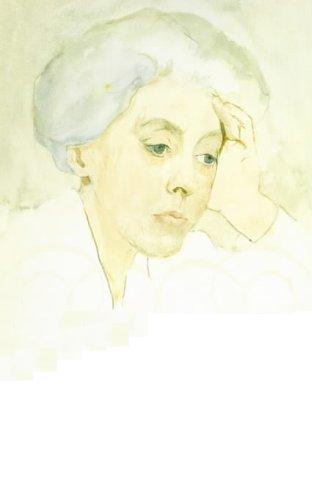
|
1926 is the year the
National Portrait Gallery gives for its
Dorothy Hawksley
portrait of Charlotte Mew.
The watercolour measures 11 inches by 7 and three-quarter inches (279 mm x 197 mm). It is not on display, but there is a picture of it on the gallery's web. Dorothy Hawksley gave the portrait to the nation in 1947. The publishers of Penelope Fitzgerald's story, "Charlotte Mew and her Friends", used an image (left) of part of Dorothy Hawksley's picture, re-shaded yellowy-green, as their cover. |
"Euston Square... together with Seymour Place, was partly erected in 1813, but not completed until 1831. Inasmuch as it actually forms a part of Euston Road it can hardly considered a square at all, and moreover, the southern portion, which until 1926 was still an open garden, is now partly covered by the handsome building of the Society of Friends..." (Clunn, H.P. 1962 p. 151)
New Year 1926: Dorothy Hawksley gave Charlotte and Anne a cyclamen
that was still flowering on 28.4.1926.
March/April 1926 Dorothy Hawksley on a windy hillside somewhere -
Not on a Mediterranean cruise.
Wednesday 28.4.1926 Letter from Charlotte Mew to
Dorothy Hawksley from 86 Delancey Street.
(Mary Davidow 1960 pp 353-354). This, and other letters (not
reproduced) were given to Mary Davidow by Dorothy Hawksley.
Monday 3.5.1926 or Tuesday 4.5.1926 Charlotte and Anne hoped
Dorothy Hawksley would come to tea at the Studio (4.30)
Sunday 30.5.1926 Two friends of Charlotte and Anne Mew were in a
motor smash. They were "children of a very old friend who had just
launched them after giving up her art and life to them". The girl, aged 22
and a half, [born December 1903?] was killed. The boy, aged 18 [born summer
1906?], was badly injured. The mother
"now broken" was the artist Anne and Charlotte had wanted Dorothy Hawksley
to meet. [Suggestion made by Mary Davidow that this is
Elsie O'Keefe]
Wednesday 2.6.1926 Letter from Charlotte Mew to
Kate Cockerell.
[BF]
Tuesday 15.6.1926 Charlotte Mew sent
Herbert Grierson
"Do Dreams Lie Deeper"
in response to his request of a poem.
Tuesday 22.6.1926 Letter from Charlotte Mew to
Sydney Cockerell -
"I have just had the nicest of nice letters from Professor Grierson after
sending him a scrap of verse for his: Women Students' Miscellany."
The port that is described in the story seems to be Barfleur, in Normandy. A straight road runs from here to St Pierre Eglise (see external map), which is mentioned on page 318. Val Warner (1997, pp xvii-xviii) says that Charlotte marked the story "abandoned October 1926". So Aglaë appears to be the last of Charlotte Mew's major works: Her unfinished story - But the images in the story recall pre-1914 poems - Pêcheresse which uses Brittany dialect - The Narrow Door - See Language The story is the recollection of the life of Aunt Aglaë, who, at "close on fifty years" [near Charlotte's age?] is "slowly dying" in the house on the inner harbour where her family have lived for generations. Germaine, her younger sister, married the fisherman Raymond, and gave birth to Odette, but Aglaë remained single. Germaine has emotions and needs, but claims that Aglae was born old and passionless. But there are different levels, or dimensions, of consciousness, different levels of interaction and the story tells the vigour and passion that moves within the wax exterior. When Germaine's second lover, Leroux, suggests Aglaë was Raymond's lover and Odette's mother, he is physically wrong. But Odette has in other respects become Odette's mother and, after his death, Raymond shares her bed and she takes possession of him.
|
Tuesday 24.8.1926 Charlotte Mew's poem Sea Love read by Alida Monro on wireless - (Penelope Fitzgerald 1988 pp 207 + 282)
October 1926 Charlotte abandons Aglaë
Wednesday 27.10.1926 Letter from Sydney Cockerell to Alida Monro referenced (Penelope Fitzgerald 1988 pp 212 + 283 - BL Add MSS 57756) - He did not know Charlotte had gone away and did not know where she had gone - He is unwilling to invest money in The Poetry Bookshop. Penelope Fitzgerald says (no referencing) that Charlotte and Anne had terminated the lease at Delancey Street, put the furniture into store, and booked two rooms until the spring at St George's House, opposite Chichester Cathedral. She says that occupation of Anne's studio was an emergency measure when they returned in November. However, the move from Delancey Street to Hogarth Studios appears to date from the spring of 1924
Do Dreams Lie Deeper? published in Atalanta's Garland being the Book of the Edinburgh University Women's Union {Date on "Prefatory Note" September 1926 - See some helpful people - The book has 14 introductory pages, 191 main pages. Charlotte's poem is page 150 of the main pages. Atalanta's Garland is an anthology published to celebrate the twenty-first anniversary of the Edinburgh University Women's Union. The contributors include A.W. Mair Greek Elegiacs - Katherine Mansfield Two Unpublished Sketches: 1) Little Jean, 2) Lucien - Hilaire Belloc Thoughts in the Manner of the Ancients - W.H. Davies Two Poems: 1) Where Shall We Live, 2) Contented Hearts - Virginia Woolf A Women's College from the Outside (story) - T.B. Simpson George Square - Ethel Colburn Mayne The Lower Road - Walter de la Mare The Snail: a poem - Cecile Walton Atalanta in Caledonia: Notes on Women's Contribution to the Arts in Scotland - Fredegond Shove Three Poems: 1) May Morning, 2) Hymn at Night in Lyme Regis, 3) Fragment - Lucie Delarue Mardrus Conte de Fées - Charles Murray Eight Versions in Scots from the Greek Anthology - John Brandane Koechlin: a play in one act -Jessie M.King The Dropping of a Pebble - Irene Forbes-Mosse Die Leuchter der Königin (story in German) - B.D. A Students' Union of 1398 - Marion Angus Two Poems: 1) World's Love, 2) Singin' Water - Rachel Annand Taylor A Renaissance Girlhood - Thomas Sturge Moore - A Recension: In devout and grateful admiration of Henry Killigrew - Ada Negri L'Usignolo - J.P. Lamb, Charles Nodier, and Fanny Kelly - Edwin Muir On the impoverishment of language (essay), Hugh McDiarmid Hungry Waters (lyrics with music by F.G. Scott) - Pauline Smith An Old Couple: From a South African Diary - Charlotte Mew Do Dreams Lie Deeper: a poem - Emilia Pardo Bazá Eterna Ley (story in Spanish) - Violet Jacob The Bold Wooer: a poem - Mary G. Dickins Madam - Naomi Mitchison Charilas, in Exile, remembers Sparta - Neil Munro Ballantrae - Gordon Bottomley (as below) - Frances Storrs Johnston In the Path of the Pioneer Medical Woman - Sylvia Lynd Early Morning
November 1926 Anne and Charlotte went to Chichester.
27.11.1926 Letter from Charlotte Mew to Sydney Cockerell - "Perhaps Grierson sent you a copy of Atalanta's Garland but anyhow here is an extract from it which may or mayn't interest you".
To Miss May Morris in Kelmscott,
with a copy of Poems of Thirty Years
By Gordon Bottomley.
In the still house so far from here
The night-long tumult of the weir
Sounds as it sounded long ago
To you and to those Others who
With you in company were set:
Tonight Their lights are gleaming yet,
Their place by your life are warm,
By you the House still works their charm
Ah, as you heard the sounds they heard
And live as they lived, lit and stirred
By rarer powers than men now know,
Would that my book by you might go
Into their consciousness and say
Their vision lights me to, and pray
That, by your cognisance to me
From them might pass that energy
Which was Their spirits, like a flame
Of blessing on my book from Them
[page 181. The permission of Miss May Morris was given for the verses to be printed (p. vii)]
Anne and Charlotte spent Christmas with Professor Browne and family at Berkhamstead. (Mary Davidow 1960 p.102)
30.12.1926 Anne entered a nursing home at 2 Nottingham Place. She returned to Hogarth Studios about a month later. (Mary Davidow 1960 p.103)
| 1927 | Charlotte 57-58 |
|
|
June: Death of Anne Mew - September/October: Staying with Kate Cockerell - October: Biographies for Kate - November: Heart strain and a private worry - November/December: Staying with Winifred and Ethel Oliver |
Scott, Mrs. C. A. Dawson. Writer. Has written many successful Novels, Founder of the P.E.N. Club. Author: "From Four Who are Dead." Has developed personal psychic powers. For personal experience, see "Light," June 4, 1927, p. 268. Address: 125, Alexandra Rd., N.W. 8, London.
2.1.1927: Letter from Charlotte Mew to Sydney Cockerell. [Berg Collection BF. Referenced Mary Davidow 1960 p.103] - mentions a fund and that Anne would be pleased to see him at 2 Nottingham Place
3.1.1927: Letter and Post Card from Charlotte Mew to Sydney Cockerell. [Berg Collection BF Letter referenced Mary Davidow 1960 p.103] Oliphant's St. Francis of Assisi
5.1.1927: Letter from Charlotte Mew to Sydney Cockerell. [Berg Collection BF Referenced Mary Davidow 1960 p.103] "brutal finality" - "I got St Francis for her".
30.1.1927: Letter from Anne Mew to Sydney Cockerell. [Berg Collection BF. She is leaving the nursing home on that day.
19.3.1927 Letter from Charlotte Mew to Mrs Inglis. [Berg Collection - BF]
27.4.1927 Letter from Sydney Cockerell to Charlotte Mew. [Berg Collection - BF] Relates to Anne moving from the studio into a nursing home
7.5.2007 Letter from Alida Monro to Harold Monro quoted (below) (Penelope Fitzgerald 1988 p. 215. No referencing, but inference from other referencing suggests the British Library
"Last night Charlotte Mew came round and said that though Anne could not speak she was always writing down that she wanted to see me and so I had to go. I have never seen anyone so near death before and because of her illness (some wasting liver disease) she has no flesh on her at all hardly and looks like a skeleton. She could just speak and I talked of our flight to Paris and the robbery practised by the French porters, which interested her.Queer how, looking towards the gas fire, and talking of the spring warmth we shall soon be feeling, she should have murmured 'I shan't want a fire soon.' As I talked to her and she shut her eyes I felt they were sealed on her face and would never open, but they did. Aunty Mew says that Dr says any moment she may go down to earthly mould. Poor little Mew, it is more tragic than I can tell you - Her rough little harsh voice and wilful ways hiding enormous depth of feeling - now she will be entirely alone and her relation with Anne has been one of complete love, and I imagine the love of sisters (or brothers) more marvellous than any other as there can be no fleshly implications or sexual complexities, Alas -"
24.5.1927 Letter from Charlotte Mew to Mrs Inglis. [Berg Collection - BF]
| Dr Horatio Cowan, the doctor involved in Anne Mew's and Charlotte Mew's treatment had his consulting room in Fitzroy Square (Penelope Fitzgerald). In the 1901 Census, Horatio W? A. Cowan, aged 26, born Inverness, "Doctor of Medicine", with his wife, Alma B. Cowan, aged 21, born London, were living, with a female general domestic and a page boy as servants, at 32 Fitzroy Square. They were the only occupiers. |
|
Saturday 18.6.1927 Death of Anne Mew (Caroline Frances Anne Mew), aged 53 years, at 43 Priory Road. She was "of 64 Charlotte Street, St Pancras, Spinster, Artist (Retired)" and her death was registered in Hampstead by "C.M. Mew, Sister, 64 Charlotte Street W." on Monday 20.6.1927,. The causes of death were "1, Carcinoma of Uterus and Liver. 2. Haemorrhage and Exhaustion. No P.M. Certified H.A. Cowan MRCS" [Comment: The cancer would have started in the womb and spread to the liver, making it fatal. Bleeding from the womb and exhaustion from the pain have contributed to the death.] She was buried in Hampstead Cemetery, Fortune Green Road.
|
Charlotte stayed with the Olivers after the funeral. (Mary Davidow 1960 pp 103-104)
25.6.1927: Letter from Charlotte Mew to Sydney Cockerell. [Berg Collection - Meynell, V. 1940 p.321]
Charlotte was at Hogarth Studios in August (Mary Davidow 1960 p.104)
16.8.1927: Letter from Charlotte Mew to Sydney Cockerell. [Berg Collection BF]
18.9.1927 Letter from Charlotte Mew to Kate Cockerell from 64 Charlotte Street, W1 [BF]
23.9.1927 Letter from Charlotte Mew to Kate Cockerell from 64 Charlotte Street, W1 [BF]
25.9.2007? to 8.10.2007 Sydney Cockerell in Greece
28.9.1927 Charlotte Mew staying with Kate Cockerell in Cambridge whilst Sydney Cockerell away. Charlotte returned on 10.10.1927 [BF]
11.10.1927 Letter from Charlotte Mew to Kate Cockerell. [BF] [??]
27.10.1927 Letter from Charlotte Mew to Kate Cockerell. [Berg Collection BF] - Kate should ask Sydney for the Conrad biography whilst waiting for Charlotte to find Mrs Gaskell's Life of Charlotte Bronte with large enough print. [Taking "GB's Life" as "CB's Life". Alida Monro was "as hypnotised as I am by them" and had a small print 1857 edition in two volumes - Which corresponds to the second edition of Mrs Gaskell]
21.11.1927 Letter from Charlotte Mew to Kate Cockerell. [Berg Collection BF] Charlotte has "been a bit ill myself (throat and heart strain) and on the top had a private worry which absorbed normal activities.". She has gone somewhere "to pick up a bit and enjoy the winter trees."
Charlotte returned to the Olivers in November and stayed with them over Christmas. (Mary Davidow 1960 p.104)
| 1928 | Charlotte 58- |
|
|
January: Death of Thomas Hardy - February: Charlotte, not sufficiently insane to be certified, agrees to Beaumont Street nursing home - March: Suicide of Charlotte Mew in nursing home - |
During 1928: Michael Tippett's String Quartet No. 2 in F major (revised 1930) Songs for voice and piano, on texts by Charlotte Mary Mew (Sea Love; Afternoon Tea; Arracombe Wood) Sonata in C minor - (external link)
Charlotte was at Hogarth Studios in January (Mary Davidow 1960 p.104)
7.1.1928: Letter from Charlotte Mew to Sydney Cockerell. [Berg Collection BF]
21.1.1928 Death of Edward Herne Kendall , aged 84, Paddington Infirmary. The name of the institution is not on the death certificate, just the address "285 Harrow Road". Possibly omitted because stigma still attached to a poor law institution, even one becoming a hospital. He was "of 73 Saltram Crescent" (that is nearby to the north) "formerly an Architects Assistant". Death was notified on 9.2.1928 by R.H. Dyer "Occupier 285 Harrow Road". The cause of death were "1.a. Myocardial Degeneration, b. Arteriosclerosis". There was no post-mortem. Death was certified by F.A. Bryning MB. [Comment: His heart had been giving him problems for some time and his arteries were clotted] - (weblink to British History Online with details of Paddington Infirmary]
23.1.1928 Letter from
Sydney Cockerell
to Charlotte Mew
[Adams collection -
Davidow 1960 354]. Being offered for sale in 2007 by
Cohort Rare Books, Clarks Summit, PA, U.S.A. Price: £3792.27 for
Charlotte Mew's poem
Fin de Fete copied in pencil by Thomas Hardy, with a
printed copy of the poem, the covering letter from Sydney Cockerell
(23.1.1928) with a separate postscript stating that "we found no other poem
of any sort copied out by T.H.". Mounted on card in a blue case with the
bookplate of Frederick B. Adams. The bookseller says "This was thought to
be the only poem copied out in his hand that Hardy ever wrote. There was,
however, a translation in Fleurs du Mal that Hardy made."
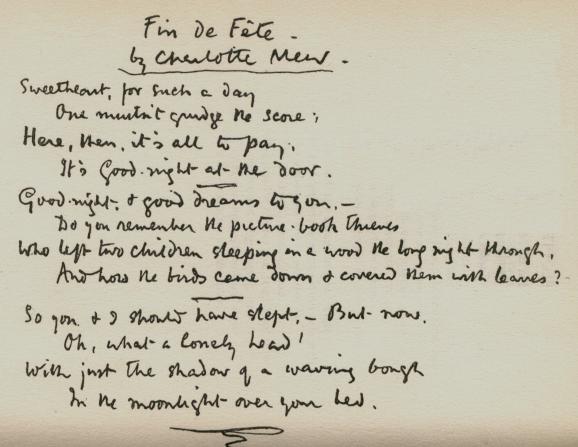
|
Death of Charlotte Mew
Alida Monro (1953), page xi, says "Charlotte was so overcome by Anne's death that she was inconsolable, and after a short time her nerves became very bad. She was unable to sleep, and so tortured herself with the idea that as she had not had a vein opened in Anne's wrist her sister might have been buried alive, that medical help had to be sought. As a result she went into a nursing home in Beaumont Street for a rest and medical supervision..." Penelope Fitzgerald 1988, page 223, says that Charlotte consulted Dr Horatio Cowan about the "little black specks which could be seen everywhere in the studio", which she thought could have caused Anne's death.
The black spots may have been mentally associated with the "black
rotundities" that Charlotte the humorist
joked about
after
Charlotte the bacteriologist looked at
malaria germs through a
microscope - and related to the tuberculosis germs that
killed her brother in an asylum. Cancer also killed her father.
If cancer is not infectious, it would not be caused by
germs. But infection seems to have been a question: In 1930
a committee on "infectious diseases in mental hospitals"
reported on a comparison of cancer cases in patients and the general
population.
Penelope Fitzgerald 1988, page 223, continues that Dr Cowan had the specks analysed and found them to be soot. Dr Cowan sent Charlotte to a "mental specialist" to find out whether or not, on the evidence, she could be certified. The specialist said that she could not. Dr Cowan then tried to persuade her to enter an asylum... as a voluntary patient, but she refused. The nursing home was Dr Cowan's recommendation. The matron was "Miss Lutch". (page 224 and 226). (No references, but indication (page 226) that it is from Dr Cowan's report at the inquest).
Henderson and Gillespie's A Text-Book of
Psychiatry (1927) advice on certification.. Voluntary
treatment in a (London) asylum, at this time, would have been in a private
asylum, such as
Brooke
House,
Chiswick House,
Peckham
House
or
Northumberland
House (twenty four hours notice if she wanted to leave) or,
possibly, treatment at the
Maudsley Hospital.
28.2.1928 [24.2.1928?] Letter from Charlotte Mew to Kate Cockerell from
37 Beaumont Street, Marleybone. W.1. [BF]
Saturday 24.3.1928 Death of Charlotte Mary Mew, aged 53 Years
[This has to be wrong. Maybe a typing error when the copy was
made], at
37 Beaumont Street. She was "of 64
Charlotte Street, St Pancras,
Spinster,
Poetess, Daughter of Frederick Mew, Architect". An Inquest was held
Wednesday 28.3.1928 and the Registrar for All Souls, St Marylebone
was informed of the death by "Certificate received from H.R. Oswald,
Coroner for London" on Thursday 29.3.1928. The cause of death was
"Swallowing Lysol poison. Killed herself while of unsound mind". There had
been a Post Mortem.
She was buried with Anne in Hampstead Cemetery,
Fortune Green Road, London, NW6
Charlotte Mew's will (3.1.1928) named
James George O'Keefe
(Mary Davidow's spelling)
and
Ethel Oliver her
executers. No literary executer was named in the will.
(Davidow, M. 1960 page 109).
[Val Warner, 1997,
page 44, also says Ethel Oliver was Charlotte Mew's executer]. "There
were a number of small legacies and gifts... £2,200 was set aside for
Freda's maintenance, and the rest of the estate was divided
between
Florence Ellen Mew,
Ethel Louisa Mew and
Katherine Righton".
Penelope Fitzgerald
1988, page 222)
|
25.3.1928 Letter from F.F.Blackman to "My dear Cockerell" gives him the news of Charlotte Mew's death.
29.3.1928 Letter from Alida Monro to Sydney C. Cockerell. [British Library 57755 638 - BF] She has just been to Charlotte's funeral. Ethel Oliver and James O'Keeffe were "chary" of publishing work still in manuscript. Alida wanted to write to Ethel asking that all manuscripts could be seen by Sydney Cockerell or herself.
29.3.1928 Sydney C. Cockerell, "Miss Charlotte Mew: A Poet of Rare Quality." Obituary. The Times p.21a. Says Charlotte had "periods of overwhelming depression" (Val Warner 1975) - Louis Untermeyer quoted from the obituary.
Elsie Blackman wrote to Sydney Cockerell thanking him for the obituary and saying "In later years I have seen little of her..." - "It seems an irony to say with Ethel Oliver - 'How pleased Charlotte would have been to read it'" - "there were about a dozen people at the cemetery and many of her favourite red flowers."
Three weeks after Charlotte Mew's death: A letter from Ethel Oliver to Alida Monro. (Acquired by Frederick B. Adams in 1987. He wrote to Penelope Fitzgerald about it on 22.8.1987.
28.3.1928 Letter from Ethel Oliver, from 2 The Grove, Isleworth to Mrs Inglis. [Berg Collection - BF]
28.3.1928 One page letter from Siegfried Sassoon to Edith Sitwell mentions Charlotte Mew. Berg Collection catalogue
4.4.1928 One page letter from Alida Monro to Sydney C. Cockerell. [Berg Collection catalogue]
4.4.1928 One page letter from Siegfried Sassoon to Sydney C. Cockerell. [Berg Collection catalogue]
11.4.1928 Letter from Alida Monro to Sydney C. Cockerell. [British Library 57755 638 - BF]
16.4.1928 Letter from Alida Monro to Sydney C. Cockerell. [British Library 57755 638 - BF]
May 1928 Charlotte Mew's poem "Sunlit House" republished in The Bookman volume 74 (therefore London), pages 112-113. [ "The Sunlit House" was one of the additional published poems in Saturday Market (1921), but was written before 29.7.1913 [Was this re-published as a memorial to Charlotte?]
21.5.1928 Letter from Alida Monro to Sydney C. Cockerell. [British Library 57755 638 - BF]
7.6.1928? Letter from Alida Monro to Sydney C. Cockerell. [British Library 57755 638 - BF]
6.8.1928 One page letter from James George O'Keefe to Sydney C. Cockerell. [Berg Collection catalogue]
21.11.1928 Letter from W.B. (William Bowers?) Dalton to F.F. Blackman Esq. Upper Cross, Storey's Way, Cambridge, who had bought a piece of Dalton's stoneware pottery from the Art And Craft exhibition at the Academy. "I hope you will get as much pleasure from it as I had in its making" (Watts boxes)
Sometime in 1928, Sigmund Freud is reputed to have said, to Professor
Becker in Berlin,
"The poets and philosophers before me discovered the unconscious. What I discovered was the scientific method by which the unconscious can be studied."He is quoted in R. Lehrman in "Freud's Contributions to Science" (in the journal Harofe Haivri Volume 1 (1940) and then cited by Lionel Trilling in "Freud and Literature" (in The Liberal Imagination 1940). |
27.2.1929 Stamp on Poetry Bookshop specimen of poems
28.2.1929 One page letter from Ethel Oliver to Alida Monro [Berg Collection catalogue]. Also later 2 page letter and a five page letter of 16.6.1929 [The folder contains the three letters and a "newspaper clipping of her obituary notice" - Is that Ethel Oliver's obituary notice?]
| The Rambling Sailor (May 1929) was preceded by a four page prospectus on blue paper quoting from the Times obituary. |
|
Alida's first account of Charlotte Mew
The two page Introductory Note to The Rambling Sailor by "A.K." [Alida Monro] has several mistakes about the dates and order of events in Charlotte's life. The book was produced at a very difficult time in Alida's life. Charlotte Mary Mew was born in London on the 15th November 1870, the daughter of an architect. She passed the whole of her life except for brief intervals in the heart of Bloomsbury. While she was still young her father died and left her and her mother and family in financial difficulties. Her temperament was keyed very low, and the tribulations and batterings of her personal life, including the poverty that dogged her all her days, were probably responsible for the fact that many of the poems in her first book, The Farmer's Bride, and indeed in this second book of posthumous poems, show an intense preoccupation with death and disaster either physical or spiritual. In 1922, through the united efforts of Thomas Hardy (who thought her one of the best poets of the time), John Masefield and Walter de la Mare, she received a Civil List pension of seventy-five pounds a year. This was helpful in mitigating the strain of poverty, but no sooner was the financial burden alleviated than her mother died, and her own health broke down. Both these trials were overcome and all seemed ready for a return to productive life when her beloved sister was stricken with a fatal illness and died after some months of agony. For a time it seemed she could repulse this last attack of Fate, but subsequently it became evident that her resistance had given way and she died in a nursing home, by her own hand, on the 24th March, 1928. No pen portrait can convey the deep charm and rare wit that were the continual delight of Charlotte Mew's intimates ; nor can the passionate sincerity and truth with which she faced the onslaughts of life be portrayed except through her poems. The following quotations, which are taken from her volume, The Farmer's Bride, exemplify this point:-
No subterfuges were possible for her, no lurking in stealthy byways stalking the hope of better things in a Better World. She was always conscious she once admitted of what seemed to her an Earthly Presence, a bond, an actual contact with the earth, of a knowledge of final peace in the heart of things. Moorland Sanctuary may be taken as her own expression of her belief. She read many times, to the writer of this note, a poem (which has not been found among her papers) which described how a Breton shepherd one night left his sheep to lay himself at the feet of a Wayside Calvary, and the next morning passers-by found a heap of leaves - all that was left of him. She finished the poem with her characteristic toss of the head, and the admission that for her part, such a death, perhaps in a wood, was all she asked. But Death came to her in the heart of London, surrounded by no trees, no birds, nothing but grey bricks and greyer life. It is not proposed in this brief note to offer a critical estimate of her work. The fact that she was awarded a Civil List pension is sufficient evidence of the esteem in which it was held by sensitive critics. Among Thomas Hardy's papers was found copied from The Sphere, the poem Fin de Fete. The best of her early poems and those most indicative of her tragic personality are included in this volume, in a separate section. All of them appeared in Temple Bar, to which periodical she contributed verse and prose for a number of years in her early life. She also contributed essays, poems and stories to The Yellow Book, The Englishwoman, The Nation, The New Statesman, The Chapbook, etc. Charlotte Mew's dislike of publicity was extreme and her defiant reserve, in later years, placed every obstacle in the way of those who desired to secure her friendship. However, to those she loved and trusted she gave loyalty and companionship without stint. A. K. |
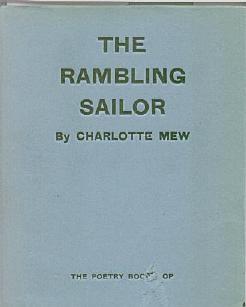
|
May 1929 -
The Poetry Bookshop published a
reprint of the
1921 edition of The Farmer's Bride and a new collection
of poems by Charlotte Mew, with the title The Rambling Sailor (price
3/6d)
There are 45 pages with thirty two poems. The Rambling Sailor is the same size book as The Farmer's Bride. It is also the same colour in its dustjacket. The Farmer's Bride, however, had this colour boards - It did not have a dustjacket.
|
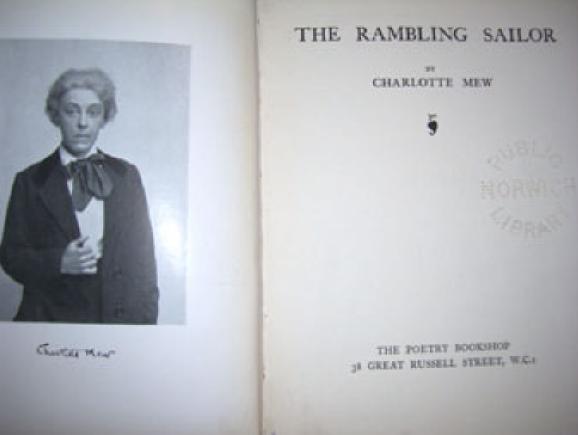
Charlotte Mew: The Rambling Sailor. London: Poetry Bookshop, 1929. Contains (with year of first publication or writing when known and highlighting those that may not have been published previously):
In the Fields (1923 and 1925) - From a Window (external web copy) - Not for that City (1902) - Rooms - Monsieur Qui Passe (Quai Voltaire) (external web copy) - Do Dreams Lie Deeper? 1926 - Domus Caedet Arborem - Fin de Fête (1923) - Again - Epitaph - "Friend Wherefore ?" - I so Liked Spring (external web copy) - Here Lies a Prisoner (written by 1924) - May, 1915 - June, 1915 - Ne Me Tangito (external web copy) - Old Shepherd's Prayer 1922 - My Heart is Lame - On Youth Struck Down (From an unfinished elegy) (possibly written 1926 - The Rambling Sailor (1922) - The Call (1912) - Absence (external web copy) - The Trees are Down (1923) - Smile, Death - To a Child in Death (1922) - Moorland Night (1925) -
PLUS early poems printed at the end: At the Convent Gate (1902) - Requiescat (1909) - The Little Portress (St Gilda de Rhuys) (1903) - Afternoon Tea - She was a Sinner - Song (1902).
| Ne me tangito One of two poems explicitly about Mary of Magdala. The other being She was a Sinner. In the same thought space is Madeleine in Church, part of which is about Mary - But dialogues between flesh and spirit pervade much of Charlotte Mew's writing. Why does she call it Ne me tangito instead of the Vulgate's "noli me tangere" - (John 20:17 dicit ei Iesus noli me tangere... Jesus saith unto her, Touch me not) - Is ne me tangito a future tense implying never touch me? Help - anyone know Latin? |
12.6.1929 Hambert Wolfe, review of The Rambling Sailor in The Observer (Davidow, M. 1960 page 265)
21.6.1929 Edith Sitwell, review of The Farmer's Bride and The Rambling Sailor in Time and Tide (Davidow, M. 1960 page 266)
Richard James Lythgoe and Katharine Tansley: The Adaptation of the Eye: its Relation to the Critical Frequency of Flicker (Reports of the Committee upon the Physiology of Vision. 4) Medical Research Council. Special Report Series. no. 134. London, 1929. - See also 1.11.1933 - 1.4.1936 and 1965
October 1929 The Survival League founded in London by Mrs C. A. Dawson Scott to affirm the unity of all religions and spread the knowledge of the scientific demonstrability of survival after death. 1929 also saw the publication of Is this Wilson?: messages accredited to Woodrow Wilson - received by Mrs. C.A. Dawson Scott; with an introduction by Edward S. Martin. New York : E.P. Dutton, 1929. 165 pages
November 1929: Second impression of The Rambling Sailor
[United States] Revised edition of Louis Untermeyer's anthology Modern British Poetry] Betty Falkenberg (2005 p.37) says the same eleven poems by Charlotte Mew were published in 1930 and 1936. I expect the introduction was also the same (See 1936).
William McDougall's autobiography: "William McDougall", in Carl Murchison (editor) A History of Psychology in Autobiography Volume 1. New York: Russell and Russell (1930): pages 191-223. - ~ External link to archive of autobiography
Chick sisters bought Hazelwood
21.4.1930 Death of the poet laureate, Robert Bridges. He was
succeeded by John Masefield.
3.3.1931 Death of Emma
Chick, aged 86. She was the chairman of
Samuel Chick
Limited from the
death of her husband to her own death.
Estate Duty papers Emma Chick died 3.3.1931. Will made, 10.8.1930. Codicil
5.2.1931. (Watts boxes)
1932
Emma Chick will and Probate dated 1932
(Watts boxes)
12.3.1932
One page letter from
Siegfried Sassoon to Edith Sitwell mentions
Charlotte Mew.
Berg Collection catalogue
16.3.1932 Death of
Harold Monro at Broadstairs, Kent. - "Harold Monro's later poems
were bitter in tone as he dealt with loneliness arising from his alcoholism
and bisexuality. During his final two years he was suffering from very poor
health and crippling pain."
21.3.1932 Letter from
Alida Monro to Sydney C.
Cockerell. She has been "fitfully employed" on her "memoir" of
Charlotte.
[British Library 57755 638 - BF]
1933
25.3.1933 Three page letter from Virginia Moore to Sydney C. Cockerell, relating to Charlotte Mew.
[Berg Collection catalogue]
1.11.1933 Katharine Tansley: "Factors Affecting the Development and
Regeneration of Visual Purple in the Mammalian Retina" Proceedings of
the Royal Society of London. Series B, Containing Papers of a
Biological Character (1905-1934) Volume 114, Number 786. Katherine: "The
Strangeways Research Laboratory, Cambridge and The Department of
Physiology, University College, London". The paper was communicated by
C.E. Lovett Evans FRS and received on 21.8.1933.
8.11.1933 Death of
James Hooley Chick, "after a distressingly painful illness of
several months duration" at The London Clinic and Nursing Home, Devonshire
Place. Funeral service at Golders Green Crematorium 11.11.1933 attended by
"many members of the regiment and the Masonic Master (Fitzroy Lodge), Major
C.A.J. Whyte. J.H.C.'s will instructed that "my body shall be cremated and
that no service of any kind whatsoever shall be held over my ashes". His
executers were Samuel Hooley Ackroyd and Alexander Wright.
Mary Chick became Chairman of
Samuel Chick Limited.
Margaret Chick and
Edith Tansley were the other two Directors.
Probate will
Samuel (James?) Hooley Chick. Will 2.9.1933. Death 8.11.1933.
(Watts boxes)
The Collected Poems of
Harold Monro
Twentieth Century Poetry: An Anthology chosen by Harold Monro
Revised and enlarged by
Alida Monro. London : Chatto and
Windus, 1933. 266 pages. Original
1929 -
Wikipedia lists the poets included - This has
Harold Monro's introduction, but Alida does not provide one of her own to
show how it has been revised and enlarged. The poems by Charlotte Mew (in
order of appearance) are
Moorland Night from
1925 (p.56) -
On Youth Struck Down from 1929 (p.142) -
Sea Love from 1919 (p.142) -
The Farmer's Bride
from 1912 (p.209)
-
Song - 1902 (p.226)
December 1933 Recent Poetry, 1923-1933 Edited by
Alida Klemantaski Monro.
London: G. Howe and The Poetry Bookshop, 1933. 12 introductory pages. 211
main pages. The poems by Charlotte Mew (in
order of appearance) are
Fin de Fête -
The Rambling Sailor and
Domus Caedet Arborem
1934
5.1.1934 Announcement that
The Survival League
had established "The International Institute for Psychical Research" with
Mrs. C. A. Dawson Scott as its Organising Secretary. The
Secretarial office (pro tem.) was at 125 Alexandra Road, London, N.W.8.
(Telephone Maida Vale 2191) Mrs Dawson Scott's
home address. It was "formed
for the purpose of investigating psychic phenomena on strictly scientific
lines".
(external source)
4.11.1934 or 5.11.1934 Death of
Catherine Amy Dawson Scott. She had ceased being secretary to
The Survival League and The International Institute for Psychical Research
a few months before.
19.12.1934 Letter to O.L. Marshall, 5 Newman Street, that it would
be necessary (under
Samuel Chick's will) to appoint two new trustees (in addition to
Miss Chick and Mr Ackroyd) if the "Chick's Executers Auction Sale" was to
go ahead. Presumably relates to
Barbara Wood Trustees
1935
Tansley, A. G. 1935. "The use and abuse of vegetational concepts and
terms." Ecology 16: 284-307 introduces his concept of the
"ecosystem" -
Peder Anker, 2001 argues that the concept was developed as a
"mechanistic view of ecology" in opposition to the "idealistic ecology" of
Smuts'
"politics of holism"
22.6.1935 Unsigned letter from Mrs Monro giving notice of the
closing down of
the
Poetry Bookshop
- In
California Collection [A two paged letter, mechanically
reproduced. The letters were addressed and signed individually by Alida
Monro and sent to friends of the bookshop. (Woolmer 1988, G12). The letter said that she had
kept the bookshop open
since
Harold's death, "trying to persuade herself that the moment had
not come". She would remain living upstairs and would be delighted to see
any of them "as if the Bookshop were still in existence".
(Woolmer 1988,
p.xxvii). Alida Monro remained at
the Russell Street
address
until 1939. After closure, Alida Monro kept the basement for
storing Poetry Bookshop publications. Flooding caused by an air raid in
1941 led to many being pulped (Woolmer 1988, p.xiv).
- In 1953, T.S. Eliot
helped the Poetry Society open a bookshop in Earl's Court Square, but this
has now closed.
(external source).
1936
Frederick Frost Blackman retired from his readership at St
John's College, Cambridge.
1.4.1936 L. E. Bayliss, R. J. Lythgoe and Katharine Tansley "Some
New Forms of Visual Purple Found in Sea Fishes with a Note on the Visual
Cells of Origin" Journal Proceedings of the Royal Society of London
Series B, Biological Sciences (1934-1990) Volume 120, Number 816
30.6.1936 The Directors
(Mary Chick
-
Margaret Chick
-
Edith Tansley) of
Samuel Chick Limited appointed
Samuel Hooley Ackroyd as the fourth Director
|
1937
Peter F. Blackman a young apprentice at the British Thomson
Houston Co. in Rugby, along with John Westcott.
Dictionary of National Biography entry for Charlotte Mew, by
A. Monro, Sources given as The Times,
29.3.1928 and personal knowledge. Includes:
"She was educated privately, and later attended lectures at University College, London." |
Sometime in 1937, Sydney Cockerell retired from the Fitzwilliam Museum and moved to London to live at 21 Kew Gardens Road, Richmond, Surrey, where he died in 1962. Kate Cockerell required a nurse from about 1942. She died in 1949. At her request, Dorothy Hawksley helped look after Sydney for the rest of his life. He was bedridden from 1951. In 1956 he sold most of his manuscript and printed book collection (raising over £80,000). (external link). However, he kept "a wonderful series of books illuminated by his late wife, Kate Kingsford" (Christian, J. 2005 p.2)
17.10.1937 Death of Florence Hardy. Her will included a clause that led to the creation of a 'Thomas Hardy Memorial Collection' in the Dorset County Museum.
6.12.1937 Death of James George O'Keefe
10.12.1937 Death of Edward Thomas Browne at Anglefield", aged 72, "following a short illness". Obituary by E. J. Allen in the Journal of the Marine Biological Association volume 22, pages 405-410, in 1938. Margaret Browne died shortly afterwards: (Notice of death in Telegraph 29.3.1938)
Death of Mary Chick. She would have been aged about 65. Her last will was dated 5.9.1935, but had a codicil dated 17.10.1938. Margaret Chick signed the Annual Report of Samuel Chick Limited in June 1939, but as "Director", not "Chairman"
Watts boxes contain a file "Early Work and Present Post of the Contributors to the Blackman Book. 1938"
May Morris (1862-1938), William Morris's youngest daughter, died. As a result of her death, Morris and Company closed.
26.5.1938 Sale of the bulk of Thomas Hardy's Max Gate library by the London auction house of Hodgson & Co. - MG Sale: "A Catalogue of the Library of Thomas Hardy, O.M. London: Hodgson & Co., 26 May 1938" - Richard Purdy and Frederick B. Adams both made numerous purchases. See Hardy library
1939
F. W. Oliver "Libyan Flowers" Journal Notes and Records of the Royal
Society of London (1938-1996) Issue Volume 2, Number 2, 1939
1.1.1939
A. G. Tansley's obituary of Harry Church (1865-1937)
Obituary Notices of Fellows of the Royal Society (1932-1954)
Volume 2, Number 7
1939/1940
I can count on the fingers of one
hand the booksellers who have ordered copies during the past eight years
(Alida Monro in 1948).
"Mrs Alida Monro" moved in 1939 from 38 Great Russell Street,
WC1, Telephone Museum 2249 (her telephone book entry since 1933, following
Harold's death) to
Greanlea House Telephone Sidlesham 24 in 1939 and then Haise Farm House
Telephone Sidlesham 240 from 1940 to 1969 - Sidlesham is in West Sussex,
south of Chichester
(GENUKI link)
1940
Viola Meynell (editor) Friends of a Lifetime - Letters to
Sydney Carlyle
Cockerell. London: Jonathan Cape, 1940. 384 pages.
1.9.1941
A. G. Tansley's obituary of Sigmund Freud (1856-1939)
Obituary Notices of Fellows of the Royal Society (1932-1954) Issue
Volume 3, Number 9
A New Anthology of Modern Verse, 1920-1940. Chosen and with an
introduction by C. Day Lewis and L. A. G. Strong. Methuen & Co., 1941
included (pages 131-132)
Song by Charlotte Mew.
|
During the second world war the
Bloomsbury Squares were made public spaces
by the Bedford Estate. Railings were removed from all but
Bedford Square.
They were taken down in
Russell Square,
Tavistock Square, Bloomsbury
Square, Woburn Square and
Gordon Square. (Clunn, H.P. 1962 p. 149)
Gordon Square was laid out about 1820 by Thomas Cubitt, but (1958) had been "mostly rebuilt at various times". Originally the property of the Duke of Bedford, it is now managed by the University of London. Tavistock Square is older. It was also laid out by Thomas Cubitt, and a range of his buildings (1826) survived on the west side of the square in 1956 To the north of Gordon Square and Tavistock Square are squares of buildings, bounded on the west by Gordon Street, on the east by Woburn Place. These used to end, on the north, with: Euston Square Gardens (south). Euston Square, on either side of the main road, was constructed between 1813 and 1833. In 1958, Euston Square Gardens (north) still fronted the original doric arch of Euston Station.
Links here are mostly external - I will move towards making this a summary
of the present squares and their history with reference to Charlotte Mew.
|
1944 Harriette Chick made a Dame of the British Empire. "The name she has always been called by in my family was "Dame Harriette", although residents of Branscombe always spoke of her as "Miss Chick" (Dorothy Lumb).
27.6.1944 Letter from Arthur Tansley to Sydney C. Cockerell concerning the sanity of the Mew sisters. [Berg Collection BF]
Mervyn Horder (1910-1997) was Chairman and Managing Director of Gerald
Duckworth & Co. Ltd., general publishers, from 1945-1970
Twentieth Century Poetry: An Anthology chosen by Harold Monro
Revised and enlarged by
Alida Monro. London : Chatto and
Windus, 1946. 266 pages. Original
1929
1946 Royal Charter to the Arts Council of Great Britain. It
began collecting literary manuscripts in
1963
30.6.1946 Annual Report of
Samuel Chick Limited gives Directors names as
Margaret Chick -
Edith Tansley -
S.H. Ackroyd.
30.6.1947 Annual Report of
Samuel Chick Limited said Mr [O.L.] Marshall (Director) unable
to attend as "very ill indeed" and the retiring director
Mr S.H. Ackroyd was not seeking re-election owing to ill health.
"
Frederick Frost Blackman, M.A., D.Sc. (London), F.R.S., Fellow
of
St. John's College, Cambridge, and formerly Reader in Botany in the
University
of Cambridge, was born on July 25, 1866, and died
at his home in
Cambridge, England, on January 30, 1947, in his 81st year."
(external link to memorial biography)
January 1948 Death of
Samuel Hooley Ackroyd.
30.6.1948 Annual Report of
Samuel Chick Limited gave Directors as
"Miss Margaret Chick -
Mrs Edith Tansley -
Mrs Margaret Tomlinson, MA -
P.F. Blackman, Esq."
Envelope Macclesfield, 6.7.1948 Cheshire -
Mrs Blackman,
34 Storey's Way, Cambridge
- "Dear Elsie, thank you for your interesting letter of the
28th to which I am sorry I have not replied more promptly. The card you
describe, must I think, be a memorial card of Grandmother Hooley's mother,
Elisabeth Wood. From Frank (?) (Watts
boxes)
July 1948 A letter in The Listener from Sir Sydney
Cockerell, prompted after hearing on the radio Patric Dickinson's "warm
tribute" to Miss Mew. "Charlotte Mew's two slim volumes are now practically
unobtainable, and little has been heard of her of late"
Alida Monro wrote to The Listener
24?.7.1948 Letter from
Alida Monro to Sydney C.
Cockerell.
[British Library 57755 638 - BF]
"My attention has been directed to a letter from Sir Sydney
Cockerell... in which he states that the two volumes of poems by Charlotte
Mew are "practically unobtainable"! May I as the publisher of the books be
allowed space to correct this statement. Ever since we at The Poetry
Bookshop, issued The Farmer's Bride in
1916 and the
The Rambling Sailor in
1929, they have been continuously in print, and are obtainable
at the present time from any bookseller who wishes to get them. The address
given on the title page of both volumes still finds me. Although The Poetry
Bookshop closed down the bookselling department before the war, there was
never any idea of losing the imprint. All the publications of The Poetry
Bookshop which I still wish to keep in print are to be had from me at my
home address... It is significant that I can count on the fingers of one
hand the booksellers who have ordered copies during the past eight years...
Both myself and my husband, the late Harold Monro, were indefatigable in
giving Readings from the works of poets in whom we believed and because of
our unique position as specialists in poetry we were able to exert an
influence on the sale of poetry ancient and modern..."
|
I'm afraid she is dead to...
In 1951 Miss K.H. Righton gave two paintings by Henry Thomas Jarman (1871- 1956) to the National Museums and Libraries of Wales - "Bacchus Kidnapped" and "Autumn Landscape". In 1957, the museums and galleries bought another painting by Henry Thomas Jarman: a portrait of "Reverend Howell Elvet Lewis (1860-1953)". Mary Davidow (1960 page 356) says that (in 1958?) "Kate Righton's nephew pointed out to me that the Iarmans' studio was in the same building as... Miss Righton's studio, and that the two women were quite friendly". She reproduces two letters from "Margaret Iarman" (Herefordshire, 19.1.1959 on page 356) and "F.M. Iarman" (Herefordshire 10.3.1959 on page 360).
"19.1.1959: Please forgive my delay in replying to your letter of October 1958. I had my sister very ill at the time and she passed away in November. Both the Miss Mews were very charming but a certain shyness prevented one from getting to know them. Both they and their friend, Miss Righton, were much older than myself and belonged to the Victorian era which seemed always to keep them apart, and a certain air of mystery about the Miss Mews which one didn't dare penetrate! ! They had a very lovely old house in one of the old and fashionable London Squares when I first met them at Miss Righton's Studio, and my husband and I dined there. Their mother was alive at the time but she didn't appear at dinner! Later on they had a small flat and Anne's studio where we occasionally went for tea. I once met there Mrs Monro... My husband was asked to paint Charlotte's portrait, but C. would not consent to sit for it, a great disappointment, as the portrait was intended for Fitzwilliam Museum. Blackwood's Magazine years ago included some of Charlotte's short stories. Miss Righton had some of them."The following telephone directory entries may be relevant: K. H. Righton, 45 Heath Hurst Road, NW3 Hampstead 2706 in 1943 and 1946 Margaret F. Jarman, Deaconess, 5 Brook Moors, Pontesbury 371 Exchange: Brook. 1959. Directory: Warwick, Shropshire, Hereford, Stafford, Worcester Henry T Jarman, 7 Sherriff Road, NW6. Maida Vale 8334 1935 to 1939 |
Margaret Chick, Letter 1952, Park Hill Ealing, compulsory purchase of Newman Street. (Watts boxes)
Spring 1953 Alida Monro opens the parcel of Charlotte Mew's typescripts that she has not looked inside since she secured them after Charlotte's funeral in 1928 - An alternative interpretation of the introductory editorial note in The Cornhill Magazine (below) is that one of Sydney Cockerell's ladies opened the parcel.
Summer 1953 Collected Poems of Charlotte Mew - With a Biographical Memoir by Alida Monro. London: Duckworth, 1953 .
Alida Monro, "Charlotte Mew: A Memoir." In Collected Poems of Charlotte Mew by Charlotte Mew. London: Duckworth, 1953 pages vii to xx, was also published in the Third Quarter 1953 issue of The Adelphi.
Third Quarter 1953 George Sims wrote to Alida Monro, care of The Adelphi. He received a reply from her home. Haise Farm, Sidlesham Common, Chichester. Sussex. After further correspondence they met at Scott's restaurant in Picadilly Circus. Their friendship lasted "until her death" and resulted in him buying "a great deal of manuscript material and many original letters from the Poetry Bookshop archives" (Simms, G. 1999 pp 148-147)
|
Autumn 1953 A previously unpublished Charlotte Mew short story,
A Fatal Fidelity, published in Cornhill Magazine
Autumn - No 997, pages 67-80. A
warm, humorous story around gravestones, with a happy ending in Southend
for the bereaved. One wonders why (if?) it was not published earlier.
Introductory editorial note (pages 66-67) "Charlotte Mew's reputation has rested hitherto on two ' slim volumes * of poems published by the Poetry Bookshop, The Farmer's Bride (1916) and The Rambling Sailor (1929). A Georgian poet in date, though not in spirit, her terror of publicity and passionate mistrust of her fellow-men placed every possible obstacle in the way of those who sought her personal friendship, and she has remained a solitary, somewhat dimly apprehended figure standing outside the main literary currents of her time. Apart from the fact that she received a Civil List pension in 1923 (her sponsors being Thomas Hardy, John Masefield and Walter de la Mare] and died by her own hand in 1928, few literary historians know much in detail of the circumstances of her life. These were exceptionally distressing: left almost penniless by her architect father, she carried for more than thirty years the responsibility of caring for her mother, two sisters and an elder brother, all of whom were ill one way or another, in body or mind; and in the end her own health broke under the strain of her accumulated misfortunes. She passed the whole of her life, except for brief holidays, in Bloomsbury and Camden Town. A Fatal Fidelity, still in its original yellowing typescript, came to light only this spring, in a forgotten parcel of her papers, together with a one-act play in Cornish dialect and file copies of various contributions to the journals (such as The Nation under Massingham's editorship, and Temple Bar) which habitually printed her prose sketches. Perhaps it had been rejected by these very journals owing to its extra length: perhaps it was an early work submitted before her name was well known. At all events it is undated, and it is impossible even to guess at the date either from internal evidence or by scrutiny of the typescript itself: this has a few pencilled corrections in the author's own hand, but offers no more clues than the address 9 Gordon Street, W.C., where Charlotte Mew lived continuously from about 1880 up to the early 1920s. The author's temperament was keyed very low and the agreeable, wry irony of A Fatal Fidelity exhibits about as sanguine a view of life, as near comedy as is to be found anywhere in her writings. Charlotte Mew's Collected Poems are being reissued this summer by Gerald Duckworth & Co. Ltd., with a new biographical memoir by her friend Mrs Harold Monro, who is one of the few people able to give an intimate picture of Charlotte Mew as she lived." |
Thursday 12.11.1953 Previously unpublished Charlotte Mew play The China Bowl (developed from, but simpler than and different from, the story), broadcast on the BBC West Region. The text of the BBC version is reproduced in Warner 1981, pages 419-455. An (almost identical) typescript of Charlotte Mew's (in the British Library) is reproduced in Warner 1997 pages 104-124. This, I take it, is the typescript discovered in the forgotten parcel.. The stage directions for the BBC version begins:
"The living room of a fisherman's cottage in Cornwall some forty years ago."
Charlotte Mew's typescript begins
"SCENE: Living room of a fisherman's cottage in Cornwall"
The original story makes no mention of Cornwall. The reference to "some forty years ago" suggests that, in 1953, it was thought the play was set about 1913. This is inconsistent with internal dates (and so, not inferred from them), and might suggest Alida Monro (or whoever) thought the play was written to be performed about forty years before.
20.2.1954: A previously unpublished Charlotte Mew short story, The Wheat, published in Time and Tide pages 237 to 238.
Analytic Studies in Plant Respiration - Nine articles by Frederick Frost Blackman, only three of which were previously published, published as a memorial volume, edited by Dr John Barker (a former student), with a portrait. Cambridge University Press.
Richard Little Purdy, Thomas Hardy: A Bibliographical Study. London: Oxford University Press, 1954. This was revised by Charles P.C. Pettit in a new edition published by Oak Knoll Press of New Castle Delaware in 2002. - Catalogue of his Thomas Hardy collection at Yale
1955
Death of Charles James Martin (9.1.1866-15.2.1955), long-time colleague of
Harriette Chick -
(archive)
25.11.1955 Death of
Sir Arthur Tansley (84 years old) "in the house at Grantchester
just outside Cambridge where he had lived since
1907".
1956
F.W. Leakey, "Baudelaire et Kendall" Revue de litterature comparee,
Trentieme Annee, no.1, 1956, pp 53-63
Viola Meynell (editor) The Best of Friends. Further letters to
Sydney Carlyle
Cockerell
18.7.1956 32nd Annual General Meeting of
Samuel Chick Limited held at 50
Great Portland Street, W1.
Margaret Chick received a Director's salary of
£200. Her report includes "A Bill has been passed through Parliament
to enable the Postmaster general to compulsory acquire the land necessary
for
the creation of the General Post Office, which includes the whole of the
properties owned by the Company in
Newman Street. While no definite
information is available, it is understood that the site on which the
Company's properties are situated will not be required for some years." In
the financiaL year 1955/1956 the company received a total of
£25,744..18/8d from numbers one to six Newman Street, 12/14 Mortimer
Street, 48/49 Wells Street, 28/32 Ridinghouse Street and 92/94/96 Oxford
Street. (Company accounts 1925-1956 - Watts boxes)
1.11.1957 H. Godwin's obituary of Arthur George Tansley. 1871-1955
Biographical Memoirs of Fellows of the Royal Society (1955-2000)
Issue Volume 3
Edith Tansley -
who lived at
Grantchester, Cambridgeshire.
Harriette Chick - Although Margaret's letter
(below)
suggests Harriette lived elsewhere, her address in Whose Who in 1958
(according to her
University College London index card) was still
30 Park
Hill, Ealing, W5. --
34 Storey's Way, Cambridge is written on later. The
telephone book entries suggest that Harriette moved to live with
Elsie about 1958
Margaret Chick - Margaret
lived at
30 Park Hill.
Elsie Blackman, who lived at
34 Storey's Way, Cambridge
Telephone numbers and address in 1957 - or otherwise if stated
Samuel Chick Ltd, 50 Great Portland Street, W1. MUSeum 0872
Captain S. Sassoon, Heytesbury House, Sutton Veny 205
R P Mew Farmer, New Fairlee, Newport, Isle of Wight. Newport 2310
The Chick family in Cambridge (Blackman and Tansley) had telephone entries
that continued after death:
F.F. Blackman, The Close, Girton Cambridge 964 in 1922
Dame Harriette Chick, 34 Storey's Way, Cambridge 4964 from 1958 [changing
to 50964 by 1971] to 1972 [Harriette Chick died in
1977]
Peter F. Blackman, 43 Beech Park Way, Hempstead Road, Watford 26630 from
1970 to 1983 (when online directories end)
A.G. Tansley, Grove Cottage, Grantchester Trumpington 206 in 1938/1939
Mary Davidow awarded a Summer Study Grant by Brown University
"which enabled her to go to London and Oxford to further her research in
connection with the Charlotte Mew thesis" (page iii). "Thus, I had the good
fortune of meeting and talking with some of Charlotte Mew's relatives,
friends and acquaintances who shared their reminiscences of the poet with
me. Little by little the pieces of the biography fell into place... the
mists have begun to disappear..." (page vi)
[I have added an estimate of age to the following]
"I owe a debt of gratitude to
Sister Mary Magdalen [82], Miss
Florence Ellen Mew [84], and Mr and Mrs
Richard Percy
Mew [Richard 89]: for their hospitality and their reminiscences
of their
cousin; to Sir
Sydney Cockerell,
Captain
Siegfried
Sassoon, Miss
Dorothy Hawksley, Miss
Margaret Chick [83], Mrs
Amice Macdonell Lee [84],
Mrs
Margaret Iarman, Mr Jack Pickerin, and Mr
Wilfred Corbett for their
generous assistance and their
patient answers to my inquiries. I owe a special debt of gratitude also to
Mrs
Alida Monro (66) for putting at my disposal her collection of
letters and
papers concerning Charlotte Mew, and also to Mr Frederick Adams, Jr.,
Director of the Pierpoint Morgan Library, for permitting me the use of
material from his private collection of Charlotte Mew..." (page ix)
(Davidow, M. 1960)
Sources of letters and other documents Mary Davidow used:
Berg Collection:
The Poetry Collection, University of Buffalo
The Buffalo collection includes Charlotte Mew's letters to
Ethel Oliver in
1902 -
1909 -
1911 and
1914
(Library lists "6 items" letters sent between 1902 and 1914)
- Her
letters to Mrs Hill in
1913 and
1915 - Her letters to Harold Monro (1915-1928 - 16 items) -
- Her letters to Alida Klemantaski Monro (1918-1926 - 7 items)
- Her letters to Poetry Bookshop (1926 - 3 items) - The Poetry Bookshop to
her (24.8.1926 - 1 item) - A letter from Charlotte Mew to
Rolfe Arnold
Scott-James
(10.2.1916) - A letter from G.G. Pertwee sent 24.12.1921 and a
letter to G.G. Pertwee from Charlotte Mew sent
January 1922 - A letter from Charlotte Mew to Evelyn Millard
sent 20.2.1928 - A letter from Elise Blackman to Sydney Cockerell in 1928
- A letter from
Mervyn Horder
to Sir Sydney Carlyle Cockerell in
1948,
about Farmer's Bride and Rambling Sailor.
Mentioned by John Newton 2000:
A typescript of
The Fête - a corrected and signed typescript of
The Changeling -
a manuscript of
Spring 1915 -
a manuscript of
Saturday Market - two manuscripts of
Sea Love - a corrected typescript and a corrected proof
for I Have Been
Through the Gates - a corrected typescript of
Again -
The surviving manuscript of
Aglaë
Listed from The Poetry Collection Catalogue by
Diane Marie Ward:
Manuscripts by Mew: - Manuscript dedication for the Farmer's Bride
(1921) 1
leaf -
Saturday Market (between
1911 and 1921) 2 leaves -
A Quoi Bon Dire
(between
1906 and 1916) 1 leaf -
The
Changeling
(1913) 2 leaves -
Again (between
1908 and
1928) 1 leaf -
From a Window
(between
1918 and
1928) 1 leaf -
I Have Been Through the Gates (between
1910
and
1920) 1
leaf
-
A Wedding Day (between
1908 and 1928) 21 leaves -
Spring (1915) 1 leaf -
Aglae (1926) 61 leaves -
Moorland Night (1924) 1 leaf -
In the Fields (1923) 1 leaf -
The Fete (1914) 6 leaves (On verso
of pages 2-5 is an autograph manuscript of The Gipsey's Luck) - ["not
exactly a draft. I can nearly always decipher
Charlotte's handwriting, but this was oddly and disconcertingly impossible
for whole stretches." Betty Falkenberg, email 4.5.2005]
Sea Love (between
1911 and
1921) 2 leaves -
Here Lies a Prisoner (between
1918
and 1928) 2 leaves -
The Cenotaph (1 leaf) - The Three Trees of
Rockwinners (19--?) 1 leaf - The China Bowl (19--?) 44 leaves
Manuscripts in Mew's handwriting:
ú A series of quotations copied by Charlotte Mew from the various works
of George Eliot.(1 item)
ú Manuscript of Richard Jefferies which appears to be transcribed by
Charlotte Mew (2 pages)
Alida Monro collection: May be with the
Poetry Bookshop papers now in the British Library: - Some are in
in the
Berg Collection (So, were
sold after Mary Davidow saw them at Alida's)
Siegfried Sassoon's Collection
Frederick B. Adams collection:
The Misses Chick, 30 Park Hill, W5. PERivale 4124
Sir Sydney Cockerell, 21 Kew Gardens Road, RIChmond 5852 (Outer London
Directory)
D.W. Hawksley, 44 Redcliffe Gardens, Earl's Court, SW10 FLAxman 6028
F.F. Blackman, Uppercross, Storeys Way. Cambridge 964 in 1924-1927
F.F. Blackman, Uppercross, Storeys Way. Cambridge 4964 in 1938
Mrs E. Blackman, Uppercross, Storeys Way. Cambridge 50964 1961-1972
[Although she died in
1967)
Sir Arthur Tansley, Grove Cottage, Grantchester Trumpington 2206 from
1961 to 1972
[Sir Arthur born 1871 died in
1955) - Lady Tansley died in
1970
The Henry W. and Albert A. Berg Collection of English and American
Literature. New York Public Library. Room 320. Fifth Avenue and 42nd Street
New York, NY 10018-2788
Link to catalogue
Guide to the Charlotte Mary Mew collection of papers, 1913-1944
Letters: May Sinclair to
Charlotte Mew -
Charlotte Mew and Sydney Cockerell -
Charlotte New to Kate
Cockerell - Florence
Hardy to Charlotte Mew -
Charlotte Mew to
Ethel Inglis -
Which was The Lockwood Memorial Library when she used it
Link to modern manuscripts collection
(archive)
current
-
Charles David Abbott (1900-1961) was the director of the University
Libraries from 1934 to 1960 and it may be during his time that the
Charlotte Mew manuscripts were collected. See
Abbott Hall
|
1.3.1958
Freda Kendall Mew died,
aged 78 at "Whitecroft Hospital, Newport". She was "of no
occupation, Spinster, Daughter of Richard
[wrong name]
Mew an Architect
(deceased)".
The causes of death: "1a Coronary Thrombosis, b. Myocardial degeneration,
c. Senility", Certified by G. Gordon Brown, LRCP, who also notified the
death on 4.3.1958. He was resident at the hospital.
[Comment: She died of a heart attack, which
was not a surprise to anyone as she had chronic heart problems and her body
was wearing out with age]
7.3.1958 Freda Kendall Mew was buried at Mountjoy cemetery This is a Civil Cemetery run by the Isle of Wight Council. Carisbrooke, Mount Joy: Registers from 03.05.1858 - 16.03.2000
[Wednesday] 3.9.1958: Letter from F.L.W. Eade, Group Secretary "Isle of Wight Group Hospital Management Committee, Claterford House, Carisbrooke, Newport, I.W." to Miss M.C. Davidow in Hampstead: "Dear Madam, I am writing to you today in the hope that you will receive my letter before you leave for the States on Friday, I have been to Whitecroft this morning to see what I could find out about Miss Freda Kendall Mew. You are no doubt aware that she died a few months ago, but I am told that she had received no communications for very many years, and there were no papers among her possessions which would be of any interest to her sister's biographer." |
August 1958 "Mary Mew (Sister Mary Magdalen)" "communicated" to Mary Davidow "that there was a romance between Charlotte Mew and Sam Chick" (Davidow, M. 1960 page 41) - See also Florence Elen Mew. Mary Davidow also spoke to Alida Monro in August 1958 and (apparently - see below) Margaret Chick.
Friday 6.9.1958 Day Mr Eade (above) anticipated Mary Davidow would return to the United States. Margaret Chick (17.9.1958) adds a PS that there was "a week of lovely summer weather after you left!" [The summer of 1958 was hot, dry, and sunny]
17.9.1958 (Year not given) Letter from Margaret Chick to Mary Davidow. It was sent from the same address Chestergate, 30 Park Hill, Ealing, W5, that the Chicks lived at in 1901. Margaret had collected a few "Charlotte Mew Souvenirs" from "the family" - Including Harriette, who lent embroidery of a Chinese design by Charlotte Mew and a handkerchief that Charlotte had marked up for her, presumably to embroider herself. Harriette has "sent" these - which suggest she is not living at Chestergate. Immediately following, Margaret wrote: "I have copied the poem An Ending as I thought it better not to send my sister's copy". This was a holograph, according to Mary Davidow. The copy Margaret made, was in her handwriting as she had no typewriter.
In 1958, Peter Blackman, John Westcott and Tom Strand formed a company (Feedback Instruments Ltd, Crowborough, East Sussex) to produce electrical instruments mainly for use in educational laboratories. He remained a director until his death
2.10.1958 Death of Marie Stopes. She bequeathed a large volume of papers to the British Library. The Add 58447-58770 STOPES PAPERS were "incorporated May 1975". Link to manuscripts catalogue
Margaret Chick and Elsie Blackman delivered a paper on Honiton Lace to the Axe Vale Branch of the Devonshire Association. (Margaret Tomlinson p.88)
1960s
Mew, Langton and Company Ltd merged with Strongs of Romsey in
1965 - The Chairman of Mews, Lieutenant Colonel Francis T. Mew, MA, TD,
LRIBA, became a Director of Strongs.
Strongs were taken over by the London based Whitbread Brewery in
1968.
Whitbread obtained a monopoly of all
public houses in Newport. The
Bugle Inn was closed a part of the
rationalisation that followed.
(Kevin Mitchell/Pubs).
The Summer 2002 issue of
Whitewash - Newsletter of the Isle of Wight
branch of CAMRA
- contains an article by Gay Baldwin, author of Isle of
Wight Ghost books, based on the memories of "Licensee John Amies" who ran
the inn in the 1960s.
Mary Celine Davidow, Charlotte Mew: Biography and Criticism. Dissertation: Brown University 1960. (See above) [This can be bought via Proquest]
Mary Davidow
(14.12.1917 -
1987)
received her MA (English) from Brown University in
1954 with a thesis on "Maxwell Anderson and the poetic drama". Her advisor
was
Benjamin W. Brown. She received her Ph.D from Brown University
in 1960
with her thesis on Charlotte Mew. Her advisor was
Charles H. Philbrick.
The thesis contains the following poems which it seems have not previously
been published: Mary Davidow footnotes all of these as being "From
Frederick B. Adams' typecript" and adds the further comments
shown:
An Ending "Lady Tansley believes that the poem dates from the
early eighteen-nineties. Charlotte Mew gave her a MS copy of the poem".
A Question
Left Behind "The sonnet appears to be addressed to the
poet's father who died
in 1898"
A Farewell
Mary Davidow's footnote
"See Hardy's poem
Her Reproach".
There
shall be no night there.
1961
Frederick Frost Blackman Memorial Lecture established
In 1961,
Alida Monro sold a collection of
Poetry Bookshop papers to the University of California
(Finding Aid) Includes two items listed under
Charlotte Mew.
Collected Poems 1908-1956
Siegfried Sassoon
1962
Keith Briant Marie Stopes. A Biography by Keith Briant. The Hogarth
Press, 1962
20.1.1963 Death of
Margaret Chick
1963 was the last year that "Mew, R.P. Farmer,
New Fairlee"
was in the Isle of Wight telephone
directory. The 1964 directory has "Trowbridge, A.E. Farmer, New Fairlee
farm" with the same telephone number: Newport 2310. The telephone directory
entry for
Peter Mew at Regent House first appears in the 1964 directory.
8.6.1964 Letter from John Barker to
"Mrs E. Blackman, Upper
Cross,
Storey's Way, Cambridge" enclosing a typed copy of the first
F.F.
Blackman Memorial Lecture, which had been given by George Edward Briggs
(25.6.1893-7.2.1985) on "A Half-Century of Plant Physiology". The lecture
not being "suitable for ordinary publication", copies had been distributed
to the "old Plant Physiology students", to Professors of Botany in all the
British Universities and to 30 foreign physiologists "with whom we have a
close association" (Watts
boxes)
1965
Katharine Tansley's Vision in Vertebrates published
(Science paperbacks, SP11) by Chapman and Hall, London. 132 pages,
illustrated.
Private Collection by Jean Starr Untermeyer. New York: Alfred A.
Knopf. Although the publishers have listed Charlotte Mew on the cover, Jean
Starr Untermeyer recalls very little of her, and does not have access to
their correspondence, the content of which she has forgotten. She
recommends we read Charlotte's poems, especially those published by her
husband, in order to get to know her.
1966
12.4.1967 Death of
Elsie Blackman. I think it likely that she was living at
34 Storey's Way, Cambridge and that
Harriette Chick also lived there. The address is on her
London
University Card as if from her marriage - and added for
Harriette on her
card. Harriette died in 1977.
1.9.1967 Death of
Siegfried Sassoon
Booklet:
Lydia Rous 1819-1896 Superintendent of
The Mount School, York 1866-1879 York: William Sessions,
[1967] 12 pages. Portrait and pictures of the school. The British Library
has the author as "Lydia Rous". My photocopy provided by
David Leonard
David Taylor The Godless Students of Gower Street University College
London Union
Death of Alida Monro -
The Poetry Bookshop collection
in the British Library was put together in 1970. Alida had
already sold several groups of manuscripts to American collections.
"After 1969 the scope of the
National Manuscripts Collection was widened. "The two new kinds
of papers included were, broadly, the drafts of prose works, and
collections like the Poetry Bookshop papers illustrating fragments of
literary history".
(Jenny Stratford 1974 p. xxvi) The title changed to National
Manuscripts Collection of Contemporary Writers (in 1970?)
Death of Edith Tansley
|
sexual assault? Theophilus E. M. Boll, "The Mystery of Charlotte Mew
and May Sinclair: An
Inquiry." Bulletin of the New York Public Library 74 (1970) pages
445-453. "while I was putting together an account of Mary Sinclair... I
read" [Alida Monro's 1954 statement that something Charlotte Mew heard
about Mary Sinclair destroyed their friendship]. "If I should find
something awful enough, I might produce a best seller". "One day, after
having traced and written to many acquaintances of May Sinclair, I received
a letter from"
[Rebecca West. The letter was about the help May Sinclair
had given her. However, she enclosed a letter to her from
G.B. Stern, which
contained the following passage:]
The main object of this letter is to recall to you a little incident about May Sinclair. She was telling us in her neat precise voice how a Lesbian poetess named Charlotte M. had once in a wild fit of passion chased her upstairs into her bedroom - "And I assure you, Peter" [G.B. Stern], I assure you, Rebecca [Rebecca West], I had to leap the bed five times!" - which you and I both realized with a thrill of horror on her behalf would have landed her on the fifth leap not at the door but on the further side of the bed with her back to the wall" "The time of this episode of passion I should put in May 1914, when May Sinclair wrote" [her letter of 14.15.1914]. |
University of Delware's first purchase of the Louis Untermeyer Papers - See Louis Untermeyer and Charlotte Mew
1.7.1970 Death of Dorothy Hawksley
Mary C. Davidow, "The Charlotte Mew-May Sinclair Relationship: Reply" Bulletin of the New York Public Library 75 (1971) pages 295-300. [Val Warner, 1997, p.44a, says that, in this, "Davidow wrote she was told by Charlotte's favourite cousin (Gertrude Mary Mew) that Sam Chick 'kept company' - confirmed by the Chick sisters"
War on Disease: A History of the Lister Institute, by Harriette Chick - [Eleanor Muriel] Margaret Hume (27.5.1887-1.4.1968), and Marjorie [Giffen] Macfarlane. London: Deutsch, 1971. 251 pages, 12 plates. ISBN/ISSN: 0233962204
31.3.1971 Arts Council of Great Britain: Annual Report and Accounts for the year ending 31.3.1971. Poetry Bookshop manuscripts acquired during this period.
57734-57768 Poetry Bookshop Papers. Papers of Harold Monro (b.1879, d.1932), Alida Monro neé Klementaski (b. 1892, d. 1969), and of The Poetry Bookshop, etc.; 1889-1969 - Collection made 1971. (Now in the British Library)
Literary manuscripts, etc., of Charlotte Mew (b. 1869, d. 1928) are grouped as Add. 57754 - 57755. Includes short stories, poems, plays and correspondence, etc. 1895-1962. Partly printed, partly typewritten, partly signed. Two volumes..
Extract: 57754. Poetry Bookshop Papers. Vol. XXI (ff. 311)
Short Stories etc,
1895
1905
and no date -
Nine typewritten
drafts of stories, together with an article about
Richard Jefferies;
Typescript drafts of
Miss Bolt -
The Bridegroom's Friend - Elinor -
A Fatal Fidelity -
Mark Stafford's
Wife -
Spine -
A Wedding Day (dated February 1895) -
The Wheat -
White World -
A Country
Book, an article about Richard Jefferies, Field and
Hedgerow
Some of the stories are in limp paper covers tied with green tape.
There are a few autograph notes.
Extract 57755. Poetry Bookshop Papers. Vol. XXII (ff. 204). Prose, poems, a
play, and miscellaneous correspondence, etc.; 1901-1962. Partly printed,
partly typewritten, partly signed.
(1) Prose: printed extracts of work by Charlotte Mew,
1901-
1914
(2) Poems: printed extracts of work by Charlotte Mew,
1901-
1915 and no date.
(3)
The China Bowl typscript about 1914, and BBC script of a
dramatisation recorded
24.9.1953
(4)
Collected Poems 1953 Two preliminary drafts of Alida
Monro's Memoir - miscellaneous correspondence with and about
Charlotte Mew;
1914-
1962 - A letter from Frederick Whelen is about staging The
China Bowl. Writers about The Farmer's Bride include Gerard
Meynell.
1972
PN Review
started in 1972. It has recently begun to put
itself online (subscribers only). I am advised (November 2005) that the
full texts of issues 1 to 6 and 117 to 164 are online and the site is
growing continually. A dozen articles include references to
Charlotte Mew.
Val Warner (1981 page xxii) refers to "the forthcoming special
supplement on Charlotte Mew in PN Review, edited by me". However,
this is not listed in the Further Reading section of her
Carcanet Collection (1997/2003). However, her
New Light on Charlotte Mew was published in PN Review in
1997. Betty Falkenberg's
Charlotte Mew in
America is
published in PN Review
Theophilus E. M. Boll Miss May Sinclair: Novelist. Rutherford:
Fairleigh Dickinson University Press.
The Oxford Book of Twentieth Century English Verse,
edited by Philip Larkin, included Charlotte Mew
Exhibition of items from the Arts Council Collection of Modern Literary
Manuscripts collected between 1963 and 1972 - See also
March 1971
The Arts Council Collection of Modern Literary Manuscripts 1963-1972. A
Catalogue by Jenny Stratford, etc. London: Turret Books, 1974. -
Effectively a catalogue of (among other things) the
Poetry Bookshop collection of manuscripts now in the British
Library.
Val Warner:
"Mary Magdalene and the Bride. The Work of Charlotte Mew"
Poetry Nation Number 4 (First half of 1975)
G. R. Searle, 1976
Eugenics and Politics in Britain
1900-1914 Leyden: Noordhoff International Publishing. A rtf copy can be
downloaded from
http://www.arno.daastol.com/books/searle.rtf
Ruth Hall
Marie Stopes, A
Biography
9.7.1977 Death of
Harriette Chick. She was the last of the Chick sisters to die.
She had helped her niece,
Margaret Tomlinson, with
the family history. In
1958 she may have been living at
30 Park Hill,
Ealing, but her
London University Card has
30 Storey's Way, Cambridge as a later, undated, address.
Mary C. Davidow, "Charlotte Mew and the Shadow of Thomas Hardy."
Bulletin of Research in the Humanities 81 (1978): pages 437-447.
British Journal of Nutrition, Volume 39, Number 1, January 1978,
pages 3-4:
A. M. Copping's obituary of
Dame Harriette Chick includes a picture.
Rolled Pottery Figures by
Audrey Blackman
(1907-1990)
in
Ceramic skillbooks series. London: Pitman, 1978. In
Watts
boxes. Audrey Blackman
was a niece by marriage of Frederick and Elsie.
Ruth Hall, editor: Dear Dr Stopes, Sex in the
1920s.
1979
The Annual Reports of the Syndicate and of the Friends of the
Fitzwilliam for year ending 31.12.1979 (Watts
boxes) includes, p.14, a gift from
Audrey Blackman of her own work and a gift from
Dr Peter Blackman of
work by Audrey Blackman. See
Fitzwilliam catalogue
Negley Harte: The Admission of Women to University College, London: A
Centenary Lecture.
University College London, 1979.
From Temple
Bar: -
Notes in a Brittany Convent [1901]
-
In the Curé's Garden
- An Open Door
- A White Night
- The Poems of Emily
Brontë
-
The Country Sunday
-
The London Sunday [catalogued as A London
Sunday]
From The
Englishwoman -
Men and Trees (1 and 2)
Fram The
Theosophist -
The Smile
(i) Drafts of two poems collected in
The Farmer's Bride 1916 -
The Pedlar
(printed extract from
The Englishwoman) -
The Forest
Road
(ii) Two poems collected in
The Farmer's Bride 1921 -
The Road to Kérity -
The Cenotaph (Printed extract from
The Westminster Gazette
27.9.1919)
A double sheet containing
On the Asylum Road and part of
Madeleine in Church stamped 27.2.1929. A specimen set from
The Farmer's Bride
1921
(iii) Drafts of ten poems collected in
The Rambling Sailor 1929, some with
autograph revisions:
Rooms -
Monsieur qui passé
-
Fin de féte -
I so liked Spring -
May 1915 -
Ne me tangito
-
My Heart is Lame (printed)
-
Smile, Death
-
At the Convent Gate (printed extract from
Temple Bar)
-
Afternoon Tea
-
A poem on the death of Queen Victoria (unsigned extract from Temple Bar March 1901)
"When I was a child (until the death of Harriette, first cousin
of my great grandfather,
William Chick) we spent our summer holidays at
Hazelwood Dame Harriette,
was generous in offering use of the house at Bransombe to
friends and relatives, and it was rarely left empty.
"When I met Harriette I was a young child in the 1970s and she, at about
100 years
old, was living with
Peter Blackman in
Cambridge and
I remembering hearing
that she left
Hazelwood jointly to
him and the National Trust."
(Dorothy Lumb).

|
Val Warner, born 1946, is a dedicated poet. Brand New Writers website includes samples of her poetry. (archive) The Carcanet site provides an overview of her work. Her biographical work focuses on Charlotte Mew. As well as the collected (and selected) works, she has also written Mary Magdalene and the Bride (1975) - New Light on Charlotte Mew (1997) and a new introduction . |
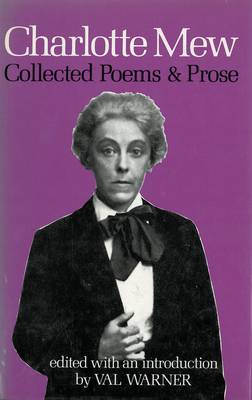
|
Charlotte Mew: Collected Poems and Prose. Edited with an Introduction by Val Warner. London: Carcanet Press in association with Virago, 1981. [Includes all known Mew poetry, fiction, and non- fiction, published and unpublished.] Includes pages v to xxiv of introductory material consisting of Contents (pages v to viii) which includes some dates and places of publication; Introduction (pages ix to xxii) and Bibliographical Note (pages xxxiii-xxiv). |
1981-1985
Siegfried Sassoon's diaries, edited and introduced by Rupert Hart-Davis,
published in three volumes by Faber (London). Diaries for 1920 to 1922 were
published in 1981; diaries for 1915 to 1918 in 1983; diaries for 1923 to
1925 in 1985. Sassoon's surviving diaries date from 1905 to 1956. Rupert
Hart-Davis began with 1920 to 1922 because Sassoon's own Siegfried's
Journey (1945) finished in August 1920.
Penelope Fitzgerald, "Lotti's Leap." Review of
Collected Poems and Prose in London Review of
Books. 1-14 July 1982: 15-16.
|
Marjorie Watts "Memories of Charlotte Mew". PEN Broadsheet
13
(Autumn 1982): pages 12-13
Part quoted by Penelope Fitzgerald 1988, p.138:
My mother told me the detailed story when I was about 17 and asked why we never saw Charlotte. She also recorded in her journal that when she and the attractive gossip and novelist, Netta Syrett, were discussing Margaret Radclyffe Hall and Una, Lady Troutbridge, with May, the latter said: |
8.12.1982 Letter to Penelope Fitzgerald from Berkhamsted Local History Society, based on a search of local directories: "J.T. Browne lived at a large house called Anglefield from the time of the first World War until the mid 1930s. The house was pulled down some years ago to be replaced by flats"
Margaret Tomlinson, Three Generations in the Honiton Lace Trade: A Family History, published by Margaret Tomlinson (Exeter?). 94 pages [12 of plates]. Includes genealogical tables. ISBN/ISSN: 0950857408 (paperback). Indexed,
Linda Mizejewski, "Charlotte Mew and the Unrepentant Magdalene: A Myth in Transition." Texas Studies in Literature and Language 26.3 (Fall 1984): pages 282-302.
Oxford Book of Short Poems Edited by James Michie and P. J. Kavanagh included Charlotte Mew
Laughter and the Urn. Life of Rex Whistler by his brother, Laurence Whistler (1912- ) published: London : Weidenfeld and Nicolson, 1985. Rex Whistler quoted Charlotte Mew in a letter to Lady Caroline Paget: "My heart is is lame with running after yours so fast Such a long way". His copy of The Rambling Sailor (1929), with his penciled signature, was offered for sale on ebay in January 2007.
Dictionary of National Biography article on Harriette Chick by Hugh Macdonald Sinclair (1910-1990) drawing on personal knowledge, information from "her niece Dr Katharine Tansley (Mrs Lythgoe) and her nephew Peter Blackman". Books Margaret Tomlinson 1983 (by another niece) and Chick, Hume and Macfarlane 1971.
Negley Harte: The University of London, 1836-1986. London: Athlone Press, 1986.
Mrs Sappho: the life of C.A. Dawson Scott, Mother of International P.E.N by Marjorie Watts; with a foreword by Francis King. London: Duckworth. 1987
Robert Ackerman, J.G. Frazer: His Life and Work Cambridge University Press 1987
Death of Mary Davidow
Penelope Fitzgerald, Charlotte Mew and Her Friends. New York: Addison Wesley,
Penelope Fitzgerald, born Penelope Knox, 17.12.1916. Married Desmond Fitzgerald in 1941. She previously published a life of Edward Burne-Jones in 1975. She published Knox Brothers, a composite study of her father and his brothers, in 1977. Her father, E.V. Knox, wrote a parody of Charlotte Mew in Punch 4.8.1921. Penelope wrote a detective story to divert her husband when he was dying, and this was followed by several novels. Her biography of Charlotte Mew is written like a novel. It is dedicated "In memory of The Poetry Bookshop". She had (1980/1981) planned a series of articles about the writers who were published by the bookshop, but wrote the book length Charlotte Mew and Her Friends instead. She died 28.4.2000, but her research papers had already been sold to a Texas University in 1989. Some of her main sources are Alida Monro 1953, Mary Davidow 1960 and Val Warner 1982, She makes special mention of help from Mrs Marjorie Watts, daughter of Mrs Dawson Scott
The Poetry Bookshop, 1912- 1935: a bibliography by J. Howard Woolmer; with an introduction by Penelope Fitzgerald. Series: St Paul's bibliographies. Published: Revere, Pa.: Woolmer/Brotherson ; Winchester : St. Paul's Bibliographies, 1988. The papers from formed The Poetry Bookshop Collection at the University of Tulsa.
University of Texas (Austin) bought Penelope Fitzgerald's papers:
Finding Aid - "Includes
Delivered,
short story by Charlotte Mew"
Robert Fraser The Making of the "Golden Bough": The origins and growth of an argument Palgrave Macmillan, 1990
150 Years of British Psychiatry 1841-1991 Edited by Hugh Freeman and German Berrios (London: Royal College of Psychiatrists), includes (Chapter 12, pages 197-205) Psychodynamic Psychiatry before World War 1 by R.D. Hinshelwood, which is available online 1991 -
J. Rose, Marie Stopes and the Sexual Revolution (1992).
Charlotte Mew: Displaced Person. Displacement and division of the ?female self? in the poetry of Charlotte Mew By Joan Bernadette Slattery. Open University Long Dissertation.
The (manuscript) Diaries of Sir Sydney Cockerell were "reserved" until 1994. British Library manuscripts 52670-52702 - Eighty volumes.
A Life in Catalogues, and other essays by George Sims. Published in Philadelphia by Holmes Publishing Co., 1994. 158 pages The final essay (12) is on "Charlotte Mew". I draws on his conversations with Alida Monro, but also (heavily) on Penelope Fitzgerald 1958. The conversations with Alida were in the course of purchasing manuscripts from her. Some of these he sold to Lockwood Memorial Library (Buffalo). I would suggest that Charlotte Mew's letters to Ethel Oliver and Mrs Hill passed through Alida Monro to George Sims.
"Fallen Women: Charlotte Mew in context" by Suzanne Raitt in Volcanoes and Pearl Divers (pages 52-73?), a collection edited by Suzanne Raitt "about the relationship of politics with pleasure. A feminist anthology that addresses three centuries of English language lesbian culture and literature" Onlywomen Press Ltd, 1994.
Millgate, 1995/1996: Letters of Emma and Florence Hardy, edited by Michael Millgate. Oxford: Clarendon, 1996. Originally published: New York : Oxford University Press, 1995.
R.D. Hinshelwood: Psychoanalysis in Britain: Points of Cultural Access, 1893-1918. International Journal of Psycho-Analysis, 76:135-151 - In chronological order, Robert Hinshelwood identifies seven "cultural locations" adopting an aspect of Freud's teaching before 1918. (1) From 1893, the Society for Psychical Research - (2) From about 1895, Havelock Ellis - (3) From around 1905, the reaction against the pessimistic attitude to treatment in British psychiatry - (4) Around 1910-1915: W. H. R. Rivers and others endeavouring to create an empirical science of psychology - (5) From around 1913, novelists using Freud's theory of symbols - (6) From 1913, educationalists using Freud's theory of child development - (7) philosophers, including Bertrand Russell, reflecting on the psychoanalytic view of the unconscious.
First edition of Joan M. Reitz's Online Dictionary for Library and Information Science (OLDIS). Then called Hypertext Library Lingo: A Glossary of Library Terminology. It had begun as a four page printed handout in 1994. Link to current edition.
Peggy Parris's novel about Charlotte Mew His Arms are Full of Broken Things.
Collected Poems and Selected Prose of Charlotte Mew includes a new introduction by Val Warner (pages ix to xxv) which is the most accurate and up to date summary of our knowledge of Charlotte Mew's life. All the poems are included. The prose selected is Elinor - The Minnow Fishers - The Wheat - An Old Servant - The China Bowl (Play). Volume reissued April 2003
September/October 1997: Val Warner "New Light on Charlotte Mew" PN Review 117. Volume 24, pages 43-47
"Charlotte Mew (1869-1928) once refused to supply biographical facts; subsequently, it has been open season on her life. Mary Davidow's unpublished thesis, 1960, contained valuable information from friends and relatives of Mew, but was spoilt by Davidow's belief, without evidence, in a secret affair between Hardy and Mew in the 1890s, and her ignorance of Virginia Moore's 1936 description of Mew as a lesbian. In 1970 May Sinclair's biographer, Theophilus Boll, tenuously confirmed the latter via Rebecca West. I followed Boll in the Introduction to my Collected Poems & Prose (1981), stressing that Mew's work focused romantically on women. Marjorie Watts, daughter of Mew's friend Catharine Dawson Scott, reviewing the Collected decided to publicize her mother's journals' confirmation of Mew's lesbianism. She subsequently gave access to her material to Penelope Fitzgerald, who published Mew's biography in 1984, declaring that Charlotte fell in love with three women - despite a continuing dearth of information. For instance, in the six years before her best-known poem 'The Farmer's Bride', nothing is known of her life except she published one other poem and had holidays in Dieppe and Boulogne, with her friend Elsie O'Keeffe (née Millard) and her sister Anne respectively. (This article does not rely on Fitzgerald's book for biographical information.) Contrary to many reviewers' accounts, P.B. Parris's 'fictional autobiography', His Arms are Full of Broken Things (Viking, 1997), shows Mew as lesbian, in a Victorian and subtler psychological evocation than Fitzgerald's, but falsifies by wholesale ignoring of known facts...."
9.10.1997 Death of Margaret Tomlinson at Dunmow
Winter 1997 Theodora Goss's poem "Charlotte Mew" published in The Lyric
A White Knight Oxford Book of English Short Stories, edited by Antonia Byatt, includes Charlotte Mew's A White Night
F. Graeme Chalmers, Women in the nineteenth-century art world : schools of art and design for women in London and Philadelphia Westport, Connecticut and London: Greenwood Press. Based on histories of the Royal Female School of Art (London) and Philadelphia School of Design for Women. External link to contents - introduction etc
Mark Seinfelt Final drafts : suicides of world-famous authors Amherst, New York: Prometheus Books, 1999. ISBN: 1573927414
Heather Ingman (editor) Mothers and Daughters in the Twentieth Century Edinburgh University Press is an anthology of women's writing beginning with Charlotte Mew's The Quiet House and continuing with extracts from May Sinclair's Mary Oliver: A Life
Strange and Secret Peoples: Fairies and Victorian Consciousness by Carole G. Silver. Oxford University Press. 1999. She discusses Charlotte Mew's "sympathetic" treatment of the The Changeling on pages 80-81.
7.10.1999 The Oxford Book of English Verse, edited by Christopher Ricks, includes three poems by Charlotte Mew: Sea Love - I so liked Spring - A Quoi Bon Dire (pages 535-536)
27.10.1999 Charlotte Mew - Selected Poems Bloomsbury Poetry Classics. Selection made by Ian Hamilton (1938-2001)
Penelope Fitzgerald died. See London Review
Suzanne Raitt 2000 May Sinclair: A Modern Victorian Oxford: Clarendon Press. "Suzanne Raitt is an Associate Professor of English and Women's Studies, University of Michigan". See also 2004 - (External link: Suzanne Raitt) - extract on first world war
Dennis Denisoff: Grave Passions: Enclosure and Exposure in Charlotte Mew's Graveyard Poetry Victorian Poetry 38.1 (2000) pages 125-140
Women's History Review Volume 9 Number 1 2000: Stephanie Spencer. "Advice and Ambition in a Girls' Public Day School: the case of Sutton High School, 1884-1924"
Complete Poems - Charlotte Mew, edited with a preface and notes by John Newton. London: Penguin, 2000 [John Newton - Boston University - "scrupulously and persuasively edited" (Bostonia, Summer 2002)] I have made extensive use of John Newton's dates for first publication and notes of and on originals. John Newton does not appear to note the punctuation differences between the 1916 and 1921 editions of The Farmer's Bride. The Cyder Press "facsimile" (below) can be used for the comparison.
The Farmer's Bride, introduction by Deborah Parsons. Cheltenham: The Cyder Press, 2000. Said to be a facsimile of the 1916 edition - The cover and size are not the same. The publishers are unable to assist me, at present (owing to illness), in describing how the text provided relates to the original. However, by comparison, it appears that the inner pages of the original have been photocopied, or reproduced by some means, and printed without the margins of the original. The type is blacker (heavier) than in my copy of the second 500, but, in other respects, type, punctuation, page numbers and layout correspond.
Oxford Anthology of Twentieth-Century British and Irish Poetry included five poems by Charlotte Mew: The Farmer's Bride - Fame - Arracombe Wood - On the Road to the Sea - Monsieur Qui Passe. See publisher's website - (Wikipedia lists the poets it includes, with links)
2001 Translation of some of Charlotte Mew's shorter poems into German by Johannes Beilharz
4.2.2001 Death of Peter F. Blackman. He left £51,075 to The National Trust. The Year on Record (National Trust, 2002-2003) lists under "Properties and Covenants Acquired" "Devon. LAND AT HAZELWOOD/HILLEND, BRANSCOMBE, SEATON (192:SY205891) 2.56 hectares (6.32 acres). Bequest under the will of Mr P. Blackman." The boxes of Chick papers sold in 2006 may have belonged to him. Tribute
17.7.2001: Leigh Wilson, University of Westminster: "Sinclair, May (1863-1946)" article in The Literary Encyclopedia
21.4.2001 Harold Monro: Poet of the New Age by Dominic Hibberd - Amazon Link
6.11.2001 and 7.11.2001 Sale at Sotherbys of the private collection of Frederick B. Adams, who died in February 2001. (BBC Link). The Charlotte Mew Collection went to Yale University - But not everything. Hardy library reconstruction has "Collection of Frederick Baldwin Adams, Jr., dispersed at Sotheby's (London), 6-7 November 2001 ('Adams sale')".
Imperial Ecology. Environmental Order in the British Empire, 1895- 1945 by Peder Anker. (pdf excerpt)
23.5.2002 Penelope Fitzgerald "The Death of a Poet" (written 1980 or 1981) published in London Review of Books.
August 2002 She loves me, she loves me not: The voice of unfulfilled love in Charlotte Mew's poetry MA Thesis by Susan Ann Santovasi, Southern Connecticut State University. [This can be bought via Proquest (pdf $35). There is a 24 page free preview] "... close readings of selected poems that speak of Mew's love experiences in sensual and remorseful tones, striving to attach the theme of unfulfilled romantic love to Mew's poems and demonstrate the connection between Mew's personal experiences with love and the poetry that she left behind." The personal experiences of love are taken from Penelope Fitzgerald's story.
Jessica Walsh, ""The strangest pain to bear": Corporeality and Fear of Insanity in Charlotte Mew's Poetry" Victorian Poetry - Volume 40, Number 3, Fall 2002, pp. 217-240 West Virginia University Press - (a web copy)
October 2002 Charlotte Mew Manuscripts collected by Frederick B. Adams junior (1910-2001), Yale 1920 listed as a recent acquisition of the Beinecke Rare Book & Manuscript Library at Yale University.
"The collection acquired by the Beinecke was formed by Frederick B. Adams, Yale 1920 and former director of the Pierpont Morgan Library. It contains various poetic drafts, in manuscript and typescript, and letters from Mew to Elkin Matthews and Kate and Sydney Cockerell, among others."
The also has material relating to "C. A. Dawson Scott, founder of the British P.E.N., who published under the pseudonym Sappho" "C. A. Dawson Scott - Marjorie Watts papers, 1913-1980" Purchased from Bertram Rota on the Edwin J. Beinecke Book Fund, 1994 Link to catalogue
1.12.2002 A New Matrix for Modernism: A Study of the Lives and Poetry of Charlotte Mew and Anna Wickham by Nelljean McConeghey Rice. Routledge
About 2003 Charlotte Mew on the Spondee Poetry website includes " An Extensive Mew Bibliography Prepared by Peggy Parris, Associate Professor of Literature at the University of North Carolina at Ashville"
March 2003 Diva Magazine "Articles on older women. Great piece on Charlotte Mew from Victorian times (a successful poet but a thoroughly unsuccessful lesbian!)". Offered on ebay November 2007
22.8.2003 (A latest update date) Thomas Hardy's Library at Max Gate: Catalogue of an Attempted Reconstruction by Michael Millgate
Negley Harte and John North. The World of University College, 1828- 2004. 3rd edition. London: University College, 2004.
Spring 2004 Poetry Review Volume 94 No 1 Michael Newton "I See Myself Among the Crowd: The Poetry of Charlotte Mew" available at http://www.poetrymagazines.org.uk/magazine/record.asp?id=13580
Spring 2004 Natalie Kressen "Otherness in Charlotte Mew's Poetry" Deluge, the undergraduate research journal of Penn State University's Department of English. Volume 2, No. 1 - Spring 2004. This analyses three poems, The Changeling - Ken and On the Asylum Road, in terms of otherness, normality, queerness and the interpenetration of people's worlds. It comments on Jessica Walsh 2002
Autumn 2004 History Workshop Journal, Volume 58, Number 1, 2004 Suzanne Raitt Early British Psychoanalysis and the Medico-Psychological Clinic
September 2004 Betty Falkenberk had collected materials from The Berg Collection at the New York Public Library, The Beinecke at Yale, and the Harry Ransome Research Center at the University of Texas at Austin (and other places in the USA)
Charlotte Mew in Russia (a collection of links that was started November 2004 - though not necessarily including Charlotte then)
2005
Max-Planck-Institut für Wissenschaftsgeschichte (History of
Science) Conference: "A Cultural History of Heredity III: 19th and Early
20th Centuries:"
Preprint 294 available as pdf. This includes
"A Changing Landscape in the Medical Geography of 'Hereditary' Disease:
Syphilis, Leprosy, and Tuberculosis in Hawai'i (1863-1903)" by
Philip K. Wilson
Dynamic Psychology in Modernist British Fiction by George M.
Johnson, Palgrave Macmillan, 2005. The influence of psychologies developed
by William James,
William
McDougall,
Henri Bergson, Pierre Janet, and
Frederic Myers
on novelists such as Virginia Woolf, D. H. Lawrence,
May Sinclair, and J.
D. Beresford. Chapters: Philosophy and psychology -
Medicine, mental science, and psychical research - "A piece of psycho-
analysis" : the British response to later dynamic psychology - May Sinclair
: the evolution of a psychological novelist - From Edwardian to Georgian
psychical realism : Bennett, Lawrence, and Beresford - "The spirit of the
age" : Virginia Woolf's response to dynamic psychology - Diving deeper :
dynamic psychology and British literature.
(external review)
18.1.2005 Letter to Betty Falkenberg from Richard Smout, County
Archivist, Isle of Wight.
Saturday 2.7.2005:
Guingamp: Pardon Notre-Dame de Bon Secours - Messe
célébrée à la Basilique suivie d'une procession
aux flambeaux dans les rues de la ville qui se termine Place du Centre
où trois feux de joie sont allumés -
See 2007 version
7.9.2005 to 11.9.2005 Planned visit of Betty Falkenberg to
London that never took place.
30.9.2005 Email from Betty Falkenberg:
If I understand the history correctly:
This embroidery of Charlotte Mew's
was given to one of the
Chick family, possibly in the 1890s.
Margaret Chick gave it to
Mary Davidow, probably in
1958. Mary Davidow gave it to
her student, Ruthe Spinninger and Elizabeth DeGroot wrote to Ruthe about
it. See
Some helpful
people
needle index:
Charlotte could turn out exquisite pieces of
embroidery executed to
her own designs -
Mary Davidow says... -
letter from Margaret Chick to Mary
Davidow -
dear little cloth with...
birds and beasts and fishes -
3.10.2005 Photocopies from University College London Records Office
of some previous
work on the what the University records show of Harriette Chick and her
sisters and Student Index Cards for
Harriette Chick,
Mrs Edith Tansley,
Elsie Chick, Margaret Robinson,
Margaret Chick,
Mrs S.H. Wood, The student index cards have been kept up to date
by successive
people adding changes of address, notes name change (marriage), obituary
notice dates etc. (
See some helpful people)
12.10.2005 to 18.10.2005: Exhibition of the work of
Dorothy Hawksley at
The Maas
Gallery, 15a Clifford Street, London, WIS 4JZ. The Catalogue
includes "An Introductory Essay" by John Christian (pages 2-12)
21.10.2005
Siegfried Sassoon: a biography, by Max Egremont
(Independent review)
"Sadly my Grandfather, Commander
William Elijah Chick, who remembered all these people died 18
months ago,
aged 93."
(Dorothy Lumb - September 2006).
"The embroidery has arrived. I wish you could have unwrapped it
with me. It
is a small -- maybe 9" by 4 1/2" -- linen runner decorated with the most
exquisite tiny, brilliantly coloured flowers and sprays, graceful, sparse,
and painfully neat. One speaks of the distillation of a passionate
intensity in the poems. I would say this is the same kind of compression
in a more conventional medium. It has been tastefully framed in an antique
gold frame, and I consider it a real treasure."
|
November 2005 Betty Falkenberg "Charlotte Mew in America"
PN Review 166: November - December 2005 pages 36-39.
[You can buy PN Review from the Carcanet website] I have also used a manuscript, provided by Betty, which includes references. |

|
February 2006 Two boxes of Chick family papers bought at an auction sale in Rugby by Suzanne Watts. They are believed to be part of a house clearance sale. Suzanne and her daughter Katy Smart have prepared a catalogue of the contents of the boxes which I am using with Margaret Tomlinson's book to fill the history of the Chick family. We would like to know where the boxes came from. At the moment, our best guess is that they may have belonged to Peter F. Blackman. The contents of the boxes included the diary that has been identified as belonging to Harriette Chick.
Saturday 12.8.2006 S Holliday, New Fairlee Farm, Mews Lane, Staplers Road, Newport, Isle of Wight won prizes for beef cattle at the Isle of Wight County Show
13.9.2006 Email from Dorothy Lumb, daughter of Gillian Lumb nee Chick. "I am a descendent of Samuel Chick and have a family tree going back to 1725 as researched by my mother's "cousin", Margaret Tomlinson (author of the history of the family lace business).
Richard Ford (Bookseller) Harriette Chick's library of pamphlets. His homepage. Richard supplied me with a list of the ones by Harriette Chick.
January 2007: Harriette Chick Diary 28.4.1901 - 13.8.1903 Bought from Suzanne Watts by Corinne Lee. It has been identified as the diary of Harriette Chick by comparison with the diaries in The Wellcome Library and by its content. Corinne supplied me with copies of sheets relating to an experiment in Vienna in June 1901 - Photography and the New Phytologist in July 1902 - Edith Chick's wedding in July 1903 - and has since sent me the book. The diary is small black notebook. Entries were not (always) made on the day and, in one case [Edith Chick's wedding in July 1903], a loose sheet from which entries were later made is slipped into the notebook. There are blank pages that appear to have been left for material to be entered later. The first and earliest date is "April 28th" (Vienna?) [Not 27.3.1901] followed by "Monday April 29" "Written in June" [1901]. There are then six blank pages followed by "Wednesday July 1st 1903" (Munich). This continues from Munich to Branscombe [Edith Chick's wedding in July 1903] and London (13.8.1903), which is the latest date in the book. There are then eighteen blank pages to (about) page 35 for "Vienna May 21 1901". The account continues in Vienna until Friday 5.7.1901 when they are in Dresden on their way to London, via Leipzig and Hanover. Then, on 11.7.1901 she goes to Liverpool. This section ends Monday 15.7.1901 with discussions with Liverpool academics about Austrian academics they all know. Two blank pages are followed by an entry "Friday Nov. 8th 1901" about an At Home where she was ignored and, after a blank page "Marche [?] 1st [1902?], about a party she enjoyed. Both appear to be Liverpool. Four blank pages are followed by "July 4th 1902", when she travels to Branscombe. She went to London on July 8th and the last entry of this section is opera on Tuesday July 15th 1902. One blank page and the final part begins "Thursday April 9th 1903". It covers a journey from London (April 1st) to Paris and on to Austria. She moves to Munich on 23.4.1903. The last entry is Tuesday 20.6.1903
30.4.2007 Digital collection from Betty Falkenberg
BF = Digital collection of Betty Falkenberg
BF CM-CADS 1913 and BF CADS 1914
There are .cwk and .doc files
BF CMM-Sapho appears the same as BF CADS 1914
Letters almost certainly in the
C. A. Dawson Scott - Marjorie Watts Papers. General Collection,
Beinecke Rare Book and
Manuscript Library, Yale University.
BF CMM-SCC 1918 3.7.1918- BF CMM-SCC 1918 (later) edited (additional
notes)
BF CMM-SCC 1919 corrupted file - BF CMM-SCC 1919 (later) OK
BF CMM-SCC 1920 .cwk file has a note that the .doc file is more up to
date.
[No 1921?]
BF CMM-SCC 1922
BF CMM-SCC 1923
BF CMM-SCC 1924
BF CMM-SCC 1926
7.6.2007 Photocopy of
Freda Mew's case notes 1899-1909 received by
Andrew Roberts from
Tony Martin. The
catalogue entry for the book from which these
are copied is:
" Reference: HO4/E2 Richard Smout, County Archivist, adds that The registers have no title, but merely have the words Isle of Wight County Asylum on the front of the volume. There is a loose sheet inside this volume which may be contemporary. It is headed
Case Book
This body clearly inspects the books annually as dated signatures of two members of the Commission appear on the first blank page in the book. The sheet states that the initial details, which are specified, must be entered in the case book within seven days of the admission of the patient. It then goes on to say that "Subsequent entries describing the course and progress of the case, and recording the medical and other treatment, with the results, shall be made in the case book for patients at the times herein-after mentioned, that is to say: once at least in every week during the first month after reception, and oftener when necessary; afterwards, in recent or curable cases, once at least in every month, and in chronic cases, subject to little variation, once in every three months. But all special circumstances affecting the patient, including seclusion and medical restraint, and all accidents and injuries, must be at once recorded." |
19.10.2007 Thomas Hardy: The Time-Torn Man by Claire Tomalin published by Viking
February 2008 Poems selected by Eavan Boland
2009

|
2013
Sunday 11.8.2013 Re-appearance of Charlotte Mew
(in the body of Kate O'Connor) at the Shuffle Festival on the old
St Clement's Hospital site.
|
|
Saturday 22.10.2016 A Marchmont Association blue plaque commemorating Charlotte Mew unveiled at 30 Doughty Street, WC1, where she was born and lived from 1865 to 1890. There are brief reports of the unveiling on the Marchmont Association website and in the Camden New Journal. |
Those present at the unveiling included Julia Copus, who is writing a biograhy of Charlotte, Heather Greetham, whose great-grandmother was Fanny Mew, Charlotte's aunt on her father's side and Michele Roberts. Julia and Michele read poems. Juia read The Sunlit House and Michele read Le Sacre Coeur.
A copy of Julia's introduction to the unveiling has been published on the Faber website. Photographs by Nathalie Fonnesu have been published on the F.E.E.L. (Friends of East End Lunatics) website and official Marchmont Association photographs on flickr
2017
24.4.2017 from 7pm at Temple Church: Kate Whitley's settings to
music of Charlotte Mew's poems,
The Farmer's Bride,
Sea Love and
Rooms,
will be played by the Albion Quartet and sung by Matthew Rose.

|
See preview by Andrew Roberts |
-
Charlotte's plaque
name and general
index:
A
B
C
D
E
F
G
H
I
J
K
L
M
N
O
P
Q
R
S
T
U
V
W
X
Y
Z
Also indexed by:
date -
writing
picture
plus:
architecture
and
isle of wight
indexes
outside links:
brief biography at Carcanet - Wikipedia article
1880 Henry Herne Mew aged
15
1884
Charlotte (15), Anne (11) and Freda (5)
1890s Charlotte's
embroidery
1880s Charlotte and Elizabeth
Goodman
1896 Charlotte
aged 26
1902 Chick sisters
1909 Dawson
Scotts
1915 Fanny Mew memorial
1916 The
Farmers Bride
1917 Letter from
Charlotte to Mrs Scott
1919 Sea Love
1922 Old
Shepherds Prayer
1923? Charlotte aged
about 55
1926 Charlotte by Dorothy
Hawksley
writing index:
date index:
1731 -
1764 -
1775 -
1776 -
1786 -
1790 -
1805 -
1811 -
1814 -
1816 -
1822 -
1823 -
1824 -
1825 -
1826 -
1828 -
1829 -
1830 -
1832 -
1834 -
1838 -
1837 -
1841 -
1842 -
1843 -
1844 -
1845 -
1846 -
1847 -
1848 -
1849 -
1850 -
1851 -
1852 -
1853 -
1856 -
1857 -
1859 -
1860 -
1861 -
1862 -
1863 -
1864 -
1865 -
1866 -
1867 -
1868 -
1869 -
1870 -
1871 -
1872 -
1873 -
1874 -
1875 -
1876 -
1877 -
1878 -
1879 -
1880 -
1881 -
1882 -
1883 -
1884 -
1885 -
1886 -
1887 -
1888 -
1889 -
1890 -
1891 -
1892 -
1893 -
1894 -
1895 -
1896 -
1897 -
1898 -
1899 -
1900 -
1901 -
1902 -
1903 -
1904 -
1905 -
1906 -
1907 -
1908 -
1909 -
1910 -
1911 -
1912 -
1913 -
1914 -
1915 -
1916 -
1917 -
1918 -
1919 -
1920 -
1921 -
1922 -
1923 -
1924 -
1925 -
1926 -
1927 -
1928 -
1929 -
1930 -
1931 -
1932 -
1933 -
1934 -
1935 -
1936 -
1937 -
1938 -
1939 -
1940 -
1941 -
1942 -
1943 -
1944 -
1945 -
1946 -
1947 -
1948 -
1949 -
1950 -
1951 -
1952 -
1953 -
1954 -
1955 -
1956 -
1957 -
1958 -
1959 -
1960 -
1971 -
1975 -
1978 -
1981 -
1988 -
1993 -
1997 -
1999 -
2000 -
2001 -
2002 -
2003 -
2004 -
2005 -
2006 -
2007 -
2008 -
pictures index:
collections:
1916 -
1917? -
1921 -
1929 -
1953 -
1960 -
1981 -
1997 -
1999 -
2000 -
2003 -
2008 -
2009 -
2010 -
2011 -
2012 -
2013 -
2014 -
2015 -
2016 -
2017 -
individual items:
A Country Book
A Farewell
A Fatal Fidelity
A Question
A quoi bon dire
Absence
Afternoon Tea
Again
Aglaë
An Ending
An Old Servant
An Open Door
Arracombe Wood
At the Convent Gate
A Wedding Day
A White Night
Beside the Bed
Delivered
Do Dreams Lie Deeper?
Domus Caedet Arborem
Elinor
Epitaph
Exspecto Resurrectionem
Fame
Fin de féte
Friend, Wherefore?
From a Window
Here lies a Prisoner
I so liked Spring
I Have Been Through the Gates
In Nunhead Cemetery
In the Curé's Garden
In the Fields
Jour des Morts
June, 1915
Ken
Le sacré-Coeur
Left Behind
Madeleine in Church
Mademoiselle
Mark Stafford's Wife
Mary Stuart in Fiction
May, 1915
Men and Trees
Miss Bolt
Monsieur qui passé
Moorland Night
My Heart is Lame
Ne me tangito
Notes in a Brittany Convent
Not for that City
Old Shepherd's Prayer
On the Asylum Road
On the Road to the Sea
On Youth Struck Down
Passed
Pécheresse
Péri en mer
Requiescat
Rooms
Saturday Market
Sea Love
She was a Sinner
Smile, Death
Some Ways of Love
Song
1902
Song 1919
Spine
The Bridegroom's Friend
The Call
The Cenotaph
The Changeling
The China Bowl
The China Bowl play
The Country
Sunday
The Farmer's Bride
The Fête
The Forest Road
The Governess in Fiction
The Hay Market
The Little Portress
The London Sunday
The Minnow Fishers
The Narrow Door
The Pedlar
The Poems of Emily
Brontë
The Quiet House
The Rambling Sailor
The Road to Kérity
The Shade-Catchers
The Smile
The Sunlit House
The Trees are Down
The Wheat
The Voice
There shall be no night..
To a Little Child in Death
To a Child in Death
V.R.I.
White World
name index
Abigail (Tutcher) Chick
absence
Ada Cubitt
Adams collection
Algernon Swinburne
Alida Monro
Alida Monro
Collection
America
Amice Macdonell (Lee)
Amy Greener
Ann/e (Lyon) Kendall
Ann (Norris) Mew
Anna Maria (Kendall) Mew
Anne Brontë
Anne Mew
Anne Macdonell
Ann Perkin
architecture
Arthur Kendall
Arthur Rackham
Audierne
Arthur
Tansley
Atalanta's Garland
Audrey Blackman
Barnes
Bedford College
Benjamin Jowett
Berg Collection
Berkhamsted
Betty Falkenberg digital
collection
Bloch
Bootham School
Branscombe
brewery
British Library collection
British Museum Library
Brittany
Brunswick Square
Burlington Road
Bugle Inn
Buffalo collection
Camaret sur Mer
Caroline F. Herne
Catherine Amy Dawson Scott
Celia Hill
Charles Darwin.
Charles Kendall
Charles Scott
Sherrington
Charlotte Brontë
Charlotte Mew
Charlotte Mew photograph:
1884 -
1890s? -
1920s?
Charlotte
Street
Chesterfield
Chestergate
Chick boxes
Chick diary
Chick family
Chick lace
children
Christopher Barnes Mew
Christopher
Scott
Clement Parsons
Cobham
Conrad
Cornwall
Crackanthorpe family
Daily Herald
Daniel Kendall Mew
Daniel Oliver
Darwin.
Dean Street
degeneration
dialect
Dieppe
Dorothy Chick
Dorothy Hawksley
Dorothy Lumb
Doughty Street
Ecology
Edith Chick
Edith Gray Hill
Edith Scull
Edith Tansley
Edmund Gosse
Edward Chick
Edward Herne Kendall
Edward Thomas Browne
Edward V. Knox
Elkin Mathews
Elijah Chick
Elizabeth
Goodman
Elizabeth Read
Ella D'Arcy
Elsie Blackman
Elsie Chick
Elsie (Millard) O'Keefe
embroidery
Emily Brontë
Emily Davies
Emma Chick
Ethel Louisa Mew
Ethel Robinson Inglis
Ethel Oliver
Evelyn Underhill
Fanny Mew
Fanny (Frances)
Mew/Barnes
Fanny (Read) Mew
Female School of Art
Fitzroy Square
Fitzwilliam Museum.
Florence Ellen Mew
Florence Emily Hardy
Florence Kate Kingsford
Florence Mary (Poole) Parsons
France
Frances Chick
Frances (Fanny)
Mew/Barnes
Francis Wall Oliver
Frazer
Freda Mew
Frederick Frost
Blackman
Frederick Mew
Frederick Mew baby
Frederic Myers
Freud
Friends school Croydon
Friends schools
York
Friends school Wigton
G.B. Stern
George Sims
1847-
George Sims 1923-
Gertrude Mary Mew
Gertrude Mayer
Gideon Scull
Gilbert Mew
Gillian Lumb
Gordon Street
Gower Street
Guingamp
Hannah Oliver
Harold Monro
Harriette Chick
Hazelwood
Henry Dawson Lowry
Henry E. Kendall senior
Henry E. Kendall junior
Henry Gillman Webb
Henry Harland
Henry Herne Mew
Henry Noel
Brailsford
Henry Mew (1790)
Henry Mew (1824)
Henry Robert Kendall
Herne
Henry Thomas Jarman
Herbert Edward Durham
Hill family
Hogarth Studios
Holy Redeemer
Horatio Cowan
Iwan Bloch
James Bull
James George O'Keefe
Jessie Murray
James Chick
John Read
Joseph Conrad
Julia Turner
Kate Cockerell
Katharine Cockerell
Katherine Righton
Labour Party
lace
Le Conquet
London Plane
London Association of Schoolmistresses
London University
London University women
Louisa Read
Louis
Untermeyer
Lucy Harrison
Lydia Rous
Lymington
Maggie
Browne
Manning and Mew
Margaret
Browne
Margaret
Robinson
Margaret Chick
Margaret Jarman
Margaret Sackville
Margaret Tansley
Margaret Tomlinson
Marjorie Watts
Marjorie Scott
Marie Stopes
Mary Davidow
Mary Anna Read
Mary Chick
Mary (Herne) Cobham
Mary Leonora Kendall
Mary (Cobham) Kendall
Max von Gruber
May Sinclair
Medico-Psychological Clinic
Methodists
Mew family 1731
Mew family 1881
Michael Tippett
Mount School
Mrs Hill
Mrs Mayer
Mrs Moore
Mrs Sappho
Mrs Scott
needlework
New Fairlee Farm
Newman Street
New Phytologist
Norris family
Notting Hill High School
Octavia Hill
Old Kent Road school
Oliver family
Paddington
Pagets Girls Club
Pall Mall Magazine
Paris
Penelope Fitzgerald
Peter Mew
Plane trees
PN Review
Poetry (magazine)
psychical research
Punch parody
Queens College
Quimper
Quain
Richard Cobham Mew
Richard Percy
Mew
Richard Mew
Richard Mew (1764)
Robert Koch
Robertson Smith
Royal Pier
Hotel
Rubert Boyce
Ryde
sacrifice
Samuel Chick
senior
Samuel Chick
junior
Sidmouth
Siegfried Sassoon
Sophia (Kendall) Cubitt
Sophia Webb
Sophia Ellen Webb
South Fairlee Farm
St Gildas de
Rhuys
Storey's Way
Sylvia Parsons
Spring Gardens
Suffolk Street
Suzanne Raitt
Sydney Cockerell
Temple Bar
The Academy
The Bookman
The Chapbook
The English Review
The Englishwoman
The Graphic
The Grove, Isleworth
The Monthly Chapbook
The Nation
The New Statesman
The New Weekly
The Outlook
The Poetry Bookshop
The Theosophist
The Yellow
Book
T.A. Cobham
Thomas Cobham Kendall
Thomas Hill Green
Thomas Hardy
Toby Scott
Val Warner
Vienna
Violet Vanbrugh
Walter Mew
Walter Mew Barnes
Walter Scott
Wek (parrot)
Wigton Quaker School
William Wordsworth
William Elijah Chick
William McDougall
Winfred Oliver
York Quaker Schools