A Middlesex University resource provided by Andrew Roberts
Contents page THE LUNACY COMMISSION,
ITS ORIGIN, EMERGENCE AND CHARACTER
1832 timeline analysis of
legislation may I introduce you? home page to
Andrew Roberts'
web site
mental health
and learning
disability

The 1832 Madhouse Act and the Metropolitan Commission in Lunacy from 1832


Describes the London body for regulating private madhouses (licensed houses) under the 1832 Madhouses Act

3.5 THE 1832 MADHOUSE ACT
Private mutilations by Peers unintentionally place the Commission in the hands of a reforming Lord Chancellor
A routine bill in extraordinary times
Meticulous vandalism in private

3.6 THE COMMISSION'S COMPOSITION UNDER
THE 1832 MADHOUSE ACT

Lord Chancellor Brougham's reforms
A re-structured commission
1832 changes
1833 Changes

3.6.2 Barristers after 1832

3.9 Claims for commission's effectiveness
3.9.1 The commission's evaluation
3.9.2 Bethnal Green as evidence of the commission's effectiveness
3.9.3 London houses improving
3.9.4 Colonel Sykes outlines the commission's functions
3.9.5 Sykes and Ashley describe the county visitors

3.10 Reasons for effectiveness
3.10.2 Excess costs
3.10.3 Hampshire and the commission compared

3.11 Limitations of effectiveness
3.11.2 Sykes, Ashley and the London Statistical Society
3.11.3 An unnatural death rate
3.11.4 The Commission's evaluation reconsidered. Hoxton and Peckham.

3.12 Central records and national interests

3.13 Hereford Lunatic Asylum

3.14 The hole and corner Metropolitan Commission


3.5 THE 1832 MADHOUSE ACT

The chronological bibliography for 1832
gives the details of Parliamentary proceedings.
analysis of
legislation

A routine bill in extraordinary times

In February 1832 Gordon, assisted by Somerset, George Lamb and Spring Rice, brought in a new Madhouse Bill. Lamb, a brother of Melbourne the Home Secretary, was also his Under Secretary of State. Spring Rice was Joint Secretary to the Treasury and had been Under Secretary at the Home Office under Lansdowne in 1827. The Bill clearly had Government support.

The 1832 Bill was a revision of the 1828 Madhouses Act in the light of a few years experience. It consolidated the 1828 Act with the 1829 Amendment Act and made detailed alterations intended to tighten and make the provisions more effective, but no major or dramatic changes. The House of Lords was to alter this.

The Madhouses Bill was brought in whilst debates on the Parliamentary Reform Bill were so engrossing the House of Commons that Wynn suggested they should set one day a week aside for other measures.

What other bills did pass that session did so by the adoption of unusual procedures which allowed them to be dealt with without detracting from the main debate. Normally bills went through their committee stage before the "whole house". That is, in the main chamber with all MPs present who wished to be but with the Chairman of Committee in the Speaker's chair. Four days after its introduction and towards the end of a late night sitting, the Madhouse Bill was referred instead to a Select Committee of 24 MPs who were to meet in the Speaker's Chamber.

The members of this committee included the Solicitor General, the Under Secretary at the Home Office (Lamb) and two recent Under Secretaries (Rice and Dawson) and the Lord Chancellor's brother. With them were the six commissioners I have already already suggested (See 3.4.5) served on this committee because of their special knowledge of the legislation. Four of these commissioners and five other members (Rice, Dawson, Fazakerley, Ord and Protheroe) had been on the 1827 Select Committee of the House of Commons on Pauper Lunatics (See list).

In this committee of specialists I assume the parliamentary work was done. If there was any discussion in the House, Hansard did not record it.

Meticulous vandalism in private

The Bill appears to have reached the House of Lords in a form consistent with its original presentation. The Lords referred it to a "Private Committee" which any Lord could attend, but which was to meet outside the House, in a building called the Prince's Lodgings. (See Journal)

The quotation marks around Private Committee in the Journals suggested to me that this was not a recognized procedure, but how the committee was actually described. It was to be one whose proceedings could not be listened to by outsiders, and that, of course, included those who would most wish to: the Bill's House of Commons sponsors.

The main House of Lords amendment (Bill 648, 1832) was to systematically substitute Lord Chancellor for Home Secretary throughout. The reason can be inferred from the care with which they specified Lord Chancellor as "custodian of Chancery lunatics" (see definitions) and from the other amendments, which:

  • Required the appointment of two barristers to the Commission

  • Required an oath of secrecy from the Commissioners

  • Extended the period during which a private return need not be made fron three to twelve months

  • Abolished and destroyed the Register of Single Lunatics

The effect of these changes with respect to Single Lunatics can be seen in the comparison of the 1828 and 1832 Acts that I have made in 3S.5.

The Lords abolished the Private Register of single lunatics (ordering destruction of any existing Register) and allowed single lunatics to be confined for a year without notice.

The Chancery Lunatics, who were the custody of the Lord Chancellor, were invariably rich and Single Houses were expensive. The Lords' aim seems to have been to protect the rich and powerful from the operations of the Act. Their revisions were not aimed at the general improvement of the legislation, but a meticulous vandalism seeking to stop the general legislation imposing on the interests of their class.

In the middle of the Reform Bill crisis one has visions of the relatives of aristocratic lunatics scurrying into the Prince's Lodgings to protect for ever their family secrets. Did they, I wonder, wear their robes for the occasion, or did they slip in furtively, hoping not to be recognised?

Referring back in 1842 to previous attempts to legislate on single lunatics, Somerset spoke a little obliquely of the "feelings" of "relatives" presenting "a great difficulty". So great a difficulty in fact that he would not even attempt legislation on the "serious grievances" suffered by Single Lunatics. "What was the fact?" he asked: The very reason single lunatics were not sent to licensed houses was "because they would there be exposed to the constant visits of the commissioners and public authorities" (Hansard 17.3.1842 p. 802)

The Lords required of an oath of discretion and secrecy from commissioners and county visitors (1832 Madhouse Act s.5), limited the number of honorary commissioners, and required two barrister commissioners (1832 Madhouse Act section 3). (See 3.6 below).

In the light of the total package of Lords amendments, I suspect that the Lords thought commissioners dependent on the Lord Chancellor for an income would be more discrete than unpaid JPs and MPs and that qualified legal commissioners would ensure even greater discretion. They neglected, however, to provide salaries for the barristers and this had to be remedied by a special amendment Act in 1833.

On its return to the House of Commons some amendments were made to the House of Lords amendments which the House of Lords accepted, and as a consequence the Act preserved a limited role for the Home Secretary (*) alongside the Lord Chancellor, but its general features remained those of the Bill as it left the Lords.

(*) The Home Secretary, as well as the Lord Chancellor, could still order special visits (see law). The Home Secretary as well as the Lord Chancellor could see the Commission's copies of County Minutes. As the Home Office no longer received information directly about lunatics, it is possible that the Commission's interest in national records from 1836 was prompted by interest from the Home Office, as well as by Henry Sykes joining the Commission. The Commission could not release a criminal lunatic, but it could examine and make a report to the Home Secretary (see law). It was the Home Secretary (not the Lord Chancellor) who was to sanction enforcement by the London Clerk of those provisions for the notification of single lunatics that remained, and the Home Office that was to pay (see law).

3.6 THE COMMISSION'S COMPOSITION UNDER
THE 1832 MADHOUSE ACT

Lord Chancellor Brougham's reforms

The first appointments under the 1832 Act were made by Henry Brougham, Whig Lord Chancellor from November 1830 to December 1834. There is no reason to believe he had any sympathy with efforts to protect the rich from inspection. He was intent on reform of the English legal system, particularly the courts, and particularly Chancery.

Brougham's 1833 Chancery Lunatics Act reduced the expense of the legal proceedings to make someone a Chancery lunatic and introduced inspection of the conditions they were kept in, by two physicians from the Chancery Visitors. Though legally a distinct organisation, at least one of the first Chancery Visitors (Southey) was a Metropolitan Commissioner. By 1842, when Bright became the second Visitor, both Chancery Visitors were Metropolitan Commissioners. (See 5.4)

These reforms were compatible with the spirit of the 1832 amendments in one respect: the Chancery Visitors, like the Metropolitan Commissioners, were responsible to the Lord Chancellor. But rather than curbing the power of the state to pry into the affairs of the wealthy and powerful, they meant that Metropolitan Commissioners, as Chancery Visitors, visited those single lunatics who were also Chancery lunatics.

Subsequent ministers, such as Lord Chancellor Lyndhurst and Home Secretary Graham, saw the possibility of tidying up the whole situation by combining the Visitors and the Commissioners. But this was not to be, and an amendment to the 1845 Lunacy Act undid the integration that had been achieved informally, by preventing professional Lunacy Commissioners from having other paid employment.

A re-structured commission

Brougham's appointments in 1832 and 1833 made the greatest changes to the Commission between 1828 and 1842 (See Chart)

  • The 1831 Commission had 5 medical and 18 unpaid commissioners.
  • The 1833 Commission had 5 medical, 2 legal and 10 unpaid commissioners.

  • In 1831 the majority (12) of the unpaid commissioners were MPs.
  • In 1833 there was an equal balance of 5 MPs and 5 others (including 3 Middlesex JPs).

    In subsequent years, until 1842, the changes that were made, every year or two, were only of one or two commissioners at a time: and the balance of "types" established by 1833 was generally maintained.

    The medical commissioners, in 1832/1833, remained the same. Not so with the unpaid commissioners.

  • Until 1833 most unpaid commissioners were 1828 appointments,
  • after 1833 only Lord Ashley, Robert Gordon and Colonel Clitherow remained from the original commission.

    I have argued that Gordon was effectively Chair until 1834, a backbench Tory MP (Ashley) was needed to balance the Commission and Clitherow was the Chair of the Hanwell Asylum Committee. The list of unpaid Commissioners appointed in 1831 was more relevant to 1828. The commission needed re-structuring as much because of its nominal membership as the requirements of the 1832 Act.

  • A number of existing commissioners were old men when first appointed.

  • Most were MPs, and, since 1828, the government and the membership of the House of Commons had changed. (Dramatically - England had undergone a constitutional revolution!)

  • Commissioners had left offices they had held in 1828, and others had become Ministers.

  • Furthermore, the commission was no longer experimental. It was an established part of London's local government.

    Unintentionally, the appointment of barrister commissioners opened the possibility of establishing it on a more business like and professional basis - with unpaid members filling a different role to what they had before. The death of the first Treasurer-Clerk, was a further factor creating circumstances for the re-structuring of the Commission.

    Brougham was responsible for some of the changes in the structure of the commission - others we might more credibly ascribe to the commissioners.

  • The paid appointments seem to have been made by Brougham - even the post of Treasurer Clerk, which in 1828 Peel had left to the choice of the Commissioners.

  • Recommendations for new unpaid appointments, however, may have come from the Commission. This is strongly suggested by the number of new unpaid appointments between 1833 and 1840 who were close relatives of previous appointments. (See Baring, Somerset, Wynn, Clive, Grey, Abel Smith, Farquhar, Milnes Gaskell).

    1832 changes

    Brougham's influence, as distinct from the consequences of the House of Lord's vandalism of the 1832 Act, only became evident in 1833. The September 1832 changes were almost the minimum necessary to comply with the Act. This (3S.2.1 + 3S.2.2) required the 23 serving commissioners to be reduced to 20 or less, and the appointment of two barristers. Four of five physicians had to be appointed, so the reduction had to be of the unpaid commissioners.

  • The five serving physicians (Drs Turner, Bright, Hume, Southey and Seymour) were re-appointed.

  • The new legal commissioners were James Williams Mylne and Bryan Waller Procter.

  • No new unpaid commissioners were appointed, and only 12 of the existing 18 were re-appointed.

    The commission was thus reduced to 19 - only one less than the maximum.

    The six unpaid commissioners not re-appointed were Calthorpe, Dowedswell, Perceval, Somerset, Freemantle and Rose.

    Calthorpe, Dowedswell and Perceval had ceased being MPs.

    Somerset, Freemantle and Rose probably considered their task on the commission completed with the 1832 Madhouses Act. Somerset and Freemantle were two of the three Tory party organisers who had kept the commission going. (See Peel's commissioners). The third, Ross, ceased being a commissioner in 1833.

    G.H.Rose (aged 61) was one of the two older commissioners, with special knowledege of the legislation, whose role on the commission was probably closely related to the need to evaluate and revise the 1828 Act (See 3.4.5). The other, Wynn (aged 59), ceased being a commissioner in 1833.

    1833 Changes

    The affairs of the Commission in the winter of 1832/1833 were in a mess. Their Treasurer Clerk, who provided their offices, died and they appear to have been without a clerk or office from November 1832 to February 1833. (See move to John Street). The new clerk had to get the finances into order, including recovering licence fees from the previous clerk's estate (see clerk's finances). Accounts for two years were published in August 1833. Until August 1833 it was also unlawful to pay the new barrister commissioners appointed under the 1832 Madhouses Act. Robert Gordon may have been the chair at this time. In which case, his later record suggests that he would have helped with the practical affairs of the Commisssion. Lord Ashley had not yet undergone the religious renewal that preceded his earnest application to social responsibilities. Several of the unpaid commissioners listed, before the Commission was reappointed in September 1833, may have been Commissioners in name only.

    About February 1833, Brougham appointed Edward Du Bois as Treasurer-Clerk in place of Robert Browne (deceased). Dubois was the assistant judge at the Middlesex Court of Requests (County Court). For the next twelve years he combined these posts.

    A bill was introduced into Parliament that included provision for paying the two barrister commissioners. Although the surviving Accounts of the Commission do not allow us to tell when Mylne and Procter were first paid, the Act making it lawful became law on 28.8.1833.

    With professional legal commissioners, a large pool of unpaid commissioners was no longer needed to make visiting possible (3.6.2). Also, as the commission was no longer experimental, MPs on the Commission no longer had the significance they had when it was intended to legislate on the basis of the first few year's experience.

    Under these circumstances the number of unpaid commissioners, and the proportion of MPs, was reduced in the September 1833 appointments to even fewer than the Act allowed. At the same time, the first new unpaid appointments for three years were made. Five replaced seven, so the commission was further reduced to 17. In 1830 the ratio of unpaid to professional commissioners had been 19:5; it was now 10:7.

    The most notable differences from the 1828 Commission were the reduction of unpaid commissioners and even more marked reduction in the proportion of MPs. Eleven of the 13 commissioners removed in 1832 and 1833 were MPs, and only Inglis and Grey replaced them. On the other hand, the three retiring Middlesex JPs (Byng MP, Bouverie MP and Hampson) and the Rev. Campbell, were replaced by Acklom, Halswell and Clive.

    3.6.2 BARRISTERS AFTER 1832

    As we have no visiting records after 1831, we must infer from other data the extent to which legal visitors replaced unpaid commissioners under the 1832 Madhouses Act. We can do this with data on the commissioners fees and days visiting, produced in 1842 for the period 1836-1841 (See table of professional commissioners fees)

    Before 1832 at least one unpaid commissioner and two medical commissioners visited (3.4.2). If visits after the 1832 Act were made by a (paid) lawyer in the place of an unpaid commissioner we might infer that the annual legal fees would be roughly half the medical fees. In fact they were 40% in 1836/1837, rising to 50% in 1840/1841.

    My suspicion would be that, after 1832/1833, two medical and one legal commissioner would be the general rule for visiting, but that unpaid commissioners would provide an extra visitor for visits to pauper or problem houses. There was more than one unpaid commissioner on just under half the visits before 1832, and these visits were usually ones to pauper or problem houses. (3.4.2)

    The reason that legal fees were not 50% of medical fees before 1840/1841 probably relates to the provisions for Release Inquiry and the number of medical commissioners (5) in relation to the legal commissioners (2). Release inquiry visits required two doctors, or three doctors if no legal or unpaid commissioner went (3S.4.4 (2) QUORUM). Three visits had to be made and, until 1845, a meeting of the Board held to decide if the release should take place. (3S.4.4 (1)). The case of "R.P." in 1838 involved a three day board sitting for five hours a day with ten commissioners present (6BIOH4 3.10.1838) If five of these commissioners were doctors they would have cost £75 for the Board alone (compared to £30 for the lawyers) - in addition to the preceding medical examinations of him. The R.P. case was presumably responsible for the dramatic increase in medical fees in 1838/1839 (3.6.2TA). The way in which the fees for doctors rise and then fall at the period of the R.P. inquiry can be compared to the relatively steady rise in the fees paid to lawyers. My explanation of this would be that the lawyers were increasingly absorbed in the administration of the office.

    TA 3.6.2 Professional commissioners' fees and days worked 1836-1841
    Based on a return moved for by Granville Somerset. Printed 3.2.1842. (Accounts and Papers 1842. Vol 34, pages 3 following)
      1836/7 1837/8 1838/9 1839/40 1840/41
    MYLNE £246
    49 days
    £272
    49 days
    £304
    56 days
    £310
    54 days
    £333
    54 days
    PROCTER £241
    47 days
    £276
    49 days
    £305
    58 days
    £317
    54 days
    £316
    52 days
    BOTH
    LAWYERS
    £487
    96 days
    £548
    98 days
    £609
    114 days
    £627
    108 days
    £649
    106 days
    TURNER £254
    54 days
    £267
    53 days
    £391
    74 days
    £297
    55 days
    £302
    55 days
    BRIGHT £261
    47 days
    £279
    53 days
    £353
    65 days
    £302
    54 days
    £295
    54 days
    SOUTHEY £239
    48 days
    £271
    51 days
    £349
    67 days
    £299
    54 days
    £309 49 days
    HUME £251
    50 days
    £273
    53 days
    £339 62 days £323
    55 days
    £336
    59 days
    SEYMOUR £168
    37 days
    £106
    23 days
    £110
    24 days
       
    HEWETT    
    £73
    14 days
    £51
    10 days
    ALL
    DOCTORS
    £1,173
    236 days
    £1,196
    233 days
    £1,542
    292 days
    £1,294
    232 days
    £1,293
    227 days
    DOCTORS +
    LAWYERS
    £1,660
    332 days
    £1,744
    331 days
    £2,151
    406 days
    £1,921
    340 days
    £1,942
    333 days
    FEES: "Sums to each commissioner". Comparison with available Commission accounts shows that the figures given are for fees exclusive of expenses.

    DAYS: "The number of days each has been employed in the execution of their duties". The professional commissioners were paid £1 an hour. It is clear from the ratios of days to fees above that the "days" are not of equal hours. The figures are, presumably, the days in the year a commissioner was employed, irrespective of how many hours he worked.

    3.8 CONTROLLING LONDON'S MADHOUSES

    The commission's major function until 1842 was the control of London's madhouses. It licensed from 30 to 40 houses.

    In 1840, Commissioner Sykes told the Statistical Society of London:

    "Forty-two asylums have been under the supervision of the commission since its first establishment. Some slight changes have taken place, in the abandonment of two or three establishments, and the addition of others. The number in existence on the 30th of May 1839 was 34, the number of patients in which varied from 2 to above 300" Sykes 1840 p.147

    The numbers from year to year are shown in table one. Table two lists the houses and provides a history of each.

    A few (all pauper houses) were large asylums of over 100 lunatics. Except for the new Peckham House these were all in Bethnal Green and Hoxton in 1828. After about 1840 smaller houses did not take paupers. (See house xii on Sykes' list)

    The size of non-pauper houses ranged from Pembroke House, Hackney with 95 lunatics in 1844 to a number of houses with only two.

    The smallest houses were ordinary dwellings where two or three certified lunatics lived in the care of the householder.

    At Turnham Green Terrace, Turnham Green, for example, John and Mary Jackson took in James Poynder on 3.3.1818 and four years later found room for William Hill. The same two men were living with them and a man and woman servant in 1841, and "Jackson's Lunatic Asylum" continued until the late 1840s.

    At Winchmore Hill, Mrs Jane Hulmes took in two lady lunatics in 1816 and 1826, but one of the ladies, Mrs Hulse, died in 1831 so Jane Hulmes no longer needed a licence - so her house ceased being a statistic.

    It was variations like this in the smaller houses that accounted for much of the variation in the total number of houses shown in table one.

    If we discount houses with less than ten lunatics and count as one those where the same owner kept men and women in separate houses, the number of London houses in 1829 was around 24. Namely: Bethnal Green (usually counted as two houses), Hoxton House, Holly House (closed 1837), Peckham House, Pembroke House, Finch's Houses, Northumberland House, Whitmore House, Cowper House, Brooke House, Sutherland's Houses, Stillwell's Houses, Normand House, Western House, Clapham Retreat, Althorpe House, Ayres' and Oxley's, Mary Bradbury's, Gloucester House (closed by 1844), Plaistow (licence revoked 1829), Sleaford House (closed probably between 1839 and 1844), Surrey House (closed probably between 1839 and 1844), Hope House (closed by 1844)

    In the same category, six new ones opened.

    A number of the established houses also changed premises or underwent major structural alterations. (See table two)

    1815 comparison The twenty four houses listed in 1815 are given below, marked * , with houses from the above list that were not listed in 1815. Where a date of opening is known or suspected, it is shown. Where an 1815 house may be identified later, this is linked in blue.
    Thomas Warburton, *White Houses and *Bethnal House, Bethnal Green - *Banks Farrand, trustee for Sir Johnathan Miles at Hoxton - *George William Burrow, Hoxton - Peckham House (opened 1826?) - *George Rees MD, Hackney - *Jane Jones, King's Road, Chelsea - Northumberland House (opened 1822?) - *Thomas Warburton, Whitmore House, Hoxton - Cowper House (opened 1828?) - *Thomas Monro, MD, Brooke House, Clapton - *Jess Annandale, Lower Street, Islington - *John Adams, Wells Row, Islington (10 or less) - *Mary Bastable, Blacklands, Chelsea - Stilwell Houses - *Edward Talfourd, Walham Green - Western House - Clapham Retreat (opened 1823) - Althorpe House - *Peter Gilles Bland, Kensington Gore - *Samuel Fox, London Lane, Hackney - *William Bignall, Kingsland Road (10 or less) - Mary Bradbury's, *James Pell, Weston Place, Somers Town - *Stephen Casey, Plaistow, Essex (10 or less in 1815) - Sleaford House - Surrey House - Hope House - *William Moyses, Lower Road, Tooting - *Richard Holt, Lewisham, Kent (10 or less) - *William Langdon, Prospect Place, Paddington (10 or less) - *John Pile, Somers Place, New Road (10 or less) - *Elizabeth Radford, Little Chelsea (10 or less) - *Robert Salmon, Beaufort Row, Chelsea (10 or less) - *Elias Tardy, Four-tree Hill, Enfield


    3.8. Table 1 LONDON HOUSES AND PATIENTS 1774-1844: NUMBERS

    [I STILL HAVE INFORMATION ON SOURCES AND INTERPRETATION TO ENTER ON THIS TABLE]

    HOUSES LUNATICS
    Number of houses licensed -

    which is not always the same as the number of licences

    All the figures I have given for lunatics were said to be the numbers in the houses on a specific day. These may differ from figures given in other sources which may be the total number in the houses during a year, or the total number for which the houses were licensed.
    Total non-pauper pauper sources
    1774 16       Parry-Jones, W.L. 1972, table page 30, quoting RCP Commission Account and 1807 SCHC
             
    1807 17      
             
    1815 24      
    7.6.1815 List
    Between (about) 1813 and 1828 the Physician Commission issued three to six licences to each large pauper house. As a consequence, 24 houses had 34 licences in 1815. (24 houses includes the White House and Bethnal House as separate houses). This table uses the numbers for houses (not licences) throughout.
               
    1828 38 2,047 871 1,176 1829 Report
    patient numbers for 31.7.1828
    The 1829 Report says that the Commissioners had revoked one licence, and discontinued another, with approval of the Home Secretary. The licence revoked was in Plaistow, Essex. Its thirty three patients were all discharged in three days at the end of May, beginning of June, 1829. ( 1829/1830 Lists)
    1829   2,048 868 1,180 1829 Report
    patient numbers for 1.5.1829
    1830          
    1831          
    1832 37        
    1833          
    1834 38 1,435 802 633 Sykes 1840
    1834-1835: three small houses closed
    1835 35 1,465 836 629 Sykes 1840
    1835-1836 One house closed, two new opened
    1836 36 1,564 828 736 Sykes 1840
    1836-1837: Four houses closed
    1837 32 1,692 874 818 Sykes 1840
    1837-1838 Two new houses opened
    1838 34 1,656 819 837 Sykes 1840
    1839 36 1,758 902 856 Sykes 1840
    1840 38 1,713 878 835 Sykes 1840
    1841 33        
    1842          
    1843          
    1844 39 1,827 973 854 1844 Report


    3.8.TA2 LONDON HOUSES LISTED WITH HISTORY

    The number of lunatics is the number in 1844 unless otherwise stated

    Most information taken from Valerie Argent's (handwritten) record book, which she compiled from printed and manuscript records including the following lists:
    Richard Powell's 7.6.1815 List
    Metropolitan Commissioners' 1829/1830 Lists (HO 44/51)
    Metropolitan Commissioners' 21.3.1831 List
    Metropolitan Commissioners' 1.1.1844 Lists
    Lunacy Commissioners' 30.6.1846 List
    Lunacy Commissioners' 1.1.1859 List
    Lunacy Commissioners' 1.1.1874 List

    When the table says something like "Opened by 1815, closed by 1874" it can be inferred that the house is shown on the 1815 list, but not on the 1874 list.


    A. PAUPER HOUSES 1828 - 1858

    Warburton's Bethnal Green. (East London)
    The Bethnal Green Asylum, Bethnal House and many other names.
    Situated on Cambridge Heath Road (south side) near the junction of Bethnal Green Road and the present site of Bethnal Green Underground. An asylum from 1727 to 1920.
    The Elizabethan Bethnal House (Kirby Castle or the Blind Beggar's House) faced west onto the green at Bethnal Green. In 1727 it was leased to Matthew Wright and used as a private madhouse. In 1754 it belonged to Elianor Wright (his widow), then George Potter (1755-1780) and Christopher Potter (1772-1780). James Stratton may have run the madhouse business from before 1770.

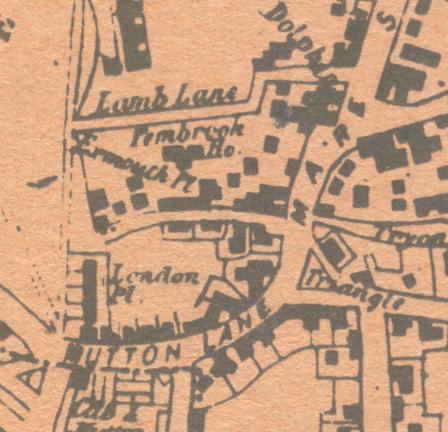
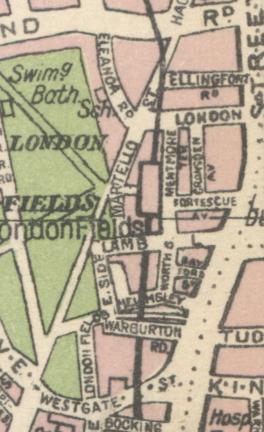
    Thomas Warburton bought the Bethnal Green business from Stratton's executers on 28.9.1800. Warburton was already the proprietor of Whitmore House, Hoxton, about a mile away. According to the accounts of how he acquired the Hoxton business, he lived there for some time. Elaine Murphy says that he [then] lived in Mare Street, Hackney [Probably at Exmouth Place from 1801, see below], and was a member of the Select Vestry and a Trustee of the Poor from 1812 to 1815. He was disqualified from serving as a Trustee in 1823 because his attendance was infrequent. He continued to serve on one of Hackney's almshouse charities, She says that Warburton Road and Warburton Flats are named after him (See 1950s map). In 1830, Exmouth Place seems to have been about the position of Warburton Road, and Exmouth Place is mentioned in Thomas Warburton's will (see margin below under Sarah Marsh). [I will call this "Thomas Warburton's Mare Street home"] From an 1847 map it can be seen to back on to Pembroke House British History Online: "A house which Thomas held from 1801 in Mare Street was to be demolished in 1847 and was commemorated in Warburton Road. (References: Morris, Hoxton Madhos; GLRO M79/KH/10, pp. 57-8 (plan); ibid. 12, pp. 50-3, 83, 86-7, 119-22; above, Mare Street and London Fields)

  • mental health
history
timeline Citation: see referencing suggestion

    Click for:

    Althorpe House

    Ashley

    asylums

    Audley House

    asylums index

    Ayres'

    Baume's House

    Bethnal Green

    Beaufort House

    Blacklands House

    Brooke House

    Camberwell

    chancery lunatics

    Church Street, Chelsea

    Clapham Retreat

    county asylums

    Cowper House

    criminal lunatics

    Dartmouth House

    Earls Court House

    Elm Grove House, Hanwell

    Finche's Houses (West London)

    Fisher House

    Fulham

    Gloucester House

    Grove House/Grove Hall, Bow

    Grove House, Stoke Newington Green

    Hanwell houses

    Hayes

    Harefield Park

    Holly House

    Hollywood House

    Hope House, Hammersmith

    Hope House, Brock Green

    Hoxton House

    hospitals

    Inverness Lodge

    Jane Holmes, Winchmore Hill

    Pope's - Hanwell

    John Thompson Jackson

    Justice of the Peace (JP)

    Kensington Gore

    Kensington House

    Lampton House

    licensed houses

    London House

    London Retreat

    mad houses

    magistrate

    Manor Cottage

    Manor House

    Martha Mugnall's, Hanwell

    Mary Bradbury's

    Mary Douglas, Ealing

    Mary Flemming, Fulham

    Melina Place

    Moor Croft House

    Normand House

    Northumberland House, Stoke Newington
    Otto House

    Oxley's

    paupers

    pauper lunatics

    Peckham House

    Pembroke House

    Pembroke Square

    Plaistow, Essex

    Quarter Sessions

    Rebecca Law, Brompton

    Retreat, Chelsea

    Sidney House

    single lunatics

    Sleaford House

    Southall Park

    statistics.

    Stillwell's Houses

    Surrey House

    Sutherland's Houses

    Timeline 1832.

    Timeline 1845 Report.

    Turnham Green

    Warburton's, Bethnal Green

    Warwick House

    Western House

    Whitmore House

    William Moyes, Lower Tooting

    Wyke House

    workhouse asylums


    The survey of London madhouses in
this chapter
is based on the research of Valerie Argent
    The survey of London madhouses in this chapter is based on the research of Valerie Argent


    Who are the madhouse Warburtons?
    Thomas Warburton died 1836.
    daughter married John Dunston
    Henry Warburton MP (1784-1858) - relationship stated in Stenton, but I am not convinced. Elaine Murphy agrees that he was "nothing to do with our Warburtons". John had an older brother, (Rector of Sible Hedingham Essex, died 1838 in a Colchester pub) called Henry. [Email from Elaine Murphy 14.4.2003]
    John Warburton MD (1793-2.6.1845) son of Thomas. Proprietor Whitmore House in 1831 and 1844, White and Red House in 1844. Born Middlesex. Educated Caius College, Cambridge. MB 1815 [dissertation On Insanity. MD 1820. Elected a Fellow of the Medical and Chirurgical Society in 1817. [One of the trustees of the Medical and Chirurgical Society was John Abernethy, surgeon (1764-1831)]. FRCP 1821. In 1825 John Mitford says "Dr Warburton of Clifford Street [map], lately married to the daughter of Dr Abernethy, is now sole physician to Hoxton, with the assistance of Dunston, the Apothecary". 19.5.1829 Elected a visiting physician to St Luke's Address 1843: 23 Park-Crescent. Portland Place.
    Elaine Murphy says "John had two sons: Thomas, who died only two years after his father in 1847, first inherited the business, then he left the empire to brother John Abernethy Warburton." (email 14.4.2003)
    John Abernethy Warburton (1825-1850) son of John. Succeeded to the three houses in 1846. [No - see above]
    Thomas Frederick Warburton senior son of John Abernethy
    Thomas Frederick Warburton junior son of senior. An anonymous note in Tower Hamlets Local History Library says he was, himself, a lunatic, but this is believed to be a confusion with the Monros, where the last one was admitted to Brooke House as a patient. [Elaine Murphy and others]

    Two houses: White and Red (Bethnal) House.
    The White House (also called Wright's House and Talbot's House is the oldest.
    Bethnal House, the Red House (also called Rhodes House), is known to have been purpose built.
    1738: Alexander Cruden an inmate of Mathew Wright's madhouse at Bethnal Green.
    1814: Robert Seymour Conway encourages parishes to send pauper lunatics to.
    1815: White House: Two licences for more than ten patients to Thomas Warburton
         Bethnal House: Three licences for more than ten patients to Thomas Warburton
    1816 Matthew Talbot, Superintendent of the White House, accused
    John Wilson Rogers and his sister Mary Humieres of deliberately falsifying facts in allegations against the house before a Select Committee of the House of Commons.
    1827: Robert Seymour Conway criticises
    1827: Robert Gordon criticises
    Resident medical officer required by law
    1829/1830 Reports: Both houses licensed to Thomas Warburton.
    White House: superintendent Charles Beverley
    Patients from: Birdham, Sussex; Ninfield near Battle, Sussex; Woodford; Houndsditch; Dalston; Sunderland; Coventry; Ware; French Hospital, City Road; Shadwell; Great Cogeshall, Essex; Somersham; Kirby le Soken; St Clements, Cambridge; Blacklands [madhouse?]; Withyham; Camberwell; Redhill, Hertfordshire; Chichester; Epsom; Croydon; Bagshot; Richmond; Clapham; Ilford; Clerkenwell; Chelsea; ..... Essex. [Hard to tell which, if any, are paupers. The majority say nothing about who sent them. Most of the rest are signed by relatives or friends] Some sent by Greenwich Hospital.
    Visit [Tuesday] 22.7.1829: Report signed G.C.H. Somerset, Thomas Turner, H.H. Southey: Mr Mayre a clergyman of the Established Church of England reads divine service every Sunday to all patients capable of attending with decency. The etablishment is in good order but the premises are too confined to admit of so complete a separation of Sexes with regard to their seeing each other as is desirable. The iron cross bars to the windows ought to be removed as they might be the means of mischief.
    Visit [Monday] 26.10.1829: Report signed Charles Ross, J.R. Hume, H.H. Southey: The Commissioners are much gratified with the general condition and management of the house. Mr Warburton has devoted much pains to the improvement of this establishment and the result is highly admirable. The Cross bars have been removed. Religious service is performed every Sunday
    Visit [Saturday] 13.2.1830: Report signed R. Gordon, J.R. Hume, J. Bright, F. Baring: ...the Commissioners... have great pleasure in confirming their former favourable reports. Extensive alterations have been made which have contributed much to the comforts of the patients but two of the female crib rooms might be improved...
    Visit [Wednesday] 26.5.1830: Report signed G.H. Rose, F. Baring: J. Bright, H.H. Southey: ...the appearance of the patients gave a very favourable impression of the mode of treatment. Religious Service has been regularly performed and apparently with some tranquillising effect.
    Visit [Thursday] 29.7.1830: Report signed James Clitherow, J. Bright, J.R. Hume, ...we found everything in the establishment well conducted notwithstanding the excessive heat of the weather, the sleeping rooms were cool and well ventilated, we examined particularly into the case of Wm Burrows also of Jeremiah Smith...
    Visit [Saturday] 9.10.1830: Report signed Spencer Perceval , Thomas Turner, H.H. Southey: We found the house clean and in good order. Religious service is regularly performed every Sunday.
    Visit [Saturday] 19.2.1831: Report signed J. Byng, James Clitherow, Thomas Turner, E. J. Seymour: ...[At] religious service ... the patients conduct themselves in a quiet and orderly manner but it does not appear that they derive any benefit from it.
    Visit [Friday] 20.5.1831: Report signed G.F. Hampson, F.G. Calthorpe, H.H. Southey: J. Bright, Thomas Turner, J.R. Hume: There is nothing particular to observe respecting the present state of this House excepting that some of the Upper Rooms in which the dirty patients sleep are not entirely free from an offensive smell. We are informed that about sixty of the patients attend religious Service but that it is productive of no effect beyond that of keeping them tranquil while it lasts - We are sorry to hear that the friends of the patients have in many instances neglected to visit them and therefore desire that they may be reminded of their duties in that respect. Thomas Wilmer, John Cox, Edward Ford, John James Hebert [,?] William Rivers [,?] William Wix [,?] and Joseph Townsend were particularly examined according to the provisions of the Act of Parliament by three Medical Commissioners.
    1829/1830 Reports:
    Bethnal House: superintendent Mr Matthew Davis
    Patients from (brackets: that number or more): Lambeth (7); St Giles and St George (6); North Shorburg?, Essex (1); Augeiring? Sussex (1); St Ann, Westminster (4); Mile End Old Town (5); St Ann, Limehouse (3); St Mary's, Whitechapel (13); St John, Hampstead (3); Hackney (7); Brighton (4); Harefield, Hertfordshire (1); St Giles in the Fields (8); St Saviours, Southwark (8); St Paul, Shadwell (4); St George, Hanover Square (2); Chesham (1); Totteridge (1); Benfield, Berkshire (2); Sheelford (1); St Mary Magdalen, Surrey (2); St Georges, Middlesex (3); Twickenham (2); St Georges East (2); St Martin in the Fields (11); Banstead near Epsom (1); Whittlesea (1); St Mary, Bermondsy (6); St Botolph, Bishopsgate (4); Mile End (other parish) (1); Kensington (1); Horndon on the Hill, Essex (1); Tilehurst, Berkshire (1), St Pancras (1); Hillingdon (1); Wanstead (1); Dunston, Northampton (1); Streatham (1).
    Visit [Wednesday] 15.7.1829 Report signed Ashley, J.R. Hume: G.F. Hampson, H.H. Southey: The house is extremely clean and well ventilated. We were pleased to find that so many of the female patients were employing themselves. We should be glad if the same system would be extended to the other classes of patients. The commissioners remark the attention paid to their suggestions made during former visitations. The crib rooms especially have been greatly improved. Religious service is performed every Sunday to the sexes. The number attending have considerably decreased since it ceased to be a novelty to them. No effect beneficial or otherwise seems as yet to have been produced by it.
    Visit [Monday] 2.11.1829 Charles Ross, W. Ward, Thomas Turner, H.H. Southey: This house is particularly clean and airy and the new crib rooms are excellent. The commissioners are glad to find the number of keepers and nurses have been increased. Religious services performed on Sundays to the females and on Wednesdays to the males.
    Visit [Friday] 12.2.1830 Report signed G.C.H. Somerset, G.F. Hampson, Thomas Turner, H.H. Southey: We found the house generally in a perfectly cleanly state, with the exception of some of the beds which are appropriated to the care of the dirty male patients and they are extremely filthy. But few of the patients seem to be employed. Religious service is performed to about ninety of the patients without appearing to be productive of any effect.
    Visit [Thursday] 20.5.1830 Report signed Frederick G. Calthorpe, Thomas Turner, G.F. Hampson, J.R. Hume: The commissioners are extremely well satisfied with the cleanliness and ventilation of these premises. They are altogether in a very improved state. Several of the women seem to be advantageously employed... The commissioners have weighed the loaves and the portions of bread cut for the patients and examined the provisions generally, with which they are entirely satisfied.
    Visit [Wednesday] 14.7.1830 Report signed G.H. Rose, J. Byng, J.R. Hume: J. Bright: The commissioners have much pleasure in confirming the [previous] report respecting cleanliness...and the occupation of several of the women in useful work - The plan of the establishment and the conduct of it are very satisfactory. The religious service is performed according to the last report about 80 or 90 patients are fit to and do attend it. They are very quiet while it lasts and more so than at other times and behave very well during the service so that it appears for a time to have a calming effect, This in the Surgeon's Report [This may refer to the weekly record]. The provisions are very good. The commissioners went into a case of complaint by a patient (Martin Baker) against a keeper for striking, but the complaint was not made good by the evidence adduced.
    Visit [Friday] 10.12.1830 Report signed Frederick G. Calthorpe, E. J. Seymour, A.M. Campbell, H.H. Southey: This establishment is in good order and the commissioners had every reason to be satisfied with the cleanliness which prevails. Divine service is performed regularly twice a week but with no apparent effect
    Visit [Saturday] 19.2.1831 Report signed G.C.H. Somerset, J. Bright, George Shepherd J.R. Hume: Divine service is stated to be performed regularly twice a week to such of the patients as are capable of attending, but without advantage
    1831: Proprietor Thomas Warburton.
    White House superintendent Charles Beverley
    138 male and 161 female pauper patients (= 299)
    119 male and 91 female private patients (= 210)
    Bethnal House superintendent Mathew Davis
    156 male and 199 female pauper patients (= 355)
    34 male and 35 female private patients (= 69)
    1840: Identifiable as houses xxxii and xxxiii on Sykes' list: Red House for males, White House for females.
    1840/1841 Rapid change in London pauper houses
    During 1841/1842 (or before) 54 patients were removed from Bethnal Green to the new Surrey County Lunatic Asylum
    1843, 1844 Original (Elizabethan) White House demolished and replaced by a new building.
    1.1.1844 562 patients. 336 pauper and 226 private.   1844? 10.5% of patients epileptic
    Weekly charge for paupers (maintenance, medicine and clothing): 9/8d farthing
    Commended in 1844
    James Phillips, surgeon was the licensee of both the Red and the White House in 1844 and 1847. Thomas James Austin (resident medical officer from 1853) says that the research for his treatise on general paralysis (1859) was carried out under the guidance of James Phillips.
    1847: evidence of James Phillips FRCS published in the Further Report of the Lunacy Commission explained a "bedstead with webbing bottom" he had designed to prevent bedsores. Out of more than 600 patients in the house, many demented with general paralysis in all its stages, no one had a bedsore when the Commissioners visited. (Hunter and Macalpine 1963 p.1052)
    1.1.1849
    White House:
    226 female pauper and 123 female private patients (= 349)
    2 female found lunatic by inquisition and 2 criminal lunatics
    Red House:
    175 male pauper and 97 male private patients (= 372)
    8 male found lunatic by inquisition and 9 criminal lunatics
    1853 to 1857 Thomas James Austin (born about 1820, died 1897) resident medical officer, Bethnal Green Asylum, Bethnal Green
    [By 1859, only Bethnal House listed]. This may be because, since about 1848, the two parts of the asylum had been licensed together under the name The Bethnal Green Asylum
    1.1.1859 Bethnal House: Proprietor John Millar surgeon
    136 male and 178 female pauper patients (= 314)
    66 male and 74 female private patients (= 140)
    6 male and 11 female (= 17) found lunatic by inquisition.
    7 criminal lunatics
    1859 national comparisons
    1.1.1874: Bethnal House: Proprietor Dr John Millar
    66 male and 158 female pauper patients (= 224)
    68 male and 75 female private patients (= 143)
    16 patients found lunatic by inquisition.
    1881 Census: "Licensed House For Reception Of Insane. London, Middlesex" John Millar LRAP? and RNCS? Edinburgh, Medical Superintendent, aged 62, born Glasgow., his wife Eleanor N., aged 60, born Farnham, Essex, unmarried son, George T. B.A. Cambridge, a barrister, aged 25, born Stone, Buckingham and G.M. Macdonald, unmarried Medical Officer, aged 25, born Manchester, MNIS? England
    1885-1902 imbecile patients from Westminster
    1896 New male block built, consolidating the asylum to release grounds for the use of patients after the loss of parts of the Green. The new block became Bethnal Green Library in 1922.
    Prospectus about 1900:
    BETHNAL HOUSE
    Is a Licensed House for the care and treatment of persons suffering from mental disorder. The House is situated within two miles of the Mansion House, and is easily accessible by train, tram and omnibus. It has the advantage of being in the proximity of large open spaces, namely, Bethnal Green Gardens and the Museum Gardens, both maintained by the London County Council, and it is besides within five minutes's walk of the Victoria Park.

    Terms from 25s to £3.3s per week
    According to the nature of the case and he accommodation wished for.
    Private Rooms and Special Attendants are provided if required.
    Voluntary Boarders received.

    For further particulars apply to: The Medical Superintendent, Bethnal House, Cambridge Road, London, NE. National Telephone: East No. 3306.


    1901 Census Bethnal Green: John Will (42) born Cullen, Scotland. Medical Officer. Surgeon. Henry Will (32) born Scotland. Medical Practitioner. Clara Will (28) born Cullen. Ella Will (40). Edward Will (25) Stay Driver. Elizabeth Will (25) and small children.
    1920 Dr Kennedy Will, the last director of the asylum, moved his patients to Salisbury.
    See Robinson and Chesshyre's history


    Hoxton Street (below) used to be called "Hoxton Old Town".
    Click here for maps showing Hoxton House, Holly House and Baumes House

    Walking up the present Hoxton Street from south to north one passes Munday Street (on the west), which leads to Hoxton Square, where James Parkinson lived. On the east, Follingham Court, brown brick flats built be the London County Council, is the five storey, redbrick 34 Hoxton Street, whose full address is Hoxton House, 34 Hoxton Street London N1 6LR. This is the surviving part of the old madhouse, not demolished when London County Council built Hoxton House School in 1911.

    "Most of the rest of the asylum, including the seventeenth century house in use as an asylum by 1695, was demolished to build the neighbouring school." (Martin Taylor, a Hackney archivist)

    The school buildings are now part of Hackney Community College, walled off behind a long cream brick wall that runs to Falkirk Street. Looking above the wall, one can see a grey and red brick school with the words "Hoxton House School, 1911" on the side.

    Morris, A.D. 1958 quoting John Hollingshead (no date):

    "Miles' madhouse in Hoxton Old Town...was a large brick house, on the right coming from the City, in a line with Curtain Road. It has extensive grounds at the back, reaching I should think to the backs of the houses in Kingsland Road, these grounds being the exercise grounds of the patients, apparently gentle and middle class people."

    Hoxton House, Hoxton Street, Hoxton (East London)

    A Jonathan Miles established a coffee house in Exchange Alley about 1680, which the London Stock Exchange developed from.

    Hoxton House became an asylum in 1695 continued into 20th century. A "seventeenth century house in use as an asylum by 1695" - See 1828 notice - It was demolished in 1911. Referred to by Coleridge in 1803 as the Hoxton madhouse. It included (at different times) a gentleman's residence where the owner lived, apparently separate from the asylum, and asylum departments for private (fee-paying) men and women, for male and female pauper lunatics (especially from the City of London), and for "maniacs" from the navy. It was the naval lunatic asylum until 1818. It also received criminal lunatics.

    1702 Commissioners for the Care of Sick and Wounded Seamen and of Prisoners of War, more commonly called the "Sick and Hurt Board", established. It continued until 1806. At first the navy hired places rather than running its own hospitals. The contractor provided everything "beds, staff and medicines" for a fixed price. A movement to establish the navy's own hospitals developed by the 1740s. Crimmin, P.K. 12.1999

    The Miles family bought the business in 1715 [ Elaine Murphy]

    1727 Wright's madhouse opened in Bethnal Green
    A Jonathan Miles of New Windsor, Berkshire, died in 1740. (Will proved 17.10.1740). Bronwyn Miles is reading this to see if any relationship can be shown.
    1750s Baumes House became a madhouse
    mid 1750s Mrs Gold's daughter released by a magistrate.

    Admiralty records (ADM 102/415) in the Public Record Office at Kew include a Hospital Muster Book "Hoxton House (Lunatics)" with covering dates 1755 to 1800. This is followed by ADM 102/416 "Hoxton House (Lunatics)" with covering dates 1801 to 1807 - ADM 102/417 with covering dates 1807 to 1809 - ADM 102/418 with covering dates 1809 to 1812 - ADM 102/419 with covering dates 1813 to 1814 - ADM 102/420 with covering dates 1815 to 1818
    1756: Jonathan Miles the elder (died 1772) expanded the business by buying two large houses in Hoxton Street. [ Elaine Murphy]

    "in 1756 James Smith went mad and was put into Jonathan Miles' madhouse at Hoxton, Mdx." - 1768 John Smith (his father) executed a bond with Jonathan Miles for £400 which he could not pay - "so the late creditor intended to sue for his money" - 4.2.1774: a writ de lunatico inquirendo for which John Stanton of Coventry was appointed James Smith's committee. The case went on to 1809, when Rev James Halifax, "John Smith's heir presumptive at law" was attempting to sell mortgaged property to avoid it being seized by other creditors and so that he could "support the Smiths from the proceeds" (Coventry Archives PA 184/5/7 and PA/101/9/16)
    About 1770 Birth in Hoxton House of Jonathan Miles (the younger) who became Sir Jonathan Miles in 1807 He inherited the Hoxton House business when he was three years old and personally kept the house from about the age of twenty. He died in 1821.
    20.1.1771 A Jonathan Miles married Rose Burke at Saint Leonards, Shoreditch. However, the children traced were born in West London and do not include a Jonathan or a Louisa.

    Much of the following information about the Miles family was provided by Bronwyn Miles, a descendent. It correlates with information provided by Gillian Ford and other sources cited.

    1772: Jonathan Miles the younger inherited the business from his father. [ Elaine Murphy]. Owned by him until the 1820s. It continued to carry his name after his death in 1821.
    5.1.1773 PROB 11/984 Will of Jonathan Miles, Gentleman of Saint Leonard Shoreditch, Middlesex
    Will states that his son Jonathan (son of Margaret Preston) is about the age of three years. It speaks of a trust for Jonathan, the son, held and looked after by two named trustees until the son is 21. Had the son died before than, the trust would have gone to Jonathan the elder's daughter, Augusta Miles, and his sister, Susannah Simpson and her three daughters. Bronwyn Miles comments "He must have had lots of money as he gives amounts in the thousands of pounds to quite a few different people."
    Between 1785 and 1788, William and Amelia Wastell christened three sons at Saint Leonards, Shoreditch. On 18.12.1785: William born 25.11.1785. This William Wastell died, aged 18 months, at White Lion Street. On 18.3.1787, Thomas born 18.2.1787. On 24.8.1788, another William, born 25.7.1788. This second William may be the William Wastell who married Louisa Miles in 1815 and ran Hoxton House. This marriage to place in St Pancras, where we know William Wastell lived about 1822. William and Louisa named their first child Louisa Amelia. - External link to text by Gillian Ford, questioning this ancestry, partly on the basis of the move from silk weaving to madhouse keeping. However, Gillian now points to the bankruptcy of James Webber and William Wastell, Whyte Lyon-Street, Norton Falgate, in 1780.
    8.8.1786 Jonathan Miles married Betty Harrison (died 1836?) at Braithwell, Yorkshire, England. One record says "Husband Age at Marriage: 16 - Wife Age at Marriage: 15". Which corresponds to Jonathan born about 1770. Another record says this Jonathan born 1770 "Of Braithwell". Note the correspondence of the children's names - Margaret (his mother), Betty (his wife), Jonathan. Margaret Miles was born 26.4.1787 and christened on 19.5.1787 at Saint Leonards, Shoreditch. Betty Miles was born 18.12.1790 and christened on 15.1.1791 at Saint Leonards, Shoreditch. Thomas Miles was born 24.2.1792 and christened on 20.3.1792 at Saint Leonards, Shoreditch. Jonathan Miles was born 6.3.1796 and christened 31.3.1796 at Allhallows London Wall. He died in 1866. Louisa Miles was born about 1797. She married William Wastell. in 1815, but died 28.10.1819. Bronwyn Miles identifies two (younger?) sons, whose dates of birth she does not know: William and Charles William. 1815.
    16.3.1789 Notices in The Times of the sale of complete stock in trade of Messrs Wastell and Son, Silk Manufacturers of Spitalfields, Bankrupts. Gillian Ford believes probably John and John Wastell who may have been the grandfather and uncle of William Wastell of Hoxton House.
    24.8.1789 Birth of James Birch Sharpe, who became medical visitor to Hoxton House in 1810. His parents were William and Rececca Sharpe and he was christened at Saint Leonards, Shoreditch, on 20.9.1789.
    1790 In 1815 Sir Jonathan Miles said he had personally kept the house for twenty five years. He would have been 21 about 1791

    Dr Harness 6.6.1815 p.219 was asked "The seamen were confined in Miles's house, from the year 1791?". He replied "Long before that"
    "The Navy began contracting with Messrs Miles and Kaye for the confinement of lunatics in 1791, or possibly even earlier, conveying 10-20 new patients a year up to 1814. Most came from the naval hospital at Haslar or direct from the hospital ship Batavia. (Elaine Murphy)
    Took naval lunatics (officers and men) from 1792 until 1818. The naval lunatics were maintained at public expense, their keep being an annual feature of the naval estimates voted by Parliament (Hansard 16.7.1844).
    The mistaken dating of naval lunatics at Hoxton House from 1791 appears to be as a consequence of the following table in the 1815 Report. The table is Appendix No 2, p.375 in Sharpe's edition. It is dated "Transport Office" 3.6.1815 and signed by Rupert George, J. Bowen and John Harness.
    An Account of the Number of Patients remaining at Hoxton House, on the 31st December in every Year since 1791.
    YEAR OFFICERS SEAMEN TOTAL
    1792 2 16 18
    1793 4 15 19
    1794 3 20 23
    1795 1 33 34
    1796 1 29 30
    1797 1 47 48
    1798 3 77 80
    1799 2 64 66
    1800 6 79 85
    1801 5 79 84
    1802 3 59 62
    1803 5 61 66
    1804 7 69 76
    1805 10 70 80
    1806 8 77 85
    1807 9 93 102
    1808 15 87 102
    1809 17 95 112
    1810 12 106 118
    1811 13 115 128
    1812 13 131 144
    1813 16 124 140
    1814 17 133 150
    1792 Holly House opened
    4.12.1793 Trial at the Old Bailey of Edmund Carvill, baker to Jonathan Miles, for stealing pewter plate. Evidence against from Jonathan Miles; his butcher, William Amos; Eleanor Burriston, his servant for many years.
    1795/1796 Charles Lamb a patient - See 1818
    5.10.1798 Dr R. Blair's "Visitation to the house of Messrs Miles and Kaye at Hoxton" - "for the reception of Lunatics"... "examined the provisions, accommodation, and general state of the patients; the bread, beef, cheese and beer, were all remarkably good, and the patients whom I examined, among whom were four of the men who lately made their escape, declared that they had them in plenty. The accommodations were also very clean and well aired, and they had sufficient airing ground for walking in the open air; in which last respect theses accommodations have greatly the advantage of Bethlem Hospital.
    The principal defect in institutions of this kind arises from the convalescent patients not being separated from those in a deranged state. If such separation could be made, and the convalescents were to have the opportunity of inspecting the regulations of the house, and particularly that which requires a continuance of their confinement for some time after an apparent return of reason, in order to guard against the consequences of relapses; and if in this state they were also allowed to lay their complaints freely before the Board (which at present is not suffered in any case) I do not see in what further respect the situation of persons in their unfortunate circumstances could be materially improved" (Presented by Dr Harness 6.6.1815 p.214
    click for numbers Click for numbers
    From 1800 to 1806 Dr John Harness (like other Commissioners of the "Sick and Hurt Board" - Drs Johnson, Blane and Blair, p.219) "occasionally" visited the "naval maniacs" at Hoxton House. John Harness said he visited, but "less frequently" from 1806 to 1815. (Evidence 6.6.1815 p.215)
    About 1802 On the death of Doctor Johnson, Dr John Harness became chairman of the "Sick and Hurt Board". Regular visitation of the "naval maniacs" at Hoxton House now fell to Dr John Weir, another Commissioner of the Sick and Hurt Board. He continued visiting as Inspector of Naval Hospitals from 1806. (Evidence 2.5.1815 and 6.6.1815, p.217)
    1803
    Mary Lamb a patient
    1803 "about 200 parish patients, some criminal lunatics and 66 naval patients (5 officers and 61 seamen)" (Elaine Murphy source for paupers not clear)

    In January? 1806 the Sick and Hurt Board was abolished and then its functions taken over by the Transport Board until 1817 (Crimmin, P.K. 12.1999). - John Harness said he was appointed to the Transport Board in January 1806 (p.219) - Dr John Weir appointed as the first Inspector of Naval Hospitals. (6.6.1815 p.214) click for numbers Click for numbers - Dr Weir in 1815 (p.210) described how naval maniacs were conveyed "from naval hospitals, marine infirmaries, and prison hospitals, in different parts of the kingdom, in a stage-coach or covered cart, attended by a proper person as a guard, to the Transport Office, when they are immediately put into a hackney-coach and sent to Hoxton, and after this removed backwards and forwards to Bethlem and the Batavia Hospital Ship at Woolwich" - "Every person sent from the Transport Office to Miles's" was examined by John Haslam, at the Transport Office, for which he received a fee (p.130)
    1806 Jonathan Miles Sheriff of London
    1806 Jonathan Miles stood for the safe (rotten borough) Whig seat of Tregony in Cornwall. He was defeated and, despite corruption against him, failed to unseat the elected candidate on appeal.
    1807 Mary Lamb a patient
    1807 Jonathan Miles knighted
    "In the year 1808 the" [Naval] "patients were very badly clothed, and went about the yard stark naked, with only a bit of a blanket on them. I could not get Dr Weir to interfere, and I reported it to the visitors of the College of Physicians, and a letter was written to the Transport Board, and since that time they have been properly clothed, on my representation" (Evidence of Jonathan Miles 8.6.1815
    1.3.1810 James Birch Sharpe, born 1789, (of 3 Myrtle Street, Hoxton at this time?) appointed visiting medical attendant. He was paid about £150 a year (see evidence Miles 8.6.1815) for attending the bodily (not the mental health of patients. Miles 8.6.1815).

    Most of the following family and financial information was sent to me by Gillian Ford. The sources include a case in Chancery in 1843/1844 (Wastell v. Leslie and Carter v. Leslie to determine whether debts were chargeable on the corpus or the income.
    "Sir Jonathan Miles being entitled, partly by fee simple and partly for term of year, to a lunatic asylum at Hoxton, executed certain deeds in 1809 and 1812 respectively, where by the asylum became vested in trustees, in trust to liquidate certain debts out of the profits of the asylum, and to pay to Sir J. Miles an annual sum of £700, during the continuance of the trusts with power for him to dispose of the sum by will, in case of his death before the trusts were performed"
    1812? Separation made between the Government and the Pauper Patients on the desire of Dr Weir. See evidence Miles 8.6.1815
    "Towards the end of" 1812, Doctor John Harness and "Commissioner Boyle, and Doctor Weir" "made an enquiry into the general management of the Naval Maniacs at Hoxton, by the direction of the Board of Admiralty".
    13.11.1812 Critical Report of the Inspector of Naval Hospitals (Dr Weir). This suggested the creation of a naval lunatic asylum at Haslar - A suggestion that Dr Weir continued to push with Dr Harkness. Dr Harkness, however, thought improvements should be made at Hoxton House. Dr Weir (at some time) sent a copy of his report directly to the Admiralty. It was published in 1814 (Evidence 4.5.1815) and 6.6.1815))
    1.5.1813 Letter from the Transport Board to the Admiralty recommending improvements at Hoxton House. It recommended an increased allowance dependant on the improvements. Amongst the suggestions was the appointment of a medical man "accustomed to the diseases and habits of seamen" to attend them. (p.220)
    12.12.1813 Marriage of
    James Birch Sharpe and Ann Ellis at Saint Matthew, Bethnal Green.
    About January 1814 A new airing and ventilation system established. See evidence Miles 8.6.1815. About the same time, provision made throughout the asylum for the separation of violent and the quiet patients. See evidence Miles 8.6.1815
    25.7.1814 House of Commons ordered papers on naval lunatics to be printed.
    James Birch Sharpe said that he had seen Jonathan Miles "very busily employed about the house" from the "latter end" of 1814... "but not before". This may be the source for the statement by some authors that prior to publication of naval lunatics papers Jonathan Miles had not visited the asylum for about four years (the length of time James Birch Sharpe had been employed), whereas afterward he visited frequently.
    27.10.1814 150 navy patients (17 officers, 133 seamen), 89 private patients, 245 pauper patients, plus a few naval and military pensioners from Greenwich and Chelsea, and some French prisoners of war. Total nearly 500. (Elaine Murphy evidence Richard Powell SCHC 25.3.1816, 75)
    December 1814 or earlier: Jonathan Miles increased James Birch Sharpe's responsibilities to include a concern for the cleanliness, order and management of the patients, as well as their bodily medical condition. See evidence of Sharpe.
    1815 Jonathan Miles Master of the Painter-Stainers Company. He donated a portrait of himself to the company, which hangs in the Livery Hall. It was originally full length but was "chopped down" in the 1960s (!!). His father had donated a silver punch bowl, inscribed with his name. (Elaine Murphy)
    1815: Six licences for more than ten patients to Banks Farrand, Trustee for Sir Jonathan Miles at Hoxton. This is probably Banks Farrand (1760-1842) (see external link), a Quaker goldsmith, with premises at 48 Cheapside until he retired in 1831. He was founder of the Stoke Newington Quaker Meeting (Information from Christopher Farrand) - If you know anything about him, please let us know.
    At this time, Elaine Murphy refers to "head-keepers John and Elizabeth Watts". John Watts was the superintendent and one of the two "managers" of the asylum. The other manager was "Mr Griffiths". One "side" of the asylum was the responsibility of Mr Griffiths.
    January/February 1815: Dr James Veitch (born about 1770, died 1856), a "staff surgeon in the navy" and a member of the Royal College of Physicians, began visiting about once a week. (see below). Weblink about his marriage - See Mary Veitch 1837
    28.4.1815 Select Committee on Madhouses moved for - See extracts.
    Tuesday 2.5.1815 Dr John Weir examined Thursday 4.5.1815 Dr John Weir examined again Friday 5.5.1815 Dr James Veitch examined: "I am a graduate of Edinburgh and a Staff Surgeon in the Navy" "How often have you been in the habit of visiting Messrs Miles House at Hoxton? - Between three and four months; generally once a week, with two exceptions I believe" (p.190)
    Monday 8.5.1815 Martha Wall and Margaret Slater, parish searchers, examined regarding deaths (p.192).
    Friday 12.5.1815 Dr John Weir examined again
    Saturday 13.5.1815 Dr James Veitch examined
    Thursday 18.5.1815 Dr John Weir examined again. Since he last examination (above), he had visited Hoxton House "accompanied as usual by Dr Veitch, when, to my great surprise, I was informed by Sir Jonathan Miles, that the Doctor, though a Navy Surgeon, could not be allowed to visit the patients any longer with me. I should here remark, that Dr Veitch has never interfered directly or indirectly, with the management of the patients, or anything belonging to the establishment" (pp 198-199)
    Tu