home page to
Andrew
Roberts'
web site Bunhill Quakers Home Page
Olive Yarrow's memories   Local timeline
Collectivised writings   Bob Saunders on the church
Quaker Quiet - Methodist Hymns

Quakers around Shoreditch

Oranges and lemons
Say the bells of St Clements
You owe me five farthings
Say the bells of St Martins
When will you pay me?
Say the bells of Old Bailey
When I grow rich
Say the bells of Shoreditch
When will that be?
Say the bells of Stepney
I'm sure I don't know
Says the great bell at Bow"

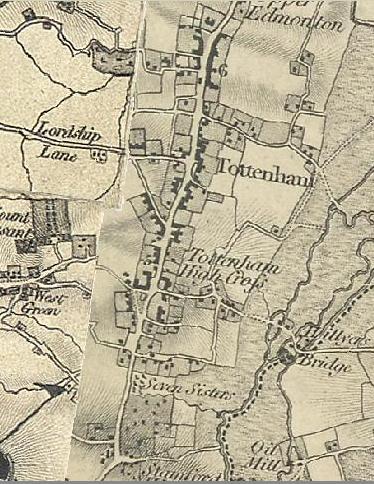
Maybe the children of London made up the song to sing the character of its districts [history link]. The Parish of Shoreditch was known for its poverty. Standing north of the Bishopsgate on the Roman Road from the Thames to Cambridge, it looked south to the City of London, where the Quaker bankers lived, north to Stoke Newington and Tottenham, where the Quaker middle classes withdrew, west to Islington where Charles Lamb peered through the curtains at Quaker women, and east to affluent Hackney and its dissenting academies. But in the immediate area of Shoreditch was a different Quakerdom: the inner city missions of Spitalfields, Hoxton, and Bunhill.

Baptist and other dissenters preceded the Quakers, but in 1647 George Fox began preaching around Leicestershire:
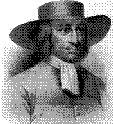
Click on the picture to visit the history of Quakers
by David M Murray-Rust of Birkenhead Meeting. "Now was I come up in a spirit through the flaming sword into the paradise of God.

All things were new and all the creation gave another smell unto me than before, beyond what words can utter."

In his vision, the Light, or Holy Spirit, guides us in our actions individually and together as a continuing revelation. Fox made "convincements" in the East Midlands, where he and his companions called themselves "Children of Light", but they ran into trouble with the authorities, and found a new name:

"This was Justice Bennet of Derby that first called us Quakers because we bid them tremble at the word of God, and this was in the year 1650."
Travelling North through Yorkshire and Lancashire, in 1652, Fox found "a great people to be gathered" around Westmorland and Furness, where people called "Seekers" were much in sympathy. Margaret Fell, wife of judge Thomas Fell, gave particular support at her home, Swarthmoor Hall, where a base was established for an organisation.

In 1654 the "Valiant Sixty" were sent around the country to spread the word. Francis Howgill and Edward Burrough were delegated to London. They worked hard, speaking and publishing constantly.

In his testimony to his companion's life, Howgill describes the characteristic silence of Quaker meetings:

    The Lord of heaven and earth we found to be at near at hand, and, as we waited upon him in pure silence, our minds out of all things, his heavenly presence appeared at our assemblies, when there was no language, tongue nor speech from any creature . . . We came to know a place to stand in and what to wait in . . .
Burrough himself described the inspiration this led to:
    While waiting upon the Lord in silence . . . our mouths opened, and we spake with new tongues, as the Lord gave us utterance, and his spirit led us, which was poured upon sons and daughters.

LOVE AND UNITY

1. General Advice

Advised, that friends be tender to the principle of God in all, and shun the occasion of vain dispute and janglings, both amongst themselves and others: for this many times is like a blustering wind, that hurts and bruises the tender buds of plants.

1676. (Book of Discipline 1834 page 84)

Quaker Women

Until the 20th century, men and women sat separately in Quaker meetings. (See Gracechurch Street 1770 and The Presence in 1916). They were also organised into separate meetings for discipline. In worship and church affairs, women left their families and became a semi-autonomous collective.

The separation of men and women was linked to the idea of a role for each. Quakers were organised into men's meetings and women's meetings and each had its responsibilities. . In the mid-nineteenth century, American Quaker women helped generate the Women's Rights Movement when they expected to take part in inter-denominational affairs.

Women played an important part from the beginning, and spoke prominently at Quaker meetings. Paintings attributed to Egbert van Heemskirk show a Quaker woman preaching on a barrel: this representation was originally satirical, as the very idea was considered ridiculous, although in different versions the amount of caricature varies. It was adapted for anti-Quaker literature: here the woman's inspiration is shown as a temptation of the devil.

One of the earliest regular Quaker meetings was held at the house of Sarah Sawyer, at Rose and Rainbow Court off Aldersgate (roughly the site of the Museum of London), even before the Bull and Mouth rooms were taken in 1655. When she married and moved out in 1675, it became a dedicated meeting house, used mainly for the women's meeting known as Box Meeting, which looked after Quaker poor relief.

One of the most important Quaker printers (although not, herself, publicly a Quaker) was Tace Sowle (1665?-1749) of London, who carried on her father's business from 1691. (external link).

Massachussetts 1656:
Quaker women missionaries searched for signs of witchcraft.
1669: Deborah Wilson
York 1725:
Mary Tuke, Quaker spinster aged 30, started a tea business. She handed the business over to her nephew, William Tuke in 1755. It became part of Twinnings after the second world war. (information from Alan Davis).
Tottenham 1790s: Priscilla Wakefield wrote children's books to compensate for her husband's shaky finances.
"Every Quakeress is a lily"
London 1817: Elizabeth Fry set up a school in Newgate Prison.
Tower Hamlets 1926: Mary Hughes: Christian Socialist
Go to crime
time Elizabeth Fry (1780-1845)

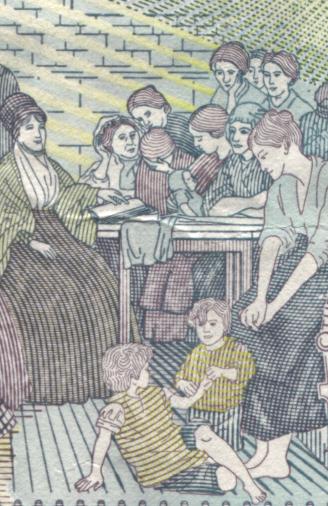
Elizabeth "Fiver" Fry was Britain's best known Quaker long before 2002 when her picture on the five pound note made her common currency. The Queen's head on the other side is a reminder that Elizabeth Fry's moral life was a struggle between her determination to be a "Plain Quaker" and her pleasure in the high society recognition that made her a Royal favourite. From 1818, Quakers counselled their younger members about the spiritual dangers of benevolent works.

Once described in Parliament as "the genius of good", and written about as "Angel of the Prisons", her visits to the women in Newgate Prison made her famous in the early nineteenth century. She lived at St Mildred's Court, near Gracechurch Street, from 1.11.1799, when she moved in above the counting house of her banker husband, Joseph Fry.

1806 Elizabeth Fry was visited by members of a Quaker committee established to visit friends suspected of being delinquent in the training of their children. (See 1795 minute on family government)

Elizabeth first visited Newgate in January 1813, at the request of the Quaker evangelist, Stephen Grellet, but her visits only began in earnest in January 1817. The following extract from her diary for 24.2.1817 reflects some of her concerns:

"I have lately been much occupied in forming a school in Newgate for the children of the poor prisoners, as well as the young criminals, which has brought much peace and satisfaction with it: but my mind has been deeply affected by attending a poor women who was executed this morning. I visited her twice. This event has brought me into much feeling, attended by some distressingly nervous sensations in the night... This poor creature murdered her baby; and how inexpressibly awful to have her life taken away! The whole affair has been truly afflicting to me; to see what poor mortals may be driven to, through sin and transgression, and how hard the heart becomes, even to the most tender affections."

3.12.1828 Bailiffs occupied the Fry family home as Joseph Fry's bank had closed its doors unable to pay a rush of customers wanting to withdraw money. He was made bankrupt and the Religious Society of Friends (Quakers) formally disowned him in the spring of 1829. Elizabeth remained an active Quaker and in 1836/1837 Joseph Fry was reinstated in membership.

As a prison reformer, Elizabeth Fry aroused hostility as well as admiration. Some other prison reformers disapproved of her unorthodox methods, and the irregular authority of her lady prison visitors.

It has been said that to see her reading to the prisoners of Newgate was considered "one of the sights of London".

"It was stated by mistake in some of the newspapers, that on the 31st of January, when His Majesty the King of Prussia visited Newgate, Mrs Fry read to the prisoners from some religious work, what she selected that day being the 12th chapter of Romans, and one of the Psalms. It is an inevitable practice, not only of Mrs Fry, but of all the ladies in connection with the several prison committees, when reading to the prisoners, to confine themselves entirely to the truths contained in the Holy Scripture." The Times 10.2.1842)

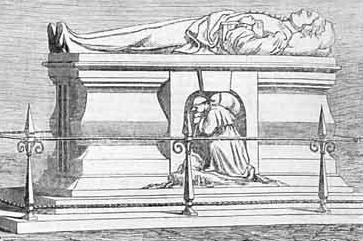
By the time of her death (12.10.1845), Elizabeth Fry was a kind of Quaker saint. Far too good, the Bishop of Norwich told her memorial meeting, to have a tomb amongst the "emblems of heathen mythology" that disgraced Westminster Abbey. Lord Ashley chaired the meeting on Wednesday 18.6.1846 that resolved to spend the four thousand pounds raised in her memory on a more fitting memorial:

"a suitable asylum to be called The Elizabeth Fry Refuge, for the temporary reception of repentant females on their release from the metropolitan gaols" (The Times, Thursday 18.6.1846 Mrs Fry's Testimonial

195 Mare Street, Hackney, is a house set back from the road which is now the Lansdowne Club, but a Hackney Council plaque at its gate tells everyone that from 1849 to 1913 it was the Elizabeth Fry Refuge "to help women in need".

Quaker women who were active in their own church affairs sought to be active in the affairs of inter-denominational associations they joined (such as slavery abolition groups). In the United States this resulted in some Quaker women being founders of the Women's Rights Movement. Harriet Taylor, in 1851, wrote

"some of the most eminent names of the present age, have made emphatic protests in favour of the equality of women. And there have been voluntary societies, religious or secular, of which the Society of Friends is the most known, by whom that principle was recognized".

From the autobiographical sketch of Lucretia Mott (1793-1880), a Quaker woman from Phildelphia, USA:

In 1840, a World's Anti-slavery Convention was called in London. Women from Boston, New York, and Philadelphia, were delegates to that convention. I was one of the number; but, on our arrival in England, our credentials were not accepted because we were women. We were, however, treated with great courtesy and attention, as strangers, and as women, were admitted to chosen seats as spectators and listeners, while our right of membership was denied--we were voted out. This brought the Woman question more into view, and an increase of interest in the subject has been the result. In this work, too, I have engaged heart and hand, as my labors, travels, and public discourses evince. The misrepresentation, ridicule, and abuse heaped upon this, as well as other reforms, do not, in the least, deter me from my duty. To those, whose name is cast out as evil for the truth's sake, it is a small thing to be judged of man's judgement

About Lucretia Coffin Mott at the Lucretia Coffin Mott Papers Project

her lice were her glory
Comrade Mary Hughes

Judge Thomas Hughes, (author of Tom Brown's Schooldays) was associated with Charles Kingsley, Frederick Denison Maurice and the Christian Socialists. [For more information on Thomas, visit
Tom Brown's School Museum in Uffington, Oxfordshire]

In Vallance Road, Tower Hamlets there are flats named Hughes Mansions in honour of Thomas Hughes.

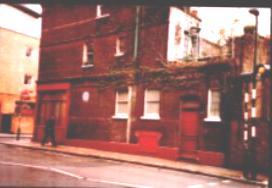
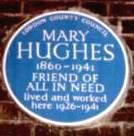
Opposite the flats is a Blue plaque put up in 1961 honouring his daughter's name.

In her youth, Mary Hughes (1860-1941) took part in work on behalf of the poor and unfortunate. You drove to that work in a carriage and when the work was done you drove back to a beautiful house.

Mary became deeply convinced that her class was unjustly privileged and felt convicted of its sins against society. She decided that she did not want to visit the poor. She wanted to be with the poor and be poor herself. Choosing to live in the East End, she became a "shabby and sometimes verminous women" living the ideals of Christian Socialism in a direct way.

In 1895 she went to live with her sister and brother-in-law, curate of St Jude's in Whitechapel, and in 1915 moved to Kingsley Hall in Bow, set up by Quakers (Stephen and Rosa Hobhouse, and Muriel and Doris Lester), and named after Charles Kingsley. (Visit Kingsley Hall web site)

Mary Hughes became a Quaker in 1918, influenced by the Society's conscientious objection to the war, but continued to attend Anglican services. She was an early example of what some have called the "Quanglicans", who value the traditions of both churches.

Dew Drop Inn
for education and joy
the inn to drop in Mary's Dew Drop Inn was set up in 1926 in an old pub (previously Earl Grey's Castle) at 71 Vallance Road. (map link) This was converted by the Quaker architect, Malcolme Sparks. In 1928 it was again adapted by the Anglican architect, S. Grylls Wilson, who continued to care for it during Mary's life.
Mary, who lived there, was described by George Lansbury as its "founder, manager, and administrator". The punning name meant it was somewhere you could drop in. People came with every sort of problem, and many stayed there.

"At the end of a long day, if the rest of the hostel was full, the old lady would push papers and old clothes aside and sleep in a bed-chair."

As well as rooms for 'lodgers' there was space for trade union meetings and, on Sundays, Christian Socialist religious services. The upper rooms were intended primarily for students of "sociology", studying at first hand how the poor lived.

the blue plaque that
should have been red

After the defeat of the General Strike (1926) and Ramsey MacDonald's cuts in unemployment benefit (1931), Mary's attachment to the Labour Party weakened and her sympathies with the communists grew, although she strongly opposed their appeals to violence. The plate glass windows of the Dew Drop Inn "were pasted up with every sort of propaganda, communist, pacifist, and religious".

Mary was tireless, exasperatingly eccentric and greatly loved: George Lansbury said, "Our frail humanity only produces a Mary Hughes once in a century". She was pictured (with stick) on Gandhi's visit to London in 1931, at Muriel Lester's house, and the Quaker Tapestry have made a panel commemorating her work.

The main building of Bearsted Memorial Hospital (Jewish Maternity Hospital at 22-26 Underwood Road, Whitechapel E1 (just off Vallance Road) was opened in 1927. When it moved to Stoke Newington, Stepney Council bought the premises (shortly after the second world war) to set up an ante- natal clinic, day nursery, nursery for the care of premature infants, hostel for nursery nurses and school treatment centre. The new project was named the Mary Hughes Centre and Day Nursery. The project was continued by Tower Hamlets Council, and ran for almost 50 years. It closed about 1996. It is now called the Mary Hughes Building and houses a variety of children and adult services for local people.

Black Tuesday 27.3.1945 Last V2 rocket attack on London. The rocket hit Hughes Mansion in Vallance Road, Bethnal Green. 133 people died. All but 20 of them were Jewish. It was the second largest death toll of the V2 campaign. A remembrance service was held on Sunday 26.3.1995 in the Brady Centre, Hanbury Street, just off Brick Lane. After Psalms were read, Montague Richardson, former chair of the Brady Boy's club, intoned the memorial prayer, the Kaddish. (Hackney Gazette 23.3.1995) weblink to the names of the Jewish dead

Information composited from many sources, including Shoreditch Quakers' exhibition, from Christian faith and practice in the experience of the Society of Friends (1959), from emails from Tracey Marks who worked at the day nursery for eleven years, before it closed, and is organising a reunion, and from material collected by Tracey Marks in her research for an exhibition at the reunion. If anyone has pictures or information, could they please contact Andrew Roberts.

We know of a book and a booklet about Mary Hughes:
Rosa Hobhouse, 1949 Mary Hughes: her life for the dispossessed
London, Rockliff. (Forward by Howard Spring)
Hugh Pyper, 1985, Mary Hughes a booklet published by the
Children and Young People's Committee of Quaker Home Service.

Friends in the truth

Jesus says he will not call us servants, but friends, for whatever he hears of his father he will share with us. (John 15:15) So we should do one with another. We are called to be friends in the truth.

Racial justice

Adult Schools

William Allen

Baker

Bedford Institute

Braithwaite

Bull and Mouth

Bunhill Fields

Bunhill Mission

Bunhill Quaker Gardens

clerks of meetings

colonials

Coffee Taverns

City Quakers

Clerkenwell Workhouse

clouds

Devonshire House

discipline

Elizabeth Fry

Family History

Friends House

Friends in the truth

George Fox

Gracious Street

hat homage

Hoxton Hall

Luke Howard

Mary Hughes

Love and Unity

William Mead

Meeting for Sufferings

naked as a sign

Peel Meeting

William Penn

plague

Quaker beginnings

Quaker Women

Quaker Social Action

Quaker Street

Ratcliff Meeting

Recording Clerk

Royal connections: Penn, Quire, Bevan, Allen, Fry,

Royal Sufferings

slave owners

Solomon Eagle or
Solomon Eccles

Spitalfields

Stoke Newington

Tottenham

trees

Tuke family

Priscilla Wakefield and family

Bunhill Coffee
Taverns
Limited

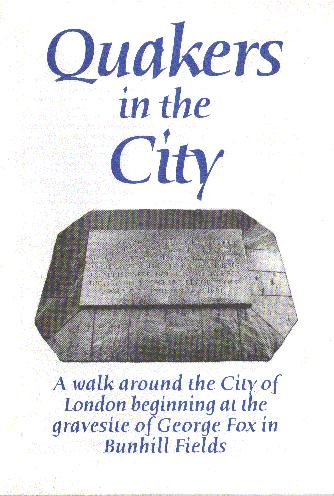
    This web page is built around the exhibition Quakers in Shoreditch held in Shoreditch Library, Hoxton by the Outreach Committee of Devonshire House & Tottenham Monthly Meeting in 1998. Many of its words were originally written by Lisa Bowers Isaacson for Quakers in the City, a pamphlet illustrating a walk in January 1991 that commemorated the tercentenary of the death of one George Fox. Any criminal or disciplinary responsibility for the page rests entirely with Andrew Roberts.


    I always like hearing from people about anything that interests them on my web page - or about their Quaker connections or other historical research.

    Try Friends House web site for more information. The Library part has is some advice about tracing Quakers in the family which includes a library guide to genealogical resources. This is also interesting about the history and organisation of the society.

    Particularly useful may be The Quaker Family History Society, which was formed in 1993 and is a member of the Federation of Family History Societies. Its aim is to encourage and assist anyone interested in tracing the history of Quaker families in Britain and Ireland.


Social history weblinks


what made
some Quakers rich?
-
(archive)

    "when I grow rich"
    may not be a very appropriate tag for Quakers in business - Quakers in business such as the Bevans were well-off to start with.


Quakers and the political process weblinks


Quaker asylum

    According to Harriet Martineau, "Quaker lunacy, being seldom caused by ... the violence of the passions, usually proceeds from some deeper and more unmanageable cause"


Quaker Street blog
There are links from this to blogs run by other Quakers - Including Under the Green Hill and Lauraxpeace


Friendlink: A message board for young Quakers


Bunhill Quaker Garden

City Quakers

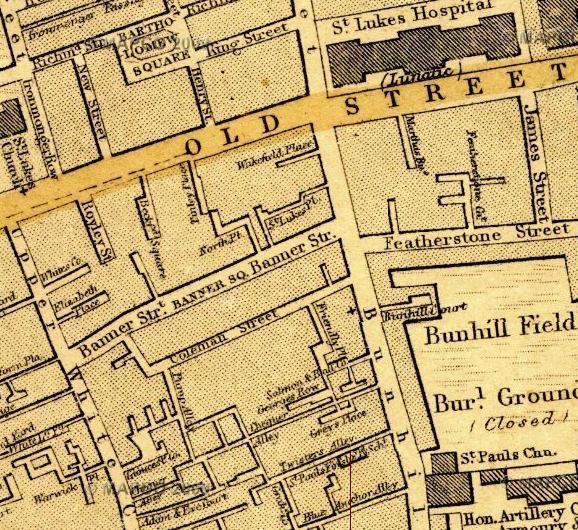
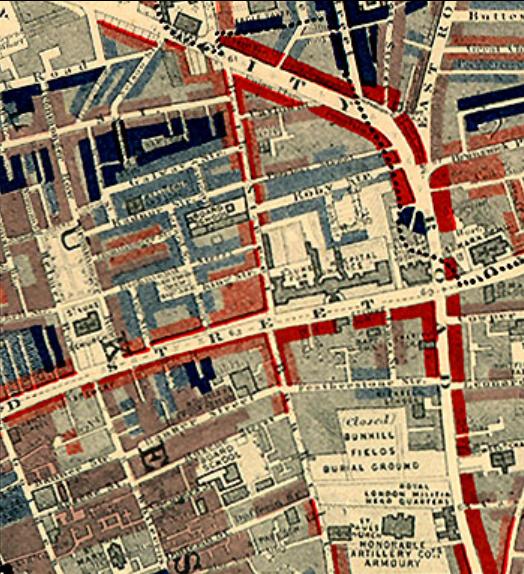
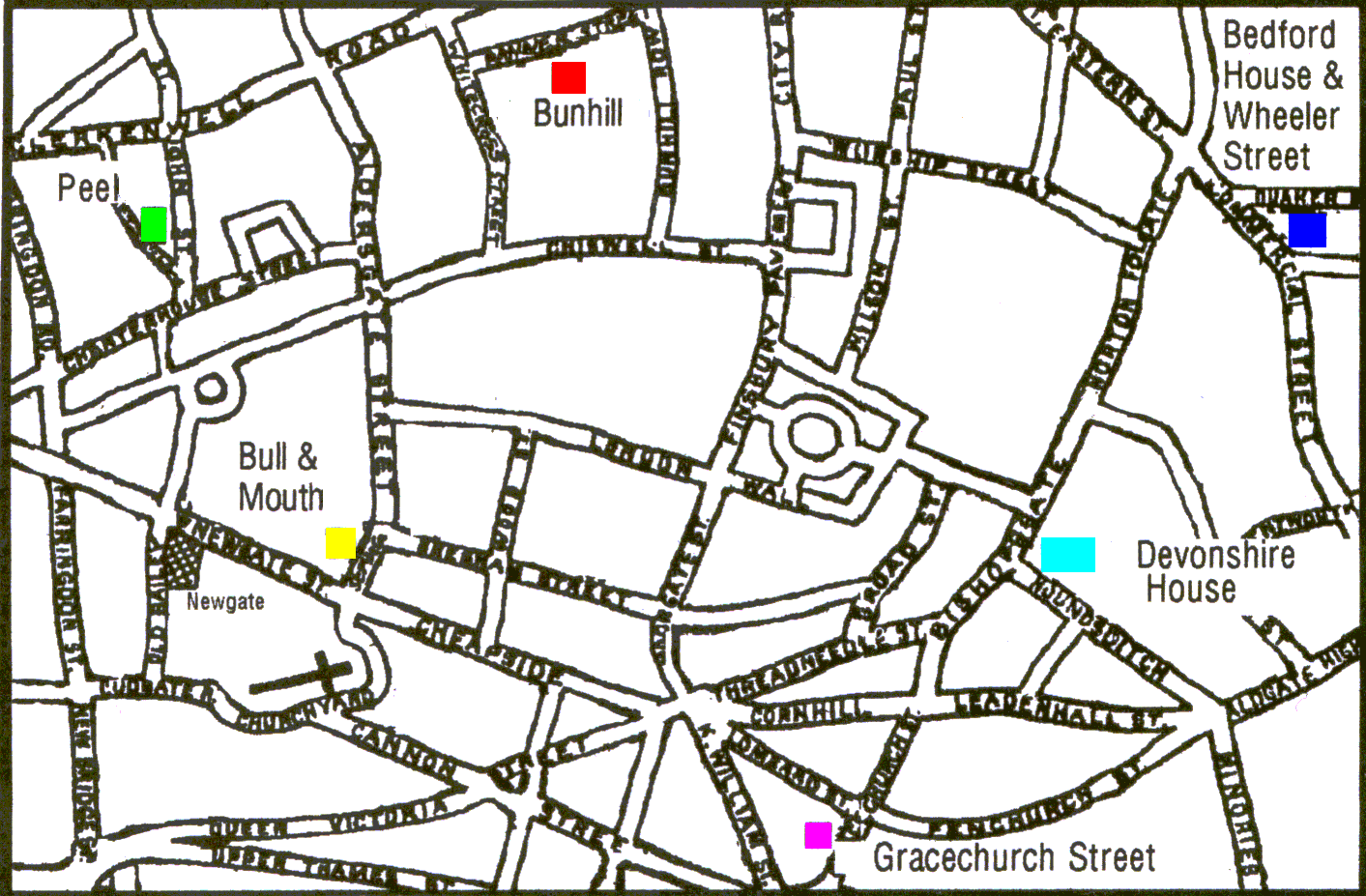
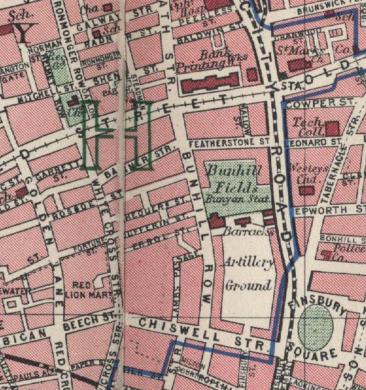
The map shows the position of three City of London Meetings: Bull and Mouth, Gracechuch and Devonshire House, and three Meetings outside the old London wall: Peel, Wheeler Street and Bunhill. Of these, only the newest, Bunhill, still meets.


Bull and Mouth

Howgill and Burrough reached London in July 1654, and took rooms at the Bull and Mouth Inn, off St Martins le Grand, using them for "threshing meetings" at which new people were attracted to Quaker beliefs. These were not silent meetings - the crowds could be rowdy and the preaching had to be robust.

By March 1655, when George Fox arrived in London to speak with Oliver Cromwell, Howgill and Burrough had established a permanent Quaker base at the Bull and Mouth Inn. The Inn was destroyed in the great fire of 1666, but it was rebuilt and Meetings continued here until 1740. After the fire, Quakers bought another Inn, off Gracechurch Street, and established another City Meeting.

Royal Sufferings - Newgate and the Tower

Cromwell's regime was not ideal for Quakers, but after the restoration of the monarchy in 1660 the situation of Quakers (and Baptists) worsened as Charles 2nd sought to stabilise the country around a common approved religion. The Quaker "Peace Testimony" 1661 was part of a letter to the new King explaining that the Quakers would not resist his regime by force. (as the 5th monarchists had just tried to). It was

"given forth from the people called Quakers to satisfy the King and his Council, and all those that have any jealousy concerning us, that all occasion of suspicion may be taken away and our innocency cleared"

This "declaration from the harmless and innocent people of God, called Quakers, against all plotters and fighters in the world" was signed "in behalf of the whole body of the Elect People of God who are called Quakers" by George Fox, Gerald Roberts, Henry Fell, Richard Hubberthorn, John Boulton, John Hinde, John Stubbs, Leonard Fell, John Furley Jnr., Francis Howgill, Samuel Fisher, and Thomas Moore - (external link to the declaration)

In 1662, the Act of Uniformity required both use of the Book of Common Prayer and an oath of allegiance.

Another Act of 1662 has been called the Quaker Act. Joseph Besse, in his "Collection of sufferings of the people called Quakers..." (1753), describes it as follows:

ANNO 1662 In the Beginning of this Year the first Act against Conventicles came in force, by which it was enacted, that if any Person should refuse to take an Oath, when by Law required, or should maintain the taking any Oath unlawful, or if the Persons called Quakers should meet for religious First Exercise after the 24th of March 1661 [1662?], being thereof convicted, should forfeit for the first Offence £5 for the second Offence £10 to be levied by Distress; and for want of such Distress to be imprisoned for the first Offence three Months, and for the second six Months: And upon Conviction for the third Offence, he or she should abjure the Realm, or otherwise the King and Council might cause him or them to be transported to any of the King's Plantations beyond the Seas. In Consequence of this Act, on the 11th of the Month called May, five Persons were taken from a Meeting in John 's Street by one Philip Miller, Commitment of 5 to Newgate. and a Rabble attending him, without any Warrant, and by a Justice of the Peace committed to Newgate." (external link)

It was possibly as a reponse to arrests under the Conventicle Act that some Quakers took to appearing naked or pouring blood on alters as a sign

The Conventicle Act of 1664 made it penal for any person to attend a conventicle. The punishment for the first offence was three months imprisonment. The Five Mile Act in 1665 punished dissenting preachers with a 40 pound fine if they came within five miles of towns.

Quakers arrested at City and East London meetings were imprisoned in nearby Newgate prison or the Tower of London. Conditions were horrific.

Edward Burrough was arrested in 1662 at a meeting and died after eight months in Newgate, aged 29. His writings were published in 1672 under the title The Memorable Works of a Son of Thunder and Consolation.

Colonials and slave owners

In the years of suffering for their dissent, many Quakers sailed for the new world to help build colonies in such places as Barbados - Carolina - New Jersey - and Pennsylvania. In the process some became the prosperous owners of black slaves. Whilst accepting, and benefiting from, the ownership of slaves, Quakers were sensitive to a tension between this and "being tender to that of God in all". It was this that precipitated one of the founding doctrinal statements, a letter of 1671 from Quakers to the Governor of Barbados, in which they set out the Christian responsibility of including slaves and natives in the family of God.

In 18th century England, Quakers were part of the triangular trade in slaves, and part of the crisis of conscience (conviction of sin) that led to its abolition. (See John Woolman)

Quakers usually emphasise the society as the pioneer of slave liberation. See external links: "Quakers and the Abolition of Slavery" and ">Keeping it under their hats"

1665 The last great plague of London. Some natural philosophers argued that God established nature by laws and so plagues were not a direct action or a sign of his wrath. Quakers would have none of this. In his A Journal of the Plague Year (1722), Daniel Defoe wrote: "...the Quakers had at this time also a burying ground set apart to their use"... and the famous Solomon Eagle, who... had predicted the plague as a judgment, and ran naked through the streets, telling the people that it was come upon them to punish them for their sins, had his own wife died the next day of the plague, and was carried, one of the first in the Quakers' dead-cart, to their new burying ground". An early Quaker victim of the plague was Henry Stokes, Spittlefields baker, who died on 24.4.1665. James Stokes, a descendent, has written his story.

Solomon Eccles (1618-1683), also known as Solomon Eagle, was a real person, even though most of what we think we know about him is a mixture of fiction and fantasy with fantasy and fiction! He was (apparently) arrested in May 1665 in Southwark. He is said to have run naked through Bartholomew and Smithfield in 1665 as a religious warning respecting the plague. Pepys witnessed him running naked through Westminster Hall in 1667 (I have not seen the entry).

However, Solomon's signs may have started in 1662. Katie King traces the information in the following passage back to the (manuscript) Great Book of Sufferings maintained by Quakers. Katie King's paper analyses "going naked as a sign" as a more general category of behaviour which includes plain speech and all the social "rudeness" (my word) of early Quakers.

In response to the passing of the first of the Acts known as the Clarendon Code, the Quaker Act in 1662, [Phyllis] Mack recounts "The day after one government raid, Solomon Eccles passed through Bartholomew Fair as a sign, 'naked with a pan on his head full of fire and brimstone, flaming up in the sight of the people, crying repentance among them, and bade them remember Sodom.' The following Sunday two women appeared at St. Paul's, one 'with her face made black, and her hair down with blood poured in it, which run down upon her sackcloth which she had on, and she poured also some blood down upon the altar and spoke some words.'"

William Penn

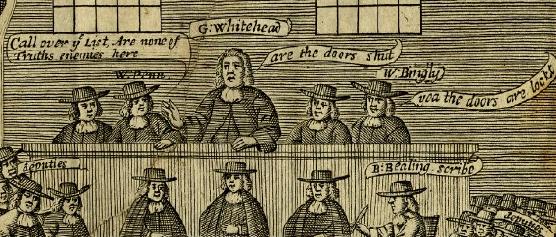
In 1670 William Penn and William Mead were arrested when the way in to the meeting house was barred but they continued to worship in the street. The jury found them guilty only of "speaking in Gracious Street" and refused to change their verdict even after two days spent in prison. This established the primacy of the jury's decision in English law.

William Penn (1644-1718), eldest son of Admiral Sir William Penn, first encountered Quakers in Ireland. His father's rival Pepys records in 1667:

While imprisoned in the Tower for writing a pamphlet, he continued writing one of his great works, No Cross,No Crown.

In 1681 he accepted land in America in payment of a debt Charles II owed his father, but he made special treaties with the Indians of Pennsylvania, as he knew his "Holy Experiment" needed their respect and friendship.


Gracious Street

"Gracious Street" or Gracechurch Street meeting house began as an inn like Bull and Mouth, acquired after the 1666 Great Fire, but was rebuilt as something more like our idea of a meeting house.

George Fox died at a house next door, after a meeting here on 13th January 1691 (or 1692, adjusted for the 1752 calendar change). After his funeral at the meeting house, some 4,000 people accompanied his body to Bunhill Fields for burial.

Gracechurch Street became one of the most important Quaker Meetings, and the neighbourhood around it became the centre of the Quaker business community in the city. By the eighteenth century 20-25% of the immediate population were Quakers. City Friends mingled piety with prosperity and earned reputations as sober, honest tradesmen. Some, like the Barclays, Lloyds, and Gurneys, made fortunes in trade and banking. Quaker financial knowhow and investment was important to the success of Pennsylvania.

On 8.6.1772 the Yearly Meeting of Ministers and Elders was shocked by a man of peculiar appearance and manner who arrived half an hour after the start of meeting, presenting a letter of introduction from America. In ministry one Quaker counselled him to return there immediately. The stranger was John Woolman who, through his loving ministry, won the support of the Yearly Meeting. He died at York on 7.10.1772.

Elizabeth Fry, a Gurney, lived in St Mildred's Court - referred to as "Mildred's Court", as Quakers' refusal to use titles like "Mr" extended to sainthood.

Another Quaker peculiarity involved hats, which were not taken off out of deference to persons in authority. This caused William Penn and William Mead to be fined for contempt of court, at the same time as the jury in their case was imprisoned. In the seventeenth century, refusing to take one's hat off before someone in authority was a highly offensive act implying complete lack of respect for the social order. Equally offensive in families was that when young men converted to Quakerism they kept their hats on in the company of their fathers. Dishonour to one's father also had political implications at a time when Royalist theory derived the legitimacy of the king from the fifth commandment. Before about 1660 the hat insult and calling everyone by the familiar "the and thou" were two signs taken to mean that Quakers were turbulent and possibly revolutionary people. (See also 5th monarchists and going naked as a sign) Gradually, as Quakers distanced themselves from these implications, with the Peace Testimony for example, refusing to pay hat homage and using the and thou, along with the Quaker dress, just became peculiarities that set Quakers apart.


The same Quakers who kept their hats on when talking to rich and powerful humans, took them off when offering prayer in a meeting for worship, or "ministering".
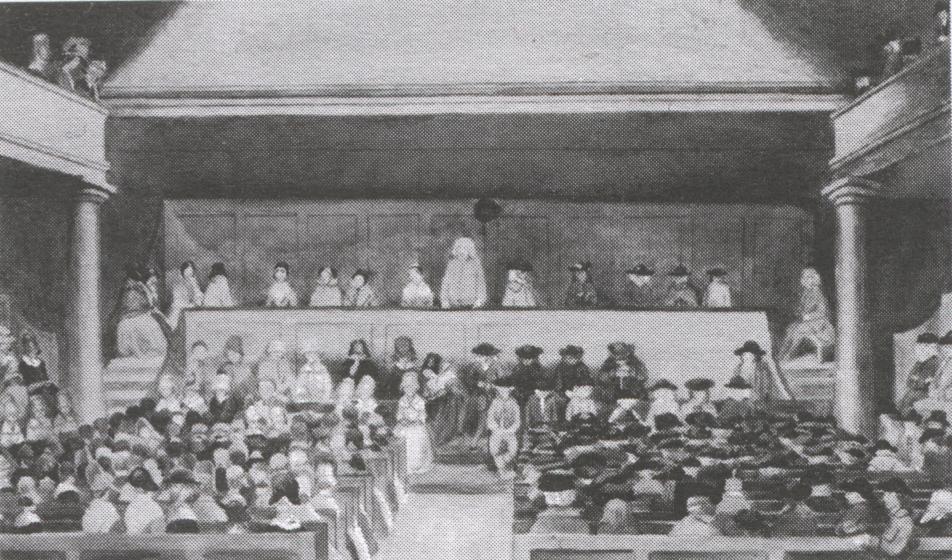
This picture of Gracechurch Street Meeting c.1770 shows Isaac Sharples of Hitchin on the "facing bench" for Elders, standing with his hat hung on a peg behind him.

Note also that women and men sit in separate halves of the meeting. They worshipped together, but there were separate men's and women's business meetings until the end of the nineteenth century. In the gallery looking on are some non-Quakers, or "the world's people", in brighter clothing. By the time of the picture the Society of Friends had become more inward-looking and "quietist".


Quakers met in Gracechurch Street continuously until 1821, when there was a fire. Gracechurch St was rebuilt, but the new Gracechurch Street meeting house closed in 1850. One of the reasons for the decline of the meeting house was the migration of Quakers to leafy Stoke Newington


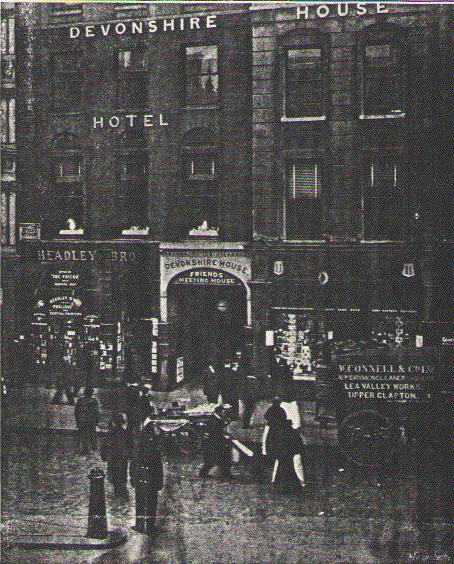
Devonshire House

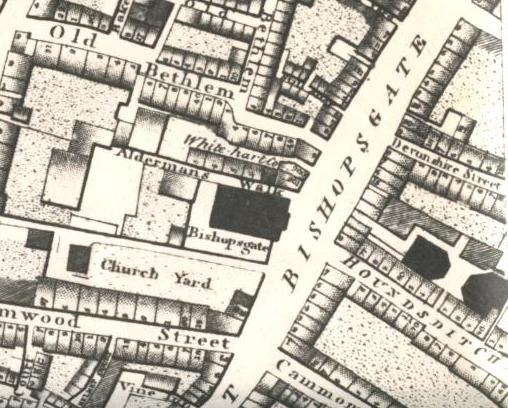
The Bull and Mouth was lost in the Great Fire. Before it was rebuilt Friends took a lease on a house on Bishopsgate owned by the Earl of Devonshire.

After extensions in 1794, Devonshire House was used for the Yearly Meeting, previously held mostly at Gracechurch Street; also for the executive body, called Meeting for Sufferings because it arose from a system of reporting anti-Quaker persecution. The Recording Clerk recorded the Sufferings, and became the general administrator of the Society.

Meetings for Sufferings archives include The Great Book of Sufferings, 1659-1793 - 29 volumes containing names of Quakers prosecuted, distrained or otherwise `suffering' for the sake of Quaker testimonies. Each volume is indexed and covers a group of counties for a particular year. In most cases the names of informers, priests, constables and justices are indexed.

Devonshire House came to house the Recording Clerk's office, and also the Library, set up in 1673 when it was decided to collect two copies of everything written by Quakers, and one copy of everything written against them.

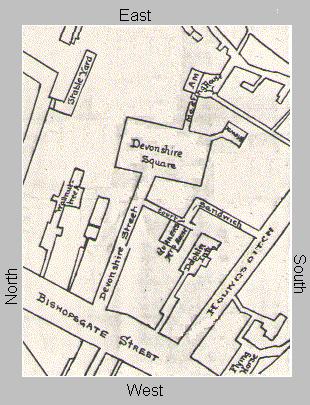
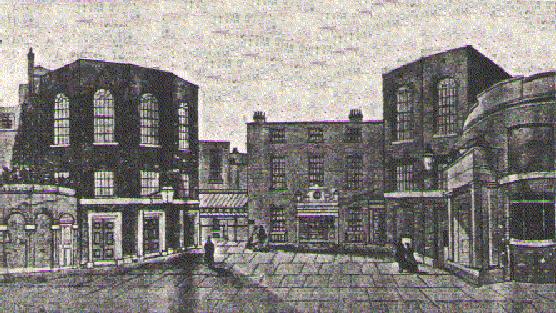
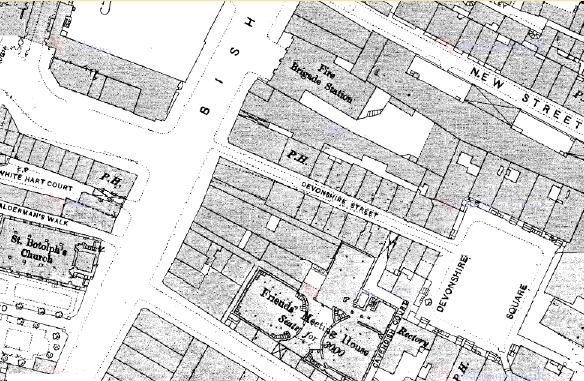
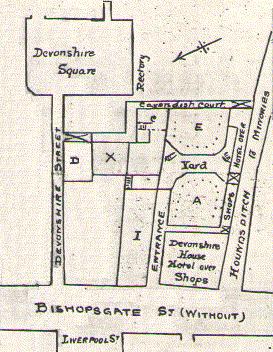
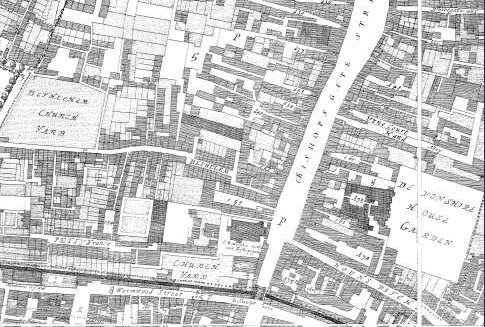
Devonshire Street faced across Bishopsgate to a street called Old Bethlem (see map). A short walk along this led to the famous Bethlem where lunatics were on public display. The Yorkshire Quaker family of Tuke (see below) were, at this time, developing new methods of confining and treating insane Quakers, which later generations were to adopt in public asylums

It was here, at Devonshire House, that, every Whitsun, the Quaker women whitened the streets as lilies, and here, in the 19th century, that the printed works of Quaker collective discipline were written under the supervision of the Clerk of Yearly meeting, whose minutes summarised the "feeling of the meeting".

In 1738, the Quakers had begun:
Christian and brotherly advices given forth from time by the Yearly meeting in London, alphabetically digested under proper head
Quaker ABC - 1738
to 1834
as handwritten volumes made available to the clerks of the Quarterly and Monthly meetings, in which Quaker meetings were organised in regions and districts .

The first printed book was Extracts from the Minutes and Advices of the Yearly Meeting of Friends held in London from its first Institution, which was agreed by the yearly meeting in 1782 and provided with a preface by Meeting for Sufferings on 24.1.1783. (William Tuke was appointed Clerk to yearly meeting in 1803). A second edition was issued in 1802.

Samuel Tuke (1784-1857) was Clerk to yearly meeting when the 'Beacon' controversy divided it. The author of A Beacon to the Society of Friends (1835) wanted more emphasis on the authority of written words of God (the Jewish and Christian Bible), whilst traditional Quakers like Tuke put the emphasis on the workings of the spirit. [All held the then Quaker belief that Jesus is the word of God, as stated in John's gospel]. Tuke had devoted much of his time to the third edition of Rules of Discipline of the Religious Society of Friends, with Advices: Being Extracts from the Minutes and Epistles of their Yearly Meeting, held in London, from its first institution, printed and published by Darton and Harvey, Gracechurch Street, in 1834 with a long introduction "On the origin and establishment of our Christian discipline", written for the occasion by Samuel Tuke.

The 1834 book was still an ABC of Quaker Discipline in which one could look up Books (a warning) before Love and Unity (a first principle). But, after this, the Society put aside its alphabet.

In 1861, book chapters were grouped into three parts: Christian doctrine, Christian practice and Church government. And then, in 1883, yearly meeting finalised what was to be the last revison of the whole book for over a hundred years: The Book of Christian Discipline of the Society of Friends in Great Britain

The Devonshire House premises came to be increasingly cramped and dismal, until the offices moved to the newly built Friends House in 1926, opposite Euston Station. Devonshire House was demolished, but is still part of the name of the local Monthly Meeting to which Bunhill and Stoke Newington belong. (Devonshire House & Tottenham Monthly Meeting))

Friends House, Euston Road

1922: Euston Square Gardens (South), and their trees, removed by property speculators. Charlotte Mew's first poem of grief at the loss ("murder") of the trees. (Published January 1923)

1923: Quakers by part of the sight for £45,000 and appoint a Quaker Architect, Hubert Lidbetter, to build their central offices and meeting rooms.

7.5.1926 The first Meeting for Sufferings to be held at Friends House

May 1927 The first Yearly Meeting to be held at Friends House

Ratcliff Meeting

Ratcliff Meeting began when in 1655 Captain James Brock of Mile End opened his house to Quakers. At this time Ratcliff was one of the rural hamlets east of the Tower of London, close to the industry of the river Thames.

By about 1666 land was bought for a meeting house in Ratcliff between Wapping and Limehouse. Numbers grew and in 1700 a sister meeting was established at Wapping. Wapping was part of Ratcliff Monthly Meeting for nearly a hundred years.

The Meeting declined in the nineteenth century, and the Bedford Institute took it over. In 1935 the building was declared a dangerous structure and had to be demolished; various plans for replacing it were overtaken by the war. Ratcliff still has no building of its own. For many years, the meeting was held every Sunday at Toynbee Hall, 28 Commercial St, London E1. (External link to history of Toynbee Hall

In autumn 2003 they moved to:
DeafPLUS,
Trinity Chapel,
Key Close,
London, E1 4HG
Sundays 11.00 a.m. to 12
(map link),

Quaker Street

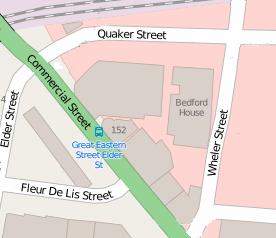
Wheeler Street meeting house in Spitalfields was on the corner of Westbury Street, which became known as Quaker Street instead. (modern map)

It started in 1656 in the upstairs of a house; as crowds grew, a tent was erected in the yard, and then a meeting house. Sir John Robinson, Guardian of the Tower, was locally powerful and anti-Quaker. After many arrests, he might have closed the Meeting, but Gilbert Latey, who owned the property, acted quickly and installed a tenant so that it became a dwelling and not subject to the law on places of worship. This strategy was soon adopted for all Quaker meeting houses.

The building was not very strong, and suffered badly in the great storm of 1703 (which destroyed the Eddystone Lighthouse). Despite repairs, fewer Quakers worshipped there, and the Meeting closed in 1740, five years before the building finally fell down altogether.

Benjamin Lay

Benjamin Lay attended the Wheeler Street Meeting, but what he described as his own "forward zeal" led him to interrupt the ministry of Zacheus Routh, for which he was disowned by the Monthly Meeting in 1721. He moved to Colchester, where something similar occurred. He redeemed himself by travelling to Barbados and Carolina as an early campaigner against slavery.

The Bedford Institute Quaker Social Action

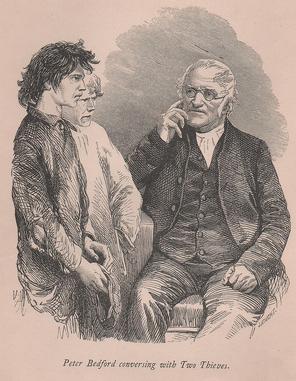
In the early nineteenth century Quaker interest in this area of Spitalfields was revived by Peter Bedford (1780-1864), a silk merchant of 28 Steward Street (modern map) Peter Bedford was particularly concerned with poverty and crime among young people, and formed the Society for Lessening the Causes of Juvenile Delinquency in the Metropolis. With others from Devonshire House Meeting, he set up a Working Men's Club and First Day School in Quaker Street, which opened in 1865 just after his death.

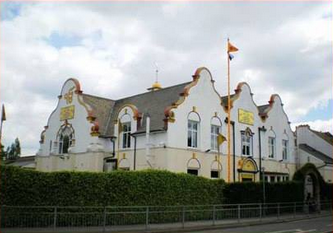
The Bedford Institute, named after Peter Bedford was built on the corner of Wheeler Street and Quaker Street in 1865. The work based here, running adult schools and alleviating the results of poverty, spread to other Quaker sites in the area, including the Peel and Ratcliff meeting houses, as well as the Bunhill Memorial Buildings, and later also Hoxton Hall.

The original Quaker Street premises were rebuilt in the 1890s.

1917 In considering the annual report of the Bedford Institute Association, London Yearly meeting were "impressed anew with the need of men of all races and classes for the salvation of Jesus Christ". The report began by saying that its work had been maintained "in each of its nine centres" although "severely handicapped in many ways by the effect of the war". Work included "religious services which are regularly held every week in no less than twelve different buildings. Seven Meetings for Worship are also held every Sunday morning"

Bethnal Green was one of the Bedford Institute buildings, and was in Harts Lane. The street was later renamed Barnet Grove, which became the name of the Quaker meeting established there. (modern map)

1972: Re-launch of the Bedford Institute Association, giving rise to projects concerned with ex-offenders and employment training.

Late 1980s Activities of the Bedford Institute Association began to grow rapidly.

The Bedford Institute Association was renamed Quaker Social Action in 1998

Until February 2006, Quaker Social Action had its offices at Bunhill. It has now moved to 18 Victoria Park Square Bethnal Green

The following list of projects relates to about 1999

HomeLink works with homeless people who do not have access to public housing. Each year over 150 people are housed. We help them find a flat in the private rented sector, advance a month's rent (which we can then claim back) and indemnify the landlord against theft and damage. Clients are offered a trained and supervised volunteer support worker to reduce the chance of them drifting back into homelessness. Refugees make up a significant proportion of HomeLink's clients.

New Life Training equips unemployed people for work in the expanding vending industry. We train people for the industry's vacancies and an agency markets trainees on completion of the course. Trainees' previous length of unemployment averages 15 months.

HomeStore, our community furniture project, offers essential goods to over 2000 people each year who are unable to afford to buy from commercial second hand shops. All clients are referred to us by social service departments and a wide range of other agencies. People with learning disabilities have always been part of the team, either undertaking deliveries or restoring wooden furniture.

In November 1998, HomeStore moved into new premises in Stratford, opened by Tony Banks MP.

New Life Electrics renovates and guarantees cookers and other domestic electrical goods for HomeStore's clients, thus ensuring that electrical equipment is safe. Training is given in domestic appliance repair to NVQ standards. We also collect thousands of fridges and, if these cannot be reconditioned, we remove the harmful CFC coolant and dispose of it safely.

The Garrett Centre, in Unitarian premises in Bethnal Green, offers an expanding range of activities for the local community, bringing local people together so that they can improve the quality of their lives.

For the future, several exciting projects are being considered including:

* a micro-credit scheme for women starting their own business

* traditional community development work especially with women at the Garrett Centre

* further development of our new HomeStore premises for employment generation, e.g. a computer "practice firm", or Large Goods Vehicle driver training project.

Coffee Taverns - Adult Schools John Woolman Settlement

Charles Simpson was a Barnsley miner who went to study at Ruskin College in Oxford, and later at Woodbrooke, the Quaker college in Birmingham. In 1916 he set up the John Woolman Settlement in Islington, named after an American Quaker who pioneered ethical living. Charles Simpson was active politically and became mayor of Finsbury.

  • In 1931 the Settlement moved to Bunhill, joining the existing adult education facilities provided by the Bedford Institute, but its activities took over much of the building, including use of the former coffee tavern as a common room.

  • There was an early Quaker school at Shacklewell run by Mary Stott of Dalston, and later by Jane Bullock, to instruct young women in "whatsever things was civill & useful in ye creation".

  • Friends Neighbourhood House in Lonsdale Square, Islington, was run by the Bedford Institute Association in the early 1970s to support what was then a poor area, with nurseries, adventure playgrounds and other facilities.

Bunhill Fields (Quaker) Burial Ground

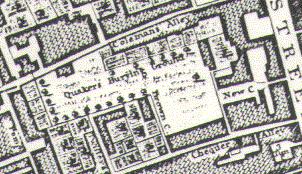
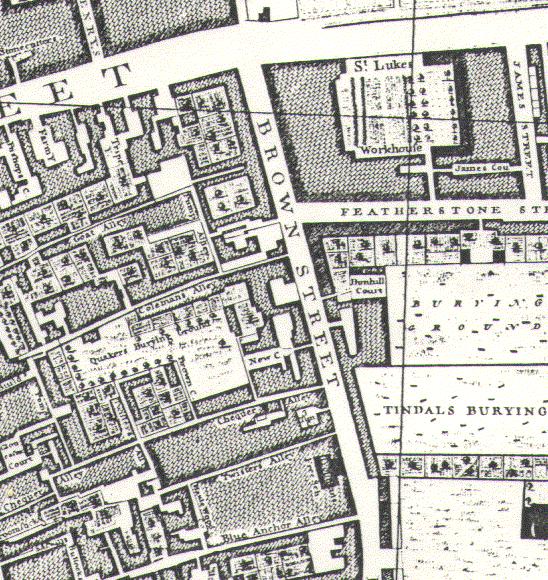
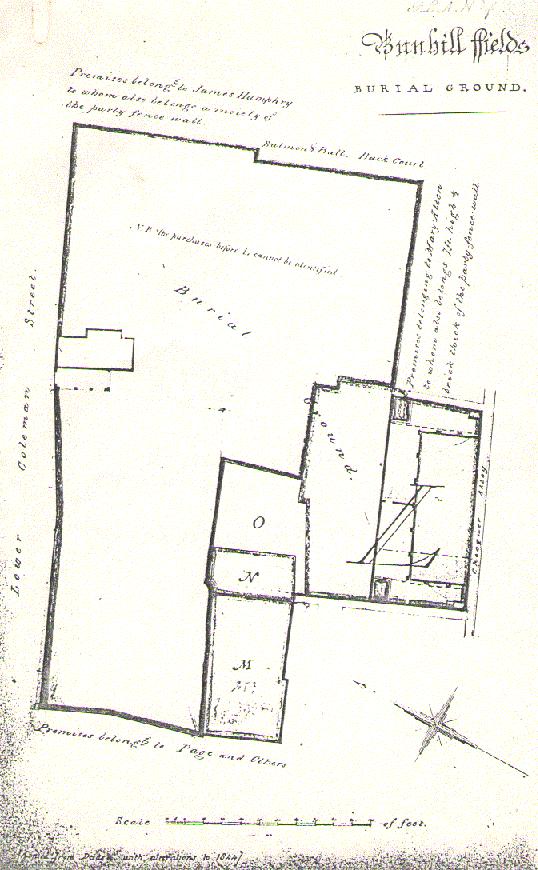
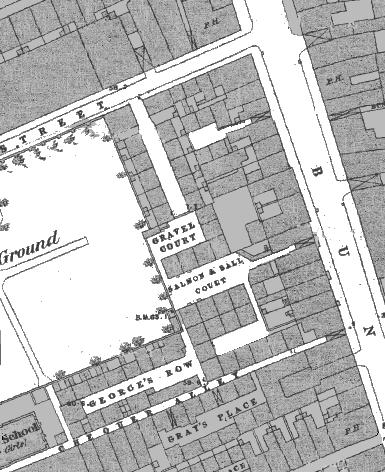
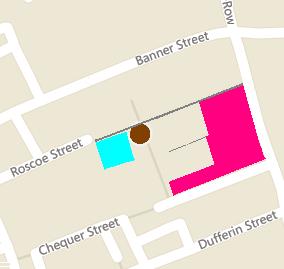
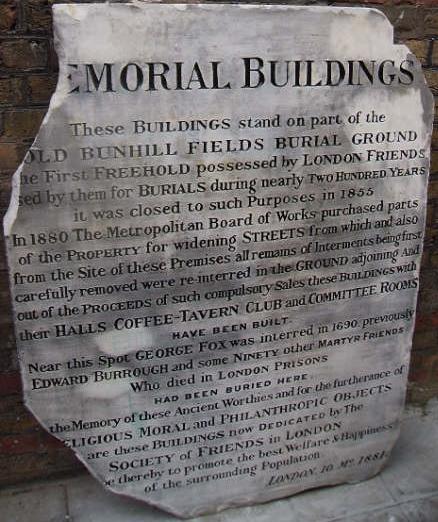
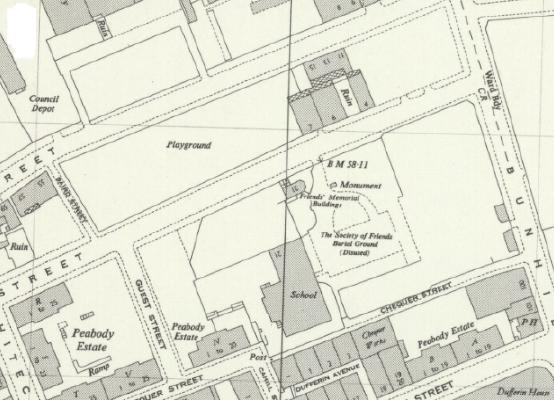
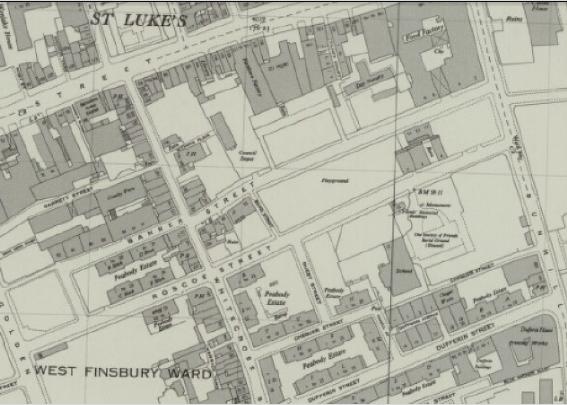
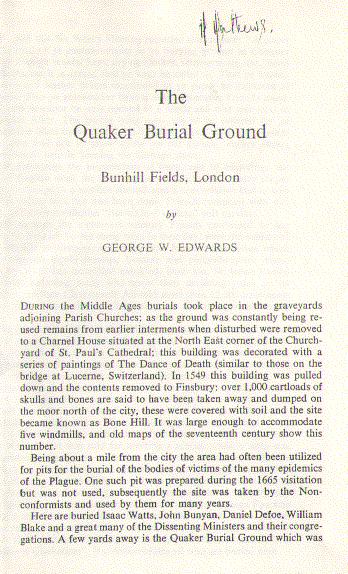
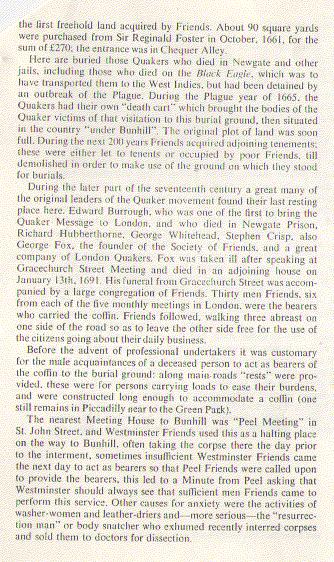
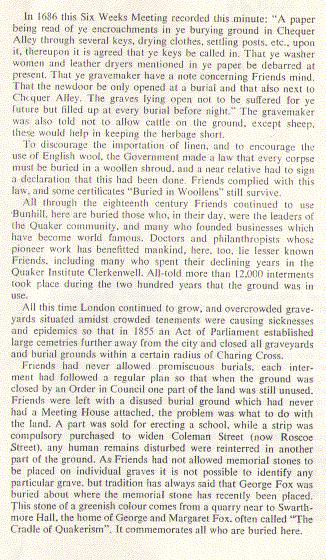
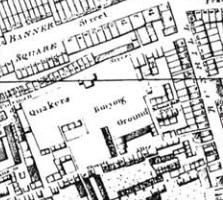
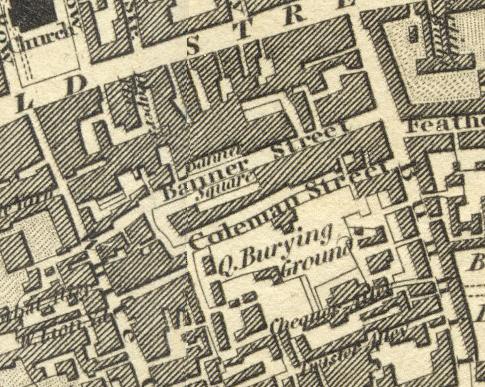
Bunhill Fields burial ground was the first freehold property owned by Quakers, bought in 1661 and used until 1855 for 12,000 burials. It predates the more famous non-denominational ground across Bunhill Row, although the area ("Bone Hill") was long associated with burials.

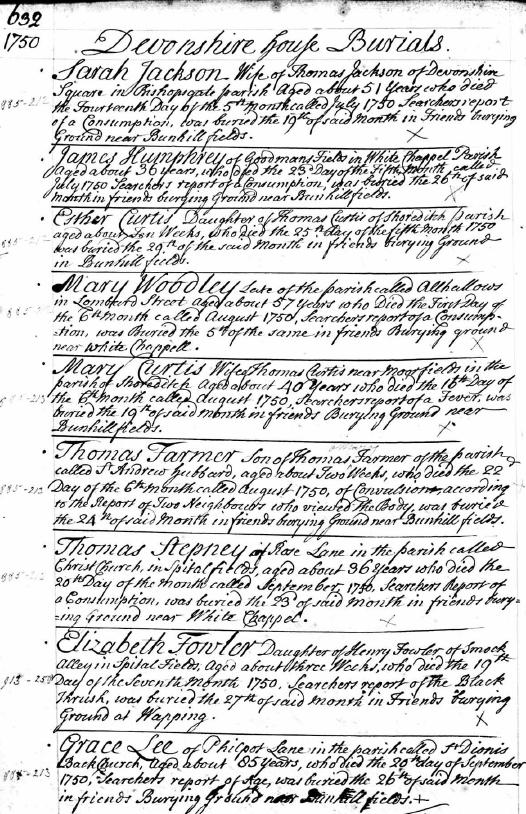
George Fox, Edward Burrough and John Bellers were buried here; among the many during the plague were 27 Quakers who died still in harbour on the ship Black Eagle "when under sentence of banishment for the Truth", as the burial register entries read.

Graves were unmarked, as monuments were "of no service to the deceased". [See death] There are two stories that suggest some "marking" underground.

    In the 1750s, Robert Howard, Quaker tinplate worker of Old Street, uncovered a stone labelled G.F. in the Bunhill burial ground. He called it Nehushtan (2 Kings 18.4) and it was hammered into rubble.

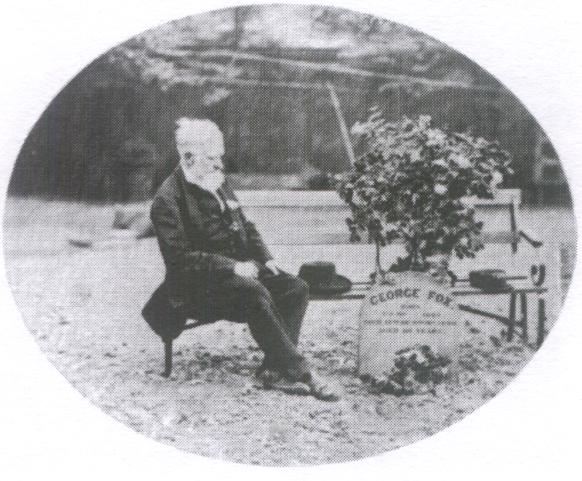
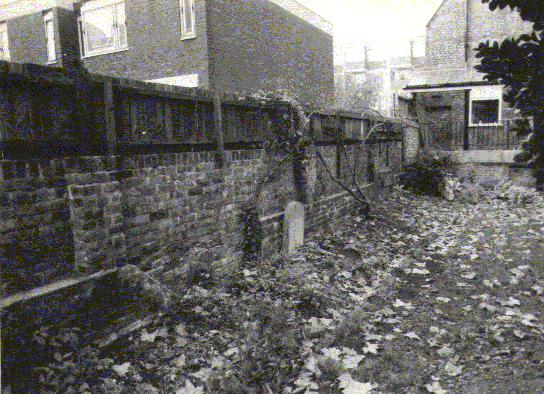
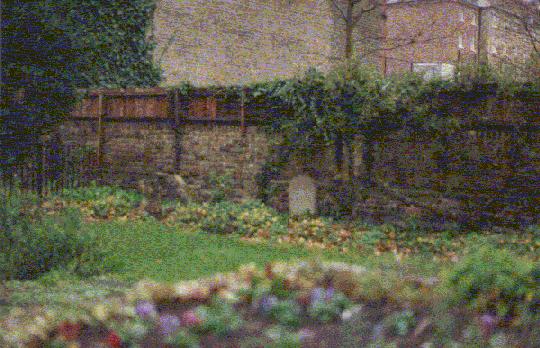
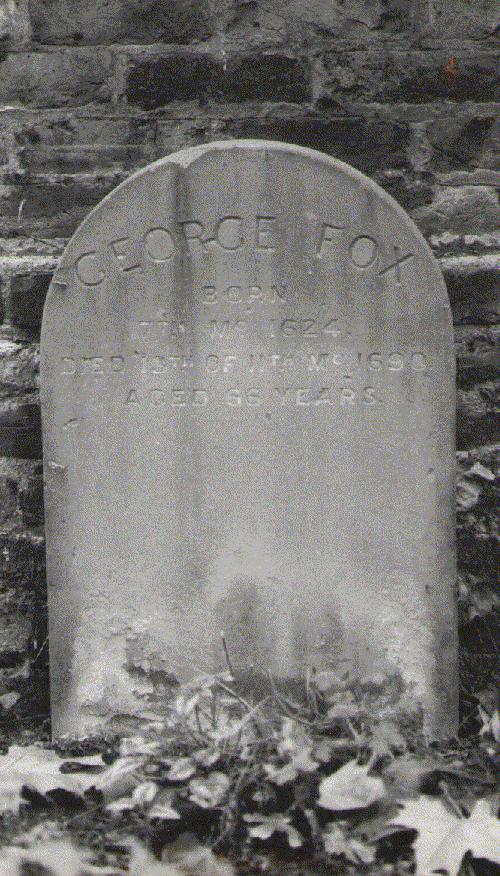
    At about that time, it is reported that when a wall was being removed a lead coffin was found, inscribed with George Fox's initials and age. The body was reinterred but the site was not marked until 1881.

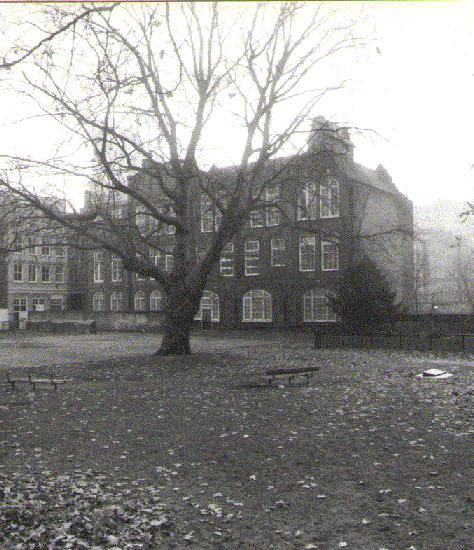
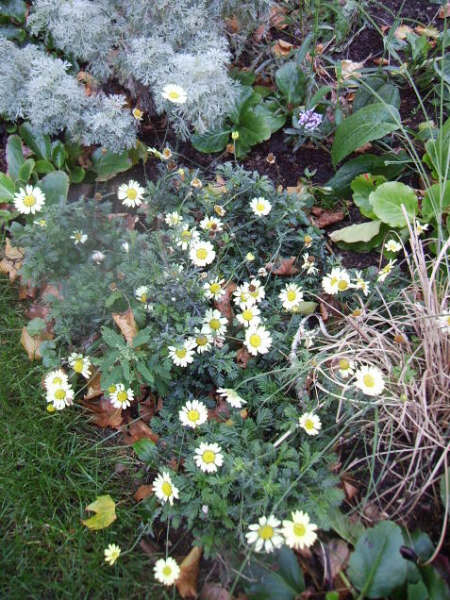
The tree Mystery and romance surround the age of the large London Plane tree that stands in the middle of Quaker Gardens. Some stories take it back (almost?) before such trees existed, others claim it is the oldest in London. The tree is at the centre of a square formed by four other plane trees. The oral tradition (via Olive Yarrow) that I think most likely to be true is that all these plane trees were planted sometime after the closure of the burial ground in 1855. The neighbouring dissenters burial ground was also set out with plane trees (1867), for the benefit of the public. The Quaker burial ground lay unused until 1874. Money became available for the development of the site in 1880 and I suspect this is when the sappling plane trees were planted.
It is 1881 and Eli Radley sits on a new garden bench admiring the new stone for George Fox, fixed in the ground in front of the site of the present tree. Where is the tree? Is that it, posed for its photograph on the bench before it is planted?

4.10.1867 Bunhill (Dissenters) Burial Ground opened as a public open space by the Lord Mayor of London. This involved the landscaping of the burial ground, tree-planting, seating, gardens, and restoration of note worthy monuments. (Wikipedia)

Wikipedia: "The nearby Quaker Burial ground was similarly landscaped. It became maintained at private expense by the Quakers"


See also the murder of the trees in Euston Road: 1922

Bunhill Fields (Quaker) Mission, Social Centre, Meeting

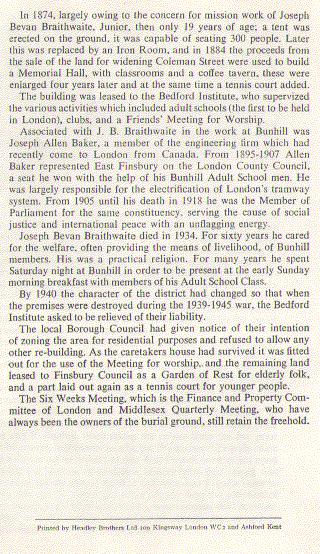
In 1874 the Bedford Institute used the ground for a Gospel Tent, seating 300 people, to hold mission meetings. Later the tent was acquired by William Booth, who used it for his own meetings held on another Quaker burial ground in Whitechapel.

May 1874 At one of the devotional meetings held during Yearly Meeting, Jonathan Grubb of Sudbury raised his concern that some use be made of the disused burial grounds at Bunhill Fields and Whitechapel, closed for internments for many years and of which no use was being made.

"The concern, so far as it referred to Bunhill Fields burial ground, took hold of J.B. Braithwaite, Junr., who had recently been converted and was eager to find some opportunity of working for Christ"

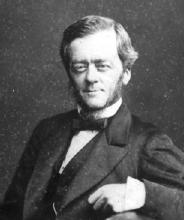
Joseph Bevan Braithwaite junior was the son of Joseph Bevan Braithwaite (senior) 1818-1905 and Martha Braithwaite. Joseph Bevan Braithwaite (senior) was a theologically conservative and evangelical Quaker who did not leave the Society in 1841 (See Book of Discipline). At the time of the 1881 Census, the family lived at 312 Camden Road, London. J.B. Braithwaite junior was born about 1856. He was 19 when he started the mission in 1874 (Lisa and Paul Bowers Isaacson, 1991 leaflet). Olive Yarrow, sitting in meeting as a child, would compare his picture on the meeting house wall with the real man who sat at the front. It was one way to while away the silent tedium. J.B. Braithwaite junior's younger brother, William Charles Braithwaite (1862-1922), "was associated with the work at Bunhill Fields, until his removal to Banbury in 1896" (50th anniversary history 1924)

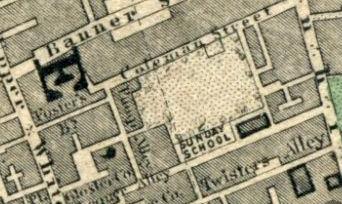
J.B. Braithwaite, Junior was authorised to attempt to raise the necessary funds for the erection of a tent. He succeeded and the first meeting was held on 11.7.1874. Meetings were continued every night during the summer and the Loyal United Friends Hall in Banner Street was engaged for the winter and the meetings carried on there. The tent was used again in the summer of 1875.

Winter 1875 An "Iron Room" with seating for about 400 people was erected. The work continued here until the memorial Buildings were opened.

At some time, an adult school was started by the young Quakers Joseph Bevan Braithwaite junior and Joseph Allen Baker (later an M.P.) in rented rooms in Banner Street.

1878 Joseph Allen and Ann Baker came to London from Canada. One of their seven sons was Philip Barton Baker (5.1.1865-17.4.1916) who "was associated with the Bunhill Adult School from his boyhood and gave much time to night school work in the days when the younger members of the school had fewer educational advantages than they have now" [1917] Another son was Philip (later Noel) Baker.

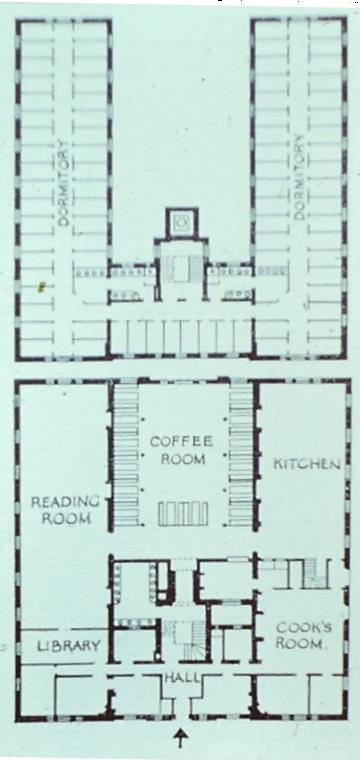
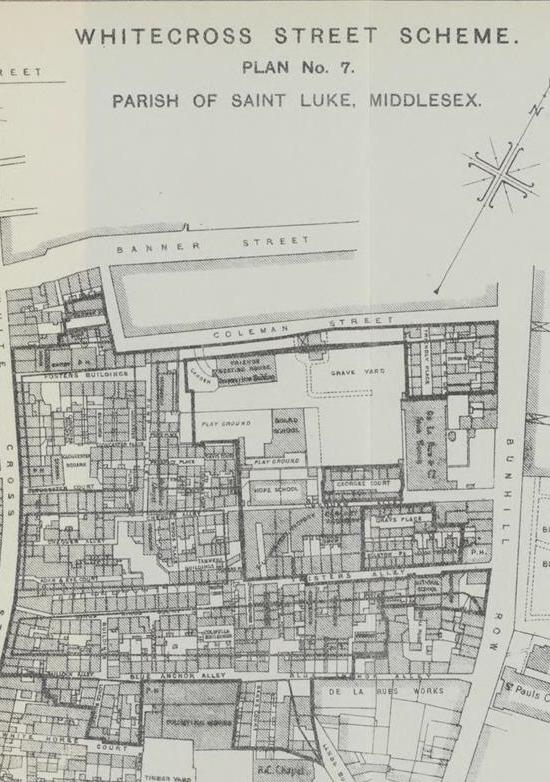
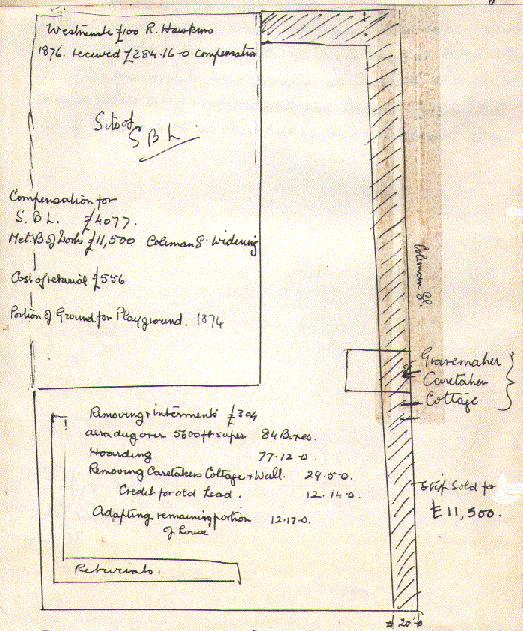
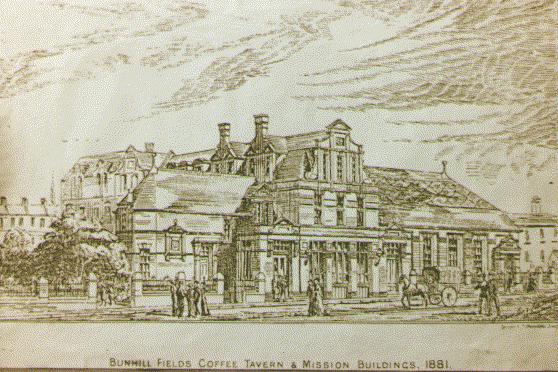
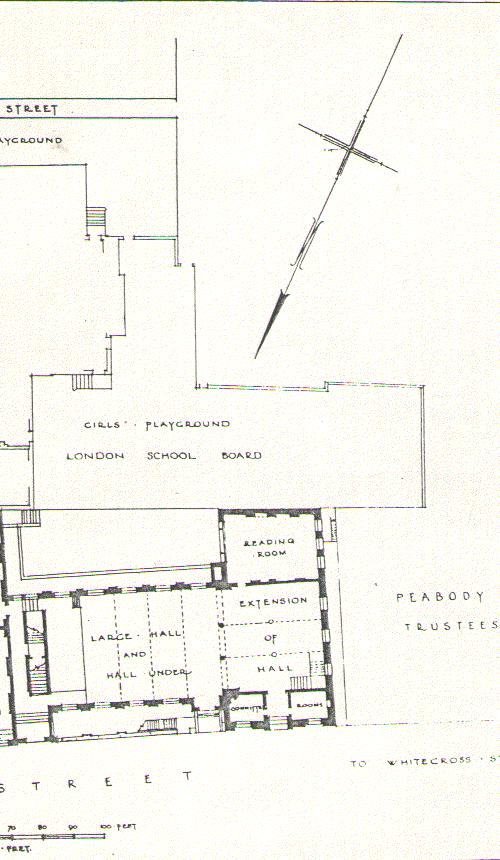
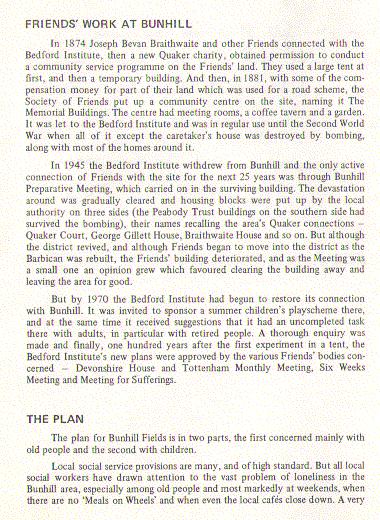
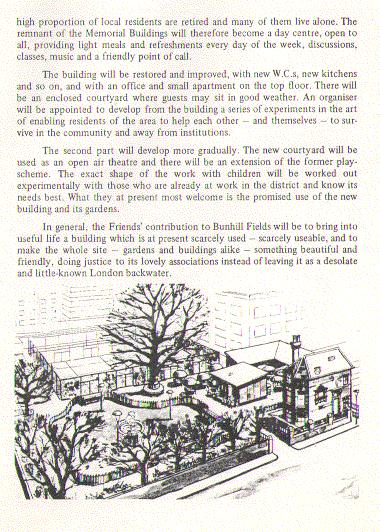
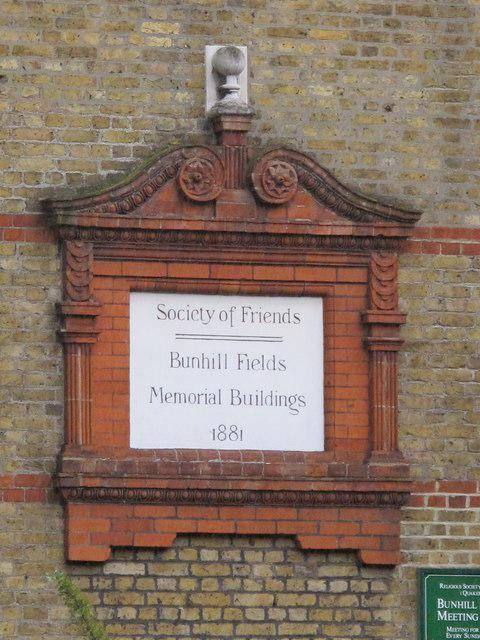
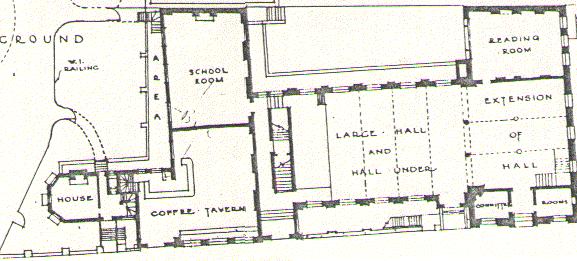
In 1880 a compulsory purchase of land for road-widening enabled the Bunhill Memorial Buildings to be built, with a coffee tavern, school rooms, a medical mission, and the first meeting house on the site.

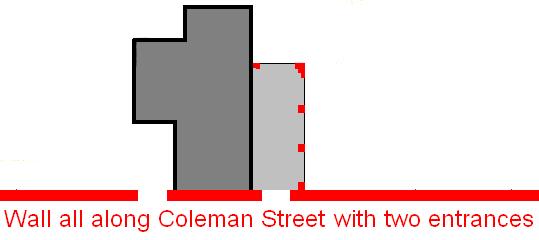
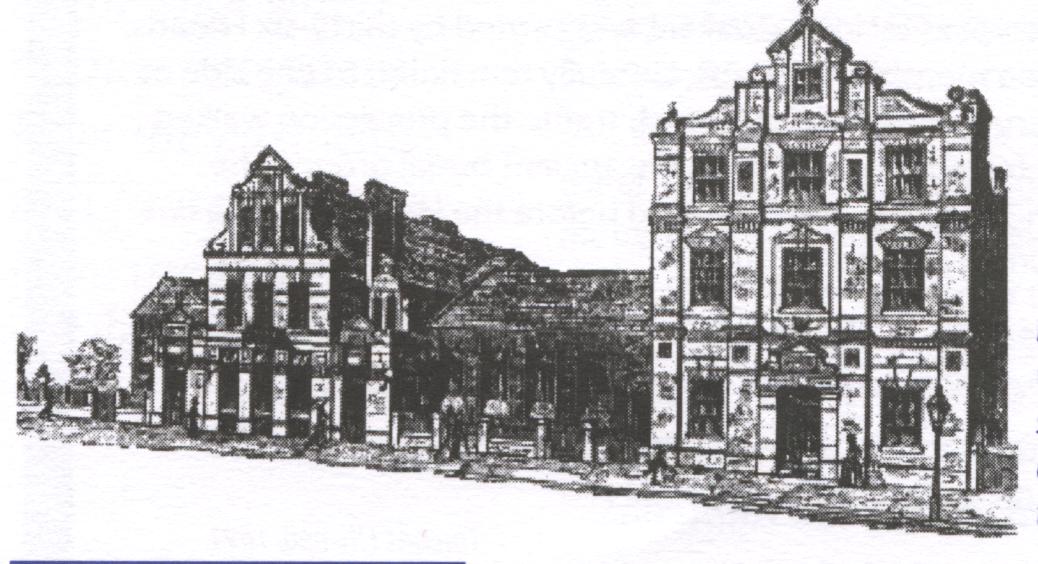
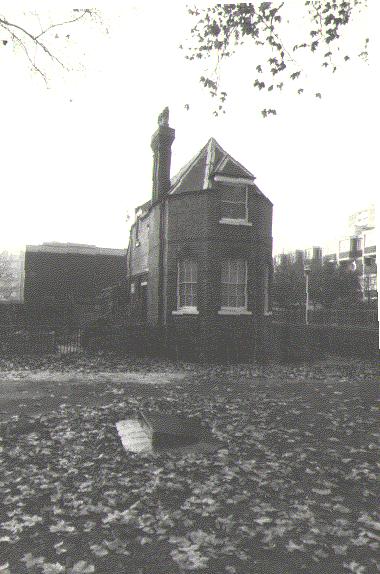
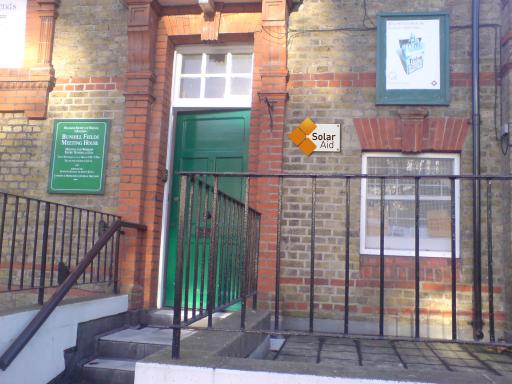
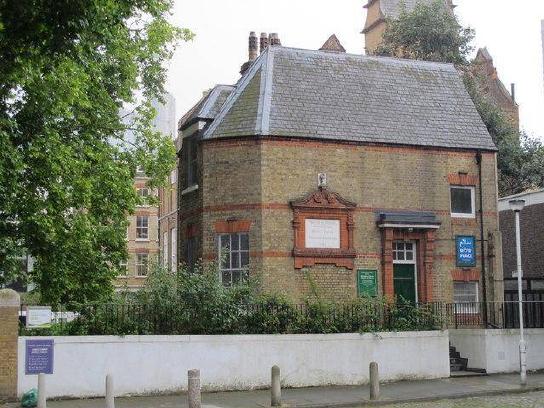
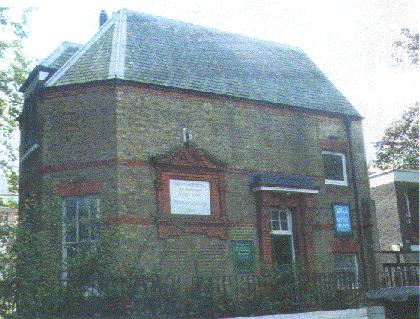
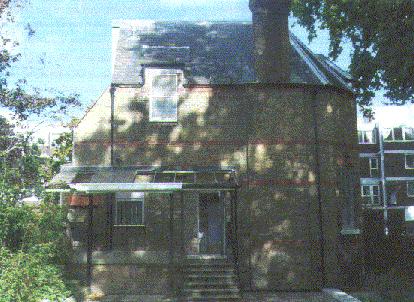
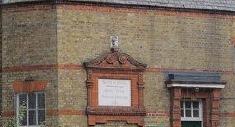
The Bunhill Fields buildings of 1881 were extended after a few years with the Adult School, on the right of the picture. On the left is the Bunhill Coffee Tavern, and between them the meeting house. The small building at the far right (east) was the caretaker's cottage. It is all that remains, and is now where Bunhill Quakers meet.
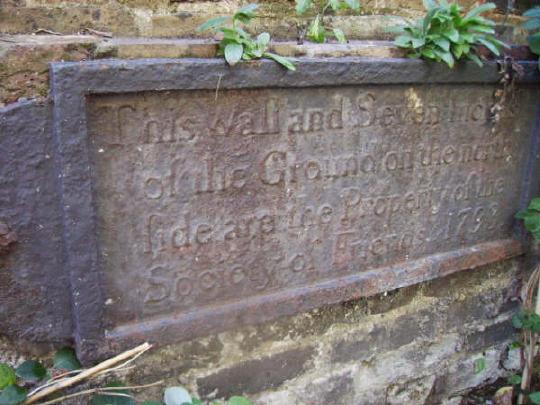
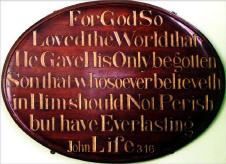
On the east wall of the meeting room it said For God so loved the world, that he gave his only begotten Son

11.4.1900 Philip Barton Baker acknowledged a minister by Devonshire House Monthly Meeting. He was a true minister of the Gospel... Perhaps the most remarkable of all was his power in prayer".

The Bunhill Hymn and Song Books

The proper Quaker meetings for worship in Britain are songless. But not all Quaker meetings are proper meetings for worship. The Bunhill Mission had its silent meeting for worship, but around it were the Mission meetings - That needed hymn books and songbooks. Some of these survive.

  • Fellowship Hymn Book Published by The National Adult School Union and The Brotherhood Movement, Incorporated. The hymnbook was first published in 1909. There are two copies at Bunhill. One is the second edition of March 1933.

  • Fellowship Song Book (Part 1) Twelve copies survive. Stamped "J. B. Braithwaite. The Highlands, New Barnet". This contains 87 songs.. "for indoor or open-air singing" prepared "on behalf of The National Adult School Union, The Co-operative Holidays Association, The Holiday Fellowship, The Workers' Educational Association, The Home Music Study Union, and for the general use of clubs, social unions and public schools" by B H. Walford Davies, whose Preface is dated "Temple Church, E.C. June 1915"
  • 1914 J.B. Braitwaite supported Britain fighting "evil (i.e. the Hun)" in the first world war. The issues are discussed by Thomas Kennedy

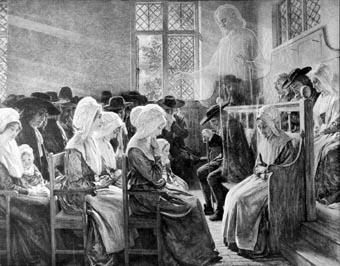
    Segregation of men and women in a Quaker meeting. As far as I know, this was a feature of Quakerism and did not happen in other Christian Churches

    The separation of men and women was linked to the idea of a role for each. Quakers were organised into men's meetings and women's meetings and each had its responsibilities.
    "The Presence in the Midst" was painted by J. Doyle Penrose in 1916. The first time I saw it was above the mantlepiece at Bunhill in the 1970s. I did not see the figure of Jesus - only the Quakers sitting men on one side and women on the other. It reminded me of a friend who told me that, as a young woman about this time, she sat down in meeting and became aware of a weighty Quakeress above her who said "Thou art sitting with the men", and escorted her to the women's side. This is what people called "eldering". I only saw the figure of Christ when someone used the picture to minister against him. The picture was removed from the wall in a general purge of Bunhill pictures in the 1990s. I grieved. I liked Bunhill's pictures.
    1917: "Our Bunhill Fields Branch has suffered a severe loss during the year in the death of Philip B. Baker. Especially in the Men's School and the Meeting for Worship has this loss been felt" (Annual Report The Bedford Institute Association)

    "Jesus Christ is the solution of the problems of 1924 just as he was of the problems of 1874 and has been all through the ages" (50th anniversary history 1924)

    Bunhill becomes the rimless bowl

    The building was bombed in 1941, and all that remains is the caretaker's cottage, still used today as the meeting house.

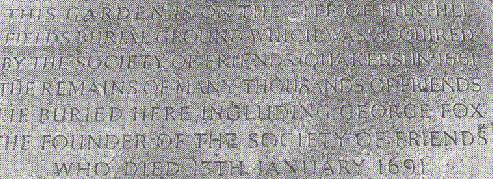
    In 1952 a new memorial stone of Westmorland slate was placed near where George Fox is thought to be buried. This commemorates the anniversary of George Fox's meeting with the Seekers in the north west of England, taken as the start of organised Quakerism.

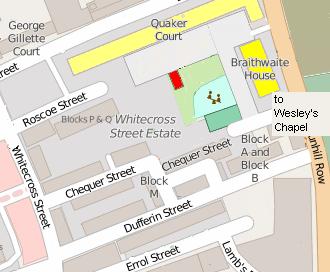
    The area to the east of the burial ground was cleared by bombing all the way to the City Road. Since then, buildings have filled the space again, including the tower block Braithwaite House alongside the burial ground

    Let us be reasonable. We cannot afford to maintain Bunhill for the benefit of a handful of eccentric Quakers who do not even live in the district!

    16.12.1968 Minute of Six Weeks Meeting:

    "The matter of Bunhill premises has been discussed many times in the past and it is now the view of this meeting that the number of Friends residing in the neighbourhood does not warrant the provision of a new Meeting House, nor the heavy expenditure on the maintenance of the upkeep of the old cottage, which is at present used for Meeting for Worship."

    Dear God...

    Bunhill: Memorandum from Bunhill Fields Preparative Meeting June 1969. To all interested Friends. Signed Kathleen Wigham.

    Bunhill Concern June 8th 1969 New Barnet. K. Wigham spoke.

    Memorandum in Olive Yarrow's handwriting:

    "The last few months have brought some anxious moments to us at Bunhill. But in our Meetings for Worship and at other times away from our Meeting we have become more aware of a growing power of prayer that has surrounded us through our difficulties. We have become increasingly aware that there is in our Society, as a whole, a fervent feeling that Bunhill is cherished not just because of its historical position (on the first freehold land to be bought by Friends in this country) but because it is held reverently in the hearts and minds of so many people as we have come to learn by the letters in The Friend and from the influx of visitors over the past few weeks. Some comments have been expressed thus 'An oasis of peace' 'A rimless bowl'. Appeals to carry on have been numerous. We have been greatly moved by the increasing interest in our beloved Meeting House and we would appeal to Friends present here to join with us to increase this rimless bowl of prayer, for it is in this power that we feel we can maintain our Meeting House and we have faith that the means to do so will be forthcoming. We are deeply thankful especially for the loving devotion of two people of our Meeting known to us as Mother and Father and known to others as Beatrice and Bertie Jenkins. Their long service to Bunhill Meeting is immeasurable. Some Friends at Yearly Meeting thought that Bunhill should at least be maintained as an historical monument. We believe that it would be the faith of all the thousands of Friends and others buried there to carry on. How this will be done we hope to discuss further. Whether to repair the present building or to rebuild on the garden and later remove the present cottage and lay the garden on that spot. The strength of Quakers in prayer has led Friends for many years to do great things. We believe as Friends of Bunhill we are being led in the right direction not for ourselves but in maintaining a Quaker stronghold in the City of London."
    28.6.1969 London and Middlesex General Meeting allowed time to discuss Bunhill at their meeting at Wandsworth Meeting House.

    Unilateral Declaration of Independence.
    Note the recourse to traditional Quaker dating practice.

    First Day 29.6.1969 Minute of Bunhill respecting above.

    Minutes of Special Preparative Meeting held 1st Day, the 6th of Seventh Month 1969: Bunhill Field's Friends are not prepared to continue the discussion with our Monthly Meeting and Six Weeks Meeting concerning the matter of our Meeting House... It would appear clear from the deliberations that have so far taken place... that they... have their own clear and strongly held views and we have our own. Any further discussion we feel therefore would only lead to more ill feeling and disunity.

    6.7.1969 Letter from Kathleen Wigham to Clifford Haigh, The Editor of The Friend, enclosing copy of Monthly Meeting Newsletter. Kathleen Wigham's Papers
    6.7.1969 Circular letter from Tony Beck to members of Bunhill asking that he and Kathleen Wigham could visit in their homes for worship and discussion.
    The beginning of healing

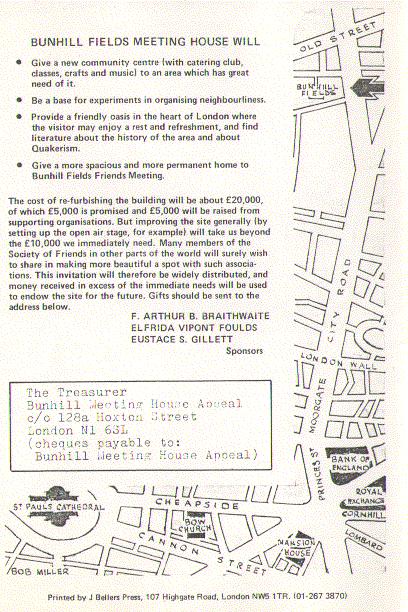
    In 1970 the Peter Bedford project was established under the sponsorship of BIA. Arose from the concern of Michael Sorensen for some of the many men who drift aimlessly beteen prison, psychiatric hospitals and common lodging houses. By 1970 the Bedford Institute had begun to restore its connection with Bunhill.

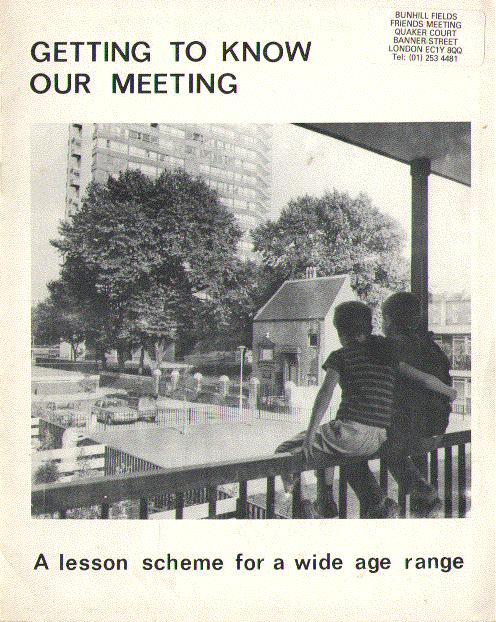
    November 1971. Getting to Know Our Meeting. A Lesson Scheme for a Wide Age Range published by Friends Education Council. The picture on the front is of Bunhill Meeting House from the balcony of the nearby flats.

    In 1972 Olive Yarrow's father died. It was after this that proposals to develop Bunhill were developed by Michael Sorenson. The meeting before this time (and for a while after) was on the top floor: the one that had been used for Olive and Ernie's wedding

    About 1976 Molly Porter began attending Bunhill (from Blackfriars settlement). In 1976 she typed a list of Bunhill Fields Friends Meeting þ Library Books þ 1976. In 1976, Bunhill finished some kind of renovation and Leo and Marguerite became Wardens. Succeeded (1979) by Martin and Judith Ward, Tim and Jenny, Paul and Lisa.

    1989 Martin and Judith Ward became wardens at Bunhill. Followed by Tim and Jenny, then (1987) Paul and Lisa.

    October 1982 Article about meeting houses in The Junior Friend illustrated by a picture and short history of Bunhill.

    October 1987 Paul and Lisa Bowers-Isaacson employed as wardens at Bunhill by the Bedford Institute.

    September 1989 Olive Yarrow ceased being Clerk, owing to ill-health. She had been Clerk for nearly 33 years. Lewis Edwards took over and then, when he left, Paul BowersþIssacson.

    1996 Paul and Lisa Bowers-Isaacson ceased being wardens at Bunhill and "B.I.A. Quaker Social Action" decided not to replace them. Both remained as active members of the meeting.

    5.12.1998 Marriage of Wangari Waweru and Andreas Wellmer. Marriages are infrequent events at Bunhill. The previous one was of Olive Jenkins and Earnest Yarrow on 24.1.1953. But, within a short space of time we were again blessed. Karl and Helen Gibbs' wedding took place at Bunhill on Sunday 10.2.2002

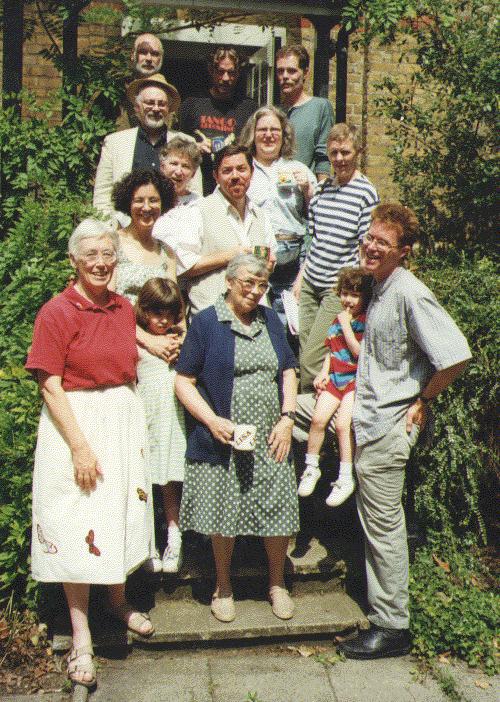
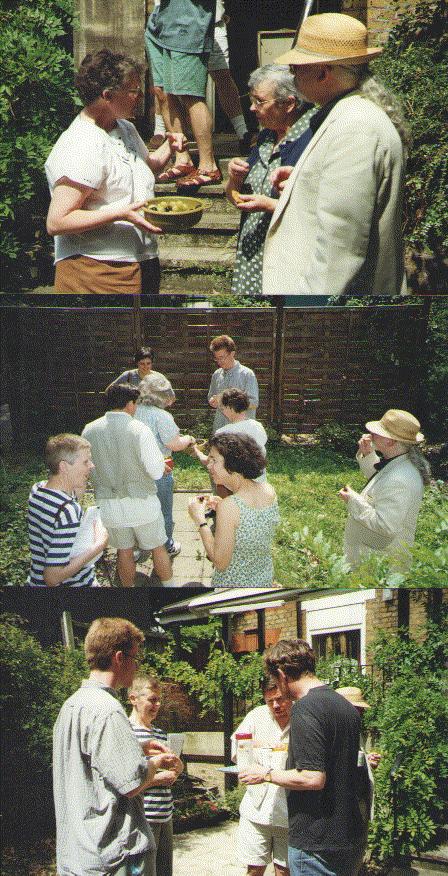
    An assortment of Quakers pose on the steps of the old cottage garden - Somewhere about 2002
    Bunhill Quaker Gardens

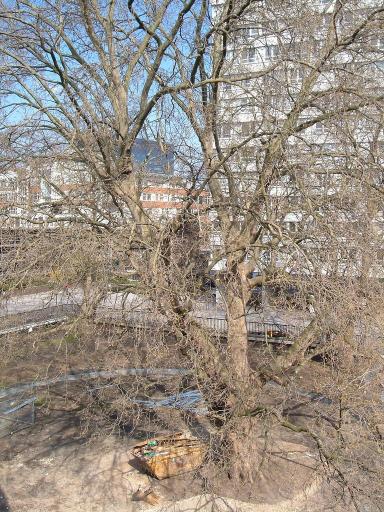
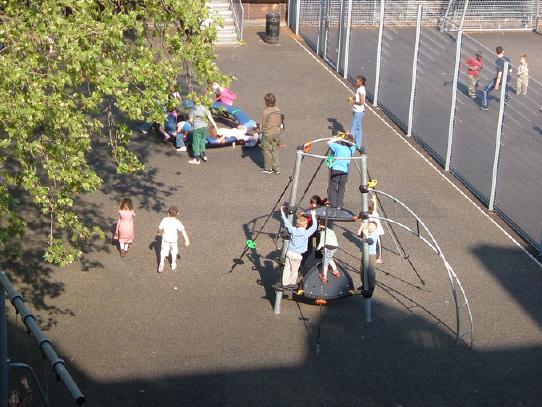
    February 2005 Beginning of the destruction of Bunhill Park and the little cottage garden of the Bunhill Meeting House. Carnage recorded by David Jennings in his blog (beginning Wednesday 16.2.2005 - Continued Saturday, 19.2.2005)

    "The good news is that when the work is over - in June or July - we'll have an even better public space, including a 'quiet garden' under the beautiful old plane tree (some branches of which are visible on the left of the picture)" (David Jennings)

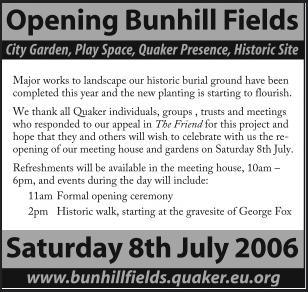
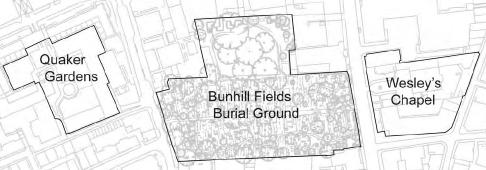
    Sunday 19.2.2006 Bunhill Quakers met, for the last time for several months, in the Bunhill Meeting House. We had been moved out (two weeks notice) whilst the building was re-furbished. Our friends, the Methodists, gave us a home in the Foundry Chapel, in Wesley's Chapel, on the other side of the dissenters' graveyard. For several glorious months we listened to them singing on the other side of the wall, and joined the Methodists afterwards for refreshments. On Sunday 30.4.2006 we were even allowed to provide the refreshments. We came back to the refurbished Meeting House on Sunday 4.6.2006. On Sunday 22.10.2006 Methodists and Quakers met in the meeting house for a joint meeting of quiet and hymn singing.

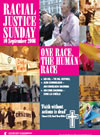
    Image: Racial Justice
Sunday
    Racial Justice Sunday

    Racial Justice Sunday is held on the second Sunday of September in every year. Click on the picture to find out more about this event which involves many Christian churches and, sometimes, other faiths. Bunhill Quakers held a meeting for learning to prepare our minds for Racial Justice Sunday after Meeting for Worship on Sunday 3.10.2006. These are the notes in preparation for the meeting. Beneath them will be found links to other local churches and faiths.
    Questions and issues for discussion are based on reading the Racial Justice Sunday Pack Each of three topics has been prepared by a different person. As you can see, we do not agree with one another on some points.

    What can Bunhill do? - Immigration and Asylum - Education and Employment

    Questions based on a sheet that quotes James 2:26: "Faith without actions is dead" by Andrew Roberts

    As Quakers do not have a church calendar, how can we make Racial Justice Sunday part of our routine? How can we make racial justice a living issue throughout the year?
    Why do our Bunhill Quaker Meetings not appeal to people from a diversity of backgrounds? Do other Quaker Meetings have a broader appeal? If so, why? If we fail to respond to that of God in everyone, is it because we lack imagination?

    Should we renew our imagination by linking with some other faith groups in our area with a different kind of membership and different forms of worship? What forms could such links take?

    Bunhill borders London's most culturally and ethnically diverse areas. Could we use our premises for meetings of people of different cultures and faiths to learn about one another and work together on practical issues in Islington, Tower Hamlets, Hackney and the City?
    In 1991, British Quakers received an epistle (open letter) from "Black, white, Asian and mixed-heritage Friends". Two extracts from this epistle are now included in Quaker Faith and Practice. The first is in chapter ten on Belonging to a Quaker meeting - Our community [item 10.13]. The second is in chapter 29 on Leadings [Item 29.15]
    Summary and reflections on Racial Justice Sunday Information Sheet 2 on Immigration and Asylum by Christopher Vincenzi

    Immigration Myths and their Consequence

    Immigration is a subject that has generated myths over many years, some based on genuine fears, others on supposed illogical and contradictory 'facts', such as that immigrants come here to take our jobs, and to work long hours for low wages, while at the same time, failing to work and drawing large amounts of social benefits. Such attitudes often seem to be most strongly held in areas where there is no contact with people who have come from abroad. However, it would be wrong not to recognise that the arrival of foreign workers and their families can change an area in a way that causes disorientation to some people, particularly the elderly.

    These fears can be exploited by political groups, and sections of the tabloid press, and this can result in hostility, aggression and violence. The response of even mainstream political parties in power has been to tighten immigration controls and impose unjust laws which can harm very vulnerable people - people fleeing rape, torture war and environmental catastroph.

    Some facts

    Only about 8% of the poulation of the UK was born outside the country or to parents who were. People who move to the UK, according to Home Office research, provide 10 % more in tax revenues than they take out using public services. More than 53 % of the people who come here have academic qualifications, and many do jobs where it is difficult to recruit British nationals with similar skills. The 280,000 refugees living here constitute only 0.4 % of the population.

    About a third of those claiming asylum are granted it. Some times it takes a very long time to process their claims. While they are waiting, they are not allowed to work until they have been here for more than a year. They cannot claim mainstream benefits, and are liable, with their families, to be detained at any time. Having sometimes been through terrible experiences before getting here, many have to rely on churches and other voluntary agencies for food and accommodation. On top of it all, they have to live in a climate nourished by sections of the press in which the term 'asylum-seeker' has become a term of abuse.

    The role of the Churches

    As the atmosphere of hostility to asylum-seekers has grown over the years, churches and religious groups have worked hard to provide practical support and friendship to destitute people and those in need of advice, informing the public about the realities of immigration and asylum and campaigning to make the law more compassionate. Groups involved in this work include : Immigrant Women Advisory Service, London, Merton Churches Asylum Seekers Support Group, London, Bridging the Gap, Glasgow, Challenging Unjust Procedures in Immigration Law, Birmingham and Winchester Visitors Group for Refugees.

    Some Conclusions

    Immigration has always aroused some fear and hostility, but this country has shown a remarkable flexibility in adapting to, and adopting foreign cultures and making them our own. We have an obligation towards refugees and are bound in in international law and humanity to welcome and help them settle here. Racism is a denial of our testimony of justice and equality, and we should oppose it with all our strength. However, there should come a time when we should question whether or not immigration is an unqualified good, and whether it is right for us to attempt to attract some of the brightest, best qualified and most highly motivated people to this country. Many come to develop their careers, but others come because our economic policies and the effects of global capitalism have driven them here, and they have left their own economies in decline. stagnation or worse.

    Summary and reflections on Racial Justice Sunday Information Sheet 3 on Education and Employment by Ruth Vincenzi

    What are the challenges?

    There is strong statistical evidence to suggest that people from minority ethnic backgrounds are not doing as well as they should in the labour market. For young people, although they are likely to remain in full time education and to get good results, graduate unemployment is higher than the average. A Cabinet Office report (2003) suggests that many factors were involved, including the fact that many live in deprived areas with poor public transport and few available jobs, but that discrimination also plays a part.

    A graphic example of this was shown in a survey for BBC Radio Five Live published in July 2004. Applications for a variety of jobs based upon similar qualifications and experience were made using fictitious traditional 'white' names, Muslim names and black African names. Almost a quarter of the applications received from 'Jenny Hughes' and 'John Andrews' resulted in interview offers but only 9% for 'Fatima Khan' and 'Nasser Hanif' and 13% for 'Abu Olasemi' and 'Yinka Olatunda'

    What are the Churches doing about them?

  • Set up the Race Equality in Employment Programme to encourage good practice among employers.

  • Supported the Commission for Racial Equality in campaigning for and enforcing anti discrimination law.

  • At national and regional levels have worked to develop their own codes of practice on racism in schools and work places.

  • The Scottish Council for Minorities Edinburgh runs a drop-in resource and development centre.

  • The Methodist Centre, Liverpool offers facilities for young people all aimed at breaking the cycle of deprivation and unemployment.

  • Mentoring for All, Cardiff, provides mentors who work to provide academic and social support.

  • Mupe Fasi (second chance) Project, London, aims at rehabilitation for young women who have been in prison.

    One Race, the Human Race. Where do Quakers stand?

    "Do we strive, as individuals and as a Society, to overcome the narrowness of our cultural inheritance? Do we seek God's forgiveness for the pain we have caused others in the past, in order to go on and change?"
    Quakers and Race Newsletter no 19. 1996

    Is the challenge for Quakers today not so much about trying to attract minority members - although being strong in the belief that we do have something to offer everyone - but about being actively aware of the causes of inequality? Should a good education be seen as the means by which an individual can succeed in a labour market which depends upon world wide social injustice? Should we not be standing firmly, shoulder to shoulder, with others seeking to control capital, cancel debt, invest ethically, transform the World Trade Organisation and protect the earth?

  • Friends in the truth - some of Bunhill's links

    St Giles's Cripplegate: Our anglican parish - Wesley's Chapel and Leysian Mission - St Joseph's Church: Our Roman Catholic Parish - Friends House, Euston Road - Some Quaker meeting internet links - Devonshire House and Tottenham Monthly Meeting - Ratcliff and Barking Monthly Meeting - Quakers in North-West London - some Friends in Christ - Nida Trust: Calling Communities Together - Landmark London Mosques - St Ethelburga's Centre for Reconciliation and Peace - 78 Bishopsgate - FACT: Faith and Citizenship Training - The Inter Faith Network for the UK - Board of Deputies of British Jews - Hindu Council - Hindu Forum - Sanaton Association - Thursday's Child - St Casimir, Lithuanian Church, Hackney Road - St John on Bethnal Green - St Thomas the Apostle, Oldhill Street, off Clapton Common - Dialogue for cultural literacy

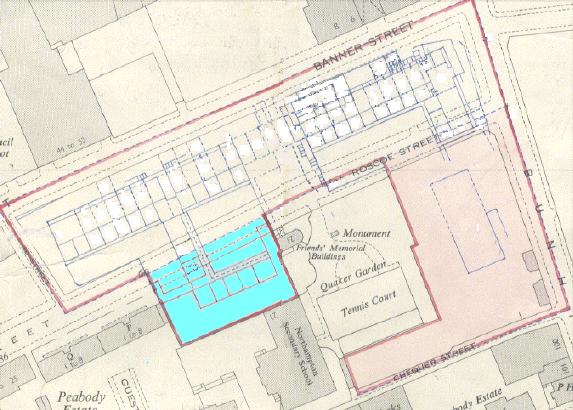
    25.1.2008 Islington Council put a Tree Preservation Order on the five mature trees in Quaker Gardens. This is to prevent anyone, including Quakers, from cutting branches off the trees or in any other way mutilating them. The trees now have preservation numbers and are described in relation to the memorial (monument) to the Quakers buried underneath:

    Hoxton Hall

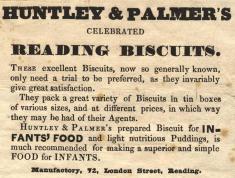
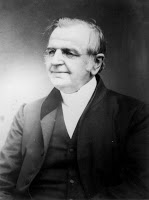
    Hoxton Hall was a classic English music hall opened in 1863, but it lost its license in 1871 because of "Police complaining". New owners applied for a license in 1876 without success, and the building came up for sale again. This time a Quaker, William Isaac Palmer, bought it on behalf of the Blue Ribbon Gospel Temperance Mission. Palmer (1824-1893) was a younger son of the Huntley & Palmer biscuit family, and spent more than his fortune on good causes - after his death his brothers had to pay out the rest of his promised donations themselves.

    William Isaac Palmer left the Hall to the Bedford Institute and, in 1895 it became their eighth centre. The Girls Guild of Good Life was a major part of the activities.

    After the second world war, as well as support for social need in Hoxton, an arts and recreational programme developed: The building continues today as an important community arts centre for the area, and the old music hall is much valued as a theatre space.

    The Plough Court Pharmacy

    In 1715 an elite pharmacy was established at 2 Plough Court, near Lombard Street, in the City of London by Silvanus Bevan, a young Quaker who had just completed his apprenticeship as an apothecary. Silvanus was a man of means whose marriage to Elizabeth Quire at Gracechurch Street on 10.11.1715 was attended by nobility and foreign dignitaries as well as by their fellow Quakers

    The Plough Court Pharmacy is the business origin of the pharmaceutical firm Allen and Hanbury.


    William Allen (1770-1843)

    William Allen (the Allen of Allen and Hanbury) was born in Spitalfields on 29.8.1770. He was the eldest son of Job Allen (1734-1800), a prosperous Quaker silk manufacturer, and Margaret Stafford (died 1830), previously of Cork. Peter Bedford was Job Allen's assistant, and, on his retirement, took over the business. William Allen had chosen to go into chemistry, having been fascinated by science since his schooldays.

    In 1792, William was employed as a clerk by Joseph Gurney Bevan in in Plough Court. Business hours were long, and Quaker meetings demanding, but William found time to attend lectures at Guy's and St Thomas's Hospitals and the meetings of scientific societies.

    "I have attended some of Higgins's lectures - learnt something of shorthand and the new system of chemistry and instituted a plan for my future studies"

    he wrote in his review of 1773

    On 2.4.1794 he became a member of the Chemical Society of Guys Hospital.

    Joseph Gurney Bevan retired (aged 40) in July 1794 and the business was run by Samuel Mildred. In January 1795 the firm became Mildred and Allen

    On 3.7.1795 he became the student of a Physician at St Thomas's Hospital, and in October 1796 a member of the Physical Society at Guys Hospital. In addition to his chemical business he was now lecturing and experimenting at Guys.

    A "little philosophical society" met for the second time at Plough Court on 28.3.1796. The Askesian Society continued for twenty years. It was a group of young chemists who met at Allen's home and used his chemical factory for scientific experiments. The society's purpose being to elucidate by experiment facts already known or newly discovered. The first members were Samuel Woods (a senior who was President), William Allen, Richard Phillips, Luke Howard, Joseph Fox Henry Lawson, Arthur Arch and W.H. Pepys.

    Luke Howard (1772-1864), described it in a letter to the German poet Goethe

    "My friend Allen and myself belonged to a select Philosophical Society which met every fortnight during the winter, each member being required by the rules to bring in an essay, in turn, for discussion, or pay a fine. It was the obligation thus contracted, which occasioned me to present to that society the Essay on Clouds. The papers deemed worth of publication by this Society were inserted in Tilloch's Philosophical Magazine, the editor being one of our members".

    On 13.11.1796, William married Mary Hamilton, the daughter of J and E Hamilton of Redruth. Mary died ten months later, two days after the birth of a daughter, who was also named Mary. Mary Allen married Cornelius Hanbury, but died herself after the birth of a son in 1823.

    After August 1797, Mildred and Allen became Allen and Howard. Luke Howard, William's friend and partner established a laboratory at Plaistow where the manufacture of new chemicals by Joseph Jewell could be carried on with greater safety than at Plough Court. Joseph Jewell (born 1763) was the porter at Plough Court under James Gurney Bevan. He became head of the laboratory.

    "He appears to have improved the existing methods of making salts of mercury, and to have commenced the manufacture of chemicals formerly purchased from outside sources. On two occasions, fires, caused by his experiments, which might well have destroyed the Old Plough Court Pharmacy, were averted through the promptitude of Luke Howard and William Allen. It was soon realised that more space and better conditions were essential in manufacturing such preparations as Nitric and Sulphuric Acid, Liquid Ammonia and Mercurial Salts"

    In a 1797 famine, William Allen was instrumental in establishing a Soup Society in Spitalfields, "the first thing of the kind in England".

    In December? 1802 Luke Howard established the classification of cloud formations in a paper he read to the The Askesian Society "On the Modifications of Clouds". - external link 1   external link 2: Within the complexity of changing skies, we can identify simple forms or categories - Cumulus (Latin for heap) - Stratus (Latin for layer) - Nimbus (Latin for rain) - Cirrus (Latin for curl) - and intermediate forms - Cirro- cumulus - Cirro-stratus - Cumulo-stratus.

    William Allen became an intimate friend of Humphrey Davy, who on 24.1.1804 gave the introductory lecture to a course on natural philosophy at the Royal Institution.

    On 6.5.1805, William was elected to the Committee of the Society for the Abolition of the Slave Trade.

    Allen and Howard became two firms in 1806. Luke Howard's firm, which had moved to Stratford, became Howard, Jewell and Gibson in 1813 and Howards of Ilford and Stratford in the 20th century.

    After his second marriage (to Charlotte Hanbury) in 1806 he divided his time between Plough Court and the pleasant village of Stoke Newington.

    On 13.11.1807 Davy, Dr Babington and William Allen establish a geological society and on 20.11.1807 Allen became a Fellow of the Royal Society.

    On 24.6.1808 Allen had an interview with Joseph Lancaster, who had established an economic system of educating children using a factory style organisation. Allen and Joseph Fox and others rescued the system financially. In 1810 the Royal Lancastrian Society was founded, with Allen as Treasurer, and this became The British and Foreign School Society in 1814, again with Allen as Treasurer. This body was the main non-conformist organisation for school education during the 19th century. In the early days, teachers were sent to France, Denmark, Germany, Russia, America and the free island of Haiti.

    Allen became acquainted with James Mill, not later than 1810, and secured his active co-operation in a literary enterprise - a quarterly journal, called the Philanthropist, published for seven years at Allen's own risk. The first volume of the Philanthropist was published in 1811. The magazine published, amongst much else, articles by James Mill and by Jeremy Bentham

    In 1810 William Allen and Tregelles Price were among the first ten members of the Peace Society

    On 25.12.1812 Allen made a list in his diary of his activities:

    "Overseer Gracechurch Street Monthly Meeting, Lancastrian Schools, Spitalfields Local Association for the Poor, Spitalfields School, superintending the Philanthropist, lectures, General association for the poor, the Bible society."

    January 1813 Confessions of a Drunkard printed in The Philanthropist

    On 31.12.1813, William Allen, Joseph Fox, Joseph Foster, Michael Gibbs and John Walker "men of marked piety, and members of different Christian denominations" became Robert Owen's partners in the purchase of New Lanark. Another who invested in New Lanark was Jeremy Bentham (I think on the advice of James Mill).

    "Tired at last of the restrictions imposed on him by men who wished to conduct the business on the ordinary principles, Owen formed a new firm, who, content with 5% of return for their capital, were ready to give freer scope to his philanthropy (1813). In this firm Jeremy Bentham and the well- known Quaker, William Allen, were partners. In the same year Owen first appeared as an author of essays, in which he expounded the principles on which his system of educational philanthropy was based." (1911 Encyclopedia)

    In 1815, Allen established both a scheme for rescuing "young Bedouins of the city" who lived from theft, and one for establishing a savings bank for the people. It may also have been in 1815 that he became trustee of the Duke of Kent's financial affairs.

    In 1816 Charlotte and William visited the Continent, where Charlotte died on 28.9.1816 at Sacconet. She was buried there.

    From 1818 to 25.2.1820 Allen toured the Continent with the Quaker evangelist, Stephen Grellet, who had first taken Elizabeth Fry to Newgate.

    On 7.5.1823, Mary and Cornelius Hanbury had a son, but on 16.5.1823, Mary died. Elizabeth Fry suckled the baby.

    In 1827, William married Grizell Birkbeck, a wealthy widow who was older than him. This provoked some ridicule, and his motives were read as avaricious. A cartoon by Robert Cruikshank showed disappointed Quaker women in Stoke Newington. But William and Grizell were genuinely close, and other cartoonists defended him. Grizell died in 1835 and, for the rest of his life, Allen was looked after by a niece.

    "After a long period of friction with William Allen and some of his other partners, Owen resigned all connection with New Lanark in 1828." (1911 Encyclopedia)


    10.5.1831: Report in The Times (page 4):

    "The annual meeting of the British and Foreign School Society was held yesterday at Exeter-hall; William Allan, esq. in the chair. The report represented the society to be yearly extending its useful labours and; as a consequence, the blessings of religious instruction among the less wealthy classes of society. His majesty had been pleased to take it under his special patronage, and to set down his name as an annual subscriber of 100l [100 pounds]. The announcement of this gracious conduct on the part of the King was received with loud cheers."

    In 1838 (1828?) there was a deed of dissolution of his partnership with Owen and two sons due to long standing unhappiness about Owen's opposition to revealed religion. [And, I think, opposition to Owen's idea that dancing was an activity to be encouraged in his adult school]

    In 1840 Elizabeth Fry, Samuel Gurney and William Allen toured the continent for five months.

    William Allen died on 30.9.1843

    Peel Meeting and Clerkenwell Workhouse

    Peel Meeting House, in St John's Lane, began in 1656. It was named after the sign of a baker's peel, the wooden spade for