
|
 Social Science Time Line 1493
Mental Health History Time Line
Social Science Time Line 1493
Mental Health History Time Line
|


|
| Sunrise: Draft Timeline for the East |
about 6th century BC Indian medical classics
1407-1408 Vasco da Gama discovered the sea route from
Europe to
India, going round the "Cape of Good Hope" at the southern tip
of Africa.
Europeans no longer had to rely on the muslim powers of the
middle east for
access to far eastern goods.
1493 Following Columbus's discovery of America, Pope Alexander
6th
decreed that the non-European world east of the Azores (in
mid-Atlantic)
should belong to Portugal and Spain should have the world west
of the
Azores. His gift was conditional on their converting the
natives to
Christianity.
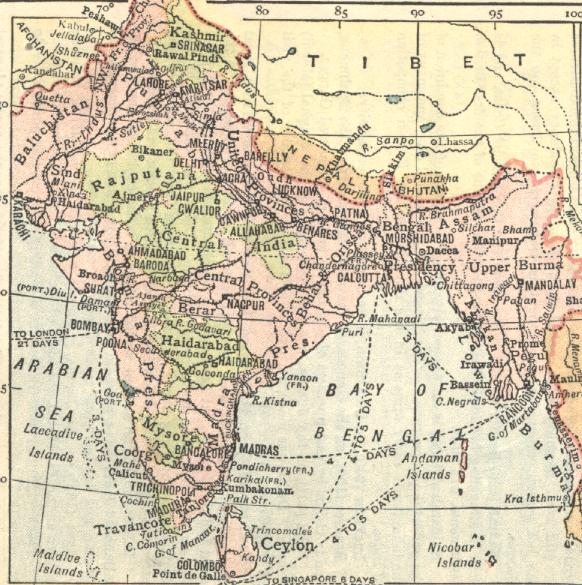
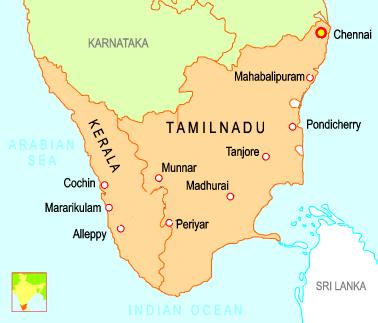
|
external link: indigenous australia
Freud on "the sexual life of these poor naked cannibals" Durkheim on religion Dance of life
1756 Histoire des navigations aux terres australes, contenant ce
que l'on sait des moeurs et des productions des contrées
découvertes jusqu'à ce jour
(History of navigations to the southern lands, containing what we know
about the manners and productions of the regions discovered to date)
by Charles de Brosses (1709-1777). Used "Polynésie" for the islands
of the Pacific and "Australasie" for the land mass believed to exist beyond
them.
August 1768-
12.7.1771 Voyage of Captain James Cook in the
Endeavour
13.4.1769 The Endeavour reached Tahiti, where it stayed for some
days.
(external link)
28.4.1770 Cook landed at Botany
Bay (which he named from its luxuriant vegetation). He named the
Country
New South Wales. Botany Bay is an inlet 8 kilometers (5
miles) south
of the present Sydney. It is the outlet of the River Georges.
The first
European settlers (including convicts) arrived here in 1788.
3.9.1770 Brief visit to the island of New Guinea
(external link)
17.9.1770 Having passed Timor (under Dutch occupation) without
stopping, Cook visited Savu to re-provision.
|
|
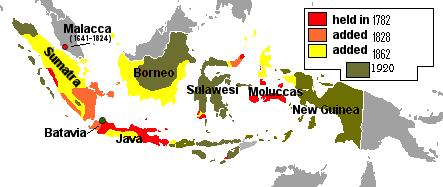
Territorial evolution of the Dutch East Indies by Red4tribe via Wikimedia Commons |

|
1784 East India Company Act
Board of Control (the India Board) established in
London by the British Government to regulate the government of
India by the East India Company.
1787 "Assistant Surgeon W. Dick offered his medical services and the lease of his private lunatic asylum to the Government of Bengal." (Ernst, W. 1988 p.51)
|
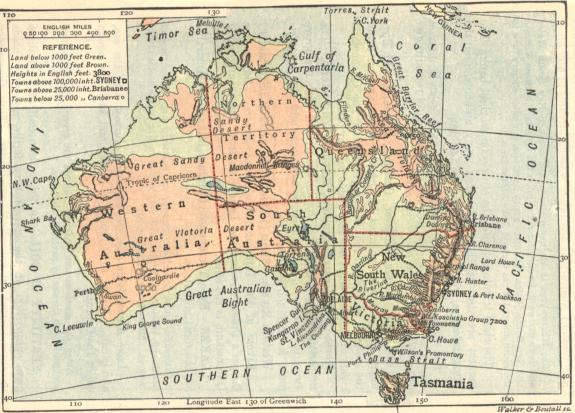
18.1.1788 Captain Arthur Phillip of the British Royal Navy, the founder of European Australia, reached Botany Bay. with a consignment of convicts. Chosen in Britain as the site for the penal colony, it seemed unsuitable on arrival, and the colony was set up at Port Jackson. They settled in Sydney Cove on 26.1.1788. Phillip had sailed from Portsmouth, England, on 13.5.1787 with a fleet of eleven ships carrying about 1,350 people (men, women and children). These included about 780 convicts and four companies of marines (soldiers). The government of New South Wales was initially military. A second fleet of convicts arrived in 1790, a third in 1791. 1811 The Castle Hill Asylum, Sydney was established to remove lunatics from the gaols. Its first medical officer (1814-1815) was Dr William Bland (1789-1898), a pardoned convict, transported to Australia from India where he had killed a man in a dual. (external link) (external link) (external link)
"In 1811, Macquarie authorised the conversion of the Government Farm into an asylum for the reception of convict lunatics. The Sydney Gazette of 1st June, 1811, reported: His Excellency, commiserating the unhappy condition of persons labouring under the affliction of mental derangement, has been pleased to order an Asylum to be prepared for their reception at Castle Hill, whither they have been accordingly removed from their former place of confinement, which was in the town gaol at Parramatta, and every provision that humanity could suggest has been made for their accommodation and comfort. |
|
cholera 1816
"Dr Barnes. who had medical charge of the district of Jessore in Bengal from 1810 to 1822, but who was absent in part of the years 1816 and 1817 when the disease assumed the epidemic character... considered it from the first as a disease peculiar to that country and previously unknown, which had superseded the periodical remittent fever formerly so prevalent. |
|
1820 Asylum later known as Beardsmore's Bedlam
established in
Calcutta as
a halfway house to hold European origin lunatics before they
were shipped
to asylums in England.
(Ernst, W. 1988 pp 52-53)
[see Pembroke House]
1833 Government of India Act (of British Parliament) continued (from 1834) the government of India in the hands of the East India Company, but without it trading. |
1834 South Australian Association established to found
a colony on
the principles of Edward Gibbon Wakefield. Adelaide, the
capital of
South Australia, was built in 1836. The separate colony of
South Australia
was formed and constituted in 1838, although Wakefield was not
directly
involved. The scheme of Gibbon Wakefield aiming at
establishing a wealthy
landlord class nearly ruined the colony by its failure.
"By 1834 Dr Edward Wright, in London, was a participant in movements to set up a new colony (South Australia) as a 'paradise of dissent'. Middle- class religious dissenters were powerful in the colony's formation. Wright wanted the job of colonial medical officer, but instead was given a free passage [1836] and a lesser position as medical attendant to the survey party. He then appears to have had a private practice, though he seems to have sent his (unqualified) son Charles out to do a lot of the work." He was a nominal member of the Church of England, but "At public dinners he would propose toasts to 'religious and civil liberty all over the world' and he participated in groups opposed to the Governor's party". [Politics may have been one of the reasons for conflict at Bethlem] read on |
| 1837 New Zealand Association formed by Edward Gibbon Wakefield. He restructured it in 1839 as the New Zealand Company. (external link) One of its Directors (at some time) was James Robert Gowen, who was a finanacial sponsor of Nelson College. (Wikipedia - Nelson, New Zealand) |
| 1838 Tarban Creek Lunatic Asylum opened on the banks of the Parramatta River, in the area now known as Gladesville, Sydney, New South Wales, Australia. It became Gladesville Mental Hospital |
|
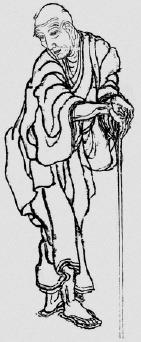
1839 Self portrait of the Japanese artist, Katsushika Hokusai, possibly born 31.10.1760 - died 10.5.1849) The term manga (whimsical pictures) was used by Hokusai (1760-1849) in 1814 to describe a collection of his pictures. By the 1940s it referred to comics or cartoons.
|
|
1839 Opium War: The Chinese Government, wishing to prevent the importation of opium into China, confiscated opium at Canton belonging to British merchants. War with Britain followed. Fighting was ended by the Treaty of Nanking in 1842 by which the British secured a lease on Hong Kong and the ports of Canton, Amoy, Foochow, Nangpo and Shanghai were opened to foreign trade.
|
|
Doris Chang and Arthur
Kleinman argue that:
"Traditional Chinese theories of medicine did not consider mental disorders separately from physical disorders, as their origins were also thought to be due to an imbalance of the internal organs. Thus, treatment of mental illness was largely somato-psychic in approach with the restoration of physiological function and balance as the primary goal. The designation of mental illness as a separate field of study and treatment did not occur until the late 1800s, when foreign missionaries began establishing asylums for the insane in China." |
|
1841 George Grey (governor of the South Australia) published
Journals of the two expeditions of discovery in north-west and western
Australia
made during 1837, 1838, and 1839 with "observations on the moral and
physical condition of the aboriginal inhabitants". London. Two volumes.
(See Durkheim on
totemism)
1842 Discovery of copper by Francis Dutton and Charles Bagot at Kapunda. External links: Kapunda - postcards from the mine - postcards from Adelaide -
1851 Victoria colony established in Gold Rush fever. External links
to
Melbourne Museum, Victoria and their
Marvellous Melbourne history web site
22.3.1852: First thirteen lunatics move in the
Adelaide Lunatic
Asylum
|
| 7.4.1856 Foundation of Nelson College, Nelson, New Zealand |
| 1858 Government of India Act |
| 6.6.1859 Queen Victoria signed Letters Patent separating the colony of Queensland, Australia, from New South Wales. |
| 1863 Sunnyside Lunatic Asylum, Christchurch, New Zealand was the first asylum in Christchurch. Its first patients were 17 people who had previously been kept in the Lyttelton gaol. The first Superintendent was Edward William Seager, who had been the first constable in Christchurch in 1852. "He was highly regarded for his progressive thinking, care and human touch with his patients as was his wife. He made study tours back to England to look at mental health developments in the 1860s. (Email from Murray Cree 9.1.2013) |
|
1865 Woogaroo Asylum established at Goodna, Queensland, Australia,
on an isolated site between Brisbane and Ipswich. It became Goodna Hospital
for the Insane and is now known as Wolston Park Hospital. In 1890
Willowburn Lunatic Asylum was built to take the overflow of an overcrowded
Goodna Asylum.
8.5.1870: Parkside Lunatic Asylum officially proclaimed an asylum. It received its first fifty male patients from the Adelaide Asylum on 18.5.1870
"...only one of the three proposed pavilions had been constructed. This building was to be the administrative centre of the asylum while housing chronic and convalescent patients in the upper floors, and was designed to copy the administrative building at the Essex County Asylum at Brentwood in shape." |
| 1875: Three experienced members of London Yearly Meeting were sent out in that year to investigate and to recommend measures to aid the struggling Australian Meetings. J.J. Dymond, William Beck and Alfred Wright left England on 19.9.1874, after a farewell meeting 19.9.1874. (William Nicolle Oats 1982 Quakers in Australia in the Nineteenth Century) |
| 1876 Queen Victoria proclaimed Empress of India |
| 1880 Kamilaroi and Kurnai : Group-marriage and relationship, and marriage by elopement, drawn chiefly from the usage of the Australian aborigines. Also the Kurnai tribe, their customs in peace and war The first by the Rev Lorimer Fison, and the second by Mr Alfred W. Howitt, with an introduction by Lewis H. Morgan. Published Melbourne: G. Robertson. (See Durkheim on totemism) |
| 1.1.1887 Start of the Indian Branch of the Civil Service Prayer Union. Members of this had a calendar of Monday prayer which surveyed broad aspects of the government of India, beginning with the Queen Empress |
| 28.6.1892 Ralph Athelstane Noble born and educated in Sydney, graduating in medicine in 1916. Became a medical officer in the Department of Mental Hospitals of New South Wales from 1916 to 1919. Then two years of general practice. He went to Cambridge in 1921, took the DPM and worked at the Maudsley, London and Queen Square hospitals before returning to Sydney. In 1923 he was the first person to be appointed a psychiatrist at Royal Prince Alfred Hospital, with the title honorary assistant physician to the psychiatry clinic. He was given full status in 1928. In 1931 Noble accepted an invitation to investigate and report on the teaching of psychiatry in the United States and while there was appointed clinical professor of psychiatry at Yale University. The report, completed in 1933, led to better integration with other disciplines in the teaching of psychological medicine. He returned to Sydney in 1934 to resume his clinical work and to act as lecturer in psychiatry at University of Sydney during the absence of Professor WS Dawson on leave. Later the same year he was appointed consultant psychiatrist in charge of the new psychiatric department at Addenbrooke's Hospital, Cambridge, a post he then held for over twenty years. During this time he conducted a private practice as a psychiatrist in Cambridge and in London.He died at Cambridge 17.3.1965 leaving his widow, two daughters, of whom one was an almoner and the other a gynaecologist, and a son, an agricultural scientist, who in due course returned to Australia." (College Roll, Royal Australian College of Physicians) |
| 1900: "the law in Japan required that the mentally ill be isolated and confined to their household. This Law of Enclosure of the Mentally Disturbed remained in effect until 1919, when the government put the Mental Health Hospital Law into effect. This law required each district to construct a hospital in which the mentally ill could be housed and cared for. In 1950, the Mental Health Hygiene Law was enacted and confining patients at home was now considered to be illegal. Finally, the Mental Health Law of 1988 replaced the Mental Health Hygiene Law of 1950, and the mentally ill were given more rights and an effort was to be made to integrate these patients into the community" (Erica Rosen The Influence of Culture on Mental Health and Psychopathology in Japan 29.11.2001. Her cited source being Koizuma, K., & Harris, P. (1992) Mental health care in Japan. Hospital and Community Psychiatry, 43, 1100-1103) |
|
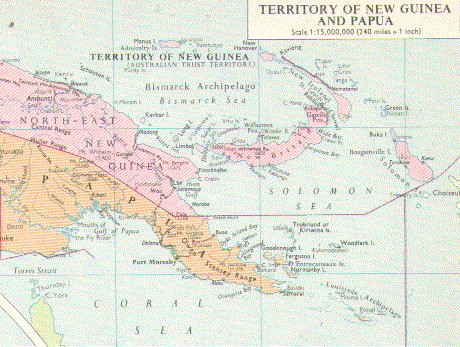
The Trobriand Islands, where
Bronislaw Malinowski
spent the
first world war, can be
seen on this (1950s) map in the south Solomon Sea.
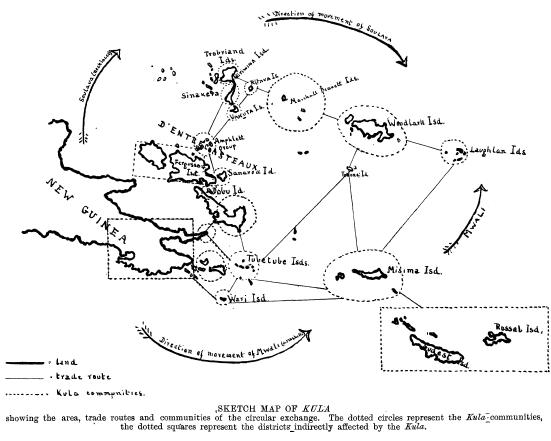
The sketch map of the Trobriand and neighbouring islands (below) is taken from Malinowski's 1920 paper on |
|
|
November 1923: The Australasian Medical Congress
of the British Medical Association held in Melbourne
"Dr Ralph Noble set forth his experience in other countries of the work of detecting and preventing mental deficiency." [See International Committee for Mental Hygiene] "Compulsory sterilisation had been abandoned in America, and the ban of marriage might lessen but would not prevent propagation of the unfit. Medical men must explore the wider fields of preventive medicine with a view to improving the conditions of life and the general well-being of the people. Sir JOHN MACPHERSON explained the measures taken in Scotland and England for dealing with the feeble-minded." (British Medical Journal 2.2.1924 p.202) |
| August 1945 |
|
Doris Chang and Arthur
Kleinman say that:
"By 1948, China had only around 60 psychiatrists and five psychiatric hospitals with a total of 1,100 beds for a population of nearly 500 million people. The founding of the People's Republic of China ushered in a period of growth and advancements in health services, as part of the official plan to transform the social system. By the end of 1959, the number of psychiatric beds throughout the country grew to 19 times that of the pre-liberation period. However, severe shortages in trained staff, inadequate medical facilities especially in the rural and mountainous regions, and limited financial resources demanded stop-gap measures that could be widely and inexpensively implemented. In fact, the bulk of treatment during these years was provided via wide-scale mobilization of nonprofessional treatment teams with minimal education and training. In the 1950s, Russian neuropsychiatric models dominated professional discourse, and political priorities focused on maintaining public order. During the Cultural Revolution, the biological orientation of Chinese psychiatry provided some protection from political accusations. Nevertheless, psychiatry was disrupted more than any other medical specialty, in that mental illness and other forms of deviance were cast as problems of wrong political thinking to be addressed through re-education, rather than psychiatric care."
|
|
In 1950 the Victorian Health Department commissioned a study by
Professor Alexander Kennedy of Durham University into the treatment of the
institutionalised mentally ill in Victoria. The resultant Kennedy Report
was scathing of the conditions within the antiquated asylum system; and, in
response, the department advertised the position of inaugural Chairman of
the newly established Mental Hygiene Authority of Victoria.
Eric Cunningham Dax (1908-2008) applied, having read the report and
corresponded with Kennedy, and was successful in gaining the position,
which he held from 1952 to 1968.
(Obituaries Austalia
1957 The Chief Commissioner of Police raised the matter of scientology with the Mental Hygiene Authority. (Anderson Report chapter one) |
| Japan 1951 Astroboy |
|
DISABLED PEOPLES' INTERNATIONAL
First World Congress' Disabled Peoples' International Singapore 30 .11.1981-4.12.1981) |
|
September 2000: BasicNeeds
organisation for a community approach to the needs of people with mental
illness from poor families in developing countries, including India.
Madness, Cannabis and Colonialism by James H. Mills (University of Strathclyde), St. Martin's Press, 2000. Reviewed by: Satadru Sen Assistant Professor of South Asian History, Purdue University |
|
Japan 2003 Atsushi Okubo created Soul Eater a Japanese manga
series set at the "Death Weapon Meister Academy". Whereas
Astroboy sought world
peace, the meisters have weapons that can be transform into humanoid
"death scythes".
Medusa, a witch who contains over a thousand snake familiars inside her body, gives birth to Crona, who is of unknown gender. Crona has a weapon, Ragnarok, or the Demon Sword. When not a weapon, Ragnarok appears from Crona's body in a black, vaguely humanoid form. Gender is just one of those things that Crona does not know how to deal with. Medusa abuses Crona and Ragnarok bullies her, so that Crona is reclusive and fearful of almost everything. However, her soul is purified by the kindness and compassion of Maka, a student of the academy. Maka puts herself at risk of losing her sanity to help Crona. Eventually, Crona is trapped inside the moon, giving an eternity of loneliness to a character who wanted love and friendship.
|
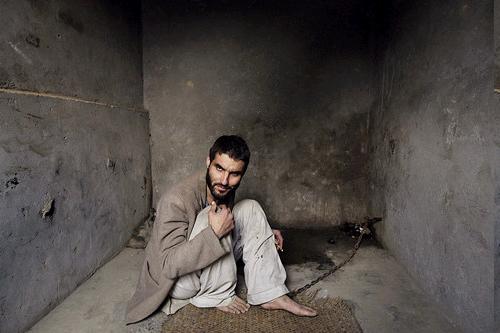
Afghanistan Wali Sultani chained in a small cell at Mia Ali Saeb Shrine in Samar Khel, outside the eastern city of Jalalabad, Afghanistan. Mentally ill people are brought here by family members for a 40-day treatment believed to rid their bodies of bad spirits. Patients are chained to trees when the weather is hot and to concrete cells when it is cold. They are provided with water, black pepper and bread. (Chicago Tribune photo by Kuni Takahashi 12.11.2008. Story 26.12.2008) |
 Study
links outside this site
Picture introduction to this site
Andrew Roberts' web Study Guide
Top
of
Page
Study
links outside this site
Picture introduction to this site
Andrew Roberts' web Study Guide
Top
of
Page
 Take a Break - Read a Poem
 Click coloured words to
go where you
want
Click coloured words to
go where you
want
Andrew Roberts likes to hear from users:
To contact
him, please
use the Communication
Form
|
Sources:
Michael Bollen, Wakefield Press. http://www.wakefieldpress.com.au/ Chang, D.F. and Kleinman, A. 2002 "Growing Pains: Mental Health Care in a Developing China" Susan Piddock 2002 A Space of Their Own: Nineteenth Century Lunatic Asylums in Britain, South Australia and Tasmania.
|
Index
1407 - 1493 - 1493 - 1502 - 1530 - 1600 - 1602 - 1639 - 1662 - 1664 - 1690 - 1747 - 1770 - 1784 - 1787 - 1788 - 1820 - 1833 - 1834 - 1841 - 1845 - 1852 - 1858 - 1870 - 1876 - 1880 - 1887 - 1892 - 1900 - 1923 - 1948 - 2000 -
India - index - Bengal - Bombay - Calcutta - Delhi - Madras -
Japan: 1839 - 1900 - 1945 - 1951 - 2003 -
The anonymous
World Travels 2000
covers roughly the same area as this page on my website, with
maps and histories.