

dictionary
A B C D E F G H I J K L M N O P Q R S T U V W X Y Z
See also, name indexes for mental health - Middlesex University - Quakers -
Jenkins folk
Wilhelm Wundt


People and ideas systems
As outlined by Andrew Roberts of Middlesex University, London. Introductory sketches of the ideas of theorists, linked to Andrew Roberts' book Social Science History (1997) and the Society and Science History TimeLine. Developed from a course document "Outline of the theorists we could cover" (February 1994), the web page was created offline before 6.3.1999. Also available in a Romanian translation by Alexander Ovsov (February 2012)
From our culture we inherit systems of ideas that help us
(speculatively) to interpret the world. One of the purposes of
Universities
is to be academic communities where people develop and test
these idea
systems.
We are often unable to explain the basis of the common
sense
theories we use, but the
academic
community
seeks to reveal the
axioms
or
first principles
on which systems of ideas
are built.
Theory Constrains Us
One of the features of any theory is that it constrains
one.
If you adopt a theory because it explains a certain part of
reality, you
have to accept its consequences for other parts.
A
state of nature theorist
might create a theory to explain politics. As the theory is
based on a
description of basic human nature, it will have consequences
for other
parts of the human reality. For example, it will
have consequences for our theories to explain gender
differences, and for
our theories to explain family relations.
Studying state of nature theorists gives you an
opportunity to develop
your skills in handling and developing theories that apply to
many
different areas of human reality. In reading about
Hobbes
and
Locke,
for example,
imagine how what they say about politics would apply to the
relations
within a family.
|
Theodor Adorno born Frankfurt 11.9.1903, died Switzerland 7.8.1969
|
books - weblinks |
1936 Theodor Adorno's article "Über Jazz" (On Jazz)
1944 Adorno and Horkheimer Dialektik der Aufklärung: Philosophische Fragmente (Dialectic of Enlightenment: Philosphical Fragments)
See Stuart Hall 1951
1966 Negative Dialectics
See 24.7.1967
|
Louis Pierre Althusser
born 16.10.1918, died 22.10.1990
|
books -
timeline
concepts |
|
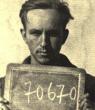
Life in a German prisoner of war camp during the second world war prepared Althusser to become a communist. It probably did not help his depression. |
1948 Althusser joined the French Communist Party. He passed the agrégation in philosophy with a dissertation on Hegel, which allowed him to become a tutor at the Ecole Normale Superieure. His students included Michel Foucault
1965 In France, theoreticians of the Communist Party, including Louis Althusser, thought hard about how to read Marx.
He has been said to "re-invent" marxism. His books For Marx, and Reading Capital, both published in 1965, departed from key aspects of traditional interpretations of marxism. They rejected economic determinism in favour of a study of the rules of ideology [ideas], which he argued to be what influences both our social structures and individual consciousness. Economic factors play a role, but they are a part of all the structures and rules of ideology that must be considered as a whole. Althusser spoke of "ideological state apparatuses" that overwhelmingly contribute to perpetuating a certain ideology. (source)
Althusser's concepts - centred structure - decentred structure - humanism - ideology - interpellate - science
Valerie Argent and Andrew Roberts
In the 1960s the home of Valerie Argent and Andrew Roberts, two mental patients (survivors as we now say), was a place where patients and others met and discussed how the changing world related to their lives. In 1974 they became founder members of the London based Mental Patients Union and lived in the union's first house in Hackney. For several years their address was a place where members of the emerging movement of patients in the United Kingdom and abroad made contact.
In the 1980s this was where Anne Boldt from the California based "Madness Network News" stayed at the start of her tours of European groups. Anne was followed by her friend Judi Chamberlin, who brought with her her book "On Our Own. Patient-Controlled Alternatives to the Mental Health System" (1978).
Andrew and Valerie both researched mental health history and, with their friend Joan Hughes, archived and wrote about the documents of patients' groups. During the 1980s they worked in many groups, including Hackney based developments of the Mental Patients Union, Hackney Action on Learning Difficulty, Mental Distress in Old Age and Everybody's Hackney, a space controlled by people with physical disabilities. Many of their activities were facilitated by Hackney Workers Educational Association.
Valerie died in 1991. Her research on London's private madhouses in the early 19th century became part of a website that Andrew started in 1999. Combined with Andrew's research on asylums, this created an index of asylums and hospitals linked to historical timelines. Other people sent in material and the website soon became a collective enterprise.
In 2006 Andrew and Joan Hughes joined the Survivors History Group which had been established in 2005 by movement pioneers such as Peter Campbell (Survivors Speak Out), Frank Bangay (PROMPT, CAPO and Mad Pride) and Clare Ockwell (CAPITAL). The group hoped, one day, to create a publicly accessible physical archive and several members had collected and preserved the materials of groups they were involved in. The web was somewhere that this material could be made available in virtual reality and so Andrew's website was developed further to include "Mental health and survivors' movements and context - A history organised by the Survivors History Group" at http://studymore.org.uk/mpu.htm
|
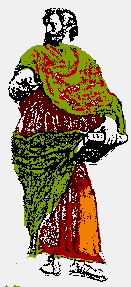
Aristotle born about 384BC, died 322BC Greek philosopher. Aristotle argued that men and women have different kinds of reason. A man's reason fits him for government, a women's reason fits her for domestic life. Compare with his tutor, Plato |
|
|
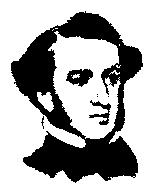
Anthony Ashley Cooper Lord Ashley until 1851 7th Earl of Shaftesbury from 1851 Born 1801, died 1885 |
Conservative theorist and politician who worked with the working class movement in the 1830s and 1840s as a factory reformer. In 1832 he agreed to be the representative in parliament of the campaign to limit the work children could do in factories to 10 a day. The 1842, Coal Mines Act, which he piloted through the House of Commons, stopped women, and children under thirteen, from working underground.
Ashley's policies are an example of the paternalism (theory of dependence and protection) that Mill and Taylor criticised, and of the feudal socialism that Marx and Engels criticised.
Gaston Bachelard
Born 27.6.1884
- died
16.10.1962
"Et, quoi qu'on en dise, dans la vie scientifique, les problèmes ne se posent pas d'eux-mêmes. C'est précisément ce sens du problème qui donne la marque du véritable esprit scientifique. Pour un esprit scientifique, toute connaissance est une réponse … une question. S'il n'y a pas eu de question, il ne peut y avoir de connaissance scientifique. Rien ne va de soi. Rien n'est donné. Tout est construit" (Gaston Bachelard La formation de l'esprit scientifique 1934)
"And, irrespective of what one might assume, in the life of a science, problems do not arise by themselves. It is precisely this that marks out a problem as being of the true scientific spirit: all knowledge is in response to a question. If there were no question, there would be no scientific knowledge. Nothing proceeds from itself. Nothing is given. All is constructed."
|
Johann Jakob Bachofen
Born 1815, died 1887 |
books |
See History of the family - Social Science Timeline 1861 - Jo Twomey 2004
Bapu
Some saw Bapu as mad and bad, others saw her as spiritual, creative,
intuitive and gifted.
Bapu is the personal name of a Tamil woman, who was born of a culturally
and materially elite family in Chennai,
Tamil Nadu,
India.
Bapu heard voices, saw visions, wrote religious verses in Tamil and
Sanskrit, and believed herself to be in deep connection with god. She was
labeled with
schizophrenia
and ended up wandering on the streets.
Bapu was deserted by her family, and struggled for daily survival, even
though she came from a very wealthy background and had a huge property and
a large family in Chennai. She lived many years of her adult life,
wandering and alone, in some healing temples of Kerala. She wrote poetry,
sang bhajans, wore the dress of a monk and shaved her head. She drew and
painted her visions, sometimes with great flourish and bursts of colour.
Bapu was caught by the police many times and forcibly brought back to a
hostile family environment. She was subjected to many invasive treatments
and psychiatric abuse, including lock up, solitary confinement, insulin
coma, several dozens of shock treatment, repeated and forced
institutionalisations, and many disabling anti-psychotic medications, on a
trial and error basis. She suffered severe and debilitating side effects of
the treatments, including severe tardive dyskinesia, Parkinson's disease
and muscular dysfunction.
Various traditional methods were also tried out on her, such as dhara,
exorcism, etc. She died in the autumn of, struck by stroke and coma.
died Autumn 1996

|
Bhargavi Davar, one of Bapu's two children, founded the
Bapu Trust
in her memory and with her legacy. Bapu's biography is taken from an
archive of its website. Bhargavi's biography is based on the
Survivor Research website.
Bhargavi V. Davar
A philosopher and social science researcher. Ph.D. from the Indian Institute of Technology, Bombay, in 1993 on the Epistemological Foundations of Psychoanalytic Theory, later published as "Psychoanalysis as a Human Science".
|
In 1999, Bhargavi started the Bapu Trust for Research on Mind and Discourse, Pune, India. She is editor of aaina (meaning "Reflections" or "Mirror"), the only national newsletter for mental health advocacy in India.
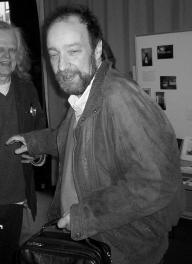
Psychologist and historian who has specialised in the history of the construction of mental health survivor identities. From the mental patient to the person, the title of a study he co- authored with Robert Hayward in 1991 expresses the key concept of identity that he discusses and the revised title for the same book in 1995, Relocating madness, expresses the way he attempts to places this changing identity within the changing structure of social care. |
|
|
Mary [Edith] Barnes
Born 9.2.1923 - Died 29.6.2001 Pictured right aged 72 Death reported in the second issue of the theraputic communities newsletter. (archive)
|
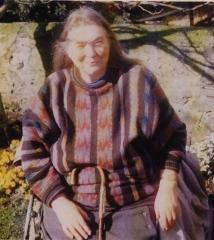
|
| See also the Unofficial catalogue of the Mary Barnes exhibition at the Nunnery Gallery Bow Arts Trust, 183 Bow Road, London, E3 2SJ, which closed on 29.3.2015. Report on visit here - and the history of Kingsley Hall Asylum |
Mary Barnes was a nurse who went into a Carmellite convent in Wales, had a breakdown and, after periods in conventional mental hospitals, entered an unconventional community where she was allowed to be as mad as she wanted. She doodled in her own shit and, being encouraged to use crayons instead, discovered that she was a brilliant artist.
Mary's life has become an argument for the idea that mental distress (madness - mental illness) is a psychic journey. She described it as a journey to hell (darkness), but one with hidden secrets - the treasures of darkness - Her true story has become a true myth: a symbolic representation of something very meaningful to many people
Mary Barnes was born on 2.2.1923, "before I was ready", from a three day home labour in which it was assumed she had died - "until the slap, the breath and the cry".
The most important event in Mary's life was being "received into the church, into the mystical body of Christ" on 8.12.1949
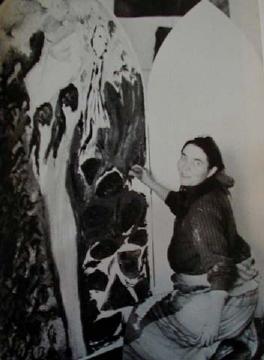
|
It has been argued that the story of Mary Barnes hinges on the five years
from June 1965 to May 1970 when she was the first to live as an inmate in
te
Kingsley Hall Asylum, and the
last to leave. Much of the asylum seems to have centred on
her.
"during this time that she discovered her gift for painting, first using her own excrement, and then oil paints. As her condition improved, she worked with Berke on their book. Her canvases, full of vivid colour - and often depicting religious imagery - were first shown in 1969 at the Camden Arts Centre in London. "My paintings are an important part of my life, which lay buried for 42 years", she said." (Guardian obituary) |
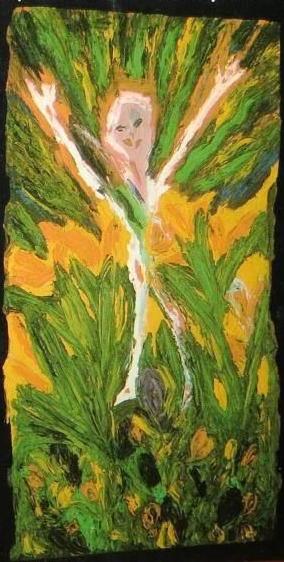
|
Two Accounts of a Journey Through Madness (one by
Mary, the other by
a Jewish American therapist
Joseph Berke) were first published in
1971. The book, Mary
wrote" "has been through many changes". Two of her "Christian stories" and
a children's story were left out and the title proposed by Mary, The
Treasures of Darkness was not used because "people like to see on
the
cover what the inside is about".
Mary's title was taken from the prophet Isaiah in the Jewish Bible. She linked Joseph Berke to God, who called her by her name, cut through iron bars and gave her the hidden riches of secret places. The hidden treasures of darkness leapt from the front cover of the American edition in a picture by Mary (left) called Spring - The Resurrection. "A finger painting on a slice of elm, done in the Spring of 1969" (Inside front cover)
|
|
The
UK
Pelican edition (
1973) had a cover which showed "a detail from
'Spring the
Resurrection', a finger painting by Mary Barnes.
They appear to be different pictures.
Mary Barnes lived in Kingsley Hall from 1965 to 1970. In the course of her treatment she came very close to death. Through her painting and her love, Mary found inner sources of strength, and restored her life. In the conclusion to her account of a journey through madness, she describes a vision of an ideal community which would be a place of refuge and creativity where people of different faiths and none could live in harmony. |

|
|
David Edgar's 1979 play Mary Barnes has been performed
Plot summary from The Oxford Dictionary of Plays: Dr Douglas Walker (30) has, together with fellow psychiatrists Brenda (33), Hugo (in his late thirties), and Zimmerman (in his twenties), set up a commune, to which they will invite mental patients for humane and gentle therapy. The first is Mary Barnes (42), who has a history of mental illness and imagines that she is a nurse. They are joined by American psychiatrist Eddie (25) with his new girlfriend Beth. When Mary refuses to eat, Eddie, fearing that she may have to be returned to hospital, wins her over with games. Beth is jealous of the attention he pays to her. Locals smash windows in the house, protesting about having 'nutters' in the area. Zimmerman leaves, a new patient Laurence joins the group, and tensions become apparent within the 'Community'. Mary appears naked, covered in her own faeces, and Eddie cleans her. When Eddie has to go away for three weeks, Mary pines for him and refuses to eat again. Three years later, Angie, a disturbed rich girl of 20, comes to the house, where Mary is now well enough to help her. Some time later, Angie is restored to health, but slips back into madness when her mother comes to take her away. Mary has an exhibition of paintings, which proves a great success. Mary's brother, whose drugs for mental illness make him 'like wax, a robot', comes to stay, leaves, but returns. Some years later, everyone has had to leave, because the lease ran out; Angie returns but, having endured conventional treatment, can now remember nothing about her stay. |
May 1984 . Sudden death of her brother, Peter Barnes. Mary was living in Devon at the time. About 1984 Mary first went to Stockholm where she met (p. 32) Maria (p.98), a hospitalised woman, who she remained in contact with.
1985 (about 62) Mary moved to Scotland, where she continued to paint and exhibit. [Possibly staying somewhere provided by her friend Ninian [Crichton] Stuart, Moncreiff House, High Street, Falkland, Fife, Scotland. (born 16.3.1957) Keeper of Falkland Palace on the Falkland Estate.
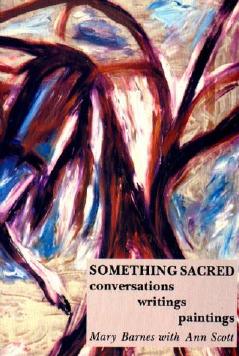
|
In
1989, Mary Barnes with Ann Scott published her second
book:
Something
Sacred: conversations, writings, paintings. This time, the
title was her own.
Following the 1971 acount of her life journey: "Something Sacred continues the story, describing her subsequent life and her involvement in a series of psychotherapeutic households, this time as a helper to others. She looks back on the Kingsley Hall years with detachment, humour and gratitude. Her observations on problems of mental health care, the relationship between psychotherapy and religious practice, and the nature of deep regression will stimulate much thought." |
After contracting spinal arthritis, she was confined to a wheelchair, but continued to paint, write poetry and travel.
1993 Mary Barnes moved to Tomintoul, in the highlands, and became a familiar sight in the village, where she insisted on paddling her wheelchair backwards down the middle of the street. (Guardian obituary)
Mary also gave lectures and participated in radio and television programmes, and her paintings have been exhibited.
1998 Last exhibition before her death may have been at the Project
Ability Gallery in Glasgow. At this some of her paintings were acquired by
Glasgow Art Galleries and Museum. See
BBC which has Feeding the Five
Thousand (1966) - The Transfiguration (1969) -
Crucifixion (1977) -
Our Lady (1980) - Willow (1988) - Tunnel (1988) -
Heavy Snowfall (1996)
- Dancers on the Dunes (1997) -
Her obituary in the therapeutic communities newsletter says:
It also mentions an enduring friendship with a girl in a mental hospital in
Sweden.
The following was entered on
the Guardian website on 2.9.2012 by "itsnevertoolate", who was
born in Welwyn Garden City, went to Manchester University, now lives
Casino, New South Wales, Australia and enjoys being with her grandchildren:
Mary died unexpectedly in Scotland on Friday, 29.6.2001, at the
age of 78.
Mary Barnes on death
The floodgates of my soul are
"she gave truth, reality and hope to the myth of the descent
into the underworld and the re-emergence from that crucifying death -
reborn, healed, and herself a healer: giving a granite foundation to that
belief in love, self, and community which she then shared, supported and
expressed"
It speaks of her in Philadelphia Association houses, in support of the
Arbours Association, in Devon, in St. Dympna's, in the creation of the
Shealin Trust in Glasgow in 1987
"Mary Barnes was my mother's cousin and I knew her before and
after her stay at Kingsley Hall. I had never realised she had any
psychiatric problems. She must have had immense self control to carry on
her profession of nurse and put forward a face of normality until she found
R.D.Laing. Her book caused some disapproval in my family but she stayed on
good terms with everyone, even her own parents. Some years later she lived
with me for a while and I came to appreciate how much she felt Kingsley
Hall had saved her. She had been given her wish to regress and start again,
in fact encouraged to go mad like Francis Gillet was. I attended a
performance of the David Edgar play by Glasgow University with her which
was very moving. After leaving Kingsley Hall she helped other people with
mental problems as well as writing her book. The experiment worked with her
but she was probably quite unique."
open, and the water of my life, flows
out, into the endless sea of light.
|
Roland Barthes
Born 12.11.1915, died 26.3.1980 |
books -
notes and quotations -
concepts
weblinks - timeline - and Stuart Hall |
From 1952 to 1959, Roland Barthes studied (lexicology and sociology) and worked at the Centre National de la Recherche Scientifique.
Barthes helped to create the science of popular culture, extending the concept of culture from what the most highly educated participated in, to include what everyday people enjoyed. He analysed things that were very familiar in France in the early 1950s, things he described as part of his reality as they were part of the reality of every other French person at the time. (Barthes 29.5.1957).
The essays gathered together in Mythologies (1957) were written as magazine articles from 1952 to 1956. Barthes described them as a collection of articles analysing myths of modern daily life in France, crowned by a more theoretical text on the notion of myth today. (Barthes 29.5.1957). They begin with an analysis of all-in-wrestling, discuss the advertising of soap powders and detergents, celebrity icons of the film industry, and the national significance of food and wine. The second part of the book, a theoretical reflection on the preceding tour of popular culture, includes a detailed analysis of a magazine cover.
Barthes analysis of culture was sociological. He sought to see what the images contained of collective representations, a phrase familiar from Durkheim, recalling within themselves something mythical of the past, but despite that, being of our time. The collective representations, containing what the psychoanalyist Jung referred to as ancestral imagery, but are produced by our society and our history and should be related to that. (Barthes 29.5.1957).
Barthes drew on many other theorists but, in particular on marxism and structuralism. "In Barthes's view, Marxism was the only theory that could produce an effective analysis of social institutions." (Ribière, M. 2010 Kindle Location 86)
The structuralism of Barthes, draws upon the theory of language developed by the Swiss linguist, Ferdinand de Saussure. Saussure argued that language is a system of signs which convey meaning. The meaning of a sign derives from its structural relationship with other signs. Thus, the meaning of a sentence is governed by the relationships between the different words which make it up.
Claude Levi-Strauss extended linguistics to the analysis of cultural life in general and Roland Barthes, and other structuralists, extended it to the study of West European popular culture. This is a development of semiotics - the science of signs. In the way Barthes uses the concepts, the magazine cover below is treated as a sign. The cover conveys a mythology (explanatory story) which we can analyse in terms of the signifier (the picture) and what it signifies to the person who looks at it (its meaning).
Because language (in the very broad semiotic sense) is the basis of culture, Barthes argues that it is possible to understand modern cultural phenomena as diverse as magazine covers, fashion items, soap powders, food and wine, celebrity icons, and all-in-wrestling, by analyzing the set of underlying structural relationships (i.e. signs denoting hidden meanings) which shape human ideas and actions.
Mythologies today The myth portrayed below uses real children, called Diouf (shown), Issa and Santoura, who were training to be soldiers in the French army.

|
... je suis chez le coiffeur, on me tend un numéro de Paris-Match. Sur la couverture, un jeune nègre vêtu d'un uniforme français fait le salut militaire, les yeux levés, fixés sans doute sur un pli du drapeau tricolore. Cela, c'est le sens de l'image. Mais naïfs ou pas, je vois bien ce qu'elle me signifie: que la France est un grand Empire, que tous ses fils, sans distinction de couleur, servent fidèlement sous son drapeau, et qu'il n'est de meilleure réponse aux détracteurs d'un colonialisme prétendu, que le zèle de ce noir à servir ses prétendus oppresseurs. (Barthes: 1957 p.201) |
"I am at the barber's, and copy of Paris-Match is offered to me. On the cover, a young Negro in a French uniform is saluting, with his eyes uplifted, probably fixed on a fold of the tricolour. All this is the meaning of the picture. But whether naively or not, I see very well what it signifies to me : that France is a great Empire, that all her sons, without any colour discrimination, faithfully serve under the flag, and that there is no better answer to the detractors of an alleged colonialism than the zeal shown by this Negro in serving his so-called oppressors ..."
Barthes' concepte: exnomination (un-naming) - ideology - metalanguage - myth - science of forms - sign - signifier - signification - semiology
|
Jean Baudrillard
Born 1929, died 2007 |
Wikipedia - weblinks - books |
Baudrillard's early work developed through a critical engagement with Marxism, in which he argued (contra Marx) that it is not economic forces which shape society, but signs and media images. Social meanings are created by the incessant flow of media images (24 hour news programmes, wall-to-wall advertising and entertainment etc). So dominant have the mass media become that we are increasingly conditioned by this virtual reality, rather than the genuine reality of solid objects and living individuals.
Baudrillard's concepts were formed before 24 hour news programmes were well known and a decade before before the world wide web. His concept of hyperreality (below) preceded the concepts of virtual reality and cyberspace.
Baudrillard published Simulacres et Simulation in 1981. ([English Simulacra and Simulation]. In this he argued that we live in a world of hyperreality, which he defined as "the generation by models of a real without origin or reality"
Hyperreality is a world over and beyond (hyper) reality. It is a kaleidoscope of signs and images having no direct connection with any external reality. Thus, the tv or magazine image of the political leader, soap star, or media celebrity is the person most people know, and identify with, or not, as the case may be.
See "Hermeneutics of Quantum Gravity" (1996)
See commentary by David Harvey (who thinks Baudrillard exaggerates)
|
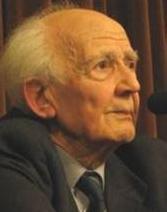
Zygmunt Bauman
Born 1925 Janina Lewinson Born 18.8.1926 Died 29.12.2009 (aged 83). |
thinking sociologically the
Bauman and May way
read the outline of Zygmunt and Janina's lives see the annotated book list Oneself with others notes |
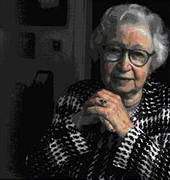
|
Zygmunt Bauman is concerned with the analysis of modernity, His wife, Janina, was a survivor of the Warsaw Ghetto during the second world war. Reflecting on her experiences led Zygmunt to write Modernity and The Holocaust (1989) in which he argues that the bureaucracy that Max Weber, and many subsequent social theorists, argue is central to modernity, robs us of our morality and disables us from being critical of what we do. (Or does it?) |
| Bauman dates the transition from pre-modernity to modernity to the seventeenth century. (1600-1700). He says that the pre-modern world view (associated with feudalism) began to fall apart towards the end of the sixteenth century and the modern world view was established roughly three hundred years ago (1700) |
|
Since 2000,
Bauman has been particularly concerned with the analysis of what
he calls the present
liquid phase of modernity, which he contrasts
with a
previous
solid phase. Bauman's term
solid modernity could
be compared
to some other authors' use of the concept of
industrial society and his
term
liquid modernity
to the concepts of post modern society and
networked society. (See
concepts of modernity and recent modernity)
See summary of book
Liquid Modernity
|
|
|
Solid-modernity relates to the industrial period, made
possible by
steam power from the mid-eighteenth centry. Bauman's
descriptions of solid modernity seem to focus (first) on the
mid-nineteenth century, to
factories,
steam ships and
railway lines. He
also highlights the later development of
Fordism (1920s). His descriptions of
liquid modernity
often
relate to the
digital age and, at
one point, he contrasts
Microsoft (1975) with Ford.
|
Bauman approaches this analysis in the spirit of critical theory.
Malcolm Richardson suggests "very roughly,
mid-19th century to late 20th
century for the solid phase of modernity.
Bauman speaks of
hardware
times, when transport and communication were mechanical, starting with
the train - and
software times, when communication is
electronic: a period coming into full development with the
world wide web.
"One sometimes hears the opinion that contemporary society
(appearing under the name of
late modern or postmodern society,
Ulrich Beck's society of
'second modernity' or, as I prefer to
call it, the
'society of fluid modernity') is inhospitable to critique"
(Bauman, Z. 2000
Liquid Modernity, p.23)

North Staffordshire wives support their husbands during the 1984 miners' strike. |
The transition from solid modernity to fluid or liquid modernity is much more than a change in technology: It is a change in the structure of society and the relation of classes. In UK history, a turning point several sociologists have focused on is the defeat of the miners' strike in 1985. This has been seen as the victory of consumerism over producerism, and of individualism over collectivism. If we look closer at the history, we see that other things are changing. A memorial to the strike speaks of "the mighty courage, heroism and pride of the ... miner and his family". Mining was male, women were the family. Liquid modernity also implies more fluid relationships in all aspects of social reality. |
Today, argues Bauman, everything is fluid and unstable: everyone is subject to continual change and uncertainty - in personal life just as much as, for example, in working life. What sociological concepts and theories can be developed to analyse a world where nothing seems permanent or certain?
| Do sociologists need to abandon old concepts and theories, and invent a radically new kind of sociology? Or can they build upon existing foundations and develop a sociology adequate to these 'liquid modern' times, by devising new concepts and theories, which enable us to grasp, for example, the nature of uncertainty and risk, and the seeming randomness of contemporary life? In the same way that classical sociologists, such as Marx and Weber attempted to develop a sociology of 'solid modernity, so Bauman is attempting to develop a sociology of 'liquid modernity', in a series of works, with titles such as Liquid Modernity (2000), Liquid Love (2003), Liquid Life (2005), Liquid Fear (2006), Liquid Times (2007). |

The Bauman Institute uses liquid for its logo - Contrast with the chains of solid modernity |
|
Cesare Beccaria
Born 15.3.1738, died 1794 |
books -
weblinks
life and works |
Many people consider the 18th century Italian writer, Cesare Beccaria, as the founder of the classical school of criminology and the late 19th century Italian writer, Cesare Lombroso, as the founder of the positivist school of criminology. The idea is expressed in the following work of David Porteous, Programme Leader MA Criminology at Middlesex University:
Beccaria reasoned that modern man
Will commit a crime if sure he can
Escape conviction and get
richer
(A little crude but you get the picture)
Lombroso took a different view
Believing that most crime was due
Not to individuals making rational choices
But rather responding to
biological forces.
See outline of Classical Criminology and Beccaria on the Crime Timeline
Cesare Beccaria's Dei delitti e delle pene was published in Italian in 1764. It was translated into French, and from the French into English as An Essay on Crimes and Punishment in 1767, with a commentary attributed to Voltaire.
Beccaria's Essay on Crimes and Punishment is called "classical" because the later "positivist school of criminology" saw itself as a modern development that moved beyond the classical by being more "scientific" than "philosophic".
Beccaria built on the idea of "social contract" used by state of nature theorists such as Hobbes and (later) Rousseau, and on theories later called utilitarian (Helvetius and David Hume).
See Analysis by Claudia Cavagna
|
Ulrich Beck
Born 1944, |
books and articles - concepts |
|
Elisabeth Beck-Gernsheim
Born 1946, |
mid-1950s A stable unity begins to break apart
2.12.1984 Bhopal: The "greatest industrial catastrophe in history"
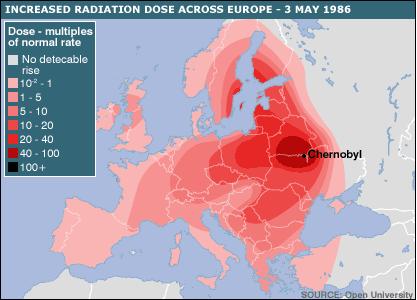
1986 Ulrich Beck's Risikogesellschaft (Risk Society) published. "rapidly went into a second edition after the Chernobyl nuclear accident" ( Outhwaite 12.2009, p.1031.
|
26.4.1986 The Chernobyl nuclear disaster
2006: BBC Chernobyl twenty years on Industrial risk in the second half of the twentieth century could have more global consequences than in the nineteenth century. |
Environmentalism
The name Ulrich Beck has become almost synonymous with the idea of Risk Society, the title of his most well-known work. Rapid technological change across the globe, confronts us with new forms of risk. Beck describes us as "living on the volcano of civilisation". The cause of this is the progress of industrialisation. In the interests of industrialisation society is taking risks with the environment that are, in reality, impossible to calculate scientifically. We calculate them according to our different values. To some, the possibility of an environmental catastrophe rules nuclear energy out, to others, it is a risk to be guarded against.
|
Votes
for worms! |
Beck says that "Soil, plants, air, water and animals" do not have a vote in this assessment, but their preservation represents our "common good" and "perhaps only a passive franchise for grass and earthworms will bring humanity to its senses". (p.31) |
Individualisation
The socially constructed risks of late modernity are not confined to environmental risks to our health or survival. They include risks associated with changing patterns of employment, greater job insecurity, the erosion of the nuclear family and the weakening influence of customs and traditions in shaping personal identity, partly a result of a democratisation of personal relationships.
Because personal futures are more open to individual choice [See Individualisation], the decisions individuals make, for example in pursuing educational qualifications, or a career path, are more open to risk., For example, it is hazardous to predict what skills will be required, or what jobs" will be available in rapidly changing economic circumstances.
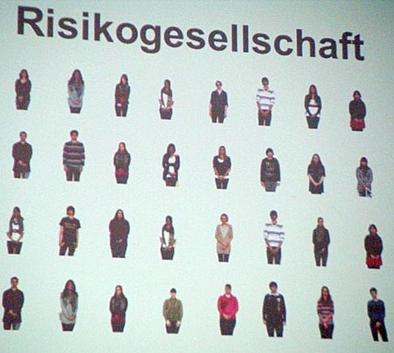
|
For young people from the city of Schwerin, in the northern part of Germany, Risikogessellschaft became the name for their individual hopes for the future in a 2010 video sculpture that you can watch with English sub-titles here. The way each fades away after expressing his or her hopes is unnerving. |
Globalistion
An important consideration, according to Beck, is that today's risks are not localised: they affect all continents and all social groups. Global Risks have global consequences, e.g. Chernobyl nuclear power plant explosion, infections in the animal food chain, or the climatic effects of global warming. As these examples imply, today's risks derive less from 'natural hazards' than from the uncertainties created by social and economic development, and the application of science and technology. Risk management is therefore one of the primary challenges of today's globalised world
Work - identity - hopes for the future
Sociologists
Elisabeth Beck-Gernsheim and
Ulrich Beck co-authored Individualisation:
Institutionalized individualism and its social and political
consequences in
2002.
Work (occupation) used to provide a focus for the development of
class-based identities in industrial societies. This was especially so in
the
case of communities based around employment, such as
mining villages, or
industrial towns where people worked in local factories. Work also provided
a stable life-long
career structure.

|
But,
the Becks argue, increasing insecurity associated with the
flexible labour market mean that
both
class and
status
are losing their significance. Beck
and Elisabeth Beck-Gernsheim refer to this process as individualistation
|
Beck concepts:
individualisation -
post-
-
reflexive modernisation
- risk society
The Reflexive Modernisation research programme suggests three main
themes to the hypothesis:
risk, individualisation and institutional change
associated wth
globalisation. Recent focus on
intended and unintended consequences.
|
Howard Becker
Born 1928, |
books and articles |
"I was born in Chicago, Illinois on April 18, 1928. (I will just mention that this is the date of the Great Earthquake and Fire in San Francisco in 1906. Make what you will of that.)" (Howie's page).
Howard Becker's Home Page. The archive of present site starts 15.10.2002. My estimate that Becker started his website in 1996 is based on an email from Howard Becker on 21.5.2002: "I consulted my wife, who reminds me that I must have started the web site well before I left the University of Washington in 1998 or so. We put our heads together and our best estimate is 1996. Howie Becker".
|
Clifford Beers
Born 30.3.1876, died 9.7.1943 |
books and articles |
USA mental patient Clifford Beers published his autobiography A Mind that Found Itself in 1908. Beers formed the International Committee for Mental Hygiene in 1919 and this led, eventually, to the present World Federation for Mental Health.
Clifford' family lived in New Haven, Connecticut. . His brother Samuel began having seizures as a teenager, and died early. Clifford worried that he would develop the same condition. Clifford and three brothers lived into adulthood, but all died in mental hospitals: George (suicide June 1932) - William (suicide in a mental hospital in 1930) - Carl (died in a mental hospital November 1935) (Dain)
As a university student, Clifford experienced frequent bouts of depression. He graduated from Yale University's Sheffield Scientific School in 1897. Over the next three years, he worked as a clerk in New York City, gradually becoming increasingly anxious and distressed. Following a suicide attempt on 23.6.1900, Clifford was admitted to a local general hospital, where they put bars on his window. He returned home, but after a month was admitted to a private sanatorium. After a brief return home, his relatives sent him to the Hartford Retreat. From here, he was moved, in November 1902, to the State Asylum. He was freed from there on 10.9.1903
He was fortunate to secure good employment as a buisinessman. At the end of 1904, a short illness gave him time to read "Les Misérables". Deeply moved, he resolved to write his own book: one that would "arouse sympathy for and interest" in the conditions of people in asylums and the problems society put in the way of their recovery and re- integration. He shared his ambition with Clara Louise Jepson, who assisted him. Clara and Clifford married in 1912. They decided not to have any children as a result of their concerns about hereditary mental illness. (Vicary EZ., "Clifford Whittington Beers," American National Biography, vol. 2 (New York, NY: Oxford University Press, 1999), 475-476.)
A Mind that Found Itself was published by Longmans Green in March 1908, and reviewed in both USA and British papers.
"Two months after the publication of his book, Beers joined with [the psychiatrist Adolph] Meyer, physician William H. Welch, and philosopher William James to found the Connecticut Society for Mental Hygiene to improve standards of care and attitudes toward the mentally ill, and to prevent mental illness and promote mental health. Several other states joined the movement and established their own societies. In 1909, Beers launched the National Committee for Mental Hygiene, which spearheaded legal reforms in several states, provided grants for research into the causes of psychiatric disorders, and funded training for medical students. The organisation also published the quarterly magazines Mental Hygiene and Understanding the Child to raise public awareness of mental health issues". (Manon Parry)
|
Jeremy Bentham
Born 1748, died 1832 An attorney's son, born in London. From 1763 Bentham studied law at Lincoln's Inn, but never practised. He was interested in the theory of law. |
 crime
crime
|
A fuller intellectual biography is being developed in the student reviews
external link to Wikipedia articles on: William Blackstone and Jeremy_Bentham
other weblinks
timeline, notes and texts
| In 1776 Bentham published A Fragment on Government. This criticised a passage in Blackstone's Commentaries. William Blackstone (1723- 1780) saw the English law embodying the collective wisdom of the society. Bentham descibed this a "fiction" - a set of ideas hiding the true motives of those who proclaimed them. The scientific study of law should be based on the understanding that humans pursue happiness and avoid pain. |

|
| From 1785 to 1788, Bentham travelled on the Continent, including Russia. He formed the idea that he could become the Newton of morals and legislation. From 1787 to 1811 he was engaged in promoting the construction of an institution for remodelling human behaviour: The Panopticon |

|
Chambers Biographical Dictionary summarises Bentham as holding
- that laws should be socially useful and not merely reflect the
status
quo
- that human beings pursue pleasure and avoid pain
See utilitarianism and again here
- that desires may be broadly classified into self- and
other- regarding
- that the function of law is to award punishment and
rewards to maintain
a just balance between them.
|
Herbert Blumer
Born 7.3.1900, died 13.4.1987 Extracts - Oneself with others notes |
crime
|
Herbert Blumer was based at the University of Chicago from 1925 to 1952, when he moved to Berkeley, California to develop its new Sociology department.
At Chicago, Blumer was influenced by George Herbert Mead, William Isaac Thomas, and Robert Park. When Mead died unexpectedly, in 1931, Blumer (a "young instructor") took over his class.
Blumer was the secretary treasurer of the American Sociological Association from 1930 to 1935, and the editor of the American Journal of Sociology from 1941 to 1952.
In 1936 Blumer published an article called "Social attitudes and non-symbolic interaction". By non-symbolic interaction he meant "spontaneous and direct response to the gestures and actions of the other individual, without the intermediation of any interpretation". Blumer suggested that this level of interaction is the one associated with feelings.
Writing about Social Psychology in 1937 he coined the term symbolic interactionist for theories developed from Mead. In this article he argues that Mead has "three stages" in the "growth of the self in the child"
Blumer wrote that socio-psychological views of what our original human nature is can be divided into three:
instinctual (typified by William McDougall)
stimulus- response (reflex) [ behaviourism] - and
Similarly, he divided views on the "group setting" of human development into three: He contrasted:
cultural determinism, which he said characterised the work of French theorists such as Levy Bruhl who used Durkheim's term collective representations to describe culture with the views of the
stimulus- response psychologists. These, he said, did not consider "forms of culture" as "real and separate things with a life of their own", but as "combinations of the activities of separate individuals". "The individual, alone, is real; the group is merely a convenient way of referring to a collection of individuals".
The symbolic interactionists agreed with the approach of seeing "the life of human groups" as creating customs, traditions and institutions. However, they did not regard these "forms of culture as consisting merely of so many different individual ways of acting". Forms of culture consist of
"common symbols, which are mutually shared and possessed by the members of the groups. Individual ways of acting are alike because these individuals are guiding their behaviour by a symbol which they share in common."
1962 "Society as Symbolic Interaction"

|
In La sociologie est un sport de combat (2001) Bourdieu gave a farewell kiss to the sociology student who said: "the reason why I loved your writings so much at the beginning. I believed I was free, but I was not free at all. Symbolic violence and all that... I have been living exactly what you write about for the last fifteen years." |
|
Pierre Bourdieu
Born 1930, died 2002 |
Books -
notes and quotes
weblinks - concepts |
Studied philosophy at the
École Normale Supérieure
1958: Published Sociologie de L'Algerie (The Sociology of
Algeria)
From 1981 Professor of Sociology at the Collège de France,
Pierre Bourdieu's theory and concepts are one dimension of his sociological practice, the other dimension of which is his empirical work (with other sociologists). The main body of his research (from 1963) was related to the sociology of education, culture and the social reproduction of society from generation to generation.
Pierre Bourdieu's best known work on education is La Reproduction (1970), which was translated into English as Reproduction in Education, Society and Culture in 1977. This was done with Jean-Claude Passeron (1930 -).
Bourdieu and Passeron's work on education began with social surveys in 1963. The first result of these were published in (1964) in a book that was translated into English as The Inheritors: French Students and their Relations to Culture [See culture]
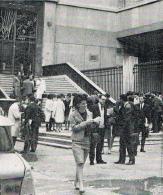
|
The book is about who would
inherit the elite Paris university in the 1960s? - and
why?. Educational success is a pathway to social and economic
success, but are there forces that ensure the children of the already
successful inherit the education? As the title indicates, the forces
indicated are cultural.
The 1964 publication was mainly a report on the research respecting formal education through school and university. Later research publications covered cultural tastes revealed in the use made of photography (1965) and art museums (1969) |
The research begun in 1963 led to two major theoretical syntheses. The first, in 1970 being La Reproduction (Bourdieu and Passeron) and the second, in 1979 being La Distinction (just Bourdieu).
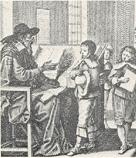
The cover illustration from La Reproduction See Malcolm's summary |
Reproduction
is a term used in contrast with production.
Production
is making goods, reproduction is making people able to produce goods. The
terms are used in
marxist theory.
Based on an August 2009 summary by Malcolm Richardson
Pierre Bourdieu' work is concerned with cultural practices, and their associated institutions (e.g. schools and universities, art galleries and museums), and how they operate in maintaining the social hierarchy.
|
Bourdieu argues that social hierarchies are reproduced primarily through cultural, rather than economic, mechanisms. He calls the cultural system that perpetuates this division one of symbolic violence. The term may appear extreme, exaggerated or even inappropriate, but Bourdieu argues that any such appearance is only because of the social mechanisms that conceal this violence. Bourdieu considers the concept essential to sociology and, in this context, it may be valuable to consider Weber's discussion of violence, force and legitimacy. As a general sociological point, Bourdieu and Passeron appear to argue (with Weber) that society is maintained by a combination of physical and symbolic power, and that sociology is about the identification of those powers. (See quotations)
cultural reproduction and social reproduction:
Speaking to the British Sociological Association in April 1970, Bourdieu said that a sociology of education would be fulfilling is purpose
"once it has established itself as the science of the relations between cultural reproduction and social reproduction. This occurs when it endeavours to determine the contribution made by the educational system to the reproduction of the structure of power relationships and symbolic relationships between classes, by contributing to the reproduction of the structure of the distribution of cultural capital among these classes" (Bourdieu 1973 "Cultural Reproduction and Social Reproduction")
Our culture is assimilated from the social environment in which we grow-up, and is therefore strongly related to our social class background. It teaches us the ways of thinking, feeling and behaving which are specific to our class. So our class background is expressed in our habits of speech, the way we dress, our orientation to education and work, and all our personal tastes, including food, films, sport, and the décor of our homes.
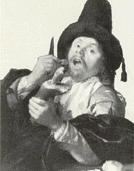
cover illustration from La Distinction |
Taste therefore is a badge of class. Our culture defines us as members of a particular social class, and distinguishes us from individuals in other social classes. Bourdieu's Distinction: A Social Critique of the Judgment of Taste (1979) is based on the empirical research he and others carried out in France between 1963 and 1968. It shows how distinctions based on social class get reinforced in daily life.
|
He argues that power defines taste (see meaning of distinctions). The judgement of taste (of what is beautiful and pleasing) is called aesthetics. Bourdieu argues that each class has its own aesthetic, but that the tastes of subordinate classes are culturally dominated by those of higher classes.
Even when the subordinate classes may seem to have their own particular idea of 'good taste':
"...[i]t must never be forgotten that the working-class 'aesthetic' is a dominated 'aesthetic' which is constantly obliged to define itself in terms of the dominant aesthetics..." (page 41)
Bourdieu's methodology
Bourdieu's philosophical, theoretical and methodolical
concerns are intrinsically related to his empirical work. His sociological
practice tries to overcome the division between objectivism and
subjectivism, between the positivist approach of quantitative research and
the subjectivism of interpretative sociology and qualitative research.
Bourdieu described his approach as genetic structuralism, arguing that
While Bourdieu might be recognised as a structuralist and believed that
structure pre-exists action, he distanced himself from classical
structuralism, as he found it too deterministic in the way it shifts from
structure to practice (Nash, 1990:433). Bourdieu (1989:14) classified his
view of structuralism as a constructivist structuralism, where
constructivism stands for the twofold of Bourdieu's sociology, (earlier
explained as subjectivism and objectivism) the subjective notion of values,
perception, norms and action summing up what Bourdieu called the 'habitus',
and on the other hand the objectivist social structures that inform these
thoughts and actions, which Bourdieu regarded as 'fields'.
Bourdieu's concepts
capital -
class -
Cultural capital
-
distinctions -
economic
capital -
field -
habitus -
objectivism -
position -
social capital -
social space
-
subjectivism -
symbolic capital
"sociology must approach social life with a focus not only on
structure but on individual actions and intersubjective meanings"
(Seidman, 1994: 152).
|
John Bowlby
Born 26.2.1907 Died 2.9.1990 |
books - web links |
Henry Peter Brougham
Born 1778, died 1868
Founder of the Social Science Association in 1857. Brougham was one of the founders of the Edinburgh Review in 1802. He moved to London in 1805 and became a barrister in 1808. He became a member of Parliament in 1810 and carried an Act that made it illegal to participate in the slave trade. He was the defence counsel for the Hunts when they were tried (in December 1812) for libelling George, the Prince Regent. In 1820 he defended Queen Caroline when George (now King) tried to divorce her. In 1822 he supported an unsuccessful scheme for national education. He was a major influence on founding the Society for the Diffusion of Useful Knowledge in 1826, and was a member of its General Committee. He was one of the founders of London University. In 1828, Brougham made a six hour speech, on which he consulted Jeremy Bentham, summarising the faults with the legal system. From November 1830 to December 1835, Brougham was Lord Chancellor. A commission intended to codify the criminal law, was appointed in 1833. Brougham was not an uncritical follower of Bentham, but he says that "the age of law reform and the age of Jeremy Bentham" were the same thing, and that Bentham was the "first legal philosopher" who had appeared in the world. (Leslie Stephens 1900 - external link)
Spartacus school-net
Edmund Burke
Edmund Burke (1729-1797), the author of
Reflections on the French Revolution, published in
November 1790 criticised the French because
See Conservative
theory -
Social Science History Chapters
three -
four -
six -
Conservatism versus
progress -
Autumn 1793 -
"you chose to act as if you had never been moulded into civil society and
had everything to begin anew. You began ill, because you began by despising
everything that belonged to you... Respecting your forefathers, you would
have been taught to respect yourselves. You would not have chosen to
consider the French as a people of yesterday, as a nation of lowborn
servile wretches until the emancipating year of 1789... in your most
devoted submission you were actuated by a principle of public spirit ... it
was your country you worshipped in the person of your king"
(Burke. E. 1790,
par.61
| Bernard Burgoyne | books |
Bernard Burgoyne is a mathematician, a philosopher and a psychoanalyist who taught sociology for many years. He interested me in the relation between mathematics and social science, from the influence of Euclid's geometry on Hobbesian constructions of society to his presnt interest in topology as a way of comprehending aspects of mind, self and society.
|
Cyril Burt
Born 3.3.1883 Died 10.10.1971 |
books |
School psychologist for the London County Council 1913-1931
Professor and Chair of Psychology at University College, London 1931-
1951 (?) in succession to
Charles Spearman
Amy Gdala (2003, p.36) introduces Cyril Burt as "the inventor of the cunning device known as the Intelligence Quotient or I.Q. score, by which each British citizen in the mid-twentieth century was graded for allocation within a division of labour that would significantly determine subsequent opportunities, talents and quality of life."
In 1931, Cyril Burt wrote:
" From the point of view of educational organisation, one of the most important facts revealed by intelligence tests is the wide range of individual differences, and its steady expansion from year to year. At the age of 5, children are spread out between the mental ages of about 3 and 7 - a total range of four or five years. By the age of 10 the range has doubled; and probably goes on enlarging until the end of puberty. "
" Older children, therefore, differ far more widely in intellectual capacity than younger children. During the infant period they can be grouped together without much regard to their different degrees of mental endowment. At the age of 8 or 9, however, to put together in a single room all those who are of the same age would be to organise a class that was extremely heterogeneous. By the age of 10, the children of a single age group must be spread over at least three different standards. And by the age of 12 the range has become so wide that a still more radical classification is imperative. Before this age is reached children need to be grouped according to their capacity, not merely in separate classes or standards, but in separate types of schools. "
In 1970, writing to Julie Ford, Cyril Burt said:
"The humblest types of operation require little more than unskilled manual labour. Although machinery is gradually taking over much that was previously performed by human muscle, dockers, navvies, and agricultural labourers will still be required for many centuries to come. Skilled manual labour requires not only greater intelligence, but also an aptitude for acquiring mechanical dexterity, which not everyone possesses. Clerical work and shopkeeping require intellectual abilities of a slightly higher order: The lower types of professional work, journalism and accountancy, for example, demand higher intelligence still and certain specific aptitudes, e.g. so-called 'verbal' and 'numerical' ability, which are partly innate. Administrative work and the higher professions - medicine, teaching and the law - require exceptionally high intellectual ability and a long preliminary training." (Burt, C. 1970 in Gdala, A. 2003, p.40)
Referring to Table 12 (p. 56) in Social Structure of England and Wales, Cyril Burt says
"broadly speaking, occupations requiring an average or medium degree of ability are by far the commonest... those requiring the highest and rarest degree of ability are comparatively few. I suggest therefore that what is needed is, not the abolition of classes, but the matching of each individual's occupational class with his innate abilities" (Burt, C. 1970 in Gdala, A. 2003, p.40)
|
Judith Butler
Born 24.2.1956 |
books -
notes and quotes
lecture notes |
"I grew up understanding something of the violence of gender norms: an uncle incarcerated for his anatomically anomalous body, deprived of family and friends, living out his days in an "institute" in the Kansas prairies; gay cousins forced to leave their homes because of their sexuality, real and imagined; my own tempestuous coming out at the age of 16; and a subsequent adult landscape of lost jobs, lovers, and homes." (Butler 1999 p.xix)
Like Foucault, Butler tends to ask us provocative questions rather than creating a system in which she invites us to believe. Here is one of her questions:
"Is there a way to link the question of the materiality of the body to the perfomativity of gender? And how does the category of "sex" figure within such a relationship?"
Judith Butler in 2008 |
Judith Butler is the author of
Gender Trouble: Feminism and the Subversion of
Identity
(1990), in which she argued against a
biologically determined
gender identity.
Judith Butler reinterprets Simone De Beauvoir's suggestion that "one is not born a woman, but, rather becomes one". De Beauvoir can be read as making a distinction between gender and sex in which gender is socially created around the natural body of sexual differences. Butler argues that "there is no recourse to a body that has not always already been interpreted by cultural meanings; hence, sex could not qualify as a pre discursive anatomical facticity. Indeed, sex, by definition, will be shown to have been gender all along". (Butler, 1990 p.8). Judith Butler uses some of Michel Foucault's ideas about the construction of self-identity to develop a performative theory of gender which argues that our sex is not something fixed and determinate, but something which is much more fluid and open. Butler develops the idea of Foucault, in a chapter called "docile bodies", that society inscribes on our bodies what we are. |
The idea of perfomativity has a relationship to the idea of performance, but the emphasis is on the way discourses shape us rather than on our creatively acting a role. Looked at from this more active perspective, Butler argues that gender is something we continually act out, or perform, in everyday life. It's analogous to a drag artist performing a male or female character. But it is more habit than creativity. Creative performance, however, is needed to subvert the perfomativity that we are given.
Timeline: Pope Benedict 16: December 2008 against gender theory - 21.12.2012 joins Chief Rabbi in support of natural women.
|
Peter Campbell
Born 1948, "a regular recipient of NHS psychiatric services since 1967"
Honorary Doctor of Education, Anglia Ruskin University 2010
Peter pioneered the publication of survivor history and is the leading British survivor historian. |
From the Anglia Ruskin Citation:
Peter Campbell is a survivor of the mental health system and as a writer and poet he has devoted his life and incredible talents to the pursuit of survivors' rights and justice.
In 2006, Melvyn Bragg presented Peter with the MIND Diamond Champion Award for the person who had done most for users of mental health services in England and Wales in the last 60 years.
Described as shy, self-effacing and highly intelligent, Peter Campbell has spent 25 years battling with the government and the mental health system for survivors' rights. Raised in the Scottish Highlands, Peter's late teenage years were spent confronting mental distress. Long stays in hospital and asylums, which curtailed his academic career at Cambridge, also prevented him from maintaining continuous paid employment. It was in 1983 that he changed his life and began an involvement with mental health activism coupled with poetry and performance which has lasted until the present day.
'There is a pleasure madmen know' is the opening line of the first poem in Peter's poetry collection entitled Brown Linoleum Green Lawns, a review of asylum life and care in the community observations.
Peter was a member of Camden Mental Health Consortium in the 1980s, one of the early local survivor action groups. In 1986 he was a founder member of Survivors Speak Out, a national networking group and played a prominent part in the organisation over the next ten years. In 1991, he and three other survivor poets set up Survivors' Poetry, providing workshops and performances by and for survivors. It is still a flourishing group. Peter has always believed that involvement in collective actions of this kind with other survivors enabled him to turn his life around.
By the 1990s he was able to construct a professional life as a freelance writer, consultant and trainer. He is a gifted poet and performer, writes extensively on mental health issues, and trains psychiatrists, psychologists, nurses and other health professionals.
Until 2000 Peter never considered himself a disabled person because he does not consider a mental health problem to be an impairment. However in 1999 Peter experienced a sudden, major hearing loss and has become progressively deaf. He now uses hearing aids, lip reading, induction loops and note takers to continue with his award-winning work.
Peter strives to help people to change their lives for the better. He believes that educating psychiatrists and clinical psychologists offers survivors a great opportunity for long term beneficial change.
His greatest hope is that the general public gets to hear about and appreciate the achievements of collective action by service users and survivors as it is only through this action that people can get involved in service changes with a view to shaping better quality services for the future.
|
In 2011, Peter was awarded an
honorary doctorate of the
Open University
for work in areas of special
educational concern to the University
He is the Chair of the Survivors' History Group. |

|
|
Thomas Carlyle
Born 1795, died 1881 |
books |
Thomas Carlyle argued against utilitarianism in a fiction called Sartor Resartus, which he wrote in 1831 (published later). Much of Sartor Resartus is about clothes, in their social context and significance, and so Carlyle can be regarded as a founder of the sociology of clothes.
Sartor Resartus is Latin for "clothes maker repaired", Carlyle conceived of societies as well as individuals having clothes. In the case of societies, the clothes are what was called the spirit of the age. This is what Carlyle argued needed repairing. But let us look at what he says about clothes in the ordinary sense of what we wear on our bodies.
Sartor Resartus argued for a social science based on the analysis of symbols. Clothes are typical social symbols. We are naturally naked, but in society we use clothes to convey meaning to one another. Although the movement of planets may be described on the model of a machine, Carlyle said social science requires the analysis of meanings. Religion had provided this, but, like old clothes, it no longer fits. The times require new clothes. Utilitarianism will not do, because it removes the significance of symbolic meanings, reducing them all to degrees of pain and pleasure in an effort to imitate the machine model used by physics.
In 1843 Carlyle (1795-1881) published Past and Present. This contrasted the human relations that, according to Carlyle, had existed between people in the past, with relations in the present which were reduced to money relations. He wrote (chapter 6)
"...the present Editor ... thinks that 'enlightened egoism' ... is not the rule by which man's life can be led. That 'laissez-faire,' 'supply-and- demand,' 'cash-payment for the sole nexus,' and so forth, were not, are not, and will never be, a practicable law of union for a society of men. That poor and rich, that governed and governing, cannot long live together on any such law of union."
John Stuart Mill was, at this time, a friend of Carlyle. In Manchester, Friedrich Engels read Carlyle with great enthusiasm.
|
Manuel Castells
Born 1924 |
books
Holberg citation |
1996 Manuel Castells' The Information Age: Economy, Society and Culture volume one "The Rise of the Network Society" - 1997 volume two: The Power of Identity - 1998 volume three End of Millennium
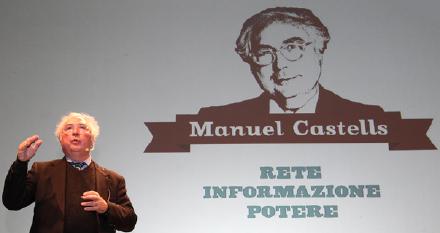
|
Network
Photo by Paolo Sacchi - 7.11.2012 - Teatro dell'arte Milan, Italy |
According to Manuel Castells, writing in 2005,
"Our world has been in a process of structural transformation for over two decades. This process is multidimensional, but it is associated with the emergence of a new technological paradigm, based in information and communication technologies, that took shape in the 1970s and diffused unevenly around the world" (Castells, M. 2005, p.3)
Castells argues that information technology networks, particularly the internet, are the defining organisational feature of society today. He says that we live in a network society and a network economy.

|
"The network society, in the simplest terms, is a social structure based on networks operated by information and communication technologies based in microelectronics and digital computer networks that generate, process, and distribute information on the basis of the knowledge accumulated in the nodes of the networks." (Castells, M. 2005, p.7) |
Networks are basically all the formal and informal links which tie people to one another, or to groups. A network society is made possible by the explosive growth of global communications. It is still a capitalist economy, but whereas Marx had argued that capitalism was based on generalised commodity production, Castells argues that computers and telecommunications are the basis of today's capitalist economy (e.g. automated production and financial trading).
Nowadays, enormous amounts of data can be processed simultaneously in different parts of the world. More powerful information and computing systems make it possible to decentralise organisational structures, and create smaller, more flexible types of enterprise.
According to Castells, we have entered a new technological paradigm, 'centred on micro-electronics-based, ICT, of the 'e-enterprise', epitomised by the American Cisco Systems (Castells, 2001, Rise of the Network Society).
2012
Holberg citation
"Manuel Castells is the leading sociologist of the
city
and new information
and media technologies. His ideas and writings have shaped our
understanding of the political dynamics of urban and global economies in
the network society.
He has illuminated the underlying power structures of the great
technological revolutions of our time and their consequences. He has helped
us to understand how social and political
movements
have co-evolved with
the new information technologies.
Castells' trilogy,
The Information Age, offers a comprehensive theory of
the
global
information-based society, associated with urban networks and
media communications. His theoretical insights are grounded in continuing
empirical research into the societal and technological transformations
associated with
media
power. His most recent work, Communication Power, is
an innovative analysis of the ways in which new media technologies can
enable challenges to the concentration of media power, thus reconfiguring
the political sphere.
In his earlier work The
Urban Question (1972) Manuel Castells
questioned
the dominant tradition that explained the form of cities by the operation
of markets across geographical space. Instead, he argued that the
underlying dynamics of urban life involved local struggles for political
power. Castells argued that cities created "collective problems" that
neither traditional capitalist nor classical Marxist models could account
for. In The City and the Grass Roots (1983) he deepened this
analysis of
the city as the product of conflict between social movements and urban
power elites.
In the nineties, Castells' attention shifted to the relation between
globalization and emerging information technologies. His trilogy,
The
Information Age: Economy, Society and Culture (1996-1998),
deepens his
continuing research into urban processes, economic transformations,
technological change, and civic movements. The first volume, The Rise of
the Network Society, had a major impact on our understanding of global
informational capitalism. The Power of
Identity analyzes the civic aspects
of the network society in promoting organised resistance and
new social movements. The final volume, End of
Millennium, is devoted to the
unevenness of the cultural transformations produced in different parts of
the world in response to the new technologies.
Castells' latest book, Communication Power (2009), places the
concept of
power at the core of his analysis of the exercise of corporate power in
culture, politics and society and the role of new media in exerting citizen
power through social movements. Castells has taken thinking about
"the
political" to an entirely new level through his prescient
account of the
emergence of and interaction between new forms of
power in the age of the
network society."
|
George Catlin
Born 1896, died 1979 |
books |
George Catlin was a trans-Atlantic political theorist who helped to develop political science and scientific sociology and also retained a respect for, and worked on, political philosophy as a field concerned with values rather than facts. He saw his work as related to logical positivism and spoke of a need for a "political logical positivism".
Catlin played an important part in the translation and adaption of Durkheim to Anglo-American social science. Whilst rejecting what he regarded as Durkheim's metaphysical concepts, he respected what he understood to be Durkheim's approach to social facts. (Catlin, G.E. 1938)
Catlin was both an English Labour politician and a USA academic. An anti- imperialist and anti-racist, he supported the struggles of Mahatma Gandhi for Indian independence.
Born in Liverpool, Catlin graduated from Oxford University and his post-graduate research developed into a short study of Thomas Hobbes. Francis Wormouth said of the politics of Catlin:
"The atomism of Hobbes, his reduction of politics to individual will and power, and his concern for psychology are all found in Catlin's system. The fiction of the Leviathan, however, is not found there; and the metaphysics of Hobbes is replaced by a thoroughgoing empiricism and an extensive reliance on history both as the source of data and as the proving-ground of hypotheses." (Wormuth, F. 1961, p. 807)
1923 Appointed to lecture at Cornell University, New York.
Catlin married the English novelist Vera Brittain (1893 - 1970) in 1925, and their children included Shirley Williams (born 27.7.1930) English politician and USA academic.
Catlin was supervising a translation of Durkheim's Rules of Sociological Method in November 1933 when his student George Simpson published a translation of Division of Labour in Society. The English translation of the Rules, with an introduction by Catlin, was not published until 1938
Catlin rejects much of what is central to Durkheim's work. Almost six pages of the 26 page introduction are devoted to attacking the concept of the collective consciousness. The preceding four pages criticise the idea of determination in history and society, which Catlin says Durkheim adopts as "the manifestation of the will or purpose of some occult collective mind" (pp xxii-xxiii). A further five pages criticises Durkheim's attempt to create a "science of morality", and most of the remaining pages are mainly critical. (See summary of sections)
However, Catlin says:
"Durkheim... is not singular among men of science in being more valuable in respect of the by-products of his theory than in his main contention." (Catlin, G.E. 1938 pxiv)
|
Judi Chamberlin
Born 30.10.1944, died 16.1.2010 |
books and articles |
No mental patient since Clifford Beers attracted such worldwide attention as Judi Chamberlin. Clifford had nurtured the mental health movement of the first half of the 20th century. His work culminated in 1948, with the founding of the World Federation for Mental Health. But he had already died in an asylum in 1943. Judi Chamberlin was born the next year. Clifford was open about his experiences of mental distress but he was quiet about the network of fellow-patients who had supported him and kept him in touch with issues. The times had not been propitious for collective action. Judi inherited the new world that the courage of Clifford and his secret friends had helped to create. Her life and work was to nurture not the worldwide mental health movement, but the worldwide movement of mental health users, victims and survivors.
|
Harriette Chick
Born 6.1.1875, died 9.7.1977 |
Harriette Chick was the third (surviving to adulthood), and best known, of the fantastic Chick sisters, whose network of friends included Charlotte Mew ("Lot") and Marie Stopes ("Stopey"). Her great- grandmother, Abigail Chick (1781-1858), founded the Chick's Honiton Lace business. The sister's came from a family in which women were used to taking the initiative and running matters.
1894-1895 Awards for botany, University College London
1896 The senior-class Gold Medal in 1896.
1901 A scholarship enabled Harriette to research in Germany and then Liverpool. Biochemistry had been founded in Germany in the 19th century and the first British department of biochemistry was founded at the University of Liverpool in 1902.
Harriette began research in Vienna on the nitrification process in sewage disposal in 1901. She then returned to England (Liverpool?) for two years, during which she worked for The Royal Commission into Sewage Disposal. Her research at this time was largely focused on green algae that live, in association with bacteria, in waters polluted by sewerage. As well as developing methods of creating pure cultures of the algae, she developed methods of studying bacteria in symbiotic association.
1903 D.Sc from London University. In 1903 she went to Munich, to resume her work on the nitrification process in sewage disposal, the results of which were presented to the Royal Society in 1905.
1908 "Chick's Law" gives the relationship between the kill efficiency of organisms and contact time with a disinfectant. It was modified by H.E. Watson to include the coefficient of specific lethality and the Chick-Watson Equation is still used. (Wikipedia)
5.9.1913 One of the three women amongst the seven new members elected to the Biochemistry Club
1915 went to the Lister Institute in Elstree to test and bottle tetanus antitoxin for the army.
1922 With Dr. Elsie Dalyell, she led a team from the Lister Institute and the Medical Research Institute to study the relation of nutrition to bone disease. They discovered the nutritional factor causing rickets, and proved that fat-soluble vitamins present in cod liver oil, or exposure to ultra violet light, could cure and prevent rickets in children. She worked at the Lister Institute for over fifty years, and isolated vitamin C in various other fruits and vegetables. [Wikipedia]
1934 to 1937 Secretary of the League of Nations health section committee on the physiological bases of nutrition from
1941: a founding member of the Nutrition Society. President from 1956 to 1959.
|
Richard Crocket
Born 7.2.1914, died 3.12.2007 |
books and articles |
Born 5.1.1916, died 8.1.1984
See David Millard - Craig Fees - Glasgow Royal Mental Hospital - Cassel Hospital 1940 - Ingrebourne. Also compare with Jean Oury in France and and Wolfgang Huber in Germany.
Richard Crocket was a mid-twentieth century theorist of the therapeutic community. Like John Conolly before him, he reflected and built on his organisational circumstances and the work of others within those circumstances. Of the doctor beneath him at the Ingrebourne Centre,in Essex in 1957, he wrote:
"Dr Hamish Anderson, a senior psychiatrist, introduced social group methods of treatment there which he had known at Dingleton Hospital in Scotland. The results were so stimulating, not to say startling, that the staff became committed to these methods. At first they knew them as their own venture into social therapy. Then came information from Dr Maxwell Jones's activities at Belmont Hospital; and we realised that by a different route we had stumbled upon what was beginning to be known as a therapeutic community." (Crocket 1997, quoted by David Millard)
Crocket's concepts: community - network - social network - structure - power and decision-taking - authority and permissiveness.
|
Charles Darwin
Born 1809, died 1882 |
timeline -
weblinks
books |
|
Thomas Henry Huxley
Born 1825 - Died 1895 |
timeline - weblinks |
Charles Darwin did not invent the theory of evolution - that had existed for a long time. He did make a credible case that evolution operated by a process of natural selection. This helped to convince scientists that evolution could be believed in as the way the different forms of life came into being. Within science, this was very contentious for many years. In the 1890s, for example, the Linnaean Society carefully awarded its gold medal equally to scientists who supported Darwin and scientists who opposed him.
Some people argue that Darwin developed his theory of natural selection as a result of careful observation. They point to the voyages from 1831 to 1836 on which he carefully noted the way birds varied from island to island. Other people argue that he developed it as a result of theoretical speculation. They point to his reading Malthus on population in 1838
Timeline links See primeval family - primeval migration - 1831 - 1838 - 1859 - 1871 - 1872 - 1893 -
|
Humphry Davy
Born 17.12.1778, died 29.5.1829 |
Humphry Davy pioneered electro-chemistry. His fame had started when he experimented on himself with laughing gas when working in Bristol on the medical uses of gases. Then, in 1800, two other chemists decomposed water into gases (hydrogen and oxygen) by passing electricity through it. Electricity generated by batteries was a new and exciting discovery that many were trying to put to scientific use. Working in the Royal Institution's new and advanced London laboratories, Davy began the decomposition of matter into its elements by means of electricity. He came to the conclusion that electricity is a force that can not only split matter, but also holds all matter together in some way. Electricity is the clue to the decomposition and reconstruction of the matter of the universe and those who explore with it can get close to understanding how creation works.
The Royal Institution, where Davy worked, was founded in 1799/1800 to teach
"the application of the new discoveries in science to the improvement of arts and manufactures."
Davy was well known for his dramatic public experiments. A famous cartoon shows him as part of a group demonstrating nitrous oxide (laughing gas).
|
Simone de Beauvoir için sürpriz doodle -
best independent quotes -
guardian quotes
106 Aniversario de Simone de Beauvoir |
|
Had she lived, she would have been 106 on Thursday 9.1.2014
Click on the Google doodle for the Google doodle video. It does not tell you why Google celebrated her 106th birthday. |
| Lecture: Simone De Beauvoir's sociology in historical context |
|
Simone de Beauvoir
Born 9.1.1908, died 14.4.1986 |
books -
weblinks -
extracts
100th anniversary - Pope against |
French philosopher, novelist and social theorist who provided an ethics for existentialism in her Pour Une Morale de L'ambiguïté [English translation: "The Ethics of Ambiguity"] in 1947.
In 1949, she published Le deuxième sexe [English translation: "The Second Sex"]. Watch the video - [a different video]
In the first chapter of the second volume of this, a chapter on childhood, she wrote (French and then English translation):
"On ne naît pas femme: on le devient. Aucun destin biologique, psychique, économique ne définit la figure que revét au sein de la société la femelle humaine; c'est l'ensemble de la civilisation qui roduit intermédiaire entre le mâle et le castrat qu'on qualifie de féminin. Seule la médiation d'autrui peut constituer un individu comme un Autre."
"One is not born, but rather becomes a woman. No biological, psychological, or economic fate determines the figure that the human female presents in society; it is civilisation as a whole that produces this creature, intermediate between male and eunuch, which is described as feminine. Only the intervention of someone else can establish an individual as an Other." [More... ]
"no factor becomes involved in the psychic life without having taken on human significance; it is not the body-object described by biologists that actually exists, but the body as lived by the subject. " [More... ]
Being a woman in a particular culture is a transaction between the woman and the culture, in which the culture is the dominant partner. Civilisation treats men as self-determining, but women as existing for the sake of men. But the essence of being human, of whatever gender, according to De Beauvoir, is to be self-determining. Women are "tricked" into accepting that it is otherwise.
"she stands before man not as a subject but as an object paradoxically endued with subjectivity; she takes herself simultaneously as self and as other, a contradiction that entails baffling consequences" [More...]
According to De Beauvoir, a world in which men and women are equal had already been thought of (although not achieved)
"A world where men and women would be equal is easy to visualize, for that precisely is what the Soviet Revolution promised: women raised and trained exactly like men were to work under the same conditions and for the same wages" [More...]
Timeline 1975 Communists spat on The Second Sex: (very free translation of a French summary)
Being a woman is not something given by nature, it is the result of the history of all civilisation, and the result of the individual history of her life from childhood.
One small part of her body becomes her destiny.
But biological differences do not make the difference in status, they are a pretext around which the status of women is built as they are subjected to exploitation and oppression.
De Beauvoir gives historical examples of the will of men to exclude women.
She tells how she herself became aware of the truth about the status of women.
She escaped this condition as an intellectual, refusing marriage and motherhood. But it was by writing The Second Sex that she saw the truth about women.
Many women are not feminists and do not hear the cry of other women.
A large proportion of women are mothers who maintain the housewife tradition under pressure from men. In the period since the Second Sex (1949- 1975), there is still a terrible dependence on the husband, and many women are trapped in subjection by economics.
Men have the interesting professions, women are confined to household work, in return for which they are maintained more or less by a husband. If women were to revolt against this design, the whole of society would be transformed.
The response to The Second Sex revealed that many socialists, communists and other left-wingers were reactionary conservatives on this issue. Communists, as a whole, spat on the book. Women's issues should, they argued, be subordinate to the problems of classes. They also believed that change of society from capitalism to socialism (communism) would be enough to make the situation of women equal to that of the man. The situation in the socialist countries should be enough to make one quickly abandon such opinions. De Beauvoir argues that feminist activism is vital. The feminist movement has an important role to play in history. The important thing is that women meet together, talk to one another, and together find solutions. Such movements are impossible in the communist countries.
A large part of feminism and the beginning of the fight back began in the revolution of 1968. Each section of participants was to take its own business in hand. Awareness was very strong at that time.
Timeline: Pope Benedict 16: December 2008 against gender theory - 21.12.2012 joins Chief Rabbi in support of natural women and against De Beauvoir.
|
Rene Descartes
Born 1596, died 1650 |
Cartesian
books |
French philosopher. One of the founders of European rationalism. (Where I outline his ideas)
Descartes argued that it empirical evidence is insubstantial, but one's own existence is certain, because in order to think you must be:
"I observed that, whilst I thus wished to think that all was false, it was absolutely necessary that I, who thus thought, should be somewhat; and as I observed that this truth, I think, therefore I am (cogito ergo sum), was so certain and of such evidence that no ground of doubt, however extravagant, could be alleged by the sceptics capable of shaking it, I concluded that I might, without scruple, accept it as the first principle of the philosophy of which I was in search"
From this first principle, his reason deduced, in no more than the turning of a page, that God exists and that truth lies in clear conception.
Cartesiain Relating to Descartes
Cartesian space
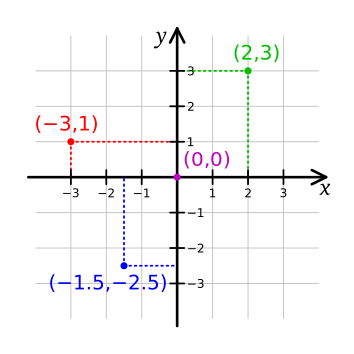
|
Through Descartes view of space we can relate
geometry and
algebra.
See
graph
See the Wikipedia article on the Cartesian coordinate system, which says "One can use the same principle to specify the position of any point in three-dimensional space by three Cartesian coordinates" |
|
A three dimensional Cartesian coordinate system, with origin O and axis
lines X, Y and Z, oriented as shown by the arrows.
The black dot shows the point with coordinates x = 2, y = 3, and z = 4, or (2,3,4). |
|
John Dewey Born 20.10.1859, died 1.6.1952 |
books - weblinks - |
1859 - 1884 - 1894 - 1896 - 1904 - 1909 - 1916 - 1920 - 1922 - 1927 - 1930 - 1931 - 1935
An American philosopher who initiated a version of Pragmatism: a philosophical concept, which evaluates thought on the basis of usefulness for practical action.
At Johns Hopkins University, John Dewey was attracted to both the biological evolution ideas of Thomas Henry Huxley, the friend of Darwin, and Hegel's, earlier, historical analysis of the evolution of ideas. This was a perspective he shared with his friend George Herbert Mead
Dewey argued that it is only in the struggle of intelligent organisms with the surrounding environment that theories acquire significance, and only with a theory's success in this struggle that it becomes true. He rejected abstract conceptions of "truth", and quoted Charles Sanders Peirce (1839- 1914) the founder of American pragmatism) to define what truth is to him.
"The opinion which is fated to be ultimately agreed to by all who investigate is what we mean by the truth, and the object represented by this opinion is the real." (Dewey, J. 1938/Log, p. 345, quoting from volume 5, p.268 of the Collected Papers of Charles Sanders Pierce)
According to Dewey, the organisation of society does not grow out of ideas. For example, the American political system is not formed around the concept of democracy. It is the other way round. On the basis of changes which occur, and forms of active organisational practices, we develop ideas about community life.
In Reconstruction in Philosophy (1920), Dewey give this description of society:
"..society is one word, but infinitely many things. It covers all the ways in which by associating together men share their experiences, and built upon common interests and aims. (Dewey, J. 1920/RP, p. 200) "Society is the process of associating in such ways that experiences, ideas, emotions, values are transmitted and made common." (Dewey, J. 1920/RP, p. 207)
|
Wilhelm Dilthey Born 1833, died 1911 |
books - weblinks - |
Emile Durkheim Born 15.4.1858, died 15.11.1917
|
Life and
works
See Social Science History, chapter six:
Durkheim is often contrasted with Spencer and with Weber See also Oby Barnes and Dina Ibrahim on family - education etc - Andrea Nagy's Durkheim Dewey Page and the Durkheim and Merton page |
|
|
Durkheim is often thought of as the founder of sociology, the
science of
society. He developed
Rousseau's
concept that society is not the sum of its individual members,
but is a
reality in itself, based on the general will. Durkheim removed
this from
its origin in
State of Nature Theory. He
argued that
humans
are by nature social. Society is not something that came about
by
individuals joining together. We have always been part of
society. Society
is, therefore, a reality which we can study, and Durkheim's
project was to
develop the scientific study of it.
See Social Science History, chapter six: Durkheim and Weber's contrasting imaginations: Who is the Sociologist?, for a fuller discussion of the issues |
crime
|
Durkheim's concepts society - altruism - anomie - categories of thought - church - collective conscience - collective representations - crime - division of labour - education - elementary forms - egoism - emotion (sentiment) - facts as things - forced and natural - freedom - function - habit - organism - profane - punishment - rate - religion - rules - sacred - social facts - space -
See also Group (types of) - institutions and mind - internalise - movement - Positivism - Pragmatism - Realism - sacrifice -
Timeline links See 1786 - 1822 - 1841 - 1858 - 1860 - 1880 - Durkheim and Weber - 1885 - 1887 - 1892 - 1893 - 1895 - 1896 - 1897 - 1901 - 1902 - 1903 - 1912 - 1917 - 1925 - 1937 - 1942 - 1967 - 1987 - 1989 - 2006 -
Emile Durkheim's view of society, anomie and crime
|
Albert Einstein
Born 1879, died 1955 |
books |
Einstein was a theoretical physicist who created the general theory of relativity. This rejects an important part of Newtonian physics which treats space and time as fixed dimensions that provide a framework for all the bodies in the universe. Instead, it considers space and time as relative to the viewpoint of the observer and the object or process being observed. See proof
John Etienne Dominique
Esquirol
Born
1772,
died
1840
A student of Philippe Pinel who succeeded him as physician in chief at the Salpêtrière Hospital in Paris in 1811. In 1823 he became chief inspector at the University of Paris and in 1826 he was appointed chief physician at the asylum in Charenton, France. In 1838 he collected and amended his writings (from 1812) into Des maladies mentales, considées sous les rapports medédical, hygienique et médico-légal published in Paris. This was translated into English as Mental Maladies. A Treatise on Insanity in 1845 (Philadelphia). Several parts were translated individually much earlier and Esquirol's ideas were circulated in England by a number of doctors.
Euclid
300BC -
about
1120 -
1482 -
About 300BC Euclid taught in Alexandria, Egypt.
Building on the
practical
geometry
of the Egyptians,
Euclid laid the foundations of theoretical geometry
Read:
Euclid's axioms
| Family | a part of society |
One of the reasons family is discussed by social theorists is its theoretical implication for social theory generally.
Robert Filmer, in the 17th century, and and Roger Scruton, in the 20th, for example, both construct views of society around the idea of family. Both theorists contrast the idea that "contract" is the foundation of society, with their own view that society is better understood by thinking about the relations that exist in the family, between parents and children. Scruton sees the family model as a "conservative" model and contract as the "liberal" model.
The title of Jean Jacques Rousseau's The Social Contract shows that it is in the contractual, liberal camp. However he combines his contractual theory with an analysis of family bonds as the basis of society:
"The family then may be called the first model of political societies: the ruler corresponds to the father, and the people to the children; and all, being free and equal, alienate their liberty only for their own advantage."
Family relations include those between adult partners as well as those between adults and children. Aristotle conceptualised the difference between these relations, but wives have often been thought of theoretically as similar to children in their relation to the male "head" of the household.
Harriet Taylor and John Stuart Mill, two liberal theorists, argued in an 1848 essay that an authoritarian, hierarchical, paternalist relationship in which women are dependent on men is unsuitable to a modern society based on self determination. Mill elaborated on this in The Subjection of Women (1869), arguing that egalitarian families would educate people for democratic political societies.
Sigmund Freud contrasted his theories of society and human relations, based on an analysis of the unconscious mind, with the consciously rational analysis of Mill (and Taylor). Mill imagined society and family based on freely determined relations been autonomous adults, educating children in a school of freedom. Freud analysed the family as the site of deadly conflicts, conflicts that are paralleled in society and history.
One of the issues in dispute between these theorists is the nature of science. Those who support the family model against a contract model tend to argue that their model is based on analysis of what is real (a "thing" as Durkheim would say) rather than on a philosophic rationalism that relates more to what some people might want society to be then to what it is. (See the positivist distinction between science and philosophy)
History of the family: Historically the family has taken different forms. Engels argues that the study of these forms began with a German writer Bachofen in 1861. To gain an broad overview of the forms Engels suggests, see my Summary of Historical Materialism which has links to extracts from Engels.
| Robin Farquharson | books - timeline - Wikipedia |
The following brief biography appears at the start of Drop Out
"Robin Farquharson was born in Pretoria, Transvaal, in 1930 or 1940, he's not quite sure, and holds the degrees of B.A. (South Africa), M.A., D.Phil (Oxon) and Ph.D. (Cantab). He has also studied at the Sorbonne. In 1961 his thesis, Theory of Voting, was awarded the Monograph Prize of the American Academy of Arts and Sciences in the field of the social science; it has been published in both America and England. In 1965 his South African passport was withdrawn as a result of the part he had taken in lobbying on behalf of SAN-ROC for South Africa's exclusion from the Olympic Games; he became a British subject in 1968. His address is The Lambeth Commune, 23 Newport Street, Lambeth Walk, London, SE11."
1958 His Doctor of Philosophy thesis An approach to a pure theory of voting procedure Nuffield College, Oxford
1959 Robin Farquharson wrote the chapter "South Africa 1958" in David Butler's Elections Abroad (Macmillan; St. Martin's Press, 1959.
1964 Robin Farquharson's Research Fellowship at Churchill College, Cambridge. "the wrench I felt resigning my Churchill College fellowship after one year and three nervous breakdowns. Marvellous folk, they gave me £3,000 journey money... under the control of two trustees... [who] let me take it out of the trust account to present to the Home Office, a little disturbed already by my two certification orders, with proof of my means". (Drop Out pages 10-11)
1965 Robin had his South African passport withdrawn in 1965 and became a British Citizen in 1968
6.11.1967 Robin Farquharson dismissed from his job in computer programming for "taking liberties" - decision to "drop out" (leaving his money in the bank and his furniture with friends). The first entry in his book about this is Monday 20.11.1967 - Which may have been the day he walked into Anthony Blond's office and secured a £2 a week advance on a book about his experiences.
|
The first edition of Drop Out by
Robin Farquharson was published in
1968. Its cover had this cartoon of Robin. In the preface (dated
30.1.1968), he wrote
"I am a manic-depressive. When I'm up, I have no judgement, but fantastic drive; when I'm down, I have judgement, but no drive at all. In between I pass for normal well enough." (See Chaos Invocation) |
1968 BIT and squatting. See also Bitman
June? 1972 Gartloch: Robin Farquharson is member number 00034 in the SUMP (Scottish Union of Mental Patients) membership list. He is the first not from Hartwood. Under "hospital" it says "Gartloch (7) transferred to Epsom". The story I remember being told is that Robin was confined (on this occasion) after succesfully ordering a (military?) aeroplane - or aeroplanes.
4.7.1973 Robin Farquharson House
|
William Farr
Born 1807, died 1883 |
books and weblinks |
English Statistician. Superintendent of the statistical department of the registrar-general from 1838 to 1880. He wrote many articles on medical matters before being appointed to the statistical department. Some of these were published in Thomas Wakley's journal The Lancet. Farr's article Vital Statistics was published in 1837 in MacCulloch's Account of the British Empire. Vital here means life. Farr was using statistics to study life and death. How he did so can be seen in his Report on the Mortality of Lunatics to the Statistical Society in 1841
Concepts: vital statistics: the statistics of health, sickness, diseases, and death - - excessive mortality and implicit natural death rate distinct from the statistical norm. Table. Life Table
William Ogle (1827-1912) succeded Farr as Superintendent of Statistics from 1880 to 1893. (See Edward Higgs)
John F. W. Tatham (1844-1924) was superintendent of statistics from 1893 to 1909 (See Edward Higgs
Thomas Henry Craig Stevenson (1870-1932) was superintendent of statistics from 1909 to (See Edward Higgs)

|
Ludwig Andreas Feuerbach
Born 28.7.1804 - died 1872 |
German philosopher and theologian. Born at Landshut, Studied under Daub in Heidelberg and after 1824 under Hegel in Berlin. In 1828 he became Privatdozent in philosophy at Erlangen; but very soon he retired to a private life of scholarship. After 1860 he lived on the Rechenberg, near Nuremberg.
Author of the influential The Essence of Christianity in 1841. This argued that Christianity is a necessary phase of human culture whose essence is to understand human potenial in a heavenly rather than an earthly form.
Feuerbach's earth-centred (rather than heaven-centred) view of religion has been described as anthropological and as humanist
His thought (along with Hegel's) strongly influened the theories of Marx and Engels. About The Essence of Christianity Engels wrote
""One must himself have experienced the liberating effect of this book to get an idea of it. Enthusiasm was general; we all became at once Feuerbachians."
|
Filmer claimed that the family is the natural form of government and that states are developed from it. Like Scruton today, he thought that imagining political society as a contract between people is unrealistic, and that the family is a better model for understanding political society. Filmer was an enthusiastic royalist, who wrote pamphlets in defence of the authority of the state, arguing that kings have a divine right to rule. He had a religious and a secular argument: The religious argument derives the ruler's right from Adam, the first man in the world according to the Jewish, Christian and Islamic bibles. God, according to the Bible, made Adam lord over creation and over his wife, and the ten commandments say that people should honour their parents. According to Filmer, this divine right to rule has passed down to all future kings. His secular argument is an attack on the idea that societies are constructed by us, for our own purposes. Filmer says that this is contrary to what we observe. Very little choice enters into the relations of everyday life. We accept what is already established.
|
Robert Filmer owned the Charlton Court Estate in East Sutton, Maidstone, Kent, from 1629, when his father died, until his death.
|
Victor (Vic) Finkelstein
Born 25.1.1938. Died 30.11.2011. |
books |
South African born marxist, imprisoned for anti-apartheid activities, came to the United Kingdom as a refugee in 1968.
Theorist of disability. His articles in The Magic Carpet in 1975 were called "Discovering the Person in 'Disability' and 'Rehabilitation'"
Cartoon from New Internationalist 1992 |
In
the first of these, he imagined a village designed and lived in by users of
wheelchairs.
They fix the height of doors and ceilings lower than outside
the village, as they do not need the extra height. When people who did not
use wheelchairs come to the village, they keep on banging their
heads. This experience teaches them that disability is
socially constructed.
|
To analyse such issues, Finkelstein distinguished between disability and impairment.
|
Ronald Fisher
Born 17.2.1890. Died 29.7.1962. |
books |
British statistician, geneticist and eugenicist.
From 1919 to 1933 at Rothamsted Experimental Station, he pioneered statistical procedures in the design of scientific experiments.
19.4.1922: - "On the Mathematical Foundations of Theoretical Statistics"
1925: Statistical Methods for Research Workers
1930: The Genetical Theory of Natural Selection
1935: The Design of Experiments
|
Julienne Ford
Born 1946. |
books - extracts -
fairy timeline -
life as a Caryatid and others Mary Wollstonecraft and Julienne Ford |
1946?. "By the early spring of 1962... she was sixteeen" (Gdala, A. 2003 p.15)
1969 In Social Class and the Comprehensive School, Julie Ford attempted to test the final two, out of seven, propositions in a theory about comprehensive schools:
Proposition six Movement from a tripartite to a comprehensive organisattion of secondary education will cause:
(a) a greater development of talent
(b) a greater equality of opportunity for those with equal talent
(c) a widening of children's occupatuonal horizons
(d) a relative decline in the social interaction in school which takes place within the boundaries of anticipated occupational strata, and a relative increase acros such strata.
Proposition seven Conditons (C) and (D) will produce a tedency to greater frequency of flexible hierarchic models of stratification over rigid dichotomous models.
These propositions, she said, suggested five hypotheses:
1. Comprehensive schools will produce a greater development of talent than tripartite schools
2. Comprehensive schools will provide a greater equality of opportunity for those with equal talent.
3. The occupational horizons of children in comprehensive schools will be widened relative to those of children in trpartite schools
4. Comprehensive school children will show less tendency to mix only with children of their own social type than will tripartite school children
5. Comprehensive school children will tend to have views of the class system as a flexible hierarchy, while tripartite school children will tend to see this as a rigid dichotomy
As she examined the evidence for each hypothesis, she came to the conclusion that litle or none of it supported the hypothesis,
Social Class and the Comprehensive School does not have a section on methodology, apart from an appendix on one aspect. However, it generally works on the idea of creating a theory with propositions from which testable hypotheses are inferred, and then subjecting those hypotheses to the risk of not being supported by the evidence. Julie Ford's empirical research appears consistent with her work on methodology that follows.
Research methods and imagination - Bridging the credibility gap between
our inner worlds and the outer world
1975
In
Paradigms and Fairy Tales (1975)
Julie Ford explored the importance of
imagination to science and put forward
the idea that theories are like fairy tales.
Julie Ford says that composing "fairy tales" about the world
is an essential part of science. When we have imagined our fairy tales we
have
to find a way of selecting the ones that are most likely to be true, but
you must first make your fairy tale. She says that
"it is through
imagination and only through imagination that we mortals may transcend the
worlds of taken-for-granted-thoughts-already-thought."
We need to
"soar away
into the freedom of make-believe. For it is there that fairies dwell"
(Ford 1975 p.75).
In her glossary
she tells us, that fairies are ideas, and a
fairy tale is a "connection of ideas in the form of an explanatory story,
or
theory".
Julie Ford's approach is similar to that of Karl Popper (1963). She thinks that science is about thinking up fairy tales and then testing them to see which are falsified.
For some of her time, Julie Ford lives a fairy tale existence with Amy Gdala in what appears to be a parallel universe subject to warps.
|
|
Michel Foucault
Born 15.10.1926, died 25.6.1984 Read his life and ideas outline |
books -
weblinks -
concepts
chronological extracts - other extracts Timeline index and Pearce |
Lecture - psychiatry - criminology - sex
Foucault - a summary - Foucault questions relationships - Foucault and his readers - Foucault and structures of ideas - Foucault on Knowledge and Power
Foucault - a summary
Malcolm Richardson (August 2009 summary) says "Michel Foucault is concerned
with the way in which language and discourse (e.g. bodies of expert
knowledge) shape our ways of thinking and acting. He is particularly
interested in how discourses (e.g. medical, educational, political,
economic) are constructed and used as mechanisms of social and political
control, e.g. in the treatment of patients (medicine, psychiatry),
punishment of offenders (criminology), or the surveillance of whole
populations (government statistics). Knowledge is produced through
relations of power (e.g. clinical practice), and is used to maintain those
relations of power."
Foucault questions relationships
Foucault's general approach tends to be to ask questions about
relationships rather than make assertions about them. For example,
Foucault denies claiming that "knowledge is power" or that "power is
knowledge".
Foucault and his readers
Reader: "Aren't you sure of what you're saying? Are you going to change
yet again, shift your position according to the questions that are put to
you...?... in your next book to spring up
somewhere else and declare as you're now doing: no, no, I'm not where you
are lying in wait for me, but over here, laughing at you?"
Foucault: "... do you imagine that I would take so much trouble and so
much pleasure in writing ... if I were not preparing ... a labyrinth
into which ... I can move my discourse, opening up
underground passages, forcing it to go far from itself. ... I am no doubt
not the only one who writes in order to have no face. Do not ask who I am
and do not ask me to remain the same."
Foucault and structures of ideas
Foucault investigates
structures of
ideas. He calls these structures
"discourses". Examples of discourses include psychoanalysis and
marxism.
He explores
ideas as
structures of power and as
structures of
discovery.
He explores how a structure of ideas, like the ideas that created
institutions based on
surveillance, are related to power.
He explores structures of ideas as a search for truth. He describes
"truth"
as a
"system of ordered procedures" governing statements. Different
discourses have different rules (ordered procedures) for how true
statements are to be produced.
The Greek word episteme means real
knowledge as distinct from
common
belief (doxa). Foucault uses it for general system of
thought to
which
all discourses relate.
He identifies
Foucault on knowledge and power
Foucault on Power
November 1971 -
You
Tube
1975 In Discipline and Punish
Foucault, M.
1975/1977 p.27), Foucault wrote:
1980 The following quotation from an essay entitled "Prison Talk" is
often
quoted as a summary of Foucault's argument about the relationship between
knowledge and power:
Foucault's concepts: See
Clare O'Farrell 2007
-
biopower -
classical
period -
confinement -
continuity -
discontinuity -
knowledge -
madness -
middle ages -
power -
punishment -
renaissance -
sex -
surveillance
"when I read -- and I know it has been attributed to me --
the thesis, "Knowledge is power," or "Power is knowledge," I
begin to laugh, since studying their relation is
precisely my problem. If they were identical, I would not have to study
them... . The very
fact that I pose the question of their relation proves clearly that
I do not identify them."
"In any
given culture and at any given moment, there is always only one episteme
that defines the conditions of possibility of all knowledge, whether
expressed in a theory or silently invested in a practice."
(Foucault The Order of Things)
"two great
discontinuities in the episteme of
Western culture: the first
inaugurates the Classical age (roughly
half-way through the
seventeenth century) and the second, at the
beginning of the nineteenth
century, marks the
beginning of the modem age."
(Foucault The Order of Things)
"Perhaps, too, we should abandon a whole tradition that allows
us to imagine that knowledge can exist only where the power relations are
suspended and that knowledge can develop only outside its injunctions, its
demands and its interests. Perhaps we should abandon the belief that power
makes mad and that, by the same token, the renunciation of power is one of
the conditions of knowledge (and not simply by encouraging it because it
serves power or by applying it because it is useful); that power and
knowledge directly imply one another; that there is no power relation
without the correlative constitution of a field of knowledge, nor any
knowledge that does not presuppose and constitute at the same time power
relations."
"Knowledge and power are integrated with one another, and there is no point
in dreaming of a time when knowledge will cease to depend on power; this is
just a way of reviving humanism in a utopian guise. It is not possible for
power to be exercised without knowledge, it is impossible for knowledge not
to engender power." (Foucault, M. 1980, p.52)
| James George Frazer 1854-1941 | books - extracts |
James Frazer's interest in anthropology was first aroused, in Easter 1883, by reading E. B. Tylor's Primitive Culture (published in 1871). In the autumn of 1883 he met William Robertson Smith, who became his "most intimate friend" (E. O. James, DNB 1959)
At the invitation of Robertson Smith, James Frazer contributed the articles on Taboo and Totemism to the ninth edition of the Encyclopaedia Britannica" (1888). He said that
"The researches I made for these articles', he explained, 'were the beginning of a systematic application to anthropology, and especially to a study of the backward races of men whom we call savages and barbarians." (quoted E. O. James, DNB 1959)
Frazer described Robertson Smith's Lectures on the Religion of the Semites, published in 1889, as marking "a new departure in the historical study of religion". (quoted E. O. James, DNB 1959)
James Frazer first published The Golden Bough: a study in comparative religion in two volumes in 1890. He expanded it to three volumes in 1900. The third edition began to be published in 1911. Extra volume appeared in 1911, 1912 and 1913, and an index volume in 1915. An aftermath volume was separately published in 1936. An abridged edition, by Frazer and his wife, was published in 1922.
|
Sigmund Freud
Born 6.5.1856, died 23.9.1939. |

|
It started with Blanche Whittman's faints. Click the picture to read about her. |
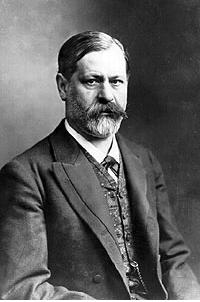
|
Freud was the founder of Psychoanalysis. Psychodynamic describes a theory derived from psychoanalysis
timeline - books -
weblinks -
extracts
life and works Do it yourself excavation of Freud What Freud thought of John Stuart Mill What De Beauvoir thought of Freud Anna Freud 1856 - 1880 - 1883 - 1885 - 1889 - 1900 dreams - 1908 Little Hans - 1908 Strachey - 1908 Bloch - 17.2.1911 England - 1913 totem - 1928 - 1930 - 1933 - 1938 - |
Many theories of human nature and society make reason a central and powerful element. Freud believed that he had discovered a scientific route to a source of human conduct that underlies, and overrides, reason.
Psychoanalysis is a technique of listening to people who have relaxed their guard on what they reveal (to themselves or others) of the contents of their minds.
On the basis of what he heard from his patients, using this technique, Freud claimed that central processes of our thinking are unconscious. A consequence of this is that reason cannot be relied on. When we give a reason for something we do, we are probably making it up - because the true reason is unconscious!
If Freud's basic theories are true, we need to rethink all social theories with reason as a central component. To be scientific, all human conduct needs to be interpreted in terms of a hidden drama that Freud discovered in the human unconscious. In 1913 he wrote:
"the beginnings of religion, morals, society and art converge in the Oedipus complex"
To explain the drama he believed relates the development of individuals and the development of societies, Freud used Greek mythology. He called a vital part of it the "Oedipus Complex" after a character in Greek myth who (unknowingly) killed his father and had sex with his mother.
According to Freud, the "performance" of this drama in our childhood, constructs our character. It is not our genitals that give us male or female personalities, but the roles we play in this drama with respect to our mother (or her equivalent) and her lover (conventionally, our father). Freud, therefore saw a distinction between male and female (personalities) as having a central effect on the content of our minds. He disagreed with those theorists (e.g. Plato, Wollstonecraft, Taylor and Mill) who had argued that, in almost everything except physical organs and ability to bear and breast feed children, men and women are essentially the same.
For Freud, the drama of the Oedipus Complex, revealed in psychoanalysis, explains why we accept authority. In this case, the authority of our father, but the issue is generalised to all authority. Freud argued this in his sociological writings, where he recounted a parallel anthropological myth of the slaying of the primal father and his resurrection in religious sacrament.

|
In Interpretation of Dreams, Sigmund Freud interpreted the symbolism of dreams in a way that he presented as a scientific exploration of the unconscious mind. In Beautiful Baby Laura Leland explains this. |
|
Erich Fromm
Born 1900, died 1980 |
books
-
weblinks
-
commentary
analysis |
Eric Fromm was a close collaborator with the Frankfurt School in the early 1930s. He severed his connections with the Institute in 1939.
In The Fear of Freedom (also called Escape from Freedom) (1942) Fromm attempted a critical integration of Marx, Freud and Durkheim to explain National Socialism. His book is called Escape from Freedom because it is about the psychological mechanism that led to people opting to dominate and be dominated, instead of opting for freedom.
Fromm argued that a group can can be described as having a character. He calls this the social character and thinks of it as part of their character structure that is common to most members of the group.
|
Francis Galton
Born 16.2.1822, died 17.1.1911 |
books - weblinks |
In Hereditary Genius (1869) Francis Galton endeavoured to prove that genius is mainly a matter of ancestry.
From about 1875 Experimenting with sweet peas. (See 1877). He used 100 seeds of each of seven different diameters (700 seeds in all). Using 100 seeds made it easy to calculate percentages. On graphs, he plotted the diameters of the original seeds against the diameters of the seeds from the plants grown from them.
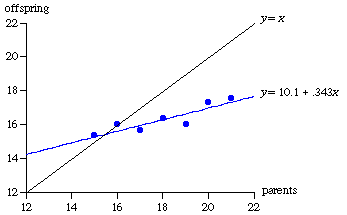
|
The y=x line shows what the plot would have shown if parent sweet pea seeds
had offspring seeds of the same weight.
The other line shows that the average offspring of each size regressed towards an average size. |
In connection with the International Health Exhibition in 1884 to 1885 Galton set up a laboratory to measure human statistics, collecting data such as height, weight, and strength of a large number of people.
William Godwin
Born
1756,
died
1836
William Godwin's book Enquiry Concerning Political Justice, started in 1791 published in February 1793 is intended to "philosophically place the principles of politics on an immovable basis". It begins with a summary of those principles.
Godwin was educated as a rationalist dissenter from the established church. His political theories formed the basis of anarchism. His version of anarchism being a belief that the state would become unnecessary as human beings developed their powers of moral and political self-determination.
|
Erving Goffman
Born 1922, died 1982 |
books -
extracts
weblinks |
The title of Erving Goffman's first book The Presentation of Self in Everyday Life (1959) indicates his concern with the concepts developed by George Herbert Mead and the group of social theorists that Herbert Blumer called symbolic interactionsists. His biography suggests that he may have been just as heavily influenced by the concept of role in the work of Talcott Parsons.
Goffman developed his approach to interactionism in field studies in the Shetland Islands (1949 - 1951), leading to The Presentation of Self in Everyday Life (1959).
From 1955 to 1956, he did one year's field research in St Elizabeth's Hospital, Washington, DC, leading to Asylums. Essays on the social situation of mental patients and other inmates in 1961.
Concepts used include self - career - degradation - extrusion - institution - moral career - presentation - underlife - social and psychological beginnings - stigma - civil inattention
|
Olympe de Gouges Born 1748, Died 1793 French feminist writer. |

|
Olympe de Gouges believed we all (men, women, rulers and ruled, slaves and free) belong to one family and that the caring relations of families should be a feature of all social relations.
Olympe de Gouges was a young widow who taught herself to
write. She
began to write in 1780 and published her memoirs in 1784. She
published her
first political pamphlet in November 1788 and numerous
political writings
followed, including her
Declaration of
the Rights of Woman.
Her vivid imagination overcame the disadvantages of her
bad spelling
and poor punctuation and her meaning forced its way through
her unorthodox
prose.
An enthusiastic writer of plays, she was also a champion
of freedom for
slaves.
In
December 1789
her play on The Slavery
of Black People was performed in a Paris theatre, but the
audience
hissed it and it had to be taken off after three performances.
She believed passionately that the philosophy of natural
freedom, that
inspired the
Declaration of the Rights of
Man,
should apply equally to every human being.
Her writings combine the image of
family
embracing the whole of humanity with that of a social contract
establishing
the law of reason for the whole of humanity. It was natural,
therefore, for
her pamphlet on the rights of women to embrace the family, the
nation as a
family, and human beings of all colours as one family.
External link to Wikipedia article on: Olympe de Gouges other weblinks

l'ingresso della cella di Gramsci a Turi [the entrance to Gramsci's cell at Turi] (source) |
Antonio Gramsci
Born 22.1.1891, died 27.4.1937
Gramsci's concepts include:
Leader of the Italian Communist Party who was imprisoned from late 1926 to 1934 by the Fascist Government of Italy. He was conditionally released in 1934 on health grounds, and died in hospital in 1937. Gramsci's writings were published in Moscow in 1957 and parts translated into English in the same year. They have had an enormous influence on the development of marxism in Europe. Gramsci's writings were used to argue that class conflict which Marx and Engels placed at the core of history was as much a struggle for the creation of new ideas as anything else.
|
Zygmunt Bauman wrote
"I discovered Gramsci and he gave me the opportunity of an honourable discharge from Marxism. It was a way out of orthodox Marxism, but I never became anti-Marxist as most did. I learnt a lot from Karl Marx and I'm grateful" ( Zygmunt Bauman quoted Bunting, M. 2003)
Wilhelm Griesinger
Born 1817, died 1869
German psychiatrist who argued E. H. Ackernecht's words) that:
"Normal people have many experiences analogous to states of insanity, for example in dreams, during febrile delirius and in toxic states. While dreaming and in the delirium of mental illness one reacts to bodily sensations without being aware of doing so. In both states critical faculties are lost and in both we notice the gratification of wishes which, unfulfilled in reality, had been repressed. Sleep induced by magnetism and somnambulism are also allied to states of insanity."

|
Pictured with hat and cat by the class of 2013. Words developed from an August 2009 summary by Malcolm Richardson. Overall concept stimulated by Norwegian and muslim students 2011/2013
Jürgen Habermas is generally regarded as today's leading representative of the Frankfurt School of Critical Theory. This school of thought has also been described (along with Gramsci), as "cultural marxist" |
| Habermas came from a German family with National Socialist (Nazi) sympathies and grew up under the Nazi regime. He was not yet four when Adolf Hitler came to power in 1933 and almost sixteen years old when Hitler committed suicide in 1945. His youth having been shaped by authoritarian, nationalistic and racist ideals, his intellectual life after the war was shaped by a search for the foundations of freedom and democracy and how these related to what he called the "bourgeoise public sphere". |

|
From 1956, Habermas studied philosophy and sociology under Max Horkheimer and Theodor Adorno. His earliest work (published in 1961) was a collaborative sociological survey of the post-war political attitudes of his fellow Frankfurt students. This revealed a disturbing shallowness in their commitment to democratic values. (See Kellner). Habermas wrote the theoretical introduction to this study "On the Concept of Political Participation", and his empirical historical studies that followed can be seen as a development of these ideas. Partly because of disagreements with Horkheimer, he finished his research (The Structural Transformation of the Public Sphere). at the University of Marburg. In 1964 he returned to Frankfurt to take over Horkheimer's chair in philosophy and sociology.
Like his predecessors ( Horkheimer, Adorno, and Marcuse), Habermas regards Marx's social theory (historical materialism) as inadequate. In particular a view of work and production as the basis of society is inadequate. Habermas argues that before people can work in production, they must be able to communicate. Communication therefore is also a basis of human society. Habermas says Marx recognised the importance to production of communication through cultural tradition, but mistakenly attempted to reduce it to work.
"Marx deludes himself about the nature of reflection when he reduces it to labour" (Habermas 1968 at marxists.org)
In the article quoted from, Habermas considers society as the interaction of three things: work, interaction (communication), and power.
Malcolm Richardson compares the importance Habermas gives to communication to George Herbert Mead and the Symbolic Interactionists. Mead argued that mind, self and society emerge together.
Habermas's development of marxism can also be compared to that of Antonio Gramsci, who wrote "homo faber cannot be separated from homo sapiens". [Man the maker cannot be separated from Man the thinker]
Communicative action and the public sphere
Theories developed in two major studies:
1962 (In German) The structural transformtion of the public sphere: An inquiry into a category of bourgeois society A theoretical work deply rooted in an empirical study of history,
1981 (In German) The Theory of Communicative Action Consciously modelled on Parsons' The Structure of Social Action (1937) the core of this work is based on Parsons' post 1955 work on adaptation , goal attainment , integration and latency (pattern maintenance) as functional prerequisites of systems. Habermas revises these in order to describe the legitimation crisis of society, which he calls the "colonisation of lifeworld by systems"
Habermas argues that the ability of people to communicate with one another freely, that is without let or hindrance, is the basis of a free and just society. When people can communicate in freedom, their actions can be guided by rational discussion, and disagreements can be resolved through force of argument. He calls this communicative action
See Habermas and the public sphere
Colonisation of the lifeworld related to decline of the public sphere
Habermas's model of society involves both rational social discussion (in the lifeworld) and external organisation (from the system world) working together. The colonisation of the life world is a tendency for the system world to take over the life world. This may be by markets and/or by administrative structures. In a free-market democracy, for example, market research and opinion polls may increasingly be used to manipulate public opinion, making social science a tool of organisation that undermines rational public discussion. In a state-communist society, free and independent communication may be replaced by a sham communication in which everyone is required to agree with the party line in a comradely way. (See William Outhwaite 1998 p.112)
There appears to be nothing inevitable about the decline of the public sphere that Habermas describes. To recognise this, we can note that as well as forces working to colonise the lifeworld, he also identifies new forces working to re-invigorate it. A section of The Theory of Communicative Action that does this was published as the influential journal article "New social movements" in 1981. (See movement)
|
Norway and the public sphere
In 2005, Habermas was the second person to be awarded the Norwegian sponsored "Holberg International Memorial Prize for outstanding scholarly work in the areas of arts and humanities, social sciences, law or theology" (see website). At this time, the Frankfurt School was being criticised in the United States as the carrier of subversive "cultural marxism". On 22.7.2011, Inspired by the American opposition to cultural marxism, Anders Behring Breivik assassinated (murdered) 77 fellow Norwegians. The public debate that followed in Norway might be considered as a test of the solidarity of the public sphere in confrontation with older nationalistic and racist ideas. |

Breivik's manifesto starts with the cross of St George, symbolising the struggle of Christianity against Islam. Hitler's swastika symbolised the struggle of the Aryan against the Jew. |
2005
Holberg citation
"Jürgen Habermas has developed path-breaking theories of discourse and
communicative action and thereby provided new perspectives on law and
democracy. His research is thematically wide ranging and has had
exceptional interdisciplinary impact. Habermas has significantly
contributed to the understanding of rationality,
ethics, legitimation,
critical public discussion, modernity, the post-national society and
European integration.
His intellectual breakthrough was
The Structural
Transformation of the Public Sphere (1962; Eng. ed. 1989),
which, by
combining empirical and theoretical research from a number of disciplines,
constituted an original contribution to democratic theory.
In his opus
magnum
The Theory of Communicative Action (1981; Eng. ed.
1984/87) he
provides a new foundation for critical social theory and discusses the
possibility of public discourse among free and equal citizens.
The
discourse theory of law and deliberative democracy is outlined in
Between Facts and Norms (1992; Eng. ed. 1996). His conception of
democracy is
further elaborated in articles addressing contemporary issues such as the
multicultural society, nationalism and globalization (collected in The
Inclusion of the Other (1996; Eng. ed. 1998) and The Postnational
Constellation (1998; Eng. ed. 2001).
Lately, Habermas has among other
things worked on foundational problems in ethics and philosophy. J�rgen
Habermas has had extraordinary international influence in a great number of
disciplines.
Habermas's concepts: colonisation of the lifeworld - communication -
communicative action -
interaction (communication) -
lifeworld -
new social movements -
power
-
public sphere
(origin) -
work -
|
Catherine Hall
Born 1946 |
books - |
1992 White, Male, and Middle-class: Explorations in feminism and history

|
"My research focuses on re-thinking the relation between Britain and its empire in the nineteenth and twentieth centuries. I am particularly interested in the ways in which empire impacted upon metropolitan life, how the empire was lived 'at home', and how English identities, both masculine and feminine, were constituted in relation to the multiple 'others' of the empire. Civilising Subjects looks at the process of mutual constitution, both of colonizer and colonized, in England and Jamaica in the period between the 1830s and the 1860s." |
|
Stuart Hall
Born 3.2.1932 in Kingston, Jamaica. Died Monday 10.2.2014, London |
books -
weblinks -
Notes and quotations Lecture notes |
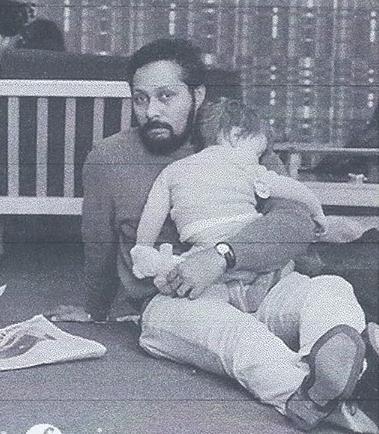
|
The only uncomfortable picture of Stuart Hall I have ever seen. He is one
of the men making a political point in
1970 by looking after children
whilst women had a conference. You can find it on the
Soundings memory blog
Other tributes: Guardian - Voice - Root - DVD Review PS: The little boy is comfortable. He has fallen asleep. Perhaps Stuart is just trying not to disturb him by smiling? |
|
Jamaica -
Oxford -
London -
Birmingham -
Open University -
Identities
Jamaica 1932-1951
Mixed race family and different colonial class
fractions -
Biographical notes and
quotations
|

|
Merton College, Oxford, 1951-1957
Stuart Hall studied English Language and Literature at
Merton Cllege, Oxford University from
1951.
1957 Stuart Hall dropped out of his Ph.D research on Henry James
Teaching, new thinking, and agitating 1957-
"From 1958 to 1960, Hall worked as a teacher in a London secondary modern
school and in adult education, and in 1964 married Catherine Hall,
concluding around this time that he was unlikely to return permanently to
the Caribbean."
(Wikipedia antry)
Stuart Hall edited
new left journals from
1957. [Editor New Left Review 1960-
1961]. Active in the Campaign for Nuclear Disarmament. See 1958. He met
his future wife,
Catherine, through
CND
Chelsea College of Science and Technology
1962-1964 Lecturer
Chelsea College of Science, University of London, Department of
Humanities,
1964
The Popular Arts by Stuart Hall and Paddy Whannel.
Birmingham University 1965-1979
Birmingham University School of English: Research Fellow,
Centre for Contemporary Cultural Studies
1965; Assistant to Director 1966; Deputy
Director 1968; Acting Director. 1970; Director 1970.
Stuart Hall was effectively the Director of the
Centre for Contemporary Cultural Studies from
1968 to
1979
At the Centre for Contemporary Cultural Studies, Hall encouraged a
marxist
approach. It was not, however, the traditional position that
sees ideas as
part of a the
"superstructure" that reflects the "base" of economics. Hall
incorporated the ideas of marxist theorists such as
Gramsci, in which a struggle for ideas is as important as any
economic class
struggle.
The Open University 1979-1997
"New Ethnicities" is a paper that Stuart Hall wrote for a
conference in 1988 on
Black Film, British Cinema.
[See paper -
lecture notes.
In this paper, Stuart Hall discusses
the development
of ethnic
identity in relation to recent films including
My Beautiful Launderette (1985) and
Sammy and Rosie Get Laid (1987) -
Handsworth
Songs - and Dreaming Rivers -
The Passion of Remembrance (1986).
Hall argues that the struggles
represented by and in these films had
moved from an older focus on "blacks", as a single entity, and
"white" culture, to more diverse issues and
identities. He suggests that "a significant
shift has been
going on... in black cultural politics...". This is not a
movement from one
to the other but "two phases of one movement which constantly overlap and
interweave". He identifies diversification as the second
"moment" in the
movement. The first moment was the construction of blackness as a concept
of resistance:
In his paper, Hall speaks of the idea that the film
"represents" a
reality outside of itself. He says this idea is grounded in the "mimetic
theory of representation": the idea that representations, like film, mime
or imitate an exterior reality. But representations, he argues, can also
form or shape reality.
Film is one of the cultural media that shapes our perceptions of ourselves,
our identity. In the introduction to the conference, the film critic Ray
Durgnat is quoted as describing film as "that cultural arena in which
society reflects upon and adjusts its image of itself" (page 4). That was
probably said at the time of
mass cinema audiences, but, the introduction
argues, "British cinema is alive and well and living on television" (page
6).
Identity - Pre and post 1997 reflections
Stuart Hall's analysis of identity in contemporary societies
examines the effects of migration and dispersal of
ethnic groups
within and between countries.
He argues that migration is the archetypal
20th/21st century experience, and that this has profoundly destabilised
individual as
well as collective identities.
On the issues of
race and
ethnicity, Hall has argued that there is no such thing
as a single, or unique black identity. On the contrary, just as the whole
idea of Britishness is now the subject of endless dispute, so also there
are endless debates about what it means, for example, to be black British.
Hall adopts a historical and sociological perspective in order to
understand of the global context in which individual and group identities
are fashioned:
British identity, he argues, was not shaped not by some essential quality
of Britishness, but by its
global network of trading and other relationships, especially with its
former colonies. He is therefore critical of those who argue that there is
- or ever has been - any such thing as a unified, national identity, such
as Britishness, or Englishness. The idea of a national culture or a
national identity is a
social construction, a device which allows something
as ethnically diverse and fragmented as, e.g. present day Britain, or USA,
to be represented as a unified entity - as one
nation.
"I arrived in Oxford on a Rhodes scholarship, more or less
straight from school in Jamaica, in 1951. I would say that my politics were
principally 'anti-imperialist'. I was sympathetic to the left, had read
Marx and been influenced by him while at school, but I would not, at the
time, have called myself a Marxist in the European sense. In any event, I
was troubled by the failure of orthodox Marxism to deal adequately with
either 'Third World' issues of race and ethnicity, and questions of racism,
or with literature and culture, which preoccupied me intellectually as an
undergraduate."
(Hall, S. 2010, p.179)
"Politically, this is the moment when the term 'black' was
coined as a way of referencing the common experience of racism in Britain
and came to provide the organising category of a new politics of
resistance, amongst groups and communities with, in fact, very different
histories, traditions and ethnic identities.... Culturally, this analysis
formulated itself in terms of a critique of the way blacks were positioned
as the unspoken and invisible 'other' of predominantly white aesthetic and
cultural discourses." (page 27)
"... events, relations, structures do have conditions of
existence and real effects, outside the sphere of the
discursive; but ...
it is only within the discursive"... [that they have] ... "meaning. Thus,
... how things are represented" ... [plays] ... "a constitutive, and not
merely a reflexive, after-the-event, role. This gives
questions of culture and ideology, and the scenarios of representation -
subjectivity,
identity,
politics - a formative, not merely an expressive,
place in the constitution of social and political life."
(Hall 1988 p.-)
"Now that, in the postmodern age, you all feel so dispersed, I
become centred. What I've thought of as dispersed and fragmented comes,
paradoxiacally, to be the representative modern experience" (quoted
page 5)
"If the black subject and black experience are not stabilised
by Nature or by some other essential guarantee, then it must be the case
that they are constructed historically, culturally, politically - and the
term that refers to this is 'ethnicity'. The term ethnicity acknowledges
the place of history, language and culture in the construction of
subjectivity and identity..." (page 29)
|
David Harvey
Born 1935, Article developed from an outline by Sue Mew |
An English geographer and anthropologist living in the United States. David Harvey is the author of Social Justice and the City (1973) and The Condition of Postmodernity: An Enquiry into the Origins of Cultural Change (1989), as well as of a long-running series of lectures on reading Marx's Capital
The condition of postmodernity
Like his fellow marxist, Fredric Jameson, Harvey thinks of postmodernity as a distinct historic period. However, unlike Jean Baudrillard, Harvey does not see postmodernism as a radically new postindustrial or even postcapitalist development. It results from new organisation and technological forms within capitalism.
The origins of cultural change
As a Marxist, Harvey is concerned with what he sees as underlying political and economic realities. He relates the symbolic world that Baudrillard analyses to economic history. What he calls "crises of over-accumulation" spark a search for "spatial and temporal solutions" creating "an overwhelming sense of time-space compression" so that we can expect crises of overaccumulation to be followed by strong aesthetic movements" (p.327)
Moving between modes of accumulation
An oil crisis in 1973 marked the beginning of a period of economic recession in the United States and most of the world when economies ceased to grow from year to year in the way they had since the second-world war. Harvey argues that the post-war years to 1973 had been governed by Fordist and Keynesian economics which were too rigid to cope with this crisis and were replaced by a more complex, supple, flexible form of capitalism. There had been a shift in contemporary capitalist societies to a "more flexible mode of accumulation". Other people have called this post-Fordism, but Harvey avoids this as he thinks there are still fundamental continuities in the two modes of capitalist organisation.
The more flexible mode of accumulation
The more flexible mode of accumulation, has more flexible manufacturing processes and labour markets, rapid product innovation and constantly changing consumer fashions. It is this transformational economic and political reality which postmodern theory has to confront. Harvey's concept of flexibility can be compared to Bauman's concept of liquid modernity
Space-time compression
Central to his analysis is the idea of 'space-time compression' ('annihilation of space through time'), by new rapid, low-cost means of transportation and information and communication technologies, which eliminate the barriers of distance and time. Harvey was writing before the world wide web and his account is not even about the internet. when he says that
"space appears to shrink to a 'global village' of telecommunications and a 'spaceship earth' of economic and ecological interdependencies ... time horizons shorten to the point where the recent is all there is" ( Harvey 1989 p.240)
He writes about 1960s jet passenger aircraft travelling at 500 to 700 mph and satellite communication systems since the early 1970s plus mass television ownership meaning that
""The whole world can watch the Olympic Games, the World Cup, the fall of a dictator, a political summit, a deadly tragedy" ( Harvey 1989 p.293)"
Ephemerality and the desire for meaning
This space-time compression expresses itself in the world of postmodern commodities by an emphasis on ephemerality, although that is counterbalanced by a new search for deeper meanings in life. ( Harvey 1989 p.291).
New forms of global commodification
But the global village does not mean everyone is brought together in a happy family. Instead, it provides new opportunities for capitalism to exploit global manufacturing and distribution chains.
"The annihilation of space through time has radically changed the commodity mix that enters into daily reproduction. Innumerable local food systems have been reorganised through their incorporation into global commodity exchange. ( Harvey 1989 p.299)"
Despite the transformations in the surface appearance of capitalism since the 1970s, its underlying drive for profit, and its crisis tendencies remain the same as those analysed by Marx
|
Georg Friedrich Hegel
Born 1770, died 1831 |
books -
extracts
timeline: Spirit of the Age - Wikipedia |
German Professor of Philosophy. Hegel believed that the whole of history is the development of reason, and he attempted to describe it all. His work is monumental. It incorporates all the major strands of philosophy that he was aware of, from the beginning of time to his own time. Part of the intellectual structure that he provides is an analysis of society into three components. These are (roughly speaking) the state, the economy, and the family.
Hegel's thought is frequently looked at as a background to that of Marx and Engels, but it is also of value in its own right.
Hegel and Freedom
Hegel's 1821 Philosophy of Right considers the family, civil society and the state. It is a social theory that uses philosophy. Hegel considers the family, civil society and the state as aspects of what he calls ethical life. He says
"ethical life is the concept of freedom developed into the existing world and the nature of self-consciousness... This ethical substance and its laws and powers are on the one hand an object over against the subject ... On the other hand, they are not something alien to the subject. On the contrary, his spirit bears witness to them as to its own essence in which he has a feeling of his selfhood..."
Notes by
Malcolm Richardson
Karl Marx was influenced by the German philosopher, Georg Hegel.
Hegel's view of
history was
idealist: history is the product of struggles between
conflicting or opposing ideas about
freedom, justice,
equality,
democracy
and other issues.
For Hegel therefore, human history is a
dialectical - conflictual and contradictory - A process which is
driven by conflicting ideas about freedom and other issues.
Thus,
religious struggles between Catholics and Protestants in
16th and
17th
century Europe, stimulated development of new ideas and forms of behaviour
in religion, politics, economics, science etc
Likewise, Hegel viewed the
French Revolution as the product of philosophical ideas - For
example conflicting ideas about
constitutional monarchy versus
general will and individual liberty versus social order.
Each stage in human history is the outcome of the struggle between
conflicting or opposing ideas. Each stage represents an advance in our
knowledge and understanding of the world. Each historical stage is an
advance in human freedom, because human actions are progressively freed
from instinct, ignorance and superstition.
For Hegel history is not random, but has direction: it is the
progressive unfolding and enlargement of human freedom.
Young Hegelians
Hegel died in
1831. The Doktorklub, later renamed Die Freien
of Young Hegelians met in Berlin in the late 1830s and early 1840s. This
cartoon of Die Freien is by
Engels. I do not have a date.
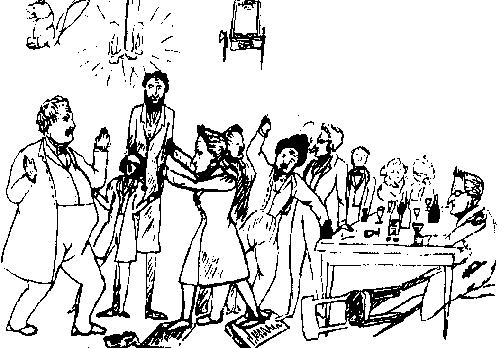
|
At the time Hegel died, Thomas Carlyle was writing about an imaginary German professor called Teufelsdröckh, for whom spirit was embedded in everyday things like clothes.
|
Martin Heidegger
Born 1889, died 1976 |
books |
German existentialist philosopher. Heidegger had Nazi sympathies, but his wide influence has related to his philosophy, not his politics. He was a major influence on the left-wing French existentialist philosopher, Jean-Paul Sartre.
Judith Harding has the following passage from Heidegger on her wall. It is intended to remind her that what she calls "new ways of thinking about teaching and learning" are not new. She says it reminds her that these approaches have always been part of some thinking, "from Socrates on".
-
"Teaching is more difficult than learning. We know that; but
we rarely
think about it. And why is teaching more difficult than
learning? Not
because the teacher must have a larger store of information,
and have it
always ready. Teaching is more difficult than learning because
what
teaching calls for is this: to let learn. The real teacher, in
fact, lets
nothing else be learned than---learning. His conduct,
therefore, often
produces the impression that we properly learn nothing from
him, if by
'learning' we now suddenly understand merely the procurement
of useful
information. The teacher is ahead of his apprentices in this
alone, that he
has still far more to learn than they---he has to learn to let
them learn.
The teacher must be capable of being more teachable than the
apprentices.
The teacher is far less assured of his ground than those who
learn are of
theirs. If the relation between the teacher and the taught is
genuine,
therefore, there is never a place in it for the authority of
the know-it-
all or the authoritative sway of the official. It still is an
exalted
matter, then, to become a teacher---which is something else
entirely than
becoming a famous professor".
|
Adolf Hitler:
Born 20.4.1889, died 30.4.1945 |
books -
weblinks
Sophie Roddy - Life |
Leader of the German Nazi (Nationalsozialist - National Socialist) party. Chancelllor of Germany from 1933 to his death. He assumed dictatorial power and the title Der Führer.
See 1859 Darwin's On the Origin of Species by Means of Natural Selection - 1887 radio waves - 21.2.1919: Assasination of Kurt Eisner - 1920: Karl Goetz medal - 1925: First volume of Mein Kampf - 1930: Alfred Rosenberg's The Myth of the 20th Century - 1933: in power - 1936: Olympic Games - 1937: Great German Art - 1939 war brings Mein Kampf to Britain - 1942: Explaining - 1943: Holocaust - 1967: Survivor conversation
Quotations from Mein Kampf selected to illustrate the core of Hitler's social theory:
"Since I usually woke up about five o'clock every morning I got into the habit of amusing myself with watching little mice which played around in my small room. I used to place a few pieces of hard bread or crust on the floor and watch the funny little beasts playing around and enjoying themselves with these delicacies. I had suffered so many privations in my own life that I well knew what hunger was and could only too well picture to myself the pleasure these little creatures were experiencing."
"no cat exists which has a friendly disposition towards mice. ... the struggle between... species does not arise from ... mutual antipathy but ... from hunger and love. In both cases Nature looks on calmly and is even pleased with what happens. The struggle for the daily livelihood leaves behind in the ruck everything that is weak or diseased or wavering; while the fight of the male to possess the female gives to the strongest the right, or at least, the possibility to propagate its kind. And this struggle is a means of furthering the health and powers of resistance in the species. Thus it is one of the causes underlying the process of development towards a higher quality of being."
"Nobody can doubt that this world will one day be the scene of dreadful struggles for existence on the part of mankind. In the end the instinct of self-preservation alone will triumph... Man has become great through perpetual struggle. In perpetual peace his greatness must decline."
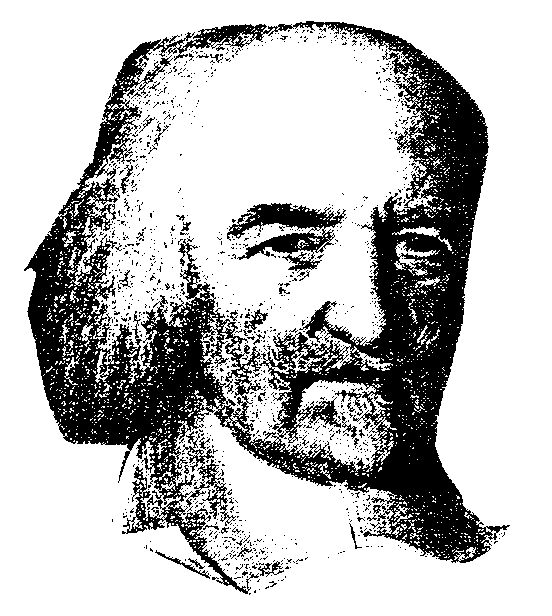
|
Thomas Hobbes:
Born 1588, died 1679 Social Science History, chapter two: Hobbes, Filmer and Locke Timeline - Bacon - Galileo - Paris 1640 - Leviathan 1651 - Louis 14 - Back to England - not in Royal Society - |
Hobbes, Locke, Rousseau and, to a certain extent, Wollstonecraft, all used a type of theory that we call State of Nature Theory. This tries to explain human society and culture by imagining what men and women would be like if we were not part of society: if we were "uncivilised" or "in a state of nature".
Each theorist argues for different characteristics to our uncivilised, animal, natures. Consequently each theorist draws different conclusions about society and civilisation.
Concepts include war of all against all - tacit (unspoken) social contract
Robotics:
The theory
behind machine-
humans can be traced back to philosophical scientists such as
Hobbes and
Descartes

|
"Bar Bot" (external link) (archive) is a 21st century (2003) Austrian Robot that talks to you about beer. It is driven by self-interest - a desire to drink beer. Once you have given it some money, it buys the beer, drinks the beer, and settles down to talk to you about giving it some more money to drink beer. |
Another Robot, or machine-human, is the more sophisticated Japanese "ifbot" (external link) (another), (one that works) made (2004) by Yoshimichi Hashiba, which approaches (in some respects) the conversational skills of a five year old child.
Despite its name, the Middlesex Manipulator (2005) is a friendly robot - although without the chubby features of ifbot. Ifbot and and the Middlesex Manipulator model humanity on altruism rather than greed.
|
Max Horkheimer born 14.2.1895, died 7.7.1973 |
books - weblinks |
Max Horkheimer was one of the central figures of the marxist-oriented Institute for Social Research (Institut für Sozialforschung) at the University of Frankfurt in Germany, founded by Carl Grünberg in 1923.
Horkheimer led it from 1930, when he became Director of the Institut. In his inaugural address he redefined Marx's "historical materialism" as a critique rather than a science and argued for the reintegration of philosophy with social science. (Swingewood, A. 2000, p. 131)
Hitler and the Nationalsozialist (Nazi - National Socialist) party came to power in Germany in 1933. Horkheimer fell foul of the NAZIS both as a Jew and for his marxist sympathies. They revoked his right to teach and the Institute closed in Germany. Horkheimer emigrated, first to Switzerland and then, in 1934, to the United States. In the USA the Institut was reestablished at Columbia University.
In 1937 Horkheimer's essay "Critical and traditional theory" introduced the term critical theory as opposed to traditional positivist science whose goal, he argued, is pure knowledge. Critical theory was committed to emancipation. (Swingewood, A. 2000, p. 131)
Horkheimer contrasted the established ideas about scientific theory with ideas that he called "self-knowledge" which evaluate reality rather than just describing it:
"the self-knowledge of present-day man is not a mathematical knowledge of nature which claims to be the eternal Logos, but a critical theory of society as it is, a theory dominated at every turn by a concern for reasonable conditions of life."
"...there is a human activity which has society itself for its object. The aim of this activity is not simply to eliminate one or other abuse, for it regards such abuses as necessarily connected with the way in which the social structure is organized....In the following pages this activity is called "critical" activity."
"the critical attitude of which we are speaking is wholly distrustful of the rules of conduct with which society as presently constituted provides each of its members"
In 1944, Adorno and Horkheimer published Dialektik der Aufklärung: Philosophische Fragmente (Dialectic of Enlightenment: Philosophical Fragments). Kant in 1784 had argued that enlightenment liberates us from authority. Adorno and Horkheimer said that in reality, the outcome of history was that reason had collapsed under National Socialism -
"With the extension of the bourgeois commodity economy, the dark horizon of myth is illumined by the sun of calculating reason, beneath whose cold rays the seed of the new barbarism grows to fruition"
Horkheimer returned to Germany in 1949 to become a professor at Frankfurt University.
|
David Hume
Born 1711, died 1776 |
books |
A Scottish philosopher and one of the founders of European empiricism.
Hume undermined confidence in the power of reason. He believed that all real knowledge is based on experience, but he argued that our powers to build knowledge on experience are very limited. (see What is Science?)
In the empirical tradition, reason builds on experience, and Hume's fundamental doubt about the validity of the process undermines the argument of Mary Wollstonecraft that reason is the power that is taking us, via a lot of accidents, towards an ever better future. (see What is Science?). Wollstonecraft, however, had read the German philosopher Kant, whose synthesis of the empirical and rational traditions salvaged the possibility of reliable knowledge, and with it the philosophical foundations of the belief in progress based on reason.
Hume's doubts can also be seen as opening the door for theories that explore below the surface of reason. For example, they opened the door to Freud's psychoanalysis and his theory of the unconscious.
Edmund Husserl
Born
8.4.1859,
died
27.4.1938
Edmund Husserl. "The Crisis of the European Sciences"
Part Three: The Clarification of the Transcendental Problem and the Related Function of Psychology
A. The Way into Phenomenological Transcendental Philosophy by Inquiring back from the Pregiven Life-World
Kant's unexpressed "presupposition": the surrounding world of life, taken for granted as valid. p.103
"But Kant, for his part, has no idea that in his philosophizing he stands on unquestioned presuppositions and that the undoubtedly great discoveries in his theories are there only in concealment; that is, they are not there as finished results, just as the theories themselves are not finished theories, i.e., do not have a definitive scientific form." (p.103)...
"But being an ego through the living body is of course not the only way of being an ego, and none of its ways can be severed from the others; throughout all their transformations they form a unity. Thus we are concretely in the field of perception, etc., and in the field of consciousness, however broadly we may conceive this, through our living body, but not only in this way, as full ego-subjects, each of us as the full-fledged "I-the-man." Thus in whatever way we may be conscious of the world as universal horizon, as coherent universe of existing objects, we, each "I-the-man" and all of us together, belong to the world as living with one another in the world; and the world is our world, valid for our consciousness as existing precisely through this 'living together." We, as living in wakeful world-consciousness, are constantly active on the basis of our passive having of the world; it is from there, by objects pregiven in consciousness, that we are affected; it is to this or that object that we pay attention, according to our interests; with them we deal actively in different ways; through our acts they are "thematic" objects...." (p.108))
"The consciousness of the world, then, is in constant motion; we are conscious of the world always in terms of some object-content or other, in the alteration of the different ways of being conscious (intuitive, nonintuitive, determined, undetermined, etc.) and also in the alteration of affection and action, in such a way that there is always a total sphere of affection and such that the affecting objects are now thematic, now unthematic; here we also find ourselves, we who always and inevitably belong to the affective sphere, always functioning as subjects of acts but only occasionally being thematically objective as the object of preoccupation with ourselves."
"Obviously this is true not only for me, the individual ego; rather we, in living together, have the world pregiven in this "together," as the world valid as existing for us and to which we, together, belong, the world as world for all, pregiven with this ontic meaning. Constantly functioning in wakeful life, we also function together, in the manifold ways of considering, together, objects pregiven to us in common, thinking together, valuing, planning, acting together. Here we find also that particular thematic alteration in which the we-subjectivity, somehow constantly functioning, becomes a thematic object, whereby the acts through which it functions also become thematic, though always with a residuum which remains unthematic-remains, so to speak, anonymous-namely, the reflections which are functioning in connection with this theme." (p. 108?)
The life-world can be disclosed as a realm of subjective phenomena which have remained "anonymous." p.111
Edward Irving
Born
4.8.1792,
died
7.12.1834
Edward Irving, Procter with respect to Lamb, Coleridge and Carlyle in the early 1820s.
See Spencer Perceval (junior) and John Thomas Perceval
|
Eric Irwin
Born Belfast 1.8.1926, died London December 1987
|
publications and sources about |
Eric Irwin: Why is a union necessary?... The psychiatrist has become the High Priest of technological society, exorcising the `devils' of social distress, by leucotomy (butchery of the brain), electric shock treatment - ECT (plugging brains into mains), and heavy use of mind- controlling drugs. The mental patient is a sacrifice we make whilst we continue to serve the Gods of the Capitalist Religion |
During
his life, Eric Irwin, was in seventeen psychiatric institutions
in
Ireland, Australia and England, including
Cane Hill
Eric's ideas inspired the formation of the Mental Patients Union in London in March 1973. His work in later groups developed a coherent theory of what he called "anti-psychiatry", which was an important strand of thought and activity maintaining and developing the survivors movement into the 1980s and beyond. |
Eric was born in Belfast in 1926. When he was young his family life was very unstable. He was adopted by an aunt, and he often said that he lived with the constant fear of being abducted. The anxiety this produced led to his early experience of psychiatric institutions (Frank Bangay)
In the 1940s or 1950s, Eric experienced Electro Convulsive Therapy when it caused epileptic fits and broke people's backs, and his own back was damaged.
Eight years younger than Eric, the survivor poet Sylvia Plath received ECT without anaesthesia in the United States in the early 1950s. In her semi-autobiographical novel The Bell Jar (1963), she described the experience thus:
"Then something bent down and took hold of me and shook me like the end of the world. Whee-ee-ee-ee-ee, it shrilled, through an air crackling with blue light , and with each flash a great jolt drubbed me till I thought my bones would break and the sap fly out of me like a split plant. I wondered what terrible thing it was that I had done"
From the early 1950s, muscle relaxants and anaesthetics were used to reduce this type of side effect of ECT. Other side effects, like memory loss, remained.
Eric was in one "long stay hospital for a very long time" (Liz and Brian). Frank Bangay, a friend of Eric, recalls that
"He talked about particularly heavy times in Cane Hill Hospital, which he referred to as "Cane Hell". He talked about a man who ran away from there when it was snowing, caught frostbite and had both his legs chopped off. Eric would often remark "Who would believe such cruelty?" because most people think that stories like that are just made up. Eric talked about his experiences there in a padded cell, wearing just a nightshirt."
In 1956, Eric says he narrowly escaped a leucotomy. At the time he was a voluntary patient, and he says a doctor told him "I wish you were psychotic so I could do it". Eric was convinced that under the "liberal" 1959 Mental Act, he would have been put on a section and operated on.
In 1960, a psychiatrist told him he was a psychopath and that psychopathy was inborn and incurable.
"I was shattered by that. But when I came out I looked it up in every textbook I could find, and found it meant so many different things that anyone could be one"
Among Eric's archives is a letter dated 15.3.1965 from Sylvia Nathan of 25 Burton Lodge, Portinscale Road, Putney, SW15 to Mrs H. Salisbury, Bromley Hospital, Department of Psychiatry, 38 Masons Hill, Bromley, Kent, which says
"I am delighted to be able to report that Mr Irwin's translation from French was really excellent and he should have no difficulty in obtaining work on a commercial basis.I am returning his translation with the original in case he should wish to show a sample of his work when approaching agencies. Please let me know if you would like me to suggest any translation agencies, but you may still have a note of those I mentioned when commenting on a German translation done by another of your patients. He should ask for about £2.10.0 per thousand words of the original, or more if he is able to offer any specialised knowledge and undertake technical translations.
Pleas offer Mr Irwin my congratulations and best wishes in his search for translation work."
In 1971 and 1972, Eric took part in the campaign to save the Paddington Day Hospital.
Following this, with Liz Durkin, Lesley Mitchell and Brian Douieb, he wrote The Need for a Mental Patients Union. Eric and Brian were the main authors of the pamphlet, which begins with an analysis of the position of mental patients in society, and then continues with suggestions about what a union might do. Eric's command of the striking phrase, and his experiences, are reflected in the following passage.
"Why is a union necessary?... The psychiatrist has become the High Priest of technological society, exorcising the `devils' of social distress, by leucotomy (butchery of the brain), electric shock treatment - ECT (plugging brains into mains), and heavy use of mind- controlling drugs. The mental patient is a sacrifice we make whilst we continue to serve the Gods of the Capitalist Religion "
This was a time of "Reichians, Laingians, encounterers and co-counsellors" (See Bill West 1976), as well as anarchists, Trotskyists and multiple varieties of Maoists, in a vibrant alternative press run off on duplicators if it could not be printed, The The Need for a Mental Patients Union drew on these rich counter-cultures, on sociology and on critical psychiatrists to argue that
"Together with other oppressed groups, patients through an organised Mental Patients' Union must take collective action and realise their power in the class struggle, alongside Trade Unions, Claimants Unions, Women's Liberation, Black Panther Groups, Prisoners' Rights etc"
One of Eric and Brian's most lasting influences on the survivor's movement was the image of a fish writhing on a hook. Eric found the following quotation from the USA psychiatrist Karl Menninger
|
"An individual having unusual difficulties in coping with his environment struggles and kicks up the dust, as it were. I have used the figure of a fish caught on a hook: his gyrations must look peculiar to other fish that don't understand the circumstances; but his splashes are not his affliction, they are his effort to get rid of his affliction and as every fisherman knows these efforts may succeed." |
Eric was one of the founder members of the London based union in March 1973. His union card index entry records him as living at 30 St Charles Square, London, W10 [a Richmond Fellowship house] and a patient at Paddington Day Hospital. He could be contacted by telephone at either place. Later he moved to 241 Uxbridge Road, W12. Peter Campbell knew him when they both lived at 30 St Charles Square.
The union built on the second part of the pamphlet, but Eric, and what became known as West London MPU, continued to develop the core ideas of the first part. Eric was also part of the West London collective COPE (Community Organisation for Psychiatric Emergencies). MPU had its first HQ in Prince of Wales Road, Kentish Town and COPE had a base in Acklam Road, North Kensington. The Prince of Wales Road base of the MPU was in a squatted centre (MindU) established by Pam Edwards, who lived there. When the squat was closed, in the autumn of 1973, the main base of the MPU became the house in Hackney (Mayola Road) occupied by a group of MPU members, including Andrew Roberts.
On Friday 19.4.1974, Eric, Pam, Andrew and others travelled to Manchester for the MPU General Meeting held on Saturday 20.4.1974 at The Music College in Oxford Road, This was the meeting that set up the Federation of Mental Patients Unions with Mayola Road as its first coordinating centre. Paul Harrison, a journalist we travelled with, wrote an article in New Society that featured Eric.
May 1975 Mary Hutchinson and Eric, as members of West London MPU, set up RAM Radical Alternatives to MIND, after disrupting a MIND conference on "Psychiatry and Alternative Support Systems". They wrote
"We were able through the conference to meet fellow RAMers - to confer and conspire... and to develop a critique not just of Mind but of the state of mental health - or rather lack of it - in Britain today and to recognise the political and other implications of psychiatry. From now on we need to take the offensive and build a solid grass roots mental health movement".
23.1.1976 Eric was a source of information in the COPE office, where he was provided with his own space and consulted as "for reference purposes". Amongst the many people who met him there was Julian Barnett, the founder of PROMPT (Protection of the Rights of Mental Patients in Therapy) (See Joan Hughes). Julian was not a mental patient, but someone who wanted to campaign on issues. Eric joined Julian in PROMPT and provided the practical idea and much of the energy behind a petition to Parliament calling for the abolition of Electro Convulsive Therapy and psychosurgery. A major purpose of petitioning to bring the small group of PROMPT members into contact with the public as they collected signatures on the streets. Julian mentioned to Andrew Roberts, at one time, how pleased they were at the public response. The petition was presented to the House Of Commons on (17.7.1979) by Christopher Price, the Labour MP for Lewisham.
A PROMPT MANIFESTO, drawing on both the Fish Pamphlet and the MPU Declaration of Intent, was put together in 1976 and "accepted every year since then". The Manifesto was printed in a PROMPT booklet in 1980. Swan, in 1980, wrote that PROMPT had "been in operation, off and on, for four years." From 1980, it existence appears continuous.
| From 1980 to 1983 PROMPT organised around the heading Anti-Psychiatry holding public meetings, including conferences at Conway Hall (Saturday 23.8.1980, and possibly October 1980) and a public meeting at the Prince Albert Public House on Saturday 16.1.1982. These were reported by "Swan" in Madness Network News (who was staying with Andrew and Valerie Roberts) and by Joan Hughes, whose reported was circulated by the Hackney based Lawletter. Julian was the main speaker at these meetings. |
Eric chose the design for the poster used for the Conway Hall conference. It asked "Do you get it? It could happen to you" and showed someone with a face and identity entering a hospital, going through the psychiatric procedures, and coming out the other end totally faceless. This image attracted Frank Bangay to attend the conference:
"the poster related a lot to my own experience, and the struggle to win back confidence and self-respect. After the conference I decided to start attending PROMPT meetings and grew to know Eric more until we became very close friends. We worked together, and he has enriched my life with his knowledge, wisdom and insight. Although he wasn't easy to get to know, Eric was a very easy person to get to like, and from time to time he would tell me a little about his life."
During 1984 Frank Bangay
" first began to get to know Eric well. We talked together a lot and I felt inspired by the things Eric had to say. I learnt a lot from our conversations and this helped me articulate the struggles that I have been through in my life. In return I feel that I inspired him. Eric talked with much pride and dignity, and was very knowledgable on the subjects he talked about. He also had a sense of humour, which would quietly come out in the things he said, and he was able to lighten any heavy topic he felt need to talk about."
Eric appears to have recognised that the vision he had was a collective vision. Some of his own surviving poetry expresses positive views of human relations as they should be - A poem about the Samaritans is in my mind. The positive alternative complements his criticisms of society and psychiatry, but such an exploration of the goodness of humanity is much more strongly developed in the poems that Frank Bangay was developing at this time, and Eric recognised this.
It was during 1984 that Peter Campbell and Mike Lawson were drawn into the oribit of PROMPT (although not into core membership) by the poetry and music gigs organised by Frank at Metropolitan Tavern in Farringdon
In 1984, a new media unit called Multiple Images approached PROMPT about producing an anti-psychiatry film for Channel Four. PROMPT became CAPO during the production of a demonstration video called "Psychiatric Oppression" (1985). By this time, Julian was withdrawing from the group and Eric was coming to the fore. The video was "made with Mike Lawson, Frank Bangay, CAPO, and members of Network Completion". The video started with Eric describing psychiatric knowledge and the psychiatric system as
"an apparatus of social control...in the final analysis its purpose is to maintain the ascendance of a dominant class...who own the means of production....mental distress...none succumb but the predestined. But who are these predestined persons? Well, of course, those who succumb. A circular argument. Logic was never a strong point of psychiatry." (Notes taken by Mark Cresswell 11.4.2010)He was followed by Frank and then Peter Campbell. Later, Mike Lawson said "I feel lucky to have escaped with my life ...We need to represent ourselves because no-one else can possibly understand...we feel betrayed...we have to get together and support each other so that we can find a voice that will have some effect..."
The relationship between Multiple Images and CAPO broke down and the core CAPO membership withdrew. Production continued, with Multiple Images and a group in which Peter Campbell took a leading role alongside a wider group of survivors, but "We're Not Mad We're Angry", the controversial 70 minute programme eventually shown on Channel 4 from 11pm to ten minutes past midnight on 17.11.1986, whilst not adhering strictly to the CAPO line, owed a great deal to the CAPO/PROMPT view of anti-psychiatry that inspired its production.
PROMPT changed its name to CAPO: - Campaign Against Psychiatric Oppression, on Eric's suggestion, in March 1985. PROMPT and CAPO both used the MPU symbol: the head caught in a spider's web and both their manifesto's drew heavily on the Fish Pamphlet and the MPU Declaration of Intent..
"Throughout the year [Frank and Eric] worked together, organising many successful fund-raising benefits of poetry and music, [now] at the Troubadour coffee house in Earl's Court.. This was the main way of raising funds and it helped us also establish CAPO."
In July 1985 English users groups like CAPO were not invited to the World Mental Health Conference in Brighton. Eric Irwin, Barry Blazeby and Frank Bangay, attended, uninvited, joining in the international alliance of patients who took over part of the conference and produced a manifesto.
By the autumn of 1985, Frank and Eric were active participants in MIND's autumn conference, where they organised workshop. They were developing a routine that enabled Eric to speak out more than before:
"Eric liked the poetry I wrote, often quoting lines from it when he wanted to drive a point home. At conferences I would start by reading my poems about psychiatry, and then Eric would give a speech. Then we would open the workshop out into a discussion with the audience. This is how we worked together and inspired each other."
The workshop was called "Who are the Consumers?", and CAPO argued that the consumers were not patients, but "those who benefit from having someone psychiatrised, whatever the reason might be - workplaces, schools, families, the army, and so on.". This argument appears to have influenced David Pilgrim and Anne Rogers whose "user" section in A Sociology of Mental Health and Illness (1993 onwards) focuses on the idea of two conflicting sets of users: carers and patients.
Frank and Eric said they did not choose to consume psychiatry, and, in a phrase that everyone remembers,
"Eric said he felt as much a consumer of psychiatry as a woodlouse would consider itself to be a consumer of Rentakill services"They suggested "recipient" as a more neutral word.
Eric and Joan Hughes were early historians of the survivors movement in England. Joan's history can be read elsewhere. Eric's distinctive interpretation of survivor history was made clear in an interview in November 1986, when he said:
"The anti-psychiatry movement of which CAPO is a part goes back to 1973, with the emergence of the Mental Patients' Union and also, in the same year, independently, COPE, which was the Community Organisation for Psychiatric Emergencies. Both these movements ran for three years or so. Then some of us who were in COPE and MPU got together and found PROMPT, which stands for the Promotion of the Rights of Mental Patients in Treatment. That continued until April 1986 when it was decided that we no longer wished to have the words 'patients' and 'treatment' in the title. At my suggestion we decided to change it to The Campaign Against Psychiatric Oppression"
By 1986 the set of ideas that Eric and his colleagues had created under the brand names of anti-psychiatry and the CAPO Manifesto were as coherent and consistent an ideology that any survivor group has produced. From Eric's perspective, it had taken half a century of painful experience and intellectual struggle, but the growing movement wanted something more flexible
"Our Manifesto came in for a lot of criticism for being "too heavy" and "too political", but how could we change something that had grown over years of struggle?" (Frank)
Just before Christmas 1987 Eric Irwin died in St Joseph's Hospice, Hackney after a year long struggle with undiagnosed cancer
|
Fredric Jameson
Born 1934, |
books -
Wikipedia -
Holberg citation |
Fredric Jameson, like his fellow marxist David Harvey, seeks to relate cultural change to social and economic change. Change is a historical process and Jameson says that the slogan "always historicise!" is "the one absolute ... imperative of all dialectical thought". (Jameson, F. 1981, Preface)
|
Jameson
writes about
the emergence of a
postmodern culture - associated with
late capitalism . He argues that postmodernism is "the
cultural
logic of
late-capitalism".
His 1991 book Postmodernism, or, the Cultural Logic of Late Capitalism "established the concept of postmodernity as a distinct period with its own specific social and cultural forms". (Holberg citation). He says that the United States was the forcing ground for the new system, but that postmodernism is now the "first specifically North American global style".
|
Commodified culture - flat?
The cover illustration of the paperback is of "Diamond Dust Shoes" (1980) by Andy Warhol. Richard Richter comments that "It suggests the conversion of human necessities into the estheticized commodities valued by the postmodern sensibility."
| Jameson argues that Warhol's work "turns centrally around commodification" and he points out that stars like Marilyn Monroe who feature in Warhol's work are themselves commodified. This commodification accounts for the lack of depth that both Warhol and Jameson say characterises Warhol's work, and Jameson compares Warhol's Diamond Dust Shoes unfavourably with Vincent Van Gogh's painting of Peasant Shoes. |
Van Gogh's Peasant Shoes. See Farhad Tehrani' project Andy Warhol: Deeply Superficial |
You can experience Warhol and other postmodern artists at the Tate Modern Gallery in London. See if you agree with his own assessment that "If you want to know all about Andy Warhol, just look at the surface of my paintings and films and me, and there I am. There's nothing behind it."
The culture of multi-national capitalism
Jameson speaks of a radical break that is "generally traced back to the end of the 1950s or the early 1960s" "related to notions of the waning ... of the ... modern movement" and heralding postmodernism. Every position on "postmodernism in culture", he says, is also a "stance on the nature of multinational capitalism today".
Late capitalism is characterised by dominance of multinational enterprises, and the commodification of virtually everything from the cradle to the grave. Its cultural counterpart is postmodern culture.
| For Jameson, postmodern culture is characterised by its superficiality and lack of depth (depthlessness); its lack of emotion or affect (As in Andy Warhol's paintings); a lack of any sense of historical development or progress, reflected in the constant reinvention and mixing of styles of the past, both architectural and artistic. |

|
Lost in hyperspace
Jameson's image of postmodern society is one in which individuals are adrift and unable to get their bearings, or understand the reality in which they live. Postmodern architecture is a paradigm for our relationship to the new social world. He calls this hyperspace. It is a space in which things are dissolved and one has no perspective,

|
He describes the Hotel Bonaventure (Los Angeles), whose central lobby is surrounded by four symmetrical towers containing the rooms. People in the lobby were unable to get their bearings, and the hotel had to add colour coding and direction signs to help them find their way |
"this latest mutation in space - postmodern hyperspace - has finally succeeded in transcending the capacities of the individual human body to locate itself, to organize its immediate surroundings perceptually, and cognitively to map its position in a mappable external world. It may now be suggested that this alarming disjunction point between the body and its built environment ... can itself stand as the symbol and analogon" [analogy] "of that even sharper dilemma which is the incapacity of our minds, at least at present, to map the great global multinational and decentered communicational network in which we find ourselves caught as individual subjects." (Jameson 1991, p.43)
2008
Holberg citation
"Fredric R. Jameson has made outstanding contributions to the understanding
of the relation between social formations and cultural forms in a project
he himself describes as the "poetics of social forms". His work combines
profound theoretical and philosophical ideas with painstaking fidelity to
particular cultural objects.
While always grounded in literary studies, Jameson has provided significant
insights in cultural studies,
hermeneutics, architectural and postcolonial
theory, as well as in aesthetics, film and television studies, and history.
His research explores an unusually wide variety of different cultural
objects from a broad geographical range. He has written on the classical
European literary tradition from the
Middle Ages
to the present; the
tradition of Western aesthetic theory; European, North American and Asian
film; science fiction and utopias; Swedish crime fiction; Rem Kolhaas's
buildings; Liszt's symphonies; and modern Chinese poetry. Much of this work
is available in important anthologies such as The Ideologies of
Theory,
vol. 1 and 2 (1988), Signatures of the Visible (1991) and
Archaeologies of
the Future (2005).
Famous for his dictum "Always historicise!" Jameson understands the
cultural artifact within the context of a given social and historical
formation, while reorienting the tradition of Western Marxist cultural
theory. Resisting the temptation to see each work as simply the expression
of its social context, Jameson looks for the extent to which writers or
other artists have tried to "escape from history". Characteristic of
Jameson's work is its openness to a great diversity of views, including
those far from the Marxist tradition, and his capacity to incorporate and
acknowledge them in his own syntheses. Marxism and Form (1971) and
The
Prison-House of Language (1972) were path-breaking studies of formalism
and
the "linguistic turn", at once admiring and critical. The fullest
development of Jameson's theory of interpretation is elaborated in The
Political Unconscious (1981) through memorable readings of authors
such as
Balzac, Gissing and Conrad.
Jameson's most lasting contribution to cultural analysis may be his account
of postmodernism and postmodernity. His epochal book
Postmodernism, or, the
Cultural Logic of Late Capitalism (1991) established the
concept of
postmodernity as a distinct period with its own specific social and
cultural forms. The account of postmodernity is shaped by Jameson's
continued engagement with modernism and modernity, beginning with Fables
of
Aggression: Wyndham Lewis, the Modernist as Fascist (1979) and
culminating
with A Singular Modernity (2002) and The Modernist Papers
(2007).
Widely translated, Jameson's work has had extraordinary global impact, not
only in Europe and North America but, to an unusual degree, also in Asia.
Immanuel Kant
Born
1724,
died
1804
German philosopher who made a very influential synthesis of rationalism and empiricism. Empiricists, such as Locke and Hume, argued that all our knowledge comes from experience, or from reflection on experience. Rationalists argued that empirical knowledge is uncertain and only reason can lead us to truth.
Knowledge that comes from experience is a-posteriori This is Latin for from what comes after and just means that the knowledge comes from (after) the experience. Hume's self-critical examination of empiricism appeared to show that very little knowledge could be reliably based on experience alone. In many fields, Hume's philosophy seemed to have proved that scientific knowledge is impossible. Kant's philosophy sought to explain why science can be relied on, even if experience, alone, is an inadequate base.
Kant argued that some knowledge is prior to experience of the world - and necessary to knowledge of the world. This knowledge is called a-priori (Latin meaning from what is before). However, he showed in his Critique of Pure Reason that reason on its own can not produce reliable results. He did this by using antinomies: An antinomy is proving two contradictory things at the same time. For example: the world has a beginning and an end/ the world is infinite. Or Everything has a cause/Everything does not have a cause. If pure reason can prove contradictions it is hardly reliable.
Reason, Kant argued, provides categories with which we interpret empirical observation. Both are needed to understand the world or to build a science. These categories are mental structures like space, time and causation that we use to structure our experiences. Because we cannot experience without organising what we experience, we have to distinguish between what actually exists (the thing in itself) and what we perceive (called the phenomena). The "thing in itself" is also called noumenon (single) or noumena (plural). It is the reality behind appearances.
| Kant reasoned, however, that there is a world to which reason gives us direct access. This is the world of morality, which he calls practical reason. This is a world of freedom rather than cause. It is a world that is special to being human. The nature of being human is to be governed by reason rather than instinct. An animal is caused to do something by its instincts. The beginning of morality in humans is saying "no" to instinct. |
crime
|
Kant's idea of practical reason was developed from Rousseau's idea of the general will. It is something that comes from our being social.
"In man (as the only rational creature on earth), those natural capacities which are directed towards the use of his reason are such that they could be fully developed only in the species, but not in the individual."
Our moral freedom from instinct is not freedom to do what we please, but freedom to act according to the laws of reason that we discover.
"Reason, in a creature, is a faculty which enables that creature to extend far beyond the limits of natural instinct the rules and intentions it follows in using its various powers, and the range of its projects is unbounded. But reason does not itself work instinctively, for it requires trial, practice and instruction to enable it to progress gradually from one stage of insight to the next."
The moral laws we discover through reason are the categorical imperatives, unconditional moral obligations derived from pure reason. (the things we must do). Through his own reasoning, Kant concludes that there is one basic categorical imperative, the mother of them all:
"There is therefore but one categorical imperative, which may be thus stated: Act in conformity with that maxim, and that maxim only, which you can at the same time will to be a universal law."
James Philips Kay
Born
20.7.1804,
died
1877
Plain Kay until 1842 when he married the heiress to the Shuttleworth's of Gawthorpe and became Kay-Shuttleworth.
Born in Rochdale, Lancashire. He studied medicine at Edinburgh University from 1824 to 1827. He worked and studied conditions in slum areas of Manchester. He helped to set up the Ancoats and Ardwick Dispensary, and became its medical officer. His well known pamphlet on The Moral And Physical Condition of the Working Classes Employed In the Cotton Manufacture in Manchester, grew out of work with the Manchester Board of Health. He was secretary to the Board during the cholera epidemic of 1832. In 1833 he helped establish the Manchester Statistical Society. After an unsuccessful bid to become a Chancery Visitor in April 1833, he was appointed an Assistant Poor Law Commissioner in 1835. [See Charles Mott file] On 11.4.1839 he became Assistant Secretary to the Committee of the Privy Council on Education - although effectively running it. With E.C. Tufnell, he set up The Battersea Normal School (Teacher Training) at their own risk in 1840. He retired in 1849, when he was knighted.
Frank Emmett, who is researching the career of James Kay, has provided me with much of the information I have used about Kay. See also Spartacus School Net, Cotton Times
|
David Kessel
Born April 1947, books of poems - some individual poems Ravaged Wonderful Earth internet feature psychopolitics - how poetry makes hope in desperate circumstances, the existential duties of schizophrenics and the humanity, or otherwise, of asylums.
David Kessel photographed by Natalie Fonnesu about 2013 |
|
Born 2.4.1947, David is the son of two committed communists. His father was a famous surgeon and his mother an artist. From when he was eleven years old they lived in Hampstead. David continues their socialist commitment though his poetry. Poems and schizophrenia are at the centre of David's view of the world. His journey from middle class Hampstead to what his German publisher describes as the "fringes of society in the East End of London's immigration district" began when he suffered his first breakdown at 17, prior to medical school. Gradually he achieved his diplomas, worked in the psychiatric unit at Hackney Hospital (where he first met Howard Mingham) and then as a GP at the Lower Clapton Health Centre in Hackney, until his second breakdown ended his medical career and started his life's work inciting his fellow mental patients to work together. "A schizophrenic", David says, "has an existential duty towards the community in communicating by word, organisation or art his or her particular spiritual richness".
David was himself inspired by the socialist poetry of Howard Mingham. "Writing poetry", David wrote "may be organically linked to the healing of schizophrenia". When Howard fell to his death from a tower block in 1984, David collected Howard's poems and published them for a memorial meeting in November 1984. In 2012 a complete edition with two recently discovered poems was launched as Waters of the Night - Complete Poems 1974-84. (Second edition launched Brick Lane Bookshop, October 2014).
Much of David's early work was made possible by the tradition of patient activism in Hackney. Alan Hartman (now in Manchester Users Network) and others had formed the Hackney Hospital Mental Patients Union in May 1974. The brothers Martin and Brendan Maher, and Rebe Korn had established patient run social activities at the German Hospital in Dalston. Centerprise, the nearby radical coffee bar and bookshop provided a community base. In the Centerprise basement on Saturday 7.11.1981, David chaired the first meeting of the Hackney Mental Patient's Association. "Everybody sat in a large circle and said what they thought". In 1982 the Association successfully nominated Valerie Argent to the local Community Health Council, and in 1983 David and Valerie became the first self- declared mental patients to be elected to the local Mental Health Association (later City and Hackney Mind).
David believed that English mental patients needed a journal. "In America and Canada", he wrote, "publications exist alongside popular movements of mental patients". In June 1984, he and others launched Phoenix Cooperative. Mental Patients' Publication "by and for people such as ourselves" as a means of creative expression that, he hoped, would "take on something of a campaigning role". In July 1982 Judi Chamberlain had brought a few copies of her 1978 book On Our Own. Patient-Controlled Alternatives to the Mental Health System to Hackney from the USA, and David asked Joan Hughes to outline the book at length. Andrew Gleadall wrote his personal view of "sanity and insanity", and the content of the new (1983) Mental Health Act for England was explained by Andrew Roberts. This first edition concluded with a letter (12.10.1983) from the "Movement for the Rights of Mental Patients in Greece" and later editions continued the combination of local and international issues.
At Minstead Lodge in 1986 a new national organisation was proposed called Survivors Speak Out. David's dissenting voice said it should be called a "mental patients union", stressing the strength of working together and continuity with the movement's past. Not long after this, he moved south from Hackney to Tower Hamlets. He published the first collected edition of his poems, The Ivy. Collected Poems 1970-89, from Limehouse. LUMP: The London Union of Mental Patients and THUMP: Tower Hamlets Union of Mental Patients were precursors of F.E.E.L. founded by David and others at Mind in Tower Hamlets in March 1992.
David suspected that that Howard Mingham had been murdered by "agents of the secret state" who were also seeking to destroy him. St Clements Hospital, Whitechapel, became his asylum. Here he met Myra Garrett, who chaired the Friends of St. Clements, formed in 1987. The Friends brought patients, their friends and families, as well as hospital staff, together to discuss the ward practices in the hospital, debating what was considered beneficial or not. In 1992 the Friends established a social club that met in Wandsworth Stanley Hall, employing Hycinth Taylor as coordinator, and a creative writing group started publishing its journal in 1995. St. Clements closed in 2007 and there was an extended period of discussion about what should happen to the Friends. David repeatedly suggested that what was needed was not a friends of a hospital but a Friends of East End Loonies. Eventually he got his way and F.E.E.L. met for the first time in November 2007.
The major collection of David's poems, The Windows of the Bookshop Must Be Broken, edited by Alan Morrison, Survivors' Press, 2006, takes its title from a 1971 poem, "Glass is dynamite" in which the explosive power of poetry is released from imprisonment in Hampstead bookshops
Ravaged Wonderful Earth - A Collection for David Kessel was published by Outsider Poets in collaboration with F.E.E.L in July 2013. It is a rich collection of pictures and writing about (and sometimes by) David, and the issues of creativity and solidarity that he has promoted. It was launched in the Wandsworth Stanley Hall (now demolished) where the Social Club once used to gather. It was part of a campaign to keep "some creative space" on the St Clements site that includes "space for mental health survivors".
One of David's slogans for F.E.E.L. is "East Enders deserve humane asylums and freedom from the chemical cosh". This does not mean that he is opposed to the use of psychiatric medication, but that he wants "Humane Therapy - Not Drug Tyranny". His concept of an inner city asylum as a creative space would be part of the revolution of the loonies that would transform the world for the better.
Poetry, parsnips and
schizophrenia
An article by
Peter Barham about
David Kessel
David Kessel is defiantly unfashionable in identifying himself as a
'chronic schizophrenic', a label, or a self-definition, that some may
consider wrong-headed or, even, offensive. Yet, in David's embrace of it,
this is not any kind of abject surrender to a psychiatric inquisitor, as
much as an instrument for interrogating the various dimensions -biological,
existential, cultural and political-of what he allows to be the 'truth' of
his situation. In these remarks I shall to a large extent adopt David's
terminology, more uncritically than I perhaps otherwise might. David, it
is, perhaps, worth emphasizing, has a double identity, or destiny, in
relation to the universe of schizophrenia, that of a direct participant and
equally that of a trained and experienced clinician accustomed to observing
and diagnosing the suffering of others and who has learned the medical
mind-set from within. Though his personal experience has certainly led him
to be very critical of psychiatric orthodoxy, equally he has in part been
shaped by the knowledge and cast of mind that his professional formation
have given him.
David has written about schizophrenia on various occasions over the years,
generally quite brief but dense remarks, not necessarily always easily
understandable but invariably thought provoking, comprising a form of
prose-poetry allied to David's own definition of a poem as a
'grammatical-
emotive nexus', the 'clotted truth' of a personal or political circumstance
or problem. 'I argue', David writes, in an essay called
Schizophrenia: A
Personal View, 'that schizophrenia is not merely a mental illness, it is
also a mystical interpretation of life'. [This piece is dated 11 January
2008 but a version of it was written as early as 1988-89 and included in
his collected poems O the Windows of the Bookshop Must Be Broken (2006)].
Because 'vicariousness is the emotional half of civilised life', it is
mostly an interpretation of life from within a condition of suffering, for
'sometimes it seems that schizophrenia is one long inner and often
inaccessible essay in vicariousness, of vicarious suffering'.
At the same time, considered from a different angle, more personal and
physiological, 'our disability could be a diabetes of the mind caused by a
traumatic disbelief ', perhaps due to a failure in hormonal cohesion during
adolescence, caused by a 'prolonged lack of intimacy and/or personal
invalidation during childhood', with the onset of a crisis usually
coinciding with some emotional or physical trauma. The experience of 'being
schizophrenic' in our type of society is above all marked by 'futility' and
'invalidation'. 'Any meaningful care', writes David, ' has to
fundamentally meet the chronic invalidation and sense of futility which
mark this condition'. In his moving and reflective foreword to the
posthumous complete poems of
Howard Mingham
[Waters of the Night,
Caparison, 2012], a friend of David and, like David, a socialist and a
schizophrenic, he identifies futility as 'the emotional mark of serious
mental illness and chronic poverty'. Acquiring insight into the character
and origins of this predicament is inevitably painful but at the same time
'the "painful bits" are the useful living bits. Pain tells us that we are
natural creatures, not deluded Gods or fairies, but part and parcel of the
natural world around us. Existential pain is the personal starting point of
healing, of which poetry -naturalistic metaphorical or ironic-can be an
essential part'.
What, he asks in another essay, would Christopher Caudwell, the Marxist
writer and poet who was killed in the Spanish Civil War, and whom David
admires, have 'thought of Britain and the world today where human
solidarity is broken up at every turn and individuality has become, for
many, a digit on a computer screen?' As a creator of the Schizophrenic
Salvation Network, David draws attention both to the need for fellowship
('must associate to counter loneliness and stigmatisation') and to the
threats to solidarity experienced by schizophrenics on the current scene
('very often invalidated and demonised and often both together. Could
become the modern Jews?'). With the closure of the asylums, many
schizophrenics 'resettled' in the community died within a year of
dislocation, neglect and cold, he observes. 'The inadequate, friendly
simple schizophrenics; the emotional, devastated hebephrenics; the intense
and wordy paranoids..we are not told about them!' [These are older terms
for identifying subtypes of schizophrenia, familiar to me from my training
at much the same period as David, but not much in currency now]. To engage
with the problems of 'chronic invalidation' and 'futility' the resources of
the therapeutic community tradition are essential. As for the writings of
radicals such as R.D.Laing and David Cooper, they are 'truly great
philosophically' but in most cases are 'downright dangerous
therapeutically'. He does not shirk from insisting that on occasions even
ECT may be an essential ingredient of modern treatment, along with
'appropriate minimal medication'.
If much of this sounds rather downbeat, that is not at all how David
intends it for he believes passionately in what he calls the 'utopianism of
the schizophrenic', and the idea that the schizophrenic has 'an
existential duty towards the community in communicating by word,
organisation or art his or her particular richness'. 'Poetry butters no
parsnips. A fancy excrescence', he sardonically remarks. 'At best a mere
condiment, a chutney'. He laments the almost unbridgeable chasm between
labour and culture today. 'Poetry, which is the coming into consciousness
of life, new life, the living thread which is inchoate, highly complex,
both painful and wonderful, is regarded as a bourgeois enclave.' All the
same, in the teeth of contemporary misery, writing poetry 'may be
organically linked to the healing of schizophrenia, that abused and ill
understood condition' and hence make of the schizophrenic a contributor in
the' inalienable task of poetry to confront the despair and deadliness
within existence and transform it in a matter of fact way into everyday and
millennial hope'. To attempt to grasp the scope of David's thought is
beyond my abilities, but I have tried in these selective remarks to convey
something of the richness of how David Kessel fulfils his own existential
duty by communicating, variously as activist, thinker and poet, about his
experience as a self-identified 'chronic schizophrenic', an experience of
life in which 'schizophrenia' and 'hope' are ironic bed-fellows. I have
intended this exposition as a brief intervention in a conversation,
involving myself and others, with David about these questions that I hope
will continue.
David Kessel's notes December 2012
Toward a Penny Poets Manifesto
The inalienable importance of true poetry
Hunger Standing where people, all living things, hunger!
Respect Celebration of the ordinary, especially the common people,
individually and collectively.
Awareness Transformation, extension of personal awareness.
Agape Pain and epiphany of others.
Analepsis Recovering of suppressed personal and historical events/
memories, identity and relationships (and psychosis), thisness and
otherness
(delusions etc), home and world, room and street, bed and work, waking and
dreaming.
Metanoia Anxiety of new, emergent, change, transformation.
Chthonic Life, culture of the underworld, subterranean.
Commitment Struggles shared held in common, practical, moral,
intellectual struggles.
Printed on the back of an advertisement for the
Howard Mingham reading 28.10.2014
NO GODS, NO MASTERS!
making hope in desperate
circumstances - Poetry's Heartening Work!
See the British war poets - Owen, Douglas et al,
Bitterness, renewal, Tenderness.
|
Emil Kraepelin
Born 1856, died 1926 |
books |
In 1883 Emil Kraepelin published Kompendium der Psychiatrie (later editions: Psychiatrie: Ein Lehrbuch für Studierende und Ärzte - Psychiatry: A Textbook for Students and Doctors) which established an orthodox classification of psychiatric diseases based on clusters of symptoms (syndromes) with underlying physical causes. Kraepelin regarded each mental disorder as distinct from all others, having its own aetiology, symptoms, course and outcome. His major groups were dementia praecox and manic-depressive psychosis. -
1912 Forschungsinstituts für Psychiatrie (Research institute for psychiatry) archive
In 1960 Ronald Laing published a criticism of the disease approach to psychosis in which he used Kraepelin as the example.
|
Jacques Lacan
Born 13.4.1901, died 9.9.1981 |
books - |
1936 First presentation of the theory of the "mirror stage" at the International Psychoanalytic Association (IPA) conference at Marienbad
1949 De Beauvoir on Lacan's mirror stage theory. The child "is separated more or less brutally from the nourishing body.... the separation is accomplished, toward the age of six months... in carnal form he discovers finiteness, solitude, forlorn desertion in a strange world. He endeavors to compensate for this catastrophe by projecting his existence into an image, the reality and value of which others will establish. It appears that he may begin to afirm his identity at the time when he recognizes his reflection in a mirror - a time that coincides with that of weaning... his ego becomes so fully identified with this reflected image that it is formed only in being projected. Whether or not the mirror actually plays a more or less considerable part, it is certain that the child commences toward the age of six months to mimic his parents, and under their gaze to regard himself as an object. He is already an autonomous subject, in transcendence toward the outer world; but he encounters himself only in a projected form."
|
Mary Lamb
Born 3.12.1764, died 20.5.1847 |
|
| extracts - web biography |
Mary Lamb is an early nineteenth century author of children's books who also wrote an article about needlework that can be regarded as an early feminist manifesto.
Mary worked with her brother, Charles and, as with other famous partnerships such as Thompson and Wheeler, Marx and Engels and Mill and Taylor, it is not necessarily possible of desirable to distinguish their work. The partnership is a social fact that can be analysed but should not be destroyed.
Children's books were a significant development in the conscience collective of the early nineteenth century. Mary and Charles were concerned to preserve the place of imagination or fantasy in the new culture. Mary Wollstonecraft, and other writers for children, used their stories to instill morality, whilst others, such as Priscilla Wakefield used children's stories to describe the discoveries of science. Mary and Charles both saw fantasy as a rather naughty, but essential, counterbalance to the more earnest efforts of morality and science.
After Mary's death, it was made public that there was a dark side to her family life that she, her family and friends had kept secret. In September 1796, in her 31st year, Mary had killed her own mother. She had been confined in a private madhouse and had spent the rest of her life sometimes living with her brother and at other times in the care and confinement of registered madhouses or unregistered accommodation for single lunatics.
|
Ronald Laing Born Glasgow 7.10.1927, died 23.8.1989 |
books |
Scottish Psychiatrist and existentialist. Laing was a psychiatrist who argued that "insane" statements by mentally ill people are statements that make sense if correctly interpreted. He believed that the thought processes that psychiatrists call "schizophrenic" are the result of people being subjected to a particular form of self contradictory dialogue within their family. Laing's theories became part of a left wing political criticism of the family. Laing can be usefully contrasted with Scruton.
Laing's concepts: existential study in sanity and madness - intervention - medical model - ontological security -
|
David Cooper
Born Cape Town 1931, came to London 1955 |
books |
|
Claude Lévi Strauss
Born 1908, died 2009 Dina Dreyfus Born 1911, died 1999 |
books - weblinks |
Claude Lévi-Strauss was born in Brussels, but grew up in Paris. After studying philosophy and law at the University of Paris, Lévi- Strauss worked as a school teacher and was associated with Jean-Paul Sartre's intellectual circle.
In 1932 Claude married Dina Dreyfus. They lived and did their anthropological work in Brazil from 1935 to 1939. While holding the position of sociology at the University of Sao Paulo in Brazil, he studied the Indian peoples of Brazil.
Dina contracted an eye infection and returned to France in 1938. The couple separated in 1939 and later divorced. In 1946 Claude married Rose Marie Ullmo, and in 1954, Monique Roman.
Lévi-Strauss escaped from Vichy France in 1941 and made his way, eventually, to New York where he worked as a visiting professor at the New School for Social Research. He was impressed with the work of the the Russian structural linguist Roman Jakobson, who was also at the New School at the time.
In studying the relation between innate behaviour and social conditioning, Lévi-Strauss came to the conclusion that the main determinant of human behaviour is structure. He is therefore known as a Structuralist.
He focussed on language and myth as the principal vehicles of collective consciousness which formed the basis of stable social structures.
Lévi-Strauss's first major work, The Elementary Structures of Kinship was published in 1949.
He soon achieved wide renown for his complex and thoroughly researched studies of a bewildering array of social structures, and the way in which these structures were supported by systems of taboo and mythology. These structures he analysed with complex mathematical tools, the like of which were previously unseen in the field of sociology. See his 1958 Structural Anthropology.
From 1950 to 1974 Lévi-Strauss was director of studies at the Écol Pratique des Hautes Étude at the University of Paris, following his predecessor Emile Durkheim..
In The Savage Mind (1962), Lévi-Strauss wrote "The thirst for objective knowledge is one of the most neglected aspects of the thought of people we call 'primitive'". He argues that there is no fundamental break between the primitive mind and more evolved attitudes. This contrasts with the argument of Levy-Bruhl (1922) in La Mentalite Primitive that the mental life and habits of thought of primitive peoples differ fundamentally from those of civilised man. (See Park 1925)
Lévi-Strauss's structuralism was an effort to reduce the enormous amount of information about cultural systems to what he believed were the essentials, the formal relationships among their elements. He viewed cultures as systems of communication, and he constructed models based on structural linguistics, information theory, and cybernetics to interpret them.
Lévi-Strauss was a Communist who frequently took issue with those who adhered to a patronistic attitude towards other cultures, insisting on the cultural validity of the systems of beliefs that other peoples used in order to organise their own relation to the world. He was a Communist while in Paris, he said, but when he was with the hill-people somewhere in the Brazilian jungle, then he had to take an objective, not a partisan, view of the cultural values of the people.
Lucien Levy-Bruhl
Born
1857,
died
1939
1922 La Mentalite Primitive by Lucien Levy-Bruhl (1857-1939). Translated into English (London and New York) by Lilian A. Clare in 1923 [See Park, R.E. 1925/7 and 1925]
1925 Levy-Bruhl, Paul Rivet (1876-1958) and Marcel Mauss (1872-1950) created the Institut d'Ethnologie (Institute of Ethnology) at the Sorbonne, dedicated to the memory of Durkheim. Rivet and Mauss were the secretary-generals.
|
Cesare Lombroso
Born 1835, died 1909 |
books -
extracts -
weblinks -
timeline
biological positivism - life and works Porteous poem |
A 1934 Encyclopedia says
"Criminology treats of the nature and causes of crime... Criminology owes its foundation as a separate science to Cesare Lombroso, an Italian-Jewish Professor of Forensic Medicine, author of L'Uomo Delinquente (1876) ("Criminal Man"). The interest of the book is now mainly historical, since the researches of such scientists as Prof. Karl Pearson, in London, have shown Lombrosos's statistics and conclusions to be unreliable" (Daily Express Encyclopedia 1934, Criminology entry)
In 2013, Adrian Raine said
"The evidence for a neurodevelopmental basis to criminal and psychopathic behavior is mounting. As much as traditional criminologists and sociologists would hate to admit it, Lombroso was partly right." (Raine, A. 2013, p.159)
Cesare Lombroso was an Italian criminologist, born in Verona on November 6th 1835, and died in Turin on October 19th 1909. He studied medicine at the universities of Pavia, Padua, Vienna, and Genoa. He showed a great interest in physiology and psychiatry, and combined with the study of anatomy of the brain resulted in his biological-based analysis of criminals. He became more eager after his experience of working at the Mental Health Hospital which he was in charge of from 1871 to 1878. He promised to transform the study of criminality into an empirical science, whereby criminality was an illness and for so it required clinical examination. His new field of research is known as criminal anthropology. Lombroso rejected the classical school of criminology who argued that crime was a free choice of the individual. Instead of that, Lombroso drew upon Charles Darwin's theory of evolution to convince readers in the validity of his born criminal theory.
Lombroso's L'uomo delinquente was first published in Milan in 1876. By 1896-1897, when it reached its 5th edition it had three volumes. It was partially translated into English in 1911 as Criminal Man.
La donna delinquente la prostituta e la donna normale by Cesare Lombroso and Guglielmo Ferrero was published in Torino. 1893. It was published in English as The Female Offender in 1895.
|
John Locke
Born 1632, died 1704 |
books - extracts |
John Locke was an English philosopher and one of the founders of European empiricism. His theory of knowledge is that everything in our heads ( ideas ) comes originally from observation of the real world. False ideas are the result of putting simple observations together in the wrong order. To obtain true ideas we must trace our ideas back to their original observations, to make sure that the ideas in our head hang together in the same order in reality. Reason is the power we use to trace our ideas back to their original observations. (See Locke's Essay on Understanding)
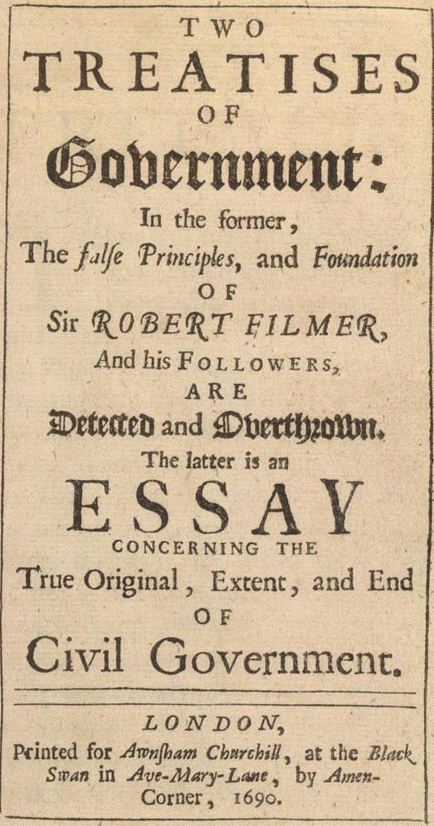
|
In his political theory, Locke was concerned to establish that
it can
be rational for subjects to protest against injustice in a
ruler.
He claimed that human beings are governed by reason before they enter into political society. This natural reason is enough to allow us to establish reasonably civilised relations without a ruler forcing his or her will upon us. When we do enter political society, it is in order more effectively to enforce the rule of reason. This law has to govern the conduct of the ruler as well as the subjects.
|
external link to Wikipedia article other weblinks
|
Bronislaw Malinowski
Born 1884, died 1942 |
books - weblinks |
An anthropologist who spent the first world war confined to the Trobriand Islands, off the eastern tip of New Guinea.
Malinowski was interested in trade and exchange from a sociological point of view. He studied trade in objects of "high value, but of no real use". His paper on this in 1920 was called "Kula; the Circulating Exchange of Valuables in the Archipelagoes of Eastern New Guinea". Kula is an inter-island system of ceremonial giving or exchange. The "gift" is only kept for a period and then travels, by sea, in a ring, to the next recipient. In this way, communities are bound together.
In 1922 he published Argonauts of the Western Pacific in which he reported fully on his participant observation in the Trobriand Islands. Argonauts are heroic sailors.
In 1927 he became the first Professor of Social Anthropology at London School of Economics.
Based on his Trobriand island studies, he published Crime and Custom in Savage Society in 1926 and The Sexual Life of Savages in 1929
In a "special forward" to the third edition of The Sexual Life of Savages in 1932, Malinowski wrote, humorously, that he had called himself the "Functional School of Anthropology"
Jomo Kenyatta studied social anthropology under Malinowski from 1935 and Malinowski wrote the introduction to Facing Mount Kenya in 1938.
Thomas Malthus
Born 1766, died 1834
See Wealth and Poverty: Malthus and Ricardo
|
Herbert Marcuse born 19.7.1898, died 1979 |
books - weblinks - extracts |
See critical theory - timeline 1941 - dimensions
Born in Berlin in a Jewish family, Herbert Marcuse completed a Ph.D. thesis at the University of Freiburg on the German Künstlerroman (artist's novel) in 1922. From 1922 to 1929 he worked in the Berlin book trade. He then returned to Freiburg in 1928 or 1929 to study with Edmund Husserl and write a habilitation (professor's dissertation) with Martin Heidegger. This was published in 1932 as Hegel's Ontology and Theory of Historicity.
In 1933, when the Nazis came to power, Marcuse began work at the Frankfurt Institute for Social Research. He left Germany with Max Horkheimer in 1933, going first to Switzerland, then the United States, where the Institute re-located. He became a USA citizen in 1940.
Reason and Revolution - Hegel and the Rise of Social Theory was published in 1941 (See extracts)
During the Second World War, and after it, Marcuse worked for the United States Office of Strategic Services (forerunner of the CIA), analysing intelligence reports about Germany.
In 1952 Marcuse began a university teaching career as a political theorist, first at Columbia and Harvard, then at Brandeis from 1954 to 1965.
1955 synthesis of Marx and Freud, Eros and Civilisation
1958 Soviet Marxism: A Critical Analysis
"Social theory is concerned with the historical alternatives which haunt the established society as subversive tendencies and forces" Marcuse 1964 p.8)
The one dimensionality of contemporary humans (in the United States) was that advertising successfully directed desire in one direction and suppressed the critical desire that would see the alternative.
In 1964 Marcuse moved to the University of California, San Diego.
"His critiques of capitalist society (especially his 1955 synthesis of Marx and Freud, Eros and Civilization, and his 1964 book One-Dimensional Man) resonated with the concerns of the leftist student movement in the 1960s. Because of his willingness to engage seriously with (and support) student protesters, Herbert soon became known as "the father of the new left" (a term he disliked and rejected). He had many speaking engagements in the US and Europe in the late 1960s and in the 1970s. He died on July 29, 1979, after suffering a stroke during a visit to Germany." Source: Harold Marcuse
|
Karl Marx
Born 1818, died 1883 and Friedrich Engels Born 1820, died 1895 |
Timeline 1848 and index of
Marx and Engels resources Marx books - extracts index Engels books - extracts index Life and works |
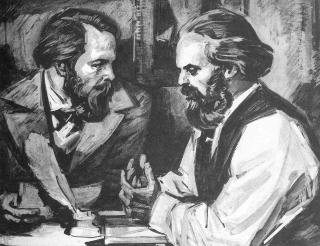
|
Marx and Engels were collaborators in the production of what they saw as a scientific analysis of human history from the perspective of socialism. They described themselves as communists, and their writings are the classical texts of communism and marxism. |
As with all major theorists, there are different interpretations of their work. It is usually agreed, however, that they argued for a materialist interpretation of society and history. They used concepts about how human societies change the material world in order to exist, as the key concepts to explain everything that humans do. The key to history is an analysis of successive modes of production, and the motor that moves history is class conflict within those modes of production. The analysis of these would be a distinguishing feature of any marxist theory, whether it concerned crime, economics, psychology, music, literature, gender relations, family relations or whatever. This approach is called historical materialism. (See Marx and Engels: Scientific Socialism)
|
|
Click weeping Stan to see what Engels' thought criminal statistics show us about the connection between crime and economics |
Some people argue that
Engels distorted
Marx. Whatever the
truth about
this, it is difficult to discuss Marx's views on gender
without discussing
Engels.
Towards the end of his life, Marx became interested in the
anthropological reports of
Lewis Henry Morgan
(1818-1881). Morgan
argued that human society has three inter-related spheres:
production,
reproduction (i.e. the family and child rearing) and
government. Something
happening in one sphere would have repercussions for something
happening in
another.
When Marx died, Engels inherited his manuscripts, including
his
notes on Morgan. Engels developed Marx's notes on historical
materialism
and the family into a book
The Origin of the Family, Private Property and the
State
in
1884.
This is an important book in its own right. It is also
important
because a number of modern
feminist
theorists have developed their theories
as criticisms of Engels.
In 1949, Simone De Beauvoir
started The Second Sex
by analysing
biological, psychoanalytic (Freudian) and historical
materialist (Engels)
perspectives on women, and argues that they are partial. From
her
existentialist view, biology, sex and economics cannot
determine a woman's
destiny
In 1971,
Shulamith Firestone also began with criticisms of
Engels and Freud.
The first chapter of her book The Dialectic of Sex is a
good
introduction to Engels, and I have used its chart to construct
my notes on
Engels.
The chart shows how, according to Engels, the state, the
family and the
economy change together over time. The notes
include a
description of the
tribal organisation of politics in the
Iroquois Confederation.
Engels speculates on the future relations of the genders under
communism.
William Morris was one of the (very) few marxist
socialists who has
imagined in print
what communism would be like. He did this in the novel
News
from Nowhere which he published in
1890.
"In our attempt to discover woman we shall not reject
certain contributions of biology, of psychoanalysis, and of
historical
materialism; but we shall hold that the body, the sexual life,
and the
resources of technology exist concretely for [a human being]
only in so far
as he [or she] grasps them in the total perspective of his [or
her]
existence."
Click for
Engels
spelling tips
|
Marcel Mauss
Born 10.5.1872 (Épinal) died 10.2.1950 (Paris) |
books - weblinks |
Marcel Mauss was a nephew and then a colleague of Emile Durkheim
1895? Studied philosophy at the University of Bordeaux, where one of his teachers was his uncle, Émile Durkheim
Mauss edited the sections on religion and classification of the science of sociology in L'Année Sociologique. Most of Mauss's early published work was in collaboration with other scholars and was published in L'Année.
1899, with Henry Hubert, "The Nature and Function of Sacrifice"
1900-1902 Taught Hindu and Buddhist philosophy at the University of Paris
1902-1930 Professor in the history of religion of primitive peoples at the University of Paris.
1903, with Durkheim, "Primitive Classification"
"Every mythology is fundamentally a classification, but one which borrows its principles from religious beliefs, not from scientific ideas" (pp 77-78)
1904 Assisted Jean Jaurès to found the socialist daily newspaper L'Humanité. Mauss wrote for this.
1904, with Henry Hubert, "Prolegomena to a General Theory of Magic"
1908, with Henry Hubert, "Introduction to Religious Phenomena"
1908, Durkheim decided to publish the L'Année Sociologique only every third year.
1923/1924 "Essai sur le don. Forme et raison de l'échange dans les sociétés archaïques" published in L'Année Sociologique
Mauss did not carry out his own field-work. He used work like that of Bronislaw Malinowski's on exchange and social structure in Melanesia, to define exchange patterns cross-culturally, using Roman, Hindu, and Germanic examples as well. He sought to demonstrate that exchange is a "total social fact" in which economic and social motives are inseparable.
1925 Lucien Levy-Bruhl, Paul Rivet (1876-1958) and Marcel Mauss created the Institut d'Ethnologie Institute of Ethnology at the Sorbonne, dedicated to the memory of Durkheim. Rivet and Mauss were the secretary-generals. In addition to his University post, Mauss taught ethnography from 1927 to 1939 at the Institute of Ethnography. These lectures were compiled in the Manual of Ethnography (1947).
1930-1939 moved from the the University of Paris to the Collège de France.
|
George Herbert Mead
Born 1863, died 1931 Extracts Life and works |
crime
|
social psychology lecture - theatrical concepts
self and body - books and articles - weblinks
Oneself with others notes
1884 - 1887 - 1888 - 1891 - 1894 - 1896 - 1909 - 1913 - 1927 - 1930 - 1931 (death) - 1934 - 1939 -
Like his friend, John Dewey, George Herbert Mead was interested in both the biological evolution ideas of Charles Darwin, and Georg Friedrich Hegel's, earlier, historical analysis of the evolution of ideas.
|
From
1894 to
1904,
John Dewey was the first chair of Philosophy at the new
Univisity of Chicago, where he
developed his version of pragmatism.
Dewey arranged for his colleague Mead to lecture at Chicago, and Mead remained a lecturer in phiolosophy at Chicago until his death 1931 |
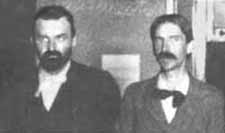
George Herbert Mead (left) with his friend John Dewey in the 1890s |
At Chicago University Mead developed theories that showed how social interaction by means of symbols could have developed from the conversation of gestures of animals.
After his death, some of Mead's students published lectures and articles by him as Mind, Self and Society, from the Standpoint of a Social Behaviourist (1934)
Mead's main contribution can be seen as his attempt to show how the human "self" is "not initially there, at birth, but arises in the process of social experience and activity" (Mead, G.H. 1934 chapter 18). What we call our self is something that develops in the process of social interaction using symbols. As a result theories based on Mead's were later called "symbolic interactionist".
Concepts used include - self - body - conversation in gestures - mind - emotion - society - institution
|
Robert King Merton
Born 5.7.1910, died 2003 |
crime
|
|
extracts -
books -
weblinks -
timeline
life and works Durkheim and Merton page |
Robert Merton was a pupil of Talcott Parsons at Harvard University (1931). Like Parsons, he analyses society in terms of structure and function and investigates the relation between social structure and culture . Whereas Parsons concerns himself mainly with theory and with theory that explains the whole of society, Merton was most interested in theory on a smaller scale and how such theory could be developed to establish empirical relations with sociological data.
Merton was a postgraduate student and teaching assistant at Harvard from 1933 to 1936 and then a tutor and instructor from 1936 to 1939 - In 1937 Merton was acknowledged by Talcott Parsons for particularly helpful suggestions and criticisms after reading the manuscript of The Structure of Social Action.
It was also in 1937 that Merton published an article on "Social Structure and Anomie" in the American Sociological Review that Margaret Evans says "catapulted Merton into the sociological spotlight"
From 1939 to 1941, Merton was teaching at Tulane University in New Orleans
In 1941 Merton was given an appointment in Columbia University, New York. Here, he combined his theoretical interest with the empirical interests of Paul Lazarsfeld to create what Merton called "middle-range theory" - testable propositions, derived from fundamental theory, addressing observable phenomena.
Mass Persuasion: The Social Psychology of a War Bond Drive, a book that Merton co-authored in 1946 is said to have "significantly shaped public opinion research"
In 1949 Merton's Social Theory and Social Structure. Towards the codification of theory and research. Sought a
" functional analysis in sociolgy ...the description of the participants (and on-lookers) is in structural terms, that is, in terms of locating these people in their inter- connected social statuses."
This was published at a time when Talcott Parsons and many other leading United States theoriest were working on a common agreement about the theoretical concepts of sociology.
Robert Merton's view of society, anomie and crime
|
Charlotte Mew
Born 15.11.1869, died 24.3.1928 |
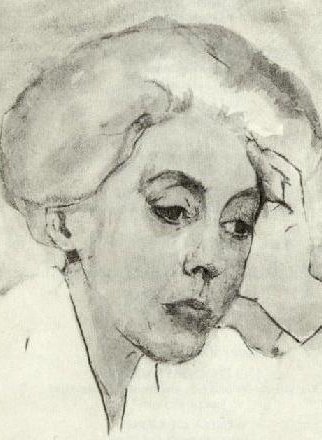
|
|
extracts -
books -
weblinks
birth - life - works Freda and Charlotte (short) - Freda and Charlotte (long)  #CharlotteMew
|
Introductory themes: life - inference - intensity - history - science - Chicks - evolution - dissolution - sensual - God - language - madness - faerie - spirit
An English short-story writer, essayist and poet, Charlotte Mew was also a social theorist and radical critic of the social policies of her time, Siegried Sasson wrote to, and of, Charlotte that poets "carry the world on their shoulders... And in their eyes the future of civilisation struggles to survive".
Eugenics, or breeding out the weak and diseased members of society, was a powerful mental health policy in the first half of the 20th century. Charlotte Mew lived in fear that her own mental illness, and that of her family, would be discovered. In protest she wrote stories and poems in which mental patients are described positively. One of these was returned by an editor with a note that such people should be in asylums.
In one of Charlotte Mew's poems, "we", a group of "merry town or village folk", meet a group of "them" "on the asylum road". They are "the saddest crowd" that we will ever pass, but we still stop and try to be friendly with them. The poem was first published in 1916 and the images in it may refer to the country lanes around the Isle of Wight asylum, where her sister Freda was a patient.
On the Asylum Road
Theirs is the house whose windows---every pane---
Are made of
darkly stained or clouded glass:
Sometimes you come upon them in the lane,
The saddest crowd that you will ever pass.
But still we merry town or village folk
Throw to their scattered stare a kindly grin,
And think no shame to stop and crack a joke
With the
incarnate wages of man's sin.
None but ourselves in our long gallery we meet,
The moor-hen stepping from her reeds with dainty feet,
The
hare-bell bowing on its stem,
Dance not with us; their pulses beat
To fainter music; nor do we to them
Make their life sweet.
The gayest crowd that they will ever pass
Are we to brother-shadows in the lane:
Our windows, too, are clouded glass
To them, yes, every pane!
The patients being the "incarnate wages of man's sin" is a reference to the recent discovery (see Frederick Mott) that syphilis (a sexually transmitted disease) was the cause of General Paralysis of the Insane, a disease that destroyed many in early 20th century asylums.
The poem suggests absence of real communication between the "we merry town or village folk" and our "brother-shadows in the lane", but also that "we" are out of touch with nature. Communication is through clouded glass. I do not think stained or clouded refers to any actual practice respecting asylum windows. It relates to our vision of one another and the reference is possibly to the Christian bible's "now we see through a glass, darkly"
Experiences frightening and enlightening
Charlotte Mew believed that in her experiences she passed across the barriers between sanity and madness, civilisation and nature, and that this might be experienced by others through reading her poetry. This was, at the same time, frightening and potentially enlightening.
Frightening
It was frightening because, according to the science of the time, she had an hereditary "taint", passed on biologically. Her out of sight of visitors, her brother had died in an asylum and her youngest sister lived and died in another asylum. All this was kept a secret and Charlotte lived in fear that her own strange experiences would be classified as madness and that she would be confined in an asylum. Many scientists of the time argued that there were hierarchies of evolution and devolution and that people were travelling up or down these hierarchies. Insanity and imbecility were journeys downwards. Upwards was civilisation and reason, downwards was the return to the primitive being from which civilisation had evolved.
At the time Charlotte wrote, asylums were increasing seen as places to isolate genetically degenerate people from the general population and to prevent them from breeding. They were a practical aspect of eugenics, or healthy breeding.
Potentially enlightening
It was potentially enlightening because it was possible that the science was wrong. It was possible that the different levels of the hierarchies were not polarised into good and bad, but that the levels had different values.
Charlotte Mew's two essays on Men and Trees, published in 1913, are the closest she came to writing a political manifesto. The title tells us that it is (amongst other things) about the hierarchy of humans and nature, which she has said we do not "dance" with. The essays begin with a discussion of different levels of communication. What is a blind man doing at a viewing in an artists studio? What does he see that the sighted people cannot? Elsewhere, Charlotte tells how, as a child, a blind man explained that he uses his ears to see. Perhaps this was what the blind man in the studio was referring to when he said:
"I really can't bear to see a tree cut down - a big tree: it's a sort of sacrilege."
Later, Charlotte began a poem about the destruction of trees with a quote from the Christian bible "and he cried with a loud voice: Hurt not the earth, neither the sea, nor the trees". In Men and Trees she contrasts the world of rational self interest (See individualism and culte du moi) characterising the "civilised" world with the barbarities of child sacrifice in Old Testament times:
"These, of course, are the darker superstitions; civilisation, brightly conscious of having abolished the devils with the gods, and replaced them all by the Culte du Moi, murmurs "shocking!" and hurries on; but there is not much doubt that human sacrifices are still being offered by American and European syndicates to the sacred tree of civilisation, the rubber tree. Civilisation demands speed, speed demands rubber, and rubber, coated with blood and slime, turns quickly into gold."
Charlotte Mew believes that it is possible and desirable to establish a dialogue between the polarities of the various heterarchies of our existence. We can listen to the other person and not polarise into them and us. Civilisation can listen to nature as the blind man listened to the trees. We can understand that it is important that economic development should not be at the expense of the rain forests and the people who live in them. And sanity can listen to insanity. Shutting people away in asylums is not the answer. When we do that, we shut away part of ourselves.
|
James Mill
Born 1773, died 1836 |
books - weblinks
|
James Mill, a shoemaker's son from Scotland who came to London in 1802. He became the disciple and chief propagandist of Jeremy Bentham from about 1808. Sometime before 1810 he also joined forces with the Quaker William Allen, cooperating with his magazine The Philanthropist, which became an important organ for utilitarian ideas. James Mill wrote the History of British India which was published in 1817 and 1818. Between 1816 and 1823 he wrote essays for the supplement of the Encyclopedia Britannica on government, law, the liberty of the press, prisons and prison discipline, colonies, the law of nations, and education. I have summarised the argument of his essay on government in Social Science History. He published the Elements of Political Economy in 1821 and 1822. In 1827 he was one of the founders of London University. In 1829 he published Analysis of the Human Mind , one of the first English text books of Psychology.
James Mill popularised the theoretical principles of Jeremy Bentham. It was James son, John Stuart Mill, who called those principles "utilitarianism". Utilitarianism is a theory with different possibilities according to how it is developed. The socialist version argued that the greatest human happiness would be obtained through cooperation. This was not James, version and, in the 1830s James Mill was the most widely read and influential of the Utilitarians. It was his version of the doctrine which most people would have recognised.
James broadened utilitarianism by linking it with other theories. He linked it to the egoistic psychology that Thomas Hobbes had developed. This argues that the foundation of any explanation of the human mind must be to trace its content back to the self-centred desires of the individual. He also linked utilitarianism to democracy, arguing that if we are all pursuing our own self-interest it is not safe to trust government to a minority. Every male adult must have a vote to act as a control on the government. He also linked it to laissez-faire economics, merging the theories of Bentham with those of Ricardo and other followers of Adam Smith.
It was the total package that James Mill put together that people often percieved as utilitarianism, but none of the links he made is a necessary one. Other utilitarians, includeing his own son, John Stuart Mill, as well as Thompson and Wheeler, made different links and constructed different versions of utilitrianism.
See timeline for
1820,
1825,
1827,
|
John Stuart Mill
Born 1806, died 1873 and Harriet Taylor Born 1807, died 1858 |
books - weblinks
life and works |
John Stuart Mill was the son of James Mill.
Like his father, he was a utilitarian philosopher and a political economist. He was also a radical liberal politician.
John Stuart Mill's A System of Logic (1843) was one of the foundations of social science. It was written to stress the importance of deduction, reason, theory and hypothesis in science, and to explore the way they relate to empirical reality and induction.
Few people read Mill's Logic nowadays (although many condemn it without reading it), so this description may come as a surprise to some people. See proof.
Harriet Taylor provided the ideas for an article On the Probable Futurity of the Labouring Classes in a book by John Stuart Mill that was the standard text book on economics in the second half of the 19th century (Mill, J.S. 1848).
The article argues against paternalism and for self-determination. Paternalism is where a benevolent, but authoritarian, government provides for the welfare of the people. It is the kind of policy associated, at the time, with people like Lord Ashley.
Mill and Taylor argued that, after the basic necessities of life have been met, freedom is the most important human need. Freedom meaning, for them, the opportunity to develop one's own life according to one's own values, rather than living, however comfortably, under the control of someone else. The working class, they argued, were rightly taking this power into their own hands. Women, they added, should do the same.
In The Subjection of Women (1869), J.S. Mill argued that western society is developing from a hierarchical organisation (feudalism) to an organisation based on freedom under law. His book incorporated the ideas of the early French sociologists, St Simon and Comte, that societies are complex wholes in which legal structures, morals, customs, political, economic and family structures interrelate. The development of democracy and freedom in politics he argued, would need to be matched by a development of freedom and democracy within the family and in the relation between the sexes.
|
Howard John Mingham
Born 25.4.1952, died 1.4.1984 |
"Howard Mingham was born in 1952 in Norfolk and moved to Hackney at the age of ten. He was educated at Hackney Downs School and Kingsway College. Schizophrenic, he was one of a group of socially marginalised writers who attended the Hackney Writers' Workshop, which started meeting fortnightly at the Centerprise Bookshop in Hackney in 1976." The alternate Wednesday evening meetings were convened by Ken Worpole and were also attended by Howard's friend, the poet David Kessel. Early one morning in 1984, Mingham was found dead in the Cambridge Heath Road area of East London, having fallen from a tower block. An open verdict was recorded. David Kessel collected Howard's poems and published them for a memorial meeting in November 1984. A fuller collection (27 poems) was launched on Saturday 16.6.2012. (International Times)
This poem by Howard can be read as a statement of his identity.
After the Rain
After the rain a holy
Pagan light fell from cloud
And struck the pavement slab,
In all the canyoned silence moved no crowd.
But in the stinking mist alone,
In the incense of the dying rain,
I stood on the brown-soaked stone
And I heard the song of the drain.
'I am the hope and the escape.
I am the tunnel to the drowning sea.
I am the gay merry and the dismal
And I am neither the light nor the way.
'Into me rolls the runaway penny;
To all things I am sanctuary.
I am their church, their catacomb, their nunnery
And I am neither the light nor the way
By the trickling cave on the kerb I sat,
My head stone-heavy in my helpless hands
And in the sour valley of the stonefaced flats,
The drain sang to me and I dreamt.
Of those distant, waiting lands
Where none made, no promise is broken
And the streams run clear to the honest sands
Where no man has stood and thus no lie been spoken.
'Yes, into me rolls the runaway penny
And longs the hopeless refugee.
I am catacomb and nunnery
And I am neither the light nor the way.
'I am merry in song and sing of the sea
And into me trickles the washed-out day.
And I drink of the hopeless refugee
And I am neither the light nor the way'.
A memorial meeting for Howard Mingham was held in October 1984, thirty years after his death. At a later meeting, David Kessel commented on how hard Howard worked on his poetry. he also said that he thought there was a connection between Howard (and his) diagnoses as schizophrenics and their poetry. They are deeply connected.
"Mental struggle expresses itself in Howard's poetry"
Juliet Mitchell
Psychoanalyst. Born New Zealand 1940. Lived in London
since 1944.
Many
feminist
theorists in the early 1970s criticised
Freud. Mitchell
is a feminist writer who argues that feminists like
Simone De
Beauvoir,
Betty Friedan, Eva Figes, Germaine Greer,
Shulamith
Firestone
and Kate
Millett, have created inadequate theories because they have
missed out the
essential Freud: his theory of the unconscious. Her 1974 book,
Psychoanalysis
and
Feminism, also discusses
Reich
and
Laing.
Montesquieu
Charles Secondat "Baron de Montesquieu" (l689-l755) was a French
aristocrat. He was a judge, but he sold this office to devote more of his
time to study. His two major works were the Persian Letters (1721)
and
The Spirit of the Laws (1748).
The Spirit of the Laws contains this message:
It is easy to find strange or bizarre parts to the book, but Montesquieu is
valued for the way he related elements to one another. The many parts of
the book hang together. In it he explored natural and human laws in a way
that enables us to analyse society as a whole, in relation to its parts, in
relation to its history and in relation to its environment.
"I beg one favour of my readers, ... that they will approve or
condemn the book entire, and not a few particular phrases."
|
Benedict Augustin Morel
Born 1809, died 1873 |
books |
Pioneer of the theory of degeneration:
"Les degenerations sont des deviations maladives du type normal de l'humanite hereditairement trans-missibles et evoluant progressivement vers la decheance." (Degenerations are deviations from the normal human type which are transmissible by heredity and which deteriorate progressively towards extinction.)
He worked on this theory from 1839 until 1857, giving it its final form in Traite des Degenerescences Physiques, Intellectuelles et Morales de I'Espece Humaine
Degeneration could be caused by intoxication, by malaria, alcohol, opium, soil conducive to cretinism, epidemics or food poisoning; the social environment; pathological temperament; moral sickness; inborn or acquired damage; or heredity. His law of two-fold fertilisation stated that combined physical and moral injuries were particularly dangerous. His law of progressivity stated that the first generation of a degenerate family might be merely nervous, the second would tend to be neurotic, the third psychotic, while the fourth consisted of idiots and died out.
Morel identified changes in the head, eye, ear, genitalia and intestines which were infallible stigmata (signs) of degeneration.
See the case of Charles Joseph Jouy in 1867 . Morel was director of the Asile d'Aliénés de Maréville at Nancy (where Jouy was later confined) from 1848 to 1856, when he was appointed director of the mental asylum at Saint-Yon in Rouen.
|
Lewis Henry Morgan
Born 1818, died 1881 |
books |
In 1851 Lewis Henry Morgan published League of the Ho-dé-no-sau-nee, or Iroquois. Included a folding map and a "Schedule explanatory of the Indian map," arranged in three columns giving the corresponding English and Indian names of the localities, stream, etc., with their signification.
1870/1871 he published Systems of consanguinity and affinity of the human family
1877 he published Ancient society, or, researches in the lines of human progress from savagery, through barbarism to civilisation
Morgan argued that human society has three inter-related spheres: production, reproduction (i.e. the family and child rearing) and government. Something happening in one sphere would have repercussions for something happening in another.
Frederick Walker Mott
Born
23.10.1853,
died
8.6.1926
Asylum pathologist. From 1884 a lecturer in physiology at Charing Cross Hospital Medical School. Appointed in 1895 to run the London County Council Asylums' new Central Laboratory at Claybury. He also remained a lecturer at Charing Cross.
Pathology (1900 dictionary) explains the nature, causes and symptoms of diseases and a laboratory is a building or room designed for investigation and experiment. The microscope is usually considered as the scientific apparatus that made the laboratory study of disease important. Its uses included looking for tiny life forms that might generate disease and taking a close look at body tissues. A central laboratory for asylums would be concerned with diseases that were associated with asylums. Mott investigated the possible relation that both psychosis and neurosis might have to the body. But there were other diseases associated with asylums: "epidemic disorders, such as dysentery". "Asylum dysentery" or "asylum colitis" covered a variety of gastrointestinal infections to which the patients in asylums seemed particularly prone. (See Claybury)
Mott and Durham (1900) investigated the theory that asylum colitis was due to the degeneration of the nervous tissue of insane people leading to tissue damage in the intestines, which then became infected. This was the prevalent theory, but they found no evidence for it. They therefore argued that the gastrointestinal infections in asylums were spread within the asylum, and better hygiene would prevent them. For the reduction in disease following on this report, Mott was awarded the Stewart Prize (for work on the origin, spread and prevention of epidemic disease) by the British Medical Association in 1903.
Mott followed Henry Maudsley's guidance that advances in the study of mind would follow study of corresponding body changes. He worked to show that general paralysis of the insane is an end product of syphilis. His work on General Paralysis of the Insane was published in the first volume of Archives of Neurology, which he founded 1899. "Mott became firmly impressed by the idea that bodily changes are to be found in all types of psychosis" (Nature 1926).
" Dementia praecox offered the most promising field of study, and in a series of papers on the pathology of the gonads and other endocrine organs and the vegetative nervous system in this disease, he was able to demonstrate with certainty the existence of a widespread degenerative change preceding the far slighter evidences of degeneration that could be detected in the central nervous system in advanced cases. In other psychoses similar though less marked pathological changes were encountered" (Nature 26.6.1926 p.900).
"He considered the majority of the pathological changes that he discovered in insanity are congenital... he enunciated the "Law of Anticipation", in accordance with which the onset of the psychotic symptoms appears earlier in the successive generations of a degenerate family, and thus ultimately, owing to the production of infertile juvenile psychotics, the tainted stock disappears." (Nature 26.6.1926 p.900).
The laboratory work on which Mott based his conclusions about biological degeneracy underlying the mental symptoms of dementia praecox were published in The British Medical Journal in November and December 1919. In a leading article, the journal said Mott had made clear "the biological significance and purpose of psychosis".
| Max Müller 1823-1900 | books |
Born in Germany, Max Müller came to England in 1846 to study the manuscript of the Rig-Veda, the sacred hymn of hinduism. This was in the possession of the East India Company. In 1847, the company commissioned Müller to edit and publish the text. Müller was appointed professor of modern languages at Oxford University in 1854. See 1861 and 1870
|
George Peter Murdock
Born 11.5.1897, died 29.3.1985 |
books - weblinks |
A United States anthropologist who advocated an empirical and statistical approach by compiling data from independent cultures, and then testing hypotheses by subjecting the data to the appropriate statistical tests. He put together a team at Yale University which created a cross-cultural data set which is now used world-wide.
|
Franz Neumann
Born 23.5.1900, died 2.9.1954 |
books - weblinks - commentary |
"Political scientist with special expertise in law" (Held, D. 1980 p.14) Graduated from University of Frankfurt. Greatly influenced by his teacher (there?) Hugo Sinzheimer, founder of German labour law. 1925-1927 Taught at Academy of Labour. 1927 Settled in Berlin as a labour lawyer. From 1928 taught at "Hochschule fur Politik" in Berlin. Legal adviser to the SDP. Arrested April 1933 but escaped in May and studied at LSE under Harold Laski. In 1936 moved to the United States and joined the Institute of Social Research at Columbia University.
Published Behemoth, written at the Institute, in 1942.
After the war joined the faculty of Columbia, working in the Department of Government. 2.9.1954 (aged 55) killed in a car accident in Switzerland. Pollock spoke at his funeral (in Switzerland?).
Isaac Newton
born
1642,
died
1727
English
mathematician
and
physicist. In
Principia Mathematica
(1686) he
set out mathematical laws of mechanics and gravitation which
he applied to
bodies on earth and to the movement of the planets in the
heavens.
Newtonian mechanics has three laws of motion:
1) that a body continues in a state of rest or uniform motion in a straight line unless it is acted on by an external force;
2) that the rate of change of momentum of a moving body is proportional to the force acting to produce the change,
3) that if one body exerts a force on another, there is an equal and opposite force (or reaction) exerted by the second body on the first.
Newtonian dynamics is an example of what Khun calls a paradigm,
To fully prove a theory is either very difficult (John Stuart Mill thought Newton had done it); or impossible (Einstein, demonstrated that Newton had not done it).
|
Florence Nightingale
Born 12.5.1820, died 13.8.1910 |
books |
A young woman from an upper middle class English family, Florence Nightingale trained as a nurse (a very low class occupation) at Kaiserwerth (1851) and Paris. After the battle of the Alma in the Crimean War, she offered to organise a nursing department for the wounded soldiers at Scutari. In October 1854 she left Britain with thirty-eight nurses and arrived in the Crimea in time to receive the wounded from Inkermann (5.11.1856). She returned to England in 1856 and a fund of £50,000 was subscribed to enable her to form an institution for the training of nurses at St Thomas's and at King's College Hospital.
|
Ann Oakley
Born 17.1.1944, |
books |
"After university, Ann Oakley wrote two novels, but had difficulty finding a publisher, She did a variety of part-time jobs, in market research, telephone sales, doing contract research in education, and writing scripts for children's television. Her first two children were born in 1967 and 1968. In 1969 she registered for a PhD on women's attitudes to housework, a subject that much puzzled the academic establishment at the time. Her first academic book, Sex, Gender and Society was published in 1972. This introduced the term 'gender' into academic and everyday discourse, and provided a very useful tool for the developing field of women's studies: 'gender' distinguishes the social treatment of men and women from the biology of sex.

|
By this time, Ann Oakley had discovered feminism, and had joined the infant women's liberation movement. Two books on the housework project followed in 1974, The Sociology of Housework and Housewife. These pointed out that the social sciences ignored housework as work, and that very few serious studies of women's work in the home existed." |
|
Jean Oury
Born 5.3.1924, |
books |
Started as a psychiatrist at the Hospital of St Alban in September 1947. Came to Loir et Cher in 1949 and founded the la clinique de la Borde in 1953.
|
Robert
Owen
Born 1771, died 1858 |
Extracts -
books
-
weblinks
Lecture notes - reviews |
Robert Owen was the son of an ironmonger or saddler in Wales. He left home when he was ten years old to enter the retail drapery trade in London. In 1785 he went to Manchester where, with a partner and £100 capital, he began making "mules" (Machines for spinning cotton). He became manager (and later partner in) a Mr Drinkwater's factory. In 1799 he married David Dale's daughter and in 1800 became manager and part owner of Dale's New Lanark Mills. In his management of New Lanark's 2,000 workers Owen attempted to replace violence by reason. In 1813, funding from Bentham and others enabled to continue developing the social and educational aspect of his business community. In 1815 (via Peel) he promoted A Bill to Regulate the Employment of Children in Textile Factories. Between 1812 and 1816 he published his A New View of Society or Essays on the Formation of Human Character and in 1817 his Plan for the Relief of the Poor. His plan was rejected, Owen suspected this was because of the influence of Malthus. Owen turned to publicity and efforts to get a trial community started. His views on community management moved away from paternalism towards equality and self- management. From 1824 to 1829 he was in the USA trying to establish a model community at New Harmony. When he returned to England in 1829, he found he was a guru of the labour movement. In 1831 the first Co-operative Conference was held in Manchester. 1832-1834 National Equitable Labour Exchange. Grays Inn Road. In 1833, the third congress appointed Co- operative missionaries and, in the same year the Grand National Consolidated Union was formed, partly with the dream of bringing about a new cooperative moral order. 1834 Tolpuddle Martyrs and collapse of union. The New Moral World (Journal) was founded afterwards. 1839-1845 Queenswood Community, Hampshire. [1843 Rochdale Shop]
Paracelsus
Born
1491,
Died
1541
Phillipus Aureolus Theophratus Bombastus von Hohenheim, called Paracelsus
German doctor. About 1520 wrote a small book called Diseases which lead to a Loss of Reason, published in 1567. Published a clinical description of syphilis in 1530. His discussion of syphilis [Vom Holtz Guaiaco gründlicher heylung (1529) and Von der Franzüsischen kranckheit Drey Bücher (1530)] criticized current methods of treatment including the popular use of guaiac (a tropical wood resin known as the holy wood). Published his Der grossen Wundartzney (Great Surgery Book) in 1536. De Generatione Stultorum, published 1567, was translated by P. Cranefield and W. Federn as "The begetting of fools" in Bulletin of the History of Medicine 41.
Paracelsus was a pioneer of practical chemistry, analogies from which he applied to biology. For example, he argued that body organs separate the pure from the impure, just as a chemist would. So the stomach separates the parts of food that the body can use from the parts that it cannot. The waste part is got rid off through the intestines. Illness occurs when this ability in an organ fails, and poisons build up.
Paracelsus linked spiritual and material entities. His idea of pygmies (gnomes) as fairy forces associated with the earth, was drawn on by some to interpret the European discovery of very small humans in the African rain forest in the late nineteenth century.
Wikipedia on Paracelsus - An introduction to the writings of Paracelsus (archive) and Paracelsus - 500 years
|
Talcott Parsons
Born 1902, died 1979 and Anthony Giddens Born 18.1.1938, |
life and works -
books and articles
-
extracts
See Action and System and Society's parts and follow the links. |
"in the good old days we used to have "main stream" so to speak, and nowadays we have the cliché that goes "contrary to Parsons I argue...," instead of "according to Parsons"" ( Kiyomitsu Yui 2010 p.44)
Talcott Parsons is an American sociologist who studied the work of Max Weber in Germany in the 1920s (see life and works for details). He later translated some of Weber's work into English. Parson's was inspired by Weber to develop a general theory of society that is based on action (or inter-action between individual actors). To do this he made a creative synthesis of the theories of Alfred Marshall, Vilfredo Pareto, Emile Durkheim and Weber. He called his synthesis the "action frame of reference" (See Parsons).
This work was published as The Structure of Social Action. A study in social theory with special reference to a group of recent European writers in 1937
A central feature was that Parsons believed the social theorists he analysed were all, in their different ways, moving towards a resolution of what he called the Hobbesian problem of order. Simply stated, this is that the socially directed actions of individuals are integrated by the common value system of the society.
Parsons moved from the construction of a system focused on social action, to the integration of that perspective with systems theory. His integration of action theory and systems theory, The Social System, was published in 1951. (See Parsons)
From 1948 to 1951, Parsons was engaged in a massive inter-disciplinary "stock-take" with other American theorists of their "theoretical resources", with the aim of creating a common "general theory of action" for the psychological and social sciences. The results were published in 1951 as Towards a General Theory of Action - Theoretical Foundations for the Social Sciences, a book edited by Parsons and Edward Shils.
Parsons described the period from 1951, immediately after publication of The Social System and Towards a General Theory of Action, as one of "general theoretical effervescence". Working with others, he explored the "relations between the social system and individual personality". His developing theories described a
"convergence between Freud and Durkheim with respect to the internalisation of normative culture in the personality of the individual" (Parsons 1964 p.2. See extract)
In 1964, Parsons was described on the book-jacket of Social Structure and Personality as "the leading figure in American sociology" and the "major representative of the school of functionalism". In the same year, a poll of about 3,400 American sociologists showed that 80% thought functional analysis and theory of great value to contemporary sociology.
From 1964, Parsons completed his construction of social theory with work on the history of society and how societies change, arguing of a three stage model of evolutionary change: primitive, intermediate, and modern.
After Durkheim, I consider Talcott Parsons the most significant sociologist. His work established sociology as a science in the English speaking world, as much by the criticism it raised as by its substantial merits. In the mid 20th century, Parsons was the example of American scientific sociology. But, in the late 1960s and early 1970s, his theories were the centre of criticism in schools of sociology and the idea of a scientific sociology itself was criticised. In these dangerous times, British sociologist, Anthony Giddens, set out to rescue sociology from imminent death.
I believe that Parsons and Giddens are wrong,
but not as wrong as their critics. Their fault is not that
they treat
society as real, but that they do not treat it as real enough.
As an
American sociologist,
Parsons is not prepared to
treat social facts as
things
in the way Durkheim does. Like
John Stuart Mill
and
Max Weber,
he thinks sociology has to be developed from the study of the
actions of
human individuals. However, Parsons argues that individual
actions are
directed to other people and that, in the inter-action of
individuals, a
social system
emerges. Society,
therefore, emerges as a reality.
The main theorists discussed in Parsons's
The Structure of Social Action
are Alfred
Marshall; Vilfredo Pareto, Durkheim and Weber.
Parson's project is to find a way of conceptualising and analysing social systems without treating them as real. His critics have mainly been from the side of those who consider he went too far towards thinking about societies as real. In the 1960s and 1970s they took their arguments to the point where it seemed no sociology was possible, because the whole idea of society is a fantasy.
Anthony Giddens, in defending Sociology, has continued Parsons' project. Giddens defends the idea of social structure, but says:
-
"
Structure is not external to the individual but
rather almost
internal, as
memory traces. Structure has no existence independent of the
knowledge
agents have about what they do in their day-to-day activity,
and the
duality of structure is always the main grounding of
continuities in social
reproduction across time and space." (Quoted from
Gidden's web site)
|
Karl Pearson
Born 27.3.1857, died 27.4.1936 |
books |
Karl Pearson was appointed Gresham Chair of Geometry in January 1891. He gave 38 "Gresham" lectures, free and open to the public, between February 1891 and November 1893. On 20.11.1891 he introduced the term histogram to designate a "time-diagram" to be used for historical purposes. On 31.1.1893, he introduced the term standard deviation.
From 1891 to 1906 (when Weldon died) Pearson worked with Walter Frank Raphael Weldon, Professor of Zoology and Comparative Anatomy, on biometry (biological measurments) and evolutionary theory. Weldon introduced him to Francis Galton
In 1911 he was appointed to be the first occupant of the Chair of Eugenics established in connexion with the legacy bequeathed by Francis Galton.
Concepts: Sample - Population - Range - Deviation - Standard Deviation - variation - coefficient of variation - scales of measurement - variable - continuous variable - nominal variables - ordinal variables -
continuous variables were divided into interval scales and ratio scales by Stanley Smith Stevens in 1947
| Louise (Roxanne) Pembroke | books - timeline entry |
Louise Pembroke (along with Peter Campbell) was identified as a [survivor] "movement intellectual" by Cresswell and Spandler in 2012. Commenting on this, she wrote
"I have never viewed myself as an intellectual - quite the opposite - but at the same time I do know that some of what I did were 'firsts' of their kind, putting a few new ideas out there. I would agree that I did a lot of thinking for the movement within my written work and actions."Much of Louise's thinking was collective thinking, others individual acts:
"Most was within the context of others yes of course, we are all influenced by each other... Some things were also individual in their initial inception because I did not discuss them with others, I just did them, like standing up at a Mind conference and saying I want to start a national network, these are my ideas who wants to join me or the dance DVD , the choreography was solely my own with no discussion with anyone else. So it is both really, there are ideas and thinking which are borne out of collective thinking and occasionally there are individual ideas." (email 26.9.2012)
Louise Pembroke joined Survivors Speak Out in 1988. She became its Education Officer. Louise describes herself as a voice hearer and survivor activist with a special interest in self-harm.
As Education Officer, Louise organised (5.9.1989) Looking at self-harm: the first national conference on self-harm to be held in the UK, "entirely organised by the recipient movement" at the International Students House in Great Portland Street in North London.
In September 1991 Louise (for Survivors Speak Out) organised an Eating Distress conference. The Eating Distress booklet published by Survivors Speak Out came out of that. (Louise Roxanne Pembroke (editor) Eating Distress - Perspectives from Personal Experience. Conference Papers . Survivors Speak Out 1992).
Self-Harm: Perspectives from Personal Experience edited by Louise Roxanne Pembroke, was published by Survivors Speak Out in 1994.
In 1994 Louise called for the setting-up of a National Self-Harm Network in order to campaign more effectively for 'rights for self- harmers'. The network was established shortly afterwards with Louise Pembroke as its the first Chair.
The Hurt Yourself Less Workbook by Eleanor Dace, Alison Faulkner, M. Frost, K. Parker, Louise Pembroke and A. Smith. was published by the National Self-Harm Network in 1998. This was the first self- management workbook written by survivors for survivors
During 1999, Louise organised the first to risk reduction conferences for survivors. One of the outcomes of these was the publication of Cutting the Risk , the first and only book on practical harm- minimisation for self-harm, which was published by the National Self-Harm Network in 1999.
|
In 2005 Louise published Dedication to the seven:
hearing voices in dance, a DVD with 20 page booklet (spiral binding)
of background information and ideas for group discussions. Louise wrote
"My dance is about my experience of living with what is labelled as 'psychosis', specifically hearing voices and seeing visions" |
|
John Thomas Perceval
Born 14.2.1803, died 28.2.1876 |
books - extracts |
John Perceval's father, Spencer Perceval senior, was the British Prime Minister from 1809 to 1812. His Tory cabinet successfully conducted the war with Napoleon in the light of the book of Revelation (see Gray, D. 1963). But he was assassinated in 1812 by John Bellingham, an alleged lunatic. Parliament compensated the Prime Minister's children handsomely.
Spencer Perceval junior (1795-1859), the eldest son of Spencer Perceval the Prime Minister, was a Tory member of parliament until 1832. In He was very active as a parliamentary inspector of London madhouses. Because of embarrassing religious speeches in the House of Commons, one commentator (in March 1832) said he had "gone mad" in the Commons. Nicknamed "Saint Perceval" he successfully called for a national day of public fasting and humiliation during the cholera epidemic of 1831-1832.
John Thomas Perceval was confined as a lunatic in Brislington House near Bristol in 1831 and transferred to Ticehurst Asylum Sussex in 1832.
"Soon after his release and presumably in 1835 he sought out the ageing Esquirol in Paris to discuss with him how best to improve public services and supervision of the insane" ( Hunter and MacAlpine 1962 referencing Perceval 1846 p.91)
In 1838 Perceval published a book length anonymous account of his treatment which he called A narrative of the treatment experienced by a gentleman, during a state of mental derangement: designed to explain the causes and the nature of insanity, and to expose the injudicious conduct pursued towards many unfortunate sufferers under that calamity
Perceval also made friends with
Richard
Paternoster, an alleged lunatic featuring in the press in 1838
for wrongful confinement
(Paternoster, R. 1841 p. 51)
In 1840 Perceval re-published a book with the same title as the 1838 one,
but under his own name and with different content.
He helped to found the
Alleged Lunatics Friend Society in 1845, at the time
when asylums were becoming
a requirement of local government in England and
Wales. His campaigning was the major cause of
Parliamentary opposition to
the 1845 Lunacy Acts. He was honorary secretary to the society from
1846.
Before a Parliamentary Committee in 1859/1860, Perceval said
John Thomas Perceval told a Select Committee on 11.7.1859
(155-158) that he had been honorary secretary of the Alleged Lunatics
Friend Society since
1846. At first, Mr Luke Hansard "to whom we owe chiefly the foundation of
the Society, was the honorary secretary".
Luke James Hansard
(26.3.1805-April 1889) was the Printer of the Reports of
Parliament from 1830 something to 1847 when he lost the contract because of
an advertisement in bizare language that he placed in The Times
attacking a Member of Parliament.
The Honorary Solicitor shown on a notice of March 1846
was Henry F. Richardson. Who lived Haileyford-place, Kennington in 1837. In
the spring of 1845, Richardson was writing from 36 Coleman Street, which
was the address given as the office of the Alleged Lunatics Friend Society
on the notice of March 1846. The secretary in 1846, John Taylor, was also
located at the office.
The three members of the Alleged Lunatics Friend Society who gave evidence
before the Parliamentary Committee in
1859/1860 were, in order of first
appearance, Gilbert Bolden (1809-1889), its solicitor; Richard Saumarez
(11.9.1791-16.1.1864), its chair; and
John Thomas Perceval. Ann Tottenham gave evidence with Richard
Saumarez. Bowden attended all of the committee sessions to 31.3.1859, and
probably beyond that. Perceval focused on reading the reports because he
had a hearing defect.
Gilbert Bolden said (31.3.1859) that he had been the "honorary solicitor"
to the "Alleged Lunatic Society" for the past twelve years [1859-12 = 1847]
and "latterly" had acted as their unpaid secretary. He confirmed that this
meant he had advised them as a solicitor and acted as their secretary in an
honorary capacity.
Gilbert Bolden said (31.3.1859) that the society was formed in 1845, when
the Lunacy Act was under discussion, by "parties, some of whom had been in
confinement themselves, who thought that they had suffered many cruelties
and ill-treatment which required correcting". The chair (Walpole) commented
"And they considered that by associating themselves together with other
friends, they might effect an improvement in the law as to the care and
treatment of lunatic patients?". Bowden agreed.
Richard Saumarez (31.3.1859 2762) said that the society did not necessarily
agree with every point its solicitor made and that it was important that
the committee also heard from himself as a member of the committe of the
society.
Richard Saumarez (11.7.1859) said that he had presented a petition to
Parliament on which, he believed, the Select Committee had been appointed.
A French speaking Swiss
biologist, born in
Neuchâtel, Switzerland. Piaget argued that the theory of the
biological organism could be used, successfully, to explain
human
mental
development. He argued that intellectual functioning is a
special case of
general biological functioning.
Living organisms
adapt to their environment. To do this they must have some form
of organisation or
structure.
Adaptation and structure are, therefore, features we can use to analyses
the way any organism functions.
Piaget divides adaptation into two closely related parts, which he calls
assimilation and
accommodation
For Piaget, intellectual growth depends essentially on the child (or
adult)'s own
actions. It does not happen automatically as a result of
biological growth.
Adapting to the environment, and organising our experiences, results in
patterns or sequences of physical or mental actions in our minds, which
Piaget calls
schemas. These idea patterns are used by us for
continuing our life activities, and are altered and developed as we do so.
Piaget studied the development of these intellectual structure over time.
From
birth to about 21 months is the period of sensori-motor
intelligence. It is called this because the schemas developed require
the direct support of what is sensed in the environment and experienced
through moving the body. At this stage, a baby is only interested in a toy
when it can be seen or sensed. If it goes out of sight, the baby loses
interest. Piaget argues that there is major development of the child's
mental schema when he or she is able to think of the toy as still existing
when it can no longer see it.
Being able to imagine the missing object and think about it is an important
step preparing the child for the development pre-operational thought
- That is thought before it is used to perform operations. At this stage
the child learns to use symbols for objects. He or she can use a signifier
(image or word) for something signified (a significate). This is the
process of a child learning to speak. We can think of it as taking place at
around two years of age.
Karl Popper taught logic and scientific method at the
London School of Economics from 1946 to 1969
This is the gist of an imaginary conversation reported by
Julie Ford
"For Popper, the proper way to test a theory is not to attempt to
prove it but to try to disprove it. In submitting a
theory to genuinely risky test the well-behaved scientist attempts to
falsify it"
As Popper and Julie discuss an experiment made by her and her friend, Ken,
that the theory has to be one that can be falsified and is worth
falsifying:
Julie: "we had a theory that led us to think that if you put jam, washing-
up liquid, molasses, bleach, ad blancmange powder in a jam jar with some
warm tea something interesting ought to happen.
Popper: Was there anything that your theory forbade your horrid
concoction to do?
Julie: It was not allowed to just sit there and do nothing.
Popper: What happened?
Julie: Nothing.
Popper: I take it you discarded your theory?
Julie: No. We reckoned we had made a mistake in the ingredients. Ken went
and got some colourless smelly liquid in a bottle, then he pored it into
the jar and it all got hot and fizzy and foamy and pale at the top and dark
at the bottom and spilling all over the top and the jar broke
(Based on
Ford, J. 1975 p. 98)
James Cowles Prichard
James Cowles Prichard helped to found both anthropology and
psychiatry in
England. Born in Bristol where the ships brought people from
every part of
the world, Prichard developed and early interest in the
different types or
races of humanity. Working on a combination of Biblical and
secular theory,
Prichard argued that all human beings had descended from
common ancestors
(Adam and Eve). He also argued that those common ancestors
were black.
Lighter skinned people evolved from these original ancestors,
and as they
did so, their intellects and civilisation evolved as well.
Western
Europeans were, he thought, the branch of the human family
that had evolved
furthest intellectually and culturally, but races would evolve
to the same
level with time.
Prichard also wrote the first English textbook for
psychiatrists. It was
based on French work, and included the concept of
moral insanity.
external link about USA
craniologist Samuel
George Morton who took the contrary view to Prichard,
believing the
varieties of humanity had different origins - and black people
are
naturally inferior.
Richard Price
Born Glamorganshire, Wales.
Doctor of Divinity (Glasgow) 1769.
Preacher at Newington Green 1758-1791.
Published Observations on Civil Liberty and the War with
America
1776
Warrington,
1761
-1767
12.6.1766 "Joseph Priestley of Warrington, Doctor of
laws, Author of
a
chart of Biography, and several other valuable works, a
gentleman very
well versed in mathematical and philosophical enquiries"
became a Fellow of
the
Royal Society on the proposal (amongst others) of
Richard Price and
Benjamin Franklin -
Leeds,
1767-1773
1767:
The history and present state of electricity, with original
experiments
1768:
An essay on the first principles of government and on the
nature of
political, civil, and religious liberty sets out
principle
of happiness of the great majority
1772:
The history and present state of discoveries relating to
vision, light,
and colours
Also 1772 (Second edition 1782?) Institutes of natural and revealed
religion
Calne, December 1773-1780
December 1772 to 1780 Priestley worked as the
librarian
to William Petty (1737-1805), Lord Shelburne, at Bowood House,
Wiltshire.
1.8.1774: In the laboratory at Bowood House, Priestley
isolated oxygen, which he called
dephlogisticated air, air from
which everything except its life giving properties has been
removed.
A few days later, he visited Paris with
Shelburne and met Lavoisier, to whom he communicated his
discovery.
-
1774: Experiments and observations on different kinds of
air
Phlogiston was a way of explaining burning. The theory argued
that solid combustible materials contain phlogiston which
escapes into the air when they are burnt. So, when a match
burns, the black remains are the dephlogisticated material. A
match will burn very brightly in oxygen, as (according to this
theory) the air re-absorbs phlogiston. Lavoisier argued that
this was wrong, claiming that when materials burn, there is a
combination, not a separation of elements. In modern terms, a
burning match involves carbon (in the match) joining with
oxygen to form the gas carbon dioxide. Deciding that Priestley
was wrong and Lavoisier right depended, in part, on
discovering ways of accurately weighing the gases produced by
combustion.
1775:
Edited and annotated
David Hartley's theory of the human
mind: Hartley's (D.) Theory of the human mind; with essays relating to
the subject of it
Philosophical empiricism; interspersed with various observations
relating to different kinds of air (Also 1775)
1777 (Second edition 1782?) Disquisitions relating to matter and
spirit and The doctrine of philosophical necessity illustrated
Birmingham, 1780-1791
1782: An history of the corruptions of Christianity
1788: Lectures on history and general policy
14.7.1791:
House burnt - moved from Birmingham
to Hackney -
Hackney, 1791-1794
7.4.1794 The Priestley's sailed for America
Pennsylvania, 1794-1804
1795:
Answer to Thomas Paine
6.2.1804
Died Northumberland, Pennsylvania, USA
Adolphe Quetelet's Sur l'homme et le
dévelopment de ses
facultés ou Essai de physique sociale was published in Paris in
1835. It was
translated into English and published in 1842 as A Treatise on Man
and the Development of his Faculties.
Quetelet put forward the concept of the
"average man".
Quetelet conceived of the qualities of an
average person as the
central values of measurements grouped in "curve of
possibility" - which we
now call a
"normal curve".
This bell shaped picture drawn by Quetelet illustrates a
distribution
according to
laws of probability. Quetelet showed that the
distribution of
naturally occurring features, such as the heights of adult
men,
approximated to the same shape. So, there would be very few
very short men
(left), large numbers of medium height men (around the central
axis) and
very few very tall men. Hidden in this picture was the
possibility of
measuring normality and abnormality (deviance)
"scientifically".
Link to entry on Quetelet in
International Encyclopedia of the Social Sciences
REICH PRESENTATION FOR 26.3.1996, PREPARED BY AMBER RICHARDS' GROUP
Reich overhead
Distinctive feature of Reich is that he was a revolutionary theorist who
thought we need a sexual and a political revolution.
Amber:
Introduction and libido theory
Wilhelm Reich
Born: Austria Galieau 1897. Died: Donbury Federal Correctional Institution,
Connecticut 1957
Whilst studying medicine in Vienna, in the early 1920s, Wilhelm Reich
became a practising psychoanalyst, eventually becoming the Director of the
Viennese Psychoanalytic Society in 1924.
Theory of the Orgasm
In conjunction with Freud's libido theory, Reich developed the theory of
the orgasm. During his time in Vienna he observed a correlation between
neuroticism in his patients and the amount of sexual satisfaction they were
experiencing.
My contention is that every individual who has managed to preserve a bit of
naturalness knows that there is only one thing wrong with neurotic
patients: the lack of full and repeated sexual satisfaction (Reich 1940
pages 108-109)
Reich argued that in order to lead a healthy, psychic life, to avoid
developing neurosis of any kind, one must be able to achieve "orgastic
potency". Orgastic potency is complete surrender to sexual excitation and
thereby achieving a natural, healthy, orgasm. The inability to achieve
orgastic potency leads to "damned up sexual energy" (sexual energy that is
blocked). According to Reich, it is this blocked flow of energy that causes
the development of neurosis. He stressed the importance of frequent sexual
energy release in the form of the orgasm.
Reich associated orgastic potency with sexual desire rather than love. He
stated that, not only has the sexual act to take place, but there needs to
be an enjoyment of this sensual act and the capacity for complete surrender
to the flow of biological energy without any inhibition, the complete
discharge of all damned up sexual excitation (Reich 1940 page 114)
Therefore, although many individuals were able to achieve orgasm, including
neurotics, not all are able to reach a satisfactory climax releasing all
damned up energy.
Sexual Revolution
Reich believed, at the time of writing The Function of the Orgasm,
that the ideal environment for one to achieve orgastic potency did not
exist due to social and economic ideologies culminating in sexual and
thereby, individual suppression. Reich's sexual revolution is a change in
ideology which would lead to the formulation of an ideal environment where
one could easily achieve orgastic potency.
Reich appears to identify factors in childhood, youth and adulthood which
are harmful and determine the inability to develop orgastic potency, it is
important to note the elements of suppression and repression contained in
each area:
childhood
puberty
The restraint of sexual activity for youths above 15 years which leads to
much frustration and misery while producing "sexual stasis" (an unchanging,
stable state) which reactivates underlying neurotic behaviour developed
during childhood.
adulthood
Marriage which is entered into for social and economic needs. Reich calls
this compulsive marriage and the compulsive family (Reich 1940 pages 204-
205). He argues that sexual needs can only be satisfied with one sole
partner for a limited period of time and marriage then creates a conflict
between sexual and economic needs. This conflict leads to misery and the
development of neurosis
In Reich's opinion, Freud had neglected to include social factors in his
analysis. By identifying those areas of life where suppression occurs,
Reich also identified what social factors and ideologies needed to be
changed in order for sexual revolution to take place.
See Wealth and Poverty:
Malthus
and
Ricardo
Thomas Ritchie founded
SUMP, the Scottish Union of Mental Patients.
September 1963
Thomas Ritchie detained in
Hartwood Hospital, Shotts Lanarkshire under Part 5 of the
Mental Health (Scotland)
Act, "with a restriction on my discharge which could only be
lifted by the Secretary of State for Scotland".
Summer 1966 On Ward 22 of
Hartwood Hospital,
Thomas Ritchie wrote
an account of his life up to his admission to Hartwood.
September 1967 In "The Sick Room, Ward
Seven" of
Hartwood Hospital,
Thomas Ritchie wrote
an account of his life in Hartwood, concluding with his
"grievances for redress". His case for a union (later) included
that such individual grievances got him nowhere, but the collective
complaints of patients were attended to.
26.7.1971
"Petition for the Redress of Grievances put forward by the
patients in Hartwood Hospital, Shotts Lanarkshire".
Friday 7.4.1972 "Journal of SUMP Days"
begins
but the prefatory note says "We are late in the starting of recording
SUMP's activities - But the Manifesto is only half finished and not yet
recorded. Moreover we have had no General meeting yet." - See also
26.7.1971
Friday 28.4.1972 Tommie Ritchie rang his Member of Parliament. "I
told him I was speaking for Sump not Self". "Was he in favour of Sump being
autonomously in the hands of patients?". He was not sure on this till he
consulted experts. (Journal page eight)
7.6.1972
Thomas Ritchie first
visited Gartnavel
after 20.6.1972
Thomas Ritchie came to London
Student discussions of Rousseau on:
Rousseau helped to lay the foundations
for the social sciences, because he argued that
reason
within society is
radically different from reason outside society. So different,
in fact,
that reason can be said to not exist outside society.
Women are closer to nature than men. They do not partake of
the general
will to the same extent as men as their closeness to the
biological
functions of childbearing and rearing makes them too concerned
with
defending their individual family to share in the rationality
of the wider
culture.
Seebohm Rowntree was the son of Joseph Rowntree of the
rich
Quaker family who owned the Rowntree chocolate company. Father
and son were Liberals politically. Seebohm, who graduated from Manchester
University as a food chemist, was also very interested in social science.
Inspired by the work of
Charles Booth, Rowntree carried out a survey in 1899 of all
46,754 people in 11,560 working class households in York. The results were
published in Poverty: A Study of Town Life in 1901.
For this survey, Rowntree used only a short
questionnaire administered by just one
investigator. There was no income schedule. Concepts he used in the
analysis included the poverty threshold for the minimum necessities
for the maintenance of merely physical efficiency. He divdied poverty into
primary poverty, where there was not enough money to meet the
necessities of life, and secondary poverty, where there would have
been enough money if some of it had not been spent on other things. The
investigation discovered that 9.9% were in primary poverty and 17.9% in
secondary. The causes of primary poverty were low wages in 52% of cases,
large families in 22%, death of the main breadwinner in 16%, incapacity in
5% and unemploymnent or underemployment in 5%.
Another concept used was that of the life cycle of poverty
Swiss
linguist
"Brief survey of the history of linguistics"
Ferdinand de Saussure described (spoken) "language ... as a product of
society at work: it is a set of signs fixed by agreement between the
members of that society"
Saussure distinguishes between language and speech, where language is the
system of ideas and speech is any particular instance of it. Behind each
example of speech there is a system of concepts related by rules that he
calls language. He explains this by comparing to the game of chess
Finally, to pass from one state of equilibrium to the next, or
according to our terminology-from one synchrony to the next,
only one chesspiece has to be moved ; there is no general rummage.
Here we have the counterpart of the diachronic phenomenon with
all its peculiarities. In fact:
(a) In each play only one chesspiece is moved ; in the same way
in language, changes affect only isolated elements.
(b) In spite of that, the move has a repercussion on the whole
system; it is impossible for the player to foresee exactly the extent
of the effect. Resulting changes of value will be, according to the
circumstances, either nil, very serious, or of average importance.
A certain move can revolutionize the whole game and even affect
pieces that are not immediately involved. We have just seen that
exactly the same holds for language.
(c) In chess, each move is absolutely distinct from the preceding
and the subsequent equilibrium. The change effected belongs to
neither state: only states matter.
In a game of chess any particular position has the unique characteristic
of being freed from all antecedent positions; the route
used in arriving there makes absolutely no difference; one who has
followed the entire match has no advantage over the curious party
who comes up at a critical moment to inspect the state of the game;
to describe this arrangement, it is perfectly useless to recall what
had just happened ten seconds previously. All this is equally applicable
to language and sharpens the radical distinction between
diachrony and synchrony. Speaking operates only on a language state,
and the changes that intervene between states have no place
in either state."
(Saussure, F. 1916/1959 pp 88-89)
SIMBA (Share In Maudsley Black Action)
Premila
Trivedi (left) - Paulette Thomas and her children, Shanice and
Aaron - and (back row) Linden Falkener, Gary Elson and Lionel.
In the Autumn of 1998 Mysterious notices all around the
Maudsley
psychiatric hospital in south London warned that the
tiger was
coming. SIMBA (Share In Maudsley Black Action) was set up by
three black
patients. Its first official meeting was on 17.12.1998
SIMBA was born to raise awareness of issues affecting black recipients of
mental health services. Many of these issues, they said, were common to all
patients, but some "are very particular to black users". These issues led
to over-representation of African and Caribbean people on locked wards,
more being held under compulsory powers, more being diagnosed with
schizophrenia, and more being treated with
high doses of multiple
psychiatric drags. (Presentation)
On 23.3.2000 SIMBA performed at the third Big Alternative Conference
organised
by Strategies for Living. Asked to do a presentation, Premila Trivedi
thought of "transparencies,
statistics and charts", but the group thought it would be "so much more
powerful to do it through prose and poetry"
The group had been clear from the beginning that they did not want to
spend their time doing user involvement work on other people's terms. They
defied convention by using art, music, poetry and writing to raise issues
and campaign for change.
September 2000 Annual General Meeting of South London and Maudsley
NHS Foundation Trust put SIMBA centre stage. SIMBA declined to be a token
of how right on the trust was and decided to "sock it to them" with a
performance of poetry and music that would "state our demands". SIMBA's
performance was accompanied by African drumming from Asafo. It included the
SIMBA anthem, written by several members, Free Again by
Linden, Dr SIMBA by Andrew, Medication, Control and Restraint
by Bobby, The Side Effect by Gary, Images of Me by CP, I
often Sit by Paulette and Is there a Doctor in the House by
Mariyam, with Premila doing the interconnecting blurb. It concluded with
the SIMBA take on Martin Luther King's I have a dream speech and Bob
Marley's Redemption Song with the lines
SIMBA Poetry
SIMBA Girl
I walk down a road
This road is long and has an ending
I see beautiful flowers to the left of me
I didn't meet you, yet still people talk about you
SIMBA's Black Space
A Sanctuary, security
Hospitalised
Going to work, nearly always late
I was hospitalised.
All I had was injections,
Largactil Shuffle
Largactil shuffle in the morning.
A cup of bromide tea to wash it all down.
Dinner time, queue up behind all the other inmates
Then largactil shuffle back to my room
Unending largactil shuffle... shuffle... shuffle....
Georg Simmel
Georg Simmel attempted to create a sociology that is based on
forms of
interaction between people. He thought of
society as a
web or
network of interactions.
An
institution, like the family, was thought of as a routine way in
which individuals interact.
An example of a "form" is a "stranger". Simmel argued that sociologists
should study what is involved in relating to all people classified as
strangers - what "shape" does our relationship to "strangers take". Here is
his answer.
The inhabitants of
Sirius are not really strangers to us, at least not in any
social logically
relevant sense: they do not exist for us at all; they are beyond far and
near.
The stranger, like the poor and like sundry "inner enemies," is an
element of the group itself. His position as a full-fledged member involves
both being outside it and confronting it. The following statements, which
are by no means intended as exhaustive, indicate how elements which
increase distance and repel, in the relations of and with the stranger
produce a pattern of coordination and consistent interaction.
Throughout the history of economics the stranger everywhere appears as the
trader, or the trader as stranger. As long as economy is essentially self-
sufficient, or products are exchanged within a spatially narrow group, it
needs no middleman: a trader is only required for products that originate
outside the group. Insofar as members do not leave the circle in order to
buy these necessities--in which case they are the "strange" merchants in
that outside territory--the trader must be a stranger, since nobody else
has a chance to make a living.
"
Claude Henri Comte de Saint-Simon
Early French Socialist. Precursor of
Sociology. See
life and the outline of ideas
as they were reflected in
John Stuart Mill's
account of his theories.
Saint Simon wrote
L'Industrie
(1817),
L'Organisateur
(1819),
Du Systeme Industriel
(1821),
Catechisme des
Industriels
(1823),
and Nouveau Christianisme
(1825).
According to Saint-Simon, history consists of a succession of
social orders
and the movement from one order to the next is triggered by
the rise of a
new class . Different ideas fit different periods of history.
(See Chart)
The ideas
that suited the medieval, or feudal, order of society do not
suit the
present day social order. The first of the leading
peculiarities of the
present age is that it is an age of transition. Mankind have
outgrown old
institutions and old doctrines, and have not yet acquired new
ones. (See
lecture notes on John Stuart
Mill)
Saint Simon developed
ideas about the role of science and scientists in
society that
Auguste Comte later called "positivism".
Auguste Comte
Disciple of
Saint-Simon
from
1818,
to
1824.
Author of Cours de
Philosophie Positive (6 volumes), published
1830,
to
1842;
translated
into English
1853.
The word
Sociologie was first coined in volume four
(1839). Comte argued that sociology would have two
closely inter-related parts, statics and dynamics. Statics would be about social
organisation and stability, dynamics about change and history. John Stuart Mill
thought that
Comte had shown how to develop the study of history into a
science.
Comte divided the history of ideas into
three stages:
[In 1839] "tried unsuccessfully ... with a group of friends"
[Richard Saumarez, John Parkin, Paternoster and
William Bailey] "who like himself all had
a personal interest either through their own experience or that of near
relatives) to introduce amendments to the laws of lunacy in the House of
Commons through the agency of Thomas Wakley" [Reference to
Perceval 1846
]. "At this time also he started that long series of memorials
to members of Government by private correspondence and letters to the Press
which he continued for more than twenty years."
(
Hunter and MacAlpine 1962)
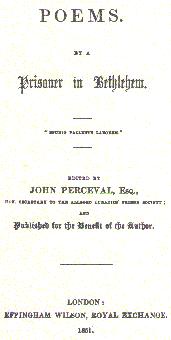
Richard Hunter says that Perceval befriended
Arthur Legent Pearce in 1841.
Pearce was confined, that year, in the criminal lunatic wing at
Bethlem Hospital for the attempted murder of his wife. Through
visiting Pearce,
Perceval met another patient
Edward Peithman whose cause he also took up.
The
conditions in Bethlem led Perceval to protest and in the early
1850s this
led to inquiry into Bethlem and also to Peithman's release.
"I consider myself the attorney-general of all Her Majesty's
madmen. I believe I am the only person, and,. as far as I can see, my
pamphlet is the only work that is published on the subject of maintaining
the rights of lunatics. I consider that society or the Legislature, who
shut up patients not only for their own benefit ... but for the benefit of
society as well ... in a manner are compelled, in doing so, to violate the
liberty of the subject, and to deprive him of the power of seeing his
friends, and I think that they should most jealously respect all his other
rights; he ought to enjoy them, and they ought not to interfere with
them."
Jean Piaget
Born
9.8.1896,
died
16.9.1980
books
-
weblinks
Piaget's theories
and educational intervention
"
Representational thought begins to emerge somewhere between
eighteen and twenty-four months of age or the period between the
sixth
stage of the sensorimotor period and the beginnings of preoperational
thought
(Piaget 1955;
Inhelder and Piaget 1964). It is characterised as the mental
activity of evoking objects and events which are outside the immediate
field of perception. Thus, representational activity extends the perceptual
field of the child from the observable present to the past and future...
Somewhere within the eighteen and twenty-four month period children become
capable of re-enacting past events, such as re-enacting home experiences,
e.g. preparing meals in the nursery's housekeeping corner or putting a
doll to sleep"
(Sigel Secrist and Forman 1973, p.30)
Plato
born about
427BC,
died
347BC
Greek philosopher.
Plato (following
Socrates) argued that men and
women have the same virtues, although usually present in
different amounts.
Reason
is the virtue needed for
government, so a women whose reason is
strongly developed is as acceptable a candidate for the
governing class as a man with similarly developed reason. This
argument has
led some commentators to consider Plato an early
founder of
feminist
theory.
Compare
with Platos' pupil, Aristotle
Life and works
See the timeline for a brief summary of Plato's ideas and
links to fuller
explanations and to texts.
Karl Popper
born
28.7.1902,
died
17.9.1994
books
born
1786,
died
1848
born
1723,
died
1791
Joseph Priestley
born
13.3.1733 near Leeds, Yorkshire
died
1804
books
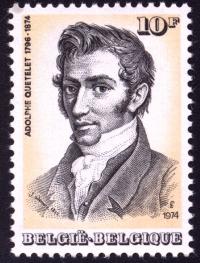
Adolphe Quetelet
Born
22.2.1796,
died
17.2.1874
Wilhelm Reich
(1897-1957)
books
1971
WR: Mysteries of the
Organism
Foucault
German Sexologist. Reich was one of a number of German
theorists,
between the wars, who tried to integrate the theories of Marx
and Freud.
Reich came to the conclusion that if we are to have political
liberation,
we must also have sexual liberation. According to him,
political regimes
control people by sexual as well as by political repression.
The way to a
better world is, for Reich, the opposite of the way that Plato
argued for.
Plato's ideal world is one where reason governs passion,
Reich's is a world
in which passion frees itself from the constraints and
distortions that
political repression builds into our character.
"I have become convinced that sexuality is the centre around
which revolves the whole of social life as well as the inner life of the
individual." Reich's diary March 1919.
Mark: Orgastic potency
Sarah:
Sexual Revolution
Paul:
Revolution and Politics
Pauline:
Free Family
John: Orgone energy
David Ricardo
Born
1772,
died
1823
Also
the timeline for explanations and texts.
Thomas Ritchie
Born
about 1928.
Jean Jacques Rousseau
Born
1712,
died
1778
politics
- power and authority
- childhood
Reason is engendered by human consciousness of the
general
will,
the
interest of all, as opposed to the narrow will of the
individual.
This is very important for society and
politics. Women, although unsuited to take part in politics,
inspire men to
patriotism because they stir in men the desire to defend their
hearth and
home. By arguing for separate and different reasons in men and
women,
Rousseau develops the tradition of
Aristotle.
See why criticism of
slavery is
an aspect of Rousseau's theory of society
(Benjamin) Seebohm Rowntree
Born
7.7.1871,
died
7.10.1954
books
Ferdinand de Saussure
Born
26.11.1857,
died
22.2.1913
books
-
weblinks
"We must not begin with the word, the term, in order to
construct the system. This would be to suppose that the terms have an
absolute value given in advance, and that you have only to pile them up one
on top of the other in order to reach the system. On the contrary, one must
start from the system, the interconnected whole; this may be decomposed
into particular terms, although these are not so easily distinguished as it
seems."
"of all comparisons that might be imagined, the most friutful
is the one that might be drawn between the functioning of language
and a game of chess. In both instances we are confronted with a
system of values and their observable modifications. A game of
chess is like an artificial realization of what language offers in a
natural form."
(Saussure, F. 1916/1959 p.88)
"In chess, what is external can be separated relatively easily
from what is internal. The fact that the game passed from Persia to Europe
is external ; against that, everything having to do with its system
and rules is internal. If I use ivory chessmen instead of wooden
ones, the change has no effect on the system, but if I decrease or
increase the number of chessmen, this change has a profound effect
on the "grammar" of the game. One must always distinguish between
what is internal and what is external. In each instance one
can determine the nature of the phenomenon by applying this
rule: everything that changes the system in any way is internal."
(Saussure, F. 1916/1959 pp 22-
23)
"First, a state of the set of chessmen corresponds closely to a
state
of language. The respective value of the pieces depends on their
position on the chessboard just as each linguistic term derives its
value from its opposition to all the other terms."
"In the second place, the system is always momentary; it varies
from one position to the next. It is also true that values depend
above all else on an unchangeable convention, the set of rules that
exists before a game begins and persists after each move. Rules that
are agreed upon once and for all exist in language too; they are the
constant principles of semiology."

SIMBA the strong and courageous
"We reckoned that user involvement was
about hearing the voices of users/survivors,
and we felt we could be heard much more
powerfully and effectively as real live people
through our creative work than through
standard user involvement systems."
SIMBA responded to invitations to sit on committees and go to
meetings with a
standard letter back, saying that they would
be happy to come to the meetings if the
chair could give them written reassurances
that their input really would make a
difference to black service users. Of 11 letters sent, two received a reply
and only one included assurances. This was the one they acted on. It was
from
Zoe Reed, the new executive director developing organisation and
community.
"Emancipate yourself from mental slavery,
None but ourselves can free our minds"
Written by the Members of SIMBA on 21.6.2005 in memory of Maryam Maule,
co-founder of SIMBA
Of light and brightness
I see a girl with a lot of faith and passion
Love and wonder
But trials and tribulations dog my journey
And so this girl give me hope
Her memory will be unending
And ugly grey skyscrapers to my right
There are potholes and broken stone beneath me
Still I walk though, still I fight
I feel I know you, because your spirit lives on at SIMBA
When I ask about you, you've touched so many
And helped a plenty, got be with you
And I'll say a prayer for you.
By Anonymous
A safe place to be, in harmony
Identity, diversity
A vibrant place - solidarity.
Creativity, spontaneity
An amazing place - excitingly.
Spirituality, community
A special place - lovingly.
Unity, non-judgemental
An important place - definitely
By Gary E.
Humming the latest dub plate
Wanting a car, and a flat not far,
Wanting to live like a superstar
When I came to work, I had the knack
Until I eventually got the sack
Constantly drinking and smoking the herb,
Which was really bad for my nerves.
Nicked by the police for being aggressive,
And then labelled a manic depressive.
Standing up, but never still,
Constantly shaking from all the pills.
And on top I was sectioned.
Working out with an unfit friend,
Fighting the flab, when will it end.
And now at least at the end of the day,
I can get my D.L.A.
By Linden F.
Down to breakfast.
I'm addicted to nicotine so I need a fag
To smother the boiled egg and toast.
Largactil dribble -
And stuttering
To the people who come to show me some support.
To get the daily gruel.
Eat and spill half over myself
Because I can't feed myself.
And throw myself down on my bed
Until they come and get me again for more medication
Largactil shuffle.
Born
1858,
died
1918
""The stranger is the person who comes today, and stays
tomorrow.he is so to speak the potential wanderer; although he has not
moved on.he is fixed within a particular spatial (i.e. territorial) group
whose boundaries are similar to spatial boundaries. But his position in
this group is determined, essentially by the fact that he has not belonged
to it from the beginning, that he imports qualities into it, which do not,
and cannot stem from the group itself.His position as a fully-fledged
member involves both being outside it and confronting it.." (Simmel, 1908,
in Wolfe, 1950, The Sociology of Georg Simmel, Free Press, p. 402).
"
"
The unity of nearness and remoteness involved in every human relation is
organized, in the phenomenon of the stranger, in a way which may be most
briefly formulated by saying that in the relationship to him, distance
means that he, who is close by, is far, and strangeness means that he, who
also is far, is actually near. For, to be a stranger is naturally a very
positive relation; it is a specific form of interaction.
Born
17.10.1760,
died
19.5.1825
Born
20.1.1798,
died
1857
1)
theological
2) philosophical
(critical) and
3) scientific
(positive).
Roger Scruton
Born 1944
English conservative theorist who distinguishes family and contract models of politics.
Scruton tries to establish a theoretical base for conservatism as distinct from liberalism.
He argues that conservatism is aligned with theories of society and political allegiance that take the family as the model. None of us chose our parents. There is no contract between us. We owe them allegiance because they have power over us and because they care for us. This loyalty, Scruton argues, is extended to the wider society.
In contrast to conservative theories, he says, liberal theories are based on contract. They assume some kind of bargain or agreement between the ruler and the subjects. Locke 's theory could be taken as an example here.
One of the theorists that Scruton criticises is Laing.
|
Burrhus Frederic Skinner
Born 20.3.1905, died 1990 |
books - weblinks |
See outline of life under America and outline of ideas on conditioning in the Association of Ideas file
|
Mary Jane Seacole
Born 1805, died 1881 |
Author of Wonderful Adventures of Mrs. Seacole in Many Lands (1857)
|
Peter Sedgwick
Born 1934, died 8.9.1983 |
books - mental health and civil liberties |
From Wikipedia 28.9.2012:
Peter Sedgwick was a translator of Victor Serge, author of a number of books including PsychoPolitics and a revolutionary socialist activist.
He grew up in Liverpool, and won a scholarship to Balliol College, Oxford, where he became a member of the Communist Party of Great Britain. In 1956, after the Hungarian Revolution he left and joined the Socialist Review Group, later the International Socialists (forerunner to the Socialist Workers Party). He wrote for the group's press whilst also involved in the activities of rank-and-file members. He was opposed to the International Socialism group's renaming itself as the Socialist Workers Party in 1976, refusing to join the new organisation while always remaining a man dedicated to the far left. (Christopher Hitchens called him "a noble remnant of the libertarian left" and dedicated his book 'Letters To A Young Contrarian' to him.)
At one stage Peter Sedgwick earned his living as a lecturer in politics at the University of York.
Peter Sedgwick wrote a book on psychiatry called PsychoPolitics. In many respects this book predicted and explained the severe Thatcher/Reagan-era reductions in US and UK National Health Service psychiatric services, especially in the number of NHS beds for the mentally ill which were reduced by 80,000 in the UK during the 1980s. Peter Sedgwick identified that "politically correct" conceptions of mental illness, such as those of the anti-psychiatry writers Michel Foucault, R.D. Laing and Thomas Szasz, could be exploited by the right wing to reduce services. His ideas have not been forgotten and Peter Sedgwick's views about psychiatry have been developed and reinterpreted in a marxist and situationist context at the web site Psychopolitics.net.
Peter Sedgwick was found dead in 1983 in a canal in Northern England. He was editing the works of Victor Serge at the time of his death.
Peter Sedgwick's concepts: PsychoPolitics
Timeline links: On Schizophrenia From Within 1975 - PsychoPolitics 1982
|
Adam Smith
Born 1723, died 1790
See Social Science History, chapter five:
lectures about: Adam Smith - Smith and Durkheim - Smith and Mauss - |
|
Adam Smith was born in Kirkaldy, Scotland in 1723. When he was 28 he became Professor of logic (later of moral philosophy) at Glasgow University.
In 1759 Smith published his Theory of Moral Sentiments. In this he argued that human conduct is the result of the inter-play of six sentiments, grouped in balancing pairs:
The balance of these motives makes a natural harmony, so that people left to follow their sentiments naturally promote the common good. These ideas developed those of his teacher, Francis Hutcheson (1694-1746), who said that there is a natural order which is superior to anything humans can devise.
Smith's major work, The Wealth of Nations, took twelve years to write. It was published in 1776 (long after he had ceased being a professor - He died in 1790)
In terms of the balance of sentiments, Wealth of Nations is mainly concerned with the the habit of labour and a propensity to exchange. Smith argued that these led (without human design) to a world-wide division of labour, which was the main cause of the wealth of nations.
"The greatest improvement in the productive powers of labour, and the greater part of the skill, dexterity, and judgment with which it is anywhere directed, or applied, seem to have been the effects of the division of labour"
"This division of labour, from which so many advantages are derived, is not originally the effect of any human wisdom, which foresees and intends that general opulence to which it gives occasion. It is the necessary, though very slow and gradual consequence of a certain propensity in human nature which has in view no such extensive utility; the propensity to truck, barter, and exchange on thing for another."To barter is to exchange goods or services, as distinct from buying goods and serives for money. Truck has the same meaning as barter.
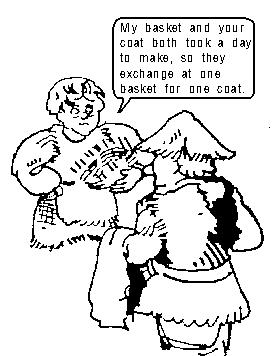
|
Adam Smith argued that "self-love" is better for the economy than "sympathy" (althought sympathy is better for families). The social theory called Political Economy (now economics) was created on this principle. |
Thomas Spencer Baynes 24.3.1823-1887
Thomas Spencer Baynes was a journalist and academic with wide interests. In
Edinburgh Review his essays included one on Cox's Aryan Mythology in
October 1870,
Tylor's
Primitive Culture in January 1872, and Darwin
on the expression of emotions in April 1873.
In 1873 Baynes took on general editorship of the ninth edition of the
Encyclopaedia Britannica, the first volumes of which were published
in 1875. The last volumes were published, after his death. In the
"Prefatory Notice" (1.1.1875) Baynes said the Encyclopedia should function
as
Recent scientific advances had altered the classification of knowledge and
Baynes had taken advice from
T. H. Huxley and Clerk Maxwell about this. As well as "the
comparatively modern science of Anthropology" he would attempt a scientific
treatment of the arts, history, philosophy, geography, and mythology.
Edward Burnett Tylor wrote eleven articles for the Encyclopedia
William Robertson Smith was a Scottish theologian and social theorist. He
was Professor of Hebrew and Old
Testament Exegesis at the Free Church College in Aberdeen from 1870 to
May 1881, when he was sacked because of the implications of
Encyclopedia Britannica articles that he
wrote. These articles were for the ninth edition. A minor one on
Angel in volume two, and a major one on
Bible in volume
three, appeared in 1875.
Others were on Chronicles, Canticles, David and
Eve.
Volume 11 of the Encyclopedia Britannica appeared on 8.6.1880. It
contained Robertson Smith's articles on Haggai, Hebrew Language
and Literature and The Epistle to the Hebrews. These, especially
the major one on Hebrew language and literature, and an
article
in the [Cambridge] Journal of Philology (9.17. pages 75-100) on
1.6.1880, called "Animal Worship and Animal
Tribes among the Arabs and in the Old Testament" (a study in
totemism) finally led to his dismissal on 24.5.1881.
He spent the winter of 1879-1880 in Egypt, Palestine and Syria. The winter
of 1880-1881 was spent in Egypt and Arabia. He observed the customs of
desert communities and applied his observations on the use of
totems to his research.
Shortly after his dismissal, Robertson Smith became the associate editor in
chief of the ninth edition of the Encyclopedia Britannica, which was
concluded in 1888. (Last volumes published 1889?). Articles he wrote
himself included Levites, Messiah, Prophet,
Priest,
Sacrifice (volume 21, 1886) and Tithes.
Robertson Smith published The Old Testament in the Jewish Church in
1881 and The Prophets of Israel in 1882
Robertson Smith met James
Frazer (at Trinity College, Cambridge) in 1883. Frazer's
articles on
Taboo and
Totem were published in volume 23 of
the Encyclopedia in 1888.
In
1887, Robertson Smith was appointed to give
a series of lectures
between 1888 and 1891 on "The Primitive Religions of the Semitic Peoples,
viewed in relation to other Ancient Religions, and to the Spiritual
Religion of the Old Testament and Christianity". He gave three series of
lectures and the first
was published as Lectures on the Religion of the Semites.
First series. The Fundamental Institutions in 1889. A revised edition
was published shortly after his death on 31.3.1894.
James Frazer's The
Golden Bough (1890) is dedicated "To my friend William Robertson Smith
in gratitude and admiration"
William Robertson Smith 8.11.1846-31.3.1894
Editors of the ninth edition of the Encyclopedia Britannica
"to some extent at least, an instrument as well as a register
of scientific progress"
|
Socrates
We mainly know about Socrates through the work of Plato. If you click on the image of Socrates arguing it will take you to Socrates' dialogue with Meno over the nature of reason in men and women.
|
|
Charles Edward Spearman
Born 10.9.1863, died 17.9.1945 |
books |
We all have specific abilities that can be given names. These might include our skills in language, mathematics, music, working with shapes, etc. In 1904, Charles Spearman published a paper suggesting a measure of general intelligence underlying these specific abilities.
|
Herbert Spencer
Born 1820, died 1903 |
books - extracts |
Herbert Spencer was the most influential social theorist of the second half of the 19th century, his dominance matching or exceeding that of Parsons and his associates in the 1950s and 1960s. His thought became organised around the principles of "evolution and dissolution".
Spencer began his working life (from 17 to 26) as an engineer on the London to Birmingham railway. He published articles on bridge construction and geometry. He then became sub-editor of the Economist until 1853, after which he devoted himself to his theories and writing.
Published Social Statics in 1850 [?].
In 1852 Spencer published a paper called "A Theory of Population" which contained a more elaborate theory of the development of society than in his previous work. Included in this was the argument that an important aspect of the process of development had been "the struggle for existence" and the principle of "the survival of the fittest".
His Principles of Psychology in 1855 applied an evolutionary approach to mental life.
In 1857 he published an essay "Progress: its Law and Cause" [?] in which he argued that the law of evolution and dissolution applies to everything. It is the key to understanding the inorganic world, the organic world and what he called the super-organic world of society.
His huge Synthetic Philosophy was conceived in 1858.
"In 1858 he issued the prospectus for what was to be the great obsession of the remainder of his long life - the System of Synthetic Philosophy, a compendium of knowledge demonstrating the universality of evolution in all spheres and culminating in ethics. The Principles of Psychology he had already written (1855), but it was to reappear at twice its length within the system; and the opening volume of metaphysics, First Principles, was issued in 1862" (Peel, JDY 1972 p.xxii)
First Principles, published between 1860 and 1862, was about "those highest generalisations now being disclosed by science which are severally true not of one class of phenomena but of all classes of phenomena; and which are thus the keys to all classes of phenomena".
In 1864 he published Principles of Biology. In this he defined life as the continuous adjustment of internal to external relations. It consequently emphasised the need to adapt the organism to its environment. The universal process of evolution meant a progression from lower to higher forms, or, its reverse degeneration. The higher is the more complex and differentiated. Spencer argued that the function something serves determines what its structure will be. He also argued that use and disuse would adapt the organ and that this would be passed on. [Summary based on 1911 Encyclopedia]
In 1873 he published The Study of Sociology
In 1876 [?] he published volume one of his The Principles of Sociology
|
Thomas Szasz
Born 15.4.1920, died 8.9.2012 |
books - mental health and civil liberties |
Thomas Szasz called his most famous book: The Myth of Mental Illness. By Myth he does not mean that psychological disorders are not real experiences. He means that to call them illnesses is misleading because they share little in common with physical illness. Szasz says that psychological disorders have only one significant characteristic in common with bodily diseases. This is that the sufferer is to some extent disabled from performing some activities. (See his discussion of the two classes of disability. Szasz 1961/1972 p.54)
Psychological and bodily disorders differ, he says, in that
psychological disorders can only be understood if they are viewed as things
that do not just happen to a person, but are brought about by him: `Mental
illness' is not something a person has, it is something he
does or is
(Szasz 1972/Summary). Psychological disorders are
actions rather than events and they are of some value to the patient. The
patient, however, is not malingering. He is not fully aware of what he is
doing and it is the psychiatrist's job to help him find out. Physical
illnesses, on the other hand, just happen to a patient, and cannot be cured
by self-knowledge. You have to kill the bug, set the bone, or whatever.
Szasz has attempted to replace the illness model of mental disturbances
with an analysis in terms of meaningful (but perhaps unconscious)
communication. Hysteria, for example, is a psychological disorder that
manifests itself as physical illness. Szasz describes it as a dramatised
representation of the message My body is not functioning well. The mental
illness called depression is a dramatisation of the proposition I am
unhappy.
(Szasz 1961/1972 p.202)
|
Osamu Tezuka or Tezuka Osamu
Developed from
Mary Hammond Bernson (2008)
"... Tezuka Osamu and Astro Boy" Osamu Tezuka was a teenager when World War Two ended after the dropping of two atomic bombs on Japan in 1945. These were the mighty atoms that gave their name to Tezuka's best known character: Tetsuwan Atomu |
Food, fuel, and money were scarce and Japan was occupied by the United States army. Aged 17, Tezuka was hired to write a four-panel cartoon for the Mainichi newspapers. There was a demand for cheap entertainment and Akabon (red books), printed on cheap paper with red covers, were sold on the streets like newspapers. Tezuka published his first Akabon, New Treasure Island in 1947. This was an exceptionally long manga (comic) book.
The term manga (whimsical pictures) was used by Katsushika Hokusai (1760-1849) in 1814 to describe a collection of his pictures. By the 1940s it referred to comics or cartoons. New Treasure Island was a novel told mainly in pictures. Tezuka adapted effects from films such as drawing his scenes from different perspectives and zooming in on them.
Jungle Taitei (Jungle Emperor, later known in English as Kimba the White Lion) was published as a serial between November 1950 and April 1953. It was the first of many serials.
The Korean war in 1950 led to the United States and Japan becoming allies against communism rather than enemies.

|
April 1951: Ambassador for inter-world peace
In 1951, Tezuka Osamu introduced Tetsuwan Atomu (Mighty Atom), a robot boy later known in English as Astro Boy. The robot first appeared as a peacemaking Ambassador Atom in a Japanese magazine for boys. "Astro Boy" as we know him was launched a year later. In 1963, Astro Boy appeared on Japanese television as the first animated television series. |
Between 6.10.1965 and 28.9.1966, 52 episodes of Jungle Taitei became Japan's first animated television series in colour.
Mary Hammond Bernso comments that
"Japan's economic recovery was bringing televisions into homes for the first time. Many Japanese today remember the powerful impact these series had in the 1960s. Anime, short for animation, was to become a booming industry in Japan. "
In 1986 Tezuka wrote
"My experience convinces me that comics, regardless of what language they are printed in, are an important form of expression that crosses all national and cultural boundaries, that comics are great fun, and that they can further peace and goodwill among nations" (Schodt 1983, p. 11).
In 1988, he said
"My manga have a wide variety of themes - they are a paean to life, they are antiwar and they are antinuclear, and they advocate the preservation of nature - but ultimately they are all one thing. They are the following appeal to young readers, to think objectively about this fragile Earth: When you grow up, don't forget to look at both Earth and mankind objectively. And always think about what it means to be human" (Schodt 2007, p. 144).
Tezuka died in 1989, the same year Emperor Hirohito. According to the studio Tezuka founded, he had drawn 150,000 pages of manga, published more than 500 titles, and produced more than 70 animated works in his lifetime. An editorial in the Asahi newspaper noted:
"Foreign visitors to Japan often find it difficult to understand why Japanese people like comics so much. . . . One explanation for the popularity of comics in Japan, however, is that Japan had Tezuka Osamu, whereas other nations did not. Without Dr. Tezuka, the postwar explosion in comics in Japan would have been inconceivable" (Schodt 1996, p. 234).
William Thompson (1785-1833) and Anna
Wheeler
(1785-18??)
| Thompson and Wheeler were Irish social scientists, feminists and socialists. In nineteenth century England the principle social sciences were Utilitarianism and Political Economy. Utilitarianism was based on the theory that human beings attempt to maximise pleasure and minimize pain. It was a practical social science that sought to discover what kind of legislation and what kind of social policy would maximize the sum of human happiness and minimize the sum of human pain. |
|
weblinks include biographical material
|
Alexis de Tocqueville
Born Paris 29.7.1805, died 1859 |
books - timeline |
Tocqueville, a liberal French aristocrat, feared that in a democracy the "tyranny of the majority" would mean that the majority would not respect liberty and not respect the interests of minorities - as he thought happened in the French revolution.
Tocqueville came to the conclusion that the centralisation of power in the Government which he saw as a feature of the French revolution was due to the speed with which France passed from absolute monarchy to democracy.
"when equality starts developing among a people who have never known or long forgotten what freedom is, as one sees it happen on the Continent of Europe.. all powers seem spontaneously to rush to the centre." (Tocqueville, A. 1840 p. 875).
One of the guards against this tendency was a history of liberty:
"Among people who have long lived in freedom before they have become equal, the instincts engendered by freedom to some extent combat the inclinations prompted by equality, and though in that case the central power does increase its prerogatives, private persons never entirely lose their independence." (Tocqueville, A. 1840 p. 875).
The French masses were uneducated in the ways of democracy whereas the Americans were politically educated.
But how does one become politically educated? The answer (according to Mill following Tocqueville) was by political participation. Democracy is necessary to educate the people in the virtues of democracy. But you do not introduce it with a big bang and although eventually everyone would have a vote you maintain institutions to secure freedom.
Alexis de Tocqueville and the positive side of faction
Although factions, according to Madison, arise out of desirable political conditions (liberty and difference), they are not themselves good. He defined faction as:
"a number of citizens.. actuated by some common impulse.. adverse to the rights of other citizens or to the interests of the community."
The good side of factions was brought out by Tocqueville.
According to Tocqueville, liberty in pre-democratic times was preserved because (or when) the aristocracy exercised a countervailing power to the monarchy. Liberty in a democracy, on the other hand, could be threatened by the "tyranny of the majority".
However, his empirical studies in America suggested to Tocqueville that the free association of minorities outside government could also act as countervailing power. (See He was also impressed by the way Americans formed associations for every conceivable purpose and argued that this reduced the temptation, always present in a democracy, to expect the government to do everything. (See Tocqueville, A. 1840 (Vol.2) part 2, chap. 5 "On the Use which the Americans Make of Associations in Civil Life")
We might consider Tocqueville to be the theorist of the "voluntary association" and its importance to political liberty and the moral welfare of the masses.
Tocqueville's positive view of the political value of associations is shared by 20th century pluralists who argue the importance for democracy and liberty of maintaining a plurality of autonomous social, political and economic organizations.
See http://xroads.virginia.edu/~HYPER/DETOC/fem/home.htm
| Ferdinand Tönnies 1855-1936 | books - weblinks |
Tönnies argued that capitalism is based on relations of association (gesellschaft), which have replaced the communal relations (gemeinschaft) of the agricultural societies that preceded industrialisation.
-
Geselle is a
word that has associations with high society. It is used when you say "to
go into society" and in the construction of words like evening dress.
Gemein is associated with low, vulgar society. It is a closer and warmer word that is used in relation to shared property and to religious communion.
| Edward Burnett Tylor 1832-1917 | books - extracts |
Edward Tylor believed that the past can be deduced from the present. He thought that the study of "primitive", or uncivilised, societies reveals the origins of all societies. He thought that the study of civilised societies can identify features (survivals) that are clues to older forms of thought in those societies. And he thought that a study of the laws that govern the human mind today, provides a basis for analysing the way that ideas originally started and how they developed.
In the early 1860s Tylor worked on the view of human culture that sees it as a continuous, progressive, development, or evolution. This view, he noted, had been held for thousands of years. Tylor's aim was to develop it into a science.
There were, Tylor believed, scientific laws governing the formation of culture and its development (see quotation). These laws are rooted in the nature of the human mind. To discover how we create language and culture he studied a system of gestures used in the Berlin Deaf-and-Dumb Institute. This language had been developed by the deaf-and-dumb inmates themselves, to communicate when they were brought together in an institution. In Researches into the Early History of Mankind and the Development of Civilisation (1865) he outlined his discoveries and tried to account for the similarities between different cultures and for the origin of culture. (See Chris Holdsworth, Oxford Dictionary of National Biography)
Charles Darwin read the Researches on the recomendation of Joseph Dalton Hooker and was impressed by it. He made several references to it in The Descent of Man - (external source)
In an article on "The Religion of Savages" in 1866, Tylor introduced the term animism to describe beliefs that imagined natural phenomena such as trees as having souls or spirits. Animism, he argued, was the root of religion.
Tylor's main tool for deducing the past from the present was what he termed "survivals". He introduced this concept in an 1869 article "On the Survival of Savage Thought in Modern Civilisation".
Tylor's main publication was the two volume Primitive Culture: Researches into the Development of Mythology, Philosophy, Religion, Art, and Custom. This was published in 1871. Volume one was about the origins of culture, and included Tylor's definition of culture. Volume two was about religion in primitive society. Primitive Culture was not, however, exclusively about pre-historic societies and technologically primitive modern societies. Tylor argued that a knowledge of the origins of culture is necessary to understand all culture and much of his book relates primitive thought to civilised thought. An example of how he theorised is in this comment on poetry:
"In so far as myth ... is the subject of poetry, and in so far as it is couched in language whose characteristic is that wild and rambling metaphor which represents the habitual expression of savage thought, the mental condition of the lower races is the key to poetry" (Tylor, E.B. 1871 pp 532-533)
In 1872 Tylor wrote a review of Adolphe Quetelet's Physique sociale (1869 - originally 1835) and Anthropométrie (1870). Quetelet's statistical and sociological approach influenced Tylor's subsequent writings.
T.S. Baynes, editor of the new Encyclopedia Britannica, reviewed Primitive Culture in January 1872. He asked Tylor to contribute the article on Anthropology. Tylor's six part article, first published in 1875, continued in the Encyclopedia through to the 11th edition (1911), or beyond.
Tylor's Anthropology: An Introduction to the Study of Man and Civilisation was published in 1881
On 30.5.1882, Oxford University accepted the donation of a collection of anthropological objects arranged according to the evolution of ideas. This collection had been put together by Augustus Henry Lane Fox Pitt Rivers. (external source). In the same year, Tylor was appointed as the new "Keeper of the Oxford University Museum of Natural History". The Pitt Rivers collection was to be housed in an extension to this museum. A condition of the bequest had been that the university appoint a lecturer in anthropology, and Tylor was appointed Reader in Anthropology (required to give 18 lectures a year) in 1883. (external source)
1883? James Frazer's interest in anthropology aroused by reading Primitive Culture
1889-1890 and 1890-1891: Gifford Lectures at Aberdeen. Lectures at Glasgow from 1888 were given by Max Müller - External link to Gifford Lectures website.
Sources include Robert Ranulph Marett DNB 1927 - Chris Holdsworth ODNB 2004
|
Vincent Van Gogh
Born 30.3.1853, died 1890 Dutch protestant evangelist who became a brilliant painter. He experienced intense emotional experiences during his life and it has been argued that the convulsions of his inner life are expressed in the convulsions of his art. An early drawing (1882) of an old man with his head in his hands has the title "worn out". |
|
|
Van Gogh was a realist whose work captures the essence of what he paints. In De Aardappeleters (potato eaters - 1885) we see both the honesty of the De Groot family eating what they have grown with their own labour and the integrity of their family emotions. Van Gogh contrasts their authenticity with "civilisation" |
Van Gogh felt too intensely for the world. As an evangelist to coal-miners (1878-1880)
"he practised the Christian virtues with such zeal, sleeping on the floor of a derelict hut and giving away his possessions, that his society became alarmed at his lack of dignity, the mine-owners at his support for strikers, and the miners mocked him for his confessions in public" (Chambers Biographical Dictionary)
In 1886 he went to Paris where he met many famous painters. Toulouse-Lautrec suggested that he should paint the intense colours of the south of France, and he moved to Arles in February 1888
|
A quarrel between Gauguin and Van Gogh resulted in Van Gogh cutting of
his own ear in remorse. He was put into an asylum at St Rémy, where
he continued to paint "with increasing frantic brushstrokes".
In May 1890, Van Gogh went to live at Auvers-sur-Oise near Paris, under the supervision of Dr Paul Gachet. On 27.7.1890 Van Gogh shot himself, near the cornfield with birds of one of his last paintings. he died two days later. |
|
A suicide of society?
At the Survivors History Group in May 2014, Thurstine Bassett and Peter Barham reported on their visit to the Vincent Van Gogh and Antonin Artaud Exhibition at the Musée D'Orsay in Paris.
Antonin Artaud was born on 4.9.1896, six years after Van Gogh's suicide. He wrote for the theatre and for the cinema. Thurstine described him as being "into gestures and screaming".
After a nine years stay (1937-1946) in a psychiatric hospital, Artaud was invited to write about Vincent Van Gogh. Seeing Van Gogh as a fellow survivor, he got involved and wrote: Van Gogh le suicidé de la société, which can be translated "Van Gogh suicide of society" or "Van Gogh: Suicided by society" (1946).
The exhibition shows Van Gogh from Artaud's perspective - one that contrasts destructive medical treatment to the creative perception of art.
|
Artaud had had 51 sessions of
Electro Convulsive Therapy - un-anaesthetised.
He refers to Van Gogh's art as 'convulsive'. He paints as though "landscape is in convulsion". |
"Van Gogh ... painted neither lines nor shapes, but inert things in nature as if they were having convulsions." (Artaud)
Peter observed that his book distanced Artaud from psychiatric thinking and challenged a psychiatric interpretation of his life and work. Artaud argues that artists like Van Gogh provide truthful insight and thought forms. These are falsely invalidated by being seen as a medical condition.
The publisher's description of Artaud's book says that he makes of Van Gogh's "violence" a response to the hateful obscenity of the world and psychiatrists. He makes of his madness, a response of the soul to the universal stupidity that says he is delirious. So Van Gogh killed himself because he could not kill the psychiatrist and he killed himself because he could no longer bear the "delirium" of his living.
|
Artaud says that he can see, as he writes, "the bloody red face of the painter" come to him in a wall of intensely coloured sunflowers, cinder path and grassland. The vision comes like a meteoric bombardment of atoms demonstrating that whilst Van Gogh thinks about his toils as a painter, he is also at the same time, a formidable musician. |
Artaud located Van Gogh as an 'authentic lunatic'- one who prefers to become mad rather than to forfeit the idea of human honour. Peter was asked if this meant it was better to be mad than to lose respect a more meaningful sense of humanity. He agreed, saying that in this case madness was keeping faith with what it is to be human.
Artaud had argued that Van Gogh bore witness to the truth in his art whereas other people found the work intolerable within their idea of the truth. Van Gogh was a certain form of philosopher - more accurate in his interpretation with paint than any psychiatric truth.
The main thesis in Artaud was that Van Gogh was suicided by society. - This was not a product of psychosis or pathology but due to society at the time being unable to bear tolerate or engage with the truth he communicated. It shunned him, rejected him and drove him to despair. As a result he took his own life.
Artaud would not accept illness as an explanation because it kept his view of the world at bay. If you accept other people's truth as real, you are more likely to be subject to it. Ian Ray Todd suggested that Artaud's message was I am not mad, I'm angry.
Artaud died of a drugs overdose on 4.3.1948 after suffering with pancreatic cancer.
Lev Semenovich Vygotsky
Born
1896,
died
1934
Soviet psychologist who created the concept
zone of proximal development
to help theorists
think about the relationship between the active learner and
the teaching,
culture and society that his theory argues is essential to
that learning.
See also
Shirley Franklin
quote
from.
|
Max Weber
born 1864 died 1920 See Social Science History, chapter six:
|
Max Weber was a German political economist who became a founder of what we call sociology. However, he was critical of the kind of sociology that treats society as real.
Weber's idea about sociology is that it should be a theory of social action. Action is something that has meaning to the individual who does it. Sociology should start inside the individual with what his or her actions mean to him or her, and work outwards to understanding any laws or regularities that govern the whole of society.
Max Weber created a whole tool-box of concepts for social theorists to use. The tools include his definition of the Modern State. (see dictionary: modern and state)
Weber's analysis of the modern state involves a quotation from a marxist about the role of force. Weber says that force (coercion) is important but so is authority (which is related to legitimacy).
The modern state is based on a monopoly of legitimate force within a given territory. (see extracts. That is only the state, or those it delegates force to, can lawfully use violence in the area that the state governs. In the past a variety of institutions, starting with the family (sib) could use force. Now all force within a territory is controlled by the state.
It is useful to contrast the modern state, as Weber describes it, with:
- The structure of society in the
feudal times, which preceded it. In feudal society, power
was
not concentrated in a central authority. Different "lords" were owed
"homage" by "vassals" and a complex network of power existed.
- With societies that do not have a fixed territory, such as the tribal organisation of Iroquois Indians (described by Engels), which is based on family relations and can move about.
Weber argued that government needs to secure the subjective support of the governed: It needs people to think it right that it governs. Power is as much, or more, about ideas as it is about the use of force.
To say a government needs the support of the governed, does not mean that a government needs to be democratic. Weber argued that many different types of idea about the rightness of government could support it. The commonest reason is tradition - People support a government because it is what they are used to. Another legitimating idea is more common nowadays than it was in the past: People support a government because it is rational. Weber's third type is very important to him, because it is something that helps a society change and meet new situations: People support a leader because he or she has charisma
Concepts: power - rule - legitimate rule - authority - domination
|
Samuel Wesley born
17.12.1662 -
died
5.4.1735
Susanna Wesley born 20.1.1669 - died 23.7.1742 John Wesley born 28.6.1703 - died 2.3.1791 Charles Wesley born 18.12.1707 - died 29.3.1788 George Whitefield born 16.12.1714 - died 30.9.1770 |
|
Samuel Wesley composed a long poem on the life of Christ, which was published in ten expensive volumes in 1693 and dedicated to the Queen. For this he was rewarded by becoming vicar of Epworth in 1695. It was there that his sons, John and Charles, the founders of "methodism" were born.
Wesleys America 1736 - Hymns 1737 - heart warming 1738 - Foundery 1739 - Whitefield America 1740 - 1740 MacCune convicted of sin and sent to a madhouse - Susanna Wesley buried 1742 - Whitefield America 1745 - Primitive Physic 1747 - Earthquake hymns 1750 - Whitefield America 1751 - Whitefield America 1754 - Invasion hymns 1759 - Whitefield America 1763 - Whitefield America 1770 - John Wesley's sermons including hell and enthusiasm 1771 - City Road foundation 1777 - our Brethren in North America 1784 - "orators as diverse as Hitler and John Wesley" 1959 - re-opening Wesley's chapel 1978 -
George Whitfield
Harry S. Stout in The Divine Dramatist: George Whitefield and the Rise of Modern Evangelicalism (1991) argues that George Whitfield was "Anglo-America's first religious celebrity, the symbol for a dawning modern age" (p. xvi). Wikipedia suggests he was "probably the most famous religious figure of the 18th century".
Whitfield stirred up controversy to attract attention. He complained about religious leaders teaching only "the shell and shadow of religion" because they did not hold the necessity of a new birth without which a person would be "thrust down into Hell".
|
Arthur Smith Woodward
Born 1864, died 1944 |
In 1882, aged eighteen, Arthur Smith Woodward began working as an assistant in the Geological Department of the new Natural History Museuum in South Kensington. Under William Davies, he arranged the collections of fossil vertebrates for exhibition.
Between 1889 and 1901 Woodward produced his four volume Catalogue of Fossil Fishes in the British Museum.
From 1901 to his retirement in 1923, he was head of the Geological Department.
At a "crowded, excited meeting of the Geological Society" in the autumn of 1912, Charles Dawson and Woodward gave an account of their discovery at Piltdown.
|
Sculls from left to right:
chimpanzee modern European man Piltdown man |
17.12.1921 "A New Cave Man from Rhodesia, South Africa" by Arthur Woodward Smith published in Nature
|
1948 The Earliest Englishman x by Arthur Smith Woodward, with a foreword by Arthur Keith, published by Watts and Co., 5 and 6 Johnson's Court, Fleet Street, E.C.4. |
|
Mary Wollstonecraft
(1759-1797)
See brief biography in Social Science History - Mary Wollstonecraft and Julienne Ford - Books Wollstonecraft agreed with Rousseau that reason separates human beings from animals. She argued that all our beliefs and morals should be based on reason.
She did not, however, think about reason as something static, something that is just given to us ready made. |
|
Reason, she argued, develops in history, and in our personal life, by experiment. We are not tied to what already exists, but can create new realities to test against experience. This means that we have to risk making horrible mistakes in order to develop and learn.
There is, however, a force that acts against the development
of reason.
For protection, we adopt
hierarchical
structures, with people in authority
over us who we agree to obey without question. This hierarchy
corrupts our
reason, whether we find it in state, church, or family.
If, in reality,
women tend to use their reason to flatter men, it is because
male dominance
has perverted reason. Reason is the same in women and men, and
the future
well being of human beings depends on all of us exercising our
reason to
establish rational human relations.
Wollstonecraft, therefore, is
developing
Plato's
argument that reason is the
governing virtue, and that it is the same in men and women.
Unlike Plato,
however, she does not see human passion as a wild, unruly
element that
reason must repress and govern, but as the inspiration for the
experiments
that develop reason.
The idea of passion that Wollstonecraft uses appears to
include many
forces that can drive human beings from within, such as
emotions and
desires (sex and hunger for example),
creative imagination,
fantasising, and
theorising.
I think she also relates it to
breaking away from conventional morality - as when her
passions drove her
to form a sexual relationship outside marriage, and when she
chose to
openly keep and care for Fanny, the child conceived in this
relationship,
as a single mother.
Wilhelm Max Wundt
Born
1832 -
Died 1920
| books - timeline - biography - psychology laboratory - association - extracts - weblinks |
Wundt was appointed professor at Heidelberg University in 1864. From 1867 he taught physiological psychology and in 1873 published the first volume of his The Principles of Physiological Psychology.
In 1874 Wundt was appointed to professor of inductive philosophy at the University of Zurich and in 1875 professor at the University of Leipzig, where he remained for forty-five years.
Wundt was given
his first
laboratory (one room) in
1875. In 1879 he opened his first full
laboratory with more rooms and equipment. In 1883 he founded the
first (?) psychological journal, which was called Philosophische
Studien (Philosophical Studies). In 1897 he was given his own
building for a laboratory. Died in Grossbothen near Leipzig in 1920
(external link)
External link: Emil Kraepelin
Concepts used include - Parallelism -
|
Jock Young
Born 1942 - Died 16.11.2013 "I remember telling Andrew I was not christened "Jock". Stupid boy!" Main author of Taylor, Walton and Young 1973 The New Criminology. For a Social Theory of Deviance. |
1986: Centre for Criminology - 1998 The New Criminology Revisited - 1999 The Exclusive Society
What he said about himself
"I am a Professor of Sociology at the University of Kent's School of Social Policy, Sociology and Social Research. I am interested in processes of social inclusion and exclusion, how this relates to the phenomenon of othering and the way this plays out in the late modern period. I study moral panics, deviancy amplification, moral indignation and the punitive turn. I am particularly interested in how these processes of essentialisation and dehumanisation can lead people to excessive violence in the areas of terrorism and conventional warfare. Such concerns link quite closely to cultural criminology and an interest in an existentially informed sociology."
I began teaching at Enfield College of Technology and was a formerly professor at Middlesex University.
My published work includes:
The Drugtakers 1971.
The New Criminology 1973 (with I. Taylor and P. Walton).
The Manufacture of News 1981 (with S. Cohen).
What's to be Done About Law and Order? 1984 (with J. Lea).
Rethinking Criminology: The Realist Debate 1992 (with R. Matthews).
The Exclusive Society 1999.
What I said about him
I agree with everything that has been said and will be said about the greatness of Jock Young's intellectual legacy. For me this is not a matter of an assessment of his reputation in Criminology. I am not qualified for that. It is that the quality of his thought made sense to me, personally. He provided frameworks of thought that I could, and still do, use.
I did not agree with Jock that positivism is "the enemy". That was something he repeated several times during the forty plus years I know him. In fact, I thought of Jock, himself, as an enlightened positivist. Every Don Quixote needs his or her windmills to fight, even as he revives the value of wind-power for a new generation. Jock discussed Durkheim positively when Durkheim was the positivist devil, and he smuggled Merton back into radical thought so that the new criminologists adopted him as their own. What sleights of hand - And he got away with even trickier ones than that.
Like many of his intellectual friends, Jock was too big and too honest as a thinker to be typecast even in the way that he and they typecast themselves. We remember that he and they opened up criminology to rich sources of theoretical thought and then found ways of making use of their theory in grass roots, practical, empirical studies: Research that made a difference to people's lives.
But there was nothing grand or aloof about this. When I was in charge of Sociology placements, Jock, in his own time, came to discuss with the students practical problems of relating theory to empirical research. He was hands on, with no pretensions and students who had been worrying about the research aspect of their placements went away thinking that, at last, they had a hold on how to do it.
"I wasn't christened Jock", he said when we could not find J. Young in the staff-room trays. But he was Jock. Did anyone every call him anything else? Whatever we say about his intellectual merits, it was his human ones that we will miss. He was such a naturally friendly person. He was the friend in the cafe or on the train that you enjoyed being with. He was the tutor who treated you as a friend. He was the colleague who treated you as an equal.
My memories of Jock will always be personal. Things that probably would not mean anything to anyone but me. Memories that thread through the longer half of my life and all of the part that I spent at Enfield. I was deeply attached to Enfield Campus, Jock thought it was dreadful. John Lea managed to persuade Jock to come to the farewell party in the old Forum and we sat together discussing our different emotions. That was the last time I saw Jock. Now that he is gone I hold on to a comment that he made that I could never be on his list of enemies. Jock was always very kind to me. I will remember him as a great human being.
What Jock said about me
At the end of a seminar, when I am tired, I tend to say something silly. That is when Andrew pounces.
Tributes to Jock Young
Memorial statement from John Jay College of Criminal Justice, New York
Guardian obituary by Keith Hayward and Roger Matthews
Jock Young concepts: - Absolutist
My referencing suggestion for this page is a bibliography entry:
Roberts, Andrew 2.1994 - People and ideas systems Available at http://studymore.org.uk/bio.htm
and intext references to (Roberts, A. 2.1994 entry).
For example: (Roberts, A. 2.1994 Wollstonecraft)
See ABC Referencing for general advice.
 Study
Link
Study
Link
 Andrew Roberts' web Study Guide
Top
of
Page
Andrew Roberts' web Study Guide
Top
of
Page
 Take a Break - Read a Poem
 Click coloured words to go where
you
want
Click coloured words to go where
you
want
Andrew Roberts likes to hear from users:
To contact
him, please
use the Communication
Form