Charlotte Mew in her own words
| About 1825 birth of Elizabeth Goodman - Life |
An Old Servant (Extracts)
As a child not much higher than her knee, I remember climbing upstairs to bed in front of her, dreading that saying which followed too often on downstairs good-nights, 'I am all behind like the cow's tail': a wretched joke which kept one awake for hours doing sums on the knots of the counterpane to prove that she could live on for years and years and was not really so very old. She was then, in fact, about fifty, with the erect swinging gait and most wonderful eyes of youth, undimmed from the day when, a girl of twenty, she had come up from her North-country village to our grandmother's London home; in time being chosen to follow her young mistress on her marriage to the less prosperous house, with its new economies and harder duties, in which we were born.
There, twenty-six years of her life were spent between the attic nursery and the basement kitchen, standing downstairs over the fire, sitting upstairs at the round table; in cooking, washing, sewing; in planning for us small treats and great careers; patching clothes and family quarrels; in an endless learning of new tasks and the making of little jests - a life of gay and monotonous and unbroken toil.
To us as children she was as fixed a part of the universe as the bath
(cruelly cold in winter) into which she plunged us every morning, and the
stars to which she pointed through the high window, naming some of them, in
the evening sky. She slaved, worshipped, fought for, and occasionally
whipped us with a calm crescendo of 'Will you? Will you?? WILL YOU?'
between the spanks; but for all that, she was not a grown-up person. She
knew everything and could do everything, and she had an odd excrescence of
authority; otherwise she was one of Us.
At fifty she had not outgrown the
absorbing conversion of lumps of sugar into 'pig's blood' over the kitchen
gas, the sheer excitement of colour in a box of chalks, or the thrill of
the blare of a penny trumpet. Mr Noah of the nursery ark to her, as to us,
was as real a personage, and the player caught cheating at croquet in the
Square an object of the same passionate and personal dislike.
Her Place of
Worship (and when she used that battered phrase it raised its head again)
was
a Wesleyan Chapel in Great Queen Street, and this was
to, I
believe, her favourite place of entertainment. From Sunday to Sunday she
could repeat the sermon almost word for word, and ribbon for ribbon and
flower for flower record the changes in neighbours' bonnets. But there and
everywhere what intensely and chiefly interested her were "the faces",
closely studied and recalled long afterwards with amazing clearness; and
never, she said, at best or worst seen so plainly in "God's House".
"Let me look at you", she would say very gravely to the culprit brought
before her in nursery days, patiently listening to his wandering story, but
judging finally from what she read in his generally swollen face.
In early years the rite and reality of daily prayers were for us strictly
insisted on, and "Forgive us our trespasses" was no idle phrase when after
it, each night at bedtime, we had to specify them; nor submission to God's
will, when it took the form of mumps on the very afternoon when one was
going to the pantomime, an easy saying. But for herself, she once admitted
later, she had never asked anything of the Almighty -
"As His Majesty, so
is His Mercy", was all she cared to say about it - though there
was one
thing passionately desired at the end, for which she must have found it
difficult not to ask. It was her great wish to "die in harness", and so,
dropping one day suddenly between the shafts,
she died.
...
...
...
It is natural to think of her as if she had been wholly ours; but long
before any of us were born she had partly kept and nursed and stored up the
shrewd, rustic counsels of a much-loved mother, then stricken with some
terrible disease - years dead in our time, but scarcely for a day
forgotten; and
that grey remote village on the hillside, which none of us
had ever seen, but all the ways of which we knew so well by hearsay, was
the scene, too, of her unforgettable romance. The man had been a blacksmith
- this was all we knew, and that he had made it for her a sudden question
of love or duty, or of this love or that. The bedridden woman could not, at
most, have lain for more than a year or so between them; they were both
young, but he could not wait. It was the big rusty horse-shoe hanging over
her bedroom door which gave us the idea of that device for the birthday
brooch and the stamping of the Christmas notepaper; after that - though
little was said about it - we began to notice the special value set on
anything, even a leaflet shot through the letter-box, bearing this symbol
of the young man who couldn't wait.
...
No one had such a passion for what she called "contrivance", and nothing
pleased her more than to be called a schemer; or if one were bent on
flattery, to compare her to Napoleon, who shared quite comfortably with
John Wesley and Queen Victoria the niche in her temple of Fame.
she had set forth and portioned out among "the family" her small
possessions, to each one of us some carefully chosen thing... But a few
hours after the blinds were drawn in the quiet room upstairs all these...
had been removed... by a band of newly arrived relations... Within an hour
of their arrival they demanded the key of what they called the "death-
chamber", and finally claimed the exclusive right to "follow to the grave".
No on who knew her could think of her in either place. There was nothing
there for her to do.
a certificate for her last twenty-five years of "domestic
service and
irreproachable rectitude of character"... hung over her bed, and was, with
the china teapot commemorating
Queen Victoria's first
Jubilee, of all her belongings the most
highly prized.
| 1871: Birth of Richard Cobham Mew - died 9.12.1876 - Sensual |
Miss Bolt (Extracts)
I see her now, seated within the charmed circle of a white drugget, in our low nursery, filling up the gaps in our pinafores and budding intelligences with melancholy impartiality as we stood round her, hanging, with childish reverence and credulity, on the words of weight that fell, like those jewels in the old fairy tale, from our poor princess's mouth. Amid the dazzling lights and colours of childhood's enchanted picture, she passes in and out, an incongruous figure, persistently monochrome, untouched by any of the bright hues surrounding her, yet assuming a strange importance in the scene.
To outsiders she was simply an unusually incompetent little needle-woman;
but our estimate of her personality found no adequate expression. We
called her affectionately 'Bolty', and enthroned her silently in our
hearts. Twice a week and on occasions of domestic pressure or festivity,
she used to mount the creaky stairs. She sat by the window in a favourite
corner making pinafores and darning socks, for which she received a weekly
salary, and generously loading our minds with priceless experiences, less
marketable, alas! than the labours of her failing eyes and unskilful hands.
Her appearance was unprepossessing. In age she was about sixty; and in
height not much over five feet. Two pale blue eyes guarded a nose,
technically speaking broken, but practically almost extinct. A small
allowance of faded drab hair was parted sparsely on her forehead and
gathered into a net behind. Her mouth was only significant as a vehicle of
speech. In describing her hastily from memory, one would be tempted to
forget it altogether, but for reminders in the shape of a couple of very
prominent front teeth. These served frequently as a convenient substitute
for scissors, which, as she remarked with thoughtful frugality when
remonstrated with on the subject, "as to be ground'. Her complexion was of
a brownish-grey hue, but served to remind her that she had had 'a fine
colour as a girl'. Of that period of her life, except in this particular,
she never spoke. It bore perhaps the record of a tragedy that passed and
left her early the frail little ghost of living humanity we knew. For she
was not unlike some skeleton leaf of a forgotten summer, which the winds
have neglected to sweep away.
...
Miss Bolt lived alone up some blind alley near the Westminster Bridge Road,
and used to drag her stoical little body to and fro in the early wet winter
mornings and late nights, rather than spend omnibus money on herself. That
infinitesimal sum was merged, I am sure, in the meagre earnings of 'Annie,
the heldest girl', who worked in a frilling factory, and who was
individualized in our minds by the possession of a mysterious talent, known
as 'keepin' 'erself to 'erself. The merit of this endowment was inscrutable
then to us. It is a secret, I now suppose, which many a London girl's good
angel whispers in her ear.
...
Annie said, "Lor, Aunt, I wish I 'ad a cloak or somethink to cover me up,
going to and from." She's got a awful cough, I wish you could 'ear 'er;
me-sister-in-law's consumptive, I always did say, and there's the moral of
it. I always expect Annie' go into a decline.'
'What is a decline?' I asked anxiously. Miss Bolt always alluded to this
disease with a complacent fatalism that was very bewildering. One knew not
if it were meritorious or undesirable, so ambiguous was her intonation.
'There's different kinds; them as comes by nature, and them as you may git
for yourself. I knew a stout young lady, wot threw herself into one,
drinking vinegar by the saucerful, and sucking lemons, even in
'er bed. She ended a corpse, very rapid. Ah! Miss Mary, if you should ever
feel yourself spreading, don't you be tempted to foller 'er; for what
you're made, that you'll be.'
Ned made the unpardonable mistake of trying to convert his aunt, and she
admitted, ' 'e was never the same agin'. For her views were unflinchingly
agnostic. 'I told 'im', she said, 'I 'adn't no patience with them as was
always 'ollerin' "yes", and setting theirselves agin them as set jest as
much store by "no". If you want 'arps and 'eaven, I said, I trust you may
git 'em, but don't go poking your 'opes and hinstruments down everybody's
throat, whether they arsts for 'em or no. Lor!' she murmured dreamily in
conclusion, 'they must 'ave a fine time of it, to be that eager to do away
with the notion of a bit of rest!'
...
Annie's baby arrived, and Miss Bolt's visits became still rarer. Mother
sent postcards-for we could not bear to lose sight of her - but when, after
long absence, she reappeared we learned they had never reached her. 'I
never got your mar's card', she would say, perhaps before it had been
mentioned; 'it's shocking the mismanagement of the Post Office, that's what
it is.
...
She came sometimes, on birthdays or in the evening, shabbier and more
thinly clad than ever, but was always 'engaged' if wanted for a day's work.
The last time we saw her was one autumn evening, not long after
my brother
Charlie died. The
baby she had known was a big boy, and
had been succeeded
by another, who was just beginning to talk. It was a dull
afternoon. There
was a grey sky overhead. Through the windows you could see the leaves
swirling along the pavements, blown from the dead heaps in the square. She
entered softly, as her habit was, looking very old and pinched, and bade us
a spiritless 'good-evening'. She sought her favourite seat by the window
and sat down listlessly, maintaining for some time a silence we knew her
well enough not to break. At last she said wearily, 'And where's Master
Charles?' I told her hurriedly, and bade her make acquaintance with the
little girl on my knee. She looked dully into the child's smiling face, and
twice repeated, 'Dead, dead, Miss Mary! Well, 'e's 'appier where 'e is!'
| 1875 on?: Isle of Wight Holidays - Life |
The Country Sunday (Extracts)
When quite a child, I was pledged to read at night and morning a book called the Believer's Daily Remembrancer, and in my little sweet-smelling country chamber, painfully at night and morning, I toiled my portion through. The pages were compact of capitals and strings of long, unspellable adjectives, forming apostrophes to Deity, with exclamation marks at the end. ...
But Sunday was my real Remembrancer, when, from some instinct of the day's respite and restfulness, I put the book away.
... the Country Sunday is always to me the Sunday of my childhood...
Then only was prayer possible, relieved from ponderous and inflated ornament. Perhaps, put into words, the spirit of my petition was a sentence from the French version of the Litany, lending the plea a note of pathos which our language lacks. 'O, Seigneur, ayez pitie de nous.'
The picture of my Country Sunday is always summer; and early summer, with the roses blooming in the fields, I see. Lovers, I used to fancy them - the pink ones maidens and the white ones men, wooing each other in the twilight of the green. The sense of twilight overhung the day, for evening was and is that day's great hour. Then the bells, together with the stillness, spoke clearer peace across the meadows, and the stars - of which they seemed the voices - came later faintly into sight, like spirits smiling when their song was sung.
It was the 'day of eyes' a blind man in the village used to say, and that was why we wore our Sunday clothes; because God and His angels (those I thought the stars) were certain to be looking down. We passed that old man on the way to evening service, and he would put his fingers to his ears and tell me those were his 'peepers', with the far-off piteous smile of one doomed to find no answer to it in the faces of his kind.
We passed, too, many people on that path; among them, the Vicar's 'young lady', who long afterwards I came to know as the poor young man's undoing, a slim, white-frocked personage, with wandering blue eyes, which led in their time, and not unwittingly, more than one honest soul astray. And Georgiana Mitchell - a strapping maiden from the rope factory - the mainstay of the choir, who prompted the love-lorn parson audibly in his occasional lapses from the sacred text.
All these people awed me somewhat; they seemed so indifferent to the fact - with which the blind man had impressed me - of the unflinching Look which marked that day. That was the thought that claimed my childhood and, in another fashion, claims it now. 'A day of eyes', of transcendental vision, when the very roses - for there are always roses in the Sunday of my fancy - challenge the pureness of our gaze, and the grass marks the manner of our going, and the sky hangs like a gigantic curtain, veiling the Face which, watching us invisibly, we somehow fail to see. It judged in those old days my scamped and ill-done tasks. It viewed my childish cruelties and still, with wider range, it views and judges now. Here in the dingy town, a book or casual visitor can chase the sense of wrong and folly, and the soul is often stifled into sleep. The futile preacher earns his meed of critical contempt as an inane and blundering egotist, but there, so little way removed from the fresh sweetness of the fragrant dust to which he must so soon return, he remains sacred still, God's Minister, - and if, poor soul, a bad one - well then - 'Dieu aie pitié de lui.'
It is - this Sunday of my dreams - the sweet Remembrancer of all patient and holy things; amongst them, of the quiet dead. They sleep in the country, nearer those who knew and loved them, than in the grim grave-acres of the town, lying either side the little pathway, which at morn and evening their old companions tread.
There was (strangely enough, the blind man's friend) a woman who could
never go to church because she said they talked of nothing there but 'dead
folk', - a scathing, though unconscious commentary on the preacher's power.
Often on moonlit nights, while from within the church
the wheezy voluntary
sounded, the moon, to my thought, has touched white headstones, giving them
a weird and wakeful prominence - leaving the unmarked mounds bathed in a
gentler, more forgetful light. Under the sward they slumbered more
securely, those of whom men recorded nothing, leaving their virtues and
their names with God; those whom man had remembered seeming to have missed
their rest. Still I recall one puzzling line, written on a small marble
slab over a child, whose short years numbered only three -
His might well be the motto of the Country Sunday - that long, mysterious
day, holding eternity within it, hinting of no tomorrow save the one which
has no ending; mocking - if such a day can mock - the transitory aims and
joys of common life; lifting the soul above its body and hallowing the body
to its soul...
Eternity is not
length of life but depth of life
and I have since many times wondered
what was the history of that little child.
| Life |
The London Sunday (Extracts)
"Son-daye" an old writer calls "God's parle with dust";... Sunday (especially the London Sunday) is a day of voices, the greatest of which is silence...
"God's parle" begins with silence; the hour of awakement starts with determined slumber. The prologue to this drama, wherein should move "bright shadows of true rest";, is chanted before a lowered curtain; for in the homes of labour crazy blinds are drawn, and not till noon will the flutter of curl papers and shirt sleeves behind them proclaim the festal nature of the day...
The issues of a wider existence are to be tried in these spare hours of tranquillity;- the worker sleeps, but soon his heart will wake to its brief taste of life, and he will rise a carpenter or sweep no longer, but the man he is, to paint in his own poor colours the clouded picture of his soul...
|
Intensity
Madeleine is a variant of Magdalene, one of the meanings of which is a prostitute. The word derives from Mary Magdalene, a female disciple of Jesus from who he cast out seven devils and to whom he first appeared after his resurrection. She is often also identified with the woman who smothered Jesus's feet with kisses and tears. This woman was a "sinner" and Christian mythology has perceived her as a prostitute. A poem by Samuel Wesley (1693) tells the story of Mary Magdalene as it was understood by combining (and elaborating) separate Bible stories. |
The Hay-Market (Extracts)
It is not near Piccadilly: it is a place of carts and the sky. Cabs and trains know nothing of it, and on the map you will find it very small, though it is more important than Piccadilly; it is in the real world...
It is a long way from any (except, perhaps, 'St Polges'') fountain...
...there is a horse-trough in the centre, cutting one of the two lines of black posts marking the road off from the great stretch of cobble-stones on either side; and one clean house with a pediment freshly painted, from which the pigeons fly. And there is the British Queen at one corner looking crossways at the King's Head at the other, and opposite the British Queen the Jolly Farmers...
The carts are always there: the hay-stacked carts with the empty shafts, standing like exiled ricks in a vast, strange yard; and the big two- or four-horsed drays loaded with coal sacks, meal sacks, beer casks; half asleep, pulling up mechanically at the horse-trough and the Jolly Farmers...
The sleek, fat pigeons, born middle-aged, have... only the everlasting problem of how to get the better of the sparrows and much too much to eat.
Past the white points of the Needles, over the Island sea, the pigeons of woods and other worlds flock home in autumn, dashing themselves sometimes at the end of the journey against the pane of St Catherine's Light, dropping dazed and spent on the wet sand. The Market cockneys flutter heavily up, no farther than their narrow ledge, to roost till the morning carts, which scatter the oats from the horses' nose-bags, lumber in again.
The sparrows flying up to their one poor tree in the side street
are nearer
the sky, and you are nearer to it
in the Market than in other places. As
London grows taller and taller she gets farther and farther away from it;
but here the bank of brown houses is low, the grey enclosure bare and wide;
on windless days the patch of sky seems to drop a little way to roof it in.
...
These things belong to the Market and the Market belongs to the children
after four o'clock on week days, all Sundays and Saturday afternoons.
Cricket goes on all over it, with or without stumps, because there are
always the posts, and most of the cricketers, by the way, are not much
taller. The bigger boys play a game of bump-ball from head to head: the
roller-skaters have to reel away on one leg down the side streets because
the paving is too rough; but there are stilts, and stilt-walkers are not as
others are. No one knows till he has tried it what it is to walk a foot or
two above the earth: if you could go on doing it for ever, you need envy no
one, neither the angels nor the millionaires. Also you can make bonfires
from knobs of coal and straw and scraps of rag and paper strewn about the
Square, and, if they don't go out at once, squat round them bivouacking on
a prairie.
The posts you climb continually; the horse-trough is likewise always there to sail your hat and trail your arms in, hanging on by the waist until your eldest sister sneaks up from behind, and cops you out of it by the neck - or lower down. When you are small, not more than four or five, you are reduced to making gardens on the grass of the cobble-stones with match-box sides for paths and wisps of straw for the garden trees, and ponds in the crevices with water fetched in your shoe (if it is not too holey) from the horse-trough; but it is difficult to find things really small enough for flowers. The gardeners will sometimes let you help them: their minute red hands are often chapped and always grubby, but if one happens to brush yours, you suddenly think of primroses, damp petals, gathered in some copse last spring. These are the only flowers in the Market, and the children's are the only real voices.
Hawkers bawling cauliflowers round and women telling each other Gawd's
Truth on doorsteps have their stock of words of course, no voice. 'Riah,
perhaps, had one that has been clogged for want of use: she seldom speaks,
and no one listens to her when she does. 'Riah, the children tell you, is
quite old, forty or fifty, and not four foot high: her head and hands and
feet are very large; her eyes, which are dull and sticky, very small. She
doesn't wash, or do anything but easy errands, sometimes getting a
halfpenny tip for them, which buys a farthing's worth of cake crumbs and a
barley-sugar whistle, of which the nearest cricketer or gardener can get a
suck and blow. She comes out about four or five o'clock to stand in among
them and watch them play: and watching 'Riah you see that she would rather
like to be in some quiet kind of game herself - a youngster too.
...
Cats doze, men smoke silently, and women discuss them with great frankness
at the Market windows, heads and shoulders hanging out.
...
In Augustus Street the thin cretonne curtains, stiffened with dirt, are
carefully drawn, and no one knows what goes on behind them...
Walking down Augustus Street one evening, towards dark, two figures came out of one of the houses just in front of me at the Market end. A tall, stout woman and a tiny child holding on to her skirt, trying to keep up with her and chattering, in a rather tired treble, like a chirpy little sparrow, as they went along. Suddenly the woman stooped and struck the child, with a thickly spoken
"Now go and make yer bl - y 'appy life miserable and stop yer bl - y jaw!"
The child stumbled and caught at the woman's skirts again, and they went on, a big shadow and a little shadow, moving unevenly in the dusk across the Square.
The Square was full of voices and sharp sounds: dogs yapping, the clatter of boots on the stones, the clash of shrill and piping voices, small black shouting shadows scudding across the thin sheet of blue mist, with the row of ghostly hay-stacked carts beyond.
A few yards from the Jolly Farmers a girl was standing in a doorway looking out at it. A woman with a red puffy face and a jug in her hand pushed past her out of the blackness of the passage behind and began talking noisily.
"You mark my words. 'E'll knock 'er silly before 'e's done. Wot's 'Erbert after orl? Not much. She always said she'd 'ave 'im, the dirty - - ! I wouldn't let it brike yer, Mibel!"
The girl said, 'Cawn't yer let it alone?' and the woman shuffled off, in loose felt slippers, to the Jolly Farmers, muttering 'A bit of muck like that!' and shuffled back two minutes afterwards wiping her mouth with the back of her hand to say it more noisily over again. The girl said, For Gawd's sake, let it alone!' and stood on, staring into the Market.
| Life - Intensity - History - |
Passed (Extracts)
"Like souls that meeting pass, And passing never meet again"
Let those who have missed a romantic view of London in its poorest quarters - and there will romance be found - wait for a sunset in early winter. They may turn North or South, towards Islington or Westminster, and encounter some fine pictures and more than one aspect of unique beauty. This hour of pink twilight has its monopoly of effects. Some of them may never be reached again.
On such an evening in mid-December, I put down my sewing and left tame
glories of fire-light (discoverers of false charm) to welcome, as youth
may, the contrast of keen air outdoors to the glow within.
...
The splendid cold of fierce frost set my spirit dancing. The road rung hard
underfoot, and through the lonely squares woke sharp echoes from behind.
This stinging air assailed my cheeks with vigorous severity.
...
But after the first delirium of enchanting motion, destination became a
question. The dim trees behind the dingy enclosures were beginning to be
succeeded by rows of flaring gas jets, displaying shops of new aspect and
evil smell. Then the heavy walls of a
partially demolished prison reared
themselves darkly against the pale sky.
...
By this landmark I recalled - alas that it should be possible -
a church in
the district, newly built
by an
infallible architect, which I had been
directed to seek at leisure. I did so now. A row of cramped
houses, with
the unpardonable bow window, projecting squalor into prominence, came into
view. Robbing these even of light, the portentous walls stood a silent
curse before them. I think they were blasting the hopes of the sad dwellers
beneath them - if hope they had - to despair. Through spattered panes faces
of diseased and dirty children leered into the street. One room, as I
passed, seemed full of them. The window was open; their wails and maddening
requirements sent out the mother's cry. It was thrown back to her, mingled
with her
[p.66] children's screams, from the pitiless prison walls.
These shelters struck my thought as travesties - perhaps they were not - of
the grand place called home.
...
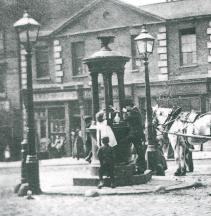
The drinking fountain, Clerkenwell Green, in 1898 |
Suddenly I emerged from the intolerable shadow of the brickwork, breathing easily once more. Before me lay a roomy space, nearly square, bounded by three-storey dwellings, and transformed, as if by quick mechanism, with colours of sunset. Red and golden spots wavered in the panes of the low scattered houses round the bewildering expanse. Overhead a faint crimson sky was hung with violet clouds, obscured by the smoke and nearing dusk. In the centre, but towards the left, stood an old stone pump, and some few feet above it irregular lamps looked down. They were planted on a square of paving railed in by broken iron fences, whose paint, now discoloured, had once been white. |
Narrow streets cut in five directions from the open roadway. Their lines of light sank dimly into distance, mocking the stars' entrance into the fading sky. Everything was transfigured in the illuminated twilight. As I stood, the dying sun caught the rough edges of a girl's uncovered hair, and hung a faint nimbus round her poor desecrated face. The soft circle, as she glanced toward me, lent it the semblance of one of those mystically pictured faces of some medieval saint. A stillness stole on, and about the square dim figures hurried along, leaving me stationary in existence (I was thinking fancifully), when my medieval saint demanded 'who I wasa-shovingof?' and dismissed me, not unkindly, on my way. Hawkers in a neighbouring alley were calling, and the monotonous ting-ting of the muffin-bell made an audible background to the picture. I left it, and then the glamour was already passing. In a little while darkness possessing it, the place would reassume its aspect of sordid gloom.
There is a street not far from there, bearing a name that quickens life within one, by the vision it summons of a most peaceful country, where the broad roads are but pathways through green meadows, and your footstep keeps the time to a gentle music of pure streams. There the scent of roses, and the first pushing buds of spring, mark the seasons, and the birds call out faithfully the time and manner of the day. Here Easter is heralded by the advent in some squalid mart of air-balls on Good Friday; early summer and late may be known by observation of that unromantic yet authentic calendar in which alley-tors, tip-cat, whip- and peg-tops, hoops and suckers, in their courses mark the flight of time.
Perhaps attracted by the incongruity, I took this way. In such a thoroughfare it is remarkable that satisfied as are its public with transient substitutes for literature, they require permanent types... of Art. Pictures, so-called, are the sole departure from necessity and popular finery which the prominent wares display. The window exhibiting these aspirations was scarcely more inviting than the fishmonger's next door, but less odoriferous, and I stopped to see what the ill-reflecting lights would show. There was a typical selection. Prominently, a large chromo of a girl at prayer. Her eyes turned upwards, presumably to heaven, left the gazer in no state to dwell on the elaborately bared breasts below. These might rival, does wax-work attempt such beauties, any similar attraction of Marylebone's extensive show. This personification of pseudo-purity was sensually diverting, and consequently marketable.
My mind seized the ideal of such a picture, and turned from this prostitution of it sickly away. Hurriedly I proceeded, and did not stop again until I had passed the low gateway of the place I sought.
Its forbidding exterior was hidden in the deep twilight and invited no consideration. I entered and swung back the inner door. It was papered with memorial cards, recommending to mercy the unprotesting spirits of the dead. My prayers were requested for the 'repose of the soul of the Architect of that church, who passed away in the True Faith - December - 1887'.
Accepting the assertion, I counted him beyond them, and mentally entrusted mine to the priest for those who were still groping for it in the gloom. Within the building, darkness again forbade examination. A few lamps hanging before the altar struggled with obscurity.
I tried to identify some ugly details with the great man's complacent
eccentricity, and failing, turned toward the street again. Nearly an hour's
walk lay between me and my home.
...
We went rapidly in and out of the flaring booths, hustling little
staggering children in our unpitying speed, I listening dreamily to the
concert of hoarse yells and haggling whines which struck against the
silence of our flight. On and on she took me, breathless and without
explanation. We said nothing. I had no care or impulse to ask our goal. The
fierce pressure of my hand was not relaxed a breathing space; it would have
borne me against resistance could I have offered any, but I was capable of
none. The streets seemed to rush past us, peopled with despair.
Weirdly lighted faces sent blank negations to a spirit of question which
finally began to stir in me. Here, I thought once vaguely, was the
everlasting No!
We must have journeyed thus for more than half an hour and walked far. I
did not detect it. In the eternity of supreme moments time is not. Thought,
too, fears to be obtrusive and stands aside.
We gained a door at last, down some blind alley out of the deafening
thoroughfare. She threw herself against it and pulled me up the unlighted
stairs.
Towards its close I looked away from the mumbling priest, whose attention,
divided between the inconvenient millinery and the holiest mysteries, was
distracting mine.
Two girls holding each other's hands came in and stood in deep shadow
behind the farthest rows of high-backed chairs by the door. The younger
rolled her head from side to side; her shifting eyes and ceaseless imbecile
grimaces chilled my blood. The other, who stood praying, turned suddenly
(the place but for the flaring altar lights was dark) and kissed the
dreadful creature by her side. I shuddered, and yet her face wore no look
of loathing nor of pity. The expression was a divine one of habitual love.
She wiped the idiot's lips and stroked the shaking hand in hers, to quiet
the sad hysterical caresses she would not check. It was a page of gospel
which the old man with his back to it might never read. A sublime and
ghastly scene.
Up in the little gallery the grey-habited nuns were singing a long Latin
hymn of many verses, with the refrain
"Oh! Sacred Heart!" I buried my face
till the last vibrating chord of the accompaniment was struck. The organist
ventured a plagal cadence. It evoked no 'amen'. I whispered one, and an
accidentally touched note shrieked disapproval. I repeated it.
...
the magnetism of human presence reached me where I stood. I hesitated, and
in a few moments found what sought me on a chair in the far corner, flung
face downwards across the seat. The attitude arrested me. I went forward.
The lines of the figure spoke unquestionable despair.
Did she reach me, or was our advance mutual? It cannot be told. I suppose
we neither know. But we met, and her hand, grasping mine, imperatively
dragged me into the cold and noisy street.
...
I record the passage of a few minutes. At the first opportunity I sought
the slumberer on the bed. She slept well: hers was a long rest; there might
be no awakening from it, for she was dead.
...
My heart went home. The dear place was desolate. No echo of its many voices
on the threshold or stair. My footsteps made no sound as I went rapidly up
to a well-known room. Here I besought the mirror for the reassurance of my
own reflection. It denied me human portraiture and threw back cold glare.
As I opened mechanically a treasured book, I noticed the leaves were blank,
not even blurred by spot or line; and then I shivered - it was deadly cold.
The fire that but an hour or two ago it seemed I had forsaken for the
winter twilight, glowed with slow derision at my efforts to rekindle heat.
My hands plunged savagely into its red embers, but I drew them out quickly,
unscathed and clean. The things by which I had touched life
[p. 72] were nothing.
Here, as I called the dearest names, their echoes came back again with the
sound of an unlearned language. I did not recognize, and yet I framed them.
What was had never been!
...
Without a pause of thought I stumbled down the horrible unlighted stairs. A
few steps before I reached the bottom my foot struck a splint off the thin
edge of one of the rotten treads. I slipped, and heard a door above open
and then shut. No other sound. At length I was at the door. It was ajar. I
opened it and looked out. Since I passed through it first the place had
become quite deserted. The inhabitants were, I suppose, all occupied
elsewhere at such an hour on their holiday night. The lamps, if there were
any, had not been lit. The outlook was dense blackness.
...
As I passed it on my way home, some dramatic instinct impelled me to re-
enter the unsightly church.
...
A service was about to begin. One little lad in violet skirt and goffered
linen was struggling to light the benediction tapers, and a troop of school
children pushed past me as I stood facing the alter and blocking their way.
A grey-clad sister of mercy was arresting each tiny figure, bidding it
pause beside me, and with two firm hands on either shoulder, compelling a
ludicrous curtsey, ad at the same time whispering the injunction to each
hurried little personage, - 'always make a reverence to the alter', 'Ada,
come back!' and behold another unwilling bob! Perhaps the good woman saw
her Master's face behind the tinsel trappings and flaring lights. But she
forgot His words. The saying to these little ones that has rung through the
centuries commanded liberty and not allegiance. I stood aside till they had
shuffled into seats, and finally kneeling stayed till the brief spectacle
of the afternoon was over.
An Open Door (Extracts)
As a child, I remember looking down from our high nursery windows on the children, far below us under the railings of the park - vagrants playing vagrant games, and even then I longed, I think, in a dreamy childish fashion to teach them prettier ways of play.
That passed, and then at school in Paris, I used to wish I had the trick of helping wayward spirits, and girls can... be wayward like their brothers.
All this was latent, crude; I saw in it a sanctimonious trait and tried to check it.
It passed, too, unrealized, a vague ideal or "crank", perhaps, and then when I left school we lived too fast for thought, it was a maze of parties and of people with not much room for actual life.
It was indeed only a month ago that enlightenment came....
... your sanity was shaken... there you lost your balance...
| Written 1890s - Sensual - dialect |
| See 1890 - Intensity |
A Country Book (Extracts)
... When first I read it many years ago, it set my own heart beating, for I felt I discovered in it an undreamed of universe. It seemed almost like a new friend who brought to me thoughts I had never known and showed me things I had never seen...
... it is a country book which teaches one to look at Nature, not as a great picture but rather as a living world, where life is orderly and sweet and for the most part peaceful - with a sweetness and peace and order to which we cannot reach...
Field and Hedgerow... tells of many things beside the hedges and the fields. It should have for motto a line of Byron's, "Oh that my words were colours!" for there is colour on almost every page of it, the myriad colours of Nature and the more mystic colours of man's mind. The tint of this man's mind was sadness, though the tint of Nature - which above all other things he loved - is joy. From a blade of slender grass which dare not grow too high lest the wind should snap it, or the smallest speck upon an insect's wing - "that singular shadow-painting", to the clouds - those "fleets of heaven which sail on and on and know no haven", he watches tirelessly the minute and mighty pageant, and it is marvellous as we read to find how much he saw.
"What is the colour of the dandelion?" he asks, "not yellow, nor orange, nor gold." And so he turned to books to find it. There was much about assorted wools and soldiers' uniforms, but "the dandelion remained unexplained". "So many, many books - and such a very very little bit of Nature in them." He found from the dandelion that there were "no books" to teach the names and mysteries of beauty, only "five thousand books to unlearn".
"It seems", he says, "as if the chief value of books is to give us something to unlearn. I hope in the days to come future thinkers will unlearn us and find ideas infinitely better." "Yet the spirit of the earth and sea, the soul of the sun - this never dies; this I wish not to unlearn."
| 22.1.1901 death of Queen Victoria - History |
|
1. January 22nd, 1901
'A Nation's Sorrow.' No. In that strange hour
II. February 2nd 1901
When, wrapped in the calm majesty of sleep,
|
| 22.3.1901: death of Henry Herne Mew - Life - Science - |
|
It is the clay that makes the earth stick to his spade;
There is nowhere else to go. I have seen this place
There is something horrible about a flower;
One of the children hanging about
We were like children last week, in the Strand;
This is not a real place; perhaps by-and-by
Not here, not now. We said "Not yet
But still it was a lovely thing
By a month we have missed our Day:
We should have stood on the gulls' black cliffs and heard the sea
You have never done that: I do not know
Now I will burn you back, I will burn you through,
If for only a little while
When I was quite a little lad
|
| My relate to a holiday in June 1901 - Science - History |
It was one windy evening on the cliffs which saw our first encounter with the rubicund old priest who plotted our conversion. He came puffing up to join the party, and between the gusts, compliment and guide-book and theology proceeded from him in a turgid stream. To the Bacteriologist's inordinate desire for information on all subjects we owed his subsequent pursuit. These two conversed in gasps and in a compromise of languages on subtleties of archaeology and doctrine till we reached the little door into the garden, where they parted with an assignation for tomorrow's mass at 6 a.m. Catholicism came to be a craze with her, and she approached it in a scientific spirit, compared its fascinations to those of the study of malaria, drew analogies and formulated theories, and ceased to be companionable. This, for in her better moments she had amiable qualities, we bore. The black rotundity (to fall into the slough of metaphor) we found a sharper thorn. He rolled round unexpected corners, cropped up on lonely roads and pounced upon us from dark doorways - a veritable little priest of prey. In vain did we evade the pressure of his palms - fat, damp and fatherly - discourage his discourse with vacant smiles. His zeal was not discourageable. Nor was his, he said, the only mind on which our lost condition weighed. The room next his was occupied by a 'devout young miss', who publicly disturbed herself on our account. He heard her praying 'Tous les soirs, for all the six!' This blameless incident, profanely handled by the Humorist under the title of the 'Listener detected, or the Maiden's Prayer', made an agreeable addition to her repertoire of recitations. But we owed more than this to the devout young miss, who was in time presented to us and who sought to lead us on by flowery ways. We owed to her our introduction to St Antoine de Padua - what an accommodating saint was he! You went to him for little things - a fine day for an expedition, and so on; you made your own arrangements', and you paid him, so to speak, upon delivery, 'by no means of necessity before. And was it not, in fact, a nice simple little faith?' We thought it was, and with the exception of the Bacteriologist, who refused to be a party to it, opened up transactions with him privately, as thus. Four sous for fine weather in an ordinary way, and to be doubled on a jour de fete. The sum was small, but his benevolence was disproportionate.
...
| Published September 1901 |
|
Dear, if little feet make little journeys,
Then, if smallest limbs are soonest weary,
|
26 Rue de Turin
(till Sunday noon)
Envelope postmarked 18.4.1902
Addressed to Ethel Oliver
My dear, I scarcely know where to begin, and start at random. I am living at two places; here I have a nice room with a small balcony looking on to the street with shops opposite; and as the food doesn't suit me, I have been going to the Rue Chat for meals. But today it was wet, and as it is a good half hour's ride, I had dejeuner here - not so bad, but I couldn't touch the meat. I had bread and jam and black coffee, and am sure of a thoroughly good meal at 7; but I find it pays one to do so much getting about, as instinctively one does here, between eight and twelve.
This morning E D'A wished me to meet her in the Parc Marceau half-way between this place and hers, but as it was wet, I didn't feel inclined, and waiting for a break, started off by myself in the other direction; visited Notre Dame and browsed about the Latin Quarter for an hour. It is certainly the most picturesque part of Paris. Where I am is a business quarter, noisy and overcrowded, and the Champs Elysees is spacious, gorgeous, airy, altogether luxurious et tout à fait différent. I cannot do justice to Notre Dame as my head was stupid and my eyes tired, and I couldn't look up, etc., but now I'm fresher. The sun has come out and in an hour's time I shall make tea in your apparatus which has been a perfect godsend and acts beautifully. I take it in the salon and make my tea...with it, and coming home last night very tired had two cups sans milk which bucked me up but probably 'hindered sleep'.
I walked up and down the Latin Quarter Boulevard this morning seeking a crémerie for some chocolate to drink. There were scores of curiosity shops and book stalls and dingy cafes, but no crémerie - so I e'en dispensed with what I couldn't get. It is much simpler to get about here than in London as all the trains and omnibuses are distinctly placarded with their destinations and when one knows roughly the terrain and so on, it is comparatively easy, though I have to keep my observations pretty keen - notice streets and landmarks; 'likewise' it is a danger to be absent-minded crossing the roads as the traffic here is simply awful. The heavy two-storied steam trams and innumerable motor cars keep one always on the qui vive.
Paris strikes me as a big place, very crowded and restless except in the
Champs Elysees Quarter, and one noticeable feature, and by far the
prettiest, one meets with is the flowers everywhere - stalls and shops and
women and men hawking lilies-of-the-valley, pinks, and lilacs at every
place or square. Up to now I have had no sensations worth recounting.
Perhaps I have worn them out; and then, too, I have been living at rather
high pressure with not much space for such.
I found
E D'A
somewhat in need of someone to look after her. The details I
am not free to enter into, but, in fact, I have had other things to think
of besides my point of view. Yesterday
morning about nine she brought up my letters, yours among them, for which,
thank you, and we sat reading our correspondence here till about ten-thirty
when we went off shopping and on to
déjeuner at the Rue Chat after which,
as she was expecting
Mme. Grout (Flaubert's niece) to tea, I went out for
her and bought the little necessaries for the occasion: flowers, cakes,
etc. We arranged the room (One lives in one's bedroom here, and hers is a
very charming one.) and as I was tired, I didn't stay to see the lady, but
came back here, and then found myself too restless to keep quiet and went
for a walk till about five when I dressed for dinner.
After dinner she had
a wood fire, and we asked up the two ladies at our table - one a
semi-French person, large and original and nice; the other an out-and-out
American (very racy in conversation and full of American vitality) who is
studying under Marcel to be a prima donna. She refused with pathetic
courage the friendly cigarette, as she treats her voice as a mother her
cherished child.
I left E D'A...and came along the Champs Elysees looking
wonderful with its innumerable lights, and nearly lost my way coming home,
as it is difficult to see the names of the streets at night and the omnibus
men either cannot or will not help you. They are very surly. Sometimes one
finds a pleasant work girl who directs you very kindly, but my French is so
bad it's not easy to understand. This afternoon I shall take it easy and
not go up to the Rue Chat perhaps till dinner, though Ella will wonder
where I am, as I promised to turn up for dejéuner.
The people here are as second-rate as the food - four Germans (women) not
over friendly; there is, however, a Mexican who speaks English but resents
being spoken to, and a vulgar French Madame who is kind, but greasy. It
is, however, intensely respectable, and I like being free and alone, and am
quite content with my room. On Sunday, however, I have to turn out, after
which, unless you hear again, please send letters to the Rue Chateaubriand.
I got
Winifred's card last night. Please thank her for it. Don't know
when I shall be back, sometime next week, probably.
C M M
P.S. Physically I have been really better here but mentally
tired, but if I wished to get my nerves under control up to now, thanks to
being better, I have done it, and hope that it will last. I can't transport
my thoughts to England and the things left behind with any sense of
reality, and perhaps it is better so, but it makes me seem very egotistic -
which I'm not really. It is
a queer uncertain mind this of mine - and
claims are being made upon it at the moment which I find difficult to meet.
Love to thee who understands and thanks to
Winifred's for the card.
| Published before June 1902 |
|
'Why do you shrink away, and start and stare?
'Oh hush! He seems to stir, He lifts His Head.
|
| Published June 1902 - Intensity |
In the Curé's Garden (Extracts)
I discovered it in summer. I do not know what it is like in spring; golden with daffodils, perhaps, and haunted by hidden violets, walled in by lilac trees, and sweetened with the scent of may.
I can imagine it to be the first meeting-place of budding things, a garden of the resurrection, where the birds re-assemble to recapture last year's song, and mate again, and build their nests anew.
Then, when the trees are leafless, or just starting into bud, one must see the convent on the hill more plainly, and hear less clearly above the birds' busy twitter, the bell tinkle across the fields. Then, in the skeleton poplar avenue, one may be able even to distinguish the figures of the good Sisters of our Lady of Compassion, as they pace slowly up and down. Today, one cannot catch a glimpse of them, but only now and then the outline of the distant walls, between green branches where they part.
In spring, Pére Laurent says the garden has an air plus béni, l'odeur plus fraîche, et plus consacré au repos.
I can believe it; in these August days, the scents are heavy, insistent,
almost over-sweet; the colours, fiercely brilliant, still more luminous at
early twilight, in the narrow walks where among roses the carnations bloom.
Was not their odour almost passionate? I asked him once, in one of our
little discursive talks, and were they not par excellence the
flowers of
seduction and desire?
Par excellence, he agreed; adding that yet it was well they should
be
there, diffusing their distracting fragrance; they were reminders of the
world, the flesh:
fleurs des sens, fantômes de la chair, toujours tentant
et qui doivent toujours étre crucifiees.
This sultry afternoon, however, it was not Pere Laurent whom I had come to
see. I passed him in the village and he stopped me to say that I should
assuredly find Anita...
...
"Mademoiselle Anita, I am very anxious to marry you".
She met the announcement with childish composure. - "It is not possible",
she said... "It is not my destiny. But it is a very charming proposition.
You are very kind"...
Her rejection was so positive, so persistent, that for the moment I was
disinclined to combat it. I got up to go.
She arrested me with quick reproach. "You are going? I have gravely
displeased you; you are wounded. Will you never return? You are not about
to leave us with an aspect so sévère".
"Why should I stay, when you dismiss me?"
"I do not do that. I implore you to remain. You have been so much our
friend; is that forgotten? Then it is true what they say of it, l'amour
est la passion cruelle qui désole et qui trahit".
Her distress was unmistakable; it cast the first shadow which I had ever
seen upon that exquisitely cloudless face. I yielded to it and said
caressingly, "Then I will stay".
'To supper?' she demanded quickly.
"If you are so good". This definite assent restored to her the familiar
untroubled smile. 'And you will perhaps gather me some flowers to take back
with me?"
The suggestion delighted, completely reassured her.
"Voyons. You shall make your choice immediately, and I will preserve
them till the sad moment when we say 'good-night'. To commence, then -
carnations, I divine rightly they are the favourites".
She bent over the crowded beds to make a critical selection. "It must not
be too small, the bouquet", she decided; "that... would not be 'pretty' for
us, and one too big, that will appear ridiculous for you. It is in fact the
size". She held it out for admiration and approval"...
I took it from her. "You and your flowers, Mademoiselle Anita, have
some
strange affinity. When I think of you, it is as if I thought of them, and
when I think of them, it is as if I thought of you".
"You think too much of them", she admonished gravely, "I have remarked it.
You give to them imaginations, dispositions of your own; they are not what
you make of them and they have no relationship with me. I see them as I see
the sky, de loin, mais nous ne nous touchons pas, we scarcely smile,
we do not speak, we are not en rapport".
"I do not believe it; see", I thrust towards her the scented
nosegay, "they
are speaking now. I do not, but you ought to understand what they say".
"It is not speech, this beautiful odour; it is solely their breath, their
life. Truly, we are apart; we have the life immortal, and their existence
is but during the spring, the summer - very short".
...
| Published Autumn? 1902 |
|
Song
Oh! Sorrow, Sorrow, scarce I knew.
Oh! Sorrow, Sorrow, was I fair
Oh! Sorrow, Sorrow, is my bed
|
| Published Autumn? 1902 |
|
Not for that City
Not for that city of the level sun,
|
| Published 1904 |
Mademoiselle (Extracts)
She came and gave us lessons twice a week; engaging little lessons into which she managed with extreme politeness to infuse her profound contempt for the literature of our country, and her keen but critical appreciation for the masterpieces of her own.
She found our romances "truly desolating", save those perhaps of Charlotte Bronte, "cette petite Huguenote pieuse at passionée" who was, but certainly, a little "passed". And for our philosophy - she laughed, and for our drama - well, mon Dieu! she wept. For the whole parlous state of everything she experienced - with, but of course, exceptions - shall we say of Shakespeare? Shall we say of Monsieur Meredith, the most obscure? - and acute despair. In a word she had some power of discernment...
She introduced us to [Monsieur Antoine de St Perre] at his studio, one cheerless afternoon in October, and my impression of that visit is of something curiously grey.
Perhaps it was the room, one of a block of studios just built, in a blind street off Camden Town. It reminded you of a vault, as you stepped down to it from the cramped dark passage. It was fairly large and disproportionately high; but it smelt of damp, and the walls were washed a hard aggressive grey, which again reminded you of tombstones. It had no window, only the top light, and very little furniture; a cheap oil stove which mixed its odour with the dampness, a bed screened of by a dingy cotton curtain, a very new and very common sideboard with a mirror at the back, a deal table, and a few odd chairs...
tilted against the steely walls along the floor, were a set of satin-wood panels, daubs of woolly nymphs and Venuses and podgy Cupids, surrounded by trophies of lyres and ribbons and festoons of heavy flowers. These were specimens which he took round... to firms from which he wanted... employment; it was this branch of art to which his talents had of late been prostituted...
England... possessed no painters. That he made indisputably plain. We mentioned Watts once with tentative anxiety. "Watts!" he explained excitedly, "who cannot even draw!" Certainly Mr Watts had been to Italy. He had learned something - but for teaching - let us go straight to the Venetian School. Admit that he had colour - there he ended, and that was but a clever copy of his master Paolo Veronese. What was Watts, after all? And Sargent? but he was not to be called English. Character? perhaps - a little - but a mere trick, an accident - and then at best, how superficial!.
So on through the list. One almost envied him the joy... with which he plucked the flesh from the most illustrious bones...
The next we heard of him was of his having sailed... As time wore on we asked for news of him... it occurred to me I had some influence with a large firm of piano-makers... who might make something of his satinwood productions...
See The Poems of Emily Bronte (1904)
Hotel de Bretagne
Le Conquet
July 6, 1909
My dear,
I went out before breakfast this morning to fetch letters and found your card and the tragic newspaper, very glad, indeed, to see them especially as there was no news from home and I was getting anxious. Those came by the second post today to my great relief. Thank you so much for looking up Anne and sending a report. I was rather wretched and worried at leaving her alone not well but hope she is really better.
Elsie heard today that the Bazaar realized £2000 - and the expenses were £800 ... We had a princely crossing, quite smooth, and a luxurious cabin on promenade deck. From my berth I could sit up and look through a little square window with a blind, right on to the deck and with a lovely view of St. Malo when I woke at five. The morning was so lovely - the pearly-gold light on the old town - that we had tea in our berths and then got up and watched the town till seven when the customs let us land. A great rush to get the Dinan train, and there we stayed at the Gare, much the same as of old.
It was warm (not hot) and sunny and Dinan fascinated Elsie though we didn't go out till four or five, sleeping off the voyage till then. Going down the one street a poor woman called us in to show her room - a hovel - sand floored and with wood rafters and walls dripping damp, date 1350, and just as it was then; she had a poor little bed in the corner, a picture of the Virgin, and a broken chair - nothing more - and had lived there along for fifty years crippled by the damp and cold. "De la misere" she said, and so it looked and felt. We went on to Guingamp next day and saw nice rooms at the France. One, I think, was Madame's own with some beautifully bound French books - and a little cabinet de toilette. I chose the old view over the river and it was heavenly by moonlight on Sunday night. The procession was as usual, only this time we were in the Church and saw it from there sweep out a blaze of travelling lights - 10,000 pilgrims, they say, though one can hardly believe it. There are the usual Americans and disagreeable English at the Hotel, one young man sitting next to me said the "Guingamp Fair" was no show, as the "White City" had spoiled him for such primitive proceedings. He regarded the Bretons much as one regards the Fat Woman or Bearded Lady at a Fair, and said wearily it was a job "to find anything noo". They had been motoring through France. I said kindly, "You should try Mans". At which he quite brightened up and said, "Oh, where's that?" but relapsed to ennui when he realized it wasn't open to the motorist just yet. We came on here thinking to get a few hours in Brest on Monday. We had only just time for a hurried tea and caught the train there by a second tearing up the dusty Brest streets after our small baggages on the back of a youth who picked them up at the Gare - the train with an open carriage at back along the country roads setting down Bretons in cap and shawl and the old [gap in photocopy] at roadside houses - a run of 18 miles through fresh country.
We are comfortable here, the only other visitors a haughty English family who glare but do not speak: Mama, Papa, and New-human-like offspring. The street here (a tiny strip called the Grand Rue) is a perfect little picture with Bretons in costume clattering in sabots up and down - with a pump at the end - the centre for some charming figure or group in white and black and blue. But beyond this, and the fresh air, it is not very interesting. The cliffs, low and cut off by an hotel and villa, and the side streets rather dreary and new. The street, however, (with a Fair in the morning) seen from our windows is worth the rather troublesome journey.
A sturdy Breton in velvet coat and all the rest talked to me at lunch today and said Landernean was a "ville morte" only beautiful from its site; and passing through in the train it looked deadly, so we may not stay there more than a night, if that, and shall probably go on to Quimper Sunday or Monday. Please send anything there till Tuesday, and then Poste Restante Audieme.
We have had a cold mist and driving rain all day, and I have been wearing the few clothes I have here all on top of one another and sitting with my feet in the eider down to keep warm; but now it has cleared a little and we are going out for a short stroll before dinner. The rain is off but it is still cold and we are Hoping for some of your warm weather to catch us up. Just going out to post this and walk round before bed. So grateful for home news and to you for sending it here. I'm sending on a card of the street later.
With love from Elsie,
Yours, C M M
Hotel du Lion d'or
Quimper
14.7.1909
My dear,
It was delightful to get your card on arrival here on Monday afternoon and the paper yesterday and letter this morning. Thank you for home news. I was just on the point of writing when I heard. I suppose moving about makes one forget the real course of time. I am glad the hat is a success and hope the dress will be likewise. Is Wek to be trusted on the floor, I wonder? We saw an old green Wek in a little shop here yesterday; and in a high window of a XVth century house in Conquet, a white-capped old lady with a young one on her arm. Did you know it was a Wek country? And at Guingamp and Landernean all that caravan had their little cages hanging up.
Conquet grew on acquaintance so much that we could hardly bear to leave it. The houses are very old and the place unspoiled; the air fresh and the main street a perfect picture with narrow carts carrying logs of wood to be shipped to Ouessant always rattling up and down. We did not go there as the weather was rough and the boat which we went over one evening in the quay, not inviting - also, it started at six a.m. But in Brest and Conquet one saw the Avenant costume; extremely strange and savage with wildly bright colours, barbarous tints, and the women wearing their hair to the shoulders under the cap which gives an unbretonish look, especially in the older women.
We came to Landemean on Saturday, rushing through Brest in Fete with flags flying, and found Landemean full of shows and caravans, just under the windows of our hotel. The Fete was a sad affair: a ballon which refused to go up for six hours in view of waiting crowds, and finally when it did, immediately collapsed. A Breton with whom I talked at dinner at Conquet described it as a "ville morte", and such it is, but with a wonderful quay of immense width stretching out onto the beautiful country; and streets of the oldest houses, solemn and deserted, the whole place giving one a sense of space and desolation, very grand and mysterious at night.
Elsie was rather upset the day we arrived (food, I think, but don't mention it) so I basely deserted her and went round alone, thinking hew much you would have liked it. But she picked up next day and is now quite fit again. We came on here on Monday, and, course, are under the spell of Quimper. Both the Madames at Conquet and Landemean recommended us to an hotel here ... and so I left Elsie with our hand luggage (on which we are living at present) on the Cathedral steps and went up to see it - the most dreary sordid place at the extreme end of the town near the barracks and slums -- where a greasy widow, apparently the sole occupant of the house offered to do us up for 4/s a day. In spite of this tempting offer, I came down here, interviewed Madame, and found one room vacant, over-looking the place, and, of course, couldn't resist it once inside. So here we are much tied to the window watching the passers-by and the departure and arrival of the queer couriers' carts, of which more hereafter.
On Monday night going down for a candle, I encountered M. le Patron who offered to show us his garden next morning. So at nine yesterday we started with him for a ten minute walk into the country and came to a house with a magnificent garden which is his paradise and hobby, the most amazing place of gorgeous shrubs, lush grass, and walk after walk of rose trees of every conceivable variety in bloom. He has 1800 different plants, some of the rarest kind; and his little room here at the back of the hotel is full of medals and diplomas. We came back with two of the most gorgeous bouquets you ever saw and filled our large basin with them, having nothing else, roses of every tint and form. Elsie says she has never seen such specimens. The little, stout, short, red-faced man thinks of nothing else, evidently, and lives with what he called 'Hues fleurs". I am afraid Madame, whom he called "one vraie communicante" considers it a mad hobby, and it must be a most expensive one.
In the afternoon as we were having tea at the window we saw a wild bus loaded with every kind of merchandise on the point of departure below, so I ran down and induced the ruffian who drove it, to take us on a pile of oozing boxes (as the inside was literally crammed with peasants), and so leaving our tea we started for the lovelier country ride to Fouesnant some 16 or 18 miles (about 8 from Beg Meil) dropping parcels on the way...At each inn on the road the white caps inside and the one Jehu went in for drinks. All along we met country carts and passed groups of haymakers in costume; the country on either side from our high seat was exquisite and the air and smells delightful. At Fouesnant we hoped to catch an automile back at six-thirty, and going up to the top of the village street at a wayside inn found a Breton wedding in full swing; people all in costume dancing real Breton dances, with old women sitting round the inn selling the wedding refreshments from little baskets. It was hard to leave this for a look at the Church - one of the most remarkable; I imagine, 10 or llth century...
When the automile did arrive it was full of Beg Meil swells and eight fat, determined marketwomen besides ourselves - resolved to get in. However, they weren't allowed, and it was just going off without us to our dismay when a kind Frenchman inside opened the door and said, "Montez, montez," subsequently explaining that as we were thin, they would be taking us in. Otherwise, I don't know how or when we should have got back.
Last night there was the Retraite aux Flambeaux in the Square here for the 14th festivities, and tonight there is to be a cinematograph on the quai. So, you see, there are the usual attractions and Quimper itself is difficult to part from. We were to go en to Audieme today but are undecided and shall probably spend Sunday in Pont-l'Abbe for the Pardon there, and then, reluctantly, leave towns for the sea.
11:30
Just back from the cinematograph show on the quays, very good, but the crowd of white caps and Breton hats was magnificent. There must have been thousands there. We have come away in the entre'acte and I suppose it will go on till 1 or 2 o'clock. This afternoon I stopped this to board another courier's cart, and went seated on the roof to Benodet, a little toy-shop bain-de-mer at the mouth of the Odet, looking pretty in the evening light. We came back on the small motor bus in front, a fine spin along the wide roads, doing the 18 or 20 kilometres in half an hour.
It has been decided to stay here till Saturday - go to Pont-l'Abbe for the Pardon, and on to Audieme on Monday. So we shall probably be there till Thursday, unless it proves very disappointing. The right way to see Brittany is to go off the beaten track, i.e., the couriers' carts; and in the little villages one sees the real people - women in strange caps, knitting on the roads while they drive the cow home, and dear little children in costumes - absolutely of the Tudor period - taking refuge under hedges from the automile rushing by.
I shouldn't have given you so much of Brittany if I didn't know you were kindly disposed to that land where M. le Patron says Religion is dying out. though judging from the Guingamp Pardon, there's life in the old faith yet. I think Le Conquet would please Mrs Frank if not too quiet - but the train only lately goes into Brest in an hour and a half, and they do you at the Hotel de Bretagne for 5/s a day, and at the Hotel St. Barbe on the point for 6/s.
I hope the ... portrait will come out well. I think it very nice of you to do it, but Wek thinks you might do one of him - another when you have the time. How's the D...business progressing? I shall be glad to know. I had a card from Ella at Landernean saying she's going to stay at [Charlotte indicates there is a word she cannot remember?] Beaumont la Roger next Thursday, and asking for a letter there. I hope the experience will be happier than ours. I also heard from Maggie today, but letter-writing takes up time and they have only had cards at home for a week. Thank you for yours and the paper.
I don't know how long we shall be at Audierne; if we like it, perhaps till Saturday week, but shall pick up letters at Pont-l'Abbé till next Monday.
Love, and many thanks; I must stop now as it is late and I ought to put out the light.
Yours,
C M M
Hotel du Commerce
Audierne
24.7.1909
My dear,
I was very glad to get your letter yesterday, but sorry to hear of the Vale babies' illness; however, when that sort of thing is over, I believe they go on all right, but it is particularly worrying for Mrs Frank just now with a move in prospect.
Le Conquet is a sweet little place but small, and there are no cabins for bathing though there is a plage across the ferry; on the whole, I think it very nice to recommend places to other people when we know them very well; and as for the French guide book, the picture post-card, and the French Monsieur, no confidence can be placed in them. All along since Conquet I tried to find out whether we should go to St. Guenole -- the other end of the bay -- or here; and in response to enquiry all the gentlemen would say was that St. Guenole was 'joli' and Audierne 'gentil' and when pressed for a comparison, all three said the same thing; c'est autre dure, or C'est different. So, from Pont l'Abbe we spent a day seeing for ourselves and found St. Guenole, and apparently all the other places at that end of the bay, ghastly stretches of desolation, dirty, sordid, with filthy rocks and hundreds of mean houses all a long way apart with their backs to the sea giving the appearance of a sort of blind detachment from it. it was an experience of a rather extraneous kind.
A friendly old gentleman at Pont l'Abbé gave us a card to see over the lighthouse at the point, and a man at Landemean had strongly recommended a hotel there, but when we saw it, it was only fit for a penal settlement, I thought, and we left it hurriedly; had a nasty walk over unsanitary rocks, a wild hunt for milk when we reached St. Guenole, and only time for a cold cup of tea or an arid plage, and a rush to catch the train. All of which made us rather doubtful about Audierne. We had an hour in Douar-nenez on the way here and came on in a little open train with women laden with baskets of fish; and at the end, a lovely run quite close to the river which runs under a bridge into this port. Luckily, when we arrived we had a choice of rooms and have now the 2 best in the hotel; but since we came it had filled up, and late last night going into a little dark shop...I found Madame asking the old lady for accomodations for a party of studnts just arrived; five or six with a chauffeur, only, unfortunately, the key was lost, and five people were hunting for it, while I waited, by the aid of a one-farthing dip. However, I suppose she found it, as they have just gone off with large supplies of petrol.
Our windows (I have a balcony) look over the bridge, the port, and beyond to a little pine wood on the hill, and below that there is much "mounting in hot haste", or the reverse, of motors, carrier's carts, and the weirdest shays you ever saw. They look as if they might drop to pieces on the road ... We were going to the Pont-l'Abb&wacute; train, but just as we were starting for the station, from the Lion d'Or window I espied a two-wheeled country cart laden with sacks and boxes, cans, etc. I rushed down and asked where for; and when I found he was that moment starting for Pont-l'Abbé, persuaded him to wait a quarter of an hour while I tore up to the station to get tea and tobacco from the trunks there; and so we came on by road, a lovely, lazy drive on the top of packages, with all the little carts bringing the horses back from the Horse Fair at Quimper with us on the road; about six white caps and one or two Breton hats to every tiny trap, a colt tied to the shafts and an old horse tethered on behind. It was very charming in the evening light to see them ambling along in front and behind, and finally turning down their own particular lanes or stopping at a wayside house.
Madame of the Hotel des Voyageurs was very nice. I had written on for rooms and asked to do us for 5/s. as I had been before, but apparently things have gone up. The Lion d'or wanted 6/8. but...Madame agreed to 5:50 which we are paying here, though this is a first class hotel; (there) are five very distinguished officers from the Quimper regiment dining opposite us; a French lady artist, young, who cleans her palate out of the next room's window at night ... a variety of French tourists arriving and departing in the afore-mentioned antedeluvian shays - excursionists, I suppose, to the Pointe du Raz. I do not think we shall go there as it takes the whole day, as the interest of the quay and the country round here (all cornfields and little sylvan patches) more commends itself and from what I [saw of?] the much vaunted "belles roches" of St. Guénolé, I don't thirst for more.
Yesterday we walked along the coast towards it, passing the land of the sea-weed burners, very picturesque - the square heaps smoking against the sea with wild-looking women in caps and sabots and wilder men tending the smoking goemon, coming back a little inland through the corn--waving against the blue, and dipping down to an old grey chapel on the edge of the cliff - and a few yards up, a rough, lichen covered calvary, weather-beaten, but very dignified and impressive - the crucifix and two figures at the side mounted on five or six great steps, showing grey against the summer sky. An old man on the road said it was the chapel of an English saint, Saint Evet, who started to convert the British, was ship-wrecked off Finistere and there, in that quiet spot, abode. Today is the Market, grouped round the triangular place of white houses at the head of the quay with wood carts stationed up behind each with its Breton driver in blue & black hat. All this seen from the window as I write, as I have not yet been out. Tomorrow the Archbishop of Quimper comes for the Benediction of the Sea. He goes out in the life boat, I believe, and processes back round the port.
Life would have been very pleasant here but for the plague of the children with whom I have been waging an unequal war since Wednesday. They surround and refuse to leave you, begging for sous and generally behaving very badly. Yesterday while Elsie bathed we had six or seven older ones trying to force the cabine door, peeping through the chinks, and ending by disgusting insults of the English, rather wearing and unpleasant; and the intervention of two nice Oxford men (I think), also bathing, and a deaf old Frenchman with his bonne, proved entirely ineffectual. On Wednesday one miserable boy buried our umbrella in the sand & I spent the morning having a row with about a dozen of them - trying to discover its whereabouts. It was, however, restored yesterday by the lady of the semaphore who had watched the interment from over her charming garden walls. They infest the rocks and the roads and have become a perfect bane. The little French bonne said all vistors, French and English, are equally victims of their villainies & the lady artist bitterly complains. Winifred ought to sympathize.
We have given up the idea of doing Croisic and further south as it would be such a rush and should have returned next Saturday, but as the Ella sails that day (only) think of waiting for the Vera on Monday and spending from Saturday night till Monday at St. Malo as our ticket on the French Railways expires then, and it will give us a quiet day before starting.
It is difficult to realize the 'elsewhere1 as Loti calls it, here: Tottenham Court Road, & a city with scarcely any sky, while here there is the whole arch of it - the harbour lights at night. One is woken up by the sound of oar a plashing and anchors being weighed, and the clatter of sabots up and down the quay. No one hurries about anything. It takes five nan to harness the station bus and about 30 to unload a little bit of scrap iron from a sail-ing boat on the quay. But this is s. pleasant sort of oblivion, which ought, even like Christmas, "come once a year", and while it lasts, it is a blessed rest, a sort of dream snatched from waking and worried days.
I hope all this doesn't bore you, and if it does, you must take the "kind thought" for what the letter lacks & many thanks for all the papers and welcome letters, particularly those with good reports of home.
Elsie sends love and thanks for card.
Yours,
C M M
| Published 1909 |
|
Your birds that call from tree to tree
Your salt scent on the thin sharp air
At the road's end your strip of blue
As if your spirit, swaying yet
What threat of old imaginings,
Yet you would wake and want, you said,
Just overhead, they whirl and dart
Beyond the line of naked trees
|
Cafe Belle Vue
10 Place Frederic Sauvage
Boulogne
June 27, 1911
My dear,
Your letter of this morning was very welcome and nice of you to write when I have been so neglectful. You sound very quiet and Quakerly.. .but perhaps you won't be sorry to get back to town. I hope you have good news from home and that the coronation party enjoyed itself. All the English boats and the hotels were gaily decorated here, and Anne has gone to see the Procession on the Cinema tonight.
We came here on Wednesday morning, looked round the town for rooms, and finding all the hotels on the quai expensive, decided to try this, a little cafe, bourgeois, but with the best view in the town, or any town, as it seems to me, looking across the bridge at the station. We watch all the carts piled with brown nets, and the fisher and factory people pass, and the train travellers with their little luggage. I like Boulogne as well or better than any place I have seen, the quai is beautiful, especially at night, with the town towering up on one side, and the trains and boats on the other - all masts and twinkling lights. The Holland and Hamburg American ships for Brazil, La Plata, and Buanos Aires put in here - and the Dutch West African liners - and the fishing boats are all aizes, from great steamers to little sailing boats; and the fish and flower markets are very fascinating.
I have made friends with (or they with me) an old woman in the Market, and the old man who sells post cards on the Bridge, very proud of his two dogs whom he "loves more than people", he says. And yesterday two little Scottish elderly ladles arrived from four weeks in Paris, very cute and cheery and 'game' for everything, who went with us to the Circus last night. I have gone with Anne to the Cinema this evening.
We are only paying 40/s. a week, exactly half of what the other hotels asked, and though the place is modest, not to say humble, we are all right. Yesterday I had to insist on having some nasty people (French) stopped from smoking and playing cards in the salle à manger, and have got one room scrubbed out today. Anne thought these suggestions would result in our expulsion, but on the contrary, Madame grasped my hand this morning and asked with a beaming smile if we were satisfied now, etc. - and the stupid little waiter has bucked up.
We went to a French play at the Casino on Monday, very well acted, and lost a franc or two at the tables - but I shall keep away from them as the attractions of gambling are irresistible, and I have no money to lose. If all goes well at home we shall probably stay another week. Until today the weather has been cold and more or less wet, but I have been out nearly all the time, yet still feel incurably tired - what the French call fini - and reluctant to take up "duties and little cares", though I might, and ought, not perhaps have left them at all, but I simply could not go on.
It's very lucky to have found a place so near, in every respect pleasing. The sands are fine, and the jetty runs out 2000 feet to the sea, Just the place to watch the boats come out and in.
The visitors are common - both French and English - but they don't spoil the harbour or the fisher-people, and keep to their own quarter: the Casino and the beach and the tea rooms in the town. There are three quarters besides the old town, or the city, with three of the gates still standing - the fishermen's port with an old church; the centre with the markets and the quai; and across the bridge, the factories and railways and cargo boats.
Anne started a sketch in the Fish market yesterday and is doing one of the quai tomorrow. I have just loafed about, but wish I were an artist - though these people don't abound, probably because it is too busy and crowded for them. We had thought of going on for a day or two in Paris, but I would rather stay here; don't want to move or face the racket of it.
I have read nothing; too tired to even think, but before I cane away Miss Jerrold lent me a book of Modern Poetry in which I found a thing by Noyes, the "Old Sceptre", the most touching poem I have read for years, and which, as far as sentiment goes, I might have written. I am glad to hear such good news of this Marriage (????) There are no Weks here. It is a town of dogs of all sorts and sizes. They draw the hand carts and play about the quays; and old white horses abound. The "Service des Postes" de Boulogne might belong to the sixteenth century - an old cart going at the pace of a hearse from the house of mourning; the mail motor carts of Gordon Street seem 10,000 or four hundred years away !
I have written no letters since I came except one home and this and have not told Maggie I am here as I said I wouldn't go to Berkhamstead, and have not heard anything of her for ages.
My nice new hat box came with me and is the largest piece of luggage this small room would hold; everything has to hang on a long row of pegs, very different from the luxuries of Aix, but the visitor to the Cafe Belle Vue usually contents himself with a small bag, or (if, as herself-) a cardboard handbox ! I am writing with a candle stuck in a match box, as our allowance of bangles is small, so must end up, as it's wearing down.
I hear Wek has been depressed by our absence, poor little soul! But he has taken kindly to my mother's companion. He would like some twigs. Love from Anne who has just come in.
Yours,
C M M
| Published 3.2.1912 |
| dialect |
|
Three Summers since I chose a maid,
"Out 'mong the sheep, her be," they said,
She does the work about the house
Shy as a leveret, swift as he,
The short days shorten and the oaks are brown,
She sleeps up in the attic there
|
| Published March 1912 |
|
From our low seat beside the fire
|
|
Published
17.2.1913
See Science - Madness - Fairies - |
|
Toll no bell for me, dear Father dear Mother,
In the garden at play, all day, last summer,
One evening, too, by the nursery fire,
Sometimes I wouldn't speak, you see,
Times I pleased you, dear Father, dear Mother,
|
| Science - History - Intensity |
| Men and Trees 1 (Extracts) | Full text |
It was a blind man in old Palestine who saw men as trees walking... and the other day in a London studio I met another quite 'dark' as thet say in Devonshire, who must have had some vision of men and trees...
... the line of lamps, just lit, cut the broken line of trees in the gardens opposite; a light rain was beginning to freshen the dusty leaves. The London trees are all the prisoners of men, some unreasonably mutilated like the lopped crowd in Greenwich Park, while, now and then, there is a wholesale massacre such as that of the seven hundred in Kensington Gardens, which took place, no one knows why, some thirty years ago, against which even the executioners protested and perhaps the homeless rooks as vainly. In my own wooded neighbourhood one after another falls; progress pulls down the old spacious shabby houses and puts up flats for the half-world; a popular draper rears a proud monument to success; the green vanishes: even tomorrow one may miss the familiar plane of yesterday, and the birds go with the tress.
"You are looking at something", said my blind friend quietly. "Not here", I
told him. "It was
a tree outside the
British Museum they were felling last week, with all the
instruments of butchery, the axe and the rope and the saw, and the clearing
round it like a scaffold; it went on for days and I didn't altogether care
for it." "No", he agreed... "I really can't bear
to see a tree cut down..."
...
One may read whole libraries about the tree. tree-myth, tree marriage,
tree-burial, tree-murder (under
'Forestry'), shelf upon shelf of books,
dreams analysed and prayers dissected, millions of words strewn round it
like its own dead leaves, and outside there stands the living tree, aloof,
splendid; as magical as it was before one of them was written...
And this beauty. The scientist puts it into schedules and cuts sections of it and labels specimens for museums, and while he is busy the soul of it makes a little journey and comes back when it has gone to bed. No soul can breath buried alive beneath the weight of all these tabulated facts.
The great tropical forests are being gradually penetrated; they are not yet ours
| Men and Trees 2 (Extracts) | Full text |
Every tree of the Druidical Grove at Marseilles is said to have been washed with human blood, and Frazer mentions the yearly sacrifice of a girl by a tribe in the Punjab to an old cedar-tree.
These, of course, are the darker superstitions;
civilisation, brightly conscious of having abolished the devils
with the gods, and replaced them all by the
Culte du Moi,
murmurs "shocking!" and hurries on; but there is not much doubt that human
sacrifices are still being offered by
American and European syndicates to the sacred tree of civilisation, the
rubber tree. Civilisation demands speed,
speed demands rubber, and rubber, coated with blood and slime,
turns quickly into gold. We have almost forgotten
the Congo, and the whole
story of the unique and more hideous abominations of the
Putumayo is not yet and probably never will be told. So far we
know that within ten years the greater part of a gay, intelligent native
race has been monstrously exploited and destroyed.
...
Religion is like music, one must have an ear for it; some people have none
at all; but given the ear it is all significant and wonderful, from the old
plain-song to a rhapsodie of Brahms. The form changes with our shifting
emotions and ideas; here and there an a tune gets lost, or goes out of
fashion.
Paganism and the medieval Christianity grafted on to it is dying hard in Celtic Brittany; but no one who within the last ten years has seen only the fires on St John's Eve at Guingamp will say that it is dead. The bonfires at each corner of the triangular place, lit by the priests without enthusiasm, are built around high poles, each crowned with a garland of flowers. In the glare, as the flames mount and spread, the old houses round, losing actuality and substance, look like painted scenery, and the pilgrims below, who have come from all parts of the countryside, for the Fête of Notre Dame de Bon Secours, like a stage crowd.
Ten years ago one or two of them snatched a tison from the fire; later I did not see this done. These were treasured, says Souvestre (in 1854) as charms against thunder, and the scorched garlands as talismans against sickness and sorrow (peines de l'âme)
The fires are relics of sun-worship, but the masts and garlands suggest the tree.
The Celts, whatever sea divides them, have the same eyes and see the same visions, touching hands on the land of dreams...
| Published June 1914 |
|
We passed each other, turned and stopped for half an hour, then went our
way,
But first I want your life: - before I die I want to see
Now, if I look, I see you walking down the years,
Is this a stupid thing to say
No shadow of you on any bright road again,
Peace! Would you not rather die
|
| See June 1914 - 10.12.1918 - 14.4.1919 |
discussing On the Road to the Sea with Florence Hardy
Dorchester
April 13, 1919
My dear Miss Mew:
I hope you are well and that the treacherous weather has not been playing tricks on you. I do hope that you have escaped 'flu'.
I am really writing to ask you a question - which I hope you won't think silly. We - some Cambridge friends - Lowes Dickinson, Elliott Felkin, and E. M. Forster have been reading with great appreciation your poem, "On the Road to the Sea." It seems to have raised a never-ending controversy. Is the speaker a man or a woman? All the men say it is a woman - I and another of my sex say it is a man who speaks. Will you tell me which it is? It would be so good of you.
I do hope that you will be able to run down to see us later when the weather is a bit warmer. We may be in town later - when perhaps we might be lucky enough to catch a glimpse of you.
Yours very sincerely.
Florence Hardy
9 Gordon Street
Gordon Square
April 14, 1919
Dear Mrs. Hardy,
"The Road to the Sea" represents to me a middle-aged man speaking, in thought, to a middle-aged woman whom he had only met once or twice.
This last week there has been a suggestion of another edition of the Farmer's Bride & if the "Road to the Sea" went into it, perhaps it would make it clearer (or darker) if this were put at the head of it: La beaute des jeunea femmes est distribute sur les diverses parties. Quand elles vieillissent, la beaute se fixe sur leur visage.
I did not want to bore you with an answer to your letter of February - an answer to mine - though I would have liked, then, to tell you how much pleasure it gave me - for you said in it the nicest thing that has been, or could be said, of these everlasting little verses & it was some weeks too before I got out of my head the bit about the 12th of March. And now your Spring is here!
I know if you should come to town, there won't be enough 1/4 of an hours to go round & you know well enough how I shall value it if you have one of them to spare for me!
I've not seen summer in the country since 1914, but this year perhaps 1 shall make a bolt for it somewhere, and if that were to be Dorchester I should wonder that I'd have such luck, only that luck has nothing to do with what one does - and the good-for-nothings seem to get most of it.
I had an amusing time at Christmas with some very Roman Catholic friends where I met a Carmelite monk who offered to "correspond" with me "on any subject"! - & I'm hoping to get a week in Sussex after Easter. I read in the papers that "Mr. Hardy is in the best of health & spirits" etc. etc. etc. which is good news for the world. Please remember me - dutifully - as my old nurse taught me to say - to him.
Very sincerely yours,
Charlotte Mew
Dorchester
March 2, 1921
My dear Charlotte Mew: (If I may venture)
Even at the risk of bothering you with another letter I must send this, to say how much I value your gift of the new edition of "The Farmer's Bride." It is - and always will be - one of my greatest treasures, and it was so good of you to send it. I read all the new poems aloud to T. H. last night. He liked "Sea Love" perhaps the best. "Saturday Market" too is exceedingly good. I remember your reciting it to us here so well.
You have altered, I see, certain lines in "On the Road to the Sea," which is perhaps my favourite of all your poems. Please forgive me if any remarks I make seem presumptuous. I do not know whether it is a better plan to make certain the sex of the speaker - as you have now done in the line "I who make other women smile." There was something alluring in each reader supplying his own idea. But then my argument always was, that the request "...put your far off little hand in mine" could not be made to a man by a woman....
|
First published June 1914
in
a slightly different version.
This version published in the 1921 edition of The Farmer's Bride. |
|
We passed each other, turned and stopped for half an hour, then went our
way,
But first I want your life: - before I die I want to see
Now, if I look, I see you walking down the years,
Is this a stupid thing to say
No shadow of you on any bright road again,
Peace! Would you not rather die
|
|
Published
25.7.1914
See language |
|
Down the long quay the slow boats glide,
At dawn they will bring in again
Just so the long days come and go.
Before he comes. The foreign ships
One night was ours, one short grey day
He bought my soul, but even so,
While in some narrow foreign street
There is but one for such as I
Just so the long days come and go,
|
| Life |
|
Theirs is the house whose windows---every pane---
But still we merry town or village folk
None but ourselves in our long gallery we meet,
The gayest crowd that they will ever pass
|
| Life - Inference - 24.7.1913 - |
| 24.7.1913 - |
|
When we were children old Nurse used to say
To get away to Aunt's for that week-end
No year has been like this that has just gone by;
Red is the strangest pain to bear;
I think that my soul is red
The things that kill us seem
The room is shut where Mother died,
To-night I heard a bell again -
|
| 24.7.1913 - |
|
Sometimes in the over-heated house, but not for long.
|
| 29.7.1913 - |
|
White, through the gate it gleamed and slept
But I, the stranger, knew that I must stay.
|
9 Gordon Street,
Gordon Sqaures, W.C.
Dear Mrs Hill,
I have to, and do most gratefully, thank you for a very fine criticism of
the verse (returned yesterday) or whatever you like to call it. So far, I
have only had a general 'appreciation' and your detailed one is more
helpful and valuable. Nor, if I may so without, impertinence, do the
experts or literary people seem to get as closely to it or judge it as
acutely. I am glad you like
Fame which I personally prefer to anything I have done,
though I
don't know why, and curiously enough
The Quiet House which you say
you see objectively, is perhaps the most subjective to me, of the lot. I
wanted in
Ken to do what you say I have done, i.e., obscure the
tragic side by a gentleness of treatment --
and for
Nunhead --
the last verse which you find superfluous is
to me the most inevitable (and was written first) being a lapse from the
sanity and self-control of what precedes it. The mind and senses can stand
no more, and that is to express their failure and exhaustion. I shouldn't
have bothered you with all this if you hadn't in a sense asked for it. The
things now in my head are rather unmanageable, and possibly too big to pull
off, as in this form I am really only a beginner.
Mrs Scott asked me to go down last Saturday to recite the poems to some
literary friends, and in my brightest way I replied that she had mistaken
me for
little Tich or Margaret Cooper at the piano, and impolitely
declined; but got a note on Saturday to say she was ill and Damn she would
not write to me again! So I went down to enquire, found her up again, and
was made to stay to dinner, and talked a lot of literary shop, and
commenting on some remark of hers, I said it was one of the things you
didn't say. "But it's true," she protested, to which even more
light-heartedly I replied, "Many things are true which only the commonest
minds observe." However, the goose that lays their golden eggs doesn't
really count, and she asked me down to Cornwall where they have a cottage
for the summer, but I can't see my way to go.
Anne's better, though she doesn't say whether she is or not, only that her
holiday has been made perfectly delightful by your kindness; a quite
unnecessary piece of news! I am bracing myself for a week-end at
Berkhamsted where the extravagance of cooks, the dearness of
vegetables,
be all our joy. Sometimes I thank the little gods that I am not a 'married
lady', but some of them escape the bit! I am dying to escape to the sea,
and can't bear to think of
Newlyn Harbour in the sunshine.
With very grateful thank and best remembrances in which my mother joins
affectionately yours,
Charlotte Mew
| God - 1886 - 1913 - 1914 - parody - |
| Intensity - February 1914 - May 1916 - |
|
The forest road,
The road! the road!
There is a shadow there: I see my soul, I hear my soul, singing among the trees!
|
| dialect - July 1919 |
|
Tide be runnin' the great world over:
Heer's the same little fishes that splutter and swim,
|
| July 1920 |
|
His heart to me, was a place of palaces and pinnacles and shining towers;
|
|
The Cenotaph
Not yet will those measureless fields be green again
|
|
Song
Love love to-day, my dear
Love love, my dear, to-day
|
from letters to Mrs Ethel Inglis
I expect I get my affection for flowers from spending some time in Somerset when I was a child with ancient aunts who didn't like me... their garden - when I was allowed into it - being, then, my only pleasure...
Your picture of the wood with the stream and the rain-soaked leaves I like very much - for though I am the most thorough of cockneys I live - in a way - in the country too - and never forget the woods and the fields...
... there is not much time for reading here and I'm afraid I spend any odd moments over a family of thrushes who hop about the sky-light of my attic window.
| dialect |
|
Some said, because he wud'n spaik
Put up in churchyard a month ago,
|
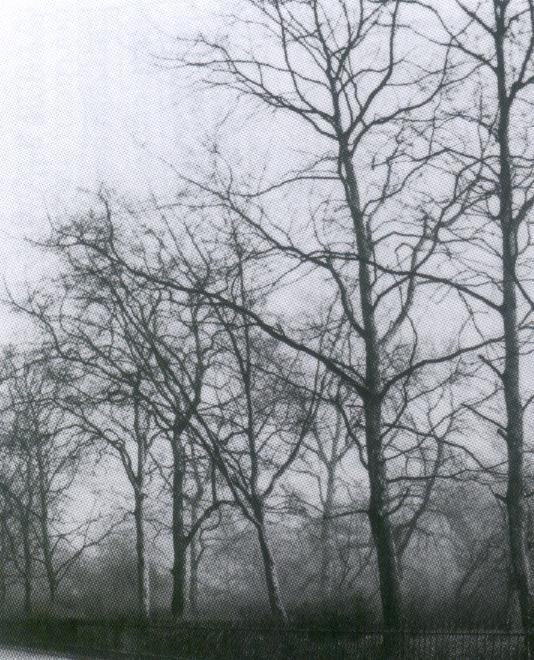
|
| A photograph of trees close to Charlotte Mew's house in Gordon Street - taken shortly before they were felled |
|
- and he cried with a loud voice: Hurt not the earth, neither the sea, nor
the trees - -Revelation
They are cutting down the great plane-trees at the end of the gardens.
|
|
Sweetheart, for such a day
Good-night and good dreams to you,-
So you and I should have slept, -But now,
|
| dialect |
|
Up to the bed by the window, where I be lyin',
Turning around like a falled-over sack
Heavenly Master, I wud like to wake to they same green places
|
| Intensity |
The Wheat (Extracts)
'Don't let them cut the Wheat', he had said, sitting up in bed and falling back on it, his face towards the window opening on to the row of windows opposite, in the brickwork of the London street. All through his illness there had been no delirium so that this touch of it at the end seemed strange to them. 'Up to that moment he was quite himself and they were so unlike him', Amy said to her Mother repeating his words about the cutting of the wheat.
No one had known, and half the time he had hardly known himself, but lying
there, taking medicines and being read to, he saw how, on and off, it had
been with him ever since he was a boy, that Something behind him which he
hadn't got at and that other sense of not being altogether Here.
...
It was a month or so before his illness that it occurred to him he must have spent his life in sleep, because all at once, things were beginning to stand out for him in a new sort of daylight, so near that however far off they were he seemed almost able to touch them, and so clearly that he might have been looking at them through a pair of field-glasses.
And then one afternoon he discovered that there were only three things on this earth: from the Bank steps, even from the house steps he found them in nearly everything except in his street and over there, on the counter, in the notes and gold.
Everywhere else - and they were in remembered things, the bronze of the seaweed against the grey of the quay-wall; the sweep of a man's hand broadcasting along the furrow: the throb in the breasts of things that ought to be flying but could hardly hold their heads up in the boxes of the bird-shops.
A little while ago he had thought there were a hundred things but now he knew there were just these three which he was beginning to get hold of, and the place where they seemed to him most to be, all together, was in the fields. In the grass, the greenness, the wave of it in the wind, and the life in every blade.
And then he was struck down.
For weeks these women had rustled about the room, pouring stuff down his throat and talking about him in whispers behind a screen; and an Angel of God could not have got them out; but what chiefly worried him was being there shut in.
He broke free, in a way, by thinking of walks in bygone holidays - before his marriage...
... when the Nurse came in to tell him how nicely he was getting on he laughed and took no notice of any one of them again.
He simply turned round and lay still and got over a stile into the fields and went on and on.
Sometimes it was spring there and twilight was over them; he liked that best; but this morning it was the August sunshine and they were August fields.
Fields - fields, quite endless, mile after mile of gold; they were the real gold - the wheat, stirring gently, with just above it the green, the line of the hedge and higher up, over it all the blue.
They were there, all three, the only things: the gold, the stir and the folded ear; they were in the wheat and his hand was passing over it and it was passing something into his hand.
All that there was or ever would be - he wanted to have it, to keep it: he was afraid of losing it: that was terror. It made him start up, it made him cry out almost as if he had seen them doing it - he didn't want them to cut down the wheat.
| - |
|
You would have scoffed if we had told you yesterday
But what of His who like a Father pitieth?
|
| First published March 1923 - Sensual |
|
Lord when I look at lovely things which pass,
|
| First published 24.1.1925 - |
|
My face is against the grass - the moorland grass is wet -
This is the end of all the roads -
|
| First published 1929 - |
|
(From an unfinished Elegy) Oh! Death what have you to say?
"Like a bride - like a bride-groom they ride away
|
| First published 1926 - |
|
His dust looks up to the changing sky
But looking up from that other bed,
|
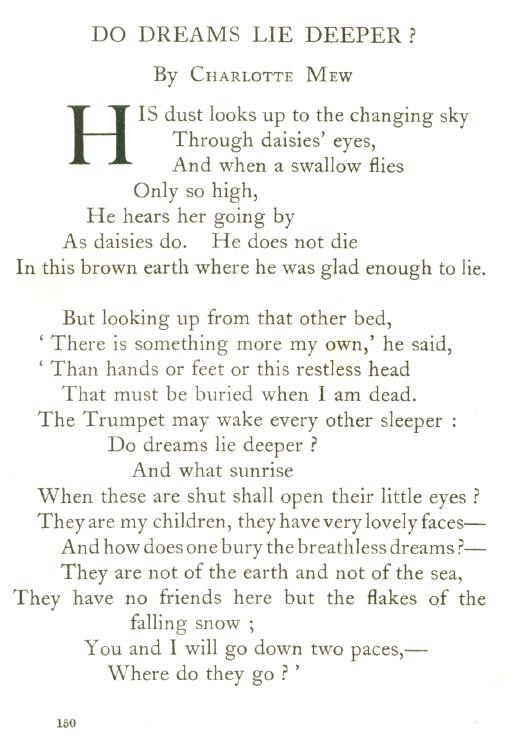
| Do Dreams Lie Deeper? scanned from its original publication in Atalanta's Garland |
| First published 1929 - |
|
My heart is lame with running after yours so fast
Home down the quiet evening roads under the quiet skies,
But not to-morrow. This has taken all my breath;
|
Poems and extracts on this website are reproduced with the approval of the
publishers
Carcanet
Index
An Old Servant
Miss Bolt
The Country
Sunday
The London Sunday
Madeleine in Church
The Hay Market
Passed
An Open
Door
A Country Book
In the Curé's Garden
Song
1902
Mademoiselle
Men and Trees (February/March 1913)
from letters to Mrs Ethel Inglis
The Wheat
In the Fields
www.carcanet.co.uk
Click for links to all Carcanet selections from
Charlotte Mew
Complete poems and selected prose with Val Warner's introduction
Poems selected by Eavan Boland
extracts
extracts
extracts
extracts
extracts
extracts
extracts
(Extracts)
extracts
extracts
(Extracts)
extracts
Some questions about Charlotte Mew's poems at the
University of Iowa