Mental Health History Timeline
|
 lunacy
|


|
Katherine Darton's
Notes of the
history of
mental health care
(archive)
(on the Mind website) begins in
10,000 BC. She says "in
prehistoric times
there was, as far as historians can tell, no division between
medicine,
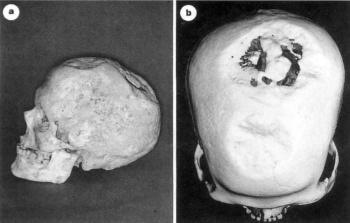
magic and religion." She refers to Stone Age evidence of
trepanning, "study of
cave drawings" of "mesolithic people" and
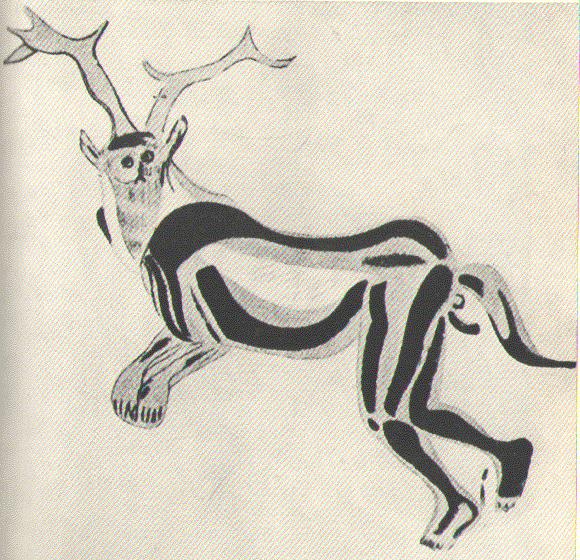
"A cave painting in Ariege, France" that "shows a strange being with human
feet and hands and antlers who has been identified as a 'psychiatrist
(witch doctor)', but it is not clear how this identification has been made.
History of the Conceptualizations of Mental Illness (archive) by Jessie in Japan (archive) begins in "prehistoric times" when "mental disorders" were thought of as "supernatural phenomena". They were disorders of the mind representing "a breakdown of the magical-religious system" due to taboos being violated or rituals neglected, or to "demonic possession".
History of Mental Illness (no longer available) at the University of Derby begins some 10,000 years ago with trepanning - possibly to let evil spirits out, but this was before written records.
|
about 5000BC The scull of a 50-year-old man buried at Ensisheim in France "had two holes" " clearly the result of surgery, not violence". Other sculls with holes thought to indicate surgery include Gadevang Man |
A history of Mental Health (archive), by an unknown nursing student (1992), begins in "primitive times" when people blieved that "mental illness was created by evil spirits entering and taking over the body".
|
The Disability Social History Project's
Disability Social History Timeline
begins
with an account of the
fitting of an
artificial limb from the
Rig-Veda (sacred poem of India) which it says was "written in
Sanskrit
between
3500BC and
1800BC.
1700BC
to
1100BC
are more conventional dates for the Rig-Veda's oral composition and
transmission to writing.
15 When in the time of night, in Khela's battle, a leg was severed like a
wild bird's pinion,
The disability timeline then
jumps to 355 BC
|
Menes of Egypt: The Society of Laingian Studies' Timeline in the treatment of Madness begins in 3,100BC when "Menes, the founder of the 1st Dynasty writes The Secret Book of the Heart, describing 3 kinds of healers, the physician, the priest and the sorcerer".
Moses: Leviticus 21 prohibits anyone who has a blemish from priestly service making offerings. He could, however, eat the bread. This included "a blind man, or a lame, or he that hath a flat nose, or any thing superfluous, Or a man that is brokenfooted, or brokenhanded, Or crookbackt, or a dwarf, or that hath a blemish in his eye, or be scurvy, or scabbed, or hath his stones broken."
David:
Ed Brown's annotated cases at Brown Medical
School -
archives
begins with the
feigned madness of David who became king of the Jews
(9th century BC)
Nebuchadnezzar or Nabonidus (whichever), king of Babylon,
in the
6th century BC,
is the
earliest in
Joan's mad monarchs series
(archive)
Indian medicine S N Kothare and Sanjay A Pai's chapter on Evolution of Psychology and Psychiatry discusses Ayurveda medicine which derives from the compendiums of Sushruta Samhita and Charaka [External links to Wikipedia], which date back to about the 6th century BC
480 to 60BC Gadevang Man - bog body. Denmark. The skull shows signs
of surgical trepanning.
Larry Merkel's
History of Psychiatry
begins with a discussion of pre-classical
(Egyptian,
Middle-Eastern, Judaic) influences on classical Greek and
Roman theory and
practice.
Drama Therapy and Psychodrama
History begins
with plays of Sophocles in 404BC
Socrates (in
Plato's The Republic)
recommends that
"the offspring of the inferior, or of the better when they
chance to be
deformed, will be put away in some mysterious, unknown place,
as they
should be"
355BC
Aristotle
said those "born deaf become senseless and incapable of
reason."
(Disability Timeline)
Galen, Greek physician
AD 129 Galen born in Pergamum, in what is now Turkey.
He died about
AD 216. His massive writings on medicine included the
theory of the
humours or body fluids (like blood) whose preponderance had a
marked affect
on a person's health and personality. (See
melancholy -
emotion).
External link:
Hospitals in Islamic History by Dr Hossam
Arafa
"The first known hospital in Islam was built in
Damascus in
706AD". Social Science
History.
See also origin of word hospital.
Bagdhad Hospital after 750.
Al-Fustat Hospital, Cairo, 872.
From the late 11th
century, Hunain ibn Ishaq's Arabic translations
of Galen,
commentaries by Arab physicians, and sometimes the original
Greek, were
translated into Latin. These became the basis of medical
education in the
European universities that started in the late
12th
century
1188
King Henry 2nd bought land next to Newgate (the gate looking
west from the
City of London towards Westminster) for a
prison.
Newgate prison occupied
this site until 1881. The Old Bailey (Central Criminal Court)
now stands
there.
1201 St Nicholas Hospital in Carlisle claims to have
been treating
lepers in 1201 - to have passed to the City as a (general)
hospital in 1477
- Some local historians link this forward to the opening of a
fever
hospital in 1809 and the Cumberland Infirmary in 1828.
Frank Walsh in Union journal
1970
Michael Warren's
health in Britain chronology
begins in 1066
|
Bethlem before:
See English Heritage Warren R. Street says: 23.10.1247 The priory of St Mary of Bethlehem, later to become Bethlehem Hospital, was founded on land donated by Simon FitzMary at Bishopsgate Without, London. This original site is now located under the the Liverpool Street railway station. Bethlehem Hospital, or "Bedlam," later became notorious for its neglectful care of people with mental illness. The priory was first used to house "distracted persons" in around the year 1377. [See 1300 - 1346
The priory of St Mary of Bethlem was founded in 1247 as a priory in Bishopsgate Street, for the order of St. Mary of Bethlehem, by Simon Fitz Mary, an Alderman and Sheriff of London. The Catholic Encyclopedia says it was a hospital (place of refuge) from the begining 'originally intended for the poor suffering from any ailment and for such as might have no other lodging, hence its name, Bethlehem, in Hebrew, the "house of bread."'
The web appendix to Noteworthy events in American
Psychology
begins with the founding of St Mary of Bethlem on 12.10.1247.
(Not, of
course, in America, and not receiving distracted persons until
1377). See also
1478 (inquistion) -
1586 (Bright) -
Noteworth events
reaches America in
1650
|
1284
Al-
Mansuri Hospital, Cairo opened. At some time,
this had music
therapy for its mental patients.
Dave Sheppard's
Development of Mental Health Law and
Practice
begins in 1285 with a case that linked "the
instigation of
the devil"
and
being "frantic
and
mad"
1290 (See 1324: 17 Edward 2 cap. 9)
De Praerogativa Regis, the Act giving the King (or, possibly, regulating and already established) custody of the lands of natural fools and wardship of the property of the insane, may have been drawn up between 1255 and 1290. This is part of feudal law relating to the idea that all land is by gift from the highest lord (in England, the King). Until the English civil war and interregnum, all land reverted to the king on the chief tenant's death, to be reclaimed by any lawful heir on payment of a fee. The King's Officers, throughout the country, who regulated these affairs were called "Escheators" (See external link). The Escheators also held the inquisitions to determine if a land holder was a lunatic or idiot.
1292
"A lunatic who had burned a man's house was convicted by
the justices but released on their authority."
| Argued that before 1400 Bethlem was a religious institution focusing primarily on collecting and distributing alms. By the fourteenth century (1300) "the main beneficiaries, apart from the Hospital and its staff, were probably poor people who lived locally, rather than the Order of Bethlehem. As the social and political changes of the mid-fourteenth century onwards made alms-collecting more difficult, the Hospital started to concentrate ever more on the care of the sick, and in particular on the care of the mad. Typically, this happened at just the moment when other English hospitals were abandoning or cutting back this type of provision severely." ( Andrews etc 1997 (Kindle Locations 2563-2568). |
1310 Date given for a German madhouse at Elbing near Danzig. Ackernecht, E. H. 1959 (ch.3 p.21-22) mentions 14th century German mad houses at Elbing, Hamburg and Nurenberg.
1340 14th? year of
Edward 3rd's reign.
16.2.1312 at York: Pardon to Richard Sharpe of Malteby,
for the
death of Agnes his wife, as it appears by the record of John
de Insula and
the others justices of gaol delivery for York, that he was mad
when he
killed her. (Calendar of Patent Rolls
Reign of Edward
the
2nd p.431 5 Edward
II Part 2... Membrane 20 - From John Alan Longbottom)
|
Bethlem before:
Warren R. Street says: 15.10.1346 The impoverished priory and order of St Mary of Bethlehem, later to become Bethlehem Hospital ("Bedlam"), was taken under the patronage and protection of Richard Lacer, mayor of London, and the citizens of London. The act brought to an end a century of "disaster, poverty, and failure." [But see below 1377 (king) and 1546 (city) |
1347-1350 Black Death (Bubonic Plague) in Europe. "In England it reached a peak in July 1349".
1349 23rd year of Edward 3rd's reign
1371 Date given for royal licence to Robert Denton,
chaplain, to
use his own house in
Tower Street ward in the parish of Barking, near the Tower of
London, as a
hospital "for the poor priests
and for the men and women in the sad city who suddenly fall
into a frenzy
and lose their memory, who were to reside there until cured;
with an
oratory to the said hospital to the invocation of the Blessed
Virgin Mary".
See
Tuke, D.H. 1882 pages 53-55 (source
Stow, Survey
of London,
1603 "written in 1598") and
Catholic Encyclopedia - source
Sir William
Dugdale Monasticon Anglicanum, London, 1655-1673
Tuke also takes from Stowe a story of
a madhouse near Charing
Cross [later called the Stone House] which
"a king" took
objection to and had its lunatics removed to Bethlem - thus
starting that
hospital's connection with insanity. This house is of uncertain origin and
may have been much older than the one in
Tower Street ward.
| Margery Kempe, who was born in Lynn, Norfolk, about 1373 and lived to 1438, dictated a book of her spiritual experiences (1436) which shows how she went "out of her mind" after childbirth, was bound in a storeroom to prevent her from self-harm, suspected of demonic possession, but escaped burning, had visions of angels and visions of men's sexual parts and was seen as both holy and heretic. Through hearing holy sermons and books, she "ever increased in contemplation and holy meditation, but learnt through divine visits to her during and after "cursed thoughts" and "pain" that "every good thought is the speech of God". (See Peterson, D. 1982) [External link to Margery Kempe pages on the Luminarium web] |
21.6.1377 to 30.9.1399 Reign of Richard 2nd. Aged ten when he became king. "Richard was said to have been tall, good-looking and intelligent. Though probably not insane, as earlier historians used to believe, he may have suffered from what modern psychologists would call a "personality disorder"" (Wikipedia)
The religious priory of St Mary of Bethlem, in London, was confiscated by King Edward 3rd in 1375, and used for lunatics from 1377. (Jones 1972 p.12). The year 1377 is the year O'Donoghue calculated that lunatics were moved from the Stone House to Bethlem
In 1403/1404 it had just six insane patients and three who were sane. (Scull 1972 p.19). This old Bedlam was a small institution (on a site south of what is now Liverpool Street Station), even in the 17th century when it had about 30 patients. Its showy replacement, the Moorfields Bedlam, opened in 1676.
about 1393 Margery Kempe went "out of her mind"
Report of a Visitation which had enquired into the
deplorable state of
affairs at Bethlem Hospital (Michael Warren). There is a report of
a Royal
Commission, in 1405, as to the state of lunatics confined
there. (Catholic
Encyclopedia)
|
Spain
has been described as the cradle of humane psychiatry
because of the
treatment at asylums such as
Valencia,
Saragossa,
Seville,
Valladolid,
Palma Mallorca,
Toledo
(the Hospital de Innocents) and
Granada.
Valencia, opened
at the beginning of the century, is said to have removed
chains and used
games, occupation, entertainment, diet and hygiene as early as
1409
Warren R. Street says: 24.2.1409 The founding of the world's first mental hospital was inspired. On this day in Valencia, Spain, Father Juan Galiberto Jofré came upon a crowd harassing a "madman." Wealthy citizens, led by Lorenzo Salom, responded to a sermon calling for a hospital for the insane. The Hospital de Nuestra Doña Santa Maria de los Inocentes was founded later in the year and is still in operation. See Lopez Ibor 2006/2008 who reproduces (from an 1848 source) this part of the sermon: "In this city, there are many and very important pious and charitable initiatives. However, one very necessary one is lacking, that is, a hospital or house where the innocent and frenzied would be drawn together because many poor, innocent and frenzied people wander through this city. They suffer great hardships of hunger and cold and harm, because due to their innocence and rage, they do not know how to earn their living nor ask for the maintenance they need for their living. Therefore, they sleep in the streets and die from hunger and cold and many evil persons, who do not have God in their conscience hurt them and point to where they are sleeping, they injury and kill and abuse some innocent women. It also occurs that the frenzied poor hurt many of the persons who are out wandering through the city. These things are known in the entire city of Valencia. Thus, it would be a very holy thing and work for Valencia to build a hostel or hospital where such insane or innocent persons could be housed so that they would not be wandering through the city and could not hurt nor be hurt." |
1436 Margery Kempe dictated a book about her spiritual experiences.
1464: Examples of people being granted custody of an idiot and his or her property.
|
Warren R. Street says:
1.11.1478 Pope Sixtus 4th issued a papal bull extending
the power of
the Inquisition to Spain. The Inquisition, established in some countries in
the thirteenth century, was responsible for the torture and execution of
many people with mental illness. In Seville, inquisitors Miguel de Morcillo
and Juan de San Martin burned about 500 people in three years. In Aragon,
inquisitor Thomas de Torquemada was said to be especially ruthless in the
pursuit of deviance.
19.5.1487 Heinrich Kramer and Johann Sprenger's Malleus
Maleficarum
(The Witch Hammer), the Inquisition's guide to the diagnosis, behavior,
trial, and punishment of witches, was endorsed by the Faculty of Theology
at the University of Cologne. The Malleus went through 19 editions in the
next 2 centuries and provided a basis for gruesome tortures of people with
deviant behavior.
|
1494 Ship of Fools. Michel Foucault suggests that the publication of Brant's illustrated narrative poem marks a point in European culture where a dialogue between reason and unreason became central.
1495 Syphilis, possibly introduced from the new world, broke out amongst troops in Italy and rapidly spread across Europe, reaching England and Holland in 1496. It reached India in 1498. In 1500 there was an epidemic of syphilis across Europe and in 1505 it reached China. The connection between syphilis and general paralysis of the insane was not demonstrated until the 20th century.
| 1500- |
words
|
1518
1520
A small book by
Paracelsus,
written about 1520 and published 1567 was called (English
translation of
title) "Diseases which lead to a Loss of Reason". The
introduction makes it
clear that these are not caused by spirits, but are natural
diseases.
(Ackernecht 1968, pp 22-23)
1527
Granada
Birth of the City of London Bedlam
Until the 1530s, Bethlem stood in open ground
1536
First Act of the Dissolution of the Monasteries. Although the
religious
foundations were closed, any "hospital" (refuge for the
homeless poor)
attached might continue. (The hospital of St Bartholemews in
London, for
example, continued when the priory closed). Continued
existence would be
precarious, however, unless civic authorities sought to
preserve it.
The City of London unsuccessfully petitioned the King to give
them five hospitals plus their endowments. The hospitals
included
Bethlem, St
Bartholomew and
St Thomas. They were needed to house:
"The interpretation of strange words, used in the translation" from
Italian of Joannes
de Vigo The most excellent works of surgery by
Barthomew Traheron, included
crisis meaning a sudden change in a disease
27.12.1546 King Henry 8th signed a document giving
Bethlem
Hospital
and St Bartholomew to the City of London. The name "St
Bartholomew" being
changed to "the House of the Poor in West Smithfield" (although this name
was only used legally). On 13.1.1547
he signed a document giving their endowments (most of their medieval
property) to the City of London. (Medvei and Thornton The Royal Hospital
of Saint Bartholomew 1123-1973) 1974, p.24)
From 1557, Bethlem was managed by the governors of the
Bridewell House of
Correction (established 1550). The governors were chosen by
the City of
London. Bethlem was controlled by the City of London until it
was
transferred to the National Health Service in
1948
In 1518 King Henry 8th, on the advice of his court
physician, founded
the Royal College of Physicians (London) to control who
practised as a
physician in London and so protect the public from quacks.
"the miserable people lying in the street,
offending every
clean person passing by the way with their filth and nasty
savours" [savour
here means smell]
1539
Juan Ciudad Duarte
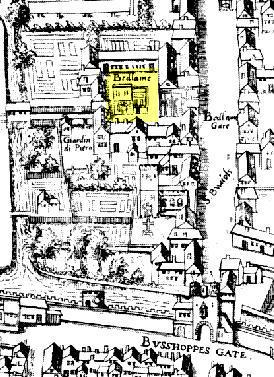
1569 Bethlehem churchyard created by enclosing about an acre of Bethlem's land by a wall. It was to be used for burying people for whom there was inadequate room in their own parish.
1562-1563 Thomas Colwell (London printer) licensed to print a play called Dyccon of Bedlam. This may be the same play as he published in 1575 as Gammer Gurton's Needle in which the wandering beggar "Dickon the Bedlam" appears.
 Hippolyto
|
Warren R. Street says:
23.5.1586 Timothie Bright, the physician of St Bartholomew's Hospital in London, wrote the forward to his book, the Treatise on Melancholy. Bright's book was the first book in the English language on the subject of mental illness. Some of the phrases Bright used in his descriptions of disordered behavior appeared later in the plays of William Shakespeare. |
1592 An account of a trial for conspiracy to kill the King, written by Richard Cosin, contains discussion and definitions of the terms applying to the various "degrees" of insanity. See furor, delirium and dementia
| The Elizabethan Poor Law |
|---|
|
1598
1598 Poor Law Act (39 Elizabeth chapter 3) Every parish was to appoint overseers of the poor to find work for the unemployed and set up parish-houses for poor people who could not support themselves. [See Blackstone on overseers] |
1601
1601 Poor Law Act (43 Elizabeth chapter 2) or Old Poor Law Act usually known as the Elizabethan Poor Law or Old Poor Law |
Mind's key dates in the history of mental health and community care
begins in 1601
|
John Stow, 'Bishopsgate warde', in A Survey of London. Reprinted From the
Text of 1603, ed. C L Kingsford (Oxford, 1908),
pp. 163-175
Next vnto the parrish church of S. Buttolph, is a fayre Inne for receipt of Trauellers: then an Hospitall of S. Mary of Bethelem, founded by Simon Fitz Mary one of the Sheriffes of London in the yeare 1246. He founded it to haue beene a Priorie of Cannons with brethren and sisters, and king Edward the thirde granted a protection, which I haue seene, for the brethren Miliciae beate Mariae de Bethlem, within the Citty of London, the 14. yeare of his raigne. It was an Hospitall for distracted people, Stephen Geninges Marchant Taylor gaue 40. li. toward purchase of the patronage by his Testament 1523. the Mayor and Communalty purchased the patronage therof with all the landes and tenementes thereunto belonging in the yeare 1546. the same yeare King Henry the eight gaue this Hospitall vnto the Cittie: the Church and Chappell whereof were taken downe in the raigne of Queene Elizabeth, and houses builded there, by the Gouernours of Christes Hospitall in London. In this place people that bee distraight in wits, are by the suite of their friendes receyued and kept as afore, but not without charges to their bringers in. In the yeare 1569. Sir Thomas Roe Marchant Taylor, Mayor, caused to bee enclosed with a Wall of bricke, about one acre of ground, being part of the said Hospitall of Bethelem, to wit on the banke of deepe ditch so called, parting the saide Hospitall of Bethelem from the More field: this he did for buriall, and ease of such parrishes in London, as wanted ground conuenient within their parrishes. The Lady his wife was there buried (by whose perswasion he inclosed it) but himselfe borne in London was buried in the parrish church of Hackney. From this hospitall Northwarde vpon the streetes side many houses haue beene builded with Alleys backward of late time too much pesterd with people (a great cause of infection) vp to the barres. Notes 164, l. 24. the ditch. On Agas's map the ditch appears clearly, and is shown to widen here to a point where a stream flows into it from the north. On Faithorne's map (prepared 1643-7) the ditch has completely disappeared. See further Archaeologia, lx. 197-200 with illustration. Recent excavations have proved the accuracy of Stow's statement as to the filling up of the ditch with soilage and other filthiness (id. lx. 202).
l. 37. purchased the patronage. From a document in Letter-book F, 154, it appears that on Oct. 15, 1346, the House and Order 'Fratrum milicie beate Marie de Bethlem' were taken under the protection and patronage of the Mayor, Aldermen, &c., of the City of London. See also Letter-books F, 163, and H, 338, where it is claimed in answer to a royal writ that the patronage and appointment of a keeper rested with the Mayor and citizens. In 1406 Henry IV again claimed the patronage and right of visitation (C. P. R. Henry IV, iii. 231). 165, l. 10. banke of deepe ditch. In the foundation charter of Bethlehem Hospital mention is made of the 'fossatum quod vocatur Depediche' (Mon. Angl. vi. 622). Recent excavations revealed a part of its course near Blomfield Street, and showed it as a deep, sluggish, stagnant stream. It was ten feet below the base of the original Walbrook, which was somewhat further west. It is the stream referred to in the last note but one. See Archaeologia, lx. 206-7 with plan. |
9.11.1604 The Honest Whore, Part 1 was entered into the Stationers' Register. The author on the cover printed later that year is Thomas Dekker. Thomas Middleton collaborated. Part 2 (Dekker only) was entered into the Stationers' Register on 29.4.1608, but not published (printed) until 1630. The plays are set in Milan, Italy. The final scene of Part One takes place in "Bethlehem Monastery" where marriages are conducted and mad people kept. (External link to text and notes). Part two concluded with "comical passages of an Italian Bridewell"
1611 Authorised (King James) version of the Bible. The bible was a major source for ideas about virtually everything in the 17th century, and later. In her Notes of the history of mental health care (on the Mind website), Katherine Darton outlines some of its influences in her consideration of the Jewish tradition. (Scroll down from 2,000BC). (archive)
about 1603 Macbeth "Canst thou not minister to a mind diseased, pluck from the memory a rooted sorrow, raze out the written troubles of the brain and with some sweet oblivious antidote cleanse the stuff'd bosom of that perilous stuff which weighs upon the heart?"
Giles Earle His Booke, a manuscript collection of lyrics in the British Museum, contains the first known written version of the English Folk lyrics "Tom o' Bedlam's Song" (see Bedlam weblinks)
|
First edition of Robert Burton's The Anatomy of
Melancholy.
What it is,
with all the kinds, causes, symptoms, prognostics and several
cures of
it... Philosophically, Medicinally, Historically opened and
cut up. By
Democritus Junior published in Oxford. The
1628 edition
had a ten
picture engraving that was explained by a poem in the
1632 edition. The
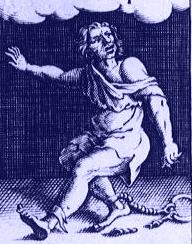
verse for the engraving of the maniac is:
But see the Madman rage downright With furious looks, a ghastly sight, Naked in chains bound doth he lie, And roars amain, he knows not why. Observe him; for as in a glass, Thine angry potraiture it was. His picture keep still in thy presence; 'Twixt him and the there's no difference. |
| Origins of la Pitie-Salpetriere and le Bicetre |

|
|---|
|
External link
Histoire de la Pitie-Salpetriere
1612 In place of an old tennis court, Marie de Médicis created a beggars' hospice: l'hospice Notre Dame de la Pitié 6.6.1636 Purchase of land under Louis 13th for the Petit Arsenal or Salpêtriere to make gunpowder. Closed after fifteen years, Louis 14th offered it to the duchesse d'Aiguillon to set up a hospice for beggars with the help of Vincent de Paul. A pdf file at http://www.ifrns.chups.jussieu.fr/ifrns.pdf contains The History of the Neurosciences at La Pitié and La Salpêtrié in French and English. 1633 to 1642 Building the Hôpital Bicêtre in Paris The Bicêtre was originally a military hospital. It was incorporated into the Hôpital Général in 1656 and used successively as an orphanage, a lunatic asylum and a hospital. external link |
October 1636 Commenting on the physics of Galileo, Thomas Hobbes wrote "the motion is only in the medium and light and colour are but the effects of that motion in the brain". Hobbes was to apply the idea of studying motion in matter to the study of light meeting the eye and ideas in the mind. In Leviathan he laid the foundations for assocationist theories of thought.
30.1.1649: English king beheaded
1650s Working with the
Bible, it was possible to
calculate that
something spectacular was likely to happen in the 1650s. For
example, it
could be calculated that the great flood that destroyed all
life not in the
Ark took place 1,656 years after the creation - So 1,656 years after the birth of Christ
could be
equally significant. (Usher's
chronology put the creation in 4004 and the flood
in 2349. 4004-
2349 = 1655). The
execution of a King was woven into
speculation that
Christ could be due to return to establish his kingdom.
9.8.1650 An
"Act against several atheistical, blasphemous and
execrable opinions derogatory to the honour of God, and destructive to
human society" made said that people "not distempered with
sickness, or
distracted in brain" professing certain beliefs were to be "committed to
Prison or to the House of Correction, for the space of six months, without
Bail or Mainprize, and until he or she shall have put in sufficient
Sureties to be of good behaviour for the space of one whole year." The
execrable opinions started with anyone maintaining "him or her self, or any
other mere creature, to be
very God, or to be infinite or almighty, or in honor, excellency, majesty
and power to be equal, and the same with the true God, or that the true
God, or the eternal majesty dwells in the creature and no where else; or
whosoever shall deny the holiness and righteousness of God, or shall
presume as aforesaid to profess, that unrighteousness in persons, or the
acts of uncleanness, profane swearing, drunkenness, and the like filthiness
and brutishness, are not unholy and forbidden in the Word of God, or that
these acts in any person, or the persons [so] committing them, are approved
of by God...".
George Fox was imprisoned under this Act on 18.10.1650.
October 1650
Rapturous quakers
Winter 1651 George Fox's
vision of blood in the streets of Lichfield
Petition respecting John Pateson at Ormskirk Quarter Sessions,
who had
fallen into a sullen, sad, melancholie and would not go
indoors or eat or
wash himself. [Described
in more detail]. The churchwardens and overseers
were ordered to
make an assessment and provide out of
poor rates for
his care
until
he recovered or died.
|
compare
America
|
Meric Causaubon's Treatise concerning enthusiasme, as it is an effect of nature, but is mistaken for either divine inspiration or diabolical possession.
1656
Alleged internment of
Rev. Mr George Trosse
(Account not published until 1714)
Friday 24.10.1656 James Nayler
(Quaker)
entered Bristol accompanied by a small group of followers. They led him on
a horse singing 'Hosanna' and 'Holy, holy, holy, Lord God of Israel'.
(see enthusiasm). The following purports to be a
copy of his examination before a Bristol magistrate:
Nayler: "I did ride into a town : but what it's name was, I know not ; and
by the Spirit a woman was commanded to hold my horse's bridle ; and some
there were that cast down clothes and sang praises to the Lord, such songs
as the Lord put into their hearts ; and it's like, it might be the song of
holy, holy, holy ..." Magistrate: "Whether or no didst thou reprove those
women?" nayler: Nay ; but I bad them take heed, that they sang nothing but
what they were moved to of the Lord". Magistrate: "Dost thou own this
letter, which Hannah Stranger sent unto thee?" Nayler: "Yea I do own that
letter." Magistrate: "Art thou, according to that letter the fairest of ten
thousand?" Nayler: "As to the visible, I deny any such attribute to be due
unto me ; but if as to that which the Father has begotten in me, I shall
own it". Magistrate: "Have any called thee by the name of
Jesus?" Nayler: "Not as unto the visible, but as Jesus, the Christ, that
is in me". Magistrate: "Whether art thou more sent than others?" Nayler "As
to that I have nothing at present given me of my Father to answer".
Magistrate: "Art thou the everlasting Son of God?" Nayler: "Where God is
manifest in the flesh, there is the everlasting Son, and I do witness God
in the flesh. I am the Son of God, and the Son of God is but one".
Magistrate: "Art thou the Prince of peace?" Nayler: "The Prince of
everlasting peace is begotten in me". Magistrate: "Art thou the
everlasting Son of God, the King of righteousness?" Nayler: "I am, and the
everlasting righteousness is wrought in me : if ye were acquainted with
the Father, ye would also be acquainted with me". Magistrate: Did any kiss
thy feet?" Nayler: "It might be they did ; but I minded them not."
[Original source: The sad and lamentable cry of oppression and cruelty
in the city of Bristol : Relating to the prosecution of certain dissenting-
Protestants in some passages most notorious to the grieved inhabitants of
the said city. London : Printed for John Alexander. 1682. Quoted by
Samuel Sayer
Nayler was in prison until 1659. Conflict between Quakers
over performances like this was a stimulous to the creation of
a collective
discipline that,
over a century
later,
made
them the pioneers in the control of insanity.
The 5th Monarchy Men believed that 1656 could be the year
when Christ
would return to earth. The year after, and again in
1661, the 5th Monarchy Men
undertook an armed
uprising to bring about his kingdom.
|
|
Opening of Hôpital Général, Paris: hospital, poorhouse and factory |
|---|
| The hospital (as it was spelt in the 17th century) was the putting together of a number of buildings for the relief of the poor. These included La Salpétrière (for women) and Le Bicêtre, which later became the Paris asylums for the insane. | |
|
meaning of
hospital
Foucault: The Great Confinement |
external link (scroll down for
English
translation
external link |
1657
|
Bethlem:
Warren R. Street says: 21.4.1657 English diarist John Evelyn recorded the details of his visit to Bethlehem Hospital in London. He saw "several poor miserable creatures in chains; one of them was mad with making verses."
See 1678
|
1660: Restoration of English
Monarchy In 1661, the
Royal prerogative over idiots and lunatics
moved from the Court of King's Wards to the Lord
Chancellor.
Charles 2nd's Lord Chancellor was Edward Hyde, Earl of
Clarendon.
The papers of the
Clerk of the Custodies of Lunatics and Idiots
went back to the days of Lord Clarendon. (J. Lowry Whittle,
Registrar
of Lunatcs in
1882 - who inherited the papers)
From
November 1660
(arrested) to 1672, John Bunyan, a
Baptist
preacher,
was imprisoned
almost continuously in Bedford Gaol for preaching outside the
established
church. In prison he wrote Pilgrims Progress and his
religious
autobiography
Grace Abounding to the Chief of Sinners.
Grace Abounding
described religious
experiences
that sound like diseases mad doctors were soon to
identify.
1.1.1661 to 4.1.1661 Venner's Rising. This began with
about fifty believers in the imminent return of Christ (the fifth monarch)
occupying St Paul's Cathedral. The
5th Monarchy rising was suppressed and
Veneer and the
other leaders executed on 19.1.1661. A hundred 5th Monarchy
Men and some
4000
Quakers were imprisoned. "The first
official declaration of absolute
pacifism
was made by the Quakers in 1661, after a number had been
arrested after
Venner's unsuccessful rising". (Hill 1972, p.241) [Presented to the King on
21.1.1661]
11.5.1662 Arrests following the
Quaker Act - 19.5.1662
Act of Uniformity.
Sunday 7.7.1661 or possibly Sunday 7.9.1662 Quaker
women
demonstrate
with blood in
(old) St Paul's Cathedral a few days after
a Quaker man had run
naked through Smithfield market with burning coals of fire on his head.
May 1665: First case (St Giles, Cripplegate) of the
London Plague.
By the end of July, more than 1,000 Londoners were dying each week. During
August it reached many provincial towns. In London, it got worse in
September, but then lessened as the weather became cooler. London returned
to some degree of normality during the winter. Many provincial towns were
badly stricken in 1666. [external link -
archive]
[Solomon Eccles may, or may not, have run naked as a sign during
the plague]
Sunday 2.9.1666 for five days: Great Fire of London.
After the Great Fire, Robert Hooke was appointed city
surveyor and
designed the new
Bethlem
(Bethlehem Hospital) in Moorfields. This opened in
1676. It was replaced by the
St George's Fields
Bethlem in
1815. The Moorfield's Bethlem had 130 patients in 1704.
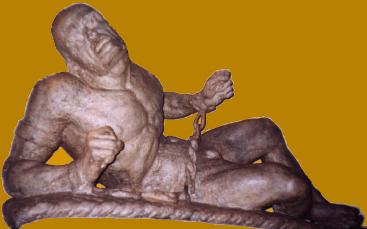
|
| At the door of the new Bedlam the visitor was confronted with sculptures commissioned from the Dutch artist Caius Gabriel Cibber (1630-1700). One (above) of mania or raving madness, the other of melancholy. Those who pass a theatre or a strip-joint today are tempted in by photographs of the performance. This drama had a hundred year run and its actors were involuntary exhibits. |
The new Bethlem was a place for display, set in gardens and modelled on the Tuileries, the palace of the French King. This is the Bethlem where the lunatics were displayed to visitors for a fee (until 1770). Londoner's on holiday could visit the zoo animals at the Tower of London and then stroll up to Moorfields to see the humans.
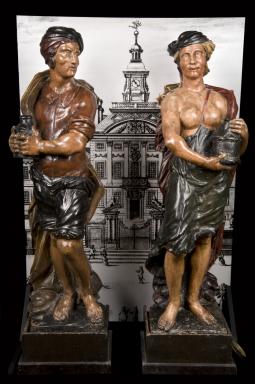
|
Thomas Tryon complained in
1695 about
the public being admitted on holy-days:
"It is a very undecent, inhuman thing to make... a show... by exposing them, and naked too perhaps of either sexes, to the idle curiosity of every vain boy, petulant wench, or drunken companion, going along from one apartment to the other, and crying out; this woman is in for love, that man for jealousy. He has over-studied himself, and the like." The life sized collection boxes, one male (clothed) and one female (topless) used are now on display in the Science Museum. |
|
|
France saw the last plague epidemic in 1668, until it reappeared in 1720. Foucault precedes his discussion of the Panopticon with a description of measures to be taken at the end of the seventeenth century "when the plague appeared in a town". These specific orders were for Vincennes. |
|
1669 In Salem, a Quakeress known for
signing with her nakedness,
is found to have a distempered mind |

|
1670
In England the earliest records of private madhouses on a
regular basis
are from 1670 onwards. [See Clerkenwell, below -
Hoxton House (1695) -
Irish's (1700)].
From the beginning, madhouses were
automatically
subject to the
common
law
of England. One could apply to the
courts for
redress against wrongful imprisonment in a madhouse as
anywhere else. When
inspection of madhouses was introduced
(in 1774), it
was mainly
to
assist
the courts.
|
Bethlem:
Warren R. Street says: 18.4.1678 Evelyn visited "new Bedlam hospital, magnificently built, and most sweetly placed in Moorfields since the dreadful fire in London." The public was allowed to tour Bethlehem hospital as a means of education and entertainment. |
1679
In his
An Essay Concerning
Understanding,
John Locke said there is a
degree of
madness in
almost everyone. This is because emotions force us
to persist in
falsely or
unreasonably associating some ideas. Madness is the inability
to let reason
sort out ideas by relating them correctly to our experiences.
Locke's ideas set a pattern for 18th century English views of
reason and
unreason. Madness was seen as a persistent inability to
associate ideas
correctly.
1692
6.3.1682 John Moore, Bishop of Norwich, preaches before the
Queen a sermon
afterwards published as
Of Religious Melancholy
1695
Hoxton House became a private madhouse
1696
Bristol Poor Act established a Board of Guardians who
used a
building near St Peter's Church, Bristol as a workhouse for
100 boys.
The addition of "infants, the aged, infirm, and lunatics" (by
1700?)
changed its character and it became
St
Peter's Hospital. In the 18th century this had
lunatic wards. In
the 19th century (1832?) it became a lunatic asylum.
English asylums in the eighteenth century were small and they
were not run
by the state. The best known and the largest was Bedlam or Bethlem in the
city of
London. This had 130 patients in 1704. There was a growing
number of
private
madhouses -
Probably
about 40 in 1800. After 1774
private madhouses had to have a licence and it is from the
surviving
licence records that we can estimate how many there were.
Charitable
asylums were opened in the eighteenth century in eight English
towns:
Norwich (1713),
London (1751),
Manchester
(1766),
Newcastle
(1767),
York (1777),
Liverpool
(1792),
Leicester (1794)
and
Hereford (1797).
The ninth
opened in Exeter
in 1801.
Eighteenth Century
Psychiatry
Ackernecht (1968, p.) argues
that psychiatry
"reached the status of an independent science" in the
eighteenth century.
But not due to "developments in medicine but to the philosophy
of
enlightenment which pervaded the whole century".
Reasons were:
Belief in
"possession by evil spirits" came to be regarded as
"superstition".
Reason was the highest good for
the
philosophers, so they sympathised especially with
those who lost
their reason. He argues that:
1700
David Irish
in his madhouse
near Guildford, Surrey, claimed to cure by
good food and
comfort, and would care for those who were not curable for
life, if paid
Quarterly:
"Since the concept of
the immortal soul was of no importance in this philosophical
system, mental
disorders could be viewed as disorders of the mortal brain or
thinking
apparatus and as such could now at last be studied on a
scientific basis.
At the same time it became possible to give up a purely
somatic viewpoint
and to introduce
psychology deliberately into psychiatry.
Cartesian philosophy, no doubt, played a part in
this
development."
"allowing them good fires, meat, and drink, with good
attendance, and all
necessaries far beyond what is allowed at Bedlam, or
any other place
that he has yet heard of and cheaper, for he allows the
melancholy,
mad, and such whose consciences are oppressed with a
sense of sin,
good meat every day for dinner, and also wholesome diet for
breakfast and
supper, and good table-beer enough at any time."
Irish, D.
1700
pp 53-4, quoted
Hunter and Macalpine 1963 p.279)
| Norwich Bethel opened. The first known charitable madhouse in England (apart from the special case of Bethlem). It is also has the longest history in one place. Norwich was then England's second largest city. The Bethlem was established by an individual private bequest. It had 28 patients in 1753. The Norwich Incorporation of the Poor had been established by Act of Parliament in 1712. |
1714
The
1714 Vagrancy Act is
thought to
have
been the first English statute to provide specifically for the
detention of
lunatics, but Blackstone
argues that it was based
on common law. [See also my introduction to Mental Health and Civil
Liberties and
Valerie Argent's discussion of the law on confinement]
| Lunatic Wards to Guys Hospital opened |
1724
Trial of Edward Arnold for the murder of Lord Onslow established the
wild beast
test
1725
Richard Blackmore's
Treatise of the Spleen and
Vapours
1728
James
Monro
was resident physician at
Bethlem
Hospital
from 1728 to
1752
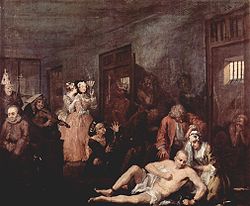
|
Publication of the prints of
1. Sudden wealth - 2. French manners - 3. a brothel - 4. escapes arrest - 5. marries for money - 6. gambles - 7. a debtors' prison - 8. Bedlam |
Wednesday 31.5.1738: Alexander Cruden escaped from Wright's madhouse, Bethnal Green, and successfully applied to the Lord Mayor to prevent his recapture. He published an account in 1739 (The London-Citizen Exceedingly Injured) "as plainly showing the absolute necessity of regulating Private Madhouses in a more effectual manner than at present"
May 1738 Conversion of Charles and John Wesley. See Evangelical Revival - Methodist Hymns - Enthusiasm
Wednesday, 17.9.1740 John Wesley's journal entry about Peter Shaw.
13.12.1740 [Date taken from Susanna Wesley : The Complete Writings, 1997, edited by Charles Wallace]. Susannah Wesley wrote to her son John (founder of the Methodists) about a man with "more need of a spiritual, than bodily physician" who was sent to a Chelsea madhouse by "that wretched fellow Monroe", the physician to Bedlam. [The letter is reproduced in Hunter and Macalpine 1963 p.423 with the incorrect date 13.12.1746. G.E. Harrison in "Son to Susanna" (p.119) says Susannah Wesley was buried in Bunhill Fields on 1.8.1742.]
1744
Construction of
naval hospitals at Gosport (Haslar), Plymouth and
Chatham
authorised. [Plymouth was built 1758-1762, Chatham, not until 1827-1828]
The
Haslar hospital was built between 1745 and
1761.
"The hospital catered for a full range of illnesses and
included wards for medical, surgical,
fever,
flux,
smallpox, consumptive,
scorbutic and recovery as well as lunatics. In the late 19th and early 20th
centuries, Haslar was one of the most important naval hospitals in the
country. It became the
main lunatic asylum for the navy as well as providing for
infectious diseases between 1898-1902"
(PAPHE external link) - The navy placed
lunatic patients in
Hoxton House, at least
until 1818, but also had insane patients
at Haslar
8.8.1746 George 2nd granted a Royal Charter to St
Patrick's
Hospital,
Dublin, Ireland, founded from the legacy of
Jonathan
Swift. Swift
had been
found of unsound mind by a Commission of Lunacy in 1742.
"St Patrick's was built by architect George Semple following Dean Swift's detailed and painstaking instructions. It is now the oldest, purpose built psychiatric hospital continuously functioning on its original site in these islands and one of the oldest in the world." (external link) |
1747
11.6.1747 Preface to Primitive Physic: Or, An Easy and Natural
Method of Curing Most Diseases by
John Wesley
1749
David
Hartley's
Observations on Man, his Frame, his Duty, and his
expectations linked the
association of
ideas
theory of human mind to the nervous system. Sensations set up
vibrations
in our nerves which move rather like sound waves through air.
Thought is
the association of these vibrations (ideas) when they meet.
Hartley's
theory, although rarely accepted without critical
modification, was
influential in philosophy, in the scientific study of mind,
and in
medicine. Some connection of thought to the body was necessary
(at this
time) for it to be
considered a medical issue, and considering the nerves as
conductors along
which thought waves run provided a possible connection of mind
and body.
At the turn of the
nineteenth/twentieth
century,
theories such as those of
Sigmund
Freud
provided a means for medicine to include psychological
"functional"
disorders as well as "organic" ones.
1750
The Gentleman's Magazine reported that a Dr Newton
"keeper and
physician to
a private
madhouse, near
Islington turnpike" had died. About this time,
William Battie
acquired premises in Islington Road for private patients and
in 1754 took
over Newton's madhouse in Wood's Close.
(Hunter, R.A. and Macalpine, I.
1963 pp 200-201 and 402-403). (See below and
1776)
| Saint Luke's Hospital for Lunatics opened in Upper Moorfields, opposite [??] (see sketch map) Bethlem Hospital on the north side of what is today Finsbury Square. William Battie was its physician to 1764. He also acquired premises for private patients. Saint Luke's had 57 patients in 1753. It moved to Old Street in 1786 |
1752
John Monro was
physician at
Bethlem
Hospital from 1752. He also opened a private asylum
at
Brooke
House
Hackney in 1759 and took over the house at Clerkenwell
in
1776
1753
Saturday 20.1.1753
John Wesley wrote in his journal that he had "advised one who
had been troubled many years with a stubborn paralytic disorder to try a
new remedy. Accordingly, she was electrified and found immediate help."
Electricity had cured two people of inveterate pain in the stomach and
another of a pain in his side he had had since a child. Wesley wondered
about doctors and apothecaries decrying such cheap and easy medicines "as
they do quick-silver and tar-water".
Sometime in the mid 1750s: a magistrate secured the release of
Mrs Gold's
daughter
from Hoxton House (madhouse), where she had been confined by
her husband.
1754
In December 1754, The Royal College of Physicians
declined a
suggestion
that they should be an authority for regulating madhouses in
London.
1755
"Pourquoi l'homme seul est-il sujet
à
devenir imbécile?"
Rousseau
asked in his
discourse on the origin of inequality.
Cole translates
imbécile
as
dotard:
"Why is man alone liable to grow into a
dotard? Is it not that he returns to his primitive state; and
that, while
the brute, which has acquired nothing and has therefore
nothing to lose,
still retains the force of instinct, man, who loses, by age or
accident,
all that his perfectibility had enabled him to gain,
falls by this
means lower than the brutes themselves?"
[See
degeneration theory]
| Madhouses for the Rich: When the very rich were lunatic or idiot, their relatives could afford to confine them as single lunatics - as the British Royal Family did in 1788, 1801, 1811 and 1916. One motive for this was secrecy. Madhouses for two or more inmates were more vulnerable to the risk of exposure, because more people were involved, and because the registration of inmates was required from 1774, but they might provide more humane custody at a lower price. Physicians and others who arranged single confinement, would also refer people to private madhouses, in which they would have some financial stake. Some of these catered especially for the rich. Irish's in Guildford, already advertised good conditions in 1700 . (We can trace a continuous line from Irish to Stilwell's in Hayes in the mid-19th century). Whitmore became a madhouse in 1757. Thomas Warburton's association with Willis, building up its aristocratic clientele, probably dates from the 1790s, before the second episode of the King's madness. Rev Willis became Dr Willis in 1759 - which gives some indication of the start of his business. John Monro opened Brooke House in 1759. Ticehurst may have opened in 1763, Cleve Hill (later Brislington) in 1794. Sidney House (later Manor House) admitted its first patient on 1.8.1829. An article by Harriet Martineau in 1834 argued that rich lunatics would be better cared for in asylums than singly. The case for the "domestic" (single) treatment of some patients was argued by Dr Edward James Seymour (1831/1832). Those who managed asylums for the rich usually also provided single houses as an option. |
1760
John Wesley's The Desideratum, or Electricity made Plain and
Useful by a
Lover of Mankind and of Common Sense was based on his use of
electricity in free medical clinics he established for the poor in Bristol
and London a decade earlier.
(source). Wesley lists disorders cured by
electricity and says "a great part of these are of the nervous kind; and
perhaps there is no nervous distemper whatever, which would not yield to a
steady use of this remedy".
1761
1762
5.9.1762 to 4.10.1762:
Mrs
Hawley
confined in
a Chelsea madhouse. Her release was secured by a
writ of habeas
corpus.
begins
by discussing attitudes before and
after
the industrial revolution
| The 1774 Madhouse Act was based on the recommendation of the 1763 Select Committee of the House of Commons on Madhouses that |

|
"the present state of the private madhouses in this kingdom, requires the interposition of the legislature."
A large part of their report was an examination of the issues raised by the (eventually successful) attempts of a Mr La Fortune to secure the release of a Mrs Hawley (confined in a Chelsea madhouse 5.9.1762 to 4.10.1762) by writ of habeas corpus. They were specifically concerned with the extent to which madhouses were used to confine people who were not lunatics.
1764
William Battie retired as visiting physician to St Lukes,
becoming, in the
same year,
President of the Royal College of Physicians (for
just one
year).
1765
1765 to 1769
William
Blackstone's
Commentaries on the
Laws of
England
published by the Oxford University Press.
| Manchester Lunatic Asylum opened |
| Newcastle Lunatic Asylum opened as a Subscription Hospital for patients from Newcastle, Northumberland and Durham. It became a licensed house in which Newcastle Corporation maintained a financial interest. |
September 1767: English Prime Minister described as "a lunatic brandishing a crutch" by Junius, the anonymous author of letters to the Public Advertiser. William Pitt (the elder), Lord Chatham, was physically incapacitated by gout and, from about March 1767, was in a state of mental withdrawal described by Daniel Hack Tuke (p.106) as a "dismal and complete eclipse" for "upwards of a year" of his "mental powers". There was no morbid illusion of the fancy, but there was utter prostration of the intellect". [As the first Junius letter was published January 1769, and the last in January 1772, I assume the reference is to a letter that made public Chatham's state in September 1767.]
1771 John Wesley's Sermons on Several Occasions contains his sermon "The Nature of Enthusiasm" in which he says "if you aim at the religion of the heart, if you talk of 'righteousness, and peace, and joy in the Holy Ghost,' then it will not be long before people describe you as "beside yourself" and say "much religion hath made you mad". He argues, however, that madness and true religion are very different.
| 1772 Pageant: James Albert Ukawsaw Gronniosaw's life narrative |
|
|
The
1774 Madhouses Act
established a
commission of the Royal College of Physicians |
|
Each September, from 1774 to 1827, Royal
College of Physicians appointed five of its Fellows
commissioners for the year. They met in October to grant
licences. They
could not refuse or revoke a licence.
(see law)
At least once in the year they visited each madhouse,
making a minute
of its condition. Any keeper refusing admission forfeited his
licence.
(see law)
A Secretary to the Commissioners was to be sent a notice
of the
admission of
every lunatic who was not a pauper to any licensed house in
England and
Wales. He kept registers of these in which he also entered
commissioners'
visiting minutes and those sent to him by the clerks of the
county visitors
(County Clerks).
(see law)
The RCP President, in the name of the Treasurer was to
prosecute
anyone
(in the London
area)
who kept an unlicensed house, admitted any
patients without a medical certificate or failed to notify the
Secretary of
the admission of a non-pauper.
(see law)
The commission could not release a patient improperly
confined. This
was the traditional role of the High Courts at Westminster,
for whose
benefit the registers were principally kept. The Westminster
courts could
also order special visits and reports, and examine those
engaged in the
execution of the Act.
(see law)
Private individuals could apply to the commission to
find out if someone was registered as a patient and, if so,
where he or she
was detained.
(see law)
The commission was financed entirely from fees charged for
licenses, from which the Treasurer paid every commissioner one
guinea for
each house visited (irrespective of the time taken) and the
Secretary an
annual salary.
(see law)
Outside London, houses were to be licensed and visited by the
Justices of
the Peace.
(see law)
Medical cartificates were required for the detention of a
person as a
lunatic.
(See law)
Click for table of
College of
Physicians commissioners (1774-1827), including biographical
notes.
| 1776 The Olney Hymns published. Written by John Newton and William Cowper. Cowper was deeply melancholic and had periods of insanity. In his best known hymn, he pleads for "a closer walk with God, a calm and heavenly frame". But he has lost it: "What peaceful hours I once enjoyed! How sweet their memory still! But they have left an aching void, The world can never fill". Cowper's life and poetry were influential in suggesting associations between mental distress and creativity. For me his most beautiful poem is one he wrote in the autumn of 1793 To Mary (Mrs Unwin) who cared for him for many years and who, being herself reduced to dependency, Cowper cared for in turn. (See Ashley's 1845 assessment and Rossetti's 1870s assessment) ... and visit the Cowper and Newton Museum |
William Battie died in 1776, and the Clerkenwell madhouse was taken over by John Monro. His son, Thomas, relinquished it in 1803, when it became a boarding school. (Hunter, R.A. and Macalpine, I. 1963 pp 200-201). The site was used in the 1890s to build the Northampton Institute (external link) (Now part of City University).
| York Asylum opened |
lunatic sent to madhouse for matricide
1780
"In the sultry, early June days of June 1780, the Lord George
Gordon No-
Popery Riots rolled through town". On Tuesday 6.6.1780,
William Blake was
caught up in the riot, and witnessed the sack of Newgate
prison. On
12.6.1780 William Cowper wrote to John Newton congratulating
him "upon the
wisdom that witheld you from entering yourself a member of"
[George
Gordon's] "the Protestant Association". When Charles Dickens made a novel of the riots,
his leading
character combined lunacy and weak-mindedness.
1782
The Royal College of Physicians was
advised by the
Attorney
General that its funds were at risk if it
prosecuted
someone for running a madhouse without a licence.
1784
William Walker, a pauper who murdered his
wife
1786
Margaret Nicholson
attacked the
king with a knife
Saint
Luke's Hospital
moved from
Moorfields
to Old Street. Thomas and Mrs Dunston were Master and Matron.
The visiting
physician was Samuel Foart Simmons. St Luke's had 298 patients
in 1815. On
an 1832 London map it stretches along Old Street from Bath
Street to
City Road. Simmons resigned as physician in 1811 and was
succeeded by
Alexander Robert Sutherland,
also licensee of
two
private houses:
Blacklands House, Chelsea. and
Fisher House, Islington.
John Warburton, another private
asylum owner,
was also physician from 1829 and Sutherland was succeed by his
son
AlexanderJohn Sutherland from
1841 to 1860.
Henry
Monro, also a private asylum owner,
was a physician from 1855 to 1882. In
1881 the address was
St Lukes
Hospital For Lunatics, Old St, City Road, London, and the
Resident
Medical Superintendent was George Mickley
1787
William Perfect M.D., proprietor of
West Malling asylum, published
Select Cases in
the Different Species of Insanity, Lunacy or Madness, with the
modes of
practice as adopted in the treatment of each.
Mathew Clay, insane burglar, discharged to
the care of
his father
1788
Wedneday 5.11.1788 Newspaper article revealed that
George 3rd, who
was ill, had been
"delirius". That
evening, the King's
personal physician,
Sir
George Baker, found him "under an entire alienation
of mind".
Other physicians called in to advise included: William
Heberden,
Richard Warren
,
Henry Revell
Reynolds and
Lucas
Pepys.
Most of the doctors had experience in the Royal College of
Physicians'
Commission for
Visiting Madhouses, but they were not specialists
in mental
disorder. At the end of November, Dr Anthony Addington, a
society doctor
who had treated William Pitt the elder's disorder and had once
run a
private madhouse, was called in to advise.
The King was removed from Windsor to Kew, for a more
therapeutic
confinement and to be closer to London doctors, and was there
(Friday
5.12.1788) introduced to Rev. Dr Francis Willis, the owner
of
a
private
madhouse
in Lincolnshire, who took control of the King's
treatment.
10.12.1788: The House of Commons published a Committee
report
containing
the evidence of Royal Physicians on the state of the King's
mind.
1789
23.4.1789 Services of thanksgiving throughout the
country to
celebrate the recovery of King George 3rd from
insanity.
"Britons Rejoice.
Your King's Restored"
|
March 1790: Decree that within six weeks "all persons detained in fortresses, religious houses, houses of correction, police houses, or other prisons, whatsoever...so long as they are not convicted, or under arrest, or not charged with major crimes, or confined by reason of madness, will be set at liberty". The mad were to be examined and either set at liberty or "cared for in hospitals indicated for that purpose". In Paris: arrangements were made for insane men to be sent to the Bicêtre and insane women to the Salpétrière (200 insane women moved there in 1792). After an initial period of confusion, the two institutions became reserved for the insane.
|
|
|
|
Philippe Pinel was appointed physician superintendent of the Bicêtre in 1793. He decided to unchain the lunatics. He was put in charge of the Salpêtriere in 1795 |
1790
|
|
31.1.1790: Report to the National Assembly by the Comité de mendicité (Poverty Committee) asserted that society must provide for the legitimate needs of the indigent including their health care. The draft legislation mandated free treatment at home for poor people by state salaried doctors who would also supervise wet-nursing, collect statistics on public health, and innoculate against smallpox. (See Dora Weiner 1993) |
John Frith tried for treason (penalty hanging, drawing and quartering) for throwing a stone at the King's coach. He was found unfit to plead.
|
1791
Jeremy Bentham published Panopticon; or, the Inspection-House: Containing the Idea of a New Principle of Construction Applicable to Any Sort of Establishment, in which Persons of Any Description Are to Be Kept Under Inspection. |

|
| Although Bentham's star plan was not much used, the principle of the "all seeing eye" of the superintendent was. It was the basic principle, for example, of John Conolly's The Construction and Government of Lunatic Asylums in 1847 - See also asylum forms - Bevans 1815 | |
13.3.1791 Ellen Riggott was christened at Chesterfield in Derbyshire. Her father was Charles Riggott, her mother is not recorded. She may have entered the Ashover Poorhouse at birth. In 1828 she was recorded as a "female idiot, not dangerous, disordered from infancy". Ashover closed in 1838. In 1851 Ellen was one of two women admitted "thinly clad and very dirty" to the new Derbyshire County Asylum from Haydock Lodge. The asylum case book records a picture of her. She died 7.6.1853.
| Liverpool Lunatic Asylum opened |
Liverpool Royal Lunatic Hospital, which was associated with the Royal Infirmary and Manchester Royal Lunatic Hospital, associated with its Royal Infirmary, York Lunatic Hospital, Bootham; St Peter's Hospital, Bristol; Fonthill-Gifford, Hindon, Wilts; Droitwich Asylum, Belle Grove House, Newcastle-on-Tyne, Bethel Hospital Norwich
In London or the surrounding counties: Bethlem Hospital, St Luke's, The Lunatic Ward of Guy's Hospital. Plus private houses: Brooke House, Clapton (Dr Monro's); Hoxton Asylum. To these we should add Bethnal Green, Whitmore House, Holly House (just opened). Possibly Fisher House. There would have been other private houses, many very small (two or three lunatics). The list of London houses licensed in 1815 was 25.
Surrounding counties: Lea Pale House, Stoke, near Guildford; Ticehurst, Sussex.
Claims for poor relief increased
as a result of the war (see
Speenhamland and
St
Marylebone). The authorities sought to reduce
social unrest by
responding generously to the claims of the dependent poor and
harshly to
any form of insurrection.
| Leicester Lunatic Asylum opened |
Susanah Millicent steals a petticoat
1795
Miss Broadric, who murdered her
lover
1796
June 1796
The
Retreat, a hospital for insane
Quakers
and those they
recommended, opened by the Religious Society of Friends in
York. The
Society of Friends had developed a powerful collective
discipline of its
members. At the Retreat, this was adapted to the control of
insanity,
replacing many physical restraints with moral restraints. In
the 1830s, the
Tuke family, who founded the Retreat, went on to reform the
internal
discipline of the Society of Friends.
[
External link to Retreat
website]
words
|
September 1796
Mary Lamb murdered her mother in a fit of insanity. She was confined in Fisher House, Islington for a period and lived in the care of her brother for the rest of her life, sometimes being cared for in a licensed house or a single house. |
| Hereford Lunatic Asylum opened as an offshoot of Hereford General Infirmary (founded 1776). Founded as a public subscription hospital, it became a licensed house in 1802. It was the centre of Parliamentary enquiry in 1839 and closed in 1853. Hereford General Infirmary became Hereford General Hospital. |
1798
|
Nineteenth Century Asylums
The nineteenth century opened dramatically with a pistol shot, and the gun fingers of Hadfield and McNaughton were to trigger the opening of many asylums. The state entered the field in a big way. By the end of the century there were 74,000 patients in public asylums. The early period of state asylums was custodial, out of it developed a period of therapeutic optimism that reached its height in the 1840s, and declined into therapeutic pessimism in the second half of the nineteenth century. 1800 15.5.1800 The ball of a pistol fired at George 3rd by James Hadfield just missed by a foot. Hadfield was detained as a criminal lunatic. 28.7.1800 The 1800 Criminal Lunatics Act aimed at the safe custody of criminal lunatics, especially any who threatened the king. The consequent long term detention of lunatics in county gaols triggered the 1808 County Asylums Act. [[Fear of lunatics, heightened by the publicity about Hadfield and the Act, may be reflected in the life of Mary Lamb] See Counter-Revolutionary Panic and the Treatment of the Insane: 1800 by Valerie Argent |
| St Thomas's Hospital, Exeter, Devon opened. This was the last of the series of asylums constructed in the eighteenth century by voluntary subscription, as the 1808 County Asylums Act provided the opportunity to combine money raised by rates with subscriptions. |
February to June 1801 The second crisis over King George 3rd's sanity. The Willis family held the king captive with the assistance of keepers from Thomas Warburton's aristocratic Hoxton madhouse business.
External link on the threat of invasion - archive.
June 1804 James Norris could not be afforded an extra cell at Bethlem because naval and army lunatics were "pouring into" Bethlem as a result of the war. ( John Haslam). In 1808 the Navy's lack of provision for clothes at Hoxton House meant (some of?) its lunatics wore only a piece of blanket. Lunatic wards for sailors opened at Haslar in 1818 and for soldiers at Chatham in 1819
Work began on Fort Pitt, between Chatham and Rochester, in 1805 and on Fort Clarence in 1808 (external link - archive). Which, in retrospect, seems rather late - Coastal defence of Britain seemed unnecessary after 1812. After the war, Clarence became a military prison and lunatic asylum.
January 1806 The short lived Ministry of All Talents (1806-1807) shifted the political landscape enough to allow in lunacy legislation in 1808. After that, however, changes were blocked by the Lords until 1828.
Before renewing the licence for Great Foster House, Egham, Surrey County magistrates required a pledge from Richard Browne, surgeon that he would remove chains used to chain disturbed patients to the floor in the bedrooms and other rooms when keepers were absent. They suggested more attendants and "less violent means". (see law)
March 1807 Portland Ministry replaces Ministry of All Talents. Spencer Perceval was Chancellor of the Exchequer and Leader of the House of Commons. "With the Duke of Portland old and unwell, Perceval was effectively the Chief Minister and even lived at 10 Downing Street. In 1809, he formally succeeded the Duke of Portland as Prime Minister." (source) - Introduced Regency 1811 - Assassinated 1812
|
23.6.1808
The
1808 County Asylums Act
was
the first
Act
permitting counties to levy a rate to build asylums. It was
promoted by
Charles Watkins Williams Wynn.
Its main
purpose was to remove lunatics from gaols and workhouses to
buildings where
they would be easier to manage. I found nothing in the
preparation of the
Bill referring to asylums as places for cure.
5.10.1808: Order of Bedfordshire Justices that a notice be placed in the Northamptonshire Mercury and County Press of their intention to provide a lunatic asylum for the County. (Quarter Session Rolls, Bedfordshire and Luton Archives) Nottingham (already planned) opened 1811, Bedford in 1812, Norfolk in 1814, Lancaster in 1816, Stafford and Wakefield in 1818, Lincoln and Cornwall in 1820, Gloucester in 1823. See also 1827. |
4.10.1809 Spencer Perceval became Prime Minister, but also remained Chancellor of the Exchequer.
Suicide is not a crime in the French Penal Code of 1810. It remained a crime in England and Wales until 1961
2.11.1810 Death of Princess Amelia aged twenty-seven (Kathryn Kane's account). Grief is said to have precipitated Gorge 3rd's final descent into madness.
29.1.1811 Spencer Perceval met with the King to explain the need for a Regency Bill. The King (and Queen) accepted this, subject to restrictions on the Regent changing the government during the first year. (Kathryn Kane's account)
6.2.1811 George, Prince of Wales, became Regent, after the final descent of George 3rd into insanity. For the rest of his life (he died 29.1.1820) George 3rd remained in confinement at Windsor under the control of Dr Robert Darling Willis. The King's own physicians (including Henry Halford) were unable to see him without the permission of Dr Willis. The Prince Regent became the patron of the planned Cornwall County Lunatic Asylum.
June 1811 The Royal College of Physicians considered that the 1774 Madhouse Act needed revising, but appears to have been deterred by the expense of private legislation. The cause was picked up by George Rose in 1813
See Clapham (London) example 1828
|
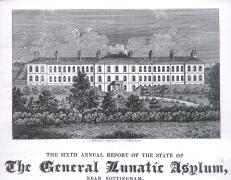
The General Lunatic Asylum for the Town and
County of
Nottingham, at Sneinton, opened
"It was the first institution that came under the Asylum Act of 1808 and Sneinton was notable in being the first public mental hospital in the country to be created from monies raised by rates. The original Sneinton asylum opened for 60 patients... and it is still possible to see part of the original wall near Sneinton Market" Dave Ogden |
|
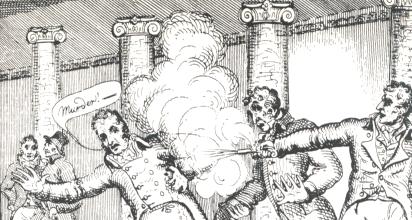
"I heard the unanimous blessings... bestowed by Englishmen upon a murderer... the act was unjustifiable... but, the people did not rejoice because a murder had been committed... but because his act...had ridded them of one whom they looked upon as the leader amongst those whom they thought totally bent on the destruction of their liberties"
Much more substantial funds went to the support of the Perceval family. Spencer Perceval junior, the eldest son of the assassinated Prime Minister, became an MP and an honorary lunacy commissioner. His religious enthusiasm led to a description of him as having "gone mad" in the House of Commons in March 1832. John Thomas Perceval, a younger son, was confined as a lunatic in 1831 and helped to found the Alleged Lunatics Friend Society in 1845.
| June? 1812 Bedfordshire County Asylum opened. The intention to provide was announced in 1808. The first county asylum for paupers only. Its first superintendent (to 1818) was a house painter with experience of caring for a lunatic. The House Surgeon at the Bedford Infirmary attended to the occasional medical needs of asylum patients. From June 1823 this was a Mr Harris. James Harris was licensed to open a nearby private asylum in 1827. He resided there, and (from 1828) acted as non-resident medical superintendent to the County Asylum. |
| Asylums were opened at Edinburgh (1813) and Glasgow (1814). The Edinburgh Asylum included funding from the government and from an international subscription. The Glasgow Asylum was constructed in the shape of a star - Following Bentham's Panopticon Plan |
2.3.1813 Mr Roberts, solicitor to the Royal College of Physicians, visited Mrs Foulkes at a house in Ivy Lane, Hoxton, owned by Mr Dunston, Master of St Luke's to ask why she was detaining four lunatics there (some in strait-waistcoats) without a licence. The college successfully prosecuted her.
May 1813 Description of the Retreat, an institution near York, for insane persons of the Society of Friends, by Samuel Tuke
"To encourage the influence of religious principles over the mind of the insane is considered of great consequence, as a means of cure."
7.7.1813 House of Commons granted Rose leave to bring in a Bill to repeal the 1774 Madhouses Act and make other provisions in its place. [Bills to reform the Madhouses Act were promoted, unsuccessfully by George Rose in 1813, 1814, 1816 and 1817. In 1815, he moved for and chaired the 1815-1816 Select Committee of the House of Commons on Madhouses. The impulse for Rose's Bill may have come from the Royal College of Physician's, which had decided in 1811 that it could not promote its own Bill for revision.]
December 1813 William and Samuel Tuke (of the Retreat) and Godfrey Higgins, a magistrate, bought their way onto the York Asylum Board of Governors to break through the asylum's secrecy.
December 1813 to April 1814 Correspondence between William Hone, James Bevans and Edward Wakefield about a possible London Asylum. [external link to Kyle Grimes 1999]
| Wednesday 18.5.1814 Norfolk County Asylum opened near Norwich. Unlike Nottinghamshire and Bedfordshire, Norfolk had a hundred year history of asylum provision, and the new asylum was supplementary to existing provision. |
![William [or James] Norris
7.6.1814](Norris.jpg)
|
7.6.1814 Patient, William [or James] Norris, sketched in his
harness in
Bethlem
Hospital. The etching was based on the drawing
which had been
done
at the request of
Edward
Wakefield. William Hone got George Cruikshank to
etch the drawing in 1815, which he then published from his new
Fleet Street
bookshop.
[external link to Kyle Grimes
1999]
"a stout ring was rivetted round his neck, from which a short chain passed to a ring made to slide upwards or downwards on an upright massive iron bar... Round his body a strong iron bar about two inches wide was rivetted... which being fashioned to and enclosing each of his arms, pinioned them close to his sides.... bars... passing over his shoulders, were rivetted to the waist bar both before and behind..." (Edward Wakefield to Select Committee in 1815) |
26.12.1814 A fire at York Asylum killed four patients and prevented effective investigation of the asylum.
The Moorfields Bethlem was replaced by one at St George's Fields, South London, in 1815. Following a Select Committee Report in 1807, the Government made an agreement with Bethlem's Governors that the new asylum should have two wings for 60 criminal lunatics. By 1852 Bethlem contained over 100 of the country's 436 criminal lunatics. They were moved to Broadmoor in 1863. The present Imperial War Museum is the administrative block of the Moorfields Bethlem. The dome was added in 1846.
James Bevans, "Architect of Grays Inn Square", put before the 1815 Select Committee on madhouses a "Panopticon Plan" for a proposed London Asylum, which was never built. This asylum had a chapel for the patients, whereas four other plans that Susan Piddock looked at, the new Bethlem, Wakefield, Hanwell and Devon did not. Under William and Mrs Ellis, however, religion and work, were features of Wakefield and Hanwell from the start.
6.7.1815 Suicide of Samuel Whitbread, leading Whig politician, social reformer and theatre goer. See 1818 and 1822
11.7.1815: First Report from the Select Committee of the House of Commons on Madhouses
Act regulating private asylums in Scotland
26.4.1816 to 11.6.1816: Further Reports from the Select Committee of the House of Commons on Madhouses
July 1816 John Haslam dimissed from Bethlem Hospital. Thomas Monro, the visiting physician, was also dismissed, but succeded by his son, Edward Thomas Monro (see 1852) in a joint appointment with Sir George Leman Tuthill.
| Sunday 28.7.1816: Lancashire County Asylum (1st), Lancaster Moor opened. Administrative records start in 1810 |
Jonathan Martin, the mad Methodist, attempted to shoot a Church of England Bishop. See 1829
30.7.1818 Pembroke House officially opened for East India Company Lunatics. Possibility that they to had been confined at Hoxton House previously.
English Heritage: Royal Naval Hospital, Haslar, Gosport, built 1745-1762 as the first hospital for Royal Naval sailors
August 1818 The Royal Naval Asylum. Haslar, opened at Gosport, near Portsmouth in 1818. The naval officers in Hoxton House were removed to Haslar. Relatives appreciated this as the treatment at Haslar was good, but were distressed when deductions from pensions were made as a contribution to costs (Hansard 16.7.1844). [The Naval Hospital opened at Yarmouth, in Norfolk in 1811 was very short lived as a hospital. However, it was used as an army lunatic asylum from 1844 to 1854 and became a Naval Lunatic Asylum in 1863/1869 [ Kathryn Morrison (7.1995) says "the former naval hospital at Great Yarmouth became the naval lunatic asylum in 1869, and special mental units were added to Haslar in 1908 - 1910, and to Plymouth in 1905"]
| 1.10.1818: Staffordshire County Asylum opened. Administrative records start in 1812. |
2.11.1818 Suicide of Samuel Romilly, lawyer and radical MP who had been at the front of the campaign to reduce the number of capital offenses
| 23.11.1818: West Riding Yorkshire County Asylum, Wakefield opened. The Committee's minutes date from 1814 |
Bethlem was used by the army and navy for some of their lunatics. In 1819, the army converted Fort Clarence, Chatham (Rochester, Kent) to a military prison and lunatic asylum (separate parts). The asylum, like Pitt and Netley which succeeded it, was situated in a naval port where soldiers could be received from abroad. From there they might be moved to other asylums. Clarence, Pitt and Netley were the receiving asylums (or lunatic wards). Separate military asylums were created for long-term care and custody at Yarmouth (1846-1856) and Bow and Coton Hill. Military pensioners were also kept in non-military asylums throughout the country.
23.1.1820 Spanish Act (amended 6.2.1822) that transferred Spanish lunatic asylums to municiple boards. They, however, lacked the means to maintain the asylums. (Lopez Ibor 2006/2008)
29.1.1820 Death of George 3rd, who had been confined at Windsor since December 1811
|
20.4.1820
Lincoln
Lunatic
Asylum opened. Originated in a bequest made in
1803
August 1820 Cornwall County Asylum opened. Notice of intention to build had been published in October 1810 |
| 1820-1821 Dundee Royal Lunatic Asylum opened. external link |
| Under the 1821 Irish Lunatic Asylums for the Poor Act, eight or nine District Asylums opened in Ireland (by 1835) at (eight of them) Armagh, Connaught, Carlow, Clonmel, Limerick, Londonderry, Maryborough, and Waterford |
Monday 12.8.1822 Suicide of Robert Stuart, Viscount Castlereagh, the Foreign Secretary. An evening paper in London reported he had died of an attack of gout in the stomach. The Times, the following morning, reported that he had "been suffering under a nervous fever, accompanied by a depression of spirits". He "refused to have his bed made on Sunday night, expressing an apprehension of taking cold". "Yesterday morning... During the absence of his servant, it appears his Lordship had got possession of a razor or some sharp instrument, which he applied to his throat..." William Wilberforce thought that if Castlereagh, Romilly and Whitbread had been observers of the Sabbath they might not have collapsed under the strain. (Howse 1953 p.17)
Commencement of lectures on mental diseases by Alexander Morison (1779-1866). An outline of these was published in 1825. They are described by Hunter and Macalpine as "the first formal lectures on psychiatry". Morison was physician visitor to Surrey madhouses from (about) 1808/9/10, and (non-resident) physician to Hanwell from 1832, Bethlem from 1835 to 1853 and Surrey County Asylum from 1841. From about 1824, Nic Harvey (1996) says Morison developed an extensive private practice recommending and organising a full range of domestic and asylum care for private insane patients.
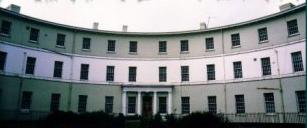
|
24.7.1823
Gloucester County Asylum
|
| Now known as Horton Road |
George Combe's Elements of Phrenology published. Phrenology was the identification of an individual's faculties by feeling the shape of the skull. Franz Joseph Gall (1758-1828) was one of the first to carry out anatomical dissections of the human brain. He argued that mind was based on the brain, that different characteristics of mind would give different shapes to the surface of the brain (variations in the size of lobes) and that the shape of the brain imposed itself on the skull. Johann Kasper Spurzheim (1776-1832) combined this theory with the idea that the individual's environment should be adapted to his or her faculties. This could be done in institutions such as schools and asylums. Amongst those who followed the science of phrenology were the educational pioneer, Robert Owen, the medical journalist, Thomas Wakley and the medical superintendents of many lunatic asylums, including William Browne , William Ellis, John Conolly and Samuel Gaskell. Phrenology provided the scientific basis on which moral management could be considered a medical issue. The Edinburgh Phrenological Society was established by George and Andrew Combe in 1820. Philadelphia Phrenological Society (the first in the USA) started in 1822. The London Phrenological Society was established by John Elliotson (and others) in 1823, In December of the same year, the Phrenological Journal (of Edinburgh) started (the first). In 1825, William Ellis established the Wakefield Phrenological Society. George Combe (1788-1858) bequethed his money to scientific education and, in 1906, it was used to fund a psychology lectureship and laboratory at Edinburgh University. John Stuart Mill (an associationist) argued in 1843 that the "latest discoveries in cerebral physiology" suggested that phrenology was untenable.
First Act regulating private asylums in Ireland
The autumn of 1826 saw the onset of John Stuart Mill's "dull state of nerves" which was cured by poetry.
|
29.6.1827:
Report from the Select Committee on Pauper Lunatics in the
County of
Middlesex and on Lunatic Asylums presented by
Robert
Gordon
The madhouse and county asylums Acts that
followed this
report are an inter-related product of the concern about the
management of
Middlesex Pauper Lunatics. They are legislation by and for
London
(Middlesex) magistrates and the magistrates who built Hanwell
were also an
integral part of the Metropolitan Commission that regulated
the private
houses - including the large pauper houses.
|
| 1828 | "Insanity is the scourge brought down on sinful men by the wrath of the Almighty" (George Man Burrows, opening words of Commentaries on the Causes, Forms, Symptoms, and Treatment, Moral and Medical, of Insanity 1828. Quoted Kraepelin 1918, pages 38- 39 (See 1811) |
| The 1828 County Asylums Act |
|
|
The 1828
Madhouses
Act
established:
The Home Secretary's Metropolitan Commission: |
|
Five physicians, including the Secretary and Treasurer of the Physician Commission; six Middlesex JPs and ten other honorary commissioners, were appointed by the Home Secretary in August 1828 to form a commission specifically to control London's madhouses. The medical commissioners were paid one pound an hour, the others were not paid.
A lawyer was appointed the Commission's Treasurer-Clerk (London Clerk) to establish an office and keep (national) registers.
New commissioners were appointed as and when necessary. With a few exceptions, the honorary ones needed replacing relatively often, but all but one of medical commissioners served until 1845 (and some beyond).
The commission was funded, in excess of licence receipts, by the national Treasury. It only licensed houses if it saw fit, and the Home Secretary could revoke a licence on its recommendation.
Quarterly licensing meetings were held, to which applicants had to submit, in advance, written details of proposed houses.
Commissioners (usually two medical and one honorary) visited each house at least four times a year and their reports were taken into account before the (annual) renewal of the licence.
The Westminster courts could no longer order visits and reports and did not have statutory access to registers. Instead the commission had power to release a patients on its own authority.
The Chart of the Metropolitan Commissioners begins in 1828
| 1.1.1829 Suffolk County Asylum opened. |
1.2.1829 Jonathan Martin, the mad Methodist, set fire to York Minster. See 1817 and "Methody parsons" in 1844..
| August 1829 Chester County Asylum opened. |
|
Therapeutic Optimism:
The optimistic period in the history of asylums runs from
about
1830
to
around
1860.
It was at its height in the
1840s.
Asylums built
under the
1808
and
1828
County Asylums Act tended to be left to the
management of
doctors. As the theories and techniques of managing lunatics
in asylums
developed, so did the belief that this asylum treatment itself
was the
correct, scientific way to cure lunacy.
Signs of the therapeutic change can be seen in the changing legislation. The 1828 Madhouses Act, unlike the 1774 Act, was concerned about conditions in asylums. These included the moral conditions. Official visitors were required to inquire about the performance of divine service and its effects. In 1832, this inquiry was extended to include "what description of employment, amusement or recreation (if any) is provided". (see law) |
| 1830 | revolution in France, riots in England |

|
Wednesday 25.8.1830 The Superintendent of
Bethlem, and current President
of the
London Phrenological
Society, Dr Edward Wright was
found at
night
with female patients. He denied wrong doing, but was
dismissed
after an
inquiry.
"After Bethlem Wright spent some time in Syria where, according to one writer, 'he became rather spoiled for regular practice'. A fondness for grog always seemed to catch up with him. He had returned to London by 1834, but soon left for Australia. |
| 1831 |
|
In January 1831, John Thomas Perceval, a son of Spencer Perceval, the assassinated Prime Minister, was confined in Brislington House Asylum. In May 1832 he was moved to Ticehurst Asylum. He may have been taken to Brislington by his brother, Spencer junior, an enthusiastic Metropolitan Lunacy Commissioner and a Member of Parliament, who shared John Thomas's religious enthusiasm. Spencer Perceval was, at this time, campaigning for national days of fasting and humiliation. Soon after John Thomas was discharged from Ticehurst, he visited Esquirol in Paris to discuss the reform of the lunacy system. (Hunter and MacAlpine say this was "presumably in 1835"). In 1838 he published the first volume of his book about the treatment of the insane, which contained the account of his own insanity and the way he was treated (see extracts)
14.2.1831 Spencer Perceval introduced a motion in Parliament
(withdrawn) calling for a day of fasting, public humiliation and prayer. He
said
He blamed "the very essence of liberalism which walks abroad" which "has
shown itself in the
late French revolution most distinctly"
"the whole country is in a complete state of disorganisation;
all the elements of society appear to be loose and disjointed; there is no
attachment on the part of the people to their rulers ... The ancient and
venerable institutions of the country ... which were once the proud boast
of every Englishman, are now viewed with disregard ... My conviction is ...
that a scourge is going forth over all lands ... that great troubles,
tumults, convulsions and struggles are about to take place all over the
world, and that they are inevitable.
"
| Monday 16.5.1831 First Middlesex County Asylum at Hanwell opened. See Harriet Martineau's article, June 1834 |
|
October 1831 Cholera
reached Britain
(external link) - It returned in
1848 -
1853 - 1865. These cholera outbreaks were important in the
development of the
germ theory of diseases
in 1831 and 1832 "many thousands perished of this new disease...although it was a time of great political excitement, and a year of election riots, the people nowhere in England entertained the dreadful suspicions of occult poisoning which excited the populace to madness and to murder, not only in Hungary, but in Paris" (Farr, W. 25.7.1868, p.ix) See John Snow in 1849 and 1854 and Cholera and the Thames by Westminster Archives. |
| 1832 | Parliamentary reform |
|
|
February 1832 A National Fast announced in Parliament after the Strangers' Gallery had been cleared; a speech deplored the sins and state of the nation, the 'houses of the nobles and gentry entered and robbed'.
21.3.1832 National Day of Fasting and Prayer. Sermon: "the disease ... was proof of the judgement of God among us". See working class protests.
| 1.8.1832 Dorset County Asylum opened |
|
|
The
1832 Madhouses Act
established:
The Lord Chancellor's Metropolitan Commission: |
|
Appointment of the commissioners was transferred to the Lord Chancellor as custodian of the property of lunatics. The number of professionals was increased by the appointment of two barristers as legal commissioners, paid (under the 1833 Madhouses Amendment Act) at the same rate as the physicians. The honorary commissioners were reduced and, because legal commissioners could take their place, they were no longer essential for licensing and visiting. Although largely responsible to the Lord Chancellor, the commission retained some responsibility to the Home Secretary.
London's madhouses
Biographies of Legal Commissioners begin in 1832
| 1833 |
|
| 1.1.1833 Kent County Asylum, Barming Heath, Near Maidstone opened |
| 1834 |
|
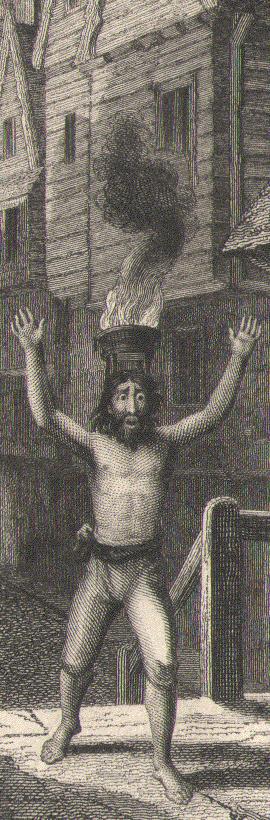
|
A Treatise on Insanity, by
James Cowles
Prichard
was the main textbook on the subject for many years. In it he
elaborated
the concept of moral
insanity that he had previously outlined in
articles.
Amongst Cruikshank's drawings is this one of Solomon Eagle This book is republished shortly after cholera arrived in Britain.
|
| 1836 |
|
August? 1836 A Madman's Manuscript in Charles Dickens' The Pickwick Papers
| 1837 |
|
In England and Wales, universal registration of births, deaths and marriages began in 1837. ""as the cause of death are recorded, the registers contained the particulars of every death" (Farr, W. 25.7.1868, p.x)
In 1837, John Elliotson, founder (1823/1824) of the London Phrenological Society, Professor of Practical Medicine at the (new) University of London and a founder of University College Hospital, was converted to mesmerism by the experiments of Baron Dupotet at Middlesex Hospital. The theory of mesmerism, at this time, was not psychological, but physical. Electricity was held to effect the "animal magnetism" within the human nervous system. Unlike phrenology, mesmerism did not gain medical credibility. Thomas Wakley was unconvinced, even by a personal demonstration at his home in August 1838. In the Winter of 1838, Elliotson resigned from University College when ordered to stop the practice. In 1843 he founded Zoist, a journal about "cerebral physiology and mesmerism and their applications for human welfare" and in 1846 his Harveian Oration (on mesmerism) at the Royal College of Physicians was the first to be given in English instead of Latin.
|
May 1837 William Alexander Francis Browne, medical superintendent of the Montrose Royal Lunatic Asylum, addressed the book version of his lectures What Asylums Were, Are, and Ought To Be. The book was dedicated to Andrew Combe in recognition of the benefits of applying Phrenology to insanity. |
| 14.5.1837 New Leicestershire County Asylum opened |
Thursday 20.6.1837 Death of William 4th. Victoria began reign. Rev William Barnett thought he had occasioned her death - but she came alive again.
21.10.1837 Editorial on The Regulation of Lunatic Asylums, from The London Medical Gazette reproduced on the Rossbret site
| 1838 |
|
|
|
"In 1838, France passed a law mandating the internment of
lunatics at
public expense in every French department"
(Richard Keller 2001)
French text of Loi sur les aliénés number 7443 du 30 juin 1838 |
|
"The French legal code of 1838 relating to mental health administration...is the first comprehensive legislation in this field (a partial law had existed in England since 1828" according to Ackernecht (1968, p.50), who says the law was "designated" by Esquirol. This, he says, served as a model for similar legislation in Switzerland (also 1838), England (Ackernecht says 1842, but I think this would only apply to the 1845 laws) and Norway (1848) - click for my discussion of influence on English/Welsh legislation Also in 1838: Le Traité des maladies mentales considéré sous le rapport médical, hygiénique et médico-légal by Esquirol |
|
Railways made the national government of lunatic asylums and a national trade in pauper lunatics possible. In September 1838 the London to Birmingham Railway opened. The first main line in the world. 112.5 miles long from Camden to Birmingham, it linked to the Grand Junction at Curzun Street, Birmingham, and this linked to the Liverpool and Manchester north of Warrington, near Newton.
| At this junction, which all the trains from London to Liverpool or Manchester passed through, two officers of the New Poor Law (one no longer serving) established in 1843/1844 a private asylum to receive pauper lunatics from all over the country. (See 1846). |

|
| 1839 |
|
May 1839 John Connolly visited Lincoln Asylum where Robert Gardiner Hill had abolished mechanical restraint of patients in a small asylum. On appointment to Hanwell, Connolly proceeded to abolish it in a large asylum. Several English asylums were practising non-restraint by 1844.
Select Committee of the House of Commons Hereford Lunatic Asylum. A madhouse proprietor tried to work the system, and focused the attention of parliament onto the counties.
| 4.6.1839 First patients admitted to the Crichton Institution, Dumfries, Scotland (external link). The first asylum for Scotland south of Edinburgh and Glasgow. The building had a Bible for a foundation stone. |
In the
hungry-forties of the 19th century many believed
that by moving mentally unstable people from a community
disturbed by
poverty, depravity and social unrest to a closed, humane, but
disciplined
environment in a
lunatic asylum early in the development of
their insanity
they could be cured and the accumulation of chronic lunatics
on poor relief
halted. Laws to make every part of England do this were passed
in
1845.
But the creation of a
Lunacy
Commission, justified by this ideal, was not a
conscious plan
worked out in advance by reforming politicians and
professionals, but the
result of people
rising to meet
forces
that took them by surprise. Forces that were,
once again,
symbolised by a
bullet.
ASYLUM CARE
1840s:
| 1840 |
|
1840 Major changes in London's three large private pauper houses at Hoxton - Bethnal Green - and Peckham. The Metropolitan Commission's report for 1.6.1840 to 31.5.1841 says
"the Commissioners have issued express direction that a sufficient number of keepers shall in all cases be employed, so as to obviate the necessity of personal restraint, except in extreme cases; and they have also endeavoured to establish some system of classification" (separating convalescent patients from violent or confirmed mania) "... "these endeavours have been seconded by the proprietors and superintendents of the three large houses, where classification is chiefly necessary... these persons have lately bestowed much attention on this subject, and have, in fact, incurred much expense... The number of keepers has been greatly increased... a greater number of rooms has been appropriated to the reception of patients, and, in some cases, new buildings have been erected..." Since May 1840 "a considerable number of pauper lunatics" had been moved from Hoxton, Bethnal Green and Peckham to "the Surrey County Asylum", and others to Hanwell - so the total number of patients in London private asylums was falling, although the Commission did not expect this trend to continue "not... from any increase in insanity, but from... more case becoming public, and greater care being bestowed on persons afflicted with the disease"
10.4.1840 A date given for the start of the construction of Pentonville Prison. It was opened in 1842. Another source says it took less than 18 months to construct. The semi-radial plan has some similarities to the Devon County Asylum. The heating and ventilation system was adopted by the Derbyshire County Asylum (See Conolly, J. 1847). The prison was known as the model prison as providing a pattern for future prisons. In 1835 and 1836, the Poor Law Commissioners had published a variety of model workhouse plans (Outlined on Peter Higginbotham's site. A hospital that performed a similar function as a model for hospitals was the Royal Herbert (1865). It is harder to pick a model asylum, but John Conolly (1847) focused on the plans for the Derbyshire County Asylum (1851)
| 1841 |
|
This became a model for similar communities. (Jones and Tillotson)
February 1841: The London Statistical Society announced that it intended to collect lunatic asylum statistics during the year
13.2.1841 The first installment of Charles Dickens' Barnaby Rudge: A Tale of the Riots of 'Eighty, about the 1780 no-popery riots, began to be published weekly in the Clock. Barnaby has charactersitics of idiocy and lunacy. In chapter forty seven, his mother and Barnaby met a "country gentleman" in the "commission of the peace" who tries to horse-whip Barnaby. The widow pleads that "her son was of weak mind".
"An idiot, eh?" said the gentleman, looking at Barnaby as he spoke... "There's nothing like flogging to cure that disorder. I'd make a difference in him in ten minutes, I'll be bound". "Heaven has made none in more than twice ten years, sir." said the widow mildly. "Then why don't you shut him up? We pay enough for county institutions, damn 'em. But thu'd rather drag him about to excite charity - of course."
| 14.6.1841 Surrey County Asylum opened - But see above |
Asylum doctors: 19.6.1841 circular from Samuel Hitch MD
of the
Gloucestershire County
Asylum to other asylum officers, which led to 44 out of 83
doctors agreeing
to belong to an
asylum
officers
association.
[
External link to Royal College of
Psychiatrists
website]
August 1841 Isabella Thackeray suffered from intense suicidal depression (following the birth of her third child, Minny Thackeray, in 1839). She spent the rest of her life in care as a mad woman. When Charlotte Bronte dedicated the second edition of Jayne Eyre to William Makepeace Thackeray, she did not know about his wife Isabella. [See Hilary Marland. Maternity and Madness: Puerperal Insanity in the Nineteenth Century - archive]
21.9.1841 In an effort to get Parliament to discuss the "treatment of lunatics", Thomas Wakley MP, editor of the Lancet, opposed continuing the Metropolitan Commission for more than a year.
The Madhouse System published by Richard Paternoster. Much had already been published as newspaper articles.
|
Dickens
on USA
asylums
Hanwell in the USA |
|
| 1842 |
|
The 1842 Licensed Lunatic Asylums Bill was brought into Parliament on 17.3.1842 by Granville Somerset, as a government measure. He had the half-hearted support of Lord Ashley, the de facto chair of the Metropolitan Commission and was opposed by Thomas Wakley MP. The medical opposition inside and outside Parliament, and Ashley's conversion to the new system of non-restraint with moral management, led to the initial Bill being completely reformed into a Bill for a National Inquiry into the teatment of lunacy.
|
|
The
1842
Licensed Lunatic
Asylums Bill
proposed a
Barristers' Commission |
|
|
|
The
1842 Inquiry Act
established the
Inquiry Commission: |
|
The medical and legal commissioners jointly visited and reported on public asylums and licensed houses throughout England and Wales. Already much extended in response to the challenge of moral management, the inquiry became even more general in response to the national panic about dangerous lunatics when McNaughton was found insane in 1843. In 1844 the commission published a 300 page report with recommendations for changes in the law aimed at curing and controlling. It included a national register of the insane, controls on the discharge of lunatics, extended asylums provision and regular monitoring of lunatics not in asylums.
10.7.1842 Jabez Jackson, aged about 25, and Hannah Beardmore were married in Chesterfield. The birth of Jabez Columbus Jackson was recorded in the Belper district of Derbyshire in the December quarter of 1845. In 1851 Jabez senior was brought from Belper to become the Derbyshire County Asylum's first patient. He was then paralysed and had to be carried from the cart to a padded room, which was used because of his helplessness rather than his violence. His hips, back, shoulders and knuckles were "extensively excoriated" and was very sore. This was put down to his having been "the subject of mechanical restraint". Extreme debility and "paralysis about the sphincters of his bladder" made him unable to keep himself clean. He was said to be epileptic. The asylum was dedicated to non-restraint principals and by September 1851 Jabez was clean in his habits and working somewhere in the ward, kitchen or garden. In the summer of the following year he died. His son became a potter's printer in Staffordshire, married to Jane, a potter's transferer from Wales. They had two sons.
| 1843 |
|
|
|
Annales médico-psychologiques du système nerveux founded by Baillarger and others in France. It is the oldest surving journal of psychiatry. (website) |
3.3.1843 Trial of Daniel McNaughton in the midst of revolutionary fear.
McNaughton was found insane. Later that year, the Metropolitan Commission's inquiry was extended to visit workhouses where dangerous idiots and lunatics might be living, but free to leave when they chose. In the following year it extended to Wales, where dangerous idiots and lunatics were reported to be living on outdoor relief. The fear engendered by McNaughton created the political will to build asylums for the lunatic poor and create a department of government to oversee their detention and treatment.
| 1844 |
|
|
The 1844 Lunacy Report and the Census of the
Insane
The report was published early in July. On 12.7.1844, Ashley startled the Home Secretary by announcing that there were over 12,000 pauper lunatics outside asylums, many of them "absolutely dangerous"
Non-restraint The 1844 Report recorded public and private asylums employing the non-restraint system (see 1839) and others that used mechanical restraint, but were not using any at the time of their visit. The non- restraint asylums were: Lincoln, Northampton, Hanwell, Lancaster, Gloucester, Haslar and Suffolk in the public sector, Fairford and Denham Park in the private. The new Haydock Lodge private asylum was also committed to non-restraint. Asylums not committed to non-restraint, but where non was in use when the Commissioners visited were: Cornwall, Dorset, Nottingham, Norfolk, The Retreat at York and Radcliff Infirmary. The Lancet in 1842 contained that on 10.6.1842 no patient in Bethlem Hospital was under restraint. |
|
| 1845 |
|
| March 1845 Shropshire and Wenlock Borough County Asylum opened. Union with Montgomery (Wales) in 1846 made it the first County Asylum provided for Welsh patients |
| 19.5.1845: Sir Thomas Freemantle introduced the Bill that was to establish a Central Criminal Lunatic Asylum in Ireland. This was opened at Dundrum in 1850. Renamed the Central Mental Hospital in 1961, it has been described as "the oldest forensic secure hospital in Europe" [external link] |
| July 1845 Devon County Asylum opened |
|
|
Two linked Acts were introduced by Lord Ashley: |
|
The 1845 County Asylums Act compelled every county and borough in England and Wales to provide asylum treatment for all its pauper lunatics and Lord Ashley told Parliament that this would "effect a cure in seventy cases out of every hundred" (Hansard 6.6.1845 column 193).

|
The
1845 Lunacy
Act
established the Lunacy Commission:
The Act named eleven Metropolitan Commissioners as Lunacy Commissioners. Six (three medical and three legal) were to be employed full time at salaries of 1,500 pounds a year. The other five were honorary commissioners whose main function was to attend board meetings. The Permanent Chairman had to be an honorary commissioner, but otherwise they were not essential to the commission's operations. The only Metropolitan legal commissioner not appointed as a Lunacy Commissioner was named in the Act as Secretary. The Lunacy Commission had national authority, under the Lord Chancellor and Home Secretary, over all asylums (except Bedlam until 1853). It shared responsibility with the poor Law Commission/Board etc for pauper lunatics outside asylums. Its principle functions were to monitor the erection of a network of publicly owned county asylums, required under the 1845 County Asylums Act, and the transfer of all pauper lunatics from workhouses and outdoor relief to a public or private asylum; to regulate their treatment in private asylums, and (with the Poor Law Commission) monitor the treatment of any remaining in workhouses or on outdoor relief. The Lunacy Commission was also to monitor the regulation of county asylums and county licensed houses by JPs, and to regulate the conduct of hospitals for the insane. With the JPs it monitored the admission and discharge of patients from all types of asylum. It collected, collated and analysed data on the treatment of lunacy and advised on the development of lunacy law and policy. It also continued to license London's madhouses. |
| 1846 |
|
| 1.8.1846 Oxfordshire and Berkshire County Asylum opened |
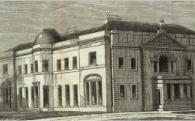
|
In the summer of 1846 it became scandalous public knowledge that officers of the Poor Law Commission (acting privately) had profited by the shortage of asylums by establishing a low cost asylum at Haydock Lodge in Lancashire for pauper lunatics from all over England and Wales. See Poor Law Commissioners and the Trade in Pauper Lunacy |
"Haydock Lodge is full of lunatics and we have Methody parsons
amongst
them".
| November or December 1846: General rules for County Asylum construction circulated to Asylum Committees by the Lunacy Commission |
Louisa Nottidge was confined in Moor Croft House asylum in 1846 but released on the orders of the Lunacy Commissioners eighteen months later (external link)
| 1847 |
|
20.5.1847 Death of Mary Lamb who spent the last decade of her life being cared for in a single house in St John's Wood.
| Wednesday 7.4.1847 East and North Riding and York Yorkshire County Asylum opened |
October 1847 Charlotte Bronte's Jane Eyre published. It contains an entirely unsympathetic image of a mad wife confined in the attic by a husband defrauded into marrying her in ignorance of her tainted inheritance:
"I daresay you ... inclined your ear to gossip ... the mysterious lunatic kept there... is my wife ... Bertha Mason ... is mad; and she came of a mad family; idiots and maniacs through three generations. Her mother, the Creole, was both a madwoman and a drunkard! .. I invite you all to ... visit ___ In the deep shade ... a figure ran backwards and forwards ... whether beast or human being, one could not, at first sight, tell: it grovelled, seemingly, on all fours; it snatched and growled like some strange wild animal: but it was covered with clothing, and a quantity of dark, grizzled hair, wild as a mane, hid its head and face... A fierce cry ... the clothed hyena rose up, and stood tall on its hind-feet... The maniac bellowed: she parted her shaggy locks from her visage, and gazed wildly at her visitors ... that purple face ... those bloated features... 'she has no knife' ... 'One never knows ... she is so cunning' ... Mr Rochester flung me behind him: the lunatic sprang and grappled his throat viciously, and laid her teeth to his cheek... more than once she almost throttled him..." [etc]
November 1847 The Lunacy Commission release Mrs Henry Howard from confinement in a single house in Kensington.
| John Conolly's The Construction and Government of Lunatic Asylums |
| 1848 |
|
Journal of
Psychological Medicine and Mental
Pathology,
edited by
Forbes Winslow (1810-1874). Quarterly?. 1848-1860.
|


|
Wednesday 1.3.1848
Somerset County Asylum
opened
|
June? 1848 Volume seven of The half-yearly abstract of the medical sciences (January to June 1848), edited by William Harcourt Ranking, included, for the first time, a "A Report on the Recent Progress of Psychological Medicine". This was written by Charles Lockhart Robertson
"The
cholera reached London in the new epidemic form about October
1848"
(Farr, W. 25.7.1868, p.ix). See
Ashley
| Tuesday 14.11.1848 North Wales (5 counties) County Asylum opened |
Anna Wheeler died about 1848. It was alleged by Edward Bulwer-Lytton that she died insane. (source)
| 1849 |
|
29.8.1849 On the Mode of Communication of Cholera by John Snow, M.D (external copy), setting out the theory of transmission in the water supply rather than directly from patient to patient, or by polluted air. The importance of the polluted air theory of disease transmission, before Snow's publications of 1849 and 1854, is evident in John Conolly's (1847) The Construction and Government of Lunatic Asylums, where much attention is paid to clean air and little to clean water.
|
The New County Lunatic Asylum now building at
Mickleover near Derby
There are many persons now living who can remember passing the gates of old Bethlehem and hearing, as they passed, the cut of the lash and the screams of its victims. That was the old treatment inspired by the "wisdom of our ancestors". ... within these few years, men have arisen who have paid more regard to the dictates of common sense and common humanity, than to the routine of tradition - ... - and have considered that insanity is a physical disease, to be treated as a disease and not as a crime, and that it would be just as reasonable to lash a man who could not run when both his legs were broken, as to flog him for not being reasonable when his faculties of reasoning were gone. The Architect of the building, under consideration informed himself of these circumstances, and has been, we believe the first to design an Asylum which shall facilitate and be adapted to the recent treatment of the insane by means of kindness, companionship, and watchfulness, rather than coercion, punishment, and confinement.
|
| 1850 |
|
|
1850s In 2010, "Truth and Reconciliation in Psychiatry" called for
"an official Apology for damaging
treatments since psychiatry's origins circa 1850s" - See index
of
official
starts
Richard Hunter and Ida Macalpine's Three Hundred Years of Psychiatry 1535-1860, page x, says: "We end with the decade 1850-1860 when the foundations of modern psychiatry were laid and its scope was extending beyond the care of the insane, when 'psychological medicine' had become an acknowledged speciality and the main lines of modern research were at least indicated; when neurology had split off as a speciality with a hospital of its own at Queens Square; when the comprehensive Lunacy Legislation of 1853 had put a period to the past by consolidating the many advances in the provision for and protection of the the insane; when the Medical Act of 1858 had ousted quacks from treatments; when psychiatry had acquired its own periodical literature, its first modern textbook, and become international; the decade in which Kraepelin, Bleuler and Freud were born who were to shape its future". |
| 1851 |
|
Medical and social institutions distinguished: A French law of 7.8.1851 (loi du 7 Août 1851 relative à l'organisation des secours hospitaliers) distinguished between a hôpital (for treatment) and a hospice - See dictionary (Discussed at external link)
| 1.1.1851 Lancashire County Asylums (2nd and 3rd), Rainhill and Prestwich, opened. As a result, Lancashire magistrates were able to close Haydock Lodge. It reopened shortly afterwards as an entirely private patient asylum. This did not last for long. Pauper patients returned to Haydock Lodge in 1854 |
| 1851: Census: A column asking about disability introduced. It had mental disability added in 1871. This heading is from the 1861 census, but I believe it is the same as in 1851. I have, however, seen census forms for the same year with different wording. |
|
| 17.7.1851 Second Middlesex County Asylum at Colney Hatch opened |
| 21.8.1851 Jabez Jackson entered the Derbyshire County Asylum as its first patient. Ellen Riggott arrived on 31.10.1851. |
|
19.9.1851
Wiltshire County Asylum
opened
1.12.1851 Monmouth, Hereford, Brecon and Radnor County Asylum opened |
| 1852 |
|
| District Asylums opened in Ireland at Cork, Kilkenny and Killarney |
|
30.6.1852
Warwickshire County Asylum
opened
9.8.1852 Lincolnshire County Asylum opened 11.8.1852 Worcestershire County Asylum opened 13.12.1852 Hampshire County Asylum opened |
Critical report by the Lunacy Commission on Bethlem Hospital. The physician, Edward Thomas Monro, refused to resign, so was made "consulting physician". When he died, in 1856, it ended the four generation Monro dynasty at Bethlem
| 1853 |
|
|
17.1.1853
Buckinghamshire County Asylum
opened
23.9.1853 Essex County Asylum opened When these opened, every county in England and Wales, except four, had (jointly or singly) an asylum for pauper lunatics. Four counties without probably had contracts with licensed houses. There was a lull in the opening of new asylums after 1853. The building of asylums for the remaining four was probably prompted by the 1853 County Asylums Act |
| A District Asylum opened in Ireland at Omagh |
|
Scotland
Introducing the 1853 Lunacy Bills, the Earl of Shaftesbury lamented that he could not
"extend the bills to Ireland and Scotland, for I believe that not in any country in Europe, nor in any part of America, is there any place in which pauper lunatics are in such suffering and degraded state as those in Her Majesty's Kingdom of Scotland" In September 1854, Dorthea Lynde Dix came to England, stayed with Samuel Tuke at York, and then visited Scotland. By visits and intimations that she would report to London, she caused alarm. To make sure she got her case in first, she caught the night train to London and reported to the Home Secretary (Palmerston) the next morning. Shortly afterwards a Royal Commission was appointed to enquire into the asylums and lunacy law of Scotland (1855). This was followed by the 1857 Lunacy and Asylums Bill, Scotland. (Hunter, R.A. and Macalpine, I. 1963 pages 911-912) The Act established The General Board of Commissioners in Lunacy for Scotland (1859-1913) which became the General Board of Control for Scotland (1913 -1960) and then the Mental Welfare Commission for Scotland. Mental Welfare Commission website. At the time of the Report, there were asylums established by Royal Charter at Aberdeen, Dundee, Edinburgh, Glasgow, Montrose, Dumfries, and Perth and a pauper asylum at Elgin. The Act required the construction of publicly financed District Asylums throughout Scotland. |
20.8.1853 Royal Assent for the 1853 Charitable Trusts Act "for the better Administration of Charitable Trusts", under which "The Charity Commissioners for England and Wales" were established.
In September 1853 it was officially announced that a cholera epidemic was claiming victims in London and other parts of the country (external link)
| 1854 |
|
Haydock Lodge private asylum in Lancashire relicensed to receive pauper patients. It continued to do so at least until the 1880s. Increasingly, however, the private side of the business was developed and, by about 1900, Haydock Lodge advertised itself as "for the upper and middle classes only"
11.12.1854 Second, much enlarged edition, of John Snow's On the Mode of Communication of Cholera (external copy)
| 1855 |
|
| District Asylums opened in Ireland at Mullingar and Sligo |
| 1856 |
|
April 1856 Daniel Dolly, a patient in Springfields Lunatic Asylum, died after being treated with a shower of about 600 gallons of cold water over 28 minutes, followed by a tartar emetic. The Lunacy Commission tried, unsuccessfully, to prosecute the medical superintendent, Charles Snape, for manslaughter.
| 1857 |
|
|
|
Bénédict Auguste Morel's Traité des dégénérescences physiques, intellectuelles et morales de l'espèce humaine et des causes qui produisent ces variétés maladives became the classic text of degeneration theory. |
English asylum doctors clashed over how to deal with wet beds. The ideas of Samuel Gaskell laid the foundations of psychiatric nursing, but this interference with the autonomy of asylum superintendents was a threat to the British Constitution.
| 1858 | 1858 cases |
|
17.7.1858 Rosina Bulwer-Lytton, estranged wife of novelist and cabinet minister Edward Bulwer-Lytton, and daughter of Anna Wheeler, released from Inverness Lodge asylum, Brentford, where she had been confined at the request of her husband. The release followed a newspaper scandal. (source)
During 1858 two patients in private asylums were found to be sane by commissions of lunacy. One was Mrs Turner at Acomb House near York, the other Mr Ruck at Moor Croft House, Middlesex.
20.8.1858 "The increase of lunacy in Great Britain" New-York Daily Tribune reporter Karl Marx:
"public indignation has been lately raised by the kidnapping of Lady Bulwer into Wyke House, and the atrocious outrages committed on Mrs. Turner in Acomb House, York. A Parliamentary inquiry into the secrets of the trade in British lunacy being imminent, we may refer to that part of the subject hereafter. For the present let us call attention only to the treatment of the 2,000 lunatic poor, whom, by way of contract, the Boards of Guardians and other local authorities let out to managers of private licensed houses"
| 1858-1859 Patients moving into the Durham County Asylum as it was constructed |
| 1859 | click for table of private asylums receiving paupers |
|
|
April and August 1859 and July 1860: Three reports from a Select Committee of the House of Commons "on the operation of the Acts and Regulations for the care and treatment of lunatics and their property"
|
27.5.1859
Suusex County Asylum
opened
Northumberland County Asylum also opened in 1859 |
John Stuart Mill's On Liberty criticised the operation of writs de lunatico inquirendo:
"the man, and still more the woman ...[who indulges] in the luxury of doing as they like... [is] in peril of a commission de lunatico, and of having their property taken from them and given to their relations"
26.11.1859 to 25.8.1860 Wilkie Collins The Woman in White, about a villainous confinement in an asylum, serialised in Charles Dicken's All the Year Round. The book was dedicated to Bryan Waller Procter [Lunacy Commisioner]
| 1860 |
|
| 1860 Three Counties: Bedford, Hertfordshire and Huntingdonshire County Asylum (Arlesey) opened |
| Therapeutic Pessimism: The pessimistic period in asylum history developed during the second half of the nineteenth century. Medical theory was strongly influenced by social darwinist beliefs that insanity is the end product of an incurable degenerative disease carried in the victim's inherited biology, and the experience of asylums, and reanalysis of their statistics, undermined the earlier beliefs in their therapeutic value. In the late 19th and 20th centuries, the pessimistic period in asylum history ran gently into a backwater period. Most progress in mental health policy took place outside the asylums, in specialist hospitals like the Maudsley, or in outpatient departments, and the asylums became the quiet back wards where chronic patients live. |
| 1861 |
|
| 1862 |
|
Edgar Sheppard (born Worcester about 1820) was medical
superintendent of
the male department of
Colney Hatch from 1862 to 1881. In
this enormous
asylum he became well known for innovations, including daily
Turkish Baths
as therapy on a large scale, an asylum band, theatre,
concerts, readings,
lectures and a revival of restraint...
His method of locking dirty and destructive patients in side rooms "in a nude state" for weeks at a time where they "slept on the floor without either bed or pillow, being supplied only with strong quilted rugs", packing violent patients in wet sheets, or retraining them by belts, wrist straps and locked gloves, was condemned "in the strongest manner" by the commissioners in lunacy (..1867;..1870;..1862) and led one of their members to blackball Shepherd at the Royal College of Physicians" [of which he is not listed as a member] (Hunter and Macalpine 1974 p.84) He was appointed King's College Hospital's first professor of psychological medicine in 1871 and published his seven lectures as Lectures on madness in its medical, legal, and social aspects in 1873. His continued support for restraint led to his not being appointed as a Lord Chancellor's Visitor in 1875 |
| 1862 Cumberland and Westmoreland asylum Carlise opened. This completed the programme of building a public pauper lunatic asylum (jointly or singly) for every county in England and Wales. |
| 1863 |
|
Broadmoor Criminal Lunatic Asylum opened, in Crowthorne, Berkshire. The criminal lunatics from Bethlem were moved to Broadmoor in 1864 and Bethlem became a hospital for the 'superior class'. Pauper patients were presumably moved to the City of London Lunatic Asylum which opened at Dartford, Kent on 16.4.1866.
Royal Victoria (Military) Hospital at Netley, on Southampton Water, opened - Its asylum opened in 1870. The new Yarmouth Naval Lunatic Hospital opened.
March 1863-December 1863 Charles Reade's Hard Cash also about a villainous confinement in an asylum, appeared as installments in Charles Dickens's magazine All the Year Round.
Yahoo weblinks: Charles Reade (1818-1884)
| 1864 |
|
20.5.1864 John Clare died in Northampton Asylum in 1864. During the many years he spent there, he wrote some of the most beautiful poetry ever spoken in English. Bird's Nests is one of his last poems. See also The Nightingale
7.4.1864 Louis Pasteur (1822-1895) lectured at the Sorbonne against
the theory of spontaneous generation of disease and in favour of contagion
by
germs - External links on
spontaneous generation experiments -
Pasteur's experiments. Identification of
micro-organisms: see
malaria 1880 -
tuberculosis
1882 -
cholera (1854 - 1884)
- bacilliary dysentery
1897
- syphilis
1905.
Pathology laboratories:
USA 1878 -
Claybury
| 1865 |
|
1.11.1865 The Royal Herbert Hospital opened. This military hospital (physical diseases) was the first built on the pavilion plan favoured by Florence Nightingale. It may have influenced the echelon plan that became the main style for asylums.
There were outbreaks of cholera in England in the autumn of 1865. The disease abated, but there was a localised (but substantial) outbreak in London in July 1866 (Farr, W. 25.7.1868, pp xii-xiii). The London outbreak was significant in that it had been thought cholera could be controlled in London. The report of William Farr showed why this had not happened and confirmed the effectiveness of clean water supplies.
| 1866 |
|
| District Asylums opened in Ireland at Castlebar and Letterkenny |
| 1867 |
|
Metropolitan
Asylums
Board set
up to oversee relief to
London's
sick and infirm poor, so that the workhouses could be freed to
discipline
the able-bodied. To deal with the sick poor suffering from
smallpox,
fever,
or insanity, London became one Metropolitan Asylum District under
the Board, which first met on 22.6.1867.
The Board proposed two new asylums for
chronic lunatics
and idiots at Leavesden and
Caterham. Fever and smallpox hospitals were built at Stockwell
in south-west London and Homerton in north-east London.
when its functions were transferred to London County Council
April 1867 The Lancet published an article by Joseph Lister (1827-1912) On the Antiseptic Principle of the Practice of Surgery. [Copy at Bartleby]
| 1868 |
|
| District Asylums opened in Ireland at Ennis and Enniscorthy |
| 1869 |
|
| District Asylums opened in Ireland at Downpatrick and Monaghan |
1869 Sedative effects of chloral hydrate explored by the German pharmacologist Oskar Liebreich (1839-1908). It was tried in Warley (Essex - UK) in 1870. Kraepelin in 1918 describes the effects of this and similar drugs on wards for the insane.
|
15.11.1869 Charlotte Mew born. Her grandfather's firm designed asylums for Essex - Sussex - and Dorset. Her earliest published work (1894) concerns mental debility in the family. Her brother, Henry, was confined in an asylum before 1890 and her youngest sister, Freda, was certified insane in 1898. See 1901 - 1902 - 1909 - 1913 - 1915 - 1916 - 1924 - 1928 - Poetry Links - 1.3.1958 |
| 1870 |
|
"The time has come when the immediate business which lies before everyone who would advance our knowledge of mind, unquestionably is a searching scrutiny of the bodily conditions of its manifestations in health and disease" (Henry Maudsley in Body and Mind)
[The journal Brain was established in 1878. In 1895, Frederick Mott was appointed to head a central laboratory for London County Asylums at Claybury]
October 1870 St Lawrence's, Caterham, Surrey and Leavesden, Abbots Langley, Watford, Hertfordshire opened. Each with 1,500 beds. These two custodial asylums were designed to relieve London's other asylums and workhouses of incurable lunatics at the least possible expense. (See 1971 and 1981)
"In May 1871 there were 1,600 patients at Leavesden and nearly 1,400 at Caterham. Not only did this ease the strain on workhouse accommodation, but a great number of incurable and harmless cases were able to be removed from the two large Middlesex County Asylums... nevertheless, the Home Secretary had to ask Middlesex to build another..." (Hodgkinson, R. 1966)
| 1871 |
|
| 2.4.1871: Census: In 1871 (See 1870 Act) the established column about disability also asked if the person was "imbecile or idiot" or "lunatic". The disability column continued until 1911 (not 1921), but the wording was varied in 1891 and 1901. |
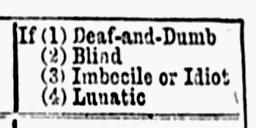
|
| 1872 |
|
22.11.1872 Louisa Lowe's case before Queen's Bench in which she charged the Lunacy Commission with concurring in her improper detention at Brislington House and The Lawn, Hanwell.
| 1873 | murder |
|
|
21.5.1873 On a visit to Fisherton House in Wiltshire, Robert Wilfred Skeffington Lutwidge, uncle of Lewis Carol, and a Lunacy Commissioner, was murdered by William M'Kave, a patient.
Lunacy Law Reform Association founded 1873. "The first report of the Lunacy Law Reform Association" London 1874. (external link) - In 1879 listed at 61, Berners-street, Oxford-street. - Office days: Tuesdays, Thursdays, and Saturdays from 2 till 4 p.m. Subscription: Essential to membership, amount optional. Object: To obtain increased safeguards against wrongful incarceration of the sane, with ameliorations in the treatment of lunatics. Kathleen Jones says that Louisa Lowe was secretary of the "Lunacy Laws Amendment Association", which supported Georgina Weldon [They appear to be different societies]
| 1874 |
|
31.10.1874 British Medical Journal: "LUNACY LAW REFORM ASSOCIATION. The Council of the above Society have just issued their first report, in which they make a series of charges all round, of brutal cruelty, political influience, anid criminal negligence on the part of medical men in signing lunacy certificates." offline)
| 1875 |
|
| 1876 |
|
The Hunting of the Snark - an Agony in Eight Fits, by Lewis Carroll, published
J. Langdon Down, On the education and training of the feeble in mind A reprint of a paper read at the Social Science Congress of 1867 (printed the same year in the Transactions of the National Association for the Promotion of Social Science) published H.K. Lewis, London, 1876. (17 plus 8 pages. Printed paper cover)
1876 Slavery in England : an account of the manner in which persons without trial are condemned to imprisonment for life : with illustrative cases, by an Eye-Witness Lunacy Law Reform Association. London : W.H. Guest, 95 pages [From 1877 SCHC Evidence, 1881 census and other sources, the author appears to have been John Langley Plumbridge (c.1829 - ), Foreign Fruit Merchant, living in Kent, of Plumbridge and son Foreign Fruit Merchants St Botolph Lane London] - See 1873.
| 1877 |
|
The third Middlesex County Asylum was opened at Banstead, in Surrey, in 1877, thus continuing the trend (evident in the location of Metropolitan Asylums Board asylums) of sending people to asylums far from their home. Under community care policies, in the late 1950s and early 1960s, special measures had to be taken to enable relatives in inner London boroughs to visit patients in distant hospitals.
12.2.1877 House of Commons appointed a committee under Thomas Dillwyn "to inquire into the operations of Lunacy Law so far as regards security afforded by it against violations of personal liberty"
The Lancet fact-finding commission on "The Care and Cure of the Insane"
Evidence 7.5.1877: James Billington Secretary of the Lunacy Law Amendement Society... "established by certain individuals who have suffered from the disadvantages of the present system of administering the law." "This society has been established about seven months, but the whole of the committee has been connected the Lunacy Law Reform Association (of which Mrs Lowe is now the secreatry)which has been established five years. It is really an old society with a new name.
| 1878 |
|
April 1878 Brain Volume 1, issue 1. Editors: Drs. Bucknill, Crichton Browne, Ferrier, and Hughlings-Jackson.
Music therapy at Worcestershire County Asylum
| 1879 |
|

|
Reverend Henry Hawkins and friends start the After-care Association for Poor and Friendless Female Convalescents on Leaving Asylums for the Insane. See 1893 - 1894 - 25.2.1913 - Mental After Care Association name - 1926 - 1932 - 1939 - 1950s - 1983 - 2005 (became "Together"). (external link to History) - Leaflets about: Henry Hawkins - history - The archives are kept in the Contemporary Medical Archives Centre in the Library at the Wellcome Institute for the History of Medicine (ref SA/MAC) - Current address and contact details |
| 1880 |
|
|
1880 - 1882 Dr Joseph Breuer (1842-1925)
and his patient
Bertha Pappenheim or "Anna O"
(1859-1936) invent the "talking cure".
At this time Freud was a medical student raising money for his studies by translating from English into German. Read his 1909 account of what Breur and Anna O. did |
| 1881 |
|
2.8.1881 40th anniversary of the Medico-Psychological Association. Daniel Daniel Hack Tuke outlined the progress of psychological medicine.
| 1882 |
|
| Daniel Hack Tuke's Chapters in the History of the Insane in the British Isles. His history, the first draft of which was published in 1854 is the first attempt at a comprehensive one that I know, and the last until the work of Kathleen Jones |
|
The Subliminal Self
The development of ideas about levels of consciousness and the unconscious mind was associated with theories about the spiritual |
|
| 13.2.1882 Charcot presented a paper on the diverse nervous states determined by the hypnotisation of hysterics (Sur les divers états nerveux déterminés par l'hypnotisation chez les hystériques) to Le Académie des Sciences in Paris. The acceptance, by the Academy, of his paper was also the acceptance of hypnosis as a scientific practice and of diseases of the mind as distinct from mental disorders caused by physical disorders. See also 1885 and 1887 |
8.4.1882 British Medical Journal " AMENDMENT OF THE LUNACY LAWS.- A meeting, convened by the Lunacy Law Amendment Society for the purpose of furthering their views, took place this week at the Holborn Town Hall, Mr Torrens occupying the chair.- Mr. Commissioner Miller moved the first resolution:- "That the lunacy laws are highly unsatisfactory, and urgently need reform." He said that the present system of incarcerating a man as a lunatic, upon the certificate of two medical men, required altering. He contended that the soundness of the medical opinions should be tested by public examination, as no man's opinion was worth having unless it would stand the test of skilful cross- examination.- Mr Moseley, in seconding the motion, denied that it would be casting a stigma upon a person should he be publicly examined for the purpose of ascertaining whether he is a lunatic or not, Was it fair to the public that a family, in which there was hereditary insanity, should not be known to have that taint? Ought persons to be allowed to contract marriages with them? For his own part, he considered secrecy as contrary to the public welfare; while, again, proprietors of public asylums had a direct pecuniary interest in still keeping patients after recovery. After some further discussion, the resolution was passed, as were all others calling for an inquiry into the lunacy laws, and adopting a petition to the Houses of Parliament." offline)
25.4.1882 Proposal in UK Parliament that "That all lunatics ought to be committed to the keeping of the State". Negatived.
| 1883 |
|
|
Emil Kraepelin (1856-1926) published Kompendium der
Psychiatrie
(later editions: Psychiatrie: Ein Lehrbuch für
Studierende und
Ärzte - Psychiatry: A Textbook for Students and
Doctors) which
established an orthodox classification of psychiatric
diseases based on clusters of symptoms
(syndromes)
with underlying physical
causes. Kraepelin regarded each mental disorder as distinct
from all
others, having its own
aetiology,
symptoms, course
and outcome. His major groups were
dementia praecox and
manic-depressive
psychosis. -
In 1960 Ronald Laing published
a criticism of the disease approach to psychosis
in which he
used Kraepelin as the example.
|
La découverte des neuroleptiques : une chronologie begins in 1883 with the synthesis of a phenothiazine.
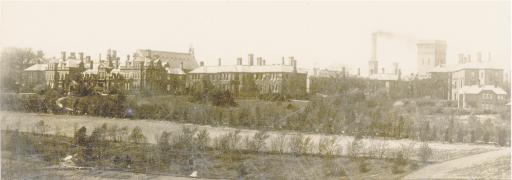
|
| Cane Hill Asylum, Surrey, opened in 1883. It was enlarged to accommodate 2,000 patients by the end of the 1880s. Click on the picture for more information. The picture is from a postcard in the collection of Nigel Roberts. It has "J.T.Carey's real photos... Cane Hill, Asylum. 5024" written at the base of the card. The same picture appears on the urban explorations site with a note that it was taken in 1912. |
1883 Association for the Care of Girls founded in Cambridge to help and protect vulnerable girls.
|
1883 The Bastilles of England: or, the lunacy laws at work
by Louisa Lowe LATE HON. SECRETARY OF THE LUNACY LAW REFORM ASSOCIATION.
London : Crookenden, 1883. 153 pages
Included the following notice:
LUNACY LAW REFORM ASSOCIATION.
OBJECTS. 1. To direct public attention to the serious defects of the existing Lunacy Laws, and the grave abuses in their operation, with a view to remedial legislation. 2. To assist persons who are or may be wrongfully incarcerated, whether in public or private asylums, to obtain liberty and redress. 3. To secure a better method of treatment for all Lunatics, and to set in motion the machinery of the law for the punishment of all persons who maltreat them. 4. To procure the gradual substitution of public for private asylums. Further Particulars may be had on Application. |
| 1884 |
|
Mrs Georgina Weldon sued Dr Forbes Winslow over an attempt to examine her and have her confined in an asylum at her husband's request. This case was a prelude to the 1890 Lunacy Act, which required alleged lunatics to be examined before a magistrate. The confinement of Elizabeth Packard in the United States relates to similar changes there.
The second Gloucester County Asylum opened at Coney Hill.
May 1884
Robert Koch and his team returned to Berlin from Calcutta
where they had isolated the
cholera bacillus. Koch was received as a national hero. See
Who first discovered vibrio cholera? (external link)
which
argues
that Koch's (re-) discovery of the cholera bacillus began to turn the tide
of international scientific opinion away from the
miasma theory. However, the article is not clear if the issue
was water (rather than air) transmission or the
germ theory of the cause of the disease.
Paraldehyde Vincenzo Cervello's "Recherches cliniques et physiologiques sur la paraldehyde" was published in Archives italiennes de biologie in 1884. It is, therefore, after this date that it became the sedative "so useful for the noisy and troublesome patient that it tended to br over-used in hospitals... given intramuscularly (10-15 cc) in the treatment of acute and grave psychoses.." (Sargant and Slater 1963)
October 1884 George Henry Savage, of Bethlem Royal Hospital, signed the Preface to the first edition of his Insanity and Allied Neuroses: Practical and Clinical - offline - . He thanked "W. Haigh, Esq., who has not only corrected my proofs, but has by criticism aided me much in the legal chapters; and Dr. F. Beach, who has contributed to the chapter on idiocy."
| 1885 |
|
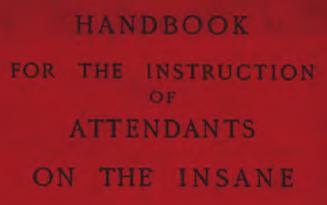
|
1885: First edition of Handbook for the instruction of attendants on the insane. Prepared by a sub-committee of the Medico-Psychological Association. 64 pages. Baillière & Co.: London. (online history at Royal College of Psychiatrists) [See 1891 Nursing Certificate] - May 1902 exam - Model Answers 1928] |
| 1886 |
|
25.6.1886 The 1886 Idiots Act allowed rates to be raised for building an "idiot asylum" or "mental deficiency colony".
| 1887 |
|
13.1.1887 The case of Louisa Lowe against Charles Henry Fox for confining her, reached the House of Lords. She lost the case and had to pay costs. Lord Halsbury, in giving judgement, said "we have nothing to do with the truth or falsehood of the statements" in the certificates of the doctors or the order for the person's detention.
"all that which the keeper of the asylum has to regard is whether the statements which are made in the order are such as to justify him in exercising the powers given to him under the statute, of detaining in confinement the person committed to his charge."
The statute law at issue here (and in several previous cases) was that access to the courts over the substantive issues of a confinement had been removed in 1845. The 1889 Lunatics Law Amendment Act provided for the truth of allegations to be tested legally before the confinement.
|
| Une Lecon Clinique a la Salpetrie, a painting by Andre Brouillet, in 1887, shows Jean Martin Charcot demonstrating on Blanche Wittmann (the lady fainting). Click on the picture to see why her faints were a turning point. - See also 1882 |

|
| 1888 |
|
Following the 1888 Local Government Act (which created London County Council), the old Surrey County Asylum in south London became a Middlesex County Asylum and the London County Council took over from Middlesex a project to build an asylum at Claybury, in Essex. Claybury Asylum opened in 1893.
Colonies for epileptics were opened in different parts of England and Scotland from 1888. Some, such as the Ewell Colony, were short lived. Eleven were still operating as epileptic colonies in 1962: the Maghull Homes, near Liverpool (founded 1888); Meath Home, Godalming (1892); Chalfont Colony (1894); Lingfield Training Colony, Surrey (1897); St. Elizabeth's, Hertfordshire (1903); David Lewis Colony, Cheshire (1904); Langho Colony near Blackburn (1905), Bridge of Weir Colony, Renfrewshire, Scotland (1906); St David's Hospital, Edmonton (1916); St Faith's Hospital Brentwood (by 1930), and Cookeridge Hall, Leeds. (Jones and Tillotson)
| 1889 |
|
April? 1889 1888 Local Government Act came into force and English and Welsh asylums passed from the magisterial control of the Justices of the Peace to the democratically elected control of newly created county and borough councils.
30.7.1889 House of Lords debate proposed notices of rights in asylums

|
Sometime before 1890, Henry Herne Mew was certified insane and confined in an asylum. As it was before the 1889 Lunacy Laws Amendment Act came into force, and as he was a private patient, his detention would not have required the approval of a magistrate. |

|
Science Time Line 1885
See
1840s,
1920s,
1940s
1890s: By the end of the 19th century the failure of asylum therapy had convinced people that insanity is largely (but not entirely) incurable. At Claybury, in 1901-1902, there were 426 admissions, 201 deaths and 148 patients were "discharched recovered". The insane were sent to even larger asylums for custody, to be protected from exploitation whilst society was protected from them. "In spite of this", Alexander Walk says, many improvements followed the asylums becoming the responsibility of County and County Borough Councils in 1888.
|
Postmortems were carried out on the brains of the majority of
patients who
died in the asylum in search of the cerebral lession that many
thought was
the basis of all insanity. This cross-section is from a
collection of
clinico-pathological photographs taken at
Colney
Hatch Asylum between 1890 and 1910. (Hunter and
Macalpine
1974 p.244) say that it shows multiple tumours and
that such
cases accounted for the high mortality amongst newly admitted
patients.
See below, 1895.
"In the 19th century nearly 10% of them died within 3 months of admission from advanced systemic or cerebral disease causing mental symptoms initially" |
| 1890 |
|
The 1890 Lunacy Act was a major consolidating Act that remained the core of English and Welsh Lunacy Legislation until it was repealed by the 1959 Mental Health Act
The major change associated with the Act (actually made in 1889) was that it said private patients, apart from chancery lunatics (whose cases were dealt with by the Court of Chancery) should not be detained without a judicial order from a Justice of the Peace specialising in such "reception orders". Pauper patients already required an order from the magistrates to be detained - although that provision was probably originally an authorisation of public funds rather than a safeguard of liberties as the reception order was intended to be. (Click here to read the summary of the law about admission to an asylum from 1828 - here for 1890 - here for emergency procedures under the 1890 Act). The law respecting the admission of private patients under the Act is outlined in a booklet for the private asylum at Haydock Lodge.
Section 207 placed such severe restrictions on the granting of licences as to virtually prevent new private asylums or the enlargement of established ones.
Section 255 allowed the county and borough asylums to build wards or separate buildings for private patients. Private units were built at the new Isle of Wight County Asylum and Derby Borough Asylum, at Dorset County Asylum and at Park Prewett, Hampshire, amongst others. London County Council made provision for private patients at Claybury and The Manor, Epsom. Shropshire had 28 private class patients in 1911. - Registers of private patients at Netherne (Surrey) survive from 1909 to 1919 - The West Riding of Yorkshire provided a separate asylum (Scalebor Park) exclusively for private patients. (See 1927 list)
Section 55 provided for a pauper lunatic to be "absent on trial" with an "allowance" "not exceeding the charge in the asylum" . Provisions for the absence on trial of private patients were also made. Section 57 provided for the "boarding-out" of pauper lunatics with relatives or friends. [See 25.2.1913]
| "Add to [the number of criminals] the number of indoor paupers and lunatics ... 78,966 - and we have an army of nearly two million: belonging to the submerged classes. To this there must be added at the very least, another million, representing those dependent upon the criminal, lunatic and other classes... and the more or less helpless of the class immediately above the houseless and starving. This brings my total to three millions, or, to put it roughly to one-tenth of the population." (William Booth, 1890, in his chapter on The Submerged Tenth) - See 1904-1908 - 1929 - 1943 |
| 1891 |
|
| 5.6.1891: Census: The column asking about disability had a different heading. |
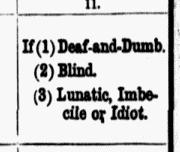
|
1891 "Examination for the Nursing Certificate" of the Medico- Psychological Association established. [See 1885 Nursing Handbook
| 1892 |
|
Special Schools Leicester Education Authority the first in England to provide special instruction for backward and weak-minded children.
The National Society for the Employment of Epileptics (NSEE) was launched in 1892
Prince of Wales Hospital Fund for London started 1892 - A royal patron raising money for London's voluntary hospitals. It became the the King Edward's Hospital Fund for London in 1902. The National Health Service made many of its functions redundant after 1948 and it developed a new role developing "good practice in the NHS". - lost source - 1999 web archive - 1999 history - full web archive - See 1980s and "social care"
| 1893 |
|
| Claybury in Essex, the first compact arrow asylum, opened |
After care association established its first residential care-
home, at Redhill in Surrey, with room for nine people.
| 1894 |
|
After care association renamed After Care Association for Poor Convalescents on Leaving Asylums for the Insane as it now helps men as well as women.
|
A short story
Passed is the first known published work of
Charlotte
Mew. The writer, walking in a poor area of London
(Clerkenwell?), visits a
church. She sees a gospel that the priest at the alter does
not:
"Two girls holding each other's hands came in and stood in deep shadow behind the farthest rows of high-backed chairs by the door. The younger rolled her head from side to side; her shifting eyes and ceaseless imbecile grimaces chilled my blood. The other, who stood praying, turned suddenly (the place but for the flaring alter lights was dark) and kissed the dreadful creature by her side. I shuddered, and yet her face wore no look of loathing nor pity. The expression was a divine one of habitual love. She wiped the idiot's lips and stroked the shaking hands in hers, to quiet the sad hysterical caresses she would not check. It was a page of gospel which the old man with his back to it might never read. A sublime and ghastly scene." The description may shock (See also 1916), but compare with Jayne Eyre in 1847 and the Care of Children Committee in 1946. The outstanding difference is the compassion. 23.8.1894 "Thyroid feeding in insanity : a summary of thirty cases treated by thyroid extract in the Derby Borough Asylum" by S. Rutherford Macphail and Lewis Campbell Bruce read at the annual meeting of the Caledonian Medical Society, at Inverness. It was published in Cretins and idiots: a short account of the progress of the institutions for their relief and cure Glasgow : Alex. Macdougall, 1894. Freda Mew received thyroid treatment in 1902. The treatment was advocated for cases of insanity where doctors had run out of options, and not just for cases of thyroid deficiency. It is an early form of treatment by fever. See later development of malarial treatment. There are similarities with the later use of insulin in that a good result was patients eating and putting on weight. |
Thursday 8.11.1894 Meeting of the Scottish Division of the Medico-Psychological Association in Edinburgh at which Lewis C. Bruce read a paper on "The Effect of Thyroid Feeding in some Forms of Insanity" (offline). In the discussion, he commented
"At present he only advocated thyroid treatment in patients who had not benefited by the ordinary routine treatment of insanity. In such cases it is only just to give the patient a chance of recovery by inducing a feverish condition and hoping for a beneficial result during the reaction subsequent to the fever." (Journal of Mental Science - offline).
| 1895 |
|
Frederick Mott was appointed in charge of the London County Council Asylums' new central Pathological Laboratories at Claybury. His Archives of Neurology from the Pathological Laboratory of the London County Asylums, Claybury, Essex was published from 1899
| 1896 |
|
The National Association for Promoting the Welfare of the Feeble-minded founded. See 1898 - See 16.10.1909 - Later became National Association for the Care of the Feeble Minded - See 1912 - Promoted formation of Central Association for the Care of the Mentally Defective in 1913.
April 1896 "The fact has long been recognised that improvement or recovery from mental disease not uncommonly coincides with, or follows, a fever or other physical disorder." J. Keay, District Asylum, Inverness. "A Study of Forty-four cases of Fever occurring in the Insane". Journal of Mental Science
| 1897 |
|
Richard von Krafft-Ebbing injected syphilis into nine patients suffering from General Paralysis Of the Insane. None of the patients said they had ever had symptoms of syphilis, but they did not develop syphilis sore after the injection, suggesting they had had syphilis in the past. (external link) (Or 1884? External Link)
In Japan, Kiyoshi Shiga identified the bacteria responsible for one form of dysentery - the form that was often found in asylums and, therefore, known as asylum dysentery.
| 1898 |
|
10.6.1898 Meeting on behalf of The National Association for Promoting the Welfare of the Feeble-minded held at Stafford House. Association office: 49, Victoria Street, S.W. (See British Medical Journal report 18.6.1898

|
Freda Mew (19) became insane early in November 1898. She was admitted to the new private block of the Isle of Wight Asylum on 4.2.1899 and remained in the asylum until her death (78) on 1.3.1958. Her case notes survive for 1898 to 17.11.1909 - After which she is largely lost to history. |
|
| 1899 |
|
"The Defective and Epileptic Children Act of 1899 empowered local authorities to spend money on children suffering from these handicaps, and opened the way for colony schools. The Act of 1914, which was mandatory on local authorities, improved the position still further." (Jones and Tillotson p.6)
| 1900 |
|

|
In Interpretation of Dreams, Sigmund Freud interpreted the symbolism of dreams in a way that he presented as a scientific exploration of the unconscious mind. |
| "sexuality, the factor to which I attribute the greatest significance in respect of the origin of these nervous affections which I am trying to cure." See 1905 |
| In 1900 it was decided that the new asylum for Belfast, at Purdysburn would be constructed as detached villas around the country house that was to be its core. This is one of the earliest examples in Britain and Ireland of a move away from a large unified building as the asylum. In the United States of America, Maryland had begun constructing a "cottage" plan asylum in 1896. |
| 1901 |
|
"We often hear it said that the care we bestow on the hopelessly sick, the insane, and the feeble-minded is in opposition to what Darwin taught about the Survival of the Fittest, and that it does harm; but Darwin perceived that it is of such importance to a community that feelings of unselfish affection and public spirit should be strengthened by having to care for the weak, that this more than makes up for any injury done to the efficiency of a community by the artificial preservation of lives not strong enough to fight their own battles" Caroline A. Martineau Voices of Nature and Lessons from Science The Sunday School Association, Essex Hall, Essex Street, Strand, WC. (Second edition) pages 119-120"
|
|
22.3.1901 Death of Henry Herne Mew, aged 34, from tuberculosis, in Peckham asylum. Charlotte Mew's In Nunhead Cemetery may grieve his death and celebrate his life. |
|
|
31.3.1901: Census: The column asking about disability had a different heading. |
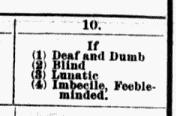
|
October 1901 Francis Galton lectured on The Possible Improvement of the Human Breed under the existing conditions of Law and Sentiment. G. R. Searle, (1976 page 20) calls this "launching his project of race improvement". The initial concern was about physical deterioration. - Contrast above. See Eugenics - 1904 - 1907 - 1910 - 1922 - 1931 - 1933 - 1947 -
| 1902 |
|
1902: National Institution for Persons Requiring Care and Control founded by Harold Nelson Burden, an Anglican chaplain. Incorporated in 1914. See The Burden Trust
|
|
4.2.1902 Freda Mew under Thyroid treatment |
|
May 1902 Five hundred and forty-three people in England, Wales, Scotland and Ireland, applied to take the May examination for the Nursing Certificate of the Medico- Psychological Association. Twelve withdrew, 352 passed and 179 failed. Examinations were also held in November. The questions were about: the composition of fresh air - the construction of the pelvis, and the organs within it - the urine of patients - suicidal attempts by patients - special risks of injury to which epileptic patients are liable - bedsores - treating attacks of apoplexy; syncope (fainting); and choking - feeding paralytic and helpless patients - guarding against and discovering escapes; precautions against homicidal impulses; and "special observation" - poisons and cases of suspected poisoning.
25.7.1902 Annual Meeting of the Medico-Psychological Association, Liverpool. T. S. Clouston, M.D., opened a discussion on the "possibility of providing suitable means of treatment for incipient and transient mental diseases in our great general hospitals."
Friday 1.8.1902 Dr. F. W. Mott (London) opened a discussion on Syphilis as a Cause of Insanity... "Dr Mott concluded by adopting, for the purposes of raising a discussion, the thesis, No syphilis, no general paralysis". (external link See below and 1916)
| 1903 |
|
1903 Sidelights on Convict Life: Broadmoor "There are something like 120 women now confined in Broadmoor, out of a total of less than 200, who had murdered their own child or children. In fact, homicide, with attempts to murder and maim, would appear to be the crime to which the great majority of criminally-inclined lunatics are most prone" (See 1919 and 1922) - "If Society itself were to become quite sane it would recognise that crime and insanity are practically the same thing" - Proposed sterilisation
26.6.1903 Croydon Mental Hospital (not "Lunatic Asylum") opened
Late 1903 A pamphlet of about 30? pages: Proposed sterilisation of certain mental and physical degenerates. An appeal to asylum managers and others by Robert Reid Rentoul, a Liverpool doctor, (born Ireland 1855, died Liverpool 1925) published: Walter Scott Publishing Company, London, 1903. A brief notice in the British Medical Journal in 9.1.1904 may be the first time that journal used "sterilisation" in this sense as distinct from sterilising milk (etc). The appendices to the pamphlet are 1. Marriage law. State of Minnesota, U.S.A., chapter 234, s.f. no. 185 - 2. Marriage of degenerates. Extract from the annual report of Dr. F.H. Craddock. 3. Extract from a woman's letter. 4. Doctor Lombroso on the increase of insanity. - See 19041908 - 1910 - USA 1907 - USA 1909 - 1913 - USA 1921 - Australasia 1923 - 1933 - 1934 - USA 1959 - 2004 -
| 1904 |
|
14.2.1904 "first comprehensive law on mental health in Italy"
16.9.1904 Francis Galton addressed a Sociological Society meeting (chaired by Karl Pearson) on eugenics. "From then onwards eugenics quickly developed into a political movement" (G. R. Searle, 1976 page 80). He spoke again in February 1905.
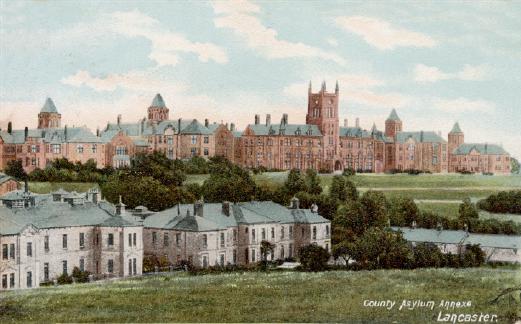
Picture postcard of County Asylum Annexe Lancaster postmarked Lancaster 6.15 pm 25.10.1904. One of several asylum postcards in the collection of Nigel Roberts. |
| 1905 |
|
1905 The spirochaete responsible for syphilis identified. The Wasserman reaction provided a test for it in 1906. This was first used at Colney Hatch Asylum in 1912. Of forty patients diagnosed as suffering from General Paralysis of the Insane, 38 gave a positive reaction. Using the test it was calculated that one tenth of the male patients suffered from General Paralysis of the Insane. In the last half of the 19th century, when other conditions were included because of similar symptoms, the percentage had been calculated as one in five. (Hunter and Macalpine 1974 p.211)
Mental Deficiency: The mid-19th century asylums were developed to treat insanity. However, although congenital idiots and imbeciles were not considered treatable, many were sent to lunatic asylums for custody or control. As the century developed, they tended to be sent to the new, cheap, asylums. Those who were considered physically and morally harmless often stayed with their families, were placed with a substitute family or were kept in workhouses.
Fear of racial degeneracy dominated policy in the early 20th century. It was feared that a "submerged tenth" of the population would outbreed the rest. The Royal Commission on the Care and Control of the Feeble Minded (1904-1908) reported that mental defectives were often prolific breeders and allowing them so much freedom led to delinquency, illegitimacy and alcoholism. They rejected sterilisation as a solution, and called for separation and control.
22.6.1905 Deutsche Gesellschaft für Rassenhygiene by
Alfred Ploetz in Berlin. His brother in law Ernst Rüdin was a
founding member.
12.7.1905 Birth of John, youngest son of George (later
King George
5th) and Mary. John died, aged thirteen on 18.1.1919.
Prince John
suffered from epilepsy and from learning difficulties that
suggested he was
mentally deficient. His existence was kept secret and, from
1916, he
was cared for at Wood Farm, Wolferton, near Sandringham,
Norfolk by a nurse
Mrs 'Lalla' Bill and a male orderly. In February 1996 (?) a
photograph of
John
wearing a sailor suit, holding hands with Queen Mary and his
sister Mary,
was discovered in a photograph album and later published in
British
newspapers. An
internet biography
of him was published by Britannia later in 1996 and a
romanticised drama
of his life
The Lost Prince, written by Stephen
Poliakoff, for BBC1
Television was broadcast in January 2003.
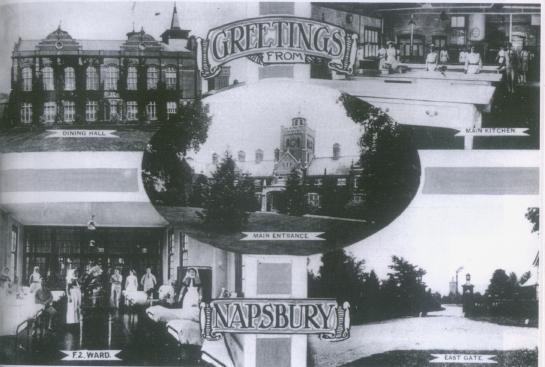
Picture postcard of Napsbury (opened 1905) that is thought to date from the first world war, when Napsbury was a war hospital. |
|
|
Sigmund Freud's Three Essays on the Theory of Sexuality followed, according to Anna Freud, by "outbursts of indignation" |
| 1906 |
|
| 1907 |
|
|
1907 A new system of statutory registers to be kept by
asylums and
hospitals for the insane in England and Wales introduced by the Lunacy
Commissioners. Consisting of seperate Medical Registers, Civil Registers,
Registers of Deaths and Registers of Discharges. Information previously
recorded in one Registry of Admissions Book (admission register) was now
dicided between Medical and Civil Registers.
This new system meant that the medical information could now be
more easily accessed and standardised through
systematic coding. The idea behind these changes was to
provide a more accurate and consistent basis for asylum statistics.
Separating the Medical and Civil registers meant that while the Civil Register could be filled in immediately and more time taken over diagnosis for the Medical Register. Medical and Civil Registers remained in use until 1948, although after the 1930 Mental Treatment Act separate series (or separate sections of registers) were maintained for certified, voluntary and temporary patients. Medical coding during this time remained the same, except for one addition in the Schedule of Forms of Insanity/Mental Illness. See 1939 example |
Autumn 1907 The Eugenics Education Society founded. It changed its name to the Eugenics Society in 1909. By October 1908 its President was Francis Galton.
David Heron: "A first study of the statistics of insanity and the inheritance of the insane diathesis" Eugenics Laboratory Memoirs; 2 London: Dulau.
Departmental Committee on the Operation of the Law Relating to Inebriates and Their Detention in Reformatories and Retreats: In England and Wales about 20 licensed retreats [homes] and 13 reformatories [asylums], as well as others not licensed. At about the same time, Scotland had three licensed retreats and six reformatories and Ireland one retreat and two reformatories. (external link)
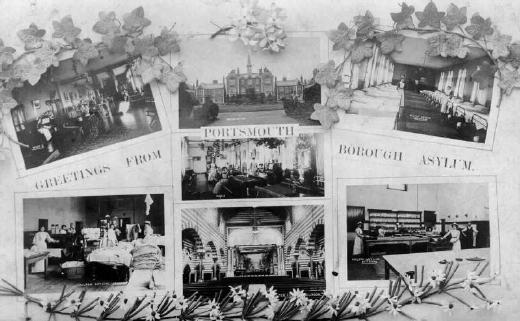
Picture postcard of Portsmouth Borough Asylum postmarked 1907 copied from Stephen Pomeroy's website. Other postcards of asylum's about this time include Lancaster (1904) - Cane Hill (1912) - Napsbury (1914-1918?) |
| 1908 |
|
|
|
1908 English translation from German: The Sexual Life of Our Time In its Relations to Modern Civilisation by Iwan Bloch (First German edition was in 1907). The authorised readership of the English edition was, for many years, restricted to lawyers and doctors. |
|
Sometime in 1908:
A Mind that Found Itself
July/August 1908 Opening of Observation Hospital - "Acute Hospital for the treatment of persons who fear they may become Insane" - in the grounds of the Hudson River State Hospital for the Insane. |
|
1908 Report of the Royal Commission for the Care and Control of the Feeble-minded
The Cambridgeshire Association for the Care of the Feeble-Minded inaugurated. At first it was a sub-committee of Charity Organisation Society organised by Mrs. F. A. Keynes and Ida Darwin.
September 1908 Alfred Frank Tredgold (1870-1952) Mental
Deficiency (Amentia). Published: London : Bailliere, Tindall and Cox.
391 pages: 26 plates. Also published New York : Wood, 1908. [In 1908
Tredgold also published a 17 page pamphlet Some account of the report
and recommendations of the Royal Commission on the care and control of the
feeble-minded, 1908. Tredgold's A Text-Book of Mental Deficiency
(Amentia) (title from 1937) was "largely re-written" in 1929. A twelfth
edition Tredgold's Mental Retardation, revised by others, was
published in 1979.
Tredgold argued that there is "a clear relationship
between amentia and other forms of mental abnormality and disease". He
argued that "family history inquiries show that defectives, persons
suffering from pre-senile forms of dementia, and others suffering from
psychoses and psychoneuroses often come from the same stocks... in many
instances these various conditions may be merely different clinical
manifestations of one and the same germ abnormality"
(Seventh edition, 1947, page 370)
| 1909 |
|
"one person in every 118 of our population is mentally defective, being either mad, idiotic, or feeble-minded" (Francis Galton The Problem of the Feeble-Minded An abstract of the report of the Royal Commission, with commentaries. Quoted Jones, K. 1960, p.65)
16.10.1909 Morning Post "there exist to-day, apart from certified lunatics who are under restraint, 150,000 mentally defective persons, and of these no less than 66,000 are considered to be " urgently in need of provision, either in their own interest or for the public safety." It is difficult to express with sufficient force the gravity of the danger to national life which the existence of these persons uncontrolled in any sufficient manner implies. For from these unfortunate men and women the ranks of paupers, drunkards, and criminals are continually recruited." [Reprinted as a leaflet by the The Oxford branch of the National Association for Promoting the Welfare of the Feeble-minded ]
|
|
17.11.1909 Freda Mew showing signs of recovery. She "has a funny way of getting up suddenly and dancing across room or airing court - has been up daily and is all the better for it." [Last entry in recovered case notes] |
|
| 1910 |
|
Rampton Hospital, Nottinghamshire, opened as England's second Criminal Lunatic Asylum. In 1920 it became a State Institution for mentally defective people considered dangerous.
14.2.1910 to 23.10.1911 Winston Churchill Home
Secretary. Churchill
was a strong supporter of
sterilisation. His proposals for the
forcible
sterilisation of 100,000 moral degenerates were considered too
extreme and
so sensitive that they were kept secret until 1992.
Work not
published until 1922. A
particular concern for Chesterton was the extension of the traditionally
limited concepts of lunatic and idiot to include a much wider section of
the population who are "feeble-minded" -
See 1909, for example
"The unnatural and increasingly rapid growth of
the feeble-
minded classes, coupled with a steady restriction among all
the thrifty,
energetic and superior stocks constitute a race danger which
it is
impossible to exaggerate. I feel that the
sources from which the stream of madness is fed should be cut
off and
sealed up before another year has passed" (Winston Churchill
to Prime
Minister Asquith, 1910, quoted by Clive Ponting, in The
Guardian
Outlook 20.6.1992)
Eugenics
and
sterilisation in the USA
meaning
of
eugenics.
|
Are talking treatments the way out of
therapeutic pessimism?
Tuesday 19.4.1910 There is a "general idea that nothing is done in the way of treatment in asylums" - "treatment does not appear to have yielded many results: the recovery rate has not increased during the past thirty years." Dr Street, of Haydock Lodge, advocated "a higher form of moral treatment than the usual occupation, recreation and amusement; a more intimate knowledge of the mental condition of every patient, and particularly a more frank and open method of dealing with it. He believed in discussing a patient's mental symptoms freely with him, whether they were delusions or suicidal inclinations". |
10.7.1910 George Gibson, an attendant at Winwick Asylum, and other disgruntled Lancashire asylum workers, formed the National Asylum Workers Union, which soon spread through the United Kingdom, including Ireland, with a branch secretary in most asylums. The union affiliated to the Labour Party in 1914 and was active in Labour Party affairs. It became the Mental Hospital and Institutional Workers' Union in 1930. In 1946 it merged with the Hospital and Welfare Services Union to form COHSE, the Confederation of Health Service Employees. Since 1993 it has been UNISON Phil Watkins' COHSE History site
| 1911 |
|
" With regard to insane criminals, it must be remembered that every form of mental alienation assumes a specific criminality." (Lombroso Ferrero 1911)
Eugen Bleuler, (1857-1939) Dementia praecox, oder Gruppe der Schizophrenien published Leipzig. [Translated into English in 1950 as Dementia praecox: or, The group of schizophrenias. (In 1910 Bleuler had coined the word schizophrenie, from Greek words for split and mind, as an alternative to dementia praecox). See 1923
8.7.1911 The first national conference of the National Asylum Workers Union was held at Pitmans Hotel, Birmingham Delegetes came from Winwick Asylum, Banstead, Bexley, Bodmin, Caterham, Cardiff, Chester, Claybury, Exminster, Hellingly, Lancaster, Leavesden, Macclesfield, Maidstone, Menston, Norwich, Prestwich, Rainhill, Storthes Hall, Wakefield and York. Apologies were received from Abergavenny, Talgarth, Colney Hatch, Darenth, Hanwell, Aylesbury, Haywards Heath, and Narboro. (Michael Walker, Unison)
| 1912 |
|
1912? Phenobarbitone (luminal) introduced into the treatment of
epilepsy.
April 1912 - Asylum chapels Of the 94 lunatic asylums in England and
Wales, only seven were without a chapel. Two because they are at present
incomplete and two are old and small asylums. The West Riding of Yorkshire
was resisting providing chapels at the
Menston,
Storthes
Hall
and
Scalebor Park asylums.
(See Hansard)
17.5.1912 Debate on second reading of the Feeble-Minded Persons
Control Bill - "to put it briefly, the object of this Bill is to
regularise the lives, and, if possible, to prevent the increasing
propagation of half-witted people"... "if the only class of persons you can
bring into this Bill are those who are dangerous to themselves and to
others, you exclude from the purview of the Bill the bulk of the feeble-
minded and specially those whom associations such as the
National
Association for the Care of the Feeble-Minded are anxious to
deal with. We
know the great interest that is aroused in this question particularly in
regard to illegitimacy."
(Hansard)
| 1913 |
|
From 1913, local authorities could provide free treatment for people suffering from tuberculosis. I believe some of this was provided by adding verandas to asylum wards (as at Brentwood in Essex). In the early 1970s I was shown how the bed space of the original Derby County Asylum had been tripled, first by converting galleries to dormitories and then by adding verandas for people with tuberculosis.
25.2.1913 Annual Meeting of the After-Care Association at which Dr C. Hubert Bond, "Commissioner in Lunacy" read a paper on "After-care in cases of mental disorder, and the desirability of its more extended scope" (Abstract on Royal College of Psychiatrists website) - About 7,000 people were discharged from public asylums in England and Wales each year. After-care would benefit all of them, but for least 1,500 it was "urgently required". However, only about a quarter were being helped by the Association. He proposed branches of the Association corresponding to each local lunacy authority and that asylums notify the local branch of discharges and trial discharges. He suggested the Association's rules be amended to allow it to help patients on trial under section 55 of the Lunacy Act. The income from such patients would assist the Association's finances.
13.6.1913 Special Committee of the After-Care Association commented that "funds would be better employed helping trial cases than many of those on whom they are at present spent".
1913 or 1914 After care association renamed Mental After Care Association for Poor Persons Convalescent or Recovered from Institutions for the Insane [Although not clear when it became just the Mental After Care Association, the short title is used in 1927]
|
1913 Asylums built under the 1913 Mental Deficiency Act (Royal Assent 15.8.1913) were not hospitals, but "colonies" designed to separate defectives from the gene- pool of the nation. In 1934, the Brock Committee recommended voluntary sterilisation as a cheaper means to the same end. See the collection of forms used under the Act. The 1913 Mental Deficiency Act also established The Board of Control. This was the old Lunacy Commission with extended functions with respect to mental deficiency. The Board of Control continued to regulate the mental health system until 1959, but with reduced responsibilities after the National Health Service Act. 15.11.1913 The National Association for the Care of the Feeble Minded called a meeting at Denison House, London, S.W. of representatives of organisations "engaged in voluntary philanthropic work for defectives". This constituted a Central Association for the Care of the Mentally Defective which would work with the Board of Control and local authorities throughout the country. Leslie Scott (1869-1950), a conservative MP and lawyer with knowledge of the new Act, was President and Chairman of the Association from 1913 to 1947. Evelyn Fox (15.8.1874- 1.6.1955) was its honorary secretary. Its name changed to the Central Association for Mental Welfare in 1922 (Ruth Rees Thomas, 1971/- , Oxford DNB, under Evelyn Fox). In 1947, Leslie Scott and Evelyn Fox became founders of the National Association for Mental Health, into which the Central Association for Mental Welfare merged. (See British Medical Journal report 22.11.1913 - (Jones, K. 1972 p.267) - Oxford DNB under Fox and Scott. |
|
|
Autumn 1913 Charlotte Mew offered to address envelopes for the new Medico-Psychological Clinic "to provide... different forms of treatment, both medical and psychological... for functional nervous diseases". |
| 1914 |
|
Pellagra shown by Joseph Goldberger (1874-1929) to be caused by a nutritional deficiency and not by an infection.
1.4.1914 [April Fools Day] The English and Welsh Mental Deficiency Act 1913 came into operation except with respect to the Board of Control [1.11.1913]
First publication of
Rachel Grant Smith's experiences:
15.7.1914
"Law Made Lunacy" in Truth
22.7.1914
"The Insufficiency of the Petition" in Truth
29.7.1914
"Madhouse Horrors" in Truth
|
the great war for civilisation
One side of a medallion, found with others, in the attic |
World War Part One: Science Time Line
1914-
1919
Bert Roberts signed up in the Royal Army Medical Corps very
early in
hostilities. His fiancee, Lily McKenzie, often saw the postman
as she left
for work in the morning. There were no letterboxes. He had to
knock to
deliver the letters. One morning he looked green and he told
her he was
close to turning his job in: "They have gone over the top at
Gallipoli".
His hand held a bundle of brown envelopes containing the
official messages
of the dead, the missing and the injured to deliver to
Dickenson Street,
Warrington. [British landings at Gallipoli were on 25.4.1915.
The British
withdrew 9.1.1916.]
The twentieth century's first encounter with mass slaughter on a world wide scale was traumatic.
The
World War
One Document
Archives'
medical
titles on
psychiatry
include
Shell Shock and its Lessons by
Grafton Elliot
Smith and Tom Hatherley Pear. Manchester University Press,
1917.
The Oxford book of Twentieth Century Words lists shell-shock from 1915, defining it as "a severe neurosis originating in trauma suffered under fire. A term particularly associated with World War 1, in which soldiers on the Western Front were subjected to a seemingly incessant barrage of shell-fire". It compares it with bomb-happy (1943) in the second world war. But shell-shock was used by the medical profession, whereas bomb-happy was colloquial. (See later rejection of shell-shock as a medical term) |

At the start of the 1914 war, Charles Stanford Read says, any officer or private showing what might be "psychotic" symptoms was sent to "D" Block, Netley, the Mental Division of the Royal Victoria Hospital. "Convoys of such cases reached there from France, Belgium, Italy, Salonika, Palestine, Mesopotamia, Egypt, and India. The first cases
"were dealt with according to the ordinary King's Regulations, which necessitated discharge from the army because of insanity and transference to their district asylum, where their status was no different from the other inmates."
It was then decided to equip special War Mental Hospitals where soldiers would stay for up to a year (reduced to nine months) under observation and treatment without certification.
| 1915 |
|
January 1915 Army Council estimated an additional 56,000 beds would
be required to cope with wounded and sick troops. The Asylum War
Hospitals Scheme, worked out with the
Board of Control, moved civilian inmates out of certain asylums
to provide accommodation for military medical, surgical and (from
February) mental casualties.
(Read, C.S. 1920 -
Cullen, S. -
and
Barham, P.
2004, pp 44-45)
The asylums during the warMany asylums were used as troop hospitals. (external link: Military Hospitals in the United Kingdom) Conditions in some asylums during the war were very bad - leading to a high death rate (See Brentwood below)
Hospitals (asylums?) during world war one: -
Military: - See Netley - Naval: See
Haslar
War Mental Hospitals: "The dropping of the word asylum was
specially undertaken to obviate,
if possible, the stigma that might be felt to attach to the name, which
stigma does exist, rightly or wrongly."
(Read, C.S. 1920) - See civil use
26.6.1903 -
1920 -
1930 -
|
10.11.1915 Royal Assent for the 1915 Naval and Military War Pensions Act - See below - See Charlotte Mew
|
|
Royal Commission on Venereal Diseases recommended free diagnosis and treatment. It was estimated that 10 per cent of the population in large cities were infected with acquired or congenital syphilis
The successful identification of General Paralysis of the Insane as an end product of syphilis raised hopes of finding an organic cause for all mental illnesses (See Frederick Mott). The following poem suggests that it also re-inforced belief in degeneration theory as the overall causal explanation.
|
|
May 1916 Publication of the major volume of
Charlotte Mew's poetry (The Farmer's
Bride) whose dialogues with insanity included this in
On the Asylum Road
"Theirs is the house whose windows...
But still we merry town or village folk
|
10.12.1916 Labour leader, George Barnes, became the first Minister of Pensions. The Ministry of Pensions was created to handle the payment of war pensions to former members of the Armed Forces and their dependants. Pensions to ex-service lunatics were used to create the category "service patients" who were paid for from public funds, but counted as private patients. See 18.8.1919 - Citizen Soldier - 2.2.1921 - 1.1.1922 - 16.2.1922 - 1.1.1927
| 1917 |
|
1917 525 patients died in Brentwood County Asylum during the year. This was only ten less than the number of admissions. By 1919 the number of deaths had fallen to 346.
1917 Malarial treatment of general paralysis Julius Wagner-Jauregg (1857-1940), in Austria, injected nine people suffering from General Paralysis of the Insane with the infectious blood of malaria patients. The theory was that the consequent fever would cure the G.P.I. and this appeared to be the case. Subsequently, experiments were carried out in many countries. See the 1924 reports on "The Malaria Treatment of Paretic Dementia". This may have become a standard treatment. See Scalebor Park, 1924, Horton 1924, Brentwood 1926 Nobel prize 1927 1929, Penicillin 1941 - 1963
Survival chart for 115 patients mainly with general paralysis admitted to Winwick Hospital between January 1923 and September 1926
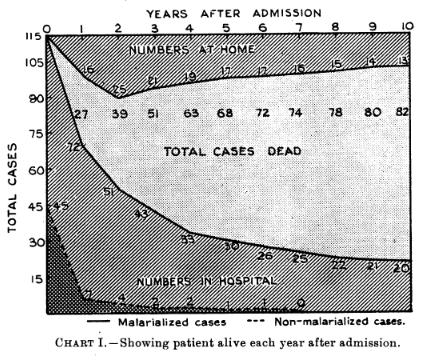
|
45 who did not get malaria from the treatment mostly died in the first
year.
Of the 70 who did get malaria, 33 lived over ten years. Of these long-term survivors, 20 were in the hospital and 13 at home at the end of the ten years.
|
|
Emil Kraepelin's Hundert Jahre
Psychiatrie : ein
Beitrag zur Geschichte menschlicher Gesittung [One Hundred
Years of
Psychiatry: A contribution to the history of human
civilisation], written
1917, published in Berlin by Springer in 1918.
115 pages,
illustrated. This was
translated into English by Wade Buskin and published in
1962 as
One Hundred Years of Psychiatry. The translation
contains a short
epilogue by H. Peter Laqueur, MD, reflecting on the
years 1917-1962.
Kraepelin wrote "in Germany in the middle of a raging war" (p.154). A single paragraph, towards the end of the book, praises chemicals in the control of patient behaviour (after "protracted baths")
"We should not fail to note that the solution of many difficulties faced by the older doctors is the contribution of the chemical industry which in the last decade has created an imposing list of new soporifics and sedatives. The first sedative was chloral hydrate, recommended by Liebreich. Almost every other drug with similar effects was first manufactured and administered in Germany. Such agents are rightly considered expedients, however, and their use opens the door to many dangers. Still, for countless patients they are an immeasurable blessing, and they are mainly responsible for bringing the quiet atmosphere of the hospital into the wards for the insane and removing much of the horror that still feeds the imagination of the lay public" (pages 143-144) |
| 1918 |
|
Encephalitis lethargica followed the flu pandemic. This
affected up to
five million people worldwide. One third died quickly, one
third recovered,
the remainder bore the aftereffects for years or decades.
Encephalitis
lethargica "vanished" in 1928. - External links: Encephalitis
lethargica:
BBC
archive
-
History of narcolepsy -
Can the flue cause Parkinson's
Disease?
archive -
Lancet 1956
archive
In 1917
Constantin von Economo in Vienna reported a small outbreak of an
illness in which the
main features were fever, stupor, and ophthalmoplegia. Of his 13 patients
died and at necropsy there was evidence of inflammation of the brain
substance.
"Report of an enquiry into an obscure disease, encephalitis
lethargica" published HMSO London in 1918. "During the next two
years a
great many similar outbreaks were
recorded and by 1921 the disease had reached epidemic proportions in almost
every country in Europe". In spite of perplexing variations in the
clinical picture from case to case, locality to locality, and even from
season to season, it soon became clear for practical purposes a new
clinical entity had appeared. In 1924, 5039 cases of encephalitis
lethargica were notified in England and Wales alone. See
1927 Mental Deficiency Act.
However, by the beginning
of the next decade (1930s?) confirmed cases of this dangerous disease had
become
sporadic and by 1939 they were extremely rare.
Said to have killed 250,000 people in the United Kingdom
and 40 million
people world wide. (And there were plenty of other things
killing people at
this time -
See Charlotte's web)
|
|
16.3.1918 First edition of
Married Love by Marie Stopes.
See also 1905 Freud - 1923 Men, Women and God |
| 1919 |
|
|
In 1919 Siân Busby's great-grandmother, Beth Wood (1878-1957) drowned two of her children and was sent to Broadmoor. The murder and the shame affected the whole family down to the present with fears about hereditary insanity and an inability to parent. The Cruel Mother: A Family Ghost Laid to Rest (2004), an investigation of what happened, is partly the author's attempt to cope with the consequences.
|
Margaret Macdowall: Simple beginnings in the training of
mentally
defective children London: Local Government Press Co. (R.
T. Leach),
1919 116 pages: illustrated. bibliography and index
18.8.1919 Right of patients classified as
"service patients" to wear
their own clothes - Others wore "pauper clothes" -
Reported Hansard
|
|
Saturday 27.9.1919 The Westminster Gazette published The Cenotaph by Charlotte Mew |
Ministry
of Health Act
1919 established a Minister of Health to
secure the health
of the people including the treatment of physical and mental
defects.
| 1920 |
|
By an Order in Council of 1920 the Minister took over the Home Secretary's powers under the lunacy and mental deficiency laws. These included appointing the non- legal members of the The Board of Control.
Science Time Line 1920
See
1840s,
1890s,
1940s
1919 1920s 1930s
From shortly after the first world war moves were made
1920 The Board of Control took over
Rampton as the first English
State Institution for mentally defective people
considered dangerous. Broadmoor now specialised in the
insane as part of
the Home Office prison
system and Rampton was part of the Board of Control's remit to
control
mental
deficiency.
"from about 1920 onwards, the term
"mental hospital" came into general use, though it did
not
receive legal recognition until
1930." (Alexander Walk
1962
24.3.1920
"Lunacy Law Scandals" in Truth
12.4.1920
Question in the House of Commons about "Military
Hospitals (Asylums)" -
Ashurst -
Ewell -
Springfield - and
Winwick were still military hospitals.
Maudsley -
Maghall -
Monyhull
- and
Craigleith were Ministry of Pensions Hospitals, but Maudsley was
due to be
handed back to the London County Council in July 1921.
But these moves only touched the edge of the mental health
system.
|
Link to Jonathan Toms' review of
Peter Barham's Forgotten
Lunatics of
the
Great War, a book that argues that the concept of citizen
soldier
help to change the public perspective on the mentally ill.
"in the aftermath of the war... ex-servicemen were drawn into recording
their embittered experience at the hands of official agencies such as the
war pensions authorities"
(p.7)
|
|
29.4.1920 First private conference on lunacy reform, Minerva Cafe
19.5.1920 Second private conference on lunacy reform, Minerva Cafe -
Followed by formation of the National Council for Lunacy Reform. "objects:
to promote research into the causes of mental instability; to investigate
the present system of care and treatment, and its results; to secure the
provision of hostels for early cases; to safeguard the liberty of
the subject; to reduce the burden of ever-increasing asylum expenditure;
and to educate public opinion on the subject of mental disorder.". Members
included
J. E. Parley and
Montagu Lomax.
(Hervey, N.B.
1986) - Nic Hervey gives its addresses as 32/33 Avenue Chambers,
Southampton Row - 90 Avenue Chambers - and
44 Wimpole
Street.
He says it became the
National Society for Lunacy Reform
1920 Ernest Parley Life in a madhouse Independent Labour
Party (Great Britain). Pamphlets. New Series ; No.27. 24 pages
12.12.1920
Question in the House of Commons suggesting
the £7,900,000 spent each year on asylums could be reduced if
councils ran run hospitals for early uncertifiable mental cases entirely
unconnected with lunacy administration.
|
28.11.1928 59th Assembly of the Swiss Psychiatry Society. Jakob Klaesi outlined his sleep cures: Dauerschlaf (continuous sleep, hibernation) or Dauernarkos (continuous anesthesia). In 1921 Jakob Klaesi published "Ueber Somnifen, eine medikamentöse Therapie schizophrener Aufregungszustände" in the Schweizer Archiv für Neurologie und Psychiatrie. 8:131. Somnifen was a barbiturate. The sleep cure was "a drug therapy for schizophrenic States of excitement". Other names for the treatment ar continuous narcosis and deep sleep treatment. See also insulin coma. Three out of the 22 original patients died. Henderson and Gillespie (1944, p.418) say "It has been claimed that by adding insulin and glucose to the treatment by narcotics, the danger to life which attends the method (from collapse, respiratory complications, etc), producing sometimes a death rate as high as 5 per cent, has been minimised" |
| 1921 |
|
1921 Ernst Kretschmer (1888-1964) published Körperbau und Charakter (body-build and character), translated into English as Physique and Character arguing that body types match characters and pre-dispositions to types of mental illness.
1921 Montagu Lomax The experiences of an asylum doctor : with suggestions for asylum and lunacy law reform, based on his experiences at Prestwich. A "popular edition" was published in 1922.
1921 Cassel Hospital admitted its first patient. External link to web archive
1921 West Park Asylum at Epsom opened. Referred to by David Cochrane as "the eleventh and the last great asylum built for London's insane". But the new hospitals in the 1930s had London catchment areas.
15.1.1921 La Ligue Française de Prophylaxie et d'Hygiène Mentale formed by Edouard Toulouse. Recognised as a "utilité publique" in 1922. Renamed la Ligue Française pour la Santé Mentale (LFSM) in 1996. (web history)
2.2.1921 Letter in The Times from G.K. Chesterton (and others?) saying that the treatment of mentally distressed servicemen had "opened the eyes of the public to the fact that the life of patients in asylums is often one of prolonged misery" (Barham, P. 2004 p.358)
| 1922 |
|
Eugenics and Other Evils Essays by G.K. Chesterton, published London: Cassell. 1922. Re-published New York by Dodd, Mead and Company 1927. "bulk of preliminary notes about the science of Eugenics were written before the war".
1922 La Ligue Nationale Belge d'Hygiène mentale formed by Auguste Ley (1873-1956). See 11.12.1922. A ladies committee formed in 1924 specialised in activities such as working with children hampered in their normal development.
Sunday 1.1.1922 number of ex-service men classified as "service patients" by the Ministry of Pensions, by asylum.
Monday 9.2.1922 "charges similar to the charges made by Dr Lomax are being repeated almost daily by responsible persons in the public Press; that some 6,000 ex-service men are being detained under the system thus openly attacked" (Charles Loseby MP. Hansard)
Wednesday 15.2.1922 Question in the House of Commons suggesting a Royal Commission.
Thursday 16.2.1922 Hansard: Partial explanation of what a "Service Patient" is.
Wednesday 22.2.1922 "The care of the insane : an address delivered at the Guildhouse, Eccleston Square, on February 26th, 1922 by Maude Royden ; with a foreword by Dr. Montagu Lomax". Published by the National Society for Lunacy Reform.
27.3.1922
Letter from Courtauld Thompson about the foundation of a
National Council for
Mental Hygiene.
4.5.1922 Founding meeting of a National Council for
Mental Hygiene
in Great Britain.
(British Medical Journal report) - See
October 1929 and
November 1946
June 1922: Begining of
Harnett v Bond and Adam case in which
a jury awarded enormous damages to an
escaped mental
patient in
his case
against a lunacy
commissioner.
31.7.1922
Ministry of Health Departmental Committee on the
Administration of Public Mental Hospitals
| 1923 |
|
31.1.1923 The London County Council Mental Hospital called
The
Maudsley opened.
"The Maudsley which will be opened by the L.C.C. on January 31, is the first municipal institution for early treatment of lunacy and scientific research into causes of insanity." (British Journal of Nursing, 27.1.1923, p.60) Medical School later Institute of Psychiatry See external history - archive |
1923 John Thomson, M.D. (editor of "Edinburgh Hospital Reports")
Opening
doors: a little book for the mothers of babies who are long in
learning to
behave like other children of their age Edinburgh and
London: Oliver &
Boyd, 1923. Twenty pages.
1923
Bleuler's
Textbook of psychiatry authorised English edition by
A.A. Brill
London : Allen & Unwin.
(offline)
1923 The Handbook for Mental Nurses being the seventh edition
of the
Handbook for the instruction of attendants
on the insane by the
Medico-Psychological
Association, with a new title. A further revision was begun in
1932 but the eighth edition
did not appear until
1954
|
|
1923 Men, Women and God: a Discussion of Sex Questions from the Christian Point of View by Arthur Herbert Gray. |
The National Society for Lunacy Reform may have started in 1923. But see National Council for Lunacy Reform - See Royal Commission evidence "National Society for Lunacy Reform" - See "National Society for Lunacy Law Reform" 1929 - 1931 - Dr James Samuel Risien Russell (1863-1939) chaired the "National Society for Lunacy Reform" in the 1920s. His his private practice was at 44 Wimpole Street from the 1900s. His web biography says "he was often a witness in legal cases involving lunacy, notably Harnett v. Bond (1924-5)".
2.5.1923
to July 1923
Clifford and Clara Beers tour of Europe: Gheel in Belgium -
Paris - London.
12.7.1923
6,900 patients receiving treatment for war neurosis
12.7.1923
House of Commons discussion of men who have sex with children -
"if it cannot be proved that they were mentally deficient at the age of
three they cannot be classified under the Mental Deficiency Act as being
mentally deficient." [See
amendment 1927] "I heard the other day of a man of 63 who for 40
years
had lived a life of continually committing these offences, being repeatedly
sent to prison, and released, and then committing the offence again. He had
done that continuously for 40 years. That man ought to be looked upon as a
mental degenerate and treated as such". (Margaret Wintringham)
17.11.1923 "Asylum reform: an address: (delivered at a conference in
Mortimer Hall, London, on November 17th, 1923) by Montagu Lomax."
Published: London:
National Society for Lunacy Reform, 1923.
| 1924 |
|
| 1924 Ministry of Pensions Mental Hospital opened at Storthes Hall in Yorkshire. |
1924 Der deutsche Verband der Psychohygiene formed by Robert Sommer. See 1927 - 1928 - 1932 - 1933 -
1924 Branthwaite Report on the diet of patients and Bond Report on nursing service in mental hospitals published by the Board of Control.
3.3.1924 Hansard: Calls for a Royal Commission following Harnett v Bond and Adam case.
May 1924 "The treatment of general paralysis of the insane by malaria" by Henry J. Macbride and W. L. Templeton published. The paper had been delivered on 12.12.1923. Summary - See Malaria treatment
Tuesday 24.6.1924 composition and the terms of reference of the Royal Commission on Lunacy and Mental Disorder published. Reported 1926
Thursday 26.6.1924 Valentine McEntee asked for "adequate facilities be given to the inmates of asylums to bring to the notice of the Royal Commission circumstances and conditions which, owing to the secrecy prevailing in lunacy institutions, do not usually come under the cognisance of the medical officers in charge thereof". (Hansard)
7.10.1924 First hearing of evidence by the Royal Commission [20 days of hearing to 10.2.1925] [22 days of hearing 24.2.1925 to 11.12.1925]
19.10.1924 la Lega italiana per l'igiene mentale founded at Bologna, Italy, by Giulio Cesare Ferrari (1867-1932) on the model established by Clifford Beers. Ferrari had met Beers in Paris in 1923.
29.11.1924 Editorial in British Medical Journal suspected there were too many semi-popular books on psychoanalysis even though public interest was great. Reading them suggests psychoanalysis is fraught with danger because of the transference mechanism which could induce signs of violent love in the patient towards the analyst. |
|
|
December 1924 Charlotte Mew met Siegfried Sassoon and the Untermeyers. Louis Untermeyer later described her as an exceedingly reticent and hermit-like poet. |
| 1925 |
|
17.1.1925 Public hearing of evidence by the Royal Commission from Mr H. W. Holman (former patient). Hearing continued 26.1.1925. (Reported British Medical Journal 31.1.1925 offline). Then on 27.1.1925. On 25.2.1925 the commission announced that further hearings from ex-patients would be in private.
21.4.1925: Board of Control Conference on what to do about the nursing service in mental hospitals
Board of Control Conference to consider ways for increasing mental hospital accommodation in England and Wales
21.5.1925 Question in the House of Commons about grant for councils running hospitals for early uncertifiable mental cases.
Nurse Jessie Millar dismissed from "Garlands Mental Hospital" for striking Elizabeth Foster (aged 70), a feeble patient who was "constantly getting in and out of bed", on the head with a stick of firewood. At Carisle, on 14.11.1925, Jessie Millar was fined £2 and 10/- costs. "For the defence, it was stated that the nurse lost her patience through nervous exhaustion. She had to attend during the day to a mother who had since died, and during the night she had the care of 31 patients" (Asylum Workers Magazine December 1925)
11.12.1925 Concluding hearing of evidence by the Royal Commission
Child guidance in Scotland In 1925 James Drever set up, within the Psychology department at Edinburgh University, "the nucleus of a clinic for the study of delinquent children. This soon developed into a Child Guidance Clinic, staffed on a voluntary basis by the members of the Psychology Department working in collaboration with psychiatrists and social workers. This pioneer voluntary clinic led to the establishment of child guidance clinics in Edinburgh and other parts of Scotland." (source)
| 1926 |
|
Report of the Royal Commission on Lunacy and Mental Disorder Summary from Michael Warren:
[argued] that there is no clear distinction between mental and physical illness, defining mental illness as "the inability of the patient to maintain his social equilibrium"; recommended a community service based on the treatment of patients in their own homes wherever possible with a strong preventive element; certification should be a last resort, not a preliminary to treatment; there should be no distinction in the methods of certification used for private and pauper patients; local authorities should established outpatient clinics, provide observation beds in general hospitals and fund after-care services provided by voluntary agencies; mental hospitals should not exceed 1000 beds [See also voluntary boarders] "The keynote of the past has been detention. The keynote of the future should be prevention and treatment".
1926 Mental After Care Association providing for 400 people in "cottage homes" and 150 people with work placements. Another 1,450 received home visits.
Hydrotherapy: At Warley, "Hydrotherapy became a vogue in 1926 that lasted until the war" - In the management of "turbulent patients" the main resources mentioned by MacPhail in 1928 are seeking the cause, separation and/or seclusion, continuous baths and sedation. A "continuous bath, with the use of a cover to the open bath, with an aperture therein for the patient's head" was one of the five means of "mechanical restraint" permitted by the Board of Control.
1926 An appeal to
The Commonwealth Fund (New York) by Cyril Burt and Amy Strachey,
(born Amy Simpson 1866) "Mrs St Loe Strachey" for funds to start training
psychiatric social workers at the London School of Economics
(see below)
and support for
Child Guidance.
| AIM25 contains "material relating to the Mental Health Course, 1926-1957, including papers of the Child Guidance Council, the Commonwealth Fund and the Mental Health Training Committee; material on the teaching of Statistics and Computing Methods, Insurance, Social Studies, Latin American Studies, Management and Management Studies." - A grant is recorded to "London, University of, 1926- 1968" in the Commonwealth Fund archives. |
| 1927 |
|
1927 A Text-Book of Psychiatry for Students and Practitioners by D.K. Henderson and R.D. Gillespie first published - (extracts)
1927 statistics
1.1.1927 74 County Mental Hospitals and 24 County Borough Mental
Hospitals in England and Wales = 98 Mental Hospitals. The total number of
patients was 110,701. 101,031 were "rate-aided". 9,670 were "Private
(including all Criminal patients)". The majority of the private patents
were ex-service men. There were 2,888 females in the private patient column
and 6,782 men. 5,376 of the men were ex-service men. 4,898 were "paid for
by the Ministry of Pensions, and classed as
'Service' patients". 478 were
"paid for by the Board of Control, and classed as 'ex-service' patients.
(1.1.1927 List)
early in 1927 a Mental Deficiency Act brought in a new, looser, definition of mental deficiency which made it easier to confine people with encephalitis lethargica or epilepsy or other diseases. A circular issued by the Board of Control emphasised that "mental defect ... may exist in persons of some - or even considerable - intellectual capacity."
|
early in 1927 the London based Child Guidance Council was
formed out of the amalgamation of organisations concerned with child mental
health.
William Moodie (13.3.1886-24.5.1960) was enabled by the Commonwealth Fund of America to go on a fact-finding tour of the United States in 1927 with a view to introducing child guidance to the United Kingdom.
Child Guidance in England "developed from an American model. Child Guidance
services were originally staffed by specially trained social workers....
Bowlby (1987) records the first introduction of psychiatrists
and
educational psychologists into a London (Canonbury) Child Guidance clinic
in 1936."
(Baldwin, L.
2008 p.22). As an indication of the importance of child guidance
in the 1930s, see the
address of the President of the The Royal Medico-Psychological
Association on 6.7.1938. Also see the rise and fall in
the use of the term and
mental health history dictionary.
The East London Child Guidance Clinic, funded by the Jewish Health Organisation, opened in 1927 (evening consultations). The London Child Guidance Clinic or Canonbury Child Guidance Clinic, funded by The Commonwealth Fund, was founded in Islington in 1929, by William Moodie, and the Notre Dame Child Guidance Clinic opened in Glasgow in 1931. See Child Guidance Council. The Association for the Scientific Treatment of Criminals (1931) appears to have focused on work with children and young people. 25.3.1927 "Report of the sub-committee appointed to consider the details of the proposed Demonstration Clinic, and to report to the" [Child Guidance] "council.." The clinic's chief objects would be:
25.3.1927 Report quoted
(Stewart, J. 9.2009, p.410
|
2.6.1927 The organising committee of the International Committee for Mental Hygiene met in Paris at the same time as a three-day celebration of the life of Philippe Pinel. Clifford was instrumental in ensuring German representation.

|
October 1927 Announcement that Julius Wagner- Jauregg was awarded the Nobel prize in medicine was for his "discovery of the therapeutic value of malaria inoculation in the treatment of dementia paralytica" (weblink). The next psychiatric Nobel was Moniz in 1949 |
|
MUNICIPAL ELECTIONS,
November, 1927. ALL MEMBERS OF THE NATIONAL ASYLUM-WORKERS' UNION ARE URGED TO WORK AND Vote for the Labour Candidates |
| 1928 |
|
1928 The Child Guidance Council [An explanatory leaflet] published by the Child Guidance Council (London). See 1935 - 1937 - Provisional National Council for Mental Health. See also Child Guidance
1928 - 1932 - 1940 - 1944
Question 66: Causes of mental disease are hereditary predisposition - age - physical disease - disease of the central nervous system - trauma or head injury - syphilis - disease of the endocrine system - effect of special experience - over-education
25.2.1928 Joan Hughes born
| 24.3.1928 Charlotte Mew drank half a bottle of disinfectant, from which she died. |
1928 Zeitschrift für psychische Hygiene the journal of the Deutscher Verband fur Psychische Hygiene was published as a supplement to the journal of the German Psychiatric Association. From 1935 (volume 11) it was the journal of the Verband Deutscher Hilfsvereine fur Geisteskranke [German Association of Societies for the mentally ill] and part of their combined journal. ISSN: 0372-9745
| 1929 |
|
Meagher's Report on treating General Paralysis of the Insane by inducing malaria, published by the Board of Control
1929 With money from The Commonwealth Fund, a Diploma in Mental Health started at the London School of Economics to train Psychiatric Social Workers. The fund's Director, Barry Smith, had written in 1928 that "the training of psychiatric social workers is an essential and fundamental part of [a] child guidance program." (source)
January 1929:
Our Baby - For
Mothers and Nurses page 126 lists
Idiocy under
Congenital Defects:
"This is a term for mental weakness which dates from birth. It varies in degree from a mere feebleness of intellect, to a state in which the mind seems wholly absent. Should a child fail to answer to most of the tests of normal progress given on page 88, it must be considered backward, and the child should be taken to a doctor, as systematic training should be begun very early, considerable improvement being then almost always possible. (See list of recommended books page 177)" The relevant recommended books are MacDowall and Thomson. As far as I can tell from library lists, there was not much more available. |
The National Society for Lunacy Law Reform: ... justice for the helpless by Lord Henry Cavendish Bentinck, Eight page pamphlet. London, 1929. Wellcome catalogue lists a file on the society "1923- 1932". Reference SA/EUG/D.142 [See The National Society for Lunacy Reform
Wood Report
on Mental
Deficiency published by the Board of Control
Let us assume that we could segregate as a separate community all the
families in this country containing mental defectives of the primary
amentia type. We should find that we had collected among them a most
interesting social group. It would include, as everyone who has extensive
practical experience of social service would readily admit, a much larger
proportion of insane persons, epileptics, paupers, criminals (especially
recidivists), unemployables, habitual slum dwellers, prostitutes,
inebriates and other social inefficients than would a group of families not
containing mental defectives. The overwhelming majority of the families
thus collected will belong to that section of the community which we
propose to term the " social problem " or " subnormal " group. This group
comprises approximately
the lowest 10 per cent in the social scale of most communities"
"the majority of the
feeble-minded are to be found within a
relatively small social group, a group which may be described as the
subnormal or social problem group, representing
approximately 10 per cent
of the whole population. Most of the parents in this subnormal group are
themselves of poor mental endowment, and would no doubt have been classed,
when children, among the dull or retarded. Similarly the dull children of
the present generation, who form a large majority amongst children in this
subnormal group, are the potential parents of many feeble-minded
in the
next generation. Therefore, from the standpoint of the prevention of many
social evils it is of the utmost importance that the problems of the
education and social care of the borderline
retarded child should be
effectively tackled....
|
20.4.1929
Letter in the Journal of the American Medical Association
about the establishment of the
London Child Guidance Clinic
See Robina Addis - Bowlby 1936 - Tavistock 1967 |
|
30.10.1929 to 2.11.1929 Conference on Mental Health convened by the Joint Committee of the National Council for Mental Hygiene and the Tavistock Square Clinic. Held in Westminster. [See Lord, J.R. 1929/1930
Minutes of the Home and School Council of Great Britain, 1929-1950s held by Institute of Education, University of London.
| 1930 |
|
1.4.1930 Under the 1929 Local Government Act, councils took over functions from the poor law guardians. This brought to an end (by incorporation into local councils) the separate structure of government established under the 1834 Poor Law and subsequent Acts
|
The 1930
Mental
Treatment Act
Royal Assent 10.7.1930 The 1930 Mental Treatment Act modernised, without replacing, the Lunacy Laws. It reorganised the Board of Control, made provision for voluntary treatment and psychiatric outpatient clinics and modernised the terms used. The intention appears to have been to make voluntary treatment available for all classes, not just those who could afford fees:
"I think it is a great charter for the poor of this country, and for the first time it gives the poor as great a chance as the rich. I think the Bill gets away from the spirit of detention to that of prevention and treatment." (Dr. J. H. Morris-Jones, M.C. Labour - Denbigh, the last speaker in the Debate on the third reading in the House of Commons)
However, a 1939 Guide to Middlesex County says of voluntary patients under the Act: "these private fee-paying patients in the majority of cases pay a higher maintenance rate than that received for the rate-aided patients". (Radcliffe, C.W. 1939 pages 153-154) 22.7.1930 and 23.7.1930 The Board of Control held a Conference on bringing into effective operation the powers conferred by the Mental Treatment Act. The report was called Mental Treatment
|
The last of the (large) mental hospitals to be built in
England or Wales
were the new Bethlem in south London (Kent),
Shenley, in Hertfordshire, and
Runwell, in
Essex. No new ones were built after the second world war.
Mental deficiency
colonies (then hospitals) continued to be built. The last to
open was
Bryn-y-Neuadd in
1971.
The new
Bethlem
Royal at Beckenham in Kent was completed in
1930. The old
Bethlem at St George's
Fields
became the Imperial War Museum. 9.7.1930 Formal opening
of the new
hospital by Queen Mary.
Moss
Side,
Maghull, Liverpool, was opened in the
1930s as
England's second
State Institution for mentally
defective people
considered dangerous. (See Rampton). It had been serving as a
hospital for
soldiers.
| 1931 |
|
Hedley Report on colonies for mental defectives published by the Board of Control
1931: Admission Units for "recent cases, wholly separate from the main building in which are housed patients of confirmed mental disorder"
Carlos Paton Blacker (1895-1975) was General Secretary of the Eugenics Society from 1931 to 1952. See 1942 - 1944 - Historical background to community care - 1946 - 1952
July 1931 Association for the Scientific Treatment of Criminals - renamed the Institute for the Scientific Treatment of Delinquency in July 1932
Friday 16.10.1931 South London Press LETTERS TO THE EDITOR - ILL-TREATING MENTAL PATIENTS - "Their Complaints Are Only Regarded as Delusions" - Sir.-Many workers in the field of Lunacy Reform will rejoice over the smart fine inflicted on the dismissed mental home attendant who gave a patient a black eye. The Board of Control by bringing the case show that they are just beginning to realise that their normal function is not to serve only the sectional interests of the doctors and nurses. Cases of ill-treatment are seldom brought to notice as patients' complaints are regarded by the authorities as "delusions." It is not unusual for an attendant to provoke a man to violence, so as to get the opportunity of paying off old scores, but the stomach is generally the target and not the face, where marks are so conspicuous. Violence is all too frequent. Only just recently an old man died in a London asylum suffering from eleven broken ribs after being crushed in a straight-jacket! The National Society for Lunacy Law Reform has been exposing these abuses for some ten years or so, and sympathisers would be doing good work by supporting them. VINDEX - Herne-hill.
| 1932 |
|
1932 The Mental After-Care Association provided a part time social worker for Brentwood Mental Hospital from 1932 to 1944.
21.5.1932 The second Deutsche Tagung für Psychische Hygiene
was held in Bonn, with the main theme: "the eugenic tasks of mental
hygiene". An audience of 200 in the University's main auditorium heard
Ernst Rüdin and other discuss, in detail, the results of psychiatric
eugenic practice and legal issue (now and in the future) respecting
measures such as sterilisation. (Anna Plezko 2011)
1932-1933 Robina Scott Addis (1900-1986) took
LSE course in Mental Health, qualifying as a psychiatric social
worker. Followed by a
Commonwealth Fund Fellowship for research into enuresis - which
possibly meant a year in he USA. From 1934 to 1939 she worked in London
Child Guidance Clinics.
During the war she was a Welfare Officer for
the
Mental Health Emergency Committee. - From
1951 she worked at
the National Association for Mental health's HQ in London.
papers -
(Wellcome biography)
| 1933 |
|
1933 Benzedrine inhalers, the first pharmaceutical drug that contained amphetamine, introduced in the USA. See Benzedrex. Benzedrine was used by Stephanie Allfree as a mind-changing drug in the 1940s.
England
1933
Stoke Park monographs on mental deficiency and other
problems of the human brain and mind. No.1 ... "Dedicated to the memory
of the late Reverend Harold Nelson Burden - Founder and first Warden of the
Incorporation of National Institutions for Persons requiring Care and
Control."
On 5.5.1933 the first residents of
Borocourt
Certified
Institution
for Mental Defectives moved into a converted Victorian
mansion
Germany
The case for eugenics (breading healthy people) and
euthanasia (humane killing) reached an extreme under the
National Socialist
(Nazi)
regime in Germany. The Nazi party came to power on
30.1.1933 ,
committed to the construction of a racially pure "Aryan"
Germany. In
addition to the attempted elimination of Jewish people,
attempts were made
to eliminate mentally and physically
degenerate
Aryans.
2.6.1933 Reich Interior Minister Wilhelm Frick announced the
formation
of an Expert Committee on Questions of Population and Racial Policy
(Sachverstandigen-Beirat für Bevolkerungsfragen und Rassenpolitik).
Members included "Alfred Ploetz, father of racial hygiene; Friedrich
Burgdorfer, editor of Politische Biologie and a director in the Reich
Statistics Office; Walther Darre, Reich Farmers' Führer and ...
Ernst Rudin, director of the Kaiser Wilhelm Institute for Genealogy in
Munich;...." (Racial Hygiene: Medicine Under the Nazis. Robert Proctor)
14.7.1933 Gesetz zur Verhütung erbkranken Nachwuchses
(Law for the Prevention of Genetically Diseased
Offspring) passed. It came into force on 1.1.1934.
In
September
1935 the Law for the Protection of German Blood and
German
Honour forbade marriage or sex between Jews and "citizens
of German or
cognate blood".
16.7.1933 Ernst Rüdin replaced Robert Sommer as chair of the
Deutscher Verband für psychische Hygiene. Hans Römer remaining
the managing director of the association. This appears to have been an
effective merger of the association with the
Deutsche Gesellschaft für
Rassenhygiene. The new organisation was called Deutscher Verband
für
psychische Hygiene und Rassenhygiene. Sommer and Weygandt were made
honorary members. In 1935, the Nazi government (through Rüdin) brought
about the merging of the German psychiatrists organisation and neurologists
organisation into one group the, Gesellschaft Deutscher Neurologen und
Psychiater. The new group came under the Deutscher Verband für
psychische Hygiene und Rassenhygiene meaning that this group and
Rüdin were the sole representatives of German mental health. (Anna
Plezko 2011) [Note journal: Zeitschrift für psychische Hygiene
offizielles Organ des Deutschen Ausschusses für Psychische Hygiene der
Gesellschaft Deutscher Neurologen und Psychiater und des Verbandes
Deutscher Hilfsvereine für Geisteskranke,
ISSN: 0372-9745 [Journal
of Mental Health: official organ of the German Committee for Mental Hygiene
and the Society of German Neurologists and Psychiatrists of the German
Association of Societies for the mentally ill] which ceased publication
in 1944.
1959 comment: "It is obviously useless to
sterilise
idiots and imbeciles, as was widely done in Germany... from 1933
to 1940,
because they do not in any case have offspring except in the rarest cases"
(Penrose 1959, p. 102) - But not so "obvious" at the time
(see below)
| 1934 |
|
England
1934 Laurence George Brock, chair of the Board of Control, published his committee's report on the voluntary sterilisation of mental defectives, with memoranda on what was happening elsewhere in the world.
March 1934 Otto Shaw started a school in "Red Hill House" in West Chislehurst, Kent. This moved to Charlton Court, East Sutton in early July 1935. The school was later described as being a residential grammar school for the education and psychological treatment of maladjusted boys who are of high intelligence. See website and 1951 newspaper cutting.
The first Google Ngram below charts the relative rise and fall in the use of the terms juvenile delinquent, maladjusted and child guidance in digitalised English books over 100 years.
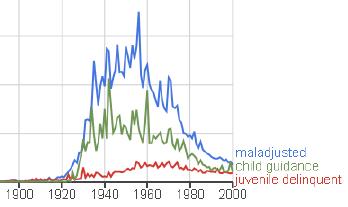
|
The second Ngram charts the relative use of the terms delinquent, maladjusted and child guidance over 200 years. Maladjusted and child guidance rise to a succession of peaks between about 1933 and 1959. |
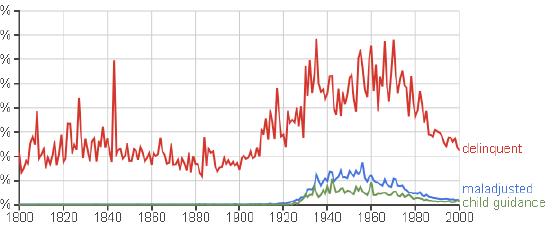
May 1934 King George 5th opened Shenley Mental Hospital in Hertfordshire. Middlesex County planned this in the neighbouring county as a small town in the countryside, composed as a network of villas of 20 to 45 beds, with 2,000 patients and 500 staff. The Middlesex Colony at Shenley, on land to the north of the main Shenley Hospital estate, had been opened by the Minister of Health in 1933. Its reception hall was opened during Jubilee Week in 1935. (Radcliffe, C.W. 1939 pages 153-154)
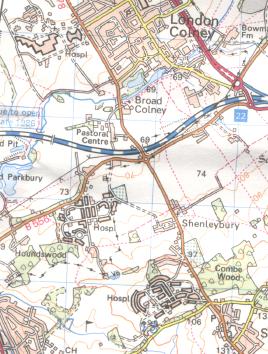
|
On this 1980s Ordnance Survey map, I believe the hospital to the west of London Colney is Napsbury, opened in 1905. This was the first of the Middlesex in Hertfordshire mental hospitals and colonies. That to the south of the map is Shenley, and north of that Shenley Colony. Please tell me if I am wrong. Leavesden was north of Abbotts Langley, further west. Hill End, Hertfordshire's own Mental Hospital, was near St Albans to the north. The MP for this area in the 1970s and 1980s was Cecil Parkinson. A report of the Parkinson Committee, published in part in 1981, triggered the closure of the mental hospitals. |
| 1935 |
|
Child Guidance Council Executive Committee minutes November 1935 to June 1937 held by Warwick University, Modern Records Centre - See Child Guidance [?] - Feversham 1936 - new constitution
12.11.1935 In Portugal, Egas Moniz performed a new psychosurgery procedure, later called leucotomy, or lobotomy. Tentatives opératoires dans le traitement de certaines psychoses (Tentative methods in the treatment of certain psychoses) published Paris, 1936. La leucotomie préfrontale. Traitement chirurgical de certaines psychoses (Prefrontal leucotomy. Surgical treatment of certain psychoses), published Turin, 1937.
| 1936 |
|
Metropolitan observation units In 1936 there were six observation wards in general hospitals run by the London Council Council. These were at Fulham - St Pancras - St Clements - St Alfege's (Greenwich) - St Francis (SE22?) - St John's (Wandsworth?). In 1936, 6,233 patients were admitted to the London observation wards of whom 3,117 were transferred to mental hospitals (only 10 per cent of these went as voluntary patients) and 1,054 discharged to the care of relatives. (source)
Wilson Report on hypoglycaemic shock treatment in schizophrenia published by the Board of Control, followed in 1938 by a report that also dealt with cardiazol shock treatment
1936 "The London Child Guidance Clinic" (Islington - Canonbury) "trained educational psychologists, social workers and child psychiatrists. Each year three fellowships in child psychiatry were advertised - they were half-time fellowships for one year". John Bowlby was appointed to one in 1936. (Bowlby, J. 19.10.1977) - See Tavistock 1946 - 1951 - A Two Year-old Goes to Hospital
Neues Volk 1.3.1936 p.37. Wir stehen nicht allein: "We do not stand alone". Shield: Gesetz zur Verhütung erbkranken Nachwuchses.
|
in force:
United States (1907? 1912?)
Denmark (1929) Norway (1934) Sweden (1935) Finland (1935?) |
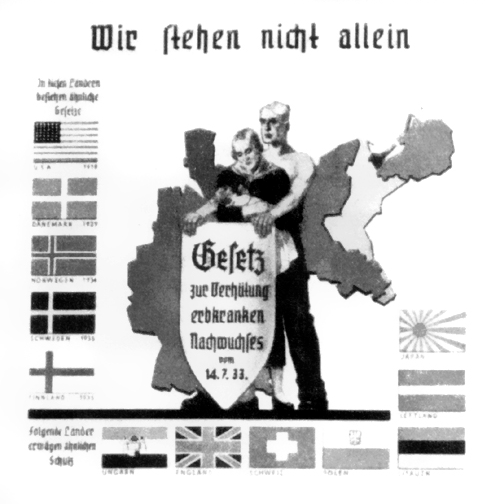
|
Scan taken from Robert Proctor, Racial Hygiene: Medicine under the Nazis (Cambridge, MA: Harvard University Press), page 96. Wikipedia
8.4.1936 Lord Feversham (Charles Duncombe, 3rd Earl of Feversham) chaired a preliminary meeting of a committee of representatives (two from each?) from the National Council for Mental Hygiene - the Central Association for Mental Welfare - the Child Guidance Council and the Home and School Council of Great Britain. Committee formed to inquire into the extent of mental disorder in England and Wales and the measures taken to deal with it by statutory and voluntary agencies. The inquiry was conducted with the sympathy and assistance of the Board of Control and other parts of central and local government. It reported in 1939
| 1937 |
|
March 1937 circular letter about a new Child Guidance Council Constitution and membership (Warwick University, Modern Records Centre) - Also Child Guidance Council "Memorandum re Amalgamation prepared for the Feversham Committee" (dated March 1937)
Monday 19.7.1937 to 24.7.1937 (Second) International Congress on Mental Hygiene held in Paris. On the Monday morning, Clifford Beers, "secretary-general of the International Committee for Mental Hygiene reported on the activities of the committee since the first congress in 1930 and Dr George Genil Perrin, secretary-general of the congress, made a brief report. The themes of the afternoon session were Eugenics and Sterilization in Relation to Mental Hygiene, and Mental Hygiene in Relation to Sex. Ernst Rudin spoke first on the "Condition and Role of Eugenics in the Prevention of Mental Diseases". He argued that "the only method of extirpating hereditary mental disorders was by preventing the propagation of tainted sex-cells". Bernard Sachs complained to to Beers that Rudin was "the most outspoken and rabid Nazi protagonist... who heads a whole group of men who are now openly making eugenic doctrines conform with the race purity doctrines of the present German regime". The choice of speakers, however, was not something that Beers had any control over. ( Psychiatric Quarterly Volume 12, Number 1. March 1938 - offline - and Dain, 1980)
1937 Official opening of Runwell Hospital, Wickford, Essex. (Jones, K. 1960 p.357) says that this already had a "patient-population of 1,010". Administrative records in Newham Public Libraries start in 1934. General records start in 1937. Kathleen Jones (who does not mention Shenley) says
"Runwell was a completely new hospital - the first to be planned since the First World War, designed to embody new ideas in mental treatment. Larger than Bethlem, it had at the time of opening in 1937 a patient-population of 1,010; but this total was broken down into small units, each largely self-contained. Runwell is the only English mental hospital to be built entirely on the villa system - Small one - or two - storey blocks with flat roofs were scattered over a wide are of garden and parkland. Parole patients, who required relatively little supervision, were housed in units for twenty to twenty-five persons... Separate blocks were constructed for patients' clubs, where resocialisation through group methods could be tried out; and a research wing was built and equipped for the examination of the biochemical and neurological bases of mental disorder" (Jones, K. 1960 pages 130-131)
| 1938 |
|
|
|
1938 UK's National Marriage Guidance Council founded by Arthur Herbert Gray, Marjorie Hume, Edward F. Griffith, David Mace and others. |
April 1938 Rome: "S.E.", a thirty nine year old man diagnosed schizophrenic, was chosen by Ugo Cerletti as the first human to have convulsions artificially induced by an electric shock through the brain. The origin of Electro-Convulsive Therapy. See Europe below - Eric Irwin - 1950 - 1968 - 1972 - 1974 - 1977 - 1983 - BNAP 1983 - 1988 - 1988 criticism - 1994 - 1997 - 2004 - 2005 - 2014 - 2015
6.7.1938 The President of the The Royal Medico-Psychological Association spoke of the change in psychiatry from pessimism to opimism since Maudsley published The Pathology of Mind in 1879:
" The great work of Sigmund Freud has cast a brilliant, if necessarily unequal light upon the dark places of psycho-pathology. General paralysis would now appear to be largely under our control. Schizophrenia is being attacked with renewed hope since recent therapeutic knowledge and research have brought insulin and cardiazol and other agents to our aid. Wider fields spread before the psychiatrist than ever before. In out- patient dispensaries, in child guidance clinics, in juvenile courts he finds an increasing welcome. Psychological factors in industry, in unemployment, in the aetiology of war invite his co-operation."
29.7.1938 to 2.8.1938 10th International Medical Congress for Psychotherapy held at Baliol College, Oxford - Its first meeting in an English speaking country. Sargant and Slater 1963 (page 165) say that reports were presented of the trial of insulin coma treatment in several countries. Manfred Sakel had carried out the experiments putting schizophrenic patients into an insulin coma since 1927. See deep sleep treatment - 1947 - 1948 - 1950 - 1952 - St David's 1956 - Croydon 1956 - 1963 - 1968 - 2009
| 1938 A Cerebral Atlas by Richard J. A. Berry, Director of Medical Services to the Incorporation of National Institutions for Persons Requiring Care and Control, Stoke Park Colony, Bristol. 425 pages with 430 photographs. 1938. London: Oxford University Press Ltd. £5 5s. Reviewd in the British Journal of Surgery in April 1939 |
| 1939 |
|
| The following is a typed copy of the medical register entry for a patient who died at Saxondale Hospital, Nottinghamshire in 1939. This, like other medical registers, uses a code for the type of illness and the cause of the illness. To work out what the codes mean, see 1925 forms |
|
Aetiological
Features:
Principle L2 Form of Mental Illness: I16 |
|
|
The code L2 is part of the Schedule of Causes and Associated Factors of Insanity. It is used to designate Cardio-Vascular Degeneration, which is classed as 'other bodily affections'. The second code relates to the Schedule of Forms of Insanity. However the code I16 does not appear on this schedule. It is possible, however, that the code in the original register may actually have been I1b. If this is the case, the designated condition would be 'Congenital/Infantile Mental Deficiency (Idiocy or Imbecility) occurring as early in life as it can be observed: I16: Intellectual, without Epilepsy'. |
1939 Jubilee book for Middlesex divides care of mental defectives into community care and institutional care
"In 1939, Kalinowski began a tour to advertise ECT" [Electro- Convulsive-Therapy] "around the globe, visiting the Netherlands, France, Switzerland, England, and the United States." (Sabbatini) - It was introduced at Warley in 1941. In 1957 it was described on television as an exciting new advance in medicine, and this created a consumer demand for it.
Steven Jenkusky (1992 - Writing about the USA) says that throughout the 1940s ECT had dangerous side effects from the seizure itself causing fractures (including to the spine" and that muscle injuries could also occur. He also says that the prospect of being subjected to an electric shock and seizure while fully awake was terrifying to patients and traumatic to the staff administering the therapy. See Eric Irwin.
Germany In Spring 1939, a Reich Committee for
Scientific
Research of Hereditary and Severe Constitutional Diseases
was
established that oversaw the killing of an estimated 5,000
'deformed'
children in a 'euthanasia' programme that finished in November
1944. In
July 1939 planning of the 'T4' programme of 'mercy
killings' of the
insane began. Experimental gas chambers were tried out at
Brandenburg
euthanasia centre in late 1939. An estimated 80,000 to 100,000
people were
killed before the T4 programme was 'stalled' in August 1941
after public
protest. Experiments in humane extermination continued in
occupied Poland.
In September 1941, 250 mental patients and 600 Russian
prisoners of war
were gassed at Auschwitz. During the war, about six million
Jews from all
over Europe were exterminated in the Polish death camps,
notably
Auschwitz 2 (Birkenau), Belzec, Chelmno, Majdanek, Sobibor,
and Treblinka.
See
entry into Belsen (concentration camp) 1945
|
January 1939 Mental Welfare Price 10d - Annual Subscription
Post Free 3/6 - January 1939 - Vol. 20, No.1 - Published by the Central
Association for Mental Welfare Incorporated - 24 Buckingham Palace Road,
London, S.W.1
Early 1939? A Mental Health Emergency Committee established by voluntary organisations to address the "problems of mental health, mental deficiency, and community care in time of war". Address 24, Buckingham Palace Road. [Address of the Central Association for Mental Welfare] (Hansard 29.2.1940) |
July? 1939 The Voluntary Mental Health Services: The Report of the Feversham Committee published by the committee. 16 introductory pages. 268 main pages. - "Mental Health Council - Feversham Committee's Proposal" Yorkshire Weekly Herald 28.10.1939 headline to article on the report of the committee, which it said was published "yesterday"
Second World War 1939-1945
Sunday 3.9.1939 Britain declared war on Germany
Hospitals during world war two: -
Belmont -
Sutton -
Netherne - Surrey -
Hellesdon - Norfolk -
Rooksdown House - Hampshire
Community
Care
"The Emergency Medical Service was introduced as soon as war
broke out, and gave central government a right of direction over both
voluntary and municipal hospitals which it had never before possessed.
Patients were discharged or evacuated from the hospitals in central London
in preparation for a wave of air-raid casualties which did not materialise"
(Geoffrey Rivett)
| 1940 |
|
Possibly sometime in 1940 that Donald Winnicott (1896-1971) said at
a meeting of the British Psychological Society "There is no such thing as a
baby" [infant] emplaning that "if you set out to describe a baby, you will
find you are describing a baby and someone." He discusses this in "Anxiety
Related to Insecurity" read before the British Psychoanalytic Association
5.11.1952 saying it was "about ten years ago". Masud R. Khan (1975)
Introduction to Winnicott's Collected Papers (p.xxxviii) gives the date as
1940. Other sources say "Winnicott, 1947".
Having been sent to Northampton as a
Mental Health Emergency Committee Welfare Officer to care for
child evacuees, after
Dunkirk,
Robina Addis cared for
adults billeted in the Northampton area who were psychiatric casualties
The Blitz, sustained bombing of London and other British cities
7.9.1940 to 10.5.1941.
| 1941 |
|
| 1941 Gregory Zilboorg's History of Medical Psychology published in New York. |
|
The mass-production of Penicillin was
developed in the
United
States from 1941. A
recent medical website
(archive)
describes General
Paralysis of the Insane as "a syndrome of madness and weakness
occurring in
tertiary
syphilis,
which is now
very rare because of treatment with penicillin". Penicillin's
use in
connection with general paralysis is after 1945.
The annual death rate (England and Wales) fell steadily from 2.272 in 1901 to 68 in 1957. (Hare, E.H. 1959). Although treatments by malaria or penicillin do not show any marked influence of the curve of the decline, I would think the statement that it has become rare because of treatment with penicillin is correct. |
1941, Withymead near Exeter established by Irene Champernowne, a Jungian psychotherapist, and her husband Gilbert. "The Jungian Community for the Healing Arts", a pioneer therapeutic community, treated 240 adults between 1942 and 1954 in a residential setting supported by the Elmhurst's of Dartington Hall. See Stevens, A. 1986
January 1941
Anna Freud
and Dorothy Burlingham opened the Children's
Rest Centre in Hampstead (Hampstead Wartime Nurseries) with financial
support from the American Foster Parents' Plan for War Children. The first
children (some with their
mothers) came from the
East End of London. Sometime in 1941, Joyce Robertson was
employed to care for children and
James Robertson "to
organize the maintenance and fire-watching services"
(Robertson and Robertson, 1989, p. xiii). All staff members
reported their observations about the children's behaviour on cards that
were later used in weekly group discussions.
(Horst and Veer 2009b p.941). James qualified as psychiatric
social worker at the London School of
Economics in 1947 and started training in psychoanalysis. He move to the
Tavistock
Clinic in 1948.
In one industrial concern more than three times as many work-
days per man were lost in 1941-1942 owing to neurosis than had been
lost in a pre-war year.
(Aubrey Lewis 4.3.1942)"
| 1942 |
|
| Long-term hospital patients were moved to residential homes to make room for injured soldiers. By 1942 the Mental After Care Association (MACA) was running fifty homes. The war established the residential care-home model and, by the 1950s, MACA had several of its own properties, where up to 50 people lived as many as five to a room. |
4.3.1942 Memo from Aubrey Lewis to the Director General of the Emergency Medical Services - Surprisingly few cases of overt neurosis had resulted from the air attacks, but psychiatric stresses appeared to be increasingly felt, especially in industry. Called for an investigation of the extent of neurosis and allied states, and the facilities for consultation and rehabilitation.
April 1942 Term Lack of moral fibre (LMF) adopted by the
Royal Air Force to stigmatize aircrew who refused to fly without a medical
reason.
21.10.1942:
Carlos Paton Blacker was seconded to the Ministry of Health
as
adviser on population and medico-social problems to undertake. with the
Medical Research Council, a survey to obtain information on the adequacy of
psychiatric out-patient facilities to deal with the psychiatric troubles of
a civilian population subjected to more than three years of war. The
publication of the Beveridge report in December 1942, however,
suggested that the survey might also consider "how the psychiatric services
of this country might be improved after the war." (Bolby)
1942?
Mental Health Emergency Committee became the Provisional
National Council for Mental Health, divided into 13 areas, based on Civil
Defence Regions [??] - Provisional National Association for Mental Health
Annual Report 1943/1944 and Provisional National Council for Mental Health
(incorporating...
Child Guidance Council...): Ad hoc Committee on the
extension of clinical training (Play Therapy) ['Inter-clinic Comm'] minutes
February 1944 to May 1944, held by Warwick University, Modern Records
Centre.
| October 1942 to February 1944 A series of Scientific Meetings of the British Psychoanalytical Society discussing the differences between the theories of Anna Freud and her colleagues and Melanie Klein and hers. After the war, this led to a led to a three way division of training in the Society by Kleinians, Anna Freudians and the Middle (or later Independent) Group. |
| 1943 |
|
| "They Called It Shell-Shock: Approximately one-third of the men invalided from the army have been discharged on psychiatric grounds. In the last war they called it shell-shock. The term was used to cover almost all types of psychological illness arising in association with, or as a result of, enemy action. The true significance of psychological factors was not appreciated. It was assumed that these disorders were the results of actual damage to the brain or nervous system caused by the effects of high explosives, and comparable in their origin and effects to actual head injury and concussion. It was a confusing and unfortunate term and is not now accepted as a diagnosis. For psychiatry has come a long way since then, and its influence in the Army is very considerable. There are ten special Army mental hospitals with, so far as possible, one Army Psychiatrist to fifty patients, and up to about four hundred patients. These beds have never been completely filled, though some hospitals have had a big and quick turnover. The average stay in hospital is about six weeks.... " (Major) Anthony Cotterell R.A.M.C. [Royal Army Medical Corp] Hutchinson, no date, but probably about 1943 |
Our Towns: A close-up - A study made in 1939-1942 - with
recommendations by the Hygiene Committee of the Women's Group on Public
Welfare, chair Amy Sayle, (in association with National Council of Social
Service). Preface by Margaret
Bondfield.
With this group are the 'problem families' always on the edge of pauperism
and crime, riddled with mental and physical defect, in and out of the
courts for child neglect, a menace to the community, of which the gravity
is out of all proportion to their numbers"
3.2.1943 Neurosis Questionnaire distributed to Regional
investigators.
15.11.1943 Final report on neurosis questionnaires received back
from regional investigators.
"The effect of evacuation was to flood the dark places with
light and bring home to the national consciousness that the
'submerged tenth' described by
Charles Booth still exists in our towns like a hidden
sore, poor, dirty, crude in its habits, and an intolerable and degrading
burden to decent people forced by poverty to neighbour with it.
|
Hospitals are for Healing:
The origin and context of community-care policies |
1940s and 1950s: Historical Background to Community
Care
The therapeutic asylums planned in the
1840s
failed monumentally, the monuments being a network of large
asylums full of
long-stay patients with little or no hope of rehabilitation.
In post war
Britain the National Health Service inherited these asylum
which still
stood in open countryside outside the towns, or had been
engrossed by the
expanding suburbs.
Post war Britain provided a new moral culture for disabled people. Eugenics and social darwinism were discredited by their association with the Nazi policies and extermination camps. The fears of "racial degeneracy" that had shaped pre-war public policy for mental defectives were no longer acceptable, even though they still dominated important texts such as Blacker (1946) and Tredgold (1947). In the absence of an acceptable conceptual framework, mental defect became a health issue. The 1946 National Health Service Act defined a hospital as an institution for "the reception and treatment of persons suffering from illness or mental defectiveness" (section 79) and transferred local authority hospitals to the Minister of Health (section 6).
| 1944 |
|
December 1944 Carlos Paton Blacker signed his preface to Neurosis and the Mental Health Services
Historical Background to Community
Care
National Health Service
Breakdown of taboo of silence.
1950s
1958
1960s
1972
Royal Commission on the Mental Health Laws
1954
to
1957
The Hurt Mind
1959 Mental Health Act
Enoch Powell's Water Tower
Speech
1962 Hospital Plan
Hospital scandals
Better Services White Papers,
1971
and
1975
1981 Care in the Community Green
Paper
|
Glenside Hospital Museum: Dr Donal Felix Mary Early, a
consultant
psychiatrist, worked at
Glenside Hospital,
Bristol, from 1944 to 1979. With Dennis
Griffiths and volunteers he began collecting artifacts during this time,
and placing them into storage. After some time, the hospital granted the
use of the balcony overlooking the dining hall at Glenside. The collection
gradually built up, as people donated artifacts to the museum.
But see below
Bristol Exhibition 1961
When the Hospital closed in 1994, the use of the derelict chapel was given to the Museum. The chapel was repaired by volunteers. The museum gradually developed with Dr Early as the guiding light, forming the exhibits, and telling the story of the Hospital. |
| 1945 |
|
Miss Lucy G. Fildes, Provisional National Council for Mental Health listed as an appointee to the Committee on the Treatment of Children Deprived of a Normal Home Life (National Archives)
26.7.1945: Election results: Labour Government (to 1951)
September 1945 International conference in Zurich of S. E. P. E. G.; Semaines internationales d'eïtude pour l'enfance victime de la guerre. International Study Weeks for Child Victims of the War. Robina Addis was [the?] British representative.
1945 The psychoanalytic study of the child (An Annual. Vol. I, 1945.) edited by Anna Freud, Heinz Hartmann, Ernst Kris, and an editorial board of twelve (1945).
|
Hospital children 1945
December 1945 Andrew Roberts (aged almost two) admitted to Hornsey Central Hospital with suspected meningitis, which turned out to be pneumonia. Being before the National Health Service, he would have been pushed to the hospital in a pram if his father had not agreed to pay Middlesex County Council £2 for an ambulance. The hospital charged his parents 35/- a week. He was on the danger list (expected to die) for a week and his parents were allowed to visit three times a day. He was treated by the new antibiotic M+B 693. Total time in hospital five weeks. After hospital, his behaviour was disturbed (fearful and excitable). Sometime in 1945 The first daughter of Joyce and James Robertson "became desperately ill and was rushed into a London teachng hospital in the middle of the night. With minutes to to spare, her life was saved... but we were not allowed to visit for ten days. Our daughter was transformed from a confident toddler to a very insecure little peoson, a condition lasting for years". (Quoted Cohen, 1964, p.63).
|
| 1946 |
|
1946 Special Educational Treatment Great Britain. Ministry of Education. Pamphlet No. 5. London : H.M.S.O., 1946. 36 pages. ["S.O. code no. 27-265-5." Text on inside covers]
March 1946 National Health Service Bill introduced
April (or earlier) 1946
Neurosis and the Mental Health
Services by
C. P. Blacker, 218 pages, published by Oxford University Press,
1946. Price, 21/- "The influence of the
report of the Feversham Committee will be apparent to all
readers" (Author's Preface, p.vii)
November 1946 The 1946
National
Health Service Act passed. This stripped the
Board of Control
of nearly all its functions except those of providing an
inspectorate of
mental hospitals, especially with respect to compulsory
detention, and managing
Rampton and
Moss Side. The
Act came
into force on
1.7.1948
|
23.10.1946 "Conrad Ormond,
General Secretary,
Provisional National Council for Mental Health,
39 Queen Anne Street,
London, W.1" witnessed the signatures to a list of "names, addresses and
descriptions of subscribers". [I will call these founding members]
Mind History website -
archive
[Date of foundation (below) is the date the three constituent bodies formerly merged. - Confirmed by Rachael Twomey at the Mind Information Office]
25.11.1946 Foundation of the National Association for Mental Health (now Mind). This was a combination of existing organisations, partly merged in 1939 as the Mental Health Emergency Committee for war-time coordination. This had become the Provisional National Council for Mental Health. Its components were the Central Association for Mental Welfare (formed in 1896 as the National Association for the Care of the Feeble Minded), the National Council for Mental Hygiene (founded 1922) and the Child Guidance Council (founded 1927 . Only the National Council for Mental Hygiene "had any real interest in the mentally ill" (Mary Applebey 1976). The Association worked closely with the Ministry of Health and the Board of Control. - See Mind and the Users Voice -
NAMES, ADDRESSES AND DESCRIPTIONS OF SUBSCRIBERS
Conferences, AGMs and [events]: [1939] - [1942] - [1946] - [1951: Mary Applebey] - [Kenneth Robinson] - [1957: Christopher Mayhew and The Hurt Mind] - [1960 Scientology] - 1961 - [Mental Health Film Council 1963] [1969] - [1970] - [1971] - 1973 move and AGM - 1974 - 1975 - 1975 - rights - 1976 - 1976 AGM - 1977 - 1978 - 1980 - 1981 - 1982 - 1983 - [description of target audience] - October 1984 - 1984 - [World Mental... July 1985] - 28.11.1985 - 1985 - NW Mind at Crawshawbooth - 1986 Conference - 1986 AGM - planning for 1987 - 1987 - [ECT 1988] - [International 26.9.1988] - 1988 - (See also 1988) - 1989 - 1990 - 1991 - 1992 - [evidence] - 1993 - [Breakthrough] - 1994 - 1994 AGM - [Bill] - 1998 - 2001 - 14.11.2002 - March 2005 - 16.3.2006 - 6.9.2006 - March 2007 - 6.11.2007 - [Mind blog - 2009] - Mind archive
National Association for Mental Health Directors, etc:
1946 Medical director: Dr Kenneth Soddy.
(27.7.1911-10.4.1986). Author of articles on
"Some lessons of war-time psychiatry" in Mental Health July 1946.
Kenneth Soddy worked with
John Rawlings Rees in founding the
World Federation for Mental Health.
Mind Directors/chief executives: 1974 Tony Smythe - 1982 Christopher Heginbotham - 1989 Ros Hepplewhite - 1992 Judi Clements - 2001 Richard Brook - 2006 Paul Farmer
Archives: Main archive and National Association for Mental Health (later Mind) collection in the papers of Robina Addis - international Internet Archive - UK web archive - |
1946 Social Psychotherapy Centre established in Hampstead by Joseph Bierer with day places and night places (closed weekend). It was known as the Marlbourough from 1954 and adopted the title "Day Hospital" shortly after the term was used in 1958 by Cameron in the United States. The centre used community and group therapies. Historians have sometimes confused the Marlborough with Paddington Day Hospital.
 Photograph is enlarged from the back cover of the 1952 edition of
Psychiatry Today
Photograph is enlarged from the back cover of the 1952 edition of
Psychiatry Today
|
1946? David Stafford-Clark (17.3.1916-9.9.1999) began studying at
the
Maudsley Hospital. At some time, Allen Lane of
Penguin Books
enquired about
a writer for a popular book on
psychiatry.
Aubrey Lewis recommended David Stafford-Clark, who finished
writing
Psychiatry Today in July 1951.
An anonymous obituary in The Times (10.9.1999) said "Stafford-Clark did more than almost anyone to dispel long-held prejudices about "lunacy" and "mental deficiency" and to remove the stigma from being mentally ill". |
|
Out of sight - Out of mind - Stigma and
taboo
The stigma of disability was intense. In the early 1940s, for example, a mother who attempted to meet other parents of handicapped children to form a playgroup had her advertisement refused by her local paper because of the "shame and disgrace" of having a handicapped child.
The 1946 Report of the Care of Children Committee complained about the "motley collection" of people it found in workhouses. In one room, with children of workhouse inmates, there was "a Mongol idiot, aged four, of gross appearance, for whom there was apparently no accommodation elsewhere. A family of five normal children, aged about six to fifteen... were sleeping in the same room as a three year old hydrocephalic idiot, of very unsightly type, whose bed was screened of in the corner... We found a number of institutions in which normal children were sleeping with low grade mentally defective children..." (Cmnd 6922 paragraphs 140 and 142). Compare the revulsion expressed with 1847, 1894 and 1916. Some of the same may have been involved in the refusal to show patients faces in The Hurt Mind in 1957. However, The Hurt Mind and the previous 1954 Archers programme, were deliberate efforts to break through the taboo of silence on mental health issues. |
| 1947 |
|
|
pre-frontal leucotomy and insulin coma - See
Warley 1946
1947 Pre-frontal Leucotomy in a thousand cases by Isabel Wilson and E.H. Warland published by the Board of Control. about 1947 to 1953 A period during which "practically every mental hospital in the country" (England and Wales) used insulin coma treatment. (Sargant and Slater 1963 p.170 commenting on 44 deaths from the treatment reported to the Board of Control in that period (W. Maclay, 1953 "Deaths due to treatment" Proceedings of the Royal Society of Medicine 46, 13)
|
National Association for Mental Health "Film Visiting Committee" formed in 1947 to "help in relation to producing, and also in avoiding inaccurate presentations which would tend to vulgarise psychology and give the public a false idea of its possibilities" (Mental Health, 1967, 7 (2), 47, quoted Crossley, N. 2005 p.78. This joined forces with members of the British Film Council in 1948. Eventually gave rise to the Mental Health Film Council (Crossley, N. 2005 p.78)
|
"Euthanasia:... with regard to the 80,000 or more
idiots and
imbeciles in the country... These are... incapable of being
employed...
their care and support absorbs a large amount of the time,
energy, and
money of the normal population... many... are utterly
helpless, repulsive
in appearance, and revolting in manners... In my opinion it
would be an
economical and humane procedure were their existence to be
painlessly
terminated... It is doubtful if public opinion is yet ripe for
this to be
done compulsorily; but I am of the opinion that the time has
come when
euthanasia should be permitted at the request of a parent or
guardian"
A Text-Book of Mental Deficiency (Amentia) by
A. F. Tredgold,
Consulting Physician to University College Hospital, London.
Seventh
edition 1947. Page 491. [My copy ex
"Bangour Village
Medical Library"] - See
1933 and Historical background to community care
|
|
The 1947 Annual Report of the
National Council for Civil
Liberties
refers to a woman released from a mental ward after the NCCL proposed
applying for a writ of Habeas Corpus as she appeared to have never been
certified. Another woman was made a voluntary patient after NCCL began
enquiries, and released herself. Both women had had illegitimate children.
"Not until after the Second World War did the Council concern itself with the most important liberty of all - the loss of total liberty when a person is wrongfully imprisoned in a gaol or institution. The first mental deficiency case which came to the Council's notice was brought to them in 1947 by a retired solicitor's clerk who, enraged by the circumstances of a young girl unrelated to himself, waged such an excellent one man war that the girl was freed before the Council needed to list a finger. The second was brought to the Council's notice by a clergyman, the third by a London legal advice centre... [in 1958 there were] 860 mental deficiency cases on the Council's files, of which more than eighty concern patients... in Rampton.." (Roxan 1958, p.224) See 1950 - 1951 - Peter Whitehead 1.11.1954 - Royal Commission 1954 - Peter Whitehead 1955 - 1956 - Roxan 1958 - |
Science Time Line 1948
See
1930
and
1966.
| 1948 |
|
July 1948
National Health Service Act came into
operation
The National Health Service (NHS) took over from county
councils and
boroughs
the major responsibility for mental health. The reforms of the
1920s and
1930s
had only touched the edge of the mental health system. The
main
inheritance of the National Health Service was a system of
over 100
asylums, or "mental
hospitals", with an average population of over 1,000 patients
in each.
The integration of the mental hospitals into the National Health Service was possibly the most decisive factor leading to a general move away from institutional policies in the 1950s. See 1959. Andrew Scull (1977, chapter 5) refers to studies of individual English mental hospitals, including Mapperley Hospital, Nottingham where inpatient numbers fell from 1948 due to changes in administrative policy, including avoiding admission altogether and early discharge of those who were admitted. In-patient numbers at Mapperley fell from 1,310 in 1948 to 1,060 in 1956. They were down to 870 (with annexes) in 1960.
[See archive - international archive]
(On the Mental Illness Concerns All (mica) web site)
Manchester 1948: Manchester Regional Hospital Board established. Manchester local authority Mental Health Department established. About 1948-1949: Psychiatric out-patient clinic and provision of a small number of beds on medical wards at Hope Hospital
Salford 1948: Salford local authority Mental Health Department established.

|
1948 World Health Organisation published the Sixth Revision of the International Classification of Diseases. For the first time this included sections on mental disorders |
The first international classification of diseases, the Bertillon Classification of Causes of Death was brought in in 1898. Revisions came into effect in 1918 (ICD2), 1922 (ICD3), 1931 (ICD4), and 1940 (ICD5). In 1948 the International Classification of Diseases in its sixth revision was extended to include non-fatal diseases. The ninth revision was adopted in 1975, the tenth revision in 1990. The tenth revision included a supplementary classification of impairments, disabilities and handicaps. external link to decoder

|
The history behind the World Federation for Mental Health includes Clifford Beers |
The founding meeting was held in London on 19.8.1948. Preparative work, led by John Rawlings Rees, assisted by Kenneth Soddy as his unpaid secretary, began in 1946. (Brody 1998 p.44)
The Rees Era: [Address: World Fedearation for
Mental Health, 19 Manchester Street, W1. Welbeck 8126 in 1950,1958 and 1961
Telephone
Directories]
See
1951 -
1954 -
1960 -
1961 -
The Geneva Secretariat: 1962- 1967 - The Working Presidents: see 1968 - 1973 - 1977 - 1979 - Baltimore and Washington see 1981 - After 1983 see 1983 - Brighton 1985 - 1987 - 1989 - Mexico 1991 - [First World Mental Health Day] - 1993 - 1995 - 1997 - 1998 - 1999 - 2001 - 2003 - 2005 - 2007 - 2009 -
| 1948: First post-war International Congress for Psychotherapy held in London (England) with the theme "The problem of guilt in psychotherapy". The themes of subsequent congresses were: 1951 Leyden The affect contact - 1954 Zürich Transference in psychotherapy - 1958 Barcelona: Daseinsanalysis and psychotherapy - 1961 Vienna: Psychotherapy and clinical medicine - 1964 London: New development in psychotherapy - 1967 Wiesbaden: Psychotherapy, prevention and rehabilitation - 1970 Milan:Psychotherapy and human sciences - 1973 Oslo: What is psychotherapy? - 1976 Paris: Psychotherapeutic process - 1979 Amsterdam: Research and training - 1982 Rio de Janeiro: Psychotherapy and culture - 1985 Opatija: Health for all by the Year 2000 - 1988 Lausanne: Culture and theory - 1991 Hannover: Psychotherapeutic health care = 1994 Seoul: Psychotherapy: East and West (Integration of psychotherapy) - 1998 Warsaw: Psychotherapy at the turn of the Century (from past to future) - 2002 Trondheim: Crossroads of clinical practice and research |
| 1949 |
|
1949 Foundation of the Mental Health Trust and the Mental Health Research Fund. These merged in 1972 to form the Mental Health Foundation (website) - information on charity - Database of Archives of Non-Governmental Organisations. The Research Fund was started by Dr Derek Richter (1907-1995) because there was so little research in the field. Dr Richter was at the Neuropsychiatric Research Centre, Cardiff from 1950 to 1983. - Published histories 1984 and 2009 - website archive from 1.6.1997

|
1949 Propylhexedrine replaced amphetamine sulfate as the active ingredient in over the counter Benzedrine, renamed Benzedrex, due to reports of widespread abuse, psychosis and sudden death. See Thomas Ritchie |
15.3.1949 Kenneth Robinson entered the United Kingdom Parliament as the member for the Borough of St Pancras (North Division). Sometime chairman of the mental health committee of the North-West Metropolitan Regional Hospital Board (DNB) and vice-president of the National Association of Mental Health before 1964 (Robinson v Church of Scientology 1973), he frequently asked mental health questions in the House of Commons. In 1958 he published a Fabian Society pamphlet Policy for Mental Health. See Mental Health Film Council (1963) and 25.7.1968.
|
1.10.1949 Full implementation of post-war open door policy at Dingleton Hospital. Melrose, Scotland. "It appears to be the first mental hospital with open doors in the world" (Ted Hayes). The medical superintendent, Macdonald Bell (G.M. Bell) published a paper "A mental hospital with open doors" describing it in an early issue of the International Journal of Social Psychiatry, 1955, 1 pages 42 to 48). The open door system was also adpted in England at Mapperley, Warlingham Park and other hospitals |
|
See
Wagner Jauregg in
1927
|
October 1949 Announcement that the Nobel Prize for physiology or medicine for 1949 would be shared by Walter Rudolf Hess of Switzerland for "for his discovery of the functional organization of the interbrain as a coordinator of the activities of the internal organs" and Egas Moniz of Portugal "for his discovery of the therapeutic value of leucotomy in certain psychoses". See Controversial Psychosurgery Resulted in a Nobel Prize by Bengt Jansson on the Nobel website. |
| 1950 |
|
|
By the 1950s, the
Mental After Care Association (MACA)
had several of its own properties, where up to 50 people lived as many as
five to a room.
"residential homes in the 1950s and 1960s were more homely than the old hospitals, but seem institutional by today's standards." (Together History Leaflet) MACA's first hostel offering short-term care opened in Ipswich in 1961. |
Mind's Key Dates: "1950s Day hospitals began to be established, increasing flexibility in psychiatric services and reducing the use of hospital beds. Hostels and therapeutic social clubs were set up to provide support for discharged patients. The introduction of neuroleptic drugs helped to shorten the length of new admissions to hospitals and encouraged the discharge of many into the community. Some new district psychiatric services were developed in general hospitals, ceasing to use beds in the regional mental hospitals, providing a model for future changes."
1950 Smith, Kline and French introduced Drinamyl (Dexamyl in the USA), combining dextroamphetamine and amobarbital (previously called amylbarbitone) as an antidepressant, anti-anxiety and diet drug. Known as "purple hearts".
Henry Rollin (born 1912) became medical superintendent at Horton Hospital [May be incorrect. His obituary says "from 1948 until 1975, he was the Deputy Superintendent of Horton Hospital".
May 1950? "In 1953, three years after a [Women's Institute] resolution on permitting family hospital visits for sick children was passed, less than a quarter of hospitals allowed daily visiting. In 1957, the [National Federation of Women's Institutes] sent evidence to the Platt Committee on the Welfare of Children in Hospital which, in its report the following year, said that parents should be allowed to visit sick child in hospital whenever they can, and to help as much as possible with the child's care. Platt's report is considered highly influential in the development of modern hospital practices."
|
6.7.1950 Meeting that set up the British Epilepsy Association
The original members
held their first meeting on 5.9.1950. The
association was registered as a
charity on 512.1950.
The brightly burning candle was chosen as the emblem in 1952. Abandoned by the British group in 1993, it still burns world wide. The aims of the British Epilepsy Association (1962) were: |
|
|
| See Epilepsy Action History Wall 1950- 2010 - offline. The British Epilepsy Association adopted the working title "Epilepsy Action" in 2002. See website |
|
18.9.1950-27.9.1950
Le Premier Congrès International de Psychiatrie Paris |
|
|---|
Sargant and Slater 1963 (page 165) say that the value of insulin coma treatment was "generally accepted" at the Congress "as the best available treatment of early schizophrenia". They say this "began to alter radically" in 1953 "with the use of the new tranquilising drugs, such as chlorpromazine"
October 1950 Labour minister of education George Tomlinson appointed a committee: "To enquire into and report upon the medical, educational and social problems relating to maladjusted children, with reference to their treatment within the educational system." Reported October 1955.
National Council for Civil Liberties: "The most important campaign which took place under" [Elizabeth Acland] "Allen's leadership began in earnest in 1950 and sought the reform of the Mental Deficiency Act of 1913. Under the Act, people could be labelled as 'moral defectives' on wide-ranging and questionable grounds, and abuse of the mental health system was therefore common. The campaign was driven forward by Frank Haskell, who joined the NCCL in 1946 as head of the Mental Deficiency Department. After a decade of conferences, publications (including the pamphlet 50,000 outside the law), legal action in individual cases and finally the submission of evidence to a Royal Commission, the NCCL achieved the abolition of the 1913 Act. Under the new Mental Health Act of 1959, Mental Health Review Tribunals were set up to reconsider individual cases. Volunteers organised by the NCCL acted on behalf of patients, securing the release of 1000s of people. This campaign ensured, amongst other things, that women were no longer at risk of being incarcerated for mental deficiency simply for giving birth outside marriage." (source)
| 1951 |
|
Second World Federation for Mental Health congress held in Mexico
about 1951 Dr Donald McIntosh Johnson, an eccentric member of the Sutton and Cheam Conservative Party and later MP for Carlisle was "wrongly certified as a result of a criminal plot". He and Labour MP Norman Dodds joined together for the reform of the mental health laws. See 25.10.1956
May 1951 2nd International Congress for Psychotherapy held in Leiden-Oegstgeest, (Netherlands) with the theme "The affective contact.".
25.10.1951 Conservative government in United Kingdom
|
|
1951 John Bowlby's Maternal Care and Mental Health published in Geneva by the World Health Organisation, in London by Her Majesty's Stationery Office and in New York by Columbia University Press. An abridged version: Child Care and The Growth of Love (2nd edition, 1965) was published by Penguin. |
|
1951: 50,000 Outside the Law: an examination of the treatment of
those certified as mentally defective published by the
National Council
for Civil Liberties (NCCL). 40 pages. Second impression in
1952.
National Council for Civil Liberties history website - an Open University website The pamphlet dealt with 200 cases of alleged wrongful certification and detention. It said the law was being administered "in a far from humane manner" and that patient labour in institutions, and release on licence to employers, created an economic motive to continue certification. |
|
1951
Mary Applebey
became Director of the
National Association for
Mental Health in place of the original General Secretary: Miss M
C Owen and
the Medical director since 1947: Dr Alfred Torrie
The picture of Mary Applebey is taken from the 1972/1973 Annual Report 1951 Robina Addis moved from Northampton to London to became Head of the National Association for Mental Health's Social Services Department. From 1954 to 1965 she was Deputy General Secretary. |
| 1952 |
|
|
|
Social Psychiatry: A Study of Therapeutic Communities by Maxwell Jones and others, foreword by Aubrey Lewis, published London: Tavistock Publications, 1952. Republised in the USA in 1953 as The Therapeutic Community - A New Treatment Method in Psychiatry
|
1952 First edition of
David Stafford-Clark's Psychiatry
Today published by Penguin. The inside cover blurb begins:
"For better or worse, psychiatry is news today: it is also frequently a feature of entertainment on the films, on television, on the radio, and provides a theme for books and a plot for plays. Although it is one of the fundamental branches of medicine it has always received notoriety more readily than fame, and seems all to often to promise more than it can perform. What was once a forbidden mystery is in danger of becoming a popular fad" The corresponding blurb for the second edition in 1963 began. "Since... the first edition of Psychiatry Today was published, the general public for which it was specially written have brought over 130,000 copies. It has been translated into French, Dutch, Spanish, German, Italian, and Greek" Chapter 7: A Consideration of Treatment "...the method of treatment most closely associated in the public mind with psychiatry... is that of psychotherapy". In this he includes "forms of reassurance, support, understanding, and guidance" of varying depth - occupational therapy - social measures, which are "the province of the trained psychiatric social worker" - a "series of interviews" including "a complete life history of the patient" - "periodic advice and supervision over some time" - psychoanalysis and other forms of psychotherapy aimed at providing the patient with insight - brief methods of analytical psychotherapy, including hypnosis - group therapy. He then indicates that "in the opinion of most psychiatrists" "physical methods have a greater part to play" in the treatment of depression and schizophrenia. [See St David's 1956] The discussion of physical treatment begins with general physical health (for example, nutrition) and the treatment of physical disorders underlying such mental illnesses as acute toxic confusional states and general paralysis of the insane by Penicillin. The drugs discussed are sedatives (for abreactions and for continuous sleep treatment) - amphetamine - and antabuse. The combination of benzedrine and ephedrine in treating children who wet their beds is discussed. The three physical treatments that had "radically altered the whole outlook" for patients suffering from depression and schizophrenia "previously beyond the power of psychological medicine to control" were electrical treatment - deep insulin treatment - neuro-surgery
The major changes in the 1963 edition were the introduction of the drugs
chlorpromazine (and
derivatives) -
meprobamate (and derivatives) - and the
antidepressants
|
| 1953 |
|
1953 Mental £millions. Almost half the National Health Service's hospital beds were for mental illness or mental defect. Hospitals generally were in old buildings, but those for mental illness included some of the worst buildings. From 1953 the government set aside substantial, if inadequate, sums of money for their improvement - The Mental £ millions. Spending on this sector in West Yorkshire reached a peak of 37% of the hospital budget in 1955/1956. Government thinking appears to have been precipitated into community care policies by the prospect of spending even larger sums on renovating the old asylums.
End of Hospital Farms: The Ministry of Health decided that hospitals were not to continue farming or market gardening (Laidlaw, E.F. 1994 p.151) - See Derby
|
|
3.4.1953 After moving from place to place for two weeks,
psychiatrist Jean Oury (born 5.3.1924), a group of staff, and thirty three
ambulant
patients, settledin the old ruined castle of La Borde. Here they
established
what, in English, would be called a
therapeutic community: applying "les
principes de la psychothérapie institutionnelle, les patients et les
soignants se constituent en commissions chargées des divers aspects
matériels de la vie collective".
(French Wikipedia). Oury was a member of
Lacan's Freudian School of Paris from
its inception.
Jean Claude Polack worked there from
1965. Polack's La
Médecine du capital in 1971 argued that a medicine in the
service of the people could only come with the disappearance of capitalism.
Polack worked with a collective of patients on the magazine
Cahiers pour la Folie from 1970 to 1974.
-
Clinique de LA BORDE
120 route de Tour en Sologne 41700 Cour-Cheverny website |
Autumn 1953 An article (not in the Lancet) described the three British mental hospitals with open door policies: Dingleton Hospital in Scotland, Mapperley, Nottingham and Warlingham Park Hospital, Croydon. David Clark became medical superintendent at Fulbourne, Cambridgeshire on 1.8.1953. He began by re-locking the admission ward that a consultant had opened. In the spring of 1954 he visited Warlingham Park to investigate the new methods. (external link to the relevant chapter of his book) . In 1954 out-patient nurses were appointed at Warlingham Park to visit out- patients and in-patients who had been discharged. (external link to Mind's key dates). Saxondale (Nottingham County) also introduced the open door system and Graylingwell, West Sussex, is mentioned as one of the hospitals that David Clark visited. (Some information from an email from Ted Hayes in Canada, who is researching open door policy)
|
|
September 1953 World Health Organisation report The Community Mental Hospital - "the need to provide more psychiatric hospital beds is being over-emphasised at present in some countries of western Europe and North America to the detriment of the provision of other services which would reduce the need for the admission of patients into psychiatric hospitals or alternatively reduce the length of stay of those patients who must be admitted." |
November 1953 The Samaritans movement was started in 1953 at St. Stephen Walbrook, by the Reverend Chad Varah. It was incorporated as a Limited Company in 1963. "Chad Varah took the first call to Samaritans on 2 November 1953. We were the first 24-hour helpline in the world." history on website
22.10.1953 Winston Churchill (UK Prime Minister) announced a Royal Commission on the law relating to mental illness and mental deficiency. The names of the Chairman and other members to be announced later. (Hansard)
| 1954 |
|
1954: Peak of numbers resident in English and Welsh Mental Hospitals. In the hospitals that pioneered community care, the numbers had been falling since 1948. Now the movement to avoid hospital admission and shorten in-patient stay began to effect overall numbers.
Mind's Key Dates: 1954 "The first out-patient nurses were appointed at Warlingham Park Hospital, Croydon. Their duties included visiting out-patients, supporting in-patients who had been discharged, helping find jobs and accommodation for them, and being available to give advice at out-patient clinics or therapeutic social clubs."
1950 Phenmetrazine (Preludin) introduced into clinical use in 1954 in Europe as a weight loss drug without the side-effects of amphetamine. Known as "Prellies" by the Beatles, who used it to keep themselves awake.
Royal Commission on the Law Relating to Mental Illness and Mental Deficiency (1954 to 1957), under Lord Percy. 4.5.1954 First day of evidence: Ministry of Health and Board of Control (jointly). The National Council for Civil Liberties gave evidence on Day 22.
21.7.1954 to 24.7.1954 3rd International Congress for Psychotherapy held in Zurich, Switzerland with the theme "Transference In Psychotherapy".
14.8.1954 to 21.8.1954 Third World Federation for Mental Health congress held in Toronto, Canada on the subject, "Mental Health in Public Affairs". In conjunction with this, The International Association for Child Psychiatry held an "International Institute on Child Psychiatry" on August 13th and 14th with the theme "Emotional Problems of Children Under Six"
Chlorpromazine is sometimes written "CPZ". This drug started being sold in 1954 or 1955. In France and the United Kingdom it was called Largactil. Largactil. In America it was called Thorazine. It was the first of the anti-psychotic phenothiazines. In a "psychotic", as opposed to a "neurotic" illness, the patient is held to have lost contact with reality. The phenothiazines controlled the symptoms of many patients without having the sedative effects of previous drugs. They controlled, not cured, and were sometimes called "chemical straight-jackets". Use of phenothiazines could make the established movement towards community care easier and less risky. Their effect, in this respect, became clearer with the introduction of long acting phenothiazines in the 1970s.
|

| 1955 |
|
1955 onwards: Substantial sums of money for construction of new hospitals
1955 to 1962: "Community methods of treatment and ward management" established at Claybury Hospital in Essex.
Meprobamate (Miltown) launched in the United States in 1955. Effects described in Cosmopolitan as "safe and quick, Miltown does not deaden or dull the senses, and is not habit forming. It relaxes the muscles, calms the mind, and gives people a renewed ability to enjoy life" (source) - (Wikipedia)
1955 NCCL Mental Health Files U DCL/84 1955-1964 10 files:
Case file MD/432
Mary Betteridge 1955-1957
Case file MD/434 Lilian Whittle 1955-1958
Case file MD/438 Olive Denman 1955-1956
Case file MD/443 Kathleen Rutty 1955-1956
Case file MD/444 James Warren Bell 1955-1959
Case file MD/447
Kathleen Bradley 1955-1959
Case file MD/475 Josephine O' Shea 1955-1964
Case file MD/511 Mary Thompson 1955-1956
Case file MD/559 Audrey Stocks 1956-1958
Case file MD/571 Eileen Rose Hood 1956-1957
1.3.1955: Charity known (from 1979) as The Tudor Trust established by a gift of shares in the construction company, George Wimpey. (external source) In 2006/2007 it helped to fund the National Survivor User Network
2.9.1955 Christopher Mayhew, Labour MP and Television presenter, took the hallucinogenic drug Mescaline as part of a BBC Panorama documentary that was never broadcast. (weblink)
|
October 1955 Report of the Committee on Maladjusted Children
(external link). The committee had been
appointed in
October 1950.
See the rise and fall in the use of the term |
| October 1955 "Seeking material directly related to mental-health problems in the mass media is like looking for a needle in a haystack". |
|
| 1956 |
|
|
St David's Hospital Carmarthen 1956-1958
"I saw the doctor in charge and was foolish enough to tell him about my voices... I was... moved to a ... ward where patients were given insulin. Before moving I had read on the walls of the admission ward, notices about rights of appeal to the local M.P., but decided this would be a waste of time. ... the lady psychiatrist ... tried very hard to persuade me to sign a "voluntary form". This seemed a farce to me and I refused." "my shouting and yelling disturbed the other patients... I was forcibly stripped (except for a sanitary towel!), fighting and struggling, turned over and injected in the buttocks. The last I remember was someone saying "Sit on her". Then I passed out." "I was given about 4 E.C.T.s and about 4 to 6 weeks insulin. I said I was not going to physically fight... The (man) doctor said 'Doesn't she think she ought to feel grateful for having treatment?'" "I expected psychiatrists to talk to their patients". [See Stafford-Clark 1952] "I hardly ever saw (five times in two years) the man in charge of me, except passing in the corridor." Nurses did far more than they were paid to do, taking patients to their own homes, to the pictures etc. There was much kindness in this hospital, but it has taken me years to get over it, and the fear of going back is strong". |
Published 1962 |
A survey by the
Institute of Community Studies of over 80
Bethnal Green patients who were sent to
Long Grove, on the other side of London, in 1956 and 1957. They
were interviewed in 1958 and 1959.
(Mills, E. 1962 p.3)
Enid Mills' interviews with them and their relatives show what happened, their reactions and impressions. She describes and discusses the difficulties of changing from a remote mental hospital system to a community service centred on local hospital such as the St Clement's Observation Unit (as it was before 1959). |
1956 The Central Health Services Council appointed a committee chared by Harry Platt to investigate "arangements made in hospital for the welfare of ill children". Report published as The Welfare of Children in Hospital: Report of a Committee of the Central Health Services Council. London: HMSO, 1959. See Womens Institutes 1957 - James Robertson 1958 - Mother Care for Children in Hospital 1961
21.2.1956 Twenty-four year old Kathleen Rutty discharged from certification as a mental defective by the High Court, following a writ of habeas corpus from the National Council for Civil Liberties. Kathleen was out on licence from Rampton. Under her licence she was barred from having boy-friends, or going to the cinema or to a dance. Afterwards she said "Now there will be no more fear that someone will be looking over my shoulder to see if I break the rules" (Roxan 1958 pages 226 and 231). Peter Whitehead was discharged directly from Rampton in December, whilst a writ was before the High Court.
"there had been some publicity about Rampton... 1956 or 1957 - I'm not sure which... exactly what was going on I'm not sure... We were not, of course, allowed to see the write- ups, so I cannot be certain... A hockey match was put on" [for the journalists] and a whole lot of other bull... the institution fooled the News of the World, but not the Empire News" (Noele Arden 1977, page 82)
25.10.1956 Mrs Harriet Thornton released from Cane Hill into the care of her uncle after a campaign led by Norman Dodds MP (Labour) and Donald Johnson (Conservative) - MP's Win Mental Patient's Freedom "Dr Johnson was himself wrongly certified five years ago as a result of a criminal plot"
| 1957 |
|
On the wireless, the Archers had featured a mental hospital in 1954.
The Hurt Mind, in January 1957 was the first television programme to do with a mental hospital. Christopher Mayhew persuaded the BBC to record this film. The camera's were not allowed to film patients' faces, only their hands or feet. Christopher Mayhew was the only one who was allowed to be filmed in person. [See filmed demented]
The five episodes were 1.1.1957 "Put Away" - 8.1.1957 "Breakdown" - 15.1.1957 "Psychological Treatment" - 22.1.1957 "Physical Treatment" - 29.1.1957 "Your Questions Answered". The BBC monitored the effects of the series, with a survey of viewer's attitudes before and after. This was published in May 1957: The Hurt Mind: An Enquiry Into Some of the Effects of Five Television Broadcasts about Mental Illness and its Treatment. Audience Research Report, B.B.C. May, 1957.
In books, a mental patient could look you straight in the eye
May 1957: Royal Commission on the Law Relating to Mental
Illness
and Mental Deficiency
(1954 to
1957)
reported
The key themes of the
Percy Report
were:
Percy wanted mental disorder to be a normal health issue. Part
of making it
normal was absorbing the Board of Control into the Ministry of
Health.
See do we need a
commission for
mental
health? for extracts.
8.7.1957 House of Commons debate on the Report of the Royal
Commission on the Law relating to Mental Illness and Mental Deficiency.
(Hansard).
"The second general mental health debate that there has been in this House
in the last twenty-seven years"
(Christopher Mayhew)
15.10.1957 Lifeline, with
David Stafford-Clark, first televised by
the BBC
(source). This series of programmes continued
to 1963. See 1959 -
1961 -
1962 -
Antidepressants Both Iproniazid (Marsalid), the first
Monoamine Oxidise Inhibitor, and Imipramine (Tofranil), the
first tricyclic antidepressant, were introduced into psychiatry in
1957
(Sargant and Slater
1963). The oldest Monoamine Oxidise
Inhibitor still in general use is Phenelzine (Nardil). William
Sargant (1960 onwards) suggested Nardil as the treatment of choice
for reactive depression. My memory suggests that these antidepressants were
coming into general use from about 1963.

|
1.10.1957 Contergan (Thalidomide) available as a cross-the-counter tranquillizer (sedatifum) and sleeping pill (hypnotikum) in West Germany. From 1.8.1961 to 27.11.1961 it was prescription only. |
In 1961 William McBride reported in the Lancet an increase in the number of deformed babies born at his hospital, all to mothers who had taken thalidomide. The drug was withdrawn in Germany later the same year.
The Patients Association was formed in 1963
In 1968 The UK manufacturer (Distillers) reached a compensation settlement after a legal battle with some of the families affected.
In 1972 The Sunday Times risked contempt of court proceedings for publicising the history of the drug. £28 million was paid out by Diageo (previously Distillers) during the 1970s.
In 1975 Hackney Mental Patients Union published its Directory of the side effects of psychiatric drugs
|
Brother Lunatic. Paul Warr exposes the unbelievable conditions in Britain's mental hospitals published at the end of 1957 by Neville Spearman (London). Paul War is a pseudonym. This concealment, the publisher claimed, was "made necessary by the law of defamatory libel". The author said he was a journalist, disillusioned by Picture Post in the Korean War, who went to work for Peace News under Bernard Boothroyd (Editor 1949-1951) who urged him to "live solely by my own conscience". He became a nurse in a rural mental hospital in the south of England, but found he was the only person motivated by idealism. |
|
Nuffield Provincial Hospital Trust funding
Mental health project funding started in 1957 1957: 27: care, education and treatment of maladjusted adolescents by the National Association for Mental Health 28: cost of mental illness by Cheadle Royal Hospital and Manchester University Department of Social Administration. This led eventually to Mental Hospitals at Work. The core work on costs began before Kathleen Jones joined the project. 1958: 34: mental health in the Oldham area 36: effect of incentives in the rehabilitation of long-stay patients and day centre for long-stay patients and industrial workshop by Cheadle Royal Hospital 41: Anglesey survey of mental health needs 42: Netherne Hospital study of the value of active work in the rehabilitation of mental patients 43: Manchester University study of the employment and training of adult mental handicapped 1959: 44: Crichton Royal Hospital study of a mental hospital and the community 46: Aberdeen University epidemiological studies of mental health - operational studies of Scottish mental health services - collation of data for the psychiatric case register by special interviewers 47: British Epilepsy Association study of epileptics in colonies. See Jones and Tillotson 1962 54: Institute of Psychiatry study of emotional disorders among school children in Buckinghamshire. 55: Aberdeen University studies of Scottish Mental Health services 57: Littlemore Hospital, Oxford, study of the prevalence of mental illness in the community. 1960: 65: study of the work of the plymouth Community Mental Health Centre 67: Fulbourne Hospital, Cambridge, study of the discharge of chronic psychotic patients. 69: Swansea Community Mental Health Centre 70: Salford study of the selection of patients mental hospital admission and a study of an industrial workshop. 71: Political and Economic Planning studies of community mental health services.
|
|
Scientology in the United Kingdom
In June 2008 it was decided that Ron Hubbard, founder of Scientology, should not have a blue plaque on 37 Fitzroy Street, London. It is said that Hubbard based himself at Fitzroy House from 1957 until 1959 and wrote many of his works there. (Telegraph 29.11.2009). Time Out wrote in 1973 "by 1955 the movement was establishing itself in Britain, opening a new centre in Notting Hill Gate" (Ian Sandeson reports 30.11.1973-6.12.1973 edition Time Out page 15. The global headquarters of the Scientology movement from 1959 to 1966 was Saint Hill Manor in East Grinstead, Sussex, 12.8.1967 Sea Org established. In 1975, the church sold the Sea Org's ships and moved the organization to land bases around the world, (Wikipedia article on Sea Org "Hubbard left the UK permanently in 1969, moving Scientology's world headquarters to a fleet of ships. The Home Office told him not to return." (Wikipedia article Scientology in the United Kingdom |
| 1958 |
|
|
looking you straight in the eye David Roxan's
Sentenced Without Cause told the story of
Peter Whitehead's successful struggle for freedom and the letter
writing campaign it fuelled amongst patients in Rampton.
Peter Whitehead's photograph, taken from a newspaper, was the
frontispiece.
This is my much battered copy. Bought second hand from Allan Saville's bookshop in Billericay - It was read and marked by fellow patients at Ingrebourne in 1963 and later. |
1958 Young Children in Hospital by James Robertson with a foreword by Ronald Mac Keith published London: Tavistock Publications. xiv and 103 pages. This was based on his evidence to the Platt comittee.
|
|
1.3.1958 Freda Kendall Mew died, aged 78 at Whitecroft Hospital, Newport. She had lived there for almost sixty years. She had received no communications for very many years. |
|
|
June 1958 to June 1959 Research at three English mental hospitals in
Cheshire, Lancashire and Yorkshire by
Kathleen Jones and Roy Sidebotham which led
to the publication of
Mental Hospitals at Work in 1962.
The Lancashire hospital ("Northtown") was either Rainhill or Prestwich. The Yorkshire hospital ("Moordale") was Scalebor Park. The Cheshire hospital ("Crown Lodge") was Cheadle Royal |
First week of September 1958 4th International Congress for Psychotherapy held at Barcelona University with the theme "Psychotherapy and Existential Analysis".
| 1959 |
|
By 1959 only 12% of admissions to mental illness hospitals were compulsory, and the trend was towards shorter periods of in-patient treatment and towards outpatient treatment. Whilst in 1930 there had been practically no outpatients, by 1959 there were 144,000 attendances at outpatient clinics. ( Maclay, W.S. 1961, p.98)
It is the above change that people are generally referring to
when they
speak of the therapeutic revolution of the 1950s.
|
Two years after the Percy Report, the 1959 Mental Health Act sought to create a legal framework within which the hospital treatment of mental disorder could approximate as closely as possible to that of physical illness. Its two main objectives were:
The 1959 Mental Health Act abolished the Board of Control. The 1959 Mental Health Act excluded promiscuity or other immoral conduct (alone) as grounds for detention. Section 4 (5) of the 1959 Act says: "Nothing in this section shall be construed as implying that a person may be dealt with under this Act as suffering from mental disorder ... by reason only of promiscuity or other immoral conduct"The 1890 Lunacy Act's grounds for confinement were that the person is a "lunatic, idiot or person of unsound mind". The 1959 Act uses a similar catch-all phrase: "any other disorder or disability of mind" - but the exclusion clause restricts it. Between the 1890 Act and the 1959 Act there was a great expansion in the power to confine people on moral grounds. This was under the 1913 Mental Deficiency Act which brought in the concept of moral defect and feeble minded. The 1957 Percy Report explained that, in practice, these concepts had been applied to people of normal intelligence who behaved unconventionally.
|
|
1959 Wentworth Stanley Hall, with stage, opened at St Clements Hospital Bow as it became an exclusively psychiatric hospital - in the inner city. In the same year, the Psychiatric Rehabilitation Association started, linking the old asylum at Longrove to the East End of London from where its patients came. |
1959 Dr Russell Barton's Institutional Neurosis outlined the symptoms of a disease that often (but not always) developed as a result of being in an institution. (See dictionary)
In 1959 BBC Lifeline included programmes on Leucotomy "Surgery of the brain" - "Fear" - "Hypnosis" as a means of examining the unconscious - a discussion with L. S. Penrose about the "Mongoloid child" - and "Battle for the mind" about the techniques used by "orators as diverse as Hitler and John Wesley".
1959 Richmond Fellowship founded by Elly Jansen, a young theology student from Holland, who invited patients from Long Grove Hospital to leave and live with her in the community in Richmond, Surrey. Many Richmond Fellowship houses developed as therapeutic communites. Registered as a Company Limited by Guarantee 20.6.1960 by The Bishop of Southwark and Bruce Reed "Director of Christian Teamwork", witnessed by N. Ely Jansen, S.R.N. Social Worker, 21 Lancaster Park, Richmond, Surrey (Signatures 14.6.1960). offline.
October 1959 Patricia Hornsby Smith spoke about the 1959 Mental Health Act in an election broadcast on behalf of the Conservative Party.
October 1959 J.C.Batt, Physician Superintendent, St. Ebba's Hospital, Epsom: "Clinical Trial of 'Stelazine' in Treatment of Chronic Schizophrenia" - On 28.2.1959 Roderick Macdonald and T.P. Shields Watts of Holloway Sanatorium published an article on its use in Paranoid Schizophrenia. In December 1959 K. Kropach wrote about treating acutely agitated senile patient. In October 1959 A. R. May, J. Stuart Whiteley and B. G. Gradwell considered its use in Psychoneuroses. Stelazine was a phenothiazine that could be used, in different doses, as either a major tranquilliser for psychosis (see Janet Cresswell 1965) or a minor one for neuroses (see Andrew Roberts May 1971).
|
1960s
In 1960s there was a breakdown in the taboo of silence about mental health in the press and TV. Radio had sowed seeds in 1954. On television, the seeds were sown by The Hurt Mind, in January 1957 and the Lifeline series from October 1957 to 1963. Man Alive (1965? on) showed people with conditions usually regarded as taboo talking about their own experiences. A famous example in the press was an Observer reporter, John Gale, who had a mental breakdown, re-covered and was re-instated to his position as a feature and news reporter. He described his subjective experiences in an Observer feature in 1966. Along with the new openness about mental illness came the possibility of open debate. In America, The Myth of Mental Illness (1961), by Thomas Szasz was published. It contained a theoretical basis for arguing that the states of mind described as "mental illness" are not "illness" but actions for which the mentally distressed person must be held responsible. [See Mental Health and Civil Liberties]. In France Michel Foucault's Histoire de la Folie told the history of unreason in an age of reason in a way that the English speaking world was not yet ready for. (extracts)
|
| 1960 |
|
|
The First World Mental Health Year 1.1.1960 to 30.6.1961
The year was designated by the World Federation for Mental Health at its annual meeting in Copenhagen in the summer of 1957. The year would culminate in the Fifth International Congress on Mental Health, to be held in Paris in August 1961. (source) "First world mental health year: a record" (160 pages), edited by Arthur C. L. Paton, was published: [London] by the World Federation for Mental Health in 1961, and with a supplement in 1962.
The eighteen month period was modelled on the
International Geophysical Year of 1957-1958.
|
February 1960 Chlordiazepoxide (Librium), the first benzodiazepine, marketed in the United States. Diazepam (Valium) was marketed in 1963. I think the heyday of the benzodiazepine tranquillisers was the early 1970s. See Phobics Society 1970 - 1975 directory - Cherry Allfree 1976 - Asylum 20003
|

|
R. D. Laing's The Divided Self: An Existential Study in Sanity and Madness. Alfred Hitchcock's black and white film Psycho ... in a lonely hotel, vicious murders take place... "This young man... being dominated by an almost maniacal woman was enough.." In 1960 BBC Lifeline included programmes on "Hallucinations and delusions" (were Joan of Arc and Francis of Assisi suitable cases for psychiatric treatment?) - and "Obsessive compulsions" in which David Stafford-Clark spoke to former patients. The National Association for Mental Health "keeps an eye on all 'fringe medicine' which purports to help people suffering from mental disorder of any kind, and in 1960 it duly noted the arrival of the scientology movement at Saint Hill Manor, East Grinstead". (Rolph 1973 chapter 8) [Ron Hubbard purchased Saint Hill Manor in 1959 and lived there until early 1966]. See 1964 - 1965 - 1966 - 1966 - 1969 |
| 1961 |
|
1961 Eric Cunningham Dax's Asylum to Community: The Development of the Mental Hygiene Service in Victoria, Australia, Cheshire: Melbourne 230 pages, published with assistance from the World Federation for Mental Health
|
1961, The Historical Development of
British Psychiatry Volume 1
18th and 19th century by Denis Leigh, Physician Royal an Maudley
Hospitals, London.
Begun in 1969, when Leigh found Hack Tuke's Daniel Hack Tuke's Chapters in the History of the Insane in the British Isles "frankly boring" and Gregory Zilboorg's History of Medical Psychology "too large a pattern" (Preface) |
January 1961 Long term planning of hospital services
begun
15.1.1961 - 22.1.1961 - 29.1.1961 - 12.2.1961: Articles in The Guardian and Observer by James Robertson about children in hospital. The last was titled "Now Over to the Mothers".
1961 Mother Care for Children in Hospital founded by Jane Thomas, a young mother living in Battersea. "We used to chat about his articles, pushing our prams round Battersea Park". (Quoted Cohen, 1964, p.65). This became the National Association for the Welfare of Children in Hospital in 1965. Core aim: to get the Platt Report's recommendations around unrestricted hospital visiting and overnight stays implemented. See Alex Mold
February 1961 The whole three days of the Quarterly Meeting of the Royal Medico-Psychological Association, in London, devoted to a conference on "Hallucinogenic Drugs and Their Psychotherapeutic Use". Proceedings published in 1963.
2.3.1961 Debate on second reading of the suicide bill - "the law of England and Wales is almost alone in treating suicide and attempted suicide as criminal offences... they are not criminal offences under the law of Scotland; and ... in the other countries of Western Europe they are regarded as constituting essentially a psychiatric problem". See Suicide Act
April 1961: Official opening of Balderton Subnormality Hospital by Enoch Powell. [See policy]
|
4.5.1961 to 24.5.1961 An exhibition
"Bristol in the evolution
of mental health. 1696-1961" at the Royal West of England
Academy - "the
first of its kind and scope to be held in Great Britain".
See asylums
index -
Bristol index
- The exhibition introduction is signed "R.E. Hemphill", who was the
Medical Superintendent of the (new)
Barrow Hospital. The catalogued exhibits for the
"Glenside/Barrow Hospital Group" (pages 36 to 43) show some relation to the
Glenside Hospital Museum exhibits.
|
August 1961 Fourth World Federation for Mental Health congress held Paris.
21.8.1961 to 26.8.1961 5th International Congress for Psychotherapy held in Vienna (Austria) with the theme "Psychotherapy and clinical medicine".
3.8.1961 Royal Assent for the
Suicide Act
(England and Wales)
section one "Suicide to cease to be a
crime. The rule of law whereby it is a crime for a person to commit
suicide is hereby abrogated." See suicide
27.11.1961 Thalidomide was withdrawn in Germany, but continued to be used in other countries. By the end of July 1962 (eight months later) there was an abrupt end to the epidemic of limb and ear malformations in Germany. Other countries had to wait until eight months after Thalidomide was withdrawn. About 40 per cent of thalidomide victims died before their first birthday. (Dr Widukind Lenz 1992). Withdrawn UK 2.12.1961 [See Patients Association], Canada was one of the last countries to withdraw it (2.3.1962). In Japan it was finally withdrawn in September 1962.
|
1961 International Bureau for Epilepsy founded. It was run from the British Epilepsy Association's London head office for the next 12 years. |

|
2015 The logo is still basically the same. See website. |
In 1961 BBC Lifeline included programmes on Epilepsy "The sacred disease" (an electrical storm in the brain which still carries stigma and fears) - the problems of an autistic child, called "Schizophrenia in children" - and several programmes on the unconscious, especially as uncovered by hypnosis, including a woman who "meets and talks in the studio to people who exist only in her own mind" -
| 1962 |
|
|
January 1962: The Hospital Plan
Envisaged: cutting mental illness beds from 151,899 (in 1960) to 99,090 by 1975 increasing mental handicap beds from 59,840 (in 1960) to 63,620 by 1975 a "considerable" increase in psychiatric units in general hospitals - for short stay (three months or less) patients (outlined in circular HM(61)25) even greater reductions in the number of mental illness beds with alternative community provision. closure of thirteen of the existing 109 mental illness hospitals with 400 or more beds by 1975 possible closure of another nine of the large hospitals after 1975 leaving 87 to continue indefinitely. Most long term care would be in these old hospitals. The size of most would be reduced, but 25 would still have 1,000 or more beds by 1975. Oxford region planned wards for medium or long stay patients near District General Hospitals Sheffield Region planned to build Crookhill Hall, a "new psychiatric hospital at Conisbrough" (in the countryside outside Doncaster) for 420 patients and, later, "a long-stay psychiatric hospital at Sheffield", as well as (eventually) closing three of its nine large hospitals. [It changed its mind on Crookhill Hall (Hansard 1.3.1965)] |
1962 Paddington Clinic and Day Hospital established in Harrow Road. Its initial parts were 1) A child guidance clinic with an established history - 2) A newly founded day hospital (Paddington Day Hospital) involved in rehabilitating patients from Horton. A department for adult out-patients joined in 1965. In the early 1960s, Basil Gregory introduced a therapeutic community approach. In 1965 he brought in staff from Henderson. - See 1972. In 1974 the building was renamed the Paddington Centre for Psychotherapy. See Baron 1987 and Spandler 2006
In 1962 BBC Lifeline included three programmes on "Children under stress" |
| 1963 |
|
| 1963 Richard Hunter and Ida Macalpine's Three Hundred Years of Psychiatry 1535-1860 "This book is...an endeavour to present original sources and through them trace clinical and pathological observations, nosologies, theories and therapies, and the care of the insane as well as social and legal attitudes to mental illness" (pp ix-x). Over 1,000 pages of documents, scrupulously indexed, each with a detailed historical introduction. Richard Hunter and his mother provided foundations for every other historian to build on. History subsequent to 1860 was covered, in a different way, by Psychiatry for the Poor in 1974 |
1963 UNAFAM (Union des Amis et Familles de Malades Psychiques) [Association of friends and families of the mentally ill] formed in France
1963 The Patients Association formed in the UK, by Helen Hodgson, a part-time teacher who was moved to do so by "reports on thalidomide babies, wrong patient operations and tests on patients." (A letter from Helen Hodgson in the Sunday Times 25.11.1962, quoted by Alex Mold 2013 See Rights 1970 .
|
1963 Second edition of
David Stafford-Clark's Psychiatry
Today published by Penguin, taking into account "important new
techniques" developed in the "ten years" since first publication
(1952).
The main change in the treatments section since 1952 is the new prominence
for drug treatment. The drugs discussed (not indexed) are
|
April 1963: Health and Welfare [The community care equivalent to the Hospital Plan.
June 1963 Mental Health Film Council founded (see above) "following a meeting called by the National Association of Mental Health to bring together "representatives of organisations involved in the use or distribution of mental health films". The First Chairman was Kenneth Robinson MP. Became Mental Health Media, charity 286467 on 11.3.1983. First Mental Health Media awards 1994. National Headlines 1998 , Launched Media Bureau in 2002. Removed from register 1.1.2010., but probably continued as part of Mind. website history (archive) - First website archive 20.5.2000
4.9.1963 Death of Lord Fevershem. He had been the chairman of the National Association for Mental Health since it started. He was succeeded by Robin (Lord) Balniel (Conservative MP). "While we could call on his support from the right we could also look to Kenneth Robinson on the left" (Mary Applebey 1976)
| "Because general paresis is now so easily treatable by neurologists, it is a pleasure to omit the whole chapter relating to it from the present edition. We look forward to seeing how an efficient physical treatment such as penicillin can put an end to a disease which caused so much mental illness and so much misery for generation after generation. We are sure that this pattern will be repeated again and again, as more and more mental disorders become simply and easily treated by medical methods" (Sargant and Slater 1963), page ix |
| 1964 |
|
| 1964 Alexander Walk wrote in his The Evolution of Hospitals in Britain "we owe a great deal to the scholarly work in this field in recent years of Drs Kathleen Jones, Richard Hunter and Denis Leigh. They will forgive me if now and again I differ from their conclusions." |
Manchester Mental Health Department opened Victoria Park Day Centre in Daisy Bank Road Manchester in 1964 - Forrester House, for women, in 1965 - and Plymouth House, for men, in 1966.
"It seems to me that 1964 marked the beginning of a mood of
disillusion. It was then that the
Church of Scientology saw fit to attack psychiatry in general
and the
NAMH
in particular. That they were not synonymous was the first misapprehension.
That if the NAMH platform was secured psychiatry would be routed was
another"
(Mary Applebey 1976) [I have not found anything to explain 1964
as the start. The date may be an error]
|
April 1964 What's Wrong with Hospitals?, a Penguin special by
Gerda L. Cohen (200 pages at 3/6d) included
[Debit and credit] |
24.8.1964 to 29.8.1964 August: 6th International Congress for Psychotherapy held in London, with the theme "New development in psychotherapy"
15.10.1964 Labour Government
| 1965 |
|
1965 Report of the Board of Enquiry into Scientology by Kevin Victor Anderson, Q.C. published by the State of Victoria, Australia [See Scientology] "From time to time attempts were made by the scientology interests to widen the scope of the Inquiry into a general investigation of the medical profession, or more particularly the practices of psychiatry and psychology," (Chapter one)
Saturday 5.6.1965 Mary Barnes first visit to Kingsley Hall led to her becoming the first (and last to leave) resident in the new asylum.
4.11.1965? First Man Alive on BBC Televison. People sometimes allowed to speak openly about taboo subjects such as agoraphobia - phobias - suicide
| 1966 |
|
1966 First edition of the journal Social Psychiatry published. It later called itself Social Psychiatry and Psychiatric Epidemiology. (website)
1966 statistics
In 1966 there were 107 mental illness and 66
mental handicap "hospitals and units with 200 or more beds".
(Hospital Statistics 1975, pp 5+7).
In 1966
Borocourt Subnormality Hospital
was a well
equipped one. Few subnormality hospitals had anything but
Victorian type
institutional wards, but the largest Borocourt one had only 30
beds. In the
late 1960s Oxford Regional Health Authority spent 1.25 million
pounds at
Borocourt on nine completely new wards, upgrading old wards
and building a
school, a gymnasium and a workshop.

|
The Mental Health Association of Ireland began in 1966, with this logo. It kept the logo when it became Mental Health Ireland. But, in 2008, it decided the logo must change. The World Federation for Mental Health held is congress in Dublin in 1995. |
1966 Trends in Psychogeriatric Care published by Political and Economic Planning. First published as Planning, 32, no 497. Prepared by Frederick Morris Martin (1923-1985) 31 pages. This was reviewed by D.M. Bevington in the second issue of Sociology in May 1967 (volume 1 no. 2 p.214) offline. Martin became the Professor of Social Administration at the University of Glasgow in 1972 (to his death).
12.1.1966 BBC Man Alive programme "The Frightened Ones" about agrophobia, in "which victims talk about their illness and a doctor and a psychiatrist discuss what can be done for them".
7.2.1966 UK House of Commons: Lord Balniel asked the Minister of Health whether he will initiate an inquiry into the scope and practice in this country of so- called Scientology, and the practice of psychology for fee or reward by persons who have no medical or psychological qualifications. Kenneth Robinson replied "No, Sir.". Balniel: "Would not the right hon. Gentleman agree that the commercial practice of psychology by unqualified persons could be very dangerous indeed for certain mentally disordered people? In view of the scathing criticism by an official board of inquiry in Australia into the so-called practice of Scientology, surely the right hon. Gentleman considers that it is in the public interest to hold a similar type of inquiry in this country?". Robinson: "I am prepared to consider any demand for an inquiry, but I have not had one yet. I am aware that extravagant claims are made on behalf of Scientology, which are not generally accepted, and for my part I would advise anyone who is considering a course of this kind to go to his doctor first."
11.2.1966 Ron Hubbard established a "Committee for Sane Psychiatry" under the direction of Fred Hare, Executive Secretary Communicator [World Wide?] of the Hubbard Communications Office. It would bring attention to "the brutal treatment and sex orgies in institutions and drive psychiatry into accepting lawful regulation by Parliament and Congress". "Case histories of brutal savage treatment are to be collected and the lurid nature of 'treatment' is to be fully documented".
The Observer Colour Supplement began a three part coverage on changing attitudes to madness down the centuries. The third part was John Gale's personal account. As it became acceptable for professional writers who had been mental patients to describe the experience in print, so some people's minds turned to the possibilities of listening to patients in mental hospitals.
| 1967 | Declaration of a summer of love |
Stanley Solomon Segal, Headmaster, Franklin Delano Roosevelt School, London. No child is ineducable - Special Education - Provision and Trends Commonwealth and International Library. Pergamon Educational Guides. 332 pages.
3.5.1967 Man Alive programme "Living with Fear" talked to "some of the half million people in Britain who suffer from apparently illogical phobias - including fear of birds, dogs, visitors and leaves."
24.5.1967 Man Alive programme "A case of suicide" looked at "how people who commit suicide might have been helped to stay alive by those near them and those who have had to live with the suicide of someone near to them."
21.10.1967 and 21.10.1967 Lacanian study days on childhood psychosis in the Maison de la Chimie (a scientific conference centre) in Paris, organised by Maud Mannoni. The conference brought French and English theorists together as it was attended by Ronald Laing, David Cooper and Donald Winnicott. (See France)
| 1967-1972 HOSPITAL SCANDALS: |
The 1960s concentrated attention and resources on the treatment of short term mental illness. There was a corresponding neglect of long-stay patients, along with a failure to implement the community care side of the new policies. The scandals of the late 1960s and 1970s shone a light on the consequences.
1967 Sans-Everything - A Case to Answer
July 1968
Report of Government Inquiry into the Sans
Everything allegations
Sans-Everything was a collection of articles edited by Mrs Barbara Robb that dealt with the condition of elderly residents in institutions. It included accounts of individual cases of ill-treatment in psychiatric and geriatric care. The official report into its allegations substantiated many of them.
The establishment in 1972 of a Health Service Commissioner ("Ombudsman") to investigate complaints of individual ill-treatment, followed suggestion made by Professor Abel-Smith in Sans-Everything
July 1967: Allegations of misconduct at Ely
26.2.1968
Shelton Hospital Fire
December 1968 Police investigate Farleigh Hospital
March 1969 Ely Hospital Inquiry Report
June 1970 Farleigh Hospital Inquiry appointed
November 1970 Farleigh Hospital Inquiry Report signed
February 1971
Whittingham Hospital Inquiry appointed
April 1971 Farleigh Hospital Inquiry Report presented
October 1971 Whittingham Hospital Inquiry Report signed
February 1972 Whittingham Hospital Inquiry Report published
5.7.1972 Fire at Coldharbour
The light shone into mental subnormality (handicap) hospitals with the publication of official reports into Ely Hospital, Cardiff, in 1969; Farleigh Hospital, Somerset and Coldharbour Hospital, Sherbourne, Dorset, in 1971.
Richard Crossman, Secretary of State at the time, responded to Ely as a personal challenge. He launched a programme of additional resources to the mental handicap hospitals, established (November 1969) a Hospital Advisory Service to visit hospitals - especially long-stay ones - and advise him on their condition, and started a re-appraisal of plans that eventually surfaced as the white paper Better Services for the Mentally Handicapped
The National Association for Mental Health (1969/1970 Annual Report) had a "perverse" regret that there had not been a scandal on the same scale as Ely in a hospital for the mentally ill whilst Crossman was Minister, to stimulate an "accelerated re-appraisal of their needs and progress". It was coming, but by the time the Whittingham Inquiry reported the government had already announced its intention to scrap the old asylums and replace them by "comprehensive psychiatric services" in each district.
| 1974 - 1976 TREATMENT AS PUNISHEMENT SCANDAL |
April 1974 The St Augustine's Hospital critique
| 1976: A COMMUNITY SCANDAL |
1976 Birmingham scandal
| 1981 HOSPITAL SCANDALS: |
1981 Silent Minority
| 1968 |
|
1968 Fifth World Federation for Mental Health congress held in London
1968 Questions and Answers on Mental Nursing for Pupil Nurses by John Michael Andrews, Principle Tutor, Claybury Hospital. Edward Arnold:
"Question: Name some physical methods of treatment for mental disorder"."Answer: Drugs - electroplexy (electro-convulsive therapy, ECT) - pre-frontal leucotomy and other cerebral surgery - prolonged narcosis - modified insulin therapy - deep insulin coma therapy (rare now) - hydrotherapy - occupational and industrial therapy".
Insulin treatment is not even mentioned in Insight - A Guide to Psychiatry and the Psychiatric Services in 1973.
25.7.1968 Statement by Kenneth Robinson of steps to protect the United Kingdom public from the "pseudo-philosophical cult" of Scientology, described by its founder as "the world's largest mental health organisation".
The monthly Scientology newspaper Freedom started as a response to this. The first edition was a "single flat sheet".
August 1968 The first edition of Time Out gave a prominant position to
|
"Art and Mental Health: an exhibition of paintings, clay models and ceramics by psychiatric and subnormal patients and maladjusted children" |
| 1969 |
|
|
23.8.1969 Miss Janet F. Henderson of Craigiemichael, Innellan, Argyll, argued in a letter in TheTimes that
"There is no mystery about the cause of any deteriioration of conditions in any British mental hospital. In 1948 the progress toward better attitudes and circumstances was suddenly brought to a stop by the loss of the work of His Majesty's Commissioners in Lunacy. Their wide and intimate knowledge of each of these institutions throughout the country was available everywhere as expert advice, their criticism a powerful stimuls to improvement. The quality control functions of the Board of Control (previously Lunacy Commission) had been assumed by the Management Committees of the National Health Service. Its civil liberties functions had continued to 1959. The Hospital Advisory Service (1969) could be seen as reinstating independence for quality control advice and the Mental Health Act Commission (1983) as reinstating central civil liberties functions. November 1969 Establishment of the Hospital Advisory Service, an independent arm of the Department of Health that advised the Secretary of State on the quality of care in hospitals - especially those for long-stay patients. In its first report (external link) (archive) it said its visits concentrated on hospitals for the mentally handicapped and the mentally ill, for geriatric and chronically ill patients. The main problem was a lack of co-ordination between hospital and community social service departments. The National Association for Mental Health welcomed the Hospital Advisory Service but "still feels strongly... that there should be an independent inspectorate of hospitals, publishing report of its investigations and answering to the Lord Chancellor, rather than to the Department of Health and Social Security. (Annual Report 1969/1970 p.9) In 1976 the Hospital Advisory Service became the Health Advisory Service, so that its reviews would cover community as well as hospital services. |
|
Local hospitals for everyone -
Out with the distant asylum Sir Keith Joseph's 1971-1972 Memorandum proposals for the replacement of mental illness hospitals by comprehensive local services. |
In the late 1960s Hospital Boards were informed of a change in government thinking. Instead of just acute, short stay, psychiatric units, they were asked to provide a comprehensive service for all patients at District General Hospitals (Ham, C. 1981 p. 129). This changed thinking was incorporated into Hospital Services for the Mentally Ill in December 1971.
Fluphenazine (Modecate). The first long-acting anti-psychotic phenothazine was tested at All Saints Hospital, Birmingham in 1969. By one injection every few weeks it was now possible to ensure people were medicated even whilst living outside hospital. Patients needed to be readmitted only if they refused their injection. If a patient did not keep an appointment at the "Modecate clinic", a psychiatric community nurse would visit to see what was happening.
Scientologists and the National Association for Mental Health 1969-
1970
March 1969 The
'Campaign Against Psychiatric Atrocities'
protested outside the NAMH offices
"In 1969,
the
Scientologists branded orthodox psychiatry as a system of
murder, sexual perversion and monstrous cruelty, and the
NAMH as a criminally motivated 'psychiatric front group'. In
October 1969, a number of Scientologists applied for membership of the
Association, and it became apparent that they were trying to take over.
Their membership was withdrawn and, after a court case, the matter was
resolved in the Association's favour."
12.11.1969 The National Association for Mental Health was unable to
hold its Annual General Meeting due to an injunction secured by eight
Scintologists who had been requested to resign. Legal and other proceedings
meant the Annual General Meeting did not take place until 3.7.1970
when "Lord Balniel" stepped down as Chairman in favour of the Chaiman
elect,
Christopher Mayhew.
"Mary Applebey, who was director from
1951 to 1974, said ... in a speech for Mind's 30th
birthday in November 1976, "Scientology represented in an exaggerated form
one aspect of disillusionment with the official mental health line"".
4.7.1969
International Times became "Insanity Times" for an
issue that featured Georg Groddeck arriving by space craft, Michael Barnett
from the "operations room" of "People for a New Psychiatry", Ron Hubbard on
Dianetics, Ronald Laing in an interview that begins with meditation and
ends with a plot to infiltrate the police to change society, and "Alan" on
his experinece of depression and Horton hospital. People for a New
Psychiatry became
People Not Psychiatry.
| 1970 |
|
 -
1970 In Italy,
Franco Basaglia moved to Trieste.
-
1970 In Italy,
Franco Basaglia moved to Trieste.
1970 Les murs de l'asile (The walls of the asylum), a 90 page
pamphlet by Roger Gentis, Series: Cahiers libres; 163. Paris: Maspero,
"The asylum is a mosaic of small fiefs, a conglomerate of feudal entities. This is so stupid and so bad that everyone feels alone in the world, and the first guy that you trust. a semblance of authority, he believes that it happened and now he begins to govern, to legislate and annoy the neighbours .... You can have 100 houses in a hospital, you will get 100 baronies, not one less and the head of the pavilion, on a war footing and mocking the neighbouring house ... Silence, routine, immobility is the currency of asylum, it is gently eternity ... Chronicity, institutionalisation, must be measured in weight, inertia" It is not enough to close the buildings, if we do not change society "we will quickly re-create the asylum elsewhere "family or any hospital in the world or the private sector if it pays enough or in the community as the English say" |
|
A Declaration of Human Rights for Mental Patients.
Proposed by the Church of Scientology, January 1970 A No person, man, woman or child, may be denied his or her personal liberty by reason of an mental illness or deficiency, so called, without a fair jury trial by laymen and with proper legal representation. This to be supplied by Lagal aid if such is available and required. B If properly committed in a fair jury trial by layman, and with proper legal representation, a mental patient has the following necessary right and may not be deprived of any civil, political, personal or property rights without the process of law. B consisted of a list of twenty five rights, followed by a concluding statement about them. |
The Schizophrenia Association of Great Britain (SAGB) was started by Bill and Gwynneth Hemmings in 1970 (Archive of home page). It closed on 15.6.2007 (Archive of closure notice)
9.5.1970 Times article "A Case of Schizophrenia, by a Correspondent", written by journalist John Pringle about his son. - History on Politics website - Led to formation of National Schizophrenia Fellowship - See The Early Years
June 1970 Conservative Government
|
From being a Labour Minister, David Ennals became the first Campaign Director of the National Association for Mental Health in August. The campaign was called the Mind Campaign and I collected this 1969/1970 Report at its 1971 "Crack Up" exhibition. It includes "Scientologists and the NAMH 1969-70" - "Protecting patient's rights" and - "Crisis over handicap" |
July 1970 Meeting at the Henderson that initiated the Therapeutic Community Round Table. It met at Ingrebourne in October 1970. It also met at Halliwick. This was followed by the Association of Therapeutic Communities (website). Principle founders of the Association were Drs Whiteley, Robert Hinshelwood (Marlborough Day Hospital) and Nick P. Manning. ATC Newsletter Number 2 (the first distributed) was published in June 1972. An ATC Research Group first reported in the Newsletter in 1974. (Millard, D.W. Summer 2008). The Association met at Paddington Day Hospital in 1975. In Spring 1981, launched the International Journal of Therapeutic Communities, which became Therapeutic Communities - ( bibliography project - website)
|
Patients' rights
In January 1970, the Church of Scientology proposed "a declaration of human rights for mental patients". During 1970, the Patients Association intensified a campaign for informed consent before patients were used for teaching purposes. The National Association for Mental Heal and the National Council for Civil Liberties (jointly) began a three year experimental project providing lay help and guidance to patients appealing against detention. The NAMH expressed concern about the lack of control over medical treatment given to formally detained patients without consent. (see 1983 Mental Health Act) It thought it was important to make a distinction between reversible and irreversible decisions. Efforts were made to bring professional associations, unions and other organisations together to discuss a "codes of practice" for nursing in subnormality and psychiatric hospitals. The NAMH welcomed the Hospital Advisory Service (November 1969), but wanted something answerable to the Lord Chancellor. The Scientologists argued that the government would have been better advised to establish legal rights based on a jury trial with legal representation before someone could be committed and legally enforceable rights for patients who were detained. |
| 1971 |
|
1971 Statistics
1971 Implementation of
1970 Local Authority Social
Services Act
and establishment of new Social Services Departments
In 1971 St Lawrences had 1,850 patients from all over
London - mostly
mentally handicapped - from young children to men and women
who had grown
old in the institution. (See
1870 and
1981)
|
Royal College of Psychiatrists the new name
for the Medico-Psychological Association
In the 1960s the British Consumers Association broke taboos with its Consumers Guide to Contraceptives. In 1971 it broke another taboo by making mental health a consumer issue, publishing Treatment and Care in Mental Illness |
In April 1971 Local Education Authorities became responsible for the education of all mentally handicapped children, however severe their handicap, under the 1970 Education (Handicapped Children) Act. As a result of the Act some level of education had to be provided for every child from five to fifteen years old. As well as providing education for the children, this meant that parents of severely handicapped children were relieved of their care during the day. The Jay Report in 1979 thought this had had such an impact on the lives of families with severely handicapped children as to partly explain why far fewer children went into residential care in the 1970s.
Better Services White Papers
There were two Better Services White Papers. The one on
Mental Handicap
in 1971, and one on
mental illness in 1975.
June 1971: Better Services for the Mentally Handicapped
Campaign for Mentally Handicapped People
The White Paper fell short of what members of
Crossman's working group
desired. One of
them, Peter Townsend, published his disagreements in the
Sunday
Times on 27.6.1971, the week after the paper was
published. He believed
the hospitals should have been phased out altogether and that
the proposed
25 bed hostels for those who left hospital were:
Townsend wanted mentally handicapped people to live in small
houses
resembling private housing. A similar position was taken by
the Campaign
for Mentally Handicapped People (CMH), a group started in
1971 in the
belief that people with a mental handicap:
This policy of normalising the lives of disadvantaged and
stigmatised
groups has since been called
normalisation. It is the
converse of the
Social Darwinist policy of segregation. Social theory, though not
social
reality, had turned full circle
2.8.1971 Lawrence Andrews (40) was sentenced at the Old Bailey to
three years on each of ten counts of indecently assaulting educationally
subnormal boys (aged between 15 and 20) under his supervision when deputy-
warden of the
National Association for Mental Health's Fairhaven Community
Home in Blackheath from 1969 to 1970.
Freedom (Scientology journal)
highlighted the case as evidence that "the NAMH is no fit body to supervise
young people"... "the NAMH wanted to sweep ... scandals under the carpet at
a time when it is embarking on a vast public fund raising campaign (Freedom
September/October 1971 pages 1-2)
The
scientologists depicted
David Ennals,
Mary Applebey and
Christopher
Mayhew as manipulating images to fund a lavish life-style
(Freedom
September/October 1971, page 3.)
19.10.1971 2pm
Andrew Roberts visited the MIND CAMPAIGN Exhibition "CRACK
UP" held in a large bell tent in the court yard of St Martin's in the
Fields, and took extensive notes. I spoke to David Ennals, John Paine, and
Mary Appleby. John Paine told me about NAMH press cuttings files kept by
Mrs Ryan who worked Tuesday, Wednesday and Friday. I contacted her and
later spent a lot of time in NAMH offices reading these files.
People go into hospital ... and they are cured
Friday 24.12.1971 "Christmas Day in the Nuthouse" edition of Time
Out (guide to London events) gave a detailed preview of
Family Life, along with other material, in a nine page feature
by
Neil Lyndon. Included photograph of a wall with the slogan
"PSYCHIATRY
KILLS".
William Ll.
Parry
Jones:
The Trade in Lunacy. A Study of Private
Madhouses in England in the Eighteenth and Nineteenth
Centuries.
Good reading for anyone who wants to know about the range of
private
houses: good and bad, rich and poor etc. I use this
regularly
for the asylums
index
13.1.1972 The film Family Life told a story of
Janice who, as a
consequence of family conflict, received two types of
psychiatric
treatment. Group therapy helped her, but drugs and
electroconvulsive
therapy broke her spirit. The film (and the television play
that preceded
it) dramatised the theories of
Ronald Laing and David Cooper. The
Paddington Day Hospital Protest involved Family Life in
its campaigning.
February 1972:
Whittingham
Hospital,
just outside Preston in Lancashire, had 3,200 beds in 1953 and
2,045 in
1971. It was
one of England's largest mental hospitals, though shrinking as
active
psychiatry was moved to District General Hospitals in Preston.
Allegations
of ill-treatment and the conviction of a male nurse for the
manslaughter of
a patient, led to an inquiry, which reported that for many of
Whittingham's
patients "the therapeutic
revolution of
the 1950s" never happened. Almost
half had no occupation during the day, but sat around
"becoming cabbages".
On one ward, 126 patients were cared for by just six nurses.
Doctors did
not visit long stay wards, but concentrated on acute work and
their work
outside the hospital. The inquiry conclude that the English
mental health
system was dividing into "well staffed 'acute' units and 'long
stay
dumps'".
The establishment of Psychiatric Units in General Hospitals
was also
squeezing out community therapy. Community therapy aimed to
develop patient
self-determination. It was perhaps, not surprising, that
squeezing led to
patients taking part in the protest. See
30.11.1971 -
10.12.1971
3.3.1972: "800 people crowded into a meeting
at Sidney
Webb
college on
3rd March to discuss the threatened closure of the
Paddington Day Clinic, a therapeutic community. The
opening of a
psychiatric unit in a
nearby general hospital has been given by the Regional
Hospital Board as
the reason for making the hospital redundant. The patients and
staff of the
P.D.H. have formed a protest group to oppose this proposal
because they
feel the work done in this hospital is concerned with
increasing the
individuals awareness of the problem rather than blotting out
the symptoms
it may produce". First paragraph of an article signed by Nicky
Road, Anna
Chadwick and Keith Venables in Politics of Psychology
Newsletter
12.3.1972
26.3.1972 Sunday Times "Brain surgery on mental patients
is now causing strong public controversy in America. Dr Peter Breggin, a
Washington psychiatrist, says a second wave of psychosurgery is gaining
momentum around the world. Oliver Gillie reports some disturbing features
of this surgery as it is practised under the National Health Service in
several hospitals in Britain" - "Every year more than 200 mental patients
in Britain have brain operations to blunt their emotions".
Easter Sunday 2.4.1972
Rose Nuttall
on Radio 4 "The World this
Weekend" "After fourteen years of a severe depressive illness, coupled with
anxiety and five years spent in and out of hospital of ECT, psychotherapy
and drugs, I finally had a COMPLETE cure following a prefrontal
leucotomy... sixteen years ago". Rose's story was told alongside that of
"the wife of a man whose operation had failed" [Letter MPU files]
6.5.1972
A letter in the British Medical Journal, from Drs.
S. E. Browne and N. L. Short of Dartford in Kent, stated that many GPs
valued the services of "psychotherapeutic units
such as the
Ingrebourne
Centre
and the
Cassel Hospital when orthodox psychiatry using
physical methods of treatment has completely
failed to be of assistance" and expressed concern that
present "plans for basing
psychiatry in district general hospitals may not
only fail to provide more badly needed facilities
for group psychotherapy, but . . . lead to the
closure of existing centres."
Schizophrenia
Ireland was founded in 1975.
National Schizophrenia Fellowship
(Scotland) was founded in
1984.
24.9.1972 Sunday Times article "Our
Thalidomide Children: A Cause for National Shame" footnoted that
it would trace how the tragedy occurred in a future article. It was
restrained from doing so by contempt of court proceedings. (See
European Court
Judgement 26.4.1979)
October 1972: Services for Mental Illness Related to Old Age
November 1972 The place to go in London for
encounter groups, and
similar alternative therapies, was called Hole in the Wall. About November
1972, Ken Smith set up an unusual therapy there called "foot massage"
A working party of some two dozen full members was formed
and not long
after set up office in a London squat. This nucleus was given
the task of
producing a statement of the union's intent and drafting a
proposed
organisational framework for MPU.
9.6.1973 British Medical Journal "Changing the Patient's
Personality" discussion in "New Horizons in Medical Ethics" series.
Problems related to "drug therapy and psychosurgery".
(online)
"Mental illness is not only to be found in mental hospitals. Every year
tens
of thousands of ordinary people break down under the stress of everyday
life and they and their families have to cope. These are the casualties of
our society. But they are not a race apart."
28.10.1973 to 3.11.1973 "MIND WEEK, the highlight of the MIND
Campaign and te last in a
series of three" (Mind Out Autumn 1973,
p.3.
21.11.1973
Mind AGM at the Royal Institute of British Architects. At the beginning of
November, Mind had moved from 39 Queen Anne , W1M OAJ to (cheaper)
accommodation at 22 Harley Street, W1N 2ED
1973
World Federation for Mental Health 25th Anniversary Congress
held
Sydney, Australia with the theme "Cultures in Collision"
The end of sustained economic growth and Labour's shift in
emphasis to
positive community care in Better
Services for the Mentally Ill (1975)
28.2.1974 Labour Government. Christopher Price, Labour, (1932 -
2015) elected for Lewisham West. He served until June 1983. A critic of
psychosurgery and electro-convulsive therapy, he facilitated the
development of
PROMPT. On 26.3.1974
he asked
"how many fit psychiatric in-patients are at present being kept in
hospital because of the shortage of hostel and other sheltered
accommodation?". See
21.1.1976 and
Frightening 1976
for ECT and psychosurgery - Links with PROMPT
established by 1977 -
4.11.1977 -
PROMPT Petition
1979 -
28.2.1974 to 1.3.1974
Mind's
Annual Conference
, on the theme ""New Knowledge in Mental Health" held at Church
House, Westminster.
1974: Mind Report: Co-ordination or Chaos?
April 1974: Interim report of the Butler Committee. As a
result of this, a
network of
Regional Psychiatric Secure Units was
planned for England
and Wales. (external link)
By the 1970s, Broadmoor was
seriously overcrowded. On a visit, I looked through a
window and saw
a sea of short haircuts so close that one could have walked
across the room
from one head to another. Partly to relieve this pressure, a
new "Special
Hospital", called Park Lane, was built on land next to
Moss Side. The
first 35
patients moved in in 1974.
April 1974 St Augustine's Hospital, Chartham Down, near Canterbury, Kent -
A Critique Regarding Policy by Brian Ankers and Olleste Etsello
February 1975: Barbara Castle's Mencap speech. See
below
The Patients Protection Law Committee "was formed to ensure the protection
of patients and to firmly establish their rights under law. It is mainly
concerned with medical experimentation of an unethical or objectionable
nature". Chairman: Alan Saint. Address 31 Brim Hill, N2 0HD [The home of
Mrs Rita Bright, who became Secretary)]. Doctors [Andre] Khilkoff-
Choubersky and T.S.G. Davies, and Mrs W.M. Baran were also Directors.
24.5.1975 The Lancet Volume 305, Issue 7917, Page 1175
"Psychosurgery on Trial". Editorial said the Royal College of
Psychiatrists
"has drawn up a workable design and the question being asked is certainly
important and unresolved in any country; the trial deserves support".
Several Community Health Councils objected that there was not enough
information about how patients would be protected and the
Schizophrenia Association condemned the trial and advised its
members "most strongly against psychosurgery"
25.9.1975 Doctor. Weekly Newspaper for the Family
Practitioner "Brain surgery plan causes a headache"
September 1975 Patients Protection Law Committee first became aware
of Royal College of Psychiatrists application to the Medical Research
Council
for £50,000 to assess the value of psychosurgery using a sample of
200 patients in British Hospitals, 2.10.1975 Letter of protest from
Patients Protection Law Committee. See
Joyce Butler petition February 1976.
3.10.1975 London Evening News "Mental Guinea-Pigs for
Surgeon's Knife"
October 1975: Butler Committee Report and Better Services for the Mentally Ill
The ninety one page White Paper
Better Services
for the
Mentally Ill
was nicknamed
Castles in the Air by COPE when it was presented by Barbara
Castle, the
Secretary of State at the Department of Health and Social
Security, in
October 1975. It was long term strategic document, pointing
out the general
direction the Government wanted services to take, prefaced
with a statement
that little progress could be made until the
economic
situation improved.
Its emphasis was on providing a comprehensive range of local
services in
place of asylums, before asylums closed:
31.10.1975 and 1.11.1975 Special Mind
Conference
on "Rights of patients and staff in the mental health services"
held at Church House, Westminster. Organiser Kathy West (Mind Out 10.1975).
Corresponding with the launch of
A Human Condition
1976 Peak in mental hospital admissions (falling
since)
The actual numbers in hospital had been falling since 1954
Between 1970 and 1975 the population of mental illness
hospitals was
reduced from 107,977 to 87,321. The population of mental
handicap hospitals
was reduced from 55,434 to 49,683 (In-Patient Statistics 1975,
tables A8
and B10).
The statistics were said to reflect the success of care in the
community,
but some argued that the fall had been achieved by discharging
patients to
families ill-equipped to cope with them, to private hotels
that exploited
them or, in some cases, onto the streets.
Better Services for the Mentally Ill acknowledged that such
things
happened, and said:-
On January 12th 1976, the Daily Mirror sensationally
questioned the
claim that discharge from hospital without inadequate care was
infrequent.
It ran a feature by John Pilger sub-headed:
Birmingham was headlined as
A West Midlands Health Official said the DHSS had
"applied the screws" to mental hospitals to "decant" patients.
Pilger
commented that "to be decanted is
to be dumped", if you have not got families or friends to take
you. The
Midlands organiser of MENCAP told him:
Pilger's report showed a seamier side to this policy. In
Birmingham, an
array of guest houses, hotels and boarding
houses
flourished on the trade in ex-patients. One landlady told
Pilger:
She had
Although this was one of the better hotels, residents still
sat all day
In one of the worst establishments patients had been slept
A councillor reported seeing guests
A Birmingham Social Services' spokesman said it was not
uncommon to find
"disturbed and frightened people" wandering about the railway
station:
Hundreds were said to be "just wandering". The Salvation Army
hostel said
"up to 30%" of the people it took in "from the streets" were
ex-patients.
"The overwhelming majority" of those who queued "in the cold
every night"
outside a Catholic refuge were "psychiatric patients".
Whose fault was it? According to Pilger, Birmingham Social
Services blamed
the hospitals and the hospitals blamed Social Services.
A debate in the House of Commons on better services for
mentally ill
people was moved for by the Conservative opposition in January
1976.
Shortly before the debate, the shadow health minister, Norman
Fowler, asked
Cecil Parkinson MP to form a
Conservative Party policy group
on the
progress that had and could be made towards community based
services for
mentally ill and mentally handicapped people. It was an issue
of special
interest to Mr Parkinson because his constituency,
Hertfordshire
South,
contained three large hospitals for mental illness and two for
mental
handicap, only one of which served the constituency - the
others received
their patients from North London.
21.1.1976
Christopher Price asked the Secretary of State for Social
Services whether she has studied the article in the British Journal of
Psychiatry (1973, 123, 441-3) which concludes that ECT can cause cumulative
and irreversible brain damage; and what guidance she has given to the NHS
hospitals as a result.
Written Answer from David Owen.
20.2.1976 Joyce Butler MP presented "a petition from the
Patients' Protection Law Committee, which is concerned about
psychosurgery
experiments on patients who are mentally ill and which seeks to uphold the
rights of patients in relation thereto. Despite the specialised and unusual
subject of the petition, this small voluntary organisation has succeeded in
a short time in obtaining 1,500 signatures to the petition, which shows
that "the Royal College of Psychiatrists intend to carry out experiments in
psychosurgery on two hundred mental patients; that psychosurgery is a
dangerous procedure which causes irreversible damage to the brain; that
last year
a court decision in Michigan, USA, held that the therapeutic
effectiveness of limbic brain lesions was unproven and the potential risks
very great and that lack of knowledge about these questions made informed
consent virtually impossible; and that in these circumstances experiments
of this nature are unethical." "Wherefore your Petitioners humbly pray that
this Honourable House will forbid the use of public funds for these
experiments."
PROMPT was a party to this petition.
Priorities was, amongst other things, an effort to
advance such
causes as Better
Services for the
Mentally Ill by giving them more money at the
expense of other
areas.
The 1975 White Paper had said that investment on the scale
needed to
achieve its ends would not be possible "over the next three or
four years"
(par. 11.5), but by giving deprived sectors priority of
general and acute
hospital provision, Priorities proposed a rate of
development which,
"if maintained", would enable the Better Services aims
to be
achieved over most of the country within twenty-five years.
Monday 29.3.1976
Five Oscars for
the film One Flew Over the Cuckoo's Nest
dramatised
the
1962 novel by Ken Kesey about the way asylums
change the
personalities
of people who become their in-patients. The novel and film
popularised the
theories of
Erving Goffman, in
Asylums (1961)
9.7.1976 to 10.7.1976
Mind's
Annual Conference
with the theme "Prevention in the field of psychiatric
disorders" held at Bedford College, London. Organiser Edna Tyrell (Mind Out
3/4.1976 p.24 - 5/6.1976 p.17)
Autumn? 1976 Mind's 30th Annual General Meeting -
Mary Applebey
gave a talk about her memories which was published in the January/February
edition of Mind Out (pages 8-1) as "Thirty years on".
1976 Publication of the first Disability Rights Handbook: A Guide
to Income Benefits and Certain Aids and Services for Handicapped People of
All Ages. 1977, editor Peter Townsend, by the Disability Alliance
(5 Netherhall Gardens, London, NW3 5RJ]) and ATV Network Ltd. 32 pages.
Beech Tree House,
Hertfordshire, was
established by
the Spastics Society in 1977 to demonstrate that even the most
severely
disturbed children from mental handicap hospitals could be
successfully
educated given sufficient resources and the right approach.
The Good Practices in Mental Health (GPMH) project was started, on
a three year experimental basis, by the International Hospital Fund in
1977. "The idea is to describe and publicise local mental health services
which have been found to work well". The first report "Good Practices in
Mental Health in the City and Hackney Health District (Teaching)" was
published in July 1978. From 1980 to 1983 the project was financed jointly
by charities and the Department of Health and Social Security. From 1983 it
was funded mainly by the DHSS and "has come to be seen as a process in
mental health planning and development rather as a time limited project"
(SSC 1985 volume 2,
page 143). Initiated and run, at first, by
Edith Morgan. In
the mid 1980s, GPMH turned its attention to the development of
user-only forums. The final
director was Edi O'Farrell, who worked closely with
Peter Campbell and
Survivors Speak
Out. GPMH ran out of money about 1997 and had to close. Edi
O'Farrell died in 2008 (email from
Thurstine Basset)
1977
World Federation for Mental Health congress held Vancouver,
Canada, with the theme "Today's Priorities in Mental Health: Knowing and
Doing". This was the regular biennial world congresses.
10.1.1977 "Gimme Gimme Shock Treatment" on The Ramones' album
Leave Home. Described as a "sing-along mental-illness ode" in
Schinder and Schwartz (2007) Icons of Rock
(source Wikipedia).
I was feeling sick, losing my mind
In "Shocked Treatment" (Spring 1985)
Frank Bangay describes patients dancing to this: "... everybody
pogoed up and down.
The 'hospital' was never a nice place, electrodes
plugged in and the damage is done. Some days I want to explode in anger and
frustration. Are we really the sick ones?"
May 1977 HC(77)17 second circular on Joint Care Planning
6.6.1977
Jubilee Bank Holiday Monday -
Andrew Voyce's
view "inside
Hellingly asylum"
SEPTEMBER 1977 THE WAY FORWARD
13.10.1977 to 14.10.1977
Mind's
Annual Conference
with the theme "Rehabilitation and resettlement of mentally
disordered people" held Westminster. Organiser Edna Tyrell (Mind Out
5/6.1977 p.24 - 7/8.1977 p.24)
November? 1977 Royal College of Psychiatrists "Memorandum on the use
of
electroconvulsive therapy" British Journal of Psychiatry
131: pages 261-272. This was produced as a consequence of the findings of
abuse of ECT at
St Augustine's Hospital. Mind archive contains a typescript
report showing that Mind representatives visited two unnamed psychiatric
hospitals to find out how the practical administration of ECT compared with
the formal guidance.
4.11.1977
Christopher Price in the House of Commons: "I have recently been
making some remarks on television about electro-convulsive therapy, and I
have received a bigger response than to any other subject I have mentioned
on television in the years I have been a Member-with a short gap-since
1966. The response so shattered me that I have gone a great deal further
into the matter."
April 1978: Maureen Oswin's Children Living in Long Stay
Hospitals was the report of a study financed by the Spastics Society.
It described the lives of children in eight hospitals chosen to give as
representative a sample as possible. These were severely handicapped
children who were found, in the main, to be relegated to a tedious,
impoverished existence on back wards.
May 1978: The Warnock Report
Although the 1970 Education Act had made local education authorities
responsible for educating all children, education for many handicapped
children was still in separate "special schools". The Warnock Report
on the education of handicapped children recommended that special classes
and units should be provided "wherever possible" in ordinary schools
(paragraph 7.35) and that "firm links" should be established between
ordinary schools and the remaining special schools in their vicinity
(paragraph 8.10).
12.10.1978 to 13.10.1978
Mind's
Annual Conference
with the theme "Positive approaches to mental informity in
elderly people" (Mind Information Bulletin June 1978 p.9)
March 1979 The Jay Report
The campaign for a normal life won
its first major victory with the publication of the Jay report into mental
handicap nursing and care. This did much more than examine the training of
staff. It made radical proposals for community care however severe a
person's handicap.
The New Conservatives and market forces:
Spring 1979; The
Parkinson Report (see
1976)
was produced for the
Conservative Party, but it was kept secret until
1981.
The report strongly endorsed community care
and called for a determined programme of hospital closures,
linked to a
statutory duty and financial incentives for councils to make
community
provision.
Confusion The first two years of Conservative rule
(May 1979 to
July 1981)
were years of
confusion and uncertainty about the direction mental health policy was to
take.
21.6.1979 New Scientist article by Ed Harriman "The brains
behind the operation" - "Scientist who operate on the brain to relieve
symptoms as disparate as aggression and anorexia nervosa hardly understand
why their operations are - sometimes - successful. They even disagree about
how to measure success and which patients to operate on. In these
circumstances, are controls on psychosurgery adequate?"
Available on Google Books
July 1979: Royal Commission on the National Health Service
Report
8.7.1979 to 13.7.1979
World Federation for Mental Health congress held in Salzburg,
Austria, with the theme "The Mental Health of Children and Families"
27.7.1979 11.4 a.m House of Commons Debates 1979 volume 971 c1247.
Christopher Price MP for Lewisham, West, presented a
"petition appertaining to electro-convulsive therapy and psychosurgery
which has been signed by 15,960 of my constituents and others in the
Greater London area. I shall read the petition... which shows "that both
electro-convulsive therapy (ECT) and psycho-surgery are largely empirical
procedures; that ECT treats the symptom and not the cause and that it has
been shown to cause cumulative and irreversible brain damage and to produce
memory loss; that psycho-surgery also causes irreversible damage to the
brain; and that the World Health Organisation has stated that psycho-
surgical interventions are ethically doubtful. Wherefore your Petitioners
humbly pray that this Honourable House will forbid the use of ECT and
psychosurgery in the National Health Service".
autumn? 1979 Patrick Jenkin to Mind [a letter quoted by Tony
Smythe in a speech to the Social Services Conference 19.11.1979)]: This
Government is as
October 1979 The
National Schizophrenia Fellowship appointed a group development
officer was appointed for the North East based in Newcastle.
DECEMBER 1979 PATIENTS FIRST
About 1980 that Robert James Maxwell became Chief Executive of the
King's Fund. "Under the 17-year leadership of Robert J. Maxwell,
the Fund also widened the scope of its activities to look at social care
and public health."
(web history) - Robert J. Maxwell was chief executive of the
King's Fund from 1980 to 1997 - Barbara Stocking was Director of the Kings
Fund
Centre for Health Services Development from 1987 to 1993.
- See
An Ordinary Life 1980
-
allies -
Preston event -
Speaking from Experience 1985 -
initial funding
of Survivors Speak Out -
Minstead
Lodge 1986 -
Barnet Action for Mental Health
1986 -
Collaboration for Change 1988 -
services for black community
1991 -
Survivors Speak Out funding 1992 -
Black Health Foundation 1995
1980
The Therapeutic Community: Outside the Hospital edited
by
Elly Jansen. Published: London : Croom Helm for the
Richmond Fellowship.
Based on papers presented at the Richmond Fellowship International
Conferences,
1973 - 1975 - and
1976. The book is about the
therapeutic community in both its
narrow sense and as community care outside hospital. It was
revied in Mind Out in February 1981.
On the other hand, 50 of the 103 mental hospitals with over
200 beds served
three or more Health Districts, only 13 served a single
district and 21
were actually outside any of the districts they served. The
situations some
of these hospitals were in was "so complex as to defy any hope
of an
efficient management structure. So, a "first essential" was to
reduce the
complexity.
The committee recommended a strategy of first developing
comprehensive
local services in districts furthest away from a mental
hospital and from
there moving towards a situation where the mental hospital
only served the
district in which it was situated. (pars 4.9 to 4.10)
25.1.1980 Patrick Jenkin promises "priority"
DHSS Press Release 80/16: The Secretary of State expressed his
determination "even in times of acute economic restraint" to maintain
the established "priority" of services for the mentally ill and the
mentally handicapped whereby the Department of Health and Social Security
attempted to "steer funds" into these "Cinderella" services. He wanted to
maintain progress towards the "new pattern" of facilities
February 1980 The
National Schizophrenia Fellowship appointed a group development
officer (David Lynes?) for the North West based in Warrington - This
appointment led to differences of opinion concerning autonomy. Mind had
opened a
North West regional office in October 1978
March 1980 An Ordinary Life. Comprehensive locally based
residential services for mentally handicapped people.
Kings Fund Project Paper 24,
May 1980: The Future Pattern of Hospital Provision [DHSS
Consultation Paper]
Patrick Jenkin invited to open:
DECEMBER 1980: MENTAL HANDICAP: PROGRESS, PROBLEMS AND
PRIORITIES (A review of mental handicap services since the 1971 White
Paper)
1981 Statistics
1981 Special Education Act
February 1981: Care in Action
31.3.1981
House of Lords debate "The Earl of Longford rose to ask Her
Majesty's Government whether they will take urgent steps to provide a more
effective system of mental after-care."
9.5.1981 10 minute "Maybury - A Preview" shown at 11.45pm on BBC2 in
which "Patrick Stewart shows that psychiatric wards are not places of gloom
and despair but hope and humour". The first series of this soap/drama based
in a psychiatric ward ran from weekly from 12.5.1981 to 4.8.1981. The
second series ran from 24.6.1983 to 5.8.1983. The series was given
technical support by psychiatrists in
Hackney who advised actors how to
play people with specific mental health problems realistically. Ruth
Boswell, the producer, spoke at a City and Hackney Association for Mental
Health meeting on the programme in Homerton Library on 16.10.1981 and
attended (as part of the audience) a Community Care Workshop on Hackney's
Psychiatric Units at Centerprise on Wednesday 21.10.1981. Also
a book.
May 1981 European Symposium on Old Age and Mental Health held in
Helsinki, Finland, concluding with the "Helsinki Resolution on Mental
Health and Old Age" (Mind Out 7.1981 pages 8-9)
Press headlines gave the impression that Government
Ministers reactions
to Silent Minority were apoplectic - Film Biased, says
Jenkin
(The Guardian
11.6.1981) - Fowler raps 'Biased Silent Minority Film'
(Nursing
Mirror
4.11.1981)
Ministers' reactions contained more positive elements, the
most
important of which was that the Under Secretary of State,
George Young,
insisted his civil servants put some urgency into producing
the Green Paper
Care in the Community.
The effect of Silent
Minority
that seemed most important
to me was its
effect on the public, but a friend who lobbies governments
disagreed with
me when I wrote that "Silent Minority probably did more to
create a popular
demand for community care than a decade of official policy
statements". She
was more conscious of what goes on in government. I just
experienced what
was happening in Hackney.
Relatives and friends of mentally handicapped people from
Hackney
living miles from home in
St Lawrences,
and other
asylums around London, had simmered with anger and anxiety
about them for
several years.
Silent
Minority
helped to bring their concern
to the boil,
and in January 1982 families, professionals, voluntary groups
and
articulate local people with a mental handicap formed
HAMHP
(Hackney Action
for Mentally Handicapped People) to press for local services
that would
give all mentally handicapped people from Hackney a chance to
live as part
of our own community.
Care in the Community and the Parkinson Report
Autumn 1981
Mind's
Annual Conference
with the theme "Psychiatric Treatment - Art or Science?"
(Reported Mind Out 11.1981 pages 9-11)
Draft of closures to
March 1994
March 1982 Extraordinary General Meeting of the
National Schizophrenia Fellowship, in Friends
House, Euston Road, London, attended by 500 people, decided to to close the
Regional Offices (Newcastle and Warrington). The Warrington group then
(1982) formed the autonomous North West Schizophrenia Fellowship
which later changed its name to Making Space
weblink
7.6.1982 CHAMH meeting at Homerton Library with Dr
Leonard Fagin
(Claybury), the author of
Unemployment and Health in Families
(1981).
25.10.1982 to 26.10.1982
Mind's
Annual Conference
(Kensington
Town Hall) Theme "Working Together? Voluntary and Statutory Mental Health
Services" - Norman Fowler, Social Services Secretary, having said, earlier
in the year, that the voluntary sector was in a unique position to provide
"real community care". [A4 flyer]
28.10.1982 The
1982 Mental Health (Amendment)
Act
received Royal
Assent. "Its provisions will, for the most part, take effect from 30
September 1983, by which time it is hoped that all the amendments made to
the 1959 Act will have been consolidated in a new
Mental Health Act"
25.11.1982 and 26.11.1982
"Cinderella No More. A Conference about the development of Comprehensive
Psychiatric Services"
December 1982 First meeting of the "Getting to Know You" core group
at
Springfield Hospital, North Manchester.
The Rising Tide: Developing Services for Mental
Illness in Old Age National Health Service, Health
Advisory Service, 1982.
4.1.1983 Under Secretary of State wrote "to all chairmen of regional
health authorities and chairmen of social services committees
commending the Health Advisory Service report, and encouraging the setting
up of comprehensive integrated psychiatric services for elderly people with
mental illness. An extra £6 million is being made available over the
next three years to help with the build-up of 'Administration Development
Districts', which will spread ideas about the creation of the right sort of
services in response to local circumstances and needs."
Hansard
The Mental After Care Association
11.3.1983 Registration of charity number 286467
Old Name
Mental Health Film Council - Working Name:
Mental Health Media. Operated throughout England and Wales. Closed (Removed
from the Register) with a transfer of funds (probably to Mind) 1.1.2010.
Objects: "To educate the public generally in the effective use of
television programmes, radio programmes, videotapes, on-line media, films
and other communications and information technologies (hereinafter
collectively referred to as the "media") about mental health or about
people who experience emotional or mental distress or mental disorder ("the
objects") and thereby to counter discrimination and prejudice on the
grounds of mental health".
9.5.1983 Royal Assent
1983 Mental
Health
Act. Under the 1959 Mental Health Act it is legally
unclear
whether a legal order to detain in hospital, against a
person's wishes,
empowers the hospital to impose medical treatments. If it does
(which was
generally accepted), there were no controls in the Act of the
treatments
imposed. The 1983 Act places legal controls on the application
of medical
treatments, particularly surgery,
electro-convulsive therapy
and mood-
altering drugs.
Section 117 imposed a duty on local Social Services
Authorities as well as
Health Authorities to provide aftercare services for some
mentally
disturbed patients who have ceased to be detained and who
leave hospital.
Section 121 established the Mental Health Act
Commission
See discussion of need for in 1976 and 1978, 1981; provisons in 1983 and way the commission
interpreted these
(1985). - Reports -
1985 -
1987 -
1989 -
2003 Strangers -
2004/2005 website -
2009: absorbed by Care Quality
Commission -
National archive
July 1983? Announcement of closure of
Friern and
Claybury
7.7.1983 Constitution of the Afro-Caribbean Mental Health
Association. Registered as charity number 287829 30.9.1983). Formed to
provide services in Wandsworth and the
surrounding area.
(external link). Objects:
"a) to relieve and prevent suffering caused by mental illness by
establishing a counselling and voluntary visiting service for the benefit
of inhabitants of wandsworth and the surrounding area and in particular
people of afro-caribbean origin and (b) to relieve poverty and advance
education in connection with other social problems as they appear." At some
time changed its name to
African-Caribbean Mental Health Association. Removed from charities
list 23.9.2009 as no longer operating.
22.7.1983 to 27.7.1983
World Federation for Mental Health congress held Washington, DC,
USA with the theme "Personal and social responsibility in the search for
mental health: Collaboration between volunteers, professionals and
governments in the formation of mental health policy and the delivery of
services". This congress
was announced as a celebration of the work of
Clifford Beers and the first International Congress on Mental Hygiene held in
Washington in May 1930. However, as the title indicates, there was little
space for the voices of users.
20.9.1983: Hackney Workers Educational Association
introductory
lecture on
Mental Distress in Old Age given by
Dr Tony
Whitehead
from Brighton. Building on in depth consultation with users,
carers and
providers the series ran for over a year and published an
interim report
in June 1984 and a
final report
in November 1985
Late 1983 Common Concern: MIND's manifesto for a comprehensive
mental health service 63 pages. See
Simon Hebditch October 1983
29.11.1983
House of Lords debate Mental Health: Richmond
Fellowship Inquiry
National Health Service Management Inquiry Report.
London: DHSS, 1983 (Not 1984, I think). ISBN: 0946539014. Sometimes
referred to as the first
Griffiths Report.
Psychiatric Services in Transition From 1983 and 1987, The
King's Fund, with support from the DHSS and NHS Training
Authority, ran workshops and projects about managing the transition to
community care. The main papers produced by the process were published as
"Managing Psychiatric Services in Transition" in 1989
John Illman and Malcolm Lader's Pathways to the mind : 25 years of
Mental Health Foundation research (112 pages) published by the
Mental Health Foundation.
Wednesday 25.5.1984 Robert Loudoun, David Friun, Sidney Crown and
Katia Herbst
from the
Mental Health Foundation
questioned by
Social Services Committee. The memorandum submitted by the fund
argued that community projects for mentally handicapped people were
innovative in comparison with those for mentally ill people. (The same
criticism was repeated in the evidence).
July 1984 Ten day Social Services Committee visit to the United
States - Its first outside Europe. Mostly about investigating the effects
of de-institutionalisation.
August? 1984 Valerie Argent's poem
Inner Circle
was
written in a psychiatric ward at Hackney Hospital.
Dr Hugh Freeman was vice-chair of Mind from November? 1984 to
November 1988.
He
succeeded Dr Douglas Bennett.
1.3.1985 The National Unit for Psychiatric Research and
Development (NUPRD) established. On 12.5.1989 this became RDP
Research and Development for Psychiatry.
Matt Muijen
director 1991. On 22.2.1994
the Sainsbury Centre for Mental Health
(Website -
Internet Archive from 20.2.2001 -
Complete publications list starts 1986.)
"Founded in 1985 by the Gatsby Charitable Foundation, one of the Sainsbury
Family Charitable Trusts, from which it receives core funding.
It is
affiliated to the Institute of Psychiatry at King's College, London." See
Towards Coordinated Care
(1988)
- In
2006, Gatsby cut its funding. It shed two-thirds of its staff and
concentrated work on employment issues and criminal justice. In 2009 the
staff were told that it should not expect to remain in its present form
after 2010. Since July 2010, known as Centre for Mental Health.
history on its website
May 1985 The Team for the Assessment of Psychiatric Services
(TAPS) set up to evaluate the transfer of care from psychiatric hospitals
to district-based services. Its specific remit was (included?) an
evaluation
with respect to the closure of
Friern and
Claybury Hospitals. It was also involved at
Warley and
Tooting Bec
-
BBC link -
3.7.1999 -
2000 -
summary
5.7.1985 UK Secretary of State (Norman Fowler) announced
£10,000,000 funding over the next three years for a new programme
called 'Helping the Community to Care'. Its chief aim was to
improve support for elderly people and for those who are
mentally ill and mentally handicapped by helping those who
help them, volunteers, friends and family members.
(source).
About 20 projects were funded, including
Womankind in Bristol.
October? 1985
Mental Health Act Commission First Biennial Report 1983-1985 -
Opinion that the 1983 Act could not lawfully be used to produce the effect
of a long-term community treatment order. Upheld in subsequent court
cases.
30.10.1985 Royal Assent to the
1985 Housing Act which established local authority
responsibilities for single people who are "vulnerable", including people
with mental health problems.
4.12.1985
House of Lords debate "Lord Mottistone rose to call attention to
the needs of mentally ill and mentally handicapped persons, with special
reference to community care".
December 1985 Forgotten Illness Campaign started
in The Times. This series of articles preceded the foundation of
SANE, a year later.
The Times 16.12.1985 In the first of a three-part investigation
"Marjorie Wallace" reveals the burdens placed on relatives". 17.12.1985
"Through anopen door to despair"
The Times 19.12.1985 Editorial "Ease a Tragedy, Stop a Scandal"
The Times 23.12.1985
Empowerment In 1986 the compilers of the Oxford
Dictionary noticed
that an old (1690)
Quaker
word had re-entered the vocabulary with a secular
meaning. Individuals and groups were being "empowered" to be
stronger and
more confident in controlling their life and claiming their
rights. The
word must have spread quickly: The 1985-1986 Report of City
and Hackney
Community Health Council, for example, was called
Empowering the Users of the Health
Service.
"Developments in mental health services", it said, will not
work well
unless they are supported by the people that use them and so
the CHC
believes they should have a say in planning them and a
continuing say in
how they are run". A similar theme ran through all issues. - See
National Empowerment Center USA 1992.
1986 Foundation of what is now Being Alongside,
the "Association for Pastoral Care in Mental Health"
"through the pioneering effort of Christian parents whose son was mentally
ill.
They wanted to raise awareness of the spiritual needs of people with mental
health problems both in mental health services and in churches."
website
3.3.1986 The Times "A survey conducted in 10 countries
indicates that schizophrenia has a biological basis" by Marjorie Wallace.
Styled as a preview of the forthcoming WHO report and as a critique of
"anti-psychiatry movements" in the USA, West Germany, UK, Italy. Sweden
and France, with a look at the "Eastern Bloc".
8.7.1986 Disabled Persons Services Consultation and
Representation Act.
Under this Act, Social Services must assess the needs of
disabled people on
request for certain welfare services and local authorities
must provide to
meet those needs if they decide it is necessary. Including
provision or
help over telephone, television, radio, library facilities,
holidays,
recreation, access to education, transport to and from
services, social
rehabilitation and adjustment, occupational, social, cultural
and
recreational activities. Disabled means "Blind, Deaf or dumb
or who suffer
from mental disorder of any description or who are
substantially and
permanently handicapped by their illness, injury or congenital
deformity"
November 1986 Psychological Medicine "Early manifestations and
first-contact incidence of schizophrenia in different cultures. A
preliminary report on the initial evaluation phase of the WHO Collaborative
Study on determinants of outcome of severe mental disorders". Ciuntries
studied (since 1977) were Colombia, Czechoslovakia, Denmark, India,
Ireland, Japan, Nigeria, the United Kingdom, the United States and the
Soviet Union.
PubMed. Co-author: Assen Jablensky.
13.11.1986-14.11.1986
Mind's
Annual Conference
held in Hammersmith (London)
Times articles (December 1985) by Marjorie Wallace were
followed in late 1986 by her founding SANE (Schizophrenia: A
National Emergency).
.
(External link to website).
Lord Mottistone was the founding chair. - Registered as
charity number 296572
on 10.4.1987 -
- See
SANE Poster December
1988 -
London Alliance
March 1989 -
SANEline 1992 -
Reclaim Bedlam
March 1999 -
SANE Service User Group
March 2007
1987
Roy Porter A Social History of Madness: Stories of the
Insane "The writings of the mad challenge the
discourses of the normal... shore up that sense of
personhood and identity which they feel is eroded by society and
psychiatry".
1987 Directors of seven
Therapeutic Communities for children and young people, and other
interested individuals, met in Charterhouse Square, London. The group
continued, calling itself Charterhouse. In 1999 the group was incorporated
as a Charitable Company.
(2.3.2001 archive)
It has since merged into
The Consortium for Therapeutic Communities (TCTC)
March 1987 Compulsory treatment of the mentally disordered in the
community : the field of choice - a discussion document from the
Mental Health Act Commission - See
above
April 1987 Community Treatment Orders - a discussion document
prepared by the Royal College of Psychiatrists
July 1987 Mind Policy Paper
"Compulsory Treatment in the Community"
Autumn 1987
Peter Barham approached about writing a Penguin Special
on the closure of Asylums. Serious work on it began about 1990 and it was
pubished in
1992 as a straight Penguin.
October 1987
World Federation for Mental Health congress held Cairo, Egypt,
with the theme "The Many Worlds of Mental Health"
October 1987
Mental Health Act Commission Second Biennial Report 1985-1987
new-generation antidepressants Fluoxetine (Prozac) was
introduced in 1988. It was the fourth selective serotonin reuptake
inhibitor (SSRI) on the United States market. The "new-generation
antidepressants" are fluoxetine, venlafaxine,
nefazodone, paroxetine (Seroxat).
source. Fluvoxamine was
launched in 1984 and introduced in the United States in 1994 and in Japan
in 1995. See
1994.
March 1988 Community Care: Agenda for action report to
Secretary of State for Health from Sir Roy Griffiths. London: HMSO, 1988
ISBN: 0113211309.
[Sometimes referred to as the second Griffiths report. It was followed by
white papers in
1989 and legislation in
1990]
External link to review by J.K. Wing
July 1988 Government guidance that by 1991 each health district in
England must have developed a care programme to provide for people
chronically disabled by mental illness. (See
Hansard 1.12,1988)
27.8.1988 Death of
William Sargant - His death occasioned controversy
Hugh Freeman wrote in the Guardian: "It is deplorable
that the death
of William Sargant should have been used by David Pilgrim (Letters Sept
7th) for an attack on psychiatry."
Monday 26.9.1988 to Thursday 29.9.1988 Common
Concerns:
International Conference on
User
Involvement in Mental
Health Services held at The University of Sussex under the
auspices of
Mind
and Brighton Health Authority. Participants included Mike
Lawson, a founder
member of the Mental
Patients
Union and of Survivors Speak Out and
Judi
Chamberlin,
author of On Our Own -
Patient
controlled Alternatives to the Mental Health
System.
The conference was an important step towards the coming out
of mental
patients - It was also marked of an early stage in the development of the
term
"user involvement". The term survivor/user action is used by
Pater Campbell (2006)
19.11.1988 At Mind's Annual General Meeting, a
patient replaced a psychiatrist as the vic-chair
28.11.1988 to 30.11.1988
Mind's
Annual Conference
held in
Bournemouth.
YOU THINK SHE WANTS TO KILL YOU
THEY THINK SHE'LL GO AWAY
In December 1988,
SANE launched a multimedia campaign aimed at raising
public awareness of schizophrenia. The posters caused the most controversy.
Some people thought they communicated the reality of severe mental illness
and made people think about the adequacy of public policy. Others thought
they communicated a stereotype of mentally distressed people and made it
more difficult for those with a label of mental illness to live in the
community.
David Ennals
was President of Mind from 1989 to
1995
In 1989 the
Planned Environment Therapy Trust Archive and Study Centre was
established to study and make available materials about
therapeutic communities.
In 1989 the Health Authority Archivists' Group was formed. It later became
the Health Archives Group and in 2006 the
Health Archives and Records Group
In 1989 Eldryd and Helen Parry and Richard Southwell set up THET (Tropical
Health and Education Trust). [Present company incororated 2006]. "THET was
asked to support the training of
psychiatric clinical officers in Uganda".
Lancet
December 2014) - See
2003
March 1989 Mind in Tower Hamlets launched its
Black and Ethnic communities Mental Health Project.
July 1989 Street poster showed a young women with spiders crawling
through her hair and across her face, with the text "She has all the love
in the world. But her life is a nightmare" (Rochdale). May have been
North West Schizophrenia Fellowship.
21.8.1989 - 25.8.1989
World Federation for Mental Health congress held in Auckland,
New Zealand, with the theme "Mental Health - Everyone's Concern".
17.9.1989 "The patients who choose loneliness" article by Jeremy
Laurance in the Sunday Correspondent. Hackney patients preferred
life outside hospital. 14.9.1989: Response letter from
Adrian Lovett and Trevor Turner
October 1989 When Mum Died and When Dad Died
published by
"Books Beyond Words". Forty titles have been published since
1989.
Sheila Hollins (born 22.6.1946) looked for pictures to help people with
learning
disabilities cope with feelings. Almost nothing was available to help
people talk about or understand adult feelings.
She decided that she would put picture books together herself and publish
them. She began work with a group of people with learning disabilities,
illustrator Beth Webb, and consultant psychiatrist Dr Lester Sireling.
November 1989 Department of Health and Department of Social Security
Caring for People: Community Care in the
Next Decade and Beyond Cmn.849 London: HMSO. 106 pages. ISN:
0101084927 Presented to Parliament by the Secretaries of State for Health,
Social Security, Wales and Scotland by command of Her Majesty, November
1989
November 1989
Mental Health Act Commission Third Biennial Report 1987-1989
30.11.1989 to 1.11.1989
Mind's
"Annual Conference and Exhibition" held in Scarborough. Title
"Money and Mental Health, Financing
the Future". Ros Hepplewhite was welcomed as the new Director. Left
31.12.1991
Mid 1990 Elaine Murphy spent three months writing After the
Asylums. Community Care for people with mental Illness
(1991) to set out her ideas about what community care should be
about.
A kind of market: Within the National Health Service
and
Local Social Services and along with voluntary and private
organisations,
the government tried to create a market to achieve the
rewards promised by the new
followers of Adam Smith, but with the basic
services remaining
in public ownership and control. The arrangements within the
NHS were known
as the "internal market".
Health Authorities now "commissioned services" from GPs, NHS
"Trusts",
voluntary and private providers. Hospitals were rearranged
as different Trusts, including some "Mental
Health Trusts" or "Mental Health and Learning Disability
Trusts". Some GPs
became "GP fundholders". A similar division took place in
Social Services
For me, the most memorable feature of the period was that I
could not work
out who was who or who was responsible for what.
Unfortunately,
government has learnt the advantages of a fog of confusion.
And there was also provision for user involvement in planning
19.9.1990 - 20.9.1990 A conference on the future of mental
health services for the black communities held at the City University,
London. Report (iii and 48 pages) compiled by Carol Baxter, and edited by
Yvonne
Christie and Linda Moore, published by the
King's Fund Centre in 1991. Also published Is race on your
agenda? : improving mental health services for people from black and
minority groups by
Yvonne Christie and Roger Blunden.
Tuesday 9.10.1990 to Thursday 11.10.1990
Mind's
Annual Conference
held in
at the Royal Albion Hotel, 35 Old Steine, Brighton, Sussex - topic was
"Advocacy, in all its varying forms"
[Lisa Haywood and
Jan Wallcraft
took
part in the planning]
24.11.1990 Mind's Annual General Meeting at the Cavendish Conference
Centre, London. (Mind members only)
28.11.1990 John Major United Kingdom Prime Minister
following the resignation of Margaret Thatcher.
1991
Elaine Murphy
After the Asylums: Community care for people with mental
illness [See 1990 and
Peter Barham 1992]
April 1991
Mental Illness Specific Grant became available in the United Kingdom.
See survey of impact in Scotland
August 1991
World Federation for Mental Health congress held in Mexico, with
the theme "People and Science: Together for Mental Health".
October 1991 Madness: A Study Guide by David Herman and Jim
Green (32 pages) Produced to accompany a three part BBC2 television series
Madness, by Jonathan Miller, shown on 6.10.1991 "To Define True
Madness" - 13.10.1991 "Out of Sight" - 20.10.1991 "Brainwaves".
12.11.1991 to 14.11.1991
Mind's
Annual Conference
held in
Blackpool. Theme "The Politics of Mental health" - speakers included
Jeffrey Mason and
Edna Conlan
November 1991
Survivors' Poetry founded by Frank Bangay
and others.
From
Dark to Night, an anthology edited by Frank Bangay, Hilary
Porter and
Joe Bidder, was published by the Survivors Press in 1992. In
1999, an
illustrated collection of Frank Bangay's poems Naked Songs
and Rhythms
of Hope (1974 to 1999) was co-published by Spare Change
Books, Box 26,
136-138 Kingsland High Street, Hackney, London, E8 2NS and
Survivors
Poetry, (then at 34 Osnaburgh Street, London, NW1
3ND). In 2001
A
True Voice
Singing, a CD of Frank Bangay reading fifteen of his poems
to musical
backgrounds, was published by
CORE
Arts.
Frank Bangay can often be heard performing at the Krazy Kats n
Dogs
Klub
31.12.1991
Ros Hepplewhite left
Mind to join the DHSS
as Chief Executive of the Child Support Agency. Jeff Cox was Acting
Director until
Judi Clements started in April 1992
1992 SANE established
SANEline - an out of hours (evenings) telephone helpline for emotional
support and information for people affected by mental health problems.
end of February 1992 Intention to set up a mental health task force
announced.
April 1992 Judi Clements became Chief Executive of
Mind (To
2001), in place of
Ros Hepplewhite,
who had left in December 1991.
9.4.1992 to 5.7.1995 Virginia Bottomley UK Secretary of State
for Health
August 1992
Peter Barham
Closing the asylum: The mental patient in modern society
Penguin. "Discusses NHS spending cuts
and the recent drive towards closing mental hospitals and treating patients
by means of 'community care'... speculates on the adequacy of community
care and support." [See
1987 and
Elaine Murphy 1991]
September 1992 Mental Health Task Force set up by
UK Government "to help unlock resources from the old, long-stay
institutions and to help build up a balanced range of local services, based
on best practice".
(Hansard 17.12.1973. See also
Hansard 2.4.1993).
The full membership of
the group and its support groups was still being finalised in January 1993.
The task force was led by
David King, assisted by
Tony Day (Development Manager). The other eight members were:
Alan Bell (Business manager), Martin Ede (Public Relations), Mary Mark
(Administrator), Richard Moore (District Review Programme), Judy
Turner-Crowson (Service Quality Programme).
Stuart Fletcher (Service Users Programme), and Neil Huggins (Users Forum
Co-ordinator) and
Yvonne Christie (Black Users Programme).
The Final Report of the Mental Health Task Force was
published in 1995 See
website of Tony Day.
"I've got a little list / Of benefit offenders who I'll soon be rooting out
/ And who never would be missed / They never would be missed. / There's
those who make up bogus claims / In half a dozen names / And councillors
who draw the dole / To run left-wing campaigns / They never would be missed
/ They never would be missed. / There's young ladies who get pregnant just
to jump the housing queue / And dads who won't support the kids / of ladies
they have ... kissed / And I haven't even mentioned all those sponging
socialists / I've got them on my list / And there's none of them be missed
/ There's none of them be missed."
24.11.1992 to 26.11.1992
Mind's
Annual Conference
held in
Bournemouth. Theme "Partnership"
atypical anti-psychotics Risperidone was launched in the
United Kingdom in 1993 - Clozapine (which has a long history) was
released in 1990 - Sertindole and Olanzapine were
launched in 1996. The claim for the atypicals is that they have less
debilitating side-effects than
Chlorpromazine.
Homeless mentally ill people not ex-patients of the
asylums. Who are
they? Publication of a study by J. Leff following 278
patients who
were discharged from two long-stay mental hospitals in north
London, as
part of closure programme. It was argued that as only seven
patients (1%)
were lost to follow-up, possibly becoming homeless, homeless
psychiatric
patients were not the result of hospital closure programmes.
Paper on
East Anglia University website
has been
removed, but see
bibliography
David Hill's views on
schizophrenia are contradicted by studies from the
World Health Organisation and other professional agencies which
show that schizophrenia
is a problem that affects all races and social classes. There is growing
evidence that it involves a biochemical imbalance in the brain and is not
simply used as a label to cover those who are socially disadvantaged. The
recent case of Ben Silcock - an intelligent young man from an ordinary
middle-class background - illustrates this point.
If the existence of schizophrenia is denied, it is no wonder that sufferers
such as Mr Silcock are not taken seriously, and denied care and treatment
even when they ask for it.
Details on the remaining large mental illness hospitals, with over 100
beds, were published in the mental health task force report, "Survey of
English Mental Illness Hospitals, March 1993", copies of which are
available in the Library
(Hansard 22.2.1995)
6.3.1993 "Italy retreats from community care for mentally ill" -
"Chris Endean, Rome correspondent, European in News section of the
British Medical Journal offline. Reproduced with the heading "Italian
Psychiatry in Crisis. Italy retreats from Community Care for the Mentally
Ill" in
Asylum Summer 1993, followed by "In defense of
law 180 - the story that isn't being told" by
Mark
Greenwood.
April 1993 Child Support Agency brought into operation.
Ros Hepplewhite was
the first director.
26.5.1993 Evidence from Ian Bino and
Lisa Haywood from
Mind and from
David Crepaz-Keay and
Jan Wallcraft from
Survivors Speak Out to the
Health Committee Inquiry
AN OPPORTUNITY TO TAKE PART IN AN
COST APPROX. £300 (subject to fimalised costs)
Trip includes four day visit of service
11.7.1993 Julie Birchill in The Mail on Sunday
23.8.1993 to 27.8.1993
World Federation for Mental Health congress held Tokyo, Japan,
with the theme "Mental Health: Toward the 21st Century"
November 1993
Mind's
Annual Conference
held in Scarborough (?). Theme "Creating Diversity"
["Diverse Minds -
Background and aims - In 1993 Mind published a policy on Black
and Minority Ethnic mental health which highlighted major concerns about
the impact of racism on people's lives, on their mental health and on the
services they receive."] [Participants may have included Joe Brand]
Friday 17.12.1993
Jayne Zito's
account of her experience published in The Independent.
1994 was a "difficult year" for
Mind. About here it moved from Harley Street to
Stratford, in East London. It faced an annual deficit of £250,000 and
had to "re-structure" in a way that meant loosing many members of staff.
February 1994 The report of the Inquiry into the Care and
Treatment of
Christopher Clunis presented to the chairman of North East
Thames and South East Thames Regional Health Authorities
Second tranche of small grants to be announced
Training the trainers days for service users at Coventry,
Manchester and Taunton.
Conferences for service users at Northampton and Birmingham
Conference for black service users Leicester
Report on services and closure plans in three regions.
Managing Transitional Costs - booklet to be published.
Conferences for service usesr at Salisbury and Sheffield
Support Group meeting
10.5.1994 HSG(94)27 guidance stated that after any homicide by a
person previously in contact with mental health services, the relevant
health authority and/or social services should set up an independent
inquiry and publish a report on the lessons to be learnt. There were over
120 inquiries by 2002. (Zito Trust website 2002)
May 1994
Mind launched its "Breakthrough - Making Community Care
Work" campaign. A petition said "Thousands of people with mental health
problems are without proper care in the community. We the undersigned are
asking Virginia Bottomley to provide them with rights to 24-hour crisis
services, supported accommodation, secure provision, appropriate therapy
and opportunities for employment". A Community Care Bill was
presented to the UK parliament in January 1995 by Tessa Jowell. The
campaign claimed that "the government has failed to provide sufficient
funding to implement the
Community Care Act" and that "More than a year after its
official introduction, Care in the Community is still far from being an
effective reality". The "official introduction" may refer to the
Mental Health Task Force.
Video of good practice on alternatives to hospital admissionn
Conference for service users at Ipswich
Conference for black service users Manchester
Workshops for Directors of Finance commence
Guidance for purchasers on services for people with severe mental illness
Conference for service users at Eastbourne
Conference for black service users at Leeds
Summer [July?] 1994 In
Listen To Me - Communicating the Needs of People with Profound
Intellectual
and Multiple Disabilities
Pat Fitton
shared what
her daughter,
Kathy, had taught her.
July 1994 Bryan Bennett (aged 57), a client of Worland Day Centre,
Newham, was killed by, Stephen Laudat (aged 26) who attended drop ins run
in the centre. Stephen was paranoic and thought Bryan was one of the Kray
twins stabbed Bryan 82 times. Stephen had a history of assault in prison
and hospital, which had not been cmmunicated. Most of the Worland clients
were white, Stephen's parents came from
Dominica.
Stephen's
father said "As a black boy I know my son will be drugged up in your prison
and hospital. I don't expect the best for my son, I expect the worst".
Stephen was sent to
Rampton
(December 1994). The inquiry into the killing was chaired by Len Woodley,
Britain's first black QC. Its recommendations influenced
THACMHO in Tower Hamlets.
Conference for service users at Preston
Conference for black service users at Bristol
Support Group meeting
Video on servives for black and minority groups
October 1994: In Finding a Place: A Review of Mental
Health
Services for Adults, the Audit Commission found that the
favoured
policy, of individual, locally based care within the
community, was
"struggling".
World Mental Health Day
National conference for black mental health service users
1.11.1994 to 3.11.1994
Mind's
Annual Conference
held in
Brighton. Theme
"Break through: making community care work".
12.11.1994 New Scientist "Drug brings relief to big spenders"
contrasted a seasonal world wide "orgy of spending" before Christmas with
the life of "some unfortunates" for whom "the obsessive urge to shop lasts
all year long". "Now... there may be drugs that can cure
compulsive shoppers". It reported pilot studies in Iowa and Cincinnati by
Donald Black and Susan McElroy with
Fluvoxamine. The
article said "Compulsive shopping is probably closest in nature to "impulse
control disorders", but "also resembles
obsessive compulsive disorder (OCD), a strange complaint that
causes sufferers endlessly to repeat pointless tasks like washing their
hands".
Saturday 26.11.1994 Mind's Annual General Meeting held in Stratford
Town Hall. David Peryer (one time Director of Social Services in
Humberside) elected chair and
Lisa Haywood Vice Chair
National conference for service users
Book on mental health and black and ethnic communities to be published
Report on the future of the mental health market
Final Support Group meeting
December 1994 Launch of
Schizophrenia Media Agency
Handbook on advocacy to be published
Concluding report
January 1995
The Zito Trust
registered as a charity (No. 1043754)
1995 "The Black Health Foundation" started as part of the King's
Fund. Became the
Afiya Trust in 1997. See
1999 - See
website and publications -
Patrick Vernon
- April 2009
Twitter -
2010 -
2011 -
2012 OBE
Spring 1995:
Home at Last: How two young women with profound intellectual
and multiple
disabilities achieved their own home.
by
Pat Fitton, Carol O'Brien and Jean Willson
8.11.1995 Royal Assent
1995 Mental Health (Patients in the
Community) Act. See
above
1995
World Federation for Mental Health congress held
Dublin, Ireland, with the theme "Time for Reflection".
2.9.1996 A group of ex-squatters in south London registered a
company (3244552) called Cooltan Arts. This became a registered charity in
1997 (1064231). Now described as "an arts in the community organisation
providing a participant-run resource for people with mental distress
including the provision of arts workshops and a gallery in Southwark". It
obtained a Mind Millennium award "to set up an art group for women who had
survived mental distress, sexual assault and trauma. The classes enabled
women to share their experiences and develop their creativity in a safe
space".
(history)
April 1996 First meeting of the "Standing Advisory Group on
Consumer
Involvement in the NHS Research and Development Programme" established
by
Director of Research and Development in the Department of
Health. See
first report 1.1.1998. Later known as "Consumers in NHS
Research". In 2001 the Group widened its
remit to cover public health and social care research commissioned by the
Policy Research Programme of the Department of Health. See
2002/2003 Newsletter. Became
INVOLVE
in July
2003.
9.7.1996 Lin Russell (45), her two daughters, Josie (9) and Megan
(6) and their dog Lucy tied up and savagely beaten with a hammer in Kent.
Only Josie survived. Michael Stone (who claims he was innocent) was
convicted of the murder. Michael Stone having been previously diagnosed as
psychopathic, but untreatable, prompted revision of the
treatability requirement for legal detention. A "National
Personality Disorder Development Programme" was introduced and
ran from 2002 to 2011.
Early May 1997 After several months of breaking down, Joe Wick's, a
character on BBC EastEnders, is diagnosed as having Schizophrenia -
weblink -
Adrianne Reveley (medical adviser)
New Labour - New Community Care
20 May 1997 After
seventeen years,
Robert James Maxwell was succeded by Rabbi Julia Neuberger as Chief
Executive of the
King's Fund -
Press report
1.6.1997 New website of the
Mental Health
Foundation first saved in
International Archive.
6.7.1997 to 11.7.1997:
World Federation for Mental Health congress held in Lahti and
Helsinki, Finland. The theme "Cornerstones for Mental Health" focused on
"social, economic, environmental, ethical, physical and psychological
issues of mental health". Topics were covered
under five cornerstone themes: 1) ethics and values; 2) wellness: healthy
body and mind; 3) social structures, culture and environment; 4)
interaction, relationships and personal autonomy; 5) services for
mental health: purchasing, providing, using.
See users
10.10.1997
World Mental Health Day. - The Alliance for Psychosocial Nursing
(APN) launched at Kensington Town Hall, London (England) where the
Bethlem Hospital was celebrating its 750th anniversary and the
Nursing Times was hosting the 6th International Congress on Mental Health
Nursing. More than 400 nurses from 15 countries joined the celebratory
launch.
October 1997 Controversial BBC Panorama programme on mental health.
1998 Mind's "Key dates in the history of
mental health and community care" was compiled by
George Stewart of Mind Information Unit. The first version was 1998.
It was updated in January 2003. The first
Internet Archive I have traced was
28.12.2005.
Current location - The
chronology starts
in
1601. It has
very extensive
material about recent mental health history.
Care in the community?: a history of the reprovision programme
of Friern
Hospital
1.1.1998 Modernising mental health services safe, sound and
supportive
Department of Health (England).
archived outline
Friday 16.1.1998 "Is the media a friend or foe of psychiatry". Panel
discussion organised by the Royal College of Psychiatrists at Maudsley
Hospital. Chaired by Marjorie Wallace. Panel members: Anthony Clare, Raj
Persaud, Rob Kerwin and Martin Deahl.
Saturday 17.1.1998 "Care in the community is scrapped". The Daily
Telegraph claims that statements made by Frank Dobson, the Secretary of
State for Health, amount to the scrapping of the Care in the Community
policy
Sunday 18.1.1998 Frank Dobson told a BBC Radio 5 Live phone-in that
there was a substantial minority of people who were either dangerous, or
made such a nuisance of themselves that they needed 24-hour supervision -
but that did not mean, as the Daily Telegraph reported on Saturday,
that the entire care in the community scheme was to be abolished.
Monday 19.1.1998
"Dobson denies call to scrap care in community"
Anthony Bevins The Independent
May 1998:
Audit Commission published
Home Alone: The Housing Aspects of
Community
Care -
archive
July 1998 Catherine Eadie started her website
Mental Health in the UK. "One of the first UK user-led mental
health websites and still going strong to this day" (15.2.2014).
29.7.1998 Frank Dobson Outline Third Way for Mental Health.
(Press release) - First of two press
releases alleging that care in the community has failed.
25.9.1998 "Prime Minister Kjell Magne Bondevik of Norway returned to
work this week after a three-and-a-half-week sick leave for depression and
insisted that he could handle the stress of the job".
(The New York Times) - See
January 2008
22.10.1998 to 24.10.1998
World Federation for Mental Health 50th Anniversary Symposium
held Church House, Westminster in London, with the theme "Partners for
Mental Health: Nations for Mental Health". -
Highlights -
offline.
30.10.1998 Death of David "Rocky" Bennett, a 38-year-old African
Caribbean, in the
Norvic
Clinic
medium secure unit in Norwich after being pinioned face down on the floor
for 25 minutes by a team of at least four nurses. The report into his death
was published in
December 2003
October 1998 John Hutton was
Parliamentary Under-Secretary of State for Health and Social Care. He
became Minister of State with responsibility for Social Care at the
Department of Health in 1999. - Minister for Health in 1999 - Minister of
State for Health in June 2001. -
3.11/1998 to 5.11.1998
Mind Conference in Brighton with the theme "An Effective
Approach to Mental Health". Mind wanted "participants to share knowledge
about delivering user-friendly" services, and ran a major consultation on
what and who should be in the programme.
The ministerial speaker was John Hutton: "Remember the infamous John Hutton
speech "we will not tolerate a culture of
non-compliance" [with medication] (Louise Pembroke). "I walked along the
seafront and arrived just after Hutton had spoken to find lots of anger in
the air. The rumour was that he had just been appointed
as a junior health minister and was completely out of his depth just
reading his script and apparently expecting most people present to agree
with him." (Thurstine Basset) "Well he got a surprise didn't he! The
outraged response from the audience was reported in the Argus the following
day" (Louise Pembroke). [Email discussion 10.12.2009]
See
Beehive report relative to Mind
Conference.
Modernising
Mental Health
Services. Safe, sound and supportive
As the old asylum based hospitals were replaced with different models of
treatment, there was concern that the stories of those who had spent time
there would be forgotten. Between 1999 and 2004 a group of interviewers
from a range of backgrounds went across England and Wales to record first
hand accounts from individuals who had experienced life in such
institutions.
Testimony - Inside Stories of Mental Health
Care
gives you online access to video clips and transcripts of the interviews.
Outside the walls of the asylum : the
history of care
in the community, 1750-2000
April 1999 UK
National Institute for Clinical Excellence (NICE)
established. It became the
National Institute for Health and Care Excellence in April 2013.
See also Social Care Institute for
Excellence (SCIE)
Monday 19.4.1999 "Religion and Severe Mental Illness Conference",
arranged by Martin Aaron, chair of The Jewish Association for the Mentally
Ill, with key speakers: Stephen Sykes, the Bishop of Ely - Dr Zaki Badawi,
the Principal of the Muslim College - and Dr Jonathan Sacks, the UK's Chief
Rabbi.
BBC News -
an archive
April 1999 The
Afiya Trust became independent of
the King's Fund.
Saturday 19.6.1999 I started
this webpage
3.7.1999 British Medical Journal
Outcome of long stay psychiatric patients resettled in the community:
prospective cohort study by Noam Trieman, Julian Leff, and
Gyles Glover.
17.7.1999 Richardson Report (to Ministers). Published November 1999
as
"Department of Health.Review of the Mental Health Act 1983. Report of the
expert committee. London: DoH, 1999")
(external link to download)
5.9.1999 to 10.9.1999
World Federation for Mental Health congress held Santiago,
Chile,
with the theme "Interfaces in Mental Health: Poverty, Quality of Life and
Society".
23.9.1999:
Audit Commission published
Children in Mind: Child and Adolescent Mental Health Services
30.9.1999
National Service Framework for Mental Health: Modern Standards
and Service
Models Department of Health (1999) London: The Stationery
Office.
November/December 1999
"Current discussion is almost entirely
preoccupied with service users as dangerous, murderous and threatening.
Mental health service users have to change this." (Peter
Beresford)
Community Care
in the Making:
A History of the Mental After Care Association
1879-2000
January 2000:
Audit Commission published
Forget Me Not: Mental Health Services for Older People
13.1.2000 Convention on the International Protection of Adults
signed at the Hague.
(external link)
Spring 2000: Rossbret (hosted by Rootsweb)
workhouse and hospitals (including asylums)
mailing
list established.
(archives). Supported by people
engaged in
family history, the list and its
website
reflect a major change in social attitudes from the days when
a relative in
an asylum was a closely guarded secret.
More social history links
1.6.2000 Press Release:
Mental Health Czar begins the process of Reform for Mental
Health Services
(archive)
National Clinical
Directors
archive
The first
fifteen themes were
: 2000: Stigma -
2001: Friendship - 2002: Out at Work - 2003: Work-life Balance -
2004: Mood - 2005: Exercise - 2006: Alcohol - 2007: Friendship (again) -
2008: Anger - 2009: Fear - 2010: Loneliness - 2011: Sleep - 2012: Doing
Good - 2013: Let's Get Physical - 2014: Anxiety -
2015 Mindfulness
24.5.2000
John Hutton on non-compliance with psychiatric medication.
20.7.2000 Royal Assent to the Care Standards Act 2000
16.9.2000 to 17.9.2000. Two-day workshop on developing a
Wellness Recovery Action Plan. Colchester, England.
September 2000 Basic Needs (UK based Trust) began operations
in South India. See
website -
Basic Needs Review May 2004
offline
22.11.2000 [Press release:
"Survivors Add New Voices to Dark Chapter in Medical History"
- [Our
archive] [Mental Health Testimony Archive]
1.12.2001
Mental Health
Media
seeking senior Public Relations Ofiicers for consultancy work. "Next year
sees the launch of its Media Bureau, which is described as a 'one-stop PR
shop'. It will provide media skills and support to those seeking dialogue
with the media about mental health issues. The charity's media manager Emma
Stewart will co-ordinate an advisory group consisting of PROs with mental
health interests, journalists and mental health professionals. Those
interested will work on a project-by-project basis, Stewart said."
25.1.2001 Health Service Journal: "
Judi Clements, chief executive of Mind for nine years, is
leaving because of diabetes-related health problems and arthritis."
Valuing People: A New Strategy for Learning Disability for
the 21st
Century Department of Health March 2001. The first
white
paper for
people with learning disability since
Better Services for the
Mentally
Handicapped in June 1971.
The Social Care Institute for Excellence (SCIE) was established by the
United Kingdom Government in 2001 to improve social care services for
adults and children. -
website - See
February 2007
The National Schizophrenia Association's
Self-Management Project
was set up in 2001 - Also called its Recovery Project
About May 2001 New, purpose built and clinically
designed, mental
health unit,
Sevenacres, opened at Newport on the Isle of Wight.
Friday 18.5.2001 "In her last speech as
Mind's Chief Executive, Judi Clements addressed the audience at
the Mind
Awards today and questioned how far public and political understanding of
mental health issues had moved on over the last few years."
(Press Release)
22.7.2001
World Federation for Mental Health congress held Vancouver,
Canada, with the theme "Respecting Diversity in Mental Health in a Changing
World" -
Mad Pride march
22.10.2001 to 26.10.2001 Presentations by
Mary Ellen Copeland "Mental Health Recovery Facilitator's
Training" in Birmingham, England followed by "Mental Health Recovery
Seminars" 30.10.2001 to 31.10.2001 Limerick, Ireland
13.11.2001 to 15.11.2001
Mind's
Annual Conference
held in Scarborough. Theme "Caught in the Act? Working for
services and law which meet users' needs"
Between February 2001 and March 2002 Gary McKinnon is alleged
to have hacked into USA military (and other) computers. McKinnon has been
diagnosed as suffering from an "autism spectrum disorder compounded with
clinical depression".
(Wikipedia)
Valuing People with Profound and
Multiple Learning
Disabilites
1.1.2002 Breaking the Circles of Fear
A review of the relationship between
mental health services and
African and Caribbean communities by Frank Keating, David Robertson,
Andrew McCulloch, and Errol Francis, published by
The Sainsbury Centre for Mental Health.
archive copy -
Research Gate
January 2002
Jeremy Jones of
Norwich
began
his website
(archive)
- See also
1902 Medical Dictionary and
1962 history of mental
hospitals
20.2.2002
Sue Lou began
her journal
February 2002 Launch of The
Social Perspectives Network for Modern
Mental Health (SPN)
March 2002 First edition of
Service Standards for Therapeutic Communities published.
18.6.2002 The Early Years of the
National Schizophrenia Fellowship published by Rethink.
website -
offline
- Produced by The History Group:
President: Cecil Kavanagh - Chair: Jenny Fisher - Group members: Nicholas
Lines - Joy Major - David Morphet - Dorothy Silberston - Philip Wilmot -
Editor: John Wing
25.6.2002: House of Commons Mental Health Debate
June 2002
National Institute for Mental Health in England
(NIMHE)
launched. "To improve the quality of life of anyone
with a mental health problem." Part of Care Services Improvement
Partnership. - See
Experts by Experience April 2002 -
Mental Health Research Network 2003 -
Making
a
Real Difference 2005 -
A
website archive started 10.8.2006.
Making
a Real
Difference 2006 -
The National Institute for Mental Health in England was succeded by the
The
National Mental Health Development Unit
in April 2009.
17.8.2002 Ian Huntley held at
Rampton. He was sectioned under the Mental Health Act just
before he was charged with the murders of two 10-year-olds from Soham,
Cambridgeshire. On 8.10.2002 he was found fit to stand trial and
moved from Rampton to a prison. The Mental Health Alliance cancelled a
march on 14.9.2002 because:
"Fears were expressed that the alliance could not guarantee the health and
safety of the march participants in the atmosphere of misunderstanding of
people with mental health problems in the wake of events in Soham,"
October 2002
The 'see me' campaign launched to challenge stigma
and
discrimination around mental ill-health in Scotland
21.10.2002 "Brain tumour causes uncontrollable paedophilia"
New
Scientist -
BBC News. Account of case reported by
neurologists Russell Swerdlow and Jeffrey Burns, of the University of
Virginia at Charlottesville, who "believe it is the first reported case
linking damage to the region with paedophilia". "We're dealing with the
neurology of morality here," says Swerdlow.
pdf of Burns and
Swerdlow 2003
23.10.2002
Mental Health Alliance lobby of UK Parliament -
Press Release
The Task Force was jointly chaired by Michelle Chinery an independent
consultant who has a learning disability and Chris Davies who is in charge
of Social Services for Somerset County Council
January? 2003 Start of Mental Health Research Network
set up by the
National Institute for Mental Health in England (NIMHE).
The earliest
international archive of the website is 8.12.2003. There
is an
archive on this site of the earliest text archived.
Service User Research Group England (SURGE)
was its service user arm. The UK Mental Health Research Network is
said to have been set up in 2004 - building on the above network.
Also see October 2005 UK Mental Health Research Network
launched (See
NHS Archive) -
current website
1.3.2003 Launch of the
Mental Health in Higher Education website.
10.6.2003
archive -
23.10.2005
archive -
Report of activity
2003-2004 -
offline -
May 2003 Start of three year
Royal College of Psychiatrists
study
investigating the community lives of people who previously
lived in a
mental hospital. The "Living Project" will explore the social
environment
which replaced the fixed structures of a closed psychiatric
hospital,
investigating the problems ex-patients may experience, such as
poverty and
social exclusion. It hopes to provide a better understanding
of the
everyday lives of people with serious mental illness who live
in the
community
Click on the ruin to see
Coney Hill as it was
July 2003
Consumers in NHS
Research changed its name to "INVOLVE - promoting public
involvement in NHS, public health and social care research".
Members of the group
- archive -
in January 2009 include - Peter Beresford
- Alison
Faulkner and
Mary Nettle
NOT "National hero and boxer Frank Bruno admitted,
October 2003:
Annette Crawford elected vice chair
of Mencap's national assembly
(archive) "A
woman from Northern Ireland has become the first person with a
learning disability to be elected as vice chair of Mencap's national
assembly".
Tuesday 18.11.2003
"Black mental health in Britain" on Radio 4, with: PANELISTS
Paul Gray,
a former patient - Mike Shooter, Royal College of Psychiatrists -
Kamlesh Patel, "Delivering Race Equality: A Framework for Action" -
Rosemarie Mallett, Brent Black African and Caribbean Mental Health
Consortium - Kwame McKenzie, Psychiatrist
AUDIENCE:
Peter Scott Blackman,
Afiya Trust -
Claire Felix, Race Equality at Rethink -
Julianna Fredericks, ISIS, SE6 -
Shahid Sardar, Editor of Diverse Minds (Mind) -
Cashain David, Southside Partnership Fanon Care -
Celina Hudson-Momodu, Ebony Housing Association
N18 -
Bakhtiar Hormoz, Director of Songhaia (social housing) -
Aadam Mohammad, a manager at Advance -
Peter Ferns, author of Letting Through Light -
Alex Gordon, Men of Vision -
Sandra Griffiths, Co-ordinator of
The Mellow Campaign
-
Eileen Phillips, A Better Way Ahead, a personal development programme for
black people -
Sidney Millen,
Chair of
Tower Hamlets African and Caribbean Mental Health [Organisation]
-
Dominic Walker, "Director of Role Players Training Consultancy"
-
Malcolm Phillips. Oremi Centre, Goldbourne Road
W10 -
Tel 020 964 0033.
The Nile Centre (an alternative to hospital)
Foulden Road N16 -
Bishop Burrell, New Testament Church of God -
Melba Wilson,
Centre for Mental Health Services Development -
Dele Olajide, psychiatrist -
Aggrey Burke, psychiatrist -
Chinyere Inyama, solicitor -
Wendy Lanham, Consultant Clinical Psychologist
-
Angela Linton Abulu, Black Women's Mental Health Project
[Brent]
Commission for Equality and Human Rights to
replace
Disability
Rights Commission, Commission for Racial Equality
and Equal
Opportunities Commission.
(Mind's response)
10.12.2003 Placed Amongst Strangers
The Mental Health Act
Commission's Tenth Biennial Report.
The Guardian report compares the
Mental
Health Act Commission to the Lunacy
Commission.
Visit the commission's website.
The report
takes its name from a passage from John Perceval
Wednesday 17.12.2003 Report of the Independent Inquiry into the
death of David Bennett
[Rocky Bennett] -
online -
archive
Butabika-East London Link: A link between East London NHS Foundation
Trust and
Butabika
Hospital
in
Uganda
started in 2003 with an introduction
from
Tropical Health Education Trust. See
website - Molly Meacher chair from 2005 to
2010 - Cerdic Hall Professional Development Nurse and Global Health
Partnerships Co-ordinator at East London NHS Mental Health Trust from
October 2005 to November 2012 - Heartsounds 2008 -
Cerdic Hall chair 2012 to 2014 - Dave Baillie current chair (2016).
The
British Sociological Association's Medical
Sociology Group established a Sociology of Mental Health Study Group in
2004
January 2004 Debate on
Attention Deficit Hyperactivity Disorder (ADHD). Is it best
considered as a cultural construct or a genetic disease?
(Psychiatric Bulletin)
Janury 2004 Changing Public Representations of Mental Illness in
Britain
1870-
1970 by
Vicky Long
2.2.2004 BBC One Inside Out story alleges
psychiatric patients "absconding" in large numbers.
Make sure
you read the Readers' Comments.
May 2004 Mencap launches
Ask Mencap website.
14.6.2004
Results of Mencap's Breaking Point
consultation
published
22.6.2004
The Guardian
corrects itself for saying
"the elderly and
disabled"
and announces that
"This week is learning disability week".
August 2004 Film
Afterlife
stars Paula Sage whose "possible film roles" are "limited by
her Down's
Syndrome". "Paula is also competing in the 2005 Special
Olympics in
Netball"
14.9.2004
Rethink put
Winston Churchill in a straitjacket to protest
against the
public stigma on severe mental illness. In 1910 Churchill urged sterilisation so
that "the
sources from which the stream of madness is fed should be cut
off". The point of the straitjacket campaign, however, was
that Churchill
suffered from severe depression and Rethink thought Britain
would have
suffered if he had been prevented from running the country
during the
second world war.
2005 Of 32,000 psychiatric care beds in the United Kingdom 7,600
were provided by the independent sector. This market was worth about
£800 million.
(see Affinity)
January 2005
Mad Mary Lamb: Lunacy and Murder in Literary
London by
Susan Tyler Hitchcock will be published. This is a
biographical companion
to the writings of
a madhouse
patient
who, having murdered her mother, was released to the
community and became
story teller and poet to generations of children.
January 2005
National Institute for Mental Health in England issued
its
Guiding Statement on Recovery -
(See recovery movement)
11.1.2005 Delivering race equality in mental health care, an
Action Plan for reform
inside and outside services; and the Government's response to the
independent inquiry into the
death of David Bennett
(Copy at Manchester)
25.1.2005 First
internet archive of
Mental Health Act Commission website.
February 2005 Edward Shorter A Historical Dictionary of
Psychiatry published by Oxford University Press.
15.3.2005 to 17.3.2005
Mind's
Annual Conference
held in Harrogate. Theme "Stepping up to excellence".
April 2005 Centre of Excellence in Interdisciplinary Mental
Health at Birmingham University began to recruit staff. The
official launch was after a purpose designed building was
completed.
7.4.2005 Royal Assent to the English
Mental Capacity Act
2005
21.4.2005: Survivors' history People met in London
to create a
history and archive of
mental health users/survivors
See
Time Together magazine July 2008.
July 2005 Hackney Action on Learning Difficulty,
founded 1982
held
its last monthly meeting - We ran out of money -
Click here to see if we survive
15.8.2005 Voluntary Sector Mental Health Providers Forum
incorporated as a charitable company limited by guarantee (Company No.
5536120). It was registered as a charity on 24.7.2007. (Charity No.
1120222) -
(website)
26.8.2005:
Person-centred planning leads to improved life experiences for
people with
learning disabilities, though not all, says new
report -
archive
28.9.2005:
first ever national survey about the lives of people with
learning
difficulties -
partial archive
4.9.2005 to 8.9.2005
World Federation for Mental Health 28th congress held in Cairo,
Egypt,with the theme "Equity and Mental Health".
November/December 2005 Count me in
Results of a national census of inpatients in mental health
hospitals and facilities in England and Wales
(a copy)
The Equalities Bill, going through the UK Parliament,
would establish a "Commission for Equality and Human Rights"
in place of
the Equal Opportunities Commission, The Commission for Racial
Equality and
the Disability Rights Commission
"Services should ... support independence, not
dependence and allow everyone to
enjoy a good quality of life, including
the ability to contribute fully to our
communities. They should treat people
with respect and dignity and support
them in overcoming barriers to
inclusion. They should be tailored to
the religious, cultural and ethnic needs
of individuals. They should focus on
positive outcomes and well-being, and
work proactively to include the most
disadvantaged groups."
Meethi, played by Konkona Sen Sharma, is the schizophrenic who imajines she
lives in 15 Park Avenue.
See critcal review by
Jayasree Kalathil
Spring 2006
Asylum to Action
Paddington
Day Hospital
, Therapeutic Communities and Beyond by
Helen Spandler.
See also the MPU website.
23.3.2006 UK Government Press Release:
New
shorter Bill to amend existing Mental Health Act (Press Release
DH_4132068) -
Thursday 13.4.2006
Survivor's Poetry launched the full volume of
David Kessel's Collected Poems (1970-2006 "O
the Windows of
the Bookshop Must be Broken" with emotional readings, by David
himself, at
the
Poetry Cafe. Also launched: Lee Wilson: You've
got an
eyelash and readings from Dino Campana - Selected
Works by the
translator Christina Viti.
October 2006 Survivor Arts Project established at Birmingham
University. Exhibitions from January to July in 2007 - 2008
(see video) - and 2009
(see video). -
online
Eleven English and four Welsh that were county or borough hospitals before
the inception of the National Health Service. Seven other surviving
hospitals were voluntary hospitals, or otherwise not county or borough
asylums, before the inception of the National Health Service.
Each of these currently has
in-patient facilities still using the main asylum buildings. Excluded from
the list are any where the site remains only in partial use
such as villas in grounds or a fraction of main complex. Two, marked red,
are due to close within one year. Others, marked brown, are proposed for
closure.
Goodmayes Hospital, Essex
Wales
Cefn Coed Hospital, Swansea
Seven other English hospitals
The Bethlem Royal Hospital
Two hospitals use approximately half or more of the asylum property to
include inpatient services:
St Nicholas' Hospital (Newcastle)
21.11.2006
Innovative Approaches in Mental Health Research Seminar
at the Royal College of Psychiatrists. Andrew Roberts was invitedby Chris
Fitch as a
reward for running this timeline. (Thank you). This was the first of four
ESRC (Economic and Social Research Council) funded conferences
(programme) - This one in London - next in
Manchester - next in
Nottingham (not invited) - Final one in
Essex.
An
archive website is preserved, but it is no longer possible to
download the soundtracks and slides. I have copies.
1. Introduction by Chris Fitch and John Larsen, the London Seminar
Organisers, and
Sheila Hollins, President of the Royal College of Psychiatrists
3. John Curran: "The anthropologist on call': using anthropology in
everyday psychiatry". On SPEKTRA, the Cultural
Consultancy Service. (See
pdf factsheet on Mental Health and Ethnicity)
4.
Peter Barham
Lived experience through historical method. - On his book
Forgotten Lunatics of the
Great War -
(publisher's link)
5: Diana Rose
of
Service User Research Enterprise (SURE) on
User-Focused and Collaborative Research in Mental Health:
Where do we go next?
6.
Tom Craig from the Institute of Psychiatry: Beyond epidemiology:
combining quantitative and qualitative approaches
7.
Hester Parr "Collaborative film-making as
method" on a film by
LUNA
8.
Lisa Blackman
Embodiment and voice-hearing
on research she was enabled to
do by the
Hearing Voices Network -
9. Summary:
Sue Estroff and audience discussion
The Department of Health's
"What's New" webpage includes details of the new Mental Health
Bill.
2006/2007 The McPin Foundation was registered as company 6010593 on
27.11.2006 and as charity 1117336 on 20.12.2006. It is
"a small charitable foundation that specialises in mental health research,
championing people's lived experience in research so mental health is
improved in communities everywhere. We deliver research in collaboration
with partners, we provide public and patient involvement in mental health
research consultancy and seek to influence the mental health research
agenda. We work across England." -
history
website
January 2007
The Fundamental Facts - The latest facts and figures
on mental health produced by the
Mental Health Foundation. Most of the data relates to "Britain"
(England, Wales and Scotland) or to "England and Wales". It is arranged in
sections: "Extent..." on how many people with different type of mental
health problems - "Differences" on gender, age, ethnic group etc - "Factors
related" on deprivation, family etc - "Treatment" on number of people
treated and type of treatment - "Cost" including economic, health and
violence.
Tuesday 20.3.2007
Social exclusion, social inequality and mental health
A one-day seminar funded by the Economic and Social Research Council at
The University of Manchester. By clicking on the title link you can
download all the presentations. [We seem to have lost that]
28.3.2007 to 29.3.2007
Mind's
Annual Conference
held in Bournemouth. Theme "Moving and shaking: Making services
work for all"
1.4.2007 Stand to Reason launched -
website
-
Disability Now article -
Breaking glass ceilings
January 2008 -
10.6.2009
-
30.4.2011
Friday 30.3.2007
3rd Annual UWE Bristol, History of Health and Social Care Conference
Health and Welfare in the Spaces of Confinement
22.6.2007 "Mental Health and Human Rights: Sociological
Perspectives" BSA Sociology of Mental Health Study Group symposium.
University of Warwick. External link to
report by Lydia Lewis
new website
- Mike Carpenter's
presentation on human rights
July 2007 National Review Workshop on Gender and Mental
Health held at
Velha Goa (Old Goa, India). See
Bhargavi Davar
2015
19.7.2007 Royal Assent to the
2007 Mental Health Act
19.8.2007 to 23.8.2007
World Federation for Mental Health congress held in
Hong Kong, China, with the theme "East Meets West: Impact of Culture on
Mental Health".
website
25.8.2007
£18m to combat mental health stigma. £16 million
from the Big Lottery Fund plus £2 million from Comic Relief, to
"Moving People" (which became
Time to Change), a
mental health charity partnership that includes the Institute of
Psychiatry, King's College London, Mental Health Media, Mind and Rethink.
"Based on a successful model run in New Zealand and Scotland".
3.9.2007
The Lancet series
global mental health, leading to
Movement for
Global Mental Health
Friday 28.9.2007
The life world and emotional wellbeing [Link lost].
A one-day seminar funded by the Economic and Social Research Council at
The University of Nottingham
October 2007 Publication by Stefan Priebe, Rosemarie Mccabe, and
others of experiment with Dialogue a structured patient-clinician
dialogue to focus on patients' views. Questions asked how satisfied the
patient was with his or her mental health, physical health, job situation,
accommodation, leisure activities, friendships, partner/family, personal
safety, medication, practical help received, and consultations with mental
health professionals. See
mental health partnerships
10.10.2007 (World Mental Health Day). Announcement of National
Health Service (England) initiative "Improving Access to Psychological
Therapies". See
Wikipedia and
Nikki
Llewellyn
1.11.2007 Interview (Coventry University) with Shelley Jofre about
her Panorama investigations on psychiatric drugs, in particular the
antidepressent
Seroxat -
external -
offline
Tuesday 4.12.2007 an Wednesday 5.12.2007 "Unhealthy
Professional Boundaries? Working Together in Health and Social Care"
London, United Kingdom. An International Conference on Interdisciplinary
Research and Interprofessional Practice in Health and Social Care. Held at
Goodenough College.
Offline programme shows sessions on user invlovment in health
and well being and in interprofessional working. See
Rohan Borschmann and
others 2007.
About 22.1.2008
Kjell Magne Bondevik of Norway spoke to UK members of parliament
about his experiences. Launch of
Stand to Reason's campaign "Breaking glass ceilings in mental
health" focusing on Westminster as a workplace. -
undated
Press Release -
Jeremy Paxman's blog and
comments -
Society Guardian - See
2.2.2011
20.6.2008
A New Vision for Mental Health -
leading to
A Future Vision for Mental Health on 7.7.2009
Tuesday 22.7.2008 Last of the summer series of Radio Four's "All in
the Mind". "The series will return in November. The presenter, Claudia
Hammond is also making a series on the history of mental health care called
State of Mind. If you were treated for a mental health problem
in the 50s, 60s or 70s or worked in the field at that time she'd love to
hear about your experiences - good or bad."
(source)
Summer (July?) 2008 First issue of
Time Together,
Together's free magazine.
It was described as a "relaunch" of the magazine
Rapport and
continued twice yearly until Winter 2011.
This collaboration inspired
Joseph Atukunda to found
Heartsounds
Uganda. "Enkuba" means rain in Luganda. Mutima means heart. The
whole phrase refers to the sound of your beating heart.
Suzan Kerunen took part in the tour
About 2009 to 2012 Patrick Vernon Chief Executive of the
Afiya Trust.
Synopsis : In any one year in the UK, one in four of us will suffer a
mental health problem. Claudia Hammond explores how the treatment and
understanding of mental illness has changed over the past 50 years, with
the help of Radio 4 listeners who responded to an appeal for testimonies.
All those who were asked conceded that it's better to have a mental health
problem now than at any other time in the last half century. Yet there were
reservations
7.1.2009
Total institutions episode
11.1.2009 - 12.1.2009 - 18.1.2009 - 19.1.2009
Committed: 11th, 12th, 18th, 19th January 2008, 7.30pm, The Finborough
Theatre. Poetry by John Clare, Robert Frost, Siegfried Sassoon, Charlotte
Mary Mew, Ezra Pound, Rev Charles Smart, William Cowper, Emily Dickinson,
Elizabeth Bishop and others who it has been suggested were mentally ill.
website
20.1.2009 Launch of
Time to Change - "England's most ambitious
programme to end discrimination faced by people who experience mental
health problems"
February 2009
A brief history of the Mental Health Foundation
[Researched (not stated) by Ed Halliwell] - See
Mental Health Foundation
3.2.2009
Living well with dementia: A National Dementia Strategy:
"A vision for transforming dementia services with the aim
of achieving better awareness of dementia, early diagnosis and high quality
treatment".
Representatives from patient groups, community organisations and the local
and national NHS came together to learn more about the specific patient and
public elements of the programme. The CLAHRC will provide members of the
public and patients with opportunities to shape health research into better
patient care.
The CLAHRC's patient representative, who has been instrumental in the
development of the CLAHRC from the early stages, John Hunter, gave a speech
emphasising the essential role of patient involvement in research to
improve the quality of healthcare for patients in northwest London and
beyond.
Alicia Renedo and Cicely Marston studied meetings and activities
of North West London
CLAHRC from 2009 to 2013 using various methods of observing the
interaction of the patient and public members. They
wrote about the way the participants did not just fit into a
space that was provided, but found ways to negotiate alterations.
30.3.2009 Statement that the
Zito Trust would close with effect from 31.3.2009 -
offline - "Having achieved our original objectives" - "reforms"
having been ... incorporated into legislation, principally the
Mental Health Act 2007.
extra powers to manage "safely and therapeutically" "those most at risk of
harming themselves or other people" -
community treatment orders -
personality disorders to be included in NHS services - responsibility for
individual patients given to psychologists, psychotherapists and senior
nurses as well as psychiatrists to broaden the use of the range of
treatments now available - improved rights for victims of mentally
disordered offenders.
31.3.2009
The
Mental Health Act Commission ceased to exist but the Mental
Health Act Commissioners continued to function as part of the Care Quality
Commission. -
Care Quality Commission website
April 2009 Short lived English
National Mental Health Development Unit (NMHDU) launched to advise
on
national and international best practice to improve mental health and
mental health services. It succeeded the
National Institute for Mental Health in England (NIMHE).
NMHDU closed on
31.3.2011, but its publications and resources remained available on
its website for a while, and may still be recoverable from the
internet archive.
6.4.2009 BBC Radio 4:
Revealing the Mind Bender General -
A programme about
William Sargant's use of
insulin coma -
(offline)
5.5.2009 Launch of
This is Survivor Research
14.5.2009
EastEnders' Stacey faces bipolar disorder (Press Release) - See
Stacey Sectioned
1.6.2009 Launch of what became Collective Voice North West "a
regional network to develop service user, carer and public engagement". -
website - A conference was held in Liverpool
in July 2009 -
feedback video - Another in Manchester in
October 2009 -
feedback video -
New Horizons claimed to be a total population mental health policy. Then
when the Conservative-Liberal coalition government took over, the policy
was initially stripped down to mere measurement, those biopolitical
elements that had been included in the Labour policy, housing,
support, poverty alleviation, education gone. Left was the bare
measurement of 'well-being', the extended version of the utilitarian's
'happiness' , to be administered by the 'big society'" (Alastair Kemp,
16.4.2011 - From a draft of his thesis).
[Welfare austerity? See
Social Science History Timeline]
14.7.2009 Shaping the Future of Care Together Green Paper
published by the Department of Works and Pensions and the Department of
Health (England and Wales). -
external link -
archive
Time to Change Summer Campaign (August)
Two short videos - The Movie appearing as an
advertisement on popular websites - and a You Tube (etc) clip in which a
"schizophrenic man terrifies kids at party".
6.8.2009 First posting on the new
Mind blog -
archive
17.9.2009 Westminster Health Forum Mental Health:
"New Horizons"
- a new strategy for mental health and well-being. "With the ten-year
national service framework for mental health drawing to an end,
this
seminar will look at the New Horizons strategy, what the priorities should
be for the next mental health framework and what steps should be taken to
improve public mental health" -
External link
2.9.2009 to 6.9.2009
World Federation for Mental Health congress to be held in
Athens, Greece, with the theme "Working Together for Mental Health"
10.9.2009 Consultation
Pandemic Influenza and the Mental Health Act 1983 -
offline
A consultation on temporary changes to the English Mental Health Act 1983
that might be required in the event of severe staff shortages during, and
in the aftermath of, an influenza pandemic.
14.9.2009 The Sainsbury Trust has called for every NHS mental health
trust to employ service users to promote recovery -
(external link) - See
2005
8.10.2009 Judy Fryd, a founder of
The Association of Parents of Backward
Children, was commemorated on a stamp as an eminent Briton
Friday 9.10.2009 "during Eastenders tonight ... they
were sectioning Stacey in front of our nation of 10 million soapwatchers"
(Jill Goble) - See Stacey
Press Release
Saturday 10.10.2009
The Time to Change Dance in Regents Park, London.
Scottish Recovery
Network definition: "Recovery is being able to live a
meaningful and satisfying
life, as defined by each person, in the presence or absence of
symptoms. It is about having control over and input into your
own life. Each individual's recovery, like his or her experience
of the mental health problems or illness, is a unique and
deeply personal process."
Journeys of Recovery (2006)
8.1.2010 First
Association of Therapeutic Communities Research Workshop
discussed quantitative research to assess therapeutic value of community
treatment, and the value of qualitative research.
Campaign launched to save Openmind.
11.2.2010
Disability Now article
"Openmind Closure fear" by Sunil Peck.
Paul Farmer, Chief Executive of Mind "refused to rule out retaining
Openmind in its current form".
9.2.2010 Ajit Singh-Mahal (12 years old) found with fatal injuries
inflicted by his mother Satpal Kaur-Singh. "Mother killed her autistic son,
12, by forcing him to drink bleach as she 'feared that social services
would take him away'"
(Daily Mail 16.11.2010)
10.2.2010
Making the Case for the Social Sciences No. 1 -
Wellbeing .
Academy of Social Sciences and Economic and Social Research
Council.
Booklet
Friday 19.2.2010
"Well, just to give you a clue, if someone gets murdered on TV, it often
turns out to be the crazy person who dunnit...so who is the crazy person
in Eastenders?" Sheila on UKsurvivors
March 2010 Relaunch of
Asylum - The magazine for democratic psychiatry
19.3.2010
"A Pageant of Survivor History -
Mental patients in poetry, story and song from the 18th to 21st
century" -
Tower Hamlets' Africans in the 18th century - Voices from the asylums
- Mary Barnes and Kingsley Hall - Eric Irwin and Mental Patients Union -
Frank Bangay of Campaign Against Psychiatric Oppression - Peter Campbell of
Survivors Speak Out - David Kessel of Hackney Union of Mental Patients -
Sophie Mirrell from Core Arts - Eamer O'Keeffe: Irish women survivors -
29.3.2010 UK Policy:
"Building bridges to work: new approaches to tackling long-term
worklessness" - 30.3.2010 Mind:
"New benefit test will fail to spot illness and
disability"
Spring 2010 Achieving Equality in Health and Social Care - A
framework for action published by the Afiya Trust -
offline
6.5.2010
United Kingdom General Election that led to the formation of a Coalition
Government of Conservatives and Liberal Democrats.
26.5.2010 UK
"Coalition government sets out radical welfare
reforms" - 6.6.2010
Clare Allan
"Let's assess this government's cynical ruse rather than the mentally ill"
(Guardian articles) - 2.7.2010
Mind blog "Welfare reform - What we are
doing"
14.6.2010 Equality and
Human Rights Commission
calls in evidence on disability-
related harassment in Britain
30.6.2010 Mike Yeoman's analysis of the advantages and dangers of
celebrity culture -
(Time Together June 2010). "The real danger is in mental
health
being trivialised. The experiences of
everyday people who experience mental
health issues are vastly different from
those of a celebrity."
20.7.2010
Making the Case for the Social Sciences No. 2 -
Ageing .
Academy of Social Sciences with Age UK and the British Society
of Gerontology.
Booklet
24.9.2010 Barbara Taylor read her paper
"The demise of the asylum in late
twentieth-century Britain: A personal history" at the Royal
Historical Society.
Wednesday 20.10.2010
"Comprehensive Spending Review hits the poor and spares the
bankers"
(Peter Beresford) - "Predictably it's
'the poor what gets the blame', while the rich are still lined
up to get the pleasure".
26.10.2010
Mad Pride protest at speakers corner over the spending cuts
Monday 1.11.2010 8.30 BBC 1 Panorama
What Have the Drugs Done to Dad?. Panorama visited Spring Mount
-
a residential care home in Yorkshire that avoids relying on anti-psychotic
drugs for dementia patients. They believe strongly in better staff training
and coping techniques for their patients.
Tuesday 16.11.2010 6.30pm "The Death of the Asylum in Late 20th
Century
Britain" Speakers: Peter Barham, Baroness Elaine Murphy, David Jones and
Barbara Taylor. Room G03, UCL, 26 Bedford Way, London WC1H. Admission free.
2011 A
Joint Special Interest Group for Psychosis formed by Valentina
Short, Charles Fernyhough and Angela Woods in the Durham University and
Tees, Esk and Wear Valleys NHS Foundation Trust.
This aims to foster a dialogue between mental health professionals, service
users, academic researchers and students. Its website is called
Hearing the Voice - earliest archive
23.6.2012 says "we have been developing
Hearing the Voice since 2010". See
Voicewalks 2013.
2.2.2011 UK Deputy Prime Minister Nick Clegg announced plan to
repeal "Section 141 of the Mental Health Act" "which means that MPs at the
moment are disqualified from being MPs if they have a mental health problem
which goes on for more than six months"
2.2.2011
No Health Without Mental Health: a cross-Government mental health
outcomes strategy for people of all ages - a call to action.
Four pages with a lot of signatures:
Thursday 17.2.2011 and Friday 18.2.2011 "Health Rights in
Global Historical Perspective" Conference at the London School of Hygiene
and Tropical Medicine. Link to
call for papers.
27.3.2011
British Census 56 million
residents in England and Wales, of whom 86% were White, 8% were Asian/Asian
British and 3% were Black/African/Caribbean/Black British. Other sources
say White British people represent only 72.5% of the inpatient
episodes in mental health and learning disability trusts.
(source)
April 2011 The end of delivering race equality?: perspectives of
frontline workers and service-users from racialised groups
(a copy -
archive)
Tuesday 12.4.2011
"Mad Activism and
Academia"
19.7.2011 Memorandum and articles incorporating The Consortium
for Therapeutic Communities (TCTC). Amended by special resolution
registered at Companies House on 16.9.2011.
Company Number 07710399. Registered as a charity (1143955) on
30.10.2014
(Open Charities) -
website. See
Who Cares website
30.11.2010 which says "The
Charterhouse Group, the
Association of Therapeutic Communities and the
Planned Environment Therapy Trust have recently decided to
merge"
1.4.2011 to 31.3.2012
Afiya Trust
received £325,017 and spent £462,829 - 1.4.2012 to
31.3.2013 the Trust received £263,276 and spent
£306,213 - 1.4.2013 to 31.3.2014 the Trust received
£22,846 and spent £52,957 - 1.4.2014 to
31.3.2015 the Trust received £5,000 and spent £3,595 -
1.4.2015 to 31.3.2016 the Trust received nothing and spent
nothing. The Twitter account continued. -
Charity Commission -
Accounts 2011-2012 offline
1.7.2011 Launch of
Human Rights in Healthcare Website
18.10.2011
"The repugnant moral rhetoric about benefit claimants echoes Victorian
prejudices about the 'undeserving poor'", writes Peter Beresford
Early October 2011 First issue of a Quarterly Mind Membership
News replaced a number of Mind
publications including
Mind Link Magazine and Diverse
Minds. A relaunched
OpenMind promised for November. External links to
OpenMind -
Mind membership -
MindLink -
Diverse Minds
December 2012
New service models in mental health: emerging lessons. A
SDO [Service Delivery and Organisation] Network Research Digest.
21.12.2012
First archive of Irene Tuffrey-Wijne's website
Breaking Bad
News
2.10.2012
"'Like a Death Sentence' - Abuses against Persons with Mental Disabilities
in Ghana". A
Human Right Watch report.
9.10.2012 Report that Patrick Vernon would be leaving
Afiya "after nearly four years of leading the trust's work". His
award of an OBE may be related.
International Year of Statistics started by the UK Coalition and
Labour opposition quoting different statistics about the relative rates at
which welfare benefits and wages had risen. The Department for Work and
Pensions statistics "show private sector wages rose by 12% on average over
the past five years, while many working-age benefits climbed by 20%,
in line with inflation." Labour published a report showing that in the
past ten years, jobseeker's allowance rose 32%, while average wages
rose slightly more, at 36%".
Guardian
January 2013 "Brian" started
antidepaware.co.uk the antidepresants awareness website.
The Conservative Party came third, after the United Kingdom Independence
Party, in a by-election at Eastleigh (28.2.2013). In 2006, David Cameron,
the leader of
the Conservative Part, described UKIP as full of "fruitcakes, loonies and
closet racists". After Eastleigh, The Sun wrote "The "loonies", Mr
Cameron, have already breached the walls of the asylum", and continued:
Defence Secretary Philip Hammond bravely raises his head above the parapet
to demand benefits should be slashed rather than troop numbers. The Sun
wholeheartedly agrees. Benefits and tax credits will cost £209
billion this year - one in every three pounds the Government spends. As
unemployment falls so should bloated, unsustainable welfare handouts.
The MoD may have to slash £1.2billion extra from its budget. Mr
Hammond points out it would take just a half a per cent from the welfare
budget to match the saving. The Lib Dems will squeak. But it's time to make
a firm stand for the world's best fighting forces.
16.4.2013 to 19.4.2013 The Consortium of Institutes of Higher
Education in Health and Rehabilitation in Europe (COHEHRE) conference
Education for Citizenship and Participation in Health and Social
Care in
Kuopio, Finland included Nyla Mehdi, Elaine Ballantyne and Kirsten MacLean:
Mad People's History and Identity
Sunday 12.5.2013
Causes of mental distress debated -
Simon Wessely and Oliver James
Psychiatrist Simon Wessely read the
psychologists as saying that
"psychiatry is gradually being taken over by the
biologists, attempting to
reduce human experience to the level of molecules and cells". This, he
argued, was not true: "Psychiatry is the study of the
brain and the
mind.
Psychiatrists look at the whole
person, and indeed beyond the person to
their
family, and to
society."
Saturday 12.10.2013 Launch of
Voicewalks, a special edition
of StepAway Magazine, co-sponsored by
Hearing the Voice
at the Durham Book Festival. One of the entries, "Behind the Wall" by
Roz Oates describes her experiences of hearing men talking about
her and being unable to find them.
27.11.2013
Making the Case for the Social Sciences No. 9 - Mental Wellbeing
Campaign for Social Science and British Association for
Counselling and
Psychotherapy.
Booklet -
Launch videos
26.1.2014
Lifetime achievement award for Archers's 'Peggy' amid praise of dementia
storyline
6.2.2014
Henry Rollin died in his sleep aged 102.
Thursday 6.2.2014
The Last Asylum. A memoir of madness in our time
Penguin.
Tuesday 18.3.2014 6.30pm-8.00pm A
launch event
was held at Queen Mary, University of London.
This was a public discussion of mental health care in Britain,
past and present, featuring
Peter Barham -
Peter
Campbell - Annette de la Cour - Antony Garelick and
Barbara
Taylor herself.
From April 2015, the
Government will only have
a certain amount of money
to spend on benefits like
Disability Living Allowance,
Personal Independence
Payment and Housing
Benefit.
See Easy Read Guide to the full budget
Friday 28.3.2014
"Developing Open Dialogue in the NHS" conference held in London.
Open Dialogue was developed in Finland in the 1980s and has been adopted in
the majority of Scandinavia, Germany and some US states, including the
Parachute project in New York . See Alex Langford
Open Dialogue: reflections on the model and the
evidence -
Open Dialogue at Feel
Campaign to Save Mental Health Services
in Norfolk and Suffolk's 52 mile walk from Ipswich to Norwich to
raise awareness of cuts to services.
Staff, users and supporters walk in unison through
beautiful countryside.
It is nigh on impossible to get a case into court for the physical and
mental damage caused by psychiatry - coercion, restraint, psych drugs
and Electroshock -
ECT. Due to the low possibility of success,
'no-win-no-fee' solicitors will not take on your case. If you represent
yourself you risk having to pay the costs for the other side which can
exceed £50,000.
30.4.2014 UK House of Lords launch of
The Council for Evidence Based Psychiatry. - Link to
article in
Canadian Medical Association Journal 9.6.2014 "New UK Council to
curb Psychiatry". See
2015.
8.7.2014
"There seems to be no understanding of mental health issues and how these
confusing things can make people feel. I have found the attitude of DWP
staff to be awful; they don't deal with issues sensitively. When I have
been at my lowest I was absolutely terrified of what was happening and
tried to explain this to the member of staff who had phoned me about my
money stopping due to failing the medical. I asked him what I was supposed
to do next and he replied 'Not my problem.' I can't even tell you how that
made me feel."
(One day at a time: examining the cumulative impact of welfare reform on
benefit claimants in Wales)
1.10.2014
Black and dangerous? Listening to patients' experiences of mental health
services in London
by Rebecca Omonira-Oyekanmi, published by openDemocracyUK
Tuesday 9.11.2014
"Mad Studies" stream convened by
Peter
Beresford
from Brunel University and Brigit McWade from Lancaster University at the
Lancaster University
Disability Studies
Conference (Paper Session A: 1.30-3pm (90 minutes). Jijian
Voronka, Kathryn Church and Lucy Costa took part in a symposium: "Making
Mad Studies in Canada: process, practice, and contestations." -
Mad Studies poster
Autumn 2014
Nothumbria University had a MAD studies course that ran 2014-2015.
archive of syllabus. A tutor may have been
Toby Brandon (Reader, Faculty of Health and
Life Sciences). A
Mad Studies North East
background page contains more information.
Wicked Fish on the hidden history of People with Learning Difficulties
November 2014
We're NOT all in this together: the story of the closure
of the Independent Living Fund
from Moore Lavan Films
Mental Elf criticisms 27.11.2014 (of report on website
20.11.2014) -
response
- 26.2.2015
"Does Understanding Psychosis and Schizophrenia exploit, disrespect,
and marginalize service users?" by James Coyne
28.11.2014
The Guardian and Observer Christmas appeal 2014: mental health.
"Helping to challenge stigma and create more positive attitudes towards
mental illness is the theme of this year's appeal". The charities
supported:
Rethink Mental Illness -
Mind - Star Wards - Mac-UK - Kidstime
Foundation - Gardening Leave - the
Samaritans - the
Centre for Mental
Health -
Cooltan Arts.
Work finishes on the 11th revision of the International Classification of
Diseases.
See 10th.
January 2015 A fascinating edition of
Neuropsychiatry News
2.1.2015 UK Deputy Prime Minister
looking for mental health heros.
19.1.2015
Don't let money blues get you down
published by the Money Advice Service in association with the English
National Health Service.
22.1.2015
Is mental health finally becoming a political priority? A King's
Fund blog by Chris Naylor.
On Saturday 28.3.2015 (2pm), Jennifer Walke spoke
about her research into the history of the
present Bethlem.
Friday 20.2.2015 Inspector Michael Brown
@MentalHealthCop
tweeted
"all the mental health law you need in your head in order to police, in
under 500 words"
26.2.2015
Care Quality Commission
response to the
Jimmy Savile investigation
Friday 6.3.2015
"No voice unheard, no right ignored
- a consultation for people with
learning disabilities, autism and
mental health conditions". Secretary of State for Health. Cm
9007
Wednesday 1.4.2015 "The
Care Act heralds a new era for social care".
(Richard Hawkes in The Guardian)
10.4.2015 to 12.4.2015 "While we welcome people with direct
experience of mental illness, the course is not suitable for those
currently experiencing distress"
(Towards a Quaker View of Mental Health - Course notice)
16.5.2015 An International Day of Protest against
Psychiatric Electroshock. Announcements state that it is
"organised by three shock survivors: Ted Chabasinski from California, Debra
Schwartzkopff from Oregon, and Mary Maddock from Ireland". Protests to
begin in Rotorua, New Zealand, circle the globe, and end at an evening
forum in New York City.
(Link to "Mad in America" ECT blog)
Then
he was diagnosed with
dementia.
Then he become a singer and performed on X-
Factor.
Dementia awareness week 2015 Monday 18th May to Sunday 24th
May
20.5.2015
Patsy Staddon says
Alcohol is a pleasurable and attractive drug, easily accessible and
socially acceptable.
-
1.6.2015 Death of Charles Kennedy, Scottish Liberal Democrat MP.
- 3.6.2015
"Blurring the difference between a 'normal, fun life' and alcoholism is one
of this country's defining features". - 5.6.2015
Alastair Campbell
21.5.2015
Hackney Gazette -
8.6.2015
Hackney Citizen
June 2015 Fifty years anniversary of the
Kingsley Hall
Asylum. In July
Friends of East End Loonies reported on three
memorial
events
Followed by the launch of the
Rights for Life website.
(archives)
Friday 5.6.2015 to Sunday 7.6.2015
Mental Health Matters "Equipping Churches to Respond" to
"help make the church a welcoming, inclusive, understanding and caring
environment". (Organised by Methodists)
Wednesday 17.6.2015
The basic rights of people with a learning disability
are threatened by welfare cuts -
Being unemployed is a mental health issue
Friday 26.6.2015
Keeping mental health in mind: Opening up the history of mental health
in 20th Century Britain through the
Mind archive
Speakers included
Barbara Taylor, John Stewart (Glasgow Caledonian University),
Teri Chettiar (Humboldt-Universität Zu Berlin), Jonathan Toms,
Emma Hancox, Rhodri Hayward (Queen Mary University of London)
and John Hall (Oxford Brookes University).
Chris Millard has written a report of the day
A music
festival for adults with learning difficulties at Lyndhurst in the New
Forest, Hampshire, England.
18.7.2015 Times Magazine article about Luke Montagu, Viscount
Hinchingbrooke, and his trouble with antidepressants
(Prozac and Seroxat)
leding to the foundation of
The Council for Evidence Based
Psychiatry. See report
(19.7.2015) on
AntiDepAware website.
25.7.2015
Google doodle marks the start of the
14th Special Olympics World Summer Games which runs in
Los Angeles until 2.8.2015.
16.11.2015 - 17.11.2015 First European Conference on Supported
Education held in Groningen, the Netherlands. Organised by the Hanze
University Groningen, Research Centre for Rehabilitation, in collaboration
with members of the Dutch RAAK Supported Education project and
organisations from Portugal, the Czech Republic and
Norway involved in supporting young adults with psychiatric disabilities in
education.
Tuesday 17.11.2015 to
Saturday 12.12.2015
"The Divided Laing, or, The Two Ronnies" a play by
Patrick Marmion about the many faces of
Ronald Laing, his colleagues, family, friends and
enemies and
Mary Barnes.
Performed at The Arcola Theatre, 24 Ashwin Street, London E8 3DL
17.12.2015 ABC (Australian Broadcasting Corporation News)
Melbourne, Australia:
Mental health patient sues Box Hill Hospital for assault after 'shock
therapy' against his will
16.2.2016 Press Release from Speak Out Against Psychiatry "On
February 20th, 2016, from 2pm until 5pm, there will be a protest at
the Australian High Commission, Australia House, Strand, London, WC2B 4LA
against the forced Electroshock of Garth Daniels purporting to be a
psychiatric 'treatment'. Garth Daniels is being given Electroshock (ECT)
to his brain against his will, against his Advance Directive and against
his family's wishes. He has been given over 50 ECTs and it is ongoing. They
want to brain damage him into submission. Garth has also been tied to his
bed for 69 days straight. He missed his Tribunal as he was tied to his
bed." Protests are taking place
in London and
Victoria, Australia
Wednesday 11.5.2016 All our welfare debate on the future of the welfare
state and launch of book
All Our Welfare: Towards a participatory social policy by
Peter Beresford.
The debate was chaired by David Brindle, public services
editor of the Guardian, and the panellists were John McDonnell, Labour's
Shadow Chancellor - Natalie Bennett, Leader of the Green Party -
Chris Goulden, Head of Poverty Team at the Joseph Rowntree Foundation,
Suzy Croft, Palliative Care Social Worker and Team Leader St John's Hospice
London and Peter Beresford.
The book argues that the theories and practice of welfare
service-user involvement offer a blueprint for a new participatory
social policy. Peter Beresford says
"There have tended to be a limited range of relationships in public
servive. There has been the traditional paternalistc/'doing good' model
from charity; the public service approach of the post-war welfare state
and, more recently, the exchange relationship of the market which has been
grafted on to it. But another model has also begun to emerge from service
users and their organisations... based on equality, shared experience and
understanding." (All our Welfare page 306).
"institutions we need and love, from the
National Health Service and Universities like Essex, to the schools our
children need and the libraries and public spaces that bring joy
and meaning to our lives"
flyer
16.5.2016 Launch of "Heads Together" campaign at Queen Elizabeth
Olympic Park, Stratford, east London, by William, Kate and Harry Windsor.
website -
Mind website -
Guardian article March 2017
January 2017 Awake, magazine distributed in print and online
by the Jehovah;s Witnesses, featured
"Teen Depression. Why?
What can help?"
Wednesday 3.5.2017
"Aaron Lennon: Everton winger detained under Mental
Health Act"
2.9.2017 to 28.10.2017 "It's how well you bounce" exhibition
at Bethlem Gallery. See
events and
BBC.
If I am still here. But if not, why not write your own?
2019 The new
Medicine Galleries at the Science Museum in South Kensington are
due to open. As part of this, the museum is seeking to form a small group
of people with personal experience of the change in the mental health
policy that occurred in the 1970s-1980s and resulted in the closure of
asylums and a move into 'care in the community'.
Andrew Roberts likes to hear from users:
© Andrew Roberts
1981- (meaning 1981 onwards)
My referencing suggestion for this page is a bibliography
entry:
Roberts, Andrew
1981-/timeline - Mental Health History
Timeline
<http://studymore.org.uk/mhhtim.htm>
and intext references to
(Roberts, A. 1981/timeline date).
For example: "(Roberts, A. 1981/timeline 1842)"
See ABC
Referencing for general advice.
This White Paper proposed a U-turn in public policy - a
pronounced
shift in the balance of provision away from hospitals towards
non-medical
services in the community. Better Services for the Mentally
Handicapped took the
unprecedented step of setting targets for the number of places
in hostels,
schools and training centres that local councils would need to
supply if
the new policy was to be successful.
"a system of minor isolated barracks put up by local
authorities in pale
imitation of the larger Victorian barracks which are at
present run by the
hospital authorities"
Scottish mental patients unite
See
London
Associations of psychiatric patients under other names are older. See
1845 -
28.5.1963

26.7.1971
"Petition for the Redress of Grievances put forward by the patients in
Hartwood Hospital, Shotts Lanarkshire". The signatories to which
are counted as the founding members of SUMP (Scottish Union of Mental
Patients) formed by Tommy Ritchie and others. This was the first
"union"
of psychiatric patients in the United Kingdom that I know of.
The Mind archive
includes the "original 1971 fundraising booklet. The focus is on the effect
mental health issues can have on people of all ages...
It is the campaign's personal appeal that makes it so successful, the
images of people look like anyone that a 1970s reader could know, a
neighbour, a brother or a friend. As the campaign text urging donations
says: 'your family may be the next in need'".
The changing image of the National Association for Mental Health, which had
appointed
David Ennals as its first Campaigns Director in 1969. Mind and
the
Mind Archive have used this poster (1971?) as the symbol of the
change, which took a few years. The Association became MIND in 1972. The
Mind Capaign lasted three years, culminating in
1973
December 1971: Hospital Services for the Mentally
Ill
This stated that the development of psychiatric methods,
and increase
in psychiatric units, had brought things to a point where it
was thought
possible:
to accelerate developments...towards the eventual replacement
of the large
separate mental hospitals by a service based on general
hospitals"
"Psychiatry is to join the rest of medicine... the
treatment of
psychosis, neurosis and schizophrenia have been entirely
changed by the
drug revolution. People go into hospital with mental disorders
and they are
cured, and that is why we want to bring this branch of
medicine into the
scope of the 230 district general hospitals that are planned
for England
and Wales"
1972
"touchy-feely"
Kathleen Jones'
A History of the Mental Health Services. See 1955 and 1960
This way to previous scandals

THE WHITTINGHAM HOSPITAL REPORT.
This way to the next scandal
Patients join protest
December 1972: A group of people in the London area
produced a
pamphlet on
The Need for a Mental Patients' Union
arguing that
"psychiatry is one of the most subtle methods of repression in
advanced
Capitalist society". This was circulated to psychiatric
hospitals and
various places where ex-patients were likely to congregate,
together with
notices of a meeting to be held during
March 1973
to discuss the formation of a union.
Mental patients unite in London
See
Scotland
-
Manchester
1973
The Future
"The
National Health Service is only 25 years old and the
Mental Health Act
that gives a legal basis to our services was only passed in 1959...
pressure from voluntary association like the
National Association for
Mental Health and the
National Society for Mentally Handicapped Children
has brought about promises for further reforms... Once successful
treatments are proven, the stigma of mental disorder will wither away. Like
tuberculosis, mental disorder will cease to be surrounded by an
aura of
mystery and dread... we need public interest in our work. Public attitudes
are at the root of all the difficulties of psychiatric practice... Only
patients and relatives can tell us what they need at particular times
during the progress of an illness... it is patients themselves who are the
most likely people to influence future developments. Who better to advise
how to make the struggle for sanity easier than the people who have been
through the experience of modern madness and survived it?"

Wednesday 21.3.1973
About 100 people attended a meeting at Paddington Day
Hospital
to discuss
forming a
mental patient's union (MPU).
The majority were patients or ex-patients. Most lived in
London, including
people who had previously formed the
Scottish Union of Mental
Patients. People
were present who had tried to form a Union in Oxford and a
message was
received from another group in Leeds. The MPU was formed with
full
membership reserved for patients and ex-patients.
"I have done many things in my life which I would not have been allowed to
do if the people concerned had suspected I had mental symptoms. (Until
recently, I kept them to myself). I think that many people could do a lot
more if society let them, and that the more you can achieve, the healthier
you will be."
Villa 18B Shenley "My family do not visit me. The last time...
was 1963. An ex-patient who lives locally visits another friend and me most
Sundays."
Andrew Roberts began
work on his
thesis on the Victorian Lunacy Commission
Trip round Pastures Hospital, Derby
Autumn 1973 Out of Mind by
David Ennals.
An Arrow action special. London : Arrow Books.
96 pages : illustrated.
Better Services in Harder Times:
1974
We are people
first
-
1974
Franco Basaglia and his colleagues founded "Psichiatria
Democratica" as a loose association of professionals fighting for radical
change in Italian psychiatry.
Secure accommodation
This way to previous scandals
THE ST AUGUSTINE'S HOSPITAL CRITIQUE.
"Drugs were given almost automatically to new admissions...ECT
(Electroconvulsive therapy) was sometimes used as a punitive measure -
although it was not openly admitted. I have heard the term 'punitive ECT'
used in the hospital in reference to "that is what a patient needs". Some
psychiatrists had a certain faith in ECT and at times patients were
threatened with it"
(page 14)
This way to the next scandal
1974 Richard Hunter and Ida Macalpine's
Psychiatry for
the Poor.
1851 Colney Hatch Asylum-Friern Hospital 1973. A medical and
social
history. continued their
history of
psychiatry in a
completely different form. "in the story of this one hospital,
Drs Hunter
and MacAlpine have managed to encapsulate the whole history of
psychiatric
care for the masses between 1851 and 1973" (David Delvin,
General
Practitioner 7.11.1975). To my mind, the best book if
you want to
know
"what asylums were like". To look at the asylum from the
patient's
point of
view, you could read Tongue Tied by Joseph Deacon
and
A Mad People's History
of Madness. For patients views on
this site see
Joan Hughes on
Rubery
Hill
and Valerie Argent on Essex Hall and her friends in
Hackney Hospital. There is also
an outsider's
view of
Broadmoor.
1975
1975 Schizophrenia Association of
Ireland launched. Later changed
its name to Schizophrenia Ireland -
old website - Changed its name to
Shine-Supporting People Affected by Mental Ill Health on 20.1.2009 -
new
website
- Phrenz groups are mutual support and social groups for people with mental
ill health. May have begun in
the early 2000s.

9.5.1975 to 10.5.1975
Mind's
Annual Conference
, originally advertised as "Can We Afford Mental Health?",
altered (same content) to "Psychiatry and
Alternative Support Systems" held at YMCA Central Club, WC1. Organiser John
Barter (Mind Out 12.1975 p.16 - 2.1975 p.15 - 4.1975 p.12
"... our main aim is not the closure or rundown of the mental
illness
hospitals as such; but rather to replace them with a local and
better range
of facilities. It will not normally be possible for a mental
hospital to be
closed until the full range of facilities described has been
provided
throughout its catchment area and has shown itself capable of
providing for
newly arising patients a comprehensive service independent of
the mental
hospital. Moreover, even then, it will not be possible to
close the
hospital until it is no longer required for the long stay
patients admitted
to its care before the local services came into operation"
(par.11.5)
A Directory of the Side Effects of Psychiatric
Drugs (October 1975)
The elements of community care before the 1980s included
hospitals. The
local psychiatric unit was considered part of the community.
Community care
was a package of local provision, distinct from the distant
asylum care.
During the 1980s, care in the community came to mean care
outside hospital,
as distinct from care in hospital. In the 1990s, support in
the community
moved towards meaning care outside hospitals, hostels or day
centres.
Notice, however, the development of secure units which
substituted, in
part, for the custodial provision in the old asylums.
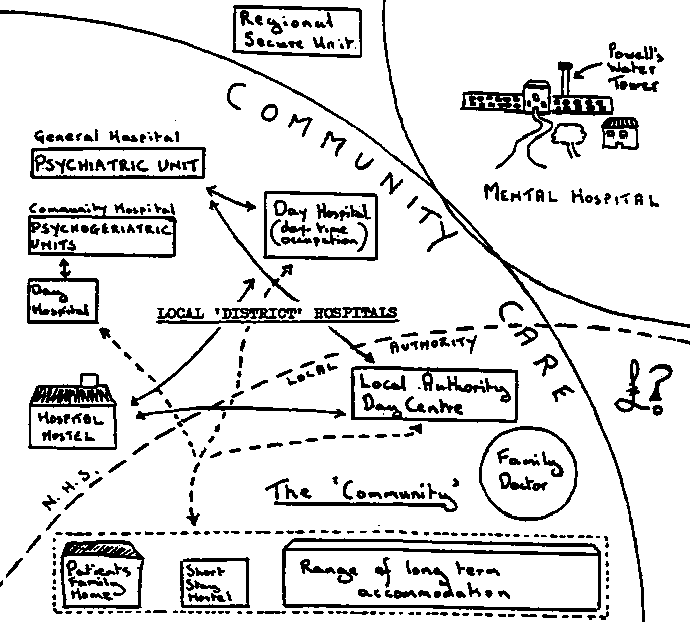
This diagram, that I drew just before the change took place,
shows the
facilities provided by the National Health Services and Local
Authorities
that should be part of the community care packet. Underneath I
drew a
Bargain Basement which contained the possibility of
alternative provision
by the voluntary sector. In the 1980s and 1990s, the bargain
basement grew
and developed a private sector department.
1976
"the public... cannot be expected to tolerate under the name
of community
care the discharge of chronic patients without...
after-care... who perhaps
spend their days wandering the streets or become an unbearable
burden on
the lives of their relatives... Such situations do not occur
very
frequently; but where they do, the whole concept of community
care is
placed at risk" (par.2.27)
This way to the previous scandals
THE BIRMINGHAM SCANDAL.
Dumped on the streets and in the slums -
5000 people who need help
The city of lost souls
"In a few years... you'll be able to see them dying in the
streets"
"We pick them off the streets or the hospital
rings us up and
says 'can you take a few?'"
"a cupboard filled with... prescribed tablets...
to keep them
quiet".
"looking blankly at each other... or at the television" [or
went] "to St
Agnes's hall to stuff toys - 'occupational therapy'"
"nine in the attic some of them less than four feet from the
ceiling" [and
fed on "two slices of bread and dripping and a third of a
sausage roll"
"with scabies and lice. They had dirty clothes and ten men had
no vests and
underpants"
"having just arrived with a travel warrant from hospitals as
far afield as
London and Scotland. The word seems to have got out that
Birmingham has
places that will take them."
This way to the next scandal
Parkinson's group drew on considerable expertise from
outside party
politics. It met regularly for three years and completed its
investigations
in
spring 1979,
just as the Conservative Party
moved from opposition into Government.
March 1976:
Priorities for Health and Personal Social Services
A Consultative Circular on Joint Planning and Finance was
issued at
the end of March.
Also mentioned during the week - "revelations about St
Augustine's" - Horizon (BBC2) on schizophrenia and its possible chemical
roots and the
five Oscars.

The Listener (first week of April?) contained an article by
Christopher Price
Christopher Price (Labour MP, Lewisham West) "It's more than a bit
frightening", reviewing Yorkshire TV's Tuesday (30.3.1976 or 6.4.1976?)
programme on psychosurgery directed by Chris Goddard "It's A Bit
Frightening".
1977
Heard about these treatments by a good friend of mine
He was always happy, smile on his face
He said he had a great time at the place
Peace and love is here to stay and now I can wake up and face the day
Happy-happy-happy all the time, shock treatment, I'm doing fine
Gimme-gimme shock treatment
Gimme-gimme shock treatment
Gimme-gimme shock treatment
I wanna-wanna shock treatment ...
1978
- "In Italy a new National Health Service (NHS),
providing free health care
to all Italian citizens, replaced the existing national insurance system.
The new NHS also incorporated the public psychiatric system, which had just
undergone a radical reform under Law 180. According to this law, all
psychiatric hospitals were closed to new admissions (and, after three
years, also to readmissions) and were replaced with community-based
services and psychiatric units based in general hospitals. The new system
was intended to provide care and support to all types of patients, without
back-up from public mental hospitals, where only existing long-stay in-
patients could remain"
(external source)
- "in 1978 we held a press conference, announcing the
closure of the mental hospital" [at Trieste] "This created a big sensation
in Italy for the situation had not been recognised until then"
(Franco Basaglia -
March 1980)
On Our Own.
Patient-Controlled Alternatives to the Mental
Health System by Judi Chamberlin gave Judi's "patient's view
of
the mental
health system", an account of her own treatment, and an
account of
communities run by their users. The book drew on the work of
colleagues in
Mental Patients' Liberation groups in North America, but also
used some
United Kingdom material.

1979
The
Borocourt Hospital
League of Friends donated an
outdoor play area for severely handicapped patients to use in
good weather.
It was a
wirenetting fence
surrounding a spacious area
with
a large cedar tree and toys for patients to play on.
"Mentally handicapped people" [they wrote] "have a right to
enjoy normal patterns of life within the community" [but] "too often... the
concept of 'as normal a life as possible' has tended to stop short of
those... with severe problems. It is still unfortunately assumed that if a
mentally handicapped person has additional physical handicaps or severe
behaviour disorder he must live in hospital." (paragraph 86)
Their
confusion followed by
clarity
- followed by
my confusion
It said that, although all governments since
1959
were committed to community care policy, there was little real
progress in
creating services in the community. Amongst hospital staff,
they found
considerable resistance to the policy and "a strongly held
belief that
successive governments had not meant what they said."
Cecil Parkinson suggested that the policy had been
discredited "because
it is not really being implemented". Patients left the
hospitals, but the
money and skills stayed in them, so patients went into the
community
without the support they needed.
"We are certain that there is a continuing need for most of the
mental illness hospitals, and we recommend that the health departments
should now state categorically that they no longer expect health
authorities to close them unless they are very isolated, in very bad repair
or are obviously redundant due to major shifts of population. It should be
made clear that they will be required throughout the remainder of this
century and for as long as it is possible to plan". (paragraph 10.60)
"firmly committed to the principles of community care" [but]
"we differ from previous governments ... in our overriding determination
to secure substantial retrenchment in public expenditure... this
retrenchment will have an adverse effect on progress towards the new
pattern of services... In some places it may be proved difficult to avoid
retreating a little"
[December 1979?] National Development Group for Mental
Handicap to be
axed as a "QUANGO".
1980
January 1980: The Nodder Report published: Working
Group on Organisational and Management Problems of Mental
Illness
Hospitals. Set up in March 1977. Held it last meeting in
February 1979.
The delay in publication was due to the change in government
and, for the
same reason, there was a "substantial gap... between the
agreed committee
draft and the report as published".
Although about half the 200 or so Health Districts
had a
District General Hospital Psychiatric Unit giving "a fairly
comprehensive
service" to at least part of the district (par.4), many of the
others
either had no local psychiatric service or a very selective
one.
31.3.1980 to 3.4.1980 European workshop, in Belgium, on
"Alternatives to Mental Hospitals" - Speakers included from Italy,
Franco Basaglia - Belgium: Daniel Coens - Sweden: Ebba Neander -
France: René Descartes - Holland: C. Trimbos - United Kingdom: David
Towell
"It is now clear that in 70 or so districts which have a well
sited mental illness hospital this will have to continue to provide all in-
patient care and be the focus for the service in its own district often for
many years to come. Only in this way can proper attention be paid to
districts at present served by a distant or otherwise unsuitable mental
hospital" (page 18)
"Jimmy took over the
conducting of the R.A.M.C. band to everyone's delight"
18.9.1980 "The opening of the Interim Medium Secure Unit at
Bethlem in 1980 was preceded by discussions with local residents
to allay fears.
Jimmy Savile OBE, television presenter, was invited to open the
unit, an event that, despite the bad weather, was regarded as 'a most
successful exercise in public relations'."
20.10.1980 to 21.10.1980
Mind's
Annual Conference
with the theme
"The Future of the Mental Hospitals" held at
Kensington and Chelsea Town Hall. (Mind Information Bulletin, October 1980,
p.1)
"The Royal Commission said that the hospitals should stay
unless they are obviously unsuitable; whereas the Government says that some
could stay for many years if they are still needed and if they fit in with
the desired pattern. This may seem a matter of semantics but it is more
than that. It is a recognition first of the primacy of the district
services, and secondly of the need, within that, to make the best use of
existing services"
By 1981, deaths and discharges from St Lawrences had
reduced the number
of patients to 1,300. It was one of seven English hospitals
with the least
money to spend on patients. (See
1870 and
1971 and
Silent Minority (below))
1981
The International Year for Disabled People which "includes
people who are physically handicapped, deaf, hard of hearing, blind,
partially sighted, speech impaired, mentally handicapped or mentally ill.
It also includes handicaps such as epilepsy and psoriasis; and disabilities
linked to ageing. It also includes children who are disabled."
(external link to Hansard debate)
This way to the previous scandals
10.6.1981: Silent Minority
This television documentary was shown in peak viewing
hours with a
warning that some of the scenes might prove disturbing. The
scenes were of
what happened out of view in two understaffed hospitals for
the mentally
handicapped,
St Lawrences
and
Borocourt.
The hospitals had cooperated with making it "in
the hope of conveying...the message that hospitals for the
mentally
handicapped are seriously understaffed and under-financed",
but one of the
messages of the documentary was that hospital asylums were the
wrong place
for mentally handicapped people to live.
Silent Minority concentrated its attention on the
most severely
disabled patients - those that Government policy still
believed would
always need "the special facilities of hospital care". It
contrasted the
understaffed wards at St Lawrences - where children were
clean, fed and
dressed, but bored and lonely - with
Beech Tree House.
It suggested that the intensive education of children in a
small unit
at Beech Tree House prevented them becoming disturbed,
frightened and
frightening adults like some who were in a
wire
compound
during daylight hours at Borocourt. Many of the Borocourt
patients were sedated with
Largactil
- but, even so, the hospital had seven
seclusion rooms. A man described by the hospital as "one of
its most
aggressive patients" was said on the television programme to
have spent
almost six months in almost continuous solitary confinement. A
member of
staff claimed that, as a result of solitary confinement, the
patient seemed
"on the edge of almost total madness".
July 16th 1981:
Care in the
Community
was the title of a Green
Paper that suggested ways of moving money and care from the
National Health
Service to local councils and voluntary associations.
It was a way of implementing the (hitherto
secret)
Parkinson Report, and seven days later the Conservative
Political Centre
published
The Right Approach to Mental
Health, an edited summary of
the
Parkinson
Report.
Care in the Community began by saying:
"Most people who need long-term care can and should be
looked after in
the community. That is what most of them want for themselves
and what those
responsible for their care believe to be best".
Care in the Community applied especially to mentally
handicapped, mentally ill and elderly patients (in that
order).
It suggested that 20,000 long-term patients (15,000 in
mental handicap
hospitals and 5,000 in mental illness hospitals) could be
discharged
"immediately" if funds could be switched from the Health
Service to local
authorities (paragraphs 3.1. and 3.2).
Opinions were sought on seven possible ways of moving
money and
patients. On July 28th 1982 the Government said it had decided
to adopt
three main proposals:
July 1981
World Federation for Mental Health congress held in Manila,
Philippines, with the theme "Mental Health, Cultural Values and Social
Development: A Look into the '80s".
Eugene Brody took office as President. "I
suggested the organisation of
an 'Atlantic basin' meeting to be held the
next year in England as a way of bringing consumers and self-help
organisations into our framework" (Brody 1998 p.368)
1982
Based at the
Department of Pharmacoepidemiology at the Norwegian Institute of Public
Health in Oslo. It is funded by the Norwegian government. It maintains what
it calls an Anatomical Therapeutic Chemical classification system
and defined daily doses for the drugs classified. [See
bibliography].

1982
The World Health
Organisation's
Collaborating Centre for Drug Statistics Methodology
established.
In simpler terms, this is described as an international language for drug
utilization research

1981
EAMH (Edinburgh Association for Mental Health) set up initially to take
over some flats then rented for ex-patients by the Royal Edinburgh
Hospital.
Began by working from a desk in the offices of the Barony Housing
Association, before moving in 1984 to 40 Shandwick Place
Edinburgh. See history.
"While sociologists and sociologically-minded historians
cast a baleful eye over the global history of mental treatment in the last
two centuries, others - consultants,
administrators or psychologists, present or past members of
psychiatric hospital staffs - prove willing to devote much toil
to the writing of detailed, often scholarly and always
affectionate accounts of the origins and development of their
own respective institutions..."
Alexander Walk,
1982
Although numbers in the old style hospitals had fallen
considerably, by
1982 the only mental illness hospitals to close were St
Ebbas, Epsom
(converted to a mental subnormality hospital in 1962) and
The Holloway Sanatorium, Virginia Water, Surrey
(closed December
1980). In November 1982, the only definite closure proposals
were a plan to
close
Banstead and concentrate services at
Horton in 1986; and proposals by North East Thames
Regional
Health Authority to close two of its six large mental
hospitals (not then
identified, but
Claybury
and
Friern were chosen). The only large mental
handicap
hospital planned to close was
Darenth Park. (Information mainly from D.
Glassborow, DHSS
Mental Health Division, 18.11.1982)
1962
St
Ebbas, Epsom (conversion to a mental subnormality hospital)
1980
The Holloway Sanatorium, Virginia Water, Surrey
(December 1980)
1985
Exminster, Devon 1985
The Lawn, Lincoln 1985
1986
Banstead October 1986
Coppice Hospital, Nottinghamshire 1986
1987
Saxondale, Nottinghamshire 1987
1988
Horton Road, Gloucester 1988
Naburn, York 1988
1989
Pastures, Derbyshire 1989?
1990
St John's, Lincolnshire 1990
Whitecroft, Isle of Wight 1990
1991
Mendip Hospital, Somerset 1991
1992
Long Grove - April 1992
Cane Hill 1992
St Augustine's, Kent 1992
Herrison, Dorset 1992
1993
Moorhaven, Devon 1993
Friern - 1993
Rubery Hill, Birmingham 1993
1994
Hellingly, Sussex (1994)
Glenside, Bristol (1994)
St Mary's, Burghill, Hereford (1994)
Brookwood (1994)
Netherne (1994)
Mapperley Hospital, Notttingham (1994)
Clifton, York 1994
Hollymoor, Birmingham
Closure index: See
1994 -
1995 -
1999 -
2002 -
2006 -
21.7.1982 to 23.7.1982 Cosponsored
Mind and
World Federation for Mental Health conference in London,
"Professionals and Volunteers: Partners or Rivals". Organised and chaired
by
Edith Morgan on the stimulus of
Eugene Brody's
suggestion, but "in keeping with her own concerns
of that time" (Brody 1998 pages 129 and 399)
1983 Representation of the People
Act
"A home, encouragement and a future"
1983 newspaper cartoon -
Preserved by my father.
Section 114 introduced the approved social worker (ASW),
specially trained
and qualified in mental health. An approved social worker
(rather than any
social worker) was qualified to make applications for formal
admission.
1984
-
5.3.1984 to 16.3.1984 "From Hospital to the Community: The
Italian Experience...A display of photographs, film-shows as well as
discussions at the King's Fund Centre...also in Sheffield and Manchester
at a later date...Italian mental health professionals who have been
involved in implementing the changeover to community care will lead the
discussion. Contact Ron Lacey or Teresa Morawiecka at MIND." (Openmind
February/March 1984)
- April 1984 four members of
Psichiatria
Democratica visited London, Sheffield and Manchester at the
invitation of Alec
Jenner and
Shula Ramon. Alec Jener may be the
psychiatrist who made a favourable report on the Italian experience to the
Social Services Committee. He visited Italy in August 1985.
"community organisations interested in mental handicap schemes
are 'on the move' in imaginative and radical ways whilst community groups
involved with mental illness schemes remain relatively stuck in the present
'tramlines'" (SSC
1985 volume 2, pages 243)
22.10.1984 to 23.10.1984 Mind Annual Conference (Kensington
Town Hall). Theme "Life after Mental Illness? Opportunities in an Age of
Unemployment" - [A4 flyer]
1985
Report of Social Services Committee on Community Care
14.7.1985
World Federation for Mental Health congress held in Brighton -
hosted by
Mind -
with the theme
Mental Health 2000 - Action Programmes for a World in
Crisis. The congress was divided into six themes - each
theme was planned with three workshops - each of these was to produce an
item for a charter to be presented (printed) to the final session on
19.7.1985. See
Charter Mental Health 2000
- August1985
Alec Jenner's
visit to Italy.
28.11.1985-29.11.1985
Mind's
Annual Conference
1985:
From Patients to People [A4 flyer]
"My knowledge stems mainly from being advised over the years
since the passage of the
Mental Health (Amendment) Act 1982 by the
National Schizophrenic Foundation."
1986
October 1986
Banstead Hospital closed
1987
Angela Martin, "female werewolf", explored
adolescent
moods in You worry me Tracey, You really Do. See
her website. In the beginning of the 21st
century Angela illustrated
user involvement in the health services.
27.6.1987 "Sir, I feel I should declare that I have been
diagnosed as a 'manic
depressive' with schizophrenic tendencies. While this description may
have helped the experts in prescribing me numerous 'drug cocktails'
over the years, it has not proved a notable success on the dance
floors of everyday life. One man's diagnostic tool is another three's
insult."
Peter Campbell. Letters to the Guardian
October 1987 Publication of Asylum to Anarchy by
Claire Baron.
The title does not fit he content, which is a sociological analysis of the
development of a "tyranny of the therapeutic" within
Paddington Day Hospital (not named). It is grounded in
participant observation from (roughly)
1975
to
1978 which was developed
into a PhD Thesis in
1984. The book is presented as a theoretical development and
critique of Goffman's
Asylums. It stimulated the research for Helen Spandler's
Asylum to Action
November? 1987
Mind's
Annual Conference
held in
Blackpool on the theme "In pursuit of excellence in community care" .
("Mind annual conferences were always in London and then they
started going round the country" (Email Thurstine Basset 11.6.2009) -
Harrogate? -
Bournemouth
1988 -
Scarborough
1989 -
Brighton 1990 -
Blackpool 1991
1988

1988
ECT Pros, Cons and Consequences: A
MIND Special Report. The Mind archive relates this back to
the Royal College of Psychiatrists guidance on use in
1977
Sometime 1988: Conference in
Trieste called "The Question of Psychiatry" sponsored by the
World Health Organisation.
February 1988 Conference on cordinating commnunity care organised
jointly by the Department of Social Security and the
National Unit for Psychiatric Research and Development. "Built
on the research funded by the department in Salford, Southampton and
Hackney to investigate the use of computers in case management systems".
Lord Henley Hansard 10.5.1989).
Reported as
Towards co-ordinated care for people with long-term, severe mental
illness by Paul Clifford; Tom Craig; and
Liz Sayce (London 1988, 28
pages)
National Unit for Psychiatric Research and Development
No conference with such a title now would be taken
seriously
with so few openly declared patients on the platform.
LouisePembroke "first met
Judi Chamberlin
in 1988 at the start of my own activism at the annual Mind
conference when her seminal text
On Our Own was published by Mind ... then at a landmark
conference in Brighton entitled
Common Concerns"
SHE THINKS YOU WANT TO KILL HER
1989
Banstead Hospital demolished
January 1989 Department of Health
Working for Patients
Sunday 10.9.1989 London Observer front page article on the
containment of people in the psychiatric hospital on the island of Leros in
Greece
1990
May 1990
ICD-10
was endorsed by the Forty-third
World Health Assembly in and came into use in
WHO Member States as from
1994. The 11th revision of the classification will continue
until
2015. See
mental disorders
1990
Wellcome Trust History of Twentieth Century Medicine Group
established to bring together clinicians, scientists, historians and others
interested in contemporary medical history. In 1993 Wellcome Witness
Seminars were introduced to promote interaction between these different
groups, and to encourage the creation and deposit of archival sources for
present and future use.
external link
October 1990 In 1990, the U.S. Congress established the first full
week of October as Mental Illness Awareness Week
(website)
1991

May 1991First Mental Health Services Conference held "back to back"
with the Royal Australian and New Zealand College of Psychiatrists
conference in Adelaide.
(history)

21.7.1991 "British Prime Minister John Major has launched a
citizen's charter to improve public services."
BBC
28.8.1991:
Death of Orville
Blackwood
26.9.1991:
Death of Valerie
Argent.
1992
Early October 1992 Peter Lilley's speech to the Conservative Party
Conference as Secretary of State at the Department of Social Security:

10.10.1992 First World Mental Health Day sponsored by the
World Federation for Mental Health
17.12.1992 Jonathan Zito murdered by
Christopher Clunis (left)
on Finsbury
Park station. It was an unprovoked murder of a complete
stranger.
Christopher Clunis was a mental patient. Jonathan's widow is
Jayne Zito.
The
Zito Trust
was established in
1994. The
2007 Mental Health Act removed its reason for being and
it closed
30.3.2009.
1993
The Independent Wednesday 13.1.1993
Letter: Physical causes of schizophrenia
From Marjorie Wallace, Chief Executive,
SANE, London, NW1
11 January
29.4.1993
David King of the
Mental Health Task Force
described his brief to users
"To deliver management objectives on flow of capital and
revenue for
strategic planning...To look at other options/providers/cost
structures in mental health apart from traditional health services
ones...To get the concept of consumer satisfaction into the mental
health arena which is difficult because of the underlying element of
compulsory treatment... To bring in a notion of quality for users ..To
inform what is going on -
bringing discussion of hospital closure into the public arena, so
people understand the issues (as) talk of hospital closures brings
strong reactions, and lobbying from MPs."
VISIT TO TRIESTE MENTAL HEALTH SERVICE
MAY 2ND - 9TH 1993
ORGANISED VISIT TO
TRIESTE TO SEE AT
FIRST HAND THE WORK OF THE MENTAL
HEALTH SERVICE
INCLUDES
FLIGHT * ACCOMODATION *
GUIDE/INTERPRETER
including mental health services,
cooperatives, plus oportunity to visit Venice
For further details write to TRIESTE '93, c/o
MACC, Swan Buildings, 20 Swan st. Manchester
M4 5JW Tel: 061 834 9823
"Last week saw the conviction of a schizophrenic released from
the hatch only to rape three women; there have been 40 murders by mental
patients in the two blood-drenched years since the grotesquely named Care
in the Community con came into being. Not only have the lunatics taken over
the asylum; thanks to this government they've now taken over the streets
too, making them one big open prison. Open for them, prison for us."
1994
Mental Health Task Force Calendar of Events
March 1994
Mental Health Task Force Calendar of Events
April 1994
Mental Health Task Force Calendar of Events
May 1994
Mental Health Task Force Calendar of Events
June 1994
Mental Health Task Force Calendar of Events
July 1994
Mental Health Task Force Calendar of Events
September 1994
Mental Health Task Force Calendar of Events
October 1994
Mental Health Task Force Calendar of Events
November 1994
Mental Health Task Force Calendar of Events
December 1994
See closure index
Lords Hansard 26.10.1995 : Column WA128
Mental Illness Hospitals: In-Patients
Lord Mottistone asked Her Majesty's Government:
How many patients were, or are, cared for (on closure or
now, if not
yet closed) in each of the hospitals named in Table 2 of the
Survey of
English Mental Illness Hospitals March 1994-Monitoring the
Closure of the
"Water Towers".
Baroness Cumberlege: The information available centrally is
given in the
table.
NHS Hospitals in Table 2 of the Survey of English Mental
Illness Hospitals
March 1994-Monitoring the Closure of the "Water Towers":
Numbers of In-patients at 31.3.1994
Hospital In-patients all ages
Barnsley Hall Hospital 57
[Worcestershire - 1903-1996]
Clifton Hospital
100
[Yorkshire 1847-1994]
Coney Hill Hospital
168
[Gloucestershire 1884-mid 1990s]
Hollymoor Hospital 185
[Birmingham 1905?-1995]
Mapperley Hospital 195
[Nottingham 1880-December 1994]
St. Francis Hospital (Nottingham) 38
[???]
St. George's Hospital (Stafford) 147
[1818-???]
St. Crispin Hospital 121
[Northampton 1876-???]
Scalebor Park Hospital 35
[Yorkshire 1902-1995]
Central Hospital 95
[Warwickshire
Claybury Hospital 361
[Essex 1893-1997]
Countess of Chester Hospital 179
[Cheshire 1829- continuing]
Hill End Hospital
153
[Hertfordshire 1899-1997]
Maidstone Hospital 115
[Kent
Netherne Hospital 57
[Surrey 1909-1994]
Princess Royal Hospital 154
[Sussex
Roundway Hospital 99
[Wiltshire
St. George's Hospital (Morpeth)
312
[Northumberland
St. Mary's Hospital (Northumberland) 247
[
St. Matthew's Hospital 157
[Staffordshire 1864-1995
Stanley Royd Hospital 277
[Yorkshire 1818-1995]
Tone Vale Hospital 117
[Somerset 1897-
Tooting Bec Hospital 96
[London 1903-1995]
Whittingham Hospital 153
[Preston, Lancashire 1873-2002 MSU
continuing]
St. Nicholas' Hospital (Newcastle) 214
[
Brookwood Hospital
311
[
Carlton Hayes Hospital 249
[
Littlemore Hospital 172
[Berkshire 1846-
Middlewood Hospital
116
[Yorkshire 1872-1999]
Napsbury Hospital
419
[Hertfordshire 1905-1999
Shenley
Hospital
424
[Hertfordshire 1934-
The Royal London Hospital (St Clements) 99
[London
Warlingham Park Hospital 143
[Croydon 1903-1999]
All Saints Hospital 261
[Birmingham 1850-2000]
Parkside Hospital 249
[Cheshire 1871-2002]
Knowle Hospital 184
[1852-1996 RSU continuing]
Fair Mile Hospital 212
[
De la Pole Hospital
246
[Hull ]
Fairfield Hospital
415
[
Fulbourn Hospital
301
[Cambridgeshire
Goodmayes Hospital
401
[Still open 2006]
High Royds Hospital
346
[Yorkshire
Horton Hospital
329
[London
Lancaster Moor & Ridge Lea Hospitals
314
[Lancashire
Park Prewett Hospital
245
[Hampshire
Runwell Hospital 320
[1936- Essex -
Still open 2006]
Severalls Hospital
218
[
St. Edward's Hospital
254
[Staffordshire
St. Lawrence's Hospital
206
[Cornwall
Warley Hospital
534
[Essex
Winterton Hospital
375
[Durham
Bexley Hospital
241
[Kent
Cherry Knowle Hospital
320
[Sunderland
Garlands Hospital
182
[Carlisle
Rauceby Hospital
173
[Lincolnshire
Towers Hospital
163
[Leicester
Winwick Hospital
398
[Lancashire
Graylingwell Hospital
249
[Sussex
St. Andrew's Hospital (Norwich)
168
[Norfolk
Springfield Hospital
429
[Still open 2006]
St. James' Hospital
204
[Portsmouth - Still open 2006]
St. Luke's Hospital 140
[Middlesbrough - Still open 2006]
St. Clement's Hospital (Ipswich) 190
[Still open 2006]
Stone House Hospital 98
[Kent 1866-
Still open 2006]
Wonford House Hospital 116
[Devon 1801-
Highcroft Hospital 132
[Birmingham
West Park Hospital 358
[Epsom 1903-2002/2005?]
Barrow Hospital 212
[Bristol
Bootham Park Hospital 107
[Yorkshire 1777 -
Ealing Hospital 327
[London 1831 - continuing
Hellesdon Hospital 258
[Norfolk -
Still open 2006]
Henderson Hospital 24
[Surrey
Kingsway Hospital 285
[Derbyshire 1888 -
Still open 2006]
Lynfield Mount Hospital
119
[Yorkshire 1910/1948 -
Maudsley Hospital 217
[1915/1923 -
Still open 2006
Old Manor Hospital 145
[Wiltshire 1813? -
Prestwich Hospital 337
[Lancashire 1851 - 1996]
Royal Shrewsbury Hospital (Shelton) 197
[Shropshire 1845- Still open 2006]
St. Martin's Hospital 120
[Kent - Still open 2006]
Sundridge Hospital 48
[Kent
The Bethlem Royal Hospital 180
[Kent
Still open 2006
Warneford Hospital 70
[Oxfordshire
Still open 2006
1995
24.1.1995 Tessa Jowell presented the
Community Care (Rights to Mental Health Services)
Bill to the House of Commons.
Lisa Haywood, vice-chair of Mind, on the left -
Judi Clements
National Director in
the centre - Tessa Jowell -
David Peryer, chair, on the right.
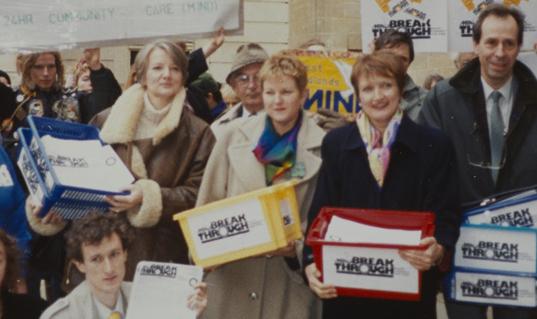
See closure index
20.2.1995 Government asked in the House of Lords, how
it judged the
strength of local and family opposition to the proposed
closure of the
following long-stay hospitals for mentally handicapped people:
Cell
Barnes
Hospital,
St Ebbas
Hospital, Turner Village Hospital,
Llanfrechfa Grange
Hospital, Northgate Hospital, Prudhoe Hospital,
Meanwood Park
Hospital,
Ida
Darwin Hospital, Calderstones Hospital,
Leybourne Grange
Hospital, Tilworth
Grange Hospital, Clarefield Hospital.
In its response to the Scottish Affairs Committee's Report on The
Closure of Psychiatric Hospitals in Scotland in 1995, The Scottish
Office committed itself to production of "A Statement of Aims and Points
which we would expect to be covered in local strategies". The
Framework for Mental Health Services in Scotland fulfilled that
commitment.
1996
1997
See
Lydia Yee
and
Valerie Amos
26.3.1997
Afiya Trust registerd
as a charity (Charity No: 1061596/0). Afiyah means Health: free from
illness and grief.
The Afiya Trust became independent of
the King's Fund in
April 1999
"Schizophrenia is the last great stigma. We have seen cancer,
AIDS, and Alzheimer's disease accepted and admitted by a number of
celebrities, and this has helped everyone else who suffers. We
psychiatrists know there are celebrities who have schizophrenia - we treat
them- but few feel able to "come out." That is why a story on a national
soap is so important." (Adrianne Reveley)
19.9.1997
A Framework for Mental Health Services in Scotland
Scottish
Executive (1997) Edinburgh: The Stationery Office.
1998
School holidays - Summer 1998 Being bored,
Andrew Tierney and
friends decided to explore the site of the disused mental hopital at
Cane Hill in Surrey, close to their homes. The site had been
closed since 1992 and nothing constructive was happening to it. In May 1999
they explored nearby
Netherne. This site was being re-developed. Later the same year
Andrew started
the_one.uk "the UKs only Urban Exploration website. Urban
exploration is exploring tunnels, buildings and other "urban" things. It's
popular in the US, Canada, and Australia". The first
Internet Archive of this was taken on
21.1.2000. The site evolved into
UrbeX UK - urban exploration in the UK in January 2002.
(Internet Archive)

7.10.1998 Launch of
Changing Minds campaign by the Royal College
of
Pyschiatrists
8.12.1998 Strategy Launched To Modernise Mental Health Services
(Press release) - Second of two press
releases alleging that care in the community has failed.
1999
The Testimonies Project
See
Peter Scott Blackman. His efforts and ability "were recognised
by Barry
Mussenden of the Department of Health and Lydia Yee, the then Chairperson
of the Afyia Trust"
Since May
1999 Afiya became the home
of several vital projects involving carers support, community involvement
and mental health. The objects of the charity are to advance education in
subjects concerned with the health of persons from minority ethnic groups
and institutions established to relieve sickness and to protect and
preserve the health of persons from minority ethnic groups in the United
Kingdom.
See closure index
A written answer originally given on 17.7.1997, but updated
16.11.1999 by
Secretary of State, Alan Milburn, identified hospitals listed
as having
recently been, or currently, the subject of consultation which
could lead
to the full closure. The psychiatric hospitals on this list
included:
Fulbourn
,
Goodmayes,
Horton,
Napsbury,
Runwell,
Shenley,
Warley,
Belmont,
St.
Andrew's,
St.
Mary's,
Winterton
Hospitals,
All
Saints,
Ida
Darwin,
Sundridge
Hospital,
Highcroft,
Monyhull,
St.
Edward's,
Stallington,
Bapu Trust was formally established in 1999, in memory of
Bapu and from her legacy.
archive of origin -
Its project office Center for Advocacy in Mental Health (CAMH) was started
in August 2000. (archive). The first issue of
Aaina, its newsletter, was in January 2001.
(archive). Its first editor was
Jayasree Kalathil.
2000
Louis
Appleby
appointed as National Director for Mental Health in England in April
2000. He chairs the Mental Health Taskforce set up to implement the NHS
Plan.
May 2000 Mental
Health Foundation says this was its first Mental Health Awareness
Week. Its
web archives suggest that it was actually a theme developed for
the established Mental Health Awareness Week.
2001
Archive link
to read your own copy (different formats etc)
a current link (main document)
Image
and
reality
22.5.2001
Fifty-fourth
World Health
Assembly endorsed the
International Classification of Functioning, Disability and
Health, (ICF).
6.8.2001
"25 die in T.N. asylum fire"
The Hindu 7.8.2001 -
Wikipedia says "28 inmates of a faith-based mental asylum died in fire. All
these inmates were bound by chains at Moideen Badusha Mental Home in
Erwadi Village in
Tamil Nadu."
The chains were part of the
faith healing process.
- See
Jayasree Kalathil 11.2007

October 2001
The World Health Report 2001: Mental Health: New Understanding, New
Hope
October 2001 Launch of "Well?" The Scottish
Executive's National
Programme for Improving the Mental Health and Well-Being of
Scotland's
Population. See
Well? on the web -
2006 archive
27.11.2001 Jack McConnell replaced Henry McLeish as First Minister
of Scotland in the Labour/Liberal coalition government. He made a large
number of number of changes to the Scottish Ministers, including replacing
Susan Deacon as Minister for Health and Community Care with her Deputy,
Malcolm Chisholm.
2002

"We have reached a point in the relationship between the Black
communities and mental health services where there are truly Circles of
Fear. Black people mistrust and often fear services, and staff are often
wary of the Black community, fearing criticism and not knowing how to
respond, and fearful of young Black men. The cycle is fuelled by
prejudice, misunderstanding, misconceptions and sometimes racism."
December 2005 archive staff list
Geraldine Bedell, The
Observer
Sunday 7.4.2002:
"Today,
fewer than 20 of the
original 120
Victorian asylums
remain"
See closure index
Liam Fox on Conservative reforms since Lord
Ashley
David Hinchliffe: Community Care has
not
failed
25.6.2002
Draft Mental Healh Bill (England) published.
Link to
archive of Parliamentary reports 24.7.2002 to 14.10.2003
Mind archive from 22.6.2003
Victoria Helen
Smith's
website was
online from
October 2002 to March 2004


27.11.2002 Ceremonial blowing up of the water tower of
Bexley
Hospital.
The plunger on the explosives was pressed by Linda Noyes, who
trained as a nurse at Bexley Hospital. Click on the picture
for partial archive of news
release.
Click here for a poem that Debbie
Mayes wrote
(22.12.1998) about being a patient in Bexley.

Adult Mental Health Services: A
National
Service Framework for Wales Welsh Assembly Government (2002) Cardiff:
The Stationery Office.
2003
Fourteen collaborative art projects took place in hospitals across
Edinburgh and the Lothians between 2003 and 2005. A creative and
colourful
report on all of them was published in 2005 as Extraordinary Everyday
-
Explorations in Collaborative Art in Healthcare
Long live the Campaign for Health
Concerns! (Archive of rather short lived links site)
January 2003:
Patient and Public Involvement
Forums
archive set up.
These include ones for mental health, such as the one for
East London and City Mental
Health -
archive
January 2003
Making Things Happen Better, the
first annual
report of the Learning Disability Task Force.
archive copy -
task force
-
Guardian Review online
21.2.2003 to 26.2.2003
World Federation for Mental Health congress held in
Melbourne, Australia, with the theme "Partnerships in Health"
(external
link to website
current website
Spring 2003: First publication of
The Naked Bird Watcher by
Suzy
Johnston. The second and updated edition (ISBN
0954809203) was published in August 2004 by The Cairn.
"The sanity birds glided seamlessly through my dream... Then
one bird fell.
Screaming it dropped from the clouds... Then another. And
another, until
the screaming was unbearable and even the clouds hurried to
leave."

International leadership exchange First Network Meeting in
Birmingham, UK in May 2003. The result of a plan developed by Mental
Health Corporations of America, Inc. (MHCA) to link their leaders with
colleagues in England. The aim was to share experiences in service
development and innovation in order to improve the quality of services for
consumers. Network Meetings followed in 2004 in Washington DC (USA)
-
2005 Wellington, New Zealand - 2006 Edinburgh (Scotland) -
2007 Ottawa - 2009 Brisbane (Australia) -
2010 Killarney (Ireland) - 2011 San Francisco (USA) -
2013 Auckland (Australia) - 2014 Manchester (England) -
(website)
[See 9.6.2014]
On Sunday 4.5.2003 Gordon Tozer took a break from his work on
the world of
asylums to photograph what is left of
Coney Hill Mental Hospital in
Gloucestershire
Gloucestershire Primary
Mental Health is part of the structure of community
care that
has replaced the asylum.
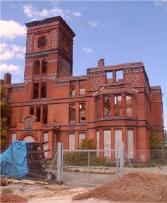
23.9.2003 Sun headline
BONKERS BRUNO LOCKED UP
under a section of the
Mental Health Act, to
Goodmayes
psychiatric hospital"
(external source)

"Instead of my understanding being addressed and enlightened,
and my path
being made as clear and plain as possible, in consideration of
my
confusion, I was ... placed amongst strangers, without
introduction, explanation or exhortation..."
John Perceval (1840)
A Narrative of the Treatment Experienced by a Gentleman,
During a State of Mental Derangement

Promoting Mental Health: Strategy and Action Plan 2003-2008
Department of Health Social Services and Public Safety (DHSSPS) (2003)
Belfast: The Stationery Office.
2004
Friday 13.8.2004:
Andrew Roberts
finished his
thirty-one year thesis on the Victorian Lunacy
Commission
Late 2004 Scottish Recovery Network formally launched as an
initiative within The National Programme for Improving Mental Health and
Wellbeing -
website - See
April May 2005 - See
recovery movement
2005
January 2005 When Jean Johnson's daughter, Suzy, had a
mental
breakdown at
university
she insisted on carrying on and succeeded in graduating. Then
came another
breakdown, even more devastating, and Jean had the fight of
her life to
understand what was happening to the daughter she loved. In
To Walk on
Eggshells, Jean shares what she discovered.
Suzy has already told her story.
19.7.2005:
Together - the relaunch of
MACA
On 1.9.2005 it was the
Manic Depressive Fellowship. On
3.9.2005 it was MDF The
Bipolar Organisation.
(Internet archive)

2006
"Our society is based on the belief
that everyone has a contribution to
make and has the right to control their
own lives. This value drives our society
and will also drive the way in which we
provide social care. This is a vision for all adults.
It includes older people and younger
adults who need care and support,
people who are frail, people with a
disability or mental health problems..."

16.1.2006 Aparna Sen's film 15 Park Avenue released in India
April 2006
National Institute for Health Research (NIHR) set up
to coordinates and fund research for the National Health Service (England).
History website. Followed on from
Best research
for best health: a new national health research strategy
published
25.1.2006.

Pilot "Collaborations for Leadership in Applied Health
Research and Care" projects (CLAHRCs) were set up in
2008 and became England wide in
2014.
Thursday 29.6.2006: Irish Mental Health Coalition (IMHC) launched
its
manifesto in Buswell's Hotel, Dublin. The coalition aims to campaign for
the improvement and prioritisation of mental health services in Ireland.
The organisers of the campaign are Amnesty International, Bodywhys - The
Eating Disorders Association of Ireland,
GROW in Ireland, The
Irish Advocacy Network and
Schizophrenia Ireland. "For the first
time, Irish organisations are formally uniting with the aim of harnessing
the support of all stakeholders to campaign for improvement in mental
health services".
4.10.2006 Official launch of the
Centre of Excellence in Interdisciplinary Mental Health at
Birmingham University.
launch video -
A to Z of resources - See
Suresearch - Glynn Rooms -
Two decades of change conference 2.11.2006
-
International
seminar -
2010 seminars.
current weblink 2017

See closure index
8.11.2006 Email from Peter Cracknell of
http://www.countyasylums.com listing the county and borough
asylums and public and subscription hospitals stiil open as psychiatric
hospitals:
Hellesdon Hospital, Norwich
Kingsway Hospital, Derbyshire
Runwell Hospital, Essex
St Clement's Hospital, Ipswich
St James' Hospital, Portsmouth
St Luke's Hospital, Middlesbrough
St Martin's Hospital, Canterbury
Royal Shrewsbury Hospital (Shelton)
Springfield Hospital, London
Stone House Hospital
Glanrhyd hospital, Glamorgan
St Cadoc's hospital, Newport
Whitchurch hospital, Cardiff
Maudsley Hospital
The Retreat, York [Not NHS]
Bootham Park Hospital, York
Wonford House Hospital, Exeter
Warneford Hospital
St Andrew's Hospital Northampton [Not NHS]
St Bernard's Hospital, London
 These seminars emerged from
discussions between members
of the British Sociological
Association Mental Health
Study Group. See
BSA Med Soc Sociology of Mental Health Study Group 2006/2007
These seminars emerged from
discussions between members
of the British Sociological
Association Mental Health
Study Group. See
BSA Med Soc Sociology of Mental Health Study Group 2006/2007
2.
Sue Estroff
from the University of North Carolina. -
"How to be a failure as a mental health researcher: strategies for success
and failure"

13.12.2006 General Assembly of the United Nations adopted
the
Convention on the Rights of Persons with Disabilities. This came
into effect on 3.5.2008, when sufficient countries had ratified it.
The Convention relates back to the
Charter of the United Nations and the
Universal Declaration of Human Rights (1948) and subsequent
conventions.
-
Wikipedia article
2007
2008
30.1.2008 to 1.2.2008 World Health Organisation meeting held in Geneva,
Switzerland which reported as
Maternal Mental Health and Child Health and Development in Low and
Middle Income Countries
"The impact of maternal mental health problems on infants in
high income countries has been identified mostly in terms of psychosocial
and emotional development, thanks to the groundbreaking early work of Spitz
and of
Bowlby, who studied the emotional needs of
infants and mother-child attachment."
July 2008 The British Journal of Psychiatry announced
"Psychiatry's 200th Birthday" - an event that might otherwise have gone
unnoticed. External link to
issue contents -
Link to 1808.

The
link and staff exchange programme between East London and
Uganda was extended in September 2008 when service users
from both countries
met in Uganda.
October 2008 (onwards?)
Nine
CLAHRC pilots established by the
NIHR. The basic partnership was between NHS
Trusts and Universities, but others were added.
CLAHRC North west London
was launched in February 2019.

2009
Sometime in 2009
Henk van Setten began his blog
stay on top - coping
with depression. In 2014 he bagan a second blog that is about
the
History of Mental Health.

State of Mind broadcasting over 5 weeks from 7.1.2009, at
9pm on
Radio 4 each Wednesday. -
-
BBC website -
Sound clips include
Moyna Peters (patient) about
Netherne Hospital, Surrey. -
Patricia Hornsby Smith
election
broadcast -
Peter Barham -
Henry Rollin (Horton 1950) -
Carole Thompson nurse about
Rainhill in 1957
Time to Change was formerly named
Moving People. See
Stigma shout survey -
Nikki
Llewellyn joined Time for Change in 2011. THACMHO event
19.12.2013
13.2.2019 The
NIHR CLAHRC for Northwest London launched its community
engagement programme at the Wellcome Trust in Euston. The health research
programme, which will run over five years, is hosted at Chelsea and
Westminster Hospital and academically led by Imperial College London.

(source)
"There was little evidence of
involvees coming from 'hard to reach' groups, although in two cases,
interviewees' first language was not English"
(Renedo and Marston 6.2015 p.493)
It was not an average patient or member of the public who took part: Twenty
two people were interviewed: "almost all were white, educated, and had
professional backgrounds". Thirteen were retired and the mean age was 65
years. This was also the typical age. Codes of conduct included "wearing a
suit" (p.495)
23.7.2009 Publication of New Horizons: towards a shared vision
for mental health - consultation -
external -
offline
Picture: Front page of London Lite - "Unbelievable he was ever
thought safe" (Sub-editors precis - page 5 - of comment by
Marjorie Wallace of Sane).

Thursday 3.9.2009 "Schizophrenic 'cooked victim's brain'" London
Informer - "NHS failure over cannibal killer Peter Bryan"
Mirror. Report on Peter Bryan's discharge from a secure
unit in Newham in February 2004 and murder of his friend Brian Cherry.
Making Recovery Real Roadshows in Thurso on 1.12.2009 -
Oban on 24.2.2010 - Stranraer on 24.3.2010 - See
brochure -
offline
2010
11.2.2010 Dorothy Rowe:
The Death of a Great Little Magazine

13.1.2010 Mind
announces that the March/April issue of
Openmind will be the last.
Street Art, Curtain Road, Tower Hamlets. Art used to advertise
Mad Pride Demo Tuesday 26.10.2010
Global mental health inside stories began on
27.6.2013
26.11.2010
"Time for a wedding! 10 good reasons for a
marriage between Global Mental
Health and the New Technologies". Roos Korste (Clinical
psychologist - University of Amsterdam) launched her
in2mentalhealth website for information from and between Mental
Health Workers, NGO's, Institutes, Service Users and others who are
interested in improving Mental Health in Low and Middle Income Countries.
archive
2011

Wendy Maycraft Kall's
The Governance Gap: Central-local steering
and mental health reform in Britain and Sweden (Uppsala
University PhD Thesis) compares the implementation of community care in
Sweden and England and Wales. The Governance Gap relates to the relation
between central and local government and Wendy Maycraft Kall examines why
Swedish central
government used soft steering strategies to get its way
whilst the UK government used hard ones.
2012
1.1.2012 Disability Rights UK was formed through a unification of
Disability Alliance, Radar and National Centre for Independent Living.
Saturday 19.5.2012
First unofficial histories conference.

Irene was diagnosed as a breast cancer patient in April 2014, aged 50. She
began
blogging about it.
2013
2.3.2013 Sun says war on shirkers
"Transforming Communities for Inclusion of People with Psychosocial
Disabilities: A Trans-Asia initiative" workshop with
participants from Nepal, Bangladesh, China, India and the Philippines.
30.4.2013
to
4.5.2013
Puna,
India
British Psychological Society's
Division of Clinical Psychology
Position Statement on
the Classification of Behaviour and Experience in Relation to
Functional
Psychiatric Diagnoses - Time for a
Paradigm Shift

6.8.2013 First posting on
Mad Studies -
Voor high-knowledge crazies in Nederland. Author:
Stichting Perceval
(Foundation Perceval). - 14.9.2013 - 22.2.2013 Four people visited consumer
groups in New York
before starting a discussion group in Holland. This "Empowerment Learning
Experience" trip was organised by "social-psychiatric nurse Rokus Loopik as
'crash course in rehabilitation for
people with psychiatric labels'", for the benefit of members of the
MoleMann Tielens; Centre for Psychosis and related disorders in
Amsterdam. Stichting
Perceval (named afer
John Thomas
Perceval) was founded on 19.3.2014 and produced an
Annual Report on 26.6.2014.
-
archive of page with posting -
4.12.2013 The Court of Appeal upheld a decision by the Upper
Tribunal that the Work Capability Assessment discriminates against people
with mental health problems. A victory for the
Mental Health Resistance
Network.

See
Survivors Timeline for the countdown to the
Campbell and Roberts
book
January 2014 CLAHRCs (Collaboration for Leadership in Applied
Health Research and Care) ticking louder. Thirteen CLAHRCs around England,
funded to 2018 were established by the
National Institute for Health Research
in place of the nine
CLAHRC pilots established
in October 2008.
See
CLAHRC Partnership Programme -
CLAHRC South London -
South London annual report
Buy your copy
Barbara Taylor's journey through
mental illness and the
psychiatric health
care system. A
survivor
historian's account of her battle with
mental illness, set inside the wider story of the end of the UK
asylum system.

19.3.2014 UK budget cap

1.4.2014 to 2.4.2014
Wednesday 9.4.2014 - 11am "PROTEST - Justice for Victims of
Psychiatric Assault" - Outside the Royal Courts of Justice. - The Strand -
WC2A 2LL. - Nearest tube Temple - Wear wigs and gowns if available! Slogans
requested!
Tuesday 7.10.2014
"Mad studies brings a voice of sanity to psychiatry" by Peter
Beresford in The Guardian
March 2014
Mad People's History and Identity in Edinburgh inspired by
A History of Madness in Canada. The link between survivors in
Toronto and Edinburgh goes back, at least, to
2001 and
the link on mad history to
October 2007

27.11.2014
Anne Cooke
(Editor) Understanding Psychosis and Schizophrenia. Why people
sometimes hear voices, believe things that others find strange, or appear
out of touch with reality and what can help British Psychological
Society. Division of Clinical Psychology.
2015
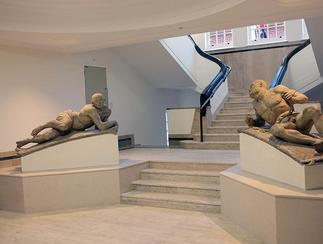
Wednesday 18.2.2015
Bethlem's new
Museum of the
Mind opened.
"Killer
pilot"
"Don't
stigmatise
depression"
Co-pilot Andreas Lubitz is alleged to have deliberately guided a German
plane into the Alps on Tuesday 24.3.2015, killing all 150 on board,
It was reported that he suffered from depression. On Sunday
29.3.2015
The Observer headlined a warning from Simon Wessely,
president of the UK Royal College of Psychiatrists that " depression should
not lead to a lifetime ban for commercial airline pilots".

May 2015
Mental health awareness week included
"Zen and the art of knowing your rights" by Pete Fleischmann,
Head of Co-Production at
Social Care Institute for
Excellence (SCIE)
Ken Payne (61), speaking on behalf of dementia awareness week
explained
that he had always wanted to become a singer and perform on X-Factor.
2.6.2015-3.6.2015 Rights for
Life: Supporting Recovery and Ending
Discrimination national conference on human rights and recovery
organised simultaneously online and in Glasgow by The Scottish Recovery
Network, See Me, and Voices Of eXperience -
Programme.

Graham Morgan
was a keynote
speaker at the Rights for Life event. The event led to the
Rights for Life Declaration in February 2016.

3.6.2015
Patsy Staddon's
Women and alcohol: Social perspectives
published as a paperback.
Emma Hancox spoke on Cataloguing the Mind Archive - Rhodri
Hayward on General practice and mental health - John Stewart on
Child Guidance and the Mind Archive from the 1940s to 1970s - Teri
Chettiar on Inherently Unstable: On the Emotional Dangers of Adolescence
and the Natural Limits of Private Life - John Hall on Personal experience
of Mind and forming mental health policy - Sophie Corlett on
Mind's contemporary work - Jonathon Toms on The Problem of Authority and
its Significance for the Mind Archive - and
Barbara Taylor on the personal
archive that helped her write The Last Asylum and on the future of
survivor archives. This led to a discussion of the importance of
collecting and recording survivors' testimonies in archives.
At the Wellcome
Library, London. By invitation only

Friday 10.7.2015 to Sunday 12.7.2015
New Forest Spectrum.
22.2.2016 Rights for Life Declaration launched -
(website) - Following the
June 2015 event.

Following
the referendum vote to leave the European Community, Peter
Beresford is concerned that what the
people say they want may destroy
 Study
Link
Study
Link
 Andrew Roberts' web Study Guide
Top
of
Page
Andrew Roberts' web Study Guide
Top
of
Page
 Take a Break - Read a Poem
 Click coloured words to go where
you
want
Click coloured words to go where
you
want
To contact
him, please
use the Communication
Form




1636 Hobbes on motion and matter
1690 Locke on reason and madness
1755 Rousseau back to primitive
1774 madhouse medical inspection
1788-1789: Royal madness treated and cured
1812: Prime Minister shot dead
1812: Philadelphia tranquilliser
1823: Lectures on mental
diseases
Gloucester asylum
1828 Home Office controls inspectors
1832 Lord Chancellor controls inspectors
1840s Social unrest and asylum hope
1843: Daniel McNaughton fails to kill Peel
1845 Ashley's Acts and the Lunacy Commission
1863 Broadmoor Criminal Lunatic Asylum
1867 Metropolitan Asylums Board
1870 St Lawrence's and Leavesden
1910 Rampton State Institution
1913 Mental Deficiency Act and The Board of Control
Between world wars: Psychoanalytic glimmers
1930s Moss Side State Institution
1933 Borocourt Certified Institution for Mental Defectives
1946 National Health Service Act
1948 National Health Service inherits asylums
1949 Scotland pioneers open doors
1954 Percy Inquiry into Mental Health Law
1957 Percy Report favours community care
1971 Better Services for the Mentally Handicapped
1973 mental patient's union (MPU)
1974 Park Lane Special Hospital
1979 Thatcher's (secret) Parkinson Report
1986 Disabled Persons Services Act
1990 National Health and Community Care Act
2003 Making Things Happen Better
| Have you tried the ABC Study Guide? |

|
| or ABC Study Links? |
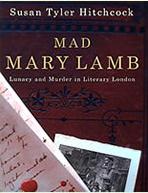
Mad Mary Lamb: Lunacy and Murder in Literary London by Susan Tyler Hitchcock |
|---|
|
... a positive account of living with mental illness now |
|---|
Asylum to Action -
 Paddington Day Hospital
, Therapeutic Communities and Beyond
by Helen Spandler
Paddington Day Hospital
, Therapeutic Communities and Beyond
by Helen Spandler
|
|---|
Listen to Me
|
|---|

|
|---|

|
|---|